Is War with Iran Now Inevitable?
By Pat Buchanan • Unz Review • October 17, 2017
With his declaration Friday that the Iran nuclear deal is not in the national interest, President Donald Trump may have put us on the road to war with Iran.
Indeed, it is easier to see the collisions that are coming than to see how we get off this road before the shooting starts.
After “de-certifying” the nuclear agreement, signed by all five permanent members of the Security Council, Trump gave Congress 60 days to reimpose the sanctions that it lifted when Teheran signed.
If Congress does not reimpose those sanctions and kill the deal, Trump threatens to kill it himself.
Why? Did Iran violate the terms of the agreement? Almost no one argues that — not the UN nuclear inspectors, not our NATO allies, not even Trump’s national security team.
Iran shipped all its 20 percent enriched uranium out of the country, shut down most of its centrifuges, and allowed intrusive inspections of all nuclear facilities. Even before the deal, 17 U.S. intelligence agencies said they could find no evidence of an Iranian nuclear bomb program.
Indeed, if Iran wanted a bomb, Iran would have had a bomb.
She remains a non-nuclear-weapons state for a simple reason: Iran’s vital national interests dictate that she remain so.
As the largest Shiite nation with 80 million people, among the most advanced in the Mideast, Iran is predestined to become the preeminent power in the Persian Gulf. But on one condition: She avoid the great war with the United States that Saddam Hussein failed to avoid.
Iran shut down any bomb program it had because it does not want to share Iraq’s fate of being smashed and broken apart into Persians, Azeris, Arabs, Kurds and Baluch, as Iraq was broken apart by the Americans into Sunni, Shiite, Turkmen, Yazidis and Kurds.
Tehran does not want war with us. It is the War Party in Washington and its Middle East allies — Bibi Netanyahu and the Saudi royals — who hunger to have the United States come over and smash Iran.
Thus, the Congressional battle to kill, or not to kill, the Iran nuclear deal shapes up as decisive in the Trump presidency.
Yet, even earlier collisions with Iran may be at hand.
In Syria’s east, U.S.-backed and Kurd-led Syrian Democratic Forces are about to take Raqqa. But as we are annihilating ISIS in its capital, the Syrian army is driving to capture Deir Ezzor, capital of the province that sits astride the road from Baghdad to Damascus.
Its capture by Bashar Assad’s army would ensure that the road from Baghdad to Damascus to Hezbollah in Lebanon remains open.
If the U.S. intends to use the SDF to seize the border area, we could find ourselves in a battle with the Syrian army, Shiite militia, the Iranians, and perhaps even the Russians.
Are we up for that?
In Iraq, the national army is moving on oil-rich Kirkuk province and its capital city. The Kurds captured Kirkuk after the Iraqi army fled from the ISIS invasion. Why is a U.S.-trained Iraqi army moving against a U.S.-trained Kurdish army?
The Kurdistan Regional Government voted last month to secede. This raised alarms in Turkey and Iran, as well as Baghdad. An independent Kurdistan could serve as a magnet to Kurds in both those countries.
Baghdad’s army is moving on Kirkuk to prevent its amputation from Iraq in any civil war of secession by the Kurds.
Where does Iran stand in all of this?
In the war against ISIS, they were de facto allies. For ISIS, like al-Qaida, is Sunni and hates Shiites as much as it hates Christians. But if the U.S. intends to use the SDF to capture the Iraqi-Syrian border, Syria, Iran, Hezbollah and Russia could all be aligned against us.
Are we ready for such a clash?
We Americans are coming face to face with some new realities.
The people who are going to decide the future of the Middle East are the people who live there. And among these people, the future will be determined by those most willing to fight, bleed and die for years and in considerable numbers to realize that future.
We Americans, however, are not going to send another army to occupy another country, as we did Kuwait in 1991, Afghanistan in 2001, and Iraq in 2003.
Bashar Assad, his army and air force backed by Vladimir Putin’s air power, the Islamic Revolutionary Guard Corps of Iran, and Hezbollah won the Syrian civil war because they were more willing to fight and die to win it. And, truth be told, all had far larger stakes there than did we.
We do not live there. Few Americans are aware of what is going on there. Even fewer care.
Our erstwhile allies in the Middle East naturally want us to fight their 21st-century wars, as the Brits got us to help fight their 20th-century wars.
But Donald Trump was not elected to do that. Or so at least some of us thought.
Coyright 2017 Creators.com.
Trump holds back from destroying Iran deal
By M K Bhadrakumar | Indian Punchline | October 14, 2017
The US President Donald Trump’s statement on Friday regarding Iran turned out to be high on rhetoric but lacking in substance. Simply put, Iran can learn to live with it, as things stand. Prima facie, Trump ‘decertified’ the Iran nuclear deal – that is to say, he refused to certify that Iran is fulfilling its commitments under the agreement. On the other hand, it is an action that falls exclusively within the domain of the relevant US law, and has per se nothing to do with the implementation of the Iran deal.
The point is, Trump has not torn up the agreement. He has instead tossed the ball into the court of the US Congress, leaving it to the lawmakers to impose sanctions against Iran (which would effectively undermine the nuclear deal.) But then, the likelihood of the Congress imposing sanctions (or assuming the political responsibility to destroy the Iran deal) is also very low. Trump probably knows it, too. And, without a re-imposition of sanctions, the nuclear deal is not in any jeopardy.
So, what has been Trump’s game plan? First, his tirade against Iran – even recalling the hostage crisis in 1980 – shores up the traditional concerns of the Republican Party regarding Iran’s role in the Middle East and appeases the Israeli lobby. Second, Trump has taken one more step to fulfill his pledge to undo the legacy of his predecessor (after having scuttled the Trans-Pacific Partnership Agreement and the Paris accord on climate change.) Third, Trump probably calculated that his brinkmanship – stepping up to the line but not killing the nuclear agreement – would enable him to rally the US’ European allies to a joint platform to pressure Iran to rein in its missile program and to moderate its regional policies.
The firm stance taken by the European Union – and UK, France and Germany, in particular – in support of the Iran nuclear deal has proved to be the clincher. The US faces isolation in the international community if it abandons the nuclear deal. An extraordinary joint declaration by the heads of governments of UK, France and Germany underscored that preserving the nuclear deal “is in our shared national security interest.” Having said that, the statement offered cooperation to the US in engaging Iran in constructive dialogue to work toward “negotiated solutions” to the concerns raised by Iran’s ballistic missile program and its regional activities. In sum, US’ European allies have suggested a twin-track approach – on the one hand preserve the nuclear deal while on the other hand independently address “our collective wider concerns” regarding Iran’s foreign and security policies.
The Iranian Foreign Ministry has reacted to Trump’s statement, meeting rhetoric with rhetoric. Evidently, Tehran understands that Trump has left the nuclear deal untouched and the chances are that the agreement may remain in place for the foreseeable future. Tehran will be open to the idea of a “constructive dialogue” with the Western powers on issues of mutual concern. Interestingly, the Iranian statement has reiterated that “Iran will not be the first to withdraw from the deal, but if its rights and interests in the deal are not respected, it will stop implementing all its commitments and will resume its peaceful nuclear program without any restrictions.” The text of the Iranian statement is here.
Russia ready to mediate talks between Saudi Arabia & Iran – deputy FM
RT | October 11, 2017
Russia is ready and willing to mediate in establishing relations between Saudi Arabia and Iran, Russian Deputy Foreign Minister Mikhail Bogdanov has stated.
“We tried several times and offered [to help Iran and Saudi Arabia sit down at the negotiating table], but we do not impose our intermediary role,” Bogdanov told reporters.
“But we have always told our partners in both Saudi Arabia and Iran that we are ready to provide both a platform for contacts and friendly services.”
Bogdanov added that Moscow has always highlighted the need to resolve the issues between the two countries.
“Many problems would have been much easier to resolve had there been mutual understanding and trust between Tehran and Riyadh,” Bogdanov said.
He added that the situation in the entire region, especially regarding antiterrorism efforts, depends on mutual understanding and cooperation between Iran and Saudi Arabia.
Bogdanov stressed that Russia always tells Saudi Arabia and Iran that it is ready to report something from one side to another or to organize their bilateral contacts. “These proposals remain on the table both with our Saudi and Iranian partners,” he said.
In May, an Iranian Foreign Ministry spokesman accused Saudi Arabia of supporting terrorism and seeking confrontational policies in the region. He was responding to comments by the Saudi deputy crown prince, who earlier ruled out dialogue with Tehran. Saudi Deputy Crown Prince Mohammed bin Salman al-Saud, the kingdom’s defense minister, said it was impossible to mend relations between his country and Iran due to Tehran’s “extremist ideology” and ambitions to “control the Islamic world.”
Diplomatic ties between the two countries were severed in 2016 after Iranian protesters attacked the Saudi embassy in Tehran, following the execution of prominent Shiite cleric Sheikh Nimr al-Nimr in Riyadh. Saudi Arabia’s foreign minister responded by accusing Iran of setting up “terrorist cells” inside the kingdom. Iran then issued a warning that “divine vengeance” would come to Saudi Arabia as a punishment for Nimr’s execution as well as for Riyadh’s bombings in Yemen and support for the Bahraini government.
In February of this year, Iranian President Hassan Rouhani, while on a visit to Saudi ally Kuwait, said that Tehran would like to restore relations and improve ties with all its Gulf Arab neighbors.
One area where Moscow and Riyadh disagree is Iran’s involvement in Syria.
Riyadh, a main backer of the Syrian opposition, is against the actions of Iran’s Islamic Revolutionary Guard Corps (IRGC) and the Hezbollah group in Syria. According to Saudi Foreign Minister Adel Jubeir, these groups influence the situations in Iraq, Syria, Lebanon, the Gulf countries, and Yemen, and have no place in Syria or any other part of the world. Riyadh’s primary objective has been to put an end to Iran’s involvement in the region.
Meanwhile, Russia has argued that Iran and Hezbollah are operating in Syria at the official request of President Bashar Assad.
“We don’t see Hezbollah as a terrorist organization. We believe that both of them [Iran and Hezbollah] – like Russia’s air forces – came to Syria following the request of the legitimate government,” Russian Foreign Minister Sergey Lavrov stressed in April.
Former Israeli Intel Chief Calls on Trump Not to Quit Nuclear Deal with Iran
Sputnik – October 10, 2017
The US President is facing an October 15 deadline to certify that Iran is complying with its terms under “the P5+1” nuclear deal. A senior US administration official said that the US leader is expected to quit the pact. Former Israeli intel chief Amos Yadlin, however, called on Trump to wait for better timing, which would create more pressure.
On Monday, former Israeli Defense Forces military chief Amos Yadlin, who is also the head of the Institute for National Security Studies (INSS), co-authored an essay with his INSS fellow and former National Security Council official Avner Golov, urging the US President against leaving the agreement.
Among the arguments provided by the authors was that any US steps at the moment “would lack European backing, let alone backing from Russia and China,” who are also parties to the deal.
The former military intelligence chief explained that first the US “must get its allies lined up for new UN resolutions against Iranian ballistic missile testing,” the Jerusalem Post quotes him as saying. “However, as the expiration date on the deal’s restrictions get closer, these countries will naturally become more worried about Iran trying to break out with a nuclear weapon and will be more ready to confront it,” the authors suggested.
“Instead of trying to end the Iran nuclear deal now, the US should pressure Iran with the threat of leaving the deal at a more strategic moment,” the authors concluded.
They also referred to a range of top US defense officials who oppose quitting the deal now, although they would support tougher inspections of Iran’s military nuclear sites and restrictions on Iran’s testing of advanced uranium centrifuges.
Ultimately, they say, “any decision by Trump to decertify the deal should be used by the US Congress and the West to raise pressure on Iran for a later battle, but not to leave the deal now and free Iran to go nuclear while blaming the US.”
Last week, a senior US administration official said that President Trump is expected to announce that he will decertify the landmark deal, more properly called the Joint Comprehensive Plan of Action (JCPOA), which was signed in 2015 between Tehran, the five Security Council powers and Germany. The US leader had previously called the deal “an embarrassment” and “the worst deal ever negotiated.”
SEE ALSO:
Lavrov Calls Reports of Trump’s Plans to Withdraw From Iran Nuclear Deal Rumors
Iran Rejects Reuters Report, Says Missile Program Non-negotiable
Al-Manar | October 6, 2017
Iranian Foreign Ministry Spokesman Bahram Qassemi says the Islamic Republic’s missile program is for defensive purposes and is not open to any negotiations.
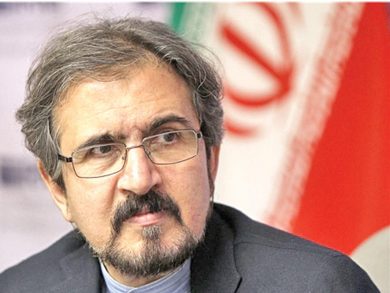 Qassemi on Friday firmly rejected a Reuters report quoting unnamed Iranian and Western officials as saying that Iran has signaled to the six world powers with which it signed the historic nuclear agreement in 2015 that it is open to talks about its ballistic missile arsenal.
“Iran regards defensive missile programs as its absolute right and will definitely continue them within the framework of its defensive, conventional and specified plans and strategies,” the Iranian spokesperson said.
He added that Iran “has repeatedly in diplomatic meetings with foreign officials” emphasized that its “defensive missile program is not negotiable” and that Tehran “does not regard it as inconsistent with [UN Security Council] Resolution 2231.”
In all his meetings and interviews with international media on the sidelines of last month’s 72th session of the United Nations General Assembly in New York, Iranian Foreign Minister Mohammad Javad Zarif reiterated the non-negotiable nature of the Islamic Republic’s defensive missile program.
According to the Reuters report, the sources said that given US President Donald Trump’s threats to ditch the nuclear agreement, known as the Joint Comprehensive Plan of Action (JCPOA), reached under his predecessor Barack Obama, Tehran had approached the powers recently about possible talks on some “dimensions” of its missile program.
Israeli ambassador pushes potential war to elite U.S. powerbrokers

Israeli Ambassador to the U.S. Ron Dermer gives address Sept. 12, 2017 to Washington D.C. movers and shakers: Wolf Blitzer and other journalists, government officials, think tank heads, philanthropists – almost all with significant ties to Israel (see list below).
By Alison Weir and Kathryn Shihadah | If Americans Knew | October 5, 2017
A select assembly of Washington D.C. heavy hitters recently attended a Rosh Hashanah event at which Israeli Ambassador to the U.S. spoke. Ron Dermer discussed alleged dangers posed by Iran, Syria, and Russia. In some places Dermer appeared to be laying out a rationale for another Israeli war.
According to JTA (Jewish Telegraphic Agency), the event is an annual affair “to which the embassy invites the U.S. Jewish leadership.” Dermer’s speeches typically seem intended to create a feeling of shared concern for Israel, saying, for example, “Let us all raise a glass and toast the fact that the Jewish people are voiceless no more. Israel has provided us with a shofar, with a sovereign voice among the nations.” Dermer himself was born and raised in the U.S.
Among those attending the invitation-only gathering this year were approximately 20 journalists, many connected to top U.S. print and broadcast media (including Wolf Blitzer, Eli Lake, Cliff May); numerous government officials and politicians (Congressmen, diplomats, White House insiders, senior staff, political operatives); and heads of major U.S. national organizations, philanthropists, and influential religious leaders (see list with biographical details below).
Dermer’s speech began on a convivial note – “Remember, on Rosh Hashana, you’re allowed to eat, drink and even laugh”– but soon became serious as he gave dire warnings about alleged dangers Israel faces, and the need for Americans to help.
Iran was the main villain to be protected against, with Syria and Russia allegedly dangerous abettors that also need to be addressed.
“The past year has posed many critical challenges for Israel,” Dermer intoned. “Foremost among those challenges has been the rising power of Iran.”
(This is very much in line with Israeli thinking; Israel’s Jerusalem Post newspaper recently reported: “Iran is the primary target of the Mossad’s actions, which number in the hundreds and thousands each year.” Netanyahu reportedly calls the Mossad Israel’s “synchronized fist.”)
Dermer claimed that the Iran deal had been a “double jackpot” for Iran (many U.S. analysts disagree, including some Israel partisans and top U.S. generals). Dermer charged that the deal had enabled Iran to spend “much of the past year consolidating its power across the Middle East.”
Next came the not-so-subtle call to action.
“Israel hopes that the coming weeks will bring about a dramatic change in the trajectory of that deal that will ultimately either fix it or cancel it,” Dermer said, making clear what was required of Americans who care about Israel.

Dermer and Debbie Wasserman Schultz at 2014 Israel Embassy Rosh Hashanah event; Dermer also warned about Iran at that event.
Dermer also focused on Syria, speaking of a potential Iranian “terror front against Israel” being established in Syria.
“Iran has been feverishly working to win the spoils of the imminent defeat of ISIS,” Dermer said, suggesting that such a defeat could be harmful to Israel.
Dermer’s statements reflect Israeli concern about U.S. efforts to end the war in Syria, leaving Russia, Assad – and by extension Hezbollah – in place. As JTA explains:
The Netanyahu government has been wary of what the end-game could be of U.S. efforts to end the war in Syria. There is a concern among Israelis — articulated most often by the defense minister, Avigdor Liberman — that the Trump administration might defer to Russia, which is allied with the Assad regime. Russia’s Assad alliance means it is in a de facto alliance with Iran and its Lebanese ally, Hezbollah, because they also are allied with the Assad regime.
Recent ongoing efforts in the U.S. to force the Trump administration to avoid diplomatic ties with Russia (despite the paucity of evidence for the accusations) may help remove that obstacle to keeping the U.S. in Syria.
Dermer said that Netanyahu had set “red lines” regarding Syria and that Israel will enforce them: “Israel will act to prevent Iran from supplying game changing weapons to Hezbollah. And Israel will act to prevent Iran from establishing another terror front against Israel in Syria.”
Israel has been stating these red lines for several years, and its escalating sabre rattling suggests that it may be planning another of its wars. Israel analyst Larry Derfner recently published an article entitled “A plea to Israel: Don’t start the third Lebanon War.”
Derfner states: “By continuing to bomb Syrian arms destined for Hezbollah – which Israel has admittedly done nearly 100 times in the last five years – as well as periodically killing Hezbollah and other pro-Syrian fighters along with the occasional Iranian general, Israel is making the next very, very ugly war in the north a self-fulfilling prophecy.”
A recent article in the very pro-Israel Atlantic (editor Jeffrey Goldberg served in the Israeli army) states: “for nearly two years now, Israeli military and intelligence officials have been warning every American official who comes through Tel Aviv and Jerusalem that the next war is coming. Israel has methodically prepared its allies—and most especially the Americans— for a very, very ugly war on the horizon.”
These wars have created massive carnage and suffering. even the Atlantic acknowledges that the 2006 Israeli assault “leveled entire neighborhoods in Beirut.”

Beirut, August 20, 2006. 1,100 Lebanese civilians died, 4,000 were injured, and over one million were temporarily displaced; 116 Israeli soldiers & 43 civilians died. Researchers found pro-Israel bias in U.S. media coverage of the war.
While Dermer tried to sell his audience on the claim that Israel is at existential risk, Derfner points out: “The idea that Hezbollah, Iran and Syria are itching for a war with Israel, that they’re just waiting to attack, is a delusion. Absent Israeli provocation, such an attack would have no parallel in the world or in history.”
Nevertheless, some influential media reports largely purvey Israeli spin, and it’s likely that Dermer’s speech was intended to influence the many journalists at his reception to take a similar line. As a Foreign Policy article reports: “When it comes to Washington, Israel’s task is to locate or induce a more coherent American strategy to counter advance of the Iranians in the Levant.”
This is particularly important, since some Trump officials don’t always march to the Israeli tune. U.S. National Security Advisor General H.R. McMaster recently told Israeli officials that Hezbollah was not a terrorist group. (Other reports claim he has called Israel an occupying power.)
Another point Dermer made to his audience was the value of U.S. strategies to help Israel bring some Arab countries into an alliance against Iran.
Dermer called the new allignment a “silver lining” and said he was “deeply grateful” to the current administration for “methodically working to advance a serious process that can move the entire region forward” – i.e. in Israel’s direction.
Dermer is no doubt pleased that, as in the past, the U.S. negotiator for Israel-Palestine is an Israel partisan; he called for applause for Jason Greenblatt, who he noted was present – one of the many “senior officials from all three branches of the U.S. government” attending the event.
Attendees
Jewish Insider provided a list of opinion makers spotted at the event, which included both liberals and conservatives, members of both political parties, and representatives of diverse positions along the pro-Israel spectrum. Below is the list, with added information on each.
We have listed each individual under one category below, although in many cases they would fit into several sectors given the revolving door that often exists between media, government, and pro-Israel organizations.
Journalists/Media Pundit
Wolf Blitzer, CNN lead political anchor, anchor of The Situation Room and Wolf. Blitzer began his career in 1972 with Reuters in Tel Aviv, before becoming a Washington DC correspondent for Israel’s Jerusalem Post. He also worked as editor of AIPAC’s monthly newsletter and edited “Myths and Facts 1976, A Concise Record of the Arab-Israeli Conflict” (Near East Research, AIPAC’s monthly publication), a volume described by Mondoweiss as “one piece of Zionist propaganda after another [that] denounced Palestinian views of [events surrounding the 1948 war] as ‘spurious myths.’”
Blitzer authored Between Washington and Jerusalem: A Reporter’s Notebook (Oxford University Press, 1985) and Territory of Lies (Harper and Row, 1989), about Israeli spy Jonathan Pollard, of which reviewer Robert I. Friedman wrote in the New York Review of books that Blitzer played down the damage caused by Pollard. Friedman stated: “Senior Israeli Defense Department officials are understandably pleased with Blitzer’s book about Pollard.” Friedman reported: “Currently, he travels the American TV talk show circuit as the ‘voice of Israel.’ Territory of Lies is a slick piece of damage control that would make his former employers at AIPAC (not to mention Israel’s Defense Ministry) proud.”
In 1990 Blitzer went to CNN, where his career skyrocketed. During Israel’s 2014 invasion of Gaza, Blitzer covered the conflict by embedding with the Israeli army. As part of “the most trusted name in news,” he maintains a pro-Israel bias (see this and this, for example). In 1989 he took part in a debate in which he largely repeated Israel’s talking points.
Sam Feist, CNN Washington Bureau Chief and senior vice-president. He oversees daily operations, leads all newsgathering and Washington-based programming, as well as campaign and election coverage. Feist was the founding executive producer of Wolf Blitzer’s The Situation Room, and has produced and managed CNN political programming including Crossfire, The Capital Gang, and State of the Union. He has been with CNN since 1991.
Danielle Heyman Feist, wife of Sam Feist. Director of Camp Rodef Shalom, a Virginia day camp that has a number of activities related to Israel, including a program in which scouts from Israel “run their own specialty area during camp, playing Israeli games, teaching a few Hebrew words, and helping bring their Israeli culture all the way to Virginia!”

Howard Friedman is director of Sinclair Media, the nation’s largest owner of local TV stations. He has served on the board of pro-Israel lobbying organizations such as AIPAC.
Howard Friedman has served on boards for many foundations, including the American Israel Public Affairs Committee (AIPAC) and the Union of Orthodox Jewish Congregations of America (which advocates for Israel and brought “tens of thousands” of its members and “hundreds of rabbis” to lobby Congress against the Iran deal). He was twice named by Washington Life Magazine as one of the 100 most powerful people in Washington DC. Formerly he was President of JTA – The Global News Service of the Jewish People.
Perhaps most significantly, Friedman is currently Director of the Sinclair Broadcast Group, the nation’s largest owner of local TV stations, and likely to become even larger, as it is in the process of buying Tribune Media for $3.9 billion.
Sinclair insists on conservative content on its local news programs, and even produces its own commentary pieces as “must-run” segments on every one of its stations . These include a daily “Terror Alert Desk” segment, which was recently exposed by political humorist John Oliver as an occasional vehicle for conflating terrorism with Islam. The “newscasters” include regulars from the Fox News Channel (like Sara Carter), contributors to conservative publications like the Washington Examiner (like Mark Hyman), and at least one former Trump staffer (Boris Epshteyn – see below).
Sinclair already owns 170 TV stations, which gives it access to 38% of American households—just shy of the cap of 39% put in place by Congress in 2004. Tribune Media is set to hand over another 42 stations (which includes stations in New York City, Chicago, Los Angeles), which would give Sinclair access to a full 72% of US households—nearly double what is allowed by law. This was made possible thanks to a move by Trump-appointed FCC Chairman Ajit Pai. Pai, heir apparent to the chair of the FCC, was wooed by Sinclair starting right after Trump’s election. Soon after his appointment, Pai unexpectedly revived an outdated regulatory loophole. About two weeks later, Sinclair announced its acquisition of Tribune.
Norman Eisen currently works with think tank Brookings Institution, does political commentary on CNN, and chairs Citizens for Responsibility and Ethics in Washington (CREW), a Democratic Party leaning nonprofit he co-founded in 2003 with Louis Mayberg, a financier who donates to Jewish causes (his wife says: “I invest in Jewish people” and partners with the Israeli Ministry of the Diaspora to bring thousands of women from 25 countries on visits to Israel). Previously, Eisen served as special council for ethics and government reform to President Obama. From 1985 to 1988, he was Assistant Director of the ADL’s Los Angeles office, where he investigated anti-semitism and other civil rights issues, promoted Holocaust education, “and advanced US-Israel relations.” He backed Tom Perez over Keith Ellison for Democratic National Committee chair, citing Perez’ “warm feelings for Israel.” As a student he had worked for Israel partisan Alan Dershowitz, who once said: “Our union was made in heaven. He was a natural guy for me to hire because he was brilliant and shared many of the same liberal democratic, pro-Israel values that I did and that he still represents.”
Eisen has also served as U.S. Ambassador to the Czech Republic, during which time bilateral trade between the U.S. and the Czech Republic almost doubled. Earlier in his career he was a partner in the Zuckerman Spaeder law firm, where he worked on cases such as Enron and Whitewater. Washingtonian Magazine listed Eisen as one of Washington’s top lawyers.

Talk show host Tom Rose (right) volunteered for the Israeli military during the first Gulf War. In 2014 he travelled to Israel with his longtime friend Mike Pence (left), in the company of Ambassador Dermer.
Tom Rose, journalist and unofficial Vice Presidential surrogate. Formerly editor/publisher of the Jerusalem Post, during which he and his family lived in Israel. Although he is an American citizen, during the Gulf War he volunteered for service in the IDF. More recently, he has co-hosted a Sunday morning satellite radio program with conservative Christian Gary Bauer. Their show, The Bauer & Rose Show, is known for its “robust defense of Judeo-Christian civilization, the US/Israel alliance, and the need for a strong America in the world.” The show ended in April 2017 when Rose took a position as assistant and advisor to Vice President Mike Pence, Rose’s “closest personal friend for 25 years.” In 2014, Rose and Pence visited Israel together, in the company of Israel’s Ambassador to the US, Ron Dermer.
Kenneth Weinstein, President and CEO of the Hudson Institute, which honored PM Benjamin Netanyahu with the Herman Kahn Award (see Roger Hertog entry below)—which is conferred on “leading public servants who exemplify a commitment to Western alliances as the bedrock of global security, prosperity, and freedom.” Hudson “seeks to guide public policy makers and global leaders in government and business.” It frequently holds conferences on topics such as defense, international relations, and economics (dozens of which have been pro-Israel) and disseminates research and analysis articles (hundreds of which have been pro-Israel). Weinstein is President and CEO of the Broadcasting Board of Governors (BBG), whose mission is “to inform, engage, and connect people around the world in support of freedom and democracy.” BBG oversees U.S. government civilian international media: Voice of America, Radio Free Europe, Office of Cuba Broadcasting, Radio Free Asia, Middle East Broadcasting Networks.

AP reporter Josh Lederman began his journalism career working in Israel, where he had spent a year as a child. He credits that year and his attendance at Tucson Hebrew Academy, whose core values include “supporting Israel,” with informing his reporting.
Josh Lederman, Associated Press reporter; started his journalism career in the AP Jerusalem bureau; he had previously lived in Israel in seventh grade (it is unknown whether he has Israeli citizenship). Lederman credits that year, combined with his education as student at Tucscon Hebrew Academy (among its “Core Values” is “Supporting Israel: We support Israel and foster close relationships with Israeli students and educators”) with helping him “connect the dots” as he reported on Israel. Now based in Washington DC, Lederman covers foreign affairs, national security and U.S. diplomacy for AP ; appears frequently on television and radio, including on MSNBC, Fox News, NPR and others. He covered 2012 presidential campaign for The Hill newspaper in Washington. From 2013 to 2017, Lederman was a White House reporter for AP. He also writes for the Times of Israel.

Media pundit Cliff May founded Foundation for Defense of Democracies (FDD), a neoconservative organization created “to enhance Israel’s image in North America.”
Clifford D. May, weekly “Foreign Desk” columnist of The Washington Times, and frequent analyst on diverse TV and radio news programs. His articles have appeared in the Wall Street Journal, National Review, Commentary, USA Today, The Atlantic and other publications. May is the founder of the Foundation for Defense of Democracies (FDD), a pro-Israel neoconservative organization – May said its purpose was “to enhance Israel’s image in North America.” Some suggested it was the new Project for a New American Century. Right Web reports:
FDD grew out of a right-wing pro-Israel initiative launched in early 2001 called EMET. Reports Slate: “On April 24, 2001, three major pro-Israel donors incorporated an organization called EMET (Hebrew for ‘truth’). In an application to the Internal Revenue Service for tax-exempt status, [FDD president Clifford May] explained that the group ‘was to provide education to enhance Israel’s image in North America and the public’s understanding of issues affecting Israeli-Arab relations.’”[3]
“… Shortly after its founding, FDD quickly became a prominent member of a group of neoconservative think tanks and advocacy groups—including the American Enterprise Institute and the Hudson Institute—that were influential in shaping the early foreign policy priorities of the George W. Bush administration. At the height of the “war on terror,” FDD also absorbed the Committee on the Present Danger, a Cold War-era anticommunist group that been reconstituted to push for hardline policies in the Middle East.”
“FDD’s president, Clifford May, is a former writer for the New York Times who once served as director of communications for the Republican National Committee. May is also a former editor of the party’s official magazine (Rising Tide), a former vice chair of the Republican Jewish Coalition, and a member of the Committee on the Present Danger.”
“FDD has been a vocal advocate of confrontational policies on Iran.”
Slate reports that FDD runs tours of Israel for American academics (with most of their expenses paid) similar to those run for journalists and politicians by AIPAC and other groups.”
May was an advisor to the Iraq Study Group; served on the Advisory Committee on Democracy Promotion (2007-2009), reporting to Secretary of State Condoleezza Rice; served on the Broadcasting Board of Governors, the entity responsible for all U.S. government and government sponsored, non-military, international broadcasting; and on the U.S. Commission on International Religious Freedom (2016).
Evan May, bio is unavailable, probably relative of Cliff May.
Boris Epshteyn, an investment banker; born in Russia and came to the U.S. in 1993 at the age of 11. Previously, he worked on Sen. John McCain’s 2008 presidential campaign. He was a top communications aide for Donald Trump’s campaign; appeared as a Trump surrogate over 100 times on major TV networks between the election and the inauguration. In April, Epshteyn left the White House and became chief political analyst for Sinclair Broadcast Group (see Howard Friedman, above), a conservative company that owns a multitude of local TV stations.
Lauren Gorlin Tanick, wife of Boris Epshteyn, a strategy executive at Google.

Journalist Eli Lake speaks at event organized by the Foundation for Defense of Democracies, Aug. 13, 2014. Observers describe him as a neoconservative “pro-Israel” ideologue.”
Eli Lake, Bloomberg journalist, former senior national security correspondent for The Daily Beast and Newsweek. He worked for a range of news outlets, including The Daily Beast, Newsweek, The Washington Times, The New Republic, New York Sun. Lake has often worked with and shared bylines with Josh Rogin (see entry below); known as extremely pro-Israel. Below are exerpts from Right Web:
Eli Lake is a well-known writer and columnist whose track record on U.S. foreign policy has led some observers to describe him as a neoconservative and “pro-Israel” ideologue. …
His writings focus on national security issues, particularly with respect to the Middle East, and he has a lengthy record of advocating for aggressive U.S. foreign policies in the region. One commentator has quipped that Lake has a “career pattern of credulously planting dubious stories from sources with strong political agendas.”
A frequent subject of Lake’s writings is U.S. policy on Iran. Generally hawkish in his critiques of U.S. engagement with Tehran… most observers agree [that his analysis] is really intended to kill negotiations…
After a nuclear agreement was reached between Iran and the P5+1 in July 2015, Lake went on the attack…. In a March 2015 commentary, Lake criticized Iran’s foreign minister Javad Zarif, a Western educated diplomat widely regarded as a moderate within Iran’s establishment… Former British diplomat Peter Jenkins criticized Lake’s article on Zarif as taking “many liberties with the truth.”
… Lake was “an open and ardent promoter of the Iraq War and the various myths trotted out to justify it, contributing to the media drumbeat that helped the Bush Administration sell the war to the public and to Congress.” Leading up to the 2003 U.S.-led invasion of Iraq, Lake reported extensively on Saddam Hussein’s alleged weapons mass destruction and ties to Al-Qaeda…
After the war and the subsequent failure to discover any weapons of mass destruction in Iraq, Lake contended that the weapons had been moved to Syria…
In a December 2001 article for the National Review, Lake argued that with its invasion of Afghanistan completed, the United States should move on to take military action against Iraq, Yemen, and Somalia. “There are very good arguments why all three should be the next target,” he opined. “Iraq after all has been developing nuclear and biological weapons …
In 2009, Lake gained notoriety for his role stirring up opposition to the nomination of Chas Freeman, a veteran diplomat and former U.S. ambassador to Saudi Arabia, to be the chairman of the National Intelligence Council. Freeman ultimately withdrew his name from consideration and blamed the controversy over his nomination on the “Israel lobby.”… [See Freeman’s statement.]
Josh Rogin, Journalist who often works closely with Eli Lake, sharing bylines on news articles. He is a CNN political analyst and columnist on foreign policy and national security for Bloomberg View. Previously, Rogin covered foreign policy and national security for Newsweek, The Daily Beast, Foreign Policy, The Washington Post, Federal Computer Week and Japan’s Asahi Shimbun. His work has been featured on CNN, FOX, MSNBC, ABC, NBC, NPR, PBS, and several other outlets. He is married to Ali Weinberg (see below); their wedding guests included journalists Eli Lake, CNN’s Wolf Blitzer, CNN’s Jake Tapper, NPR’s Michael Goldfarb, NBC News Political Director and Meet the Press host Chuck Todd, Jamie Kirchick, Jonathan Karl, and NBC’s Alex Moe.
Ali Rogin (aka Ali Weinberg), ABC journalist, married to Josh Rogin. She is the daughter of Max Weinberg (see below). Her Linkedin entry reports that she covers the State Department for ABC News, producing pieces for broadcast and reporting for ABCNews.com and ABC News Radio. She formerly worked at NBC.
Max Weinberg, Drummer for Bruce Springstein and on Conan O’Brian show, father of journalist Ali Rogin (see above). His net worth is reportedly $35 million.
Joel Mowbray, Fellow, Foundation for Defense of Democracies, 2005-2014; formerly syndicated columnist with articles in Wall Street Journal, Washington Times, NY Post, The New Republic, L.A. Times, Philadelphia Inquirer, Atlanta Journal-Constitution, San Diego Union Tribune, Las Vegas Review Journal, Sacramento Bee, Pittsburgh Post-Gazette, Investors Business Daily, Arizona Republic, San Francisco Chronicle, and FoxNews.com. In 2002, Mowbray founded Fourth Factor Consulting, LLC: “Fourth Factor advises Silicon Valley tech companies and pro-Israel and national security-oriented think tanks. The bulk of the work is strategic government affairs, which supplements lobbying efforts by being proactive instead of reactive.” He was a Hudson Institute Adjunct Fellow from 2003 – 2005, where he “conducted research into terror networks and Islamic radicalization, investigated Saudi influence in America, and scrutinized State Department’s handling of national security.” Mowbray is the author of Dangerous Diplomacy: How the State Department Threatens America’s Security.” His Linkdin bio lists AIPAC as one of his interests.

Rabbi Shmuley Boteach at the 2012 “Christians United for Israel” conference. Newsweek lists Boteach as one of America’s “most influential rabbis.”
Rabbi Shmuley Boteach, founder of The World Values Network, “the leading organization spreading universal Jewish values and defending Israel in American media” (see video); frequent guest on CNN, Fox News, MSNBC, the BBC, NBC, CBS, as well as The New York Times, The Wall Street Journal, Time Magazine, Breitbart News, and The Washington Post. Rabbi Boteach’s personal site pictures him with his book: “The Israel Warrior: Fighting Back for the Jewish State from Campus to Street Corner.” Newsweek has repeatedly listed him in “The 50 Most Influential Rabbis in America. He ran for Congress in New Jersey, receiving an endorsement from House Majority Leader Eric Cantor. His site states:
“Rabbi Shmuley Boteach, “America’s Rabbi,” whom is for many the very face of Judaism in global media.
“The international best-selling author of 31 books, Rabbi Shmuley’s works have been translated into 20 languages. A world-renowned relationships expert, his book Kosher Sex is regarded as a modern classic and he has won numerous awards including The London Times Preacher of the Year Competition, The National Fatherhood Award, and The American Jewish Press Association’s Highest Award for Excellence in Commentary…
“Labeled ‘a cultural phenomenon’ by Newsweek and a man with ‘his scholarly finger on the pulse of the nation’ by Slate, Rabbi Shmuley is revolutionizing the place of Judaism and spirituality in modern culture and politics, and is one of the world’s most accomplished defenders of the State of Israel.”
At the 2015 Israel Day Concert In New York City Boteach said, to loud applause: “We are connected to Israel because it’s Jewish… we love Israel because Israel is good. We love Israel because it is the foremost protector of human rights in the world’s most troubled region. There is a war going on. There is a battle for the future of the Jewish state and each and every one of you is a soldier in that fight.”
Noah Pollak, Pollak’s bio describes him as a “political writer on foreign policy, Israel, and the Jewish people.” Pollak has written for Commentary, the Weekly Standard, National Review, the Wall Street Journal, Politico, and appeared on Fox News, PBS Newshour, and CNN. He is executive director of the Emergency Committee for Israel, a neoconservative political advocacy organization whose board members include neocons William Kristol and Rachel Abrams, wife of Elliott Abrams. Pollak helped promote the Taylor Force Act.
Ron Kampeas’ Linkedin entry reports: “Ron Kampeas is JTA’s [Jewish Telegraphic Agency ] Washington bureau chief, responsible for coordinating coverage in the U.S. capital and analyzing political developments that affect the Jewish world. He comes to JTA from The Associated Press, where he worked for more than a decade in its bureaus in Jerusalem, New York, London and, most recently, Washington. He has reported from Northern Ireland, Afghanistan, Bosnia and West Africa. While living in Israel, he also worked for the Jerusalem Post and several Jewish organizations.” Kampeas graduated from Hebrew University of Jerusalem.
Nathan Guttman, the Forward’s Washington bureau chief. He joined the staff in 2006 after serving for five years as Washington correspondent for the Israeli dailies Ha’aretz and The Jerusalem Post. Guttman was born in Canada and grew up in Israel. He is a graduate of Hebrew University.
Government, Politics
Congressman Eliot Engel has been in Congress since 1988 as a Democrat representing the Bronx. He has traveled to Israel many times, and says, “I remain committed to the unbreakable bond between the United States and Israel.” On another occasion, he opined, “We don’t want one party to be pro-Israel; we want both parties to be pro-Israel” because the state is “our best friend in the Middle East, and – I’d even argue – in the world.” Engel favors recognition of Jerusalem as the undivided capital of Israel, and is uncritical in his support.

Congressman Lee Zeldin (right), member of the House Foreign Affairs Committee and Co-Chair of the House Republican Israel Caucus, meets in his Washington, DC office with Yoav Kisch, member of the Israeli Knesset, Feb. 1, 2017.
Congressman Lee Zeldin previously served in the New York State Senate, and is now in the U.S. House of Representatives. As Co-Chair of the House Republican Israel Caucus, he spoke on the issue of the U.N. “anti-Israel resolution” of December 2016: “Pro-Palestinian, anti-Israel nations are continuing their fanatical efforts at the United Nations to delegitimize [Israel]… Their disparaging, divisive and dangerous tactics will be met with zero tolerance. Continued unilateral concessions by Israel in exchange for no promises or follow through towards peace on the part of others would be as ill-advised as it is unfeasible.” Zeldin also wrote, regarding the U.N. resolution, that it “further cements President Obama’s legacy as one of the worst presidents in the history of the United States… [He] chose to embrace a pro-Palestinian attempt to ethnically cleanse East Jerusalem and Judea and Samaria.” Zeldin is also passionately in favor of moving Israel’s capital to Jerusalem.
Congressman Henry Waxman, Democratic Congressman from southern California, 1975 – 2015. The Forward calls him “one of the most influential liberals, and one of the most skilled legislators, of his generation.” In the Times of Israel report, “Jewish lawmaker, who maintains close ties to Israel, has represented Los Angeles district for 40 years,” Waxman was named “the dean of Jewish lawmakers in the U.S. House of Representatives.”
Waxman said that he had “worked throughout my career to strengthen the US-Israel relationship. I have traveled to Israel on numerous occasions…” Waxman once stated: “…it is with pride that I have seen my daughter thrive in Israel and my grandchildren serve in the Israeli army.”
Janet Kessler, Waxman’s wife; founder of Congressional Wives for Soviet Jewry.
Jason Greenblatt, formerly executive vice president and chief legal officer to Trump and the Trump Organization, and his advisor on Israel; currently special envoy to the Israeli-Palestinian peace process for President Trump, charged with facilitating “the ultimate deal.” According to NPR, Greenblatt once studied in a yeshiva – a Jewish religious seminary – in a West Bank settlement. He has recently met with senior settler leadership in preparation for negotiations. In fact, Greenblatt and Trump’s administration are more sympathetic toward settlements than any previous administration, much to the delight of Israel. The Palestinian Authority, on the other hand, is not optimistic: Greenblatt has yet to even commit to helping create a Palestinian state.

U.S. Secretary of Veterans Affairs David Shulkin (left) meets with Israeli Deputy Defense Minister Eli Ben-Dahan, March 2017. The Israeli government has used Shulkin to build a closer relationship between Israel and the U.S. After the meeting, the VA purchased medical equipment from an Israeli company.
David Shulkin, current U.S. Secretary of Veteran Affairs; he was recommended to President Trump by U.S. Ambassador to Israel David Friedman, even though Shulkin is not a veteran. (Veterans had wanted the position to be filled by a military veteran, the normal procedure; some lobbied for then VA Secretary Robert McDonald to be named.) Israel sees veterans affairs as a new means of bringing the U.S. and Israel closer together, as JNS (Jewish News Service) reports: “While US-Israeli military ties have long focused on foreign aid packages, intelligence-sharing and jointly developed missile defense technology, veterans affairs could become a major new frontier in that relationship.” JNS writes that the selection of Shulkin, “a Jewish doctor and administrator,” for Secretary of veterans affairs, was an important development in the process. Within weeks of Shulkin’s confirmation, the Israeli Deputy Defense Minister asked Shulkin for a meeting. The meeting was the first of its kind between American and Israeli officials responsible for the care of injured and released soldiers. After the meeting, Veterans Affairs purchased Israeli medical equipment. U.S. officials sometimes provide Israelis the opportunity “to make presentations during international conferences at which Israel is not yet participating.” JNS notes: “Such opportunities will allow the Israelis to showcase their knowledge on a world stage to which they have, until now, largely been denied access.’
Shulkin and his wife Merle Bari (below) are currently under investigation for taxpayer funding of a recent trip to Europe.
Merle Bari, wife of David Shulkin, physician specializing in general and cosmetic dermatology. Recently she has been criticized for reports that “the government covered the cost of Bari’s airfare and gave her a per diem for meals” when she accompanied her husband on a trip to Europe. She seems to have close ties to Israel. In 1977 Bari was a youth participant in Israel’s Maccabiah Games, and in 2013 her daughter similarly participated in the Games during a year she spent in Israel, and was a delegate to the AIPAC national convention.
Aaron David Miller worked at the State Department for 25 years as a Middle East negotiator and adviser on Arab-Israeli affairs. He is currently a vice president at the Wilson Center; he says he believes “in the importance of a strong U.S.-Israeli relationship.” In an article for the Washington Post Miller admitted that he and other U.S. mediators had actually like “Israel’s lawyer.”
“With the best of motives and intentions, we listened to and followed Israel’s lead without critically examining what that would mean for our own interests, for those on the Arab side, and for the overall success of the negotiations. The “no surprises” policy, under which we had to run everything by Israel first, stripped our policy of the independence and flexibility required for serious peacemaking.”
“What we ended up doing was advocating Israel’s positions before, during and after the summit.”
Matt Nosanchuk was Jewish Liaison under Obama; said he had very strong relationships with pro-Israel organizations across the political spectrum. He has worked in the White House, Congress, the State Department, Justice Department, and Homeland Security on a range of domestic and foreign issues arising at the intersection of policy, law, advocacy, legislation, strategic communications, and outreach and engagement. He described President Obama’s views (and said he agreed with them):
“The president [Obama] said he wouldn’t be where he is today without the support of the Jewish community in Chicago. He believes in Zionism. He believes we have shared values. He shows strong, unwavering support for Israel. He says he did the Iran deal partially to protect Israel’s security, that it would be a ‘moral failing’ not to protect Israel’s security.”

(L-R) Aaron Keyak, William Daroff and Steve Rabinowitz at the launch of Bluelight Strategies, a consulting group at the “nexus of political Washington and the Jewish and pro-Israel world.” Keyak was previously a senior Congressional staffer and executive director of the National Jewish Democratic Council.”
Aaron Keyak, Co-owner of a Washington DC PR firm; he was a senior staffer for some Congressional representatives and communications director and interim executive director for the National Jewish Democratic Council. Keyak has said that strengthening the U.S.-Israel relationship is one of the values he most cares about. Washington Jewish Week reported about the 2015 launch of Keyak’s public relations firm:
“The official announcement was made at the “Latkes & Vodkas” party at their swanky downtown office on Dec. 15. Steve Rabinowitz, founder and president of the mostly progressive and Judeocentric Washington, D.C.-based political public relations firm, Rabinowitz Communications – the former Clinton White House staffer who produced the famed photograph of Israeli Prime Minister Yitzhak Rabin and PLO leader Yasser Arafat shaking hands on the White House South Lawn – would no longer be flying solo. Aaron Keyak, 29, would become his partner in a new PR company called “Bluelight Strategies.”
“… recently, communications director and senior Middle East policy advisor for Jewish Rep. Jerry Nadler (D-N.Y.), who represents one of the most heavily Jewish districts in the country. He previously served in a similar role with Rep. Steve Rothman (D-N.J.).
“According to Keyak, the idea for the partnership arose out of the successful working relationship he and Rabinowitz enjoyed during the 2012 presidential election, when the two collaborated on a venture they called the “Hub,” an effort aimed to organize Jewish voters for Democratic candidates.”
Avi Goldgraber, wife of Aaron Keyak, is manager at Accenture; previously she was confidential secretary to Deputy Secretary, Department of Health and Human Services. Goldgraber attended Israel’s Hebrew University of Jerusalem, received her B.A. from Washington University in Political Science and Jewish, Islamic, and Near Eastern Studies. She is the daughter of Moshe B. Goldgraber who endowed a fellowship for Israeli physicians.
Josh Raffel currently leads the communications team for Jared Kushner and is his principal spokesman. Raffel is “often the primary route for delivering Mr. Kushner’s message to the news media, and he also handles communications on issues like Israeli-Palestinian negotiations.” He was formerly a publicist, whose clients included Hollywood horror films, Glenn Beck, and Jared Kushner’s family business.

Top Democratic strategist Ann Lewis declared that “the role of the president of the United States is to support the decisions that are made by the people of Israel.”
Ann Lewis, leading Democratic Party strategist and communicator. In one public meeting of Jewish leaders before the 2008 election, Lewis declared that “the role of the president of the United States is to support the decisions that are made by the people of Israel. It is not up to us to pick and choose from among the political parties.” This was after some discussion that “there’s something wrong with Senator Obama’s views about Jews, about Israel” – referring to Obama’s pastor, Rev. Jeremiah Wright’s, preaching that Israel is committing “state terrorism against the Palestinians,” as well as Obama’s apparent sympathy for Palestinians. Lewis’ pro-Israel clout as leading Democratic Party strategist and communicator is clear in how she was able to change the Israel policy of the Center for American Progress, a powerful progressive research and advocacy organization. She made it clear that criticism of Israel, AIPAC, and American Jewish groups is forbidden. CAP was quick to self-censor, removing or cleaning up tweets and articles.
David Milstein, Research Analyst for Senator Ted Cruz (R-TX), primarily focusing on issues related to Israel. “He played a leadership role with an organization called Young Jewish Conservatives whose mission is to build a community of politically conservative young Jews who strongly support Israel; co-organized its annual Shabbat Event at the Conservative Political Action Conference (CPAC), the largest annual gathering of conservative activists.”
ThinkTanks, NGOs, Funders
Morton Klein has been national president of the Zionist Organization of America for 24 years. When President Obama abstained from voting in the U.N. Security Council resolution condemning Israeli settlements, Klein opined, “Obama has made it clear that he’s a Jew-hating anti-Semite.” He agreed with candidate Trump’s plan for profiling Muslims: “We should adopt the same profiling policies as Israel and be more thorough in vetting Muslims,” adding, “it’s not the worst thing to do.” Klein criticized Secretary of State Rex Tillerson for using the word “Palestine,” claiming that it sends a message to the Arab world that “this administration is biased to their side.” Going even further, Klein called for Tillerson to be fired when the State Department published its annual terror report, which suggested (as it had the previous year) that Israeli settlements and Palestinian hopelessness are factors contributing to Palestinian terrorism. Klein indicated that the State Department had “put out reports that give excuses for Palestinian murder of Jews.” The ZOA organized a letter opposing the Iran deal.

Abe Foxman worked at the Anti-Defamation League (ADL) for 50 years. After retiring he joined Israel’s Institute for National Security Studies (INSS).
Abe Foxman, former National Director of the Anti-Defamation League; currently ADL National Director Emeritus and fellow at Israel’s Institute for National Security Studies (INSS), a Tel Aviv-based think tank for issues of security and Middle East policy. He is also head of the Center for the Study of Anti-Semitism at the Museum of Jewish Heritage in New York City. Foxman is known as the “Jewish Pope” thanks to his 28-year leadership of the Anti-Defamation League. INSS director Amos Yadlin called him “an undeclared leader of the American Jewish community and a leading global figure on matters of human dignity and moral conduct.” Foxman believes that the BDS movement is anti-Semitic “99% of the time.”
Stacy Burdett, Vice President, Government Relations, Advocacy & Community Engagement at Anti-Defamation League. He has participated in the international campaign to change the definition of anti-Semitism to include many statements about Israel.
Loribeth Weinstein, CEO of Jewish Women International (JWI) for over 15 years. JWI works to “end violence, ensure economic security, and spotlight leadership and mentoring.” She has also served American Jewish World Service, dedicated to “ending poverty and promoting human rights in the developing world.” Weinstein has also been on the Regional Council of the New Israel Fund, which includes as its mission statement, achievement of “equality for all the citizens of the state… protection of Palestinian citizens… opposition to all forms of discrimination and bigotry… a just society at peace with itself and its neighbors.” The New Israel Fund has supported B’tselem to the tune of $2.2 million over the last ten years.

Howard Kohr, executive director of the American Israel Public Affairs Committee (AIPAC). Analysts write: “AIPAC, which is a de facto agent for a foreign government, has a stranglehold on the U.S. Congress.”
Howard Kohr, executive director of AIPAC since 1996. Under his supervision, Congresspeople have been given all-expenses-paid trips to Israel to “discover their own personal connection to the land…and to understand the issues more clearly.” Kohr has turned AIPAC into “the most influential foreign policy lobbying organization” in Washington, and promises to keep it that way with the help of 4,000 pro-Israel student leaders across the country. “Mr. Kohr [representing AIPAC] has helped to navigate congressional passage of the annual U.S. Foreign Aid bill by historic, record-breaking margins — accomplishments achieved often in the midst of a hostile, budget-cutting environment.”
In his testimony to Congress in April 2017, as Kohr requested $3.1 billion in foreign military aid, he reminisced about the “close strategic relationship between the United States and Israel” that began with sharing of key intelligence in 1967 – the same year that Israel attacked the USS Liberty with napalm, gunfire, and missiles, even machine-gunning three lifeboats. The Moorer Commission found that the attack constituted “an act of war against the United States.” Professors John Mearsheimer of the University of Chicago and Stephen Walt of Harvard state: “AIPAC, which is a de facto agent for a foreign government, has a stranglehold on the U.S. Congress.”
Fortune magazine has ranked AIPAC the number two most powerful lobbying group in Washington D.C., after the American Association of Retired Persons (AARP)
Bob Cohen, Chairman of the Board of Directors of AIPAC (American Israel Political Affairs Committee), former President of AIPAC (2014). Cohen is considered one of AIPAC’s six key leaders.

Jason Isaacson of the American Jewish Committee (AJC) speaks at the National Leadership Assembly for Israel at the National Press Club, July 28, 2014. (Video here.)
Jason Isaacson, Director of Government and International Affairs at the American Jewish Committee (AJC). The AJC website announces:
“Around the world—from the hallways of the U.N. in New York, to the corridors of the European Union in Brussels, and to the countries of Asia—AJC advocates for Israel at the highest levels. And when Israel is under assault, whether from the terrorist organizations on her doorstep or the global BDS movement, AJC helps bring the world the truth about Israel.”
The AJC is an American nonprofit organization. Donations to it are tax-deductible.
Daniel S. Mariaschin, CEO of B’nai B’rith International, “a national and global leader in…Israel advocacy.” His B’nai B’rith bio reports: “Mr. Mariaschin has met with countless heads of state, prime ministers, foreign ministers, opposition leaders, influential members of the media and clerical leaders. Each time, his goal has been to advance human rights, help protect the rights of Jewish communities worldwide and promote better relations with the state of Israel.” Mr. Mariaschin represented the organization at numerous international conferences, many of which helped to establish a new, Israel-centric definition of anti-Semitism, including the International Conference on Holocaust Education, Remembrance and Research; and the State Department’s 1998 Washington Conference on Holocaust-Era Assets. Mariaschin served as part of the U.S. delegation to the Organization for Security and Co-operation in Europe (OSCE) conference on anti-Semitism in Vienna in 2003; was public advisor to the U.S. delegation at the 2004 conference in Berlin, the 2005 conference in Cordoba, Spain, and the 2007 meeting in Bucharest, Romania. In 2009 he was a member of the U.S. delegation to the Warsaw Human Dimension Implementation meeting of the OSCE.
Mariaschin began his professional Jewish life in 1973 as community relations associate for the Jewish Community Council of Boston. Two years later, he became director of the New England office of the American Zionist Federation and Zionist House in Boston. In 1977, he joined the Anti Defamation League (ADL) of B’nai B’rith as director of its Middle East Affairs Department. From 1979 to 1986, he served as assistant to ADL’s national director, the late Nathan Perlmutter, and as director of its National Leadership division, responsible for ADL’s nationwide program of leadership development. He then became director of the Political Affairs Department of the American Israel Public Affairs Committee (AIPAC), where he supervised political action activities and grassroots organization programs.
Prior to joining B’nai B’rith, Mr. Mariaschin served as director of communications and principal spokesman for former Secretary of State Alexander M. Haig, Jr. during his 1987-88 presidential campaign.
Mariaschin has written numerous articles for such publications as The New York Times, The Wall Street Journal, Los Angeles Times, Chicago Tribune, The Washington Times and Newsday, and appears frequently as a foreign affairs analyst on television and radio programs. He has lectured on foreign and defense affairs at the U.S. State Department’s Foreign Service Institute, the Marine Corps Command and Staff College, and at other military installations across the country. He has also worked as a radio announcer and news commentator and has lectured widely in the U.S. and abroad.
Rabbi Levi Shemtov, Shemtov has been called “the rabbi of Capitol Hill.” The Washingtonian states: “Rabbi Levi Shemtov is a Washington institution.” It reports that Shemtov
“is among the country’s best-connected and most politically savvy rabbis. Shemtov has supervised the koshering of the White House kitchen, lit the National Menorah alongside Vice President Joe Biden, and for more than two decades has run American Friends of Lubavitch (AFL), the Washington arm of the world’s most successful Jewish outreach organization.”
“It’s hard for me to think of any political Jewish person in Washington that doesn’t have a relationship with him,” says Steve Rabinowitz, a PR executive and longtime friend of the rabbi’s.”
His bio on the Rabbinical Council of Greater Washington reports:
“Rabbi Shemtov is also the Executive Vice President of American Friends of Lubavitch (Chabad) and serves the daily governmental and diplomatic needs of the international Chabad-Lubavitch movement, the world’s largest and fastest growing Jewish network of educational and social service institutions, with over 3,500 centers in 49 states and over 80 countries. He maintains close relationships with numerous members of the United States Congress, senior Administration officials and leaders in the international community, including a number of heads of state and government. Rabbi Shemtov chairs the organizing committee of the International Chabad-Lubavitch Conference – Living Legacy, which facilitates high-level interaction between rabbis and communal leadership from around the globe and prominent US and international figures in the arenas of government, diplomacy, academia and the arts.
“Programs he organizes include several signature events such as the annual lighting ceremony of the National Chanukah Menorah drawing thousands to The Ellipse (across from the White House) every year, and seen by millions more via various media and the internet. In addition, he founded and directs the Capitol Jewish Forum, which is the largest (apolitical) Jewish group on Capitol Hill, designed to “create and enhance a sense of identity and community among Jewish Congressional staffers and members of Congress” and which enjoys strong support of the Leadership and members of both parties in the US Senate and House of Representatives. Rabbi Shemtov is often at the White House, Pentagon, United States Department of State and other venues in official Washington, seen by many as an effective, bipartisan unifier and premier Jewish resource.”
Shemtov is a passionate Israel defender who used the national menorah lighting awhile ago to complain about a U.N. resolution saying that Israeli settlements are illegal. In 2014 he gave a speech at a Stand With Us rally in Washington DC:
(Jared Kushner and Ivanka attend his synagogue.)
Nathan Diament previously served on President Obama’s Faith Advisory Council; his writing has appeared in The Washington Post, The Forward, and other publications, he has appeared on CNN, FOX News, NPR, and other broadcasts. Currently he is Executive Director for the Orthodox Union Advocacy Center, “public policy arm of the nation’s largest Orthodox Jewish organization‚ representing nearly 1,000 congregations nationwide.” One of its main issues is “supporting Israel.” The Orthodox Union website never uses the word Palestine when referring to the modern-day state, without using quotation marks (i.e. “Palestine”); it states that “historically, there was never an indigenous Palestinian people”; its Newsroom and Campus Life sections are anti-Palestine; and it features a Birthright travel agency. Diament himself is a strong advocate of an “undivided Jerusalem” as capital of Israel.

Roger Hertog, “strategic philanthropist” and chairman of the Tikvah Fund, with Israeli Prime Minister Netanyahu at a gala ceremony at Manhattan’s Plaza Hotel where Netanyahu received an reward from the Hudson Institute.
Roger Hertog, vice-chair emeritus of Alliance-Bernstein L.P., an investment firm which was reportedly valued in 2002 at $100 billion that was investigated for “improper trading moves.” Hertog practices what he calls “strategic philanthropy.” He has funded many pro-Israel organizations: the Anti-Defamation League; American Friends of Shalva; Tikvah (he is chairman); in 2005, gave $5 million to Taglit-Birthright Israel; he founded Israel’s Shalem Center; is on the boards of Commentary magazine and the American Enterprise Institute; and is a member of what Ha’aretz called Netanyahu’s “billionaire’s club.” Inside Philanthropy reports:
“involved in philanthropy for decades. Hertog was previously chairman of New York Historical Society and the Manhattan Institute, each of which has received large support. As well, the couple has given tens of millions to the New York Public Library over the years. The Hertog Foundation has given away around $10 million annually in recent years, mainly toward Jewish causes, conservative policy issues, education (both higher education, and school reform), and arts and culture. The Hertog Foundation also runs educational programs for students in areas such as politics, war, and economics…
“served as chairman emeritus of the conservative think tank Manhattan Institute, as well as served on the board of the American Enterprise Institute (AEI). He was also a backer of the right-leaning New York Sun newspaper. Hertog and Susan have also supported outfits like the Thomas Jefferson Foundation, the Alexander Hamilton Society, the Brookings Institution, the Hudson Institute, the Claremont Institute, the Washington Institute, and the Institute for the Study of War.
Involved in Israeli archaeology projects (for info on their agenda see this); funded an excavation by Israeli archaeologist Eilat Mazar and provided resources for multi-volume scholarship to interpret and publish the Temple Mount Excavation.
Hertog has also been involved in media ventures: he was co-owner of The New Republic for a period; supplied the seed money for the now-defunct New York Sun, and guaranteed the $2 million bail for pro-Israel media baron Conrad Black when he was charged for defrauding shareholders.
Lindsay Kaplan, wife of Norman Eisen, Georgetown University English Department.
Sander Gerber was a low profile New York hedge fund CEO and AIPAC national board member who heard about the death of American Taylor Force in Israel and investigated the Palestinian Authority’s budget with the help of a top intelligence Israeli general and an Israeli research institute. Gerber and his associates discovered the Palestinian Authority’s social safety net program which provides a stipend for families of men who have been injured, killed, or imprisoned by Israel. He dubbed the program “pay to slay,” and began to lobby Congress and the media to stop the practice. The Taylor Force Act would slash aid to the PA unless it stops the stipend program for widows and children.
Israelis & Israeli media
Danny Ayalon, Israeli Deputy Foreign Minister of Foreign Affairs; formerly Israeli ambassador to the U.S. In 2005 Ayalon received the Brandeis award from the Jewish Community in Baltimore. He is the founder of “Truth About Israel,” an Israeli organization known for its short videos, which is registered as a nonprofit, tax-deductible organization in the U.S., and is also present in Singapore. (We have not yet been able to find the organization’s 990 tax form, which suggests that it’s registered under a different name.)
Yarden Golan, Chief of Staff at the Israeli Embassy.
Ron Prosor, former Israeli ambassador to the UN.
Sarah Abonyi, Special Projects Manager for the Ambassador of Israel. From New Mexico.
Miriam Smallman, Director of Media Relations at Israeli embassy.
Michael Wilner, A native New Yorker who is the Washington bureau chief and White House correspondent for Israel’s The Jerusalem Post.
Alison Weir is executive director of If Americans Knew, president of the Council for the National Interest, and author of Against Our Better Judgment: The Hidden History of How the U.S. Was Used to Create Israel. Her upcoming book talks are listed here. Kathryn Shihadah is a staff writer for If Americans Knew. She recently wrote “How Israel Weaponizes Archeology.”
Israeli war minister: Next war will not spare population centers
Palestine Information Center – October 3, 2017
OCCUPIED JERUSALEM – Israel’s war minister Avigdor Lieberman warned on Monday that the next war is likely to feature attacks on population centers and civilians, according to Haaretz daily.
 Avigdor Lieberman, who took part on Monday evening in a ceremony in which certificates of honor were awarded to 31 Israeli officers and soldiers from various units in the army, said: “The next confrontation, if it breaks out, will take on a completely different character, when our enemies will try to strike first at population centers and civilian infrastructure. So we will not have the luxury to wage a long war.”
“We live in a new reality of a new Middle East, which is much worse than the old Middle East. And in this terrible new reality, we have yet to face difficult tests,” he added.
“Any confrontation will have to be conducted from the very first moment in the highest profile, using all the army’s strengths,” Lieberman continued. “If there is a crossing of red lines, the other side must know in advance that it is going to pay very heavy prices.”
“The sovereign, too, regardless of whether he controls his territory or not – as soon as a hostile action takes place, the sovereign will also bear all the responsibility,” the war minister further threatened.
The international community has ceaselessly sounded alarm bells over the Israeli aggression on civilian homes, infrastructure, and unarmed communities across the occupied Palestinian territories and the blockaded Gaza Strip, in aggressions deemed by the international law as crimes against humanity.
Featured Video

Death Spikes & Rising Cancer In Our Youth Explained
or go to
Aletho News Archives – Video-Images
From the Archives
Politicians lie
By Mazin Qumsiyeh | Popular Resistance | August 18, 2013
There is no way to say this truth nicely: Politicians lie. That includes Japanese, American, Egyptian, Israeli, and Palestinian politicians! Is there something more common sense than that? Yet, so many citizens around the world believe their own politicians or wistfully acknowledge lies but think it is part of the job needed to run things. They believe even when politicians contradict themselves blatantly. This phenomenon is rather remarkable. It is a dissonance and disconnect from reality that many seem oblivious to. It is very dangerous because it can lead to accepting rationales for going to war. These can be deadly wars that lead to millions of lives lost as happened in what was called World War 1 and WW2. Even when incredible and declassified evidence abound, politicians continue to lie and old mythologies refuse to die. Here are just a few of the countless lies told to us over the past few decades… continue
Blog Roll
 Aletho News
- Turkish parliament to review Saudi-Pakistan defense pact next month
- DEATH SPIKES & RISING CANCER IN OUR YOUTH EXPLAINED
- Iran offers Trump deal before US election
- Merz regime wants ‘secret police’ – opposition
- Israeli settlers terrorize West Bank Palestinians with state-provided drones: Report
- They see them, then kill them: Israeli quadcopters track, deliberately target civilians in Gaza
- Debunked: Trump’s egregious UNGA claims on war against Iran crumble under scrutiny
- Europe was part of the infrastructure of US aggression against Iran: Deputy FM
- New evidence on the Bucha Massacre
- Italy and France debunk reports CIA issued ‘Russian drone threat’ warning
- If Americans Knew
- An error has occurred; the feed is probably down. Try again later.
- No Tricks Zone
- New Study: Earth And Venus Surface Warmth Largely Explained By Convection And Lapse Rate, Not CO2 Or Radiation
- 2025 Nature Paper Claiming Worsening Global Drought Gets RETRACTED …Heavily Flawed
- New Study: ‘Global Drought Shows No Detectable Recent Acceleration Under Climate Warming’
- Economic Masterminds: German Socialists Suggest Taxing Productivity Gains Stemming From Using AI
- The South China Sea Has Not Been Cooperating With The Climate Change Narrative
- Energy Crisis: Germany Enters Heating Season With Historically Low Gas Reserve Fill Levels
- New Study: The Antarctic Ice Sheet Gained Mass From 2020-2024 Due To Staggering Snow And Ice Accumulation
- Study: Ocean Heating Rates From Thousands Of Years Ago ‘Dwarf’ Modern Ocean Heating Rates
- Climate Extremists Target, Attack Large-Scale Power Grid Infrastructure In Germany!
- New Study: Antarctic Ice Melt Has Contributed Less Than 1 Centimeter To Sea Level Rise In The Last 30 Years

