Which U.S. Senators Want War on Iran
By David Swanson | War Is A Crime | August 7, 2015
Let’s do the count:
Senators rallying and whipping their colleagues to support the Iran agreement: 0.
Senators admitting that Iran has had no nuclear weapons program and has never threatened or been a threat to the United States: 0.
Senators pushing the false idea that Iran is a nuclear threat but indicating they will vote to support the agreement precisely in order to counter that threat: 16
(Tammy Baldwin, Barbara Boxer, Dick Durbin, Dianne Feinstein, Kirsten Gillibrand, Martin Heinrich, Tim Kaine, Angus King, Patrick Leahy, Chris Murphy, Bill Nelson, Jack Reed, Bernie Sanders, Jeanne Shaheen, Tom Udall, Elizabeth Warren)
Republican (and “Libertarian”) senators indicating they will try to kill the agreement, thereby moving the United States toward a war on Iran: 54.
(All of them.)
Democratic senators inspired during the repulsive Republican debate Thursday night to announce that they will try to kill the deal (and would rather have a war): 1.
(Charles Schumer.)
Democratic senators who haven’t clearly stated a position: 29.
The number of those 29 who would have to join Schumer to kill the agreement and set the United States on a path toward self-isolation, international disgrace, and disastrous illegal immoral catastrophic war that will make Iraq and Afghanistan look like diplomacy: 12.
Can we keep the agreement protected from such a fate? Of course we can. We’ve been stopping a war on Iran for many years now. We stopped it in 2007. Such things never enter U.S. history books, but wars are stopped all the time. In 2013, the push for a massive bombing campaign on Syria was hard and absolutely bipartisan, yet public pressure played the key role in stopping it.

Now we have the White House on our side for godsake. When Obama wants a horrible corporate trade agreement fast tracked or a supplemental war spending bill rammed through or a “healthcare” bill passed, he twists arms and offers bribes, he gives rides on his airplane, he sends cabinet secretaries to do PR events in districts. If he really wants this, he’ll hardly need our help. So one strategy we need to keep after is making clear he knows we expect this of him.
Senator Sanders has a gazillion fans now, and something like all but 3 of them believe he is a hero for peace. If you’re a Bernie supporter, you can urge him to rally his colleagues to protect the Iran agreement.
In states like Virginia where one senator is taking the right position and one is keeping quiet, urge the first one (Kaine) to lobby the other one (Warner).
Would-be senators like Alan Grayson who want people to think of them as progressives but who have been pushing to kill the deal since before Schumer slithered out from under his rock, should be hounded everywhere they show their faces.
Schumer himself should not be permitted to appear in public without protest of his warmongering.
Just as in the summer of 2013, most senators and house members are going to be at public events in the coming weeks. Email and call them here. That’s easy. That’s the least anyone can do. And it had an impact last time in 2013. But also find out where they will be (senators and representatives both) and be there in small or large numbers to demand NO WAR ON IRAN.
The most expensive weapons system they’ve got (“missile defense”) has been using the mythical Iranian threat as a ridiculous justification for picking your pocket and antagonizing the world in your name for years and years. But Raytheon wanted those missiles to hit Syria, and Wall Street believed they would.
The Israel lobby has much of Congress bought and paid for. But the public is turning against it, and you can shame its servants.

In the long run, it’s useful to remember that lies do not set us free.
If both proponents and opponents of the agreement depict Iran falsely as a nuclear threat, the danger of a U.S. war on Iran is going to continue, with or without the deal. The deal could end with the election of a new president or Congress. Ending the agreement could be the first act of a Republican president or a Schumerian Democratic Leader.
So, don’t just urge the right vote while pushing the propaganda. Oppose the propaganda as well.
War Chief Yaalon: Israel Not Responsible for Lives of Iranian Nuclear Scientists
Al-Manar | August 8, 2015
 Israeli ‘Defense’ Minister Moshe Yaalon made a less-than-veiled threat that covert assassinations of Iranian nuclear scientists could resume.
In an interview with German newspaper Der Spiegel, Yaalon said that the Zionist entity is not responsible for the lives of Iranian nuclear scientists.
As the world moves closer to ratifying a nuclear deal Israel would do anything necessary in order to assure Tehran does not get atomic weapons, including taking military action, Yaalon said in the interview published on Friday.
“Ultimately it is very clear, one way or another, Iran’s military nuclear program must be stopped,” Ya’alon said, according to a retranslation from an interview published in the German daily.
“We will act in any way and are not willing to tolerate a nuclear-armed Iran. We prefer that this be done by means of sanctions, but in the end, Israel should be able to defend itself,” the defense minister said.
He added that he was “not responsible for the lives of Iranian scientists,” according to Der Spiegel, which will publish the full interview on Saturday.
Ya’alon further stated that Tel Aviv was considering carrying out airstrikes on Iranian military facilities, the German paper reported.
Five Iranian nuclear scientists were killed in the last decade, in bomb attacks blamed on the Zionist regime.
Obama’s Pragmatic Appeal for Iran Peace
By Robert Parry | Consortium News | August 5, 2015
Trying to rally public support for a diplomatic agreement to constrain Iran’s nuclear program, President Barack Obama went to American University in Washington D.C., where – in 1963 – President John F. Kennedy gave perhaps his greatest speech arguing against the easy talk of war in favor of the difficult work for peace.
Obama’s speech lacked the universal appeal and eloquent nobility of Kennedy’s oration, but represented in a programmatic way what Kennedy also noted, that the details and deal-making of diplomacy are often less dramatic than the clenching of fists and the pounding of chests that rally a nation to war. Obama went through the pluses of what he felt the Iran deal would achieve and the minuses of what its rejection would cause.
Obama said congressional approval of the agreement would gain the narrow but important goal of ensuring that Iran won’t get a nuclear weapon while congressional rejection would lead toward another war in the Middle East, thus adding to the chaos started by President George W. Bush’s invasion of Iraq in 2003.
“Congressional rejection of this deal leaves any U.S. administration that is absolutely committed to preventing Iran from getting a nuclear weapon with one option, another war in the Middle East. I say this not to be provocative, I am stating a fact,” Obama said.
“So let’s not mince words. The choice we face is ultimately between diplomacy or some form of war. Maybe not tomorrow, maybe not three months from now, but soon.”
Obama also called out many of the deal’s opponents, noting that many were vocal advocates for invading Iraq and that some are now openly acknowledging their preference for another war against Iran.
Obama said, “They’re opponents of this deal who accept the choice of war. In fact, they argue that surgical strikes against Iran’s facilities will be quick and painless. But if we’ve learned anything from the last decade, it’s that wars in general and wars in the Middle East in particular are anything but simple.
“The only certainty in war is human suffering, uncertain costs, unintended consequences. We can also be sure that the Americans who bear the heaviest burden are the less-than-1 percent of us, the outstanding men and women who serve in uniform, and not those of us who send them to war.”
Still a ‘War President’
Apparently seeking to establish his own credibility as a “war president,” Obama also took note of how many countries he has launched military attacks in and against during his presidency:
“I’ve ordered military action in seven countries. There are times when force is necessary, and if Iran does not abide by this deal, it’s possible that we don’t have an alternative. But how can we, in good conscience, justify war before we’ve tested a diplomatic agreement that achieves our objectives, that has been agreed to by Iran, that is supported by the rest of the world and that preserves our option if the deal falls short?
“How could we justify that to our troops? How could we justify that to the world or to future generations? In the end, that should be a lesson that we’ve learned from over a decade of war. On the front end, ask tough questions, subject our own assumptions to evidence and analysis, resist the conventional wisdom and the drumbeat of war, worry less about being labeled weak, worry more about getting it right.”
One might note that as worthy as those guidelines are, they have often been violated by the Obama administration, such as its dubious allegations against the Syrian government regarding the infamous sarin gas attack on Aug. 21, 2013, and against Russia over the shoot-down of Malaysia Airlines Flight 17 in eastern Ukraine on July 17, 2014. In both cases, Obama and his administration have kept from public view evidence that they claim to possess while decrying skeptics who have questioned the conventional wisdom.
But Obama did take to task the neoconservatives and other warmongers who have followed a pattern of exaggerating dangers to frighten the American people into support for more warfare:
“I know it’s easy to play in people’s fears, to magnify threats, to compare any attempt at diplomacy to Munich, but none of these arguments hold up. They didn’t back in 2002, in 2003, they shouldn’t now. That same mind-set in many cases offered by the same people, who seem to have no compunction with being repeatedly wrong.”
In conclusion, Obama added,
“John F. Kennedy cautioned here more than 50 years ago at this university that the pursuit of peace is not as dramatic as the pursuit of war. But it’s so very important. It is surely the pursuit of peace that is most needed in this world so full of strife.”
Usual Iran Bashing
Yet, while Obama made an impassioned case for a diplomatic solution to the Iran-nuclear dispute – and defended the details of the agreement – he also drifted back into the typical propagandistic Iran bashing that has become de rigueur in Official Washington.
Obama salted his praise for diplomacy with the typical insults toward Iran, portraying it as some particularly aggressive force for evil in the Middle East, juxtaposed against the forces for good, such as Saudi Arabia, the Gulf sheikdoms and Israel – all of which have spread more violence and chaos in the Middle East than Iran.
In that sense, Obama’s speech fell far short of the statement of universal principles on behalf of humanity that was the hallmark of Kennedy’s speech on June 10, 1963, a declaration that was remarkable coming at a peak of the Cold War and almost unthinkable today amid the petty partisan rhetoric of American politicians. In contrast to Obama’s cheap shots at Iran, Kennedy refrained from gratuitous Moscow bashing.
Instead, Kennedy outlined the need to collaborate with Soviet leaders to avert dangerous confrontations, like the Cuban Missile Crisis of 1962. Kennedy also declared that it was wrong for America to seek world domination, and he asserted that U.S. foreign policy must be guided by a respect for the understandable interests of adversaries as well as allies. Kennedy said:
“What kind of peace do I mean and what kind of a peace do we seek? Not a Pax Americana enforced on the world by American weapons of war. Not the peace of the grave or the security of the slave. I am talking about genuine peace, the kind of peace that makes life on earth worth living, and the kind that enables men and nations to grow, and to hope, and build a better life for their children — not merely peace for Americans but peace for all men and women, not merely peace in our time but peace in all time.”
Standing Up to Cynics
Kennedy recognized that his appeal for this serious pursuit of peace would be dismissed by the cynics and the warmongers as unrealistic and even dangerous. But he was determined to change the frame of the foreign policy debate, away from the endless bravado of militarism:
“I speak of peace, therefore, as the necessary, rational end of rational men. I realize the pursuit of peace is not as dramatic as the pursuit of war, and frequently the words of the pursuers fall on deaf ears. But we have no more urgent task. …
“Too many of us think it is impossible. Too many think it is unreal. But that is a dangerous, defeatist belief. It leads to the conclusion that war is inevitable, that mankind is doomed, that we are gripped by forces we cannot control. We need not accept that view. Our problems are manmade; therefore, they can be solved by man. And man can be as big as he wants. No problem of human destiny is beyond human beings.”
And then, in arguably the most important words that he ever spoke, Kennedy said, “For in the final analysis, our most basic common link is that we all inhabit this small planet. We all breathe the same air. We all cherish our children’s futures. And we are all mortal.”
Kennedy followed up his AU speech with practical efforts to work with Soviet leader Nikita Khrushchev to rein in dangers from nuclear weapons and to discuss other ways of reducing international tensions, initiatives that Khrushchev welcomed although many of the hopeful prospects were cut short by Kennedy’s assassination on Nov. 22, 1963.
Kennedy’s AU oration was, in many ways, a follow-up to what turned out to be President Dwight Eisenhower’s most famous speech, his farewell address of Jan. 17, 1961. That’s when Eisenhower ominously warned that,
“In the councils of government, we must guard against the acquisition of unwarranted influence, whether sought or unsought, by the military–industrial complex. … We must never let the weight of this combination endanger our liberties or democratic processes.”
Arguably no modern speeches by American presidents were as important as those two. Without the phony trumpets that often herald what are supposed to be “important” presidential addresses, Eisenhower’s stark warning and Kennedy’s humanistic appeal defined the challenges that Americans have faced in the more than half century since then.
Those two speeches, especially Eisenhower’s phrase “military-industrial complex” and Kennedy’s “we all inhabit this small planet,” resonate to the present because they were rare moments when presidents spoke truthfully to the American people.
Nearly all later “famous” remarks by presidents were either phony self-aggrandizement (Ronald Reagan’s “Mr. Gorbachev, tear down that wall” – when the wall wasn’t torn down until George H.W. Bush was president and wasn’t torn down by Mikhail Gorbachev anyway but by the German people). Or they are unintentionally self-revealing (Richard Nixon’s “I am not a crook” or Bill Clinton’s “I did not have sexual relations with that woman.”)
Obama has yet to leave behind any memorable quote, despite his undeniable eloquence. There are his slogans, like “hope and change” and some thoughtful speeches about race and income inequality, but nothing of the substance and the magnitude of Eisenhower’s “military-industrial complex” and Kennedy’s “we all inhabit this small planet.”
Despite the practical value of Obama’s spirited defense of the Iran nuclear deal, nothing in his AU speech on Wednesday deserved the immortality of the truth-telling by those two predecessors.
~
Investigative reporter Robert Parry broke many of the Iran-Contra stories for The Associated Press and Newsweek in the 1980s. You can buy his latest book, America’s Stolen Narrative, either in print here or as an e-book (from Amazon and barnesandnoble.com).
Iran nuclear deal: Why Empire blinked first
By Sharmine Narwani | RT | August 5, 2015
We’ve now spent three weeks watching American politicians argue needlessly over the Iran nuclear deal. For or against, they all miss this one salient point: It is the US that needed to end this standoff with Iran – not the other way around.
For years we have been hearing that US sanctions “were biting” and had “teeth.” Sanctions, it was said, would “change Iranian behaviors,” whether in regards to the Islamic Republic’s “support of terrorism,” its “calculations” over its nuclear program, or by turning popular Iranian sentiment against its government.
Here is US President Obama spinning the fairytale at full volume:
“We put in place an unprecedented regime of sanctions that has crippled Iran’s economy… And it is precisely because of the international sanctions and the coalition that we were able to build internationally that the Iranian people responded by saying, we need a new direction in how we interact with the international community and how we deal with this sanctions regime. And that’s what brought President Rouhani to power.”
There is, of course, scant evidence that any of this is true.
If anything, on the economic front, the net effect of sanctions has been to rally Iranians behind domestic production and thrift – establishing both the discipline and policy focus necessary to sustain the country indefinitely. A 2013 Congressional Research Service (CRS) report explains this unintended consequence of sanctions:
“There is a growing body of opinion and Iranian assertions that indicates that Iran, through actions of the government and the private sector, is mitigating the economic effect of sanctions. Some argue that Iran might even benefit from sanctions over the long term by being compelled to diversify its economy and reduce dependence on oil revenues. Iran’s 2013-2014 budget relies far less on oil exports than have previous budgets, and its exports of minerals, cement, urea fertilizer, and other agricultural and basic industrial goods are increasing substantially.”
Sanctions didn’t succeed on the political front either. By in large, Iranians did not hold their leadership responsible for sanctions-related economic duress, nor did they seek rapprochement with the West as a way out. The US continues to flog the narrative that Iranians elected President Hassan Rouhani in a bid to “moderate” foreign policy stances, but a survey conducted by US pollster Zogby Research Services in the immediate aftermath of Rouhani’s election turns that premise on its head:
Ninety-six percent of Iranians surveyed agreed with the statement that “maintaining the right to advance a nuclear program is worth the price being paid in economic sanctions and international isolation.” Of those polled, a mere five percent of Iranians felt that improved relations with the US and the West were their top priority.
No, sanctions have not worked in any of the ways they were intended.
So if the Iranians were not ‘dragged’ to the negotiating table, then what was the sudden incentive behind a multilateral effort to forge a deal in 2015 – 36 years after the first US non-nuclear sanctions were levied against the Islamic Republic, and nine years after the UN Security Council first issued nuclear-related sanctions?
Keep in mind that both the Iranians and the permanent members of the UNSC have offered up proposals to end the nuclear deadlock since 2003. So why, this deal, now?
Could it be that the Americans had simply blinked first?
And the world turned
It must be understood that much of this nuclear brouhaha has nothing to do with Iran actually possessing or aspiring to possess nuclear weapons. The Islamic Republic neither has nuclear weapons, nor does it profess to want them.
US intelligence agencies, over the years, have conceded that Iran has not even made the “decision” to pursue weaponization, and the IAEA has repeatedly stated in 52 periodic assessment reports that there has been “no diversion” of nuclear materials to a weapons program.
In short, all the fuss has really only ever been about containing, isolating and taming a developing nation with aspirations that challenge Empire’s hegemony. Iran was never going to be able to change the rules of the game single-handedly. That is, until the game itself shifted hands and direction.
In 2012, cracks in the global economic and political power structures started to shift dramatically. We started to see the emergence of the BRICS, in particular Russia and China, as influential movers of global events. Whether it was a shift in trading currencies from the conventional dollar/euro to the rupee/yuan/ruble, or the emergence of new global economic/defense institutions initiated by BRICS member states, the world’s middle powers began to assert themselves and project power on the international stage.
But it was in the vast and complicated Middle East arena that old power and new power came to clash most ferociously.
In November 2011, the year of the Arab uprisings, the BRICS announced their first collective foreign policy statement, urging the rejection of foreign intervention in Syria’s internal affairs.
By 2012, it started becoming clear that the crisis in Syria was being heavily fomented by external players, including the three UNSC Western permanent members, the US, UK and France and their regional allies, Saudi Arabia, Qatar and NATO-member Turkey.
In 2012, it also became clear that Al-Qaeda and other militant Islamist fighters were dominating the opposition inside the Syrian military theater and that these elements were being backed by the United States and its allies.
The American calculus, at this point, was to allow and even encourage the proliferation of fighters prepared to unseat the government of Syrian President Bashar Assad, anticipating that at some future date they could then reverse the gains of radicals.
Assad did not fall, but extremism – fueled by funding, arming and training from US allies – entrenched itself further in Syria.
This did not go unnoticed in Washington, which has always struggled to make a coherent case for its Syria strategies. The rise of ISIS (IS, formerly ISIS/ISIL) and the flood of jihadists into the Syrian theater began to change the American calculations. The US began to work on hedging its bets… and that is when Iran began to factor significantly in America’s Plan B.
That Plan B began in mid-2012, just as Saudi Arabia’s incoming intelligence chief Bandar bin Sultan was preparing for a violent escalation in Syria, one that would exacerbate the Islamist militancy in the Levant exponentially.
That July, secret backchannel talks between the United States and Iran were established in Oman, kicked off, according to the Wall Street Journal, by “a pattern of inducements offered by Washington to coax Tehran to the table.”
Take note that the Americans initiated this process, not the allegedly “sanctions-fatigued” Iranians, and that this outreach began when Iranian President Mahmoud Ahmadinejad was at the helm, not his successor Rouhani.
Iran – or bust
Iran’s elite Quds Force Commander Qassem Soleimani said a few months ago: “Today, there is nobody in confrontation with [IS] except the Islamic Republic of Iran, as well as nations who are next to Iran or supported by Iran.”
If you look at the array of ground forces amassed against Islamist radicals from Lebanon to Iraq, they consist almost entirely of elements allied with the Islamic Republic, or are recipients of weapons and sometimes training provided by the Iranians.
There are no combat forces from Western states and none from their Arab or Turkish allies within the region.
‘Boots on the ground’ are essential in asymmetrical warfare, but the US military will continue to oppose inserting its troops into direct combat situations in Syria and Iraq.
In a Telegraph op-ed on the eve of the Vienna nuclear agreement, Britain’s influential former ambassador to Washington Christopher Meyer wrote:
“Whether we like it or not, we are in de facto alliance against ISIL with Assad of Syria and with Iran, the implacable foe of our long-standing ally, Sunni Saudi Arabia…. if ISIL is able to expand further in the Middle East, won’t this unavoidably lead to the conclusion that our strategic ally in the region for the 21st century must be Iran?”
This is the conundrum Washington began facing in 2012. And so it set in motion a face-saving strategy to enable itself to “deal” with Iran directly.
The Vienna Agreement
Here’s what the Iran nuclear deal does – besides the obvious: it takes the old American-Iranian “baggage” off the table for the US administration, allowing it the freedom to pursue more pressing shared political objectives with Iran.
The Iranians understood full well in Vienna that they were operating from a strong regional position and that the US needed this deal more urgently. The Americans tried several times to get Iran to expand discussions to address regional issues on a parallel track, but the Iranians refused point-blank. They were not prepared to allow the US to gain any leverage in various regional battlefields in order to weaken Iran’s position within broader talks.
Although the Iranians are careful to point out that the Vienna agreement is only as good as the “intentions” of their partners, this deal is essentially a satisfactory one for Tehran. It ensures rigorous verification that Iran is not pursuing a nuclear weapons program, which is great for a country that doesn’t seek one.
It also provides Iran with protections against ‘over-inspection’ and baseless accusations, dismisses all UNSC resolutions against the Islamic Republic, recognizes the country’s enrichment program, provides extensive international sanctions relief, binds all UN member-states to this agreement (yes, Israel too) and nails down an end-date for this whole nuclear saga.
The deal also frees up Iran to pursue its regional plans with less inhibitions.
“What the president (Obama) and his aides do not talk about these days — for fear of further antagonizing lawmakers on Capitol Hill who have cast Iran as the ultimate enemy of the United States — are their grander ambitions for a deal they hope could open up relations with Tehran and be part of a transformation in the Middle East,” reads a post-Vienna article in the New York Times.
US Secretary of State John Kerry, commenting after the deal, said: “I know that a Middle East that is on fire is going to be more manageable with this deal and opens more potential for us to be able to deal with those fires, whether it is Houthi in Yemen or ISIL in Syria and Iraq than no deal and the potential of another confrontation with Iran at the same time.”
“The Iran agreement is a disaster for ISIS,” blares the headline from a post-agreement op-ed by EU foreign affairs chief Frederica Mogherini. She explains:
“ISIS is spreading its vicious and apocalyptic ideology in the Middle East and beyond… An alliance of civilizations can be our most powerful weapon in the fight against terror… We need to restart political processes to end wars. We need to get all regional powers back to the negotiating table and stop the carnage. Cooperation between Iran, its neighbors and the whole international community could open unprecedented possibilities of peace for the region, starting from Syria, Yemen and Iraq.”
Clearly, for Western leaders Iran is an essential component in any fight against ISIS and other like-minded terror groups. Just as clearly, they have realized that excluding Iran from the resolution of various regional conflicts is a non-starter.
That is some significant back-tracking from earlier Western positions explicitly excluding Iran from a seat at the table on Mideast matters.
And stay tuned for further policy revisions – once this train gets underway, it will indeed be “transformative.”
As for the Iran nuclear deal… except for some hotheads in Congress and the US media, most of the rest of the world has already moved on. As chief US negotiator and undersecretary for political affairs, Wendy Sherman said recently: “If we walk away, quite frankly we walk away alone.”
The balance of power has shifted decisively in the Middle East. Washington wants out of the mess it helped create, and it can’t exit the region without Iran’s help. The agreement in Vienna was reached to facilitate this possibility. Iran is not inclined to reward the US for bad behavior, but will also likely not resist efforts to broker regional political settlements that make sense.
It was not a weak Iran that came to the final negotiations in Vienna and it was not a crippled Iran that left that table.
As New York Times columnist Thomas Friedman (for once) aptly observed: “It is stunning to me how well the Iranians, sitting alone on their side of the table, have played a weak hand against the United States, Russia, China, France, Germany and Britain on their side of the table. When the time comes, I’m hiring (Iran’s Supreme Leader) Ali Khamenei to sell my house.”
Iran just exited UNSC Chapter 7 sanctions via diplomacy rather than war, and it’s now focusing its skill-sets on unwinding conflict in the Middle East. If you’re planning to challenge Empire anytime soon, make sure to get a copy of Iran’s playbook. Nobody plays the long game better – and with more patience.
~
Sharmine Narwani is a commentator and analyst of Middle East geopolitics. She is a former senior associate at St. Antony’s College, Oxford University and has a master’s degree in International Relations from Columbia University. You can follow her on Twitter at @snarwani
Iran Accuses US of Already Backtracking on Nuclear Deal
Sputnik | August 4, 2015
Mere weeks after the historic nuclear deal between Iran and the P5+1 nations was finalized, Tehran has already accused the United States of violating the agreement.
After months of negotiations, the Iran nuclear deal was finalized on July 14. Allowing the Islamic Republic to pursue nuclear energy for peaceful purposes, the agreement was heralded by the Obama administration as a major success.
“History shows that America must lead not just with our might, but with our principles,” President Obama said in a speech. “It shows we are stronger not when we are alone, but when we bring the world together.”
But according to a new complaint filed with the International Atomic Energy Agency, Iran feels that the US has already breached its newfound pledge of comradery.
Filed by Iranian Ambassador and Resident Representative Reza Najafi, the complaint refers to statements made by White House press secretary Josh Earnest. These comments occurred during a news briefing on July 17, only three days after a deal was reached.
“The military option would remain on the table, but the fact is, that military option would be enhanced because we’d been spending the intervening number of years gathering significantly more detail about Iran’s nuclear program,” Earnest said.
Iran’s complaint calls Earnest’s statement, essentially threatening military use of force, a “material breach of the commitments just undertaken.”
During the news conference, Earnest went on to say that any future “targeting decisions” would be well informed, “based on the knowledge that has been gained in the intervening years through this inspections regime.”
The complaint points out that the nuclear agreement was never meant as a way for the United States to gain intelligence information through the International Atomic Energy Agency. The very mention of such an act could potentially destroy the trust necessary for international inspections to be carried out.
“Recalling the past instances, in which highly confidential information provided by the Islamic Republic of Iran to the Agency inspectors had been leaked, posing a grave threat to the national security of Iran… it is absolutely essential and imperative for the Agency to take immediate and urgent action to reject such flagrant abuses…” the complaint reads.
Najafi includes his expectation that the IAEA “condemn categorically the July 17, 2015 statement by the White House Press Secretary.”
While the nuclear agreement is intended to foster the Islamic Republic’s peaceful development of nuclear energy, it has also heralded an uptick in Western aggression in the Middle East. On Tuesday, former Undersecretary of Defense for Policy Eric Edelman encourage US Senators to expand the Pentagon’s presence in the Persian Gulf.
Iran Nuclear Deal Boosts Saudi Demand for US Weapons Systems
“I think we are going to have to expand our regional military presence to reassure Israel and the Gulf States and to deter Iran,” Edelman said during a hearing on the regional impacts of the nuclear agreement.
Saudi Arabia has also begun bolstering its military capabilities, fearing the growing influence of its regional rival. According to former US Assistant Secretary Lawrence Korb, major US defense contractors have already increased weapons sales to Riyadh.
“The Saudis want the Patriot [air defense] missiles,” Korb told Sputnik on Tuesday. “The Saudis feel that with Iran now getting relief from sanctions… they [Iranians] are going to be more aggressive militarily.”
Senior Iranian cleric proposes conference between top Shia and Sunni scholars
Press TV – August 4, 2015
Senior Iranian cleric Ayatollah Nasser Makarem Shirazi has welcomed a call by the Grand Imam of the al-Azhar Mosque, Egypt’s top Muslim authority, for a unity meeting of leading Sunni and Shia scholars.
Ayatollah Makarem Shirazi has sent a letter to al-Azhar’s Sheikh Ahmed el-Tayeb, proposing a conference between top Shia and Sunni scholars “to review the most important obstacles in the way of Islamic unity” and “to set forth the most significant, necessary measures for reinforcing Islamic unity,” the Iranian cleric’s international affairs adviser Ayatollah Seyyed Mohammad Hosseini Qazvini told reporters on Monday, without specifying the date the letter was sent.
The call by Tayeb had been aired on Egypt’s state TV on July 22 at the end of a series of programs during the holy month of Ramadan.
Stressing the necessity of “coexistence and peace” between Shia and Sunni Muslims, Tayeb had urged Sunni scholars to issue a fatwa (religious decree) prohibiting the killing of Shia Muslims.
He had also called on Shia scholars to issue a similar fatwa banning the killing of Sunni Muslims.
Elsewhere in his remarks, Ayatollah Qazvini said Ayatollah Shirazi had included principal issues in his letter and is awaiting Tayeb’s response.
60 Minutes Provides Platform for US Military to Hype Imaginary China and Russia Threat
By Matt Peppe | Just the Facts | August 2, 2015
The CBS news program 60 Minutes on Sunday aired an extended segment titled “The Battle Above” that relayed the concerns of various US military personnel that China and Russia could pose a threat to the vast system of American satellites that are used for military purposes and for commercial use by banks, telecommunications companies, farmers and others.
“Top military and intelligence leaders are now worried those satellites are vulnerable to attack. They say China, in particular, has been actively testing anti-satellite weapons that could, in effect, knock out America’s eyes and ears,” said correspondent David Martin.
Gen. John Hyten, head of the 38,000-person Space Command unit of the US Air Force, tells all his troops that there is a “contested environment” in space with multiple countries not allied with the U.S. possessing capabilities that could potentially threaten American satellites. “It’s a competition that I wish wasn’t occurring, but it is. And if we’re threatened in space, we have the right to self-defense, and we’ll make sure we can execute that right,” Hyten says.
While the Pentagon admits spending $10 billion per year on space, 60 Minutes reports that when you add in other indirect costs the actual total reaches $25 billion. And Air Force Secretary Deborah Lee James says the Pentagon plans to spend an additional $5 billion over the next 5 years on protecting its satellites.
Hyten describes the ambitions and activities of foreign actors in space as essentially an existential threat not just to the U.S. military but to the American economy. This is a useful narrative for an agency that is seeking billions of dollars to extend its current dominance.
Without a discernible threat, it would be difficult to justify such outlandish expenditures as the X-37B space plane. The plane is able to return to earth after voyaging for 20 months into space, allowing anything included in the payload to be later retrieved. The purpose of the plane is as yet undisclosed. But Hyten’s response when asked if it will one day be used as a weapons system – that he can’t answer – is revealing.
The military officials interviewed by 60 Minutes frame the issue as one in which the U.S. is acting purely in self-defense and within international law. Martin mentions that there is a 1967 U.N. treaty that calls for the peaceful use of space, but says in practice it does not resolve much. When he asks if this means it’s every country for himself, Lee James says, “Pretty much.”
60 Minutes makes much of anti-satellite weapons tests that China conducted in 2007, nearly a decade ago. China’s foreign ministry told the news program that it has not conducted any tests since and is “committed to the peaceful use of outer space.”
Are China’s declarations just empty rhetoric to conceal their true ambitions? And what threat do Russia and other countries like North Korea actually pose?
60 Minutes fails to mention that the United Nations has actively been dealing with the threat of weapons in space, and it is the United States itself – not China or Russia – that has been most forceful in rejecting limits on weapons programs and an arms race in space.
In its most recent session, the UN General Assembly passed two resolutions directly related to the use of weapons in space – one of which the U.S. government outright opposed and the other which it abstained from voting on.
UNGA resolution 69/31, “Prevention of an arms race in outer space” passed by a margin of 178-0 with 2 abstentions (the United States and Israel). The resolution affirmed that “the exploration and use of outer space, including the Moon and other celestial bodies, shall be for peaceful purposes and shall be carried out for the benefit and in the interest of all countries” and recalled that all States must “observe the provisions of the Charter of the United Nations regarding the use or threat of use of force in their international relations, including in their space activities.”
The General Assembly also passed resolution 69/32, “No first placement of weapons in outer space,” passed by a margin of 126-4 with 26 abstentions. China, Russia, North Korea and Iran all voted in favor of this measure, while the United States, Israel and US allies Georgia and Ukraine were the only nations voting against it.
The resolution “urges an early start of substantive work based on the updated draft treaty on the prevention of the placement of weapons in outer space and of the threat or use of force against outer space” that was submitted at the Conference on Disarmament. The draft treaty was submitted by two states: China and Russia.
In their story, 60 Minutes serves the role of Pentagon PR mouthpiece, allowing US military officials to hype the threat of China and Russia by presenting a narrative based on little more than their own paranoia.
If they wanted to realistically assess the threat of an arms race in space and determine who is responsible, 60 Minutes would have examined the extensive actions and voting record of the United States, China, Russia, and other states in the diplomatic arena to deal with such a threat. This would demonstrate emphatically that the United States has stood virtually alone in the world in opposing peaceful cooperation and de-escalation of military action in space. But apparently 60 Minutes finds it easier to simply take the Pentagon’s arguments and analysis at face value.
The DoD’s scare tactics of creating an imaginary threat – in the form Washington’s familiar punching bags China and Russia – allow them to frame their space program as an imperative reaction to legitimate national security threats, rather than as a superfluous, aggressive expansion of their unchallenged hegemony that extends not just around the globe, but thousands of miles into the reaches of outer space.
Vox’s “Plutonium Plant”: Explainer Site Still Doesn’t Understand Arak
By Nima Shirazi | Wide Asleep In America | July 17, 2015
On the heels of the recently announced historic multilateral agreement over Iran’s nuclear program, self-described explanatory journalism outlet Vox.com has posted a number of infographics to explain certain parameters of the deal. The images were produced by Vox‘s graphics editor Javier Zarracina, who previously worked at the Los Angeles Times and the Boston Globe. The text accompanying the graphics, however, appears to derive largely from previous Vox posts, most likely ones penned by the site’s content manager Max Fisher.
While the post is not as error-laden as some of the site’s previous articles and supposedly explanatory maps, one mistake is glaring and deserves both attention and correction.
In its copious coverage of the Iranian nuclear program, Vox – and Mr. Fisher in particular – routinely refers to Iran’s heavy water research reactor at Arak as a “plutonium plant,” a description that is not only factually inaccurate but also deliberately alarmist. The new post is unfortunately no different.
In its brief section on the nuclear facilities Iran will continue to operate under deal and the specific restrictions agreed to pertaining to these facilities, Zarracina produced the following map:
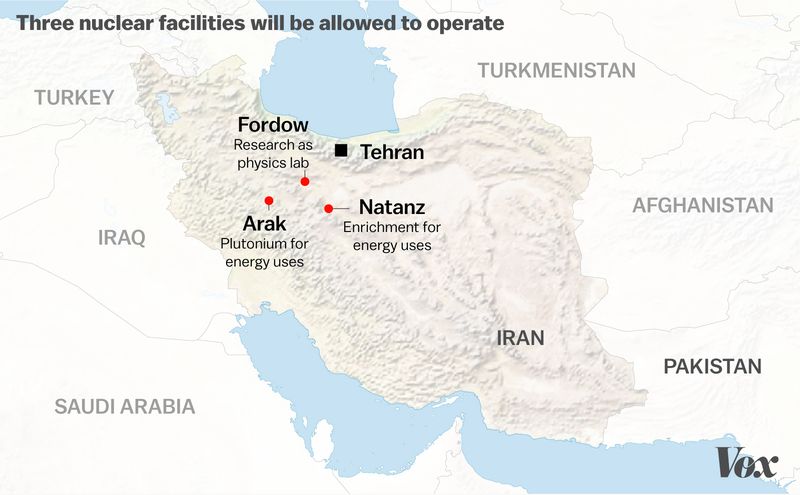
The bold text at the top of the map above is misleading. Iran currently has 18 nuclear facilities and nine additional locations (all hospitals) where nuclear material is used. All of these facilities – not just three, as Vox says – will continue to operate. All of them have long been declared to the International Atomic Energy Agency (IAEA) and all are under agency safeguards and open to regular monitoring and inspection. At least four times a year for the past dozen years, the IAEA has consistently continued to “verify the non-diversion of declared nuclear material at these facilities” to military and weaponization programs.
The three facilities Zarracina focuses on, however, are especially important. Two – Natanz and Fordow – are operational enrichment facilities; the other is a nuclear research reactor still under construction at the Arak complex.
In his explanation of the limitations Iran has accepted on its nuclear program, Zarracina claims the following:
The Arak facility matters because Iran has used it to develop plutonium, another nuclear fuel that can be used for energy or for a weapons program. Iran will be required to restructure its plutonium plant at Arak such that it will only make energy-grade plutonium, and will ship out its spent plutonium. The Arak facility will also be monitored.
Each of Zarracina’s three sentences contains either egregious errors or is explicitly misleading. His explanation is, as a result, just the opposite – an embarrassing exercise in ignorance and disinformation.
Let’s take the sentences one by one:
“The Arak facility matters because Iran has used it to develop plutonium, another nuclear fuel that can be used for energy or for a weapons program.”
For starters, the reactor at Arak remains under construction and has never been operational; therefore, Iran has never – ever – “used it to develop plutonium.” The reactor has in fact never been “used” to do anything. It’s never even been turned on.
Zarracina is clearly confused as to what facilities Arak contains, what those facilities do, and what Iran has done with these facilities. At Iran’s Arak complex, two facilities are relevant in this discussion: one is the IR-40 heavy water research reactor, the other is a heavy water production plant (HWPP). There is no such thing as a “plutonium plant” on the site.
The half-built IR-40 reactor is under full IAEA safeguards and is visited regularly by inspectors; the production plant, however, is not under safeguards and thus not legally subject to inspections. This is less alarming than it might sound and here’s why: heavy water is not nuclear material, it merely acts as a moderator and coolant in nuclear reactors that use natural uranium rather than enriched uranium. Still, Iran voluntarily provided IAEA inspectors access to HWPP in August 2011 and again in December 2013, even though this exceeded Iran’s legal obligations to the agency.
The IR-40 reactor at Arak – like all reactors – produces energy, not nuclear fuel. It runs on nuclear fuel. And once that fuel is used, it becomes irradiated and must be extracted from the reactor and replaced with new fuel.
All reactors that use uranium (natural or enriched) as fuel produce plutonium as a waste product. Ever heard of nuclear waste? Yeah, that includes plutonium, which hypothetically can be used to produce nuclear weapons. The amount of weapons-capable plutonium produced as a byproduct in the spent nuclear fuel of a heavy water reactor is usually more than what naturally occurs in the spent fuel from light water reactors, which run on enriched uranium and use normal water as coolant. This is why the Arak reactor in particular is considered by some to be an unacceptable proliferation risk.
But there’s more: weapons-grade plutonium present in irradiated (used) fuel must be extracted through a process known as reprocessing before it can be used for anything else. Iran has no reprocessing facility and has for years agreed never to build one. The new Iran deal simply reaffirms this past decision.
As nuclear expert Martin Sevior has explained, “Going the plutonium route to nuclear weapons is more difficult than using highly enriched uranium” because Iran “would have to build a sophisticated reprocessing plant which would be very hard to conceal while constructing, and requires even greater skill to conceal while operating.” Considering Iran has the single most scrutinized nuclear energy program on the planet and is constantly spied on by its adversaries,
Vox‘s writers seem to think that once a heavy water reactor is switched on, out pops weapons-grade plutonium, ready to be loaded into the nose cone of a ballistic missile bound for Tel Aviv or Boca Raton. This is not the case.
“Iran will be required to restructure its plutonium plant at Arak such that it will only make energy-grade plutonium, and will ship out its spent plutonium.”
Ok, again, there is no such thing as a “plutonium plant at Arak,” so that’s wrong. As part of the final agreement between Iran and its six negotiating partners, the Arak reactor will be redesigned and rebuilt so that it runs on 3.67% enriched uranium, not natural uranium, and no longer produces weapons-grade plutonium as a waste product. This essentially means Arak will be converted from a heavy water reactor to a light water reactor.
Once operational, the Arak reactor will be used for “peaceful nuclear research and radioisotope production for medical and industrial purposes,” just as Iran originally intended.
Zarracina compounds his misunderstanding of what nuclear reactors do and what they produce with the claim that Iran “will ship out its spent plutonium.” Reactors don’t produce “spent plutonium.” They produce spent uranium, the substance that actual fuels reactors, which, after irradiation, contains (along with many other radioactive byproducts) both plutonium isotopes Pu-239, which is suitable for weapons, and Pu-241, which is not. Plutonium enriched to more than 97% Pu-239 is dangerous; the more it is contaminated by Pu-241, the less danger it poses. The length of time nuclear fuel stays in a reactor determines how much of each plutonium isotope is leftover once the fuel is used up and removed from the reactor core. The longer the fuel stays in the less Pu-239 there is and the more Pu-241 there is. That’s why Pu-239, which is combustible, is referred to as “weapons grade,” while Pu-241 is known as “reactor-” or “energy-grade” plutonium. None of this plutonium, in whatever form, is used to fuel reactors; it is the byproduct of fuel, not the fuel itself.
And, again, for this plutonium byproduct to ever be used in a nuclear weapon, it must first be isolated and extracted from the spent fuel through reprocessing, which Iran is not incapable of – and not interested in – doing.
“The Arak facility will also be monitored.”
Ok, here’s an easy one. In simple terms, yes, Zarracina is correct. Arak will be monitored. But this statement is misleading without context. As mentioned already, Arak is already monitored by the IAEA – this is not a new development as a positive consequence of the Iran deal. Zarracina makes it sound like Iran finally agreed to put Arak under IAEA safeguards, but that’s not even remotely true.
In truth, even before Hassan Rouhani was elected president, Iran’s delegates to the IAEA under Mahmoud Ahmadinejad were urging international “nuclear monitors to use powerful new detection technologies to dispel international concern that the Persian Gulf country is seeking to build atomic weapons,” reported Bloomberg News. “We always welcome the agency to have more sophisticated equipment, to have more accuracy in their measurements, so that technical matters will not be politicized,” Iranian Ambassador to the IAEA Ali Asghar Soltanieh said in early June 2013, adding that Iran “won’t object to IAEA monitors using new technologies to determine whether plutonium is being extracted from spent fuel at its new reactor in Arak.”
Ignoring Facts and Avoiding Responsibility
Writers and editors at Vox have a responsibility not to mislead their readers. Sure, nuclear technology is complex and journalists on deadline don’t always have time to study a lot of the details. But once errors are pointed out, Vox‘s editors should do their best to own up to and correct their mistakes and those of their writers. When it comes to their Iran coverage, this tends not to happen at Vox. Quite the contrary, fact-checking Vox on Iran’s nuclear program often results in hostility and dismissal from Vox staff.
At the very least, Vox should immediately stop referring to the research reactor at Arak as a “plutonium plant.” This is easy to do: call it what it is and stop misleading readers. Instead, due to either a stubborn allegiance to ignorance or extreme laziness, Vox has continued to misinform it audience about the Iranian nuclear program. Unless facile and faulty explanations are its editorial mission, Vox should do better.
Erodoğan and Netanyahu Declare War
By James Petras :: 07.31.2015
The rulers of the two most powerful authoritarian regimes in the Middle East are launching major wars to reconfigure the Middle East. Israeli Prime Minister Netanyahu has declared war by proxy on Iran, announcing full-scale military mobilization within Israel (July 27 -29) and organizing the biggest political campaign of ultra Zionist Jews in Washington.
The purpose of this two-pronged propaganda blitz is to defeat the recently signed US-Iranian agreement and start another major Middle East war. Ultimately, Netanyahu intends to take care of his ‘Palestinian Problem’ for good: complete the conquest and occupation of Palestine and expelling the Palestinian people from their homeland – the single most important foreign policy and domestic goal of the Jewish state. In order to do this, Israeli leaders have had to systematically campaign for the destruction of the Palestinians regional supporters and sympathizers – Iraq, Libya, Syria, Lebanon and Iran.
Erodogan’ s Multiple Wars
At the same time, Turkish Prime Minister Erodogan has launched a major war against the Kurdish people and their aspirations for a Kurdish state. This has followed closely on several recent incidents beginning with the bombing (with cooperation from Turkish intelligence ) of a Kurdish youth camp, killing and wounding scores of young secular activists. Within days of the massacre of Turkish-Kurdish youth, Erodogan ordered his air force to bomb and strafe Kurdish bases within the sovereign territories of Iraq and Syria and Turkish security police have assaulted and arrested thousands of Kurdish nationalists and Turkish leftist sympathizers throughout the country. This has all occurred with the support of the US and NATO who provide cover for Erodogan’s plans to seize Syrian territory, displace Kurdish civilians and fighters and colonize the northern border of Syria – under the pretext of needing a ‘buffer zone’ to protect Turkish sovereignty. Such a massive land grab of hundreds of square kilometers will end the long standing support and interaction among Syrian, Iraqi and Turkish Kurdish populations who have been among the most effective opponents of radical Islamist groups.
Erdogan’s newly declared war on the Kurds has complex domestic and regional components (Financial Times 7/28/15, p 9): Within Turkey, the repression is directed against the emerging electoral-political power of the Kurdish People’s Democratic Party. Erodogan plans to discredit or outright ban this political party, which had won a surprising number of seats in the recent parliamentary election, call for new elections, secure a ‘majority’ in Parliament and assume dictatorial ‘executive powers’.
Regionally, Erodogan’s invasion of Syria is part of his strategy to expand Turkey’s borders southward and westward and to provide a platform from which Turkey’s favorite jihadi clients can launch assaults on the secular government in Damascus and Aleppo. The bombing of Kurdish villages and camps in Iraq and Syria are designed to reverse the Kurd’s military victories against ISIS and will justify greater repression of Kurdish activists backing autonomy in southeastern Turkey.
Erodogan is counting on Turkey’s agreements with the US and NATO for overt and covert collaboration against the Kurds and against Syrian national sovereignty.
Netanyahu’s Proxy Wars
Netanyahu’s multifaceted political offensive is designed to drag the US into a war with Iran. His strategy operates at many levels and in complex complimentary ways. The immediate target is the nuclear agreement recently signed between the White House and Iran. Part of the longer-term strategy to destroy Iran includes the formation of a coalition of Middle East states, especially Gulf monarchies, to encircle, confront and provoke war with Iran. This political-military strategy is being pushed by leading Zionists within the highest circles of the US Government.
All the major Israeli political parties, and most Israeli voters support this dangerous policy against Iran. The Presidents of the 52 Major American Jewish Organizations in the US have been mobilized to bully, bribe and bludgeon the majority of Congress into following Netanyahu’s dictates. Every US Congressperson is being ‘visited’ and presented with propaganda sheets by leaders, activists and full time functionaries of AIPAC, the Jewish Confederations and their billionaire political donors. All the major US press and TV media parrot Netanyahu’s call for ‘war on the peace accord’ despite massive US public opinion against any escalation of the conflict.
At the highest levels of US Executive decision-making top Zionist officials avoid association with AIPAC’s public polemics and thuggish bluster, all the while promoting their own political-military ‘final solution’ … for eliminating Iran as an adversary to Israeli-Jewish supremacy in the Middle East. In the State Department and Departments of Commerce, Defense and Treasury, US-Israeli agents acting as special Middle East advisers, ambassadors and insiders push Netanyahu’s policies to undermine any normalization of relations between the US and Iran.
A recent proposal written by Professor Phillip Zelikow in the Financial Times (7/23/15, p. 9 ) entitled “To Balance (sic) the Nuclear Deal, Defeat ISIS and Confront Iran” is chilling.
The former ‘Executive Director of the ‘9/11 Commission Investigation Report’, uber-insider Zelikow promotes the formation of an ingenious coalition, in the name of fighting ISIS, but whose real purpose is to “confront Iranian ambitions”. Zelikow’s “coalition” includes Turkey, which will be assigned to attack Iran’s regional allies in Syria and Lebanon (Hezbollah) – all in the name of “fighting ISIS”.
The bland, bespectacled and most respectable Professor Zelikow lays out Netanyahu’s own bloody hit list down to the most minute detail – but tidied up with a thin veneer of ‘confronting ISIS’ to obscure his real agenda. This is no blustering AIPAC thug or open Neo-Con war monger beating the drums…
Zelikow’s ‘anti-ISIS coalition’ will ultimately go after the Iraqi Shia militia and their main supporters among Iran’s Revolutionary Guard – hewing closely to Netanyahu’s strategy!
Zelikow was a major inside advocate of the 2003 invasion of Iraq. Twelve years after the US invaded, occupied and destroyed Iraq, Zelikow pops up again to promote a policy of sending US combat troops to serve Israel’s regional interest. He writes, “The military side [of the ‘coalition’] will need more Americans on the ground to offer meaningful combat support among the coalition”. (FT ibid).
Zelikow is clearly aware of US public opinion in favor of diplomacy with Iran and against the US engaging in more ground wars in the Middle East, when he writes that a ‘military effort is not an alternative to diplomacy.” Zelikow and his bosses in the Israeli Foreign Office know any US military intervention with such a “coalition” would lead to the destruction of the US-Iran Agreement and another major ground war with US troops fighting for Israel once again!
Considering his position as a highly connected insider, Zelikow’s attempts to sabotage the Iran-US agreement presents a far greater danger to world peace than all the noisy lobbying by the 52 Zionist organizations active in Congress.
Zelikow has been a highly influential security adviser to the US Executive and State Department since the early 1980’s under Reagan. He was appointed ‘special adviser to the State Department’ in 2007, a position held earlier by Neo-Con operative Wendy Sherman and followed by war-monger, Victoria Nuland. In 2011 President Obama appointed him to the President’s Intelligence Advisory Board.
He came to national prominence when President Bush appointed him Executive Director of the 9/11 Commission where he directed the highly controversial (and highly censored) 9/11 Commission Report against much public opposition. The appointment was made after Bush first choice of Henry Kissinger had created a media storm – Kissinger was never a serious choice with an insider-gatekeeper like Zelikow waiting in the wings. He was a controversial choice because of his role as intimate advisor to Condaleeza Rice and his authorship of the notorious Bush national security strategy promoting pre-emptive war, published in September 2002.
Phillip Zelikow suppressed any discussion of Israel’s role as a major catalyst for US involvements in the Afghan and Iraq wars. As executive-director of the 9/11 Commission Report, Zelikow assumed the role of editor and censor. He ignored the history of Israeli Mossad operations in the US, especially in the run-up to the attack on September 11, 2001. The report made no mention the fake ‘moving’ van filled with Israeli spies arrested on September 11, 2001 while celebrating and photographing the destruction of the World Trade Center complex. Nor did he discuss the quiet ‘deportation’ of the Israeli agents. The report contains no discussion of the scores of phony Israel “art students” who operated in South Florida around US military installations and in the vicinity of the apartment of the alleged 9-11 hijackers. They too were quietly arrested and deported.
He also suppressed discussion of the Defense Department’s ‘Able Danger Project’, which showed US intelligence awareness of the hijackers presence and activities much earlier dating back to 1997.
In October 2001, the first ‘anthrax attack’ occurred – first sickening and killing a photojournalist at a scandal sheet in Florida. National news programs featured an interview with… the re-packaged ‘al Qaeda’ and ‘bioterrorism’ expert Professor Zelikow (his lack of Arabic and scientific credentials notwithstanding…) who declared the anthrax to be ‘weapons grade’ and ‘definitely from a state sponsored military lab’, implying Iraq. (He was correct in the ‘military lab’ part of his declaration – only the facility was the US Weapons Lab at Fort Detrick. Zelikow’s role in accusing the embargoed and beleaguered regime of Iraqi President Saddam Hussein of the anthrax hysteria was crucial in the public build-up for the case to invade Iraq, echoed Israeli Prime Minister Ariel Sharon’s call for the destruction of Iraq. Master-performance complete, ‘scientist’ Zelikow’s interview (among others) has disappeared from the ‘web’.
Zelikow’s ‘expertise’ (such as it is) and usefulness to Israel derives from his articles on the political usefulness of ‘false flags’ and catastrophes – events concocted or instigated by imperialist powers to push a traumatized public into unpopular wars and draconian domestic police state policies. His work has centered on the manipulation and exploitation of ‘events’ to push public policy – and include the Cuban Missile Crisis, the re-unification of Germany, policing Northern Ireland, (but not Middle East studies or bio-weaponry’). His expertise is in the historical use of the ‘public myth’- whether the Riechstag Fire or Pearl Harbor. In Foreign Affairs, November-December 1998, he co-authored an article with the current US Defense Secretary Ashton Carter, entitled Catastrophe Terrorism where a ‘watershed event’ could result in ‘horror and chaos’ pushing the US public to accept the destruction of ‘their civil liberties, wide-spread surveillance, detention and use of deadly force…’
Zelikow continues to push the “false flag” script: In 2001 with the “anthrax hysteria” and now with the “Iran threat hysteria” . . . What is not surprising is that in both instances he hews closely to Israel’s strategic goal of utterly destroying countries, which have opposed Israel’s dispossession, occupation and expulsion of Palestinians – Iraq, Syria, Libya, Lebanon and now Iran.
Zelikow is a long-term, major asset for Israel, working quietly and effectively while the AIPAC bullies break down the doors of Congress. He never held a prominent position in the Cabinet or White House post like the brazen Zion-Cons Wolfowitz, Feith, Libby, Perle, Abrams and Levey who aggressively pushed the country into war with Iraq. Wolfowitz and company have scuttled back into obscurity under the cover of lucrative private positions while Zelikow continues to work inside pushing the Iran war agenda out of the limelight.
Zelikow’s role is far more discrete and important to Israel over the long haul than the loudmouths and thugs of AIPAC and other Zionist fronts. On the surface he pursues his academic and university administrative career (an excellent cover) while repeatedly inserting himself into crucial public discussions and quietly assuming strategic positions to advise on events or policies which have ‘turning point’ consequences and where his deep ties to Israel are never discussed.
Zelikow has one asset, which his bullying and blustering Zionist comrades lack and another which he shares with them. Zelikow is a great con-man – claiming knowledge about anthrax, Middle East relations, and military strategy. He spouts …. pure unadulterated rubbish with authoritative finesse!.. Claiming legal and investigative expertise he controlled the 9/11 Commission Report and denied the American people any open and relevant discussion of the event. He even likened the Commission Report skeptics to ‘an infection’ within American public opinion – apparently relying on his ‘expertise’ in biological warfare…
What Zelikow does have in common with the raging bulls of Zionism is his constant resort to vituperation against any country or movement identified as a target by Israel. He consistently refers to the secular government of Syria (under attack by jihadi terrorists) as a “terrorist regime”. He calls the Iraqi militia fighting ISIS “Shia torture squads”. This is part of a build-up to push the US into ground war for Israel against Iran and its allies.
Unlike Turkey’s Erodogan who uses his own armed forces to launch an all-out war to dispossess, terrorize and colonize ethnic Kurdish territories in Syria, Iraq and Turkey, Israel’s Netanyahu relies on his overseas (US) high level operatives to set in motion the wheels of war. Within days of attacks of September 11, 2001, Israel’s leading mouthpiece in the US Senate, Joseph Lieberman presented the roadmap for US wars for the next decade and a half – declaring that “the US must declare war on Iraq, Syria, Libya, Lebanon and Iran”, despite the complete absence of these countries’ involvement in the event.
Is he a prophet or just a highly successful agent? Zelikow will push for a ‘coalition’ of Middle East dictators and monarchs to fulfill Israel’s dream as dictated by Joseph Lieberman in September 2001. This is a dream of waging devastating war against Iran leading to its partition, similar to the de facto partition of Iraq, Syria and Libya, resulting in a Middle East forever ravaged by sectarian strife, foreign occupations, balkanized and devoid of any possibility of regaining civilized life. Israel can then carry out its brutal final solution: the dispossession and expulsion of all Palestinians and establishment an expanded, purely Jewish state – surrounded by unspeakable destruction and destitution…
Conclusion
Erodogan expands ‘Turkoman frontier’ into Syria and Iraq – despite the fact that Turkey has never shown any interest in the Turkoman minorities. To that end, he allies with ISIS terrorists to uproot Kurds, everywhere extending into Turkey. Erodogan, like, Netanyahu, wants a ‘pure’ ethnic state – one Jewish, the other Turkish! Both brutal leaders have no regard for the sovereignty of neighboring states, let alone the security of their civilian populations. Both depend on the military support of the US. Both are in the process of igniting wider and more destructive wars in the Middle East. Netanyahu and Erodogan want to reconfigure the Middle East: Turkey seizes Kurdistan and Syria; Netanyahu expands military dominance in the Persian Gulf through the destruction of Iran.
These two leaders appear to hate each other because they are so similar in arrogance and action… But according to Professor Zelikow, the US will step in ‘god-like’ to ‘mediate’ the different power grabs among what he mindlessly refers to as the ‘partners of the coalition’.
Obama and Kerry Play with Fire on Iran Agreement
By Sheldon Richman | Free Association | July 29, 2015
Barack Obama and John Kerry are playing with fire. They presumably want Congress and the American public to accept the nuclear agreement they and four other governments struck with Iran, but they work against their own objective by accepting the false premise of their opponents: namely, that Iran’s regime is untrustworthy, dangerous, bent on becoming a nuclear power — and containable only by a U.S. readiness to wage war.
Who knows if the president and secretary of state really believe this? But they ought to know that this premise is wrong.
Their incentive to accept the false premise is obvious. Neither wants his obituary to declare that his greatest achievement was to persuade Iran not to develop a weapon it had no intention of developing.
On announcing the deal Obama said, “Today, because America negotiated from a position of strength and principle, we have stopped the spread of nuclear weapons in this region. Because of this deal, the international community will be able to verify that the Islamic Republic of Iran will not develop a nuclear weapon.”
Likewise in remarks to the Senate Foreign Relations Committee last week, Kerry said, “So this isn’t a question of giving them [Iran] what they want. I mean it’s a question of how do you hold their program back, how do you dismantle their weapons program….”
Hence, Obama and Kerry endorse the claim that Iran was seeking to build nuclear weapons. The long negotiating process was based on that premise. So they must now insist that the agreement contains leak-proof verification, because like their opponents, Obama and Kerry say the Iranians cannot be trusted. But the hawks demagogically ignore that part of the administration’s case and claim the agreement does depend on trust; Iran can and will cheat, the hawks say, no matter what verification measures are in place. They can even quote Wendy Sherman, leader of the U.S. negotiating team, who once told a Senate committee, “We know that deception is part of the [Iranian] DNA.”
That’s some great way for Obama and Kerry to sell their agreement.
It would be better for Obama and Kerry to tell the truth for once: Iran has not been seeking a nuclear bomb. This has long been well-understood by American and Israeli intelligence and military agencies. As former CIA analyst Ray McGovern points out, George W. Bush had to give up plans to attack Iran in 2007 because a National Intelligence Estimate signed by all 16 U.S. intelligence agencies found that Iran had stopped (alleged) research on nukes four years earlier. This conclusion was renewed regularly in subsequent years. In fact, as Gareth Porter notes, “US national intelligence estimates during the Bush administration concluding that Iran had run such a program, including the most famous estimate issued in November 2007, were based on inference, not on hard intelligence.”
We have many other indications of Iran’s non-interest in nukes, all of which are documented by Porter, the man who literally wrote the book on the case. (See Manufactured Crisis: The Untold Story of the Iran Nuclear Scare.) We know, for example, that Iran’s Supreme Leader, Ali Khamenei, issued a religious edict (fatwa) against nuclear weapons. We know that when Iran could have bought weapons-related equipment from an illegal Pakistani network, it did not. We know that for years Iran tried every way to avoid having to enrich uranium for its power plants but was thwarted each time by the U.S. government. Finally, we know that when the Iranian government could have made chemical weapons to retaliate for Iraq’s U.S.-backed chemical warfare against Iran in the 1980s, then-Supreme Leader Ruhollah Khomeini forbade it on religious grounds.
Despite this, it is open season on Iran. Most everyone feels he can level any charge against it without providing a scintilla of evidence. Most common is the charge that Iran is the “chief state sponsor of terrorism.” But does anyone bother to prove it? It requires no proof. It’s the Big Lie, and it serves the war party’s agenda. (For evidence to the contrary see these two pieces by Ted Snider.
The P5+1 agreement, though unnecessary, is preferable to war. Obama and Kerry should stop thinking about their legacies and start leveling with us.
Another Iranian Non-Threat
By Sheldon Richman | Free Association | July 28, 2015
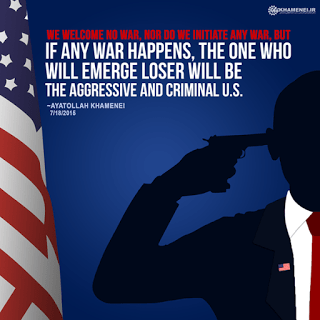 This image tweeted by Iran Supreme Leader Ayatollah Ali Khamenei has a lot of people upset. Is it supposed to be Barack Obama holding a gun to his own head?
What if it is? The picture is hardly threatening or aggressive in any way. After all, it’s not a picture of Khamenei holding a gun to Obama’s head.
And look at the text:
We welcome no war, nor do we initiate any war, but if any war happens, the one who will emerge loser will be the aggressive and criminal U.S.
That is not aggressive in the least. On the contrary, it rejects war. Who’s been threatening war against whom? The U.S. government (along with Israel) has been threatening war against Iran. Even after the nuclear agreement was signed, Secretary of War Ash Carter reiterated that war against Iran is still an option. So all Khamenei is saying is that if the U.S. government starts a war, it will lose. It will be as though Obama had pointed a gun at himself and pulled the trigger.
In the past, Iran’s pledges to retaliate if attacked have always been presented by the news media and politicians as though they were threats to initiate war. This is happening again.
When will the media and the hack politicians be straight with the public? Iran has threatened to attack no one, but the U.S. and Israeli governments, both with nuclear weapons, routinely threaten to attack Iran. Who is the criminal?
US Concerned About Increased Russia-Iran Trade Cooperation – Senator
By Leandra Bernstein – Sputnik – 24.07.2015
WASHINGTON — On July 14, the P5+1 countries — the United States, Russia, France, Britain, China, and Germany — reached an agreement with Iran to relieve economic sanctions in exchange for assurances that it will not seek to develop or acquire a nuclear weapon.
“We know, though, under the terms of this agreement, that Russia will have no hesitancy to be involved in Iran’s economy, and that is a concern.”
Cardin, ranking member of the US Senate Foreign Relations Committee, noted that regardless of the nuclear agreement, the expansion of trade between Russia and Iran “has always been a concern.”
The United States has already expressed disapproval over Russian plans to deliver a S-300 air defense system to Iran, fulfilling a contract from 2007. Washington, however, has acknowledged the legality of the deal.
Enhanced Russian-Iranian trade could also result from future Iranian membership in the Shanghai Cooperation Organization (SCO), a proposition discussed on the sidelines of the recent SCO meeting in Ufa, Russia earlier in July.
Featured Video

Death Spikes & Rising Cancer In Our Youth Explained
or go to
Aletho News Archives – Video-Images
From the Archives
Politicians lie
By Mazin Qumsiyeh | Popular Resistance | August 18, 2013
There is no way to say this truth nicely: Politicians lie. That includes Japanese, American, Egyptian, Israeli, and Palestinian politicians! Is there something more common sense than that? Yet, so many citizens around the world believe their own politicians or wistfully acknowledge lies but think it is part of the job needed to run things. They believe even when politicians contradict themselves blatantly. This phenomenon is rather remarkable. It is a dissonance and disconnect from reality that many seem oblivious to. It is very dangerous because it can lead to accepting rationales for going to war. These can be deadly wars that lead to millions of lives lost as happened in what was called World War 1 and WW2. Even when incredible and declassified evidence abound, politicians continue to lie and old mythologies refuse to die. Here are just a few of the countless lies told to us over the past few decades… continue
Blog Roll
 Aletho News
- From Unipolar Universalism to Multipolar Civilizational Distinctiveness
- RSF military group defects, joins Sudanese army: State media
- Ireland goalkeeper refuses to play ‘Israel’ as squad weighs boycott
- China pushes back against US on Cuba, Iran
- Ukrainian Soldiers, Potential Mercenaries: Have Gun, Will Travel!
- Burnham’s UN debut… A masterclass in British disinformation
- Iran flights continue despite US aviation sanctions
- Global Tipping Points Lead the World Into a State of Entropy
- The day-after at the White House: USA and Xi Jinping
- The Geopolitical Balance in the Red Sea: The UAE Being Displaced by New Players
- If Americans Knew
- Deconstructing Netanyahu’s pants-on-fire UN rant – Daily Update
- Trump betrayed voters with his campaign lies and prioritized a foreign country once he took office
- Netanyahu calls Israel’s war in Gaza ‘opposite of genocide’ in UN speech to near-empty hall
- Settler Kidnappings: Torture, Sexual Abuse and Terrorisation of Palestinian Abductees as Israel Deepens Annexation of West Bank
- Gaza winter nears as 162,000 tents become unusable, raising fears of humanitarian crisis
- Netanyahu says, “It’s the opposite of genocide”; UN says Gaza economy is world’s ‘most severe crisis on record’ – Daily Update
- Israel’s US-Backed Assault on Gaza Has Created the ‘World’s Most Severe Economic Crisis on Record’: UN
- ‘Protecting U.S. Citizens’… From Israel
- ‘This is where I live now, the back of a truck’: a day in the life of a grandmother in Gaza
- In UN Speech, Iran’s President Displays Pictures of Children Killed by US, Brings Attention to Israel’s Nuclear Arsenal
- No Tricks Zone
- New Study: Earth And Venus Surface Warmth Largely Explained By Convection And Lapse Rate, Not CO2 Or Radiation
- 2025 Nature Paper Claiming Worsening Global Drought Gets RETRACTED …Heavily Flawed
- New Study: ‘Global Drought Shows No Detectable Recent Acceleration Under Climate Warming’
- Economic Masterminds: German Socialists Suggest Taxing Productivity Gains Stemming From Using AI
- The South China Sea Has Not Been Cooperating With The Climate Change Narrative
- Energy Crisis: Germany Enters Heating Season With Historically Low Gas Reserve Fill Levels
- New Study: The Antarctic Ice Sheet Gained Mass From 2020-2024 Due To Staggering Snow And Ice Accumulation
- Study: Ocean Heating Rates From Thousands Of Years Ago ‘Dwarf’ Modern Ocean Heating Rates
- Climate Extremists Target, Attack Large-Scale Power Grid Infrastructure In Germany!
- New Study: Antarctic Ice Melt Has Contributed Less Than 1 Centimeter To Sea Level Rise In The Last 30 Years

