‘In the US, joking about war has become acceptable’
RT | July 23, 2015
Attempts at humor over bombing huge numbers of people, and inflicting death is increasingly considered acceptable and this has a subtle effect on the population, says David Swanson, blogger and activist, author of ‘War Is A Lie’.
US President Barack Obama made an appearance on America’s Daily Show hosted by Jon Stewart taking the chance for a bit of light-hearted foreign policy banter.
RT: The situation in Yemen and Iraq is no laughing matter. Is it acceptable for the President to be laughing about these subjects?
David Swanson: It really isn’t. Jon Stewart jokes “We still get to bomb people, right?” and there is no stern rebuke from the President as there is when he is accused of allowing Americans to be held hostage in Iran and not caring about them and so forth, there is no offense taken, it’s all for laughs. Who are we bombing? President Obama has no idea specifically who he’s bombing not even with drone strikes and the tangled mess that Jon Stewart points to is far beyond what he listed. Making peace with Iran in order to fight a war with Iran, going to war in Syria on the opposite side in 2014 as you were told, as you head into 2013, US weapons in the hands of Islamic State, US allies funding IS – it’s an incredible mess and Jon Stewart, although it’s his last chance, last interview with the president, makes jokes instead of asking questions. He makes a joke about trying diplomacy for once after bombs, proxies and arming and so forth, but it’s a joke, Obama doesn’t answer. Jon Stewart could have said “Why, if diplomacy is an option in one case do you not use it in all these other cases?” He didn’t ask the question.
RT: How do jokes about foreign policy influence the public?
DS: A certain segment of the public including myself is not laughing about war and doesn’t think it’s a laughing matter, but I think it influences the public very subtly that jokes about war are acceptable. I heard a weapon’s contractor on national public radio in the US joke about wanting a big new invasion and occupation when another one might be ending – ha-ha. When jokes about things like sexual abuse or racism or all kinds of cruelty, anti-morality are absolutely not acceptable, absolutely excluded from public discussion in US media, but jokes about war, about bombing huge numbers of people to death, injury and trauma are acceptable and that does have an impact.
RT: Obama had previously joked about predator drones. Does that make the matter more mundane, perhaps more acceptable? Politically, how intentional are such jokes?
DS: It points to this huge contrast in the US between the immorality of war and any other kind of immorality. President Obama this week said that jokes about rape in US prisons are absolutely offensive and unacceptable; it’s not something that should ever be joked about. The US, I believe, is the first society in the history of the world where the majority of rape victims are male and it’s in prison and it’s an epidemic. He is absolutely right, don’t you joke about it. But when it comes to war, to murder with weapons of war, spying, massive surveillance and the whole package of militarism, jokes seem to be totally acceptable – even for the President speaking to the journalists and reporters who are actually supposed to know the horror and suffering of war.
Gays who swallow unverified anti-Iran propaganda will be partly responsible if Iran is turned into another Iraq
Uprooted Palestinians | July 23, 2015
Gay hanging in Iran: Atrocities and impersonations
By Scot Long
Everybody on earth knows that last week a deal on Iran’s nuclear program was announced. Everybody also knows that this apparent step toward peace launched a new stage in an old war: of propaganda. Proponents praise the possibility of a historic opening. Opponents — who include Israel, Saudi Arabia, and the Republican Party — warn of disaster. Both sides want to expand their constituencies. In Western countries, gay communities — small but politically influential — are more and more the target for just this courtship and recruitment.
The right-wing pundit Amir Taheri greeted the nuclear deal with a storm of tweets and screeds condemning it. One 140-character charge drew special attention.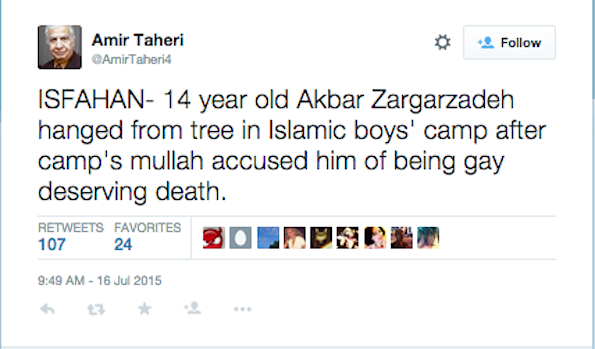 Anyone’s first reaction would be some version of “My God.” It sounded horrible. I wrote to Taheri asking for more information — and so, judging from Twitter, did at least three other people.
But the story quickly began to show cracks. Taheri didn’t reply to me, or anybody. I sat down that night with a Farsi-speaking friend and began searching for the story in the Iranian press: under the youth’s name, under various other key words. It didn’t turn up anywhere. I wrote to the Toronto-based Iranian Queer Organization (IRQO), a diaspora-based group of LGBT Iranian activists with which I’ve worked closely over the years. They searched the media as well and found no sign of it. They also reached out to contacts in Isfahan. On Friday morning, they told me no one there had heard of the story, either.
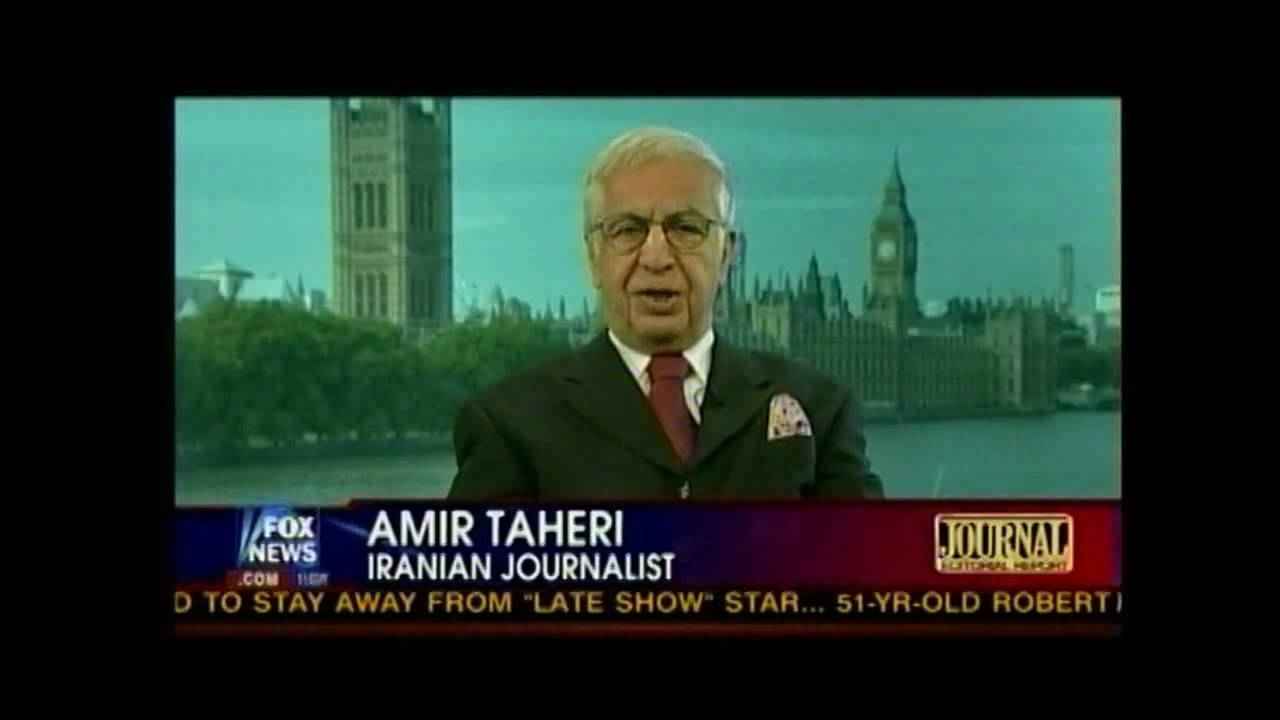
Amir Taheri lies a lot. Eight years ago, Jonathan Schwartz called him “one of the strangest ingredients in America’s media soup,” adding, “There may not be anyone else who simply makes things up as regularly as he does, with so few consequences.” An arch-conservative protege of the Pahlavis, an editor of the Tehran daily Kayhan under the Shah, he repeatedly fabricates stories about Iran to please right-wingers in his adoptive West. Most famously, in 2006 he claimed in Canada’s National Post that a new dress-code law in Iran would impose special clothes on religious minorities, including yellow badges for Jews. Many conservatives swallowed the story; even the Canadian Prime Minister repeated it. But it was a complete falsehood, and after a huge furor the National Post retracted it and apologized: “It is now clear the story is not true. … We apologize for the mistake and for the consternation it has caused.” (The Post also noted that Taheri went “unreachable” after his fiction was exposed, rather as he did on Twitter.) Undeterred, in 2008 Taheri concocted a quote from Ayatollah Khomeini, complete with a fake citation of an invented source; American neoconservative luminaries duly repeated it. In 2002, Taheri claimed that “Osama bin Laden is dead …. the fugitive died in December and was buried in the mountains of southeast Afghanistan.” The list of his duplicities goes on and on. In 1989, an academic reviewing one of Taheri’s books
detailed case after case in which Taheri cited nonexistent sources, concocted nonexistent substance in cases where the sources existed and distorted the substance beyond recognition when it was present. … [The reviewer] concluded that Nest of Spies was “the sort of book that gives contemporary history a bad name.”
Larry Cohler-Esses condemns Taheri as a “journalistic felon,” part of a “media machine intent on priming the public for war with Iran.”
There are ample grounds for skepticism about stories Taheri spreads.
But skepticism doesn’t make headlines. Propaganda’s best friend is the ambition of the press. On Thursday, a reporter for the UK-based Gay Star News also tweeted to Taheri.
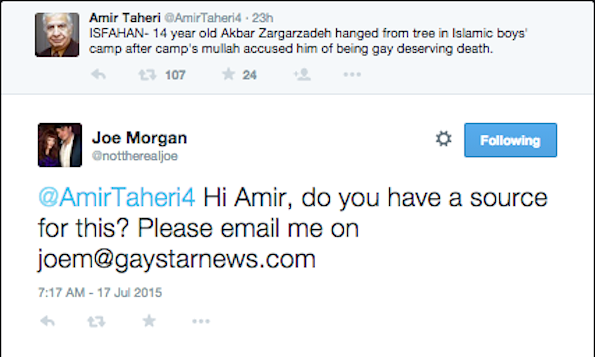
Taheri didn’t answer him, either. I know this because the reporter didn’t wait for a source. About 25 minutes later, his story — “GAY TEEN, 14, ‘HANGED FROM TREE’” — topped the website of Gay Star News, and it said Taheri hadn’t told them anything. In other words, their entire account was based on one single tweet with no evidence behind it. This tweet was special, though. The topic of gay killings in Iran has shown its passionate drawing power over a decade, its ability to keep queers clicking. GSN wanted the clicks for itself.
The reporter clearly never asked Iranian LGBT activists or groups for their take. It was more important to get the headline out there. I wrote to Tris Reid-Smith, GSN’s editor, and asked “Is this standard practice — to run a story based on a single, unsourced, unconfirmed tweet from someone who declines to answer follow-up questions?” Tris rather cannily refused to reply in writing; he wanted to talk by phone. My phone in Cairo is tapped; I declined. I wanted this on the record, but not State Security’s record. If Tris still wants to answer my question, he is welcome to do so here. GSN has since added a few sentences to its story, saying:
we should note Iranian LGBTI networks have not confirmed the story. Some critics have questioned Taheri’s reliability. … UPDATE: For clarity, GSN has noted from the outset this report has not been independently verified. Taheri is yet to reply to our questions seeking to substantiate his claims. We urge caution but feel it is in the public interest to report the claims, given they are gaining traction on social media.
Let that final sentence revolve in your mind. What defines news these days isn’t truth. It’s traffic. (I’ve saved a screenshot of GSN’s original article, prior to the caution-urging, here.)
And of course the story spread. Neoconservative propagandist Ben Weinthal tweeted it manifold times:
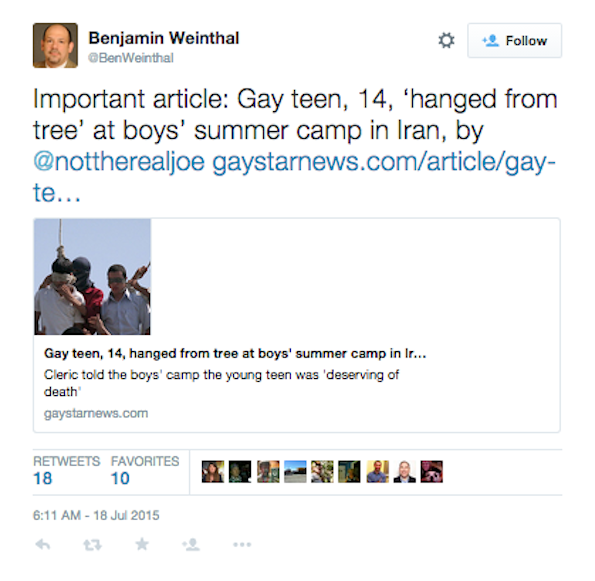 Weinthal is a lobbyist for the right-wing, pro-Israel Foundation for Defense of Democracies. One of his jobs is to drum up support in gay communities for hardline policies against Iran. I’ve detailed some of his many misrepresentations here. His desperate drive to ensure Taheri’s tweet gets coverage suggests what the motives at work are.
No one should ever minimize the real, documented, and terrible human rights abuses in Iran. But credulity for suspicious stories devalues the true ones. Given Taheri’s record, and the tangled political context, there is no reason to credit this tale without corroboration.
And here’s the thing: we’ve been through this before, and learned nothing. Look at the photo GSN attached to its article.
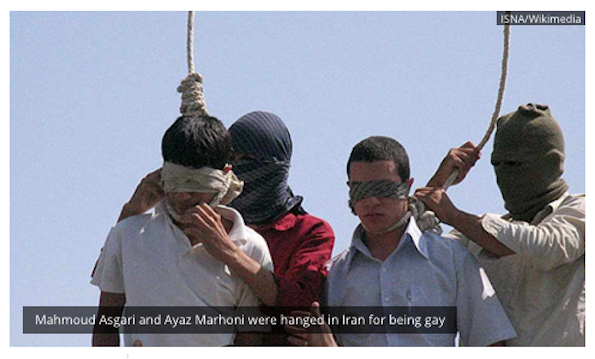 That famous image, exactly ten years old, reverberates with misery and horror. And cynics and opportunists know it as proven clickbait. In fact, the two youths were not executed simply for “being gay.” They were convicted of the rape, at knifepoint, of a 13-year-old boy. Claims that they were gay lovers circulated widely among Western activists; but no clear evidence materialized to confirm them.
International tension shaped the context, then as now. In June 2005, Mahmoud Ahmadinejad was elected President of Iran. The religious hardliner’s victory intensified foreign fears of Iran’s nuclear plans; Ahmadinejad moved quickly to quash negotiations with European powers and smear reformists as appeasers. Western conservatives stoked those fears, and rumors roiled. Immediately after the vote, a website affiliated with the Mujahedin e Khalq claimed Ahmadinejad had participated in the 1979 seizure of the US embassy in Tehran. The Mujahedin is a wealthy, cult-like Iranian exile group widely despised in the diaspora, but closely tied to many Western politicians. Amir Taheri leapt in; he alleged in print that that Javad Zarif — then Iran’s UN ambassador, now its foreign minister — had joined the hostage-taking. (Another fabrication: Zarif was studying in the US at the time.) That summer, a charged, familiar storm-cloud of fact, anxiety, and speculation swirled round the subject of Iran.
On July 19, 2005, the two teenagers were hanged in Mashhad. Reports in the local and national Iranian media said clearly they had been tried for tajavoz (rape) or lavat beh onf (“sodomy by force,” or male rape); the Quds newspaper in Mashhad quoted both the 13-year-old victim and his father. Another website of the Mujahedin e Khalq, however, published a piece on the execution aimed at Western audiences, and omitted the rape charge. Almost certainly the Mujahedin pointed out the story to lone-ranger UK activist Peter Tatchell — who had a record of publicity-seeking animosity to Iran and political Islam — and proposed the “gay” angle. On July 21, Tatchell’s OutRage website blared, “IRAN EXECUTES GAY TEENAGERS,” above the pictures taken from the Iranian press. Tatchell claimed, falsely, that Iranian media had not mentioned the rape, and that the pair were originally charged with consensual sex: setting in motion a stream of fictions that didn’t stop for months.
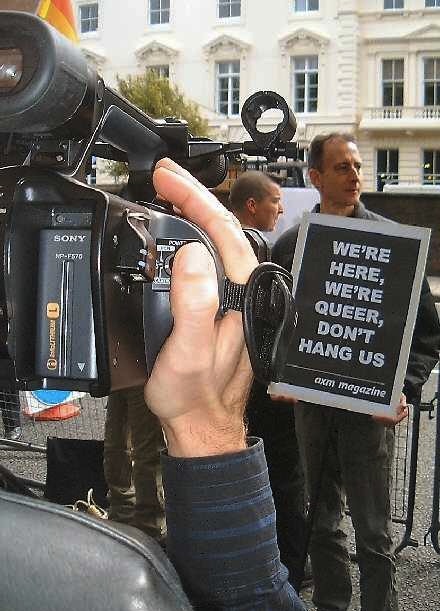
With panic over Iran already in the air, the photos went vastly viral. If politics motivated some to promote the story, for others it was publicity. (Doug Ireland, a gay US writer with no prior knowledge of Iran who nonetheless rode the story to a new journalistic job, told me his blog got 60,000 hits the first day he carried the pictures.) As more facts came out and the tale seemed less plausible, its proponents got aggressive: not only with doubters, but with the protagonists. Tatchell, for instance, belittled the alleged rape and suggested the victim wanted it: “It could be the 13-year-old was a willing participant.” Meanwhile, the story’s popularity led to a desperate search for sequels, for new “gay victims,” that stretched for years. Virtually any execution for rape reported in the Iranian media — even of male rapists of women — could be arrogated or mistranslated as a punishment for consensual gay sex. In a grim and grotesque irony, the quest helped produce the dead. In 2007, Tatchell intervened in the last-ditch appeal of an Iranian prisoner on death row, also for the rape of a 13-year-old. Makwan Mouloudzadeh had been framed in a village vendetta; there was no real evidence he’d had sexual relations with the child, much less any other male. Instead of maintaining Makwan’s innocence, though, Tatchell falsely alleged the child was Makwan’s “partner.” Allies of Tatchell started a letter-writing campaign to Ahmadeinjad pleading for the “young homosexual Makvan,” arguing explicitly that he was “‘guilty’ of having loved a peer when he was 13 and having sexual intercourse with him.” They incriminated the man they were trying to save. Makwan, neither homosexual nor a rapist, was hanged.
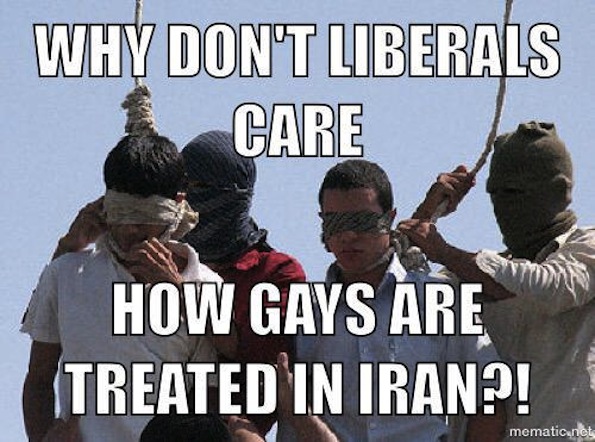
The Mashhad story survives, immune to its malign consequences. Taheri certainly knows it — he surely suspected a 14-year-old victim would make his tweet go viral. The youths’ images are memed and manipulated everywhere. Sometimes the uses are political:
 Sometimes they’re mythological figures, as if the kitsch of Shi’ite religious iconography melded with the preoccupations of San Francisco.
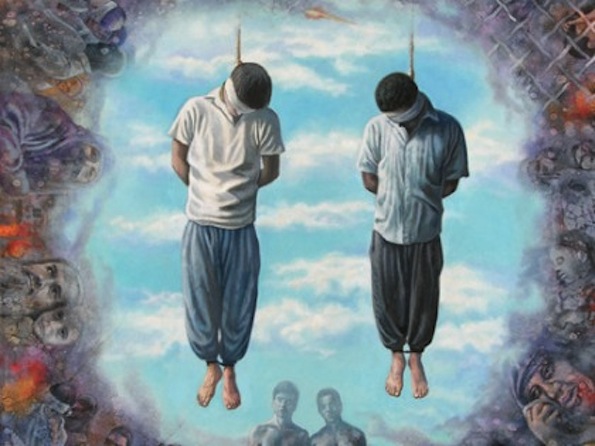
But they remain, always, “the sacred gay martyrs of Iran.”
An hour or two after the Gay Star News story appeared, Tatchell seized the opportunity, announcing a “vigil” to commemorate the tenth anniversary of the youth’s deaths.
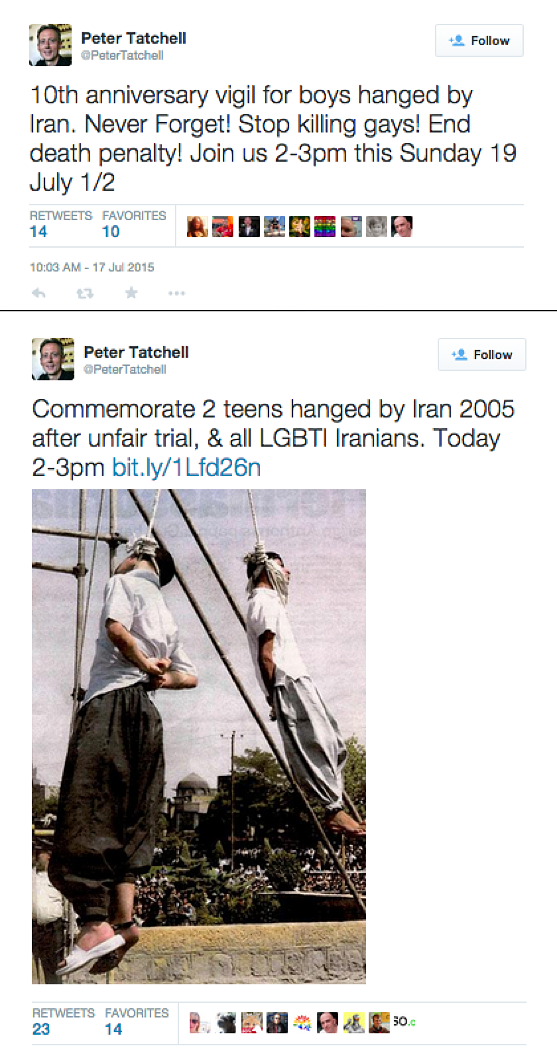 “On 19 July, we stand for life, liberty and love,” Tatchell said at the demo. But think what that rhetoric obliterates. If their 13-year-old victim’s story was true, what would he say about those words? Most human rights activists know that you can oppose grave abuses, like the appalling execution of children, without spinning narratives of absolute innocence or “love.” But to do that requires abjuring sentimentality, and acquiring maturity.
A deep narcissism lies pooled here. What does “never forget” them mean, when you never knew anything about them in the first place? No one has ever seriously sought to learn facts (rather than weave romances) about the youths’ lives; no one ever showed the least interest in the 13-year-old they allegedly brutalized; no one has ever tried to find their families, and hear what they think of their sons’ pictures being broadcast in this way, or inserted into a foreign story about “gayness.” The boys are silent. Their muteness is their appeal. They offer a clean field for Western political and erotic fantasies; they’ve withered to ventriloquist’s dolls for Western voices. The indignities they suffered before death have been succeeded by a further descent, the indignity of being erased in the imperial name of memory. What Tatchell wants remembered is not the murdered youths. It’s himself.
II.
Strangely, I took two different tacks with Amir Taheri. The day after I politely asked him for information, you could have found me on Twitter writing in quite a different tone:
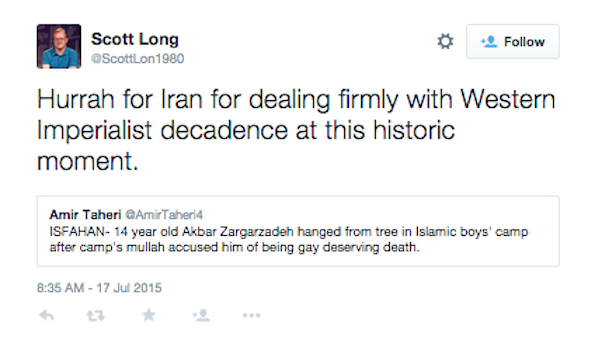 Except that wasn’t me. It was an account someone set up under my name about a week ago, which has been firing off tweets to Egyptians and various right-wing Westerners ever since. It says I’m a pro-Iran Islamist. It uses an old picture of me, and the inevitable photo of the hanged Iranian youth.
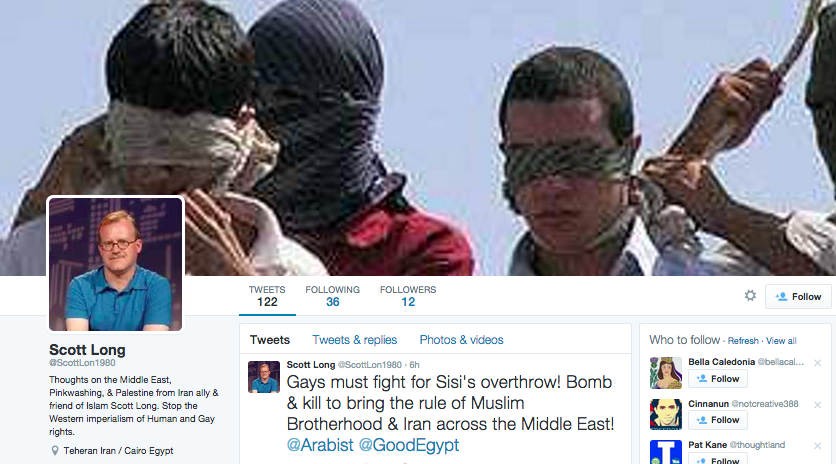
The account isn’t a “parody.” Not just that it isn’t funny: it’s trying to get me arrested. It makes out that I support banned insurgent movements and want the Egyptian government overthrown. These messages it forwards to Egyptian tweeters, including government accounts.
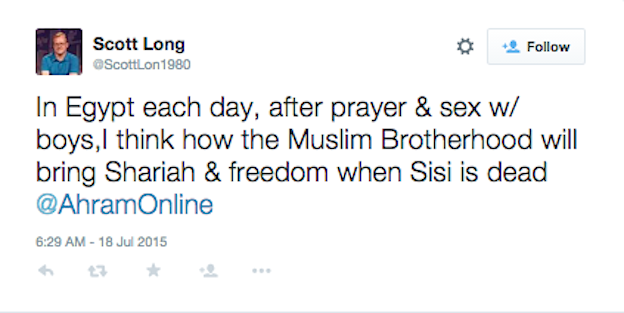
That one tweet could easily lead to a few decades in prison here. And the person who put my name to it appears quite conscious of the fact.
Who’s behind this thing? I have no idea. But I know who likes it. Here are the account’s followers when I checked it on July 16:
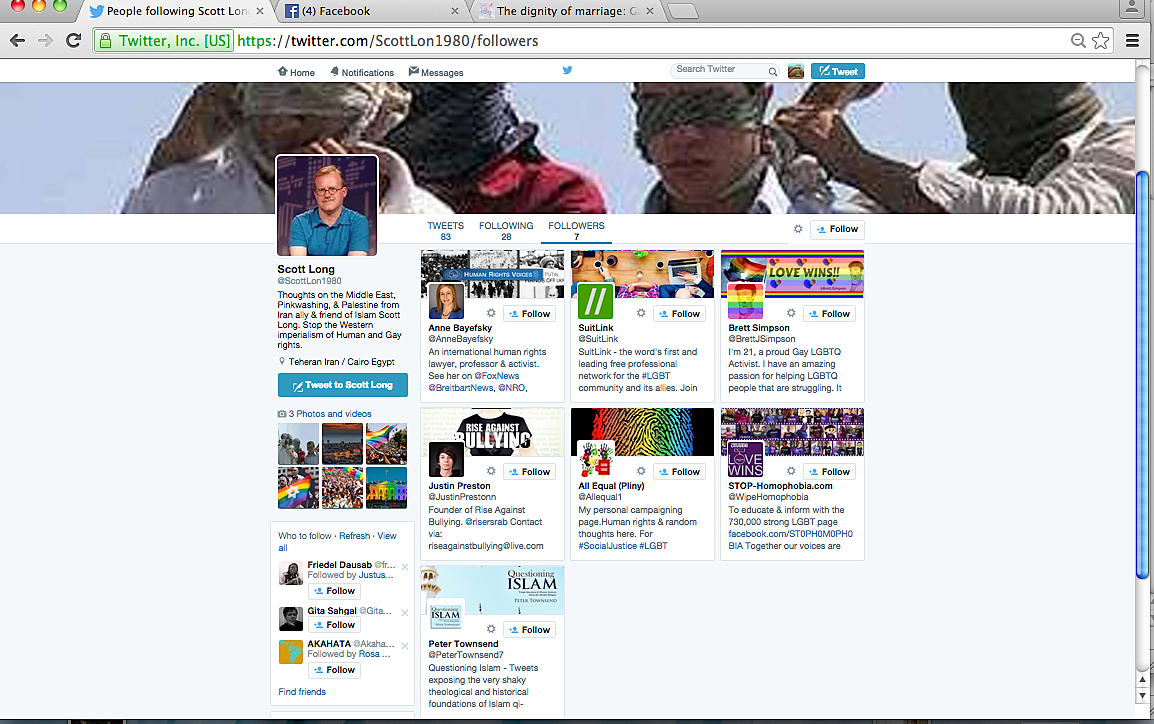
The third person who’d followed the account — out of seven at the time — was “All Equal.” That’s the Twitter of Pliny Soocoormanee, who happens to be the personal assistant of Peter Tatchell, director of the Peter Tatchell Foundation. How he found out about this obscure account when no one else knew of it, and why it interested him so much, is a fascinating question. I can’t imagine the answer.
The morning after I criticized the Taheri story on Twitter, the account exploded with vengeful drivel, directed at people inside and outside Egypt (the one at top went to the country’s Ministry of Foreign Affairs):
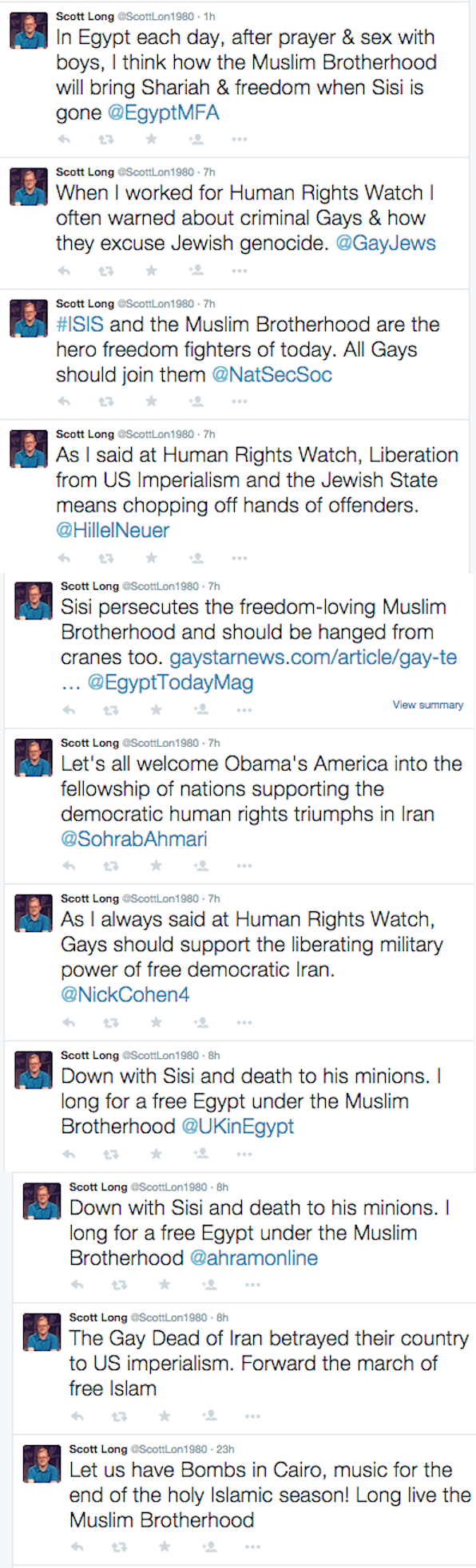 But this BS is merely typical. Apparently I work for the Brotherhood, an illegal organization here:
 My motives appear to be erotic as well as pecuniary.
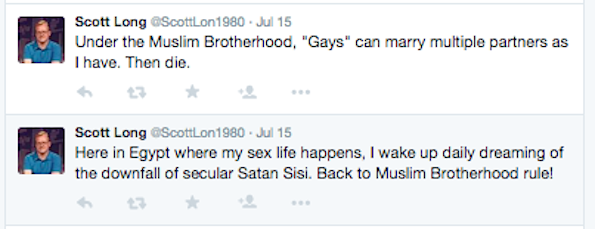 I’m also an informer.
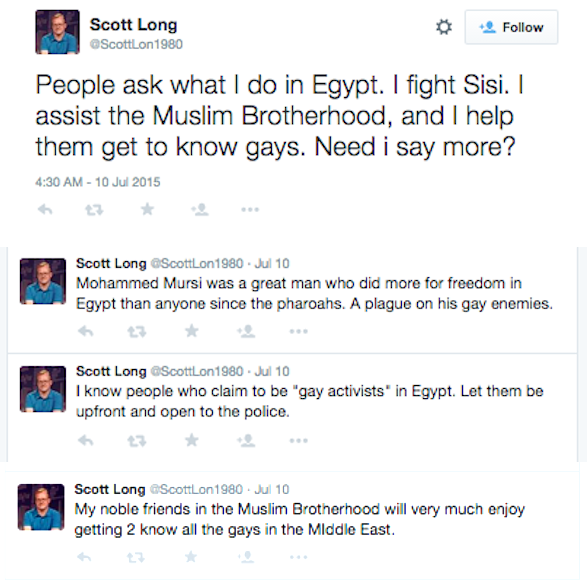
But mostly the account just strives to identify me with vicious anti-Semitic ravings, marking the intrinsic fascism of its maker’s mind. (Fascism is the politics of a cynical, corrosive narcissism. The mark of fascism is that it imagines all other opinions are as fascist as itself.)
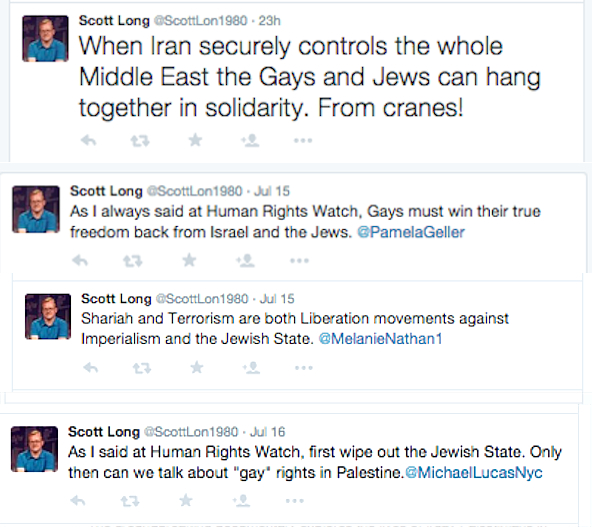
The account is pretty much coeval with the nuclear deal with Iran. Its first three tweets:

I wouldn’t pay attention to this crude fakery if it weren’t trying explicitly to incriminate me to Egypt’s government — which is arresting gay foreigners, and may not know the difference, or want to. I never cease to be surprised by the retributory malice of the Iran- and Islam-obsessed crowd, whether driven by ideology or the sheer love of headlines. They never stop.
Back in 2006, when Amir Taheri’s lies about Iran’s dress-code law were exposed, The Nation spoke to his PR agent. Accuracy on Iran is “a luxury,” she said. “As much as being accurate is important, in the end it’s important to side with what’s right. What’s wrong is siding with the terrorists.” You see? It’s us or them. Loyalty trumps truth. To expose useful lies is to take the terrorists’ side. And by that standard I am, of course, a terrorist.
Why does it matter? Because LGBT Iranians shouldn’t be exploited for propaganda. They lead lives seamed by danger, distinguished by courage; they deserve better than to be backgammon pieces, passive tokens stacked and shifted in a great-power political game. LGBT people should speak in their own voices, be masters and heroes of their own lives. That is what the liberation struggle is about.
The fact that nobody — not Tatchell, not Ben Weinthal, not Gay Star News — bothered to ask LGBT Iranian activists or groups what the truth was, or whether they wanted a demonstration, is appalling. But it’s typical. The story of Western engagement with LGBT rights in Iran has been one of occupation and ventriloquism, not freedom. It’s long past time for the sick game to stop.

NOTE: The fake account seems to have been taken down not long after I posted this: I don’t know whether by its maker or by Twitter (of course I complained). But, in some form or another, they’ll be back.
Iran’s Nuclear Deal With the P5+1: Winners and Losers
By Sasan Fayazmanesh | CounterPunch | July 22, 2015
The dust has settled and the long-awaited agreement between Iran and the P5+1 (five permanent members of the Security Council and Germany) called “Joint Comprehensive Plan of Action” (JCPOA) is now a reality. The JCPOA curtails Iran’s nuclear program in exchange for some sanctions relief. Also real is the UN Resolution 2231, which terminates all the previous sanctions resolutions against Iran passed by the United Nations Security Council. We can now announce the winners and losers in the 36-year battle between Iran and its adversaries.
Let us start with the biggest loser in this battle, the colonial regime in Palestine called Israel. Since the 1990s Israeli leaders, particularly Benjamin Netanyahu, had been trying to wage a war against both Iraq and Iran, the twin pillars standing in the way of Eretz Yisrael. But they tried to do this on the cheap, sending American boys and girls to kill and get killed. They were successful in the case of Iraq, but had a difficult time getting the US to wage a war against Iran. They could not even convince George W. Bush to go along with bombing Iran, even though they had planted their “neoconservative” allies around a president who was not known for his immense intelligence and had visions of talking to God before invading Iraq. The work became harder when Barack Obama became president. Once again, Israel planted some of its best lobbyists, such as Dennis Ross, in the highest positions in the White House and charged them with the task of formulating and implementing the policy of “tough diplomacy,” a policy designed to wage a military attack on Iran after a series of steps beginning with imposing the most severe sanctions on the country. Yet, however hard Israeli leaders tried, they could not get President Obama to take the last step and start a war with Iran. The job became even tougher when some of the Israeli lobbyists left the Obama Administration and Secretary of State John Kerry replaced Hillary Clinton, a sycophant who often mimicked Netanyahu when it came to Iran. In the end Israel not only could not get the US to attack Iran, it had to witness the entire policy of “tough diplomacy” wither away.
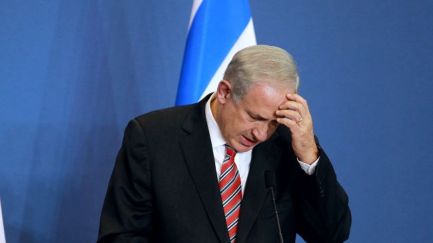
The failure to make the US wage a war on Iran is, indeed, one of the greatest losses that Israel has ever suffered. Ironically, the dim-witted Prime Minister of Israel played a role in this loss. Netanyahu’s bizarre behavior was, indeed, instrumental in making the P5+1 take Israel’s demands and threats not too seriously. His insane and incessant comparison of Iran to another Nazi Germany intent to commit Holocaust, his silly and continuous warnings that an Iranian nuclear bomb awaits not only Israel but Europe and the US, his ridiculous spectacle at the UN holding a cartoon of an Iranian bomb—mocked by some as “Bibi’s Wile E. Coyote UN speech”—his behind the scene maneuvers with some like mined looney-tunes in the US to defy Obama and speak before a joint session of the US Congress, all helped to isolate Israel and prevent it from playing a major role in the final P5+1 negotiations with Iran. We should all be grateful to Bibi for helping to prevent another war in the Middle East on behalf of Israel!
Israel’s loss is, of course, also the loss of its surrogates in the US. The gambling and “investor” tycoons allied with Israel, the congressmen and women who owe their seats and survival in the US Congress to these moguls, the lobbyists who are nourished by these magnates, the “neoconservatives” whose existence depends on the benevolence of these tycoons, all and all have suffered a colossal loss. The Adelson and Sabans of this world, the Cottons, Kirks and Menendezs, the AIPACs, WINEPs and UANIs, the Kristols, Boltons and Dubowitzs, have all lost big with the conclusion of the JCPOA and Resolution 2231. We should give them an “A” for effort and an “F” for the final outcome.
All this, of course, does not mean that the colonial regime of Israel and its allies are finished with trying to do to Iran what was done to Iraq. They still have a few weeks left to try to kill the US part of the bargain. But even if they muster all the needed votes against the JCPOA in the Congress, the agreement between Iran and the rest of the P5+1 will not go away. Neither will the UN Resolution 2231. That ship has already sailed!
Other big losers in the decades-old battle between Iran and the West are the medieval regimes in the Middle East, particularly in the Persian Gulf, that are nurtured and nourished by the West, especially by the Unites States. A common argument, originally manufactured in Israel, is that if Iran is allowed to enrich uranium, Arab regimes, such as Saudi Arabia, will try to develop nuclear weapons of their own. But this argument only shows how backward and reactionary these regimes are. Why didn’t these sheikhdoms try to acquire nuclear weapons when a colonial power in their midst acquired hundreds of nuclear warheads? Is it because the existence of these regimes is interwoven with colonialism? Is it because they fear resistance to colonialism? Is it because they see Iran as assisting the anti-colonial forces? Is it because they, too, had been working for decades to maintain sanctions against Iran and were hoping that one day the US or Israel or both would attack Iran? Well, the medieval regimes did not get what they wished for.
Who was the main winner in the 36-year old battle? It is tempting to say Iran. But, for reasons explained below, that would not be my first choice. My answer is actually the international corporations! As I once explained, the battle in the US over sanctioning Iran, particularly during the Clinton’s presidency, was fought between two forces, Israel and its lobby groups that were the underwriters of the sanctions, and the corporate lobby that fought to remove the sanctions. Needless to say that the corporate concern was with profit and not with the ethics of trying to starve a nation.
Over the years the corporate lobby, led particularly by the aerospace, energy and agricultural industries, lost all hopes of ever defeating its much stronger foe. Starting in the second half of the Clinton Administration foreign corporations, too, became increasingly fearful of dealing with Iran. Eventually most ties between Iran and the capitalist world economy were severed. Now, after the JCPOA, both the American and foreign corporations are salivating over the prospect of returning to Iran. Like vultures that see a fresh carcass, the capitalists of the world see a large “market” ahead of them, a country with nearly 80 million people who are mostly young and thirsty to possess commodities. Even before the final agreement was reached between Iran and the P5+1, delegation after delegation of corporate leaders started to visit Iran to reserve their seats at the forthcoming auction. But they might be jumping the gun. The sanctions that would eventually be removed are only related to the nuclear dispute. All the other sanctions, related to such things as Iran’s putative “support for terrorism” and “violations of human rights,” will remain in place.
But did Iran have a victory? I was asked this question after a talk I gave following the April Lausanne agreement. My answer was that the battle between Iran and the P5+1 is analogous to the fight between a lightweight and a heavyweight. Even before the fight begins you know who will get clobbered. The question, however, is if the lightweight will still be standing after the fight. If so, that might be construed as a victory for the lightweight. Using that analogy one can say that President Rouhani’s negotiators were victorious. They entered the talks from a position of weakness and yet they were standing at the end. In the process they crossed many of their own “redlines,” to use a favored expression of both sides of the negotiation. The redlines that were crossed by Iran included, among others, the demand that the agreement be reached in one stage rather than different stages, that military sites not be inspected at all and that sanctions be removed on the day of the agreement and not gradually. The UN Resolution 2231 also includes many concessions by Iran, such as a “snap-back” mechanism, a mechanism that would effectively trigger sanctions on Iran if one of the parties to the nuclear deal, such as the US, contends that Iran is not fulfilling its commitments. In addition, the resolution keeps in place an arms embargo and a ban on ballistic missile technology for many years to come. When examined closely, the concessions made by Iran in the JCPOA and Resolution 2231 appear shocking to those who have followed these negotiations from the very beginning.
Some “principalist” opponents of Rouhani in Iran have compared the concessions made by his team of negotiators to those made in the past by Iran in its struggle against imperialist forces—for example, the 1828 Turkmanchai Treaty with tsarist Russia, or the 1890 Tobacco Concession and, subsequently, the 1919 “Anglo-Persian Agreement” signed with the British, or the 1988 “poison chalice,” which forced Iran to accept a cease-fire demanded by the United Nations Security Council to end the war imposed by Iraq’s Saddam Hussein and his supporters, particularly the U.S. But what the “principalists” ignore is that making concessions did not begin with Rouhani and his team. It started a long time ago, in 2003, during the presidency of the “reformist” President Khatami, when Iran entered negotiations over its enrichment of uranium with E3 (France, Britain, and Germany), while contending at the same time that it has an “inalienable right” under Article IV of the Non-Proliferation Treaty to enrich uranium. Only a country in a weak position negotiates with others over its “inalienable right.” But this weakness was not associated solely with Iranian reformists. President Ahmadinejad, who was considered to be an ally of the principalists, also negotiated with the P5+1 over Iran’s enrichment of uranium. Thus, both the reformists and principalists negotiated with the biggest powers in the world from a position of weakness. This, however, was unavoidable, given the circumstances. When your whole existence is threatened, you might make a Faustian bargain, and, if you are still standing, you might call it a victory.
The biggest victim of 36 years of sanctions and threats against Iran was the Iranian working class who had to live not only under conditions of deprivation and austerity but under continuous fear of being bombed by the US, Israel or both. Let us hope that Iran’s “victory” brings about some relief for these workingmen and women, rather than merely translating into a bonanza for the Western corporate elites and their counterparts in Iran. Let us also hope that with lessening of daily threats of war, the fear of the “enemy”—a common phrase in the parlance of Iranian leaders—lessens and a greater freedom descends upon the people of Iran.
Sasan Fayazmanesh is Professor Emeritus of Economics at California State University, Fresno, and is the author of Containing Iran: Obama’s Policy of “Tough Diplomacy.” He can be reached at: sasan.fayazmanesh@gmail.com.
Syria wants to join Russia-led Eurasian Economic Union – prime minister
RT | July 21, 2015
Syrian Prime Minister Wael Halqi has said joining the Eurasian Economic Union (EEU) will allow Damascus easier economic and trade cooperation with friendly nations. Russia and Belarus are also discussing a new loan to Syria.
“Negotiations with Russia on joining the Eurasian Union and customs-free zone are being held. We see this as a benefit and strengthening the relations with friendly states, which will facilitate economic and trade cooperation with them,” said Halqi in an interview with RIA Novosti Tuesday.
According to the prime minister, Russia and Syria have signed a number of contracts for the construction of gas processing plants, irrigation facilities and power stations. In 2013, an agreement was signed for Russian companies to develop oil fields on the Syrian coast. The first phase is worth $88 million and will last for five years.
The countries are also discussing the expansion of loans to Damascus.
“Negotiations with Russia and Belarus on the provision of new lines of credit continue. It will help to meet the needs of production, create new opportunities for the development of the internal market and economic process,” said the prime minister.
He expressed the hope that Russia would help the Syrian government “to cope with the brutal attacks, including the unjust economic sanctions imposed by the West.”
Halqi said that credits between Iran and Syria have already been implemented. The two countries have signed and implemented two lines of credit, of which $3.6 billion Tehran has allocated for projects related to oil and $1 billion for the delivery of humanitarian aid, including food, medicines, hospital equipment and components for power plants.
The prime minister said that Syria appreciates all the efforts made by the Russian leadership to maintain the policy and economy of Syria during the years of crisis, and specifically thanked Moscow for donating 100,000 tons of wheat as humanitarian aid to the Syrian people.
READ MORE: Thailand to apply for free trade zone with EEU by 2016 – minister
Iran and the United States after the Nuclear Deal: Hillary Mann Leverett, Seyed Hossein Mousavian, and Seyed Mohammad Marandi
By Flynt Leverett and Hillary Mann Leverett | Going to Tehran | July 18, 2015
Now that the P5+1 and Iran have concluded their Joint Comprehensive Plan of Action (JCPOA), it is important to look not just at how the parties will go about implementing the deal but also at the JCPOA’s strategic impact. Hillary, the University of Tehran’s Seyed Mohammad Marandi, and Princeton University’s Seyed Hossein Mousavian engaged in a good discussion of these issues on CCTV’s The Heat, see here or click on the video links below.
Mohammad underlines what—not just from an Iranian perspective but from any perspective that values the possibility of rules-based international order—is certainly a key aspect of the JCPOA’s long-term significance:
“For the first time, really, the United States has been forced to accept the Iranian peaceful nuclear program. I think that is the most significant thing to come out of this… Despite the United States forcing the UN Security Council, in previous years, to impose sanctions on the country, and despite the fact that the United States applied punitive sanctions itself, and threatened other countries with sanctions if they did business with Iran, despite all that, ultimately the United States had to accept Iran’s peaceful nuclear program. And we have to remember that, in the past, the United States was saying that Iran did not have the right to enrich uranium…
The fact that Iran has been able to retain its peaceful nuclear program shows Iran’s inherent strength as an independent country. And I think it also vindicates the fact that Iran continued to pursue its peaceful nuclear program over the past few years. This has given Iran the capability to have a strong hand at the negotiating table.”
As for the JCPOA’s impact on U.S.-Iranian relations, Hillary explains that this will depend very much on how Washington presents the JCPOA to its own public and the extent to which the agreement prompts a fundamental revision of U.S. strategy toward the Middle East:
“[The Obama administration] may try to sell it as a narrow arms control agreement. Well, there’s never going to be an agreement that’s good enough to contain what many in Washington see as this unreconstructed, ‘evil’ state, I think that’s going to fail. And I think that the attempt to say, ‘Well, the Iranians are going to abide by this, so you don’t have to worry,’ and, in the meantime, we’re going to continue to sell billions of dollars of weapons to Saudi Arabia and Israel—while Iran still has the arms embargo in place—could make for a more destabilized region, a more highly militarized region.”
Similarly, Mohammad points out that, if the United States were ready to “rethink” its policy toward the Middle East and toward Iran,
“if the United States changes its behavior toward the country, it would benefit a great deal. But we have to also keep in mind that the United States is still imposing a large number of sanctions against the country. U.S. policy in the region is still in conflict with that of Iran, because of U.S. support for Saudi Arabia and Turkey in their support for al-Qa’ida. So, Iranian-U.S. relations are pretty poor, and I don’t think they will change very quickly.”
As Hillary underscores, the only way to reap the full potential benefit of the JCPOA is for the United States to pursue real, “Nixon to China” rapprochement with the Islamic Republic of Iran. But, at the moment, there is no consensus in favor of that within the Obama administration.
The discussion is worth watching in its entirety.
Bill Kristol on Iran Deal: ‘Its Munich!’

By Daniel McAdams | Neocon Watch | July 18, 2015
Bill Kristol is the epitome of the neocon mindset: cultivating a staid and urbane image while writing the most unhinged and mendacious claptrap. In his utterly predictable denunciation of the successful Iran nuclear talks, Kristol frames the issue in the crudest terms: if the deal goes through on the US end it will mean the return of $150 billion that was seized from the Iranians by the United States — and that money will be used to commit terrorism against the United States!
Writes Kristol: “How can we debate [the deal] without attending to the $150 billion that is going to a regime with American blood on its hands?”
Kristol cites the National Review which makes the fatuous claim (first made by the Jerusalem Center for Public Affairs, which is headed by a close advisor to Israeli prime minister Netanyahu) that Iran has killed 1,000 Americans since 9/11. It turns out any weapon used in Iraq or Afghanistan against an invading US military that might have Iranian manufacturing origins means that the Iranians are responsible for that kill.
Do they want to extrapolate that methodology to include every bullet sold by the US military-industrial complex to every despot overseas?
But you can see how this works: A Netanyahu think tank makes an outlandish claim, it is picked up by the National Review and thus laundered from its biased foreign origins, and then recycled and further laundered by Kristol in his publication. Cute trick.
And Kristol’s objection to foreigners with American blood on their hands is highly selective. The Marxist-jihadist death cult Mojahedin-e-Khalq (MeK) has plenty of American blood on its hands, but Kristol’s own magazine joined other neocon voices in urging the US to remove the terrorists from the US list of terror organizations. Why? Because they are Kristol’s kind of terrorists: they infiltrate Iran to assassinate civilians and foment unrest, while passing off laptops with Mossad-fabricated data made to look like Iranian nuclear weapons activity.
The other thing that has Kristol up in arms over the deal is what he calls the “notorious” Annex III.D.10 of the agreement, which he claims will “help the Iranian regime fight off attempts by others to slow its nuclear program, and more.”
But what does that annex really say?
10. Co-operation in the form of training courses and workshops to strengthen Iran’s ability to prevent, protect and respond to nuclear security threats to nuclear facilities and systems as well as to enable effective and sustainable nuclear security and physical protection systems;
10. Co-operation through training and workshops to strengthen Iran’s ability to protect against, and respond to nuclear security threats, including sabotage, as well as to enable effective and sustainable nuclear security and physical protection systems.
In other words, the parties to the agreement will help Iran protect against attempts to attack and sabotage Iran’s peaceful and legal nuclear program. Recall the Israeli/US cyberattack on Iranian nuclear facilities and simultaneous programs to assassinate Iranian scientists. Kristol is furious that anyone would find such illegal and murderous activity to be objectionable. After all, blood on one’s hands doesn’t count if it is Iranian or other Muslim blood.
Oh, and, writes Kristol: “Munich!!!” That is obligatory any time diplomacy supplants neocon lust for war.
That Kristol remains a favored foreign policy “expert” on stations like FoxNews and ABC says very little about the quality of his analysis and much more about his saying what the mainstream media want their audiences to hear.
Who can forget Bill Kristol’s greatest hits, such as this 2011 piece on the “liberation” of Libya titled “The Party of Freedom“? In it he writes:
And so, despite his doubts and dithering, President Obama is taking us to war in another Muslim country. Good for him. … Our invasions have in fact been liberations… in our own national interest, of course, but also to protect Muslim peoples and help them free themselves. Libya will be America’s fifth war of Muslim liberation.
Ah yes, that glorious liberation of Libya!
Indeed the timeline of his faulty predictions would no-doubt span the equator. Imagine any other profession where one can be so consistently wrong and still be considered (and handsomely remunerated as) an expert. Imagine your doctor was wrong in his diagnosis 95 percent of the time. Imagine your financial advisor consistently lost 95 percent of anything you invest with him. Yet Kristol continues to drop his golden turds from the hallowed heights of the foreign policy firmament. What a country…
Sectarian, tribal wars protecting Israel: Khamenei
Press TV – July 18, 2015
Leader of the Islamic Revolution Ayatollah Seyyed Ali Khamenei says the ongoing sectarian and tribal wars have been imposed on the Middle East region to deflect Muslims’ attention away from the atrocities of the Israeli regime.
The Leader made the remarks in a Saturday meeting with senior Iranian officials and ambassadors of Muslim countries posted in Iran on the occasion of Eid al-Fitr, marking the end of the holy Muslim fasting month of Ramadan.
“If the Islamic Ummah were united and relied on their own commonalities, they would certainly be a unique power in the international political scene but big powers have imposed such divisions on the Islamic Ummah to pursue their own interests and safeguard the Zionist regime [of Israel],” Ayatollah Khamenei said.
The Leader added that certain incompetent officials in Muslim countries support the “illegitimate” Israeli regime, noting that arrogant powers created “criminal” terrorist groups such as al-Qaeda and the ISIL.
“Iran has no trust in the US because American politicians are completely dishonest and unfair,” Ayatollah Khamenei said.
He stressed the importance of reinforcing unity among Muslim nations, and said Shia and Sunni Muslims have long coexisted peacefully in the region.
“With regard to regional issues like Iraq, Syria, Yemen, Lebanon and Bahrain, the Islamic Republic of Iran does not pursue its own interests but it believes that the main decision-makers in these counties are the nations and others have no right to interfere and make decisions,” the Leader said.
Ayatollah Khamenei pointed to arrogant powers’ policies on Yemen, saying the US is supporting the Arab country’s fugitive former president who left the country at a sensitive juncture.
He added that arrogant powers also seek to overthrow a popular government in Iraq, sow discord among Muslims and divide the country, but the Islamic Republic’s policy vis-a-vis its western neighbor is based on supporting a democratic government, resisting factors of civil wars and defending Iraq’s territorial integrity.
Arrogant powers intend to oust the Syrian government which is strongly resisting the Israeli regime, the Leader said, adding that Iran considers an anti-Zionist country as useful for the Muslim world.
Ayatollah Khamenei once again reaffirmed Iran’s support for the Lebanese resistance movement due to its bravery and genuine resistance against aggressive powers.
“The Americans dub the Lebanese resistance as terrorist and regard Iran as a supporter of terrorism because of its support for the Lebanese Hezbollah, while the Americans, themselves, are the real terrorists who have created Daesh [ISIL] and support the wicked Zionists,” the Leader said.
Ayatollah Khamenei further pointed to the latest round of nuclear talks between Iran and the P5+1 group of countries in Vienna, and called on the Iranian nation to remain united because the negotiators are pursuing national interests.
US/Israeli/Saudi ‘Behavior’ Problems
By Robert Parry | Consortium News | July 15, 2015
There is a madness in how the mainstream U.S. media presents the world to the American people, a delusional perspective that arguably creates an existential threat to humanity’s survival. We have seen this pattern in the biased depiction of the Ukraine crisis and now in how Official Washington is framing the debate over the Iranian nuclear agreement.
In this American land of make-believe, Iran is assailed as the chief instigator of instability in the Middle East. Yet, any sane and informed person would dispute that assessment, noting the far greater contributions made by Israel, Saudi Arabia and, indeed, the United States.
Israel’s belligerence, including frequently attacking its Arab neighbors and brutally repressing the Palestinians, has roiled the region for almost 70 years. Not to mention that Israel is a rogue nuclear state that has been hiding a sophisticated atomic-bomb arsenal.
An objective observer also would note that Saudi Arabia has been investing its oil wealth for generations to advance the fundamentalist Wahhabi sect of Sunni Islam, which has inspired terrorist groups from Al Qaeda to the Islamic State. Fifteen of the 19 hijackers on 9/11 were identified as Saudis and the U.S. government is still concealing those 28 pages of the congressional 9/11 inquiry regarding Saudi financing of Al Qaeda terrorists.
The Saudis also have participated directly and indirectly in regional wars, including encouragement of Iraq’s invasion of Iran in 1980, support for Al Qaeda-affiliate Nusra Front’s subversion of Syria, and the current Saudi bombardment of Yemen, killing hundreds of civilians, touching off a humanitarian crisis and helping Al Qaeda’s Yemeni affiliate expand its territory.
U.S. Meddling
Then there’s the United States, which has been meddling in the Middle East overtly and covertly for a very long time, including one of the CIA’s first covert operations, the overthrow of Iran’s elected government in 1953, and one of U.S. foreign policy’s biggest overt blunders, President George W. Bush’s invasion of Iraq in 2003.
The Iran coup engendered a deep-seated hatred and suspicion of the U.S. government among Iranians that extends to the present day. And, the Iraq invasion not only spread death and destruction across Iraq but has spilled over into Syria, where U.S. “allies” – Turkey, Saudi Arabia, Qatar and Israel – have been seeking another “regime change” that is being spearheaded by Sunni terrorist groups, including Al Qaeda’s Nusra Front and the Islamic State.
The U.S. government has further aided in the destabilization of the region by flooding U.S. “allies” with powerful military equipment, including aircraft that both Israel and Saudi Arabia have used to bomb neighboring countries.
Yet, in the fantasy land that is Official Washington, the politicians and pundits decry “Iranian aggression,” parroting the propaganda theme dictated by Israeli Prime Minister Benjamin Netanyahu when he spoke before an adoring audience of senators and congressmen at a joint session of Congress on March 3.
This Iranian “bad behavior” includes helping the Iraqi government withstand brutal attacks by the Islamic State and assisting the Syrian government in blocking a major victory for Islamic terrorism that would follow the fall of Damascus. Iran is also being blamed for the Houthi uprising in Yemen although most informed observers believe the Iranian influence and assistance are minimal.
In other words, the neoconservatives who dominate Official Washington’s “group think” may detest Iran’s regional activities since they are not in line with Israeli (and Saudi) desires, but less ideological analysts might conclude that – on balance – Iran is contributing to the stability of the region or at least helping to avert the worst outcomes.
A Lost Mind
The question becomes: Has Official Washington so lost its collective mind that it actually favors Al Qaeda or the Islamic State raising the black flag of Islamic terrorism over Damascus and even Baghdad? Is Iranian assistance in averting such a calamity such a terrible thing?
Apparently yes. Here’s how The Washington Post’s foreign affairs honcho David Ignatius – in a column entitled “Will Tehran Behave?” – describes the geopolitical situation following Tuesday’s signing of a deal to tightly constrain Iran’s nuclear program in exchange for lifting sanctions:
“The problem isn’t the agreement but Iran itself. Its behavior remains defiantly belligerent, even as it signs an accord pledging to be peaceful. Its operatives subvert neighboring regimes, even as their front companies are about to be removed from the sanctions lists. The agreement welcomes Iran to the community of nations, even though its leader proclaims that Iran is a revolutionary cause.
“Obama argues that dealing with a menacing Iran will be easier if the nuclear issue is off the table for the next 10 years. He’s probably right, but the Iran problem won’t vanish with this accord. Iranian behavior in the region becomes the core issue. Having played the dealmaker, Obama must now press Iran to become a more responsible neighbor.”
By the way, I always thought that the United States proclaimed itself “a revolutionary cause.” But here is Ignatius, who is regarded as a “big thinker,” setting the parameters of the acceptable debate about the Iran nuclear deal. It’s all about Iran’s “behavior.”
Ignatius even quotes Netanyahu decrying the danger that, after 10 years, the agreement will give Iran “a sure path to nuclear weapons.” Of course, Ignatius doesn’t bother to note that Israel already has taken its own path to nuclear weapons. That context is almost never mentioned.
Nor does Ignatius admit how he and many of his fellow pundits supported Bush’s invasion of Iraq, which in a normal, parallel universe would disqualify Ignatius and his friends from lecturing anyone about how to “behave.” But in today’s Official Washington, a pre-war endorsement of the Iraq disaster is not a disqualifier but a prerequisite for being taken seriously.
Similarly, The Washington Post’s editorial page, which in 2002-03 eagerly backed Bush’s invasion and routinely asserted as flat fact that Iraq possessed hidden WMD stockpiles, now says the real risk in the Iran deal is, you guessed it, “Iranian behavior.”
The Post says the deal could unleash “a dangerous threshold nuclear state that poses a major threat to the United States and its allies.” And, the Post warns that Iran’s “leaders will probably use” the money from the sanctions relief “to finance wars and terrorist groups in Iraq, Syria, the Gaza Strip, Yemen and elsewhere.”
Step into Crazy Land
Again, to appreciate the Post’s thinking, you have to step into crazy land. In the real Iraq and the real Syria, the Iranians are supporting internationally recognized governments battling against terrorist groups, Al Qaeda’s affiliate and the Islamic State.
In Yemen, Iranian involvement is probably minor at most. Plus, the Houthis are not a terrorist group, but rather an indigenous popular movement that has been fighting Al Qaeda’s terrorist affiliate in Yemen.
While it’s not clear what the Post thinks that Iran is doing in the Gaza Strip, which is under a tight Israeli military blockade, only fully committed neocons would think that the long-suffering people of the Gaza Strip don’t deserve some outside help.
Still, the larger issue for the American people is what to do with this insane political-media system that dominates Official Washington. Either these powers-that-be are detached from reality or they are deceitful propagandists who think they can manipulate us with lies and distortions.
Yet, by creating a false reality, whether from madness or cynicism, this system guides the nation into terrible decision-making. And, given the immense military power of the United States, this long national detour into a dark psychosis of delusion must be addressed or the future of humankind will be put into serious jeopardy.
~
Investigative reporter Robert Parry broke many of the Iran-Contra stories for The Associated Press and Newsweek in the 1980s. You can buy his latest book, America’s Stolen Narrative, either in print here or as an e-book (from Amazon and barnesandnoble.com).
Hassan Nasrallah: Israel is terrorism in essence, and the source of all terrorism in the region
~
Speech of the Secretary General of Hezbollah, Sayed Hassan Nasrallah, on the occasion of International Al-Quds Day (Jerusalem), July 10, 2015.
Transcript:
[…] Israel announces its satisfaction with the civil wars ravaging the entire region, and works through its secret services and in different ways to extend these wars. And unfortunately, many countries have been affected by this disaster, and we see what is now being prepared against Algeria, with unfortunately, once again, a sectarian appearance.
At present, I have no detailed information, I do not claim to be a specialist in this matter, but every time that there were problems in some regions, the media spoke of ethnic differences, or ethnic considerations, namely between Arabs and Amazigh (Berber). But I have seen, in recent days, some foreign (Western) channels broadcast in Arabic [BBC Arabic, France 24, etc.] speak of fights between Malikis and Ibadits. That is to say that the West wants to present this as a denominational and sectarian conflict.
This is what (the West) is implementing in the whole of the region.
During this conference (of the Israeli High Command), the impudence of Israelis went as far as calling for an Arab-Israeli alliance to confront terrorism. Conceive of it: Israel calling for an Arab-Israeli alliance to confront terrorism! And what is terrorism for them? Iran and the Resistance movements. Now, so that the imposture not be too blatant, they put Daech (the Islamic State) with us. But of course they did not include the Al-Nusra Front, or Al-Qaeda or other movements like Ansar Bayt al-Maqdis, or Boko Haram or… or… or…
So this hypocrite Israel claims it shows solidarity with Egypt in the Sinai, and it incites the conflict between Egypt and the Gaza Strip, especially with the Hamas movement. In Syria, Israel presents itself as the protector of the Druze, while it fully supports the Al-Nusra Front and armed takfiri groups that threaten all Syrians, not just the Druze. This is pure hypocrisy. This is hypocrisy and deception.
But regardless of the details, Israel that is the mother of terrorism, the source of terrorism, the terrorist country, the entity that was founded by a terrorist organisation, and, to use philosophical concepts, the only state whose very essence is terrorism, whose nature is terrorism, that Israel presents itself as fighting against terrorism? Do you see what times we are in? The Israel that just a year ago, led the most merciless war and perpetrated the most heinous crimes, war crimes and crimes against humanity in Gaza, so that the reports of international institutions that, at all times, exonerated Israel, have failed, this time, to conceal the truth: the number of women and children killed by Israel, the number of houses destroyed, all the blood of Gaza civilians that was spilt. And after that, it dares to present itself as a civilised country, and claims to be part of a project or an Axis fighting against terrorism. Of course, this is the pinnacle of impudence.
And we must be careful not to mislead ourselves, because unfortunately there are people who may sometimes, because of the impact of terrorism on them, say “What do I care, about Israel? My priority, is this terrorism that is attacking me!” For the existing takfiri terrorism today is among the major adversities faced by our (Muslim) Community. Because (these terrorists) do not fight on a political basis, or for a political project, but on the basis of religious affiliation, or current of thought, or sectarian affiliation. And all the killings that are currently taking place throughout the region are committed on this basis, and not on a political basis or for a political struggle.
Well, the last point that shows that Israel is our enemy, who does it consider to be a threat? Who according to him is a threat? There is only one direction, only one country which represents a threat for Israel: after what happened in Syria, this country (Syria) was removed from the list of threats. All that remains is Iran. The Islamic Republic of Iran. That is why we have seen, during the (Israeli) conference of Herzliya, before, and after, that the spirit of Israel is completely obsessed and captured by Iran, by the Islamic Republic: by its nuclear program, the development of its ballistic capacity, its economy, its democracy, the support of its people for its leaders, the health of its leaders and the health of the country… For everything related to Iran, one can see Israel secure its full attention and work on it, both inside and outside of Iran, and at all international forums. The only target for Israel is the Islamic Republic of Iran, and with it, the Resistance movements.
As for Israel, despite all our consideration and our respect for the Resistance movements and for ourselves (there is no harm if we manifest our respect for ourselves!), the Resistance movements have not reached the stage where they are, from Israel’s point of view, an existential danger. It is not shameful to say the truth, and that is the truth. Yes, the Resistance movements now represent a strategic danger, but they have not reached the point of representing an existential threat (to Israel). Today, on the whole of the face of the Earth, the only state, the only entity, the only thing that is considered by Israel as an existential danger to them is the Islamic Republic of Iran. These are undeniable truths. If someone claims things are different, may he come (and expose his analysis to us).
And this is why Israel incites the entire world against Iran: the United States, Congress… Netanyahu is ready to ruin his relations with the White House by urging Congress against Iran… Israel incites the Arabs (against Iran)… And many of these Arab regimes already have, by nature, such calculations, such a mentality, such a vision (hostile to Iran). This is the reality.
Question: does this not represent, today (I raise this point), if we calm somewhat, as Arabs, as Muslims, as Palestinians, as peoples of the region, if someone relaxes a bit and calmly reflects, away from the bullets, the suffering, the screaming, the problems and the Arab channels, and wonders seriously: Why? Why Israel… In all the Arab and Islamic world, worldwide, with its billion and a half Muslims, its states, its armies, its peoples… Israel fears no one, cares about no one, does not pay attention to anyone except Iran. Why Iran? Should we not pose this question on the occasion of the International Day of Al-Quds (Jerusalem)? Why this total hostility against Iran on the part of the Zionists? Why do we see nothing of this sensitivity, this preoccupation, this anxiety, this fear, this precaution, for example on the part of Israel with regard to Saudi Arabia? Or in respect to any other Arab regime? So that no one say that today, Sayed (Nasrallah) was bitter against Saudi Arabia. No, it is a logical and natural question: why?
Today, at this very moment, the Arab countries and the Arab armies buy billions of dollars of aircraft, missiles, artillery, anti-tank weapons, long-range missiles… Israel does not care in the least because there is a certainty, a confidence, a guarantee, not just a written commitment: they have absolute confidence and certainty in this official Arab mentality, and these official Arab regimes, to the point of having no need for guarantees or written commitments. And experience is the best proof: for 67 years, what for example have the Arabs done, most of them? In short, because Israel knows with certainty that the official Arab regimes have sold them Palestine, Al-Quds (Jerusalem) and the Palestinian people. And the proof is what has happened for 67 years and to this day.
Well, this year, they paid a visit to Gaza: have Gazan homes been rebuilt? What is the situation of the wounded of Gaza? Where is the blockade of Gaza? How are the people of Gaza? If a small portion of the billions of dollars being spent on the war against Yemen, the war against Syria, the war against Iraq and the repression of the populations, was spent on Gaza, would we not today have Gaza in a more acceptable situation? Are they not part of Palestine? Are they not part of the (Islamic) Community? And forgive me for expressing myself again like this, but today we are forced to speak in these terms, are they not a part of the Sunni community? Are they not Muslims, who fast and pray? Why are they abandoned? Because there is an official Arab decision to sell Palestine (to Israel). Palestine has no existence (for them). And the Palestinians are subjected to torture and live in ruins because of it.
And because Israel also knows that the takfiri project, which is sponsored by some Arab countries, does not care about Palestine and Al-Quds (Jerusalem), and that its battle is on other fields, and that this takfiri project completely serves Israeli interests and destroyed for them, without them making any effort, Syria and Iraq, it participated in the destruction of Yemen and spreads sectarian and ethnic conflicts among all Muslims and Christians, tearing apart our (Islamic) Community, and tearing through the national and social fabric in each of our countries, and freely (for Israel).
Who then still carries the flag (of the Palestinian cause)? I do not say this to praise Iran, but to come to a stance. I request a stance to be taken. The one who continues to carry the flag, to face the enemy and refuse to recognise the very existence of this entity, even though the negotiations and the agreement on the nuclear issue should be stopped because of this, whether the current discussions in Vienna that last longer than expected or the ones to come. You will remember that Netanyahu asked that the agreement include the recognition of the existence of Israel by Iran. And I tell you: if the entire nuclear dossier should be closed and Iran be given everything it wanted on the nuclear issue, including what she did not even dare to dream, if the condition was (only) the acknowledgment by Iran of Israel’s existence, the Islamic Republic of Iran, the Republic of Imam Khomeini, under the leadership of His Eminence Imam Khamenei, through his government, the Chamber of Deputies and his people, would never accept such a clause, as Iran would leave its religion by doing so. They know that this is Iran.
And because Iran continues to face the enemy, it is Iran who support the Axis of Resistance, its states, its peoples and its countries, politically, morally, materially, financially, in terms of arms, on the roof and in full sunlight (in plain sight). And this is something that nobody dares to do, or, so as not to exaggerate, that many are afraid to do. Despite the severe sanctions that Iran suffered for over 30 years, and the threat of permanent war and bombing of its facilities. Because Iran is such a threat to Israel, and for the project of American domination over the region, military wars have been fought against it in the past, and media wars, political, psychological and economic wars are conducted against it, wars involving the instruments and allies of the United States in the region, who constituted by their acts the best support for Israel for decades.
On this International Day of Al-Quds (Jerusalem), allow me to speak frankly with Muslims, Christians, Arabs, Palestinians, with the Resistance movements, and whoever supports and sustains the Palestinian cause: you cannot be with Palestine but by being alongside the Islamic Republic of Iran. And if you’re the enemies of the Islamic Republic of Iran, then you are the enemies of Palestine and Al-Quds (Jerusalem). Why is this? These are not empty slogans. Because the only hope remaining after God the Exalted and Most High, to recover Palestine and Al-Quds (Jerusalem), is this Islamic Republic, its help and support to the people and the Resistance movements in the region, and primarily to the Palestinian people. As long as the world is divided into poles, military camps and positions, we must be clear and straightforward: if we want to be serious and sincere, if we leave aside the partisanship, if we want to be logical, this is the logical vision: this enemy (Israel) unanimously recognises what I say, there is no one in Israel that says anything else about the Islamic Republic of Iran.
As for attempts to escape this historic and decisive stance on the pretext of the “Persian project”… There is no “Persian project”! It is deception to keep people away from a genuine and sincere ally of the Arabs and Muslims and all peoples of the region, namely Iran. Everything concerning a Safavid project is nothing but empty words, exhumed from ancient history. Everything about evoking an ostensible Shiite crescent (is futile)… And besides, Iran is now accused in Yemen, but the (alleged) crescent would be distorted by such a movement. The crescent was to be Iran-Iraq-Syria-Lebanon: how would the crescent reach Yemen? Who are they trying to fool? These are just lies concocted by the corrupt official Arab mentality which has abandoned Palestine and Al-Quds (Jerusalem), and if anyone approaches to lend a helping hand to Palestine and Al-Quds, they will present them as an enemy, as evidenced by the fact that the Shah (of Iran) was not their enemy when he was an ally of Israel [although he was also Shiite]. But now they want to present Iran as an enemy. How to achieve this? Pretend that there is a Shiite crescent, they want to spread Shiism, it is a Persian project, it is a Safavi project, etc. These are absurd and empty statements.
[…]
Translated from Arabic by Sayed Hasan
Translated from French by Jenny Bright
The World Rebukes Netanyahu
By Robert Parry | Consortium News | July 14, 2015
In a rare rebuke to his bullying, Israeli Prime Minister Benjamin Netanyahu failed to stop the United States and five other world powers from reaching an agreement to constrain but not eliminate Iran’s nuclear program. Yet, Netanyahu still is dominating how the U.S. public and congressional debate is being framed, with Iran accused of regional “aggression” in four countries.
On Tuesday, a recurring theme on U.S. news broadcasts, such as Andrea Mitchell’s MSNBC program, was that any lifting of economic sanctions against Iran will give it more money to engage in trouble-making in the Middle East with references to four nations – Iraq, Syria, Lebanon and Yemen – a central theme in Netanyahu’s speech on March 3 to a joint session of the U.S. Congress.
To repeated standing ovations from U.S. senators and congressmen, Netanyahu declared: “In the Middle East, Iran now dominates four Arab capitals, Baghdad, Damascus, Beirut and Sanaa. And if Iran’s aggression is left unchecked, more will surely follow. So, at a time when many hope that Iran will join the community of nations, Iran is busy gobbling up the nations. We must all stand together to stop Iran’s march of conquest, subjugation and terror.”
Netanyahu’s reference to “Iran’s aggression,” which is now becoming a conventional-wisdom talking point in Official Washington, was curious since Iran has not invaded another country for centuries. In 1980, Saddam Hussein’s Iraq – at the urging of Saudi Arabia – invaded Iran. But Iran has not invaded any of the four countries that Netanyahu cited.
One of Netanyahu’s citations of Arab cities supposedly conquered by Iran was particularly strange: Baghdad, which is the capital of Iraq where the U.S. military invaded in 2003 to overthrow Saddam Hussein and his Sunni-dominated government, on Netanyahu’s recommendation. In other words, Iraq was conquered not by Iranian “aggression” but by U.S. aggression with the support of Israel.
After the Iraq invasion, President George W. Bush installed a Shiite-dominated government which then developed friendly ties to Iran’s Shiite government. So, whatever influence Iran has in Baghdad is the result of a U.S. invasion that Netanyahu personally encouraged.
More recently, Iran has helped the embattled Iraqi government in its struggle against the murderous Islamic State militants who seized large swaths of Iraqi territory last summer. Indeed, Iraqi officials have credited Iran with playing a crucial role in blunting the Islamic State, the terrorists whom President Barack Obama has identified as one of the top security threats facing the United States.
So, in the current Iraqi fight against the head-chopping Islamic State, Iran and the United States are on the same side. Yet, Netanyahu calls Iran’s help “aggression” – and American talking heads repeat that refrain.
Netanyahu also cited Damascus, where Iran has aided the Syrian government in its struggle against the Islamic State and Al-Qaeda’s Nusra Front. That means that Iran is assisting the internationally recognized government of Syria hold off two major terrorist organizations. By contrast, Israel and Saudi Arabia have provided direct and indirect help at least to Nusra. [See Consortiumnews.com’s “Did Money Seal Israel-Saudi Alliance?”]
The Israeli prime minister also mentioned Beirut, Lebanon, and Sanaa, Yemen, but those were rather bizarre references, too, since Lebanon is governed by a multi-ethnic arrangement that includes a number of religious and political factions. Hezbollah is one and it has close ties to Iran, but it is stretching the truth to say that Iran “dominates” Beirut or Lebanon.
Similarly, in Sanaa, the Houthis, a Shiite-related sect, have taken control of Yemen’s capital and have reportedly received some help from Iran, but the Houthis deny those reports and are clearly far from under Iranian control. The Houthis also have vowed to work with the Americans to carry on the fight against Yemen’s Al-Qaeda affiliate, which has benefitted from a brutal Saudi bombing campaign against Houthi targets, an act of real aggression that has killed hundreds of civilians and provoked a humanitarian crisis.
Indeed, Iran and these various Shiite-linked movements have been among the most effective in battling Al-Qaeda and the Islamic State, while Israel’s Saudi friends have been repeatedly linked to funding and supporting these Sunni terrorist organizations.
So, there is little truth and much exaggeration to Netanyahu’s depiction of what is going on in the Middle East. Yet, the U.S. mainstream media mindlessly reprises Netanyahu’s falsehood about Iran “gobbling up” nations.
~
Investigative reporter Robert Parry broke many of the Iran-Contra stories for The Associated Press and Newsweek in the 1980s. You can buy his latest book, America’s Stolen Narrative, either in print here or as an e-book (from Amazon and barnesandnoble.com).
Beneath the Negotiating Endgame in Vienna: Hillary Mann Leverett and Seyed Mohammad Marandi
~
By Flynt Leverett and Hillary Mann Leverett | Going to Tehran | July 12, 2015
As the world waits to see if the P5+1 and Iran can, in fact, conclude a comprehensive nuclear deal, it is important to step back from the not just day-by-day, but minute-by-minute coverage of comings and goings at the Palais Coburg in Vienna and think about what is really at stake in the negotiating endgame. To this end, we post here a very good discussion of these issues by Hillary and the University of Tehran’s Seyed Mohammad Marandi on CCTV’s The Heat, see here or click on videos above. (Like Mohammad, Flynt is currently in Vienna for the nuclear talks.)
The most critical of the remaining issues to be resolved by the parties relate to the terms of a new United Nations Security Council resolution that would negate previous Security Council resolutions dealing with the Iranian nuclear issue, remove Security Council-authorized international sanctions against Iran, and formally start implementation of a comprehensive nuclear deal. As both Hillary and Mohammad point out, underneath discussions about the modalities for removing international sanctions, whether and how to lift the conventional arms embargo against Iran, and related matters are more fundamental issues:
–Can the United States, for its own interests, abandon its increasingly self-damaging quest to dominate the Middle East and adopt a more reality-based strategy toward this critical part of the world?
–Can the United States, for its own interests, finally accept the Islamic Republic of Iran as a legitimate political order representing legitimate national interests, and genuinely come to terms with this already indispensable and still rising actor in the Middle East?
–In the process, can the United States, for its own interests, replace its longstanding reliance on Israel and Saudi Arabia as its key “partners” in the Middle East with a more balanced approach characterized by strategically-grounded diplomacy with all major regional players?
Let’s see what happens in Vienna.
Featured Video

Death Spikes & Rising Cancer In Our Youth Explained
or go to
Aletho News Archives – Video-Images
From the Archives
Politicians lie
By Mazin Qumsiyeh | Popular Resistance | August 18, 2013
There is no way to say this truth nicely: Politicians lie. That includes Japanese, American, Egyptian, Israeli, and Palestinian politicians! Is there something more common sense than that? Yet, so many citizens around the world believe their own politicians or wistfully acknowledge lies but think it is part of the job needed to run things. They believe even when politicians contradict themselves blatantly. This phenomenon is rather remarkable. It is a dissonance and disconnect from reality that many seem oblivious to. It is very dangerous because it can lead to accepting rationales for going to war. These can be deadly wars that lead to millions of lives lost as happened in what was called World War 1 and WW2. Even when incredible and declassified evidence abound, politicians continue to lie and old mythologies refuse to die. Here are just a few of the countless lies told to us over the past few decades… continue
Blog Roll
 Aletho News
- From Unipolar Universalism to Multipolar Civilizational Distinctiveness
- RSF military group defects, joins Sudanese army: State media
- Ireland goalkeeper refuses to play ‘Israel’ as squad weighs boycott
- China pushes back against US on Cuba, Iran
- Ukrainian Soldiers, Potential Mercenaries: Have Gun, Will Travel!
- Burnham’s UN debut… A masterclass in British disinformation
- Iran flights continue despite US aviation sanctions
- Global Tipping Points Lead the World Into a State of Entropy
- The day-after at the White House: USA and Xi Jinping
- The Geopolitical Balance in the Red Sea: The UAE Being Displaced by New Players
- If Americans Knew
- Deconstructing Netanyahu’s pants-on-fire UN rant – Daily Update
- Trump betrayed voters with his campaign lies and prioritized a foreign country once he took office
- Netanyahu calls Israel’s war in Gaza ‘opposite of genocide’ in UN speech to near-empty hall
- Settler Kidnappings: Torture, Sexual Abuse and Terrorisation of Palestinian Abductees as Israel Deepens Annexation of West Bank
- Gaza winter nears as 162,000 tents become unusable, raising fears of humanitarian crisis
- Netanyahu says, “It’s the opposite of genocide”; UN says Gaza economy is world’s ‘most severe crisis on record’ – Daily Update
- Israel’s US-Backed Assault on Gaza Has Created the ‘World’s Most Severe Economic Crisis on Record’: UN
- ‘Protecting U.S. Citizens’… From Israel
- ‘This is where I live now, the back of a truck’: a day in the life of a grandmother in Gaza
- In UN Speech, Iran’s President Displays Pictures of Children Killed by US, Brings Attention to Israel’s Nuclear Arsenal
- No Tricks Zone
- New Study: Earth And Venus Surface Warmth Largely Explained By Convection And Lapse Rate, Not CO2 Or Radiation
- 2025 Nature Paper Claiming Worsening Global Drought Gets RETRACTED …Heavily Flawed
- New Study: ‘Global Drought Shows No Detectable Recent Acceleration Under Climate Warming’
- Economic Masterminds: German Socialists Suggest Taxing Productivity Gains Stemming From Using AI
- The South China Sea Has Not Been Cooperating With The Climate Change Narrative
- Energy Crisis: Germany Enters Heating Season With Historically Low Gas Reserve Fill Levels
- New Study: The Antarctic Ice Sheet Gained Mass From 2020-2024 Due To Staggering Snow And Ice Accumulation
- Study: Ocean Heating Rates From Thousands Of Years Ago ‘Dwarf’ Modern Ocean Heating Rates
- Climate Extremists Target, Attack Large-Scale Power Grid Infrastructure In Germany!
- New Study: Antarctic Ice Melt Has Contributed Less Than 1 Centimeter To Sea Level Rise In The Last 30 Years