Huckabee’s Use of “Daisy” Ad Totally Undermined by Original
By Sam Husseini | July 12, 2015
Mike Huckabee just released an ad that uses footage from the Johnson “Daisy” ad.
It states in text at the end: “A threat to Israel is a threat to America. Stand with Israel. Reject a nuclear Iran.”
What nobody (according to a Google News search I just did) is noting is that the original ad totally undermines Huckabee’s presumed case.
In the original ad, after zooming into the girl’s eye and showing the countdown and nuclear explosion, it features Johnson’s voice: “These are the stakes: to make a world in which all of God’s children can live, or to go into the dark. We must either love each other. Or we must die.”
See the original ad:
The new Huckabee deformed ad only seems to make sense to some because the entire political establishment — Democrats as well as Republicans — ignores the reality of Israel’s menacing yet unacknowledged nuclear threat to the planet.
The original ad’s subtext was that Goldwater could not be trusted to have his finger on the button. The Huckabee ad seems to poorly attempt to use the same logic on Iran, but it more obviously applies to Netanyahu — and now, Huckabee as they champion Israel’s nuclear domination of the region.
Indeed. These ARE the stakes: to make a world in which ALL of God’s children can live, or to go into the dark. We MUST either LOVE each other. Or we must DIE.
Conspiracy against Syria & Iran initiated in 2007

Introduction by Brandon Martinez – Non-Aligned Media
Here are excerpts from a 2007 report from award winning journalist Seymour Hersh. His report, published in the New Yorker under the heading “The Redirection,” outlines in clear language that the conspiracy to topple the governments of Syria and Iran, specifically by sponsoring terrorist groups as mercenaries against them, was conceived and initiated during the Bush years, and began to take shape in earnest in 2007.
In the past few months, as the situation in Iraq has deteriorated, the Bush Administration, in both its public diplomacy and its covert operations, has significantly shifted its Middle East strategy. The “redirection,” as some inside the White House have called the new strategy, has brought the United States closer to an open confrontation with Iran and, in parts of the region, propelled it into a widening sectarian conflict between Shiite and Sunni Muslims.
To undermine Iran, which is predominantly Shiite, the Bush Administration has decided, in effect, to reconfigure its priorities in the Middle East. In Lebanon, the Administration has coöperated with Saudi Arabia’s government, which is Sunni, in clandestine operations that are intended to weaken Hezbollah, the Shiite organization that is backed by Iran. The U.S. has also taken part in clandestine operations aimed at Iran and its ally Syria. A by-product of these activities has been the bolstering of Sunni extremist groups that espouse a militant vision of Islam and are hostile to America and sympathetic to Al Qaeda.
…
The new American policy, in its broad outlines, has been discussed publicly. In testimony before the Senate Foreign Relations Committee in January, Secretary of State Condoleezza Rice said that there is “a new strategic alignment in the Middle East,” separating “reformers” and “extremists”; she pointed to the Sunni states as centers of moderation, and said that Iran, Syria, and Hezbollah were “on the other side of that divide.” (Syria’s Sunni majority is dominated by the Alawi sect.) Iran and Syria, she said, “have made their choice and their choice is to destabilize.”
Some of the core tactics of the redirection are not public, however. The clandestine operations have been kept secret, in some cases, by leaving the execution or the funding to the Saudis, or by finding other ways to work around the normal congressional appropriations process, current and former officials close to the Administration said.
…
The policy shift has brought Saudi Arabia and Israel into a new strategic embrace, largely because both countries see Iran as an existential threat. They have been involved in direct talks, and the Saudis, who believe that greater stability in Israel and Palestine will give Iran less leverage in the region, have become more involved in Arab-Israeli negotiations.
The new strategy “is a major shift in American policy—it’s a sea change,” a U.S. government consultant with close ties to Israel said. The Sunni states “were petrified of a Shiite resurgence, and there was growing resentment with our gambling on the moderate Shiites in Iraq,” he said. “We cannot reverse the Shiite gain in Iraq, but we can contain it.”
…
This time, the U.S. government consultant told me, Bandar and other Saudis have assured the White House that “they will keep a very close eye on the religious fundamentalists. Their message to us was ‘We’ve created this movement, and we can control it.’ It’s not that we don’t want the Salafis to throw bombs; it’s who they throw them at—Hezbollah, Moqtada al-Sadr, Iran, and at the Syrians, if they continue to work with Hezbollah and Iran.”
In the past year, the Saudis, the Israelis, and the Bush Administration have developed a series of informal understandings about their new strategic direction. At least four main elements were involved, the U.S. government consultant told me. First, Israel would be assured that its security was paramount and that Washington and Saudi Arabia and other Sunni states shared its concern about Iran.
Second, the Saudis would urge Hamas, the Islamist Palestinian party that has received support from Iran, to curtail its anti-Israeli aggression and to begin serious talks about sharing leadership with Fatah, the more secular Palestinian group. (In February, the Saudis brokered a deal at Mecca between the two factions. However, Israel and the U.S. have expressed dissatisfaction with the terms.)
The third component was that the Bush Administration would work directly with Sunni nations to counteract Shiite ascendance in the region.
Fourth, the Saudi government, with Washington’s approval, would provide funds and logistical aid to weaken the government of President Bashir Assad, of Syria. The Israelis believe that putting such pressure on the Assad government will make it more conciliatory and open to negotiations. Syria is a major conduit of arms to Hezbollah.
US-Israeli Imperialists Plot Downfall of Syria and Iran

By Brandon Martinez | Non-Aligned Media | July 9, 2015
The United States has been running a particularly reckless and transparent bluff on the world.
‘We must defeat ISIS’ has been the repetitive mantra bellowed from pulpits and podiums by deceitful US officials. But this bit of shameless Orwellian newspeak is coming from the very same rogue policy makers who have been the primary source of arms and largesse to that group and its sordid affiliates across Syria, Libya, Iraq and elsewhere.
Republican Senator Rand Paul called his own party’s bluff in a summer 2014 interview with CNN, telling the incompetent host that “we [the US government] are allied with ISIS in Syria.”[1] “[ISIS] would not be empowered in Iraq if we hadn’t been providing them a safe haven in Syria by arming their allies,” the Senator said, adding that “we are where we are because we armed the Syrian rebels,” the preponderance of whom are Wahhabi-Salafist extremists. Paul recently doubled down on that line of reasoning, informing another interviewer in May 2015 that “hawks in my party” are responsible for the rise of ISIS because of their purposefully intransigent policy of “distributing arms indiscriminately” to Syrian and Libyan militants in their fanatical drive to depose Gaddafi and Assad.[2]
Paul’s words were confirmed by a recently unearthed US Defense Intelligence Agency report that, in true Machiavellian style, welcomed an ISIS-controlled “Salafist principality in eastern Syria” to serve as a buffer to “isolate the Syrian regime” and roll back Iran. The US defense analysts, writing at the outset of the rebel insurgency in Syria in 2012, acknowledged that the anti-Assad coalition of militants that Washington was enthusiastically supporting were dominated by Salafist extremist elements linked to the Muslim Brotherhood and al-Qaeda.[3]
A June 2015 Washington Post report revealed the extent of the CIA’s covert campaign to train, arm and deploy mercenaries against Assad in Syria, pegging it as one of the Agency’s “largest covert operations, with a budget approaching $1 billion a year.”[4] The article’s authors Greg Miller and Karen DeYoung write:
“At $1 billion, Syria-related operations account for about $1 of every $15 in the CIA’s overall budget, judging by spending levels revealed in documents The Washington Post obtained from former U.S. intelligence contractor Edward Snowden.
“U.S. officials said the CIA has trained and equipped nearly 10,000 fighters sent into Syria over the past several years — meaning that the agency is spending roughly $100,000 per year for every anti-Assad rebel who has gone through the program.
“The CIA declined to comment on the program or its budget. But U.S. officials defended the scale of the expenditures, saying the money goes toward much more than salaries and weapons and is part of a broader, multibillion-dollar effort involving Saudi Arabia, Qatar and Turkey to bolster a coalition of militias known as the Southern Front of the Free Syrian Army.
“Much of the CIA’s money goes toward running secret training camps in Jordan, gathering intelligence to help guide the operations of agency-backed militias and managing a sprawling logistics network used to move fighters, ammunition and weapons into the country.”
After weeding through all the phony anti-ISIS bluster emanating from the White House, it becomes clear that Washington’s overarching strategy is to play all Muslim groups and factions in the Middle East off against each other in what amounts to a sinister divide and conquer gambit that ultimately serves the interests of Israel. In 2007, years before the present crisis in Syria and Iraq, Hezbollah chief Hassan Nasrallah identified this genocidal US/Israeli-led scheme against the region in an interview with American journalist Seymour Hersh. He told the award-winning reporter that the Bush administration was working in tandem with Israel to instigate a cataclysmic civil war – something akin to the Thirty Years’ War in Europe – in the Muslim world. Nasrallah said that this fitna, an Arabic term which means “insurrection and fragmentation within Islam,” was being deliberately fomented by US and Israeli intelligence agencies to significantly weaken the region and allow the Zionist-American imperialists to achieve full-spectrum dominance.[5]
According to Hersh’s excellent March 2007 reportage published in the New Yorker under the title “The Redirection,” the US, Israel and Saudi Arabia began laying the groundwork for a rebel invasion of Syria that same year.[6] The US and Israel planned to enlist radical Wahhabi-Salafist elements backed by Saudi Arabian largesse as proxy mercenaries against Damascus in a wider effort to undermine Assad and precipitate the demise of Iran. Hersh outlined the criminal plan in these terms:
“To undermine Iran, which is predominantly Shiite, the Bush Administration has decided, in effect, to reconfigure its priorities in the Middle East. In Lebanon, the Administration has cooperated with Saudi Arabia’s government, which is Sunni, in clandestine operations that are intended to weaken Hezbollah, the Shiite organization that is backed by Iran. The U.S. has also taken part in clandestine operations aimed at Iran and its ally Syria. A by-product of these activities has been the bolstering of Sunni extremist groups that espouse a militant vision of Islam and are hostile to America and sympathetic to Al Qaeda.”[7]
Citing officials close to the Bush administration, Hersh explained that the CIA sought to employ radical anti-Syrian militants clandestinely “by leaving the execution or the funding to the Saudis, or by finding other ways to work around the normal congressional appropriations process.” Hersh’s sources told him that “the Saudi government, with Washington’s approval, would provide funds and logistical aid to weaken the government of President Bashir Assad, of Syria.” Using the Saudis as a conduit would, in turn, give Washington plausible deniability. “The Israelis,” Hersh wrote, “believe that putting such pressure on the Assad government will make it more conciliatory and open to negotiations.”[8]
In an article titled “The Pentagon plan to ‘divide and rule’ the Muslim world,” security scholar Nafeez Ahmed highlighted the contents of a 2008 RAND Corporation report which openly elucidated this belligerent strategy of tension.[9] The Pentagon-backed study group advocated playing all sides and every side in the Muslim world against one another in order to fracture and disorient opposition to Western and Israeli imperialism in the region. The Orwellian strategists identified essentially all Arabs and Muslims – Salafists, Shiites, Sunnis, secular Arab nationalists, communists, Baathists, etc. – as adversaries to be pitted against each other. Already-existing rivalries and fissures would be stoked up and exploited to their maximum potential.
RAND’s divide and conquer objectives are eerily similar to the vile prescriptions of Oded Yinon, an Israeli strategist who authored a geopolitical screed entitled “A Strategy for Israel in the 1980s,” published in 1982, which called for the break-up of all Arab states surrounding Israel into fragmented polities along ethnic and religious lines. “Every kind of inter-Arab confrontation will assist us in the short run,” Yinon expounded in his Machiavellian manifesto, “and will shorten the way to the more important aim of breaking up Iraq into denominations as in Syria and in Lebanon.”[10] The Israeli militarist gleefully cited the Iran-Iraq war as a prime example of the type of internecine conflict Israel hopes to ignite, exacerbate and capitalize on to achieve its Zionist imperium. In a June 2014 television interview, Israeli Prime Minister Benjamin Netanyahu, a dedicated Jewish imperialist, explicated his Yinonite ideology, emphasizing Tel Aviv’s desire to have Sunni and Shiite Muslims fight each other and thereby cancel each other out while Israel reaps the spoils.[11]
It’s impossible to ignore the primacy of Israel in all of this unscrupulous intrigue. Netanyahu’s Likud Party is not only committed to eliminating what’s left of Palestine, but they also harbor expansionistic aspirations that go beyond Israel’s current borders – what some have called “Greater Israel.” Netanyahu’s seminal role in conceiving the rancid doctrines of the ‘war on terror’ itself, alongside the inescapable reality that the neocons who dominate the US foreign policy establishment are first and foremost loyal to Israel, is paramount in understanding the ‘method to the madness.’
Dismembering Syria
While Western-backed ISIS militants behead their way to Damascus, US foreign policy hawks are now plotting the literal dismemberment of Syria as a whole in accordance with the Zionist neocons’ balkanization plan.
In its latest release, the Brookings Institution, an influential pro-Israel, pro-US Empire think tank, has audaciously called for the break-up of Syria, advancing an incremental strategy to facilitate a stealth US invasion and takeover of the Arab country in the service of Israel.
In the June 2015 report titled “Deconstructing Syria: Towards a regionalized strategy for a confederal country,”[12] neocon ideologue Michael O’Hanlon outlines his hopes for a weakened “confederal” Syria “made up of autonomous zones rather than being ruled by a strong central government.” (Pg. 3) Such “safe zones” are to be controlled by US Special Forces and their trained foot-soldiers of the “Syrian opposition.” Specifically, O’Hanlon calls for the US and its regional proxies,
“to help defend local safe areas using American airpower as well as special forces support once circumstances are conducive, the Syrian opposition fighters would then establish safe zones in Syria that they would seek to expand and solidify. The safe zones would also be used to accelerate recruiting and training of additional opposition fighters who could live in, and help protect, their communities while going through basic training.” (Pg. 3)
O’Hanlon admits that the US has spent upwards of a billion dollars in “arms flows and other assistance to [Syrian militants]” and later suggests that the so-called ‘moderates’ are ineffective fighters, “a collection of groups with no unity, common vision, or survivability on the battlefield.” O’Hanlon proposes that moderation would not be a prerequisite for US support, something that has never been an issue for Washington anyway which has been covertly sponsoring some of the most unsavory characters imaginable.
Later in the document O’Hanlon identifies the anti-Assad orientation of the strategy, envisioning the “safe zones” as buffers to launch operations against Assad and to eventually push the Syrian president out of power. He writes:
“The plan would be directed in part against Assad. But it would not have the explicit military goal of overthrowing him, at least not in the first instance or the near term. Rather, it would seek to constrict the territory that he governs. And if he delayed too long in accepting a deal for exile, he could inevitably face direct dangers to his rule and even his person. The plan would still seek his removal, but over a gradual time period that allowed for a negotiated exit if he were smart enough to avail himself of the opportunity.” (Pg. 10)
O’Hanlon ponders the “outright partition of the country.” (Pg. 11) This partition scheme is evidently aimed at pressuring Assad and perhaps provoking him to strike at one of the US-controlled “safe zones” which would, O’Hanlon contends, give Washington an excuse to attack Damascus directly. “If Assad sought to attack the enclaves,” writes O’Hanlon, “where moderate forces were being aided by American and other outside powers … the United States would need to be ready to escalate quickly and powerfully—even disproportionately.” (Pg. 13)
This Brookings plan typifies an advanced phase of the destruction of Syria, something in the works since at least 2007. Washington’s anti-Syrian, anti-Iranian and broader anti-Muslim agenda clearly transcended both the Bush and Obama administrations, underscoring the existence of a permanent ‘shadow government’ – the neocon-dominated Military-Industrial Complex – that stays in place behind the curtain no matter who is elected. Obama’s ascendance to the White House was merely a public relations facelift, serving to make the American-Zionist Empire’s bloodthirsty aims more palatable to a war-weary public.
NOTES
[1] https://www.youtube.com/watch?v=0e_4tUYc6ag
[2] “Rand Paul says GOP hawks ‘created’ ISIS,” New York Post, May 27, 2015. http://nypost.com/2015/05/27/rand-paul-says-gop-hawks-created-isis/
[3] Brad Hoff, “2012 Defense Intelligence Agency document: West will facilitate rise of Islamic State ‘in order to isolate the Syrian regime’,” The Levant Report, May 19, 2015. http://levantreport.com/2015/05/19/2012-defense-intelligence-agency-document-west-will-facilitate-rise-of-islamic-state-in-order-to-isolate-the-syrian-regime/
[4] Greg Miller and Karen DeYoung, “Secret CIA effort in Syria faces large funding cut,” Washington Post, June 12, 2015. http://www.washingtonpost.com/world/national-security/lawmakers-move-to-curb-1-billion-cia-program-to-train-syrian-rebels/2015/06/12/b0f45a9e-1114-11e5-adec-e82f8395c032_story.html
[5] Seymour Hersh, “The Redirection,” The New Yorker, March 5, 2007. http://www.newyorker.com/magazine/2007/03/05/the-redirection?currentPage=all
[6] Ibid.
[7] Ibid.
[8] Ibid.
[9] Nafeez Ahmed, “The Pentagon plan to ‘divide and rule’ the Muslim world,” Middle East Eye, April 3, 2015. http://www.middleeasteye.net/columns/pentagon-plan-divide-and-rule-muslim-world-1690265165
[10] http://www.scribd.com/doc/155650153/A-Strategy-for-Israel-in-the-Nineteen-Eighties-Oded-Yinon#scribd
[12] Michael O’Hanlon, “Deconstructing Syria Towards a regionalized strategy for a confederal country,” Brookings Institute, June 2015. http://www.brookings.edu/~/media/research/files/papers/2015/06/23-syria-strategy-ohanlon/23syriastrategyohanlon.pdf
Copyright 2015 Brandon Martinez
Obama’s Failure to Make the Strategic Case for an Iran Nuclear Deal: The Leveretts on CNN and CNBC
By Flynt Leverett and Hillary Mann Leverett | Going To Tehran | July 8, 2015
The Iran nuclear talks may be getting close to some sort of conclusion in Vienna, but American political and policy elites remain, to an appallingly large extent, clueless as to what is really at stake in the negotiations. (This was a significant theme yesterday in Hillary’s appearance on CNN, see here, and in Flynt’s appearance on CNBC, see here, to discuss the Vienna talks.) And, while the headline from a recent NBC News poll notes that Americans favor an Iran nuclear deal by a “2 to 1” margin, in fact, the polls shows that a plurality of Americans say they don’t know what to think about a possible Iran nuclear deal.
These observations underscore a point that we have been making for some time: President Obama has yet to make the case to his fellow Americans for why an Iran nuclear deal—and, beyond that, a potential realignment of U.S. relations with the Islamic Republic—is not just profoundly in American interests, but is strategically imperative for the United States.
–This failure will almost certainly make it more difficult for Obama (and his successor) to implement a deal.
–Furthermore, this failure will severely circumscribe the strategic benefits that the United States can accrue from a deal.
At the moment, many American elites convey particular distress over the Obama administration’s inability simply to dictate the terms of a prospective United Nations Security Council resolution that would endorse a final nuclear agreement and, to help implement such an agreement, remove international sanctions previously authorized by the Council against the Islamic Republic.
–In its approach to drafting a new Security Council resolution, the Obama administration has been demanding that previously authorized limits on exports of conventional weapons and missile-related technology remain in place. Iran, for its part, resists any text that would imply its “acceptance” of continuing international sanctions. Moreover, Russia and China are not going along.
–Likewise, Moscow and Beijing have rejected the Obama administration’s demand that UN sanctions be lifted only for six months at a time, subject to renewal—renewal which the United States, on its own, could veto, thus realizing U.S. ambitions to be able to “snap” sanctions back into place without being blocked by Russia and China.
That the Obama administration has been pushing these positions reveals much of what is so fundamentally wrong with the U.S. approach to diplomacy with Iran. As Flynt pointed out on CNBC, “This was an approach that not only were the Iranians going to object to it, but I don’t think the administration ever had a serious chance of getting consensus within the P5+1, among the permanent members of the Security Council…It was foolish, really, for the administration to take those positions on those issues.” Yet these are the positions the administration took, and now it must either find a way to walk back from them or (foolishly) embrace diplomatic impasse.
Of course, this reflects weakness on Obama’s part—but not the sort of weakness for which neoconservatives and others constantly lambaste him. As Hillary noted on CNN,
“We have tried [the interventionists’] version of strength—invading Iraq; invading Libya; occupying Afghanistan for more than a decade; arming, training, and funding various jihadis in Syria and all across the Middle East. And all it has brought us is damage to ourselves.
The real strength would be, just like Nixon and Kissinger went to China and accepted the People’s Republic of China, we need to go to Tehran, as we wrote in our book, and make our peace with Iran. It will help us. It will resurrect our position in the Middle East and around the world. And if we don’t, we will see ourselves continue to flail across the Middle East and around the world…
The Islamic Republic of Iran is here to stay, like the People’s Republic of China. What we need to recognize is that rising Iran, just like rising China, is a strong, independent power. And we need to work with them, not constantly try to bring them down and align with other countries like Saudi Arabia that get us into strategic disaster after strategic disaster.”
But that is precisely what Obama has been unwilling to do. Could the United States still “walk away” from the process? As Hillary said on CNN, “A decision by the United States to ‘walk away,’ to cut off talks with Iran would be just as strategically damaging, if not more so, to the United States than the decision to invade Iraq. It would have enormously devastating consequences for the United States in the Middle East, keep us on a trajectory to get into one never-ending, unwinnable war after another. And it would have repercussions for us globally, in economic terms and military terms.”
Stay tuned.
Russia: Iran to join SCO after sanction lifted
Press TV – July 8, 2015
Iran will join the Eurasian economic, political and military bloc, the Shanghai Cooperation Organization (SCO), after sanctions are lifted on the country, a Russian presidential aide has said.
The announcement came after foreign ministers of the organization met ahead of a summit by SCO and BRICS leaders in the Russian city of Ufa.
“The Iranian application is on the agenda for consideration. Sooner or later, the application will be granted after the UN Security Council sanctions are lifted,” Interfax quoted Russian presidential adviser Anton Kobyakov as saying.
Iran and the P5+1 group of world countries are currently involved in make-or-break talks in order to reach a nuclear agreement which would have sanctions lifted on Tehran.
Russian Foreign Minister Sergei Lavrov told Interfax that the removal of a conventional arms embargo on Iran is a “major problem” in the negotiations.
“I can assure you that there remains one major problem that is related to sanctions: this is the problem of an arms embargo,” he said in Vienna.
Iranian President Hassan Rouhani will head to Russia on Thursday to participate in the summit of SCO and BRICS nations.
Iran has an observer status on SCO, awaiting the removal of sanctions to become a full-fledged member.
SCO currently consists of China, Kazakhstan, Kyrgyzstan, Russia, Tajikistan, and Uzbekistan. Kobyakov said the organization has received 11 new applications for membership, including from Egypt.
Russian officials have said India and Pakistan will join SCO as full members after years of holding observer status as Prime Ministers Narendra Modi and Nawaz Sharif will join regional leaders in Ufa.
The Iranian president will attend the BRICS summit of Brazil, Russia, India, China and South Africa as a special guest and will also deliver a speech to the event.
The BRICS accounts for almost half the world’s population and about one-fifth of global economic output. Its New Development Bank is seen on course to challenge the dominance of US-led World Bank and International Monetary Fund.
Nuclear Deal-Making in Vienna and Tehran
By Kaveh L. Afrasiabi | Iran Diplomacy | July 5, 2015
The latest reports from Vienna indicate that the negotiators from Iran and the “5 +1” nations, i.e., UN Security Council’s Permanent Powers plus Germany, have reached a tentative deal and are only inches away from turning it into the final agreement.
According to a source close to the Iran negotiation team, as of July 4th, there were still some residual issues regarding the sanctions, the Additional Protocol, and what is referred to as the “Possible Military Dimension (PMD),” but none of these at this stage is going to “break the deal” and are expected to be resolved in the next few days.
One of the reasons for the rapid progress of the Vienna talks has to do with the important Tehran visit of the head of International Atomic Energy Agency (IAEA), which was reportedly successful in closing the gaps between Iran and the agency, which has repeatedly confirmed the absence of any evidence of diversion of nuclear material in Iran and, yet, insisted that it is unable to verify the complete peacefulness of Iran’s civilian program in light of the PMD issues.
From Iran’s vantage point, however, the PMD has been exploited as a license to access Iran’s military secrets, which is why it was important for Mr. Amano to meet with Iranian leaders last week and reach a new understanding on the future scope of IAEA’s inspection access. Certainly, the U.S.’s unreasonable demand for inspections “anytime, anywhere,” is unacceptable and by now the Americans have realized it and retreated from what could have been a deal-breaker.
On the issue of sanctions, Iran has rightly insisted on the concept of simultaneity, so that the other side will not have the luxury of playing with delays after Iran’s fulfillment of its obligations. With respect to the timeline for the removal of sanctions, there would be a UN Security Council resolution that would render moot the existing sanctions resolutions on Iran. By all indications, this is a tremendous diplomatic victory for Iran, thus short cutting a potentially arduous and lengthy process.
Henceforth, with the imminent announcement of a final agreement in Vienna, the stage is set for a tremendous breakthrough in a nuclear stalemate that has blocked normal relations between Iran and the West. In addition to releasing the potential for rapid growth in market relations between the two sides, the final nuclear agreement also carries the seed of “linkage” to anti-terrorism, deemed as a “common threat” by Iran’s lead negotiator, foreign minister Javad Zarif, who has exhorted the West to wrap up the nuclear talks so that both sides can focus on a hitherto missing comprehensive strategy to defeat the growing menace of terrorism, reflected in the on-going barbaric atrocities of the self-declared Islamic State (Daesh).
In terms of the reaction by the conservative Arab bloc led by Saudi Arabia, the final nuclear deal ought to bring a new sense of realism to Riyadh, which has been led astray by a senseless, even genocidal, unilateral war on Yemen, which must be brought to an end for the sake of millions of suffering people in Yemen as well as regional stability. Some of the Persian Gulf Cooperation Council states such as UAE are eyeing to rip huge economic benefits from the lifting of Iran sanctions and, therefore, it is futile for Saudi Arabia to continue with its anti-deal approach that is bound to put it at odds with some PGCC member states.
Israel, on the other hand, is expected to continue with its current negative campaign against the deal, hoping that the U.S. Congress would ruin it, yet even the Republican opponents of the deal have recently conceded that they lack the votes to override a presidential veto. Hopefully, the nuclear deal will spawn a new era of attention on Israel-Palestinian issue, which has been quietly festering and requires serious global focus, which has to some extent been deflected so far due to the Iran nuclear crisis.
While it remains to be seen what a final nuclear agreement would look like in the technical details, it is a sure bet that it will be complex, multi-layered, and fully dependent on the faithful implementation by both sides, which is why a special dispute resolution commission will be handling the issues of potential non-compliance. A similar panel set up by the 2013 Geneva Agreement was highly successful in this regard and has thus set a positive precedent. One of Iran’s informal complaints during the timeline of the Geneva agreement has been, however, that the U.S. had officially agreed to certain provisions, such as the lifting of restrictions on shipping insurance, and yet would send envoys to Europe to discourage the Europeans from entering into new contracts with Iran. Such “double dealings” with Iran must stop after a final deal is signed, which will sound the death knell for the unjust sanctions regime on Iran.
Iran’s IRGC launches 2nd Qadir radar system
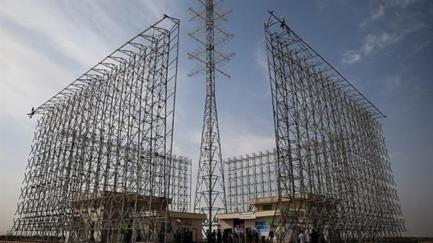
Iran’s first Qadir radar system, which was unveiled in the central city of Garmsar in June 2014. (Fars new agency photo)
Press TV | July 4, 2015
Iran’s Islamic Revolution Guards Corps (IRGC) has launched a long-range radar system in the southwest of the country to enhance its air defense capabilities.
The second Qadir radar system was put into service in Iran’s southwestern city of Ahwaz on Saturday.
The first Qadir system was unveiled in the city of Garmsar in the central province of Semnan in June 2014. The third system is also scheduled to be unveiled in the near future.
The domestically-manufactured Qadir radar system, designed by IRGC’s Aerospace Division, is capable of detecting targets with a very small cross section from a long distance.
The system enjoys a direct range of 1,100 kilometers (more than 680 miles) and can be used to detect different types of aircraft as well as ballistic missiles.
Qadir falls in the category of long-range three-dimensional radar systems.
In recent years, Iran has made major breakthroughs in its defense sector and attained self-sufficiency in producing important military equipment and systems.
The country has manufactured different types of state-of-the-art radar systems, including Arash-2 and Kayhan.
The Islamic Republic has repeatedly assured other nations, particularly its neighbors, that its military might poses no threat to other countries, insisting that its defense doctrine is merely based on deterrence.
Ulterior motives behind sanctions on Iran: Ayatollah Khamenei
Press TV | July 4, 2015
 Leader of the Islamic Revolution Ayatollah Seyyed Ali Khamenei says the sanctions against Iran have nothing to do with the country’s nuclear activities or human rights record, adding that there are other motives behind the bans.
Addressing a group of university professors and researchers on Saturday night, Ayatollah Khamenei said those who have imposed sanctions on Iran are themselves the ones who foster terrorism and commit human rights violations.
The Leader said the sanctions against Iran have been imposed because the Islamic Republic has emerged as a nation, a movement and an identity guided by principles against the hegemonic system.
“Their objective is to prevent Iran from reaching a prominent civilizational status,” Ayatollah Khamenei said.
The Leader also highlighted the special role of professors in educating a generation of self-reliable, confident and diligent youths who will further move Iran toward progress.
On Iran’s Nuclear Program, Ghosh’s “Gotcha” is Nothing But Smoke
“Whoever is careless with the truth in small matters cannot be trusted in important affairs.” – Albert Einstein
By Nima Shirazi | Wide Asleep in America | July 3, 2015
Bobby Ghosh, former TIME contributor and currently managing editor at Quartz, decided on Tuesday to produce some absurd, mouth-breathing click-bait – the kind of deliberately sloppy disinformation that serves only to further chum the waters of public opinion with the false narratives and grotesque stereotypes that have long been the stock-in-trade of agenda-driven, attention-seeking commentators about Iran and its nuclear program.
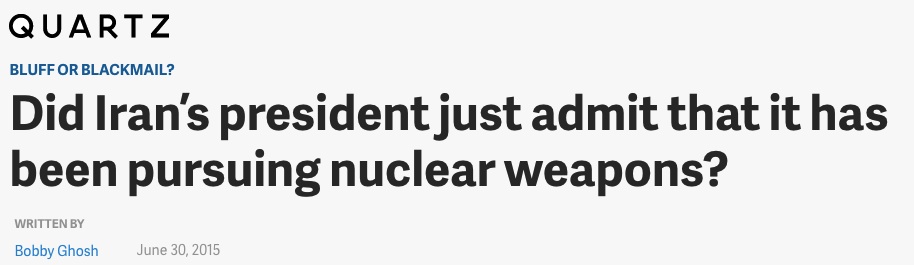
There’s a quick answer to this leading – and deceiving – question: No, no he did not.
There’s a longer answer, too, which we’ll get to in a minute.
Ghosh, in his desire to expose what he thinks is a “gotcha” moment from a recent Iranian media interview with Iranian President Hassan Rouhani, eagerly and disingenuously conflates uranium enrichment with nuclear weapons development. In doing so, he reveals himself to be more interested in delivering page views to his website and dishing out conventional wisdom than in reporting truthfully and critically about an important international issue.
Ghosh notes that, during a interview with Iranian media about the pending nuclear deal with six world powers, Rouhani said that “if the other side breaches the deal, we will go back to the old path, stronger than what they can imagine.” Ghosh omitted Rouhani’s initial comment, “If we reach a deal, both sides should be committed to it.”
What gets Ghosh’s goat is Rouhani’s reference to “the old path,” that is, the allusion to Iran’s previous state of nuclear development, as opposed to its current restricted program under the interim deal and what results from a potential negotiated multilateral agreement.
Conceding that Iranian officials have long “sworn, over and over again, that [Iran] has never pursued nuclear weapons,” Ghosh then gets to the crux of his claim:
If we’re to believe the regime’s claim, then Rouhani’s threat makes no sense. The “old path” would simply be more “peaceful” nuclear research, allowing the sanctions to continue devastating the Iranian economy. That’s not so much a threat as a flagellant’s cry for help: “If you go back on your word, I’ll hurt myself.”
To jump to such a conclusion requires a remarkably mistaken understanding of both the history of Iran’s nuclear program and either the ignorance or dismissal of the massive concessions it has already made during ongoing international talks. Ghosh apparently suffers from both.
In an emblematically Ghoshian column on why the Iranian government is eviler than the Cuban government, Ghosh wrote on December 18, 2014, that Iran “was caught trying to build nuclear-weapons technology as recently as 2002, when its secret facilities at Arak and Nataz [sic] were discovered. Thereafter, under pressure from the US and the international community, the Tehran regime backed down from its policy of developing dual-use nuclear technology (for energy and weapons) and promised not to build bombs.”
There’s a lot wrong here, but I’ll try to be quick (not my strong suit).
The facilities at Arak and Natanz were never “secret” nor do they “build nuclear-weapons technology.” In 2002, they were both under construction and non-operational. Iran was, at that point, not obligated to declare their existence to the IAEA. Arak was designed as a power plant, Natanz is an enrichment site. Upon declaration, both have been subject to IAEA safeguards for over a decade. Iran’s interest in developing an uranium enrichment industry has been open knowledge (and publicly acknowledged) since shortly after the Iranian Revolution in 1979.
The Iranian government never “backed down” from a “policy of developing dual-use technology” and “promised not to build bombs” as Ghosh claims. Such a claim is bizarre. Beyond the fact that, as an original signatory to the Nuclear Nonproliferation Treaty, Iran has in effect “promised not to build [nuclear] bombs” since 1968 and Iranian officials have – since at least the early 1990s – constantly and consistently condemned and prohibited any domestic development of nuclear weapons (not only after 2002), it is literally impossible for any nation with an ongoing enrichment program to stop the acquisition of “dual-use” nuclear infrastructure since every single enrichment program on Earth is inherently dual-use: enriched uranium can be used for both energy or weaponry.
With this false narrative, Ghosh has, however, set up a convenient straw man with which to bandy about his erroneous assumptions of Iran’s nuclear past. This brings us back to his recent article.
In trying to hash out what Rouhani’s “old path” statement means, Ghosh establishes two options – the bluff or the blackmail – one of which, he claims, must be true. The bluff is that, in Ghosh’s words, “There’s no “old path,” and Tehran is simply trying to frighten the P5+1 into relenting on the remaining sticking points at the negotiating table in Vienna.”
The blackmail, on the other hand, is a damning admission by the Iranian leader of a clandestine nuclear weapons program Iran has long denied having. “The alternative,” Ghosh writes, “is that Rouhani has unwittingly revealed that Iran was indeed pursuing nukes. That would be a real threat, especially if he is also sincere in pursuing this path ‘stronger than what they can imagine.'”
But there is a third option, unacknowledged by Ghosh, which is the most obvious and most accurate: Rouhani is not talking about a nuclear weapons program to return to, but rather the reestablishment of full-scale uranium enrichment, which has been curtailed by Iran’s obligations under the terms of its diplomatic agreements since January 2014.
Ghosh doesn’t tell his readers that, in the same interview he cites as “fascinating” and “belligerent,” Rouhani said of his international interlocutors, “If they claim that they want to prevent the development of nuclear weapons in Iran, they should know that Iran has never sought to build nuclear weapons.” Obviously, such a statement – in the very same interview – severely undermines the credibility of Ghosh’s blackmail or blunder claim that Rouhani has either purposely or accidentally revealed something alarming about its nuclear work.
Under the terms of the November 2013 Joint Plan of Action, agreed to by Iran and the six powers – Britain, China, France, Germany, Russia, and the United States – known as the P5+1, Iran has halted all enrichment above 5%, diluted or disposed of its entire stockpile of 19.75% low-enriched uranium (LEU), converted the vast majority of its remaining stockpile of LEU to a form incapable of being weaponized, suspended upgrades and construction on its safeguarded nuclear facilities at Natanz, Fordow, and Arak, and allowed unprecedented access to its program by IAEA inspectors.
At every single juncture, Iran has complied fully with the demands of the plan.
All Rouhani was saying, therefore, is that these commitments – which were negotiated and agreed to by Iran, not imposed forcibly by foreign countries – would no longer be binding and Iran would resume its previous course of action, or “the old path.” This previous course of action, still, was anything but a mysterious, opaque, nefarious development of dubious and deadly technology. Rather, even before current talks began, Iran’s was the most heavily-scrutinized nuclear program on the planet and had been for years.
Rouhani’s statement, therefore, was actually a fairly innocuous clarification of the fact that, if the P5+1 reneges on its own negotiated commitments, Iran will no longer abide by the deal either. That’s hardly cause for Ghosh to collapse on his fainting couch.
What Ghosh also doesn’t point out is that there is clear historical precedent for Rouhani’s statement.
A dozen years ago, Iran’s then-nascent uranium enrichment program was the subject of intensive diplomacy between Iran and the EU-3, shorthand for Britain, France and Germany. It was on Rouhani’s watch – he was secretary of Iran’s Supreme National Security Council and lead negotiator at the talks – that Iran voluntarily suspended uranium enrichment in 2003 and accepted intrusive inspections above and beyond what was legally required by its safeguards agreement as talks progressed. During this period, the IAEA affirmed the peaceful nature of the program.
In mid-2004, with Iran fully complying with its obligations under Saadabad Agreement of October 2013, the negotiations were strained by the prospect of a new European-drafted IAEA resolution against Iran. President Mohammad Khatami told the press, in terms strikingly similar to Rouhani’s recent statement, that Iran’s voluntary suspension of enrichment would thus be endangered if the resolution passed.
“If the draft resolution proposed by the European countries is approved by the IAEA, Iran will reject it,” Khatami said on June 18, 2004. “If Europe has no commitment toward Iran, then Iran will not have a commitment toward Europe.”
A month later, Khatami insisted that “nothing stands in the way” of Iran “building and assembling centrifuges designed for uranium enrichment,” reported the Associated Press.
Throughout the first half of 2005, Iranian officials were still intent on resolving the nuclear impasse through diplomacy with Europe, but explained that the resumption of “full-scale enrichment” was the ultimate goal of the talks, along with assurances that the program would remain forever peaceful.
Following the election of Mahmoud Ahmadinejad in June 2005, outgoing president Khatami made the Iranian position clear. “We will never overlook our legal and national right for possessing nuclear technology and fuel cycle to generate electricity. Iran will never change its national policy in this respect,” he said, adding, “We have made it clear that suspension of uranium enrichment will not be forever. We have displayed our good faith. Now, it is the turn of the European friends to do in line with the commitments they have made about the matter.”
Regardless of the offer soon to be put forward by the EU-3, Khatami reiterated that Iran would resume its conversion activities and eventually enrichment as well, in line with its inalienable rights to development domestic, civilian nuclear technology. “I hope that the Europeans’ proposals will, as agreed, allow for the resumption of [nuclear activities],” Khatami told reporters in late July 2005. “But if they do not agree, the system has already made its decision to resume [uranium conversion] at Isfahan.”
Uranium conversion restarted in early August 2005.
It was only after Iran’s European negotiating partners, at the behest of the Americans, reneged on their promise to offer substantive commitments and respect Iran’s inalienable right to a domestic nuclear infrastructure that talks dissolved and Iran resumed enrichment. The proposal eventually brought to Iran by Western negotiators on August 5, 2005 has been described as “vague on incentives and heavy on demands,” and even dismissed by one EU diplomat as “a lot of gift wrapping around an empty box.”
The resumption of full-scale enrichment by Iran had nothing to do with nuclear weapons, as the IAEA has affirmed consistently in quarterly reports over the past decade that no fissile material has ever been diverted to military purposes. Lingering questions about Iran’s past work have long been debunked as unfounded allegations for which no credible evidence actually exists.
Rouhani’s statement about “the old path” – that is, the legal and inalienable right of Iran to enrich uranium under international safeguards and supervision – therefore reveals nothing not previously known.
On the other hand, Ghosh’s reaction to Rouhani’s statement reveals the extent to which Ghosh himself will go to demonize and propagandize about Iran and its nuclear program. If he can’t get the small stuff like this right, why are we listening to him about anything at all?
*****
Disclosure: I am an (often erstwhile) editor for the online magazine Muftah, which has recently announced a new partnership with Quartz, where Mr. Ghosh is managing editor.
As Iran nuclear deadline passes, narrative battle heats up
By Sharmine Narwani | RT | June 30, 2015
It’s D-Day in Vienna, and the parties sitting across the negotiating table still haven’t ironed out terms to settle a 12-year standoff over Iran’s nuclear program. Expect this deadline to be missed. And prepare for a lot of hot air to fill its space.
The “hot air” is calculated narrative-spin from a range of players that seek to 1) scuttle a deal, 2) increase pressure/create leverage at the negotiating table, or 3) frame an upcoming agreement in language favorable to one side.
And the Western media serves as a willing handmaiden in this petty game. Journalists thought nothing of casting a global question mark over Iranian Foreign Minister Javad Zarif’s pre-arranged one-day detour to Tehran – even though his six P5+1 counterparts were also off “seeing to business.”
Western pundits weighed in en masse after Iranian Supreme Leader Ayatollah Ali Khamenei’s June 23 speech, accusing him of rejecting key provisions of the Lausanne framework agreement and walking back from earlier promises.
“It’s not true at all,” says one senior foreign ministry official, appearing perplexed – if not skeptical – at these charges. “Iran is under severe pressure from Western media,” he insists, adding: “It’s not a fair trend. No one seems to care about what Iran is doing, what’s on the table. We just want a fair reflection of what is going on at these negotiations.”
If anything, the Iranians charge that the US team “seems to have experienced buyer’s remorse after Lausanne,” and backtracked on, or revisited, some already ‘resolved’ issues.
According to various sources, at this late date, US negotiators are opening up discussion points that Iran thought they’d already dealt with. These include access to Iranian military sites (which Iran has already rejected), some technical issues around the Fordo nuclear facility, research and development parameters, and the critical issue around the timeline established for staged sanctions relief.
Clearly, for the Iranians, one of the main objectives of these negotiations is the removal of all international sanctions related to the Islamic Republic’s nuclear file.
An official explains: “The sanctions-lifting is not a day’s job – we don’t expect this. The US needs to do some preparatory work to change the culture of sanctions. They have to inform the companies and financial institutions and remove the political and cultural bias/fear of doing business with Iran – the Americans refer to this as the ‘psychological effect of sanctions’ – and this needs at least six months of hard, hard work, including a lot of legal work.”
But the Iranians want the US to work in parallel and simultaneously on sanctions-removal alongside Iran as it undertakes its physical task of disassembling agreed-upon aspects of its nuclear program. Based on technical calculations from official sources, it will take Iran a maximum of three months to implement these steps.
The most significant setback at this stage of negotiations is in fact the insertion of the US Senate into the process. Post-Lausanne, the Senate passed a bill that demanded oversight over the Iran nuclear deal and so Congress gets approximately 52 days to fiddle with whatever gets approved in Vienna.
“It’s a massive setback,” says an Iranian official. “Even if there is an agreement on June 30, we have nothing until the Senate approves it. If Iran had passed a similar bill, do you think the media would be so silent about this development?”
“If we want to be fair, the sanctions removal process should start together, in parallel with Iran’s work, to establish trust. It’s doable within three months. Otherwise – what? We destroy the heart of the Arak (hard water) reactor and then the US changes its mind?” This is a sentiment heard from many Iranians interviewed.
What do the Americans say about this, I ask? “The US is saying we’re still thinking about this.”
The same lack of definition surrounds the much-hyped issue of access to Iran’s military facilities. In the past few months, Western media has highlighted this storyline ad nauseum – to the annoyance of the Iranians at the negotiating table today.
“We never accepted this military site access. Ayatollah Khamenei’s recent speech never established this as a ‘new’ red line – it was one of our biggest problems with the US fact sheet after Lausanne. The Americans created a problem for themselves by saying this repeatedly.”
Iran has agreed in principle on IAEA access based on the ‘Additional Protocol’ which leaves it up to the individual member-state to decide on whether to provide access to requested sites.
The protocol specifically states that “it is permissible not to allow” access – and that inspectors can only use this access for “local environmental sampling,” which the Iranians know full well can be done from outside a facility’s perimeters.
“Even the US demands ‘managed access’ of the IAEA when it does its US inspections,” says a source familiar with the nuclear organization’s procedures.
Says an Iranian close to negotiators: “This issue of ‘access’ is really more an issue that speaks to the integrity of the American position at the negotiating table.”
The thing about Vienna on D-Day is that it is packed to the rafters with journalists of every stripe, straining for the tiniest tidbit of information to get a reading on what is happening at that table.
They congregate until well past midnight in the hotel lobby where most of them stay… or inside the large white tent erected outside the Palais Coburg – site of the talks – next door.
Information is the currency of the media, and when the stakes are this high and on-the-record news is so scarce, every bit of information becomes “newsworthy” – never mind that much of it is purposefully flogged by various parties for gain inside the deal-making room.
It is driving the Iranians nuts. “At this stage we still have joint common interests otherwise we couldn’t sit at the table,” says one. “But the sense outside the negotiating room is that there is a crisis.”
And the media fuels it.
Just last night, for instance, an Iranian official shot down an Agence France Press (AFP) report on the Islamic Republic’s readiness to allow inspections of its military sites. He insists the article, which is based entirely on the claims of a ‘senior US official’, “deliberately distorted information to influence the negotiations.”
“We will never allow anyone to inspect military sites because they are not relevant to the IAEA inspections.” He added: “We have serious doubt about the intentions of those who are pushing for access to our defense installations.”
The Iranian government has, on two separate occasions in 2005, “voluntarily provided access” to the IAEA to inspect a single “suspected site” called Parchin. According to an official source, “we did it because we wanted to close – once and for all – the issue of the ‘potential military dimension’ (PMD), even though we know it’s a fabricated story and we knew the US knew it was fabricated.”
“These (the PMD) are not real issues. They are more a matter of the US trying to prove the credibility of past claims. It was wrong, they knew they were wrong, but they have a need to stick to the script… Kerry himself has said the PMD issue has been distorted ‘a little bit’ – to put it mildly.”
“We don’t care how much they want to be tough on the PMD,” says the source. “It is a security case that doesn’t have any end,” which is why Iran’s top leadership has drawn a firm ‘red line’ under matters that have no reasonable or logical relevance to the IAEA’s task at hand.
Iran’s few red lines are there for good reason.
Prompted by the IAEA’s suspicions, in 2008, the Islamic Republic provided information on their EBW (Exploding Bridgewire) program to the nuclear agency. One of the authors of this study was Darioush Rezaeinejad, a postgraduate electrical engineering student. “The IAEA said this has dual-use applications,” says an Iranian familiar with the case. “Darioush was one of five Iranian scientists assassinated later, in front of his family – the knowledge that he had got him killed.”
“We are not afraid of our past so we are ready to do any kind of activity to clarify this for the whole world,” he explains. “But only within a process that would not lead to the death of our scientists.”
Iran today refuses to provide information or access to 18 scientists, academics and military personnel the US would like to interview. Western media cites this tidbit as though it is a sign of bad faith negotiating – like the Iranians have something to hide. But ask Iranian officials about this sticking point and you learn: “The list of 18 is specifically an American demand. It was a demand already rejected by Iran before the Lausanne framework agreement three months ago. It isn’t even on the table – the Americans haven’t brought up the issue again.”
There are times in Vienna when an agreement seems further away than ever. Everyone agrees that the seven countries at the table want this done, the US and Iran – for different reasons – at the forefront of the ‘hopefuls.’
But when you look at the nitty-gritty of what is being discussed and how far apart the sides are on simple things like ‘process’ and ‘positioning,’ it isn’t hard to wonder whether an Iran nuclear deal is even in the cards.
The press corps huddling over lattes in the lobby may be better-employed researching articles on “what if there is no Iran deal?” After all, as Iran’s Zarif said just a few days ago, “If there’s no deal, it’s not the end of the world.”
Sharmine Narwani is a commentator and analyst of Middle East geopolitics. She tweets @snarwani
READ MORE: Iran, P5+1 extend interim nuclear deal until July 7 to win more time for talks
China, India, Russia largest shareholders in China-led bank
The BRICS Post | June 29, 2015
Fifty countries on Monday signed the articles of agreement for the new China-led Asian Infrastructure Investment Bank, the first major global financial instrument independent from the Bretton Woods system.
Seven remaining countries out of the 57 that have applied to be founding members, Denmark, Kuwait, Malaysia, Philippines, Holland, South Africa and Thailand, are awaiting domestic approval.
“This will be a significant event. The constitution will lay a solid foundation for the establishment and operation of the AIIB,” said Chinese Finance Minister Lou Jiwei.
The AIIB will have an authorized capital of $100 billion, divided into shares that have a value of $100,000.
BRICS members China, India and Russia are the three largest shareholders, with a voting share of 26.06 per cent, 7.5 per cent and 5.92 per cent, respectively.
Following the signing of the bank’s charter, the agreement on the $100 billion AIIB will now have to be ratified by the parliaments of the founding members.
Asian countries will contribute up to 75 per cent of the total capital and be allocated a share of the quota based on their economic size.
Chinese Vice Finance Minister Shi Yaobin said China’s initial stake and voting share are “natural results” of current rules, and may be diluted as more members join.
Australia was first to sign the agreement in the Great Hall of the People in Beijing on Monday, state media reports said.
The Bank will base its headquarters in Beijing.
The Chinese Finance Ministry said the new lender will start operations by the end of 2015 under two preconditions: At least 10 prospective members ratify the agreement, and the initial subscribed capital is no less than 50 per cent of the authorized capital.
The AIIB will extend China’s financial reach and compete not only with the World Bank, but also with the Asian Development Bank, which is heavily dominated by Japan.
China and other emerging economies, including BRICS, have long protested against their limited voice at other multilateral development banks, including the World Bank, International Monetary Fund and Asian Development Bank (ADB).
China is grouped in the ‘Category II’ voting bloc at the World Bank while at the Asian Development Bank, China with a 5.5 per cent share is far outdone by America’s 15.7 per cent and Japan’s 15.6 per cent share.
The ADB has estimated that in the next decade Asian countries will need $8 trillion in infrastructure investments to maintain the current economic growth rate.
China scholar Asit Biswas at the Lee Kuan Yew School of Public Policy, Singapore, says Washington’s criticism of the China-led Bank is “childish”.
“Some critics argue that the AIIB will reduce the environmental, social and procurement standards in a race to the bottom. This is a childish criticism, especially because China has invited other governments to help with funding and governance,” he writes.
The US and Japan have not applied for the membership in the AIIB.
However, despite US pressures on its allies not to join the bank, Britain, France, Germany, Italy among others have signed on as founding members of the China-led Bank.
Meanwhile, New Zealand and Australia have already announced that they will invest $87.27 million and $718 million respectively as paid-in capital to the AIIB.
The new lender will finance infrastructure projects like the construction of roads, railways, and airports in the Asia-Pacific Region.
Iran, 49 states sign Asia bank charter
Press TV June 29, 2015
Iran on Monday joined 49 countries in signing up to the Asian Infrastructure Investment Bank (AIIB), bringing Asia’s largest financial lender a step closer to existence.
Finance and Economy Minister Ali Tayebnia put Iran’s signature to the bank’s articles of association at a ceremony in Beijing’s Great Hall of the People, which capped six months of intense negotiations.
In April, China accepted Iran as a founding member of the Asian Infrastructure Investment Bank being seen as a rival to the US-led World Bank, the International Monetary Fund (IMF) and the Asian Development Bank.
With the signing which amounted to the creation of AIIB’s legal framework, China’s Finance Minister Lou Jiwei said he was confident the bank could start functioning before the end of the year.
Seven more founding members would ink the articles after approval by their respective governments.
The bank will have a capital of $100 billion in the form of shares, each worth $100,000, distributed among the members. Beijing will be by far the largest shareholder at about 30%, followed by India at 8.4% and Russia at 6.5%.
China will also have 26% of the votes which are not enough to give it a veto on decision-making, while smaller members will have larger voice.
Singapore’s Senior Minister for Finance and Transport Josephine Teo said the bank will provide new opportunities for its members’ businesses and promote sustainable growth in Asia.
Seventy-five percent of AIIB’s shares are distributed within the Asian region while the rest is assigned among countries beyond it.
Germany, France and Brazil are among the non-Asian members of the bank despite US efforts to dissuade allies from joining it. Another US ally joining AIIB is Australia but Japan has stayed away from it.
Countries beyond the region can expand their share but the portion cannot be bigger than 30%. Public procurement of the AIIB will be open to all countries around the world.
But the president of the bank will have to be chosen from the Asian region for a maximum of two consecutive five-year terms.
The bank will be headquartered in Beijing and its lean structure will be overseen by an unpaid, non-resident board of directors which, architects say, would save it money and friction in decision-making.
Earlier this month, former Federal Reserve chairman Ben Bernanke rebuked US lawmakers for allowing China to found the new bank, which threatens to upend Washington’s domination over the world economic order.
He said lawmakers were to blame because they refused to agree 2010 reforms that would have given greater clout to China and other emerging powers in the International Monetary Fund.
Featured Video

Death Spikes & Rising Cancer In Our Youth Explained
or go to
Aletho News Archives – Video-Images
From the Archives
Politicians lie
By Mazin Qumsiyeh | Popular Resistance | August 18, 2013
There is no way to say this truth nicely: Politicians lie. That includes Japanese, American, Egyptian, Israeli, and Palestinian politicians! Is there something more common sense than that? Yet, so many citizens around the world believe their own politicians or wistfully acknowledge lies but think it is part of the job needed to run things. They believe even when politicians contradict themselves blatantly. This phenomenon is rather remarkable. It is a dissonance and disconnect from reality that many seem oblivious to. It is very dangerous because it can lead to accepting rationales for going to war. These can be deadly wars that lead to millions of lives lost as happened in what was called World War 1 and WW2. Even when incredible and declassified evidence abound, politicians continue to lie and old mythologies refuse to die. Here are just a few of the countless lies told to us over the past few decades… continue
Blog Roll
 Aletho News
- From Unipolar Universalism to Multipolar Civilizational Distinctiveness
- RSF military group defects, joins Sudanese army: State media
- Ireland goalkeeper refuses to play ‘Israel’ as squad weighs boycott
- China pushes back against US on Cuba, Iran
- Ukrainian Soldiers, Potential Mercenaries: Have Gun, Will Travel!
- Burnham’s UN debut… A masterclass in British disinformation
- Iran flights continue despite US aviation sanctions
- Global Tipping Points Lead the World Into a State of Entropy
- The day-after at the White House: USA and Xi Jinping
- The Geopolitical Balance in the Red Sea: The UAE Being Displaced by New Players
- If Americans Knew
- Deconstructing Netanyahu’s pants-on-fire UN rant – Daily Update
- Trump betrayed voters with his campaign lies and prioritized a foreign country once he took office
- Netanyahu calls Israel’s war in Gaza ‘opposite of genocide’ in UN speech to near-empty hall
- Settler Kidnappings: Torture, Sexual Abuse and Terrorisation of Palestinian Abductees as Israel Deepens Annexation of West Bank
- Gaza winter nears as 162,000 tents become unusable, raising fears of humanitarian crisis
- Netanyahu says, “It’s the opposite of genocide”; UN says Gaza economy is world’s ‘most severe crisis on record’ – Daily Update
- Israel’s US-Backed Assault on Gaza Has Created the ‘World’s Most Severe Economic Crisis on Record’: UN
- ‘Protecting U.S. Citizens’… From Israel
- ‘This is where I live now, the back of a truck’: a day in the life of a grandmother in Gaza
- In UN Speech, Iran’s President Displays Pictures of Children Killed by US, Brings Attention to Israel’s Nuclear Arsenal
- No Tricks Zone
- New Study: Earth And Venus Surface Warmth Largely Explained By Convection And Lapse Rate, Not CO2 Or Radiation
- 2025 Nature Paper Claiming Worsening Global Drought Gets RETRACTED …Heavily Flawed
- New Study: ‘Global Drought Shows No Detectable Recent Acceleration Under Climate Warming’
- Economic Masterminds: German Socialists Suggest Taxing Productivity Gains Stemming From Using AI
- The South China Sea Has Not Been Cooperating With The Climate Change Narrative
- Energy Crisis: Germany Enters Heating Season With Historically Low Gas Reserve Fill Levels
- New Study: The Antarctic Ice Sheet Gained Mass From 2020-2024 Due To Staggering Snow And Ice Accumulation
- Study: Ocean Heating Rates From Thousands Of Years Ago ‘Dwarf’ Modern Ocean Heating Rates
- Climate Extremists Target, Attack Large-Scale Power Grid Infrastructure In Germany!
- New Study: Antarctic Ice Melt Has Contributed Less Than 1 Centimeter To Sea Level Rise In The Last 30 Years

