Iran gives Venezuela $500 million credit line
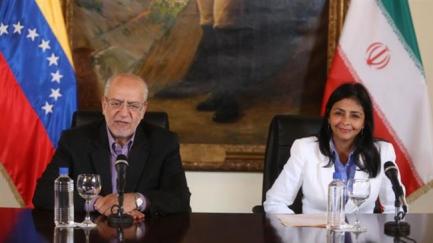
Iran’s Minister of Industry Mohammad Reza Nematzadeh and Minister for Foreign Affairs of Venezuela Delcy Rodriguez talk to reporters in Caracas
Press TV – June 27, 2015
Iran has agreed to a $500 million credit line for Venezuela to finance joint investments there, President Nicolas Maduro has announced.
He made the announcement after meeting Iranian Minister of Industry, Mine and Trade Mohammad Reza Nematzadeh in Caracas where the two sides signed six agreements to expand financial, economic, industrial and technological cooperation.
Among the agreements, there are plans for joint production of commodity goods, including detergents and other hygiene materials in Venezuela and Iran’s sales of medical drugs and surgical equipment to the country.
Maduro said the two countries had also agreed to a “comprehensive plan” to develop a joint program in nanotechnology in which Iran is among the top seven countries.
He said the deals would ensure a higher level of cooperation and deepen the bonds between the two nations.
Moreover, Iran agreed to transfer its expertise to Venezuela in combating an “economic war” on the Latin American country, Maduro said, apparently referring to Iran’s experience in facing years of US-led sanctions.
“We are facing an economic war of monumental proportions; a brutal war (but) we are here attending to our people,” Maduro said as he invoked the vision of the late President Hugo Chavez for “the government’s union with the people and struggle against imperialism”.
The Venezuelan head of state also hailed relations with Iran as “an example of alliance between two brother nations”.
“Today we have mutual trust in our relations and we work together with results. Working with Iran has gone well and our cooperation has been a great success since Hugo Chavez began a strategic alliance and brotherhood with Iran,” Maduro said.
Relations between Iran and Venezuela — both critics of US policies — have expanded in recent years. Iran is involved in a series of joint ventures worth several billion dollars in energy, agriculture, housing, and infrastructure sectors in Venezuela.
Iran’s main industrial projects in Venezuela include a car assembly plant, a tractor manufacturing complex and a cement factory.
The Islamic Republic has also built more than 3,000 residential housing units for less privileged citizens in Venezuela, with 7,000 more to be completed.
Both countries are hugely rich in resources. Venezuela possesses the world’s biggest oil deposit while Iran owns the fourth largest oil and first largest gas reserves of the world.
Maduro has announced his intention to visit Tehran to attend a summit of Gas Exporting Countries Forum planned for Nov. 23.
US fails to name Turkey as sponsor of terrorism
Press TV – June 21, 2015
The United States has admitted that it has been fully aware of Turkey’s role in the transit of terrorists into Syria, but has failed to name it as a sponsor of terrorism.
Throughout 2014, Turkey served as a source and transit country for foreign terrorists seeking to enter Syria, the United States said in its annual report on terrorism.
However, the State Department report released on Friday failed to condemn Ankara or declare it as a sponsor of terrorism.
Surprisingly enough, the report leveled accusations against Iran which has supported the fight against the ISIL terrorist group in Iraq and Syria.
Syria has been gripped by deadly violence since 2011. The United States and some of its regional allies — especially Qatar, Saudi Arabia, and Turkey — have been supporting the militants operating in Syria.
According to the United Nations, more than 220,000 people have been killed and millions displaced due to the turmoil that has gripped Syria for nearly four years.
The ISIL terrorists, who were initially trained by the CIA in Jordan in 2012 to destabilize the Syrian government, are engaged in crimes against humanity in the areas under their control.
They have been carrying out horrific acts of violence such as public decapitations and crucifixions against all communities, including Shias, Sunnis, Kurds, and Christians.
US State Department accuses Iran of supporting terrorism
Press TV – June 20, 2015
The US State Department has accused Iran of supporting international terrorist groups, claiming the country’s terrorist activities continue.
The department said in its annual report on Friday that Iran is supporting those militant groups fighting against the ISIL terrorist group in Iraq and Syria.
The report also said the Islamic Republic increased its military aid to the Syrian government of President Bashar al-Assad and Shia fighters in Iraq last year.
Washington alleges that Tehran is increasing its support for Lebanon’s resistance movement Hezbollah and Palestinian resistance movements.
This is while the report makes almost no mention of Saudi Arabia, Qatar and Turkey, which are widely believed to be the main supporters of terrorists in the Middle East. The US itself stands accused of financing and arming militants in the region.
In an interview with Press TV on Friday, American political commentator Dr. Kevin Barrett said that the United States is the primary sponsor of the ISIL terrorists.
“It seems that they’re using a very self-serving definition of terrorism here and elsewhere,” he said.
“It’s ironic though that Iran has been bashed primarily for fighting against the people that this very report says are the world’s biggest terrorist threat and that would be ISIL and Takfiri terrorists,” Dr. Barrett added.
He also noted that Iran “has been the biggest single force fighting against that particular brand of terrorism that this report says it’s getting out of control.”
CIA chief pays secret visit to Israel over Iran N-talks: Report
Press TV – June 9, 2015
Director of the US spy agency CIA John Brennan has reportedly made a secret visit to Israel to brief the regime’s officials over the ongoing nuclear negotiations between Iran and the P5+1 states.
Brennan traveled to Israel on June 4 and met with high-ranking Israeli officials, including Prime Minister Benjamin Netanyahu and one of his advisers Yossi Cohen, to discuss the developments in the talks between Iran and the six world powers, Haaretz quoted two senior Israeli officials as saying on Tuesday.
The officials, who asked not to be named, said the CIA chief also held meetings with the head of Israel’s spy agency Mossad Tamir Pardo and the regime’s military intelligence chief Major General Herzl Halevi.
It is unclear whether Brennan conveyed a message from US President Barack Obama to Netanyahu about a possible comprehensive agreement over Tehran’s nuclear program.
The CIA has not yet commented on the report of Brennan’s trip.
Diplomatic efforts aimed at reaching a final agreement over Iran’s nuclear program have drawn angry reactions from Israel. The Tel Aviv regime has been lobbying intensely to thwart such a deal.
Brennan’s visit to Israel came at a sensitive juncture, less than a month ahead of the June 30 deadline set by Tehran and its negotiating sides to finalize a deal, which seeks to end the Western dispute over Tehran’s nuclear case.
A few days before his visit to Israel, Brennan told the US-based CBS network that Washington and Tel Aviv are closely cooperating on the issue of Iran’s nuclear negotiations.
“The CIA, NSA (the US National Security Agency) and other intelligence community entities are working very close with their Israeli … counterparts” regarding the talks, Brennan said.
Iran and the P5+1 states– Russia, China, France, Britain, the US and Germany — have been working on the text of the final deal since they reached mutual understanding on key parameters of such an accord in the Swiss city of Lausanne on April 2.
Israel, Saudi Arabia hold secret meetings on Iran: Report

Anwar Majed Eshki, a former top adviser to the Saudi government (R), and Dore Gold, former Israeli ambassador close to Prime Minister Benjamin Netanyahu, shook hands during the Jun 4, 2015 meeting in Washington.
Press TV – June 5, 2015
A report has revealed that representatives from Israel and Saudi Arabia have secretly met five times since the beginning of last year to discuss their positions against Iran.
The five bilateral meetings were held over the last 17 months in India, Italy, and the Czech Republic, Bloomberg reported on Thursday.
The outlet cited one participant, Shimon Shapira, a retired Israeli general, as saying, “We discovered we have the same problems and same challenges and some of the same answers.”
Also on Thursday, well-known former Saudi and Israeli officials attended a rare meeting of the Washington-based Council on Foreign Relations think tank.
The event saw Anwar Majed Eshki, a former top adviser to the Saudi government, and Dore Gold joining former Israeli ambassador close to Prime Minister Benjamin Netanyahu.
Riyadh and Tel Aviv both oppose, what they call, the expansion of Iran’s regional influence and have not refused in the past to show fierce opposition to the potential of a final agreement between world powers and Tehran on the Islamic Republic‘s peaceful nuclear energy program.
The two sides also share alliance with the United States and opposition – emerging in the form of an overt bloody aggression on the part of Riyadh – to the Houthi Ansarullah movement of Yemen.
On May 23, a London-based paper reported that Israel had offered to provide the technology used in its Iron Dome missile system against rockets from Yemen, with the proposal being sent via American diplomats during a meeting in the Jordanian capital of Amman.
Syria : Interview with Muhammad Raad, Deputy of Hezbollah
Extracts of the interview of Muhammad Raad on Al-Mayadeen Channel, May 22, 2015
Journalist: My question is: In your view at Hezbollah, when will this war (Syrian Crisis) end? Could it last for years more?
Mohammad Raad: When the US Administration and the West that orbits around it, and the regional guards and agents who are supporting the armed terrorists, when they take the decision to stop financing (the terrorists) & close the border crossings & prevent sneaking into Syria, the war will end in Syria, and the opportunity for national dialogue will open, (this very dialogue) which was supposed to take place since the beginning of the crisis.
Journalist: Do you mean by ‘the regional agents’: Saudi, Qatar, Turkey and Israel?
Mohammad Raad: I mean all those who support the armed terrorists.
Journalist: There is a view that says that Saudi Arabia, whom you always accuse, is still supporting (the terrorists) while other countries have stepped back like Qatar. And that Turkey is still giving a great amount of support to (the terrorists).
Mohammad Raad: Let us talk in general in order to avoid miscalculations and leave the assumptions to those who are concerned. In general, whoever supports, finances & facilitates the terrorists’ sneaking into Syria in order to destroy and sabotage Syria should cease to do so.
Journalist: That means the war might last for years.
Mohammad Raad: Yes, the military option can take some time.
Journalist: Today, after what was achieved in Qalamoun and the great victory you presented in this difficult region where the fighting was fierce, as we understand, today we see that Palmyra might have fallen, yesterday Al Mastouma and other areas fell. It looks like the fighting is a win here then a defeat there, a defeat then a victory, etc. It seems that no one can use military means to resolve the situation in a decisive way.
Mohammad Raad: Sami, now the media and the propaganda machine works on propagating false and hasty news about partial matters that have nothing to do with the strategic movement or even with the battlefield, the very issues which will define the results and the outcome of the war. We have an evaluation of the situation: in Syria, the military situation on the ground is in the favor of the regime and what we witness is a tightening of the (Syrian Arab Army’s) grip on the areas under the regime’s control.
Journalist: How can you explain this to us? The image circulated now in the other media is that the State doesn’t have control over many areas, and there’s a new offensive by the armed terrorists under Fatah Army and other groups. And the armed opposition, or the rebels or the Takfiris or terrorists, whatever you may call them, are achieving big gains on the ground. In your strategic evaluation, how do you see that your side, along with your ally the Syrian President Bashar Al-Assad, has actually started to achieve strategic gains on the ground?
Mohammad Raad: Before I answer your question, we should remember all the (previous) experiences of false propaganda talking about these terrorists & enlarging their achievements, their numbers, and their situation. Isn’t it about time for the public opinion to realize that this inflated image of the (terrorists) situation is untrue? Take what happened in Qalamoun: how many were the terrorists in Qalamoun? How long did they withstand their positions?
Journalist: Some would also say that they are in the Damascus countryside, in Jobar and in areas adjacent to Damascus, also in Aleppo…
Mohammad Raad: Sometimes there are areas and positions the regime ignores because they are not important, and he (knows he) can contain them whenever he wants. But he goes towards the strategic areas the control of which defines the preservation of the State’s structure. Isn’t it strange, in the opinion of all international observers, that after 4 years and a half, the State’s institutions are still functioning in Syria?
Journalist: Excellent, this is a very good point as the Army has been fighting for more than 4 years; the Syrian diplomacy is still functioning and maybe more actively than before. Now, I saw by myself that there is a head of a Syrian diplomatic mission in Egypt, Dr. Riadh Sneih, at an ambassador level, and he is an ambassador in fact, he was abroad; and the State institutions are still paying salaries, to the Army and even to students, scholarships and others… All this is important.
Mohammad Raad: Can you imagine a state suffering a devastating war like what is happening in Syria, and still you’ll find a traffic police officer issuing traffic violation tickets?
Journalist: It is said for that, Hajj Mohammad Raad, that if it wasn’t for the direct financial support from a country like Iran, maybe the State wouldn’t function until now, in addition to the military support, of course.
Mohammad Raad: This is not a shortfall in Syria’s ability to withstand. Why are alliances forged between countries and forces at the first place? Isn’t it to benefit from them during crises and during difficult times?
It is much emphasized now, and there is an abuse of this feeling that Iran is controlling Syria, while in Syria there is an Army that is still fighting after 4 years so far. This is part of the misinformation image being circulated.
First of all, do not believe that anybody would fight on behalf of anybody else for free. Maybe there will be mutual strategic or tactical interests imposing on two parties to fight on the same field for the same goal, but each party defends its goal within this mutual interest. Iran is supporting Syria also not only as a gratitude for the Syrian stance towards the Saddam imposed 8-years war against Iran, which was financed by all those who are now contributing in the war against Syria. Iran is standing by Syria because Iran is in an alliance with Syria within the same strategic choice, but if it wasn’t for the fact that the Syrian structure is capable of preserving its choice in the stance against (Israel), all the support Syria is receiving wouldn’t be enough to save the situation.
Enough of simplifying the issues; now it is said that we (Hezbollah) are helping the Syrian Army. Of course, we are carrying out an assistant role to the Syrian Army in the areas where we have an interest to be present in, either in defending the Resistance (Hezbollah) or to preserve the Syrian positive position in supporting the Resistance. But why is it that the heroism and bravery of the Syrian Arab Army are neglected, the army that is holding the keys of the battlefield struggle and manages the struggle until now?!
Journalist: Do you fight in the north (of Syria) Hajj Mohammad Raad? like in Aleppo, are there fighters (of Hezbollah)?
Mohammad Raad: I’m not In favour of talking about details, but I can tell you: We fight where we have to fight.
Journalist: And this is what Sayyed Nasrallah said. He recently said that after the last Qalamoun battle, Hezbollah lost 13 martyrs. Can we know the total number of Hezbollah’s martyrs since the beginning of the Syrian war? Approximately? Some say they reached a thousand (martyrs), is this correct?
Mohammad Raad: I do not believe the figure reached this much, but it is nearing five hundred. Five hundred approximately.
Journalist: Nearing five hundred. Less or a bit more? If it is nearing, it means less… Did President Bashar Al-Assad’s administration manage to survive collapsing? Now the talks saying that ‘There is no solution with the Syrian president involved’ are renewed. And even some of the fighters factions, 13 of them, gathered in Turkey recently and raised this slogan again that by force, he will fall. While for the past 4 years and now in the 5th year, he is still here? Will President Assad’s administration survive?
Mohammad Raad: Our belief is that the solution in Syria depends on the presence and the partnership of President Assad in this solution.
Journalist: Him in person?
Mohammad Raad: Him in person.
Journalist: OK. Can you tell us, Haj Mohammad Raad, why president Assad’s allies like Iran & Hezbollah at the utmost, maybe Russia to the same degree as you or less, I don’t know, why do they hold on to President Bashar Al-Assad in person? As some might argue that if President Al-Assad leaves, maybe the situation in Syria would become better. Is he (President Assad) in person the base to any solution for you?
Mohammad Raad: No, we are holding on him because the matter is not about the person, it is about the position and choice this person is committed to. You might say that there might be other persons like him, but this very person who defended Syria due to his commitment to this choice (resistance), why replace him?!
Journalist: It is said that his presence on top of the current Syrian State has maintained this State due to his personal features, his nerves of steel. I hear about this even among your ranks, that due to his calm, while most of his allies have collapsed, the veteran ones and even in Lebanon, he remained… This proves that he should remain in the partnership position to find a solution. But he’s also blamed by his foes inside Syria and abroad to be responsible for where we have reached. I want to know if Hezbollah and Iran (as Russia will not state its position) are insisting on the person of President Assad in any coming solution, whatever happens. There won’t be any solution found without President Assad?
Mohammad Raad: First of all, as long as the Syrian people are holding on to President Bashar Al-Assad, we cannot overlook this Syrian public opinion.
Journalist: Half of the people… More than half of the people are with President Assad?
Mohammad Raad: Of course
Journalist: How do you know? How do we know? Who is measuring the Syrian public opinion for us to know who is with him and who is not?
Mohammad Raad: First: who said there is anybody in the world who would accept his country to be destroyed? The hesitating portion at the beginning of the crisis of the Syrian people now joined those supporting President Assad to stay in power, because they found out that the alternative is the destruction of Syria and the end of its position and role, and making Syria a satellite in the orbit of the West and subjugating it to the Israeli conditions.
Journalist: So in your opinion President Assad is staying until the last day in his term?
Mohammad Raad: And maybe beyond…
[…]
Translation : Arabi Souri
Tehran-Moscow talks on S-300 successful: Iran official
Press TV – May 26, 2015
A senior Iranian official has described as “successful” negotiations on the delivery of Russia’s S-300 surface-to-air missile system to Iran.
“Negotiations on the delivery of the S-300 [missile system] to Iran has been successful”, Iran’s Deputy Foreign Minister for Arab and African Affairs Hossein Amir-Abdollahian said on Monday during a press conference after a meeting with Russian Deputy Foreign Minister Mikhail Bogdanov in the Russian capital, Moscow.
Amir-Abdollahian also stressed that all issues surrounding the delivery of the system to Iran are progressing well.
He further noted that the delivery of S-300 to Iran will happen at the soonest opportunity possible.
On April 13, Russian President Vladimir Putin signed a presidential decree paving the way for the long-overdue delivery of the missile system to Iran.
Russian President Vladimir Putin
The decision to deliver the missile system came after Iran and the P5+1 group of countries – the five permanent members of the UN Security Council plus Germany – reached a mutual understanding on Tehran’s nuclear program in the Swiss city of Lausanne on April 2.
Moscow had banned the delivery of the S-300 system to Tehran in 2010 under the pretext that the agreement it signed with Iran in 2007 was covered by the fourth round of the Security Council sanctions against Iran over its nuclear program. The resolution bars hi-tech weapons sales to the Islamic Republic.
The Russian president defended Moscow’s decision on S-300 supply to Iran, saying the system is meant for deterrence amid ongoing developments in war-torn Yemen.
The UN says since March, nearly 2,000 people have been killed and 7,330 others injured due to the conflict in Yemen. However, according to Yemen’s Freedom House Foundation, the Saudi airstrikes have claimed the lives of about 4,000 Yemeni people.
Israeli Prime Minister Benjamin Netanyahu criticized Russia over its decision to lift the ban on the delivery of S-300 missile system to Iran, saying Tel Aviv sees the plan with “utmost gravity.”
US, UK, and Canada Reject Nuke-Free Mideast
Press TV has interviewed two journalists and political commentators Hafsa Kara-Mustapha from London and Maxine Dovere from New York, to discuss the United States’ rejection of a proposal made by Arab countries to establish a nuclear weapons-free zone in the Middle East.
How the Uncertain Outcome of Nuclear Talks With Iran Has Taken Its Economy Hostage
By ISMAEL HOSSEIN-ZADEH | CounterPunch | May 22, 2015
I recently returned from a six-week trip to Iran. While the primary purpose of my trip was to visit family and friends, I also made some general enquiries into the state of the country’s stagnant economy. These included informal discussions with various strata of economic agents or market players: manufacturers, bankers, shopkeepers, miners, farmers, livestock breeders, workers, teachers, and more.
Sadly, most of these economic actors painted pictures of pessimism and distrust of the country’s economic conditions. The economy is mired in a protracted stagflation, with no government plan or macroeconomic policy for recovery. While the Rouhani administration boasts of having contained or slowed down the inflation, the Iranian people do not cherish that tempering of inflation as it has come about at the expense of deepened recession; that is, at the expense of heightened unemployment and weakened purchasing power. As a retired school teacher, who now works as a taxi driver, put it, lowering inflation by worsening recession is no cause for celebration (paraphrased).
And what is the major culprit behind the depressing recession? The common answer of the overwhelming majority of the economic actors I spoke with was, in a nutshell, uncertainty—uncertainty of the constantly shifting outcome of the unending nuclear negotiations. There is a clear consensus that while onerous economic sanctions against Iran are obviously damaging, the perilous effects of the protracted and uncertain outcome of the negotiations are even more devastating. Equally devastating is the current administration’s neoliberal policies of austerity economics, which have further aggravated the recession by cutting social/public spending while not offering any industrial or developmental program or planning.
Market uncertainty, combined with a regrettable lack of protection by the government of the nation’s infant industries against the more mature industries abroad, has led to an unwillingness of the country’s entrepreneurs to invest in long-term production projects. By the same token, the major bulk of the nation’s finance capital is devoted to short-term, parasitically high-yielding but unproductive investments such as buying and selling of real estate.
The largely unregulated financial sector has led to a mushrooming growth of shadow banks—known as moasesat-e etebari, or credit institutions. While there are a handful of conventional or bona fide commercial banks, the number of dubious moasesat-e etebari has in recent years skyrocketed to over 900!
There is undeniable evidence that, using the influence of corrupt and rent-seeking authorities, many of these shadow banks borrowed huge sums of money from government banks at below-market interest rates, often under the pretext of wanting to invest in job-creating or manufacturing enterprises, but in fact used the monies thus obtained for speculative purposes. In other words, most of these shadow banks came to existence not through the investment of monies owned by their founders but through that of public money!
Worse yet, many of the oligarchic borrowers and/or founders of these shadow banks now refuse to pay the monies they borrowed! And the government does not or cannot do anything about it because there is an incestuous business relationship between the two sides. Parasitic growth of these speculative shadow banks has reached unsustainably dangerous levels of an imminent implosion of the financial sector—similar to what happened in the US nearly seven years ago, which has since been transmitted to a number of European countries. It is regrettable that President Rouhani and his economic team do not seem to have learned any lessons from the disastrous experiences of the unregulated financial markets in many of the core capitalist countries.
The US and its allies are obviously aware of the fact that continued uncertainty resulting from prolonged nuclear negotiations is wreaking havoc on the Iranian economy. Perhaps this helps explain why they intend to extend the negotiations for a long time: 10, 15 or even 25 years. There are speculations that this policy is designed to help bring about regime change from within, that is, by instigating a social upheaval through an economic collapse.
Not only has the Rouhani administration thus thrown the private sector into confusion and uncertainty, it has also largely abandoned traditional public sector responsibilities in terms of macroeconomic guidance and infrastructural developments. The administration’s rudderless economic outlook is reflected (among other places) in its latest (1394, Iranian calendar) budget priorities.
“The Budget Bill, which has been produced by the newly‑revived Organization of Management and Planning, offers no explicit conceptual framework within which the budget is formulated, nor is it based on any “planning” for the economy. . . . It also does not begin with a discussion of the nation’s economic development pre-requisites nor give any indication of its trajectories.
“The key concept behind the budget is a twisted “neoliberal” model. . . . The proponents of the neoliberal economic policy support extensive economic liberalization, free trade, and reductions in government spending in order to enhance the role of the free market, individual and private sectors in the economy” [1].
The priorities of the budget bill are so warped and irrational that they tend to harm both the supply and demand sides of the economy. On the supply-side,
“[T]he budget neglects the productive sectors, infrastructure and the environment. Development funds have been increased by a nominal 16 percent; in real terms that will mean a reduction. Agriculture receives an increase, but its share is minimal relative to the sector’s need. Manufacturing remains cash-hungry given the tight-money policy and a 22 percent interest rate. R&D’s share in the GNP remains at about 0.06 percent and industry-driven R&D is almost non‑existent. Infrastructure, including transportation and urban development, is equally under-budgeted” [2].
On the demand side, except for health care spending, real or inflation-adjusted funding for most social programs has been cut. Subsidies for housing, education, food, and fuel have been reduced when the inflation rate is accounted for. The budget also fails to devote funds for the repayment of the government’s growing debt to the social security and retirement funds.
“The preference for muddling through and preserving the status quo of zero growth is evident in the uses of the budget. Thus, while the supply side of the economy is neglected, the demand side is depressed through the use of contractionary fiscal and monetary policies. The budget also disregards growth-friendly educational, industrial and trade policies while it only gives lip service to construction and infrastructure. Most significantly, the sanctions-crippled Iranian economy needs serious popular mobilization and attention to social justice, but the elite-centered budget is equally oblivious to these requirements” [3].
Since the public sector has traditionally played a major role in the building of the country’s industrialization/developmental infrastructures, the Rouhani administration’s shirking that responsibility, that is, of drastically reducing public spending on infrastructure building, has significantly contributed to the deepening of economic recession and/or the rising of unemployment.
While in light of the ongoing economic recession, this curtailment of public/social spending is certainly irrational from an objective macroeconomic standpoint (as it would aggravate the recession), it is quite rational from the standpoint of the neoliberal austerity economics, to which Mr. Rouhani and most of his economic team seem to subscribe. According to neoliberal school of economic thought, a recession must be created in order to (a) fight inflation, and (b) create conditions (in the fashion of an economic shock therapy) for a subsequent economic recovery. Such conditions would include lowering labor cost by heightening unemployment, expanding deregulation of business activities, shrinking the public sector in order to make more room for the private sector, diluting environmental and workplace safety standards, expanding privatization of public property and services, including of education and health services, and the like.
This neoliberal/austerity/supply-side prescription has since the late 1970s and early 1980s replaced the Keynesian/New Deal/Social-Democratic prescription of the previous period of nearly three decades (from mid-1940s to mid-1970s), which often relied on public-sector spending in pursuit of economic recovery. The historic switch from the New Deal to neoliberal economic paradigm took place largely in the 1980s—under the formal stewardship of President Ronald Reagan in the United States and Prime Minister Margaret Thatcher in Great Britain.
The supply-side doctrine, epitomizing the dominance of economic policy-making by big business, has since the 1980s been pursued vigorously in country after country, including now in many European countries. Having thus become the dominant economic strategy in the core capitalist countries, with devastating consequences for the overwhelming majority of the people (the so-called 99%), austerity economics has now arrived in a number of the less-developed countries, including Iran—a development which catapulted Mr. Rouhani to the seat of the country’s presidency as its messenger.
President Rouhani’s subscription to neoliberal economic doctrine is evident from his many speeches and statements, as well as from his book, National Security and Economic System of Iran [امنیت ملّی و نظام اقتصادی ایران]. In his book, Mr. Rouhani deplores Iran’s “very oppressive” labor laws to business. He argues that the minimum wage must be slashed and restrictions on the laying off of workers eliminated if Iran’s “owners of capital” are to have the “freedom” to create prosperity. “One of the main challenges that employers and our factories face,” he writes, “is the existence of labor unions. Workers should be more pliant toward the demands of job-creators” [4].
Not surprisingly, Mr. Rouhani’s economic outlook is essentially devoid of any specific development plan or industrialization project as he and most of his economic advisors subscribe to an economic doctrine that frowns upon government intervention in economic affairs—unless such interventions help “pave the way” for unfettered market operations. According to this doctrine, solutions to economic stagnation, poverty and under-development lie in unhindered market mechanism and unreserved integration into world capitalist system. Recessions, joblessness and economic hardship in many less-developed countries are not so much due to economic mismanagement or the nature of global capitalism as they are because of government intervention and/or exclusion from world capitalist markets.
This explains why Mr. Rouhani has made the solution to Iran’s economic problems contingent upon a political détente or friendly relations with the United States and its allies. The administration’s perception (or delusion) that the mere establishment of relations with the U.S. would serve as a panacea to Iran’s economic woes has essentially made Iran’s economy hostage to the unforeseeable outcome of its negotiations with the United State and, therefore, hostage to the endless, and increasingly futile, nuclear negotiations.
This also explains Mr. Rouhani’s and his nuclear negotiators’ dilemma: they have essentially trapped themselves into an illusion, the illusion that a combination of charm offensives, smiley faces and diplomatic niceties would suffice to change imperialist policies toward Iran. In reality, however, the U.S. policy toward Iran (or any other country, for that matter) is based on an agenda—an imperialistic agenda that consists of a series of demands and expectations, not on diplomatic decorum, or the type of language its leaders use.
One would expect that the market uncertainty created by nuclear negotiations may have led Iran’s producers of industrial and agricultural products to be eagerly looking forward to a breakthrough in the negotiations and a lifting of the brutal sanctions against their economy. My discussions with a number of manufacturers and farmers revealed, however, that while they certainly suffer from the oppressive economic sanctions, they are also concerned that, in light of President Rouhani’s neoliberal free trade policies, a relief from sanctions that may result from such a breakthrough may, in fact, end up driving them out of business by further opening the domestic market to an unbridled deluge of foreign products.
For example, Mahmoud Sedaqat, vice president of the Association of UPVC Window & Door Profiles Manufacturers, bitterly complained that while domestic production capacity of this petrochemical is more than twice as much as domestic needs, the government recently reduced import tariffs for this product from 30% to 15%, thereby paving the way for the substitution of imports for domestic products. Sedaqat further pointed out that government’s careless trade policy and a lack of protection for domestic producers has led to an atmosphere of confusion and uncertainty among domestic producers, which is contributing to further aggravation of the ongoing economic stagnation [5].
Mohammed Reza A’le Sara, a representative of domestic producers of automobile tires, likewise complained about a glaring lack of protection of his industry against the unrestrained imports of similar, indeed substitutable, products from abroad. A’le Sara also pointed out that, despite the comparable quality of domestically-produced tires, 50% of domestic demand is currently supplied by imports. A careful or calculated government support for domestic producers, he further argued, could gradually but certainly make Iran self-sufficient in this industry [6].
Mohammed Serfi, an economics analyst, recently pointed out that the degree of import-substitution in Iran could be as high as 70%; meaning that as much as 70% of Iran’s imports could be substituted by domestically produced goods. Yet, due to the Rouhani administration’s warped open-door/free-trade policy, the crucially important industrialization strategy of import-substitution—pursued by all the currently more developed countries at earlier stages of their development—is ignored. [7].
Complaining about the administration’s lack of an economic strategy, Gholam-Hosein Shafe-ei, Chairman of Iran’s Chamber of Commerce, also argued that while relief from economic sanctions is obviously necessary it is not sufficient; perhaps more importantly are government-championed macroeconomic objectives and carefully-guided ways or plans to achieve those objectives. In the absence of clearly defined economic objectives and the concomitant strategies of import-substitution and export-promotion, Shafe-ei reasoned, Iran could become a heaven for foreign producers while many of domestic producers would be driven out of business.
Under President Rouhani, farmers have suffered even more than manufacturers. Since he was elected nearly two years ago, his administration has raised the energy/utilities bill by anywhere between 50% and 80%. This has drastically heightened the cost of agricultural production, as it has of industrial production. Additionally, the government has in recent years changed both the provision and distribution structure of fertilizers, increasingly shifting those responsibilities from the public to the private sector. This has further added to the cost of production. The government has also failed to establish a meaningful policy of crop insurance or financial assistance in the face of various natural disasters such as floods, drought and other climate fluctuations. Combined with the administration’s misguided free trade policy, which has greatly facilitated the import of many agricultural products, these ill-advised policies have effectively driven many farmers out of business, thereby plunging the agricultural sector into a deep recession.
Prior to the Rouhani administration’s pursuit of neoliberal economic policies, Iran viewed economic sanctions as an (unsolicited) opportunity to become self-reliant: to rely on domestic talents and resources in order to become self-sufficient by producing as many of the consumer goods and other industrial products as possible. And it did, indeed, make considerable progress in scientific research, technological know-how and manufacturing industries.
For example, prior to the recent rise of neoliberal economic policies, which have greatly undermined Iran’s manufacturing and agricultural capabilities, Iran had become self-sufficient in producing many of its industrial products such as home and electric appliances (television sets, washers and dryers, refrigerators, washing machines, and the like), textiles, leather products, pharmaceuticals, agricultural products, processed food, and beverage products (including refined sugar and vegetable oil). The country had also made considerable progress in manufacturing steel, copper products, paper, rubber products, telecommunications equipment, cement, and industrial machinery.
None of the oppressive economic sanctions in retaliation for the 1979 revolution deterred Iran from forging ahead with its economic development and industrialization plans. The Rouhani administration’s misguided and haphazard switch from that tradition of inward-looking strategy of self-relying economic development to the ill-conceived outward-looking strategy has thrown tens of thousands of small and medium-sized industrial and agricultural producers into a market atmosphere of confusion and uncertainty. As has already been pointed out, the uncertainty stems from two major sources: (1) a glaring lack of protection of domestic producers against the more competitive foreign producers, and (2) a regrettable linkage or tying of any macroeconomic policy to the unending, unpredictable and, ultimately, futile results of the nuclear negotiations.
The inordinately high priority given to the dubious nuclear negotiations, which has sadly taken most of the Rouhani administration’s time and energy at the expense of everything else, has place the urgently needed macroeconomic policies on hold. The sooner such unduly delayed policies are delinked from the fraudulent imperialist game of nuclear negotiations the better.
More fundamentally, the sooner the nuclear talks are seen (or acknowledged) for what they really are—a pretext or a ploy on the part of the US and its allies, both inside and outside Iran, to adapt the country into another “client state”—and dealt with accordingly, the better. So far, Iran’s negotiating team has successfully concealed many of the gratuitous concessions they have made during the negotiations—essentially suspending the nation’s hard-earned nuclear science and technology while having gained no meaningful relief from sanctions—from the Iranian people. Whether they will succeed in continuing to sell a fraudulent deal to the Iranian people, or whether they may face a harsh backlash when the people learn of the deceitful nature or substance of the deal remains to be seen.
 Ismael Hossein-zadeh is Professor Emeritus of Economics (Drake University). He is the author of Beyond Mainstream Explanations of the Financial Crisis (Routledge 2014), The Political Economy of U.S. Militarism (Palgrave–Macmillan 2007), and the Soviet Non-capitalist Development: The Case of Nasser’s Egypt (Praeger Publishers 1989). He is also a contributor to Hopeless: Barack Obama and the Politics of Illusion.
References
[1] Hooshang Amirahmadi, “Iran’s Neoliberal Austerity-Security Budget”
[2] Ibid.
[3] Ibid.
[4] As excerpted by Keith Jones, “Iranian president declares country ‘open for business’”
[5] Mahmood Sedaqat, “کاهش تعرفه پروفیل «یوپیویسی» ضربه دولت به تولید داخلی است,” Kayhan, Mordad 25, 1393 (August 16, 2014).
[6]. Interview with A’le Sara, in Farsi: واردات بیش از 50 درصد لاستیک علیرغم توان تولید داخلی
[7] Mohammed Serfi, “Gentlemen, the Party is Over,” in Farsi: آقایان! ضیافت تمام شد!(یادداشت روز)
Featured Video

Death Spikes & Rising Cancer In Our Youth Explained
or go to
Aletho News Archives – Video-Images
From the Archives
Politicians lie
By Mazin Qumsiyeh | Popular Resistance | August 18, 2013
There is no way to say this truth nicely: Politicians lie. That includes Japanese, American, Egyptian, Israeli, and Palestinian politicians! Is there something more common sense than that? Yet, so many citizens around the world believe their own politicians or wistfully acknowledge lies but think it is part of the job needed to run things. They believe even when politicians contradict themselves blatantly. This phenomenon is rather remarkable. It is a dissonance and disconnect from reality that many seem oblivious to. It is very dangerous because it can lead to accepting rationales for going to war. These can be deadly wars that lead to millions of lives lost as happened in what was called World War 1 and WW2. Even when incredible and declassified evidence abound, politicians continue to lie and old mythologies refuse to die. Here are just a few of the countless lies told to us over the past few decades… continue
Blog Roll
 Aletho News
- From Unipolar Universalism to Multipolar Civilizational Distinctiveness
- RSF military group defects, joins Sudanese army: State media
- Ireland goalkeeper refuses to play ‘Israel’ as squad weighs boycott
- China pushes back against US on Cuba, Iran
- Ukrainian Soldiers, Potential Mercenaries: Have Gun, Will Travel!
- Burnham’s UN debut… A masterclass in British disinformation
- Iran flights continue despite US aviation sanctions
- Global Tipping Points Lead the World Into a State of Entropy
- The day-after at the White House: USA and Xi Jinping
- The Geopolitical Balance in the Red Sea: The UAE Being Displaced by New Players
- If Americans Knew
- Deconstructing Netanyahu’s pants-on-fire UN rant – Daily Update
- Trump betrayed voters with his campaign lies and prioritized a foreign country once he took office
- Netanyahu calls Israel’s war in Gaza ‘opposite of genocide’ in UN speech to near-empty hall
- Settler Kidnappings: Torture, Sexual Abuse and Terrorisation of Palestinian Abductees as Israel Deepens Annexation of West Bank
- Gaza winter nears as 162,000 tents become unusable, raising fears of humanitarian crisis
- Netanyahu says, “It’s the opposite of genocide”; UN says Gaza economy is world’s ‘most severe crisis on record’ – Daily Update
- Israel’s US-Backed Assault on Gaza Has Created the ‘World’s Most Severe Economic Crisis on Record’: UN
- ‘Protecting U.S. Citizens’… From Israel
- ‘This is where I live now, the back of a truck’: a day in the life of a grandmother in Gaza
- In UN Speech, Iran’s President Displays Pictures of Children Killed by US, Brings Attention to Israel’s Nuclear Arsenal
- No Tricks Zone
- New Study: Earth And Venus Surface Warmth Largely Explained By Convection And Lapse Rate, Not CO2 Or Radiation
- 2025 Nature Paper Claiming Worsening Global Drought Gets RETRACTED …Heavily Flawed
- New Study: ‘Global Drought Shows No Detectable Recent Acceleration Under Climate Warming’
- Economic Masterminds: German Socialists Suggest Taxing Productivity Gains Stemming From Using AI
- The South China Sea Has Not Been Cooperating With The Climate Change Narrative
- Energy Crisis: Germany Enters Heating Season With Historically Low Gas Reserve Fill Levels
- New Study: The Antarctic Ice Sheet Gained Mass From 2020-2024 Due To Staggering Snow And Ice Accumulation
- Study: Ocean Heating Rates From Thousands Of Years Ago ‘Dwarf’ Modern Ocean Heating Rates
- Climate Extremists Target, Attack Large-Scale Power Grid Infrastructure In Germany!
- New Study: Antarctic Ice Melt Has Contributed Less Than 1 Centimeter To Sea Level Rise In The Last 30 Years

