Iran Raps Israeli DM’s Remarks as Threat to International Peace, Civilians
Fars News Agency | May 20, 2015
TEHRAN – Iranian Ambassador to the United Nations Gholam Ali Khoshrou lashed out at Israeli Defense Minister Moshe Ya’alon for raising the possibility of using atomic weapons against Iran, and asked the UN Security Council to condemn the remarks as a threat against the international peace and innocent civilians.
“Moshe Ya’alon’s recent remarks and the Zionist official’s implied reference to the possibility of using nuclear weapons against the Islamic Republic like what happened in Hiroshima and Nagasaki and also his threats against the Lebanese civilians, including the women and children, shows more than ever the regime’s aggressive nature,” Khoshrou said in a letter on Wednesday to UN Secretary-General Ban Ki-moon and Lithuanian Ambassador Raimonda Murmokaite, whose country holds the rotating UN Security council presidency this month.
He underlined that the Israeli minister’s comments are evidence showing that the regime possesses atomic weapons and isn’t afraid of using them against other countries.
“The impudent remarks have challenged the primary principles ruling the armed conflicts and the international humanitarian rights and weaken the international peace and security and therefore, the UNSC is expected to condemn these irresponsible remarks and clear threats of using nuclear bomb and massacre of civilians,” the letter added.
Khoshrou also called on the UNSC president to release the letter as the Council’s document.
Ya’alon claimed last week that Israel would attack entire civilian neighborhoods during any future assault on Gaza or Lebanon.
Speaking at a conference in Jerusalem, Ya’alon threatened that “we are going to hurt Lebanese civilians to include kids of the family. We went through a very long deep discussion … we did it then, we did it in [the] Gaza Strip, we are going to do it in any round of hostilities in the future.”
The Israeli official also appeared to threaten to drop a nuclear bomb on Iran, although he said “we are not there yet.”
In response to a question about Iran, Ya’alon said that “in certain cases” when “we feel like we don’t have the answer by surgical operations” Israel might take “certain steps” such as the Americans did in “Nagasaki and Hiroshima, causing at the end the fatalities of 200,000.”
US threatens not to sign nuclear deal with Iran due to inspection of sites
Press TV – May 21, 2015
Washington has threatened “not to sign” a final nuclear agreement with Tehran unless the Iranian government gives access to its possible military dimension-related sites and nuclear scientists.
“If we don’t get the assurances we need on the access to possible military dimension-related sites or activities, that’s going to be a problem for us,” State Department spokeswoman Marie Harf said in Washington on Wednesday.
“We and Iran have agreed that we will undertake a process to address possible military dimensions (of past nuclear work), and part of that includes access,” Harf said. “Under the Additional Protocol … which Iran will implement and has said they will implement as part of this deal, the IAEA does get access.”
“If we cannot agree in the final instance to something that meets our bottom line for what we need in terms of access, we’re not going to sign a final deal. And that’s just something we’ve been very, very clear about,” she added.
The remarks were made after Leader of the Islamic Revolution Ayatollah Seyyed Ali Khamenei said that Iran would not allow inspection of its military sites.
Iran says the United States is making fresh demands in the nuclear negotiations.
“They are making new comments in the negotiations. Regarding the inspections, we have said that we will not allow foreigners to carry out inspections of any military sites,” Ayatollah Khamenei said on Wednesday.
“The enemies should know that the Iranian nation and officials will, by no means, give in to excessive demands and bullying,” the Leader underlined.
The US and its negotiating partners reached a framework nuclear agreement with Iran in Switzerland on April 2.
Tehran and the P5+1 group – the US, Britain, France, China, Russia and Germany – are currently working to draw up a final accord by the end of June.
Iran has repeatedly stressed that it will not allow inspections of its military facilities and insists that the nuclear deal must only include nuclear issues.
“Iran will brook no excessive demands. The agreed parameters are those confirmed by the two sides in Lausanne and these parameters need to be stipulated in a written agreement by Iran and the P5+1,” Iranian Foreign Minister Mohammad Javad Zarif said earlier this month.
Obama renews ban on Iran oil trade
Press TV – May 20, 2015
In a decree, issued by his office, the US president said that “global economic conditions, increased oil production by certain countries, and the level of (oil) spare capacity” had allowed him to take the decision.
Saudi Arabia, a key US ally in the Middle East, has ramped up production leading to a crash in crude prices.
“I determine … that there is a sufficient supply of petroleum and petroleum products from countries other than Iran to permit a significant reduction in the volume of petroleum and petroleum products purchased from Iran by or through foreign financial institutions,” Obama said in his statement.
The statement also referred to a US measure which forbids transactions with Iran.
Under the measure, foreign companies are cut off from the US financial system and face sanctions if they engage in transactions with Iran’s financial institutions.
However, a preliminary agreement reached in Nov. 2013 allows Iran to sell around 1 million barrels per day of crude oil.
The US restrictions fly in the face of that agreement under which no new sanctions should be imposed on the Islamic Republic.
Washington contends the agreement does not include renewal of the previous restrictions.
The US and five other countries are currently discussing a possible final agreement with Iran by the end of June.
Iran says any deal should envisage immediate removal of all sanctions, with the US saying they should be lifted gradually.
IRNA: Israel ordered to pay Iran $1.1 billion
Press TV – May 20, 2015
An Israeli oil company has been ordered by a Swiss court to pay $1.1 billion to Iran in compensation in a long-standing legal battle related to a joint venture before the Islamic Revolution, the IRNA news agency says.
Citing an “informed source” at Iran’s Presidential Center for Legal Affairs, IRNA said the ruling relates to the Israeli company’s sale of Iranian oil and withholding the money.
Iran has been conducting three arbitration suits against Israel at French and Swiss courts in a legal tussle estimated worth several billion dollars.
The case relates to a joint venture established in 1968 under the defunct shah of Iran to ship the country’s oil to the Israeli port of Eilat in the Mediterranean for export to Europe.
Iran cancelled the contract after the Islamic Revolution of 1979 because the country doesn’t recognize Israel.
Tel Aviv, instead, expropriated Iran’s assets and launched its own litigation offensive against the Islamic Republic, which has been dismissed at international courts.
According to IRNA, the latest ruling pertains to a case related to the National Iranian Oil Company (NIOC)’s delivery of 14.75 million cubic meters of crude oil worth $450 million to Israel’s Trans-Asiatic Oil Ltd. or TAO.
In 1989, the Swiss court initially ordered TAO to pay $500 million to Fimarco Anstalt, a company registered before the revolution in Lichtenstein by NIOC.
The court put off proceedings for interest claims then, issuing a final ruling only this month, which ordered TAO to pay $1.1 billion in addition to $7 million in legal fees, IRNA quoted the source as saying.
The source said Iran has also launched a case against TAO in Panama’s courts for implementation of the ruling and original claims against the Israeli firm.
Switzerland’s Federal Supreme Court has reportedly allowed Iranian clients to file an arbitration claim for $7 billion against Israel.
The original claim is related to Iran’s shares in the Eilat-Ashkelon Pipeline Co. (EAPC), as well as two oil ports and storage facilities, and a fleet of tankers which have been expropriated by Israel.
The Tel Aviv regime has issued a secrecy order under which any information about the company’s operations and news of arbitration is subject to military censorship.
The EAPC, part of TAO, is one of the most secretive companies in Israel, operating under a special legal force since 1968.
The company enjoys immunity from public control and regime supervision including its comptroller as well as the Knesset and the media.
The Eilat-Ashkelon Pipeline Co. was built in the aftermath of the Sinai operation of 1956 against Arab armies.
During the years that Israel controlled Sinai, Israel stole pumps and pipes from Italian and Belgian firms operating oil fields in the peninsula and built the pipeline from Eilat.
Larry Mendte Gets It So Wrong: How Persistent Iraq Mythologies Inspire Bad Analysis on Iran
By Nima Shirazi | Wide Asleep in America | May 8, 2015
Earlier this week, Kayvon Afshari, communications director for the American Iranian Council, appeared on Another Thing with veteran broadcaster Larry Mendte to discuss the state of negotiations over Iran’s nuclear program and the prospect, in the face of powerful opposition, of a final deal being reached in the coming weeks.
While Afshari’s pro-diplomacy optimism was backed up by important facts not often heard in the media, Mendte made a number of comments that betrayed his role as an ostensibly objective and informed interviewer.
Right off the bat, for instance, Mendte describes the ongoing talks as a negotiation about an “Iranian nuclear arms deal.” That’s a bizarre – albeit revealing – way to begin, namely because that’s not what this is. If anything, the Nuclear Non-Proliferation Treaty (NPT) is a nuclear arms deal, one signed back in 1968 by Iran and ratified two year later, as it proscribes all non-nuclear weapons signatories to forever forgo the acquisition of nuclear weapons.
What Iran is negotiating with six world powers about is accepting verifiable limits and constraints on its peaceful, civilian, non-weaponized, non-military, safeguarded nuclear energy program in exchange for the lifting of international and unilateral sanctions and the normalization of its nuclear dossier.
This is not an “arms deal,” as Iran has no “arms” to give up. The United States intelligence community and its allies have long assessed that Iran doesn’t even have a nuclear weapons program, let alone nuclear weapons. Iranian officials, for decades, have consistently maintained they will never pursue such weapons on religious, strategic, political, moral and legal grounds. The IAEA has found no credible evidence that Iran has ever had a nuclear weapons program.
As the conversation gets underway, Mendte repeats the tired claim that Iran is just biding its time under intense and intrusive scrutiny until – years from now – when it will suddenly emerge with a deadly nuclear arsenal manufactured out of thin air:
The way I understand the deal, and I think some of the people that are critical of it, is that there’d be a decade-long moratorium and then, the president has admitted in an article, in an interview, that after that decade-long moratorium, Iran could start up a nuclear program just like that. As a matter fact, they could advance the program during that decade and then be able to start up, for 10 years. This just puts off the inevitable. Is that fair?
Obviously this is not “fair” and Mendte’s understanding of the deal, or anything having to do with Iran or its nuclear program for that matter, is effectively nonexistent.
Afshari rightly points out to Mendte that Iran already has a nuclear program, one that is legal and guaranteed under the NPT, also noting, “It’s not as though there’s going to be no inspections after ten years. There’s still going to be strict inspections, but they’ll be loosened after that initial ten years.”
Mendte is quick to jump in. “We had strict inspections in Iraq. That didn’t turn out really well,” he patronizingly tells Afshari, continuing, “The reason we went into Iraq, people forget, in the first place, is because the inspectors were thrown out and not allowed in. [There were] supposed to be UN inspections and he [Saddam Hussein] didn’t allow it.”
When Afshari replies that the analogy is a stretch as Iran has never kicked out inspectors and that Iraq’s nuclear program was very different than Iran’s, Mendte is undeterred, insisting on playing out his analogy. “There was a nuclear arms deal in place” before the U.S. invasion of Iraq in 2003, he says, “and what I’m saying is that lead to the Iraq War. I mean, I know there [were] other factors including 9/11, including President Bush wanting to go after Iraq, but that was the catalyst: the fact that they left out UN inspectors, if you remember at the time.”
While Afshari is a gracious guest and tries to steer the conversation back on track, he really shouldn’t have been so accommodating to Mendte’s version of history. Basically, he should have told him was flat-out wrong. Beyond the fact that Mendte seems to have forgotten that Bush administration claims about Iraq’s weapons of mass destruction were false (and that there was no “nuclear arms deal in place” with Iraq), his claim about international inspectors is also completely and totally bogus. How so, you ask?
Saddam never kicked inspectors out of Iraq.
This claim is a canard, a wholesale myth, a straight-up falsehood. It was built up by the Bush administration to justify the invasion of Iraq and dutifully reinforced by the mainstream media. In fact, between late November 2002 and mid-March 2003, weapons inspectors from the IAEA and the U.N. Monitoring, Verification, and Inspection Commission (UNMOVIC) conducted more than 750 inspections at 550 sites in Iraq.
In January 2003, UNMOVIC chief Hans Blix told reporters that inspectors had been “covering the country in ever wider sweeps” for months but “haven’t found any smoking guns.” An Associated Press dispatch from the time noted, “In almost two months of surprise visits across Iraq, U.N. arms monitors have inspected 13 sites identified by U.S. and British intelligence agencies as major ‘facilities of concern,’ and reported no signs of revived weapons building.”
IAEA Director-General Mohamed ElBaradei delivered a report to the U.N. Security Council on March 7, 2003, during which he spoke of increased Iraqi cooperation with international inspections and thoroughly dismantled Bush administration claims about aluminum tubes, high-strength magnets, and importing yellowcake from Niger. ElBaradei concluded, “After three months of intrusive inspections, we have to date found no evidence or plausible indication of the revival of a nuclear weapon program in Iraq” and clearly stated the intention “to continue our inspection activities.”
Inspections ended abruptly eleven days later, on March 18, 2003, for one reason: the United States was about to start dropping bombs all over the place.
“In early March,” Glenn Kessler of The Washington Post‘s “Fact Checker” blog wrote in 2011, Blix “began getting warnings from senior U.S. and British officials about the safety of the inspectors. Then the company that supplied helicopters for the teams withdrew its equipment from Iraq.”
News reports at the time leave no doubt as to what really happened.
“In the clearest sign yet that war with Iraq is imminent, the United States has advised U.N. weapons inspectors to begin pulling out of Baghdad, the U.N. nuclear agency chief said Monday,” reported the Associated Press on March 17, 2003. The article continued:
Mohamed ElBaradei, head of the International Atomic Energy Agency, said the recommendation was given late Sunday night both to his Vienna-based agency hunting for atomic weaponry and to the New York-based teams looking for biological and chemical weapons.”
“Late last night… I was advised by the U.S. government to pull out our inspectors from Baghdad,” ElBaradei told the IAEA’s board of governors.
Within hours, the evacuation began. “U.N. weapons inspectors climbed aboard a plane and pulled out of Iraq on Tuesday after President Bush issued a final ultimatum for Saddam Hussein to step down or face war,” AP reported the next day. “U.N. Secretary-General Kofi Annan on Monday ordered all U.N. inspectors and support staff, humanitarian workers and U.N. observers along the Iraq-Kuwait border to evacuate Iraq after U.S. threats to launch war.”
“[A]t no time did Iraq throw out the inspectors,” wrote Kessler, in an attempt to forever put these talking points to rest. “[I]nspectors voluntarily ended their mission because of the threat of military action by the United States and its allies.
Larry Mendte’s regurgitation of Rumsfeldian propaganda – 13 years after the illegal and disastrous invasion of Iraq – should cast doubt on his credibility as a broadcaster. Let’s hope a correction and mea culpa are forthcoming – not to mention an apology to Afshari.
*****
UPDATE:
May 10, 2015 – I guess I shouldn’t have been surprised by Larry Mendte’s inability to grasp basic facts. A quick look at some of his past rants on Iran makes clear he’s long bought into the most bellicose and alarmist propaganda pushed by Iran hawks and is incapable of any semblance of critical thought. He sees the U.S. invasions and occupations of Afghanistan and Iraq as warnings to other nations, not as lessons to be learned about jingoism, faulty intelligence, war crimes, and imperial adventurism. He thinks Iran has a “nuclear weapons program.” He thinks sanctions “brought Iran to the negotiating table.” He says he knows that Iran wants a nuclear bomb.
Larry Mendte bloviates like he’s in a Darrell Hammond sketch. With one exception: he should be taken far less seriously.
US frowns at India-Iran port deal
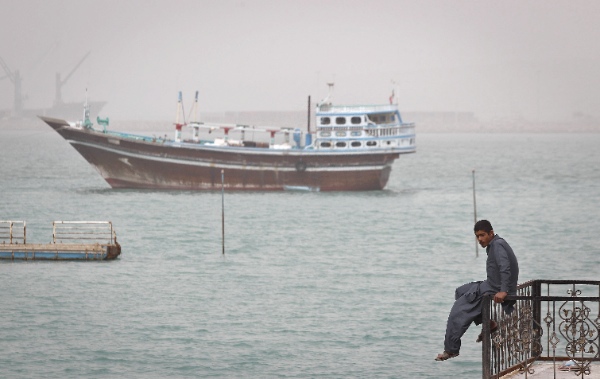
An Iranian man sits on the beach in the port city of Chabahar, southeastern Iran, on March 7, 2015 [Xinhua]
The BRICS Post | May 7, 2015
As New Delhi aims to take advantage of a thaw in Tehran’s relations with world powers, India and Iran have reached a deal on Wednesday to develop a strategic port in southeast Iran.
Abbas Ahmad Akhoundi, Iranian Minister for Transport and Urban Development and his Indian counterpart Nitin Gadkari signed an inter-Governmental Memorandum of Understanding (MoU) regarding India’s participation in the development of the Chabahar Port in Iran.
“With the signing of this MoU, Indian and Iranian commercial entities will now be in a position to commence negotiations towards finalisation of a commercial contract under which Indian firms will lease two existing berths at the port and operationalise them as container and multi-purpose cargo terminals,” the Indian Foreign Ministry said in a statement.
Richard Verma, US Ambassador in India, cautioned against “rushing in” with the deal saying there is no guarantee that a final deal will be secured with Tehran by a June 30 deadline.
India intends to lease two berths at Chabahar for 10 years. The port will be developed through a special purpose vehicle (SPV) which will invest $85.21 million to convert the berths into a container terminal and a multi-purpose cargo terminal.
The port of Chabahar in southeast Iran is central to India’s efforts to open up a route to landlocked Afghanistan where it has developed close security ties and economic interests.
“The availability of a functional container and multipurpose cargo terminal at Chabahar Port would provide Afghanistan’s garland road network system alternate access to a sea port, significantly enhancing Afghanistan’s overall connectivity to regional and global markets, and providing a fillip to the ongoing reconstruction and humanitarian efforts in the country,” said the Indian Foreign Ministry late on Wednesday evening.
Iranian President Hassan Rouhani, in his meeting with the Indian Minister in Tehran said, “Resumption of Iran-India cooperation in the southeastern Iranian port city of Chabahar would lead to a new chapter in relations of two countries.”
Meanwhile, India’s fellow BRICS member, South Africa is sending a delegation headed by its Foreign Minister for talks with Iranian leaders.
South Africa hopes to restore energy ties with Iran, its energy minister, Tina Joemat-Pettersson, said on Sunday.
Following the Money: The New Anti-Semitism?

By Jim Lobe and Charles Davis | LobeLog | May 1, 2015
In the 1976 docudrama about the Watergate affair and the fall of Richard Nixon, All the President’s Men, Bob Woodward’s source at the FBI, Deep Throat, tells him to “follow the money.” To the Washington Post editorial board in 2015, doing just that is problematic—and probably anti-Semitic. Or at least that’s their charge in a piece published last Friday entitled, “Argentina’s President Resorts to Anti-Semitic Conspiracy Theories,” the Post opens by asking:
What do lobbyists at the American Israel Public Affairs Committee and the director of a Washington think tank have to do with hedge-fund manager Paul Singer and the Argentine prosecutor, Alberto Nisman, who died mysteriously in January? Well, according to Argentine President Cristina Fernandez de Kirchner, they are all part of a “global modus operandi” that “generates international political operations of any type, shape and color.”[Links added]
The Post’s problem is that Kirchner posted a “rant” on her website highlighting the fact that Paul Singer—whose hedge fund, Elliott Management, is seeking to force Argentina to repay the full amount of its defaulted debt—has contributed a whole lot of cash to the same neoconservative organizations in Washington that have been tarring the South American nation as a deadbeat ally of Iranian-backed terrorism. These same groups have also uncritically promoted the work of prosecutor Alberto Nisman, who in 2006 issued a highly controversial 900-page indictment charging seven senior Iranian officials with ordering the 1994 bombing of the Jewish community center in Buenos Aires, the Argentine Israelite Mutual Association (AMIA), that killed 85 people. Nisman died in his apartment from a bullet to the head January 18, the night before he was set to testify before the Argentine congress in support of new charges that Kirchner and her foreign minister, Hector Timerman, had conspired with Tehran to quash international arrest warrants against those same Iranians, including Supreme Leader Ayatollah Ali Khamenei and then President Ali Hashemi Rafsanjani, in exchange for a favorable trade agreement.
Making the Links
In 2013, Inter Press Service (IPS) ran a two-part feature by Charles (here and here) on the links between Singer and Nisman’s neoconservative fan club in the United States. The Argentine press and the president herself recently cited this work. The Post, however, plays dumb: “How do Singer, AIPAC and Mark Dubowitz of the Foundation for Defense of Democracies [FDD] come into this?” it asks.
Mr. Singer—or “the Vulture Lord,” as Ms. Kirchner called him—won a court battle on behalf of holders of Argentine debt last year; Ms. Kirchner chose to default rather than pay. Mr. Dubowitz’s think tank has published papers on Argentine-Iranian relations, while AIPAC has criticized the Obama administration’s preliminary nuclear deal with Iran. Confused?
Conspicuously and no doubt consciously missing from the Post’s retelling is the fourth sentence of Kirchner’s “rant”: “[Singer] contributed to the NGO Foundation for the Defense of Democracies (FDD), $3.6 million from 2008 to 2014.” By leaving this out, the Post is better able to pretend the only link between Singer and Dubowitz and Nisman is their Judaism.
Argentina, whose politics are reputedly as byzantine and Machiavellian as any country’s, does indeed have a history of anti-Semitism. Not only did it offer a refuge to fleeing Nazis after World War II, but the military junta that took power in 1976 included elements that extolled the Third Reich, as eloquently retold by perhaps the most famous survivor of the junta’s torture chambers, Jacobo Timerman (the foreign minister’s late father) in his 1981 book, Prisoner Without a Name, Cell Without a Number.
Kirchner may indeed have a political interest in claiming that an international conspiracy is defaming her government, but the evidence for such a conspiracy in this case is much stronger than the Post suggests. As noted above, millions of dollars have flowed from Singer’s pockets to the various neoconservative groups whose advocacy of confrontation with Iran has extended to attacking Argentina, in particular over its ties to the Islamic Republic.
Singer, who sits on the board of the hawkish Republican Jewish Coalition, turns out to be a generous funder of not only FDD, but AIPAC and the American Enterprise Institute (AEI), as well as a number of other right-wing groups and politicians that have stoked hostility toward Iran. In 2010, for example, his personal and family foundations contributed a combined $1 million to the American Israel Education Foundation, the fundraising wing of AIPAC and the sponsor of its congressional junkets to Israel. The $3.6 million he gave to FDD between 2008 and 2011, meanwhile, makes him the group’s second largest donor during those three years. So, it’s pretty clear that what ties AIPAC and FDD together is not only their anti-Iran efforts, but also Paul Singer’s largesse. And that’s the link Kirchner highlights but the Post leaves out.
Make no mistake: Singer and Elliott Management stand to make as much as $2 billion if they can collect full value on the debt they bought for pennies on the dollar after the country’s 2001 default. About 93 percent of Argentina’s bondholders agreed to accept a fraction of what they were originally owed (a fact the Post also conveniently omitted). But Singer—who has done this sort of thing before with other nations that have defaulted on their debt—sued in U.S. court to recover the full amount, a move the Kirchner government has fought every step of the way. The Obama administration and the International Monetary Fund, as well as most of Latin America and Washington’s closest European allies, have also sided with Argentina, viewing Singer’s actions as a threat to the international financial system.
The Iranian “Connection”
What has this got to do with Nisman, though? His allegations of Iranian direction in the 1994 bombing in Buenos Aires—and subsequent charges that the Kirchner government was trying to cover up that involvement so as to not undermine its growing economic relations with the Tehran—proved quite useful in another arena: the court of public and congressional opinion. According to IPS’s Gareth Porter, Nisman’s 2006 indictments were based virtually entirely on the testimony of a long-discredited former Iranian intelligence officer and several members of the cult-like Mujahedin-e Khalq (MEK), an Iranian opposition group that fought alongside Saddam Hussein’s forces in the Iran-Iraq war.
But the claims have undoubtedly been useful to Singer’s cause. “We do whatever we can to get our government and media’s attention focused on what a bad actor Argentina is,” Robert Raben, executive director of the American Task Force Argentina (ATFA) explained to The Huffington Post. ATFA, a group Singer helped create with other hold-out creditors in 2007, spent at least $3.8 million dollars over 5 years doing whatever it could to paint Argentina as a pariah, according to IPS. Connecting the Kirchner government to Iran has clearly furthered that purpose.
“Argentina and Iran: Shameful Allies” was the headline of one ATFA ad that ran in Washington newspapers back in June 2013 as the Obama administration was considering whether to file an amicus brief with the U.S. Supreme Court in Argentina’s favour. The ad featured adjoining photos of Kirchner and outgoing President Mahmoud Ahmadinejad connected by the question, “A Pact With the Devil?”
“What’s the TRUTH About Argentina’s Deal with Iran?” asked another very flashy full-page ad featuring unflattering photos of Kirchner and Hassan Rouhani published in the Post’s front section shortly thereafter. The ad included excerpts of letters denouncing the joint investigation from members of Congress, including Mark Kirk (R-IL) who received more than $95,000 from employees of Singer’s firm, Elliott Management, in the 2010 election. The signer of one letter urging the administration against siding with Argentina, former Rep. Michael Grimm (R-NY)—who after his re-election in 2014 pleaded guilty to federal tax evasion and resigned shortly thereafter—received $38,000 in campaign contributions from Elliott in 2012, nearly twice as much as his next largest donor.
Singer’s generosity also appears to have produced results in the think tank world, with Dubowitz’s FDD leading the way. In May 2013, as ATFA was running the Kirchner-Ahmadinejad ad, FDD release an English-language summary of a new “ground-breaking” report by Nisman detailing “Iran’s extensive terrorist network in Latin America.” (In an extended exchange with ProPublica here and here, Jim pointed out the summary’s many serious holes, leaps of logic, and other weaknesses.) The report triggered a flood of op-eds by FDD fellows and fellow-travellers at other neo-conservative organizations, as well as a series of hearings held by the House Homeland Security Subcommittee. According to FDD’s vice president, Toby Dershowitz, the report provided:
a virtual road map for how Iran’s long arm of terrorism can reach unsuspecting communities and that the AMIA attack was merely the canary in the coal mine. …The no-holds-barred, courageous report is a ‘must read’ for policy makers and law enforcement around the world and Nisman himself should be tapped for his guidance and profound understanding of Iran’s terrorism strategy.
Nisman’s death, on the eve of his testimony before the Argentine Congress about his charges against Kirchner and Timerman (since dismissed by two courts), produced another outpouring of articles by FDD fellows recalling the prosecutor’s tireless efforts to document Iran’s alleged involvement in the AMIA bombings and Kirchner’s purported courtship of Iran. Within a month, FDD announced the establishment of an “Alberto Nisman Award for Courage.” “We must pay careful attention to the detailed Iranian playbook he left behind and from it, heed important lessons in counter-terrorism and law enforcement,” Dershowitz said in the announcement. (For an interesting take on Nisman’s work, see “Why Nisman is No Hero in Argentine Bombing Case” by Argentine journalist Graciela Mochkofsky published last month in The Forward.)
Although FDD clearly lent itself with gusto to Singer’s efforts to tar Argentina and Kirchner with the Iranian brush, AIPAC has been more reserved. It has focused on the issue of Iranian terrorism in its own tireless drive to promote sanctions legislation and a policy of confrontation against the Islamic Republic. In 2010, however, the same year in which Singer and his foundation contributed $1 million to the premier pro-Israel lobby, Nisman was featured on a panel entitled, “Dangerous Liaisons: Iran’s Alliances With Rogue Regimes” at the group’s annual policy conference.
AEI Joins In
As for AEI, Singer would find it attractive not only for its pro-Israel hawkishness and long-standing hostility toward Iran and leftist governments everywhere, but also to its domestic agenda: a hands-off policy toward Wall Street. In other words, he may have had several reasons to give the group $1.1 million in 2009—its second-biggest donor that year—and another $1.2 million over the next two. Whatever his reasons, those who received those millions surely (and demonstrably) knew well enough not to upset their benefactor. And AEI fellow Roger Noriega, a former senior Bush administration official, has certainly pushed the Argentina-Iran/Nisman connection.
As Charles reported in 2013, Noriega has himself been paid at least $60,000 by Elliott Management since 2007—the same year AFTA was founded—to lobby on the issue of “Sovereign Debt Owed to a U.S. Company.” In 2011, he published an article on AEI’s website citing Nisman’s AMIA indictment and denouncing Iran’s offer to cooperate with Argentina in investigating the AMIA bombing as “shocking, in light of Tehran’s apparent complicity in that attack.” The article—“Argentina’s Secret Deal With Iran?”—cited secret documents suggesting that Tehran and Buenos Aires had recently renewed their cooperation on nuclear development as part of a deal “brokered and paid for” by Venezuela’s Hugo Chavez.
Two years later, Noriega and Jose Cardenas, a contributor to AEI’s “Venezuela-Iran Project,” co-authored a seven-page policy brief on AEI’s website entitled “Argentina’s Race to the Bottom,” which, among other things, charged that Kirchner’s government was “casting its lot with rogue governments like those in Venezuela and Iran.” Noting that two-way trade with Iran had grown from $339 million in 2002 to $18.1 billion in 2011, the article asserted:
…[T]he Kirchner government has been turning its back on its historical alliances and increasingly tilting its economic relationships toward countries of dubious international standing where rule of law is less of a concern.
And a week after FDD announced its Nisman Award for Courage, Noriega was back at it with an article headlined “Argentina’s Kirchner Reeling from Scandal.” The piece called for a “credible international investigation into Nisman’s case… to ensure that his 10-year search for the truth was not in vain and that justice is attained not only for his family but also for the victims of the 1994 AMIA bombing.” In a veiled reference to Singer’s quest, he wrote:
From ongoing battles with bondholders playing out in a New York courtroom to pressuring critical news outlets through threats and intimidation to failed attempts to jumpstart a flagging economy, the Kirchner administration cannot end soon enough for many Argentines. Candidates lining up to replace Kirchner in the October elections will likely position themselves as far away from the kirchnerista record as possible. A new administration will have ample opportunity – and likely significant public support – to chart a new economic course. That means reconciling with international financial institutions and markets, restoring trust among foreign investors, and rooting out corruption.
Perhaps Noriega is simply interested in tarring Argentina with the Iranian brush in keeping with his long-standing crusade against any Latin American government that defies Washington’s writ. But like others engaged in this campaign, he and his organization have been paid generously by a very wealthy individual with a clear financial stake in seeing that Argentina’s current government is excised from the community of respectable nations, at least until it pays what he thinks he is owed.
If the Post had “followed the money,” it perhaps would not have been so “confused” by the connections Kirchner highlighted between Singer and those who have attacked her government over its allegedly nefarious relations with Iran. Ignoring Deep Throat’s advice and acting as if that trail of money doesn’t exist allowed the paper to better roll out the powerful charge of anti-Semitism. In truth, it’s not the president of Argentina’s supposed bigotry that offends, though, but the powerful enemies she’s made (and how much they’re worth).
Maersk vessel to be released after company pays debt: Iran
Press TV – April 30, 2015
The Iranian Embassy in Denmark has reportedly said that a cargo ship recently impounded in the Persian Gulf by Iranian Navy forces will be released if the ship’s operator company settles its overdue debts to an Iranian plaintiff.
“Iranian authorities reiterate that there has been absolutely no political or security intentions or considerations behind the incident,” read a statement by the Iranian Embassy on Thursday, AFP reported.
The cargo ship, Maersk Tigris, which was seized on Tuesday in the Strait of Hormuz in the Persian Gulf, had trespassed on Iranian waters carrying the flag of the Marshal Islands, a pacific nation.
A spokesman for Iran’s Ports and Maritime Organization said on Wednesday that the seizure of Maersk Tigris was based on a court ruling issued on March 16, 2015, which reportedly came after a plaintiff sued the Maersk Line, the Danish company operating the ship, over unpaid debts.
“The seizure of the ship was solely an enforcement of a judicial court ruling resulting from a commercial dispute between two private parties,” the statement said, adding, “Naturally the ship will be released after settlement of debts by Maersk Shipping Line and will be allowed to sail to its final destination.”
According to IRNA, the ship’s captain is Bulgarian and the first mate is Russian. Other crew members include 13 nationals of Myanmar, four Romanians, one Ukrainian, one British national, two Sri Lankans, and a national of Poland.
The statement added that diplomats can meet the crew “in case of need or request.”
Iranian Foreign Ministry Spokeswoman Marziyeh Afkham has defended as legal Iran’s decision to impound the ship, which is currently docked at the Bahonar Port near Bandar Abbas in southern Iran.
‘US funding of Sunni militia groups would further partition Iraq’
RT | April 29, 2015
The US is boosting its military support for security forces fighting against Islamic State in Iraq. The Republicans have proposed a bill to directly fund militia groups operating in the country, such as the Kurdish Peshmerga and Sunni irregular forces. If the bill is passed, tribal groups could receive up to $429 million in aid from the US.
The US Republicans’ proposal to fund Peshmerga and Sunni militias in Iraq, if approved, would entrench the country which is already partitioned by war, defense analyst Ivan Eland told RT.
RT: Do you think America’s funding of tribal security forces such as the Peshmerga might encourage further sectarian tension in such a volatile region?
Ivan Eland: Definitely. I think that’s true. Of course the US during its occupation was helping out the Peshmerga, so they were kind of undermining a unified Iraq even back then. But now Iraq basically is partitioned by war and I don’t think we can put it back together again. And so the Republicans are actually facing reality, but certainly this effort to fund individual militias will hasten the effort and entrench already partitioned Iraq.
RT: The bill also requires these security forces to be an independent entity from Iraq, so they can receive the aid separately from Iraqi national forces. What implications could that have on the US-Iraq partnership?
IE: The Republicans are unhappy with the Iraqi government’s dependence on Iran for training its Shia militias, and the Shia militias have been accused of some atrocities against Sunnis. The US doesn’t like Iranian influence in Iraq and so this bill says it funds the Peshmerga and other militias which would be Sunnis, but it also says that [if] the government of Iraq doesn’t [dis]associate itself with the Shia militias; they’ll give even more funds to the Peshmerga and other Sunni militias. So it doesn’t totally go away from the Iraqi government, but it puts a lot of pressure on them to dissociate themselves from the Shia militias which the Iraqi government probably is not going to do.
RT: If the bill does recognize these tribal security forces, they will gain a large amount of aid assigned for Baghdad. How will that affect the ability of Iraqi forces to counter Islamic State’s offensive?
IE: I think the Iraqi forces are already sort of a shell; they cut and ran when the ISIS forces attacked. The Iraqi government is depending on the Shia militias to defend them and they had the greatest role in the campaign to recapture Tikrit. The US Congress – if they pass this bill – will be asking the Iraqi government to remove the only reliable military force it has. The Iraqi armed forces are not reliable. And the Shia militias are the only groups that can adequately, even have a priority, of taking on ISIS.
RT: There are also reports of Kurds recruiting former US military members to fight the terrorist group. Apparently, a dozen Americans have already joined their ranks. What do you think about that?
IE: This may be the US government giving a wink and a nod to this without officially sanctioning it because they want to shore up the Peshmerga against the ISIS fighters and the administration doesn’t really want to do this. Most probably – what the Republicans are suggesting – giving direct aid – because of course implications can lead to the breakup of Iraq officially. Iraq is already broken up on the ground but the administration probably doesn’t want to encourage officially supporting the Peshmerga. So this could be a way of winking and nodding to get more expertise and to help them fight ISIS.
Iran says seizure of ship a legal matter
Press TV – April 29, 2015
Iran seized a cargo ship in the Persian Gulf because the company operating the vessel owed an outstanding debt to an Iranian private company which it is refusing to pay, an official says.
“A legal complaint by a domestic private company resulted in the seizure of the Marshal Islands-flagged vessel in Iranian waters by the Coast Guard,” head of the Ports and Maritime Organization of Iran Mohammad Sa’eednejad said.
The Coast Guard intercepted the ship belonging to the MV Maersk Tigris on the order of a court in Tehran, he said.
Sa’eednejad said the Iranian company has an outstanding amount of claims against Maersk which it has failed to settle.
“The complaint by a private plaintiff resulted in an order issued on March 17 for the confiscation of assets held by Maersk,” he added.
The ship was sailing in the Iranian waters when it was intercepted by the Coast Guard and diverted toward Larak Island near Bandar Abbas.
The US Navy’s Fifth Fleet in Bahrain dispatched the destroyer USS Farragut and a reconnaissance aircraft to the area following a distress call by the Maersk Tigris, the Pentagon said.
Sa’eednejad said the American forces left the scene when the situation was explained to them.
“It was announced that the issue was a legal dispute between two trade companies and the American forces accepted it,” he told IRNA.
The vessel has been described as a 65,000-tonne container ship and listed as sailing from Saudi Arabia’s Red Sea port of Jeddah, bound for the United Arab Emirates port of Jebel Ali in the Persian Gulf.
It reportedly had 24 crew on board, mostly from eastern Europe and Asia.
Featured Video

Death Spikes & Rising Cancer In Our Youth Explained
or go to
Aletho News Archives – Video-Images
From the Archives
Politicians lie
By Mazin Qumsiyeh | Popular Resistance | August 18, 2013
There is no way to say this truth nicely: Politicians lie. That includes Japanese, American, Egyptian, Israeli, and Palestinian politicians! Is there something more common sense than that? Yet, so many citizens around the world believe their own politicians or wistfully acknowledge lies but think it is part of the job needed to run things. They believe even when politicians contradict themselves blatantly. This phenomenon is rather remarkable. It is a dissonance and disconnect from reality that many seem oblivious to. It is very dangerous because it can lead to accepting rationales for going to war. These can be deadly wars that lead to millions of lives lost as happened in what was called World War 1 and WW2. Even when incredible and declassified evidence abound, politicians continue to lie and old mythologies refuse to die. Here are just a few of the countless lies told to us over the past few decades… continue
Blog Roll
 Aletho News
- From Unipolar Universalism to Multipolar Civilizational Distinctiveness
- RSF military group defects, joins Sudanese army: State media
- Ireland goalkeeper refuses to play ‘Israel’ as squad weighs boycott
- China pushes back against US on Cuba, Iran
- Ukrainian Soldiers, Potential Mercenaries: Have Gun, Will Travel!
- Burnham’s UN debut… A masterclass in British disinformation
- Iran flights continue despite US aviation sanctions
- Global Tipping Points Lead the World Into a State of Entropy
- The day-after at the White House: USA and Xi Jinping
- The Geopolitical Balance in the Red Sea: The UAE Being Displaced by New Players
- If Americans Knew
- Deconstructing Netanyahu’s pants-on-fire UN rant – Daily Update
- Trump betrayed voters with his campaign lies and prioritized a foreign country once he took office
- Netanyahu calls Israel’s war in Gaza ‘opposite of genocide’ in UN speech to near-empty hall
- Settler Kidnappings: Torture, Sexual Abuse and Terrorisation of Palestinian Abductees as Israel Deepens Annexation of West Bank
- Gaza winter nears as 162,000 tents become unusable, raising fears of humanitarian crisis
- Netanyahu says, “It’s the opposite of genocide”; UN says Gaza economy is world’s ‘most severe crisis on record’ – Daily Update
- Israel’s US-Backed Assault on Gaza Has Created the ‘World’s Most Severe Economic Crisis on Record’: UN
- ‘Protecting U.S. Citizens’… From Israel
- ‘This is where I live now, the back of a truck’: a day in the life of a grandmother in Gaza
- In UN Speech, Iran’s President Displays Pictures of Children Killed by US, Brings Attention to Israel’s Nuclear Arsenal
- No Tricks Zone
- New Study: Earth And Venus Surface Warmth Largely Explained By Convection And Lapse Rate, Not CO2 Or Radiation
- 2025 Nature Paper Claiming Worsening Global Drought Gets RETRACTED …Heavily Flawed
- New Study: ‘Global Drought Shows No Detectable Recent Acceleration Under Climate Warming’
- Economic Masterminds: German Socialists Suggest Taxing Productivity Gains Stemming From Using AI
- The South China Sea Has Not Been Cooperating With The Climate Change Narrative
- Energy Crisis: Germany Enters Heating Season With Historically Low Gas Reserve Fill Levels
- New Study: The Antarctic Ice Sheet Gained Mass From 2020-2024 Due To Staggering Snow And Ice Accumulation
- Study: Ocean Heating Rates From Thousands Of Years Ago ‘Dwarf’ Modern Ocean Heating Rates
- Climate Extremists Target, Attack Large-Scale Power Grid Infrastructure In Germany!
- New Study: Antarctic Ice Melt Has Contributed Less Than 1 Centimeter To Sea Level Rise In The Last 30 Years

