Press TV has conducted an interview with Soraya Sepahpour Ulrich, an independent researcher and writer, in Irvine, to get her take on the stance of Iran and other countries over the Non-Proliferation Treaty (NPT).
The following is a rough transcription of the interview.
Press TV: Mohammad Javad Zarif’s spokes of fairness and equity when it comes to the implementation of the NPT, has that been like that ever since this treaty came into effect?
Sepahpour: Regrettably, not at all and under the international law there ought to be no discrimination whatsoever. In fact, scholars have argued that the only time that discrimination if he wants to be called that is acceptable in international law is to elevate the status of a state to be on par with the rest. But right now as we said the international law has been hijacked and we see that powerful states are doling out favors to those that are pariah states, especially Israel in the region, and in fact, rewarding them for violating international law, while again themselves violating international law by not rendering assistance to those who are signatories to this treaty.
Press TV: How imperative is this for this NPT treaty to remain relevant to be able to bring Israel’s nukes under its control or supervision and also compel nations like the United States to clamp down on their own arsenals?
Sepahpour: I think if the former director general of the IAEA Mr. ElBaradei had listened to Mr. Zarif and perhaps he has, he would have applauded him. In 2004, Dr. ElBaradei, in fact, said that we need to talk seriously to Israel about its nuclear weapons whether it wants to admit to having them or not. And in fact, he called on a Middle East free of nuclear weapons. So, Mr. Zarif is right on the point in calling out, Israel is not a signatory to the NPT, is being rewarded for having nuclear weapons. And as far as the other states are not abiding by the NPT, again I’d like to quote Mohamed ElBaradei, he was the IAEA chief for three terms and he was a recipient of the Nobel Peace Prize together with the IAEA, and he said of nuclear powers, it is like them having it, “dangling a cigarette in their mouth while telling others not to smoke”. You can not violate international law and expect others to comply. This will create total chaos, disorder and it is a threat not just to the Middle East but to the entire world.
Press TV: When you speak of international law, so let’s not forget Iran is a signatory to the NPT and yet it has faced multiple sanctions regarding its peaceful nuclear energy program. That in itself is another violation, would not you agree?
Sepahpour: It is absolutely a violation. The whole purpose of the IAEA, when it was established in 1957 as a body of the United Nations, was to enable peaceful nations, those there were party, there was no treaty at that time, but to spread nuclear technologies, peaceful use around the world and NPT which was presented in 1968 for signature, in fact the whole spirit of the NPT was not only to render assistance in peaceful nuclear technology to the signatories but to ultimately eliminate all nuclear weapons, total disarmament and stop proliferation none of that has happened, in fact, Iran is a victim of policies here. There are nations that would want to use this law, this international treaty as a tool to dole out favors to the nations to that their working with and to those that are demanding their rights under the international law. So, it is very hypocritical, it is very dangerous and I think that this was a good occasion for the world to listen to a representative of 120 nations. And I just want to add that Iran has asked in numerous occasions for there to be total nuclear disarmament in the Middle East and even in 2009 the Arab League had said they could no longer tolerate Israel’s nuclear weapons without it is being subjected to… become a part of the NPT and have its nuclear facilities inspected. So, the vast majority of the world understands what is going on and what needs to happen. It is for more powerful nations that have hijacked the NPT that are keeping it as hostage to come on-board and be law abiding.
As soon as the framework for a comprehensive nuclear deal between Iran and six world powers was announced in Lausanne, Switzerland on April 2, Vox.com content manager Max Fisher came out strongly in favor of the agreement’s reported details. While his optimism is certainly welcome, his understanding of some key details leaves something to be desired.
Unfortunately, for someone who writes about the Iranian nuclear program as much as he does, Fisher seems not to have a very solid grasp on certain basic facts about the program. Sure, this is tricky, complex stuff, but if you’re in the business of producing what you refer to as “explanatory journalism” – and your entire reporting model is based upon providing clear analysis to a presumably less knowledgeable public – you should probably know what you’re talking about.
Here are just a few of his most recent errors.
‘Covert Nuclear Facilities’
In his “plain English” guide to the framework parameters, as described by the United States State Department, Fisher notes that facilities at Natanz and Fordow will continue to operate, with uranium enrichment continuing at Natanz and non-uranium enrichment and research occurring at Fordow.
Fisher concludes that this is a good deal for those worried about Iranian nuclear capabilities. “International inspectors will have access [to these facilities],” he writes, “so they won’t really function as covert nuclear facilities anymore.”
But, apparently unbeknownst to Fisher, neither Natanz nor Fordow ever actually functioned as secret nuclear enrichment facilities. Ever.
Natanz
While much is often made of the 2002 revelation of Iran’s supposedly clandestine enrichment plant at Natanz, rarely do we hear that the pilot facility was still under construction when it was declared by Iran to the IAEA. Per Iran’s safeguards agreement with the IAEA at the time, however, “Iran did not have to declare that it was building a pilot plant until 180 days before it expected to introduce nuclear material into the plant,” explained a May 2003 article in the Bulletin of the Atomic Scientists. Furthermore, as pointed out at the time by a research analyst at the Arms Control Association, Iran “is not required to allow visits to the Arak and Natanz sites under its current agreements with the IAEA.”
In effect, the United States has long been proud of discovering a construction site that Iran was under absolutely no obligation to announce to the IAEA. Natanz was not operational until June 2006, at which which point it had already been under IAEA safeguards for over three years. Not a single atom of enriched uranium has ever been produced at Natanz outside the purview of IAEA inspectors. Nevertheless, in a separate article published the same day, Fisher claims Natanz “was once used for covert enrichment.”
Fordow
Similarly, the site at Fordow was never a functional enrichment site outside IAEA monitoring. As with Natanz, it was “clandestine” only to the effect that it wasn’t officially declared by Iran to the IAEA before the US intelligence agencies said they already knew about it.
The site was announced by Iran to the IAEA on September 21, 2009, well in advance of the 180 days prior to the introduction of nuclear material as required by Iran’s Safeguards Agreement. At the time, the facility was still under construction and did not actually begin uranium enrichment until early January 2012, roughly 28 months after it had been declared to the IAEA. Upon visiting the facility six weeks after it was announced, then-IAEA Secretary General Mohammed ElBaradei described Fordow as “a hole in a mountain” and “nothing to be worried about.”
When the plant began operation, the IAEA confirmed that “all nuclear material in the facility remains under the agency’s containment and surveillance.” This was the case well before the November 2013 interim deal between the P5+1 and Iran and this remains the case to this day.
While Fisher has written elsewhere that both the Natanz and Fordow “sites are now publicly declared and will be monitored as part of any deal,” meaning “their value (and threat) as covert facilities is gone,” he appears to insinuate that recent negotiations – and namely Iranian concessions extracted by determined American negotiators – are responsible for this positive state of affairs. Natanz has been safeguarded, monitored and inspected by the IAEA for over a decade, Fordow for over four years.
‘Plutonium Plant at Arak’
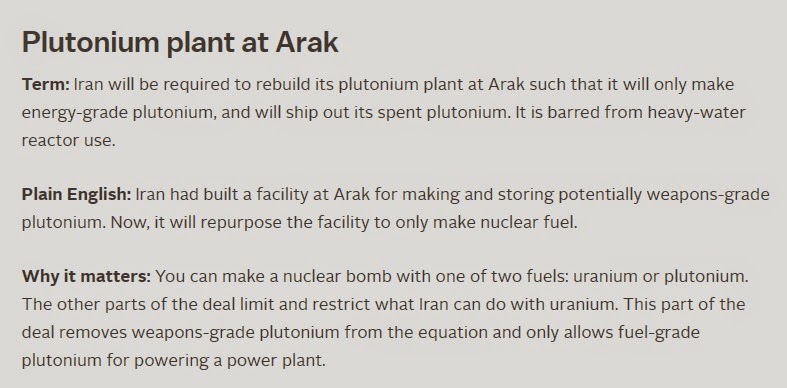
If you read Vox.com, you’d really think Iran has something called a “plutonium plant at Arak.” The main reason you’d probably think that is because that’s exactly what Max Fisher and other explainers at the site claim as fact over and over again. Here’s Fisher from the other day:
There is so much wrong with Fisher’s understanding of Iran’s Arak facilities it’s difficult to know where to begin. Fisher even changed the original words of the State Department’s “fact sheet” on the deal framework to match his misunderstanding before allowing himself to explain things to his readers. Basically none of Fisher’s sentences in this section make any sense.
What Fisher routinely refers to as Iran’s “plutonium plant” is actually the IR-40 heavy water research reactor, a nuclear reactor at the Arak complex that is still under construction and not yet operational. The half-built reactor is under IAEA safeguards and is visited regularly by inspectors. Nevertheless, it has long been used by Israel and its contingent of hawkish American supporters as an alternate way to fear-monger about Iran’s nuclear program.
In simple terms, heavy water reactors are fueled by natural, rather than enriched, uranium. Heavy water, a non-nuclear form of water, acts as both a moderator and coolant in the fuel process. These reactors are said to pose a potential proliferation threat due to the amounts of plutonium produced as a byproduct of their spent nuclear fuel, material that could then be separated from the irradiated fuel and further processed to weapons-grade levels.
So, to be clear, Iran has not been building a “plutonium plant,” let alone a facility “for making and storing potentially weapons-grade plutonium.” Rather, it has been building a certain type of nuclear reactor that happens to produce plutonium as a byproduct in its spent fuel.
Still, the Arak reactor is not in itself a proliferation risk. Even though plutonium is produced as a byproduct of running the reactor, it must first be separated out from irradiated fuel and reprocessed to weapons-grade material before it poses any actual danger. Iran has no reprocessing plant, and has long agreed not to build one.
Reading Fisher’s explanation, it’s clear he thinks that, once operational, the facility at Arak would have somehow made “weapons-grade plutonium,” but now will only “make nuclear fuel” to power a reactor. He is wrong. The relevant facility at Arak is a reactor; it doesn’t make fuel, it runs on fuel. Whenever it is eventually commissioned, it will be used for medical, scientific and agricultural research.
Beyond this, even before Iran’s current negotiating team was in place following the election of President Hassan Rouhani in June 2013, “Iran encouraged United Nations nuclear monitors to use powerful new detection technologies to dispel international concern that the Persian Gulf country is seeking to build atomic weapons,” reportedBloomberg News.
“We always welcome the agency to have more sophisticated equipment, to have more accuracy in their measurements, so that technical matters will not be politicized,” Iranian Ambassador to the IAEA Ali Asghar Soltanieh told the press in Vienna at the time, adding that Iran “won’t object to IAEA monitors using new technologies to determine whether plutonium is being extracted from spent fuel at its new reactor in Arak.”
In his guide to the nuclear framework, Fisher went to weird lengths to confuse his readership about Arak. The State Department’s own fact sheet notes, “Iran has agreed to redesign and rebuild a heavy water research reactor in Arak, based on a design that is agreed to by the P5+1, which will not produce weapons grade plutonium, and which will support peaceful nuclear research and radioisotope production.” Fisher changed the mention of “a heavy water research reactor” to “plutonium plant,” which appears to be a deliberate decision to make Iran’s safeguarded nuclear program sound undoubtedly nefarious.
Fisher also writes that, under the agreement, Iran “is barred from heavy-water reactor use.” That’s not true. Even though IR-40’s reactor core will be redesigned and rebuilt, it will still be a heavy water reactor. What the framework fact sheet says, however, is specifically that “Iran will not build any additional heavy water reactors for 15 years.” (emphasis mine)
‘Inspections’
As part of the Joint Plan of Action (JPOA) agreed to in November 2013, Iran has granted IAEA inspectors regular access to non-safeguarded, non-nuclear sites such as centrifuge assembly workshops, centrifuge rotor production workshops and storage facilities, and uranium mines and mills at Gchine, Saghand, and Ardakan. Fisher is pleased with this development, explaining that, “Inspectors, by gaining access to not just the core nuclear sites but also secondary things like uranium mills and centrifuge plants, will be in a really good position to make sure Iran isn’t cheating on a deal or trying to build another secret facility somewhere.”
Fisher’s sentence construction here is both curious and revealing. He notes that “by gaining access” to “core nuclear sites” as well as other, non-nuclear sites, inspectors have a clearer picture of the entire Iranian supply chain for its nuclear program. But the nuclear sites in question have always been under safeguards and open to routine inspections since they were declared years ago, prior to any actual nuclear work being done there. This is nothing new; it is not a virtue of the JPOA or any other recent negotiated terms. You wouldn’t know this by reading Fisher’s work.
Even before the JPOA was negotiated, Iran’s was the most heavily-scrutinized nuclear program on the planet and had been for years. Though the IAEA has even deeper access as a result of the interim deal (which will presumably continue for the foreseeable future as part of any final deal), the regular inspection regimen was itself quite intensive and intrusive. Rarely is this noted in mainstream media reports, leading many to the outrageously incorrect conclusion that, prior to the current nuclear talks, Iran operated a wholly unmonitored, clandestine and opaque nuclear program. (This is actual an apt description of Israel’s own nuclear arsenal.) Nothing could be further from the truth.
Nuclear expert Mark Hibbs has explained, “There are IAEA safeguards personnel in Iran 24/7/365,” pointing out that inspectors enter and examine enrichment sites “frequently and routinely,” where they carry out “two kinds of inspections: ‘announced inspections’ and ‘short-notice announced inspections.'” The “announced inspections” are conducted with “24-hour notification” given to Iran, while “Iran’s subsidiary arrangements in fact permit the IAEA to conduct a short-notice inspection upon two hours’ notice.” Each of Iran’s enrichment facilities was already subject to two regular inspections every month. Additionally, two unannounced inspections were conducted every month at both Natanz and Fordow.
Former Iranian nuclear negotiator Seyed Hossein Mousavian, now a lecturer at Princeton University, has noted that, between 2003 and 2012, “the International Atomic Energy Agency (IAEA) has implemented the most robust inspections in its history with more than 100 unannounced and over 4000 man-day inspections in Iran.” In 2012 alone, IAEA investigators spent 1,356 calendar days in Iran, conducting 215 on-site inspections of the country’s 16 declared nuclear facilities, and spending more than 12% of the agency’s entire $127.8 million budget on intrusively monitoring the Iranian program, which includes only a single functional nuclear reactor that doesn’t even operate at full capacity.
IAEA inspectors have also had consistently open access to the gas conversion facility at Esfahan and the light water reactor at Bushehr, despite these facilities not being explicitly covered by Iran’s Safeguards Agreement with the IAEA.
The agency has continued to verify – four times a year for the past dozen years – that Iran has never diverted any nuclear material for military purposes and has also affirmed “it has all the means it needs to make sure that does not happen with Iran’s enriched uranium, including cameras, physical inspections and seals on certain materials and components.”
And that was before the increased scrutiny provided by the JPOA.
‘Breakout Time’
In his post on why the newly-announcement framework – as described by the State Department’s own fact sheet – is such a good deal, Fisher explains the oft-used term “breakout time” to his readers this way:
If Supreme Leader Ayatollah Ali Khamenei woke up tomorrow morning and decided to kick out all of the inspectors and set his entire nuclear program toward building a nuclear warhead — to “break out” to a bomb — right now it would take him two or three months. Under the terms of the framework, his program would be so much smaller that it would take him an entire year to build a single nuclear warhead.
Fisher is wrong about this. “Breakout time” – an arbitrary measure in itself – is not the time it takes to build one nuclear bomb. Rather, it is the time it would hypothetically take Iran to acquire enough highly-enriched uranium (HEU) for one nuclear bomb. As Gary Sick has succinctly explained:
Note that “breakout” does not mean Iran will have a nuclear device. It is the starting point to build a nuclear device, which most experts agree would require roughly a year for Iran to do–and probably another two or more years to create a device that could be fit into a workable missile warhead. Plus every other country that has ever built a nuclear weapon considered it essential to run a test before actually using their design. There goes bomb No. 1.
So when officials, pundits, and interested parties talk about a one-year breakout time for Iran, what they are really saying is that if Iran decides to break its word and go for a bomb, it will take approximately one year to accumulate 27 kilograms of HEU. The hard part follows.
As is common in Fisher’s reporting, uranium enrichment is presented as nearly synonymous with nuclear bomb-making. Fisher essentially conflatesthe two, thereby drawing conclusions that neither the IAEA nor Western and Israeliintelligence agencies have made. Acquiring uranium enriched to high enough levels for a nuclear bomb is only one component of manufacturing a nuclear weapon, which includes the mastery of the detonation process, requisite missile technology, and making a bomb deliverable.
For over a decade, it has been acknowledged that, in addition to the nine nuclear weapons states (Britain, China, France, Russia, the United States, Israel, India, Pakistan, and North Korea), perhaps “40 countries or more now have the know-how to produce nuclear weapons,” according to former IAEA chief Mohammad ElBaradei.
Nuclear physicist Yousaf Butt had also noted that, “if a nation has a developed civilian nuclear infrastructure—which the NPT actually encourages—this implies it has a fairly solid nuclear-weapons capability. Just like Iran, Argentina, Brazil, and Japan also have a nuclear-weapons capability—they, too, could break out of the NPT and make a nuclear device in short order. Capabilities and intentions cannot be conflated.”
‘Modified Code 3.1’
Fisher writes that, under the proposed deal, “Iran has finally agreed to comply by a rule known as Modified Code 3.1 of the Subsidiary Arrangements General Part to Iran’s Safeguards Agreement, shorthanded as Modified Code 3.1. It says that Iran has to notify inspectors immediately on its decision to build any new facility where it plans to do nuclear work — long before construction starts.”
This is true and Fisher should have left it at that. Instead, he went on to smugly editorialize about Iran’s behavior and it’s here that he revealed his misunderstanding of the actual issues at stake. He writes:
Iran in the past has either rejected this rule or stated that it would only notify inspectors a few months before introducing nuclear material at a facility — a “cover your ass” move in case the world caught them building a new nuclear site. Tehran’s promise to comply may signal that it intends to stop building such covert facilities.
In truth, what Fisher refers to as “a ‘cover your ass’ move” is actually a legally binding stipulation of the original Code 3.1 under Iran’s Subsidiary Arrangements to its Safeguards Agreement with the IAEA, which was implemented in 1976, two years after the initial safeguards.
In 1992, the IAEA modified the code to read that member states would have to notify the agency and provide design information at the planning stage for new facilities, rather than the previously obligatory “no later than 180 days before the introduction of nuclear material to the site.” While most countries accepted the modified code, Iran did not and the original Code 3.1 remained legally in place until February 26, 2003, when Iran agreed to voluntarily implement the modified code, pending ratification by the Iranian parliament. The modified code remained in place for over four years, though it was never ratified.
Days after the adoption of an illegal sanctions resolution by the UN Security Council on March 24, 2007, an outraged Iran suspended its voluntary implementation of the modified code, and reverted to re-implementing the 1976 version of Code 3.1.
While the IAEA disputes Iran’s legal authority to unilaterally revert to the original code, Iran isn’t randomly rejecting official protocol and making up rules as it goes along, despite what Fisher would have his readers believe.
As to Fisher’s claim about Iran building “covert facilities,” that was already addressed above.
Obfuscatory Journalism
Two years ago, researchers at the University of Maryland’s Center for International and Security Studies (CISSM) released the findings of an extensive examination of mainstream media’s coverage of the Iranian nuclear program between 2009 and 2012. “The manner in which news media frame their coverage of Iran’s nuclear program is critically important to public understanding and to policy decisions that will determine whether the dispute can be resolved without war,” the report’s authors wrote.
Among other things, the study found that when media “coverage did address Iranian nuclear intentions and capabilities, it did so in a manner that lacked precision, was inconsistent over time, and failed to provide adequate sourcing and context for claims,” which in turn “led to an inaccurate picture of the choices facing policy makers.”
It also found that “coverage generally adopted the tendency of U.S., European, and Israeli officials to place on Iran the burden to resolve the dispute over its nuclear program, failing to acknowledge the roles of these other countries in the dispute” and that such coverage often “reflected and reinforced the negative sentiments about Iran that are broadly shared by U.S., European, and Israeli publics,” leading to “misunderstandings about the interests involved and narrowed the range of acceptable outcomes.”
Unfortunately, Fisher’s coverage of the Iranian nuclear program and the current negotiations are hardly any different. For a media venture dedicated to “explanatory journalism,” this is even more troubling.
With two months to go before the June deadline for a comprehensive nuclear accord between Iran and the P5+1, Fisher and his Vox colleagues will inevitably publish more articles about the Iranian nuclear program.
Still, here’s hoping that, before he explains anything else about the Iranian nuclear program, Max Fisher finally gets his facts straight.
Iran’s Foreign Minister Mohammad Javad Zarif says Israel is the main impediment to the universality of the Treaty on the Non-Proliferation of Nuclear Weapons (NPT) and the single violator of the accord.
“Unfortunately, Israel’s possession of nuclear weapons and its refusal to engage with the international community has become the greatest impediment to the universality of this treaty,” Zarif told Press TV correspondent in New York upon the arrival of Iran’s delegation of nuclear negotiators in the city to attend the 2015 Review Conference of the Parties to the NPT.
Israel is widely believed to be the sole possessor of a nuclear arsenal in the Middle East with up to 400 undeclared nuclear warheads. Tel Aviv has rejected global calls to join the NPT and does not allow international inspectors to observe its controversial nuclear program.
“Israel is the single most violator of this international regime (NPT) which is the requirement of the international community,” Zarif stressed.
The top Iranian diplomat further underlined the need for the establishment of a nukes-free zone in the Middle East.
“Since [the] 1970s, the General Assembly of the United Nations has been calling for the establishment of a nuclear weapons free zone in the Middle East, he said.
He underlined that the call for such a nuclear-free zone is not something new.
“In 1995, when the NPT was renewed, there was a declaration on the need for the universality of the NPT as well as the need for the establishment of the nuclear weapons free zone in the Middle East. This request, or requirement and demand of the international community and member states of the NPT was again repeated in 2010 in the last review conference,” Zarif said.
“One of the most important issues in the NPT review process is to look into ways and means of bringing about universality and bring about the Israeli compliance with NPT,” he added.
He also elaborated on the function of the NPT, stressing that the treaty “rests on three pillars: nuclear disarmament, non-proliferation and the peaceful use of nuclear energy.”
He also said that the issue of Israeli compliance with the NPT will top the agenda in the 2015 Review Conference.
Zarif further noted that he will probably have a meeting with US Secretary of State John Kerry on the sidelines of the event during which the will discuss the issues surrounding negotiations on Iran’ nuclear program. The meeting will be the first time since the groundbreaking talks on Iran’s nuclear program in the Swiss city of Lausanne earlier in the month.
The top Iranian diplomat said he will also hold separate meetings with EU foreign policy chief Federica Mogherini and some foreign ministers of the P5+1– the United States, Russia, China, France, Britain, and Germany, engaged in talks with Iran over its nuclear program.
Zarif also said that he will make a speech on behalf of the Non-Aligned Movement countries as Iran is the movement’s current chair. The countries of the Non-Aligned Movement represent nearly two-thirds of the United Nations members and contain 55 percent of the world population.
He further stressed that he will also sit for talks with foreign ministers of the countries in the region to discuss the ongoing crisis in Syria, Iraq, and especially in Yemen.
The NPT review conference, slated to be held from April 27 to May 22 at the UN headquarters, will address issues such as nuclear disarmament, nuclear non-proliferation, safeguards measures and the peaceful use of nuclear energy.
US Republican presidential hopefuls and some other GOP lawmakers were in the state of Nevada on Saturday to attract big donors for their campaign funding.
Texas Senator Ted Cruz, Florida Senator Marco Rubio, Texas Governor Rick Perry, Senator Rob Portman (OH), Governor Mike Pence (IN), and Senator Lindsey Graham (SC), all Republicans, were in Las Vegas for the annual Republican Jewish Coalition’s spring meeting which began on Thursday.
The candidates wrapped up 3 days of lobbying for Israel to attract potentially billions of dollars in donations in the biggest gambling hub in the US.
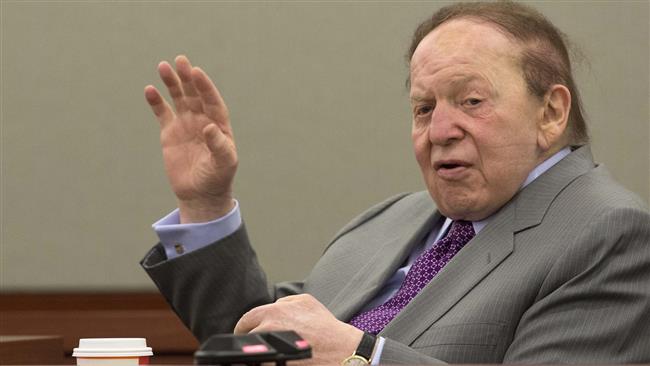
They were there to win big donations from casino tycoons, most notably Zionist Sheldon Adelson who is the largest campaign donor in the US.
As far as the GOP contenders in Las Vegas are concerned, the fight to win Adelson’s support and others in Las Vegas is all about showing support and solidarity for Tel Aviv.
Former Texas Governor Rick Perry said, “Ignoring the lessons of history, our president aims to sign an agreement with… the Islamic Republic of Iran.”
“Sadly, the American friendship and alliance with Israel has never been more imperiled than it is right now today under this administration,” said Ted Cruz, one of the Republican presidential candidates.
About 800 members of the summit enthusiastically cheered the consecutive slaps on Obama and on a potential nuclear agreement with Iran and promises of loyalty to Tel Aviv.
In fact, Adelson was not there on Saturday, according to local media, because that’s when the session was open to the media.
It is reported that Adelson has a favorite candidate so far, and that’s Senator Marco Rubio who the tycoon “speaks to once every 2 weeks.”
Adelson spent almost $150 million in the last presidential election in 2012 and he is set to throw in millions of more dollars behind his favorite contender in 2016.
Adelson, a Jewish American and the country’s eighth-wealthiest person, has said that he will not invest in the 2016 elections based on personal loyalty but on a more strategic aim.
He is a prominent supporter of Israel’s Likud Party, which is currently headed by Prime Minister Benjamin Netanyahu. He is also known for his anti-Iran rants.
During a speech at Yeshiva University in New York City in October 2014, Adelson said that the US should drop a nuclear bomb on Iran before beginning negotiations with Tehran over its nuclear program.
As the humanitarian crisis in Yemen worsens, the Obama administration seems less concerned about the plight of the desperate Yemeni people than the feelings of the Saudi royals who have spent the last month indiscriminately bombing a nearly defenseless Yemen, using high-tech U.S. jets and bombs to reportedly kill hundreds of civilians and damage its ancient cities.
On Friday, the Obama administration took credit for blocking nine Iranian ships from reaching Yemen with relief supplies, claiming that the ships may have carried weapons that the Yemenis could use in their civil war or to defend against Saudi attacks. President Barack Obama had dispatched a U.S. aircraft carrier fleet to the Yemeni coast to enforce an embargo that has helped the Saudis seal off the country from outside help.
A person closely involved with the Yemen crisis told me that the Iranian ships carried food and medicine, not weapons, but turned back to avoid the risk and humiliation of being boarded by the U.S. Navy. Meanwhile, Yemen, already one of the poorest countries in the Arab world, is facing shortages of basic supplies since the Saudis have cut off normal trade routes into Yemen.
Yet, despite the suffering of Yemen, the U.S. government appears more worried about the sensitivities of Saudi Arabia, one of the richest countries in the region. A Defense Department official, speaking anonymously, told the New York Times that it was “important that the Saudis know that we have an arm around their shoulders.”
Defense Department officials also acknowledged that they didn’t know what type of cargo was being transported aboard the Iranian ships, the Times reported. Though the Obama administration had touted the possibility that the Iranian ships carried weapons, the decision by Iran to avoid a confrontation may have reflected Tehran’s desire not to worsen relations with the United States and thus disrupt fragile negotiations over international guarantees to ensure that its nuclear program remains peaceful.
But the losers in this military/diplomatic maneuvering appear to be the Yemenis who, in effect, face a Saudi strategy of starving the country into submission with the help of the United States. While U.S. Ambassador to the United Nations Samantha Power built her public image as a “humanitarian interventionist” asserting a “responsibility to protect” vulnerable populations, she has said little about the Saudi role in Yemen’s humanitarian crisis.
In a statement on April 14, at the height of the Saudi bombing campaign, Power made no mention of the Saudi attacks or the hundreds of civilian dead from Saudi bombs supplied by the United States. She instead focused her denunciations on the Houthi rebels and former Yemeni President Ali Abdullah Saleh who have joined forces in a civil war that ousted sitting President Abd Rabbuh Mansur Hadi, who then fled to Saudi Arabia.
Power primarily blamed the Houthis, who “have intensified their military campaign, bombed Aden, and extended their offensive to Yemen’s south. These actions have caused widespread violence and instability that threaten the security and welfare of the Yemeni people, as well as the region’s security.”
Though the Saudi air force has bombed a number of cities including the ancient port city of Aden, Power ignored those attacks in her statement. But Power was not alone in her solicitousness toward the Saudis. On Friday, Secretary of State John Kerry even endorsed the Saudi bombing of Houthi targets in Yemen.
Who Are the Houthis?
The Houthis adhere to the Zaydi sect, an offshoot of Shiite Islam but one that is considered relatively close to Sunni Islam and that peacefully co-existed with Sunni Islam for centuries. But the Houthis have been resisting what they regard as government persecution in recent decades.
Asrevealed in leaked U.S. government cablesand documented by Human Rights Watch, Yemen’s government used U.S. military aid to support an all-out assault against the Houthis in 2009. HRW said Yemeni government forces indiscriminately shelled and bombed civilian areas, causing significant civilian casualties and violating the laws of war. This repression of the Houthis led to an escalation last fall which ended with the Houthi rebels, who allied themselves with army forces loyal to ex-President Saleh, capturing Sanaa and other major cities.
After these victories, in private contacts with American officials, the Houthis indicated their readiness to take the fight to Al-Qaeda’s Yemeni affiliate. However, since the Saudi airstrikes began a month ago, “Al-Qaeda in the Arabian Peninsula” has taken advantage of the limitations on Houthi rebel movements by grabbing more territory in the east and overrunning a prison that held a number of Al-Qaeda militants.
The Saudi royals have a complicated relationship with Al-Qaeda including some princes who are viewed as important financiers of the terror group. The Saudis also promote the same extremist interpretation of Sunni Islam, known as Wahhabism. Now, instead of concentrating on the terror threat from Al-Qaeda, the Saudis have sought to portray the Yemeni civil war as a proxy assault in Saudi Arabia’s backyard by Shiite-ruled Iran.
In that propaganda effort, the Saudis have been helped by Israeli Prime Minister Benjamin Netanyahu who has relied on the powerful Israel Lobby and his own rhetoric to divert the U.S. Congress from a focus on Al-Qaeda and its hyper-brutal spinoff, the Islamic State, to Iran, which both Saudi Arabia and Israel have designated their primary regional enemy.
In his March 3 speech to a joint session of Congress, Netanyahu cited Yemen as one of the Mideast countries that Iran has been “gobbling up.” Many regional experts, however, considered Netanyahu’s assertion ludicrous given the Houthis’ reputation for stubborn independence.
For instance, former CIA official Graham E. Fuller called the notion “that the Houthis represent the cutting edge of Iranian imperialism in Arabia – as trumpeted by the Saudis” a “myth.” He added:
“The Zaydi Shia, including the Houthis, over history have never had a lot to do with Iran. But as internal struggles within Yemen have gone on, some of the Houthis have more recently been happy to take Iranian coin and perhaps some weapons — just as so many others, both Sunni and Shia, are on the Saudi payroll. The Houthis furthermore hate al-Qaeda and hate the Islamic State.”
But the Obama administration remains sensitive to Israeli-Saudi criticism of its efforts to negotiate a peaceful settlement of the Iranian nuclear dispute. So, to demonstrate that the Americans are comforting the Saudi royals with “an arm around their shoulders,” the U.S. government is embracing the Saudi bombardment of a largely defenseless country and is turning back ships carrying relief supplies.
~
Investigative reporter Robert Parry broke many of the Iran-Contra stories for The Associated Press and Newsweek in the 1980s. You can buy his latest book, America’s Stolen Narrative, either in print here or as an e-book (from Amazon and barnesandnoble.com).
“The Islamic Republic of Iran has never been and will never be a threat to the [Middle East] region and neighboring countries, but it will react with full strength against any aggression.” — Leader of the Islamic Revolution Ayatollah Seyyed Ali Khamenei
Iran has not acted aggressively against its neighbors since Nader Shah invaded India in 1738. Yet US politicians, military leaders and the media persist in portraying Iran as an untrustworthy menace threatening the entire civilized world.
Given that the US military now appears to have a Zionist in charge as its new defense secretary and the relentless threatening rhetoric, we must ask, if a final nuclear deal with Iran is sealed, can the US be trusted to abide by its provisions? Iran’s Leader Ayatollah Seyyed Ali Khamenei has justifiable reservations.
In a speech on April 19, 2015 before a group of Iran’s high-level military commanders, Ayatollah Khamenei correctly observed, “Today, the biggest threats to the world and to the region are the US and the Zionist regime, which intervene in any spot they deem necessary and trigger killings, without any consideration and without conforming to religious and conscientious obligations and criteria.” The veracity of the Leader’s words are demonstrated by the US support for the despotic Saudi regime’s bombing campaign against Yemen, which has targeted refugee camps, hospitals, schools, urban neighborhoods and soccer stadiums, resulting in the slaughter of hundreds of innocent people. Similarly, the Israeli entity supports its newfound Saudi ally in its latest aggression in Yemen. Of course, the occupant of the Oval Office whose middle name is Hussein has assured the Custodian of the Two Holy Mosques of “US full commitment to sustain Saudi Arabia’s capabilities to defend itself,” in the same way that as he has reaffirmed “Israel’s right to defend itself” while the Zionist regime was systematically slaughtering innocent, unarmed civilians in Gaza with US-supplied weapons. How could the Leader of Iran trust a nation whose president had stood in Zionist leader Netanyahu’s residence in occupied Al-Quds just a year earlier and blatantly threatening the Islamic Republic avowed, “All options are on the table. We will do what is necessary to prevent Iran from getting the world’s worst weapons.”
The incessant barrage of US threats against Iran appears to be the byproduct of a thorough Israeli penetration into the highest levels of the American government, resulting in a convergence of neocon Iranophobic dogma and Zionist security paranoia. That Congress is an “Israeli-occupied territory” has been known for years, but now Tel Aviv’s tentacles extend to the US military. For verification, one need look no further than Obama’s new war chief, Ashton Carter, who during a 2013 visit to the Israeli entity remarked, “Protecting America means protecting Israel, and that’s why we’re here in the first place.” According to the Zionist organization United with Israel, Carter “is regarded by Israel as an honest and perceptive friend in the uppermost echelons of the Pentagon.”
Apparently, Carter not only believes that Iran has a nuclear weapons program, but also appears intent on conflating the two remaining independent members of George W. Bush’s infamous Axis of Evil. “With respect to the nuclear weapons situation in Iran … those negotiations that are being conducted by us and our P5-plus-1 partners with the Iranians have the objective of arresting the North Korean — I mean, not North Korean, excuse me, the Iranian nuclear program,” averred the US defense secretary during a recent Pentagon press conference. Perhaps the mistake reflects Carter’s long standing desire to bomb North Korea’s nuclear facilities, which in 2006 he viewed as “a prudent policy.”
While the slip of the tongue is somewhat amusing, Carter’s obsession with security is alarming but in perfect alignment with Zionist interests. In a 1998 paper coauthored with John Deutch and Philip Zelikow, Carter expounded his thesis that nations should be “obliged to reassure other states that are worried and to take reasonable measures to prove they are not secretly developing weapons of mass destruction. Failure to supply such proof or to prosecute the criminals living within their borders should entitle worried nations to take all necessary actions for their self-defense.” Hence Carter’s philosophy meshes perfectly with Netanyahu’s ceaseless cacophony of concerns over an imagined “Iranian nuclear threat.” Furthermore, any nuclear agreement with Iran would represent a concrete implementation of Carter’s view that the burden of proof of compliance rests on the suspect nation. From this it follows rather quickly that suspicion alone is sufficient to justify military threats. Of course that Carter would not apply his burden of proof on the suspect nation doctrine to the Israeli entity goes without saying.
During the same meeting with military commanders, Ayatollah Khamenei stated, “After a [short] period of silence by the opposite side, one of their officials recently spoke once more of options on the table.” The Leader was referring to US joint chiefs of staff chairman Martin Dempsey, who, in a press conference emphasized, “The military option that I owe the president to both encourage the diplomatic solution and, if the diplomacy fails, to ensure that Iran doesn’t achieve a nuclear weapon, is intact.” This same threat was voiced one day before the detailed nuclear outline was signed in Lausanne, Switzerland when Obama’s press secretary, Josh Earnest, after being asked by a reporter what if the negotiations fail, emphasized, “There is, of course, a military option that’s sitting on the table.”
And the military option is on a table that has an expensive nuclear centerpiece called the B61-12. A so-called LEP (life extension program) of earlier B61 designs, the B61-12 is a nuclear smart bomb specifically designed as an earth penetrator. According to Hans M. Kristensen, Director of the Nuclear Information Project of the Federation of American Scientists, the B61-12 is a new nuclear weapon with improved military capabilities, and is “the most expensive nuclear bomb project ever.” The development of this B61-12 smart nuke places the US squarely in violation not only of its own 2010 Nuclear Posture Review, but also Article 6 of the Nuclear Non-Proliferation Treaty, which commits the US to “pursue negotiations in good faith on effective measures relating to cessation of the nuclear arms race at an early date and to nuclear disarmament, and on a treaty on general and complete disarmament under strict and effective international control.”
And as if the B61-12 nuclear “device” were not enough, the Pentagon has unveiled the improved Massive Ordnance Penetrator (MOP) GBU-57A-B, a 30,000 lb. conventional-explosive bomb specifically designed to target Iran’s hardened nuclear facilities. Why spend obscene sums of money to develop bigger and better bunker buster bombs if indeed the Washington regime seeks peaceful relations? The answer seems obvious that Washington has no such peaceful intentions. By accusing Iran’s civil nuclear program of having a weapons dimension while simultaneously providing political cover for the Israeli entity’s very real nuclear weapons program, US leaders are obviously talking out of both sides of their imperial mouths.
As insane as this may sound, Andrew C. Weber, US assistant secretary of defense for nuclear, chemical and biological defense programs, insists that “maintaining a safe, secure and effective nuclear stockpile is critical to deterring potential adversaries and assuring US allies and partners.” Perhaps Ayatollah Khamenei had this in mind in addition to Dempsey’s recent threat when he commented, “On the one hand, they bluff this way and on the other, they say the Islamic Republic of Iran should stop its defense progress, which is an idiotic remark.” Undeniably it is idiotic, and in view of these stark realities, Iran would be foolish not to deploy the S-300 missile air defense systems against the American aggressor. The Leader wisely instructed all of Iran’s Defense Forces to “boost their military and defense preparedness as well as their combat readiness” in his April 19 speech before Iranian military leaders.
Nevertheless, the United States, Russia, the United Kingdom, France, China, India, North Korea, Pakistan, and the Israeli entity all cling tenaciously to their nuclear weapons. Despite hopes for disarmament, counting warheads in storage and awaiting dismantlement, there are some 15,700 nuclear weapons in the world. Evidently, the goal here is not the complete elimination of nuclear weapons or else why would the US create a new nuclear weapon with new capabilities? Moreover, by ignoring the Israeli entity’s nuclear arsenal, the US has undermined its own credibility in attempting to police the proliferation of nuclear weapons.
“Over the past 250 years, Iran has not waged a single war of aggression against its neighbors, nor has it initiated any hostilities,” political scientist and former advisor to Iran’s nuclear negotiating team Dr. Kaveh L. Afrasiabi reminds us. Without a single nuclear weapon and no intention of acquiring one, Iran is clearly not threatening world peace. It is the hypocritical US along with eight other nuclear-armed states, which still possess over 10,000 nuclear warheads, who are collectively threatening our planet. How can Iran trust such a nation?
A senior Iranian military official has denounced as “ridiculous” Saudi Arabia’s allegation that Tehran is sending weapons to Yemen.
“This claim is ridiculous because everyone knows that it is Saudi Arabia which has procured different weapons through the US and is using them against the oppressed Yemeni nation today,” Chief of Staff of the Iranian Armed Forces Major General Hassan Firouzabadi told reporters on Saturday.
He added that Iran supports the Yemeni people because they have stood up for their civil rights, national sovereignty and independence.
He said Tehran supports an independent Yemen and a democratic Yemeni nation, saying the Yemenis are fighting against the enemies in a united way.
Firouzabadi emphasized that if the US and Saudi Arabia make an allegation against Iran, it is a “blame game.”
Iran has in numerous occasions denied as baseless reports that Tehran is sending weaponry for the the revolutionaries in Yemen.
Saudi Arabia started its military aggression against Yemen on March 26, without a UN mandate, in a bid to restore power to the former fugitive president, Abd Rabbuh Mansur Hadi, a close ally of Riyadh.
More than 2,600 people have been killed during the Saudi aggression so far.
In a letter to UN Secretary General Ban Ki-moon on Friday, Iran’s Foreign Minister Mohammad Javad Zarif submitted a four-point peace plan on Yemen in an attempt to end the bloodshed in the impoverished Arab country.
The plan calls on the international community to get more effectively involved in ending the senseless aerial attacks on the Yemeni people and establishing a ceasefire in the country.
Iran’s Ambassador to the United Nations Gholam-Ali Khoshrou on Friday submitted to the UN a four-point plan on putting an end to the ongoing bloodshed in Yemen prepared by Foreign Minister Mohammad Javad Zarif.
The following is the full text of the foreign minister’s letter which was addressed to UN Secretary General Ban Ki-moon:
In the Name of God, the Most Compassionate, the Most Merciful
H.E. Mr. Ban Ki-moon,
Secretary-General
United Nations
New York
Excellency,
I would like to draw your attention to the extremely alarming situation in Yemen, exacerbated by the recent provocative foreign military air campaign. It goes on in flagrant defiance of the most basic principles of international law, flouting the purposes and principles of the Charter of the United Nations, in particular the obligation to refrain from the threat or use of force in international relations.
Foreign military forces have mostly targeted purely civilian infrastructures of Yemen, destroying, inter alia, hospitals, schools, road, food factories and power plants, and thus depriving civilians of basic necessities. They have also indiscriminately targeted residential areas, including refugee camps, killing and injuring innocent civilians, in particular women and children.
This critical situation is escalating and the humanitarian crisis in Yemen is approaching catastrophic dimensions. It may result in further exacerbation of the already tense circumstances in a region that has been plagued by one of the most barbaric types of extremism and multi-pronged vicious campaign of foreign-backed terrorists. These terrorist groups have been the main beneficiaries, gaining strategic foothold in Yemen aided by the foreign aerial campaign.
Under these circumstances, it is imperative for the international community to get more effectively involved in ending the senseless aerial attacks and establishing a ceasefire, ensuring delivery of humanitarian and medical assistance to the people of Yemen and restoring peace and stability to this country through dialogue and national reconciliation without pre-conditions.
The Islamic Republic of Iran reiterates that there is no military solution to this conflict. The only way to restore peace and stability is to allow all Yemeni parties to establish, without any foreign interference, their own inclusive national unity government. To this end, the Islamic Republic of Iran believes that all efforts, particularly those by the United Nations, should be guided, in conformity with the Charter of the United Nations and fundamental principles of international humanitarian law, by the following objectives:
1.Ceasefire and an immediate end to all foreign military attacks;
2.Unimpeded urgent humanitarian and medical assistance to the people of Yemen;
3.Resumption of Yemeni-lead and Yemeni-owned national dialogue, with the participation of the representatives of all political parties and social groups;
4.Establishment of an inclusive national unity government.
I hope that Your Excellency will urgently use your good offices and conduct consultations with the concerned parties to facilitate and encourage an immediate end to these senseless bombardments and initiation of a genuine dialogue to find a political solution to this tragic crisis. The Government of the Islamic Republic of Iran stands ready to assist you in advancing this objective.
Please accept, Excellency, the assurances of my highest consideration.
M. Javad Zarif
Minister of Foreign Affairs of the Islamic Republic of Iran
US Republican presidential hopefuls have ratcheted up their rhetoric against Tehran and denounced the Obama administration’s efforts to reach an agreement with Iran over its nuclear energy program, with Senator Marco Rubio calling on Washington to bomb Iran’s nuclear infrastructure.
Rubio, the first-term senator from Florida a candidate for the 2016 presidential elections, told participants at a Republican Party reception in New Hampshire on Friday that the world, particularly the Middle East, is in chaos because of President Barack Obama’s policies.
The Cuban American politician, known as an ultimate opportunist within the party, warned of a coming terrorist attack on US soil and even raised the specter of Iranian missiles striking the United States.
“We may have to decide at some point what is worse: a military strike against Iran or a nuclear-armed Iran,” the 43-year-old said during a question-and-answer session.
“I am not cheerleading for war. I don’t want there to be the need to use military force, but a nuclear Iran is an unacceptable risk for the region and the world,” he added.
He went on to say that “Iran is developing long-range rockets that will at some point, in less than a decade, be capable of reaching the East Coast of the United States.”
Iran and P5+1 group of countries – the US, Britain, France, China, Russia and Germany – reached a mutual understanding on Tehran’s nuclear program on April 2 in Switzerland. The two sides are expected to start drafting a final deal which they seek to sign by the end of June.
If a final deal is reached, it would lift all international sanctions imposed against the Islamic Republic in exchange for certain steps Tehran will take with regard to its nuclear program.
Rightwing elements in the Republican Party along with Israeli Prime Minister Benjamin Netanyahu and some of their allies accuse Iran of pursuing military objectives in its civilian nuclear program.
Iran rejects the allegation, arguing that as a committed signatory to the nuclear Non-Proliferation Treaty (NPT) and a member of the International Atomic Energy Agency (IAEA), it has the right to use nuclear technology for peaceful purposes.
Rubio, who has recently emerged as one the strong supporters of Israel in the Senate, said earlier this week that the United States must abandon the Obama administration’s drive to reach a comprehensive agreement with Iran, and renew its commitment to Israel and strengthen the military.
“If America accepts the mantle of global leadership… then our nation will be safer, the world more stable, and our people more prosperous,” Rubio said.
As neocons are working to destroy Iran’s tentative nuclear deal, US President Obama will have to either reinvent America’s policy or give in to Israel’s lobby and Saudi Arabia’s paranoiac fear of Shia Islam.
If months of intense political wrangling were crowned earlier this April by the confirmation that Iran and the P5+1 countries reached a tentative framework agreement over one of the most contentious issue of the past three decades – Iran’s nuclear dossier – it appears such diplomatic respite could prelude to a dangerous political standoff.
If by any account Iran’s nuclear negotiations were going to be trying, especially since Tehran’s nuclear ambitions do not necessarily sit at the center of this internationally staged quarrel, Israel’s neocon war campaign against the Islamic Republic risks pushing the world toward yet another lengthy conflict- a global one at that.
With the fires of war already burning bright in the MENA region – Middle East and North Africa – the fall of another domino could prove one too many for the word to handle. From a purely geostrategic standpoint a war with Iran, however pleasing to Tel Aviv’s avid warmongers, would likely force Western powers and their Arab allies to commit more military power than they can handle. Bearing in mind that the US has already committed troops and resources to Afghanistan, Libya, Pakistan, Yemen, Syria, Iraq, and of course Ukraine, how much farther can imperial America really stretch?
However grand the US might think itself to be, and however solid the US might think its alliances to be, Washington has yet to win a war. Claiming victory as George W. Bush did in Iraq on May 1, 2003 did not exactly make it so. And though America basked in the glorious light of its military supremacy over the “Iraqi enemy,” its joy was short-lived as reality soon came knocking. And though starting a war might seem an easy enough business for neocon America, it is really the art of peace this belligerent nation has failed to master so far.
But back to Iran’s nuclear deal
To the surprise of many skeptics, Iran and the P5+1 did reach a deal – and while there were a few near misses, a deal was nevertheless brokered; proof experts actually insisted that Tehran is more interested in diplomacy than its detractors gives it credit for. Iran’s concessions attest to its officials’ determination to engage with the international community and integrate back into mainstream international politics.
As Gareth Porter wrote in a report for CounterPunch this April, “The framework agreement reached on Thursday night [April 2, 2015] clearly gives the P5+1 a combination of constraints on Iran’s nuclear program that should reassure all but the most bellicose opponents of diplomacy.”
And although Iran gave every assurance its government will not seek to weaponize its nuclear program, no amount of concessions might prove sufficient enough or comprehensive enough to assuage Washington’s fears vis-a-vis its “great Satan” – especially if the Saudis and Israelis have a say in it.
With the ink of the nuclear framework agreement still left to dry, both the powerful Israeli lobby and Al Saud’s petrodollars went on overdrive, telling the world what a catastrophe Iran’s nuclear deal would be.
One trip to US Congress and a few well-chosen words against its mortal enemy later, Israel seems satisfied it forever drove a wrench into the yet to be formulated and signed nuclear agreement.
As Yuval Steinitz, Israel minister for intelligence and strategic affairs so eloquently told the world on April 6, Israel would try to persuade the P5 +1 “not to sign this bad deal or at least to dramatically change or fix it”.
Echoing his minister’s narrative, Israel Prime Minister Benjamin Netanyahu determined that since Iran represents a threat to Israel’s very existence, America should abandon all diplomacy and instead beat the war drums. And we don’t really need to know why, only that it is so – If Netanyahu’s drawing did not convince your idle mind of Iran’s evil in 2012 then nothing will!
Just as Israel’s lobby bullied its way through the Oval office, cornering U.S. President Barak Obama into relenting power to Congress, Saudi Arabia declared war on Yemen, adding a new layer of complication to an already impossible mesh of over-lapping and over-conflicting alliances in the Middle East, thus weaving a dangerous noose around peace’s neck.
Interestingly, if war requires no US Congress oversight you can be sure that peace does!
Caught in between a rock at home and a hard place in the Middle East, US President Obama is faced with one mighty dilemma – one which will determine not his presidency but his very legacy.
If recent tensions between President Obama and the Israeli Premier are anything to go by, it would appear Israel’s lobby suit of armor is not as thick and potent as it’d like it to be, or maybe just maybe, it simply exhausted Americans’ patience. Israel’s greatest ally and supporter, the one power which has quite literally and almost single-handedly carried the Jewish State into being and helped it survive adverse winds since its very inception in 1948: vetoing UNSC resolutions when needed, propping its military and economy when needed, acting a political champion when needed, could be running out of road.
If Israel and Saudi Arabia’s foreign agenda stand now in perfect alignment – their ire directed not at one another but at Iran, changes in the region and fast-moving geostrategic interests have forced the US to re-evaluate its position vis-a-vis Iran and the so-called mythical Shia crescent the world has learnt to be wary of without quite understanding why.
In Netanyahu’s officials’ own words we are to believe that Islamic radicalism, a perverted, acetic and reactionary interpretation of Islam which has mapped itself around Saudi Arabia’s Wahhabism movement would be preferable to seeing Iran gain a greater footing in the Arab world. In September 2013, the Israeli Ambassador to the United States Michael Oren told the Jerusalem Post that Israel favored the Sunni extremists over Assad and the Shiites. “The greatest danger to Israel is by the [Shiite] strategic arc that extends from Tehran, to Damascus to Beirut. And we saw the Assad regime as the keystone in that arc,” Oren said in an interview.
“We always wanted Bashar Assad to go, we always preferred the bad guys who weren’t backed by Iran to the bad guys who were backed by Iran.” He said this was the case even if the “bad guys” were affiliated with al-Qaeda.
Obviously Saudi Arabia would rather eat its own foot than allow the all so devilish Iran from reclaiming its standing in the region, especially since it would essentially mean relenting power to rising calls for democratic reforms in the Gulf monarchies – Bahrain being the flagship of such a desire for change.
Why do that when you can wage senseless wars to assert your dominion?
Iran’s nuclear deal is more than just a nuclear deal. If signed, this deal would become the cornerstone of a broad shift in alliances, the moment when the US would actually choose to put its national interests over that of Tel Aviv and over Riyadh’s billions. Where Israel has bullied the US for decades, Saudi Arabia has bought its policies for decades.
With nothing left to lose but his good name and his legacy, President Obama could be just the man to break this self-destructing cycle and reinvent America’s foreign policy.
And that’s not even wishful thinking it would actually make sense for America to make peace with Iran – economically, politically and in terms of energy security and counter-terrorism Iran could be a more helpful and potent ally than Saudi Arabia. Bearing in mind that Riyadh’s fingerprints are all over al-Qaeda, ISIS and whatever terror offshoots radicals created those days, Washington might want to consider another ally in its fight against radicalism.
Thing is, America wants change! What it needs now is mastering the courage of its desire.
America is a superpower running out of steam, and more importantly running out of standing in the world. America’s exceptionalism is on its last leg. Too many double-standards, too many incoherencies in its alliances, too many double-talks, double-entendres and double-crossings. America needs a deal.
And though the July deadline seems very far away indeed, especially since Yemen’s war came to yank at diplomacy’s already stretched out rope; not signing the nuclear deal would be far worse than ruffling Israel and Saudi Arabia’s feathers.
For the sake of argument, why not ask Israel to pay the world the courtesy of practicing what it preaches in terms of nuclear transparency. That would be the nuclear deal of the century!
Catherine Shakdam is a political analyst and commentator for the Middle East with a special emphasis on Yemen and radical movements. A consultant with Anderson Consulting and leading analyst for the Beirut Center for Middle East Studies, her writings have appeared in MintPress, Foreign Policy Journal, Open-Democracy, the Guardian, the Middle East Monitor, Middle East Eye and many others. In 2015 her research and analysis on Yemen was used by the UN Security Council in a situation report.
The U.S. government has charged into another civil war in the Middle East. When you find yourself repeatedly asking, “Will they ever learn?” the answer may be that the decision-makers have no incentive to do things differently. What looks like failure may be the intended outcome. Quagmires have their benefits — to the ruling elite — if American casualties are minimized.
The Obama administration is assisting Saudi Arabia in its bombing of Yemen, creating — in concert with the Saudi embargo — a humanitarian catastrophe in the Middle East’s poorest country. Civilians are dying, and what infrastructure the country has is being destroyed.
Why? Secretary of State John Kerry says the United States won’t “stand by while the region is destabilized.” Kerry is a veteran, and presumably a student, of America’s Indochina war. So he must know that bombing is a terrible way to prevent destabilization. Kerry isn’t stupid — but that means he’s a liar and a demagogue.
Note that he says “the region,” not “Yemen.” Why would a civil war in Yemen affect the region? Because according to the official narrative, faithfully carried by most of the news media, Yemen is under siege by agents of Iran, the Houthis.
Iran today serves the same purpose the Soviet Union, or the International Communist Conspiracy, served from the end of World War II until 1989-91, when the Soviet empire collapsed. Iran is the all-purpose arch enemy on which virtually any evil can be blamed. So the war party and its Saudi and Israeli allies tell us every day that Iran is on the march, controlling capitals throughout the Middle East: Baghdad, Damascus, Beirut, and now Sana’a.
But this is absurd. Iran is not on the march. George W. Bush knowingly delivered Baghdad to Iran-friendly Iraqi Shiites in 2003. The Assad regime in Syria is a long-time Iranian ally that Obama and his first secretary of state, Hillary Clinton, declared open season on, emboldening al-Qaeda and its more-virulent mutation, ISIS. Iran’s friends in Lebanon, the political party Hezbollah, formed itself in response to Israel’s 1982 invasion and long occupation. None of these demonstrate an aggressive Iran. A better explanation is that those alliances help Iran cope with the American encirclement. (Recall: the CIA overthrew Iran’s democratic government in 1953 and was complicit in Iraq’s 1980s offensive war against Iran, in which Saddam Hussein used U.S.-facilitated chemical weapons. Since then, U.S. presidents and Israel’s government have attacked Iran in many ways: economic, cyber, proxy-terrorist, and covert.)
And what of Yemen, where the Houthis drove out the U.S.-backed autocratic president while also fighting declared enemies of the United States, Sunni al-Qaeda in the Arabian Peninsula and the Yemeni affiliate of ISIS? Yes, the Houthis practice a kind of Shiite Islam, Zaidi, but it differs importantly from Iranian Shiism. In fact, the Houthis are merely the latest manifestation of a long-oppressed Yemeni religious minority seeking autonomy from the central government. After years of being frustrated, lied to, and double-crossed, it finally moved on that government. Say what you will about the group, but don’t call it an agent of Iran.
Saudi Arabia sees Iran as a menace, but the kingdom is hardly credible, and the Obama administration is likely to be placating the royal family now that a nuclear deal with Iran may be at hand. As independent researcher Jonathan Marshall notes, “Decades before Iran became an enemy, however, Saudi Arabia began intervening in its southern neighbor [Yemen]. Besides grabbing land, the Saudis poured vast sums of money into Yemen to promote its extreme brand of Sunni Islam known as Wahhabism. In 2009, it invaded northern Yemen to attack the Houthis, unsuccessfully.”
Marshall adds, “Washington has also inserted itself in Yemen’s civil conflicts for decades.”
Of course Washington has been killing Yemenis with drones — not all of them even “suspected terrorists” — since 2001, when the corrupt and oppressive government in Sana’a became an ally in the “war on terror.”
“Yemen’s government repeatedly used U.S. military aid to support an all-out assault against the Houthis (“Operation Scorched Earth”),” Marshall writes, “causing extensive civilian casualties.”
As we should know by now, U.S. intervention is no innocent mistake.
By Mazin Qumsiyeh | Popular Resistance | August 18, 2013
There is no way to say this truth nicely: Politicians lie. That includes Japanese, American, Egyptian, Israeli, and Palestinian politicians! Is there something more common sense than that? Yet, so many citizens around the world believe their own politicians or wistfully acknowledge lies but think it is part of the job needed to run things. They believe even when politicians contradict themselves blatantly. This phenomenon is rather remarkable. It is a dissonance and disconnect from reality that many seem oblivious to. It is very dangerous because it can lead to accepting rationales for going to war. These can be deadly wars that lead to millions of lives lost as happened in what was called World War 1 and WW2. Even when incredible and declassified evidence abound, politicians continue to lie and old mythologies refuse to die. Here are just a few of the countless lies told to us over the past few decades… continue
This site is provided as a research and reference tool. Although we make every reasonable effort to ensure that the information and data provided at this site are useful, accurate, and current, we cannot guarantee that the information and data provided here will be error-free. By using this site, you assume all responsibility for and risk arising from your use of and reliance upon the contents of this site.
This site and the information available through it do not, and are not intended to constitute legal advice. Should you require legal advice, you should consult your own attorney.
Nothing within this site or linked to by this site constitutes investment advice or medical advice.
Materials accessible from or added to this site by third parties, such as comments posted, are strictly the responsibility of the third party who added such materials or made them accessible and we neither endorse nor undertake to control, monitor, edit or assume responsibility for any such third-party material.
The posting of stories, commentaries, reports, documents and links (embedded or otherwise) on this site does not in any way, shape or form, implied or otherwise, necessarily express or suggest endorsement or support of any of such posted material or parts therein.
The word “alleged” is deemed to occur before the word “fraud.” Since the rule of law still applies. To peasants, at least.
Fair Use
This site contains copyrighted material the use of which has not always been specifically authorized by the copyright owner. We are making such material available in our efforts to advance understanding of environmental, political, human rights, economic, democracy, scientific, and social justice issues, etc. We believe this constitutes a ‘fair use’ of any such copyrighted material as provided for in section 107 of the US Copyright Law. In accordance with Title 17 U.S.C. Section 107, the material on this site is distributed without profit to those who have expressed a prior interest in receiving the included information for research and educational purposes. For more info go to: http://www.law.cornell.edu/uscode/17/107.shtml. If you wish to use copyrighted material from this site for purposes of your own that go beyond ‘fair use’, you must obtain permission from the copyright owner.
DMCA Contact
This is information for anyone that wishes to challenge our “fair use” of copyrighted material.
If you are a legal copyright holder or a designated agent for such and you believe that content residing on or accessible through our website infringes a copyright and falls outside the boundaries of “Fair Use”, please send a notice of infringement by contacting atheonews@gmail.com.
We will respond and take necessary action immediately.
If notice is given of an alleged copyright violation we will act expeditiously to remove or disable access to the material(s) in question.
All 3rd party material posted on this website is copyright the respective owners / authors. Aletho News makes no claim of copyright on such material.