… Mr Humphrys told listeners that “there will be high-level meetings to find ways of Iran giving up its nuclear weapons programme in exchange for sanctions being dropped”. Unfortunately for Humphrys, Iran does not have a nuclear weapons programme… Read full article
In BBC Today’s programme today John Humphreys referred to Iran’s “nuclear weapons programme”, something that BBC does now and again.
Interviewing the Israeli government’s spokesman, Mark Gregory, he did not challenge him on his numerous lies and accusations, including describing Iran’s programme as “an aggressive nuclear weapons programme”, a phrase that Humphrey repeated! Neither did he challenge Gregory on the lie that the current Iranian government has threatened Israel with “obliteration” in the past couple of weeks.
It is crucial that people individually write to the BBC and John Humphreys and not allow such venomous propaganda to go unchallenged.
You can listen to the interview here. It starts at around 1.33.49
September 27, 2013
Posted by aletho |
Deception, Mainstream Media, Warmongering, Wars for Israel | BBC, Iran, Israel, Israeli government, John Humphreys |
Leave a comment
This week can be a turning point in the troubled history of relations between the United States and Iran. It is greatly to be hoped that President Obama will take the chance of meeting President Rouhani when they both attend the UN General Assembly in New York this week and that this will set the scene for a diplomatic breakthrough between the US and Iran.*
Significantly, President Rouhani was the head of Iran’s nuclear negotiating team in 2003-5 at a time when Iran was actively engaged in negotiations with Britain, France and Germany (aka EU3) about a range of issues including its nuclear programme.
Then Rouhani made a series of proposals that could, and should have led to a settlement – were a deal not blocked by George W Bush.
We know this because, as Britain’s Foreign Minister at the time, Jack Straw took part in these negotiations. Here’s what he said on the Today programme on 3 August 2013, the day that Hassan Rouhani was inaugurated as president:
“I’m absolutely convinced that we can do business with Dr Rouhani, because we did do business with Dr Rouhani, and had it not been for major problems within the US administration under President Bush, we could have actually settled the whole Iran nuclear dossier back in 2005, and we probably wouldn’t have had President Ahmadinejad as a consequence of the failure as well.”
So, according to Jack Straw, these talks could have been successful “had it not been for major problems within the US administration under President Bush”. In other words, the intransigence which stood in the way of a settlement in 2005 lay in Washington and not in Tehran.
This isn’t news to anybody with a passing familiarity with these negotiations – the blunt truth is that they foundered because the US insisted that Iran must not have uranium enrichment facilities on its own soil in any circumstances, and the EU3 bowed to this diktat from Washington.
What is news is that the leading British player in these negotiations, Jack Straw, has now acknowledged publicly that the intransigence that caused the negotiations to founder lay in Washington and not in Tehran. The message we have continually heard from the US and its allies, including Britain, is that Iran was intransigent then on the nuclear issue and continues to be intransigent today – and that is what is standing in the way of a settlement. What Jack Straw is saying is that this message pumped out from Washington and London for the past decade is not the whole truth.
This is a staggering assertion coming from the leading British player in these negotiations. The failure to take advantage of Iran’s flexibility in 2005 and reach a settlement on the nuclear issue (and perhaps a great deal more besides) has had enormous consequences. The conflict between the US and its allies and Iran, ostensibly over Iran’s nuclear activities, has cast a dark shadow over the world for the past decade, with persistent threats of military action against Iran by Israel and the US. This has ended up with ferocious economic sanctions being imposed on Iran by the US and the EU and Iranians dying for want of lifesaving drugs. All this despite the fact that it is universally acknowledged that Iran doesn’t possess any nuclear weapons and, according to US intelligence, hasn’t got an active nuclear weapons programme.
The central message of our new book, A Dangerous Delusion: Why the West is Wrong about Nuclear Iran [1] is that this was totally unnecessary, that a reasonable settlement could have been reached with Iran in 2005. Jack Straw’s remarks on Today confirm this.
Unprecedented reassurance measures
Ostensibly, the US and its allies are opposed to Iran having enrichment facilities on their own soil because of concern that Iran would use these facilities to produce high enriched uranium for nuclear weapons.
Almost unknown today because of the woeful reporting of these matters by the mainstream media is that Iran’s nuclear facilities, including its enrichment facilities, operate under IAEA supervision in accordance with Iran’s safeguards agreement with the IAEA, as required by the NPT of which Iran is a signatory.
This makes it virtually impossible for these enrichment facilities to be used to produce weapons grade uranium for even one bomb without the IAEA becoming aware of Iran attempting to do so. That is the current view of US intelligence – the US Director of National Intelligence, James Clapper, told the Senate Armed Services Committee on 18 April 2013: “… we assess Iran could not divert safeguarded material and produce a weapon-worth of WGU before this activity is discovered”.
Also unknown today is that in 2005 Iran offered to put in place unprecedented measures, in addition to the requirements in its safeguards agreement with the IAEA, to reassure the outside world that its nuclear activities were exclusively for peaceful purposes.
These measures were contained in a comprehensive set of proposals presented to EU3 representatives in the Quai D’Orsay in Paris on 23 March 2005 [2] by Javad Zarif, (whom President Rouhani has recently appointed Minister of Foreign Affairs). The proposals envisaged the continuation of Iran’s enrichment programme, but under arrangements that would have greatly reduced the possibility that Iran could produce either high enriched uranium or plutonium, the fissile material for nuclear weapons. In particular:
- Immediate conversion of all low enriched uranium to fuel rods for power reactors, to make further enrichment to high enriched uranium more difficult;
- No reprocessing of spent fuel rods, thereby precluding the production of plutonium;
The proposals also provided for continuous on-site presence of IAEA inspectors at Iran’s conversion and enrichment facilities.
There is no doubt that in 2005 Iran went out of its way to address international concerns that its enrichment facilities might be used for weapons purposes. Nevertheless, the EU3 negotiators refused to accept the plan even as a basis for negotiation – because it involved Iran continuing to enrich uranium on its own soil.
When the EU3 eventually made proposals in August 2005 [3], they required Iran to cease enrichment and related activities permanently and to make arrangements for the supply of reactor fuel from abroad, which could be cut off at any time.
Voluntary suspension of nuclear activities
Under the Paris Agreement of November 2004, which established the framework for the 2005 negotiations, Iran had consented to suspend its nuclear activities “while negotiations proceed on a mutually acceptable agreement on long-term arrangements”. This was a voluntary act – Iran was under no legal obligation under the NPT or any other international agreement to do so. Significantly, the EU3 themselves recognised this in the Paris Agreement saying that “this suspension is a voluntary confidence building measure and not a legal obligation”.
Iran had agreed to this suspension with great reluctance fearing that the real objective of the US and its allies, who were pushing for suspension, was to have most or all of Iran’s nuclear activities halted permanently. That turned out to be the case.
What happened next was inevitable: over the following six months or so Iran gradually restarted its nuclear activities. The resumption began just before Mahmoud Ahmadinejad took over from Mohammed Khatami as Iranian president on 3 August 2005.
Iran referred to the Security Council
Iran came under fierce criticism for resuming its nuclear activities, even though the suspension had been a voluntary confidence building measure and not a legal obligation, recognised as such by the EU3. And France and Britain took the lead in persuading the IAEA Board to pass a resolution in September 2005[4], which for the first time mentioned the word “non-compliance” in connection with Iran’s nuclear activities.
The word is important because Article XII.C of the IAEA statute requires any “non-compliance” to be reported to the Security Council – and Iran was referred to the Security Council in March 2006.
To be precise, the resolution said:
“Iran’s many failures and breaches of its obligations to comply with its NPT Safeguards Agreement, as detailed in GOV/2003/75, constitute non-compliance in the context of Article XII.C of the Agency’s Statute”.
GOV/2003/75 is a report by IAEA Director General, Mohamed El Baradei, to the IAEA Board in November 2003 [5] (that is, nearly two years earlier). In other words, the resolution stated that Iran had been in “non-compliance” in November 2003. However, it also stated that, “the Director General in his report to the Board on 2 September 2005 noted that good progress has been made in Iran’s correction of the breaches and in the Agency’s ability to confirm certain aspects of Iran’s current declarations”.
So, Iran was referred to the Security Council, not because of current “non-compliance” that needed to be corrected, but because of past “non-compliance”, which had largely been corrected.
In fact, as Mohammed El Baradei wrote in his book, The Age of Deception, it was referred in order to get the Security Council to stop Iran’s perfectly legitimate uranium enrichment programme:
“What made Iran’s eventual referral a cause for cynicism was that there was nothing new in its ‘non-compliance’, which had essentially been known about for two years. Recent developments had been positive: the agency had made substantial progress in verifying Iran’s nuclear program. The eventual referral, when it came, was primarily an attempt to induce the Security Council to stop Iran’s enrichment program, using Chapter VII of the UN Charter to characterise Iran’s enrichment – legal under the NPT – as “a threat to international peace and security”. (p146-7)
Chapter VII Security Council resolutions
Beginning on 31 July 2006, the Security Council passed six Chapter VII resolutions on Iran’s nuclear programme, demanding, inter alia, that Iran suspend its uranium enrichment.
In theory, before passing a Chapter VII resolution, the Security Council has to decide that a “threat to the peace” exists (or that a “breach of the peace, or act of aggression” has taken place) and that action is required by the Council to “maintain or restore international peace and security” (UN Charter, Article 39). The action may be to impose economic sanctions on a malefactor under Article 41 of the Charter.
But what possible basis can there be for saying that Iran’s nuclear activity constituted even a “threat to the peace” in 2006? Iran had no nuclear weapons and its nuclear facilities were under IAEA safeguards. And the IAEA hadn’t uncovered any attempt to divert nuclear material for military use or any evidence of a nuclear weapons programme.
Furthermore, a couple of months earlier, in May 2006, speaking about Iran’s nuclear activities at the Monterey Institute for International Studies [6],Mohamed El Baradei said: “Our assessment is that there is no imminent threat”.
Can there be any doubt that the Security Council has acted outside UN Charter in passing Chapter VII resolutions imposing economic sanctions on Iran?
War in Lebanon ignored
Ironically, when the first Chapter VII resolution was passed on 31 July 2006, Israel’s military assault on Lebanon had been going on for almost three weeks. Hundreds of Lebanese civilians had been killed and Lebanon’s civilian infrastructure had suffered billions of dollars worth of damage. The previous day a large number of civilians, many of them children, had been killed by Israeli bombing in Qana.
From 12 July 2006, when the Israeli assault began, the US and the UK blocked the Security Council even calling for an immediate ceasefire. They did so because they wanted the hostilities to continue – because they supported the Israeli action, hoping that it would seriously damage Hezbollah.
But, on 31 July 2006, having remained silent for three weeks about Israel’s ongoing assault on Lebanon as the death toll rose, the Security Council declared Iran, not Israel, a threat to the peace – because of its nuclear activities.
(A final point: if Iran is a “threat to the peace” even though it has no nuclear weapons and no hard evidence of a nuclear weapons programme, surely Israel with perhaps as many as 400 nuclear warheads must be a “threat to the peace” and deserve to be sanctioned?)
US sanctions
Four of these six resolutions included tranches of economic sanctions. These UN-approved sanctions were rather limited, because Russia and China would have blocked harsher ones. They were directed primarily at individuals and entities allegedly involved in the Iranian nuclear and missile programmes. They didn’t have much impact on the Iranian economy as a whole and therefore didn’t hurt ordinary Iranians.
The US used to make a virtue of this – in January 2010, Secretary of State,Hillary Clinton said:
“Our goal is to pressure the Iranian government, particularly the Revolutionary Guard elements, without contributing to the suffering of the ordinary [people], who deserve better than what they currently are receiving.” [7]
Times have changed. Sanctions imposed by the US beginning in July 2012 have done, and continue to do, real damage to the Iranian economy. President Obama boasted of this success during his re-election campaign: in a debate with Mitt Romney on 22 October 2012, he said:
“We … organized the strongest coalition and the strongest sanctions against Iran in history, and it is crippling their economy. Their currency has dropped 80 percent. Their oil production has plunged to the lowest level since they were fighting a war with Iraq 20 years ago. So their economy is in a shambles.” [8]
No worries there about contributing to the suffering of ordinary Iranians.
These are not UN sanctions – they were not prescribed by the Security Council in a resolution under Article 41 of the UN Charter.
They owe their existence to legislation passed by the US Congress in December 2011 at the behest of the Israeli lobby in the US. The legislation was accepted by President Obama, who was loath to offend the lobby in the upcoming election year.
The legislation requires the US administration to bully other states around the world to stop (or at least reduce) purchases of Iranian oil, by threatening to cut off foreign financial institutions from the US financial system, if they conduct transactions with the Central Bank of Iran or other Iranian financial institutions. Additional sanctions have been imposed since. None of this affects US trade with Iran since it has been negligible since the Islamic Revolution in 1979.
As usual, the EU (including Britain) didn’t need to be bullied – they imposed a total ban on oil imports from Iran beginning in July 2012.
At the time of writing, ordinary Iranians are suffering considerable hardship as a result of these sanctions. It is now difficult for Iran to make payments for imports of any kind, because it is cut off from the international banking system. As a result, although pharmaceuticals are not included in the sanctions regime, some life-saving drugs are unobtainable and patients are dying.
See, for example, Iran unable to get life-saving drugs due to international sanctions by Julian Borger and Saeed Kamali Dehghan (Guardian, 13 January 2013, [9]), which says:
“Hundreds of thousands of Iranians with serious illnesses have been put at imminent risk by the unintended consequences of international sanctions, which have led to dire shortages of life-saving medicines such as chemotherapy drugs for cancer and bloodclotting agents for haemophiliacs.”
Iran doesn’t deserve to be the subject of economic sanctions – it hasn’t attacked another country in the past two hundred years, it isn’t occupying territory not its own, it hasn’t got any nuclear weapons and by no stretch of the imagination can it be regarded as a “threat to the peace” and deserving of economic sanctions.
Britain shares in the responsibility for this appalling state of affairs whereby patients are dying in Iran because of the unavailability of life-saving drugs. To cause the deaths of innocent civilians in a country that has engaged in aggression, and deserves to be sanctioned, is difficult to justify. To cause the deaths of innocent civilians in Iran today is impossible to justify.
Deal breaker
All of this could have been avoided. A deal could have been reached in 2005, which would have provided unprecedented measures to reassure the outside world that Iran’s nuclear activities were for exclusively peaceful purposes – if the US and its allies had been prepared to concede that Iran had a right to enrichment.
So, what are the prospects of a deal now? Seyed Hossein Mousavian was the spokesman for the Iranian negotiating team while Rouhani headed it. In his book The Iranian Nuclear Crisis, he reports that at a meeting in Geneva on 25 May 2005, Rouhani warned the EU3 negotiators three times that “any proposal that excluded enrichment would be rejected in advance” (p171).
That was the deal breaker in 2005, when the reformist Khatami was President. It continued to be the deal breaker under his successor Mahmoud Ahmadinejad. It remains the deal breaker today under President Rouhani.
*The meeting did not occur. See US government notes here http://www.whitehouse.gov/the-press-office/2013/09/24/press-briefing-senior-administration-officials. See President Rouhani’s speech at the UN here and notes on his other meetings here. [editor]
References:
[1] www.amazon.co.uk/Dangerous-Delusion-Wrong-About-Nuclear/dp/1908739894/ref=sr_1_1?ie=UTF8&qid=1375977693&sr=8-1&keywords=a+dangerous+delusion
[2] www.isisnucleariran.org/assets/pdf/Iran_Proposal_Mar232005.pdf
[3] www.iaea.org/Publications/Documents/Infcircs/2005/infcirc651.pdf
[4] www.iaea.org/Publications/Documents/Board/2005/gov2005-77.pdf
[5] www.iaea.org/Publications/Documents/Board/2003/gov2003-75.pdf
[6] www.chinadaily.com.cn/world/2006-05/31/content_604730.htm
[7] www.state.gov/secretary/rm/2010/01/134671.htm
[8] www.nytimes.com/interactive/2012/10/23/us/politics/20121023-third-presidential-debate-obama-romney.html
[9] www.theguardian.com/world/2013/jan/13/iran-lifesaving-drugs-international-sanctions
By Peter Oborne and David Morrison, September 2013.
Peter Oborne is the chief political commentator of the Daily Telegraph and reports for Channel 4′s Dispatches and Unreported World. David Morrison is a Political Officer of Sadaka: The Ireland Palestine Alliance. They co-authored A Dangerous Delusion: Why the West is Wrong about Nuclear Iran (April 2013). Morrison can be reached at david@sadaka.ie.
September 26, 2013
Posted by aletho |
Progressive Hypocrite, Timeless or most popular, War Crimes, Wars for Israel | George W. Bush, Iran, Israel, Jack Straw, Obama, Rouhani, United States |
Leave a comment
Dear Public Editor,
Many activists who follow the nuclear weapons issue, and the tortured path to nuclear disarmament, were really gratified to see, that for the first time Israel’s nuclear arsenal was discussed in the NY Times in the context of present events in Syria and Iran. However, I was shocked and disappointed to see that this educational op-ed, which sheds so much light on the nuclear disarmament situation today, only appeared in the International Edition of the NY Times, and the people in the US remain ignorant and unenlightened about a significant provocation in the middle east. This news should be published so American citizens can have a broader understanding of what’s involved in actually getting rid of nuclear weapons and stopping further proliferation.
Sincerely,
Alice Slater
Op-Ed that never made it to the US edition:
Let’s Be Honest About Israel’s Nukes
By VICTOR GILINSKY and HENRY D. SOKOLSKI
THE recent agreement between the United States and Russia on Syria’s chemical weapons made clear what should have been obvious long ago: President Obama’s effort to uphold international norms against weapons of mass destruction in the Middle East will entangle the United States in a diplomatic and strategic maze that is about much more than Syria’s chemical arsenal. … Read more
September 26, 2013
Posted by aletho |
Ethnic Cleansing, Racism, Zionism, Mainstream Media, Warmongering, Militarism | Henry D. Sokolski, Iran, Israel, Middle East, Syria, United States, Victor Gilinsky |
Leave a comment
Iran’s state-owned Fars News Agency (FNA) claims that CNN has ‘fabricated’ the remarks made by President Hassan Rouhani in response to the question about the Holocaust. The US news channel added to or changed parts of his remarks, the agency said.
On Tuesday, the newly elected Iranian president gave his first English-language TV message in an interview with CNN’s Christiane Amanpour. The interview made international headlines with hundreds of news agencies worldwide boasting titles like “Iran’s President Rouhani calls Holocaust ‘reprehensible’ crime against Jews” or “Rouhani recognizes the Holocaust as crime against Jews”.
Asking about Rouhani’s take on the Holocaust, Amanpour noted that his predecessor, President Ahmadinejad, infamously denied the Holocaust. “Do you accept what it was, and what was it?” the US journalist asked.
However, according to Iran’s FNA, the news channel made up parts of Rouhani’s answers, adding the word ‘Holocaust’ among other placatory remarks to its translation from the answers given in Farsi.
According to the exact English translation provided by FNA, the Iranian President said,
“I have said before that I am not a historian and historians should specify, state and explain the aspects of historical events, but generally we fully condemn any kind of crime committed against humanity throughout history, including the crime committed by the Nazis both against the Jews and non-Jews, the same way that if today any crime is committed against any nation or any religion or any people or any belief, we condemn that crime and genocide. Therefore, what the Nazis did is condemned, [but] the aspects that you talk about, clarification of these aspects is a duty of the historians and researchers, I am not a history scholar.”
Meanwhile, the CNN translation of Rouhani’s answer stated:
“I’ve said before that I am not a historian and then, when it comes to speaking of the dimensions of the Holocaust, it is the historians that should reflect on it. But in general I can tell you that any crime that happens in history against humanity, including the crime that Nazis committed towards the Jews as well as non-Jews is reprehensible and condemnable. Whatever criminality they committed against the Jews, we condemn, the taking of human life is contemptible, it makes no difference whether that life is Jewish life, Christian or Muslim, for us it is the same, but taking the human life is something our religion rejects but this doesn’t mean that on the other hand you can say Nazis committed crime against a group now therefore, they must usurp the land of another group and occupy it. This too is an act that should be condemned. There should be an even-handed discussion.”
According to FNA, the word ‘Holocaust’ as well as the statement “whatever criminality they committed against the Jews, we condemn” are “the worst parts of the fabrications which totally change what President Rouhani has said.”
September 26, 2013
Posted by aletho |
Deception, Mainstream Media, Warmongering, Supremacism, Social Darwinism | Christiane Amanpour, CNN, Hassan Rouhani, Holocaust, Iran, Jews, Mass media, USA |
Leave a comment

Hassan Rouhani
Yesterday in USA Today (9/22/13), Aamer Madhani wrote this about the challenges facing Barack Obama:
The president is also trying to take advantage of a diplomatic opening–created by the installation of a new, more moderate president in Iran–to persuade Tehran to abandon its nuclear weapons program.
As you might know by now, this is misleading; Iran is suspected by some governments of having a nuclear weapons program, but there is no solid intelligence that such a program exists.
USA Today made a similar claim a few months ago; when FAIR activists wrote to the paper, it eventually got around to issuing a correction. But good luck figuring that out; the paper had originally claimed that new Iranian President Hassan Rouhani was “known for his negotiating skill over the country’s nuclear weapons program.” The paper’s correction read:
A June 17 story on Iranian President-elect Hassan Rouhani misstated his previous position. He was a negotiator over Iran’s nuclear program.
There’s basically no chance that any reader of the paper would have been able to know what was being corrected. But if the paper is actually interested in accuracy, they might want to run another correction.

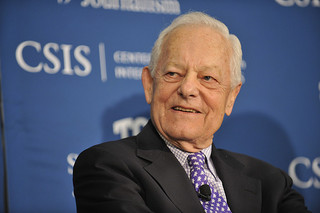
Bob Schieffer (photo: CSIS)
They’re not the only ones who should consider clarifying the record. Here’s CBS Face the Nation host Bob Schieffer (9/22/13):
Rouhani says that Iran does not want and is not pursuing a nuclear weapon. Does anybody take that at face value?
Actually, the burden of proof should be the other way around: Politicians who claim that Iran has such a program should have to prove it. Schieffer obviously doesn’t see the world that way. He’s interviewed people like Israeli Prime Minister Benjamin Netanyahu and failed to challenge their claims about Iran’s weapons. Indeed, Schieffer presented them as facts, telling viewers about Iran’s “continuing effort to build a nuclear weapon” (FAIR Blog, 7/15/13).
So Schieffer is indeed skeptical of government claims. Iran‘s government, that is.
September 24, 2013
Posted by aletho |
Deception, Mainstream Media, Warmongering | Benjamin Netanyahu, Bob Schieffer, CBS Face the Nation, Iran, USA Today |
Leave a comment
Bashar’s acceptance to let go of his “Nukes of the poor” arsenal could mean that the Syrian government has assessed the potential outcome of an American sustained offensive to be a game changer and desperately agreed to any way out.
Handing over chemical weapons in a gradual more controlled manner would have been understandable but giving up the location of the chemical sites with such immediacy hints to a much weakened Syrian position. It is no secret that the details given to the UN will eventually end up in Israeli hands, then why would the Syrian government accept such a deal other than Assad’s real fear of loosening his grip on power?
Netanyahu’s remarks following the chemical handover deal that “negotiating with Syria and Iran with a real and present threat to use force is the only way to make them cooperate” suggests that Syria’s president is indeed at the mode of fighting for survival. But that too is too simplistic provided that, surrendering chemical weapons or not, the US is sure to pursue him to the very bitter end. Then why give up such a strong deterrent?
The fact of the matter is that Bashar al-Assad is an intelligent man who at the very least understands that betraying Russia and Iran, who have been supporting his efforts in the past two years, would be a serious mistake. Therefore, any big decision Syria makes has to have been consulted with its main backers and has been given some sort of guarantees that giving up chemical weapons is not as risky as it might appear and that a credible backup plan is in place.
Smartly, Syria is giving both the US and Russia a face saving mechanism to avoid any further escalation between the two super powers and at the same time it is buying crucial time. Bashar himself declared that at least one full year is required to clear Syria of chemical weapons.
For Syria, chemical weapons are much harder to dispose of than replenish because Syria’s allies have stockpiles upon stockpiles of them. And so if the US chooses to change course somewhere during the period of chemical disarmament and attacks Syria, the very scenario that has been averted would be quickly reintroduced.
One ship full of chemical weapons is all that is required to rearm Syria, after all the main target of such weapons is a country the size of a province; Israel. Moreover, the Iranian and Hezbollah threat of intervening by attacking Israel will not be changed by simply handing over the chemical weapons.
Of course, the decision to hand over the weapons which buys the Syrian government crucial time is unwelcome by the “saboteur” of the region, Saudi Arabia and Turkey. The real danger for them is that this could actually lead to further weakening of the Syrian opposition and force them unto Geneva peace talks; talks which have just been strengthened by Syria’s agreement to declare its chemical arsenal.
Turkey and Saudi Arabia know well that their stances on Syria in the past two years makes it impossible for relations with Bashar’s Syria to normalize or even a negotiated Syria where opposition participates in governance.
Regardless of Turkish and Saudi stances, the US administration and Israel had strong interests in making sure that a war is averted in some way. Had the US congress vote gone ahead and disapproved of any attack on Syria in order to fulfill the wishes of the American people, it would have been a huge blow to them.
For Obama, it would have meant being stripped of legitimacy as it relates to Syria and wider international engagements and for Israel it would have meant the weakening of the Zionist lobby within US politics and a disastrous counter attack from Iran, Syria and Hezbollah.
Bashar’s objectives to consolidate alliances and weaken the counter alliance and buying time have all been thus far satisfied. The one year disarmament period that Bashar suggested will be needed is no speculation at all; it is well calculated period during which time to weaken the opposition and its supporters and to deny the US and her allies any legitimate pretext to attack Syria.
Moreover, if Iran and Hezbollah felt justified to intervene early on, now any attack from the US or her allies before the chemical disarmament is complete makes the Iran and Hezbollah retaliation against Israel with the support of Russia even more justified.
On the other hand, the US, Turkey and Saudi Arabia, (the latter seeming more keen than the US to overthrow Bashar’s government), provided that the SNC is in a weakened position and the desperation of the trio is acute, places them in a real danger of open colluding with the likes of Al Qaeda and Al-Nusra Front. So much for fighting “terrorism”!
Every time one sees a billboard advertising Syrian International Trade Exhibition across the world one wonders how can a government in a war state for over two years manage to facilitate an environment where its factories can produce? The answer could simply be that Syria is not nearly as chaotic or as weak as Western media portrays it to be. That position has just been strengthened by Syria’s agreement to disarm.
The objective of the US and Israel has always been to disarm any Arab army that might use its weapons against Israel; the issue is not whether a country owns a huge arsenals of weapons or not, but whether it has enough potential will to use them against Israel.
The Saudis are armed to the teeth and so are the Turkish but it is their clear stance on ensuring Israel’s peace that makes them allies rather than enemies. It is for that reason that Syria is a prime target as was Saddam’s Iraq.
Five armies that pose serious threat to Israel were the priorities of the US and Israel namely Iranian, Syrian, Egyptian, Iraqi and Hezbollah and so far only one has been dealt with; that of Iraq. In the case of Egypt, the US and Israel are pleased because the Egyptian army is suspect and they truly believe they will eventually buy out its generals. That means Hezbollah, Iran and Syria are left to fight this war that will not stop until one side secures a clear victory.
Where Russia had disappointed in the past as was the case with Iraq, now it appears poised to put up a stronger posture and as such days ahead will clarify the longevity of the new Russian posture. But the latest events have revealed that Russia is no longer a mere Security Council voter but a physical actor in world events.
Therefore, it is naive to assume that Russia has been blackmailed or tricked by the US into pressuring Syria to surrender her most prized deterrent against Israel. Syria will comply albeit at a calculated pace and will give America and Israel no legitimate pretext to attack it and as such Russia will have no choice but to stand its ground. If an attack takes place, Russia’s response is likely to be far stronger than the recent showdown in the Mediterranean or else Russia becomes a goofball.
The stance of Western media and Aljazeera is a good indication that the US and her allies are not in a war mood. When a war is imminent, there are certain networks that have a duty to fulfill and that is drumming for war. They are not doing that just yet!
While it will be naive to assume that Bashar will hold on to power indefinitely, it is clear that the Syrian civil conflict will be a long term struggle and will not end nor conclude the way the US and Israel are hoping for.
September 24, 2013
Posted by aletho |
Wars for Israel | Bashar al-Assad, Hezbollah, Iran, Israel, Russia, Saudi Arabia, Syria, Turkiye, United States |
Leave a comment
Iranian officials say they have completed decoding the surveillance data and software extracted from the Central Intelligence Agency (CIA) drone that the United States lost possession of nearly two years ago near the city of Kashmar.
Hossein Salami, the lieutenant commander general of Iran’s Army of the Guardians of the Islamic Revolution, told the country’s Fars news agency that analysts have finally cracked the systems used within the RQ-170 Sentinel drone obtained in December 2011.
Iranians claimed previously that they brought the drone down after it entered Iranian airspace without permission. Roughly one week later, CIA officials admitted the drone was conducting a reconnaissance mission over Afghanistan when it went missing.
When the US asked Iran to return the unmanned aerial vehicle, Salami told Fars news agency, “No nation welcomes other countries’ spy drones in its territory, and no one sends back the spying equipment and its information back to the country of origin.”
Nearly two years later, Salami is now celebrating Iran’s latest accomplishment with regards to the UAV.
“All the memories and computer systems of this plane have been decoded and some good news will be announced in the near future not just about the RQ-170 and the optimizations that our forces have done on the reverse engineered model of this drone, but also in area of other important defense achievements,” Fars quoted him.
When the Iranian military gained control over the drone, the unmanned aerial vehicle’s (UAV) erase sequence allegedly failed to delete sensitive data from it. Since then, Iranian experts have been decoding the captured data, occasionally reporting their progress.
Although the CIA has not admitted the extent of the drone’s capabilities, experts have said previously that reverse engineering the Sentinel could be a significant event for any nation-state looking to learn more about the technologies utilized by American spy planes.
“It carries a variety of systems that wouldn’t be much of a benefit to Iran, but to its allies such as China and Russia, it’s a potential gold mine,” robotics author Peter Singer told the Los Angeles Times in 2011.
“It’s bad — they’ll have everything” an unnamed US official added to the Times then. “And the Chinese or the Russians will have it too.”
Meanwhile, a report in the New York Times this weekend suggested that Chinese researchers have been busy on their own attempting to emulate American drones. Edward Wong wrote in the Times on Friday that Chinese hackers working for the state-linked Comment Crew cybergroup have targeted no fewer than 20 foreign defense contractors during the last two years in hopes of pilfering secrets that would be useful in programming their own UAVs.
“I believe this is the largest campaign we’ve seen that has been focused on drone technology,” Darien Kindlund, manager of threat intelligence at California-based FireEye, told Wong. “It seems to align pretty well with the focus of the Chinese government to build up their own drone technology capabilities.”
Vice’s Motherboard website reported this week that at least 123 cyberattacks waged at American drone companies have been spotted by security researchers since 2011, and quoted Kindlund as saying the attacks have been “largely successful.”
September 23, 2013
Posted by aletho |
Timeless or most popular | Central Intelligence Agency, China, CIA, Drones, Hacking, Intelligence, Iran, Lockheed Martin RQ-170 Sentinel, Security, United States, Unmanned aerial vehicle, USA |
Leave a comment
1. Which of the following is the most accurate statement?
1. chemical weapons were first used during the First World War
2. chemical weapons were invented and first used in the 19th century
3. chemical weapons have been around since prehistoric people first put poisons on arrowheads
4. the first real chemical weapon was “Greek Fire” invented by the Byzantines in the 7th century
5. chemical weapons were first produced in the 18th century, based on formulae found in Leonardo da Vinci’s rediscovered writings
2. An international conference in 1899 produced the Hague Treaty, which bans the use of projectiles containing poison gas in warfare. Only one country’s representative dissented. What country was this?
1. Russia
2. U.S.
3. United Kingdom
4. Japan
5. Union of South Africa
3. In the First World War, what percentage of fatalities were due to chemical weapons?
1. 4%
2. 12%
3. 39%
4. 51%
5. 59%
4. In April 1917, British forces used poison gas against German and Ottoman forces in
1. Turkey
2. Germany
3. Austria
4. Libya
5. Palestine
5. Who made the following comment in May 1919, regarding the use of mustard gas against Mesopotamian Arabs?
“I do not understand this squeamishness about the use of gas…I am strongly in favor of using poisoned gas against uncivilized tribes… It is not
necessary to use only the most deadly gasses: gasses can be used which cause great inconvenience and would spread a lively terror and yet would leave no serious permanent effects on most of those affected.”
1. Benito Mussolini
2. Winston Churchill
3. Georges Clemenceau
4. Woodrow Wilson
5. Ibn Saud
6. Mustard gas was invented in 1917 by a scientist in
1. U.S.
2. Austria
3. Norway
4. Germany
5. Japan
7. During the First World War, Germany was the largest producer of chemical weapons. What country was number two?
1. U.K.
2. U.S.
3. Japan
4. Italy
5. France
8. 88,000 people died due to chemical weapons during the First World War. 56,000 of these were in one country. What was it?
1. Russia
2. Japan
3. China
4. Germany
5. France
9. At the Washington Arms Conference of 1922 which country opposed inclusion in a treaty of an article banning chemical weapons?
1. France
2. U.S.
3. U.K.
4. Russia
5. Japan
10. Over 60 U.S. merchant seamen were killed by mustard gas in an Italian port in December 1943. Why did this happen?
1. The ship was accidently attacked by a British submarine, with torpedoes armed with mustard gas
2. German troops attacked with gas
3. Italian guerrillas attacked with gas
4. The gas was aboard their ship and released when German forces bombed it
5. None of the above
11. How many tons of chemical weapons material did the U.S. at peak inventory?
1. The U.S. never built or stockpiled such weapons
2. 10,000 tons
3. 30,000 tons
4. 50,000 tons
5. 110,000 tons
12. Napalm was invented
1. by the ancient Greeks
2. by a Swedish scientist in 1876
3. by scientists at Harvard University in 1943
4. by Dow Chemical Corp. during the Vietnam War
5. by the Japanese military during World War II
13. Which president announced that the U.S. would not be the first to use chemical weapons?
1. Wilson
2. Eisenhower
3. Kennedy
4. Nixon
5. Carter
14. Napalm is:
1. A mix of petroleum plus a gelling agent that sticks to skin and causes severe burns when ignited
2. A gas that causes asphyxiation
3. A type of explosive bullet
4. An invisible gas released at low altitude by helicopters
5. A kerosene-based jet fuel used in firebombs
15. Over 2 million tons of napalm were used in World War II. Between 1965 and 1973 how many tons of napalm were dropped on Vietnam by U.S. forces?
1. 1 million
2. 2 million
3. 5 million
4. 8 million
5. 15 million
16. Up to March 1992, according to a Senate study, the U.S. licensed export of anthrax and VX nerve gas to which country among the following?
1. Zimbabwe
2. South Africa
3. United Kingdom
4. Iraq
5. Canada
17. In March 1988 Iraqi forces attacked Kurds in northern Iraq with chemical weapons, killing over 3000. How did the U.S. react?
1. The State Department stated its belief that Iran was behind the attacks
2. Pres. Reagan declared Iraq in violation of international law and asked Congress for permission to punish it
3. U.S. officials openly argued that since Saddam Hussein was a firm ally against Iran the U.S. had to overlook his war crimes
4. The U.S. placed Iraq back on its list of terror-sponsoring nations
5. The U.S. halted military cooperation with Iraq in its war with Iran
18. Which of the following countries are believed to possess stockpiles of chemical weapons?
1. Russia, China, France, U.K., Russia, Syria
2. Egypt, Israel, Syria, North Korea, Russia, U.S.
3. Iran, Iraq, Pakistan, China, France, Russia, U.S.
4. Iran, Syria, Russia, U.S., India, Egypt
5. Iran, Pakistan, North Korea, Russia, U.S., Germany
19. The U.S. claims that Syria possesses about 1000 tons of chemical weapons. How many tons does the U.S. still possess?
1. 500
2. 1000
3. 2000
4. 2500
5. 3000
20. What countries continue to refuse to ban chemical weapons?
1. Syria, Israel, Zimbabwe, South Korea, North Korea
2. Angola, Egypt, North Korea, South Sudan
3. Syria, Israel, U.S., Russia, China
4. Syria, Iran, Zimbabwe, North Korea
5. Angola, Syria, Egypt, North Korea, South Sudan
Bonus question:
The Chemical Weapons Convention approved by the UN General Assembly that bans use of chemical weapons was first signed by participating nations in what year?
1. 1945
2. 1968
3. 1974
4. 1993
5. 2003
Answers:
1. 3 (Salon of Athens poisoned the Spartan water supply. Henry III used quicklime against the French. In 1675 the French and Germans agreed to stop using poisoned bullets. Chemical warfare is not only modern.)
2. 2 (The U.S. representative wanted no curbs on U.S. inventiveness.)
3. 1 (Remarkably small proportion.)
4. 5 (Mostly British versus Germans, with the latter winning.)
5. 2 (Churchill the consummate colonialist.)
6. 4 (Germany’s chemical industry led the world.)
7. 5 (The U.K. and U.S. produced chemical weapons too, but France was far ahead.)
8. 1 (Compare 9000 Germans, 8000 French, 8000 British Empire, 1500 U.S.)
9.1 (Not surprising, since France was then the world’s leading manufacturer of chemical weapons.)
10. 4 (News of this was hushed up.)
11. 3 (Now down to 3000.)
12. 3 (The scientists were doing war-related research. Napalm was soon used; on March 9, 1945 napalm dropped on Tokyo killed over 87,000 people.)
13. 4 (Nov. 25, 1969 statement.)
14. 1 (From naphthenic palmitic acids.)
15. 4
16. 4 (As part of cooperation during the Iran-Iraq War.)
17. 1 (At the same time anonymous government officials opined that there was no law preventing someone from using weapons of mass destruction on his own people.)
18. 2 (Israel argues that its chemical weapons serve as a deterrent to Syrian attack.)
19. 5 (Russia has about 9000 and plans to destroy it all by next year.)
20. 2 (Now that Syria has signed the treaty, just four countries remain outside it.)
Bonus: 4 (There are now 189 signatories.)
September 21, 2013
Posted by aletho |
Militarism, Timeless or most popular, War Crimes | Chemical weapon, Germany, Iran, Iraq, North Korea, Russia, Syria |
Leave a comment
As New York prepares for the annual opening of the United Nations General Assembly next week, the volume of Western media speculation about the prospects for a U.S.-Iranian diplomatic breakthrough is mounting to impressive levels. Predictably, much of this speculation amounts to little more than wondering how many concessions the Islamic Republic’s new president, Hassan Rohani, is willing and will be able to make, especially on the nuclear issue.
As usual, we prefer looking at facts and authoritative statements of official positions over the speculation of journalists and pundits. In this spirit, we want to highlight a few passages from President Rohani’s much noted Op-Ed in the Washington Post earlier this week, see here.
Three passages seem especially relevant for understanding Tehran’s position on the nuclear issue. The first presents Rohani’s definition of “constructive engagement” (emphasis added):
“It is—or should be—counterintuitive to pursue one’s interests without considering the interests of others. A constructive approach to diplomacy doesn’t mean relinquishing one’s rights. It means engaging with one’s counterparts, on the basis of equal footing and mutual respect, to address shared concerns and achieve shared objectives. In other words, win-win outcomes are not just favorable but also achievable. A zero-sum, Cold War mentality leads to everyone’s loss.”
The explicit reference to not relinquishing one’s rights is, of course, very much of a piece with Rohani’s statements, during his presidential campaign and since his election, that he is not about to surrender Iran’s right—as a sovereign state and as a non-weapons state party to the Nuclear Non-Proliferation Treaty (NPT)—to enrich uranium under international safeguards. Unfortunately, there is no concrete indication that the Obama administration is prepared to acknowledge this right. In fact, one can find multiple statements from administration officials over the last five years publicly denying that there is such a right. (This is, among other things, a legally and intellectually dishonest reading of the NPT.)
The second passage from President Rohani’s Op-Ed that we want to highlight here explains with admirable clarity why the Islamic Republic is not about to compromise its right to safeguarded enrichment (again, emphasis added):
“We must also pay attention to the issue of identity as a key driver of tension in, and beyond, the Middle East. At their core, the vicious battles in Iraq, Afghanistan and Syria are over the nature of those countries’ identities and their consequent roles in our region and the world. The centrality of identity extends to the case of our peaceful nuclear energy program. To us, mastering the atomic fuel cycle and generating nuclear power is as much about diversifying our energy resources as it is about who Iranians are as a nation, our demand for dignity and respect and our consequent place in the world.”
President Rohani goes on to note, “Without comprehending the role of identity, many issues we all face will remain unresolved.” Indeed. Unfortunately, it remains far from clear that the Obama administration understands how tightly the matter of Iran’s nuclear rights is linked to fundamental questions of identity (like independence and control of the country’s energy resources) for Iranians who supported Imam Khomeini’s revolution and continue to support the political order it produced.
The third passage from President Rohani’s Op-Ed that we want to highlight discusses the requirements for diplomatic progress (yet again, emphasis added):
“To move beyond impasses, whether in relation to Syria, my country’s nuclear program or its relations with the United States, we need to aim higher. Rather than focusing on how to prevent things from getting worse, we need to think—and talk—about how to make things better. To do that, we all need to muster the courage to start conveying what we want—clearly, concisely and sincerely—and to back it up with the political will to take necessary action. This is the essence of my approach to constructive interaction.”
President Rohani certainly is not the first Iranian leader to want the United States to clarify its ultimate intentions vis-à-vis the Islamic Republic. Unfortunately, it remains far from clear that the Obama administration is or will be prepared to lay out a clear and positive end game for nuclear talks with the Islamic Republic—for this would require the United States to acknowledge Iran’s aforementioned right to safeguarded enrichment as an essential pillar of any negotiated solution to the nuclear issue.
So, going into UNGA next week and looking beyond UNGA to renewed nuclear negotiations with the Islamic Republic, the relevant question is not how much is Iran’s leadership prepared to concede on the nuclear issue. Rather, the relevant question is whether Washington is prepared to abandon a strategic approach to the Middle East that has done profound damage to America’s own position in this vital region—in no small part, by rendering productive diplomacy with the Islamic Republic impossible.
This was very much the theme of an interview that our colleague, Seyed Mohammad Marandi from the University of Tehran, gave earlier this week to Russia Today, see here. We append the interview, titled “Iran’s position strengthening while US in decline,” below, along with Russia Today’s editorial precede:
“Iran’s vow to never develop nuclear arms appeared to be an olive branch extended America’s way. But it is Washington, and not Tehran who needs all the friends it can get these days, Professor Seyed Mohhamad Marandi from the University of Tehran told RT.
On Wednesday, Iran’s new president Hassan Rouhani said of the Islamic Republic, ‘under no circumstances would we seek any weapons of mass destruction, including nuclear weapons, nor will we ever.’
Underscoring Rouhani’s concerted efforts to kick start negotiations over its controversial uranium enrichment program with the West, US President Barack Obama and Rouhani exchanged letters. This followed recent elections in Iran and the two leaders may meet on the margins of the UN general assembly next week. Rouhani, who took office in August, also ordered the release of Nasrin Sotoudeh, an Iranian human rights lawyer, and a number of other political prisoners on the eve of a visit to the United Nations.
The White House has thus far reacted positively towards these overtures, with White House spokesman Jay Carney saying ‘there is an opportunity for diplomacy when it comes to the issues that have presented challenges to the United States and our allies with regards to Iran.’
Professor Marandi says that while the onus has been put on Tehran to return to the Western fold, it is Washington who needs Iran to help fix the mess it’s made in the region.
RT: Iran has always said that it would not construct nuclear weapons. So why the apparently enthusiastic reaction from the US now?
Seyed Mohhamad Marandi: It’s hard to say, it really should be asked why the United States didn’t respond earlier because this is what the Iranians have been saying all along. But still I think the Iranians are quite willing to see if the apparent enthusiasm will lead to any change in US policy; that’s the important thing. What the Iranians are doing right now is saying ‘look, we are going to preserve our sovereign rights as an independent country, we will continue with our peaceful nuclear program, we’ve never disregarded international law, there’s no evidence of that, but we are willing to create a new favorable environment for negotiations.’ So basically what the Iranians have done is put the ball firmly in the American’s court, where it’s been for quite a while, but they’re doing this basically for the international community to see, and it’s now for the United States to respond.
So far the United States has responded negatively. As soon as Mr Rouhani became president [Washington] slapped on new sanctions, now they are taking a building that is linked to the Iranian community in the United States. These are not positive signs, so the Iranians are waiting to see over the next few days and weeks whether the United States is going to rethink its previously irrational approach toward Iran.
RT: You mentioned peaceful energy purposes. Will the US ever accept that?
SMM: That’s up to the United States. Iranians are not going to wait for US acceptance. The Iranian position has been strengthened over the past few months, recent Iranian elections have shown Iran’s strength; the high turnout has shown there is a great deal of legitimacy in the Iranian electoral process. The reason why some of these people in prison were released was not because of any human rights work that they did, but because after the previous elections (which they deemed fraudulent), they were helping to create unrest in the country. But after this election, President Rouhani and many reformists and people from all backgrounds in the political establishment have said that there never was fraud and that basically this has strengthened Iran’s position. Right now, while the rest of the region is in uproar and there’s increasing instability thanks to the United States, Iran is the only country that is completely stable and with a high turnout in the political process in the country.
On the other hand the United States has isolated itself by threatening Syria; the international community has moved against the United States, and even within the United States Obama and the political establishment has lost popularity and support over their proposed aggression against Syria. So Iran feels that its position is much stronger today, and America’s position is much weaker.
RT: Could Iran’s new efforts to improve relations with the West be seen as a sign that sanctions have actually worked?
SMM: Sanctions are working in the sense that some people have died because of a lack of medicine because Americans have basically tried to shut down the Iranian central bank, along with their allies. But that has created anger among Iranians. But at the same time, President Rouhani has said specifically that Iran is very willing to resolve questions that exist with regards to the Iranian nuclear program in the West as long as Iran’s rights are preserved. But when the United States threatens countries, invades countries and imposes sanctions on ordinary Iranians, creating a lack of medicine for cancer patients for example, then that does not help resolve the situation. The Iranians are not going to kneel to the United States. Iran is a sovereign and independent country, that’s what the revolution was about 34 years ago, for Iran to gain its independence and overcome American hegemony. It’s not a client regime like Saudi Arabia, Qatar or Jordan. So if the United States comes to respect Iran, then we can have rapprochement. The United States needs Iran, because thanks to its own policies, its destabilized the whole region, the United States has allowed Al-Qaeda to thrive through Saudi Arabia, Qatar and other oil rich dictatorships. In order to salvage the situation, it needs a strong, powerful, secure and stable country like Iran to help resolve the current mess that they’ve created in the region.”
We will be spending time in New York over the next week, monitoring developments and meeting with senior members of the Islamic Republic’s UNGA delegation. Whatever happens, it is likely to be an interesting—and potentially very revealing—week.
September 21, 2013
Posted by aletho |
Militarism, Timeless or most popular | Hassan Rowhani, Iran, United States |
Leave a comment
Iran’s Ambassador to the International Atomic Energy Agency (IAEA) Reza Najafi has called for the restructuring of the UN nuclear agency.
Addressing the 57th regular session of the IAEA General Conference in the Austrian capital of Vienna on Thursday, the Iranian envoy called for an increase in the number of the members of the agency’s Board of Governors as well as a revision of the make-up of the permanent seats at the UN body.
“While the General Conference consists of all member states and the Board of Governors has a limited [number of] members, there is no appropriate balance between the powers and duties of these two bodies, and the decisions made at the General Conference are mainly subject to the approval or prior recommendations of the Board of Governors,” Najafi said.
It is necessary to discuss the issue of striking a balance between the prerogatives and responsibilities of the two bodies, he stressed.
The Iranian ambassador proposed the formation of a consultative group comprising all members to discuss the above-mentioned proposals and make appropriate recommendations in that regard.
A number of other envoys to the IAEA including those from Cuba, Venezuela, Pakistan, Algeria, Ecuador, Nicaragua, Egypt and Lebanon expressed support for Iran’s proposals.
September 20, 2013
Posted by aletho |
Aletho News | IAEA, International Atomic Energy Agency, Iran |
Leave a comment
Speaking in Tehran to NBC’s Ann Curry in his very first interview with an American media outlet, Iranian President Hassan Rouhani again – and repeatedly, considering Ms. Curry kept asking him the same question over and over – asserted Iran’s wholesale condemnation of nuclear arms and its commitment never to build or acquire such weaponry.
Rouhani’s statements were consistent with those of nearly every high-level Iranian official and diplomat over the past twenty years.
After Curry stated (totally incorrectly), “The world believes that Iran could build a bomb very quickly,” Rouhani replied:
We have never pursued or sought a nuclear bomb and we are not going to do so. We are solely seeking peaceful nuclear technology.
Once wasn’t enough for Curry. She asked, “Can you say now categorically then, that Iran will not build a nuclear weapon under any circumstances whatsoever?”
So Rouhani repeated:
The answer to this question is quite obvious. We have time and again said that under no circumstances would we seek any weapons of mass destruction including nuclear weapons, nor will we ever.
Again, Curry pondered, “So the answer is ‘no’?” After Rouhani again affirmed this point, she gave it another shot. “I want to make sure I understand. So the American public, so the world understands. If you can say categorically that Iran will not seek a nuclear weapon under any circumstances whatsoever. Is the answer to that yes or no, sir?”
Rouhani was patient. “The answer is that this country will never seek nuclear weapons.”
He added that “Iran wants nothing beyond what is defined in the Non-Proliferation Treaty (NPT) regarding the nuclear [rights] of countries,” a common statement often made by Iranian officials who understand that the Western demand on Iran to shutter or scale back its IAEA-safeguarded nuclear program is in itself a violation of Iran’s inalienable national rights.
In fact, Curry shouldn’t be so surprised by such statements coming from the top Iranian executive, as she has made a habit out of asking Iranian president the exact same question multiple times in a row and receiving the same answer.
When she interviewed President Mahmoud Ahmadinejad in September 2009, he told her (as noted in the above litany), “We don’t have such a need for nuclear weapons. We don’t need nuclear weapons. Without such weapons, we are very much able to defend ourselves…It’s not a part of our any – of our programs and plans.”
As a perfect example of how the mainstream media operates, after the interview, Curry published a summative report entitled, “Ahmadinejad refuses to rule out weapons.”
Two years later, when Curry again interviewed Ahmadinejad in Tehran, she asked the president directly, “Is Iran working on a nuclear warhead?”
Ahmadinejad’s reply was consistent, as always:
This is an old and repeated story. These are the same claims made by the U.S. administration many times. They have been repeating these claims for many years. This is not a new thing for us. In principle, we are against nuclear weapons because it is against our beliefs and ideology. We do not consider nuclear weapons as a useful weapon. The period or era of nuclear weapons is over…
Can nuclear weapons offer solutions to the current international problems? Can they bring superiority for the nuclear states? Certainly the answer is ‘no.’
He further stated, “We think those who try to build or make nuclear weapons, they are doing something absurd and useless. They only jeopardize their own situation and they waste the wealth of their own nations if they do it,” and explained that, as opposed to “a period of nuclear bombs,” today is an “era of humanity.”
Responding to allegations of a clandestine Iranian nuclear weapons program, he explained (as he always had):
We have integrity and are sincere in what we say because we are not afraid of any power and we do not need to conceal our intentions. If we want to build a nuclear weapon, we have the courage to announce it openly. We are not afraid of others.
Still unsatisfied, Curry decided to repeat herself, asking, “Is the answer yes or is it no, with all due respect?”
When Ahmadinejad reiterated, “We do not need nuclear weapon and we do not accept nuclear weapons. We are against that,” Curry quadrupled-down, “So you’re saying the answer is no?”
The president replied, “Right, that’s right, certainly.”
Apparently, Ann Curry has trouble taking ‘no’ for an answer. And yet, all we hear is that Rouhani’s unequivocal statement against nuclear weapons is something new and unprecedented. Clearly, it’s not.
Brian Williams, during tonight’s broadcast of NBC Nightly News, told his audience that Rouhani’s exclusive interview with Curry is “significant because it represents the first reason for any optimism, the first sign of any movement from Iran on the issue of nuclear weapons.”
What an absurd thing to say. Such is the scope of perception in the mainstream media.
September 19, 2013
Posted by aletho |
Deception, Mainstream Media, Warmongering, Timeless or most popular | Ann Curry, Iran, NBC, NBC Nightly News, Rouhani |
Leave a comment
Citing a “potential positive development” in the Russian proposal regarding Syrian chemical weapons stockpile, US President Barack Obama has put a temporary break on the express train of war on Syria and, simultaneously, accelerated the White House push for a congressional authorization for a military strike.
This new development, following a purportedly off-the-cuff press statement by US Secretary of State John Kerry, has been viewed as a potential game-changer that may result in a win-win scenario, whereby Obama can safeguard his reputation, heal the rifts with Moscow, avoid another US entanglement in Middle East conflicts, and simultaneously declare victory by resorting to “credible military threat,” an important consideration given the close links with the US’s Iran policy (of nuclear containment).
The Russian proposal, put forth by Foreign Minister Sergei Lavrov, has two skeletal components respecting the international supervision and monitoring the Syrian chemical stockpile and the provisions for the destruction of that stockpile, yet to be fleshed out. The Syrian foreign minister has welcomed this initiative and so has UN Secretary General Ban Ki-Moon, who has warned that a unilateral US strike without the UN authorization would be illegal. Iran’s initial reaction has been positive as well, in the light of a statement by the Foreign Ministry spokesperson articulating the position of the Islamic Republic of Iran.
In turn, a number of important questions have been raised as a result of this new development. First, how feasible and practical is the idea of international supervision of the chemical weapons stockpile in the present context of warfare in Syria? The likelihood of danger to the inspectors being relatively great, will they need to be accompanied by an international force and, if so, is the UN willing to risk its peacekeepers in a war zone?
Second, although the international community is correct to push Syria to join the Protocol on Chemical Weapons and to disarm, such a decision cannot be taken in the vacuum of regional realities, above all the fact that historically these weapons have served a deterrent purpose for the Syrian regime vis-à-vis Israel, which has reportedly amassed a huge arsenal of chemical weapons over the years; a recent CIA document confirms this by referring to Israel’s “nerve gas facilities” which went into production decades ago. Indeed, the deterrent value of Damascus’ chemical weapons capability have been demonstrated in the current crisis, whereby Israel has been forced to take several drastic steps such as mass distribution of masks, early installation of Iron Dome defense shield, etc.
Henceforth, Syrian disarmament without a parallel disarmament of the Israeli stockpile would, in strictly military terms, shift the balance in Israel’s favor. Therefore, it is important to explore the short and long-term implications of Syrian disarmament with respect to the long-standing territorial dispute between Syria and Israel. Perhaps Israel should pledge to refrain from the use of chemical weapons against Syria as a part and parcel of the Syrian disarmament agreement.
Third, what happens if the Syrian regime disarms but the rebels, who are reportedly in possession of chemical weapons, do not and resort to these weapons? The threat of chemical weapons by the Syrian rebels has so far been completely overlooked by the White House and, yet, must be taken into consideration in any agreement on Syrian disarmament. In other words, a total disarmament covering the rebels as well as the government, irrespective of the difficulties with respect to the leading rebel groups, which have known Al-Qaeda ties. In principle, this is the right approach that would not discriminate toward any group suspected of possessing and or using the ghastly weapons.
Fourth, a complicating factor is the role of certain regional states that support the rebels and may not consent to any such deal, which raises the question what happens if these sates are not brought on board the agreement on Syrian chemical weapons disarmament? The US should push for explicit and unequivocal endorsement of the plan by Saudi Arabia, Qatar, and other Persian Gulf Cooperation Council member states.
Finally, the two issues of supervision and destruction of Syrian chemical weapons stockpile should not be conflated, and a preliminary investigation of the merits of the former without the necessity of the latter should be conducted. Given the stated concern of Obama and other Western leaders regarding the future use of chemical weapons, the stationing of international monitors on the ground will go a long way in terms of confidence-building that the regime will not use them. This more moderate approach is far more realistic than the issue of “control” that raises serious practical difficulties, such as interfering in the Syrian system of military “command and control.”
For now, however, a glimmer of hope against a US strike on Syria has sparked on the horizon that may not be long-lasting, if the disarmament issue is used by the White House to acquire a “yes” vote on the war power authorization and then attack Syria with the excuse that it has skirted its disarmament obligation.
Theoretically, it is now easier for Obama to lobby the US Congress, by nuancing the pitch in the name of the noble objective of chemical weapons disarmament. In that case, the potential breakthrough in the Russia disarmament proposal may only serve the ultimate US’s war aims which have been partly checked, ironically, by Syrian chemical weapons threats to Israel. By removing these weapons, the imminent threat of US strike may be put to rest and, yet, the paradoxical effect is likely to be a weakened Syria more vulnerable to foreign threats and pressures. In a word, a war-saving proposal adversely affecting Syrian national security interests may be an invitation to war in the future.
September 11, 2013
Posted by aletho |
Militarism, Wars for Israel | Iran, Israel, John Kerry, Syria, United States, Zionism |
Leave a comment


 Aletho News
