Over at The Daily Beast‘s Cheat Sheet, which serves as a news aggregator, a post went up today with the eye-catching headline: “Iranian President Ahmadinejad Arrested.”
The blurb accompanying the post claims:
Iranian President Mahmoud Ahmadinejad was arrested Monday while on a visit to a book fair in Tehran, where he was held for seven hours and questioned by the Revolutionary Guards’ intelligence unit. According to a source within the guards’ unit, Ahmadinejad was intercepted while on his way to a meeting at the supreme leader’s office. His security team was stripped of communication devices and Ahmadinejad was questioned about documents that may be detrimental to the regime. He was warned, essentially, to keep his mouth shut about all matters that could harm the regime going into the upcoming presidential election.
How positively scandalous! The infamous Iranian bogeyman, along with his entourage, accosted, interrogated, threatened and silenced by the very security forces the hysterical Western media and political pundits would have you believe he himself commands and wields with an iron fist!
At the bottom of its short post, the Beast sources the information to The Guardian and links to the original article. But following the link, something doesn’t feel right. Or look right.
Because it isn’t right.
The link leads to a site called “The Guardian Express” at the URL guardianlv.com. ‘Hey, what’s the “lv” stand for?,’ one might ask if one cared about such things as accuracy. It stands for “Las Vegas,” because the website is actually a local community news forum in Nevada, not the prestigious British news outlet.
The article found on “The Guardian Express” site – posted by a forum member who goes by the moniker “randy77” – is a nearly completely plagiarized story stolen from the latest piece of nonsense published Tuesday by the pseudonymous neocon darling “Reza Kahlili,” a serial liar and propagandist beloved by the Bomb Iran crowd who wears a surgical mask in public for absolutely no reason. “Kahlili” claims he is a former CIA agent who infiltrated the highest echelons of the Iranian intelligence apparatus and apparently some people believe him. He may also be a San Francisco Giants fan, but that might actually be a clever ruse to throw the pursuing mullahs off his trail.
 |
| Yes, he does this. |
“Kahlili” is a regime change enthusiast who wants Iran attacked by the United States and Israel yesterday. He consistently publishes scoops on the right-wing loony-toon website WorldNetDaily that contain no factual information, save that a country called Iran does actually exist.
A few years ago he insisted that there is “no doubt” the Iranian government is “going to commit the most horrendous suicide bombing in human history. They will attack Israel, European capitals and the Persian Gulf region at the same time, then they will hide in a bunker [until a religious prophecy is fulfilled]… and kill the rest of the nonbelievers.” He also said Iran had already enriched uranium to 90%, that is, weapons-grade, and that “they have missiles that they have not publicly shown, because that would verify their intention of carrying out nuclear warheads,” whatever that means.
He’s also warned of an “Iranian dominated worldwide terror network that now reaches the United States” and said that the Iranian government has planted sleeper cells in the U.S. that are ready to strike if Iran is attacked. Impending terrorist acts carried out in the United States by Iranian agents is a recurring theme in his creative writing.
Wondering about “Kahlili”‘s bona fides and impressive associates? “I thought I knew a lot about Iran until meeting with him,” admitted racist Islamophobe Peter King, who is also somehow a U.S. Congressman. He was a featured guest of the AIPAC-affiliated Washington Institute on Near East Policy in 2010. This insane interview with leading lunatic Pam Geller might also be useful.
In 2011, “Kahlili” claimed both that Iran was planning an EMP attack on the United States and wrote, “Not only does the Islamic Republic already have nuclear weapons from the old Soviet Union, but it has enough enriched uranium for more. What’s worse, it has a delivery system,” because, hey why not?
He likes suggesting that the Iranian government is both messianic and genocidal, that it’s planning to “annihilate the Jews” and wage an apocalyptic war to hasten the end times. Last fall he declared that “a three-person delegation of the Obama administration led by a woman engaged in secret negotiations with a representative of Iranian Supreme Leader Ayatollah Ali Khamenei,” and cut a sanctions-alleviating deal before the 2012 presidential election.
Earlier this year, “Kahlili” repeated the claim that Iran had “successfully… built a nuclear bomb with the help of Russia and North Korea and has enough weapons-grade uranium and plutonium for more.” Soon thereafter, he pretended that there had been a massive explosion at the Iranian enrichment facility at Fordo, even though it wasn’t true.
Just a couple months later, however, he claimed his super secret sources revealed that “Iranian scientists are working on nuclear warheads – and trying to perfect them – at an underground site unknown to the West,” adding that Iran had, as yet, only “succeeded in enriching uranium to 20 percent, which is 80 percent of the way to weapons grade.”
Perhaps the most ridiculous allegation “Kahlili” has made in recent memory was when, on April 22, he stated the Iranian Revolutionary Guard Corps was responsible for the bombings at the Boston Marathon a week earlier and that the Tsarnaev brothers were devoted followers of Iranian leader Ayatollah Khamenei.
Needless to say, the claim that Ahmadinejad was arrested has not been corroborated by any other sources and should be taken with a grain of salt the size of Atlantis.
That The Daily Beast would promote such silliness, with false attribution that lends the tale the imprimatur of a real news story, no less, is a testament to both its own lack of fact-checking and willingness to believe whatever nonsensical stories pop up about Iran are floating around in cyberspace. A glimpse at the Beast‘s own “Xtra Insight” link on that same post, which brings the reader to an asinine article by shameless self-promoter, staunch Zionist and self-described “public intellectual” Bernard-Henri Lévy about regime change in Iran only drives the point home.
With “insight” like that, it’s no wonder The Daily Beast has troubling seeing clearly.
*****
UPDATE:
As a result of this post getting some attention, The Daily Beast has issued a correction on its Cheat Sheet post:
Still no reference to the “sourcing” being WorldNetDaily or “Kahlili”, but hey, it’s something, right?
Meanwhile, Britain’s Daily Mail has already picked up the story and run with it.
May 2, 2013
Posted by aletho |
Deception, Mainstream Media, Warmongering | Daily Beast, Iran, Mahmoud Ahmadinejad, WorldNetDaily |
Leave a comment
The controversy over Iran’s nuclear activities has at least as much to do with the future of international order as it does with nonproliferation. For this reason, all of the BRICS have much at stake in how the Iranian nuclear issue is handled.
Conflict over Iran’s nuclear programme is driven by two different approaches to interpreting the Nuclear Non-Proliferation Treaty (NPT); these approaches, in turn, are rooted in different conceptions of international order. Which interpretation of the NPT ultimately prevails on the Iranian nuclear issue will go a long way to determine whether a rules-based view of international order gains ascendancy over a policy-oriented approach in which the goals of international policy are defined mainly by America and its partners. And that will go a long way to determine whether rising non-Western states emerge as true power centers in a multipolar world, or whether they continue, in important ways, to be subordinated to hegemonic preferences of the West—and especially the United States.
The NPT is appropriately understood as a set of three bargains among signatories: non-weapons states commit not to obtain nuclear weapons; countries recognised as weapons states (America, Russia, Britain, France, and China) commit to nuclear disarmament; and all parties agree that signatories have an “inalienable right” to use nuclear technology for peaceful purposes. One approach to interpreting the NPT gives these bargains equal standing; the other holds that the goal of nonproliferation trumps the other two.
There have long been strains between weapons states and non-weapons states over nuclear powers’ poor compliance with their commitment to disarm. Today, though, disputes about NPT interpretation are particularly acute over perceived tensions between blocking nuclear proliferation and enabling peaceful use of nuclear technology. This is especially so for fuel cycle technology, the ultimate “dual use” capability—for the same material that fuels power, medical, and research reactors can, at higher levels of fissile isotope concentration, be used in nuclear bombs. The dispute is engaged most immediately over whether Iran, as a non-weapons party to the NPT, has a right to enrich uranium under international safeguards.
For those holding that the NPT’s three bargains have equal standing, Tehran’s right to enrich is clear—from the NPT itself, its negotiating history, and decades of state practice, with at least a dozen states having developed safeguarded fuel cycle infrastructures potentially able to support a weapons program. On this basis, the diplomatic solution is also clear: Western recognition of Iran’s nuclear rights in return for greater transparency through more intrusive verification and monitoring.
Those recognising Iran’s nuclear rights take what international lawyers call a “positivist” view of global order, whereby the rules of international relations are created through the consent of independent sovereign states and are to be interpreted narrowly. Such a rules-based approach is strongly favoured by non-Western states, including BRICS—for it is the only way international rules might constrain established powers as well as rising powers and the less powerful.
Those who believe nonproliferation trumps the NPT’s other goals claim that there is no treaty-based “right” to enrich, and that weapons states and others with nuclear industries should decide which non-weapons states can possess fuel cycle technologies. From these premises, the George W Bush administration sought a worldwide ban on transferring fuel cycle technologies to countries not already possessing them. Since this effort failed, Washington has pushed the Nuclear Suppliers’ Group to make such transfers conditional on recipients’ acceptance of the Additional Protocol to the NPT—an instrument devised at US instigation in the 1990s to enable more intrusive and proactive inspections in non-weapons states.
America has pressed the UN Security Council to adopt resolutions telling Tehran to suspend enrichment, even though it is part of Iran’s “inalienable right” to peaceful use of nuclear technology; such resolutions violate UN Charter provisions that the Council act “in accordance with the purposes and principles of the United Nations” and “with the present charter.” The Obama administration has also defined its preferred diplomatic outcome and, with Britain and France, imposed it on the P5+1: Iran must promptly stop enriching at the near-20 per cent level to fuel its sole (and safeguarded) research reactor; it must then comply with Security Council calls to cease all enrichment. US officials say Iran might be “allowed” a circumscribed enrichment programme, after suspending for a decade or more, but London and Paris insist that “zero enrichment” is the only acceptable long-term outcome.
Those asserting that Iran has no right to enrich—America, Britain, France, and Israel—take a policy-or results-oriented view of international order. In this view, what matters in responding to international challenges are the goals motivating states to create particular rules in the first place—not the rules themselves, but the goals underlying them. This approach also ascribes a special role in interpreting rules to the most powerful states—those with the resources and willingness to act in order to enforce the rules. Unsurprisingly, this approach is favoured by established Western powers—above all, by the United States.
BRICS need to call Washington’s bluff
All of the BRICS have, in various ways, pushed back against a de facto unilateral rewriting of the NPT by America and its European partners. Since abandoning nuclear weapons programmes during democratisation and joining the NPT, Brazil and South Africa have staunchly defended non-weapons states’ right to peaceful use of nuclear technology, including enrichment. With Argentina, they resisted US efforts to make transfers of fuel cycle technology contingent on accepting the Additional Protocol (which Brazil has refused to sign), ultimately forcing Washington to compromise. With Turkey, Brazil brokered the Tehran Declaration in May 2010, whereby Iran accepted US terms that it swap most of its then stockpile of enriched uranium for new fuel for its research reactor. But the Declaration openly recognised Iran’s right to enrich; for this reason, the Obama administration rejected it.
The recently concluded 5th BRICS Summit in Durban saw a joint declaration Declaration that referred to the official BRICS position on Iran:
“We believe there is no alternative to a negotiated solution to the Iranian nuclear issue. We recognize Iran’s right to peaceful uses of nuclear energy consistent with its international obligations, and support resolution of the issues involved through political and diplomatic means and dialogue.”
At the same time, the BRICS have all, to varying degrees, accommodated Washington on the Iranian issue. Russian and Chinese officials acknowledge there will be no diplomatic solution absent Western recognition of Tehran’s nuclear rights. Yet China and Russia endorsed all six Security Council resolutions requiring Iran to suspend enrichment. Beijing and Moscow did so partly to keep America in the Council with the issue, where they can exert ongoing influence—and restraint—over Washington; at their insistence, the resolutions state explicitly that none of them can be construed as authorising the use of force against Iran.
Russia, China, and the other BRICS have also accommodated Washington’s increasing reliance on the threatened imposition of “secondary” sanctions against third-country entities doing business with the Islamic Republic. Such measures violate US commitments under the World Trade Organisation, which allows members to cut trade with states they deem national security threats but not to sanction other members over lawful business with third countries. If challenged on this in the WTO’s Dispute Resolution Mechanism, America would surely lose; for this reason, US administrations have been reluctant actually to impose secondary sanctions on non-US entities transacting with Iran. Nevertheless, companies, banks, and even governments in all of the BRICS have cut back on their Iranian transactions—feeding American elites’ sense that, notwithstanding their illegality, secondary sanctions help leverage non-Western states’ compliance with Washington’s policy preferences and vision of (US-dominated) world order.
If the BRICS want to move decisively from a still relatively unipolar world to a genuinely multipolar world, they will, at some point, have to call Washington’s bluff on Iran-related secondary sanctions. They will also have to accelerate the development of alternatives to US-dominated mechanisms for conducting and settling international transactions—a project to which the proposed new BRICS bank could contribute significantly.
May 1, 2013
Posted by aletho |
Economics, Timeless or most popular | Iran, NPT, Nuclear Non-Proliferation Treaty, Nuclear proliferation, United States |
Leave a comment
At the second annual Jerusalem Post Conference, held in New York City on Sunday April 28, a number of former and current Israeli officials offered new estimates about Iran’s nuclear progress, issued threats of war and pretended Israel is more powerful and militarily capable than it really is.
In other words, it was just another day of shameless and shameful Israeli propaganda; pathetic, jingoistic bluster meant to appeal to hawkish American donors, puff up Israel’s inflated sense of self, and attempt to boost its already non-existent credibility.
Former IDF intel chief Amos Yadlin said, “Even though Iran is on the way to crossing the line of Netanyahu, that doesn’t mean that they have the bomb,” which might be the most tediously self-evident comment made in recent memory, despite also relying on fact-free speculation. He also said that Israel could weather the consequences of a potential unilateral military assault on the Islamic Republic, but that, before that happens, “we must give more time for the other strategies that nobody takes credit for,” an apparent reference to Israeli-led covert murder operations and cyberwar.
Meanwhile, former IDF Chief of Staff Gabi Ashkenazi also told the mouth-breathing attendees that Israel can effectively attack Iran and sustain the inevitable blowback. “We cannot allow this regime to have the bomb,” he said, before insisting that a recent multi-billion dollar U.S. arms sale to Israel “sends a signal” to Iran about Israel’s military capabilities and intentions.
The best comments of the day, however, were made by Israeli Strategic Affairs Minister Yuval Steinitz. Calling an Iran with an atomic arsenal “equal to 30 nuclear North Koreas,” Steinitz’s stand-up routine didn’t disappoint. Not only was a “nuclear Iran” an “existential threat” to Israel, he said, it would also pose a “terrible threat” to all of the Middle East, Europe and the United States. Canada, Mexico, Central and South America, Africa, Australia and Antarctica would apparently be spared the devastating scourge, however.
“Iran is problem number one of our generation,” Steinitz declared. He then launched into an embarrassingly repetitive rant about how Iran is the new Nazi Germany, an analogy so stupid and played out that even its most ardent champion Netanyahu hasn’t used it in a while. After praising Winston Churchill for his actions in the 1930s (which garnered a healthy round of applause from the crowd), Steinitz implicitly condemned other powers and political leaders for their past follies and failures, evoking the tired bromide equating diplomacy with appeasement.
“We shouldn’t repeat the same mistakes again,” he said, continuing:
This was Nazi Germany, a secular regime with a fanatical ideology. And here we are speaking about the Shiite Ayatollahs of Iran. Totally [religious] fanatical regime. There it was Europe, here it’s Iran. The Nazis spoke about the final solution for the Jewish people in Europe. They [Iranian leaders] are speaking about destroying the Jewish State in the Middle East. There are some differences. We have to learn from history. And so it never repeats itself exactly. And if there’s a lesson to learn from history, it’s not to repeat the same mistake again. And not to allow, come what may, the nuclearization of Iran.
He wasn’t finished.
Once at full capacity, the Iranian nuclear program, he claimed, will be able to produce 20 to 30 nuclear bombs each year and somehow decided that, “if Iran gets the first few bombs, in a decade or so they will have 100 nuclear bombs.”
This was “not an intelligence estimate,” he was quick to note, but rather was based on statements by the Islamic Republic itself, which makes literally no sense since Iran has never once stated any intention to build or acquire a single nuclear weapon.
For good measure, Steinitz also tossed around phrases like “global ambitions” and “a new era of Islamic hegemony,” because things like that – regardless of their sheer stupidity – play well with ignorant, racist audiences like the one assembled Sunday at the Times Square Marriott.
Dismissing sanctions as insufficient “to achieve our goal,” Steinitz demanded that “a very clear military threat” be made to Iran (ignoring, of course, that this is an undeniable violation of the UN Charter), “a credible threat that will make it crystal clear that they are paying something for nothing.”
“If there is a chance to resolve this problem without military action,” he said, it will only be because opponents of Tehran’s nuclear program “choose a big enough stick and wave it in their faces,” appealing to the Orientalist conception that Middle Eastern leaders only understand the language of force and will only kowtow to Western and Israeli demands when sufficiently fearful of potential violence.
Former Israeli Prime Minister Ehud Olmert, who also spoke at the conference, tried to temper such alarmist rhetoric and dispel the notion that Iran poses an existential threat to Israel, one worthy of constant hysteria and attention.
“I think that we have exaggerated, for a long time, the potential threat of Iran possessing nuclear power,” he told the crowd.
Predictably, Olmert’s comments did not receive a positive reception; instead, he was heckled and booed.
May 1, 2013
Posted by aletho |
Ethnic Cleansing, Racism, Zionism, Mainstream Media, Warmongering, Militarism, Timeless or most popular | Amos Yadlin, Benjamin Netanyahu, Iran, Israel, Middle East, Yuval Steinitz, Zionism |
Leave a comment
TEHRAN – Iran and India will hold a joint economic meeting in Tehran in the upcoming days, during which the two sides will sign six memorandums of understanding, the Iranian ambassador to India stated.
Iranian foreign minister Ali-Akbar Salehi and his Indian counterpart Salman Khurshid will chair the meeting, ILNA quoted Ambassador Gholamreza Ansari as saying on Monday.
The issue of exporting Iranian gas via the Iran-Pakistan gas pipeline to India will be also discussed, Ansari said.
India and Iran must work together to further promote trade and economic links, increased people- to-people contacts between them and within the region, Indian President Pranab Mukherjee has said.
The two countries plan to reach $25 billion in annual bilateral trade in the next four years.
April 30, 2013
Posted by aletho |
Economics | Ali Akbar Salehi, India, Iran, Salman Khurshid |
Leave a comment
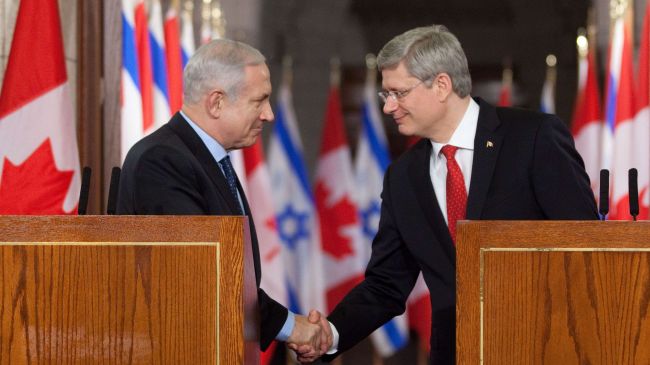
This picture shows Canada’s Prime Minister Stephen Harper (R) and Israeli Prime Minister Benjamin Netanyahu shaking hands after a joint press conference on Parliament Hill, Ottawa, March 2, 2012.
The world is taking note of the ruling Conservatives’ shameful betrayal of Canada’s once admirable reputation as a fair country, sincerely working on the world stage to improve the lot of the disadvantaged and suffering.
In the UN Human Rights Council’s Universal Periodic Review, Canada was criticized to such an extent that the Council decided to send the Special Rapporteur on the Rights of Indigenous Peoples, and representatives of the Committee on the Elimination of Discrimination Against Women and the Inter-American Commission on Human Rights, to investigate.
Minister of Foreign Affairs spokesman Joseph Lavoie dismissed complaints by
*China of “widespread racial discrimination”,
*Iran of “child sexual exploitation and trafficking, the right to food, discriminatory law and regulation against indigenous people and minority groups including Muslim, Arab and African communities”,
*Pakistan of “increased poverty and unemployment rate among immigrant communities”,
*Egypt of “racial profiling in law-enforcement action”, and
*Cuba of “racism and xenophobia” in Canada,
insisting that “Canada has a track record of being a human rights leader, at home and around the world.”
The visits come at an awkward moment for the Conservatives, as it makes a public display of victimizing Muslims as part of a campaign to ram through the “Combating Terrorism Act” (Bill S-7), which gives the state extraordinary powers to detain suspects without any charges and without any legal protections for up to a year.
This sorry state of Canadian political life is the fruit of the Conservatives’ slavish obedience to every US whim, and of its decision to abandon any pretense of an independent foreign policy, making all decisions in consultation with Israeli advisers under the public security cooperation “partnership” signed in 2008 by Canada and Israel to “protect their respective countries’ population, assets and interests from common threats”. Israel security agents now officially assist Canada’s security services, the RCMP and CSIS, in profiling Canadian citizens who are Muslims and monitoring individuals and/or organizations in Canada involved in supporting the rights of Palestinians and other such nefarious activities. Even the usually timid UN is appalled.
The past two weeks of public spectacle could be lifted from a perverse Alice-in-Wonderland scenario. The latest claim to have uncovered a dastardly scheme by Muslim furriners plotting to explode weapons of mass destruction came just a week after the now legendary Boston bombing. Both incidents were dramatically unfolded to a gullible public as classic ‘good vs evil’, though neither holds water.
Canadian authorities boasted Monday afternoon that, working in concert with the FBI and other US national security agencies, they had broken up a terrorist conspiracy involving an “Iranian-based al-Qaeda cell”. The announcement, made at an RCMP press conference, came out of the blue, just days after the Boston bombing, and a few days after the House of Commons agenda was changed to debate final reading of the draconian anti-terrorism legislation.
On cue, US Ambassador to Canada David Jacobson hailed the action as “the result of extensive cross-border cooperation” showing “that we face serious and real threats.” The men were arrested in a Hollywoodesque fashion–Chiheb Esseghaier while eating at McDonald’s in Montreal’s main train station; Raed Jason, by scores of police armed with rifles and accompanied by search-dogs at his workplace in the Toronto borough of North York. They were charged with conspiracy to bomb a New York-bound Via passenger train, though the RCMP conceded that there had never been an imminent threat of an attack or even a definite plan, that Esseghaier and Jaser have been under police radar since last August (based on a year-old tip from an imam), and that their alleged crimes date back to last year.
The reason for their delayed and then sudden arrest is beyond a doubt the notorious Bill S-7, a bill that was forced on Canada by Big Brother in post-911 2001, and which was not renewed in 2007 thanks to Liberal opposition (they originally passed it and then had enough sense to oppose it). The Conservative government suddenly changed the House of Commons agenda as US authorities placed Boston under martial law. The Canadian copycat arrests clearly are intended to add a Canadian pretext for proceeding with Bill S-7, while showing that “We are all Americans now.”
This episode calls to mind the terrorist scare in 2006, when the RCMP staged the dramatic arrest of 18 young Muslims, whom they accused of preparing extensive terrorist attacks, including blowing up the parliament buildings. During the trial, it emerged that the “Toronto 18” was riddled with police agents, one providing the arms instruction at a “terrorist training camp” while another providing harmless bomb-making ingredients. Nevertheless, eleven were convicted and most given lengthy prison terms.
When Esseghaier, a Tunisian-born Montreal PhD student in nanotechnology, told the judge, “These conclusions are being reached based on facts that are nothing but words and appearances,” he was told to shut up, and the hearing was shut down. Jaser’s lawyer John Norris said his client was “in a state of shock and disbelief” and “intends to defend himself vigorously”. Norris took exception to the police’s attempt to present his client as a non-Canadian, noting that the Palestinian refugee has lived with his family in Canada for the past twenty years.
Is it just possible that UN Human Rights Council members read the ‘news’, are appalled, and are genuinely concerned about what’s happening to human rights in Canada?
Canadians’ plight is bad enough, but this recent orchestration of Islamophobia has another angle, just as appalling. The RCMP assertion that these damn furriners acted under the “direction and guidance” of “al-Qaeda elements located in Iran” is a blatant falsehood, as Iran (like Iraq before the US invasion) is probably the most anti-al-Qaeda country in the world. The fundamentalist al-Qaeda delights in killing Shia, was (and is?) supported by the US and financed by Canada’s enlightened Saudi oil-millionaire allies. So it’s not just a question of stripping Canadians of their rights, but of adding toxic fuel to the US-Israeli fires intended to launch war against peaceful (pro-Palestinian) Iran.
The RCMP admitted that they had no evidence of Iranian government involvement, but still… (nudge, nudge, wink, wink). When Canada broke off diplomatic relations with Tehran last autumn, Foreign Minister John Baird labeled Iran “the most significant threat to global peace and security in the world today”. All Iranian Foreign Ministry spokesman Ramin Mehmanparast had to do was to point to the hypocrisy and cynicism of Canada’s government backing the campaign to overthrow the Syrian government -a campaign in which some of insurgents are openly aligned with al-Qaeda: “The same [al-Qaeda] current is killing people in Syria while enjoying Canada’s support.”
And what about the latest hit on the American 911 funny bone? Tamerlan Tsarnaev was under surveillance for four years by the FBI, who were asked by the Russian government to arrest him in 2010 (which they did not do). They do admit to interviewing him in 2011 and sifting through his computer files, but, remarkably for someone allegedly radicalized by the internet, they found nothing of concern. It’s not clear why Russia let him go to visit his parents in the center of terrorism (Dagestan) in Russia in 2012, where purportedly he received some form of terror training or further Islamist indoctrination. Nor how he managed to attend a workshop next door in hostile Georgia organized by the “Fund of the Caucasus” (which works with the US rightwing thinktank the Jamestown Foundation) focused on destabilizing the Caucasus region.
Were both the FBI and the Russian FSB asleep? Was Tamerlan an FBI operative? Was he set up to do the bombing, or did he go AWOL on the FBI? Is this Chechen connection intended to frighten Russia into acquiescing to US-Israeli plans for Syria? “This [official] scenario is simply impossible in the real world,” writes former UK Ambassador Craig Murray. In an interview with Russia Today, Tamerlan’s mother said, “‘They were set up, the FBI followed them for years.” Is this international intrigue-intended to scare both Russia and Iran into abandoning the beleaguered Syrian government -really what Canadian domestic human rights and foreign policy should be based on? Why should we trust Ambassador Jacobson’s blah-blah about “serious threats”?
Canadians are left with security forces eager to show they are doing something, a craven government intent on passing a draconian bill to take away freedoms, and a foreign policy based on a US-Israel obsession with finding some spark to ignite the latest war craze -attack Iran. The supposed pretext -Iran’s nuclear energy program- is after all wearing a tad thin. Peter Osborne in the Telegraph explained how the West has turned down one serious offer after another by Iran (two in 2005 alone), and argues that it is western rather than Iranian intransigence that prevents a deal being struck today. So if no one believes the cry of “Wolf!” on that boondoggle, then the next best thing is “al-Qaeda”. Hell, Bush got away with it against Iraq in 2003; maybe it will work again.
Iran poses only an ideological threat -telling the truth to the US-Israeli tyrant and inspiring Arab Springs.
As for being killed by a bona fide terrorist, the odds are 1 in 20 million, while every year, 4,600 Americans are killed in workplace-related accidents, and more than 30,000 are killed by gun violence. Every 28 hours a black person is killed by police, security guards or vigilantes. On Boston Marathon Day, six Pakistanis died in a drone strike, while scores were killed in car bombs in Iraq. I won’t even begin to recount the daily horrors inflicted by the US in Afghanistan.
Not that these latter crimes against humanity -committed by us- justify retributive violence in any religion, especially Islam. “You shall not be treacherous, you shall not deceive, you shall not mutilate, you shall not kill children.” But the fact that we in the West are unconcerned with preventing senseless deaths at home, and are unaware or don’t care about the murders committed daily in our name abroad, does not bode well for the future. Only when we stop perpetrating violence will violence against us end.
April 28, 2013
Posted by aletho |
Civil Liberties, Deception, False Flag Terrorism, Timeless or most popular, Wars for Israel | al-Qaeda, Canada, Iran, Israel, RCMP, Royal Canadian Mounted Police, Stephen Harper, United States, Zionism |
Leave a comment
Neoconservatives are grasping at the finest of straws in their search for links between the Boston Marathon bombers and al-Qaeda and, more importantly for the neocons, the two Canadian Muslims accused of plotting to destroy a train on orders from al-Qaeda in Iran.
The reality is that no matter how hard the various intelligence authorities look, there is no evidence at all linking the Boston Marathon bombers to al-Qaeda or an al-Qaeda linked group. And, while most clear thinking analysts have agreed that the notion of Iran hosting al-Qaeda is far-fetched, senior neocon warmonger “Mad Max” Boot writing in Commentary claims that there are some obscure links between the Taliban and Iran and that, therefore, there can be no reason why there can’t be a link between Iran and al-Qaeda despite al-Qaeda being Sunni and Iran being Shia. What Mad Max forgets, however, (he doesn’t actually forget, he just hopes his readers don’t know) is that any association Iran has with the Taliban is purely for geo-political expediency reasons whereas an alliance between Iran and al-Qaeda would require an ideological association – an association that would be out of bounds for both entities especially considering the current state of play in Syria.
The reason a link between Iran and al-Qaeda is important to the neocons is because any link, if it actually resulted in a terrorist act inside the US as the Canadian so-called plot may have if the train was derailed or destroyed while inside the US or even New York where it was bound, could well become a trigger for a US attack against Iran.
Any link at all to al-Qaeda is also important to the neocons. It drives their obsessive anti-Islam propaganda which, in turn, feeds the Israeli Zionist cause of a Greater Israel which the neocons support and are a part of.
April 24, 2013
Posted by aletho |
Deception, False Flag Terrorism, Timeless or most popular, Wars for Israel | alqaeda, Boston Marathon, Greater Israel, Iran, Taliban |
Leave a comment
Interview with Flynt Leverett by Kourosh Ziabari
If you regularly follow the headlines on the American and European radio stations, TV channels or newspapers, you come to believe that Iran’s nuclear program is the world’s most important, unsolvable and complicated problem. It’s been more than a decade that they have been incessantly talking of an Iranian threat that has endangered world peace and security. At the same time, they turn a blind eye to Israel’s nuclear arsenal and the fact that Israel is the sole possessor of nuclear weapons in the Middle East. The claim that Iran is trying to produce atomic weapons has laid the groundwork for the U.S. and its allies to impose harsh economic sanctions on Iran and damage Iran’s economy and trouble the daily lives of the ordinary Iranian people.
To study the different aspects of the sanctions imposed on Iran by the United States and the European Union, Iran Review has conducted a series of interviews with world-renowned political scientists, lawyers, journalists and authors and asked them some questions on the humanitarian and legal impacts of the sanctions, their compatibility with international law and the human right standards, etc.
Today’s interviewee is Prof. Flynt Leverett, a prominent Iran expert. Leverett is a professor of international affairs and law at Pennsylvania State University and co-author of “Going to Tehran: Why the United States Must Come to Terms with the Islamic Republic of Iran.” Prof. Leverett has written on Iran’s nuclear program extensively and is regularly interviewed by international media. What follows is the text of the interview.
Q: The United States claims that by imposing sanctions on Iran, it intends to prevent Tehran from acquiring nuclear weapons, but the sanctions have recently targeted the ordinary citizens and consumer goods and medicine. Why have the sanctions swiftly diverted from the issue of disarmament and are directed toward the daily life of the ordinary Iranian citizens?
A: This is the inevitable logic of sanctions. American and other Western officials declare that the targets of their sanctions policies are governments, not people. In reality, though, the point of sanctions is to make ordinary people in targeted countries miserable.
In the Western logic of sanctions, if enough ordinary people are made sufficiently miserable, then they will rise up and either force their governments to change policies that Washington views negatively or else force these governments from power. There is no other strategic rationale for sanctions.
Q: While the process of passing on Iran’s nuclear dossier to the Security Council was illegal, do the resolutions issued on this basis have a legal warranty?
A: A number of prominent international legal scholars have advanced a powerful argument, with which I agree, that the Security Council resolutions calling on Iran to stop enriching uranium are legally invalid. Article 25 of the UN Charter establishes a strong presumption that UN member states should comply with Security Council resolutions. But the same article also limits member states’ obligation in this regard to Security Council decisions “in accordance with the present charter.” Likewise, Article 24 of the Charter holds that, in discharging its duties, “the Security Council shall act in accordance with the purposes and principles of the United Nations.” (Those purposes and principles are presented in Articles 1 and 2 of the Charter.)
The Security Council resolutions calling on Iran to suspend uranium enrichment demand, in effect, that the Islamic Republic surrender what the Nuclear Non-Proliferation Treaty recognizes as signatories’ “inalienable right” to the peaceful use of nuclear technologies—including uranium enrichment. By adopting these resolutions, the Council was acting neither “in accordance with the [UN] Charter” nor “in accordance with the purposes and principles of the United Nations.” And that renders these resolutions invalid.
Q: Don’t you think that focusing the sanctions on basic staples and goods, especially medicines, is tantamount to a continued and systematic violation of the human rights?
A: The U.S. government claims that the sanctions are not focused on items like food and medicine—that there is an explicit exemption for food and medicine in the sanctions policy. But, as the question implies, this is, to say the least, hypocritical. Formally, there is an exemption in the sanctions for food and medicine. But, in practice, as long as banking sanctions deter Western and many other international banks from processing transactions with Iranian counter-parties—even for “permitted” items like medicines—the effect is to bar the export of medicines to Iran, with predictably tragic consequences.
This is both inhumane and illegal, on multiple levels. Besides the horrible impact of U.S.-instigated sanctions on ordinary Iranians, U.S. sanctions policy is a gross violation of international economic law. Most of the sanctions that are having such terrible effects on ordinary Iranians are not unilateral U.S. sanctions—which the Islamic Republic has been dealing with for decades—or multilateral sanctions authorized by the UN Security Council. Most of the sanctions that are creating real difficulties and hardships for Iranians are so-called “secondary” sanctions, whereby Washington threatens third-country entities doing perfectly lawful business with the Islamic Republic with punishment in the United States. In recent years, Congress has been regularly expanding and intensifying Iran-related secondary sanctions through laws that President Obama immediately signs and obediently implements.
Secondary sanctions clearly violate American commitments under the World Trade Organization (WTO), which allows members to cut trade with states they deem national security threats but not to sanction other members over lawful business conducted with third countries. If challenged on the issue in the WTO’s Dispute Resolution Mechanism, Washington would surely lose. That’s why U.S. administrations have been reluctant to impose secondary sanctions on non-U.S. entities transacting with Iran, and have done so pretty rarely. What Washington relies on is that, in many cases, the legal and reputational risks posed by the threat of U.S. secondary sanctions reduce the willingness of companies and banks in many countries to transact with Iran, with negative consequences for Iran’s economy and for many ordinary Iranians. It is the approach of a bully who does not believe he is constrained by the same laws that apply to others.
Q: It’s said that the sanctions that target ordinary civilians are a kind of collective punishment, and collective punishment is a crime according to the Nuremberg Tribunals. The Western states claim that they care for human rights, but they are behaving in such a hypocritical manner and punish the Iranian citizens for a crime they have not committed. What’s your viewpoint on that?
A: As a matter of policy, the United States is not and never has been interested in human rights in any sort of universal or objective way. The United States is only interested in the selective, instrumental exploitation of human rights concerns to undermine governments it does not like. As Washington has co-opted, and corrupted, the human rights agenda in this way, it has also undermined its credibility to address human rights in Iran or anywhere else. Moreover, as the question implies, America’s professed concern for human rights in Iran is especially hypocritical so long as the United States continues what I would call its “dirty war” against the Islamic Republic—including economic warfare targeting civilians (through sanctions), cyber-attacks, and support for groups doing things inside Iran that, in other places, Washington condemns as “terrorism.”
Q: It seems that the sanctions are not simply aimed at curbing Iran’s nuclear program but the main objective of the sanctions is seemingly to create social unrest in Iran which can finally lead to a regime change. So, what’s the message which the sanctions impart? Diplomacy or conspiracy?
A: Since the Iranian revolution, no American administration—not even that of Barack Hussein Obama—has been prepared to accept the Islamic Republic as a legitimate and enduring political entity, representing legitimate national interests. Every administration has seen the Islamic Republic as fragile and vulnerable to internal subversion, and has sought in various ways to encourage such subversion. Of course, it has not worked, but this outlook continues to dominate mainstream foreign policy discussions in the United States about Iran.
U.S. sanctions policy toward Iran needs to be seen in this context. The proposition that sanctions are somehow intended to promote a diplomatic “solution” is, to put it bluntly, dishonest. Consider the way that the sanctions have been drawn up. Even just a few years ago, most of them were imposed by executive orders, which are more or less at the discretion of the White House. Now, though, most of the sanctions have been written into law, which greatly reduces the President’s ability to pull back on them as part of a negotiating process, or to lift them even if Iran acceded to all U.S. demands on the nuclear issue.
Regarding this point, look at the language in current U.S. law on sanctions. Even if the Islamic Republic allowed the U.S. government to come in, dismantle every centrifuge in Iran, and take them back to the United States—like Qadhafi did in Libya—there would still be no legal basis for the President to lift sanctions. The law says that, in order for sanctions to be lifted, the President would also have to certify to Congress that Iran had stopped all dealings with resistance movements like Hizbullah and Hamas, which the United States persists in calling terrorist organizations, and that the Islamic Republic had effectively turned itself into a secular liberal “Republic of Iran” to meet U.S. standards on “human rights.”
That’s not a serious approach to diplomacy. The argument that sanctions are somehow meant to encourage a diplomatic outcome is detached from reality.
Q: Along with the expansion of sanctions, the resistance of the Iranian nation has increased, as well. Why haven’t the sanctions had the effects the West desires, whether in the political or social level?
A: There is no case in history in which sanctions have prompted a target population to rise up, overthrow their government, and replace it with a government prepared to adopt policies sought by the sanctioning power. That has literally never happened. Even in Iraq, where for twelve years the United States led the way in imposing sanctions so severe they killed more than a million Iraqis (half of them children), the population did not rise up to overthrow Saddam Hussein. That took a massive U.S. invasion—and even then, the United States did not get a “pro-American” government in Baghdad.
Beyond this history, the Islamic Republic, as I have come to understand it, is the product of a revolution that had, as one of its highest priorities, the restoration of Iran’s effective sovereignty and independence after a century and a half of domination by Western powers.
Q: The experts say that something around 15-20% of the current price of the oil is a result of the EU’s oil embargo against Iran. How much has the oil embargo influenced the EU’s economy in the current critical juncture?
A: In the late 1990s and early 2000s, when some European elites had serious ambitions for the European Union to emerge as an independent force in international affairs, capable of balancing the United States, European nations pursued an at least somewhat independent policy toward Iran. However, with the collapse of the EU’s constitutional project in the mid 2000s, European elites calculated that the next-best way for Europe to have influence in the Middle East is by helping the United States pursue its hegemonic ambitions in the region.
To understand what I am talking about, just look at the extraordinary shift in the Middle East policies of France and Germany. Both of those countries were absolutely right in anticipating what a strategic and moral disaster America’s 2003 invasion of Iraq would be, and in refusing to go along with the United States in this ill-conceived campaign. But within just a few years of having been right on Iraq—and having been proved right by events on the ground there—the French and German governments aligned themselves almost completely with Washington’s Middle East policies.
As a result of this shift, Europe has, over the last few years, almost completely subordinated its Iran policy to that of the United States—even though, as the question implies, this imposes additional costs on European economies at a time when those economies are already under significant strain. A few EU countries, like Sweden, continue trying, on the margins, to keep some element of rationality in European discussions on Iran, but they are fighting a losing battle.
Q: Currently a number of countries implement the sanctions for different reasons, but several others don’t, so the sanctions have practically turned into an economic opportunity for those countries which haven’t put into effect the sanctions because those countries that adopt the sanctions have deprived themselves of robust and profitable trade with Iran. Are the sanctions capable of curtailing or stopping Iran’s foreign trade?
A: I agree with the premise of the question. Those countries which comply with illegal U.S. secondary sanctions and limit their trade with the Islamic Republic are ultimately hurting themselves more than they may hurt Iran. Sanctions may distort Iran’s foreign trade to some degree, but they cannot stop it.
Q: Complementing the sanctions with valid threats of military strike and intelligence operations are among the most important advice given by Israel to Europe and the United States. How successful have these countries been in sabotaging Iran’s security?
A: They have not been successful at all. I hope that my country will not engage in overt military aggression against the Islamic Republic. If, however, the United States is so foolish as to launch another war in the Middle East, to disarm yet another Middle Eastern state of weapons of mass destruction it does not have, I believe that the blowback to U.S. interests in the region will be disastrous for America’s strategic position. The United States will be the big loser in such a war.
April 23, 2013
Posted by aletho |
Deception, Economics, Timeless or most popular, War Crimes | Flynt Leverett, Iran, Sanctions against Iran, United States, World Trade Organization |
Leave a comment
First Iran, now it’s North Korea. The US global minstrel show of pseudo-handshakes and offers of talks just keeps on rolling, despite the laughable see-through fraudulence.
Remember earlier this year, American Vice President Joe Biden startled the international media with an offer of “direct talks” with Iran to resolve the “nuclear dispute.”
The real reason for why that apparent offer was startling was because it amounted to such transparent nonsense. The barefaced ability to lie by Washington knows no shame. Biden’s overture for talks with Iran was made at the same time that the US tightens illegal sanctions afflicting Iranian civilians, while continuing to threaten the Islamic Republic with war, along with its Israeli surrogate, and as Washington steps up diplomatic and material support for proxy terrorist groups, such as the MKO (Mujahedin-e Khalq Organization), operating within Iran.
Washington’s fatuous rhetoric and posturing is an insult to people’s intelligence. Yet it continues to declaim such asinine verbiage. The latest star-turn in its absurd diplomacy is the “offer” of “dialogue” extended to North Korea by US Secretary of State John Kerry.
After weeks of rising war tensions on the Korean Peninsula, Kerry again appeared to give a startling gesture of goodwill. On a recent trip to East Asia, the top US diplomat said: “The United States remains open to authentic and credible negotiations on denuclearization, but the burden is on Pyongyang [the capital of North Korea].”
Kerry urged North Korean leader Kim Jong-un to “return to the negotiating table.” Is [this] the same table that US President Barack Obama continually warns us that no options are off [it]?
The latest US offer of talks came as a surprise because Washington does not have any diplomatic relations with the Democratic People’s Republic of Korea (DPRK). US policy has long been one of isolating the Northern state through crippling sanctions and, through military exercises with US-backed South Korea, piling pressure on the government in Pyongyang to surrender its nuclear capability.
Fortunately, as with Iran, North Korea is not buying this risible American charade. The government in Pyongyang responded tersely to dismiss the offer made by the US.
“Dialogue cannot coexist with war,” was how the DPRK official news agency, KCNA, aptly put it. That is the essential truth and correct assessment of the US position, not only towards North Korea, but also towards Iran.
Iran, by the way, does not have nuclear weapons. North Korea is believed to have nuclear weapons capability, but it is doubtful that the country has the missile means of delivery. Nevertheless, the US and its Western allies, including the media, insist on demonizing Iran and North Korea as having sinister “nuclear ambitions” without providing a shred of proof.
The US has the temerity to assert that “the burden is on Pyongyang” in the same way that it arrogantly insists that Tehran must “show good faith” about its legally entitled nuclear program.
This astounding US arrogance turns reality on its head. Just who is the real aggressor? Don’t expect to find an answer in the Western corporate media whose goldfish-bowl memory and art of deception are designed to augment this reality-inversion.
After dismissing the US “offer” of talks, North Korea has since issued its own demands for any negotiations to take place. These conditions are perfectly logical, reasonable and just. They also point up the real reasons for why the Korean Peninsula is continually wracked by the threat of nuclear war.
North Korea wants: 1) Recently imposed United Nations sanctions to be revoked. These sanctions were imposed at the behest of Washington over the DPRK’s launch of a space satellite in December. The US maligned that launch by falsely labeling it a “ballistic missile test.” The provocative and unjustified sanctions spurred North Korea to conduct an underground nuclear weapon test on 12 February. Since North Korea withdrew its membership of the Non-Proliferation Treaty last decade, there is no legal constraint on it to conduct such a test. And given the level of continual threat towards North Korea from the US, the former is well justified in developing military defenses, including nuclear weapons.
Condition 2) for North Korea to entertain talks with the US and its Southern ally is for these latter states to immediately halt all threats of war that are implicit in the perennial war maneuvers on and off the Korean Peninsula. These so-called “war games” carried out by the US and South Korea often simulate invasion of North Korea. That is an outrageous, criminal de facto act of war. And yet it is committed every year, and sometimes several times a year.
Condition 3) is for the US to withdraw its nuclear weapons capability from the Korean Peninsula. Bear in mind that it was the US that first instated nuclear weapons on the Peninsula during the Korean War (1950-53). While the US did technically remove nuclear missiles some years back from South Korean soil, it effectively can reintroduce weapons of mass destruction at any moment and it retains North Korea within its target sites. The recent build-up of US nuclear-capable submarines and Aegis-class destroyers in the South and East China Seas, and the simulated bombing raids by B-2, B-52 and F-22 warplanes, all represent clear and present danger of nuclear annihilation to the DPRK. Note too that Washington has been busily integrating a hemispheric missile system between South Korea, Japan and the Pacific West Coast of the US. This missile system targets North Korea, as well as China and Russia.
Finally, what North Korea wants probably above all else as a guarantee for meaningful negotiations, is for the US to end the Korean War with a proper peace treaty. Since the war ended in 1953, the cessation of hostilities was only marked by an armistice, which in effect is a ceasefire. In other words, the US is technically still at war with North Korea and can at any moment resume bombing of that country. During the Korean War, the US dropped more explosives and napalm on the Northern population than it did in the whole of the Pacific War with imperial Japan. Up to a third of the Northern [Korean] population – some 3 million people – were annihilated by American bombs. Given that experience of genocide, is it any wonder that North Korea remains deeply wary of the US and its allies, especially with the ever-present threat of more war looming.
For the past 60 years, the DPRK has been demanding this basic entitlement of a full peace treaty, including a non-aggression pact. For 60 years, every US President has refused to countenance any such
treaty.
It is a shame that Russia and China have signed up to the recent round of US-led sanctions against North Korea. Moscow and Beijing appear to have bought into the upside-down worldview that the US and its Western media are peddling. Rather than adding to pressure on North Korea, Russian and Chinese leaders need to go back and refresh their memories on the history of aggression and genocide in East Asia and the Pacific. Then they would rightly redirect the pressure on the true aggressor – Washington.
Peace in East Asia, as in the Middle East, depends on a unilateral withdrawal of American militarism, aggression and its self-styled right to inflict nuclear war on others. The burden is not on North Korea or Iran. Far from it, the burden is where it has always been – on the USA.
April 23, 2013
Posted by aletho |
Militarism, Timeless or most popular, War Crimes | Iran, John Kerry, Korean War, North Korea, United States |
Leave a comment
A recent report says the visit by Israeli National Security Council Head Yaakov Amidror to Turkey is aimed at securing an airbase in Iran’s neighbor to pave the way for a military attack against the Islamic Republic.
In an article, the Sunday Times said that during his visit on Sunday, Amidror is expected to solicit Turkey’s agreement with regard to the deployment of Israeli fighter jets in Akinci airbase, northwest of Ankara, in exchange for advanced military equipments and technology, the Times of Israel reported.
“Until the recent crisis, Turkey was our biggest aircraft carrier. Using the Turkish airbases could make the difference between success and failure once a showdown with Iran gets underway,” Sunday Times quoted an unnamed Israeli military source as saying.
Ankara agreed to restore relations with Tel Aviv on March 22 after Israeli Prime Minister Benjamin Netanyahu apologized to Turkey for the deaths of nine Turkish activists in a 2010 Israeli attack on a Gaza-bound international flotilla.
Israel also agreed to pay compensation to the families of those who were killed by Israeli commandos. The apology was brokered by US President Barack Obama during his recent visit to Israel.
The Israeli source added that the regime’s military has been “lobbying hard for the politicians to find a form of apology, in order to restore the Israeli-Turkish alliance against Syria and Iran.”
The trip comes as the Israeli military chief recently repeated its war threats against Iran, saying the regime can invade Iran on its own.
“We have our plans and forecasts… If the time comes we’ll decide” on whether to take military action against Iran, Lt. Gen. Benny Gantz said on April 16.
Netanyahu has also recently said that the US-engineered sanctions against Iran over its nuclear energy program might not be enough.
The US, Israel and some of their allies accuse Iran of pursuing non-civilian objectives in its nuclear energy program with the Israeli regime repeatedly threatening to attack Iran’s nuclear facilities based on the unsubstantiated allegation.
Iran argues that as a committed signatory to the Non-Proliferation Treaty (NPT) and a member of the International Atomic Energy Agency (IAEA), it has every right to use nuclear technology for peaceful purposes. Iran has further promised a crushing response to any act of aggression against it.
Unlike Iran, Israel, which is widely believed to possess between 200 to 400 nuclear warheads, is a non-signatory to the NPT and continues to defy international calls to join the treaty.
April 21, 2013
Posted by aletho |
Militarism | Iran, Israel, Obama, Turkiye, United States |
Leave a comment
South Africa has lashed out at the United States and European Union for imposing oil sanctions on Iran over its nuclear energy program without first consulting major importers of the Iranian energy supplies.
South Africa’s Energy Minister Elizabeth Dipuo Peters, who is in India to attend the Clean Energy Ministerial (CEM) meeting, said that such decisions have geopolitical implications and mostly affect “the poorest of the poor” that are in dire need of energy supplies and have no alternative.
“When decisions are made at bilateral or unilateral levels that have serious geopolitical consequences, we need to engage seriously,” Peters said.
“When we had to look for crude of the kind we got from Iran, it came at a premium,” she added.
“It has a multiple knock-on effect, especially on the poorest. When these decisions are taken, they must always consider the impact and consequences of their decisions at the geopolitical level. Or at least involve other countries so that when the decision is made they can say South Africa is taking it consciously. They have calculated the impact on them but not on others,” the South African minister said.
At the beginning of 2012, the US and EU imposed new sanctions on Iran’s oil and financial sectors with the goal of preventing other countries from purchasing Iranian oil and conducting transactions with the Central Bank of Iran.
On October 15, 2012, the EU foreign ministers reached an agreement on another round of sanctions against Iran.
The sanctions have been imposed on Iran over the groundless charges of a potential military diversion in Iran’s nuclear energy program.
Iran rejects the unfounded allegations over its nuclear energy program, arguing that as a committed signatory to the Non-Proliferation Treaty (NPT) and a member of the International Atomic Energy Agency (IAEA), it has the right to use nuclear technology for peaceful purposes.
Peters said that that the petroleum industry is a victim of financial sanctions, which include US sanctions on dollar-denominated trading and EU sanctions on insurance for shipping companies.
She emphasized that the US 18-month exemption for Iran oil sanctions had not benefited South Africa because the EU has refused to grant waivers.
On December 8, 2012, the US added China, India, South Korea, Malaysia, Singapore, South Africa, Sri Lanka, Turkey, and Taiwan to the list of countries exempted from the sanctions for another six months.
April 19, 2013
Posted by aletho |
Economics, Wars for Israel | European Union, Iran, Press TV, Sanctions against Iran, South Africa, United States |
Leave a comment
Director of National Intelligence James Clapper and director of the Defense Intelligence Agency Army Lieutenant General Michael Flynn testified before the Senate Armed Services Committee today and reiterated the same assessment regarding Iran as was delivered in March 2013.
The exact same statements – verbatim – were included in Clapper’s unclassified report, including the assessment that “Iran is developing nuclear capabilities to enhance its security, prestige, and regional influence and give it the ability to develop nuclear weapons, should a decision be made to do so. We do not know if Iran will eventually decide to build nuclear weapons.”
Of course, as Clapper notes, Iran’s ability to potentially manufacture the components is inherent to its advanced nuclear infrastructure and is not an indication of an active nuclear weapons program, which all U.S. intelligence agencies agree Iran does not have.
As such, Clapper again reported to the Senate Committee, “Iran has the scientific, technical, and industrial capacity to eventually produce nuclear weapons. This makes the central issue its political will to do so.”
In his testimony, Clapper stated that, were the decision to weaponize its nuclear energy program to be made by Ayatollah Khamenei, Iran could theoretically reach a “breakout” point within “months, not years.” His report repeats the assessment, though, that “[d]espite this progress, we assess Iran could not divert safeguarded material and produce a weapon-worth of WGU before this activity is discovered.”
Again, undermining the bogus claims that Iran is an irrational and reckless actor, Clapper maintained the judgment that “Iran’s nuclear decision making is guided by a cost-benefit approach,” balancing its own domestic interests with “the international political and security environment.” Iran also has a defensive – not aggressive – military posture, one based on “its strategy to deter – and if necessary retaliate against – forces in the region, including US forces” were an attack on Iran to occur.
During questioning from Senators following his prepared remarks, Clapper admitted – as a number of recent independent reports have shown – that the increasingly harsh sanctions levied upon Iran have had no effect on the decision-making process of the Iranian leadership, yet have produced considerable damage to the Iranian economy and resulted in increased “inflation, unemployment, [and the] unavailability of commodities” for the Iranian people.
This, he said, is entirely the point. Responding to Maine Senator Angus King, who asked about the impact sanctions have on the Iranian government, Clapper explained that the intent of sanctions is to spark dissent and unrest in the Iranian population, effectively starting that Obama administration’s continued collective punishment of the Iranian people is a deliberate (and embarrassingly futile) tactic employed to foment regime change.
“What they do worry about though is sufficient restiveness in the street that would actually jeopardize the regime. I think they are concerned about that,” Clapper said of the Iranian leadership. It is no wonder, then, why Clapper refers in his own official report to the economic warfare waged against Iran as “regime threatening sanctions.”
Not mentioned in the session, of course, are the decades of repeated affirmations by senior Iranian officials that Iran rejects nuclear weapons on strategic, moral and religious grounds. Within the past six weeks, this position has been reiterated by Iran’s envoy to the IAEA Ali Asghar Soltanieh, President Ahmadinejad, and Ayatollah Khamenei himself.
Just two days ago, for instance, during a three-day diplomatic visit to Africa, Ahmadinejad declared, “The era of the atomic bomb is over. Atomic bombs are no longer useful and have no effect on political equations. Atomic bombs belong to the last century, and anyone who thinks he can rule the world by atomic bombs is a political fool,” according to a report by Iran’s state-run PressTV. He also pushed back the constant conflation in Western discourse of nuclear energy with nuclear weapons. “Nuclear energy is one thing and an atomic bomb is another. This useful energy must belong to all nations,” he stated.
Furthermore, reports that Iran has continued converting its stockpiled 19.75% enriched uranium into fuel plates for its cancer-treating medical research reactor gained absolutely no traction within the Committee or Clapper’s comments. For Congress, Iran is a threat simply by virtue of having independent political considerations, inalienable national rights and refusing to accept American hegemony over its own security interests.
South Carolina Senator Lindsey Graham, who spends most of his time advocating for new, illegal military adventures in the Middle East, presented this wholly disingenuous and misleading question to Clapper: “Over the last six months, as we’ve been imposing sanctions and been negotiating with the P5+1 regime, [does Iran] have more or less enriched uranium for a nuclear bomb?”
None of Iran’s enriched uranium is “for a nuclear bomb” insofar as it is all far from weapons-grade and under the safeguard and seal of the IAEA. Iran’s enriched uranium is no more “for a nuclear bomb” than Graham’s fanciest set of steak knives are for throat-slitting.
“Can I just say it’s more?,” Graham proffered, revealing that he already knew the answer he wanted to hear, at which point Clapper chimed in. “Not highly-enriched,” he said, “but up to the 20% level.” Graham was undeterred from his propagandizing and grandstanding. “Well, they’re marching in the wrong direction,” he said. “We talk, they enrich.” AIPAC poetry at its finest.
Shortly before ending the session, in response to questions from Connecticut Senator Richard Blumenthal, Clapper stated that the relationship between the American and Israeli intelligence communities – especially on the Iranian nuclear program – has “never been closer or more pervasive,” citing unprecedented levels of “intimacy.”
While each state continues to maintain its own unique sources for intelligence gathering, Clapper said, “generally speaking,” the United States and Israel are “on the same page” when it comes to Iran.
Pressing the issue on behalf of his AIPAC backers, Blumenthal asked whether all information is shared between the two nuclear-armed nations, at which point Clapper declined to agree completely.
“Pretty much,” he replied.
Why was Clapper being so cagey? An Associated Press report from last July seems to provide an answer:
Despite inarguable ties between the U.S. and its closest ally in the Middle East and despite statements from U.S. politicians trumpeting the friendship, U.S. national security officials consider Israel to be, at times, a frustrating ally and a genuine counterintelligence threat.
In fact, the AP states, “The CIA considers Israel its No. 1 counterintelligence threat” in the Middle East, meaning that the agency “believes that U.S. national secrets are safer from other Middle Eastern governments than from Israel.” This is unsurprising, of course, as “Israel’s foreign intelligence service, the Mossad, and its FBI equivalent, the Shin Bet, both considered among the best in the world, have been suspected of recruiting U.S. officials and trying to steal American secrets.”
Did any of that make it into Clapper’s “Worldwide Threat Assessment” today? No, of course not. Israel was only mentioned as a victim and an ally. One might think an untrustworthy, nuclear-armed serial aggressor, constantly threatening to drag the United States into an unprovoked military conflict with inevitable devastating consequences, all with the allegiance and blessing of Congress, would rank rather high on potential security threats to the United States.
But James Clapper isn’t allowed to say that.
April 18, 2013
Posted by aletho |
Timeless or most popular, Wars for Israel | AIPAC, Ali Asghar Soltanieh, Ali Khamenei, Economy of Iran, Iran, Israel, James R. Clapper, Sanctions against Iran, United States Senate Committee on Armed Services |
Leave a comment
The Israeli military chief claimed the Zionist entity can invade the Islamic Republic of Iran on its own.
Chief of Staff Lt. Gen Benny Gantz made the remarks in an interview on public radio in East al-QudsGantz (Jerusalem) on Tuesday, AFP reported.
“We have our plans and forecasts… If the time comes we’ll decide” on whether to take military action against Iran, he said.
Other Israeli officials made similar remarks, including Prime Minister Benjamin Netanyahu and Minister for Military Affairs Moshe Ya’alon.
Netanyahu said that US-engineered sanctions against Iran over its nuclear energy program might not be enough.
Ya’alon also said Iran’s nuclear energy program is the most dangerous threat to the world.
The United States, Israel and some of their allies have repeatedly accused Iran of pursuing non-civilian objectives in its nuclear energy program with the Israeli regime repeatedly threatening to attack Iran’s nuclear facilities based on the unsubstantiated allegation.
Iran rejects the allegations, arguing that as a committed signatory to the nuclear Non-Proliferation Treaty (NPT) and a member of the International Atomic Energy Agency (IAEA), it has the right to use nuclear technology for peaceful purposes.
April 17, 2013
Posted by aletho |
Militarism, War Crimes | Al-Manar, Benjamin Netanyahu, Benny Gantz, Iran, Israel, Moshe Ya'alon |
Leave a comment


 Aletho News
