SNSC secretary dismisses US response to Iran’s conditions as ‘inadequate’
Press TV – October 12, 2026
Secretary of Iran’s Supreme National Security Council (SNSC), Major General Mohsen Rezaei, has dismissed the United States’ partial concessions regarding Tehran’s seven conditions for resolving the ongoing war as “inadequate.”
In a post on X, Rezaei acknowledged that Washington has agreed to some of the conditions outlined by the Islamic Republic, but stressed that the response falls far short of Tehran’s demands.
“Iranian diplomacy has changed, and there will be no return to the status quo ante,” he declared, signaling a fundamental and permanent shift in how Tehran engages with Washington, demanding full compliance rather than incremental or half-hearted concessions.
In a second post, Rezaei eviscerated the US administration’s strategic competence and the origins of the war.
He stated that US President Donald Trump, “deluded by the fantasy of conquering Iran, launched one of the most idiotic wars in human history after being duped by Netanyahu.”
Rezaei then highlighted the humiliating reality of the US military’s inability to achieve its objectives on the battlefield, referencing Washington’s recent attempts to bypass Iranian maritime controls.
“Now, after the US fleet failed to reopen the Hormuz, he has resorted to smuggling,” Rezaei wrote, adding that “the US military has never sunk to such a disgraceful low!”
This rebuke comes against the backdrop of the Islamabad Memorandum of Understanding, which established the framework for halting the US-Israeli war of aggression.
Under the MoU, Washington committed to lifting its illegal naval blockade, releasing frozen Iranian assets, and ceasing all military operations in exchange for a phased normalization of maritime traffic.
Crucially, the agreement stipulated that any resumption of commercial transit through the strait must be coordinated with and approved by the Islamic Republic of Iran.
However, instead of adhering to the agreed-upon framework, US officials have reportedly attempted to force or sneak commercial vessels through the Strait of Hormuz without coordination with Iranian authorities.
The Iranian Armed Forces have responded decisively to these violations, intercepting unauthorized vessels and enforcing the defensive arrangements established during the war.
Tehran maintains that the Strait of Hormuz will remain under its firm control until the United States fully implements all seven of Iran’s conditions, proving that the era of US hegemonic dictates in the region is permanently over.
Seyed M. Marandi: US-Iran War Inevitable: Kuwait and Bahrain May Fall
Glenn Diesen – October 11, 2026
Prof. Seyed Mohammad Marandi is a professor at Tehran University and a former advisor to Iran’s nuclear negotiation team.
Follow Prof. Glenn Diesen:
Substack: https://glenndiesen.substack.com/
X/Twitter: https://x.com/Glenn_Diesen
Support the research by Prof. Glenn Diesen:
PayPal: https://www.paypal.com/paypalme/glenn…
Buy me a Coffee: buymeacoffee.com/gdieseng
Go Fund Me: https://gofund.me/09ea012f
Iran security chief says powers greater than US tried to conquer Iran but ended in ‘dustbin of history’
Press TV – October 11, 2026
Secretary of Iran’s Supreme National Security Council, Major General Mohsen Rezaei, says powers greater than the US have tried to conquer Iran but ultimately ended up in the “dustbin of history.”
During an exclusive interview with Press TV on Saturday, Rezaei said the “US suffered repeated defeats in its confrontation with Iran and has consequently turned to economic warfare out of desperation.”
Iran, rather than the US, would determine when the confrontation ends, he said, stressing that Tehran would continue its resistance until its rightful demands are met.
Addressing the presence of US forces in the region, Rezaei told Press TV that the withdrawal of US forces from Iraq reflected Washington’s failure to impose its military agenda on the region, describing it as a vindication of Iran’s resistance to American military presence in West Asia.
Rezaei further said that more than “30 million Iranians have registered in ‘Janfada’ (Sacrifice for Iran) Campaign to take up arms in the event of US aggression.”
On diplomacy, the official said “Tehran would not return to its previous diplomatic norms,” while stressing that “Iran would never abandon diplomacy altogether.”
The senior official warned that, if Washington launched another act of aggression against Iran, American assets could be targeted, including key data systems and artificial intelligence sensors.
Rezaei also identified Washington and its regional allies as the root of the problem surrounding the Strait of Hormuz.
Iran closed the Strait of Hormuz in response to the latest round of US-Israeli aggression, preventing US and allied ships from navigating the strategic waterway.
The move resulted in a significant increase in oil and energy prices across the globe, especially in the US, forcing Washington and the International Energy Agency (IEA) to release their strategic resources several times.
Following the signing of the Islamabad Memorandum of Understanding (MoU) between Iran and the US in June, Tehran opened the Strait of Hormuz, but after the US violated the MoU by blockading Iranian ports, Iran’s Armed Forces closed the maritime corridor once again.
Hormuz and the Looming Economic Catastrophe
The Trump administration is missing the bigger picture
By Philip Pilkington | The American Conservative | October 9, 2026
In the classic martial arts film Enter the Dragon, Bruce Lee’s character is instructing a young, aspiring fighter. Irritated at the lack of progress his student is making, he points to the sky. “It’s like a finger pointing away to the moon,” he says as the student tries to focus on what his teacher is saying. “Don’t concentrate on the finger,” Lee says, slapping him on the head, “or you will miss all that heavenly glory.” The quote is derived from an old Buddhist text called the Śūraṅgama Sūtra, and the point is clear: Sometimes if you focus on what is immediately in front of you, you can miss the point entirely.
Something like this is happening in Washington, DC, right now. For almost two weeks, the debate around the progress or lack thereof in the Iran War has been focused on activity in the Strait of Hormuz. A whole host of maritime experts have emerged suddenly to inform us that the Trump administration has succeeded in reopening the crucial waterway to shipping. Maximalists are claiming that this means the United States has effectively won the war in the Middle East. Others are making the more modest claim that this reopening of the Strait will solve the looming energy crisis.
These were the two perspectives that most people who were not deeply involved in the debate heard. There was, however, a small but vocal minority who questioned whether the Strait had been opened at all. If Iran had effective fire control over the Strait in spring and summer, they asked, then why would they suddenly lose it now? Almost immediately after this question was raised, Iran settled the debate by striking an enormous number of ships: 12 and counting in less than a week.
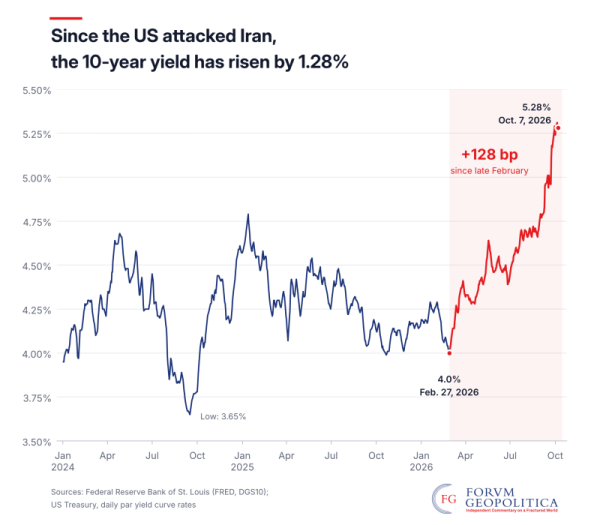
To those of us who were paying attention, the whole exercise felt like looking at Lee’s finger as he points to the moon. As these debates unfolded, the market for U.S. Treasury debt continued an epic sell-off. Bloomberg quoted an investment banker who stated that Treasuries were “trading like a meme stock.” U.S. Treasury bonds have now experienced their worst long-run returns in history.
Treasury bonds are not just any old asset. For one, they are the debt of the U.S. government. If they become uninvestable, the capacity for Washington to live beyond its means through debt issuance is open to question. Treasuries are also the benchmark asset for the entire global dollar system that has allowed the U.S. to run enormous deficits for decades. If this asset starts “trading like a meme stock” and generating awful returns, foreigners will opt for something else. This week, the president of the German central bank stated that “the case for further diversification into gold remains significant.” People are talking.
In mid-September, the speaker of the Iranian parliament, Mohammed Bagher Ghalibaf, posted an equation on X. Unusually for an obscure piece of algebra, the post garnered nearly 7 million views. The equation was a modified version of what economists call the “Taylor Rule,” a method that economists and central bankers use when setting central bank interest rates. In normal times, the equation factors in expected future inflation and how much slack is in the economy. But Ghalibaf’s equation—which he called the “Straits Taylor Rule” —included two new variables: the Strait of Hormuz and the Bab el-Mandeb, the two waterways currently under fire from Iran and the Houthis in Yemen, respectively.
The equation is a stripped-down representation of Iran’s strategy. By controlling these waterways, Iran and its allied groups have gained control over the global energy market. By squeezing these chokepoints, Iran can assert de facto control over America’s financial markets by pushing up expected inflation. Central banks like the Federal Reserve realize that this is no mere bluff and have already started raising interest rates. Ghalibaf’s equation explains, to a very large extent, why American government debt is currently trading like a meme stock.
Meanwhile, at the same time as these pressures are felt in American financial markets, the real economy is undergoing a squeeze too. Recent reports from the Energy Information Agency suggest that American heating-oil bills are expected to rise by 21 percent this winter. Diesel markets are entering into a genuine crisis, with President Donald Trump floating the prospect of banning diesel exports to ensure that there are no shortages. Diesel is the lifeblood of the American logistics chain. If there are shortages, trains and trucks will not run and goods will not be delivered to shelves. Trump has walked back the diesel export ban for now, after strong-arming the Europeans to dump their oil and diesel reserves, but there is every chance that this option appears back on the table as the crisis worsens. Food prices are rising too, with sugar prices looking particularly worrisome.
Once again, Ghalibaf outlined how this is part of Iran’s overall strategy. In an X post this week, the speaker published a rudimentary graph—coupled with a haunting image of a ghost—showing rising commodity prices and interest rates on one side, and falling consumer confidence, foreign interest in U.S. Treasuries, hyperscaler investment, and housing affordability on the other. The Iranians are not just trying to squeeze the American financial system—they are aiming to put extreme stress on the entire economy—and it looks increasingly like they intend on making this pressure felt before American voters go to the polls on November 3.
The Trump administration has become fixated on the Strait of Hormuz, seeing it as a decisive battlefield on which the U.S. can win the war. But the Strait is merely a means to an end. For Iran, that end is to slowly demolish the American economy and financial system until the pressure becomes too much and the U.S. backs off. The idea that you can “win” such a battle is delusional.
The Strait is merely the finger in Lee’s analogy. It is Iran’s overall economic strategy—the moon—that we should focus on. And when we do, we come to the worrying conclusion that by the time the Trump administration cries uncle, the damage done to the American economy and financial system will be so severe that it could take many, many years to recover.
Original article: www.thea
Putin Conveys to Trump Iran’s Vision on Possible Conflict Resolution – Kremlin
Sputnik – 10.10.2026
MOSCOW – Russian President Vladimir Putin conveyed to US President Donald Trump, in coordination with Iranian President Masoud Pezeshkian, Iran’s vision on a possible resolution of the conflict, Kremlin spokesman Dmitry Peskov said on Saturday.
Putin, during communication on the sidelines of the summit in Turkmenistan, held two meetings with Pezeshkian, at one of which he informed the Iranian president about the upcoming telephone conversation with the US president, the Kremlin spokesman noted.
“And then, in coordination with the Iranian president, Putin conveyed to Trump Iran’s vision on a possible resolution of the conflict,” Peskov said.
During a conversation with Trump, Putin showed understanding regarding some proposals of the US leader aimed at de-escalating the conflict in Ukraine, Peskov said.
At the initiative of Trump, most of the time in the telephone conversation between the leaders, which took place the previous evening, was devoted specifically to the Ukrainian settlement, Peskov added.
‘Harsh reality’: Iran says France seeks monopoly on power and intimidation, not peace for all
Press TV | October 9, 2026
Iranian Foreign Ministry spokesman Esmaeil Baghaei says France does not want peace for all but seeks to preserve its monopoly on military power and the ability to intimidate others.
Baghaei made the remarks in a post on his X account on Friday, responding to French President Emmanuel Macron’s earlier statement during a test of a ballistic missile capable of carrying a nuclear warhead, during which Macron said, “To be free, therefore, one must be feared, and to be feared, one must be powerful.”
Baghaei contrasted those remarks with Macron’s position on Iran, which has never sought to acquire nuclear weapons, quoting the French president as saying, “Iran must never possess nuclear weapons. Neither today, nor in five years, nor in ten years. Never.”
He said the question is not why France possesses a nuclear deterrent force, but why Paris regards its own nuclear deterrent as essential to guaranteeing its security and freedom while portraying Iran’s nuclear activities as a “threat,” even though Tehran’s nuclear program is peaceful and subject to international oversight.
“The harsh reality is this: they do not want peace for all. They want to maintain the monopoly on the kind of power that inspires fear and the monopoly on the legitimacy to intimidate,” the Iranian spokesperson wrote.
Baghaei emphasized that France seeks to remain powerful, armed with nuclear weapons and capable of inspiring fear, while imposing restrictions on countries that seek to use nuclear energy for peaceful purposes under the pretext of an alleged “nuclear threat.”
“A peace in which nuclear powers regard their own weapons as the guarantors of their freedom and security, but label the same logic a threat when invoked by others, is not true peace. It is a monopoly on power founded on a sense of superiority,” he said.
He added that an international order that fails to recognize every country’s right to security and peace serves the dominance of a small circle of powers rather than protecting peace itself.
Iran has maintained a consistent position regarding its peaceful nuclear program, citing a religious decree by martyred Leader of the Islamic Revolution Ayatollah Seyyed Ali Khamenei, who forbade the acquisition of nukes.
Iran, as a signatory to the NPT, maintains that its nuclear program is exclusively peaceful and that there has been no diversion of nuclear material following more than two decades of inspections.
Despite this and the extensive inspections by the UN nuclear watchdog on Iran’s nuclear facilities, the Israeli regime has long been trying to portray Iran’s nuclear program as a threat.
The regime persuaded the administration of US President Donald Trump to launch two rounds of aggression against Iran in June 2025 and early 2026 on the false pretext of divergence from a civilian nuclear program.
In both wars, the aggressors targeted Iran’s civilian infrastructure, including nuclear facilities, in flagrant violation of international law and the Nuclear Non-Proliferation Treaty (NPT).
When Will This White House Madness End?
The United States competes with Israel for the “Most Hated” Distinction
By Philip Giraldi • Unz Review • October 8, 2026
It was another horrific week in Washington with President Donald Trump actually succeeding in coming out with an apparently improvised comment that equaled or maybe even exceeded his ghastly performance at the United Nations where he speculated over whether he should “annihilate” Iran and drive it back into the Stone Age. It would seem that ninety plus million dead Persians would satisfy Donald’s blood lust when it comes to killing innocent civilians, but the latest musing by our beloved leader had him addressing a campaign rally in Nebraska, where he appeared to be declaring that he might well consider wanting to continue the war against Iran even if the price to pay from the Iranians were to be retaliation consisting of eliminating some of our cities. He said “It’s a small price to pay for keeping the world safe, for keeping our country safe, and it’s going to be over with very soon. Let ’em take out Los Angeles, let ’em take out San Diego.”
Trump clearly saw the whole thing as some kind of quid pro quo expecting that even Californians would consider the price to pay worth it if it kept Iran from obtaining a nuclear weapon but he failed to make any reasonable connection between the nonexistent weapon and the good to come out of annihilation of millions of Americans. The irony is, of course, that since Iran has no nukes and nor is it even developing that resource, a point generally made by US intelligence, it could not in any event destroy either or both of the West Coast cities. But then again, Trump is not given much to deep thinking and what he tends to say is what is roiling around among the three brain cells that might actually be functioning in his oversize head at any moment.
Interestingly, the video recording the gathering shows the Nebraska crowd of MAGA supporters cheering the exchange, seemingly unaware that the war never needed to be fought, that Iran was not and is not any military threat to the United States, and that the whole bloody thing could be ended by Trump repeating his frequent declaration of “victory” before ordering all the troops home and putting an end to it. That way no one “loses” and no more innocents have to die but somehow that does not appear to be an option circulating in the White House.
In the wake of the comment, both California’s Democratic Governor Gavin Newsom and San Diego Republican Mayor Todd Gloria called out President Trump for his willingness to see Americans die in large numbers due to bad policies coming out of Washington. Newsom wrote on social media how “After sending the National Guard to occupy California, Donald Trump is now saying our foreign enemies should ‘take out’ Los Angeles and San Diego. He is deranged and dangerous.” Gloria added “San Diego is not collateral damage. We are not expendable. And we are never a ‘small price to pay.’ Keep our city out of your reckless war talk.”
The White House inevitably pushed back in support of Trump’s comments, with communications director Steven Cheung writing on social media how “The media freakout over President Trump’s comments is not rooted in reality. He was clearly stating US cities would have been threatened if a nuclear Iran hadn’t been stopped. America is safer because of the President. Iran has no nuclear, no navy, no air force, and no money.” Interestingly, Trump’s communications director, who interpreted the comment backwards by claiming falsely that the president had “stopped” an Iranian nuke, was incapable of understanding what Trump actually said and instead invented what he might have been wanting to say. All of which explains why the White House is as dysfunctional as it is.
Beyond that, something at least veering towards a bit of constructive policy did take place on September 30th when the United States completed its troop withdrawal from Iraq, which it has been de facto occupying for the past 23 years. The withdrawal, which took place after multiple requests by the Iraqi government, appears to be due to the desire to move US troops out of the effective range of some of the Iranian short range-missiles and drones which could easily reach Iraq. The soldiers and airmen will be moving to next door Jordan which means they will still be near enough to intervene if the Iraqis become naughty and do anything that is not perceived as being in American “interests.”
Some will recall that back in January 2020, then President Donald Trump ordered the assassination of the Iranian head of the Iranian Revolutionary Guards Qasim Soleimani who had just landed in Baghdad Airport to join in peace talks between his country and the Iraqis. Peace talks are not the sort of thing that Trumpists are good at, particularly if they involve actual or potential enemies of Israel, so Soleimani had to be stopped. The Iraqis are certainly aware that the departure of US soldiers does not mean an end to American intervention, which can indeed be at the point of a gun but which might also be through sanctions and other less kinetic means.
All of which is to suggest that the game is not over yet and Trump is quite capable of doing something very stupid in an attempt to salvage whatever remains from his reputation. What is behind a lot of this nonsense is the evil circle involving Trump himself and his good friends in Israel. Make no mistake that Israel is dedicated to becoming “Greater Israel” while also eliminating its potential enemies in Asia and Africa. And, unlike Iran, it is actually nuclear armed thanks to the material and technology that it stole from the United States before killing President John F Kennedy who tried to stop them. And the witless Donald will do everything in his power to help Prime Minister Benjamin Netanyahu be reelected, be it because he is being blackmailed or because he loves the man so much. Be that as it may, Trump will cooperate fully with Netanyahu or whoever succeeds him, no matter what. So too will there be the usual consensus on doing everything to please the Jewish state coming from the usual crowd of Israel firsters in Congress, in the mainstream media and among the Foundations that have come to rely on the money and “respect” that comes from inhabiting the same space as those who are beloved by Zion.
For those who are not yet aware of just how deeply the Zionist activists have inserted themselves in the body politic, I would greatly recommend an article put out by the highly respectable Quincy Institute that just appeared this past week written by Kelley Vlahos, the Editor in Chief of Responsible Statecraft. It provides the sordid details of how the Israel Lobby backed up by Jewish billionaires has been able to create and then subvert a conservative movement that originally appeared to support American interests to make them instead do Israel’s bidding. She describes how “The annual confab, [NatCon 2026] ostensibly launched for American conservatives in 2019, is in Jerusalem this week, largely focused on shoring up US support for the Jewish state.” If Israel is successful, it will bring about a proposed US-Israeli integration at the Pentagon and take its place as a “partner” of the United States in defense matters as well as in foreign policy. Make no mistake, Israel will bleed us dry and then discard our carcass without even a backward glance. It will be the end of our country. President Donald J Trump and his predecessor Joe Biden have done much to move this process along and it is to them and the cowards in Congress and the media that we the owe the deep hole that we as a once-upon-a-time proud and independent people will soon find ourselves in.
Baghaei to Rubio: Distorted narratives cannot erase US record of broken commitments
Press TV – October 7, 2026
Iranian Foreign Ministry spokesman Esmaeil Baghaei has dismissed claims by US Secretary of State Marco Rubio that Tehran has repeatedly squandered chances for an agreement, saying the inversion of historical facts cannot erase Washington’s pattern of treaty-breaking from public memory.
Baghaei, responding to an IRNA question on Rubio’s assertion that “Iran has missed opportunities for an agreement multiple times,” stated on Wednesday, “The inversion of historical truths cannot remove the reality of America’s repeated breaches of commitment from the mind of public opinion.”
He pointed to Washington’s successive acts of bad faith, including its unilateral withdrawal from the nuclear deal on May 8, 2018, the sabotage of diplomatic tracks, military aggression against Iran while negotiations were underway, and the subsequent violation of the Islamabad Memorandum of Understanding Iran reached on June 18.
Baghaei held the United States responsible for the insecurity prevailing in the region and for the economic consequences felt in America and worldwide.
“Blame-shifting and contradictory statements cannot overshadow the demand of American and global public opinion that those responsible for the illegal war and the crimes committed be held to account,” he said.
On the latest developments in contacts with the United States, the spokesman said the Islamic Republic’s considerations and conditions for ending the imposed war on all fronts and restoring security to the Persian Gulf and the Strait of Hormuz have been set out explicitly and decisively.
The necessary response to the other side’s proposals will be conveyed through intermediaries. “The exchange of messages between Iran and the US is being conducted through intermediaries,” he added.
On diplomatic efforts related to regional peace and security, including commercial shipping in the Strait of Hormuz, Baghaei stressed that the security of navigation in the waterway matters more to the Islamic Republic of Iran than to any other party. Iran, in consultation with Oman as the other littoral state, has spared no effort to restore security to the Strait.
“The consultation process between Iran and Oman has proceeded successfully. In addition to agreeing on the geographical coordinates of safe two-way routes in the Strait of Hormuz, the two sides have reached an understanding on how the matter will be presented to the relevant international body, a step that will, God willing, be taken soon,” he said.
Asked about the possibility of a joint meeting involving Iran, Oman, and other Persian Gulf states, Baghaei said Iran will continue its efforts to strengthen trust and engagement among the region’s countries.
“Defenders of the homeland, in both the diplomatic arena and the field, stand shoulder to shoulder, resolute and steadfast in defending Iran’s sovereignty and securing the nation’s interests and security,” he concluded.
Houthis Don’t Have to Conquer Saudi Arabia to Make It Pay
Daniel Davis / Deep Dive – October 7, 2026
False flags won’t save aggressors, Iran FM spokesman says
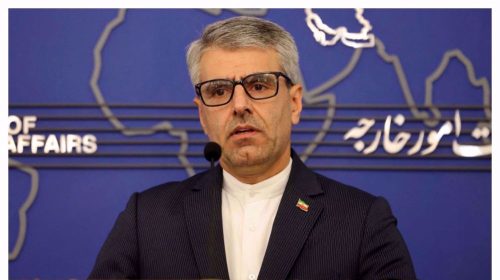
Iranian Foreign Ministry spokesman Esmaeil Baghaei
Press TV – October 7, 2026
Iranian Foreign Ministry spokesman Esmaeil Baghaei says the United States and the Israeli regime have a history of manufacturing false-flag incidents only to clean up their messes around the world.
In a Wednesday post on his X account, the Iranian official said such scenarios would not save them from the quagmire of the aggression against Iran.
Baghaei said telling lies about Iran and accusing it of having a role in security incidents would fail to justify the US-Israeli aggression against the Islamic Republic.
“In a world where the American and international public is weary of an unlawful war of aggression against Iran, and where the aggressors have no honest way to justify a war of choice, even a raft made of lies can look like salvation to those who are drowning,” he said in the post.
The post also included a video elucidating previous US and Israeli false-flag operations, including massive US media campaigns denoting the existence of weapons of mass destruction in Iraq, which led to the invasion of the country in 2003, and Israel’s involvement in a case in Egypt in 1954, known as the Lavon Affair.
“False flags are an old craft: manufacture the incident, assign the blame, and harvest the consequences,” said Baghaei.
The post came after officials in the US and allied countries suggested that Iran may have had a role in recent security incidents, including on a Flydubai flight from the United Arab Emirates to the Israeli-occupied territories and in a suspected plot against an American base in Britain.
Iran has roundly rejected the accusations, calling them a pretext for launching renewed aggression against the country, months after the US and the Israeli regime were forced to end a previous offensive under a ceasefire reached in mid-April.
The fallacy of US delusions about Iran’s economic collapse
Iran’s economic adaptation over decades, marked by domestic production, regional trade and Asian partnerships, is on course to thwart Washington’s economic terrorism.
Press TV – October 6, 2026
US Treasury Secretary Scott Bessent’s prediction that Iran’s economy would soon collapse underscores the depth of delusion within the current American leadership.
“Iran is absolutely not sanctionable,” Deputy Economy Minister Mortaza Zamanian said this week as Tehran worked to keep trade flowing despite Washington’s latest sanctions campaign.
Zamanian cited Iran’s extensive borders, established commercial routes and longstanding trading relationships, saying that they make it impossible for external pressure simply to switch off the country’s economy.
His remarks came as Washington intensified its economic terrorism against Iranian oil, shipping, aviation, finance, technology and foreign companies supporting those sectors.
The new American campaign has been accompanied by extraordinary predictions from senior American officials, including Treasury Secretary Scott Bessent’s claim that Iran could have “nothing left to trade” within two weeks.
Speaking on September 27, Bessent claimed that Iran would probably make its final oil deliveries to China within two weeks, after which, he asserted, “they will have nothing.”
That prediction deserves comparison with history, because American administrations have imposed increasingly severe sanctions on Iran since 1979 while repeatedly expecting economic pressure eventually to produce collapse.
Yet the economy did not disappear, and Iran instead developed domestic industries, expanded regional commerce, strengthened trade with Asian powers and accumulated extensive experience operating outside Western financial channels.
The proposition that an economy which has absorbed American sanctions for almost half a century will suddenly disintegrate within two weeks therefore indicates the depth of delusion among the current US leadership.
Iran enters this confrontation possessing a large domestic market, extensive productive capacity, enormous energy resources and deeply established commercial relationships across Eurasia.
These are not temporary sanctions evasions assembled during the present crisis, but economic capabilities developed over decades through investment, industrial learning, regional integration and repeated adaptation to external restrictions.
The most important fact about Iran’s economic structure is its size, because a country with more than ninety million people possesses a domestic market capable of supporting extensive production independently of Western consumers.
The World Bank describes Iran as relatively diversified for an oil-exporting economy, with a substantial domestic market, a large workforce and significant activity across manufacturing, agriculture and services.
That domestic market sustains production across food, pharmaceuticals, construction materials, steel, petrochemicals, machinery, transportation, consumer goods and numerous intermediate industrial sectors serving Iranian households and companies.
Iran is therefore not an economy that must export continuously merely to keep its factories operating, because a substantial portion of its production already serves domestic consumption, investment and infrastructure.
That distinction becomes particularly important when external restrictions are designed around the assumption that cutting foreign trade will automatically paralyze domestic economic activity.
A country whose productive system is centered on domestic demand possesses an economic engine that continues operating even when international transactions become more complicated.
Iran has also spent decades building industrial capabilities specifically suited to its own resource base, population, infrastructure requirements and energy-intensive economy.
Steel production, petrochemicals, cement, refining, power generation, construction, food processing and pharmaceuticals represent substantial industrial ecosystems involving domestic engineering, manufacturing, logistics and skilled employment.
These capabilities have repeatedly expanded during periods when access to Western investment and technology was severely restricted, demonstrating that Iranian industrial development does not depend upon continuous Western participation.
Iran’s long exposure to sanctions has produced another asset that cannot be imposed or removed through a Treasury designation, namely a large body of accumulated technical and commercial experience.
When foreign manufacturers withdraw, Iranian companies have learned to redesign equipment, substitute components, develop domestic suppliers and work with companies from countries willing to maintain commercial relationships.
Academic research has documented this process in Iranian industries, including evidence that sanctions simultaneously restricted access to foreign technology while encouraging the development of domestic technological capabilities.
The resulting industrial knowledge extends beyond individual companies, because engineers, technicians, procurement specialists and managers have accumulated practical experience with restricted supply chains over successive decades.
A manufacturer that has operated under sanctions for years does not design its procurement system around the assumption that every international supplier will remain available indefinitely.
It develops alternatives as part of ordinary business planning, creating a commercial culture in which substitution, regional sourcing and domestic production are integrated into industrial decision-making.
This is one of the strongest reasons the prediction of sudden economic emptiness looks disconnected from Iran’s actual economic structure.
There is no single foreign supplier whose disappearance can remove Iran’s entire industrial capacity, because Iranian production is distributed across thousands of domestic enterprises and numerous regional supply relationships.
The system has been shaped by scarcity for so long that adaptation has become embedded within the operating methods of Iranian companies themselves.
Iran’s geographical position provides another form of economic strength that cannot be erased by financial sanctions, because the country physically connects several of the world’s most important commercial regions.
Iran borders Turkey, Iraq, Armenia, Azerbaijan, Turkmenistan, Afghanistan and Pakistan, while its southern coastline provides direct access to the Persian Gulf and Gulf of Oman.
Those borders connect Iranian commerce with the Caucasus, Central Asia, South Asia, the Persian Gulf, Turkey and Iraq, creating commercial possibilities extending in several directions simultaneously.
This geography gives Iran direct access to neighboring markets while also placing the country along important transportation corridors linking Russia, Central Asia and the Indian Ocean.
The significance of Zamanian’s argument is therefore practical rather than rhetorical, because no financial authority can relocate Iran away from its geographic position.
Goods can move through different borders, suppliers can be found in different countries and exporters can redirect shipments towards different markets when commercial conditions change.
Iran has consequently developed a regional trading system that does not depend upon one border, one port, one customer or one foreign economic relationship.
Its trade with Iraq, Turkey, the United Arab Emirates, Afghanistan, Pakistan, the Caucasus, Central Asia and China represents an extensive commercial geography developed through years of interaction.
The World Bank has documented precisely this shift, noting that Iranian trade has increasingly pivoted towards neighboring countries and China as sanctions have restricted conventional international economic relationships.
That transformation is now an established feature of Iran’s economy rather than an emergency measure invented after the latest American escalation.
China gives Iran’s economic system another dimension because it combines enormous industrial capacity with sustained demand for Iranian energy and other commodities.
In other words, Iran possesses access to a major global market even while facing comprehensive American restrictions on its oil industry.
China also supplies Iranian companies with machinery, manufactured products, electronics, industrial equipment and intermediate goods required across the domestic production system.
The relationship therefore operates in both directions, with Iran supplying commodities and China supplying industrial goods, creating a commercial relationship considerably broader than the simple sale of sanctioned oil.
Iran consequently does not need unrestricted access to every Western market when it possesses substantial trade relationships with China and numerous neighboring economies.
Iran’s energy resources provide perhaps the clearest demonstration of the country’s underlying economic strength.
It ranks second globally in proven natural-gas reserves and fourth in proven crude-oil reserves, giving the country extraordinary resource depth beneath its existing industrial economy.
These resources provide not merely potential export earnings but also abundant domestic energy and petrochemical feedstocks supporting Iran’s manufacturing, electricity generation, transportation and industrial production.
Iran has consequently developed an extensive downstream economy that converts hydrocarbons into refined products, petrochemicals and industrial inputs rather than relying exclusively upon crude-oil exports.
The World Bank has specifically noted that sanctions encouraged additional processing of crude oil and hydrocarbons into petrochemicals, illustrating how restrictions have contributed to changes within Iran’s economic structure.
The country’s resource base also gives it a durable position in Asian energy markets, where large industrial economies require reliable supplies of oil and petrochemical products.
That is why American attempts to eliminate Iranian oil revenue confront persistent commercial demand rather than an absence of buyers interested in Iranian resources.
The financial system represents another area where Iran has developed substantial independent capacity after decades of exclusion from conventional Western banking.
Iran’s economic ties span a broad network of foreign entities, reflecting its commercial reach across banking, shipping, logistics, commodities, and manufacturing.
Against this background, Bessent’s latest prediction appears less to be an independent economic forecast than an expectation based on what the American campaign is intended to achieve.
His claim that Iran will have nothing left to trade within two weeks assumes that removing one major source of oil revenue effectively removes the economic foundations supporting the entire Iranian system.
Iran’s actual economic structure is considerably broader, because oil exports represent one component of national economic activity alongside manufacturing, agriculture, services, domestic consumption and regional commerce.
The World Bank estimates that Iran’s economy contracted during the Iranian year ending March 2026, while simultaneously describing an economy that has adapted to sanctions through changing trade patterns and alternative payment mechanisms.
Those facts should not be confused with economic collapse, because contraction in a particular period is fundamentally different from the disappearance of productive capacity, markets and commercial institutions.
The historical record is even more significant, because American sanctions have been imposed repeatedly since 1979 and have been intensified dramatically during successive administrations.
The sanctions regime has targeted Iranian banking, oil exports, investment, technology, shipping and foreign companies, with especially severe measures introduced during the 2010s and after Washington abandoned the nuclear agreement.
Iran nevertheless retained its industrial base, rebuilt oil exports after earlier restrictions, expanded non-oil exports and redirected a growing share of trade towards neighboring countries and China.
The American expectation that economic pressure would eventually produce decisive Iranian economic capitulation has therefore been tested repeatedly against an economy that continued adapting.
Predicting that a strategy that failed to trigger economic collapse over half a century will suddenly achieve it within fourteen days merits no serious consideration, because it reveals the naivety of its proponents.
Washington now possesses powerful financial tools, but financial power does not eliminate Iran’s factories, oilfields, farms, engineers, consumers, borders, ports, regional markets or established commercial relationships.
Iran enters the current phase with an economic architecture extending from domestic manufacturing plants to Chinese refineries, from Persian Gulf shipping networks to northern Eurasian trade corridors.
Its domestic market provides magnitude and size, its industrial base provides production, its energy reserves provide commodities and its geography provides access to several major commercial regions.
In other words, Iran already possesses the domestic capabilities and international relationships required to keep its economy operating beyond the reach of any single American economic sabotage.
Iran warns US allies in region: Reusing soil for attacks will bring ‘different’ response
Press TV – October 4, 2026
Iran’s Foreign Ministry spokesman, Esmaeil Baghaei, warned on Sunday that any future use of regional countries’ territory to attack the Islamic Republic will provoke a different and decisive response, stressing that Tehran expects its neighbors to uphold the principle of good neighborliness.
Speaking at a press conference in Tehran, Baghaei said countries in the region—especially those that placed their facilities at the disposal of the United States and the Zionist regime during the recent war—must reconsider their actions.
“If in the future we witness another aggression by America and the Zionist regime and their soil is used to attack Iran, certainly the response will be different,” Baghaei said.
He emphasized that all countries in the region have had a bitter experience with US military presence and intervention, adding: “We are eternal neighbors.”
Baghaei said Iran has quickly and clearly conveyed its grievances to regional countries, particularly those that provided territory and facilities to the US and Israeli regime during the military aggression.
He stressed that these countries bear international responsibility for participating in aggressive actions.
He noted that on the sidelines of the UN General Assembly, Iranian officials held good meetings with almost all southern Persian Gulf countries.
The spokesman also addressed the presence of the Israeli prime minister in the UAE, warning that the Zionist regime is seeking to sow sedition in the region.
He called on neighboring states not to allow their facilities and territory to be abused by parties that have shown no regard for regional security and prosperity.
UNGA participation a success
Baghaei described Iran’s participation in the 81st UN General Assembly as one of the country’s most successful international appearances.
A small but highly productive delegation, led by President Masoud Pezeshkian, attended the summit. He said meetings with counterparts, think tanks, and media helped explain Iran’s positions and logic on regional and global issues.
Responding to a US media claim that two members of the Iranian delegation were expelled from the US, Baghaei dismissed it as “pure lies.”
He said Iran’s travel, entry, and exit were fully notified in advance. One diplomat left New York due to US pressure, while the others departed according to the pre-arranged schedule.
“This is an admission by the host government that it violated its obligations,” Baghaei said. “It proves they are not a worthy host for the United Nations.”
He added that the US, having failed to prevent Iran’s participation and isolate Tehran, resorted to such “cheap news-making.”
Seven-day plan
Baghaei said Iran’s seven-day plan was the latest initiative to keep the diplomatic path open, and the world witnessed Iran’s responsible and goodwill-based approach.
He noted that previous experiences show the American side is not committed to diplomacy and has always shirked its obligations.
“That is why, while we speak of diplomacy, we will decisively defend Iran’s national interests and security. Our armed forces are vigilant, powerful, and ready to repel any evil.”
On US proposals conveyed via the Qatari mediator, Baghaei said they largely reflect previous US positions and specifically concern nuclear issues.
“We explicitly announced that our focus at this stage is the Strait of Hormuz,” he said.
He added that restoring security to the Strait requires concrete US steps, including stopping disruption of Iran’s commercial shipping, lifting sanctions, and ending other interventionist measures.
He said all items previously included in the Islamabad understanding, plus new ones added in recent months, must be honored.
“Sanctions imposed by America during this period must be lifted.”
UK envoy summoned over accusations
Baghaei said the British ambassador was summoned on Thursday to receive Iran’s official protest over baseless accusations linking Tehran to an alleged incident at a British airbase.
He described UK accusations against Iran as a “forward escape” because London knows Iran has demanded accountability for Britain’s participation in the military aggression.
“There is no doubt that Britain directly participated in this illegal war by providing its military bases,” he said.
He cited NATO Secretary-General Mark Rutte’s admission that bases in Europe were used during the US-Israeli aggression.
“The British government must be held accountable. It cannot escape responsibility with fabricated claims.”
US withdrawal from Iraq a ‘blessed’ step
Baghaei called the withdrawal of US forces from Iraq a very important and blessed development for consolidating Iraqi national sovereignty, and a sign of American failure.
He recalled the crimes committed during the 23-year occupation, including Abu Ghraib, and said Daesh and takfiri terrorism were products of the occupation.
“Foreign occupation creates the ground for violence, division, and insecurity,” he said. “We hope this step strengthens relations between the two countries and protects Iraq’s national sovereignty and independence.”
Featured Video
Racist Seinfeld Dances for Joy as Bibi Unveils His New Map
or go to
Aletho News Archives – Video-Images
TV Drama Review
Japanese drama projects Japan’s wartime atrocities onto Chinese characters

Global Times | October 25, 2026
By portraying Chinese characters as perpetrators of ruthless violence while casting Japanese Self-Defense Forces (SDF) intelligence operatives as defenders, the season 2 of the Japanese drama Vivant has recently drawn criticism from Chinese netizens, who argue that its depiction turns historical reality on its head while ignoring Japan’s wartime atrocities.
The TBS drama series – a spy suspense story in which an alleged unofficial intelligence unit of the SDF operates across the globe — has attracted a passionate fanbase. Its currently airing season 2 opened with a household rating of 18.8 percent, the highest for a TV drama this year, according toa commentary article by Japanese media Toyo Keizai.
What draws attention is the portrayal of the enemies in the series, the article noted. Scenes in which the Chinese organization subjects kidnapped members of the SDF unit to brutal torture are repeated with unrelenting intensity.
It is rare for Japanese TV dramas to explicitly portray a real-life country as the enemy, the article noted.
Japanese Prime Minister Sanae Takaichi also made a reference to the drama, saying that she has been recording Vivant and hopes to binge-watch it over the year-end and New Year holidays, according to Japanese media outlets.
China’s CCTV News report on Sunday revealed that the drama features scenes in which Chinese personnel cut off the fingers of and stab Japanese intelligence operatives in the abdomen. Such acts bear striking similarities to the torture inflicted on Chinese nationals by invading Japanese troops during the World War II.
The drama distorts the truth by attributing these atrocities to modern Chinese characters. Beneath the surface, it subtly glorifies Japan’s cross-border overseas operations, blurs the functional boundaries of the SDF and implicitly promotes an expansionist narrative, per CCTV News. … continue
Blog Roll
 Aletho News
- Up in arms… Koreans reject U.S. empire’s plan to make South Korea the next Ukraine
- Iran, Turkey, Pakistan, Saudi Arabia could advance region-led security framework in Tehran: FM spox
- Netizens condemn Japanese drama for projecting Japan’s wartime atrocities onto Chinese characters
- Racist Seinfeld Dances for Joy as Bibi Unveils His New Map
- A West Bank War for Netanyahu’s Election Campaign, Could It Backfire?
- Yemen denounces European Parliament’s ‘hypocritical’ push to blacklist Ansarullah
- Qalibaf: UAE’s UN bid aims to ‘clear the runway’ for ‘Greater Israel’, whitewash genocide
- Pakistan reopens Iran border after boosting security: Report
- Why are so many Brazilians voting for Flávio Bolsonaro?
- Democrats Put Anti-Russia Agenda Ahead of American Workers
- If Americans Knew
- An error has occurred; the feed is probably down. Try again later.
- No Tricks Zone
- Sudden Stratospheric Warming, Powerful El Niño Combination May Lead To Extreme Europe Cold, Energy Crisis!
- Two New Studies Find Thwaites Glacier Melt Cannot Be Driven By Human Activity Or A Warming Ocean
- E-Cars Reduce CO2 Emissions By Only 41% Compared To Internal Combustion Engine Vehicles
- Predictions Made By Renowned Climate Professor Over Past Decades Have Been Proven To Be Poor
- New Study Suggests Large Regions Of The Pacific Ocean Have Been Cooling For The Last 80 Years
- Germany’s Green Energy Debacle: High Energy Costs Force Kahla Porzellan to Close After 182 Years!
- New Study: 50 Years Of The Most Aggressive ‘Net Zero’ Policies Can Only Affect The Global Climate By 0.03°C
- US September “Heat” Was No Record…Many Records Set Decades Ago
- Latest European Green Energy Debacle; Portugal’s Largest Flagship Solar Park Insolvent!
- Green Energy Debacle: German Expert Professor Fritz Vahrenholt Warns Of Severe Economic And Social Consequences

