Trump Regime Continues Supporting ISIS
By Stephen LENDMAN | August 18, 2018
US support for ISIS is an open dirty secret – undiscussed by media scoundrels, pretending it’s not so.
Washington actively arms, funds, trains, and directs ISIS and other terrorists – backing the scourge they pretend to oppose.
Obama and Trump’s vow to degrade and destroy ISIS was and remains a bald-faced lie, using these and other cutthroat killers as proxy fighters in Syria and other countries where they’re deployed – their presence unjustifiably justifying illegal US occupation of northeast and southwest Syrian territory.
Last November, Russia’s Defense Ministry said the following:
“The Abu Kamal liberation operation conducted by the Syrian government army with air cover by the Russian Aerospace Force at the end of the last week revealed facts of direct cooperation and support for ISIS terrorists by the US-led ‘international coalition.”
“Americans peremptorily rejected to conduct airstrikes over the ISIS terrorists on the pretext of the fact that, according to their information, militants are yielding themselves prisoners to them and now are subject to the provisions of the Convention relative to the Treatment of Prisoners of War.”
US-led “coalition’s aviation tried to create obstacles for the aircraft of the Russian Aerospace Forces in this area to safely shield militants of the Islamic State.”
“There is indisputable evidence that the United States pretends it is waging irreconcilable struggle against international terrorism in front of the international community, while in reality it provides cover for the combat-ready Islamic State groups to let them regain strength, regroup themselves and advance US interests in the Middle East.”
Washington directly aids ISIS and other terrorist fighters, deploying them where Pentagon commanders want them used, relocating them to new conflict zones in Syria and other countries.
Iran has credible documents showing US support for ISIS. Its armed forces deputy chief of staff Major General Mostafa Izadi earlier said “(w)e are facing a proxy warfare in the region as a new trick by the arrogant (US-led) powers against the Islamic Republic,” adding:
“We possess information showing direct support by US imperialism for (ISIS) in the region which has destroyed Islamic countries and created a wave of massacres and clashes.”
Separately, Iranian Parliament Speaker Ali Larijani condemned Washington for “align(ing) itself with ISIS in the region.”
So-called Syrian Democratic Forces (SDF) are infested with ISIS and other terrorists. Washington’s objective in Syria remains regime change – why the Obama regime launched naked aggression in the country, continued by Trump regime dark forces in charge of Washington’s geopolitical agenda.
A new Security Council report showed renewed ISIS strength in parts of Syria controlled by US forces and allies, saying:
ISIS terrorists have “breathing space to prepare for the next phase of its evolution into a global covert network.”
Aided by the Trump regime and allied forces, they control “small pockets of territory in the Syrian Arab Republic on the Iraqi border.”
Russia’s General Staff earlier accused the Pentagon of training ISIS and other terrorists at its illegally established At Tanf base in southwest Syria – calling it a staging ground for US armed struggle against the Syrian government.
ISIS and other terrorists infest the Rukban refugee camp controlled by US Forces, holding tens of thousands of defenseless Syrians hostage, using the camp to recruit anti-government terrorists.
On August 15, AMN News said US-led forces “transported over 250 trucks filled with weapons (and other military hardware) to the Euphrates River Valley this morning” – intended for Syrian Democratic Forces terrorists in Deir Ezzor province, adding:
Washington is “expand(ing) (its) bases and airports in northern and eastern Syria” – indicating US forces will remain in the country, not leave, as Trump earlier said.
Separately on August 18, AMN News said Washington and its allies “sent reinforcements to their military bases in the towns of Tal Tamer, Al-Houl, and Al-Shaddadi.”
Syria’s liberating struggle continues, no end of it in sight as long as US regime change intentions remain unchanged.
ISIS given ‘breathing space’ in parts of Syria under US-backed forces’ control

© Aboud Hamam / Reuters
RT | August 18, 2018
Islamic State managed to regain access to Syrian oil fields and make profits from selling oil, a new UN report reveals. While the UN did not point fingers, the IS reemergence seems to occur in areas held by the US-backed forces.
“Islamic State in Iraq and the Levant [IS, formerly ISIL/ISIS], having been defeated militarily in Iraq and most of the Syrian Arab Republic during 2017, rallied in early 2018. This was the result of a loss of momentum by forces fighting it in the east of the Syrian Arab Republic,” the recent report from the UN Security Council’s Sanctions Monitoring Team reads. The document is dated July 27, but was only released to the public this week.
The slow-down gave IS “breathing space to prepare for the next phase of its evolution into a global covert network.” As of June 2018, the terrorist group has been controlling “small pockets of territory in the Syrian Arab Republic on the Iraqi border,” effectively carrying on with its quasi-state ways.
“[IS] was able to extract and sell some oil, and to mount attacks, including across the border into Iraq,” the reports stated, adding that the terrorist group regained “access to some oil fields in northeastern” Syria.
While the report did not specify which forces exactly were having troubles with “momentum,” northeastern Syria is located on the left bank of the Euphrates river, controlled by the so-called Syrian Democratic Forces (SDF) militia backed by the US-led coalition.
Regaining control of the oil fields allowed IS to yet again make oil profits a significant source of revenue. The report also vaguely stated that IS continues to impose “taxes” on civilians “in areas it controls, as well as in contested areas,” as well as to kidnap local businessmen for ransom.
Apart from strengthening of IS-held “pockets” in northeastern Syria, the report also listed a number of hotspots in Syria, which might be sources of further IS reemergence. Among them, the UN named the Rukban refugee camp, located near the Al-Tanf US military base. Other IS-infested places listed in the report include unspecified locations in the Aleppo province and an area controlled by an IS-affiliated group in the Deraa province. The latter, however, was already eradicated late in July during the Syrian Army offensive in the south-west of the country.
The issue of the Rukban refugee camp has been repeatedly raised by Moscow and Damascus, who repeatedly urged the US to cooperate. Earlier in August, Colonel General Sergey Rudskoy, the head of operations of the Russian General Staff, described Rukban as place where “people are living in harsh conditions and where terrorists find shelter.”
“Our American partners should provide humanitarian access to Rukban as soon as possible, provide passage for the refugees to their home areas and withdraw the base from Al-Tanf,” Rudskoy stated.
Baghdad grapples with ‘curse’ of US sanctions on Iran
By Omar al-Jaffal | Asia Times | August 17, 2018
Iraqi Prime Minister Haider al-Abadi has raised the level of uncertainty over how Iraq will handle long-expected US sanctions on Iran.
In the span of less than a week, Abadi went from pledging to abide by the sanctions the day after they were imposed, to backtracking on his statement.
“I said yes, we will abide … but abide when it comes to dollar transactions,” Abadi told reporters Monday. The confusion for Iraqi citizens and political parties is even greater for the Central Bank of Iraq.
“Dealing in dollars with Iran has been banned for a very long time,” the bank’s director general of financial operations, Mahmoud Dagher, told the media. “Neither the bank nor the banking system deals with Iran in dollars when it comes to foreign trade.”
Iran is not only a neighbor to Iraq, with a land border of more than 1,000 kilometers. It dominates the Iraqi market and political scene.
Prime Minister Abadi’s vocal opposition to the US sanctions stems from this hegemony, especially as he is seeking a second term in office. His coalition placed third in the May parliamentary elections and he will need Tehran’s support moving forward.
Politically, Iran has influence on a large number of Shiite parties in the government and parliament. Some of these parties have announced they will mount a “break the siege” campaign to counter the US sanctions on Iran.
Militarily, Tehran supports and trains dozens of militias in Iraq, and these groups sharply criticized Abadi over his initial acquiescence to the sanctions. The United States also holds major influence in the military and economic spheres.
As in the past, Abadi is walking a tightrope between Tehran and Washington, both of which have their share of clout in green lighting the next prime minister.
Iranian dairy, Iranian cars
Where there is political and military influence in Iraq, there is economic reverberation.
Hamid Hosseini, the secretary-general of the Iran-Iraq Chamber of Commerce, said in December that “Iraq, for Iran, equals the markets of three continents: Europe, America and Africa.”
Iranian goods account for about 17% of the Iraqi market, making it the second largest destination for exports after Turkey in this respect. Iranian exports to Iraq have risen exponentially over the past decade.
Before US sanctions were reimposed, Iran said it was seeking to control a quarter of the Iraqi market and increase the volume of trade from $13 billion in 2017 to $20 billion in the coming years.
In the markets of central and southern Iraq, one can clearly observe how Iranian goods dominate shop shelves and how dairy products occupy a large place in the refrigerators.
On the streets, the Iranian-made SAIPA and Samand cars are too many to count. The cheap, poor-quality vehicles have not only entered Iraq by highway — they are assembled at factories in the heart of the country.
Iraq’s power plants are heavily reliant on diesel and gas to operate, and in this regard, Tehran has an agreement to export diesel and about 25 million cubic meters of gas per day to Iraqi power plants.
Even so, Iraq continues to suffer from major power shortages, which this summer prompted major waves of protests as temperature hovered around 50 degrees Celsius. The Iraqi government since 2005 has been compelled to conclude successive deals with Iran to ease the shortfall, importing 1,500 to 2,500 megawatts of electricity per year.
For Iraq, Iranian religious tourism is a major source of income.
Each year, about three million Iranian pilgrims flock to the shrines of the descendants of the the Prophet Mohammad in the provinces of central and southern Iraq.
Baghdad charges a $40 visa fee per tourist, but Abadi’s government quickly announced it would reduce that amount for pilgrims as sanctions on Tehran came into effect.
Iranian goods are often the source of ridicule in Iraq for their lack of quality. But they are hugely popular in the central and southern provinces of the country, as a much more affordable option than goods made in Turkey. Not to mention the foodstuffs Iraqis depend on for their daily diet.
For much of the population, those low prices make a major difference in the household budget, especially with the rise of unemployment and poverty following the price of oil – the key export on which Baghdad relies to conduct about 97% of its economic activities.
Iran’s trade surplus with the Iraqi private sector is more than $7 billion.
Against this backdrop, the Iraqi government appears at a loss, with scant plans in place to deal with the first package of US sanctions against Iran, which is light compared to the second round coming in November.
Dr. Mohammed Saleh, an economic adviser to the prime minister, says Iraq faces a dilemma in the coming period.
“Given the closed border with Syria and the dangerous situation [on the border] with Jordan, for Iraq only Turkey remains” to compensate for the shortage in Iranian goods when the second tranche of US sanctions comes into force. “But also [Turkey] is in a vague position as a result of the US sanctions,” he added, with a note of desperation.
“Iraq will have to comply with the US sanctions on Iran and it will have to compensate for the loss of Iranian goods by producing some of them,” Saleh told Asia Times, adding that this goes especially for the gas sector.
“We will also have to revive the manufacturing of oil products by reactivating refineries suspended from work. The same goes for agriculture, if Iraq can persuade the Turkish side to up Iraq’s water quotas.”
Asked whether Iraq had immediate plans to implement what he had referred to, he said: “Unfortunately, so far there are no actual plans on the ground,” stressing that Iraq was still reeling from the war against ISIS and the failure to form a government after the latest elections.
Made in Iraq?
Falah al-Rubaie, professor of economics at the Faculty of Management and Economics at Mustansiriya University in Baghdad, said the sanctions should be seen as an opportunity for Iraq. An opportunity to reconsider its economic policy in the fields of industry and agriculture, and to start competing with Iranian goods through local production.
“Iraq has the space to activate such a policy,” Rubaie told Asia Times. “But such a decision requires political will and belief in achieving development.”
He said Iraq’s economic predicament was not for a lack of strategies. “There have been more than 16 strategies developed by successive governments related to industry, agriculture, trade and others sectors, in addition to the existence of four development plans since 2003.
“All these plans sit on the shelf because of the confusion of political decision-makers and many of them are linked to Iran politically, which facilitates the import of their products at the expense of Iraqi development plans.
“The absence of development and the return to oil revenue is what Iraqi politicians have been doing since 2003 in order to secure their personal benefits at the expense of the country’s interest,” Rubaie added.
Up till now, Iraq has not faced major issues with Tehran or Washington over the latest US sanctions.
“Trade between the two countries (Iraq and Iran) is proceeding normally,” said Nasir Behrouz, Iran’s trade adviser in Baghdad. “The import and export process with Iraq continues at all ports.
“Iran is determined to expand its presence in the Iraqi market to suit the interests of the two countries,” Behrouz was quoted as saying by the official IRNA news agency.
The US, for its part, has not flagged any sanctions violations by Iraq to date, despite alarmist reports in the local press.
The US embassy in Baghdad issued a statement of clarification after State Department spokesperson Heather Nauret warned Tuesday that Washington would “continue to hold countries accountable for any violations.”
The embassy said Nauret’s statement had been misinterpreted and stated categorically that there was “no breach of sanctions” by Iraq in dealing with Iran.
The economic adviser to PM Abadi described the sanctions against Iran as “the curse” and said that the second round was an impending disaster that Iran must redress.
He did not say whether Iraq would be able to tackle this curse and find a substitute for Iranian imports.
US begins construction of largest consulate abroad in Erbil
Press TV – July 7, 2018
US Ambassador to Iraq Douglas Silliman and Kurdistan Regional Government (KRG) Prime Minister Nechirvan Barzani have broken ground on the largest American consulate building in the city of Erbil.
Barzani said Friday the project shows that “America wants to stay in Iraq, that America wants to remain in Kurdistan, that America wants to develop its ties,” the Kurdish Rudaw Media Network reported.
Silliman, for his part, emphasized that the construction of the biggest US consulate complex, which is one of the most modern facilities, is a “strong symbol of the continued strong relationship” between Washington and Erbil.
The US initially opened a diplomatic office in Erbil in February 2007 and four years later upgraded it to a consulate general.
The new US consulate, which will be built on a 200,000 square meter piece of land, will cost $600 million. The construction project is expected to take four years.
Back in 2009, the US inaugurated the largest and most expensive embassy in the world in the Iraqi capital, Baghdad, suggesting that Washington was set for a long haul in the Arab country.
The 104-acre compound is bigger than the Vatican and about the size of 80 football fields. It cost the US $750 million.
Iraq has been wracked by a vicious cycle of violence since the US invasion of the country in 2003, which has destroyed the nation’s infrastructures.
In recent months, Washington has also stepped up its alliance with Kurdish forces active in Syria despite opposition by Turkey that is worried about the formation of an autonomous Kurdish state on its borders.
About 2,000 US troops are deployed to northeast Syria in territories under the control of Kurdish militants amid fears of the war-torn state’s partition.
Last December, US President Donald Trump approved providing weapons worth $393 million to what Washington calls partners in Syria, including the so-called Kurdish People’s Protection Units (YPG).
The US measures infuriated Ankara and prompted the country to launch a military campaign against Kurdish forces in Syria.
Syria Is Now Like the Balkans in 1914
By Jeremy Salt | American Herald Tribune | June 30, 2018
The war in Syria has returned to where it was started in 2011, in Dara’a, close to the Jordanian border and therefore easily accessible to takfiris and weapons shipped in to be used behind the façade of ‘peaceful protests.’ The template had been used in Latin America and the Middle East on many occasions and here it was being used again, with the enthusiastic support of the corporate media.
Having failed in its attempt to overthrow the Syrian government the US is now abandoning those groups described in the corporate media as its ‘allies.’ One such group is the takfiri collective fighting under the banner of the Free Syrian Army, which has been told to expect no help from the US in its collapsing attempt to hold ground in southwestern Syria. Another is the Kurdish SDF-YPG collective in the north, which the US betrayed when signing an agreement with Turkey over Manbij. The Kurds, as an administrative and military force, have been forced out. The town is now being patrolled by Turkish and US military units.
The Kurds can’t say they were not told to distrust the US. They have played their cards hopelessly just about everywhere. When Turkey invaded north-western Syria early this year the Kurds rejected an offer of military assistance from the Syrian government, apparently thinking they could hold their ground against the Turkish army, only to be routed by it and to be driven out of Afrin city.
The US had warned Turkey that Manbij was a red line. However, when the Turks insisted, the US gave in. The YPG is now reconciling with the Syrian government, just as some at least of the betrayed takfiris in the southwest, along the border with Jordan and the armistice line with the occupied Syrian Golan Heights, have been accepting an amnesty offer. Israel is still doing its best to throw the Syrian military off balance, by bombing near Damascus airport and striking at Syria’s Iraqi allies along the eastern border, but to no avail. The army is making a clean sweep and all the southwest will soon be back in the hands of the Syrian government.
Syria’s next target is likely to be the base the US has set up at Al Tanf on the Syrian-Iraqi border. At Al Tanf the US has been retraining and rebranding takfiris into its Maghawhir al Thawra (Commandos of the Revolution) proxy force. Backed by US air power, this force has been attacking Syrian forces outside the ‘deconfliction zone’ the US has unilaterally set up within a 50 km radius of Al Tanf.
The US is still arguing that its forces are needed in Syria to fight the Islamic State. In fact, if the Islamic State continues to exist, it is because of tacit support from the US. The heavy work in destroying the Islamic State was done by the Syrian military and the Syrian and Russian air forces, not the US and not the Kurds, as the corporate media would have its gullible consumers believe. The latest example of a helping hand is the helicoptering of two IS leaders from Twaimin on the Syrian-Iraqi border to the US base at Al Shaddadi, south of al Hasaka.
From Tanf the US continues to attack the Syrian and Iraqi militaries, with air support from Israel. The aim seems to be to control the border and prevent the war in Syria from ending. Donald Trump has blown hot and cold over Syria and even Americans should be asking what their forces are doing there. The US has reached none of its set goals. The Syrian government is still in power and the proxy forces armed and paid by outside governments are being routed. The Kurdish card was played, with the apparent intention of linking up the occupied northeast, predominantly Kurdish, with the Kurdish governorate in northern Iraq, in 2011 only a few steps short of statehood. That is now not going to happen, following the collapse of the independence movement in northern Iraq and the loss of all territory taken by the peshmerga since 2014. The US betrayal of the Kurds in favour of an agreement with Turkey puts the final nail in the coffin.
The US is now staying in Syria to prevent the war from ending. Its withdrawal would signify the complete and humiliating failure of the policy of intervention. The US would be signalling that Syria, Russia, Iran and Hezbollah have won and the tripartite axis of the US, Saudi Arabia and Israel have failed. The US is now isolated and vulnerable in Syria. It is opposed on both sides of the Iraq-Syrian border by military and tribal forces, whose resistance to foreign occupation is being coordinated/monitored by a joint command centre set up in Baghdad by Iraq, Syria and Russia.
If Trump does one of his familiar back flips and announces the withdrawal of US forces from Syria it will be Turkey’s turn to be left isolated and vulnerable not just in north-western Syria or Manbij where the government has repeatedly refused to withdraw its troops, but from Bashiqa, near Mosul, despite the repeated demands of the Iraqi government. Turkish occupation of north-western Syria extends to the town Al Bab, northeast of Aleppo, where an industrial zone is being created. Throughout the occupied region the Turkish flag is being flown, a police force trained and proxy town councils set up. Turkish forces are now present in Manbij, further to the west, and Idlib, where under the ‘deconfliction’ arrangements set up under the Astana negotiations Turkey has set up at least 12 ‘observation’ posts.
Bashar al Assad has said Syria intends to liberate the entire country, as is his constitutional duty, and that all occupying forces that do not voluntarily withdraw will be driven out by force. The Turkish government has said it will not return occupied territory to the Syrian government: to whom it would return this territory is not clear. Following his recent election victory Tayyip Erdogan said he would continue to take measures to ‘liberate’ Syria. As these completely polarized positions indicate, open armed conflict between Syria and Turkey would seem inevitable sooner or later. The main Turkish opposition party, the Republican People’s Party (CHP), strongly opposed to intervention in Syria, had said it intended to repair the relationship with the government in Damascus, a process that would inevitably have entailed the withdrawal of Turkish forces but that exit route has now been closed off.
Syria is now a cross between the Balkans in 1914 and Europe 1930-39. The combination of irresponsible outside powers and the violent groups they are backing inside Syria but cannot necessarily control have created a tinderbox. One more spark and the entire region could be blown sky high.
Jeremy Salt has taught at the University of Melbourne, Bosporus University (Istanbul) and Bilkent University (Ankara), specialising in the modern history of the Middle East. His most recent book is “The Unmaking of the Middle East. A History of Western Disorder in Arab Lands” (Berkeley: University of California Press, 2008.)
The Ups and Downs of Rebuilding Aleppo, Mosul
Veterans Today | June 23, 2018
Aleppo and Mosul, cities that endured some of the worst urban warfare in the 21st century, have quite different liberation stories, but they are alike in the way media treated them with oblivion once the post-war struggle began.
Both the Syrian city of Aleppo and Iraq’s Mosul found themselves gripped in fierce battles in late 2016. Syrian forces were trying to liberate the eastern part of Aleppo from militant groups to end the mortar shelling, which was killing civilians in the western half, and to begin rebuilding the war-ravaged districts of the city. An ambitious Russia-backed effort to evacuate civilians from the warzone set up humanitarian corridors. It was the US-backed Iraqi battle for Mosul, however, that captured the Western media’s favor as a heroic struggle to liberate civilians from Islamic State (IS, ISIS/ISIL), while the war in Aleppo was presented in a markedly different light.
‘Bombing kitten sanctuaries’ in Aleppo
It’s no secret that the mainstream media coverage of eastern Aleppo’s liberation – more often termed as the “siege” or the “fall of Aleppo” in the West – focused exclusively on alleged atrocities of the Syrian Army rather than the full picture. Reports tugged at the emotional strings of the viewers, describing children’s hospitals, schools and blood banks destroyed in the government bombing. However, they failed to mention that the former schools and hospitals often housed militant mortars, while the “last hospital in Aleppo” was destroyed multiple times as MSM readily cited militant-linked sources without verifying them.
But perhaps the most absurd of the stories spun by the media during the battle was the “bombing” of the cat sanctuary in the city. The home for orphaned felines, which was run by Mohammad Alaa Aljaleel, who was referred to as an “ambulance driver” and “the Catman of Aleppo,” was repeatedly brought into the spotlight, highlighting the hardships of the rebel-held parts of the city. In November 2016, the Catman reported that the facility was “bombed,” and several cats and a dog, aptly named Hope, were killed. The incident was squarely pinned on President Bashar Assad’s air forces and Russia. The next alleged attack on the sanctuary came with the MSM’s weapon of choice – chlorine – according to the owner, who was eventually safely evacuated from Aleppo.
home of Ernesto cats, will close !! now also they bombarded with chlorine. We go away with our cats and Dog .😔#HouseOfCatsErnestoinAleppopic.twitter.com/5cZ0pfh3CB
— The Aleppo CatMan (@theAleppoCatman) November 18, 2016
The man eventually settled in the militant-held western countryside of Aleppo, opening a new kitten sanctuary. The feline facility, sadly, has not received much media attention ever since. As the battle for Aleppo ended, the media largely lost its interest in the city, forgetting about the civilians who are now working hard to rebuild a peaceful life.
Hushed strikes on Mosul
The chaotic battle for Mosul, where IS terrorists ruthlessly used civilians as human shields amid relentless US-led coalition bombing, was no less of a tragic story of suffering, but the absence of evacuations for civilians made the city warfare particularly extreme. When it came to coverage, however, the MSM mostly picked military advances while the toll of the fighting was covered in a hushed and infrequent manner.
While footage and photos of the city, taken by a few real reporters on the ground, showed the vast destruction and carnage, no widespread outrage was to be seen in the aftermath of mass civilian casualties reported. Warnings from international human rights groups, including the UN bodies, which highlighted the dire refugee situation and apparent disregard for “collateral damage” by the coalition, were also left largely unaired.
But as the battle ended and the city was pronounced liberated from IS, the story of Mosul’s struggles was seemingly cut short in the media once and for all.
But what happened next?
The battle for Aleppo ended in the very end of 2016, and the city has been vigorously striving to get back to peaceful life ever since. The cafés have reopened, the World Cup is broadcasted, and people are celebrating holidays – of several different religions – in peace.
Latin Parish of St Francis marking the feast day of St Anthony of Padua #Aleppo#Syriapic.twitter.com/npHOKtn9nU
— G (@SyrianLionesss) June 14, 2018
Syrian football fans are watching the 2018 FIFA World Cup. During the match in the sports bars there is no free one. Most support the Russian team.#Syria#Aleppo#Rusia2018#FifaWorldCup18#FifaWorldCup2018#SoccerAid#Syrian#FIFA#SportWithoutPolitics#2018FIFAWorldCuppic.twitter.com/xDWj0Vtk9i
— RealNewsfromAleppo (@RealNewsAleppo) June 20, 2018
The Old City’s Sheraton Hotel, which was turned into a Syrian Army barracks during the battle, was restored to its former glory and is open for guests.
Sheraton #Aleppopic.twitter.com/Tx6VSQhIJ4
— maytham (@maytham956) June 13, 2018
The city is rebuilding, roads have been long cleared of rubble, and they are getting new asphalt.
Restoration work has started on the Old Markets in #Aleppo#Syriapic.twitter.com/xz5zzq82qa
— maytham (@maytham956) June 5, 2018
Now why is it that Syria’s Aleppo is of no mainstream media interest when it is rising again with its citizens cleaning and rebuilding their city after the defeat of ISIS and Al-Qaeda jihadists? 🤔
(Photos via @NamanTarcha) pic.twitter.com/O1csFbe90f— Sarah Abdallah (@sahouraxo) March 28, 2018
Mosul, which was liberated nearly a year ago, presents a more chilling picture. The authorities still haven’t managed to collect the dead – militants, civilians and those who fought against IS.
Last week, Mosul was visited by Hollywood superstar and Special Envoy of the High Commissioner for Refugees (UNHCR) Angelina Jolie, who found the “worst devastation” there that she has seen in her 17 years representing the UN watchdog. The streets of Mosul’s Old City are still laying in ruins, and the stench of decomposing corpses is still in the air.
“There are bodies in this rubble that stay here and you can smell the bodies and some of them have family members that are here and they are unable to move them,” Jolie said, walking the streets where the “liberators” made the last push against IS terrorists.
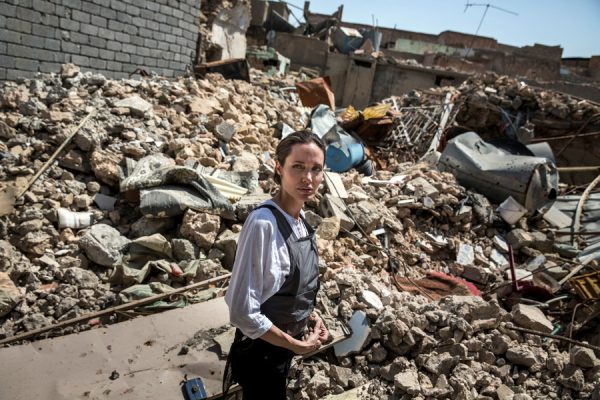
UNHCR Special Envoy Angelina Jolie visits the Old City in West Mosul, Iraq June 16, 2018. © UNHCR / Andrew McConnell
Surely, life is picking up in Mosul, yet at a very slow pace, with destruction seen in the background of every photo.
A photo worth a thousand words ❤#EidAlFitr in #Mosul#Iraq#BackToLifepic.twitter.com/5hZyPgToau
— ICRC Iraq (@ICRC_IQ) June 19, 2018

Iraqi workers repair a building in Mosul on March 15, 2018. © Ahmad Al-Rubaye / AFP
Restoring hope & heritage
Historical sites in both cities sustained massive damage during the fighting. An iconic landmark of Mosul, the Grand al-Nuri Mosque, was blown up by IS militants a month before the city was recaptured by the coalition. The monument was effectively reduced to rubble, and, nearly a year after, it remains in the same state – showing only signs of further deterioration and weathering.
The destroyed Grand al-Nuri Mosque is seen in the Old City of Mosul on January 17, 2018. © Ari Jalal / Reuters
Aleppo Citadel, on the other hand, not only endured the battle for the city, but it actually played one of the key roles in it, serving as a stronghold for Syria’s defenders once again. While the monument was damaged during the fighting, restoration – and demining – works were launched almost immediately after the city’s liberation. Now it’s open for everyone again.
Syrian children from the St. Francis Church summer camp enjoy an exploratory trip to Syria’s historic Citadel in Aleppo, free of terrorism.
You won’t be seeing these smiling faces on any mainstream media outlets because it doesn’t advance their agenda against Syria. pic.twitter.com/X3nrDoH0TH
— Sarah Abdallah (@sahouraxo) June 7, 2018
#Aleppo Citadel is back open for Syrian and Foreign Tourists. Fee to enter in US $ equivalent?
Foreign Tourists = $1.16
Syrian Visitors = $0.17
Syrian Soldiers = $0.12
Families of Martyrs = Free https://t.co/gMyRsQ3Rtupic.twitter.com/gZwLg4CCFG— EHSANI2 (@EHSANI22) June 20, 2018
Another iconic landmark of the city – the Umayyad Great Mosque – was less lucky and sustained way more serious damage, getting pierced with shrapnel and having one of its minarets toppled. While more work needs to be done, it looks way better now – and it actually serves its purpose.
Iraq receives dozens of advanced T-90 battle tanks from Russia
Press TV – Jun 7, 2018
The Iraqi military has received dozens of more advanced T-90 battle tanks from Russia under a major deal struck between Moscow and Baghdad last year.
The Iraqi Defense Ministry, in a statement released on Thursday, announced that it had taken delivery of 39 tanks, adding that the armored fighting vehicles had been distributed between two battalions of an army brigade.
The statement said that Iraqi military personnel had already been trained by Russian experts on how to operate the battle tanks.
Iraqi Army Chief of Staff General Othman al-Ghanimi said on February 19 that his country’s army had received 36 Russian-made T-90 battle tanks.
The T-90 is a third-generation Russian battle tank built upon the time-proven Soviet T-72 design.
It is among the best-selling tanks in the world, and known for its firepower, enhanced protection and mobility.
The T-90 features a smoothbore 2A46M 125mm main gun, which can fire both armor-piercing shells and anti-tank missiles.
The advanced tank also features sophisticated armor, ensuring all-round protection of the crew and critical systems, including explosive reactive armor and active infrared jammers to defend it from inbound rocket-propelled grenades, anti-tank missiles and other projectiles.
Indian, Algerian and Azerbaijani militaries have purchased hundreds of T-90 battle tanks in past years. Kuwait, Vietnam and Egypt have also expressed strong interest in buying the tank.
The Iraqi military plans to reinforce its fleet of M1A1 Abrams main battle tanks with T-90s. A large number of American M1A1 Abrams tanks have been damaged in the fight against Daesh Takfiri terrorists.
Iraqi voters undermine Trump’s Iran strategy
Muqtadar al-Sadr and Hadi al-Amiri, both anti-American, finished first and second in elections held on the day Trump scrapped the Iran nuclear deal
By M.K. Bhadrakumar | Asia Times | May 24, 2018
In an ironic twist, May 12, which was the deadline for US President Donald Trump’s decision on the Iran nuclear deal, also happened to be the day the Iraqi parliamentary elections took place.
Yet no one seemed to take note of the symbolism. In the event, the Iraqi election results seriously hinder Trump’s agenda of rolling back the Iranian presence in the northern tier of the Middle East comprising Iraq, Syria and Lebanon.
Of these three countries, Iraq is arguably the most crucial theatre of contestation between the United States and Iran. The fate of the Iranian presence and Iranian capacity to influence the politics of the entire Shi’ite arc will be critically dependent on its standing and influence in Baghdad. The stakes have never been as high as they are today.
To be sure, the Iraqi election results that were formally announced on Sunday constitute a stunning setback for Trump’s containment strategy against Iran. Washington had bet heavily on the alliance led by Prime Minister Heidar al-Abadi to win, but it has been relegated to third place, winning only 42 seats in the 329-member parliament.
Anti-American tilt
Worse still, two staunchly anti-American alliances – led by Muqtadar al-Sadr and Hadi al-Amiri – secured first and second places respectively.
Coalition making will be a long drawn out process, but what is clear is that the next government in Baghdad will have a pronounced anti-American tilt and the probability is high that it could evict US troops and contractors totaling 100,000 in Iraq.
While Amiri leads the powerful Iran-aligned militia groups known as the Popular Mobilization Force, Sadr’s surge is really bad news for the Americans. Sadr’s Mahdi Army has the blood of hundreds of Americans and Brits on its hands.
In the expert opinion of the Washington-based think tank Brookings Institution: “His (Sadr’s) victory has turned America’s Iraq policy upside down, and Washington now faces a severe political crisis in a country where it has invested substantial blood and treasure … His movement gave rise to many of the Shiite militia groups that committed atrocities against Americans and that today dominate Iraq – as well as the front lines of the war in Syria, where they have fought US forces. These groups have been pivotal to securing the Assad regime’s survival as well as enhancing Iran’s influence in the region.”
In the coming weeks and months, Tehran will play a key role in the negotiations for the formation of the next government in Baghdad. During earlier such moments, Tehran and Washington had tacitly agreed on compromise candidates – prime ministers Abadi and Nouri al-Maliki respectively – but the scope for such accommodation is non-existent today.
Western analysts make much out of Sadr’s nationalistic outlook to give it an anti-Iranian tweak, but that betrays wishful thinking. Sadr is indeed a mercurial personality and tends to lean toward “red Shi’ism” in his outlook on Iraq’s political economy. His alliance partners are communists and secularists.
The Iran-Sadr connection
But significantly, he met Amiri on Monday and said later in a statement: “The process of government formation must be a national decision and importantly, must include the participation of all the winning blocs.”
Again, much has been made out of Sadr’s visit to Saudi Arabia last year and his meeting with Crown Prince Mohammed bin Salman, but in reality, the warming relationship between Baghdad and the Persian Gulf states – Saudi Arabia, the UAE and Qatar – runs only skin deep.
On the other hand, Iranians and Sadr’s family go back a long way. Sadr lived in Tehran in exile for many years. Meanwhile, reports say Tehran is bringing on board the two main Iraqi Kurdish parties – KDP and the PUK – who feel aggrieved that the US connived with Abadi’s crackdown in Kirkuk last October, to align with Amiri.
All in all, Tehran can afford to weigh the pros and cons of many options open to it.
It is entirely conceivable that Tehran might even choose to settle for another government led by Abadi as the figurehead of a staunchly pro-Iranian power structure. Ever since the regime change in Baghdad following the US invasion in 2003, Tehran has made sustained and intense efforts to cultivate wide-ranging political partnerships with Iraqi groups across the religious, ethnic and political spectrum.
It is preposterous to fantasize that Baghdad is about to move out of Iranian orbit.
The bottom line is that a new coalition government in Baghdad over which Iran enjoys political leverage may well set a timetable for the withdrawal of American troops. The Trump administration must prepare for such an eventuality since it has left Tehran in no doubt that continued US military presence in Iraq poses an existential threat of “regime change.” Trust Tehran to pull out all the stops – short of directly targeting US troops – to undermine the American influence in Iraq.
On the other hand, a well-grounded military footing in Iraq is an absolute pre-requisite for the Pentagon to conduct its operations at the present scale in northeastern Syria, given the imponderables in Turkey’s continued cooperation. In these circumstances, it is hard to see how Trump is going to realize his dream to get Iranians to vacate from Iraq or Syria.
Israeli Parliament Reportedly Considers Promoting Kurdish State
Sputnik – May 22, 2018
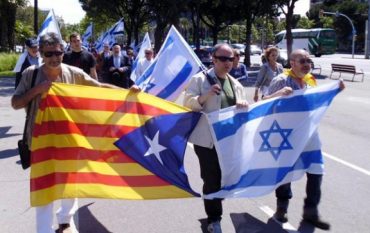 Israeli MPs have reportedly discussed a bill that outlines the means by which Israel may help Kurds build their state in Syria, Iraq and Turkey, which would support Tel Aviv. According to one of Israel’s radio stations, the bill had been submitted to the Knesset by two Israeli right-wing parties, namely Likud and Yisrael Beiteinu. The radio quoted Yoav Kish as saying that given the Kurdish minority living in the aforementioned countries, which are generally hostile to Israel, the proposed move would play into the hands of the Israeli state.
“There is a reason that Israel was the first to publicly congratulate moves toward Kurdish independence in northern Iraq,” Kish added.
Back in 2017, Israel became the only country to support the Kurdish plebiscite which endorsed the Kurds’ secession from Iraq – a development that was vigorously criticized around the world.
Back then, Israeli Prime Minister Benjamin Netanyahu claimed that Tel Aviv backed what he called “legitimate efforts of the Kurdish people to attain a state of its own.” Alongside political backing, Israel was reportedly a major buyer of Kurdistan’s oil and the top investor in the region in 2017.
The Iraqi Kurdistan independence referendum that took place on September 25 triggered changes in the region. More than 90 percent of the voters who took part in the plebiscite backed the independence from Baghdad. Iraqi authorities declared the referendum illegal, while Turkey and Iran vehemently criticized the plebiscite and threatened to impose tough sanctions on Iraqi Kurdistan’s capital Erbil.
Read more:
Tensions Rising Between Syrian Army, Kurds Amid Creation of US Bases – Reports
Featured Video
Iran spent $1 million to wipe out $30 billion in data center plans, and take down Amazon in the ME
or go to
Aletho News Archives – Video-Images
From the Archives
Clash of Civilization, Iran Part II
By Jamal Kanj – Intifada-Palestine.com – January 14, 2011
Israel’s survival kit is: perpetuate conflict, insecurity to rationalize collective hate and finally playing victim.
Devoid of conflict, Israel implodes internally; without hate, Zionism loses its justification; and playing eternal victim to continue blackmailing the West. Absence of this holy trinity, Israel ceases to exist. … continue
Blog Roll
 Aletho News
- ‘Bucha massacre’ a false flag orchestrated by UK – Moscow
- China Rejects Outside Pressure on Trade Ties After New US Russia Sanctions Bill
- Houthis Keep Advancing as the Red Sea Crisis Deepens
- Iran spent $1 million to wipe out $30 billion in data center plans, and take down Amazon in the ME
- Zionist billionaire pressure to silence Macklemore sparks exodus from Ed Sheeran tour
- House Votes to End Iran War for Third Time
- North Korea Slams US Plan for ‘AUKUS 2.0’ with South Korea and Japan
- Prolonging US-Iran Conflict Not Meeting Interests of Int’l Community – China’s Wang Yi
- EU bans former Zelensky aide from parliament
- NATO-backed Kosovo separatist ‘responsible for war crimes’
- If Americans Knew
- Israeli Forces Detain Journalist Alaa al-Rimawi amid Widespread West Bank Raids
- Even a pro-Israel Congress member has put a hold on 40,000 one-ton bombs to Israel
- As Gaza crumbles, Israel preps new ground invasion – Daily Update
- ‘We are not like everyone else’ laws that bind other nations do not apply to Israel, says Likud lawmaker
- Trump’s govt makes ‘treasonous’ claim of weapons shortages
- Palestinian-American Journalist Naqaa Hamed Imprisoned by Israeli Forces After Settlers Targeted Her
- U.S. Makes, Israel Takes: The Real Story of U.S.-Israeli Military Cooperation
- Night raids rise in Palestine
- Tucker Carlson interviews Norman Finkelstein about Gaza
- Groups urge Americans to support Van Hollen legislation on Israel’s killing of Americans & Palestinians
- No Tricks Zone
- New Study: ‘Global Drought Shows No Detectable Recent Acceleration Under Climate Warming’
- Economic Masterminds: German Socialists Suggest Taxing Productivity Gains Stemming From Using AI
- The South China Sea Has Not Been Cooperating With The Climate Change Narrative
- Energy Crisis: Germany Enters Heating Season With Historically Low Gas Reserve Fill Levels
- New Study: The Antarctic Ice Sheet Gained Mass From 2020-2024 Due To Staggering Snow And Ice Accumulation
- Study: Ocean Heating Rates From Thousands Of Years Ago ‘Dwarf’ Modern Ocean Heating Rates
- Climate Extremists Target, Attack Large-Scale Power Grid Infrastructure In Germany!
- New Study: Antarctic Ice Melt Has Contributed Less Than 1 Centimeter To Sea Level Rise In The Last 30 Years
- Fear Of Debate: Alarmist German Climate Scientist Calls On Mainstream Media To Discredit Skeptic Voices
- End-Of-August Arctic Sea Ice Extent Hasn’t Fallen In 20 Years, Official Data Show!
 Aletho News