Tehran will loan $3 billion to help Baghdad with the restoration of its infrastructure after the defeat of the Daesh terrorist group in the country, Iranian First Vice-President Eshaq Jahangiri said on Sunday.
“Iran is ready to provide Iraq with a credit line of $3 billion in order to increase the presence of Iran’s private sector in the restoration of Iraq,” Jahangiri said, as quoted by the Tasnim news agency.
Both Iran and Iraq aim to further strengthen their bilateral political and economic ties, according to the official.
Jahangiri also said that it is necessary to connect the railway systems of both countries and the sides are planning to construct a bridge and a 30-kilometer section of the railway.
“By doing this, Iraq will be able to get access to Central Asia and China, and the Iranian railways will reach the Mediterranean [region],” the first vice-president added, as quoted by the agency.
Jahangiri is currently on a visit to Baghdad to hold talks with the country’s officials.
In December, Iraqi Prime Minister Haider Abadi declared an end of the country’s fight against Daesh as Iraqi troops re-established complete control over the country’s Syrian border. This came after years of violent fighting, that brought significant damage to the country’s infrastructure.
The Kuwait International Conference of Iraq Reconstruction and Development, which was held in February, managed to raise $30 billion in direct aid, loans and investments for the post-war reconstruction of Iraq’s economy, according to Kuwaiti Foreign Minister Sabah Al Salim Sabah.
This month marks the 15th anniversary of the US war on Iraq. The “shock and awe” attack was launched based on “stove-piped” intelligence fed from the CIA and Pentagon through an uncritical and compliant US mainstream media. The US media was a willing accomplice to this crime of aggression committed by the George W. Bush Administration.
Despite the lies we were constantly bombarded with, Iraq never presented a threat to the United States. Iraq never had the weapons of mass destruction that the neocons used to frighten Americans into supporting the war. How many of them knew all along that there were no WMDs? We’ll never know. Attacking Iraq and overthrowing its leader was long a plan in the neocon playbook and they used the 9/11 attack on the US as an excuse to pull the plan off the shelf and put it into action.
The US “regime change” war on Iraq has directly resulted in the death of at least a quarter of a million civilians, and indirectly perhaps a million Iraqis have been killed. The Iraqi infrastructure was destroyed and the country was set back many decades in development. Far from the democratization we were promised, Iraq has been turned into a hell on earth. Due to the US use of depleted uranium and other chemical weapons like white phosphorus, Iraqis will continue to suffer from birth defects and other related illnesses for generations.
How did we get there? War propaganda was essential in paving the way for the Iraq war. Americans are generally skeptical about launching new wars, so it takes a steady media bombardment about the alleged depravities of any targeted regime before public opinion begins to shift in favor of war.
Because the neocons who helped launch the war have never had to face the consequences of their actions, they continue to promote war with impunity. Just this past week, Sen. Lindsey Graham (R-SC) was pushing for a US attack on North Korea in which millions may be killed. He said this weekend, “All the damage that would come from a war would be worth it in terms of long-term stability and national security.” That’s just what they said before the US attacked Iraq, and how did that turn out? I find it disgusting that the media continues to give airtime almost exclusively to those who promote more US disasters like Iraq.
The Iraqi parliament did something extraordinary last week. A majority of elected Iraqi representatives voted to demand that their prime minister draw up a timetable for the withdrawal of US troops from the country. President Obama had withdrawn US troops from Iraq in 2011, after a status of forces agreement could not be reached with the Iraqi government, but he returned the US military to Iraq under the auspices of fighting ISIS.
We had no business going into Iraq in the first place and we have no business remaining in Iraq. Al-Qaeda and ISIS emerged in Iraq because our attack and occupation of the country 15 years ago created fertile fields for extremism. Nothing will be achieved if we remain. Let’s listen to the Iraqis and just come home!
Western media is heaping scorn on Syria for using ‘excessive force’ in its effort to liberate Ghouta from militant control. But where was that same concern when Mosul was being pulverized by US-led forces?
The Syrian government’s liberation efforts in the Damascus suburb of Eastern Ghouta have deteriorated into a media circus where truth has taken a back seat in the clown car. As was the case in the liberation of Aleppo, the government of President Bashar Assad – as opposed to the militant groups wreaking havoc in his country – has borne the main brunt of criticism from the Western world.
Due to the conditions on the ground in Ghouta, it is virtually impossible to get a clear picture of the situation there. What we do know, however, is that Damascus is being hit by approximately 70 missiles daily from militant positions inside Ghouta. The Western media would rather ignore that fact, speculating instead that “more than 500 people” have been killed by the Assad “regime” since efforts to retake the city began last month.
So where does the Western media get its information? In the majority of cases, from the Syrian Observatory for Human Rights (SOHR), a one-man operation based out of a humble abode in Coventry, UK. Western reporters also rely on the so-called White Helmets, the very same ‘humanitarian’ group that is suspected of working in tandem with terrorist groups that are carrying out attacks on civilians. Based on these extremely dubious sources, and others, one of the UK’s most respectable newspapers, the Guardian, was bold enough to assert that “Eastern Ghouta is turning into Syria’s Srebrenica.”
“Like the Bosnian Muslim enclave in 1995, eastern Ghouta … has been besieged by regime forces since the early stages of the Syrian war,” Simon Tisdall wrote. “As in Bosnia, nobody attempted to protect the civilian population when a regime offensive began there in December after negotiations failed. The airstrikes and bombardments… are carried out with impunity by Syrian forces and their Russian backers.”
I read that article twice in the hope of finding any mention of the militant forces that have been occupying Eastern Ghouta off and on since late 2012, subjecting the local population to untold horrors, including the threat of chemical attack. Regrettably, I failed; not a single mention of the terrorists. Indeed, to read Tisdall’s article one gets the impression that the citizens of Ghouta are perfectly content with the occupation of their city by fanatical militants.
Examples of such biased attitudes towards the Syrian government have, at the same time, overtaken the social media jungle like the invasive kudzu vine, blocking out the light of truth.
This week, for example, a US-based user who goes by the name of Sami Sharbek posted two photos on his Twitter account – one showing a building consumed by an explosion; the other depicting a man carrying a crying child.
“This is not a movie. This is Syria,” he wrote in the caption.
Sharbek was only 50 percent right.
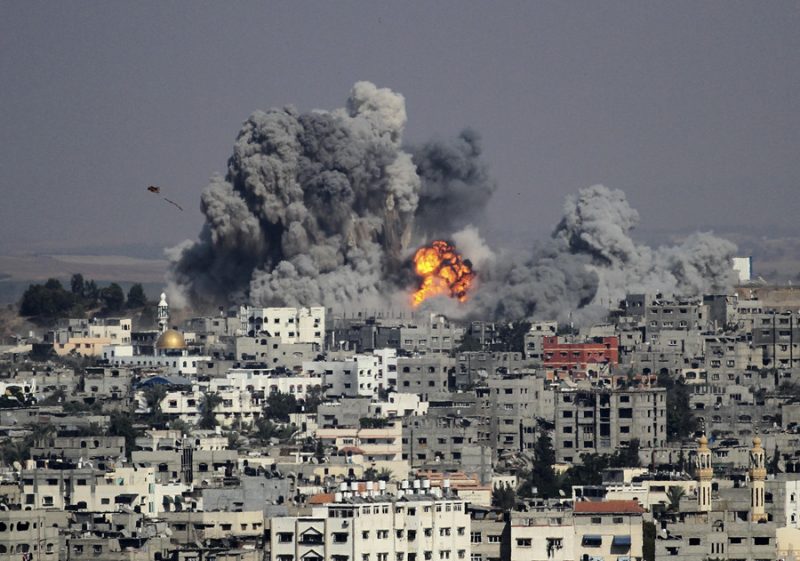
Although the photos were not taken from a Hollywood blockbuster film, they did feature horrific images from Gaza and Mosul, respectively. In other words, very far from the action in Ghouta. Although Sharbek later admitted to his error, the damage was already done. As of February 28, the Tweet had made a huge impression, generating over 125,000 shares and 154,000 likes (the account is now blocked, open only to “approved followers”), possibly reaching millions of users. It is probably safe to say that very few of those same people will hear that Sharbek’s tweet was for all intents and purposes fake news.
On February 25, Danny Gold, a writer and correspondent, compared the situation in Ghouta to one of history’s worst human atrocities when he tweeted: “I know how Jews who lived through the holocaust felt 70 years later about the world turning a blind eye, can’t imagine how Syrians in Ghouta will feel about their suffering being so well-documented as it’s happening yet doubted by so many.”
I know how Jews who lived through the holocaust felt 70 years later about the world turning a blind eye, can’t imagine how Syrians in Ghouta will feel about their suffering being so well-documented as it’s happening yet doubted by so many.
Dan Cohen, a correspondent with RT America, responded to Gold: “Ghouta is like the Holocaust but Mosul was ‘a huge journalism event’ in which US-led forces took ‘much care’ in burying at least 3,200 civilians in the rubble.”
Cohen’s comment was a jibe at a tweet Gold had sent on February 1, 2017 in which he embellished the historical record of the US-led Iraqi campaign, remarking: “Mosul was a huge journalism event. Everyone who covers the Middle East was there.”
Ghouta is like the Holocaust but Mosul was “a huge journalism event” in which US-led forces took “much care” in burying at least 3,200 civilians in the rubble. pic.twitter.com/SxQGxFhYlc
But if Mosul really was one big happy media confab, then how was it possible for the fatality figures to have been so skewed? As AP rather belatedly reported in December 2017, long after the nine-month conflict had ended, “The price Mosul’s residents paid in blood to see their city freed was between 9,000 and 11,000 dead … a civilian casualty rate nearly 10 times higher than what has been previously reported.”
Perhaps if Western reporters had not spent so much of their time reporting on the same type of military operation in Aleppo, which was then the focus of a Russian-backed liberation campaign, they may have more accurately described the situation in Iraq’s second-largest city.
Michael Raddie, co-editor of BSNews, provided a convincing explanation for the discrepancy in the way the Western media reports on war zones, which he said can be reduced to a matter of “worthy victims” and “unworthy victims.”
“The victims of US bombs and British airstrikes are not worthy because we don’t do that kind of thing,” Raddie told RT. “Our killing of civilians is a mistake, collateral damage. The Syrian air force killing of civilians … that is atrocities. And that is the ideology that Western media portray all the time.”
However, there is another side to this wave of Western cynicism with regards to Syria that could spark a real catastrophe. That involves the threat of a chemical strike, which the West seems to believe is something only the “Assad regime” is capable of committing. After all, who would ever suspect bona-fide terrorists deprived of modern weapons of resorting to such barbaric means of warfare?
Much like Barack Obama’s utterly reckless “red line” warning regarding the use of chemical weapons, which he said would warrant US military action, French President Emmanuel Macron issued the very same foolish warning on February 14.
“On chemical weapons, I set a red line and I reaffirm that red line,” Macron told reporters. “If we have proven evidence that chemical weapons proscribed in treaties are used, we will strike the place where they are made.”
Did it surprise anyone that less than two weeks after Macron’s warning a chemical attack – conveniently supported by photos provided by, yes, the White Helmets – was reported to have occurred in Ghouta? Western media and politicians have actually suggested a Russian connection to the event.
“Whoever conducted the attacks, Russia ultimately bears responsibility for the victims in Eastern Ghouta and countless other Syrians targeted with chemical weapons since Russia became involved in Syria,” US Secretary of State Rex Tillerson said.
Presently, a 30-day ceasefire endorsed by the UN Security Council is in effect across Syria, as well as a daily five-hour “humanitarian pause” in Eastern Ghouta enforced by Russia.
Yet thus far the plan is not producing the desired effect. Militants are preventing civilians from fleeing besieged Eastern Ghouta and are sabotaging the humanitarian operation there, Major General Vladimir Zolotukhin, a spokesman for the Russian Center for Reconciliation in Syria, told journalists on Thursday.
Robert Bridge is an American writer and journalist. He is author of the book, ‘Midnight in the American Empire,’ released in 2013. robertvbridge@yahoo.com
Hey Maple Leafs, be careful which traditions you honour.
On Saturday the Leafs play an outdoor game against the Washington Capitals at Navy-Marine Corps Memorial Stadium at the U.S. Naval Academy in Annapolis, Maryland. To mark the occasion the team created a jersey with the Royal Canadian Navy’s (RCN) “Ready, Aye, Ready” motto on it. The website unveiling the sweaters includes a brief history of the RCN, and Leafs President Brendan Shanahan said the jerseys were designed to honour “the traditions of the Royal Canadian Navy” whose sailors “stand always ready to defend Canada and proudly safeguard its interests and values whether at home or abroad.”
Sounds all maple syrupy, but there are a couple of nagging questions: Whose “interests and values” are we talking about? Should we honour all their traditions?
For example, in 1917 the Royal Bank loaned $200,000 to unpopular Costa Rican dictator Federico Tinoco just as he was about to flee the country. A new government refused to repay, saying the Canadian bank knew Tinoco was likely to steal it. “In 1921,” reports Royal Military College historian Sean Maloney in Canadian Gunboat Diplomacy, “Aurora, Patriot and Patrician helped the Royal Bank of Canada satisfactorily settle an outstanding claim with the government of that country.”
In 1932 RCN destroyers Skeena and Vancouver assisted a month-old military coup government that brutally suppressed a peasant and Indigenous rebellion in El Salvador. London had informed Ottawa that a “communist” uprising was underway and there was “a possibility of danger to British banks, railways and other British lives and property” as well as a Canadian-owned utility. Bolstered by the RCN’s presence, the military regime would commit “one of the worst massacres of civilians in the history of the Americas.”
In 1963 two Canadian naval vessels joined U.S., British and French warships, reports Maloney, that “conducted landing exercises up to the [Haiti’s] territorial limit several times with the express purpose of intimidating the Duvalier government.” That mission was largely aimed at guaranteeing that Haiti did not make any moves towards Cuba and that a Cuban-inspired guerrilla movement did not seize power.
Two years later, thousands of U.S. troops invaded the Dominican Republic to stop a left-wing government from taking office. Alongside the U.S. invasion, a Canadian warship was sent to Santo Domingo in April 1965, in the words of Defence Minister Paul Hellyer, “to stand by in case it is required.”
After dispatching three vessels during the first Iraq war in 1991, Canadian warships were part of U.S. carrier battle groups enforcing brutal sanctions. In 1998 HMCS Toronto was deployed to support U.S. airstrikes on Iraq. In the months just before and after the second U.S.-led invasion of Iraq at least 10 Canadian naval vessels conducted maritime interdictions, force-support and force-projection operations in the Arabian Sea. Canadian frigates often accompanied U.S. warships used as platforms for bombing raids in Iraq. A month before the commencement of the U.S. invasion, Canada sent a command and control destroyer to the Persian Gulf to take charge of Taskforce 151 — the joint allied naval command. Opinion sought by the Liberal government concluded that taking command of Taskforce 151 could make Canada legally at war with Iraq.
In 2011 HMCS Charlottetown and Vancouver were dispatched to enforce a UN arms embargo on Libya. But, they allowed weapons, including from Canadian companies, to flow to anti-Gadhafi rebels. They also helped destroy Libyan government naval vessels.
Last summer HMCS Ottawa and Winnipeg participated in “freedom of navigation” operations alongside U.S., Japanese, Australian and other countries’ warships in disputed areas of the South China Sea. Chinese vessels responded by “shadowing” the Canadian vessels for 36 hours.
The honest truth is that the RCN is employed mostly to advance corporate and Western geostrategic interests, something many of us would prefer not to honour.
A Canucks and Canadiens fan, I confess to having hated the Leafs before they partnered with the navy.
Iraq is interested in getting the Russian S-400 air defenses. Earlier this week an Iraqi delegation traveled to Moscow to discuss buying it. The Russian defense industry has confirmed Iraqi interest and the Russian ambassador to Baghdad confirms Russia would be happy to sell.
So albeit nothing concrete has happened yet the US is already warning Iraq not to go through with the purchase (27min, 52s):
During a press briefing State Department’s Heather Nauert has explained the US has informed Baghdad getting Russian air defenses would go against America’s Countering America’s Adversaries Through Sanctions Act of 2017 which imposed sanctions on Iran, North Korea and Russia — which would mean Iraq would be facing US sanctions for doing business with Russia.
QUESTION: Okay. Let me ask you about Iraq. It’s getting – you’ve described the terrible things that Russia is doing in Syria, whether Russia’s activity in Iraq would be deny – benign. Iraq recently received Russian tanks, T-90 tanks, and it’s reportedly considering the purchase of the S-400 air defense system. What is your comment on that and would those transactions make Iraq susceptible to CAATSA sanctions?
MS NAUERT: Well, first of all, we are communicating with governments all around the world, such as Iraq and others, about the CAATSA law, and making those governments aware of how they could run afoul of the CAATSA law and the potential repercussions as a result. So we made it clear to all of those – all of – many of the countries that we work with – information about our new law. So let me – I just want to be clear about that.
Secondly, I don’t know if this deal that you speak of is a done deal or not, so I’m not going to get ahead of what that may be, but I can just tell you that we make it clear with our partners and allies.
QUESTION: So it sounds like, from what you’re saying, if this S-400 deal were to go ahead and be concluded, they could be in violation of CAATSA?MS NAUERT: Look, that’s a hypothetical, but we have made it clear to countries around the world this is our law, this is what will cause your country, your government to run afoul of the law, and countries then need to make a choice.
Iraq has traditionally got its arms imports from Moscow and has recently concluded a $4.7 billion weapons deal with Russia that included purchases of T-90 tanks and BMP-3 vehicles. Before the unexpected rise of ISIS in 2014 Baghdad was in talks to purchase the Russian S-300 air defenses.
China and India, as well as traditional US clients Turkey, Saudi Arabia, Egypt and Qatar have already ordered the missiles or are interested in doing so.
The United States has warned Iraq, among a number of other countries, of the consequences of extending military cooperation with Russia, and striking deals to purchase advanced weaponry, particularly the S-400 surface-to-air missile defense systems.
US State Department spokeswoman Heather Neuert said on Thursday that Washington has contacted many countries, including Iraq, to explain the significance of the Countering America’s Adversaries Through Sanctions Act (CAATSA), and possible consequences that would arise in the wake of defense agreements with Moscow.
On August 2, 2017, US President Donald Trump signed into law the CAATSA that imposed sanctions on Iran, North Korea, and Russia.
Neuert said she did not know whether Iraq and Russia have finalized an accord on the S-400 missile systems.
The remarks came only a few days after Saudi Arabia’s Arabic-language al-Watan newspaper reported that Baghdad is planning to buy Russian-made S-400 surface-to-air missile system from Moscow.
There are also reports that Iraqi Prime Minister Haider al-Abadi has tasked a team of advisers from the Iraqi Ministry of Defense and National Security Council to negotiate the purchase of the missile systems with Russian officials.
Earlier this month, Chairman of the Defense Committee of the Russian Federation Council, Colonel General Viktor Bondarev, named Syria, Iraq, Sudan and Egypt as the potential buyers of the defense systems.
Last week, Chief Executive Officer of Rostec, Russia’s state-owned corporation for promoting the development, production and export of high-tech industrial products, stated that Moscow is ready to sell its air defense systems to any country with security concerns.
A senior Iranian official says the resistance front in the region will push the United States and Israel out of the eastern side of the Euphrates River, which flows from Turkey through Syria and into Iraq.
Ali Akbar Velayati, a senior advisor to Leader of the Islamic Revolution Ayatollah Seyyed Ali Khamenei on international affairs, made the remarks in a conference on Islamic unity in the Iraqi capital, Baghdad, on Saturday.
Velayati said the Americans and Arabs are trying to create “a new Middle East, whose reality will be marked by the disintegration of Muslim societies.”
He said Washington was seeking to split Syria through its presence in the eastern Euphrates.
He also referred to US Secretary of State Rex Tillerson’s recent Middle East tour, saying the visit had been aimed at broadening the division among the Muslim Ummah and Muslim countries.
Velayati said the Americans were seeking to establish bases for the North Atlantic Treaty Organization (NATO) with the help of Muslim states to prevent unity among these countries.
“The Americans and Zionists should know that as they were defeated in the Lebanon, Syria, and Iraq, their illusions won’t materialize. The resistance front in Iraq, Syria, and Lebanon will push them out of the eastern Euphrates,” he said.
Much of northeast Syria to the east of the Euphrates is controlled by the so-called Syrian Democratic Forces (SDF), which is dominated by the militants from the Kurdish People’s Protection Units (YPG) and is backed by the US.
The US announced last month that it would work with the SDF to set up a new 30,000-strong “border security” force along the Turkish border with Iraq and within Syria along the Euphrates River.
Ross Caputi, a former Marine who was “witness and accomplice to the atrocities” committed in Fallujah in November 2004 during “Operation Phantom Fury”, wrote this about his unit’s entry into the city:
Perhaps it was just too painful of a realization for many of us to make, because we saw ourselves as the liberators, the good guys, and to admit that we were hurting innocent people would have contradicted everything that we claimed to stand for. I can only speculate about what the motives were for the people who dreamed up that mission and decided to make the people of Fallujah flee into the desert. Was it also too painful for the decision makers to admit to themselves that we were hurting innocent people? Or were they so evil that they just did not care who we were hurting? Whatever their reasons for doing it were, the fact of the matter is that our entire command was aware that we had forced the majority of the city’s population, about 200,000 people, into refugee status, but nobody took responsibility for their wellbeing, as international law required of us.
Central to that command was Major General Andrew “Jim” Molan, an Australian who was seconded to the US military in 2004 and took overall command of US coalition forces in Iraq, alongside the current US defence secretary Jim Mattis.
What happened in the so-called “second battle of Falluja” however, went far beyond a failure to attend to the needs of the civilian population who were able to flee the city before the US assault. Those who remained found themselves imprisoned in a “free-fire zone” for 10,500 US troops and 850 UK special forces, along with 2000 Iraqis loyal to the Occupation government in Baghdad.
While the “Battle for Falluja” has been glorified and celebrated as the most destructive and significant US battle since Vietnam, intended to be a final stand against insurgents who had become concentrated there, it has also been recognised as one of the worst war crimes committed by US coalition forces during the whole occupation of Iraq.
Although the insurgents included the progenitors of those now fighting in Syria, – AQI and Ansar al Sunna, there was significant popular backing for them amongst the local Sunni population, who saw US forces as oppressors rather than liberators. In the “first battle of Falluja” eight months earlier, when legitimate public protests against oppressive actions by US forces drew a lethal response and the deaths of 17 innocent civilians, this popular resistance solidified. As Ross Caputi describes it:
After the resistance movement in Fallujah successfully repelled the first U.S. led siege of their city in April of 2004, Fallujah became a symbol of heroism and resistance to Iraqis. In the United States Fallujah was made into a symbol of terrorism. The U.S. mainstream media described Fallujah as a “hotbed of anti-Americanism” and an “insurgent stronghold”, and gave little mention of the 300,000 civilians that lived there. In November of 2004, the U.S. launched a massive siege on Fallujah that killed anywhere between 800 and 6,000 civilians, forced hundreds of thousands to flee their homes, and left much of the city in ruins. From that point on Fallujah became a symbol to much of the world of cruelty, devastation, and occupation.
The suffering inflicted on Fallujah did not end in 2004. Life for the people who chose to return to their city never improved. The U.S. imposed security measures and curfews that made living a normal life in Fallujah impossible. Residents already had to struggle to make ends meet in their dilapidated city, but the constant security check-points, ID card scans, and arrests only made life harder. Food and Medicine were scarce, and they remain scarce to this day.
It is impossible to read these accounts, both of what happened to Fallujah in 2004 and of the way it was portrayed by US leaders and US media, without comparing it with the current “battles” in both Iraq and Syria – Mosul, Raqqa, Aleppo and Idlib. Looking at the gaping chasm between the current reality perceived by Syrians and their allies, and that presented in Western media one can only lament for the lessons unlearned, and be incensed at the depth of deception that marks today’s battles.
But one question remains as hard to answer. As Caputi asked:
Was it also too painful for the decision makers to admit to themselves that we were hurting innocent people? Or were they so evil that they just did not care who we were hurting? Whatever their reasons for doing it were, the fact of the matter is that our entire command was aware… (of the refugees’ plight)
A similar question was asked in the Australian Parliament this week of the now former General Jim Molan, who has just entered the parliament as a Liberal party senator. Greens leader Richard Di Natale was reacting to Molan’s apparent sympathy for anti-Muslim and anti-immigration groups, but chose to draw attention to Molan’s questionable record in Iraq, and in the battle of Falluja.
Di Natale said the attack on Fallujah was a disaster for civilians, and Senator Molan had to bear responsibility:
“At the time of the assault on Fallujah under the command of now-Senator Molan, a UN special rapporteur said coalition forces used hunger and deprivation as a weapon of war against the civilian population — a flagrant violation of international law,” Senator Di Natale said.
“Minister, given Senator Molan’s extreme views, do you have a concern these views influenced the decisions he made while executing the military campaign in Fallujah?”
The defence minister Maurice Payne, who also has a military background avoided addressing Di Natale’s legitimate demands altogether – hardly surprising given her own defence of the indefensible over Australian actions in Syria. Di Natale doesn’t know “what it takes to lead your nation in a uniform”, she said, while PM Turnbull echoed with his own paean to the defence of “Australian values”:
I want to remind the honourable member that in this parliament, on both sides, there are men and women who have served Australia in our uniform, putting their lives on the line, to defend those values. They haven’t just defended them, they’ve fought for them.
Should we assume that those Australian values are represented by Molan’s actions in Fallujah, which appear to have not merely condoned atrocities but to have contributed to them? Molan himself went on the front foot in his maiden speech to the Senate this week, including this claim:
I spent one year in Iraq when I ran the war in Iraq. I fought for Muslims in Iraq, and many Iraqis were alive when I left because of the actions that I took—not racist, not anti-Islam. Linking me to Britain First is absolutely absurd.
No doubt many similar statements could be found in Molan’s book about his year in Iraq, published in 2008 – “Running the War in Iraq”. The truth of what happened however, and Molan’s apparent shared responsibility for the crimes, is revealed in an article from the time by an Australian academic, Chris Doran. (An abbreviated version was posted more recently here)
Doran details the many parts of the US coalition’s brutal and vindictive assault on Fallujah, which led to the deaths of up to 6000 trapped civilians, as well as the most devastating ongoing health problems from the use of chemical weapons including White Phosphorus and Depleted or undepleted Uranium. The terrible effects of the latter have been investigated at length by Dr Chris Busby, but fourteen years later remain unacknowledged and unanswered crimes of the Empire.
While providing as much evidence as might be necessary for an accusation of criminal complicity in these crimes, Chris Doran also finishes with a generous statement:
Under the international legal doctrine of command responsibility, a commander can be held liable if they knew, or should have known, that anyone under their command was committing war crimes and they failed to prevent them. The consistency and similarity of the attacks at Najaf, Samarra, and Fallujah display a deliberate disregard for civilian casualties in the planning and implementation of those military assaults. By Molan’s own admission, he was responsible for not only planning, but also directing, these attacks. It is not conceivable that Molan was unaware of the serious and well documented accusations of atrocities being committed under his command.
While admirable that General Molan is so quick to admit responsibility for Fallujah, it is disconcerting that he does not seem to feel that he has done anything wrong, or should in any way be held accountable, for his actions. It is this utter hubris that most accurately characterises his writing. Sanitised as it is though, Molan has written an excellent brief regarding why it is crucial we start holding our political and military leaders accountable for their actions in Iraq. He would be an excellent place to start.
Sadly we can now say that not only have our political and military leaders still not been held to account for their actions in Iraq, but in the ten years since this was written, they have gone on to commit crimes in both Iraq and Syria which are not even recognised, yet in total threaten to exceed all those of the previous decade.
15 years ago today, Colin Powell delivered his infamous speech at the U.N., the speech which cemented the support of the U.S. political and media establishments for the invasion of Iraq, under the pretext of “weapons of mass destruction”. This blog came into existence in August, 2003, a few months later, as one of the very first (if not the first) radical left blogs on the internet (there were a few leftish progressive Democrat blogs at the time, that was about it). Here are some of the posts from that time (and later) which talk about Powell’s speech:
Here’s a letter to the editor I wrote, before the blog started, but after Powell’s speech. I had no special knowledge with which to analyze his speech, just the ability to listen, read, and analyze what was being said, rather than simply accept it at face value. That, unfortunately, was more than the editors of the New York Times, Washington Post, and almost all Democrats and Republicans were capable of.
Here’s an article I wrote many years later, when people started asking George Bush and other politicians, “If you knew then what you know now…”. That question was a distraction, an excuse, because, as I show in the article, there was plenty known then (more than I had known when I had written that letter to the editor), way more than enough to say that “WMD” was just an excuse to carry out yet another U.S. war of regime change.
And this article talks about a subject which I was practically the only one to ever write about — the fate of Iraqi General Amer al-Saadi, the Iraqi liaison to the weapons inspectors and the man who spoke the truth to Powell’s lies. “‘I have always told the truth about these old programs,’ Saddam Hussein’s top scientific adviser said in an interview with German TV last April [2003]. ‘The future will show it.'” As I wrote in that article, “History has proven that every word al-Saadi spoke was true, and every accusation made by Colin Powell (‘We know that Iraq has at least seven of these mobile biological agent factories…There can be no doubt that Saddam Hussein has biological weapons and the capability to rapidly produce more, many more… Saddam Hussein has chemical weapons.’) was false.” Remarkably, the fate of General al-Saadi, who was imprisoned after the war, remains unknown, while the fate of Colin Powell remains all too well-known.
On October 6th 2017 I wrote a lengthy article for The Duran in which I said that the US’s two previous plans in Syria having failed – Plan A being regime change through US backing of violent Jihadi groups, Plan B being the attempt to set up an anti Assad ‘Sunnistan’ in eastern Syria – the US was resorting to Plan C, which was to establish a US backed Kurdish protectorate in northern Syria, so as to undermine the Syrian government from within.
In that article I outlined in detail how that was being done, with the massive supply of arms to the YPG, the Kurdish militia in northern Syria, and through the permanent deployment of US troops in the Kurdish controlled regions of northern Syria.
I also outlined what I thought the likely consequences of this Plan C would be,
Consequences of the US’s Kurdish policy
What are the consequences of the US’s Plan C/’Kurdish’ strategy, and what are its prospects? In summary there are five:
(1) it will prolong the conflicts in Syria and Iraq;
(2) it is delaying the final defeat of Al-Qaeda and ISIS in Syria and Iraq;
(3) it will make the Iraqi government align itself still more closely to Iran and Syria;
(4) it will strengthen hostility within Turkey to the US, and may make Turkey more inclined to seek regional alignments with the US’s Middle East rivals and enemies: Russia and Iran;
(5) it risks making the Kurds even more isolated in their region, whilst uniting the region against them.
I also said that though Plan C was rather more grounded in reality than Plan B since a Kurdish statelet in northern Syria had rather more coherence and reality than the eastern ‘Sunnistan’ proposed as Plan B, it was nonetheless in the long term unworkable, and the attempt to implement it would set the scene for the next US Middle East debacle.
Just two weeks later, with the Iraqi army’s successful offensive against the Iraqi Kurds in northern Iraq, and following the Iraqi army’s recapture from the Kurds of the key Iraqi oil town of Kirkuk, it appeared that this Plan C was already failing and on 19th October 2017 I wrote a further article for The Duran in which I said as much.
In the event, with a persistence worthy of a better cause the US despite the failure in Iraq has persisted with its Plan C.
Firstly the US announced that it intended to keep 2,000 US troops stationed (illegally) in Syria indefinitely, supposedly to prevent a ‘vacuum’ emerging there.
In reality the true number of US troops in Syria is much greater, and it is the presence of these troops which by preventing the restoration of the Syrian government’s authority across the whole of Syria is threatening to create a ‘vacuum’ there. Most, though not all, these US troops appear to be based in northern Syria, in territory controlled by the YPG.
Then the US announced that it was building up a 30,000 strong ‘border force’ in northern Syria, which it was clear would be built up around the Kurdish militia, the YPG.
The results have been very much as I predicted in my article of 6th October 2017.
Firstly, the US game with the Kurds in Syria has outraged the major regional powers: Turkey, Iran, Iraq and Syria.
Turkey’s President Erdogan has now launched his army and air force against the Syrian Kurds whom the US has been backing in their north Syrian enclave of Afrin.
In order to launch this attack Erdogan needed Moscow’s permission, the Russians having previously positioned military observers in Afrin.
A Turkish military delegation accordingly visited Moscow and obtained Moscow’s permission, resulting in the withdrawal of the Russian military observers from Afrin and the unimpeded operation of the Turkish air force there.
The Russians for their part attempted to persuade the Kurds to hand over Afrin to the Syrian government as a way of averting the Turkish attack. The Kurds, counting on US protection, however refused, with the result that they have quickly discovered that the US protection that they had counted on is nowhere to be seen, so that they now find themselves facing the Turkish army on their own.
In a bizarre twist, showing the extent of their confusion and possibly highlighting the internal criticism their leaders are coming under for putting so much trust in the US, the YPG is now blaming the Russians for the debacle.
We know that, without the permission of global forces and mainly Russia, whose troops located in Afrin, Turkey cannot attack civilians using Afrin air space. Therefore we hold Russia as responsible as Turkey and stress that Russia is the crime partner of Turkey in massacring the civilians in the region.
In the meantime, where a few weeks ago it appeared that ISIS in its fastnesses in eastern Syria was close to total collapse after coming under simultaneous attack by the Syrian army and the US backed Kurds, it is now back on the attack and has actually been able to recover some territory at the expense of the Kurds, who are having to transfer fighters to face the threat from the Turkish army in the north.
Meanwhile the Syrian army has been able to capitalise on Turkey’s focus on the Kurds to carry out major advances against the remaining Jihadi enclaves in western Syria near Damascus and in Idlib province, where the key Abu Duhur air base has now been recaptured from the Jihadis, and where large numbers of Jihadi fighters have been surrounded by the Syrian troops.
Latest reports from the normally reliable Al-Masdar news agency speak of continuing Syrian military advances deeper into Idlib province, with plans apparently being prepared for an offensive which will bring the Syrian army all the way up to the outskirts of Idlib city.
An article in the Guardian has now confirmed the critical role of the British government in egging the US on with Plan C as well as the extent of US and British dismay with the latest developments:
The problem for the west is that, as an endgame possibly approaches in Syria, it cannot afford to lose Turkish diplomatic support since Ankara has been the vital countervailing force to a Russian-imposed peace.
The Turkish preoccupation with the Syrian Kurds on its borders could lead to the Turkish president, Recep Tayyip Erdoğan, reaching a deal with Damascus and Moscow.
The speech – in which the UK Foreign Office had a big hand – was something of a watershed and was under-appreciated in Europe. Previously, Trump’s policy on Syria was simply the destruction of Isis and an aversion to talk of nation-building. But the Tillerson speech has been widely criticised because it was long on aspiration but short on detailing the credible levers the US and the west have to pressure Moscow to abandon Assad.
Western diplomats say they have some stakes in the ground: the threat to withhold EU and US reconstruction funds, the promise to keep 2,000 US troops inside Syria indefinitely and a slightly confused commitment to help the Kurds form a border force inside northern Syria. British ministers also repeatedly warn that a Russian-imposed peace that simply leaves Assad in charge would not only be morally reprehensible but unstable…..
There is so much wrong with the thinking in this article that it is difficult to know where to start.
Firstly, it is grotesque to say that “a Russian-imposed peace that simply leaves Assad in charge would not only be morally reprehensible but unstable” when it is Western policy to use the Kurds to prolong the war in Syria in order to increase pressure on the Russians so as to get them to agree to having President Assad ousted which is the true and obvious cause of the continuing instability there.
Secondly, to suppose that Turkey would stand idly by whilst the US armed the Kurds to fight President Assad’s government when Turkey is already fighting a Kurdish insurgency on its own territory was beyond farfetched. It should have been obvious that any policy of this kind that relied upon both Turkey and the Kurds in order to succeed was bound to fail.
Thirdly, the idea that the Western powers can ‘pressure’ Russia into ‘abandoning’ President Assad now that President Assad is in secure control of Damascus, Aleppo, Homs, Hama, Deir Ezzor, all of Syria’s main cities, and in fact every part of what constitutes ‘useful Syria’, when Russia previously refused to abandon him when the territory under his control was reduced to a small coastal strip and he was about to lose control of Deir Ezzor and Aleppo, is beyond delusional.
Now that the Turkish army is pressing deep into Afrin, with the US and the Western powers as the Guardian article says unable to stop it, the Guardian article refers to what is rapidly becoming the default Western position in northern Syria: abandon the Kurds and hand over to Turkey and its Jihadi allies a strip of northern Syria as a ‘security zone’ at the Kurds’ expense:
The US can argue it tolerated Kurdish territorial expansions across northern Syria, and specifically west of the Euphrates river, only so long as the Kurdish militias inside the Syrian Democratic Forces were needed to defeat Isis, but now that battle has been won the US priority is to stop the freefall in its relations with Turkey. If that means a temporary Turkish foothold in the patchwork that is Syria, so be it.
One might even call it Plan D.
That this is indeed the emerging policy – though some US officials still seem to be unaware of the fact – has now been confirmed by Rex Tillerson, the US’s hapless Secretary of State, who speaking of Turkey is reported to have said the following:
Let us see if we can work with you to create the kind of security zone you might need.
What this ignores is that this policy is every bit unworkable as the Plans A, B and C which preceded it.
Firstly, the duplicity towards the Kurds is nothing short of staggering. Having armed the Kurds and encouraged them to create their own statelet in northern Syria in order to fight ISIS and destabilise the government in Damascus, the US is now preparing to abandon them to Turkey as soon as the going gets difficult.
Needless to say duplicity of this order is going to shatter trust in the US both amongst the Kurds and even in Turkey, which is not likely to forget any time soon the game the US attempted to play with the Kurds in Syria at its expense.
Secondly, Turkey’s Jihadi allies have repeatedly shown their lack of military effectiveness. It is all but inconceivable that they can control territory in northern Syria in the face of opposition from both the Kurds and the local Arab people without the protection on the ground of the Turkish army.
However whether the Turkish army would be prepared to remain entrenched forever in northern Syria facing what is likely to become before long a guerrilla war waged against it by both the Kurds and the local Arab population backed by the Syrian government in Damascus is problematic to say the least.
My opinion is that that is all but inconceivable, in which case Plan D is as unworkable as Plans A, B and C.
Thirdly, despite the Kurdish complaints about ‘betrayal’ by Russia, the likely consequence of the latest events is that over time it will oblige the Kurds to rein in their regional aspirations and seek to come to terms with the government in Damascus, just as the Russians have been urging them to do.
By any objective measure the Kurds in both Syria and Iraq have in recent years grossly overplayed their hand.
They used the US induced internal crises in Syria and Iraq to forge all but independent areas within those countries. They then expanded these zones far beyond their natural limits, bringing under their control large areas with predominantly Arab populations.
Then as the internal crises within Syria and Iraq abated, instead of leveraging the strong position they had achieved to come to terms with the governments of those countries so as to hold on to their gains, the Kurds went for broke, and gambling on US promises of support, they pitched for what amounted to outright independence, in Syria de facto, in Iraq de jure.
As a result they antagonised all the regional powers and Russia, bringing down upon themselves the wrath of Iraq and Turkey, and finding themselves isolated, when they discovered in Iraq in October and in Syria now that the promise of US support had no reality behind it.
The result is that when they were attacked by the Iraqi army in October and by the Turkish army now they found that they had no one to look to but themselves.
Pressure of events if nothing else will now probably force the Kurds in Syria to come to terms, however grudgingly, with the Russians and with the Syrian government in Damascus.
That would obviously mean accepting the overall authority of the government in Damascus in return for whatever form of autonomy the Russians can negotiate for them.
That is the only realistic way that the Kurds in Syria – who ultimately account for no more than 8% of Syria’s population – can secure protection for themselves provided by Russia, which as recent events have shown is the only secure form of protection that can be relied upon in this region.
As for the US and its Western allies, the time has come – in fact it is long overdue – for them to commit themselves to some serious rethinking.
The strategy of regime change in Syria which was launched in 2011 has decisively failed.
There is no realistic possibility of the US persuading Russia to abandon President Assad and agreeing to regime change in Syria, and no realistic way the US can bring about regime change in Syria without Russia’s agreement.
That means that regime change in Syria is impossible and is not going to happen.
With the Syrian government in Damascus now secure and gaining daily in power and confidence, it is now only a matter of time before it regains full control of all Syrian territory.
All the various plans to keep Syria weak and divided by playing Sunnis against Alawites, Kurds against Arabs, and Turks against Kurds and Syrians, can only delay this outcome, not prevent it, and can only do so only at horrific cost, whilst setting up the US for further humiliation
This is because the only practical effect of these plans is to increase the Syrian government’s dependence on Moscow and Tehran, thereby strengthening Syria’s alliances with Russia and Iran and weakening the regional geopolitical position of the US.
In reality if the US’s objective really were to limit or even extinguish Russian and Iranian influence in Syria – as it claims – then the only way it could do this would be by coming to terms with the Syrian government in Damascus, which is the legitimate government of Syria recognised as such by the overwhelming majority of Syria’s people, so as to persuade it to limit or cut its ties to Russia and Iran so as to reduce or extinguish the influence of these countries in Syria.
That would involve giving the Syrian government security guarantees that it could trust and economic aid to rebuild Syria, in return for its agreement to limit or close the Russian and Iranian bases which are now starting to appear on Syria’s territory.
Whether such a thing is now possible is another matter. However the modern history of the Middle East is such an appalling catalogue of duplicity that I for one would not say it was impossible if it were ever seriously attempted.
Already there are rumours that some officials within the Syrian government in Damascus are uneasy about the over close relations (as they see it) which Syria now has with Iran, and the problems which they think these are causing Syria.
However if the US is going to embark upon this genuinely realistic foreign policy then it must end its maniacal fixation with the person of Bashar Al-Assad, and it must tell its allies in Britain, Saudi Arabia and Israel that they must do the same.
Putting aside the disaster this fixation has caused to the people of Syria, who have had to endure seven years of war because of it, its only result has been to strengthen Syria’s alliances with Iran, Russia and more recently Iraq, thereby weakening the geopolitical position in the Middle East of the US.
As ought to be obvious, doubling down on this fixation can only spell more disaster further down the line, and the latest debacle in northern Syria which has resulted in fighting between the US backed Kurds and the US’s NATO ally Turkey ought to underline this fact.
However because this obvious truth is one which continues to be passionately resisted in Washington – not to mention in London, Jerusalem and Riyadh – it looks to be rejected, opening the way for still more disasters to come.
The editor of a prominent Jewish community newspaper has come under strong attack for making a joke about a war in which more than a million Iranians and Iraqis lost their lives.
Stephen Pollard, editor of Britain’s Jewish Chronicle, now stands accused of inciting hatred and bigotry following a tweet in which the staunchly pro-Israel and equally enthusiastic Tottenham Hotspur fan compared the Premier League game between Chelsea and Arsenal yesterday to the war between Iran and Iraq because he wanted both sides to lose.
“Time to wheel out my regular comment,” tweeted Pollard. “It’s Arsenal v Chelsea tonight, the football version of the Iran/Iraq war when you want both sides to lose.”
Other twitter users condemned the JC editor for his insensitive and callous remarks about a war in which more than a million people were killed.
“I wonder what your reaction would of been if someone made football related jokes about the Holocaust!” one furious twitter user responded. Another said: “Wow, how callous can you be? 1 Million people died and 10s of thousand people suffer from chemical attack and you make this comment. What is next? you will compare it to Holocaust?”
Others described the comment as “vile” and “disgusting”. Many were keen to point out the latent racism displayed by Pollard.
“You despicable man. A million people died & you make fun of them? Is this implicit #Islamophobia coming out? If someone had made such a hideous analogy with Israel etc you’d be crying antisemitism. Truly hideous man”.
“His hate and contempt for Arabs and Muslims is so obvious. And this is the editor of a major Jewish paper!” wrote another angry user.
One took aim at Pollard’s well-known support for Israel: “Is it a bit like the Israeli Palestinian conflict where you wish Israel would just leave after their away game with Palestine, instead of permanently making the stadium their home?”
The liberation of Mosul from Islamic State came at a high cost, according to an AP probe which found that between 9,000 and 11,000 civilians died during the process. The coalition acknowledges responsibility for 326 of the deaths.
The investigation cross-referenced independent databases from non-government organizations and analyzed the city morgue’s list of 9,606 names of people killed in the battle. The probe found that at least 3,200 civilians were killed by Iraqi or US-led coalition airstrikes, artillery fire, or mortar rounds between October 2016 and July 2017.
Most of those victims were described in Health Ministry reports as simply being “crushed.” However, the US coalition has acknowledged responsibility for just 326 of those deaths, while stating that it lacks the resources to send investigators to Mosul, according to AP.
Another one-third of the dead were killed in the final violent campaign of Islamic State (IS, formerly ISIS). The causes of the remaining deaths could not be determined, as they were civilians who were trapped inside neighborhoods hit by airstrikes, IS explosives, and mortar rounds from all sides of the fight.
The numbers are likely a low estimation of the actual situation, as hundreds of dead civilians are thought to still be trapped underneath rubble in the city, which saw some of its 44 neighborhoods almost completely destroyed. Thousands are believed to be in mass graves in and around the city, and as many as 4,000 in the natural crevasse known as Khasfa. The AP toll does not include those figures.
Imad Ibrahim, a civil defense rescuer from west Mosul, has been tasked with excavating the dead, mostly in the Old City. “Sometimes you can see the bodies, they’re visible under the rubble, other times we dig for hours and suddenly find 15 to 30 all in one place. That’s when you know they were sheltering, hiding from the airstrikes,” Ibrahim said. “Honestly, none of this was worth it.”
AP also spoke to Radwan Majid, who lost both his children in a May airstrike. “There were three Daesh [IS militants] in front of my house, so when the airstrike hit it also killed my children… we can see their bodies under the rubble, but we can’t reach them by ourselves,” he said. “All I want is to give them a proper burial.”
Responding to AP’s questioning about civilian deaths in Mosul, coalition spokesman Col. Thomas Veale said “it is simply irresponsible to focus criticism on inadvertent casualties caused by the coalition’s war to defeat ISIS.” He went on to state that “without the coalition’s air and ground campaign against ISIS, there would have inevitably been additional years, if not decades of suffering and needless death and mutilation in Syria and Iraq.”
The coalition has not offered an official estimation of deaths resulting from the battle for Mosul, and relies on drone footage, video from cameras mounted on weapons systems, and pilot observations. Meanwhile, Iraqi Prime Minister Haider al-Abadi told AP that only 1,260 civilians had been killed in the fighting.
Chris Woods, head of Airwars, an independent organization that documents air and artillery strikes in Iraq and Syria, told AP “it was the biggest assault on a city in a couple of generations, all told. And thousands died. There doesn’t seem to be any disagreement about that, except from the federal government and the coalition,” he added.
The databases used by AP in its investigation are from Amnesty International, Iraq Body Count, and Airwars. It also utilized a UN report in its research.
By Jamal Kanj – Intifada-Palestine.com – January 14, 2011
Israel’s survival kit is: perpetuate conflict, insecurity to rationalize collective hate and finally playing victim.
Devoid of conflict, Israel implodes internally; without hate, Zionism loses its justification; and playing eternal victim to continue blackmailing the West. Absence of this holy trinity, Israel ceases to exist. … continue
This site is provided as a research and reference tool. Although we make every reasonable effort to ensure that the information and data provided at this site are useful, accurate, and current, we cannot guarantee that the information and data provided here will be error-free. By using this site, you assume all responsibility for and risk arising from your use of and reliance upon the contents of this site.
This site and the information available through it do not, and are not intended to constitute legal advice. Should you require legal advice, you should consult your own attorney.
Nothing within this site or linked to by this site constitutes investment advice or medical advice.
Materials accessible from or added to this site by third parties, such as comments posted, are strictly the responsibility of the third party who added such materials or made them accessible and we neither endorse nor undertake to control, monitor, edit or assume responsibility for any such third-party material.
The posting of stories, commentaries, reports, documents and links (embedded or otherwise) on this site does not in any way, shape or form, implied or otherwise, necessarily express or suggest endorsement or support of any of such posted material or parts therein.
The word “alleged” is deemed to occur before the word “fraud.” Since the rule of law still applies. To peasants, at least.
Fair Use
This site contains copyrighted material the use of which has not always been specifically authorized by the copyright owner. We are making such material available in our efforts to advance understanding of environmental, political, human rights, economic, democracy, scientific, and social justice issues, etc. We believe this constitutes a ‘fair use’ of any such copyrighted material as provided for in section 107 of the US Copyright Law. In accordance with Title 17 U.S.C. Section 107, the material on this site is distributed without profit to those who have expressed a prior interest in receiving the included information for research and educational purposes. For more info go to: http://www.law.cornell.edu/uscode/17/107.shtml. If you wish to use copyrighted material from this site for purposes of your own that go beyond ‘fair use’, you must obtain permission from the copyright owner.
DMCA Contact
This is information for anyone that wishes to challenge our “fair use” of copyrighted material.
If you are a legal copyright holder or a designated agent for such and you believe that content residing on or accessible through our website infringes a copyright and falls outside the boundaries of “Fair Use”, please send a notice of infringement by contacting atheonews@gmail.com.
We will respond and take necessary action immediately.
If notice is given of an alleged copyright violation we will act expeditiously to remove or disable access to the material(s) in question.
All 3rd party material posted on this website is copyright the respective owners / authors. Aletho News makes no claim of copyright on such material.

 Aletho News
 Aletho News