EU members purchased oil from ISIL: Official
Press TV – September 15, 2014
A senior European Union official has revealed that some EU member states have purchased oil from ISIL Takfiri militants despite their rhetoric against the group.
In a briefing to the European Parliament Foreign Affairs Committee, EU Ambassador to Iraq Jana Hybas-kova said some European countries have purchased crude from the ISIL.
She, however, refused to disclose any names despite pressure by some Parliament members to do so.
The EU official also warned against any support by the West for separatist Kurdish groups who, she said, would destabilize the Middle East.
Earlier reports accused Turkey of buying and transporting oil from both the ISIL and Qaeda-linked Nusra Front. According to the reports, Western intelligence agencies could track ISIL oil shipments as they moved across Iraq and Turkey.
ISIL reportedly controls eleven oil fields in northern Iraq as well as Syria’s Raqqa province.
US intelligence officials estimate that the Takfiri militants earn more than USD 3 million a day from oil profit, theft, human trafficking and ransom. They say the militants sell oil and other products via established networks in Turkey, Jordan and Iraq’s Kurdistan region. Turkey has denied reports of involvement in ISIL’s oil smuggling operations.
Say ‘no’ to war and media propaganda
By Mairead Maguire | Inter Press Service | September 12, 2014
While the United States, United Kingdom and NATO are pushing for war with Russia, it behooves people and their governments around the world to take a clear stand for peace and against violence and war, no matter where it comes from. We are at a dangerous point in our history of the human family and it would be the greatest of tragedies for ourselves and our children if we simply allowed the war profiteers to take us into a third world war, resulting in the death of untold millions of people.
NATO’s decision at its summit in Wales (September 4-5) to create a new 4,000 strong rapid reaction force for initial deployment in the Baltics is a dangerous path for us all to be forced down, and could well lead to a third world war if not stopped. What is needed now are cool heads and people of wisdom and not more guns, more weapons, more war.
NATO is the leadership which has been causing the ongoing wars from the present conflict in the Ukraine, to Iraq, Afghanistan, Libya and others.
NATO’s latest move commits its 28 member states to spend two percent of their gross domestic product on the military, and to establish a series of three to five bases in Eastern Europe where equipment and supplies will be pre-positioned to help speed deployments, among other measures.
This decision by the United States/NATO to create a high readiness force with the alleged purpose of countering an alleged Russian threat reminds me of the war propaganda of lies, half-truths, insinuations and rumors to which we were all subjected in order to try to soften us all up for the Iraq war and subsequent horrific wars of terror which were carried out by NATO allied forces.
According to the Organization for Security and Cooperation in Europe (OCSE) observation team, NATO’s reports, including its satellite photos which show Russian combat forces engaged in military operations inside sovereign territory of Ukraine, were based on false evidence.
While NATO is busy announcing a counter-invasion to the non-existent Russian invasion of Ukraine, people in Ukraine are calling out for peace and negotiations, for political leadership which will bring them peace, not weapons and war.
This spearhead military force will be provided by allies in rotation and will involve also air, sea and special forces. We are also informed by a NATO spokesperson that this force will be trained to deal with unconventional actions, from the funding of separatist groups to the use of social media, intimidation and black propaganda.
No doubt the current Western media’s demonization of President Vladimir Putin and the Russian people, by trying to inculcate fear and hatred of them, is part of the black propaganda campaign.
NATO’s latest proposals of 4,000 soldiers, and a separate force of 10,000 strong British-led joint expeditionary force also proposed, is a highly aggressive and totally irresponsible move by the United States, United Kingdom and NATO. It is breaches the 1997 agreement with Moscow under which NATO pledged not to base substantial numbers of soldiers in Eastern Europe on a permanent basis.
NATO should have been disbanded when the Warsaw Pact disintegrated but it was not and is now controlled by the United States for its own agenda. When speaking of NATO, one of President Bill Clinton’s officials said “America is NATO”. Today NATO, instead of being abolished, is re-inventing itself in re-arming and militarizing European states and justifying its new role by creating enemy images – be they Russians, IS (the Islamic State), and so on.
In an interdependent, interconnected world, struggling to build fraternity, economic cooperation and human security, there is no place for the Cold War policies of killing and threats to kill and policies of exceptionalism and superiority. The world has changed. People do not want to be divided and they want to see an end to violence, militarism and war.
The old consciousness is dysfunctional and a new consciousness based on an ethic of non-killing and respect and cooperation is spreading. It is time for NATO to recognize that its violent policies are counterproductive. The Ukraine crisis, groups such as the Islamic State, etc., will not be solved with guns, but with justice and through dialogue.
Above all, the world needs hope. It needs inspirational political leadership and this could be given if President Barack Obama and President Putin sat down together to solve the Ukraine conflict through dialogue and negotiation and in a non-violent way.
We live in dangerous times, but all things are possible, all things are changing … and peace is possible.
The mysterious link between the US military prison Camp Bucca and ISIS leaders
By Mohammed Mahmoud Mortada | Al-Akhbar | September 13, 2014
Beyond conspiracy theories – which are often justified in an era where everything appears as though it is part of a plan or a scheme – we have the right to ask why the majority of the leaders of the Islamic State (IS), formerly the Islamic State in Iraq and Syria (ISIS), had all been incarcerated in the same prison at Camp Bucca, which was run by the US occupation forces near Omm Qasr in southeastern Iraq.
In the context of conspiracy theories, there are a lot of rumors about links between IS and the US intelligence or affiliated organizations. But to what extent are these theories credible? Is there evidence to corroborate them?
These questions seem legitimate, provided that ready-made answers are not accepted without convincing evidence. However, it is difficult to get this kind of evidence, and we might need another Edward Snowden or WikiLeaks to learn the real truth about the relationship between IS and US intelligence.
Yet not having this evidence should not prevent us from trying to gather some clues that may not amount to definitive evidence, but which will no doubt question the narrative that fully exonerates US intelligence from involvement with the jihadis.
First of all, most IS leaders had passed through the former U.S. detention facility at Camp Bucca in Iraq. So who were the most prominent of these detainees?
The leader of IS, Abu Bakr al-Baghdadi, tops the list. He was detained from 2004 until mid-2006. After he was released, he formed the Army of Sunnis, which later merged with the so-called Mujahideen Shura Council.
What happened during Baghdadi’s detention in Bucca remains a mystery. Some press reports said he had been detained as a “civilian” in prison for 10 months in 2004, while other reports stated he was captured by the US forces in 2005 and held for four years at Camp Bucca. This latter possibility is unlikely, given that Baghdadi had formed the Army of Sunnis and joined the Mujahideen Shura Council shortly before the assassination of Abu Musab al-Zarqawi in June 2006. This is while bearing in mind that this council was established in January 2006, which makes it more likely that Baghdadi had been released either in late 2005 or early 2006.
It should be noted that after the Army of the Sunnis merged with the Mujahideen Shura Council, the Americans were able to successfully hunt down the leaders of al-Qaeda in Iraq, starting with Zarqawi in 2006, and not ending with Abu Omar al-Baghdadi and Abu Hamza al-Muhajir in 2010, the death of the former being the event that paved the way for Abu Bakr al-Baghdadi to become the organization’s leader.
Another prominent IS leader today is Abu Ayman al-Iraqi, who was a former officer in the Iraqi army under Saddam Hussein. This man also “graduated” from Camp Bucca, and currently serves as a member on IS’ military council.
Another member of the military council who was in Bucca is Adnan Ismail Najm. He was known as Osama al-Bilawi (Abu Abdul_Rahman al-Bilawi). IS named the operation for the “invasion of Mosul” after him. He was detained on January 2005 in Bucca, and was also a former officer in Saddam’s army. He was the head of a shura council in IS, before he was killed by the Iraqi army near Mosul on June 4, 2014.
Camp Bucca was also home to Haji Samir, aka Haji Bakr, whose real name is Samir Abed Hamad al-Obeidi al-Dulaimi. He was a colonel in the army of the former Iraqi regime. He was detained in Bucca, and after his release, he joined al-Qaeda. He was the top man in ISIS in Syria, but was killed in Aleppo in the first week of January 2014.
According to the testimonies of US officers who worked in the prison, the administration of Camp Bucca had taken measures including the segregation of prisoners on the basis of their ideology. This, according to experts, made it possible to recruit people directly and indirectly.
Former detainees had said in documented television interviews that Bucca, which was closed down in September 2009, was akin to an “al-Qaeda school,” where senior extremists gave lessons on explosives and suicide attacks to younger prisoners. A former prisoner named Adel Jassem Mohammed said that one of the extremists remained in the prison for two weeks only, but even so was able to recruit 25 out of 34 inmates who were there. Mohammed also said that U.S. military officials did nothing to stop the extremists from mentoring the other detainees.
While Camp Bucca is the common denominator among most IS leaders, another one is the fact that a majority of them were officers in the Baathist army, which explains the ease with which the radical group has been able to infiltrate the clans and coax some of their leaders into joining its ranks.
Another noteworthy point is that none of the leaders who had emerged out of Bucca and who were subsequently killed, were killed in U.S. airstrikes, but rather at the hands of the Iraqi army, the Syrian army, or in fighting with other armed groups.
What had happened in Bucca then? What were the circumstances that made all those former detainees subsequent leaders in the extremist group? These questions require answers and serious investigations. No doubt, we will one day discover that many more leaders in the group had been detained in Bucca as well, which seems to have been more of a “terrorist academy” than a prison.
The final point that cannot be ignored is that the creation of ISIS has greatly weakened al-Qaeda.
Syria Next on Hit List
By John V. Walsh | Dissident Voice | September 11, 2014
Obama took to the airwaves yesterday, oh so coincidentally, on the eve of September 11, to roll out his latest “smart war.” And it comes, oh so coincidentally, just before Congressional midterms when every member of Congress fears like the plague to be painted as a dove, just as happened in 2002 before Bush II took us to war.
Whatever role ISIS plays in this, Syria is certainly the target. It is telling that when it comes to money, Obama is asking Congress only for funding to train the Syrian “moderate rebels” in that bastion of Sunni moderation, Saudi Arabia.
The rationales that Obama is peddling make no sense. If the barbarity of beheading were the actual trigger of this latest onslaught on the Middle East, then the U.S. would not be sending our “moderate” trainees to Saudi Arabia where beheading is a well respected national past time – far more popular than allowing women to drive automobiles.
And if the barbarity that has motivated Obama were the wanton taking of American life, then we would be training Jewish “moderates” to overthrow the Apartheid State of Israel. For let us remember that the IDF bulldozed the American Rachel Corrie into the ground when she stood in the way of the destruction of Palestinian housing. And it was Israel that killed the American citizen living in Turkey, Furkan Dogan, who was on the Mavi Marmara in the Gaza Flotilla. And it was Israel that tried to blow the USS Liberty out of the water killing 34 American sailors and wounding 171.
No, it is not the beheadings nor the loss of American life that move Obama. Syria is now to be bombed. That is an act of war. In fact, arming rebels to overthrow a government is an act of war but there will be no declaration of war – just a vote to supply the funds for the mythical “moderate” rebels.
We are told that only ISIS leaders will be targeted in Syria. But Syria has not approved bombing its territory so it does not believe that story. And let us suppose that U.S. planes are overhead when Assad’s forces are attacking “moderate” rebels that the U.S. is arming and training. Is it credible that there will be no bombing of the Syrian forces?
And ISIS remains a mysterious entity, springing up out of nowhere and carrying arms that are supplied by American and Saudi agencies. In Iran, as was reported in the NYT yesterday on the front page, the great majority of “the street” believes it is an American/Israeli/Saudi creation. It may be true that ISIS has got out of control and that Saudi Arabia now fears it, but that could also be another fiction. All we know for sure is that Syria and Iraq are to be bombed again. And also that ISIS emerged only after our invasion, bombing and continuing presence in Iraq.
Syria, of course, was on the list of targets that General Wesley Clarke revealed to us stating that there was a hit list in the Middle East and North Africa of seven countries, “starting with Iraq, and then Syria, Lebanon, Libya, Somalia, Sudan and, finishing off, Iran.” And miraculously the schedule has been modified only slightly perhaps because Assad has put up such fierce resistance.
And other lies are in the air. Obama tells us that there will be not “boots on the ground,” but he also admits that he has sent over a thousand additional troops to Iraq. Are they barefoot? In fact, the lies will only grow more intense and be repeated more frequently in the days to come as the war propaganda machine swings into ever higher gear.
As far as the election of 2008 goes, Obama promised peace, and Hillary war. But so far Obama has been in perfect synch with his hawkish adversary who has been especially keen to assault Syria. The election debate was a sham.
So we may expect Syria to be targeted and Iran next. But Iran is supported by Russia already under attack in its West via Ukraine. Can Russia allow Iran to be the next target? Can Iran allow Syria to fall to the U.S. Empire? It is quite clear where this is going. The dream of the U.S. Empire to dominate the Eurasian land mass is being implemented: Damascus, Tehran, Moscow and finally Beijing unless nuclear war breaks out first. Obama and the rest of the imperial elite are flirting with Armageddon.
John V. Walsh can be reached at john.endwar@gmail.com.
Ex-reporter: Media tool of misinformation
By Jonathon Cook | The Blog From Nazareth | September 10, 2014
It takes a professional trauma, I suspect, for a journalist to awaken from the slumber that is their role as news entertainer. Then, like Neo in the Matrix finally seeing the binary code that is the basis of what he assumes to be reality, the reasons for the media’s dismal performance become unavoidably clear.
Andrew MacGregor Marshall has grounds to be disillusioned. Despite a long and successful career, including a stretch covering Iraq as bureau chief, he was abandoned by the Reuters news agency in 2011 when he took possession of classified documents about the Thai monarchy. Reuters showed what a news organisation does when one of its reporters provokes the fury of a US ally: it quickly loses its backbone and sides with the power elites against its own reporter.
Only a few journalists find themselves coming up against their news organisation in such dramatic fashion. And of those, an even smaller number decide to act on principle and resign. An even tinier number choose to speak out, based on their own experiences, about the failures of journalism. Doing so is likely to be a form of career suicide. So bravo to Marshall for this interview with RT that offers many great insights into the role of journalists.
Highlights:
I came to believe that what we’d done in Iraq had been fairly useless, because we covered the day-to-day bloodshed and killing, but we failed to give the proper context that would allow readers to understand what was going on. It was almost like bloodthirsty entertainment. It makes headlines, but I don’t think mainstream media coverage of these conflicts really produces understanding. In fact I say it does the opposite, it prevents understanding. There is a focus on blood and gore and there is no attempt to really explain what the geopolitical forces behind it are. …
Nobody ever told me that I should lie, and if they ever had I would refuse. I think most of my colleagues in the mainstream media are similar.
But what was interesting is that it’s more insidious than that. There is a certain discourse that becomes normalized, in which certain views are acceptable and others not. And if you make obvious statements, you know, like about the role of banks or global superpowers, and about the disaster that’s befallen the world in many areas in recent years, you are often marginalized as some sort of loony figure. And there is a “cult of moderation,” of being “neutral”’ in the media. Being neutral is normally held to be that if there is a crazy right-winger or left-winger, you are somewhere in the middle. But obviously, truth is not always in the middle. …
I think it is through this process that the mainstream media basically becomes a tool of misinforming people, rather than informing people. It’s not so much deliberate lies, although some clearly do engage in deliberate lies, but it’s just the sense that there are some things that are safe to say that we become conditioned that they are safe to say, and there are other things that we probably know them to be true, but if we say them we are mocked or delegitimised. …
We have seen Guantanamo, Abu-Ghraib and Bagram, and many other US detention centers. We have seen torture, and sexual torture became normalized. But when I was trying to report any story like this for Reuters, my editors would demand enormous evidence. I had to jump over innumerable hurdles to prove that my staff had been tortured. And I knew these men very well and I knew they were telling me the truth.
But if we wanted to report on atrocities by a militant group in Baqubah or Fallujah, we would just write “that it had been reported,” and there would be no attempt to ask us to prove what happened, because it was just assumed that this is what the militants do – they do bad things, and the Westerners do good things. …
I think that there is tendency for the Western media to claim that it is neutral and unbiased, when in fact it’s clearly propagating a one-sided, quiet nationalistic and selfish view of its own interventions in these countries. If I’d ever been told by any of my bosses to lie, I would have quit. And I ended up quitting, because I was told to lie about Thailand. But it’s done more subtly. If you want to accuse the US military of an atrocity, you have to make sure that every last element of your story is absolutely accurate, because if you make one mistake, you will be vilified and your career will be over. And we have seen that happen to some people in recent years. But if you want to say that some group of militants in Yemen or Afghanistan or Iraq have committed an atrocity, your story might be completely wrong, but nobody will vilify you and nobody will ever really check it out….
I think it is our responsibility to dig deeper and talk about causes. Why are these conflicts happening? So rather than focus on the froth and the atrocities, and the horror on the top, which are important, we have to also try and provide the framework that allows people to understand why this is happening.
As Kerry visits Iraq, Sadr warns of cooperation with “occupiers”
Al-Akhbar | September 10, 2014
Cleric Muqtada al-Sadr, head of a powerful movement in Iraq, said on Wednesday during a visit by US Secretary of State John Kerry that Iraq should not cooperate with “occupiers.”
“We wish for Iraq to cooperate with the neighboring countries and its allies, but not with the occupiers,” said Sadr, whose opinions hold sway over tens of thousands of militants.
Kerry, who arrived in Baghdad on Wednesday in a bid to build a coalition against Islamic State in Iraq and Syria (ISIS) in Iraq and Syria, met Iraq’s new Prime Minister Haider Abadi and said he was impressed by the premier’s plans to rebuild the Iraqi military and push broad political reforms.
Speaking in front of reporters, Kerry told Abadi he was “encouraged” by the premier’s plans for the “reconstituting” of the military and “your commitment to broad reforms that are necessary in Iraq to bring every segment of Iraqi society to the table.”
Abadi called for the international community to help Iraq fight ISIS, urging them “to act immediately to stop the spread of this cancer.”
“Of course our role is to defend our country, but the international community is responsible for protecting Iraq and protecting Iraqis and the whole region,” Abadi said at the close of his meeting with Kerry.
Abadi said there was “a role for the international community, for the United Nations” in tackling the threat of ISIS in neighboring Syria.
During Kerry’s visit, three car bombs exploded in a neighborhood in eastern Baghdad, killing 19 people and wounding at least 52 others, officials said.
They said a suicide car bombing followed by a car bomb struck near a police checkpoint in a crowded area of eastern Baghdad.
Kerry due in Saudi Arabia “to battle extremism”
Kerry will meet with ministers from 10 Arab States and Turkey in Saudi Arabia on Thursday to hold talks on joint action against ISIS.
The talks coincide with an address from President Barack Obama at the White House, where he will outline the US’ strategy to confront ISIS and address criticism that he has been slow to respond to a wave of atrocities that has shocked the world.
Britain also announced on Tuesday that it will ship $2.6 million (two million euros) worth of weapons to Kurdish forces in Iraq, to help roll back the militants’ lightning advances.
Kerry’s arrival in the region on Wednesday comes as Washington hailed the formation of the new government in Baghdad.
Iraq’s campaign to claw back territory it lost in the north and west of Baghdad in June, and US efforts to engage neighboring governments in the fightback, have been complicated by regional politics.
Saudi Arabia and the five other Gulf Arab states have had deeply strained relations with the government in Baghdad, with each side blaming the other for the jihadists’ gains.
But their foreign ministers will be among those attending Thursday’s talks in the Saudi city of Jeddah, along with top diplomats from Egypt, Jordan, Lebanon, Turkey and Iraq itself.
They will address “terrorism in the region, extremist organizations behind it and means of fighting them,” Saudi state media said.
The Arab League, which has stopped short of explicitly backing ongoing US air strikes against ISIS, also drummed up regional support for the fight.
Ahead of his visit, Kerry vowed to build “the broadest possible coalition of partners around the globe to confront, degrade and ultimately defeat (ISIS).”
“Almost every single country has a role to play in eliminating the (ISIS) threat and the evil that it represents,” he said.
Notably absent from Jeddah will be Russia, the Syrian government – which has not been consulted over possible US airstrikes on its soil – and Iran.
ISIS has taken advantage of the conflict to seize a big chunk of northeastern Syria in fighting with government forces, rival rebel groups and Kurdish militia.
Damascus views itself as a bulwark against the militants, but Washington has ruled out any cooperation.
Washington launched airstrikes against jihadists in Iraq on August 8.
Obama is prepared to authorize air strikes in Syria against ISIS, The New York Times and the Washington Post reported late Tuesday.
An opinion poll published on Tuesday suggested Americans are hawkish towards ISIS, with nearly three-quarters favoring ongoing airstrikes against the group in Iraq while 65 percent would approve extending operations into Syria.
But critics opposed to US involvement in the conflict with ISIS have pointed out that Washington in partnership with its Gulf allies, including Saudi Arabia, played a role in the formation and expansion of extremist groups like ISIS by arming, financing and politically empowering armed opposition groups in Syria.
On Monday, a study by the London-based small-arms research organization Conflict Armament Research revealed that ISIS jihadists appear to be using US military issue arms and weapons supplied to the so-called moderate rebels in Syria by Saudi Arabia.
The report said the jihadists disposed of “significant quantities” of US-made small arms including M-16 assault rifles and included photos showing the markings “Property of US Govt.”
It also found that anti-tank rockets used by ISIS in Syria were “identical to M79 rockets transferred by Saudi Arabia to forces operating under the Free Syrian Army umbrella in 2013.”
The Pentagon said on Tuesday that more strikes had been carried out over the previous two days near western Iraq’s massive Haditha dam as part of operations against ISIS forces.
After months of wrangling, Iraq’s new Prime Minister Haidar al-Abadi finally formed a government on Monday that Washington said had “the potential to unite all of Iraq’s diverse communities.”
Kerry described the new government as a “major milestone” after the divisive rule of Abadi’s predecessor, Nouri al-Maliki.
Iran – alongside the United States, the key outside power in Iraq – said it hoped the change of government in Baghdad would help turn the tide against ISIS.
“I hope that during your new mandate, complete calm will return to your country,” President Hassan Rouhani said.
In reality, the new government does not constitute quite the sea-change hailed by Washington, as the divisive Maliki becomes one of three vice presidents.
In other developments, French President Francois Hollande will visit Iraq on Friday ahead of hosting a conference in Paris on security in the country next Monday, his office said.
(AFP, Reuters, Al-Akhbar)
Arrest Kissinger for both 9/11s
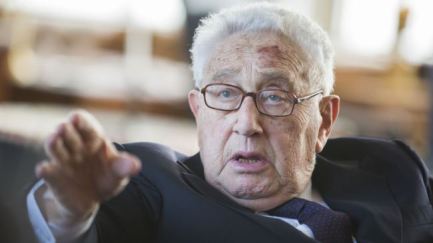
Former US National Security Advisor and Secretary of State Henry Kissinger
By Kevin Barrett | Press TV | September 10, 2014
The anniversary of the September 11th attacks on New York and Washington would be a propitious day to arrest Henry Kissinger for crimes against humanity.
For while Kissinger is guilty of many war crimes, including the slaughter of millions of Vietnamese, it was on September 11th that he committed two of his most memorable outrages: The murder of Chilean President Salvador Allende and installation of the torture-loving Pinochet junta in 1973; and the explosive demolition of the World Trade Center, and massacre of nearly 3,000 people in New York and Washington in 2001.
Kissinger was undeniably the mastermind of the first 9/11. As President Nixon’s National Security Advisor in 1973, and the head of the “40 Committee” that oversaw US covert operations, Kissinger designed the coup that overthrew and murdered Allende. That operation was “Made in USA” and financed with American taxpayers’ money. Kissinger’s operatives paid lavish bribes to corrupt Chilean military officers including Pinochet, essentially hiring them to murder Allende and thousands of other honest, democracy-loving Chileans.
Kissinger’s complicity in the torture and murder of thousands of Chileans, and the destruction of democracy in Chile, is no secret. Kissinger actually confessed his intentions toward Chile on June 20th, 1970 when he famously said, “I don’t see why we need to stand by and watch a country go communist because of the irresponsibility of its own people.” (In fact, Allende was a democratic socialist, not a communist; his sin, in Kissinger’s eyes, was believing that Chile should control its own economy and resources.)
During the past two decades, many countries’ judicial officials have tried to prosecute Kissinger for the first 9/11. In 1998, Kissinger’s Chilean stooge, General Pinochet, was arrested – and spent the rest of his life under real and virtual house arrest, fighting prosecutions for crimes against humanity before he died in 2006.
Prosecutors in Chile, Argentina, Spain and France have subpoenaed Kissinger. Chilean judge Juan Guzman submitted 30 questions to Kissinger about his relationship with Pinochet but Kissinger refused to answer them. At one point Kissinger had to flee France to avoid arrest.
Though at various times he has been a wanted man in various countries, somehow Kissinger is still walking around free…and planning new war crimes. Since the coup of September 11th, 2001, Kissinger has been a leading advocate of the neoconservative plan to destroy “seven countries in five years” as Gen. Wesley Clark revealed.
Though they invaded Iraq and Afghanistan first, and then destabilized Somalia, Sudan, Libya, and Syria – all of which took longer than the planned five years – the neocons’ biggest and most important post-9/11 target has always been Iran. During the past decade Kissinger has been feuding with his fellow mummified ex-National Security Advisor, Zbigniew Brzezinski, about whether the US should attack Iran for Israel. While Brzezinski has been arguing against attacking Iran, Kissinger and his stable of Israel-loving neoconservatives have been beating the drums for war on Tehran.
Kissinger’s anti-Iran extremism was on display Saturday when he told National Public Radio that Iran is a bigger threat than ISIL. What he didn’t say is that by “threat” he meant threat to Israel, not the USA.
Kissinger’s close association with the fanatically pro-Israel, anti-Iran neoconservatives since September 11th, 2001 has surprised some observers, who traditionally viewed the former National Security Advisor as a realist rather than an ideologue.
Why did Kissinger turn neocon? Some speculate that as his mind deteriorates he is rediscovering his tribal roots and experiencing a Zionist second childhood. Evidence supporting this view includes his petulant statement to the New York Post that “In ten years there will be no more Israel.” Apparently Kissinger has fallen victim to the kind of Zionist existential anguish that lies at the root of the radicalism of such neocons as Paul Wolfowitz, Richard Perle, Scooter Libby, Douglas Feith, Dov Zakheim, and others of that ilk.
But there may be another reason for Kissinger’s succumbing to what Gilad Atzmon calls Pre-Traumatic Stress Disorder. That reason, in a nutshell, is Kissinger’s complicity in the neoconservative coup d’état of September 11th, 2001. By helping design the 9/11 shock-and-awe psychological warfare operation, Kissinger appears to have indelibly wedded his own fate to that of the neoconservative September criminals.
How do we know Kissinger was involved in the 9/11-anthrax operation? Because President Bush, acting under orders of Dick Cheney and the 9/11 perpetrator cabal, appointed Kissinger to head the 9/11 Coverup Commission. Only a person with intimate knowledge of what needed to be covered up, as well as a strong grasp on the crumbling “19 hijackers led by a dying man in a cave” cover story, could have been entrusted to head the Commission.
Since Kissinger was a known war criminal, mass murderer, and Machievellian conspirator who had orchestrated at least one September 11th coup d’état, the victims’ family members protested his appointment as Executive Director of the 9/11 Cover-up Commission. Due to public pressure, Bush was forced to fire Kissinger and replace him with another likely planner of the 9/11-anthrax operation, Philip Zelikow.
Unlike Kissinger, Zelikow was a relatively unknown war criminal. The architect of the Bush Doctrine of disguising the supreme crime of aggressive war under the “pre-emptive” euphemism, Zelikow is a self-described expert in “the creation and maintenance of public myths.” One of the likely creators of the 9/11 myth, Zelikow wrote the 9/11 Commission Report in chapter-by-chapter outline in March, 2003, before the Commission had even convened. That early draft, which is virtually identical with the Report’s final draft, was probably based on a Hollywood-style script for the 9/11-anthrax events written by Zelikow, Kissinger and others to serve as a playbook for the covert operatives who perpetrated the attacks.
During and immediately after the 9/11-anthrax false flag operation, Kissinger sat on the Defense Policy Board under key 9/11 suspect Richard “Prince of Darkness” Perle, a leading PNACer who demanded a “New Pearl Harbor” in September 2000 – and got one exactly one year later. As Perle’s senior advisor, Kissinger would have been one of the most significant architects of the 9/11-anthrax operation and subsequent cover-up.
Like Perle, who boasts of his satanic nickname “Prince of Darkness,” Kissinger revels in criminality and evil: “The illegal we do immediately. The unconstitutional takes a little longer.”
9/11-anthrax wasn’t just unconstitutional; it entailed the destruction of the Constitution in an American Reichstag Fire. It took Kissinger and his neoconservative and Israeli allies years to plan; and they have spent the past 13 years covering their tracks by “fleeing forward” into a widening circle of wars.
If the 9/11 wars ever end, and the post-2001 state of emergency is lifted, the September criminals could face prosecution. No wonder Kissinger and his neocon pals are demanding war with Iran and Russia – either one of which could likely escalate into World War III.
To save the planet, we need to arrest Henry Kissinger for his September 11th crimes: those of 2001 as well as 1973.
The American fear-mongering machine is about to scare us back into war again
Thanks to a say-anything media, hawkish politicians and an Orwellian administration, a war-weary public is terrified. Are there any red lines anymore – or just launch buttons?

Photograph: Bixentro / Flickr via Creative Commons
By Trevor Timm | The Guardian | September 10, 2014
Did you know that the US government’s counterterrorism chief Matthew Olson said last week that there’s no “there’s no credible information” that the Islamic State (Isis) is planning an attack on America and that there’s “no indication at this point of a cell of foreign fighters operating in the United States”? Or that, as the Associated Press reported, “The FBI and Homeland Security Department say there are no specific or credible terror threats to the US homeland from the Islamic State militant group”?
Probably not, because as the nation barrels towards yet another war in the Middle East and President Obama prepares to address that nation on the “offensive phase” of his military plan Wednesday night, mainstream media pundits and the usual uber-hawk politicians are busy trying to out-hyperbole each other over the threat Isis poses to Americans. … continue
ISISophobia or “The Mooslims Are Coming”
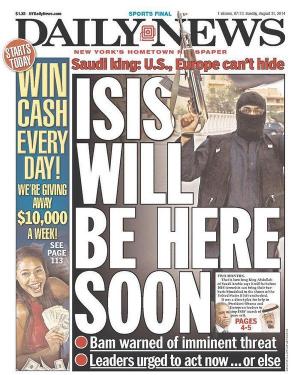
Why would the NY Daily News or any publication believe an anonymous Saudi source concerning any subject?
By Richard Silverstein | Tikun Olam | September 9, 2014
ISIS has become the scare du jour of world politics. While ISIS is a profoundly disturbing phenomenon for which the world should develop some sort of response, the problem is that the Islamist movement has become a useful foil for many varied political interests from Israel to the U.S. Islamophobes among the Euro-nationalist far-right and the U.S. Tea Party have latched onto ISIS as their political gravy train. Bibi Netanyahu, ever alert to memes he can exploit to promote Israel’s interests, made the memorable, and profoundly mendacious statement: “Hamas is ISIS and ISIS is Hamas.” Senator Bill Nelson, who has a huge elderly Jewish constituency and is allied closely with the Israel Lobby, said this today:
“Any group that sets them [sic] up as a religious caliphate and says that they will not stop until the black flag of ISIS is flying over the White House — I take that pretty seriously,” he said.
No ISIS leader has ever made such a statement. But Nelson appears to be watching FoxNews, because it claimed ISIS said so. The fact that a major national political leader would air such nonsense is disturbing. There is enough to hate about ISIS without making things up out of whole cloth.
Then we have the tried and true Wall Street Journal, always good for a bit of Islamophobic hysteria. This is the headline for Ryan Crocker’s op-ed: Islamic State Is Getting Stronger, and It’s Targeting America. The neo-cons are on the warpath demanding that we “eviscerate” ISIS, that we engage in some sort of a counter-jihad. Which is just what both the world and America need, yet another war against Islam in the Mideast.
Similarly, Israeli media have reported that a freed French journalist held hostage by ISIS identified the Belgian museum attacker as an adherent of ISIS. While the journalist, who worked for the right-wing French daily Le Point, did say Mehdi Nemmouche tortured and abused him and others while he was held in custody, he never made any statement about the alleged terrorist’s affiliations. So when Nemmouche left Syria was he affiliated with ISIS? Why did he leave? Had he broken with ISIS? Had ISIS broken with him? And if so, why?
The implication of this Israeli reporting was that the attack which killed two Israeli intelligence agents may’ve been the work of ISIS. In fact, no one knows whether Nemmouche was acting on his own or on behalf of another Islamist group. Any speculation to the contrary is just that.
Open Democracy has published an incisive piece raising uncomfortable similarities between ISIS and Israel’s religion-derived claims of authority and sovereignty.
All this leads to the next logical question: what threat does ISIS really pose to U.S. national interests? If it doesn’t pose such a threat, then what should our response to it be? Does it threaten other interests or values that are important to us? And what will be the outcome of any form of intervention we choose to take? … Full article
Syrian media slams Arab support for new US war in the region
Al-Akhbar | September 9, 2014
Syrian media accused Arab governments Tuesday of giving Washington prior agreement for military action against jihadists, with one daily calling for Damascus to form an alternative alliance with Moscow and Tehran.
The commentary comes ahead of talks in Saudi Arabia on Thursday between Secretary of State John Kerry and US regional allies on joint action to tackle the threat posed by the Islamic State group in both Syria and Iraq.
“Washington, which used the false pretext of weapons of mass destruction to enter the region militarily in 2003 and draw new geopolitical lines… is returning today under a new false pretext, the fight against terrorism,” said the Al-Baath newspaper.
“The Arabs meanwhile, are absent from every decision and are playing secondary roles,” it added.
The Baath party daily was referring to the US-led invasion of Iraq in 2003 in which notoriously the alleged chemical and biological weapons that were used to justify the overthrow of Saddam Hussein’s regime were never found.
Kerry is set to meet foreign ministers from Egypt, Jordan, Iraq, Lebanon, Turkey and the six Gulf Arab states in Saudi Arabia on Thursday.
The talks are part of US efforts to build a coalition to tackle ISIS, which has seized large tracts of territory in both Syria and Iraq, and carried out abuses including the decapitation of Syrians, Iraqis, Lebanese and two American journalists.
On Sunday, the Arab League pledged to take “necessary measures” to confront ISIS, and said it was ready for “international cooperation on all fronts.”
But Syria, and its ally Iran, will not be present at the talks in Saudi Arabia, and Damascus fears efforts to tackle ISIS will involve air strikes on its territory without its permission.
State-run newspaper Al-Thawra warned: “The United States is setting the stage to bring new wars to the region.
“Its local partners are ready to carry out its orders without even knowing the details of the American plan,” it added.
Government daily Tishrin questioned why Kerry and US Defence Secretary Chuck Hagel were coming to the region “when the Arab League has already given its prior agreement for a new war in the region organized by the United States.”
A newspaper called for the formation of an alternative “Russian-Iranian-Syrian coalition” against the jihadists to that being put together by Washington.
“Western and regional governments are excluding the nations that really want to fight terrorism,” it said, charging that the US-led coalition included nations that “support terrorism financially, military and logistically.”
Damascus considers all rebel groups fighting to overthrow President Bashar al-Assad “terrorists” and has long accused the rebels’ supporters, particularly Qatar, Saudi Arabia and Turkey, of funding “terror.”
Similarly, critics opposed to US involvement in the conflict with ISIS have pointed out that Washington in partnership with its Gulf allies, including Saudi Arabia, played a role in the formation and expansion of extremist groups like ISIS by arming, financing and politically empowering armed opposition groups in Syria.
On Monday, a study by the London-based small-arms research organization Conflict Armament Research revealed that ISIS jihadists appear to be using US military issue arms and weapons supplied to the so-called moderate rebels in Syria by Saudi Arabia.
(AFP, Al-Akhbar)
Compare and Contrast: Cluster Bomb Usage in Syria, July 2014 Vs September 2014
Interventions Watch | September 6, 2014
Rick Gladstone, writing in The New York Times, July 30th 2014:
‘Cluster bombs, internationally banned weapons that can maim and destroy indiscriminately, not only have been frequently used for the past two years by government forces in the Syrian civil war . .
. . . According to an assessment by Human Rights Watch, a member of the Cluster Munition Coalition, Syrian government forces used the weapons in at least 224 locations, in 10 of Syria’s 14 governorates, from July 2012 to this March, with new indications that their “use is ongoing.” The assessment is incomplete and based partly on remnants recorded by video, Human Rights Watch said, suggesting the actual use may be even more widespread.
Syria’s government has denied the use of cluster munitions in the conflict, which is now in its fourth year. But Ms. Blakemore said that the insurgents fighting to topple President Bashar al-Assad did not have the capacity to deploy such weapons.’
So then, rebels in Syria simply aren’t able to use cluster bombs. No siree! It’s all the work of the Assad regime.
Rick Gladstone, writing in The New York Times, September 1st 2014:
‘The Islamic State in Iraq and Syria, the extremist militant group now almost universally vilified for atrocities that include boastful beheadings, summary mass executions and enslavement in the areas it aspires to control, also has attacked enemies with cluster bombs, the banned weapons that kill and maim indiscriminately, Human Rights Watch said on Monday.
Stephen Goose, the arms division director of Human Rights Watch, said in a statement that “credible evidence” had emerged that ISIS forces used ground-fired cluster munitions on July 12 and Aug. 14 during fighting with Kurdish militia members in Aleppo Province near the northern Syrian border with Turkey.
“The use of cluster munitions by nonstate actors such as the Islamic State shows the urgent need for Syria and all nations that have not yet done so to join the ban on cluster munitions and destroy their stockpiles,” Human Rights Watch said in the statement’.
No wait! The rebels do have the capacity to deploy cluster bombs after all, and they are deploying them! And they were even when we said they weren’t! Or at least ISIS are!
And how convenient that this new ‘credible evidence’ has come to light just as the U.S. et al are embarking on a long term, overt war in Iraq – and very probably Syria before too long – to be justified by the ISIS ‘threat’.
Featured Video

The Truth About the Trump Shootings with Ken Silva
or go to
Aletho News Archives – Video-Images
From the Archives
Trans ‘milk’ as good as the real thing – NHS
RT | February 18, 2024
The drug-induced nipple secretions of trans women are as good as mothers’ breast milk for babies, the University of Sussex Hospitals NHS Trust claimed in a letter to campaigners made public in a report by British think tank the Policy Exchange on Sunday.
The healthcare trust’s medical director, Rachel James, argued that the off-label prescription drug cocktail men transitioning to female take in order to produce milk was “similar to the natural hormones which encourage lactation to develop when the baby is newly born.”
“The evidence which is available demonstrates that the milk is comparable to that produced following the birth of a baby,” James wrote in the letter, sent to Children of Transitioners last August.
Biological men who wish to lactate must first take hormones to grow milk glands and then take high doses of either domperidone or metoclopramide to stimulate milk production. Neither drug is approved for this use, though they are occasionally prescribed off-label to biological women who have trouble lactating.
However, domperidone’s own manufacturer, Janssen, warns patients the drug “may cause unwanted side effects affecting the heart in a breastfed baby” and “should be used during breastfeeding only if your physician considers this clearly necessary.” … continue
Blog Roll
 Aletho News
- Russia Voted Under Fire. Washington Is Loading the Tankers.
- 12 Things Your Oncologist Was Trained Not to Tell You
- Anthrax Attacks Paved Way for COVID-Era ‘Junk Drugs and Vaccines’
- How Real Is the Impact of Western Sanctions on Israel?
- France, You Are Guilty: How Paris Turned Western Sahara into the Maghreb’s Powder Keg
- 2025 Nature Paper Claiming Worsening Global Drought Gets RETRACTED …Heavily Flawed
- Your Milk Is Not the Problem
- The Truth About the Trump Shootings with Ken Silva
- ARE PATIENTS BEING PROPERLY INFORMED ABOUT OZEMPIC?
- US lawmaker blocks $2.8 billion weapons sale to Israel: Report
- If Americans Knew
- Salah Sarsour’s Legal Team Says DHS Has Not Met Its Burden to Prove He Is Deportable
- An analysis of tax forms by The Intercept show Kraft’s charity and LLC have donated to Friends of the IDF and AIPAC’s super PAC.
- Israeli attacks kill four Palestinians in Gaza – Daily Update
- Inside Gaza’s death trap of collapsing, bombed-out buildings
- The everyday items Israel bans from Gaza every day
- Inside the siege, the ruined buildings of Gaza – Daily Update
- Debunking The Claim That Macklemore Has A “History Of Antisemitism”
- CPJ demands release of arrested Palestinian-US journalist near Bethlehem
- Robert Kraft: The Billionaire Friend of Netanyahu Pulling The Strings Behind the Macklemore/Ed Sheeran Blow Up
- Columbia Administered Fund Gives Big Money to Pro-Israel Groups
- No Tricks Zone
- 2025 Nature Paper Claiming Worsening Global Drought Gets RETRACTED …Heavily Flawed
- New Study: ‘Global Drought Shows No Detectable Recent Acceleration Under Climate Warming’
- Economic Masterminds: German Socialists Suggest Taxing Productivity Gains Stemming From Using AI
- The South China Sea Has Not Been Cooperating With The Climate Change Narrative
- Energy Crisis: Germany Enters Heating Season With Historically Low Gas Reserve Fill Levels
- New Study: The Antarctic Ice Sheet Gained Mass From 2020-2024 Due To Staggering Snow And Ice Accumulation
- Study: Ocean Heating Rates From Thousands Of Years Ago ‘Dwarf’ Modern Ocean Heating Rates
- Climate Extremists Target, Attack Large-Scale Power Grid Infrastructure In Germany!
- New Study: Antarctic Ice Melt Has Contributed Less Than 1 Centimeter To Sea Level Rise In The Last 30 Years
- Fear Of Debate: Alarmist German Climate Scientist Calls On Mainstream Media To Discredit Skeptic Voices
 Aletho News