Three years ago this month, I wrote a piece entitled “Who’s to Blame for the Iraq War?” to mark the seventh anniversary of the US invasion. My sole purpose in compiling a by-no-means-exhaustive list of 20 Israel partisans who played key roles in inducing America into making that disastrous strategic blunder was to help dispel the widespread confusion — some of it sown under the guise of “progressive investigative journalism” by likely crypto-Zionists – about why the United States made that fateful decision. As the tenth anniversary approaches, there is no excuse for anyone genuinely interested in the facts to deny the ultimate responsibility of Tel Aviv and its foreign agents for the quagmire in Iraq. Nevertheless, it’s an appropriate time to remind ourselves of some of the chief architects of the devastating Iraq War.
1. Ahmed Chalabi, the source of much of the false “intelligence” about Iraqi WMD, was introduced to his biggest boosters Richard Perle and Paul Wolfowitz by their mentor, a University of Chicago professor who had known the Iraqi con man since the 1960s. An influential Cold War hawk, Albert Wohlstetter fittinglyhas an American Enterprise Institute (AEI) conference centre named in his honor.
2. In 1982, Oded Yinon’s seminal article, “A Strategy for Israel in the 1980s” was published in Kivunim, a Hebrew-language journal affiliated with the World Zionist Organization. “Iraq, rich in oil on the one hand and internally torn on the other, is guaranteed as a candidate for Israel’s targets,” advised Yinon. “Its dissolution is even more important for us than that of Syria. Iraq is stronger than Syria. In the short run it is Iraqi power which constitutes the greatest threat to Israel.”
3. “A Clean Break: A New Strategy for Securing the Realm,” a report prepared for Israeli Prime Minister Benjamin Netanyahu in 1996, recommended “removing Saddam Hussein from power in Iraq—an important Israeli strategic objective in its own right.” Richard Perle, chairman of the Pentagon’s Defense Policy Board during the initial years of the George W. Bush administration, was the study group leader.
4, 5. A November 1997 Weekly Standard editorial entitled “Saddam Must Go” opined: “We know it seems unthinkable to propose another ground attack to take Baghdad. But it’s time to start thinking the unthinkable.” The following year, the Project for the New American Century (PNAC), an influential neoconservative group, published a letter to President Clinton urging war against Iraq and the removal of Saddam Hussein on the pretext that he was a “hazard” to “a significant portion of the world’s supply of oil.” PNAC co-founders William Kristol and Robert Kagan also co-authored the “Saddam Must Go” editorial.
6. In Tyranny’s Ally: America’s Failure to Defeat Saddam Hussein, published by AEI Press in 1999, David Wurmser argued that President Clinton’s policies in Iraq were failing to contain the country and proposed that the US use its military to redraw the map of the Middle East. He would go on to serve as Mideast adviser to Vice President Dick Cheney from 2003 to mid-2007.
7. On September 15, 2001 at Camp David, Deputy Defense Secretary Paul Wolfowitz attempted to justify a US attack on Iraq rather than Afghanistan because it was “doable.” In the lead-up to the war, he assured Americans that it was “wildly off the mark” to think hundreds of thousands of troops would be needed to pacify a postwar Iraq; that the Iraqis “are going to welcome us as liberators”; and that “it is just wrong” to assume that the United States would have to fund the Iraq war.
8. On September 23, 2001, Senator Joe Lieberman, who had pushed for the Iraq Liberation Act of 1998, told NBC’s “Meet the Press” that there was evidence that “suggests Saddam Hussein may have had contact with bin Laden and the al-Qaeda network, perhaps [was] even involved in the September 11 attack.”
9. A November 12, 2001 New York Times editorial called an alleged meeting between Mohammed Atta and an Iraqi agent in Prague an “undisputed fact.” Celebrated for his linguistic prowess, columnist William Safire was egregiously sloppy in his use of language here.
10. A November 20, 2001 Wall Street Journal op-ed argued that the US should continue to target regimes that sponsor terrorism, claiming, “Iraq is the obvious candidate, having not only helped al Qaeda, but attacked Americans directly (including an assassination attempt against the first President Bush) and developed weapons of mass destruction.” The professor of strategic studies at the Nitze School of Advanced International Studies, Johns Hopkins University who made these spurious claims was Eliot Cohen.
11. George W. Bush’s January 2002 State of the Union address infamously described Iraq as part of an “axis of evil.” It was David Frum, Bush’s Canadian-born speechwriter, who coined the provocative phrase.
12. In a February 2002 article entitled “How to win World War IV,” Norman Podhoretz, the longtime editor of Commentary magazine, asserted: “Yet whether or not Iraq becomes the second front in the war against terrorism, one thing is certain: there can be no victory in this war if it ends with Saddam Hussein still in power.”
13. Kenneth Adelman, Defense Policy Board member and PNAC signatory, predicted in a February 13, 2002 Washington Post op-ed: “I believe that demolishing Hussein’s military power and liberating Iraq would be a cakewalk.”
14. On August 3, 2002, Charles Krauthammer, the psychiatrist-turned-Washington Post columnist, enticed Americans with this illusory carrot: “If we win the war, we are in control of Iraq, it is the single largest source of oil in the world…. We will have a bonanza, a financial one, at the other end, if the war is successful.”
15. In a September 20, 2002 Wall Street Journal op-ed entitled “The Case for Toppling Saddam,” current Israeli Prime Minister Benjamin Netanyahu warned that Saddam Hussein could be hiding nuclear material “in centrifuges the size of washing machines” throughout the country.
16. “Why would Iraq attack America or use nuclear weapons against us? I’ll tell you what I think the real threat (is) and actually has been since 1990—it’s the threat against Israel.” Despite this candid admission to a foreign policy conference at the University of Virginia on September 10, 2002, Philip Zelikow, a member of President Bush’s Foreign Intelligence Advisory Board, authored the National Security Strategy of September 2002 that provided the justification for a preemptive war against Iraq.
17. According to a December 7, 2002 New York Times article, the role of convicted Iran-Contra conspirator Elliott Abrams during Colin Powell’s efforts to negotiate a resolution on Iraq at the United Nations was “to make sure that Secretary Powell did not make too many concessions to the Europeans on the resolution’s wording, pressing a hard-line view.” Abrams was senior director of Near East and North African affairs at the National Security Council during the George W. Bush administration.
18. Lewis “Scooter” Libby, who was Vice President Cheney’s chief of staff until he was indicted for lying to federal investigators in the Valerie Plame case, helped draft Colin Powell’s fraudulent February 5, 2003 UN speech.
19. According to Julian Borger’s July 17, 2003 Guardian article entitled “The spies who pushed for war,” the Pentagon’s Office of Special Plans (OSP) “forged close ties to a parallel, ad hoc intelligence operation inside Ariel Sharon’s office in Israel” to provide the Bush administration with alarmist reports on Saddam’s Iraq. Douglas Feith was the Under Secretary of Defense for Policy who headed the OSP.
20. Bernard Lewis, a British-born professor emeritus of Near Eastern Studies at Princeton University whose 1990 essay “The Roots of Muslim Rage” introduced the dubious concept of a “Clash of Civilizations,” has been called “perhaps the most significant intellectual influence behind the invasion of Iraq.”
Maidhc Ó Cathailis an investigative journalist and Middle East analyst. He is also the creator and editor of The Passionate Attachment blog, which focuses primarily on the U.S.-Israeli relationship.
Efforts to determine the health and environmental risks of depleted uranium (DU) weaponry in Iraq have been hampered by the Obama administration. DU, which makes shell and bullet casings harder and more capable of piercing armor, can contaminate the environment and contribute to health problems, including cancer and birth defects.
The Dutch peace group IKV Pax Christi complained in a new report that “Coalition Forces” (read: the United States) have refused to provide information on when and where invading forces fired DU weaponry.
Due to a “lack of transparency” by the U.S., “there is an absence of crucial information on firing coordinates, the quantities and types of DU munitions used; data gaps relating to the efforts undertaken to clean up contaminated sites and material are hindering efforts to assess risks and implement remediation work,” the report reads.
There are reportedly more than 300 sites in Iraq that were contaminated by DU weapons, many of them located in populated areas.
It is estimated that 400 tons of DU ammunition were fired in Iraq, mostly by American units, during the Gulf War and the 2003 invasion. Although the United States continues to use depleted uranium munitions, the report notes that “over the last couple of years the US Army has invested in research into replacing DU rounds in the A-10 with tungsten alloy based munitions, as well as non-DU 105 and 120mm munitions for the M1A2 Abrams tank, referring in their rationale for this move to DU’s potential environmental impact.”
Thanks to the efforts of the indefatigable James Morris, a seeming transformation of the view of the illustrious Noam Chomsky was revealed, which, if not equivalent to the change that Saul of Tarsus underwent while on the road to Damascus, was significant nonetheless. Morris seems to have a knack for ferreting out the unknown views of the famous, as was illustrated in his 2010 email exchange with General David Petraeus, then head of U.S. Central Command, in which he was able to reveal the latter’s close relationship with neocon Max Boot and his ardent desire to propitiate the pro-Zionist Jewish community at a time when it was generally thought that Petraeus was critical of the negative effects of the intimate U.S.-Israeli relationship on America’s position in the Middle East.
The Chomsky revelation took place while the latter was a guest on Phil Tourney’s “Your Voice Counts” program on Republic Broadcasting Network from 2:00 pm to 3:00pm Eastern Standard Time on Sunday, February 24, 2013. While Chomsky is a strong and very knowledgeable critic of Israel, he also has been (at least, was before this program) a stringent critic of the idea that the neocons have any significant impact on American Middle East policy. Rather, he presents a somewhat nebulous, quasi-monolithic, corporate elite, which includes the oil interests, as determining American policy in that region—as it does everywhere else in the globe—for its own economic interests. In what has been Chomsky’s view, Israel only serves as an instrument for American imperialism; that it too might benefit from American policies is, presumably, only an incidental by-product.
Chomsky was quite impressive on the program as he demonstrated extensive knowledge of the USS Liberty issue, which is a major issue of the program, since Tourney was a seaman on that ill-fated ship that was deliberately attacked by Israeli planes and gunboats during the Six Day War in June 1967, causing the deaths of 34 U.S. seamen and wounding 171 others out of a crew of 297.
Chomsky included an injection of his standard theme that Israel became a valuable strategic asset to the United States with the 1967 war when it wrecked Nasser and secular Arab nationalism in general, thus aiding America’s conservative client states, such as Saudi Arabia.
Listener phone calls were restricted to the last 15 minutes. Consequently, James Morris wasn’t able to get on the program until the last five minutes when he tried to get Chomsky to address the issue of the connection between the neocons and Israel. Morris cited then-Secretary of State Powell’s reference to the “JINSA crowd” (Jewish Institute for National Security Affairs) as the primary force for the war on Iraq within the Bush Administration. Morris went on to say that the neocons were a leading element of the Israel lobby.
After Morris made these statements, Chomsky amazingly blurted out that he “agreed completely” with him regarding the importance of the neocons—describing the neocons as “tremendously important.” Chomsky acknowledged that the neoconservatives had been the “dominant force” in the Bush administration, and that they had “pushed through” the Iraq war over many objections even from within the government. What Chomsky had said about the importance of the neocons was radically different from his usual portrayal of a monolithic corporatist dominance of U.S. Middle East policy. Chomsky even seemed to agree that the neocons held positions that diverged from those of the traditional foreign policy establishment—Morris had earlier mentioned Scowcroft and Brzezinski as opponents of the neocons.
What Chomsky said pertaining to the neocons being the leading force for the Iraq war is essentially identical to my position in “The Transparent Cabal.” And it is not only the opposite of what it appeared that he used to hold but what his protégé Norman Finkelstein continues to expound, as I discuss in my article, “Norman Finkelstein and Neocon Denial.”
Finkelstein denies that the neocons were a factor in causing the U.S. to go to war—and has nothing to do with my book, describing it as conspiracist—but he does not seem to realize that his position contrasts with that of his mentor. Since the two are quite close, it would seem that Chomsky has not even expressed this new view to Finkelstein in private conversation. When Finkelstein finds out that his mentor holds that the neocons were the “dominant force” for war with Iraq, one wonders if he will then charge him with believing in a conspiracy.
Unfortunately, however, Chomsky still stops far short of the full truth. For in his response to Morris, he went on to maintain that the neocons are different from the Israel lobby—definitely implying, though not explicitly stating, that the neocons are not motivated by the interests of Israel. He quickly put forth two arguments for this contention. First, he claimed that the neocons are simply a mainstream force in American conservatism going back to the Reagan administration. Even if true, this would not necessarily preclude their being biased in favor of Israel. However, it is not true—the neocons did not just fit into existing mainstream conservatism, but altered it to fit their own goals.
As I bring out in “The Transparent Cabal” (with numerous citations from secondary sources, this being a rather conventional view), the neocon movement originated among liberal Democrats, mainly Jewish, who gravitated to the right in the late 1960s and early 1970s. In significant part, this reflected a concern that American liberalism was moving leftward in ways detrimental to Jewish interests. In foreign policy, this involved diminished support by American liberals for Israel—in line with the world left’s support for Third World movements that included the Palestinians—and the liberals’ turn against an anti-Communist foreign policy, as a reaction to the Vietnam imbroglio, at a time when the Soviet Union’s policies were exhibiting discrimination against Soviet Jewry and opposition to Israel in support of its Arab enemies. In opposing what they saw as liberalism’s move to the left, these proto-neoconservatives did not see themselves as becoming conservative, but were dubbed with the moniker “neoconservative” by left-wing social critic Michael Harrington, who intended it as a pejorative term, and the name soon stuck.
Neoconservatives basically wanted to return mainstream American liberalism to the anti-Communist Cold War positions exemplified by President Harry Truman (1945–1953), which had held sway through the administration of Lyndon B. Johnson (1963–1969). When this effort failed to achieve success, neocons would turn to Ronald Reagan in the 1980. Despite being newcomers to the conservative camp, neoconservatives were able to find significant places in the Reagan administration, especially in the national security and foreign policy areas, although at less than Cabinet-level status.
Neoconservatives, however, did not become traditional conservatives, but instead altered the content of conservatism to their liking. “The neoconservative impulse,” pro-neocon Murray Friedman maintains in his book “The Neoconservative Revolution,” “was the spontaneous response of a group of liberal intellectuals, mainly Jewish, who sought to shape a perspective of their own while standing apart from more traditional forms of conservatism.”[Quoted in “Transparent Cabal,” pp. 39-40]
In domestic policy, neoconservatives supported the modern welfare state, in contrast to the traditional conservatives, who emphasized small government, states’ rights, and relatively unfettered capitalism. Most importantly, they differed significantly from the conservative position on foreign policy. Although the American conservatives of the Cold War era were anti-Communist and pro-military, they harbored a strain of isolationism. Their interventionism was limited largely to fighting Communism, but not to nation-building and the export of democracy, the expressed goals of the neocons. Nor did traditional conservatives view the United States as the policeman of the world. Most significantly, traditional conservatives had never championed Israel.
While traditional conservatives welcomed neoconservatives as allies in their fight against Soviet Communism and domestic liberalism, the neocons in effect acted as a Trojan Horse within conservatism: they managed to secure dominant positions in the conservative political and intellectual movement, and as soon as they gained power, they purged those traditional conservatives who opposed their agenda, particularly as it involved Israel. Support for Israel and its policies had become, and remains, a veritable litmus test for being a member of the multitudinous political action groups and think tanks that comprise the conservative movement.
In his 1996 book, “The Essential Neoconservative Reader,” editor Mark Gerson, a neocon himself who served on the board of directors of the Project for the New American Century, jubilantly observed: “The neoconservatives have so changed conservatism that what we now identify as conservatism is largely what was once neoconservatism. And in so doing, they have defined the way that vast numbers of Americans view their economy, their polity, and their society.” [Quoted in “Transparent Cabal”, p. 42]
While in domestic policy Gerson’s analysis might not be completely accurate, it would seem to be so in US national security policy, as illustrated by the near unanimous Republican opposition in the US Senate to the nomination of Chuck Hagel as Secretary of Defense because of his past statements critical of both US all-out support for Israel and its hardline position toward Iran (currently Israel’s foremost enemy) that might lead to war.
Now the fact that Cheney and Rumsfeld may not be motivated by a desire to aid Israel in their support for neocon Middle East policy, the Middle East policies they have supported have been formulated by those who identify with Israel. Since both of them have been closely associated with the neocons, Cheney more so than Rumsfeld, they were undoubtedly influenced by the pro-Israel neocons. Cheney even went so far as to serve on JINSA’s Advisory Board. And JINSA was set up in 1976 to put “the U.S.-Israel strategic relationship first.”
Moreover, as Vice President, Cheney specifically relied on advice from the eminent historian of the Middle East, Bernard Lewis, a right-wing Zionist and one of the neocons’ foremost gurus, who strongly advocated war against Iraq and other Middle Eastern states. (Barton Gellman, “Angler: The Cheney Vice Presidency,” p. 231) Chomsky has said that “Bernard Lewis is nothing but a vile propagandist,” and he presumably means a propagandist for Israel.
The influence of ideas per se was not the only factor that likely motivated Cheney. The fact that Cheney and his wife, Lynne, who was with the American Enterprise Institute (AEI—known as “neocon central”), had close personal and professional relations with the neocons also would have predisposed him to give his support to the neoconservatives and their agenda.
The same arguments would apply for Rumsfeld, with one additional one: a war on Iraq would give him the chance to demonstrate the value of his concept of a smaller, mobile, high tech American military. Rumsfeld held that a small, streamlined invasion force would be sufficient to defeat Iraq. As Bob Woodward writes in his book, “State of Denial”: “The Iraq war plan was the chess board on which Rumsfeld would test, develop, expand and modify his ideas about military transformation. And the driving concept was ‘less is more’ – new thinking about a lighter, swifter, smaller force that could do the job better. Rumsfeld’s blitzkrieg would vindicate his leadership of the Pentagon.”[“State of Denial,” p. 82]
For the neocons, Rumsfeld’s approach would not have the drawbacks of the conventional full-scale invasion initially sought by the military brass. The neocons feared that no neighboring country would provide the necessary bases from which to launch such a massive conventional attack, or that during the lengthy time period needed to assemble a large force, diplomacy might avert war or that peace forces in the U.S. might increase their size and political clout and do likewise. In short, it was this convergence on interests between the Rumsfeld and the neocons that made them so supportive of each other in the early years of the George W. Bush administration.
It must be acknowledged that the neocon Middle East war agenda did resonate with both Cheney’s and Rumsfeld’s general positions on national security policy, but there is little reason to think that they would have come up with the specifics of the policy, including even the identification of Iraq as the target, if it had not been for their neocon associates, whose policy reflected their close identification with Israel. It should also be pointed out that in Chomsky’s usual presentation of an American foreign policy shaped by the corporate elite, the actual government officials who implemented the policy were not necessarily members of the corporate elite nor motivated by a desire to advance the interests of the corporate elite as opposed to the national interest of the United States. In order for any type of elite to be successful, it is essential that it attract significant numbers of people outside of itself, which Chomsky himself has discussed at length regarding the corporate elite. This is also the very purpose of the neoconservative network and the information that it disseminates.
Acknowledging as much as he did, it is hard to see how Chomsky can fail to discern that the neocons identify with Israel. The evidence is overwhelming. The following are a few examples of this connection.
The effort to prevent Chuck Hagel from becoming the Secretary of Defense has been spearheaded by the Emergency Committee for Israel, the creation of which in 2010 was in large part the work of leading neocon, Bill Kristol, and which claims “to provide citizens with the facts they need to be sure that their public officials are supporting a strong U.S.-Israel relationship.” As Bill Kristol states: “We’re the pro-Israel wing of the pro-Israel community.” Kristol had co-founded the Project for the New American Century (PNAC), which promoted the war on Iraq. Kristol’s father, the late Irving Kristol, a godfather of neoconservatism, is noted for his identification with Israel. In 1973, he said: “Jews don’t like big military budgets. But it is now an interest of the Jews to have a large and powerful military establishment in the United States . . . American Jews who care about the survival of the state of Israel have to say, no, we don’t want to cut the military budget, it is important to keep that military budget big, so that we can defend Israel.” [Congress Bi-Weekly (1973), published by the American Jewish Congress]
Noah Pollak, a contributor to “Commentary” magazine, is the Emergency Committee’s executive director and, while living in Israel for two years, was an assistant editor at the Jerusalem-based Shalem Center.
Eliot Cohen, a veteran neocon, was a founding signatory of the Project for the New American Century and advised the Committee for the Liberation of Iraq. He coined the term “World War IV” for the war on terror. During the George Bush administration, he served on the Defense Policy Board in Bush’s first term and was closely affiliated with those neocons around Vice President Cheney. He is on the International Academic Advisory Board of the Began Sadat Center for Strategic Studies in Israel, which is affiliated with Bar Ilan University, and is involved in contract work for the Israeli government.
Douglas Feith, who as the Under Secretary of Defense for Policy in George W. Bush’s first term set up and controlled the Office of Special Plans, which spread the most specious war propaganda, was closely associated with the right-wing Zionist group, the Zionist Organization of America. In 1997, he co-founded One Jerusalem, a group whose objective was “saving a united Jerusalem as the undivided capital of Israel.” Before entering the Bush administration, Feith ran a small Washington-based law firm, which had one international office – in Israel. And the majority of the firm’s work consisted of representing Israeli interests.
Richard Perle has had very close personal connections with Israeli government officials, and has been accused of providing classified information to that country on a number of occasions. Perle not only expounded pro-Zionist views, but was a board member of the pro-Likud “Jerusalem Post” and had worked as a lobbyist for the Israeli weapons manufacturer Soltam.
Norman Podhoretz is considered a godfather, along with Irving Kristol, of the neoconservative movement. When editor of “Commentary” magazine, he wrote that “the formative question for his politics would heretofore be, ‘Is it good for the Jews?’” (“Commentary,” February 1972) In 2007, Podhoretz received the Guardian of Zion Award, which is given to individuals for their support for Israel, from Bar-Ilan University in Israel. Neocon Charles Krauthammer was the 2002 winner of the Guardian of Zion Award.
Max Singer, co-founder of the neocon Hudson Institute and its former president, who pushed for the war on Iraq, has moved to Israel, where he is a citizen and has been involved with the Institute for Zionist Strategies, which advocates the need to better infuse Zionist ideology in the Jewish people of Israel.
The neocons’ support for Israel does not necessarily mean that they were deliberately promoting the interest of Israel at the expense of the United States. Instead, as I point out in “The Transparent Cabal,” they maintained that an identity of interests existed between the two countries – Israel’s enemies being ipso facto America’s enemies. However, it is apparent from their backgrounds that the neoconservatives viewed American foreign policy in the Middle East through the lens of Israeli interest, as Israeli interest was perceived by the Likudniks.
Despite this professed view of the identity of American and Israel interests, sometimes the neocons’ actions verged on putting Israel interests above those of the United States government. For example, some leading neocons—David Wurmser, Richard Perle, and Douglas Feith—developed the “Clean Break” proposal outlining an aggressive policy for Israel intended to enhance its geostrategic position, which they presented in 1996 to then-incoming Prime Minister Benjamin Netanyahu. One part of the plan was to get the United States to disassociate itself from peace negotiations between Israel and Palestine and simply let Israel treat the Palestinians as it saw fit. “Israel,” stated the report, “can manage it’s own affairs. Such self-reliance will grant Israel greater freedom of action and remove a significant lever of [US] pressure used against it in the past.” It was highly noteworthy that the neocons would devise a strategy to enable Israel to become free from adhering to the goals of their own country. [“Transparent Cabal,” p. 93]
In conclusion, while Chomsky’s change was far from being complete, his acknowledgement that the neoconservatives were the “dominant force” in driving the U.S. to the war on Iraq in 2003 is, nonetheless, very significant. Chomsky, who was voted the “world’s top public intellectual” in a 2005 poll, certainly influences many people, most particularly on the anti-war left, and his new view should make them rethink their belief that the war was all about oil. It is to be hoped that Chomsky’s words were not a one-time aberration and that he will not revert to his previous publicly-espoused position. Rather, it is to be hoped that he will now look more deeply into the neocons’ activities and thus discern their close connection to Israel.
Stephen J. Sniegoski is the author of The Transparent Cabal: The Neoconservative Agenda, War in the Middle East, and the National Interest of Israel.
The US military used veterans of its “dirty wars” in Latin America to set up secret detention and torture centers in Iraq and overseeing ‘some of the worst acts of torture’ during the US-led invasion of the country, a British daily reports.
Sectarian commando units, operating under direct supervision of American Special Forces veterans, who were involved in the so-called US counter-insurgency efforts against opponents of some of the most brutal Washington-backed dictatorships in Central America, “conducted some of the worst acts of torture during the US occupation and accelerated the country’s descent into full-scale civil war,” The Guardian reports Thursday.
The principal US commanders of its detention and torture operations in Iraq, according to the report, were Colonel James Steel, who directly reported to then Defense Secretary Donald Rumsfeld, and a retired colonel named James Coffman, who reported directly to General David Petraeus who later became the top American commander in Iraq and Afghanistan before his rise to directorship of the CIA spy agency.
Petraeus later resigned from his latest post after admitting to maintaining an extramarital affair with his biographer since he was a top US military commander.
The network of detention and torture centers in Iraq were funded “with millions of dollars of US funding,” the report insists.
“Coffman reported to Petraeus and described himself in an interview with the US military newspaper Star and Stripes as Petraeus’s ‘eyes and ears out on the ground’ in Iraq,” according to the daily.
“They worked hand in hand,” said Iraqi General Muntadher al-Samari, quoted in the report, which adds that he worked with Steele and Coffman for a year while the detention and torture centers were being set up.
“I never saw them apart in the 40 or 50 times I saw them inside the detention centers. They knew everything that was going on there … the torture, the most horrible kinds of torture,” General al-Samari added.
The daily says its probe of the US-sponsored detention and torture operations was triggered with the publication of classified US military logs by whistleblower group WikiLeaks, detailing “hundreds of incidents where US soldiers came across tortured detainees in a network of detention centers” run by US-funded sectarian commandos throughout Iraq.
The report further cites American and Iraqi sources as confirming that top US military commanders and officials, including Petraeus, were fully aware of the highly abusive detention and torture operations during the destructive US-led war in Iraq.
A public inquiry into allegations that British soldiers in Iraq murdered 20 unarmed prisoners and tortured 5 others has begun in London, with further legal arguments expected to slow the inquiry in the deaths of the Iraqi men nine years ago.
The Al-Sweady inquiry will examine claims that Iraqi prisoners were tortured by British soldiers following the Battle of Danny Boy in Maysan province, southern Iraq in the summer of 2004.
Evidence has also come to light that several of the corpses suffered severe mutilation. Iraqi death certificates recorded that one man had allegedly had his penis removed while another two bodies were missing eyes.
Several of the corpses were also said to have signs of torture when they were handed back to their families by British personnel at Camp Abu Naji.
However, there is major dispute between the British Ministry of Defense (MoD) and the families of the dead Iraqi men over the way in which the deaths occurred.
“The Iraqi witnesses say that the evidence points to there having been a number of Iraqi men having been taken into camp Abu Naji alive by the British military on 14th May, and who were handed back to their families dead the next day,” said Jonathan Acton Davis QC, counsel to the inquiry.
“The military say the evidence points to 20 Iraqi dead having been recovered from the battle and handed back to their families the next day,” he added, continuing that the two sides couldn’t even agree about the number of those killed or captured, or their identities.
On May 14th 2004, the troops embroiled in the allegations were involved in a fierce battle known as Danny Boy, the name of a permanent vehicle check point, which was on route six in Iraq.
A group of insurgents launched an attack against vehicles of the Argyll and Sutherland Highlanders. It soon developed into a fierce firefight, which also involved soldiers from the Princess of Wales Royal Regiment, with many Iraqis shot dead and two British soldiers being wounded.
The Iraqi dead would normally have been left on the battlefield but British soldiers were allegedly told to try and identify an insurgent thought to be involved in the murder of 6 British soldiers a year earlier in 2003.
One of the first jobs of the inquiry is to try and establish whether the 20 Iraqis were killed in battle as the MoD claims or if in fact they were captured alive and then unlawfully killed.
The inquiry will also try to determine if five men taken prisoner following the battle of Danny Boy were mistreated at a second British base in Shaibah, near Basara, between 14 May and 23 September 2004.
The al-Sweady inquiry as it is known is named after Hamid al-Sweady, a 19 year old alleged victim.
The inquiry was set up after former prisoners and relatives of the dead men took their case to the High Court in London in February 2008. They are entitled to an independent inquiry because the UK is a signatory of the European convention on human rights.
But even as the enquiry opened on Monday, there were signs of legal disagreements to come. Lawyers for the relatives of the dead Iraqis are saying that its terms of reference are too narrow, while the MoD is arguing that it should be limited to allegations of mistreatment that were already decided in previous High Court rulings.
This is potentially the most embarrassing inquiry since the killing of 26-year-old Iraqi citizen Baha Mousa while in British custody in Basara in 2003. He was severely beaten on suspicion of being an insurgent. The Ministry of Defense never accepted any liability for Mousa’s death.
According to Christpher Stanley of the UK-based Rights Watch group, “today [the MoD] is trying to manage it and put a cap on it. These are people getting away with grave human rights violations – including killing – without punishment or due process of law. “
So far the MoD has not come out well in the proceedings. The inquiry was ordered by then defense secretary Bob Ainsworth, after high court judges found that the MoD had made “serious breaches” of its duty.
Furthermore, British Foreign Minister William Hague has written a private memo to other ministers on March 1, urging them not to discuss Iraq and its legality in the run-up to the tenth anniversary of the NATO-led invasion.
Investigators have faced problems trying to access MoD documents concerning events covering the battle of Danny Boy and at Camp Abu Naj.
In 2010 investigators found in files of the Royal Military Police a number of relevant papers which had been entirely absent from evidence disclosed by the MoD in previous court proceedings. While another 9 files were handed over by the MoD in 2011, a six week search by investigators of MoD archives found 600 documents that were relevant to the case.
Last week the inquiry was still waiting to receive emails from the MoD about a visit to the Shaibah base by the International Committee of the Red Cross (ICRC).
The inquiry has already cost the taxpayer £15 million and that is expected to double. Up to 200 military witnesses will be called and 45 Iraqis will give evidence through a video link from Beirut.
Why is it, just when you think the British Government can sink no lower and visit no more embarrassment and shame upon the country they are supposedly there to represent, that within a week or less one of the Ministers will open his mouth or put pen to paper and demonstrate just how arrogant and useless they are? Arrogant because they believe that whatever they say will be accepted as the final word on the subject; useless because they apparently can’t foresee how their statements will be received.
Foreign Secretary William Hague, who makes a career of talking down to people, has excelled himself. According to the Guardian, with the 10-year anniversary of the invasion of Iraq approaching, he has written to all his fellow Ministers and asked them not to discuss the case for, or the legality of, the Iraq war.
According to a source close to Hague: ‘The foreign secretary has written to colleagues to remind them that the agreed position of the coalition government is not to comment on the case or justification for the war until Chilcot has reported. This is about allowing the inquiry to reach its conclusion, not having the government prejudge them.’ Has Hague forgotten why the long-awaited Chilcot Inquiry cannot deliver its report?
In November 2011 we were told that the report would be delayed until the summer of 2012 because Whitehall departments were continuing to block the disclosure of documents about the circumstances surrounding the invasion of Iraq. Chilcot’s panel, having read all these classified documents, knew how important it is that they are made public. And unless they are, it is very difficult for them to produce an accurate, evidence-based judgment on why this country invaded Iraq, and the lessons that need to be learned from this disastrous error of judgment.
In July 2012 we were told the report had been delayed again, when we learned that the Inquiry panel were ‘deeply frustrated by Whitehall’s refusal to release papers, including those that reveal which ministers, legal advisers and officials were excluded from discussions on military action. The papers still kept secret include those relating to MI6 and the government’s electronic eavesdropping centre, GCHQ’. Chilcot’s letter to David Cameron referred to the ‘sharp exchanges’ with the former cabinet secretary Gus O’Donnell over disclosing details ‘of correspondence and conversations between Blair and Bush….which would illuminate Mr Blair’s position at critical points in the runup to war.’
In late 2012 there was news of a further delay as the issue about disclosing the documents was still being fought over by the Inquiry and the Cabinet Office. Publication is now postponed until late 2013 or even sometime in 2014. It is not as if the interested public, with good reason, doesn’t already have a pretty accurate idea of what those documents contain. And it is clear from much of the evidence given to the Chilcot Inquiry how deals were made, legal advice ignored and vital people were kept out of the discussions. It was certainly clear to Chilcot and his panel; they had to recall several people, Tony Blair among them, as much of their previous evidence had been rubbished by other witnesses. And how about this for two-handed dealing? Gus O’Donnell, the cabinet secretary, told the inquiry that the cabinet should have been told of the Attorney General’s doubts about the legality of invading Iraq before Blair went to war. Sir Gus, before he retired, was the one blocking the much sought after publication of the classified documents. Diss Blair with one hand and protect with the other.
Hague wants to block all meaningful discussion on the justifications and the ‘legal’ basis for invading Iraq until Chilcot has delivered his report, while at the same time the Government, including Hague’s own Ministry, are busy blocking the very action Chilcot needs from them in order to finalise his report. But Hague goes further. His letter to the cabinet made clear that ‘not prejudging Chilcot should not prevent [ministers] acknowledging the sacrifices of the armed forces’. However, an honest confronting of the illegality of the invasion would necessarily have to acknowledge that the armed forces did not die in defence of this country but were sacrificed on the altar of Blair’s delusional ambitions.
Why should the Conservatives support Hague’s letter? Because to a man – and occasional woman, as the Conservatives, looking at their record, also support gender inequality – they voted to go to war. Labour can comfort itself in a small way with the thought that some Labour MPs disobeyed their Prime Minister and voted against the invasion. But most of them will keep their heads down. And the LibDems? They have suddenly discovered their principles again after recently having one MP found guilty of perverting the course of justice and facing prison, and their former chief executive accused of sexual harassment while Nick Clegg, our deputy Prime Minister prevaricated about knowing of the abuse. So Hague’s letter has allowed Clegg to climb back on his rather small soapbox to deliver a speech sometime before the anniversary. For the LibDems were in theory all against the invasion – until we invaded and then, of course, they had to ‘support our brave troops’ and the sacrifices ‘our boys’ were making etc. So William Hague can rest easy; very few of those in Parliament really want to discuss the war. It brings up too much embarrassment. It is too much of a reminder that they were and are a very active part of Perfidious Albion.
Despite what all the media are yammering at you, despite all the fear mongering about Iran’s “nuclear threat” (Iran has been fully verified by the IAEA and ALL the U.S. intelligence community agree and are on record that Iran is not pursuing nuclear weapons), despite talk that Iran is intolerant, despite the daily barrage of bad press and unpleasant innuendo, Iran is a great country, friendly, cultured, fun and spiritually-minded!
The “Powers That Were” are dead set on taking us to war against Iran, but “They lied about Vietnam… Iraq… Afghanistan…” and “Iran Is NOT Our Enemy ! “
TEHRAN – The Iraqi foreign ministry in a statement underlined the importance of bilateral relations with Iran for the country, and announced that Baghdad will not impose the US-sponsored sanctions against Tehran.
Iraq opposed Washington’s request to comply with the US-led sanctions imposed against Iran over its nuclear energy program.
“Our relations with Iran are more important than all other issues or benefits,” the Iraqi Foreign Ministry said in a statement on Wednesday.
Referring to the meetings held between the Iraqi government and US Undersecretary for Terrorism and Financial Intelligence David Cohen, the statement said that the two sides had not reached any agreements on enforcing sanctions against Iran.
The Iraqi Foreign Ministry added that Baghdad has requested an exemption from the US-led sanctions imposed against Iran.
“Our economic relations with Iran will continue and are not in conflict with international resolutions,” an Iraqi official said. … Full article
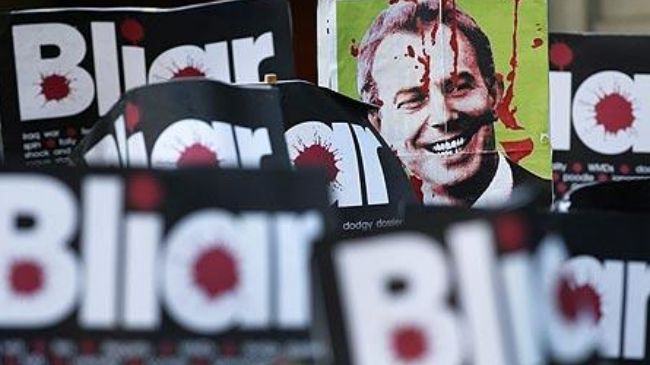
Former British Prime Minister Tony Blair, who is globally discredited for his war crimes, has tried to defend his decision to invade Iraq in 2003, claiming the country is a “safer place” after the execution of dictator Saddam Hussein.
In an interview on BBC2’s Newsnight marking the tenth anniversary of UK armed forces joining a US-led invasion of Iraq, he said despite the death toll among both British troops and Iraqi civilians being “very, very high”, the decision to wage a war against the Arab country was the right one.
He also conceded people are still “very abusive” to him years after the war on Iraq, adding that he had given up trying to “persuade people it was the right decision”.
Being asked if he minded being called a “liar” and “war criminal”, former leader of Britain’s Labour party said it did not matter whether the controversy about Iraq had “taken a toll on” him.
Moreover, he admitted that life in Iraq today was not what he had hoped for 10 years ago.
His comments come as hundreds of thousands were killed and injured in illegal interventions, and hundreds of thousands more were made refugees between 1997 and 2007, under Blair’s premiership.
Meanwhile, according to a recent Guardian/ICM poll a decade after the invasion of Iraq, the majority of Britons believe that the war “sold on a false prospectus delivered little but bloodshed.”
In 2003, the US and Britain invaded Iraq in blatant violation of international law and under the pretext of finding weapons of mass destruction (WMD) allegedly stockpiled by the former Iraqi ruler. However, no WMD were ever discovered in Iraq.
More than one million Iraqis were killed as a result of the invasion and subsequent occupation of the country, according to the California-based investigative organization Project Censored.
Jordanian King Abdullah II’s recent visit to Moscow crowned a series of steps that Amman has been taking over the past few months, signalling a shift away from its traditional allies like Washington and Israel.
Until recently, Jordan was in the warm embrace of oil-rich Gulf Arab countries that, prepared to admit the Hashemite kingdom into their Gulf Cooperation Council (GCC), would then shower it with billions in aid.
This is while Amman offered the services of its security and intelligence forces, coordinating closely with both Washington and Tel Aviv in a variety of areas, not least of which the unfolding crisis in Syria.
According to informed sources, last July 2012, Amman hosted a gathering of security officials from the US, Qatar, and Israel, who recommended setting up training camps for Syrian opposition fighters near the Jordanian city of Irbid.
US Secretary of Defense Leon Panetta admitted as much when he acknowledged in October 2012 that dozens of American soldiers were deployed along the Jordanian-Syrian border, explaining that “these units are tasked with establishing a base in Jordan and to assist the Syrian refugees and Jordanian armed forces to confront the dangers stemming from Syria’s chemical weapons.”
In the last few months Amman has begun to reassess its alliances in light of the Syrian crisis, perhaps embarking on a process of strategic realignment, moving closer to Iraq and Russia, at the expense of its traditional allies.
The prospective threat posed by the powerful Jordanian Muslim Brotherhood and the more radical Islamist currents prompted the army and intelligence to convince the palace not to go along with Washington’s plan.
Amman even went so far as to completely close its border with Syria, preventing fighters and weapons from crossing it.
This came at a high cost for Jordan, as Saudi Arabia and Qatar – who were mobilizing all the forces they could muster against the Bashar al-Assad regime – to halt their support for the kingdom, causing a serious economic crisis in the country.
Iraq quickly moved in to try to fill the void and revive its once close ties with Jordan. An official visit to Amman by Iraqi Prime Minister Nouri al-Maliki at the end of 2012 led to the signing of several lucrative deals that would see cheap Iraqi oil once again flowing to Jordan.
As for Jordan’s relationship with Iran, “that’s a tough one for us,” says a high-level Jordanian security official, pointing out that the realignment underway may go far, “but it has its limits, for there are lines that cannot be crossed, and Iran lies outside these boundaries.”
In light of all this, King Abdullah II’s visit to Moscow on Tuesday, February 19 cannot in any way be seen simply as a routine call.
For its part, Jordan is seeking a counterbalance to US influence, for fear that Washington is preparing to force Amman into accepting a confederation with the Palestinians as a solution to the Arab-Israeli conflict.
Russia, on the other hand, sees this as an opportunity to bring Amman into its orbit, particularly on the Syrian question, where Moscow is in the process of pushing for a settlement.
Jordan’s diplomatic support in the Arab arena and the valuable intelligence it can provide on the Syrian opposition make it a critical resource for the Russians.
TEHRAN – Implementation of the Friendship Gas Pipeline project which is due to take Iran’s rich gas reserves to Iraq and Syria was agreed by the Iraqi government, an Iraqi cabinet statement announced.
A Tuesday Iraqi cabinet statement said that Iraq’s Minister for Petroleum Abdel Kareem Luaibi had been authorized to sign the “framework of the agreement” on setting up the strategic pipeline that would also prepare the ground for exporting Iranian gas to Europe through Syria in the future.
The statement added that Luaibi had recently held talks with his Iranian counterpart Rostam Qassemi and Managing Director of the National Iranian Oil Company (NIOC) Ahmad Qalebani in Tehran regarding the issue.
Late in January, Iranian Oil Ministry Spokesman Alireza Nikzad Rahbar said the country will start exporting natural gas to Baghdad by next summer via an under-construction pipeline between the two countries.
He said that the “friendship” pipeline project between Iran, Iraq and Syria is the most important project currently pursued by the ministry.
The official said if the project is carried out according to schedule, the gas pipeline between Iran and Iraq will be completed next summer, adding that tripartite talks are underway to extend the pipeline to Syria.
He noted that the pipeline would be designed in such a way that it would be able to deliver gas to other Muslim countries like Jordan and Lebanon in the future.
The oil ministers of Iraq, Iran and Syria had signed a preliminary agreement for a $10 billion natural-gas-pipeline deal on July 25, 2011, in Assalouyeh industrial region located in the Southern province of Bushehr.
Iranian oil officials then said Syria would purchase between 20 million to 25 million cubic meters a day of Iranian gas while Iraq had also already signed a deal with Tehran to purchase up to 25 million cubic meters a day to feed its power stations.
The main project, 1,500 km length of piping Assalouyeh gas to Damascus requires $10 billion investment.
The pipeline will transfer a capacity of 110 million cubic meters of natural gas a day to Damascus.
The gas will be produced from the Iranian South Pars gas field in the Persian Gulf, which Iran shares with Qatar, and holds estimated reserves of 16 trillion cubic meters of recoverable gas.
Iranian officials have said that Tehran also aims to extend the pipeline to Lebanon and the Mediterranean to supply gas to Europe.
Turkey has reportedly struck a massive oil and gas agreement with Iraq’s Kurdistan Regional Government, a move that would strain Ankara’s ties with the US and the central government in Baghdad.
According to a Monday report by The New York Times the Kurds in Iraq have agreed to supply Turkey with at least 10 billion cubic meters of gas every year through a natural gas pipeline whose construction is part of the deal.
Turkey has not officially confirmed the deal, which represents a fifth of the country’s current gas consumption.
The agreement is a major bone of contention between Turkey and the US, which believes such a measure would put Iraq’s integration in jeopardy by pushing the Kurds in the oil-rich country into the hands of Turks, the report says.
“Economic success can help pull Iraq together,” US Ambassador to Turkey Francis Ricciardone said earlier this month.
But “if Turkey and Iraq fail to optimize their economic relations … there could be more violent conflict in Iraq and the forces of disintegration within Iraq could be emboldened,” he warned.
The US envoy added that at the end of the day, the measure would harm the interests of Turkey, the US and the regional countries.
Turkey had previously shied away from engagement with Iraqi Kurds fearing their probable efforts for independence on Iraqi soil would embolden the Kurds in Turkey to intensify their three-decade battle for autonomy. But Ankara’s recent attempts at ironing out issues with Kurds to put an end to the long hostility may have convinced them to build up courage and get closer to Iraqi Kurds.
The recent deal is also a thorn in the side of Iraq’s central government which tries to block Turkey’s efforts at boosting leverage by planning to become an energy hub in the region.
In November, Baghdad prevented Turkish national energy firm TPAO from bidding for an oil exploration contract.
And in December, Baghdad barred a plane carrying Turkish Energy Minister Taner Yildiz from landing in Arbil as he was reportedly on his way to seal the much-speculated energy deal.
The drug-induced nipple secretions of trans women are as good as mothers’ breast milk for babies, the University of Sussex Hospitals NHS Trust claimed in a letter to campaigners made public in a report by British think tank the Policy Exchange on Sunday.
The healthcare trust’s medical director, Rachel James, argued that the off-label prescription drug cocktail men transitioning to female take in order to produce milk was “similar to the natural hormones which encourage lactation to develop when the baby is newly born.”
“The evidence which is available demonstrates that the milk is comparable to that produced following the birth of a baby,” James wrote in the letter, sent to Children of Transitioners last August.
Biological men who wish to lactate must first take hormones to grow milk glands and then take high doses of either domperidone or metoclopramide to stimulate milk production. Neither drug is approved for this use, though they are occasionally prescribed off-label to biological women who have trouble lactating.
However, domperidone’s own manufacturer, Janssen, warns patients the drug “may cause unwanted side effects affecting the heart in a breastfed baby” and “should be used during breastfeeding only if your physician considers this clearly necessary.” … continue
This site is provided as a research and reference tool. Although we make every reasonable effort to ensure that the information and data provided at this site are useful, accurate, and current, we cannot guarantee that the information and data provided here will be error-free. By using this site, you assume all responsibility for and risk arising from your use of and reliance upon the contents of this site.
This site and the information available through it do not, and are not intended to constitute legal advice. Should you require legal advice, you should consult your own attorney.
Nothing within this site or linked to by this site constitutes investment advice or medical advice.
Materials accessible from or added to this site by third parties, such as comments posted, are strictly the responsibility of the third party who added such materials or made them accessible and we neither endorse nor undertake to control, monitor, edit or assume responsibility for any such third-party material.
The posting of stories, commentaries, reports, documents and links (embedded or otherwise) on this site does not in any way, shape or form, implied or otherwise, necessarily express or suggest endorsement or support of any of such posted material or parts therein.
The word “alleged” is deemed to occur before the word “fraud.” Since the rule of law still applies. To peasants, at least.
Fair Use
This site contains copyrighted material the use of which has not always been specifically authorized by the copyright owner. We are making such material available in our efforts to advance understanding of environmental, political, human rights, economic, democracy, scientific, and social justice issues, etc. We believe this constitutes a ‘fair use’ of any such copyrighted material as provided for in section 107 of the US Copyright Law. In accordance with Title 17 U.S.C. Section 107, the material on this site is distributed without profit to those who have expressed a prior interest in receiving the included information for research and educational purposes. For more info go to: http://www.law.cornell.edu/uscode/17/107.shtml. If you wish to use copyrighted material from this site for purposes of your own that go beyond ‘fair use’, you must obtain permission from the copyright owner.
DMCA Contact
This is information for anyone that wishes to challenge our “fair use” of copyrighted material.
If you are a legal copyright holder or a designated agent for such and you believe that content residing on or accessible through our website infringes a copyright and falls outside the boundaries of “Fair Use”, please send a notice of infringement by contacting atheonews@gmail.com.
We will respond and take necessary action immediately.
If notice is given of an alleged copyright violation we will act expeditiously to remove or disable access to the material(s) in question.
All 3rd party material posted on this website is copyright the respective owners / authors. Aletho News makes no claim of copyright on such material.
 Aletho News
 Aletho News