How much will America’s animus against Iran distort U.S. policy toward Syria?
By Flynt Leverett and Hillary Mann Leverett | Race for Iran | August 13th, 2012
Across most of the American political spectrum, policy elites are urging that the United States double down on the Obama administration’s failing Syria policy. America’s reliably pro-intervention senatorial trio (Lindsay Graham, Joseph Lieberman, and John McCain) recently argued that the “risks of inaction in Syria,” see here, now outweigh the downsides of American military involvement. Last week, the Washington Post prominently featured a piece by Ken Pollack, see here, asserting that negotiated settlements “rarely succeed in ending a civil war” like that in Syria—even though that it precisely what ended the civil war in Lebanon, right next door to Syria. From this faulty premise, Pollack argues that the only way to end a civil war like that in Syria is through military intervention. (After his scandalously wrong case for the 2003 U.S. invasion of Iraq, we wonder why the Washington Post or anyone else would give Pollack a platform for disseminating his views on virtually any Middle Eastern topic—but especially not for a piece dealing with the advisability of another U.S. military intervention in the region. In this regard, we note that the bio line at the end of Ken’s op ed makes no mention of his book that made the case for the U.S. invading Iraq, The Threatening Storm, describing him instead as “the author of A Path Out of the Desert: A Grand Strategy for America in the Middle East.)
A more chilling—and, in some ways, more candid—indicator of the direction in which the debate over American policy toward Syria is heading was provided last week in Foreign Policy by Robert Haddick (managing editor of the hawkish blog, Small War Journal), see here. Remarkably, Haddick argues that,
“rather than attempting to influence the course of Syria’s civil war, something largely beyond Washington’s control, U.S. policymakers should instead focus on strengthening America’s diplomatic position and on building irregular warfare capabilities that will be crucial in future conflicts in the region. Modest and carefully circumscribed intervention in Syria, in coordination with America’s Sunni allies who are already players in the war, will bolster critical relationships and irregular warfare capabilities the United States and its allies will need for the future.”
And why is bolstering these relationships and capabilities so critical? Because, as Haddick writes,
“The conflict in Syria is just one front in the ongoing competition between Iran and America’s Sunni allies on the west side of the Persian Gulf… The Sunni countries have a strong interest in stepping up their irregular warfare capabilities if they are to keep pace with Iran during the ongoing security competition. The civil war in Syria provides an opportunity for the United States and its Sunni allies to do just that… U.S. and GCC intelligence officers and special forces could use an unconventional warfare campaign in Syria as an opportunity to exchange skills and training, share resources, improve trust, and establish combined operational procedures. Such field experience would be highly useful in future contingencies. Equally important, it would reassure the Sunni countries that the United States will be a reliable ally against Iran.”
Foreign Policy has become arguably the leading online venue for topical discussion of key issues on America’s international agenda. And it is giving its platform to an argument that Washington should leverage the “opportunity” provided by the civil war in Syria to help its regional allies get better at killing Shi’a. And Washington should do this for the goal of prevailing in “the ongoing security competition” between the Islamic Republic and the United States (along with America’s “Sunni allies).
Such trends in the American policy debate show an appalling incapacity to learn from either current experience or history. And these trends are, in fact, influencing actual policy. Late last week, during a visit by U.S. Secretary of State Hillary Clinton to Turkey, Ankara and Washington agreed that “a unified task force with intelligence, military and political leaders from both countries would be formed immediately to track Syria’s present and plan for its future,” see here. After meeting with her Turkish counterpart, Ahmet Davutoğlu, Secretary Clinton said that the United States and Turkey are discussing various options for supporting opposition forces working to overthrow the government of President Bashar al-Assad, including the possibility of imposing a no-fly zone over rebel-held territory in Syria, see here.
In the wake of Clinton’s remarks, Flynt appeared on CCTV’s World Insight weekly news magazine to discuss the internal and international dimensions of the Syrian conflict, see here. Flynt and both of the other guests on the segment—Jia Xiudong from the China Institute of International Studies and our colleague Seyed Mohammad Marandi from the University of Tehran—agreed, contra Pollack, that the only way to resolve what has become a civil war in Syria is through an inclusive political process.
Getting to the heart of the matter, Flynt pointed out that “the United States and its regional partners are trying to use Syria to shift the balance of power in the Middle East in ways that they think will be bad for Iran.” This strategy is “ultimately doomed to fail”—but, as long as Washington and others are pursuing it, “the international community is going to be challenged to find ways to keep the violence from getting worse and try to get a political process started.” Flynt also observed that China and other players in the international community have historical grounds for concern about the imposition of a no-fly zone in Syria to create so-called “humanitarian safe havens” could lead to: since the end of the Cold War, every time that the United States has imposed humanitarian safe havens—in Somalia, Bosnia, Iraq, and most recently in Libya—this has ultimately resulted in a heavily militarized intervention by the United States and its partners in pursuit of coercive regime change.
In part, American elites persist in their current course regarding Syria because they continue to persuade themselves that, in the “security competition” between America and Iran, the United States is winning and the Islamic Republic is losing. At roughly the same time that Pollack and Haddick were holding forth last week, the New York Times offered an Op Ed by Harvey Morris purporting to explain Iran’s “paranoia” over Syria’s civil war by describing “What Syria Looks Like from Tehran,” see here. Morris claims that
“the impact of regime change in the Arab World has in fact been largely negative from Tehran’s perspective. The Muslim Brotherhood leadership in Egypt is closer to Saudi Arabia than it is to Iran. If the Alawite-dominated regime in Damascus were to fall, it would mean the loss of a non-Sunni ally.”
Our analysis—of both Tehran’s perspective on, and the reality of, how the Arab Spring is affecting the regional balance of power—is diametrically opposite to Morris’s. For an actual (and genuinely informed) Iranian view, we note that Al Jazeera devoted last week’s episode of its Inside Syria series to the topic, “Can Iran Help End the Syrian Crisis?,” see here. Once again, our colleague from the University of Tehran, Seyed Mohammad Marandi, gave a clear and concise exposition of Iranian views on the imperatives of and requirements for serious mediation of the struggle in (and over) Syria.
Related articles
- Syria and the Invisible Hand of Foreign Intervention (nationalinterest.org)
August 14, 2012 Posted by aletho | Mainstream Media, Warmongering, Timeless or most popular | Flynt Leverett, Hillary Rodham Clinton, Iran, Iraq, Syria, United States | Leave a comment
The Great American Culture of Cover-up
By Phillip Faruggio | Dissident Voice | August 13th, 2012
We have seen many cover-ups and scandals throughout the history of our nation. Barely twelve years into this, the 21st century, there are three major cover-ups that add to our national shame: 9/11, Iraq invasion and the Jerry Sandusky child abuse scandal. Each time, those at the very top of power failed, or chose to fail, to follow the narrow path of truth. Truth is this funny thing because the more you either stretch it or silence it, eventually, like that puppy that runs away… it always returns. It may take months or years, or even a generation or two, but it will come back!
There are many facts and half truths, disinformation of all types about what really went down on 9/11. This writer will not focus on what it took volumes of 9/11 Truth to uncover, that being to question how many rogue elements inside of our own intelligence agencies were somewhat involved. Sometimes it is the little things that reveal so much. When the president of the United States is told on August 6, 2001 that “…FBI information indicates suspicious activity in this country consistent with preparations for hijackings and other types of attack”… the threat was so real that the Attorney General of the United States, John Ashcroft, stopped flying on commercial aircraft that summer!
We had true patriots like Sibel Edmonds, a government translator, who warned in April of 2001 that “Bin Laden was planning a major attack in the US within a few months, using airplanes and targeting four or five American cities.” She went on to warn that the operatives were “already inside the United States”. There were diligent FBI agents like Coleen Rowley who actually pinpointed some of these possible Bin Laden operatives… and nothing was done to follow up. So, way before the heinous act was completed, the truth was swept under the rug by those who had the power to save lives.
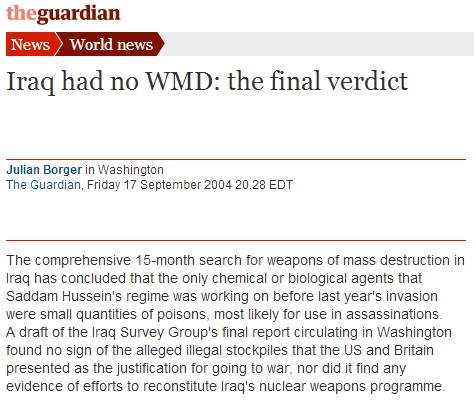
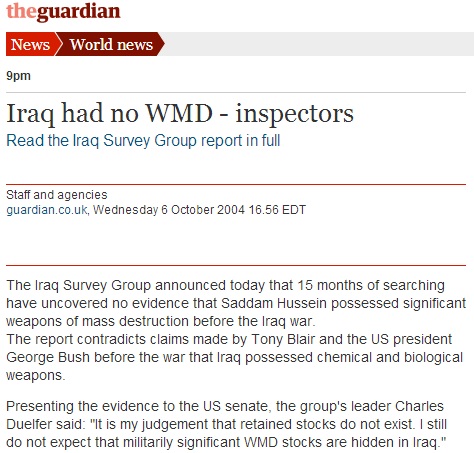
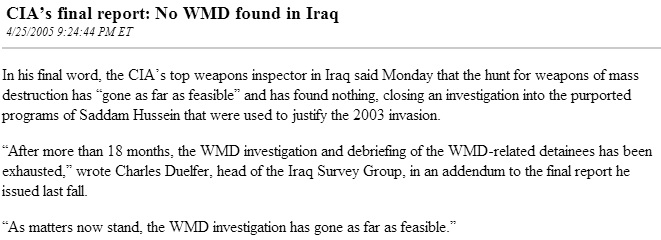
The invasion of Iraq was consummated after a campaign of fear, disinformation and outright lying. We knew then that Iraq did not have weapons of mass destruction. In his 2003 resignation speech before Parliament, Labor MP Robin Cook, former cabinet member and one time confidante of Tony Blair, made things perfectly clear. Cook explained how not only did Saddam Hussein not possess WMDs in 2001, but any WMDs that he once had were supplied for him by the US, the Brits and the French. Here at home in America, the Bush cabal was working overtime to rally the public into a ‘fear plus revenge’ and ‘fight them there before they come here’ mode. An overly compliant mainstream media and bipartisan Congressional cowardice helped take the phony war on Iraq over the top.
Senator Robert Byrd was left with an almost empty Senate chamber to hear his warnings about rushing to war. Scott Ritter, former UN weapons inspector, was made into a raving fool by the media. Phil Donahue had his cable television talk show cancelled right before we invaded Iraq, because he covered the subject too well (and too balanced – Donahue always had more pro invasion talking heads on his panels than dissidents). So, we invaded and Shock and Awed that modern and culturally advanced sovereign nation back into the Stone Age.
Then the cover-up went into high gear. In October of 2006 a group of (so called) progressive Democrats held an impromptu panel discussion on the invasion of Iraq. Rep. John Conyers of Michigan made a most eloquent statement promising that when the Democrats took back control of the Congress and he became chair of the Judiciary Committee, his first order of business would be to conduct hearings on the run-up to the invasion of Iraq. History reveals that the Democrats did succeed and he did become chair… yet no hearings! The Military Industrial Empire once again ruled supreme.
As anyone who reads or watches television knows, former assistant football coach of Penn State University, Jerry Sandusky, was arrested, tried and convicted of repeated sexual child abuse, spanning decades. Football coach Joe Paterno and three school officials were either indicted or put under the public microscope for helping to cover up these heinous acts by Sandusky.
There were many other individuals, from government agencies to charity executives, to even janitors, who knew that this man was a sexual predator. Read the new book Game Over by Bill Moushey and Bob Dvorchak for the intricate details of this terrible crime and cover-up.
When a grown man is seen showering with a young boy, not even 12 years of age, that should be enough to begin investigations. Yet, there were much worse instances than that. When a mother goes to the high school where her son is a freshman, and sees him in a fetal position on a chair sobbing in the school office about how Sandusky had sexually violated him for years… that was in 2008, three years before any arrest! We can focus all our attention on Jerry Sandusky, who was and is a very sick man.
Yet, it was the multitude of individuals who refused to pursue the facts as they were given them. Why? Why was the young boy who was in the shower with Sandusky in 2002, the event that got Paterno and the Penn State officials into this fray, never questioned by any of them? If he was questioned, perhaps many other young boys could have been spared the most heinous violations of their beings by this perverse and mentally ill man.
Truth does always triumph in the end, but at whose expense?
Philip A Farruggio, a spokesperson for the 25% Solution Movement to Save Our Cities by cutting military spending 25%, can be reached at: paf1222@bellsouth.net.
Related articles
- Penn State Pedophile Ring Accomplices Get Plush Gov’t Jobs! (dprogram.net)
- Commonly Asked Questions about the USS Liberty (alethonews.wordpress.com)
- The Raw Story treats readers like “jerks” over Israel’s attack on USS Liberty (alethonews.wordpress.com)
- The USS Liberty Cover-Up (whatreallyhappened.com)
- On History and Intellectual Courage (alethonews.wordpress.com)
- 9/11: Explosive Evidence – Experts Speak Out (alethonews.wordpress.com)
August 13, 2012 Posted by aletho | Corruption, Deception, Timeless or most popular | Coleen Rowley, Iraq, Jerry Sandusky, Joe Paterno, Pennsylvania State University, Robert Byrd, United States | Leave a comment
Iraqi ambassador to Iran calls for closer economic ties
Press TV – August 12, 2012
Iraqi Ambassador to Iran Mohammad Majid al-Sheikh says there is a huge capacity for development of financial transactions between the two countries.
“Given the friendly and brotherly relations between the two neighboring countries and hundreds of kilometers of shared borders, there are many potentials for boosting bilateral trade ties,” he told IRNA on Sunday.
He noted that Iran-Iraq trade transactions amounted to $7 billion in 2011, and hoped that the number would rise to $10 billion in the near future.
He said that a high-ranking Iraqi delegation is to visit Tehran this Tuesday in order to further commercial relations.
Headed by Deputy Prime Minister Rozhi Nouri Shawis, the delegation will include Finance Minister Rafe al-Essawi, Trade Minister Khairullah Hassan Babakr, Industries and Mines Minister Ahmad Nasser Deli, and Governor of the Central Bank Sinan Al-Shabibi, the ambassador stated.
Al-Sheikh added that setting up an Iraqi bank in Iran will be on the delegation’s agenda.
“Establishing an Iraqi bank [in Iran] can greatly help enhance bilateral economic and commercial relations,” he underlined.
August 12, 2012 Posted by aletho | Economics | Iran, Iraq | Leave a comment
Israel seeks to destroy neighbours’ histories and identities
By Jeff Goodall | August 12, 2012
This would not be the first time that the Israelis have endeavoured to destroy historical and cultural artifacts in order to bolster their territorial claims and to eradicate inconvenient elements of the past.
In 2003, in an article headed “Pillaging 7000 Years Of Iraq History No Accident” sub-heading “The Sacking Of Iraq’s Museums – US Wages War Against Culture And History”, Patrick Martin wrote in Rense.com that
“US claims to have been taken by surprise by the ransacking of cultural facilities in Baghdad, Mosul and other cities are not credible. Such a tragedy was not only predictable, it was specifically warned against. . . . Attacking the cultural resources that connect the Iraqi people to 7,000 years of history is part of the process of systematically destroying their national identity.” (Emphasis added – link to full article).
A little-known event in 1948 during the “Naqba”, was the Israeli theft of books and manuscripts.
Journalist Arwa Aburawa, writing in “Sabbah Report” two years ago, refers to
“the systematic looting of more than 60,000 Palestinian books by Israeli forces and the attempted destruction of Palestinian culture… Between May 1948 and February 1949, librarians from the Jewish National Library and Hebrew University Library entered the desolate Palestinian homes of west Jerusalem and seized 30,000 books, manuscripts and newspapers alone. These cultural assets, which had belonged to elite and educated Palestinian families, were then “loaned” to the National Library where they have remained until now.” (See “The great book robbery of 1948″ here)
Not only does Israel wish to achieve complete domination of the Middle East, it also wants to destroy the history, the culture, and the very identity of its neighbours and those it occupies.
We can be sure that an attack on Iran, one of the oldest civilisations in the world with a massive treasure-trove of historical and cultural artifacts, will include widespread theft and destruction as was the case with Iraq.
The United States, Britain, and all other backers and enablers of “gallant little Israel” are fully complicit in these crimes against humanity.
Foreign-backed armed groups targeting Syrian history
PRESS-TV | August 11th, 2012
Clashes continue in Syria’s largest city Aleppo between the army and foreign-backed militant groups. This time the Aleppo Castle was the target, but the army managed to repel the assaults, and declared the historical building as safe and intact.
Castle of Aleppo, is a large medieval fortified palace in the centre of the old city of Aleppo. It is considered to be one of the oldest and largest castles in the world. Usage of the Citadel hill dates back at least to the middle of the 3rd millennium BC.
Foreign backed armed groups and supporting media outlets emphasized on controlling the castle repeatedly. Press TV crew headed to the castle, the tension was high, Syrian soldiers were almost everywhere fully geared, two tanks on the sides of the roads and a commander waiting for us.
Upon arriving the archaeological building, the traces of mortars were imprinted on the Defensive bridge, the main gate was Booby-trapped by the armed groups upon attempting to penetrate the historic fortifications and several Syrian soldering were assigned to protect the castle being under hours of attack by the armed groups.
Syrians believe this war against Syria, has already targeted all components of Syrian society, and now foreign backed armed groups and their sponsoring countries are after Syrian 7000 years history.
August 12, 2012 Posted by aletho | Ethnic Cleansing, Racism, Zionism, Timeless or most popular, Video, Wars for Israel | Aleppo, Iraq, Israel, Jerusalem, Middle East, Syria, Zionism | Leave a comment
The Yinon Thesis Vindicated: Neocons, Israel, and the Fragmentation of Syria
By Stephen J. Sniegoski | The Passionate Attachment | August 12, 2012
It is widely realized now that the fall of President Bashar Assad’s regime would leave Syria riven by bitter ethnic, religious, and ideological conflict that could splinter the country into smaller enclaves. Already there has been a demographic shift in this direction, as both Sunnis and Alawites flee the most dangerous parts of the county, seeking refuge within their own particular communities. Furthermore, it is widely believed in Syria that, as the entire country becomes too difficult to secure, the Assad regime will retreat to an Alawite redoubt in the northern coastal region as a fallback position.
Syrian Kurds, about ten percent of the country’s population, are also interested in gaining autonomy or joining with a larger Kurdistan. The Syrian Kurdish Democratic Party (PYD)—linked to the Kurdistan Workers Party (PKK), which has engaged in a separatist insurgency in Turkey’s Kurdish southeast region for nearly three decades—has gained control of key areas in northeast Syria. While Turkey has supported the Syrian opposition, it is terrified of a Kurdish autonomous zone in Syria, believing that it could provide a safe haven for staging attacks into Turkey. Moreover, Kurdish autonomy would encourage separatist sentiment within the Turkish Kurdish minority. Turkey has threatened to invade the border areas of Syria to counter such a development and Turkish armed forces with armor have been sent to Turkey’s border with the Syrian Kurdish region. A Turkish invasion would add further complexities to the fracturing of Syria.
What has not been readily discussed in reference to this break-up of Syria is that the Israeli and global Zionist Right has long sought the fragmentation of Israel’s enemies so as to weaken them and thus enhance Israel’s primacy in the Middle East. While elements of this geostrategic view can be traced back to even before the creation of the modern state of Israel, the concept of destabilizing and fragmenting enemies seems to have been first articulated as an overall Israeli strategy by Oded Yinon in his 1982 piece, “A Strategy for Israel in the Nineteen Eighties.” Yinon had been attached to the Israeli Foreign Ministry and his article undoubtedly reflected high-level thinking in the Israeli military and intelligence establishment in the years of Likudnik Menachem Begin’s leadership. Israel Shahak’s translation of Yinon’s article was titled “The Zionist Plan for the Middle East.”
In this article, Yinon called for Israel to use military means to bring about the dissolution of Israel’s neighboring states and their fragmentation into a mosaic of homogenous ethnic and sectarian groupings. Yinon believed that it would not be difficult to achieve this result because nearly all the Arab states were afflicted with internal ethnic and religious divisions, and held together only by force. In essence, the end result would be a Middle East of powerless mini-statelets unable to confront Israeli power. Lebanon, then facing divisive chaos, was Yinon’s model for the entire Middle East. Yinon wrote: “Lebanon’s total dissolution into five provinces serves as a precedent for the entire Arab world including Egypt, Syria, Iraq and the Arabian peninsula and is already following that track. The dissolution of Syria and Iraq later on into ethnically or religiously unique areas such as in Lebanon, is Israel’s primary target on the Eastern front in the long run, while the dissolution of the military power of those states serves as the primary short term target.”
Eminent Middle East historian, Bernard Lewis, who is a Zionist of a rightist hue and one of the foremost intellectual gurus for the neoconservatives, echoed Yinon with an article in the September 1992 issue of “Foreign Affairs” titled “Rethinking the Middle East.” In it, he wrote of a development he called “Lebanonization,” stating “[A] possibility, which could even be precipitated by [Islamic] fundamentalism, is what has of late been fashionable to call ‘Lebanonization.’ Most of the states of the Middle East—Egypt is an obvious exception—are of recent and artificial construction and are vulnerable to such a process. If the central power is sufficiently weakened, there is no real civil society to hold the polity together, no real sense of common identity. . . . The state then disintegrates—as happened in Lebanon—into a chaos of squabbling, feuding, fighting sects, tribes, regions, and parties.” Since Lewis— credited with coining the phrase “clash of civilizations”—has been a major advocate of a belligerent stance for the West against the Islamic states, it would appear that he realized that such fragmentation would be the result of his belligerent policy.
In 1996, the neoconservatives presented to incoming Israeli Prime Minister Benjamin Netanyahu their study “A Clean Break” (produced under the auspices of an Israeli think tank, the Institute for Advanced Strategic and Political Studies), which described how Israel could enhance its regional security by toppling enemy regimes. Although this work did not explicitly focus on the fragmentation of states, such was implied in regard to Syria when it stated that “Israel can shape its strategic environment, in cooperation with Turkey and Jordan, by weakening, containing, and even rolling back Syria. This effort can focus on removing Saddam Hussein from power in Iraq — an important Israeli strategic objective in its own right — as a means of foiling Syria’s regional ambitions.” It added that “Damascus fears that the ‘natural axis’ with Israel on one side, central Iraq and Turkey on the other, and Jordan, in the center would squeeze and detach Syria from the Saudi Peninsula. For Syria, this could be the prelude to a redrawing of the map of the Middle East which would threaten Syria’s territorial integrity.”
David Wurmser authored a much longer follow-up document to “A Clean Break” for the same Israeli think tank, entitled “Coping with Crumbling States: A Western and Israeli Balance of Power Strategy for the Levant.” In this work, Wurmser emphasized the fragile nature of the Middle Eastern Baathist dictatorships in Iraq and Syria in line with Lewis’s thesis, and how the West and Israel should act in such an environment.
In contrast to some of the Western democracies as well as Arab states, Israel did not publicly call for Assad’s removal until a few months ago. This, however, does not mean that the Netanyahu government did not support this outcome. This tardiness has a number of likely reasons, one of which being the fear that an Islamist government would replace Assad that would be even more hostile to Israel and more prone than he to launch reckless attacks. Moreover, instability in a country on Israel’s border is of tremendous concern to its security establishment. It is feared that in such a chaotic condition, Assad’s massive chemical weapons arsenal and advanced surface-to-air missile systems could end up in the hands of terrorist groups like the Lebanese Hezbollah, which would not be hesitant to use them against Israel.
Unlike the armchair destabilization strategists and the neocons, the actual Israeli leaders, including hardline Likudniks such as Prime Minister Netanyahu, have to be concerned about facing the immediate negative political consequences of their decisions even if they believe that the long-term benefits would accrue to the country. This invariably leads to the exercise of caution in regard to dramatic change. Thus, the concern about the immediate security risks cited above likely had a significant effect on their decision-making.
Furthermore, it could have been counterproductive for Israel to express support for the Syrian opposition in its early stages. For Assad has repeatedly maintained that the opposition is orchestrated by foreign powers, using this argument to justify his brutal crackdown. Since Israel is hated by virtually all elements in the Middle East, its open support of the opposition could have turned many Syrians, and much of the overall Arab world, against the uprising. While Israel did not openly support the armed resistance, there have been claims from reliable sources that Israeli intelligence has been providing some degree of covert support along with other Western intelligence agencies, including that of the United States.
Since May of this year, however, the Israeli government has become open in its support for the overthrow of the Assad regime. In June, Netanyahu condemned the ongoing massacre of Syrian civilians by Assad, blaming the violence on an “Axis of Evil,” consisting of Iran, Syria and Hezbollah. “Iran and Hezbollah are an inseparable part of the Syrian atrocities and the world needs to act against them,” he proclaimed. This inclusion of Iran and Hezbollah illustrates Israel’s goal of using the Syrian humanitarian issue to advance its own national interest.
If the Assad regime were to fall, Israel would certainly be more secure with a splintered congeries of small statelets than a unified Syria under an anti-Israel Islamist regime. Consequently, staunch neoconservative Harold Rhode presents the fragmentation scenario in a positive light in his article, “Will Syria Remain a Unified State?” (July 10, 2012). In contrast to what has been the conventional Western narrative of the uprising against the Assad regime, which presents a heroic Sunni resistance being brutally terrorized by government forces and pro-government Alawite militias, Rhode writes with sympathy for the pro-government non-Sunni Syrian minorities: “In short, what stands behind most of the violence in Syria is the rise of Arab Sunni fundamentalism in its various forms – whether Salafi, Wahhabi, or Muslim Brotherhood. All of those threaten the very existence of the Alawites, the Kurds, and other members of the non-Sunni ethnic and religious groups.
“It is therefore much easier to understand why the ruling Alawites feel they are fighting a life and death battle with the Sunnis, and why they believe they must spare no effort to survive. It also explains why most of Syria’s other minorities – such as the Druze, Ismailis, and Christians – still largely support the Assad regime.”
For a short aside, the neoconservative background of Harold Rhode is of considerable relevance, providing further evidence for the much denied neocon support for the fragmentation of Israel’s enemies. (The mainstream view is that the neocons are naïve idealists whose plans to transform dictatorships into model democracies invariably go awry.) Rhode, a longtime Pentagon official who was a specialist on the Middle East, was closely associated with neocon stalwarts Michael Ledeen, Paul Wolfowitz, and Richard Perle. He was also a protégé of Bernard Lewis, with Lewis dedicating his 2003 book, “The Crisis of Islam,” to him. Rhode served as a Middle East specialist for Douglas Feith, Undersecretary of Defense for Policy during the administration of George W. Bush, where he was closely involved with the Office of Special Plans, which provided spurious propaganda to promote support for the war on Iraq. Rhode was a participant in the Larry Franklin affair, which involved dealings with Israeli agents, though Rhode was not charged with any crime. Alan Weisman, the author of the biography of Richard Perle, refers to Rhode as an “ardent Zionist” (“Prince of Darkness: Richard Perle,” p.146), more pro-Israel than Perle, which takes some doing since the latter has been accused of handing classified material to the Israelis. Rhode is currently a fellow with the ultra-Zionist Gatestone Institute, for which he wrote the above article.
Obviously the very removal of the Assad regime would be a blow against Israel’s major enemy, Iran, since Syria is Iran’s major ally. Significantly, Assad’s Syria has provided a conduit for arms and assistance from Iran to Hezbollah and, to a lesser extent, Hamas, to use against Israel. If Israel and Iran had gone to war, these arms would have posed a significant threat to the Israeli populace. Moreover, a defanged Hezbollah would not be able to oppose Israeli military incursions into south Lebanon or even Syria.
A fragmented Syria removes the possible negative ramifications of Assad’s removal since it would mean that even if the Islamists should replace Assad in Damascus they would only have a rump Syrian state to control, leaving them too weak to do much damage to Israel and forcing them to focus their attention on the hostile statelets bordering them. Moreover, Israel is purportedly contemplating military action to prevent Assad’s chemical weapons from falling into the hands of anti-Israel terrorists. With such a divided country there is no powerful army capable of standing up to an Israeli military incursion.
The benefits accruing to Israel from the downfall of the Assad regime and the concomitant sectarian fragmentation and conflict in Syria go beyond the Levant to include the entire Middle East region. For sectarian violence in Syria is likely to cause an intensification of the warfare between Sunnis and Shiites throughout the entire Middle East region. Iran might retaliate against Saudi Arabia’s and Qatar’s support for the Syrian opposition by fanning the flames of Shiite Muslim revolution in Bahrain and Saudi Arabia’s oil-rich and majority Shiite Eastern Province. Both areas have witnessed intermittent periods of violent protest and brutal government suppression since the Arab Spring of 2011. And Iraq remains a tinderbox ready to explode into ethno-sectarian war among the Shiites, Sunnis, and Kurds, with violence already on an uptick since the formal departure of American troops in December 2011.
In assessing the current regional situation, American-born Barry Rubin, professor at the Interdisciplinary Center (Herzliya, Israel) and director of its Global Research in International Affairs Center, writes in the Jerusalem Post (“The Region: Israel is in good shape,” July 15, 2012) : “The more I think about Israel’s security situation at this moment, the better it looks.” He goes on to state: “By reentering a period of instability and continuing conflict within each country, the Arabic-speaking world is committing a self-induced setback. Internal battles will disrupt Arab armies and economies, reducing their ability to fight against Israel. Indeed, nothing could be more likely to handicap development than Islamist policies.”
It should be noted that the “period of instability and continuing conflict” in the Middle East region has been the result of regime change and is in line with the thinking of Oded Yinon who, along with the other aforementioned geostrategic thinkers, pointed out that the major countries of the Middle East were inherently fissiparous and only held together by authoritarian regimes.
America’s removal of Saddam Hussein in a war spearheaded by the pro-Israel neoconservatives served to intensify Sunni-Shiite regional hostility and, in a sense, got the destabilization ball rolling. Iran is targeted now, and Israel and its neocon supporters seek to make use of dissatisfied internal elements, political and ethnic—the radical MEK, democratic secularists, monarchists, Kurds, Arabs, Baluchis, and Azeris— to bring down the Islamic regime. And while Saudi Arabia is currently serving Israeli interests by opposing Iran, should the Islamic Republic of Iran fall, Israel and their supporters would likely turn to Saudi Arabia’s dismemberment, seeking the severance of the predominantly Shiite, oil-rich Eastern Province, with some neocons already having made such a suggestion—e.g., Max Singer, Richard Perle, and David Frum (schemes which have been put on ice while Israel and its supporters have focused on Iran). If everything went according to plan, the end result would be a Middle East composed of disunited states, or mini-states, involved in intractable, internecine conflict, which would make it impossible for them to confront Israeli power and to provide any challenge to Israel’s control of Palestine. The essence of Yinon’s geostrategic vision of Israeli preeminence would be achieved.
Related articles
- Orwellian Ramifications Begin to Unfold in Syria (alethonews.wordpress.com)
- Is Israel slyly inciting genocide against Alawites as prelude to creation of Kosovo-style enclave in Syria? (alethonews.wordpress.com)
- Militant Zionism and the Invasion of Iraq (alethonews.wordpress.com)
August 12, 2012 Posted by aletho | Ethnic Cleansing, Racism, Zionism, Timeless or most popular, Wars for Israel | Bashar al-Assad, David Wurmser, Iraq, Israel, Kurdistan, Kurdistan Workers Party, Middle East, Syria | Leave a comment
Ron Paul: US obsessed with ‘act of war’ on Iran
Press TV – August 3, 2012
Texas Congressman Ron Paul says the US is “obsessed with” keeping Iran under illegal sanctions, while pushing for furthering the embargoes in, what he calls, an “act of war” against the Islamic Republic.
Addressing Congress on Wednesday, Paul accused Washington of “marching into a determination to have another war.”
“When you put on sanctions on a country, it’s an act of war and that’s what this is all about,” he said.
“I think this bill would be better named Obsession with Iran Act 2012,” Paul said, referring to a bill, which has been approved by the House of Representatives and the Senate, targeting Iran’s energy sector.
In a statement, released by the White House, US President Barack Obama has said the existing illegal sanctions on Iran’s oil industry has been expanded “by making sanctionable the purchase or acquisition of Iranian petrochemical products.” He said that the US sanctions will apply to any financial institution that allows Iran to access the international financial system.
However, Paul said, “What we continue to be doing is obsess with Iran and the idea that Iran is a threat to our national security.”
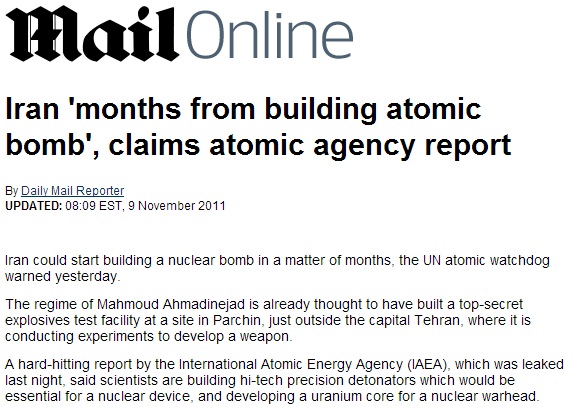
He asserted, “The IAEA (International Atomic Energy Agency) and our CIA said they are not on the verge of a nuclear weapon. It is so similar to what we went through in the early part of this last decade, when we were beating the war drums to go to war against Iraq. And it was all a façade. There was no danger from Iraq.”
The new embargoes build on Iranian crude sanctions, signed into law in December and approved in March, that penalize other countries for buying or selling Iran’s oil. The sanctions took effect on June 28.
The US sanctions are meant to pile up pressure on Iran over its nuclear energy program, which Washington, Tel Aviv, and some of their allies claim may include a military aspect.
Iran refutes the allegation and holds that, as a signatory to the nuclear Non-Proliferation Treaty (NPT) and a member of the IAEA, it is entitled to enrich uranium for peaceful purposes.
August 3, 2012 Posted by aletho | Timeless or most popular, Video, War Crimes | Iran, Iraq, Obama, Ron Paul, Sanctions against Iran, United States | Leave a comment
Israel, US faking intelligence to attack Iran: Ex-CIA analyst
Press TV – July 31, 2012
A former CIA analyst says the United States and Israel seek to come up with a pretext for attacking Iran by fabricating intelligence, a ploy similar to the one adopted by the United States for justifying the war on Iraq a decade ago.
“As we saw 10 years ago with respect to Iraq, if one intends to whip up support for war, one needs to find a casus belli – however thin a pretext it might be,” Ray McGovern wrote in an article.
“How about juxtaposing ‘weapons of mass destruction’ with terrorism. That worked to prepare for war on Iraq, and similar rhetorical groundwork for an attack on Iran is now being laid in Israel,” his article further read.
Referring to the recent attack on a number of Israeli tourists in Bulgaria, McGovern said, “Netanyahu broke all records for speed in blaming Iran and Hezbollah” for the bombing.
“On Fox News, Sunday on July 22, Mr. Netanyahu claimed Israel has ‘rock-solid evidence’ tying Iran to the attack in Bulgaria. The same day on CBS’s Face the Nation, Mr. Netanyahu said, ‘We have unquestionable, fully substantiated intelligence that this [terrorist attack] was done by Hezbollah backed by Iran,’ adding that Israel gives ‘specific details to … responsible governments and agencies,’” McGovern went on to say.
The former CIA analyst added that Israel, however, has so far failed to provide any evidence for its claims of Iran’s involvement.
“Bulgarian Prime Minister Boyko Borisov has admitted that he was aware of no information concerning the terrorist or those who dispatched him,” he underlined.
McGovern then refered to the historical moment when British intelligence chief Sir Richard Dearlove admitted that intelligence on Iraq had been fixed.
“… Military action was now seen as inevitable. Bush wanted to remove [executed Iraqi dictator] Saddam [Hussein], through military action, justified by the conjunction of terrorism and WMD [weapons of mass destruction]. But the intelligence and facts were being fixed around the policy,” Dearlove said on July 23, 2005.
“The likelihood of hostilities with Iran before the [US] presidential election in November is increasing. Beware of “fixed” intelligence,” McGovern concluded.
Related articles
- Will Downing St. Memo Recur on Iran? (alethonews.wordpress.com)
July 31, 2012 Posted by aletho | Deception, Mainstream Media, Warmongering, Timeless or most popular, Wars for Israel | Boyko Borisov, Iran, Iraq, Israel, Netanyahu, Ray McGovern, Richard Dearlove, United States | Leave a comment
Britain’s ex-army commandos train armed rebels in Syria: UK media
Press TV – July 24, 2012
Britain’s former Special Air Service (SAS) commandos are reportedly training armed opposition groups fighting against the government of Syrian President Bashar al-Assad, reports say.
The Daily Mail and Sunday Express have revealed that the mercenaries have set up training camps in Iraq and on the Syrian border for the armed rebels.
British army sources, speaking on condition of anonymity, have said the militants are receiving instructions in military tactics, weapons handling and communications systems.
Groups of 50 militants at a time are being trained by two Mideast-based private security firms which employ former SAS personnel.
More than 300 rebel forces have completed the commando training program, and are said to account for a number of the opposition’s combatant units fighting Syrian security forces in Damascus.
Britain has also placed more than 600 troops on standby over the unrest in Syria.
UK Foreign Secretary William Hague says London should be acting outside the UN Security Council and step up its support for militant groups in Syria.
Syria has been the scene of violence by armed groups since March 2011.
Damascus blames “outlaws, saboteurs, and armed terrorist groups” for the unrest, asserting that it is being orchestrated from abroad.
July 24, 2012 Posted by aletho | Illegal Occupation, Militarism | Britain, Daily Mail, Iraq, Secretary of State for Foreign and Commonwealth Affairs, Syria | Leave a comment
A court for the savages
The Southern Times | July 12, 2012
Does anyone recall this statement: “If I may say so, this is not a court set up to bring to book Prime Ministers of the United Kingdom or Presidents of the United States”?
Those words are from none other than the late Former UK Foreign and Commonwealth Secretary, Robin Cook, live on television.
He had been asked in an interview if the UK did not fear prosecution by the International Criminal Court (ICC) for its actions during and after the invasions of Iraq and Afghanistan.
How much more bluntly can it be put? With such a plain explanation from such a powerful man, no one should bother about why the US and its European buddies are not prosecuted for their massive crimes against humanity in the decade that the ICC has been in existence.
But let us side-track a little.
Do we ever pause to consider the fact that the total membership of the ICC consists of just one-third of the world’s population?
We are often told that two-thirds of the members of the United Nations have ratified the Rome Statute that set up the ICC.
But this two-thirds of the UN membership, if we look at the populations of their countries, consist just 33 percent of the world’s population.
In essence, the ICC is made up of a group of small countries.
One analysis – as reported elsewhere in this paper – represents a minority of the world’s population despite the claim to being an “international” institution.
Says one analyst, “When you start down the list of the world’s largest countries, the first four, and six of the top 10, are not members of the Court.
“In addition, very significant regions of the world — Asia, the Middle East and North Africa — are woefully underrepresented in the Court’s membership.
“How do you create a significant international institution without the involvement of strategic powers such as China, India, Russia, Israel, Egypt, Pakistan, and the United States (a list that includes three of the five permanent members of the UN Security Council)?”
What we have then, in the ICC, is a minority court set up for the express purpose of not touching the leaders of the UK and the US, and imposing the will of these same untouchables on the rest of the world.
And while Robin Cook’s – and by extension the UK governing establishment’s ‑ attitude to the ICC is frankly disconcerting, more alarming is that of the United States.
Throughout the 1990s, the US Congress passed several resolutions supporting the creation of an international criminal court but one which provides safeguards to protect Americans from prosecution.
In between Monica Lewinsky and other shenanigans, Bill Clinton was involved in the negotiations leading to 1998 Rome Statute, which in turn led to the ICC’s creation on July 1, 2002.
But Clinton’s participation ‑ true to form – was to try and ensure an outcome that would not result in Americans being tried in an international court.
Clinton said, “I will not and do not recommend that my successor submit the treaty to the Senate … until our fundamental concerns are satisfied.”
His successor was to be George W Bush. And Bush’s reaction to the ICC was typical of the gung-ho cowboy with a nuclear arsenal who invaded Iraq because of non-existent weapons of mass destruction.
He not only declined to put the Rome Statue before the US Senate, he went a step further and – together with that dyed-in-the-wool rightwing Senator called Jesse Helms ‑ initiated what is known as the American Service-members’ Protection Act.
This law is also referred to as the Hague Invasion Act, and with good cause.
The Hague Invasion Act is an amendment to the National Defence Authorisation Act and its stated purpose is “to protect United States military personnel and other elected and appointed officials of the United States government against criminal prosecution by an international criminal court to which the United States is not party”.
The law gives the US President authority to use “all means necessary and appropriate to bring about the release of any US or allied personnel being detained or imprisoned by, on behalf of, or at the request of the International Criminal Court”.
This means the US can and will bomb The Hague in Holland – where the ICC is housed – if any American is brought before that court.
So there you have it: a minority court that survives at the mercy of the US and the UK is supposed to be responsible for maintaining global law and order.
Stephen Asiimwe, writing for the New Vision newspaper of Uganda ahead of the court’s 10th anniversary on July 1, 2012 said: “ICC will continue to pick the weak people, take them to The Hague and hang them.”
And Africa, as divided and lily-livered as we are, will not do anything about it, In fact, a la Joyce Banda, we will tell fellow Africans that they are not welcome in our countries if they are indicted by this minority court.
Not surprising at all.
Geoffrey Robertson, a prominent UK lawyer and a Queen’s Counsel, said at the time of the ICC’s inception,
Related articles
- AI calls on nations to back ICC (jurist.org)
July 23, 2012 Posted by aletho | Ethnic Cleansing, Racism, Zionism, Timeless or most popular, War Crimes | American Service-Members' Protection Act, George W. Bush, Hague, International Criminal Court, Iraq, United States | Leave a comment
Context of ‘July 8-10, 1996: Israeli Prime Minister Netanyahu Tells Congress US Must Join Israel in ‘Democratizing’ Middle East’
History Commons
1965: Former RAND Analyst Gathers Young, Nascent Neoconservatives
Albert Wohlstetter
Albert Wohlstetter, a professor at the University of Chicago, gathers a cadre of fiery young intellectuals around him, many of whom are working and associating with the magazine publisher Irving Kristol (see 1965). Wohlstetter’s group includes Richard Perle, Zalmay Khalilzad, and Paul Wolfowitz. Wohlstetter, himself a protege of the Machiavellian academic Leo Strauss, is often considered the “intellectual godfather” of modern neoconservatism. Formerly an analyst at the RAND Corporation, Wohlstetter wielded a powerful influence on the US’s foreign policy during the heyday of the Cold War. Wohlstetter, who is believed to be one of several analysts who became a model for director Stanley Kubrick’s title character in the 1968 film Dr. Strangelove, added dramatic phrases like “fail-safe” and “second strike” capability to the US nuclear lexicon, and pushed to increase the US’s military might over what he saw as the imminent and lethal threat of Soviet nuclear strikes and the Soviet Union’s plans for global hegemony. He was such a powerful figure in his hundreds of briefings that he projected far more certainty than his facts actually supported. Though his facts and statistics were often completely wrong, he was so relentless and strident that his ideas gained more credence than they may have warranted. By 1965, he is known in some circles as a “mad genius” who is now collecting and molding young minds to follow in his footsteps. Author Craig Unger writes in 2007, “To join Team Wohlstetter, apparently, one had to embrace unquestioningly his worldviews, which eschewed old-fashioned intelligence as a basis for assessing the enemy’s intentions and military capabilities in favor of elaborate statistical models, probabilities, reasoning, systems analysis, and game theory developed at RAND.” An analyst with the Federation of Atomic Scientists will write in November 2003: “This methodology exploited to the hilt the iron law of zero margin for error.… Even a small probability of vulnerability, or a potential future vulnerability, could be presented as a virtual state of emergency.” Or as one-time Wohlstetter acolyte Jude Wanninski will later put it, “[I]f you look down the road and see a war with, say, China, twenty years off, go to war now.” Unger will observe, “It was a principle his acolytes would pursue for decades to come—with disastrous results.” [Unger, 2007, pp. 42-46]
Entity Tags: University of Chicago, Stanley Kubrick, Richard Perle, Zalmay M. Khalilzad, RAND Corporation, Leo Strauss, Albert Wohlstetter, Paul Wolfowitz, Irving Kristol, Federation of Atomic Scientists, Craig Unger, Jude Wanninski
Timeline Tags: Neoconservative Influence
Early 1970s: Neoconservatives Coalesce around Conservative Democratic Senator
Henry ‘Scoop’ Jackson
The recently formed neoconservatives, bound together by magazine publisher Irving Kristol (see 1965), react with horror to the ascendancy of the “McGovern liberals” in the Democratic Party, and turn to conservative senator Henry “Scoop” Jackson (D-WA) for leadership. Jackson calls himself a “muscular Democrat”; others call him “the Senator from Boeing” for his strong support of the US defense industry. Jackson merges a strong support of labor and civil rights groups with a harsh Cold War opposition to the Soviet Union. Jackson assembles a staff of bright, young, ideologically homogeneous staffers who will later become some of the most influential and powerful neoconservatives of their generation, including Richard Perle, Douglas Feith, Elliott Abrams, Abram Shulsky, and Paul Wolfowitz. Jackson’s office—“the bunker,” to staffers—becomes a home for disaffected, ambitious young conservative ideologues with a missionary zeal for change. Jackson presides over the cadre in an almost fatherly fashion.
History of Two Dictators – Many of Jackson’s neoconservative disciples came of age either fighting two foreign dictators—Stalin and/or Hitler—or growing up with family members who fought against them. [Unger, 2007, pp. 35-41] Wolfowitz’s father’s family perished in the Holocaust; he will later say that what happened to European Jews during World War II “shaped a lot of my views.” [New York Times, 4/22/2002] Feith will tell the New Yorker in 2005, “[My] family got wiped out by Hitler, and… all this stuff about working things out—well, talking to Hitler to resolve the problem didn’t make any sense.” Most neoconservatives like Feith and Wolfowitz tend to look to military solutions as a first, not a last, resort. To them, compromise means appeasement, just as Britain’s Neville Chamberlain tried to appease Hitler. Stefan Halper, a White House and State Department official in the Nixon, Ford, and Reagan administrations, will say of the neoconservatives, “It is use force first and diplomacy down the line.”
Former Trotskyites – On the other hand, many neoconservatives come to the movement from the hardline, socialist left, often from organizations that supported Bolshevik revolutionary Leon Trotsky (see Late 1930s – 1950s). Trotskyites accused Stalin of betraying the purity of the Communist vision as declaimed by Karl Marx and Vladimir Lenin. “I can see psychologically why it would not be difficult for them to become [conservative] hard-liners,” says Harvard Sovietologist Richard Pipes, himself a hardliner whose son, Daniel Pipes, will become an influential neoconservative. “It was in reaction to the betrayal.” Many neoconservatives like Stephen Schwartz, a writer for the Weekly Standard, still consider themselves to be loyal disciples of Trotsky. Richard Perle is a Trotskyite socialist when he joins Jackson’s staff, and will always practice what author Craig Unger calls “an insistent, uncompromising, hard-line Bolshevik style” of policy and politics. Like Trotsky, Unger writes, the neoconservatives pride themselves on being skilled bureaucratic infighters, and on trusting no one except a small cadre of like-minded believers. Disagreement is betrayal, and political struggles are always a matter of life and death. [Unger, 2007, pp. 35-41]
Entity Tags: Stefan Halper, Stephen Schwartz, Richard Pipes, Richard Perle, Neville Chamberlain, Abram Shulsky, Douglas Feith, Daniel Pipes, Craig Unger, Paul Wolfowitz, Henry (“Scoop”) Jackson, Elliott Abrams, Leon Trotsky, Irving Kristol
Timeline Tags: Neoconservative Influence
Summer 1972 and After: Neoconservatives Work to Toughen US Policy towards Soviet Union
Neoconservatives see Democratic presidential candidate George McGovern’s floundering campaign and eventual landslide defeat (see November 7, 1972) as emblematic of, in author Craig Unger’s words, everything that is wrong with the “defeatist, isolationist policies of the liberals who had captured the Democratic Party.” If the neoconservatives had had their way, their favorite senator, Henry “Scoop” Jackson (see Early 1970s), would have won the nomination. But the Vietnam War has put hawkish Cold Warriors like Jackson in disfavor in the party, and Jackson was set aside for the disastrous McGovern candidacy. The Republicans offer little interest themselves for the neoconservatives. Richard Nixon is enamored of one of their most hated nemeses, National Security Adviser Henry Kissinger, whose “realpolitik” did nothing to excite their ideological impulses. And under Nixon, the icy Cold War is slowly thawing, with summit meetings, bilateral commissions, and arms limitations agreements continually bridging the gap between the US and the neoconservatives’ implacable foe, the Soviet Union. In Nixon’s second term, the Coalition for a Democratic Majority (CDM)—populated by Democratic neoconservatives like Jackson, Irving Kristol, Norman Podhoretz, Midge Decter, Daniel Patrick Moynihan (Nixon’s domestic adviser), Jeane Kirkpatrick, Ben Wattenberg, and James Woolsey, and joined by 1968 Democratic presidential candidate Hubert Humphrey, will pressure Nixon to adopt a tough “peace through strength” policy towards the Soviet Union. Although it will take time, and the formation of countless other organizations with similar memberships and goals, this group of neoconservatives and hawkish hardliners will succeed in marginalizing Congress, demonizing their enemies, and taking over the entire foreign policy apparatus of the US government. [Unger, 2007, pp. 47-48]
Entity Tags: Norman Podhoretz, Midge Decter, Jeane Kirkpatrick, Richard M. Nixon, James Woolsey, Henry (“Scoop”) Jackson, Ben Wattenberg, Coalition for a Democratic Majority, Irving Kristol, George S. McGovern, Craig Unger, Henry A. Kissinger, Daniel Patrick Moynihan
Timeline Tags: US International Relations, Neoconservative Influence
August 15, 1974: Neoconservatives Begin Moving to Influence US Foreign Policies
Conservative Democratic senator Henry “Scoop” Jackson (D-WA) meets with President Ford as part of a discussion about the standoff with the Soviet Union over trade and emigration of Soviet Jews to Israel. Jackson—hawkish, defense-minded, and solidly pro-Israel—sees the standoff as an opportunity to undercut Secretary of State Henry Kissinger. Jackson is a forerunner of what in later years will be called “neoconservatism” (see 1965), an ideology mostly espoused by a group of Democratic lawmakers and intellectuals who have abandoned their support for Rooseveltian New Deal economics and multilateralist foreign policies (see Early 1970s). Jackson and his outspoken pro-Israel aide, Richard Perle, view Kissinger as far too conciliatory and willing to negotiate with the Communist bloc. Jackson and Perle see the Soviet Union, not the Israeli-Palestine conflict, as the chief threat to US interests in the Middle East and the control of that region’s oil fields. They see a strong, powerful Israel as essential to their plans for US domination of the region. Jackson resists a proposed compromise on the number of Soviet Jews the USSR will allow to emigrate to Israel—the Soviets offer 55,000 and Jackson insists on 75,000—and many in the meeting feel that Jackson is being deliberately recalcitrant. “It made no sense to me because it was sure to be counterproductive,” Ford later writes, “but he would not bend, and the only reason is politics.” For his part, Kissinger respects Jackson’s political abilities, but to his mind, Perle is a “ruthless… little b_stard.” Kissinger knows that Republican hawks as well as the burgeoning neoconservative movement will pressure Ford to abandon Richard Nixon’s policies of moderating relations with the Soviet Union and Communist China. But, author Barry Werth writes in 2006: “what Kissinger and now Ford would chronically underestimate was the neoconservatives’ argument that the United States should not so much seek to coexist with the Soviet system as to overthrow it through direct confrontation. Or the extent to which the neoconservatives would go to exaggerate a foreign threat and stir up fear.” [Werth, 2006, pp. 77-79]
Entity Tags: Richard M. Nixon, Barry Werth, Henry A. Kissinger, Gerald Rudolph Ford, Jr, Richard Perle, Henry (“Scoop”) Jackson
Timeline Tags: US International Relations, Neoconservative Influence
Early 1976: Neoconservative ‘Team B’ of Outside Intelligence Analysts Created
Richard Pipes
After George H. W. Bush becomes the head of the CIA (see November 4, 1975 and After), he decides to break with previous decisions and allow a coterie of neoconservative outsiders to pursue the allegations of Albert Wohlstetter that the CIA is seriously underestimating the threat the USSR poses to the US (see 1965), allegations pushed by hardliners on the President’s Foreign Intelligence Advisory Board.
Internal Opposition – Bush’s predecessor, William Colby, had steadfastly refused to countenance such a project, saying, “It is hard for me to envisage how an ad hoc ‘independent’ group of government and non-government analysts could prepare a more thorough, comprehensive assessment of Soviet strategic capabilities—even in two specific areas—than the intelligence community can prepare.” (Bush approves the experiment by notating on the authorization memo, “Let ‘er fly!”) The national intelligence officer in charge of the National Intelligence Estimate on the USSR, Howard Stoertz, will later recall: “Most of us were opposed to it because we saw it as an ideological, political foray, not an intelligence exercise. We knew the people who were pleading for it.” But Bush, on the advice of deputy national security adviser William Hyland, agrees to the exercise. Hyland says the CIA had been getting “too much flak for being too peacenik and detentish…. I encouraged [Bush] to undertake the experiment, largely because I thought a new director ought to be receptive to new views.” The neocon team of “analysts” becomes known as “Team B,” with “Team A” being the CIA’s own analytical team. It is unprecedented to allow outsiders to have so much access to highly classified CIA intelligence as Bush is granting the Team B neocons, so the entire project is conducted in secret. CIA analyst Melvin Goodman later says that President Ford’s chief of staff, Dick Cheney, is one of the driving forces behind Team B. The outside analysts “wanted to toughen up the agency’s estimates,” Goodman will say, but “Cheney wanted to drive [the CIA] so far to the right it would never say no to the generals.” [Dubose and Bernstein, 2006, pp. 208; Unger, 2007, pp. 53-55]
Political Pressure – Ford’s political fortunes help push forward the Team B experiment. Ford has been a strong proponent of detente with the Soviet Union, but his poll numbers are sagging and he is facing a strong presidential primary challenger in Governor Ronald Reagan (R-CA), an avowed hardliner. Reagan is making hay challenging Ford’s foreign policy, claiming that the so-called “Ford-Kissinger” policies have allowed the Soviet Union to leap ahead of the US both militarily and geopolitically. In response, Ford has lurched to the right, banning the word “detente” from speeches and statements by White House officials, and has been responsive to calls for action from the newly reforming Committee on the Present Danger (CPD—see 1976). In combination, these political concerns give Bush the justification he wants to push forward with the Team B experiment.
Three B Teams – According to Carter administration arms control official Anne Cahn, there are actually three “B” teams. One studies Soviet low-altitude air defense capabilities, one examines Soviet intercontinental ballistic missile (ICBM) accuracy, and the third, chaired by Harvard Sovietologist Richard Pipes, examines Soviet strategic policy and objectives. It is Pipes’s team that becomes publicly known as “Team B.” [Bulletin of Atomic Scientists, 4/1993]
Assembling the Team – Pipes fits in well with his small group of ideological hardliners. He believes that the USSR is determined to fight and win a nuclear war with the US, and he is bent on putting together an analysis that proves his contention. He asks Cold War icon Paul Nitze, the former Secretary of the Navy, to join the team. Richard Perle, a core member, has Pipes bring in Paul Wolfowitz, one of Wohlstetter’s most devout disciples. Wolfowitz immediately begins arguing for the need to deploy tactical nuclear weapons in Europe. The “incestuous closeness” of the members, as Cahn later calls it, ensures that the entire group is focused on the same goals as Wohlstetter and Pipes, with no dissension or counterarguments. Other key members include William von Cleave and Daniel Graham. The entire experiment, Cahn will write, “was concocted by conservative cold warriors determined to bury détente and the SALT process. Panel members were all hard-liners,” and many are members of the newly reconstituted “Committee on the Present Danger” (see 1976). The experiment is “leaked to the press in an unsuccessful attempt at an ‘October surprise’ [an attempt to damage the presidential hopes of Democrat Jimmy Carter—see Late November, 1976]. But most important, the Team B reports became the intellectual foundation of ‘the window of vulnerability’ and of the massive arms buildup that began toward the end of the Carter administration and accelerated under President Reagan.” Team B will formally debate its CIA adversaries, “Team A,” towards the end of the year (see November 1976). [Bulletin of Atomic Scientists, 4/1993; Quarterly Journal of Speech, 5/2006; Unger, 2007, pp. 53-55]
‘Designed to be Prejudiced’ – In 2008, author J. Peter Scoblic will note, “Team B was designed to be prejudiced.” Pipes, the Soviet experts, holds a corrosive hatred of the Soviet Union, in part stemming from his personal experiences as a young Jew in Nazi-occupied Warsaw, and his belief that the Soviet system is little different from the Nazis. When asked why his team is stacked with hardline opponents of arms negotiations and diplomacy of any kind with the USSR, Pipes replies, “There is no point in another, what you might call, optimistic view.” Scoblic will write, “Team B, in short, begged the question. Its members saw the Soviet threat not as an empirical problem but as a matter of faith.” He will add, “For three months, the members of Team B pored over the CIA’s raw intelligence data—and used them to reaffirm their beliefs.” [Scoblic, 2008, pp. 93-94]
Entity Tags: Richard Perle, Richard Pipes, William Hyland, Paul Nitze, William Colby, J. Peter Scoblic, Paul Wolfowitz, George Herbert Walker Bush, ’Team A’, ’Team B’, Anne Cahn, Albert Wohlstetter, Foreign Intelligence Advisory Board, Central Intelligence Agency, Howard Stoertz
Timeline Tags: US International Relations, Neoconservative Influence
November 1976: Team B Browbeats CIA Analysts, ‘Proves’ Soviets Far Ahead of US in Military, Nuclear Capabilities
A team of young, mid-level CIA and DIA analysts, informally dubbed “Team A,” debates the neoconservative/hardline group of outside “analysts” known as “Team B” (see Early 1976) over the CIA’s estimates of Soviet military threats and intentions. The debate is a disaster for the CIA’s group. Team B uses its intellectual firepower and established reputations of members such as Richard Pipes and Paul Nitze to intimidate, overwhelm, and browbeat the younger, more inexperienced CIA analysts. “People like Nitze ate us for lunch,” recalls one member of Team A. “It was like putting Walt Whitman High versus the [NFL’s] Redskins. I watched poor GS-13s and GS-14s [middle-level analysts with modest experience and little real influence] subjected to ridicule by Pipes and Nitze. They were browbeating the poor analysts.” Howard Stoertz, the national intelligence officer who helped coordinate and guide Team A, will say in hindsight, “If I had appreciated the adversarial nature [of Team B], I would have wheeled up different guns.” Team A had prepared for a relatively congenial session of comparative analysis and lively discussion; Team B had prepared for war.
Ideology Trumps Facts – Neither Stoertz nor anyone else in the CIA appreciated how thoroughly Team B would let ideology and personalities override fact and real data. While CIA analysts are aware of how political considerations can influence the agency’s findings, the foundation of everything they do is factual—every conclusion they draw is based on whatever facts they can glean, and they are leery of extrapolating too much from a factual set. Team A is wholly unprepared for B’s assault on their reliance on facts, a line of attack the CIA analysts find incomprehensible. “In other words,” author Craig Unger will write in 2007, “facts didn’t matter.” Pipes, the leader of Team B, has argued for years that attempting to accurately assess Soviet military strength is irrelevant. Pipes says that because it is irrefutable that the USSR intends to obliterate the US, the US must immediately begin preparing for an all-out nuclear showdown, regardless of the intelligence or the diplomatic efforts of both sides. Team B is part of that preparation. [Bulletin of Atomic Scientists, 4/1993; Unger, 2007, pp. 53-57] Intelligence expert John Prados, who will examine the contesting reports, later says that while the CIA analysts believe in “an objective discoverable truth,” the Team B analysts engaged in an “exercise of reasoning from conclusions” that they justify, not in factual, but in “moral and ideological terms.” According to Prados’s analysis, Team B had no real interest in finding the truth. Instead, they employed what he calls an adversarial process similar to that used in courts of law, where two sides present their arguments and a supposedly impartial judge chooses one over the other. Team B’s intent was, in essence, to present the two opposing arguments to Washington policy makers and have them, in author J. Peter Scoblic’s words, “choose whichever truth they found most convenient.” [Scoblic, 2008, pp. 98]
Attacking the Intelligence Community – The first sentence of Team B’s report is a frontal assault on the US intelligence community. That community, the report says, had “substantially misperceived the motivations behind Soviet strategic programs, and thereby tended consistently to underestimate their intensity, scope, and implicit threat.” Team B writes that the intelligence community has failed to see—or deliberately refused to see—that the entire schema of detente and arms limitations negotiations are merely elements of the Soviet push for global domination.
Fighting and Winning a Nuclear War – Team B writes that the Soviets have already achieved measurable superiority in nuclear weaponry and other military benchmarks, and will use those advantages to cow and coerce the West into doing its bidding. The Soviets worship military power “to an extent inconceivable to the average Westerner,” the report asserts. The entire Soviet plan, the report goes on to say, hinges on its willingness to fight a nuclear war, and its absolute belief that it can win such a war. Within ten years, Team B states, “the Soviets may well expect to achieve a degree of military superiority which would permit a dramatically more aggressive pursuit of their hegemonial objectives.” [Scoblic, 2008, pp. 94-95]
Lack of Facts Merely Proof of Soviets’ Success – One example that comes up during the debate is B’s assertion that the USSR has a top-secret nonacoustic antisubmarine system. While the CIA analysts struggle to point out that absolutely no evidence of this system exists, B members conclude that not only does the USSR have such a system, it has probably “deployed some operation nonacoustic systems and will deploy more in the next few years.” The absence of evidence merely proves how secretive the Soviets are, they argue. [Bulletin of Atomic Scientists, 4/1993; Unger, 2007, pp. 53-57] Anne Cahn, who will serve in the Arms Control and Disarmament Agency in the Carter administration, later says of this assertion, “They couldn’t say that the Soviets had acoustic means of picking up American submarines, because they couldn’t find it. So they said, well maybe they have a non-acoustic means of making our submarine fleet vulnerable. But there was no evidence that they had a non-acoustic system. They’re saying, ‘we can’t find evidence that they’re doing it the way that everyone thinks they’re doing it, so they must be doing it a different way. We don’t know what that different way is, but they must be doing it.‘… [The fact that the weapon doesn’t exist] doesn’t mean that it doesn’t exist. It just means that we haven’t found it yet.” Cahn will give another example: “I mean, they looked at radars out in Krasnoyarsk and said, ‘This is a laser beam weapon,’ when in fact it was nothing of the sort.… And if you go through most of Team B’s specific allegations about weapons systems, and you just examine them one by one, they were all wrong.… I don’t believe anything in Team B was really true.” [Bulletin of Atomic Scientists, 4/1993; Common Dreams (.org), 12/7/2004; BBC, 1/14/2005]
Soviet Strike Capabilities Grossly Exaggerated – Team B also hammers home warnings about how dangerous the Soviets’ Backfire bomber is. Later—too late for Team A—the Team B contentions about the Backfire’s range and refueling capability are proven to be grossly overestimated; it is later shown that the USSR has less than half the number of Backfires that B members loudly assert exist (500 in Team B’s estimation, 235 in reality). B’s assertions of how effectively the Soviets could strike at US missile silos are similarly exaggerated, and based on flawed assessment techniques long rejected by the CIA. The only hard evidence Team B produces to back their assertions is the official Soviet training manual, which claims that their air-defense system is fully integrated and functions flawlessly. The B analysts even assert, without evidence, that the Soviets have successfully tested laser and charged particle beam (CPB) weapons. [Bulletin of Atomic Scientists, 4/1993; Quarterly Journal of Speech, 5/2006 ] (The facility at Semipalatansk that is supposedly testing these laser weapons for deployment is in reality a test site for nuclear-powered rocket engines.) [Scoblic, 2008, pp. 96]
Fundamental Contradiction – One befuddling conclusion of Team B concerns the Soviets’ ability to continue building new and expensive weapons. While B acknowledges “that the Soviet Union is in severe decline,” paradoxically, its members argue that the threat from the USSR is imminent and will grow ever more so because it is a wealthy country with “a large and expanding Gross National Product.”
Allegations ‘Complete Fiction’ – The CIA lambasts Team B’s report as “complete fiction.” CIA director George H. W. Bush says that B’s approach “lends itself to manipulation for purposes other than estimative accuracy.” His successor, Admiral Stansfield Turner, will come to the same conclusion, saying, “Team B was composed of outsiders with a right-wing ideological bent. The intention was to promote competition by polarizing the teams. It failed. The CIA teams, knowing that the outsiders on B would take extreme views, tended to do the same in self-defense. When B felt frustrated over its inability to prevail, one of its members leaked much of the secret material of the proceedings to the press” (see Late November, 1976). Former CIA deputy director Ray Cline says Team B had subverted the National Intelligence Estimate on the USSR by employing “a kangaroo court of outside critics all picked from one point of view.” Secretary of State Henry Kissinger says that B’s only purpose is to subvert detente and sabotage a new arms limitation treaty between the US and the Soviet Union. [Bulletin of Atomic Scientists, 4/1993; Common Dreams (.org), 12/7/2004; BBC, 1/14/2005; Quarterly Journal of Speech, 5/2006 ; Unger, 2007, pp. 53-57]
Costs of Rearmament – In 1993, after reviewing the original Team B documents, Cahn will reflect on the effect of the B exercise: “For more than a third of a century, assertions of Soviet superiority created calls for the United States to ‘rearm.’ In the 1980s, the call was heeded so thoroughly that the United States embarked on a trillion-dollar defense buildup. As a result, the country neglected its schools, cities, roads and bridges, and health care system. From the world’s greatest creditor nation, the United States became the world’s greatest debtor—in order to pay for arms to counter the threat of a nation that was collapsing.” [Bulletin of Atomic Scientists, 4/1993] Former Senator Gary Hart (D-CO) will agree: “The Pro-B Team leak and public attack on the conclusions of the NIE represent but one element in a series of leaks and other statements which have been aimed as fostering a ‘worst case’ view for the public of the Soviet threat. In turn, this view of the Soviet threat is used to justify new weapons systems.” [Quarterly Journal of Speech, 5/2006 ]
Entity Tags: Howard Stoertz, Henry A. Kissinger, Stansfield Turner, Richard Pipes, J. Peter Scoblic, Ray Cline, George Herbert Walker Bush, Craig Unger, Defense Intelligence Agency, ’Team A’, Gary Hart, Anne Cahn, ’Team B’, Carter administration, Arms Control and Disarmament Agency, Paul Nitze, Central Intelligence Agency
Timeline Tags: US International Relations, Neoconservative Influence
Late November, 1976: Team B Breaches Security to Successfully Whip up Fears of Soviet Threat
Although the entire “Team B” intelligence analysis experiment (see Early 1976, November 1976, and November 1976) is supposed to be classified and secret, the team’s neoconservatives launch what author Craig Unger will call “a massive campaign to inflame fears of the red menace in both the general population and throughout the [foreign] policy community—thanks to strategically placed leaks to the Boston Globe and later to the New York Times.” Times reporter David Binder later says that Team B leader Richard Pipes is “jubilant” over “pok[ing] holes at the [CIA]‘s analysis” of the Soviet threat. Team B member John Vogt calls the exercise “an opportunity to even up some scores with the CIA.” [Unger, 2007, pp. 57] Team member George Keegan tells reporters, “I am unaware of a single important category in which the Soviets have not established a significant lead over the United States… [This] grave imbalance in favor of Soviet military capability had developed out of a failure over the last 15 years to adjust American strategic thinking to Soviet strategic thinking, and out of the failure of the leadership of the American intelligence community to ‘perceive the reality’ of the Soviet military buildup.” Keegan’s colleague William van Cleave agrees, saying that “overall strategic superiority exists today for the Soviet Union,” and adds, “I think it’s getting to the point that, if we can make a trade with the Soviet Union of defense establishments, I’d be heartily in favor of it.” [Scoblic, 2008, pp. 95]
Used to Escalate Defense Spending – The experiment is far more than a dry, intellectual exercise or a chance for academics to score points against the CIA. Melvin Goodman, who heads the CIA’s Office of Soviet Affairs, will observe in 2004: “[Defense Secretary Donald] Rumsfeld won that very intense, intense political battle that was waged in Washington in 1975 and 1976. Now, as part of that battle, Rumsfeld and others, people such as Paul Wolfowitz, wanted to get into the CIA. And their mission was to create a much more severe view of the Soviet Union, Soviet intentions, Soviet views about fighting and winning a nuclear war.” Even though Wolfowitz’s and Rumsfeld’s assertions of powerful new Soviet WMD programs are completely wrong, they use the charges to successfully push for huge escalations in military spending, a process that continues through the Ford and Reagan administrations (see 1976) [Common Dreams (.org), 12/7/2004; BBC, 1/14/2005] , and resurface in the two Bush administrations. “Finally,” Unger will write, “a band of Cold Warriors and neocon ideologues had successfully insinuated themselves in the nation’s multibillion-dollar intelligence apparatus and had managed to politicize intelligence in an effort to implement new foreign policy.” [Unger, 2007, pp. 57-58]
Kicking Over the Chessboard – Former senior CIA official Richard Lehman later says that Team B members “were leaking all over the place… putting together this inflammatory document.” Author and university professor Gordon R. Mitchell will write that B’s practice of “strategically leaking incendiary bits of intelligence to journalists, before final judgments were reached in the competitive intelligence exercise,” was another method for Team B members to promulgate their arguments without actually proving any of their points. Instead of participating in the debate, they abandoned the strictures of the exercise and leaked their unsubstantiated findings to the press to “win” the argument. [Quarterly Journal of Speech, 5/2006 ]
‘One Long Air Raid Siren’ – In 2002, defense policy reporter Fred Kaplan will sardonically label Team B the “Rumsfeld Intelligence Agency,” and write: “It was sold as an ‘exercise’ in intelligence analysis, an interesting competition—Team A (the CIA) and Team B (the critics). Yet once allowed the institutional footing, the Team B players presented their conclusions—and leaked them to friendly reporters—as the truth,” a truth, Team B alleges, the pro-detente Ford administration intends to conceal. Kaplan will continue, “The Team B report read like one long air-raid siren: The Soviets were spending practically all their GNP on the military; they were perfecting charged particle beams that could knock our warheads out of the sky; their express policy and practical goal was to fight and win a nuclear war.” Team B is flatly wrong across the board, but it still has a powerful impact on the foreign policy of the Ford administration, and gives the neoconservatives and hardliners who oppose arms control and detente a rallying point. Author Barry Werth will observe that Rumsfeld and his ideological and bureaucratic ally, White House chief of staff Dick Cheney “drove the SALT II negotiations into the sand at the Pentagon and the White House.” Ford’s primary opponent, Ronald Reagan, and the neocons’ public spokesman, Senator Henry Jackson, pillory Ford for being soft on Communism and the Soviet Union. Ford stops talking about detente with the Soviets, and breaks off discussions with the Soviets over limiting nuclear weapons. Through Team B, Rumsfeld and the neocons succeed in stalling the incipient thaw in US-Soviet relations and in weakening Ford as a presidential candidate. [Werth, 2006, pp. 341]
Entity Tags: Melvin A. Goodman, New York Times, Paul Wolfowitz, Reagan administration, Ronald Reagan, Richard Lehman, William van Cleave, John Vogt, Richard Pipes, Richard (“Dick”) Cheney, Henry (“Scoop”) Jackson, Gordon R. Mitchell, Bush administration (41), Boston Globe, Barry Werth, Gerald Rudolph Ford, Jr, Bush administration (43), Central Intelligence Agency, ’Team B’, David Binder, Fred Kaplan, Craig Unger, Ford administration, George Keegan, Donald Rumsfeld
Timeline Tags: US International Relations, Neoconservative Influence
1977-1981: Nationalities Working Group Advocates Using Militant Islam Against Soviet Union
In 1977 Zbigniew Brzezinski, as President Carter’s National Security Adviser, forms the Nationalities Working Group (NWG) dedicated to the idea of weakening the Soviet Union by inflaming its ethnic tensions. The Islamic populations are regarded as prime targets. Richard Pipes, the father of Daniel Pipes, takes over the leadership of the NWG in 1981. Pipes predicts that with the right encouragement Soviet Muslims will “explode into genocidal fury” against Moscow. According to Richard Cottam, a former CIA official who advised the Carter administration at the time, after the fall of the Shah of Iran in 1978, Brzezinski favored a “de facto alliance with the forces of Islamic resurgence, and with the Republic of Iran.” [Dreyfuss, 2005, pp. 241, 251 – 256]
Entity Tags: Richard Pipes, Zbigniew Brzezinski, Nationalities Working Group
Timeline Tags: Complete 911 Timeline, US International Relations, Neoconservative Influence, War in Afghanistan
Early 1981: Richard Perle Assists Reagan’s Transition Team
Richard Perle works on the Reagan administration’s transition team. He manages to “place his associates in important national security positions and in the Department of Defense.” [New York Times, 4/17/1983]
Entity Tags: Richard Perle
Timeline Tags: Neoconservative Influence
Early 1981 and After: Reagan Categorically Opposed to Arms Control Agreements with Soviet Union; Advisers Reflect Oppositional Agenda
In conjunction with his huge peacetime military buildup (see Early 1981 and After), President Reagan strongly opposes any sort of arms control or limitation discussions with the Soviet Union.
Rostow to ACDA – As a member of the Committee on the Present Danger (CPD—see 1976), Reagan had spoken out against the SALT II arms control treaty with the USSR (see June 18, 1979-Winter 1979), calling it “fatally flawed.” He has opposed every significant arms limitation agreement since 1963, no matter whether it was negotiated by Republican or Democratic administrations. To continue his opposition, Reagan appoints Eugene Rostow to head the Arms Control and Disarmament Agency (ACDA). Rostow, a fellow CPD member, is flatly opposed to any sort of arms control or disarmament agreement with the Soviet Union, and had led the CPD fight against the SALT II agreement. “Arms control thinking drives out sound thinking,” he told the Senate. [Scoblic, 2008, pp. 118-120] During his confirmation hearings, Rostow tells Senate questioners that the US could certainly survive a nuclear war, and gives World War II-era Japan as an example—that nation “not only survived but flourished after a nuclear attack.” When asked if the world could survive a full nuclear attack of thousands of nuclear warheads instead of the two that Japan had weathered, Rostow says that even though the casualties might be between “ten million… and one hundred million… [t]he human race is very resilient.” [Scoblic, 2008, pp. 126] Rostow’s aide at the ACDA, Colin Gray, says that “victory is possible” in a nuclear war provided the US is prepared to fight. [Scoblic, 2008, pp. 127]
Burt to State Department – Reagan names Richard Burt to head the State Department’s Bureau of Politico-Military Affairs, the State Department’s primary liaison with the Defense Department. Burt, a former New York Times reporter, is one of the few journalists synpathetic to the CPD, and recently called the SALT agreement “a favor to the Russians.” Just before joining the Reagan administration, Burt called for reductions in nuclear arms controls: “Arms control has developed the same kind of mindless momentum associated with other large-scale government pursuits. Conceptual notions of limited durability, such as the doctrine of mutual assured destruction [MAD], have gained bureaucratic constituencies and have thus been prolonged beyond their usefulness. There are strong reasons for believing that arms control is unlikely to possess much utility in the coming decade.” [Scoblic, 2008, pp. 118-120; US Department of State, 2008]
Perle to Defense Department – Perhaps the most outspoken opponent of arms control is neoconservative Richard Perle, named as assistant defense secretary for international security affairs. Perle, until recently the national security adviser to Senator Henry “Scoop” Jackson (D-WA—see Early 1970s), will quickly become, in author J. Peter Scoblic’s words, “the administration’s chief arms control obstructionist, dubbed ‘the Prince of Darkness’ by his enemies.” Perle once said: “The sense that we and the Russians could compose our differences, reduce them to treaty constraints… and then rely on compliance to produce a safer world. I don’t agree with any of that.” Now Perle is poised to act on his beliefs. [Scoblic, 2008, pp. 118-120]
Vice President Bush – Although seen as a pragmatist and not a hardline conservative (see January 1981 and After), Vice President George H. W. Bush is also optimistic about the chances of the US coming out on top after a nuclear exchange with the Soviet Union. During the 1980 campaign, he told a reporter: “You have a survivability of command and control, survivability of industrial potential, protection of a percentage of your citizens, and you have a capability that inflicts more damage on the opposition tham it inflicts on you. That’s the way you can have a winner.” [Scoblic, 2008, pp. 126-127]
Other Appointees – Perle’s immediate supervisor in Defense is Fred Ikle, who headed ACDA in 1973 and helped battle back part of the original SALT agreement. Ikle will be primarily responsible for the Pentagon’s “five-year plan” that envisions a “protracted nuclear war” as a viable option (see March 1982). Defense Secretary Caspar Weinberger considers the standoff between the US and the Soviet Union akin to the situation between Britain and Nazi Germany in 1938, with himself and his ideological confreres as Britain’s Winston Churchill and any attempt at arms control as nothing but appeasement. Energy Secretary James B. Edwards says of a hypothetical nuclear war, “I want to come out of it number one, not number two.” Pentagon official Thomas Jones tells a reporter that the US could handily survive a nuclear exchange, and fully recover within two to four years, if the populace digs plenty of holes, cover them with wooden doors, and bury the structures under three feet of dirt. “If there are enough shovels to go around, everybody’s going to make it,” he says. Reagan’s second National Security Adviser, William Clark, will, according to Reagan official and future Secretary of State George Shultz, “categorically oppos[e] US-Soviet contacts” of any kind. Some of the administration’s more pragmatic members, such as Reagan’s first Secretary of State Alexander Haig, will have limited access to Reagan and be cut off from many policy-making processes by Reagan’s more hardline senior officials and staffers. [Scoblic, 2008, pp. 118-120, 127; Air Force Magazine, 3/2008]
Entity Tags: George Herbert Walker Bush, Fred C. Ikle, Committee on the Present Danger, Colin Gray, Caspar Weinberger, Arms Control and Disarmament Agency, Alexander M. Haig, Jr., Eugene V. Rostow, US Department of State, William Clark, Thomas Jones, Richard Burt, Richard Perle, Reagan administration, James B. Edwards, Ronald Reagan, J. Peter Scoblic, US Department of Defense, Henry (“Scoop”) Jackson, George Shultz
Timeline Tags: US International Relations
September 1981 through November 1983: Hardliners Block INF Arms Agreement
Reagan officials reopen the stalled Intermediate-Range Nuclear Forces (INF) arms limitation talks with the Soviet Union, against the advice of President Reagan’s more hardline officials (see January 1981 and After). The talks center on the Soviets’ SS-20 missile, designed to strike European targets. In return, then-President Carter had agreed to deploy US intermediate-range nuclear missiles—Pershing II’s and Tomahawks—in West Germany and Italy by 1983. According to author J. Peter Scoblic, the missiles have little real military value, as American ICBMs, submarine-based nuclear missiles, and long-range bombers could destroy Soviet targets with near-impunity. They do, however, have some political significance, mostly in helping tie European security to US security. Carter had agreed to open talks with the Soviets to get rid of the SS-20s entirely.
Hardliners Sabotage Talks – The more pragmatic Reagan officials succeed in reopening the talks; Reagan hardliners, thwarted in stopping the talks, set about sabotaging them in any way available. When arguments in favor of delays and “further study” finally fail, they pressure Reagan to offer an agreement they know the Soviets will refuse: the so-called “zero option,” which originates with Defense Department official Richard Perle (see Early 1981 and After). Perle says that the Soviets should remove all of the SS-20s, and in return, the US will not deploy its Pershings and Tomahawks—in essence, having the Soviets concede something for essentially nothing. State Department officials suggest a fallback position in case the Soviets reject Perle’s offering; in his turn, Perle appears before the Senate Armed Services Committee and compares anyone who opposes his zero-sum offering to Neville Chamberlain’s appeasement of Adolf Hitler in 1938.
‘Walk in the Woods’ – When the Soviets reject Perle’s option, Reagan hardliners argue that the government should accept no compromise. The head of the INF negotiation team, Paul Nitze—a Cold War figure who has come out against arms control (see January 1976) but is not fully trusted by the hardline ideologues because of his history as an arms negotiator—wants a compromise. In official negotiations, he sticks to the all-or-nothing position of Perle, but opens private, informal negotiations with his Soviet counterpart, Yuli Kvitsinsky. One afternoon in 1982, Nitze and Kvitsinsky go for what later becomes known as their “walk in the woods.” Sitting together on a log during an afternoon rainstorm, the two hammer out an agreement that greatly favors the US—mandating a 67 percent reduction in Soviet SS-20s and allowing the US to deploy an equal number of Tomahawks. Not only would the Soviets have to reduce their already-deployed contingent of missiles and the US be allowed to deploy missiles, because the Tomahawks carry more independent warheads than the SS-20s, the US would have a significant advantage in firepower. The deal also sets limits on SS-20 deployments in Asia, and forbids the Soviets from developing ground-launched cruise missiles. In return, the US would agree not to deploy its Pershing missiles.
Hardliners Block Agreement – Perle and his hardline allies in the Reagan administration succeed in blocking acceptance of the Nitze-Kvitsinsky agreement. As author J. Peter Scoblic later writes, “Perle’s ideological obstructionism—concisely conveyed in his disparagement of Nitze as ‘an inverterate problem-solver’—reached fantastic heights.” Perle first tried to block Reagan from even learning the details of the agreement, and lied to Reagan, asserting falsely that the Joint Chiefs of Staff opposed the agreement. Perle, in conjunction with Defense Secretary Caspar Weinberger, eventually convinces Reagan to stick to the “zero option.” Perle argues against pressure from key US allies such as Britain’s Margaret Thatcher, telling Reagan, “We can’t just do something; we’ve got to stand there—and stand firm.” In 1983, Perle tells Weinberger that it would be better for the US to deploy no missiles at all than to accept the agreement. Scoblic will write: “In other words, he argued that foregoing deployment in return for nothing was better than foregoing deployment in exchange for something. The position made no sense, but the Reagan team held firm to it, once again preventing the adoption of a viable arms control deal.” When the US deploys Pershing missiles in Europe in November 1983, the Soviets walk out of the talks. [Scoblic, 2008, pp. 120-123]
Entity Tags: Richard Perle, Margaret Thatcher, Joint Chiefs of Staff, J. Peter Scoblic, Caspar Weinberger, Paul Nitze, Ronald Reagan, Reagan administration, Senate Armed Services Committee, US Department of State, Yuli Kvitsinsky
Timeline Tags: US International Relations
May 1982 and After: START Talks Supplant SALT Negotiations, Make No Progress
President Reagan, giving a speech at his alma mater, Eureka College, renames the US-USSR SALT (Strategic Arms Limitation Talks) negotiations START (Strategic Arms Reduction Talks). The renamed negotiations reflect profound dissension within the administration for and against arms limitation talks (see January 1981 and After and Early 1981 and After). State Department official Richard Burt, formerly opposed to arms negotiations, wants to ramp up the SALT talks and seek reductions in warheads and launchers. Defense Department official Richard Perle, the neoconservative who is working to block another arms limitation with the Soviet Union (see September 1981 through November 1983), wants to focus on payloads and “throw weight.” The administration’s compromise between the two positions—START—“ma[kes] no sense whatsoever,” according to author J. Peter Scoblic.
Initial Proposal Unacceptable to Soviets – START’s initial position—reducing each side’s deployment to 850 nuclear missiles and 5,000 warheads, of which no more than 2,500 can be on ICBMs—sounds like a significant reduction on paper, but many experts on all sides of the nuclear arms issue worry that such an agreement, putting so many warheads on so few missiles, would actually encourage each side to consider a first strike in a crisis. Arms control proponent Paul Warnke says, “If the Russians accept Mr. Reagan’s proposal, he’ll be forced to reject it himself.” But because of the disparity in missile configurations between the US and the Soviets, such an agreement would require the Soviets to drastically reduce their nuclear arsenal by 60 percent, while the US would lose almost nothing; therefore, the Soviets would never agree to such a proposal. Scoblic will note that as an opening gambit this proposal might be successful, if the Americans were prepared to back down somewhat and give the Soviets something. But the US negotiators have no intention of backing down. The Soviets are keenly interested in the US agreeing to reduce the number of cruise missiles it has deployed, but Reagan signs a National Security Directive forbidding US negotiators from even discussing the idea until the Soviets made significant concessions on “throw weight,” essentially tying his negotiators’ hands.
Chief US Negotiator Insults Soviets – The negotiations are made more difficult by the US team’s chief negotiator, Edward Rowny. Rowny, a former national security adviser to hardline Senator Jesse Helms (R-NC), does not believe in diplomacy with anyone, particularly the Soviets. According to Scoblic, Rowny believes in “telling it like it is” to his Soviet counterparts, which Scoblic calls “insulting one’s negotiating opponents.” As he has no real negotiating latitude, Rowny’s diplomacy consists of little more than insults towards his Soviet counterparts. He tells them they do not understand the issues, boasts of his own Polish (i.e. anti-Russian) heritage, even stages walkouts over the seating arrangements. Rowny feels that he is opening a new era in negotiations, but in reality, the START talks are making no progress. [Scoblic, 2008, pp. 123-124]
Entity Tags: Paul Warnke, Edward Rowny, J. Peter Scoblic, Jesse Helms, Ronald Reagan, Richard Burt, Richard Perle
Timeline Tags: US International Relations
1984: Richard Perle Promotes Propaganda Campaign to Encourage Soviet Soldiers to Defect
Assistant Secretary of Defense Richard Perle urges the CIA to promote a propaganda program urging Soviet soldiers to defect to the mujaheddin in Afghanistan. He is viewed by the CIA officers as the craziest of the many extreme right-wingers with whom they have dealt. [Crile, 2003, pp. 331-334]
Entity Tags: Richard Perle
Timeline Tags: Neoconservative Influence
October 11-12, 1986: Reagan, Gorbachev Almost Conclude Agreement to Eliminate Nuclear Weapons; Negotiations Founder on US Missile Defense Program
Gorbachev and Reagan
President Reagan and Soviet Premier Mikhail Gorbachev meet in Reykjavik, Iceland, for a second summit, to follow on the success of their first meeting almost a year before (see November 16-19, 1985). They base their discussion on Gorbachev’s January proposals of deep cuts in the two nations’ nuclear arsenals (see January 1986).
Elimination of All Nuclear Weapons by 1996 – Gorbachev and his negotiators begin by reiterating Gorbachev’s proposals for a 50 percent cut in all nuclear weapons, deep reductions in Soviet ICBMs, and the elimination of all European-based intermediate nuclear weapons. Reagan and his negotiators counter with a proposal for both sides to destroy half of their nuclear ballistic missiles in the next five years, and the rest to be destroyed over the next five, leaving both sides with large arsenals of cruise missiles and bomber-based weapons. Gorbachev ups the ante, proposing that all nuclear weapons be destroyed within 10 years. Reagan responds that it would be fine with him “if we eliminated all nuclear weapons,” implicitly including all tactical nuclear weapons in Europe and everywhere else. Gorbachev says, “We can do that,” and Secretary of State George Shultz says, “Let’s do it.”
Agreement Founders on SDI – The heady moment is lost when the two sides fail to reach an agreement on SDI—the Americans’ “Star Wars” missile defense system (see March 23, 1983). Gorbachev cannot accept any major reductions in nuclear weapons if the US has a viable missile defense system; Reagan is convinced that SDI would allow both sides to eliminate their nuclear weapons, and offers the SDI technology to the Soviets. Gorbachev finds Reagan’s offer naive, since there is no guarantee that future presidents would honor the deal. Reagan, in another example of his ignorance of the mechanics of the US nuclear program (see April 1981 and After), does not seem to realize that even a completely effective SDI program would not defend against Soviet cruise missiles and long-range bombers, and therefore would not end the threat of nuclear destruction for either side. Author J. Peter Scoblic will later write, “[SDI] would have convinced the Soviet Union that the United States sought a first-strike capability, since the Americans were so far ahead in cruise missile and stealth bomber technology.” Gorbachev does not ask that the US abandon SDI entirely, but simply observe the terms of the 1972 Anti-Ballistic Missile treaty (see May 26, 1972) and confine SDI research to the laboratory. Reagan refuses. Gorbachev says that if this is the US’s position, then they would have to “forget everything they discussed.” Foreign Minister Eduard Shevardnadze breaks in, saying that the two nations are “so close” to making history that “if future generations read the minutes of these meetings, and saw how close we had come but how we did not use these opportunities, they would never forgive us.” But the agreement is not to be.
Participants’ Reactions – As Shultz later says, “Reykjavik was too bold for the world.” Shultz tells reporters that he is “deeply disappointed” in the results, and no longer sees “any prospect” for a third summit. Gorbachev tells reporters that Reagan’s insistence on retaining SDI had “frustrated and scuttled” the opportunity for an agreement. Gorbachev says he told Reagan that the two countries “were missing a historic chance. Never had our positions been so close together.” Reagan says as he is leaving Iceland that “though we put on the table the most far-reaching arms control proposal in history, the general secretary [Gorbachev] rejected it.” Scoblic will later write, “In the end, ironically, it was Reagan’s utopianism, hitched as it was to a missile shield, that preserved the status quo.” [Washington Post, 10/13/1986; Scoblic, 2008, pp. 140-142]
Hardline Sabotage – One element that contributes to the failure of the negotiations is the efforts to undermine the talks by hardline advisers Richard Perle and Ken Adelman, who tell Reagan that confining SDI to research facilities would destroy the program. Perle and Adelman are lying, but Reagan, not knowing any better, believes them, and insists that SDI remain in development. [Scoblic, 2008, pp. 143-144]
Going Too Far? – Reagan’s negotiators, even the most ardent proponents of nuclear reduction, are shocked that he almost agreed to give up the US’s entire nuclear arsenal—with Shultz’s encouragement. British Prime Minister Margaret Thatcher and French President Francois Mitterand are horrified at the prospect, given that NATO’s nuclear arsenal in Europe is the only real counterweight to the huge Red Army so close to the borders of Western European nations. [Scoblic, 2008, pp. 140-142]
Failure of Trust – The US-Soviet talks may well have foundered on an inability of either side to trust the other one to the extent necessary to implement the agreements. During the talks, Soviet aide Gyorgy Arbatov tells US negotiator Paul Nitze that the proposals would require “an exceptional level of trust.” Therefore, Arbatov says, “we cannot accept your position.” [National Security Archives, 3/12/2008]
Entity Tags: Paul Nitze, J. Peter Scoblic, Kenneth Adelman, Gyorgy Arbatov, George Shultz, Francois Mitterand, Margaret Thatcher, Richard Perle, Ronald Reagan, Mikhail Gorbachev
Timeline Tags: US International Relations
1987-2004: Richard Perle Serves as Member of Defense Policy Board
Richard Perle serves as a member of the Defense Policy Board, an unpaid but influential position in the Pentagon. [Inter Press Service, 6/29/2004]
Entity Tags: Richard Perle
Timeline Tags: Neoconservative Influence
March 20, 1989 and After: Dick Cheney Becomes Secretary of Defense
Dick Cheney
Former Representative Dick Cheney (R-WY) becomes secretary of defense under President George H. W. Bush. [US Department of Defense, 11/24/2005] Cheney is the second choice; Bush’s first consideration, former Texas senator John Tower, lost key Senate support when details of his licentious lifestyle and possible alcoholism became known. Cheney was the choice of, among others, Vice President Dan Quayle and National Security Adviser Brent Scowcroft, who both feel that Bush needs someone in the position fast, and the best way to have someone move through the confirmation process is to have someone from Congress. Although Cheney never served in the military, and managed to dodge service during the Vietnam War with five student deferments, he has no skeletons in his closet like Tower’s, and he has the support of Congressional hawks. His confirmation hearings are little more than a formality.
Cheney Leaves the House, Gingrich Steps In – Cheney’s House colleague, Republican Mickey Edwards, later reflects, “The whole world we live in would be totally different if Dick Cheney had not been plucked from the House to take the place of John Tower.” Cheney was “in line to become the [GOP’s] leader in the House and ultimately the majority leader and speaker,” Edwards will say. “If that [had] happened, the whole Gingrich era wouldn’t have happened.” Edwards is referring to Newt Gingrich (R-GA), the future speaker of the House who, in authors Lou Dubose and Jake Bernstein’s own reflections, “ushered in fifteen years of rancorous, polarized politics.” While Cheney is as partisan as Gingrich, he is not the kind of confrontational, scorched-earth politician Gingrich is. According to Edwards, no one can envision Cheney moving down the same road as Gingrich will.
Successful Tenure – As the Pentagon’s civilian chief, many will reflect on Cheney’s tenure as perhaps his finest hour as a public servant. “I saw him for four years as [defense secretary]. He was one of the best executives the Department of Defense had ever seen,” later says Larry Wilkerson, who will serve in the Bush-Cheney administration as chief of staff to Secretary of State Colin Powell. “He made decisions. Contrast that with the other one I saw [Clinton Secretary of Defense Lester Aspin], who couldn’t make a decision if it slapped him in the face.” Cheney will preside over a gradual reduction in forces stationed abroad—a reduction skillfully managed by the Chairman of the Joint Chiefs of Staff, Colin Powell.
Bringing Aboard the Neoconservatives – Cheney asks one of Tower’s putative hires, Paul Wolfowitz, to stay; Wolfowitz, with fellow Pentagon neoconservatives Lewis “Scooter” Libby and Zalmay Khalilzad, will draft the Pentagon’s 1992 Defense Planning Guide (DPG) (see February 18, 1992), a harshly neoconservative proposal that envisions the US as the world’s strongman, dominating every other country and locking down the Middle East oil reserves for its own use. Though the DPG is denounced by President Bush, Cheney supports it wholeheartedly, even issuing it under his own name. “He took ownership in it,” Khalilzad recalls. Cheney also brings in his aide from the Iran-Contra hearings, David Addington (see Mid-March through Early April, 1987), another neoconservative who shares Cheney’s view of almost unlimited executive power at the expense of the judicial and legislative branches. [Dubose and Bernstein, 2006, pp. 87-95]
Entity Tags: Lester Aspin, George Herbert Walker Bush, David S. Addington, Dan Quayle, Colin Powell, Brent Scowcroft, Jake Bernstein, Lawrence Wilkerson, Richard (“Dick”) Cheney, John Tower, Newt Gingrich, Zalmay M. Khalilzad, Mickey Edwards, Lewis (“Scooter”) Libby, Lou Dubose, Paul Wolfowitz
Timeline Tags: US Military
Late March 1989 and After: Defense Secretary Cheney Advocates Enforced Regime Change in Soviet Union
When Dick Cheney becomes defense secretary (see March 20, 1989 and After), he brings into the Pentagon a core group of young, ideological staffers with largely academic (not military) backgrounds. Many of these staffers are neoconservatives who once congregated around Senator Henry “Scoop” Jackson (see Early 1970s). Cheney places them in the Pentagon’s policy directorate, under the supervision of Undersecretary of Defense Paul Wolfowitz, himself one of Jackson’s cadre. While most administrations leave the policy directorate to perform mundane tasks, Wolfowitz and his team have no interest in such. “They focused on geostrategic issues,” one of his Pentagon aides will recall. “They considered themselves conceptual.” Wolfowitz and his team are more than willing to reevaluate the most fundamental precepts of US foreign policy in their own terms, and in Cheney they have what reporters Franklin Foer and Spencer Ackerman call “a like-minded patron.” In 1991, Wolfowitz will describe his relationship to Cheney: “Intellectually, we’re very much on similar wavelengths.”
A Different View of the Soviet Union – Cheney pairs with Wolfowitz and his neoconservatives to battle one issue in particular: the US’s dealings with the Soviet Union. Premier Mikhail Gorbachev has been in office for four years, and has built a strong reputation for himself in the West as a charismatic reformer. But Cheney, Wolfowitz, and the others see something far darker. Cheney opposes any dealings with the Soviets except on the most adversarial level (see 1983), and publicly discusses his skepticism of perestroika, Gorbachev’s restructing of the Soviet economy away from a communist paradigm. In April, Cheney tells a CNN news anchor that Gorbachev will “ultimately fail” and a leader “far more hostile” to the West will follow in his footsteps. Some of President Bush’s more “realistic” aides, including James Baker, Brent Scowcroft, and Condoleezza Rice, as well as Bush himself, have cast their lot with Gorbachev and reform; they have no use for Cheney’s public advocacy of using the USSR’s period of transitional turmoil to dismember the nation once and for all.
Cheney’s Alternative Policy – Cheney turns to the neoconservatives under Wolfowitz for an alternative strategy. They meet on Saturday mornings in the Pentagon’s E ring, where they have one maverick Sovietologist after another propound his or her views. Almost all of these Sovietologists echo Cheney and Wolfowitz’s view—the USSR is on the brink of collapse, and the US should do what it can to hasten the process and destroy its enemy for good. They assert that what the Soviet Union needs is not a reformer guiding the country back into a papered-over totalitarianism, to emerge (with the US’s help) stronger and more dangerous than before. Instead, Cheney and his cadre advocate enforced regime change in the Soviet Union. Supporting the rebellious Ukraine will undermine the legitimacy of the central Soviet government, and supporting Boris Yeltsin, the president of the Russian Republic, will strike at the heart of the Gorbachev regime. Bush and his core advisers worry about instability, but Cheney says that the destruction of the Soviet Union is worth a little short-term disruption.
Failure – Bush will not adopt the position of his defense secretary, and will continue supporting Gorbachev through the Soviet Union’s painful transition and eventual dissolution. After Cheney goes public one time too many about his feelings about Gorbachev, Baker tells Scowcroft to “[d]ump on Dick” with all deliberate speed. During the final days of the Soviet Union, Cheney will find himself alone against Bush’s senior advisers and Cabinet members in their policy discussions. [New Republic, 11/20/2003]
Entity Tags: George Herbert Walker Bush, Brent Scowcroft, Boris Yeltsin, Franklin Foer, US Department of Defense, Paul Wolfowitz, Richard (“Dick”) Cheney, James A. Baker, Henry (“Scoop”) Jackson, Condoleezza Rice, Mikhail Gorbachev, Spencer Ackerman
Timeline Tags: Neoconservative Influence
1991-1997: Group of Foreign Policy Analysts Recommends Interventionist Policy
Morton Abramowitz
Morton Abramowitz, president of the Carnegie Endowment for International Peace, establishes a number of blue-ribbon commissions, headed by a select group of foreign policy elite, to create a new post-Cold War foreign policy framework for the US. Some of the group’s members are Madeleine Albright, Henry Cisneros, John Deutch, Richard Holbrooke, Alice Rivlin, David Gergen, Admiral William Crowe, Leon Fuerth, as well as Richard Perle and James Schlesinger, the two token conservatives who quickly resign. The commission will issue a number of policy papers recommending the increased use of military force to intervene in the domestic conflicts of other countries. Some of the commission’s members are appointed to brief Democratic presidential candidates on the commission’s reports ahead of their release. [American Spectator, 6/1999] Abramowitz is also influential in the career of counterterrorism “tsar” Richard Clarke, who refers to Abramowitz as his “boss and mentor” at the State Department. [Clarke, 2004, pp. 48]
Entity Tags: Richard A. Clarke, Richard Holbrooke, William Crowe Jr., Richard Perle, Morton I. Abramowitz, Madeleine Albright, Leon Fuerth, David Gergen, Henry Cisneros, John Deutch, Alice Rivlin, Arthur M. Schlesinger
Timeline Tags: Complete 911 Timeline, Neoconservative Influence
February 1991-1992: Cheney and Neoconservatives Dispute Decision Not to Overthrow Hussein
Many experts consider President Bush’s decision not to invade Baghdad and overthrow Saddam Hussein (see January 16, 1991 and After) as wise and prudent, avoiding putting the US in the position of becoming a hostile occupying force and, thusly, avoiding the alienation of allies around the world as well as upholding the UN mandate overseeing the conflict. However, many of the neoconservatives in Defense Secretary Dick Cheney’s office have different views. Paul Wolfowitz, Lewis “Scooter” Libby, and Zalmay Khalilzad are among those who view the “failure” to overthrow Hussein as what author Craig Unger will call “a disastrous lost opportunity.” Unger will reflect, “Interestingly, in what critics later termed ‘Chickenhawk Groupthink,’ the moderate, pragmatic, somewhat dovish policies implemented by men with genuinely stellar [military] records—George H. W. Bush, Brent Scowcroft, and Colin Powell—were under fire by men who had managed to avoid military service—Cheney, Wolfowitz, Libby, and Khalilzad.” (Secretary of State James Baker tells Powell to watch out for the “kooks” working for Cheney.) In some ways, the criticism and counterproposals from Cheney and his followers amounts to another “Team B” experience similar to that of 16 years before (see Early 1976, November 1976 and November 1976). Wolfowitz, with Libby and Khalilzad, will soon write their own set of recommendations, the Defense Planning Guide (DPG) (see February 18, 1992) memo, sometimes called the “Wolfowitz doctrine.” [Unger, 2007, pp. 115-117]
Entity Tags: Paul Wolfowitz, Brent Scowcroft, Colin Powell, Craig Unger, Richard (“Dick”) Cheney, Saddam Hussein, Zalmay M. Khalilzad, Lewis (“Scooter”) Libby, George Herbert Walker Bush
Timeline Tags: Events Leading to Iraq Invasion
February 18, 1992: ’Wolfowitz Doctrine:’ Proposal Advocates US as World’s Lone Superpower
Paul Wolfowitz
A draft of the Defense Department’s new post-Cold War strategy, the Defense Planning Guidance (DPG), causes a split among senior department officials and is criticized by the White House. The draft, prepared by defense officials Zalmay Khalilzad and Lewis “Scooter” Libby under the supervision of Undersecretary of Defense Paul Wolfowitz, says that the US must become the world’s single superpower and must take aggressive action to prevent competing nations—even allies such as Germany and Japan—from challenging US economic and military supremacy. [New York Times, 5/23/1992; Rupert and Solomon, 2005, pp. 122; Scoblic, 2008, pp. 165] The views in the document will become known informally as the “Wolfowitz Doctrine.” Neoconservative Ben Wattenberg will say that its core thesis is “to guard against the emergence of hostile regional superpowers, for example, Iraq or China.” He will add: “America is No. 1. We stand for something decent and important. That’s good for us and good for the world. That’s the way we want to keep it.” [AntiWar (.com), 8/24/2001] The document hails what it calls the “less visible” victory at the end of the Cold War, which it defines as “the integration of Germany and Japan into a US-led system of collective security and the creation of a democratic ‘zone of peace.’” It also asserts the importance of US nuclear weapons: “Our nuclear forces also provide an important deterrent hedge against the possibility of a revitalized or unforeseen global threat, while at the same time helping to deter third party use of weapons of mass destruction through the threat of retaliation.” [New York Times, 3/8/1992] The document states, “We must maintain the mechanism for deterring potential competitors from even aspiring to a larger regional or global role.” [New York Times, 3/8/1992] In 2007, author Craig Unger will write that deterring “potential competitors” from aspiring to a larger role means “punishing them before they can act.” [Unger, 2007, pp. 116]
US Not Interested in Long-Term Alliances – The document, which says the US cannot act as the world’s policeman, sees alliances among European nations such as Germany and France (see May 22, 1992) as a potential threat to US supremacy, and says that any future military alliances will be “ad hoc” affairs that will not last “beyond the crisis being confronted, and in many cases carrying only general agreement over the objectives to be accomplished.… [T]he sense that the world order is ultimately backed by the US will be an important stabilizing factor.” [New York Times, 5/23/1992] Conspicuously absent is any reference to the United Nations, what is most important is “the sense that the world order is ultimately backed by the US… the United States should be postured to act independently when collective action cannot be orchestrated” or in a crisis that demands quick response. [New York Times, 3/8/1992] Unger will write of Wolfowitz’s “ad hoc assemblies:” “Translation: in the future, the United States, if it liked, would go it alone.” [Unger, 2007, pp. 116]
Preventing the Rise of Any Global Power – “[W]e endeavor to prevent any hostile power from dominating a region whose resources would, under consolidated control, be sufficient to generate global power. These regions include Western Europe, East Asia, the territory of the former Soviet Union and Southwest Asia.” The document advocates “a unilateral US defense guarantee” to Eastern Europe, “preferably in cooperation with other NATO states,” and foresees use of American military power to preempt or punish use of nuclear, biological or chemical weapons, “even in conflicts that otherwise do not directly engage US interests.” [Washington Post, 3/11/1992]
Containing Post-Soviet Threats – The document says that the US’s primary goal is “to prevent the re-emergence of a new rival, either on the territory of the former Soviet Union or elsewhere, that poses a threat on the order of that posed formerly by the Soviet Union.” It adds, “This is a dominant consideration underlying the new regional defense strategy and requires that we endeavor to prevent any hostile power from dominating a region whose resources would, under consolidated control, be sufficient to general global power.” In the Middle East and Southwest Asia, “our overall objective is to remain the predominant outside power in the region and preserve US and Western access to the region’s oil.” The document also asserts that the US will act to restrain what it calls India’s “hegemonic aspirations” in South Asia [New York Times, 5/23/1992] , and warns of potential conflicts, perhaps requiring military intervention, arising in Cuba and China. “The US may be faced with the question of whether to take military steps to prevent the development or use of weapons of mass destruction,” it states, and notes that these steps may include pre-empting an impending attack with nuclear, chemical or biological weapons, “or punishing the attackers or threatening punishment of aggressors through a variety of means,” including attacks on the plants that manufacture such weapons. It advocates the construction of a new missile defense system to counter future threats from nuclear-armed nations. [New York Times, 3/8/1992]
Reflective of Cheney, Wolfowitz’s Views – Senior Pentagon officials say that while the draft has not yet been approved by either Dick Cheney or Wolfowitz, both played substantial roles in its creation and endorse its views. “This is not the piano player in the whorehouse,” one official says.
Democrats Condemn Policy Proposal – Senator Robert Byrd (D-WV), an advocate of a reduction in military spending, calls the document “myopic, shallow and disappointing,” adding: “The basic thrust of the document seems to be this: We love being the sole remaining superpower in the world.” Senator Joseph Biden (D-DE) attacks what he sees as the document’s emphasis on unilateral military action, and ridicules it as “literally a Pax Americana.” Pentagon officials will dispute characterizations that the policy flatly rejects any idea of multilateral military alliances. One defense official says, “What is just dead wrong is this notion of a sole superpower dominating the rest of the world.” [New York Times, 3/8/1992; Washington Post, 3/11/1992]
Abandoned, Later Resurrected – Wolfowitz’s draft will be heavily revised and much of its language dropped in a later revision (see May 22, 1992) after being leaked to the media(see March 8, 1992). Cheney and Wolfowitz’s proposals will receive much more favorable treatment from the administration of George W. Bush (see August 21, 2001).
Entity Tags: Richard (“Dick”) Cheney, Paul Wolfowitz, Ben Wattenberg, Craig Unger, Robert C. Byrd, North Atlantic Treaty Organization, Bush administration (41), United Nations, Lewis (“Scooter”) Libby, Zalmay M. Khalilzad, US Department of Defense, Joseph Biden
Timeline Tags: US International Relations
March 8, 1992: Raw US World Dominance Plan Is Leaked to the Media
The Defense Planning Guidance, “a blueprint for the department’s spending priorities in the aftermath of the first Gulf War and the collapse of the Soviet Union,” is leaked to the New York Times. [New York Times, 3/8/1992; Newsday, 3/16/2003] The document causes controversy, because it hadn’t yet been “scrubbed” to replace candid language with euphemisms. [New York Times, 3/10/1992; New York Times, 3/11/1992; Observer, 4/7/2002] The document argues that the US dominates the world as sole superpower, and to maintain that role, it “must maintain the mechanisms for deterring potential competitors from even aspiring to a larger regional or global role.” [New York Times, 3/8/1992; New York Times, 3/8/1992] As the Observer summarizes it, “America’s friends are potential enemies. They must be in a state of dependence and seek solutions to their problems in Washington.” [Observer, 4/7/2002] The document is mainly written by Paul Wolfowitz and I. Lewis “Scooter” Libby, who hold relatively low posts at the time, but become deputy defense secretary and Vice President Cheney’s chief of staff, respectively, under George W. Bush. [Newsday, 3/16/2003] The authors conspicuously avoid mention of collective security arrangements through the United Nations, instead suggesting the US “should expect future coalitions to be ad hoc assemblies, often not lasting beyond the crisis being confronted.” [New York Times, 3/8/1992] They call for “punishing” or “threatening punishment” against regional aggressors before they act. [Harper’s, 10/2002] Interests to be defended preemptively include “access to vital raw materials, primarily Persian Gulf oil, proliferation of weapons of mass destruction and ballistic missiles, [and] threats to US citizens from terrorism.” The section describing US interests in the Middle East states that the “overall objective is to remain the predominant outside power in the region and preserve US and Western access to the region’s oil…, deter further aggression in the region, foster regional stability, protect US nationals and property, and safeguard… access to international air and seaways.” [New York Times, 3/8/1992] Senator Lincoln Chafee (R-RI) later says, “It is my opinion that [George W. Bush’s] plan for preemptive strikes was formed back at the end of the first Bush administration with that 1992 report.” [Newsday, 3/16/2003] In response to the controversy, US releases an updated version of the document in May 1992, which stresses that the US will work with the United Nations and its allies. [Washington Post, 5/24/1992; Harper’s, 10/2002]
Entity Tags: Soviet Union, Lincoln Chafee, United States, Paul Wolfowitz, Lewis (“Scooter”) Libby
Timeline Tags: Complete 911 Timeline, Events Leading to Iraq Invasion, US International Relations, Neoconservative Influence
May 22, 1992: New European Military Force Announced
Germany and France announce the formation of a pan-European military force, and invite other European nations to join. The new alliance will work with NATO in individual crises when NATO’s 16 members declare an interest, but will also work independently of NATO when that organization’s interests are not involved. A new US proposal for post-Cold War foreign policy (see May 22, 1992) does not oppose such alliances, though it emphasizes the role of NATO, which is dominated by US interests and policies. [New York Times, 5/23/1992]
Entity Tags: North Atlantic Treaty Organization
Timeline Tags: US International Relations
July 1992: Think Tank Publishes Book Proposing Policy of Unilateral Interventionism in the Name of Humanitarianism
The Carnegie Endowment for International Peace publishes “Self-Determination in the New World Order” by Morton H. Halperin (head of State Department policy planning under Madeleine Albright) and David Scheffer (Albright’s special envoy for war crimes issues). The book proposes a set of criteria for the US to use in responding to the independence and separatist movements that have arisen since the break-up of the Soviet Union. The authors argue that in certain circumstances, such as when civil unrest threatens to create a humanitarian crisis, “American interests and ideals” compel the US to assume “a more active role.” Interventions “will become increasingly unavoidable,” the authors write. Foreshadowing the unabashed unilateralist foreign policy adopted by the Bush administration after the September 11 attacks, they write that “the United States should seek to build a consensus within regional and international organizations for its position, but should not sacrifice its own judgment and principles if such a consensus fails to materialize.” [Review of International Affairs, 4/2000]
Entity Tags: David Scheffer, Morton H. Halperin, Carnegie Endowment for International Peace, Madeleine Albright
Timeline Tags: Neoconservative Influence
Autumn 1992: Influential Neoconservative Academic Advocates Breaking Up Middle Eastern Countries, Including Iraq
Bernard Lewis
Princeton University professor Bernard Lewis publishes an article in the influential journal Foreign Affairs called “Rethinking the Middle East.” In it, he advocates a policy he calls “Lebanonization.” He says, “[A] possibility, which could even be precipitated by [Islamic] fundamentalism, is what has late been fashionable to call ‘Lebanonization.’ Most of the states of the Middle East—Egypt is an obvious exception—are of recent and artificial construction and are vulnerable to such a process. If the central power is sufficiently weakened, there is no real civil society to hold the polity together, no real sense of common identity.… Then state then disintegrates—as happened in Lebanon—into a chaos of squabbling, feuding, fighting sects, tribes, regions, and parties.” Lewis, a British Jew, is well known as a longtime supporter of the Israeli right wing. Since the 1950s, he has argued that the West and Islam have been engaged in a titanic “clash of civilizations” and that the US should take a hard line against all Arab countries. Lewis is considered a highly influential figure to the neoconservative movement, and some neoconservatives such as Richard Perle and Harold Rhode consider him a mentor. In 1996, Perle and others influenced by Lewis will write a paper for right wing Israeli leader Benjamin Netanyahu entitled “A Clean Break” that advocates the “Lebanonization” of countries like Iraq and Syria (see July 8, 1996). Lewis will remain influential after 9/11. For instance, he will have dinner with Vice President Cheney shortly before the US invasion of Iraq in 2003. Some will later suspect that Cheney and others were actually implementing Lewis’s idea by invading Iraq. Chas Freeman, former US ambassador to Saudi Arabia, will say in May 2003, just after the invasion, “The neoconservatives’ intention in Iraq was never to truly build democracy there. Their intention was to flatten it, to remove Iraq as a regional threat to Israel.” [Dreyfuss, 2005, pp. 330-337]
Entity Tags: Chas Freeman, Bernard Lewis, Richard Perle, Harold Rhode, Richard (“Dick”) Cheney
Timeline Tags: Complete 911 Timeline, Events Leading to Iraq Invasion, Neoconservative Influence
January 1993: Pentagon Releases Revamped ‘Wolfowitz Doctrine’ Envisoning ‘Zone of Peace’ Led by US
As Defense Secretary Dick Cheney and his staff prepare to leave the Pentagon to be replaced by President-elect Clinton’s appointees, Cheney’s senior aide Paul Wolfowitz and his staff recycle their controversial “Defense Planning Guidance” (DPG) from the year before (see February 18, 1992 and May 22, 1992) and publish them in another proposal, the “Regional Defense Strategy” (RPS). Much of the DPG’s ideas are present in this proposal as well, including the concept of a “democratic ‘zone of peace,’” defined as “a community of democratic nations bound together in a web of political, economic and security ties.” In Wolfowitz’s view, the US government must shoulder the responsibility “to build an international environment conducive to our values.” Like the DPG, this document has the quiet but firm support of Cheney. Years later, Cheney’s closest aides will point to the DPG and the RPS as the moment when Cheney’s foreign policy views coalesce into a single overarching framework. A Cheney staffer will say, “It wasn’t an epiphany, it wasn’t a sudden eureka moment; it was an evolution, but it was one that was primed by what he had done and seen in the period during the end of the Cold War.” [New Republic, 11/20/2003]
Entity Tags: Paul Wolfowitz, US Department of Defense, Richard (“Dick”) Cheney
Timeline Tags: US International Relations
October 1995: Right-Wingers Call for Israeli Prime Minister Rabin’s Death, Compare Israeli Government to Nazis
Most Israeli lawmakers and politicians distance themselves from the Jewish extremists calling for the assassination of Israeli Prime Minister Yitzhak Rabin over the Oslo peace accords (see September 13, 1993). However, Likud Party leader Benjamin Netanyahu actively curries their favor (see July 1-2, 1994). On the floor of the Knesset, he often attacks Rabin (see September 21, 1993) for giving away “parts of our homeland.” After one particularly fiery speech, thousands of right-wing protesters gather in Jerusalem’s Zion Square, where they put of posters of Rabin wearing a Nazi SS uniform, display banners calling Rabin “Arafat’s Dog,” and chant, “Death to Rabin! Nazis! Judenrat!”—a particularly odious epithet referring to the “Jewish councils” that were forced by the Nazis to expedite the transfer of Jews to concentration camps. Housing Minister Benjamin Ben-Eliezer is horrified by the frenzy of the mob, and tells Netanyahu, who is orchestrating the demonstration, “You’d better restrain your people. Otherwise it will end in murder. They tried to kill me just now.… Your people are mad. If someone is murdered, the blood will be on your hands.… The settlers have gone crazy, and someone will be murdered here, if not today, then in another week or another month!” Netanyahu ignores the warning, and, basking in the chants of “Bibi! Bibi! Bibi!,” takes the podium, where he is optimistically introduced as the next prime minister of Israel. [Unger, 2007, pp. 139-140]
Entity Tags: Yitzhak Rabin, Benjamin Ben-Eliezer, Benjamin Netanyahu
Timeline Tags: US International Relations
November 4, 1995: Israeli Prime Minister Rabin Assassinated
Israeli Prime Minister Yitzhak Rabin is assassinated at a rally in Tel Aviv. Over 100,000 people have gathered in Kings of Israel Square to support Rabin and the Oslo peace process (see September 13, 1993 and October 6, 1995). The rally is designed to be light-hearted, in contrast with the angry, combative rallies staged by radical conservatives to oppose the peace agreements (see October 1995). Rabin gives a short radio interview before leaving the stage at the rally, and tells listeners, “People have their personal security but they do not have doubts that the path of peace should be pursued.” Rabin’s wife Leah is asked if her husband is wearing a bulletproof vest. “Have you gone crazy?” she replies. “What are we, in Africa?… I don’t understand the ideas you journalists have.” Meanwhile, law student Yigal Amir (see September 13, 1993 and October 6, 1995) is sitting on a concrete flower planter in the parking lot. A guard notices Amir and whispers into his microphone, “For God’s sake. What’s that dark guy doing down there? Is he one of us?” When Rabin walks by Amir to go to his car, Amir pulls out a gun and fires three shots. Two hollow-point bullets strike Rabin in the chest, severing major arteries and destroying his spinal cord. The third strikes Rabin’s bodyguard in the arm. “It’s nothing!” Amir shouts. “It’s just a joke! Blanks, blanks!” Police seize Amir; the wounded bodyguard rushes Rabin to the hospital, where he is pronounced dead 90 minutes later. When the police inform Amir that Rabin has died, he tells them, “Do your work. I’ve done mine.” Turning to an officer, he adds, “Get some wine and cakes. Let’s have a toast.” Someone later goes through Rabin’s pockets and finds a bloodied piece of paper with the lyrics to a popular tune, “The Song of Peace,” copied on it. Rabin had joined in singing the song at the rally. Author Craig Unger later writes that aside from the personal tragedy of the assassination, “In part because of his legacy as a great Israeli military commander, no one in Israel was, or ever could be, a more forceful figure than Rabin in promoting the peace process. As a result, his murder was a devastating blow to the Oslo principle, the principle of land for peace.” [Unger, 2007, pp. 141-143; Knesset Homepage, 2008]
Entity Tags: Craig Unger, Yigal Amir, Yitzhak Rabin, Leah Rabin
Timeline Tags: US International Relations
May 29, 1996: Netanyahu Elected Israel’s Prime Minister; Clinton Administration Dismayed
Right-wing political leader Benjamin “Bibi” Netanyahu becomes Israel’s new prime minister. When the campaign to replace assassinated Prime Minister Yitzhak Rabin (see November 4, 1995) began in early 1996, even Netanyahu’s fellow Likud leaders did not believe he had a chance of being elected. At at least one rally after Rabin’s death, crowds chanted “Bibi’s a murderer!” accusing Netanyahu of inciting the violence that led to Rabin’s death (see October 1995 and November 4, 1995 and After). Netanyahu’s opponent, Shimon Peres, cast himself as Rabin’s successor, and the Clinton administration tacitly endorsed Peres as the best hope for peace between Israel and the Palestinians. But Netanyahu is a polished orator with a strong following among the hardline conservatives and religious fundamentalists both in Israel and the US. He also knows how to appeal to America’s more secular, cosmopolitan Jewish community. He hired Arthur Finkelstein, a prominent Republican political consultant, to run a campaign smearing Peres as a weak, ineffective leader who will betray Israel to the Arabs. Peres was befuddled by Netanyahu’s slick, US-style attack campaign and his ability to secure financial and other support among American Christian fundamentalists. The election hung in the balance when a timely spate of Hamas bombings in February and March, and a Netanyahu ad campaign blaming the attack on Peres’s supposed weakness, gave Netanyahu enough voter support for him to eke out a razor-thin margin of victory. US envoy Dennis Ross, one of the Clinton officials involved in the Oslo peace talks, later recalls that he and his colleagues were horrified at Netanyahu’s victory. “Our collective relief became a collective dread,” he will later write. [Unger, 2007, pp. 143-144]
Entity Tags: Yitzhak Rabin, Arthur Finkelstein, Benjamin Netanyahu, Clinton administration, Dennis Ross, Hamas, Shimon Peres
Timeline Tags: US International Relations
July 8-10, 1996: Israeli Prime Minister Netanyahu Tells Congress US Must Join Israel in ‘Democratizing’ Middle East
Newly elected Israeli Prime Minister Benjamin Netanyahu (see May 29, 1996) flies to Washington, DC, to visit one of his strongest political supporters, neoconservative Richard Perle. Perle is the chief author of a new strategy proposal called “A Clean Break: A New Strategy for Security in the Region” (see July 8, 1996). In essence, Perle’s policy proposal is an update of fellow neoconservative Paul Wolfowitz’s Defense Planning Guide (see February 18, 1992), which had so horrified Clinton and Bush officials. But Netanyahu is clearly pleased with the proposal. After meeting with Perle, Netanyahu addresses the US Congress. Quoting extensively from the proposal, he tells the lawmakers that the US must join Israel in overseeing the “democratization” of the Middle East. War might be a necessity to achieve this goal, he warns. While the “Clean Break” authors are primarily concerned with Iraq and Syria, Netanyahu takes a longer view. “The most dangerous of these regions is Iran,” he says. [Unger, 2007, pp. 145-148]
Entity Tags: Clinton administration, Bush administration (41), Paul Wolfowitz, Richard Perle, Benjamin Netanyahu
Timeline Tags: US International Relations
Late Summer 1996: Neoconservatives Push for War with Iraq, Reshaping of Middle East to Favor Israel
After Israeli Prime Minister Benjamin Netanyahu’s visit to the United States (see July 8-10, 1996), US neoconservatives mount an orchestrated push for war against Iraq and an overall reshaping of the Middle East (see July 8, 1996). At first, the offensive takes place in the pages of US newspapers and magazines. William Kristol and Robert Kagan write articles for the magazines Foreign Policy and the Weekly Standard; syndicated columnists Charles Krauthammer and A. M. Rosenthal use their columns to push the idea; Zalmay Khalilzad and Paul Wolfowitz pen op-eds for the Washington Post; “Clean Break” co-author David Wurmser writes op-eds for the Wall Street Journal and publishes a book, Tyranny’s Ally, in which he proposes that the US use its military to literally redraw the map of the Middle East (see Late Summer 1996). Neoconservatives are transforming Christian evangelicals’ argument that Americans are God’s “chosen people” into secular terms, and argue in their op-eds and articles that it is, in author Craig Unger’s words, the US’s “moral duty to project that greatness throughout the world—using American military power, if necessary.” [Unger, 2007, pp. 148-149]
Entity Tags: Robert Kagan, A. M. Rosenthal, Benjamin Netanyahu, David Wurmser, Charles Krauthammer, William Kristol, Paul Wolfowitz, Zalmay M. Khalilzad
Timeline Tags: Neoconservative Influence
1997: Neoconservative Advocates Forcible, Bloody Retaking of Palestinian Land by Israel
Neoconservative Douglas Feith writes a position paper entitled “A Strategy for Israel.” Feith proposes that Israel re-occupy “the areas under Palestinian Authority control” even though “the price in blood would be high.” [Commentary, 9/1997; American Conservative, 3/24/2003; In These Times, 3/13/2007] Feith is the co-author of the 1996 position paper “A Clean Break” (see July 8, 1996), which advocates a similar aggressive posture for Israel. [In These Times, 3/13/2007]
Entity Tags: Douglas Feith
Timeline Tags: Neoconservative Influence
November 12, 1997: Neoconservative Advocates Backing INC in Overthrowing Hussein
David Wurmser, director of the Middle East program at the neoconservative American Enterprise Institute, writes an op-ed piece in the Wall Street Journal arguing that the US government should support Ahmed Chalabi’s Iraqi National Congress [INC] and work to foment “an Iraqi insurgency to depose the butcher of Baghdad.” Wurmser writes: “Washington has no choice now but to abandon the coup option and resurrect the INC. An insurgency may be able to defeat Saddam’s weak and demoralized conventional army. But one thing is clear: There is no cost-free way to depose Saddam. He is more resolute, wily and brutal than we. His strength lies in his weapons of terror; that is why he is so attached to them…. Organizing an insurgency to liberate Iraq under the INC may provoke Saddam to use these weapons on the way down. Better that, though, than current policy, which will lead him to use them on his way back up.” [Wall Street Journal, 11/12/1997]
Entity Tags: David Wurmser, Saddam Hussein, Ahmed Chalabi
Timeline Tags: Events Leading to Iraq Invasion, Neoconservative Influence
January 26, 1998: Neoconservative Think Tank Urges US to Attack Iraq
The Project for the New American Century (PNAC), an influential neoconservative think tank, publishes a letter to President Clinton urging war against Iraq and the removal of Saddam Hussein because he is a “hazard” to “a significant portion of the world’s supply of oil.” In a foretaste of what eventually happens, the letter calls for the US to go to war alone, attacks the United Nations, and says the US should not be “crippled by a misguided insistence on unanimity in the UN Security Council.” The letter is signed by many who will later lead the 2003 Iraq war. 10 of the 18 signatories later join the Bush Administration, including Defense Secretary Donald Rumsfeld, Assistant Defense Secretary Paul Wolfowitz, Deputy Secretaries of State Richard Armitage and Robert Zoellick, Undersecretaries of State John Bolton and Paula Dobriansky, presidential adviser for the Middle East Elliott Abrams, Defense Policy Board chairman Richard Perle, and George W. Bush’s special Iraq envoy Zalmay Khalilzad. Other signatories include William Bennett, Jeffrey Bergner, Francis Fukuyama, Robert Kagan, William Kristol, Peter Rodman, William Schneider, Vin Weber, and James Woolsey. [Project for the New American Century, 1/26/1998; Sunday Herald (Glasgow), 3/16/2003; Unger, 2007, pp. 158] Clinton does heavily bomb Iraq in late 1998, but the bombing doesn’t last long and its long term effect is the break off of United Nations weapons inspections. [New York Times, 3/23/2003] The PNAC neoconservatives do not seriously expect Clinton to attack Iraq in any meaningful sense, author Craig Unger will observe in 2007. Instead, they are positioning themselves for the future. “This was a key moment,” one State Department official will recall. “The neocons were maneuvering to put this issue in play and box Clinton in. Now, they could draw a dichotomy. They could argue to their next candidate, ‘Clinton was weak. You must be strong.’” [Unger, 2007, pp. 158]
Entity Tags: Robert B. Zoellick, Vin Weber, William Kristol, William Jefferson (“Bill”) Clinton, Zalmay M. Khalilzad, William Schneider Jr., Richard Perle, William J. Bennett, Richard Armitage, Robert Kagan, Paula J. Dobriansky, Donald Rumsfeld, Craig Unger, Peter Rodman, Elliott Abrams, John R. Bolton, James Woolsey, Francis Fukuyama, Jeffrey T. Bergner, Paul Wolfowitz
Timeline Tags: Complete 911 Timeline, Events Leading to Iraq Invasion, Neoconservative Influence
February 19, 1998: Neoconservative Group Calls on US to Help Overthrow Hussein
The Committee for Peace and Security in the Gulf (CPSG), a bipartisan group made up largely of foreign policy specialists, sends an “Open Letter to the President” calling for President Clinton to use the US military to help Iraqi opposition groups overthrow Saddam Hussein and replace him with a US-friendly government. US law forbids such an operation. The group is led by, among others, former Representative Stephen Solarz (D-NY) and prominent Bush adviser Richard Perle, a former assistant secretary of defense.
Largely Neoconservative in Makeup – Many of its co-signers will become the core of the Bush administration’s neoconservative-driven national security apparatus. These co-signers include Elliott Abrams, Richard Armitage, John Bolton, Stephen Bryen, Douglas Feith, Frank Gaffney, Fred Ikle, Robert Kagan, Zalmay Khalilzad, William Kristol, Michael Ledeen, Bernard Lewis, Peter Rodman, Donald Rumsfeld, Gary Schmitt, Max Singer, Casper Weinberger, Paul Wolfowitz, David Wurmser, and Dov Zakheim. [CNN, 2/20/1998; Middle East Policy Council, 6/2004] The CPSG is closely affiliated with both the neoconservative Project for the New American Century (PNAC—see June 3, 1997 and January 26, 1998) and the neoconservative American Enterprise Institute (AEI), both of which boast Perle as a powerful and influential member. Jim Lobe of the Project Against the Present Danger later learns that the CPSG is funded in large part by a sizable grant from the right-wing Bradley Foundation, a key funding source for both the PNAC and the AEI. According to Counterpunch’s Kurt Nimmo, the plan for overthrowing Iraq later adopted by the Bush administration, and currently advocated by the CPSG, will be echoed in the PNAC’s September 2000 document, “Rebuilding America’s Defenses” (see September 2000). [CounterPunch, 11/19/2002]
Advocates Supporting Iraq-Based Insurgency – The letter reads in part: “Despite his defeat in the Gulf War, continuing sanctions, and the determined effort of UN inspectors to root out and destroy his weapons of mass destruction, Saddam Hussein has been able to develop biological and chemical munitions.… This poses a danger to our friends, our allies, and to our nation.… In view of Saddam Hussein’s refusal to grant UN inspectors the right to conduct unfettered inspections of those sites where he is suspected of storing his still significant arsenal of chemical and biological munitions and his apparent determination never to relinquish his weapons of mass destruction, we call upon President Clinton to adopt and implement a plan of action designed to finally and fully resolve this utterly unacceptable threat to our most vital national interests.” The plan is almost identical to the “End Game” scenario proposed in 1993 (see November 1993) and carried out, without success, in 1995 (see March 1995). It is also virtually identical to the “Downing Plan,” released later in 1998 (see Late 1998). In 2004, then-Defense Intelligence Agency official Patrick Lang will observe, “The letter was remarkable in that it adopted some of the very formulations that would later be used by Vice President [Dick] Cheney and other current administration officials to justify the preventive war in Iraq that commenced on March 20, 2003” (see March 19, 2003). The CPSG advocates:
US support for Ahmed Chalabi’s Iraqi National Congress (INC—see 1992-1996) as the provisional government to replace Hussein’s dictatorship;
Funding the INC with seized Iraqi assets, designating areas in the north and south as INC-controlled zones, and lifting sanctions in those areas;
Providing any ground assault by INC forces (see October 31, 1998) with a “systematic air campaign” by US forces;
Prepositioning US ground force equipment “so that, as a last resort, we have the capacity to protect and assist the anti-Saddam forces in the northern and southern parts of Iraq”;
Bringing Hussein before an international tribunal on war crimes charges.
Carrying out these actions, Solarz says, would completely eliminate the threat of weapons of mass destruction that he claims Iraq owns. [Abrams et al., 2/19/1998; CNN, 2/20/1998; Middle East Policy Council, 6/2004]
Entity Tags: Richard Burt, Richard Armitage, Richard Perle, Richard (“Dick”) Cheney, Paula J. Dobriansky, Peter Rosenblatt, Project for the New American Century, Richard V. Allen, Peter Rodman, Robert A. Pastor, Saddam Hussein, Robert Kagan, William Jefferson (“Bill”) Clinton, William Kristol, Zalmay M. Khalilzad, William B. Clark, Sven F. Kraemer, Stephen Solarz, Roger Robinson, Paul Wolfowitz, Stephen Bryen, Robert C. McFarlane, Michael Ledeen, Patrick Lang, Fred C. Ikle, Dov S. Zakheim, Elliott Abrams, Frank Carlucci, Douglas Feith, Frank Gaffney, Donald Rumsfeld, Committee for Peace and Security in the Gulf, American Enterprise Institute, Ahmed Chalabi, Max Singer, David Wurmser, Bernard Lewis, Caspar Weinberger, Gary Schmitt, Kurt Nimmo, Leon Wienseltier, Martin Peretz, Joshua Muravchik, Frederick L. Lewis, John R. Bolton, Jeffrey T. Bergner, Helmut Sonnenfeldt, Jarvis Lynch, Jeffrey Gedmin, Jim Lobe, Iraqi National Congress
Timeline Tags: Events Leading to Iraq Invasion, Neoconservative Influence
May 29, 1998: PNAC Calls on Republican Congressional Leaders to Assert US Interests in Persian Gulf
The Project for a New American Century (PNAC) publishes a letter addressed to Congressman Newt Gingrich and Senator Trent Lott. The letter argues that the Clinton administration has capitulated to Saddam Hussein and calls on the two legislators to lead Congress to “establish and maintain a strong US military presence in the region, and be prepared to use that force to protect [US] vital interests in the Gulf—and, if necessary, to help removed Saddam from power.” [Century, 5/29/1998]
Entity Tags: Saddam Hussein, Newt Gingrich, US Congress, Project for the New American Century, Trent Lott, Clinton administration
Timeline Tags: Complete 911 Timeline, Events Leading to Iraq Invasion, Neoconservative Influence
July 1998: Rumsfeld Commission Wildly Inflates Threat from Iran, North Korea
The “Team B” intelligence analysis exercise of 1975, which so disastrously overestimated the Soviet threat (see November 1976), returns in the form of the “Rumsfeld Commission,” which issues its report this month. Conservative commentators and former participants have called for a second “Team B”-style competitive intelligence analysis ever since the fall of the Berlin Wall (see 1990, 1994, and 1996). The “Commission to Assess the Ballistic Missile Threat to the United States” (see July 15, 1998), led by former Defense Secretary Donald Rumsfeld, is packed with conservative and neoconservative hardliners much as the original Team B cadre was; it includes some former Team B members such as former Pentagon official Paul Wolfowitz. Like the original Team B, the Rumsfeld Commission challenges CIA estimates of foreign military threats; like the original Team B, the Rumsfeld Commission wildly overestimates the impending threat from countries such as Iran and North Korea, both of which it judges will be capable of striking the US with nuclear weapons in five years or perhaps less. The original Team B findings impelled thirty years of full-bore military spending by the US to counter a Soviet threat that was fading, not growing; the Rumsfeld Commission’s equally alarmist findings impels a new push for spending on the so-called “Star Wars” ballistic missile defense system (see March 23, 1983). Conservative activist Phyllis Schlafly will observe that the Rumsfeld Commission’s report “provided Congress with enough talking points to win the argument [on missile defense] both in the strategic arena and in the 20-second soundbite television debates.” Former State Department intelligence analyst Greg Thielmann will later observe, “time has proven Rumsfeld’s predictions dead wrong.” Author and professor Gordon R. Mitchell will write that the second “Team B” exercise shows “that by 1998, Rumsfeld and Wolfowitz had honed the art of intelligence manipulation through use of competitive intelligence analysis. Retrospective assessments revealing serious flaws in the Team B work products came long after political officials had already converted the alarmist reports into political support for favored military policies.” [Quarterly Journal of Speech, 5/2006 ]
Entity Tags: Strategic Defense Initiative, ’Team B’, Central Intelligence Agency, Commission to Assess the Ballistic Missile Threat to the United States, Donald Rumsfeld, Gordon R. Mitchell, Phyllis Schlafly, Paul Wolfowitz, Greg Thielmann
Timeline Tags: Neoconservative Influence
February 1999: David Wurmser Urges US to Support Insurgency in Iraq
In his book, Tyranny’s Ally: America’s Failure to Defeat Saddam Hussein, David Wurmser of the American Enterprise Institute urges the US to support an insurgency aimed at toppling the Bath’ist government of Saddam Hussein as part of a broader policy to defeat pan-Arabism in Iraq. In its place, the US should encourage the creation of a “loosely unified Iraqi confederal government, shaped around strong sectarian and provincial entities,” Wurmser argues. [Wurmser, 1999, pp. 136-137] What happens in Iraq is vitally important, Wurmser notes, because the country is of extreme strategic importance. “It is a key transportation route, and it is rich in both geographic endowments and human talent,” he explains. “Its location on pathways between Asia and Europe, Africa and Asia, and Europe and Africa makes it an ideal route for armies, pipelines, and trade from both the eastern Mediterranean and Asia Minor to the Persian Gulf. Iraq also has large, proven oil reserves, water, and other important resources. Its geographic centrality and abundance of natural advantages alone make the country a regionally important center.” [Wurmser, 1999, pp. 116-117]
Entity Tags: David Wurmser
Timeline Tags: Events Leading to Iraq Invasion, Neoconservative Influence
April-May 1999: ’Realists’ Not Concerned about Neoconservative Influence on Younger Bush
Advisers and colleagues of George H. W. Bush are working alongside a stable of neoconservatives (see April-May 1999) to give Bush’s son, George W., a basic grounding in foreign policies and principles. Though much of the neoconservatives’ teachings conflict with the ideas and interpretations of the elder Bush’s more ‘realist’ advisers, they are not overly concerned about the neoconservatives’ influence on the younger Bush. “The idea that [Paul] Wolfowitz and the neocons represented a great ideological shift from [Brent] Scowcroft’s group of realists was not yet clear,” a knowledgeable State Department source will later note. “Then Wolfowitz and [Condoleezza] Rice [a colleague of Bush adviser Brent Scowcroft with as-yet unsuspected neoconservative leanings] started going down to Austin to tutor Bush in foreign policy (see August 1998). Bush’s grandiose vision emerged out of those tutorials, with Rice tutoring him in global history and Wolfowitz laying out his scheme to remake the world (see February 18, 1992). The whole view of those people was that the next president was not going to be a passive actor, but was to reshape the world to US interests. That was the message that Rice and Wolfowitz were giving to Bush. Rice was the one giving [Bush] the idea that we’re entering some sort of 1947-like transitional period in which the United States could shape the world.” [Unger, 2007, pp. 165-168]
Entity Tags: Paul Wolfowitz, Condoleezza Rice, George W. Bush
Timeline Tags: US International Relations
2000: Michael Ledeen: Leaders May Have to ‘Enter into Evil’ under Certain Circumstances
Michael Ledeen
In his book, Machiavelli on Modern Leadership, neoconservative Michael Ledeen measures modern leaders against Machiavelli’s rules for leadership and concludes that “[e]ven after a half a millennium, Machiavelli’s advice to leaders is as contemporary as tomorrow.” [Ledeen, 2000, pp. 185] He laments that contemporary Western leaders, “like their counterparts in the rest of the world, have fallen short of Machiavelli’s standards.” [Ledeen, 2000, pp. 187] According to Ledeen, “[I]f new and more virtuous leaders do not emerge, it is only a matter of time before we are either dominated by our enemies or sink into a more profound crisis.” [Ledeen, 2000, pp. 187] Such a situation, he explains, would put the US in the “same desperate crisis that drove Machiavelli to call for a new dictator to set things aright.” He adds, “In either case, we need Machiavellian wisdom and leadership.” [Ledeen, 2000, pp. 188] Throughout the book Ledeen highlights certain qualities that he believes make strong leaders. A leader “must be prepared to fight at all times,” he writes, and must be of “manly vigor.” Women, he says, are rarely strong leaders because women generally cannot achieve virtue for they lack the “physical wherewithal and the passionate desire to achieve” military glory. To Ledeen, the ends may justify the means. In some situations, “[i]n order to achieve the most noble accomplishments, the leader may have to ‘enter into evil.’” [Ledeen, 2000, pp. 90] According to Ledeen, the Christian god sanctions this view. Machiavelli, he notes approvingly, wrote: “I believe that the greatest good that one can do, and the most gratifying to God is that which one does for one’s country.” Ledeen thus adds: “Since it is the highest good, the defense of the country is one of those extreme situation in which a leader is justified in committing evil.” [Ledeen, 2000, pp. 117]
Entity Tags: Michael Ledeen
Timeline Tags: Events Leading to Iraq Invasion, Neoconservative Influence
September 2000: Neoconservative Think Tank Writes ‘Blueprint’ for ‘Global Pax Americana’
The neoconservative think tank Project for the New American Century writes a “blueprint” for the “creation of a ‘global Pax Americana’” (see June 3, 1997). The document, titled Rebuilding America’s Defenses: Strategies, Forces and Resources for a New Century, was written for the George W. Bush team even before the 2000 presidential election. It was written for future Vice President Cheney, future Defense Secretary Rumsfeld, future Deputy Defense Secretary Paul Wolfowitz, Florida Governor and Bush’s brother Jeb Bush, and Cheney’s future chief of staff Lewis Libby. [Project for the New American Century, 9/2000, pp. iv and 51]
Plans to Overthrow Iraqi Government – The report calls itself a “blueprint for maintaining global US preeminence, precluding the rise of a great power rival, and shaping the international security order in line with American principles and interests.” The plan shows that the Bush team intends to take military control of Persian Gulf oil whether or not Saddam Hussein was in power and should retain control of the region even if there is no threat. It says: “The United States has for decades sought to play a more permanent role in Gulf regional security. While the unresolved conflict with Iraq provides the immediate justification, the need for a substantial American force presence in the Gulf transcends the issue of the regime of Saddam Hussein.” The report calls for the control of space through a new “US Space Forces,” the political control of the internet, the subversion of any growth in political power of even close allies, and advocates “regime change” in China, North Korea, Libya, Syria, Iran and other countries. It also mentions that “advanced forms of biological warfare that can ‘target’ specific genotypes may transform biological warfare from the realm of terror to a politically useful tool” (see February 7, 2003). [Project for the New American Century, 9/2000 ; Sunday Herald (Glasgow), 9/7/2002]
Greater Need for US Role in Persian Gulf – PNAC states further: “The United States has for decades sought to play a more permanent role in Gulf regional security. While the unresolved conflict with Iraq provides the immediate justification, the need for a substantial American force presence in the Gulf transcends the issue of the regime of Saddam Hussein.”
‘US Space Forces,’ Control of Internet, Subversion of Allies – PNAC calls for the control of space through a new “US Space Forces,” the political control of the Internet, and the subversion of any growth in political power of even close allies, and advocates “regime change” in China, North Korea, Libya, Syria, Iran, and other countries.
Bioweapons Targeting Specific Genotypes ‘Useful’ – It also mentions that “advanced forms of biological warfare that can ‘target” specific genotypes may transform biological warfare from the realm of terror to a politically useful tool.”
‘A New Pearl Harbor’ – However, PNAC complains that thes changes are likely to take a long time, “absent some catastrophic and catalyzing event—like a new Pearl Harbor.” [Los Angeles Times, 1/12/2003]
Bush Will Claim a ‘Humble’ Foreign Policy Stance – One month later during a presidential debate with Al Gore, Bush will assert that he wants a “humble” foreign policy in the Middle East and says he is against toppling Saddam Hussein in Iraq because it smacks of “nation building” (see October 11, 2000). Around the same time, Cheney will similarly defend Bush’s position of maintaining President Clinton’s policy not to attack Iraq, asserting that the US should not act as though “we were an imperialist power, willy-nilly moving into capitals in that part of the world, taking down governments.” [Washington Post, 1/12/2002] Author Craig Unger will later comment, “Only a few people who had read the papers put forth by the Project for a New American Century might have guessed a far more radical policy had been developed.” [Salon, 3/15/2004] A British member of Parliament will later say of the PNAC report, “This is a blueprint for US world domination—a new world order of their making. These are the thought processes of fantasist Americans who want to control the world.” [Sunday Herald (Glasgow), 9/7/2002] Both PNAC and its strategy plan for Bush are almost virtually ignored by the media until a few weeks before the start of the Iraq war (see February-March 20, 2003).
Entity Tags: Robert Kagan, Robert Martinage, Richard (“Dick”) Cheney, Robert Killebrew, Peter Rodman, Project for the New American Century, Roger Barnett, Paula J. Dobriansky, Saddam Hussein, William Jefferson (“Bill”) Clinton, Steve Forbes, Zalmay M. Khalilzad, William J. Bennett, William Kristol, Paul Wolfowitz, Vin Weber, Stephen A. Cambone, Steve Rosen, Thomas Donnelly, Norman Podhoretz, Phil Meilinger, Midge Decter, Donald Kagan, Donald Rumsfeld, Dov S. Zakheim, Devon Gaffney Cross, Aaron Friedberg, Abram Shulsky, Michael Vickers, Dan Quayle, Eliot A. Cohen, Dan Goure, Alvin Bernstein, Barry Watts, David Epstein, Elliott Abrams, Frank Gaffney, John Ellis (“Jeb”) Bush, James Lasswell, Lewis (“Scooter”) Libby, Mark P. Lagon, Mackubin Owens, Francis Fukuyama, Henry S. Rowen, Gary Schmitt, Fred C. Ikle, Frederick Kagan, David Fautua, Hasam Amin, George Weigel
Timeline Tags: Complete 911 Timeline, Events Leading to Iraq Invasion, 9/11 Timeline, Neoconservative Influence
November 1, 2000: David Wurmser Urges US and Israel To ‘Strike Fatally’ Against Arab Radicalism
In an op-ed piece published by the Washington Times, David Wurmser of the American Enterprise Institute calls on the US and Israel to “broaden” the conflict in the Middle East. The US, he says, needs “to strike fatally, not merely disarm, the centers of radicalism in the region—the regimes of Damascus, Baghdad, Tripoli, Tehran, and Gaza” —in order to “reestablish the recognition that fighting with either the United States or Israel is suicidal.” This is necessary, according to Wurmser, because the policies of the US and Israel during the last decade have strengthened Arab radicalism in the Middle East. Wurmser complains that the two countries have mistakenly identified the Israeli-Palestinian conflict and their own behavior as the primary causes of anti-Israeli and anti-American violence instead of focusing on what he claims are the real sources of resentment among Arab leaders—Israeli and American values. “Few anti-American outbursts or Arab-Israeli confrontations initially have much to do with Israel’s or America’s behavior; they have more to do with what these two countries are: free societies,” Wurmser writes. “These upheavals originate in the conditions of Arab politics, specifically in the requirements of tyrannies to seek external conflict to sustain internal repression.… A regime built on opposition to freedom will view free nations, such as the United States and Israel, as mortal threats.” The US and Israeli failure to grasp this reality, along with the Clinton administration’s reluctance to remove Saddam from power, according to Wurmser, has only empowered Arab radicalism. The answer, he argues, is to forcefully reassert US and Israeli power. [Washington Times, 11/1/2000]
Entity Tags: David Wurmser
Timeline Tags: Events Leading to Iraq Invasion, Neoconservative Influence
Late December 2000 and Early January 2001: Bush Transition Teams Install Neoconservatives in Key Offices
The Bush team moves into Washington. Neoconservative Zalmay Khalilzad heads the Pentagon transition team, and he ensures that plenty of his friends and colleagues move into the civilian offices of the Defense Department. Four of the most influential advocates for the US overthrow of Iraq’s Saddam Hussein—Elliott Abrams, Douglas Feith, Richard Perle, and Abram Shulsky—are waiting to learn where they will serve in the department. But Vice President Cheney is still concerned with ensuring the placement of his own colleagues and cronies who will help him build what many will call the “imperial presidency.” Secretary of State Colin Powell, Cheney’s ideological rival, is working to install his friend and colleague Richard Armitage as deputy secretary of defense. For Cheney, Armitage would be a calamity—although Armitage is sufficiently hardline and in line with conservative foreign policy aims, he is far too centrist for Cheney and the neoconservatives. The neoconservative magazine the Weekly Standard alerts the faithful to the potential problem with an article entitled “The Long Arm of Colin Powell: Will the Next Secretary of State Also Run the Pentagon?” Powell does not get his wish; Armitage eventually becomes deputy secretary of state. Abrams will join the National Security Council; Khalilzad, Feith, and Shulksy will join the Defense Department; and Perle will head the Defense Policy Board, an independent group that advises the Pentagon. [Weekly Standard, 12/25/2000 ; Unger, 2007, pp. 115, 191-192, 204, 249]
Entity Tags: Elliott Abrams, Colin Powell, Bush administration (43), Abram Shulsky, Douglas Feith, Richard (“Dick”) Cheney, Richard Armitage, US Department of Defense, Richard Perle, Weekly Standard, Zalmay M. Khalilzad, Saddam Hussein
Timeline Tags: Neoconservative Influence
January 2001: Neoconservative Institute Advocates Wide Use of Nuclear Weapons against Non-Nuclear Opponents
The neoconservative National Institute for Public Policy (NIPP) issues a report calling for the increased reliance upon, and the broad potential use of, nuclear weapons in conflicts by the United States. The NIPP is a think tank headed by Keith Payne, who in 1980 coauthored an article arguing that the US could win a nuclear war with the Soviet Union. (Payne wrote that American casualties would be an “acceptable” twenty million or so.) The NIPP report is written by a group of hardline conservatives and neoconservatives, including veterans of the “Team B” exercises (see November 1976). The report advocates the deployment and potential use of nuclear weapons against an array of potential enemies, from geostrategic opponents such as Russia or China, to “rogue” nations such as Iran, Iraq, or North Korea, to non-national enemies such as an array of terrorist organizations. It argues that “low-yield, precision-guided nuclear weapons” be developed “for possible use against select hardened targets such as underground biological weapons facilities,” weapons later nicknamed “bunker-busters.” Nuclear weapons, the report states, can be used not only as deterrents to other nations’ military aggression, but as a means to achieving political and military objectives even against non-nuclear adversaries. President Bush will put Payne in charge of the nation’s Nuclear Posture Review (see December 31, 2001), and, upon its completion, will name Payne assistant secretary of defense for forces policy, in essence putting him in charge of nuclear force planning. Payne’s thinking will inform later nuclear planning (see January 10, 2003 and March 2005). [Scoblic, 2008, pp. 182-183]
Entity Tags: US Department of Defense, ’Team B’, George W. Bush, Keith Payne, National Institute for Public Policy
Timeline Tags: US International Relations, Neoconservative Influence
January 22, 2001 and After: Neoconservatives Begin Push for Invasion of Iraq
An orchestrated push in the media begins to make the case for the need to invade Iraq. The San Diego Union-Tribune reprints a Weekly Standard article by William Kristol and Robert Kagan that tells readers (after comparing President Bush favorably to Ronald Reagan, Dwight D. Eisenhower, and Harry Truman, and lauding Bush’s “steely determination”) that US military action “could well be necessary to bring Saddam down.” They write: “At some point, Bush could well find himself confronted by an Iraq armed with weapons of mass destruction. During these past few years, it was relatively easy for congressional Republicans to call for arming and funding the Iraqi opposition. That remains a good idea. But the more sober of Bush’s advisers, like Robert Zoellick and Paul Wolfowitz (see February 18, 1992 and February 27, 2001), have recognized that this alone will not do the trick. Some use of American military force, both from the air and on the ground, could well be necessary to bring Saddam down, no matter how wonderfully the Iraqi opposition performs. Whether he chooses it or not, Bush may quickly be faced with the same decision his father had to make in 1990. He has in his cabinet at least one person who counseled inaction the last time [referring to Secretary of State Colin Powell]. If the crisis comes, Bush, like his father, will not be able to rely only on the judgment of the men and women around him: He will have to act from his own instincts and his own courage.” [Weekly Standard, 1/22/2001; Unger, 2007, pp. 206] In the coming weeks, an onslaught of print and television op-eds and commentaries, some from Bush administration officials, will advocate the overthrow of Hussein (see February 27, 2001, February 16, 2001, April 9, 2001, and July 30, 2001).
Entity Tags: Robert Kagan, William Kristol
Timeline Tags: Complete 911 Timeline, Events Leading to Iraq Invasion, Neoconservative Influence
January 30, 2001: First National Security Council Meeting Focuses on Iraq and Israel
The Bush White House holds its first National Security Council meeting. The focus is on Iraq and the Israeli-Palestinian conflict. [Bamford, 2004, pp. 261] This meeting sets the tone for how President Bush intends to handle foreign affairs. Counterterrorism chief Richard Clarke wants to focus on the threat from al-Qaeda and Islamist terrorism, especially in light of the recent attack on the USS Cole (see October 12, 2000). But Bush isn’t interested in terrorism. [Unger, 2007, pp. 201]
Israeli-Palestinian Conflict to be ‘Tilted Back Towards Israel’ – Instead, Bush channels his neoconservative advisers, particularly incoming Deputy Defense Secretary Paul Wolfowitz (see February 18, 1992 and April-May 1999), in taking a new approach to Middle East affairs, particularly the Israeli-Palestinian conflict. Referring to President Clinton’s efforts to make peace between the Israelis and the Palestinians, Bush declares: “Clinton overreached, and it all fell apart. That’s why we’re in trouble. If the two sides don’t want peace, there’s no way we can force them. I don’t see much we can do over there at this point. I think it’s time to pull out of the situation.… We’re going to correct the imbalance of the previous administration on the Mideast conflict. We’re going to tilt it back towards Israel.” His view is that the Israeli government, currently headed by Ariel Sharon, should be left alone to deal as it sees fit with the Palestinians. “I’m not going to go by past reputations when it comes to Sharon. I’m going to take him at face value. We’ll work on a relationship based on how things go.” Justifying his position, he recalls a recent trip he took to Israel with the Republican Jewish Coalition. “We flew over the Palestinian camps. Looked real bad down there.… I don’t see much we can do over there at this point.” Secretary of State Colin Powell, surprised by Bush’s intended policy towards the 50-year old Israeli-Palestinian conflict, objects. According to Secretary of the Treasury Paul O’Neil, Powell “stresse[s] that a pullback by the United States would unleash Sharon and the Israeli army.” When Powell warns the president that the “consequences of that [policy] could be dire, especially for the Palestinians,” Bush shrugs. “Sometimes a show of strength by one side can really clarify things,” he suggests. [Bamford, 2004, pp. 265-266; Middle East Policy Council, 6/2004] In this and subsequent meetings, Bush’s National Security Adviser, Condoleezza Rice, “parrot[s]… the neocon line,” in author Craig Unger’s words, by discussing Iraq. “Iraq might be the key to reshaping the entire region,” she says, clearly alluding to regime change and overthrow in that nation (see March 8, 1992, Autumn 1992, July 8, 1996, Late Summer 1996, Late Summer 1996, 1997-1998, January 26, 1998, February 19, 1998, September 2000, Late December 2000 and Early January 2001, and Shortly after January 20, 2001). [Unger, 2007, pp. 201]
Possible WMD Sites in Iraq Spark Bush to Order Plans for Ground Assaults – The meeting then moves on to the subject of Iraq. Rice begins noting “that Iraq might be the key to reshaping the entire region.” She turns the meeting over to CIA Director George Tenet who summarizes current intelligence on Iraq. He mentions a factory that “might” be producing “either chemical or biological materials for weapons manufacture.” The evidence he provides is a picture of the factory with some truck activity, a water tower, and railroad tracks going into a building. He admits that there is “no confirming intelligence” on just what is going on at these sites. Bush orders Defense Secretary Donald Rumsfeld and Joint Chiefs of Staff Chairman General Hugh Shelton to begin preparing options for the use of US ground forces in Iraq’s northern and southern no-fly zones in support of a native-based insurgency against the Hussein regime. [Bamford, 2004, pp. 267; Middle East Policy Council, 6/2004] Author Ron Suskind later sums up the discussion: “Meeting adjourned. Ten days in, and it was about Iraq. Rumsfeld had said little, Cheney nothing at all, though both men clearly had long entertained the idea of overthrowing Saddam.” Defense Intelligence Agency official Patrick Lang later writes: “If this was a decision meeting, it was strange. It ended in a presidential order to prepare contingency plans for war in Iraq.” [Middle East Policy Council, 6/2004]
Regime Change Intended from the Outset – US Secretary of the Treasury Paul O’Neill, later recalls: “From the very beginning, there was a conviction, that Saddam Hussein was a bad person and that he needed to go.… From the very first instance, it was about Iraq. It was about what we can do to change this regime. Day one, these things were laid and sealed.” O’Neill will say officials never questioned the logic behind this policy. No one ever asked, “Why Saddam?” and “Why now?” Instead, the issue that needed to be resolved was how this could be accomplished. “It was all about finding a way to do it,” O’Neill will explain. “That was the tone of it. The president saying ‘Go find me a way to do this.’” [CBS News, 1/10/2004; New York Times, 1/12/2004; Guardian, 1/12/2004; Vanity Fair, 5/2004, pp. 234] Another official who attends the meeting will later say that the tone of the meeting implied a policy much more aggressive than that of the previous administration. “The president told his Pentagon officials to explore the military options, including use of ground forces,” the official will tell ABC News. “That went beyond the Clinton administration’s halfhearted attempts to overthrow Hussein without force.” [ABC News, 1/13/2004] Unger later writes, “These were the policies that even the Israeli right had not dared to implement.” One senior administration official says after the meeting, “The Likudniks are really in charge now.” [Unger, 2007, pp. 201]
Funding the Iraqi National Congress – The council does more than just discuss Iraq. It makes a decision to allow the Iraqi National Congress (INC), an Iraqi opposition group, to use $4 million to fund efforts inside Iraq to compile information relating to Baghdad’s war crimes, military operations, and other internal developments. The money had been authorized by Congress in late 2004. The US has not directly funded Iraqi opposition activities inside Iraq itself since 1996. [Guardian, 2/3/2005]
White House Downplays Significance – After Paul O’Neill first provides his account of this meeting in 2004, the White House will attempt to downplay its significance. “The stated policy of my administration toward Saddam Hussein was very clear,” Bush will tell reporters during a visit to Mexico In January 2004. “Like the previous administration, we were for regime change.… And in the initial stages of the administration, as you might remember, we were dealing with desert badger or fly-overs and fly-betweens and looks, and so we were fashioning policy along those lines.” [New York Times, 1/12/2004]
Entity Tags: Richard B. Myers, Hugh Shelton, Paul O’Neill, George W. Bush, Colin Powell, Donald Rumsfeld, George J. Tenet, Condoleezza Rice, Craig Unger, Iraqi National Congress
Timeline Tags: Complete 911 Timeline, Events Leading to Iraq Invasion
March, 2001: Perle Says Hussein Has Weapons of Mass Destruction
Defense Policy Board chairman and prominent neoconservative Richard Perle tells the Senate Foreign Relations Committee, “Does Saddam [Hussein] now have weapons of mass destruction? Sure he does. We know he has chemical weapons. We know he has biological weapons…. How far he’s gone on the nuclear-weapons side I don’t think we really know. My guess is it’s further than we think. It’s always further than we think, because we limit ourselves, as we think about this, to what we’re able to prove and demonstrate…. And, unless you believe that we’ve uncovered everything, you have to assume there is more than we’re able to report.” Perle fails to offer any evidence of his claims to the senators, and fails to provide evidence from UN inspectors that shows virtually all of Iraq’s WMD stockpiles and programs have long since been destroyed. [Hersh, 2004, pp. 209-210]
Entity Tags: Richard Perle, Senate Foreign Relations Committee, Saddam Hussein
Timeline Tags: Events Leading to Iraq Invasion, Neoconservative Influence
March 12, 2001: Neoconservative Journalist: US Must Develop Missile Defense System for Offensive Reasons
Neoconservative journalist Lawrence Kaplan argues that the US must withdraw from the 1972 Anti-Ballistic Missile Treaty (see May 26, 1972) and immediately begin development of a new missile defense system (see March 23, 1983 and January 29, 1991). “[M]issile defense is about preserving America’s ability to wield power abroad,” Kaplan writes. “It’s not about defense. It’s about offense. And that’s exactly why we need it.” [Scoblic, 2008, pp. 176]
Entity Tags: Lawrence F. Kaplan
Timeline Tags: US International Relations, Neoconservative Influence
May 1, 2001: Bush Says US, Allies Must Pursue New Nuclear Policies to Face Threat of Rogue Nations, Groups
President Bush gives a speech at the National Defense University outlining what he calls a “new strategic framework” for the nation’s strategic defense policy. “This afternoon, I want us to think back some 30 years to a far different time in a far different world,” he tells his listeners. “The United States and the Soviet Union were locked in a hostile rivalry.… Our deep differences were expressed in a dangerous military confrontation that resulted in thousands of nuclear weapons pointed at each other on hair-trigger alert. Security of both the United States and the Soviet Union was based on a grim premise: that neither side would fire nuclear weapons at each other, because doing so would mean the end of both nations.” Bush is referring to the concept of “mutual assured destruction,” or MAD, which has driven the policies of the US and the former Soviet Union since the 1950s. “We even went so far as to codify this relationship in a 1972 ABM [Anti-Ballistic Missile] Treaty (see May 26, 1972), based on the doctrine that our very survival would best be insured by leaving both sides completely open and vulnerable to nuclear attack,” he says.
A Different Threat – Times have now changed: “Today, the sun comes up on a vastly different world.… Today’s Russia is not yesterday’s Soviet Union.… Yet, this is still a dangerous world, a less certain, a less predictable one. More nations have nuclear weapons and still more have nuclear aspirations. Many have chemical and biological weapons. Some already have developed… ballistic missile technology.… And a number of these countries are spreading these technologies around the world. Most troubling of all, the list of these countries includes some of the world’s least-responsible states. Unlike the Cold War, today’s most urgent threat stems not from thousands of ballistic missiles in the Soviet hands, but from a small number of missiles in the hands of these states, states for whom terror and blackmail are a way of life.” Bush cites the example of Iraq’s Saddam Hussein, who, he says, could have forced a very different outcome to the 1991 Gulf War (see January 16, 1991 and After) had he “been able to blackmail with nuclear weapons.” Hussein is an exemplar of today’s hate-driven dictators, Bush asserts: “Like Saddam Hussein, some of today’s tyrants are gripped by an implacable hatred of the United States of America. They hate our friends, they hate our values, they hate democracy and freedom and individual liberty. Many care little for the lives of their own people. In such a world, Cold War deterrence is no longer enough.”
ABM Treaty Now a Hindrance to US Security – “To maintain peace, to protect our own citizens and our own allies and friends, we must seek security based on more than the grim premise that we can destroy those who seek to destroy us,” Bush says. “Today’s world requires a new policy, a broad strategy of active non-proliferation, counter proliferation and defenses.… We need new concepts of deterrence that rely on both offensive and defensive forces. Deterrence can no longer be based solely on the threat of nuclear retaliation.… We need a new framework that allows us to build missile defenses to counter the different threats of today’s world. To do so, we must move beyond the constraints of the 30-year-old ABM Treaty. This treaty does not recognize the present, or point us to the future. It enshrines the past. No treaty that prevents us from addressing today’s threats, that prohibits us from pursuing promising technology to defend ourselves, our friends and our allies is in our interests or in the interests of world peace.… We can, and will, change the size, the composition, the character of our nuclear forces in a way that reflects the reality that the Cold War is over.” Bush is heralding his intention of withdrawing from the 1972 ABM Treaty (see December 13, 2001). Bush says of the treaty: “We should leave behind the constraints of an ABM Treaty that perpetuates a relationship based on distrust and mutual vulnerability. This Treaty ignores the fundamental breakthroughs in technology during the last 30 years. It prohibits us from exploring all options for defending against the threats that face us, our allies and other countries. That’s why we should work together to replace this Treaty with a new framework that reflects a clear and clean break from the past, and especially from the adversarial legacy of the Cold War.” [White House, 5/1/2001; CNN, 5/1/2001; Scoblic, 2008, pp. 171-172]
An Old Response to a New Threat – Author J. Peter Scoblic later calls Bush’s rationale “disingenuous.” He explains: “Conservatives had wanted to field missile defenses ever since the Soviet Union had developed ICBMs.… But somewhat paradoxically, following the collapse of the Soviet Union—and with it the likelihood of of a missile attack—conservative calls for missile defense increased” (see September 27, 1994). [Scoblic, 2008, pp. 171-172] Joseph Cirincione of the Carnegie Endowment for International Peace calls Bush’s proposal “tragically mistaken.” [PBS, 5/1/2001] Senator John Kerry (D-MA), an outspoken opponent of Bush’s foreign policies, says: “This is essentially a satisfy-your-base, political announcement. It serves no other purpose.” [New York Times, 5/1/2001]
Entity Tags: George W. Bush, J. Peter Scoblic, John Kerry, Saddam Hussein, Joseph Cirincione
Timeline Tags: US International Relations
August 21, 2001: PNAC Think Tank Leader States US Should Embrace Imperialist Hegemon Role
Thomas Donnelly, deputy executive director of the PNAC, explains to the Washington Post that the US should embrace its role as imperialist hegemon over the world. He says many important politicians privately agree with him. “There’s not all that many people who will talk about it openly,” he says. “It’s discomforting to a lot of Americans. So they use code phrases like ‘America is the sole superpower.’” He also says, “I think Americans have become used to running the world and would be very reluctant to give it up, if they realized there were a serious challenge to it.” [Washington Post, 8/21/2001] Such statements of policy had been publicly denounced by Bush prior to his election, and some claim that the Bush administration only changes its mind toward a more aggressive policy after 9/11. However, this claim is inconsistent with the roles of senior Bush officials such as Vice President Cheney, Defense Secretary Rumsfeld, and Deputy Defense Secretary Wolfowitz in formulating the preemptive doctrine in 1992 then pushing for it in PNAC during the Clinton administration. In the summer of 2001, Defense Secretary Rumsfeld’s office “sponsored a study of ancient empires—Macedonia, Rome, the Mongols—to figure out how they maintained dominance.” [New York Times, 3/5/2003]
Entity Tags: Thomas Donnelly
Timeline Tags: Complete 911 Timeline
Shortly After September 11, 2001: Perle Says Iraq ‘Has to Pay a Price for’ 9/11
According to a later account provided by CIA Director George Tenet, he bumps into Pentagon adviser Richard Perle in the White House who tells him, “Iraq has to pay a price for what happened yesterday, they bear responsibility.” Tenet, recalling his reaction to Perle’s statement, later says, “I’ve got the manifest with me that tells me al-Qaeda did this. Nothing in my head that says there is any Iraqi involvement in this in any way shape or form and I remember thinking to myself, as I’m about to go brief the president, ‘What the hell is he talking about?’” (Note: Tenet says in his book that this incident happened on September 12; however, after Perle insists that he was not in the country that day, Tenet concedes that it may have happened a little later). [Tenet, 2007; CBS News, 4/29/2007; CNN, 4/30/2007] On September 16, 2001, Perle will hint in a CNN interview that Iraq should be punished for the 9/11 attacks (see September 16, 2001).
Entity Tags: Richard Perle, George J. Tenet
Timeline Tags: Complete 911 Timeline, Events Leading to Iraq Invasion, Neoconservative Influence
September 15, 2001: President Bush Tells Neoconservative Adviser that US Will Attack Iraq after Afghanistan
During a morning meeting with advisers at Camp David, President Bush indicated that he wanted to focus on attacking Afghanistan first, and then look at the issue of attacking Iraq later (see September 15, 2001). During the lunch break, he sends a message to the neoconservatives in attendance that he does not want to hear any more about Iraq that day. But one of the neoconservatives there is Richard Perle, who holds no government position but heads the Defense Policy Board advising the Pentagon. According to Vanity Fair, Perle will later claim that the morning discussion about Iraq “had planted a seed. Bush told Perle at Camp David that once Afghanistan had been dealt with, it would be Iraq’s turn.” [Vanity Fair, 5/2004]
Entity Tags: Richard Perle, George W. Bush
Timeline Tags: Complete 911 Timeline, Events Leading to Iraq Invasion, Neoconservative Influence, War in Afghanistan
September 19-20, 2001: Defense Policy Board Discusses Advisability of Attacking Iraq
The Defense Policy Board (DPB) meets in secret in Defense Secretary Donald Rumsfeld’s Pentagon conference room on September 19 and 20 for 19 hours to discuss the option of taking military action against Iraq. [New York Times, 10/12/2001] They also discuss how they might overcome some of the diplomatic and political pressures that would likely attempt to impede a policy of regime change in Iraq. [New York Times, 10/12/2001] Among those attending the meeting are Rumsfeld, Deputy Defense Secretary Paul Wolfowitz, Princeton academic Bernard Lewis, Iraqi National Congress leader Ahmed Chalabi (see 1992-1996), Chalabi’s aide Francis Brooke, and the 18 members of the DPB. [New York Times, 10/12/2001; Vanity Fair, 5/2004, pp. 236; New Yorker, 6/7/2004] Defense Intelligence Agency official Patrick Lang will later call the DPB “a neocon[servative] sanctuary,” boasting such members as former House Speaker Newt Gingrich, former CIA Director James Woolsey, former arms control adviser Ken Adelman, former Undersecretary of Defense Fred Ikle, and former Vice President Dan Quayle. [Middle East Policy Council, 6/2004]
Powell, State Officials Not Informed of Meeting – Secretary of State Colin Powell and other State Department officials in charge of US policy toward Iraq are not invited and are not informed of the meeting. A source will later tell the New York Times that Powell was irritated about not being briefed on the meeting. [New York Times, 10/12/2001]
Chalabi, Lewis Lead Discussion – During the seminar, two of Richard Perle’s invited guests, Chalabi and Lewis, lead the discussion. Lewis says that the US must encourage democratic reformers in the Middle East, “such as my friend here, Ahmed Chalabi.” Chalabi argues that Iraq is a breeding ground for terrorists and asserts that Saddam Hussein’s regime has weapons of mass destruction. [Vanity Fair, 5/2004, pp. 232; Middle East Policy Council, 6/2004] He also asserts “there’d be no resistance” to an attack by the US, “no guerrilla warfare from the Ba’athists, and [it would be] a quick matter of establishing a government.” [New Yorker, 6/7/2004]
Overthrow of Hussein Advocated – Attendees write a letter to President Bush calling for the removal of Saddam Hussein. “[E]ven if evidence does not link Iraq directly to the attack [of 9/11], any strategy aiming at the eradication of terrorism and its sponsors must include a determined effort to remove Saddam Hussein from power in Iraq. Failure to undertake such an effort will constitute an early and perhaps decisive surrender in the war on international terrorism,” the letter reads. The letter is published in the Washington Times on September 20 (see September 20, 2001) in the name of the Project for the New American Century (PNAC), a neoconservative think tank that believes the US needs to shoulder the responsibility for maintaining “peace” and “security” in the world by strengthening its global hegemony. [Project for the New American Century, 9/20/2001; Manila Times, 7/19/2003] Bush reportedly rejects the letter’s proposal, as both Vice President Dick Cheney and Powell agree that there is no evidence implicating Saddam Hussein in the 9/11 attacks. [New York Times, 10/12/2001]
Woolsey Sent to Find Evidence of Hussein’s Involvement – As a result of the meeting, Wolfowitz sends Woolsey to London to find evidence that Saddam Hussein was behind the 9/11 attacks and the earlier 1993 attack on the World Trade Center (see Mid-September-October 2001). [Middle East Policy Council, 6/2004]
Entity Tags: Newt Gingrich, Paul Wolfowitz, James Woolsey, Kenneth Adelman, Patrick Lang, Harold Brown, Defense Policy Board, Francis Brooke, Adm. David E. Jeremiah, Fred C. Ikle, Ahmed Chalabi, Dan Quayle, Bernard Lewis, Henry A. Kissinger, Donald Rumsfeld
Timeline Tags: Complete 911 Timeline, Events Leading to Iraq Invasion
September 20, 2001: Neoconservative Think Tank Demands Bush Invade Iraq ‘Even if Evidence Does Not Link Iraq Directly’ to 9/11 Attacks; Also Demand Attacks against Syria, Iran, Hezbollah
The Project for the New American Century (PNAC), an influential neoconservative think tank, publishes a letter addressed to President Bush and signed by magazine publisher William Kristol, Defense Policy Board chairman Richard Perle (see September 16, 2001), and 38 other neoconservatives and hardliners. It is reprinted by Kristol’s Weekly Standard shortly thereafter. The authors threaten to brand Bush as a “wimp,” guilty of “surrender in the war on international terrorism” if he fails to carry out their demand to make “a determined effort” to overthrow Iraq’s Saddam Hussein, “even if evidence does not link Iraq directly to the [9/11] attack[s].” [Project for the New American Century, 9/20/2001; Rich, 2006, pp. 28] Any failure to attack Iraq, the authors say, “will constitute an early and perhaps decisive surrender in the war on international terrorism.” Invading Iraq is not their only demand. To retain their support, the letter reads, Bush must also target the terror organization Hezbollah for eradication, and retaliate against Syria and Iran if they do not break their ties with Hezbollah. The letter calls Israel “America’s staunchest ally against international terrorism.” Conservative isolationist Pat Buchanan will later write that the real motive for this letter seems to be tied to Israel: “Here was a cabal of intellectuals telling the commander in chief, nine days after an attack on America, that if he did not follow their war plans, he would be charged with surrendering to terror. Yet, Hezbollah had nothing to do with 9/11. What had Hezbollah done? Hezbollah had humiliated Israel by driving its army out of Lebanon. President Bush had been warned. He was to exploit the attack of 9/11 to launch a series of wars on Arab regimes, none of which had attacked us. All, however, were enemies of Israel.… The War Party [Bush administration neoconservatives] seemed desperate to get a Middle East war going before America had second thoughts.” [Project for the New American Century, 9/20/2001; American Conservative, 3/24/2003]
Entity Tags: Patrick Buchanan, William Kristol, Weekly Standard, Project for the New American Century, George W. Bush, Richard Perle
Timeline Tags: Complete 911 Timeline, Events Leading to Iraq Invasion, Neoconservative Influence
September 24, 2001: Neoconservative Columnists Advocate Overthrow of Hussein as Part of a ‘Larger War’ to Reestablish US ‘Dominance’ in Middle East
In an op-ed column for the neoconservative Weekly Standard, writers Thomas Donnelly and Gary Schmitt state that the US’s enemies “want to push the United States out of the Middle East. Our response must be to prevent that.” Donnelly and Schmitt, members of the Project for the New American Century think tank (PNAC—see January 26, 1998 and September 2000), say that such an effort “will require more than a vague, unfocused ‘war on terrorism.‘… Last week’s strikes represent a new and more complex phase of this war. But this is not a new war. This is a ‘theater war’ in the classic sense. Neither [O]sama bin Laden nor Saddam [Hussein] cares much about America’s role in Europe or East Asia. They want us out of their region.”
Reasserting Dominance in Middle East – The US can win this “struggle for power in the Persian Gulf” by “reasserting our role as the region’s dominant power; as the guarantor of regional security; and as the protector of Israel, moderate Arab regimes, and the economic interests of the industrialized world.” Donnelly and Schmitt trace the US’s problems in the region back to the decision not to overthrow Hussein in 1991 (see January 16, 1991 and After). “As Saddam has crawled back from defeat,” they write, “bin Laden has grown increasingly bold. Meanwhile, our regional allies have begun to hedge their bets, not only with the terrorists and Iraq, but with Iran as well.” The US should focus on routing both bin Laden and Hussein from the region, they say. It is unclear if Hussein was involved in the 9/11 attacks, they say, though they assert that Hussein was “implicated in the 1993 World Trade Center bombing (see February 26, 1993 and October 2000).… But as with bin Laden, we have long known that Saddam is our enemy, and that he would strike us as hard as he could. And if we have learned anything at all from [the] past week, it is that adopting a defensive posture risks attacks with unacceptable consequences. The only reasonable course when faced with such foes is to preempt and to strike first.” Overthrowing Hussein “is the key to restoring our regional dominance and preventing our enemies from achieving their war aims.… When Bush administration officials speak of ‘ending’ regimes that participate in the war against America, they must mean Saddam Hussein’s Iraq” (see Before January 20, 2001).
Cowing Other Nations, Restoring ‘Global Credibility’ – Overthrowing the Iraqi government will also cow Iran, Syria, and other regional threats, the authors say, and “will restore the global credibility tarnished in the Clinton years. Both our friends and our enemies will be watching to see if we pass this test.” Although attacking Afghanistan is not necessary, toppling the Saddam regime will not be difficult in a military sense, and “the larger challenge will be occupying Iraq after the fighting is over.”
Surpluses Will Pay for Effort – The so-called “lockboxes”—Social Security funds and others—previously kept from being spent on other government programs are, the authors write, “yesterday’s news,” but the sharp increases in defense spending that this war effort will require will not be difficult to fund: “given the surpluses that exist, there is no impediment to such increases.” [Weekly Standard, 9/24/2001]
Entity Tags: Thomas Donnelly, Gary Schmitt, Weekly Standard, Project for the New American Century
Timeline Tags: Events Leading to Iraq Invasion, Neoconservative Influence
September 25-26, 2001: Neoconservative Commentator Kristol Advocates Regime Change in Iraq, Slams Powell
Neoconservative commentator and publisher William Kristol writes that the US must implement “regime change where possible” throughout the Middle East, and especially in Iraq. He excoriates Secretary of State Colin Powell for being against such an aggressive policy. The next day, the Washington Times, a right-wing newspaper, prints an editorial agreeing with Kristol about the need for regime change, and adds its voice to Kristol’s in criticizing Powell. [Unger, 2007, pp. 217]
Entity Tags: Washington Times, Colin Powell, William Kristol
Timeline Tags: Complete 911 Timeline, Events Leading to Iraq Invasion, Neoconservative Influence
October 29, 2001: Neoconservative Scholar: ‘This Is Total War’
Michael Ledeen, speaking at an event sponsored by the American Enterprise Institute (AEI), states: “No stages. This is total war. We are fighting a variety of enemies. There are lots of them out there. All this talk about first we are going to do Afghanistan, then we will do Iraq… this is entirely the wrong way to go about it. If we just let our vision of the world go forth, and we embrace it entirely and we don’t try to piece together clever diplomacy, but just wage a total war… our children will sing great songs about us years from now.” [Institute, 10/29/2001; Village Voice, 11/21/2001] Interestingly, several sources credit fellow AEI neoconservative Richard Perle, and not Ledeen, with the quote, including John Pilger’s book The New Rulers of the World [Pilger, 2002, pp. 10] and former State Department and USAID official William Fisher. [Informed Comment, 2/1/2005] Perle is the moderator of the AEI event where Ledeen speaks. [Institute, 10/29/2001; Village Voice, 11/21/2001]
Entity Tags: Richard Perle, Michael Ledeen, American Enterprise Institute
Timeline Tags: Complete 911 Timeline, Events Leading to Iraq Invasion, Neoconservative Influence
November 14, 2001: Neoconservative Foreign Policy Adviser Perle Says Iraq War Should Alert Other Nations: ‘You’re Next’
Neoconservative Richard Perle, the chairman of the Pentagon’s Defense Policy Board, says during remarks at the Foreign Policy Research Institute that the proposed invasion of Iraq is merely the first step in a much larger military strategy that should encompass most of the Middle East and other states which, in Perle’s view, pose threats to the US. “Those who think Iraq should not be next may want to think about Syria or Iran or Sudan or Yemen or Somalia or North Korea or Lebanon or the Palestinian Authority,” Perle says. “These are all institutions, governments for the most part, that permit acts of terror to take place, that sponsor terrorists, that give them refuge, give them sanctuary, and very often much more help than that. When I recite this list, people typically say ‘Well, are we going to go to war against a dozen countries?’ And I think the answer to that is that, if we do it right with respect to one or two, we’ve got a reasonable chance of persuading the others that they should get out of the business of supporting terrorism. If we destroy the Taliban in Afghanistan, and I’m confident we will, and we then go on to destroy the regime of Saddam Hussein, and we certainly could if we chose to do so, I think we would have an impressive case to make to the Syrians, the Somalis, and others. We could deliver a short message, a two-word message: ‘You’re next. You’re next unless you stop the practice of supporting terrorism.’ Given the fact that until now there has been no cost attached to supporting terror, I think there’s a reasonable prospect that looking at the costs on the one side—that is, that those regimes will be brought to an end—and the benefits on the other—they will decide to get out of the terrorist business. It seems to me a reasonable gamble in any event.” [Foreign Policy Research Institute, 11/14/2001]
Entity Tags: Defense Policy Board, US Department of Defense, Saddam Hussein, Richard Perle
Timeline Tags: Neoconservative Influence
November 18-19, 2001: Perle: US to ‘Absolutely’ Go After Iraq for 9/11
Defense Policy Board member Richard Perle, discussing the US’s planned reaction to the 9/11 attacks, says that Iraq is next on the US’s military strike list. CNN anchor John King asks, “Next phase Saddam Hussein?” and Perle replies, “Absolutely.” The day before, on ABC, Perle explained why the US had to make such a move: “Weapons of mass destruction in the hands of Saddam Hussein, plus his known contact with terrorists, including al-Qaeda terrorists, is simply a threat too large to continue to tolerate.” And what would the upshot of such an invasion be? Perle tells his CNN listeners, “We would be seen as liberators in Iraq.” [PBS, 4/25/2007]
Entity Tags: ABC News, Richard Perle, CNN, Al-Qaeda
Timeline Tags: Events Leading to Iraq Invasion, Neoconservative Influence
November 20, 2001: Neoconservative: US Must Realize It Is Involved in ‘World War IV’
Neoconservative professor Eliot Cohen writes that the Afghan war is misnamed. It should be, he says, the latest salvo in “World War IV,” the US-led fight against Islamist terrorism. In agreement with other neoconservatives (see 1992, February 2002, April 3, 2003, and Spring 2007), Cohen says that World War III was the Cold War between the US and the Soviet Union. Like the Cold War, this “world war” against militant Islam “is, in fact, global;… will involve a mixture of violent and nonviolent efforts;… will require mobilization of skill, expertise and resources, if not of vast numbers of soldiers;… may go on for a long time; and… has ideological roots.” Afghanistan is “just one front in World War IV,” Cohen asserts, and after the US destroys al-Qaeda and kills its leadership, including, presumably, Osama bin Laden, it must then engage in new battles. Cohen recommends that the US ally itself with secular democracies in the Muslim world, and actively target Islamic regimes that sponsor terrorism, including Iraq (which he calls “the obvious candidate,” as it “not only helped al-Qaeda, but attacked Americans directly… and developed weapons of mass destruction”). After overthrowing the Iraqi regime, he counsels the US to “mobilize in earnest.” [Wall Street Journal, 11/20/2001]
Entity Tags: Eliot A. Cohen
Timeline Tags: Neoconservative Influence, Domestic Propaganda, War in Afghanistan
November 29-30, 2001: Neoconservative Group Encourages Bush Administration to Invade Iraq as First Step to Dominating Middle East
Christopher DeMuth
Deputy Secretary of Defense Paul Wolfowitz arranges for Christopher DeMuth, president of the neoconservative think tank The American Enterprise Institute (AEI), to create a group to strategize about the war on terrorism. The group DeMuth creates is called Bletchley II, named after a team of strategists in World War II. The dozen members of this secret group include:
Bernard Lewis, a professor arguing that the US is facing a clash of civilizations with the Islamic world.
Fareed Zakaria, a Newsweek editor and columnist.
Mark Palmer, a former US ambassador to Hungary.
Fouad Ajami, director of the Middle Eastern Studies Program at the Paul H. Nitze School of Advanced International Studies.
James Wilson, a professor and specialist in human morality and crime.
Ruel Marc Gerecht, a former CIA Middle East expert.
Steve Herbits, a close consultant to Defense Secretary Donald Rumsfeld.
According to journalist Bob Woodward, the group comes to quick agreement after just two days of discussions and a report is made from their conclusions. They agree it will take two generations for the US to defeat radical Islam. Egypt and Saudi Arabia are the keys to the problems of the Middle East, but the problems there are too intractable. Iran is similarly difficult. But Iraq is weak and vulnerable. DeMuth will later comment: “We concluded that a confrontation with Saddam [Hussein] was inevitable. He was a gathering threat – the most menacing, active, and unavoidable threat. We agreed that Saddam would have to leave the scene before the problem would be addressed.” That is the key to transform the region. Vice President Dick Cheney is reportedly pleased with their report. So is National Security Adviser Condoleezza Rice, who finds it “very, very persuasive.” It is said to have a strong impact on President Bush as well. Woodward later notes the group’s conclusions are “straight from the neoconservative playbook.” [Woodward, 2006, pp. 83-85]
Entity Tags: Richard (“Dick”) Cheney, Steve Herbits, Paul Wolfowitz, Fareed Zakaria, Fouad Ajami, George W. Bush, Donald Rumsfeld, Condoleezza Rice, Mark Palmer, Reuel Marc Gerecht, Bernard Lewis, Christopher DeMuth, James Wilson
Timeline Tags: Complete 911 Timeline, Events Leading to Iraq Invasion, Neoconservative Influence
December 7, 2001: Neoconservative Michael Ledeen Argues in Favor of Perpetual War against the Muslim World
Michael Ledeen, an avid admirer of Machiavelli, argues in a piece published by National Review Online that the US must be “imperious, ruthless, and relentless” against the Muslim world until there has been “total surrender.” Any attempt on the part of the US to be “reasonable” or “evenhanded” will only empower Islamic militants, he asserts. He writes: “We will not be sated until we have had the blood of every miserable little tyrant in the Middle East, until every leader of every cell of the terror network is dead or locked securely away, and every last drooling anti-Semitic and anti-American mullah, imam, sheikh, and ayatollah is either singing the praises of the United States of America, or pumping gasoline, for a dime a gallon, on an American military base near the Arctic Circle.” [National Review, 12/7/2001] The piece is republished in the Jewish World Review four days later. [Jewish World Review, 12/11/2001]
Entity Tags: Michael Ledeen
Timeline Tags: Events Leading to Iraq Invasion, Neoconservative Influence
February 2002: Neoconservative: Bush Must Attack Numerous Arab Nations to Fight, Win ‘World War IV’ against Terrorism
Norman Podhoretz, the editor of the neoconservative magazine Commentary, writes a call to arms called “How to Win World War IV.” For Podhoretz, the US has already won World War III—the Cold War with the Soviet Union. Now, he asserts, it is time to win the war against Islamist terrorism. The US must embrace this war against civilizations, and President Bush must accept that it is his mission “to fight World War IV—the war against militant Islam.” To win this war, Podhoretz writes, the nations of Iraq, Iran, and North Korea must be overthrown, but also Syria, Lebanon, Libya, Saudi Arabia, Egypt, and the Palestinian Authority. Bush must reject the “timorous counsels” of the “incorrigibly cautious Colin Powell [and] find the stomach to impose a new political culture on the defeated” Islamic world. The 9/11 attacks caused the US to destroy the Afghan Taliban in the process of battling al-Qaeda, Podhoretz writes: “We may willy-nilly find ourselves forced… to topple five or six or seven more tyrannies in the Islamic world (including that other sponsor of terrorism, Yasir Arafat’s Palestinian Authority). I can even [imagine] the turmoil of this war leading to some new species of an imperial mission for America, whose purpose would be to oversee the emergence of successor governments in the region more amenable to reform and modernization than the despotisms now in place.… I can also envisage the establishment of some kind of American protectorate over the oil fields of Saudi Arabia, as we more and more come to wonder why 7,000 princes should go on being permitted to exert so much leverage over us and everyone else.” A year later, conservative pundit Pat Buchanan will explain why Podhoretz wants to so drastically remake the map of the Middle East: “[O]ne nation, one leader, one party. Israel, [Ariel] Sharon, Likud.” [Commentary, 2/2002; American Conservative, 3/24/2003]
Entity Tags: George W. Bush, Colin Powell, Ariel Sharon, Likud, Patrick Buchanan, Taliban, Norman Podhoretz, Al-Qaeda
Timeline Tags: Neoconservative Influence
April 2002: Neoconservatives Say War against Iraq Is about Redrawing ‘Geopolitical Map of the Middle East’
According to Arnaud de Borchgrave, the editor-at-large of the Washington Times, he learns in April 2002 from neoconservatives that the planned war against Iraq is not about WMD, but about reshaping the Middle East. In a February 2004 op-ed, he writes: “WMDs were not the principal reason for going to war against Saddam Hussein’s Iraq; they were the pretext.… When this writer first heard from prominent neoconservatives in April 2002 that war was no longer a question of ‘if’ but ‘when,’ the casus belli had little to do with WMDs. The Bush administration, they explained, starkly and simply, had decided to redraw the geopolitical map of the Middle East. The Bush Doctrine of preemption had become the vehicle for driving axis-of-evil practitioners out of power.” [Washington Times, 2/10/2004]
Entity Tags: Arnaud de Borchgrave
Timeline Tags: Events Leading to Iraq Invasion, Neoconservative Influence
April 23, 2002: Neoconservative: US Should ‘Pick Up Some Small, Crappy Little Country and Throw It against the Wall’
In a column for the National Review advocating the immediate overthrow of Iraq’s Saddam Hussein, neoconservative Jonah Goldberg praises his fellow neoconservative Michael Ledeen and urges the US to implement what he calls the “Ledeen Doctrine,” which he paraphrases as: “Every ten years or so, the United States needs to pick up some small, crappy little country and throw it against the wall, just to show the world we mean business.” Goldberg says that he heard Ledeen make this statement in an early 1990s speech. [National Review, 4/23/2002; Unger, 2007, pp. 149]
Entity Tags: Saddam Hussein, Michael Ledeen, Jonah Goldberg
Timeline Tags: Neoconservative Influence
May 2002: Wilson Breaks Decade-Long Silence to Speak out against Iraq War
Former ambassador Joseph Wilson participates in the annual conference of the American Turkish Council. One of the keynote speakers is Richard Perle, the neoconservative head of the Defense Policy Board and the chief author of the 1996 position paper “A Clean Break,” which argued for the forcible redrawing of the political map of the Middle East (see July 8, 1996). In 1996, Perle had called for the overthrow of the Iraqi government. At the conference, Perle makes the same call. Wilson will later recall being deeply troubled by Perle’s “fire and brimstone” speech. The next afternoon, when Wilson is scheduled to speak, he voices his concerns over Perle’s position. Although he had journeyed to Niger to learn the truth or falsity about the Iraq-Niger uranium claims (see February 21, 2002-March 4, 2002), he has not spoken publicly about Iraq in over a decade. He does so because he urgently feels that Perle’s views need to be countered. “No decision is more important than that to send a nation’s sons and daughters to a foreign land in order to kill and perhaps die for their country,” he will write. “As a democracy, we are all participants in that decision. Not to speak out would amount to complicity in whatever decision was taken.” Wilson tells the assemblage that “if we were prepared to entertain the possibility that in coming year Iraq might be reduced to a chemical, biological, and nuclear wasteland, then we should march in lockstep to the martial music played by Perle; if not, we should think about alternatives to war.” His partner at the podium, former Turkish military commander Cevik Bir, is, Wilson will recall, “even more strident than me in his opposition to military action.” The audience, “largely American and Turkish businessmen, [largely] agreed with us,” Wilson will recall. For his part, Perle has long since departed the conference. Wilson will later write: “As I discovered while debating the issue, the prowar advocates were little inclined to listen to the views of others. They had made up their minds long ago, and now it was a matter of ramming their agenda through the decision-making process.” [Wilson, 2004, pp. 291-292]
Entity Tags: Richard Perle, American Turkish Council, Joseph C. Wilson, Cevik Bir
Timeline Tags: Events Leading to Iraq Invasion, Niger Uranium and Plame Outing
August 6, 2002: Prominent Neoconservative Wants to Turn Middle East into ‘Cauldron’ of Violence
On August 4, 2002, retired Lt. Gen. Brent Scowcroft said that if the US invades Iraq: “I think we could have an explosion in the Middle East. It could turn the whole region into a cauldron and destroy the War on Terror” (see October 16, 2001, March 2002, and August 4, 2002). On August 6, prominent neoconservative author and sometime intelligence agent Michael Ledeen, who is an informal White House adviser and a sometimes-vituperative advocate for the US invasion of Iraq, mocks Scowcroft. Writing in his weekly column for the National Review, Ledeen says: “It’s always reassuring to hear Brent Scowcroft attack one’s cherished convictions; it makes one cherish them all the more.… One can only hope that we turn the region into a cauldron, and faster, please. If ever there were a region that richly deserved being cauldronized, it is the Middle East today. If we wage the war effectively, we will bring down the terror regimes in Iraq, Iran, and Syria, and either bring down the Saudi monarchy or force it to abandon its global assembly line to indoctrinate young terrorists. That’s our mission in the war against terror.” [National Review, 8/6/2002; Unger, 2007, pp. 231] Author Craig Unger will later comment: “‘Faster, please,’ became [Ledeen’s] mantra, repeated incessantly in his National Review columns. Rhapsodizing about war week after week, in the aftermath of 9/11, seemingly intoxicated by the grandiosity of his fury, Ledeen became the chief rhetorician for neoconservative visionaries who wanted to remake the Middle East.” [Unger, 2007, pp. 231]
Entity Tags: Brent Scowcroft, Michael Ledeen, Craig Unger
Timeline Tags: Events Leading to Iraq Invasion, Neoconservative Influence
August 16, 2002: Perle: Bush’s War Rhetoric Makes Invasion Necessary
Neoconservative Richard Perle, the head of the Pentagon’s Defense Policy Board, says that the Bush administration has expended so much time and effort in making its case for war against Iraq that it has no other choice except to invade. He says, “The failure to take on Saddam [Hussein]… would produce such a collapse of confidence in the president that it would set back the war on terrorism.” [New York Times, 8/16/2002] In 2006, author Frank Rich interprets Perle’s words, writing: “If Bush didn’t get rid of Saddam after all this saber rattling, he will look like the biggest wimp since—well, his father. If he didn’t do it soon, after all these months of swagger, he would destroy his credibility and hurt the country’s.” [Rich, 2006, pp. 62]
Entity Tags: Richard Perle, Bush administration (43), Defense Policy Board, Frank Rich, George Herbert Walker Bush, George W. Bush, US Department of Defense
Timeline Tags: Events Leading to Iraq Invasion
September 4, 2002: Neoconservative Michael Ledeen Advocates Overthrow of Iraqi, Iranian, Syrian, and Saudi Arabian Governments
Neoconservative Michael Ledeen argues in a piece published by the Wall Street Journal that the US must not limit the next military strike to Iraq alone. Rather, according to Ledeen, the US “should instead be talking about using all our political, moral, and military genius to support a vast democratic revolution to liberate all the peoples of the Middle East from tyranny.” In addition to Iraq, he says, the governments of Iran, Syria, and Saudi Arabia must also be overthrown. “Stability is an unworthy American mission, and a misleading concept to boot. We do not want stability in Iran, Iraq, Syria, Lebanon, and even Saudi Arabia; we want things to change. The real issue is not whether, but how to destabilize.” [Wall Street Journal, 9/4/2002]
Entity Tags: Michael Ledeen
Timeline Tags: Events Leading to Iraq Invasion, Neoconservative Influence
November 2002-December 2002: Abrams Leads Secretive Neocon Planning Group for Iraq Occupation
Elliott Abrams, a well-known neoconservative and former Iran-Contra figure, leads one of a dozen Bush administration working groups charged with drafting post-invasion plans. Involved in his group are adamant neoconservatives Joe Collins, a deputy assistant secretary at the Pentagon, and Robin Cleveland, a former aide to Republican Sen. Mitch McConnell of Kentucky. His working group is supposed to draft plans for rapid humanitarian planning. But critics in the State Department complain that it involves itself in the issue of post-Saddam politics and economic reconstruction. Abrams’ group is backed by Paul Wolfowitz and the vice president’s office. An ally of Secretary of State Colin Powell tells Insight magazine, “This is a case of stealthy micromanagement by the Wolfowitz hawks—they use what bureaucratic vehicles are available to make their imprint on policy.” Additionally the group is very secretive. It refuses “to brief not only top State Department officials but also aides of Gen. Tommy Franks, the commanding officer of the US Central Command [CENTCOM], about what it is doing.” Instead it stovepipes its work to its contacts in the White House. Sources in the State Department and CIA believe that one of the group’s apparent aims is reducing the influence of the State Department, CIA and the United Nations in post-Saddam Iraq. These critics also question “why a convicted felon [Abrams], pardoned or not, is being allowed to help shape policy.” Within the Pentagon, there is also resentment of Abrams’ group. An unnamed Pentagon source says General Tommy Franks is being “left out of the loop.” A Defense official says, “CENTCOM is for the most part unaware of what Abrams is doing, but friction is developing and the military end of the equation feels that they are being mislead.” [Insight, 11/26/2002; Insight, 12/28/2002]
Entity Tags: Joe Collins, Elliott Abrams, Paul Wolfowitz, American Enterprise Institute
Timeline Tags: Events Leading to Iraq Invasion, Iran-Contra Affair, Neoconservative Influence
November 12, 2002: Neoconservative Writer Recommends US Invade Iran First
Neoconservative Michael Ledeen recommends that the US invade Iraq—but only after invading Iran and overthrowing that nation’s government. Ledeen claims that the sporadic demonstrations by Iranian dissidents prove that the entire nation is just waiting for someone like the US to come in and get rid of the theocratic Iranian “mullahcracy” and replace it with a Western-style democracy. Ledeen writes: “This is yet another test of the courage and coherence of American leaders. President Bush has been outstanding in endorsing the calls for freedom in Iran, as has Defense Secretary Rumsfeld. It would be nice if Secretary of State Powell added his own eloquence to the chorus, especially because many Iranians fear that the State Department is still trying to cut a deal with the mullahs. I have long argued that it would be better to liberate Iran before Iraq, and events may soon give us that opportunity. Let’s hope our national security team recognizes how wonderful an opportunity it is, and therefore gives the Iranian freedom fighters the assistance they so richly deserve. Faster, please. Opportunity is knocking at our door.” [National Review, 11/12/2002]
Entity Tags: Michael Ledeen
Timeline Tags: US confrontation with Iran, Iraq under US Occupation, Neoconservative Influence
November 20, 2002: Perle: UN Won’t Find Iraqi Weapons Because They Are So Well Hidden; US Will Attack Even If No Weapons Found
Richard Perle, a member of the Defense Policy Board, attends a meeting on global security with members of the British Parliament. At one point he argues that the weapons inspection team might be unable to find Saddam’s arsenal of banned weapons because they are so well hidden. According to the London Mirror, he then states that the US would “attack Iraq even if UN inspectors fail to find weapons.” [Mirror, 11/21/2002] Peter Kilfoyle, a former defense minister and Labour backbencher, tells the Mirror: “America is duping the world into believing it supports these inspections. President Bush intends to go to war even if inspectors find nothing. This make a mockery of the whole process and exposes America’s real determination to bomb Iraq.” [Mirror, 11/21/2002]
Entity Tags: Peter Kilfoyle, Richard Perle, George W. Bush
Timeline Tags: Events Leading to Iraq Invasion
January 9, 2003: US Rejects British Suggestions to Put Off Iraq War
US officials and advisers reject British suggestions—revealed the previous day—that the war be put off (see January 8, 2003). Richard Perle, chairman of the Defense Policy Board, says that the Bush administration is under no obligation to abandon its war plans on account of opposition from the UN Security Council. He says, “I’m assuming that we will not get a consensus on the Security Council but it may be possible to get it… It would be a great mistake to become dependent on it and take the view that we can’t act separately… That would be an abrogation of the president’s responsibility… If there’s no change in Saddam’s attitude I think there’ll be a reluctance to continue this without a clear indication that our patience will be rewarded by a UN Security Council consensus… A consensus would be a useful thing and I think we’d be willing to wait a little longer to get it but not a long time… We might be acting without a resolution from the UN authorizing it but I think the administration can make a strong case that Saddam’s defiance of a variety of resolutions passed previously could be understood to justify military action.” [Daily Telegraph, 1/10/2003] And John Negroponte, the US Ambassador to the UN, also dismisses widespread objections to US aggression, asserting that any instances of Iraqi non-cooperation will “constitute further material breach,” regardless of what the UN ultimately decides. [Associated Press, 1/9/2003; London Times, 1/10/2003]
Entity Tags: John Negroponte, Richard Perle
Timeline Tags: Events Leading to Iraq Invasion
February 2003: Prominent Neoconservatives Argue Iraq War Is Really about US World Dominance
Prominent neoconservatives William Kristol and Lawrence F. Kaplan publish the book The War Over Iraq advocating a US invasion of that country. In the book’s introduction, they assert: “We stand at the cusp of a new historical era.… This is a decisive moment.… The decision about what course to take in dealing with Iraq is particularly significant because it is so clearly about more than Iraq. It is about more even than the future of the Middle East and the war on terror. It is about what sort of role the United States intends to play in the world in the twenty-first century.” [Kristol and Kaplan, 2003, pp. vii-viii]
Entity Tags: William Kristol, Lawrence F. Kaplan
Timeline Tags: Events Leading to Iraq Invasion, Neoconservative Influence
February 13, 2003: Neoconservative Ledeen Says Iraq Invasion Could Be ‘War to Remake the World’
At a press conference, neoconservative author and academic Michael Ledeen celebrates the imminent Iraq war, saying that now is the time for the US to “destroy [its enemies] to advance our historic mission.… I think we are going to be obliged to fight a regional war, whether we want to or not. It may turn out to be a war to remake the world.” [Dreyfuss, 2005, pp. 336, 367; Unger, 2007, pp. 290]
Entity Tags: Michael Ledeen
Timeline Tags: Events Leading to Iraq Invasion, Neoconservative Influence
February 25, 2003: Neoconservative Foreign Policy Adviser Says UN Weapons Inspectors Being ‘Seriously Deceived’ by Iraqis
Neoconservative Richard Perle, the chairman of the Defense Policy Board, has a simple explanation as to why UN inspectors are not finding WMD in Iraq (see February 8, 2003): skullduggery. “UN weapons inspectors are being seriously deceived,” he declares in an essay published on the American Enterprise Institute’s Web site entitled “Take Out Saddam—It’s the Only Way.” Perle’s contentions are similar to those he has extolled in the past (see March, 2001 and November 20, 2002). This time he escalates the rhetoric even farther: “It reminds me of the way Nazis hoodwinked Red Cross officials inspecting the concentration camp at Theresienstadt in 1944.” [American Enterprise Institute, 2/25/2003; Unger, 2007, pp. 289]
Entity Tags: Richard Perle, Defense Policy Board
Timeline Tags: Events Leading to Iraq Invasion, Neoconservative Influence
March 19, 2003: Neoconservative: ‘Iraq Is a Battle, Not a War’
Neoconservative Michael Ledeen, in an op-ed entitled “One Battle in a Wider War,” echoes the thinking of other neoconservatives when he writes that other Middle Eastern countries, specifically Iran, Syria, and Saudi Arabia, must also be invaded by the US. “Once upon a time, it might have been possible to deal with Iraq alone, without having to face the murderous forces of the other terror masters in Tehran, Damascus, and [Riyadh], but that time has passed,” he writes. “Iraq is a battle, not a war. We have to win the war, and the only way to do that is to bring down the terror masters, and spread freedom throughout the region.” [New York Sun, 3/19/2003]
Entity Tags: Michael Ledeen
Timeline Tags: Events Leading to Iraq Invasion, Neoconservative Influence, Domestic Propaganda
March 27, 2003: Accused of Profiteering, Perle Resigns from Pentagon Advisory Panel Chairmanship
Embroiled in controversy over multiple conflicts of interests, Richard Perle resigns his position as chairman of the Defense Advisory Panel (DAP). [CNN, 3/28/2003] His resignation is the result of criticism of his mix of business activities as an investor, consultant, lobbyist, and political advocacy as an adviser to Secretary of Defense Donald Rumsfeld. In the weeks prior to his resignation, the New Yorker revealed that Perle’s venture capital firm, Trireme Partners LP, solicited funds from Saudi financiers, despite Perle’s vociferous criticisms of the Saudi government (see March 17, 2003). (Perle had notably invited a RAND Corp. analyst to give the DAP a briefing advocating the overthrow of the Saudi regime.) In the New Yorker article, the Saudi ambassador to the United States, Prince Bandar, said, “Here he is, on the one hand, trying to make a hundred-million-dollar deal, and, on the other hand, there were elements of the appearance of blackmail—‘If we get in business, he’ll back off on Saudi Arabia’—as I have been informed by participants in the meeting.” [New Yorker, 3/17/2003; Washington Report on Middle East Affairs, 5/2003; Washington Post, 7/24/2004]
Entity Tags: Defense Policy Board, Richard Perle, Bandar bin Sultan, Trireme Partners LP
Timeline Tags: Neoconservative Influence
December 19, 2003: Neocon Says Bush Administration Should Work for Regime Change in Iran
Neoconservative Michael Ledeen, in an op-ed piece published by the Wall Street Journal, makes numerous charges against the Iranian government, saying it supports terrorism and is on the verge of developing a nuclear weapon. He asserts that the Bush administration must therefore act soon against Iran. He says Iran is the “ultimate litmus test of the seriousness of the Bush administration” and that the administration’s “ability to conduct an effective campaign against the mullahs in Tehran will determine the outcome of the war against the terror masters.” Ledeen asserts that the US does not need to invade Iran to “liberate it,” rather it only needs to support the “enthusiastically pro-American” people, as the US did the “Serbs against Slobodan Milosovic, the Filipinos against the Marcoses, the Poles against Soviet Communism.” [Wall Street Journal, 12/19/2003]
Entity Tags: Michael Ledeen, Bush administration (43)
Timeline Tags: US confrontation with Iran, Neoconservative Influence
January 24, 2004: Perle Takes Part in Rally for Iran; Denies Knowledge of Connections to MEK
Pentagon adviser Richard N. Perle speaks at a charity event whose stated purpose is to express “solidarity with Iran” and raise money for Iran earthquake victims. During the event, statements are made in support of “regime change in Iran.” The event is attended by FBI agents because of suspicions that the event has connections to the Mujahedeen-e Khalq (MEK), a militant Iranian opposition group that is included on the state department’s list terrorist organizations. The US Treasury Department will freeze the assets of the event’s prime organizer, the Iranian-American Community of Northern Virginia, two days later (see January 26, 2004). Perle tells the Washington Post that he was unaware of possible connections to MEK. [Washington Post, 1/29/2004]
Entity Tags: People’s Mujahedin of Iran, Richard Perle
Timeline Tags: US confrontation with Iran
October 28, 2005: Analysis: Libby Involved in Many Aspects of Bush Administration Foreign Policy
In light of the indictment of Lewis “Scooter” Libby (see October 28, 2005), the Center for American Progress (CAP) puts out an analysis of Libby’s role as Vice President Dick Cheney’s chief of staff, and the impact Libby has had on Bush administration policies. Libby, a powerful and influential neoconservative, “has been one of the most important men pulling the levers behind the Bush administration,” the article finds. “From the very beginning of the administration, Libby has essentially been Dick Cheney’s Dick Cheney.” But, the article goes on to note: “[w]hat few have realized at this historic moment is that for the past four and a half years, Libby has been ‘scooting’ from scandal to scandal. Libby has been at center stage for the other major national security scandals of the Bush administration, including the Iraq intelligence debacle, the secret meetings about Halliburton contracts, and doubtless others we have not heard of yet. It was Libby—along with Paul Wolfowitz, Doug Feith, and a handful of other top aides at the Pentagon and White House—who convinced the president that the US should go to war in Iraq. It was Libby who pushed Cheney to publicly argue that Saddam Hussein had ties to al-Qaeda and 9/11. It was also Libby who prodded former Secretary of State Colin Powell to include specious reports about an alleged meeting between 9/11 terrorist Mohamed Atta and an Iraqi intelligence official in Powell’s February 2003 speech to the United Nations” (see February 5, 2003). Libby co-authored the controversial Defense Planning Guidance document of 1988 (see February 18, 1992) that called on the US to essentially transform itself into an aggressive empire, using its military to stretch its power around the world. “This Planning Guidance document went a long way toward endearing Libby to Cheney,” the CAP article reads. There is also evidence that Libby helped steer no-bid Iraqi reconstruction contracts to Cheney’s former firm, Halliburton. The article concludes, “Given the depth of his influence in shaping the White House agenda over the past four and a half years, losing Libby today is not only a huge blow to the vice president, but to the entire Bush administration.” [Center for American Progress, 10/28/2005]
Entity Tags: Bush administration (43), US Department of Defense, Lewis (“Scooter”) Libby, Center for American Progress
Timeline Tags: Niger Uranium and Plame Outing
March 2007: Journalist Calls Neocon Policy Paper ‘A Playbook for US-Israel Foreign Policy During Bush-Cheney Era’
Craig Unger
Author and journalist Craig Unger writes that the 1996 Institute for Advanced Strategic and Political Studies policy paper, “A Clean Break: A New Strategy for Securing the Realm” (see July 8, 1996), was “the kernel of a breathtakingly radical vision for a new Middle East. By waging wars against Iraq, Syria, and Lebanon, the paper asserted, Israel and the US could stabilize the region. Later, the neoconservatives argued that this policy could democratize the Middle East.” Unger’s thoughts are echoed by neoconservative Meyrav Wurmser, an Israeli-American policy expert who co-signed the paper with her husband, David Wurmser, now a top Middle East adviser to Vice President Dick Cheney. Mrs. Wurmser (see March 2007) calls the policy paper “the seeds of a new vision.” While many of the paper’s authors eventually became powerful advisers and officials within the Bush administration, and implemented the policies advocated in the paper in the invasion and occupation of Iraq, the paper’s focus on Iran has been somewhat less noticed. Former Israeli prime minister Benjamin Netanyahu, for whom the paper was written, has observed, “The most dangerous of these regimes [Iran, Syria, and Iraq] is Iran.” Unger writes, “Ten years later, ‘A Clean Break’ looks like nothing less than a playbook for US-Israeli foreign policy during the Bush-Cheney era. Many of the initiatives outlined in the paper have been implemented—removing Saddam [Hussein] from power, setting aside the ‘land for peace’ formula to resolve the Israeli-Palestinian conflict, attacking Hezbollah in Lebanon—all with disastrous results.” [Vanity Fair, 3/2007]
Entity Tags: Richard (“Dick”) Cheney, David Wurmser, Craig Unger, Saddam Hussein, Bush administration (43), Hezbollah, Meyrav Wurmser, Benjamin Netanyahu, Institute for Advanced Strategic and Political Studies
Timeline Tags: Events Leading to Iraq Invasion, US International Relations, Iraq under US Occupation, Neoconservative Influence
September 24, 2007: Gingrich: Blow Up Iran’s Gas Refinery
Newt Gingrich
Former Republican House Speaker Newt Gingrich says that the US should sabotage Iran’s gasoline refinery as part of its efforts to bring down the Iranian government. Gingrich also is harshly critical of the Bush administration for its failure to deal more strongly with Iraq, saying, “I can’t imagine why they put up with this. I mean, either General Petraeus is wrong and the military spokesman’s wrong, or the current policies we have are stunningly ineffective.” He then gives his own prescription for regime change in Iran: “We should finance the students. We should finance a Radio Free Iran. We should covertly sabotage the only gasoline refinery in the country. We should be prepared, once the gasoline refinery is down, to stop all of the gasoline tankers and communicate to the Iranian government that if they want to move equipment into Iran—into Iraq, they’re going to have to walk.” Gingrich adds, “I think we are currently so timid and our bureaucracies are so risk-avoiding—it took enormous leadership by President Reagan and by Bill Casey to reenergize the CIA in the early ‘80s. And we’ve now been through a long period of beating up the intelligence community and having lawyers say, You can’t do this, you can’t do that.” [Fox News, 9/25/2007]
Entity Tags: Newt Gingrich, Fox News
Timeline Tags: US confrontation with Iran, Neoconservative Influence
October 28, 2007: Presidential Candidate Giuliani’s Foreign Policy Adviser Says US Must Bomb Iran; Would Take ‘Five Minutes’
Neoconservative founder Norman Podhoretz, a senior foreign adviser to Republican presidential frontrunner Rudolph Giuliani, says the US has no other choice than to bomb Iran. Podhoretz says heavy and immediate strikes against Iran are necessary to prevent that country from developing nuclear weapons. “None of the alternatives to military action—negotiations, sanctions, provoking an internal insurrection—can possibly work,” Podhoretz says. “They’re all ways of evading the terrible choice we have to make which is to either let them get the bomb or to bomb them.” Podhoretz says that such strikes would be effective: “People I’ve talked to have no doubt we could set [Iran’s nuclear program] five or 10 years. There are those who believe we can get the underground facilities as well with these highly sophisticated bunker-busting munitions.” (Podhoretz does not identify the people he has “talked to.”) “I would say it would take five minutes. You’d wake up one morning and the strikes would have been ordered and carried out during the night. All the president has to do is say go.” Giuliani has echoed Podhoretz’s belligerence towards Iran; last month, Giuliani told a London audience that Iran should be given “an absolute assurance that, if they get to the point that they are going to become a nuclear power, we will prevent them or we will set them back five or 10 years.” Podhoretz says he was pleasantly surprised to hear Giuliani make such assertions: “I was even surprised he went that far. I’m sure some of his political people were telling him to go slow…. I wouldn’t advise any candidate to come out and say we have to bomb—it’s not a prudent thing to say at this stage of the campaign.” Podhoretz has given President Bush much the same advice (see Spring 2007).
‘Irrational’ ‘Insanity’ – Nation editor Katrina vanden Heuvel blasts the “immorality and illegality” of Podhoretz’s “death wish,” and notes that such “military action would be irrational for both sides. The US military is already stretched to the breaking point. We’d witness unprecedented pandemonium in oil markets. Our troops in Iraq would be endangered.” Vanden Heuvel cites the failure to destroy Saddam Hussein’s Scud missiles during six weeks of bombings in 1991 (see January 16, 1991 and After), and the failure of the Israeli bombing of Iraq’s Osirak reactor (see June 7, 1981) to curb “regional [nuclear] proliferation.” She concludes, “Podhoretz and his insanity will embolden Iranian hardliners, plunge the region into even greater and darker instability and undermine our security.” [Nation, 10/28/2007]
Giuliani’s Stable of Neocons – Since July 2007, Giuliani has surrounded himself with a group of outspoken hardline and neoconservative foreign policy advisers (see Mid-July 2007).
Entity Tags: Norman Podhoretz, Katrina vanden Heuvel, Saddam Hussein, George W. Bush, Rudolph (“Rudy”) Giuliani
Timeline Tags: US confrontation with Iran, Neoconservative Influence
February 19, 2009: Perle Denies Any Neoconservative Influence in Bush Administration
In a speech at the Nixon Center, neoconservative guru Richard Perle (see 1965 and Early 1970s) attempts to drastically rewrite the history of the Bush administration and his role in the invasion of Iraq. The Washington Post’s Dana Milbank writes that listening to Perle gave him “a sense of falling down the rabbit hole.” Milbank notes: “In real life, Perle was the ideological architect of the Iraq war and of the Bush doctrine of preemptive attack (see 1987-2004, Late December 2000 and Early January 2001, March, 2001, Shortly After September 11, 2001, September 15, 2001, September 19-20, 2001, November 14, 2001, November 14, 2001, November 18-19, 2001, May 2002, August 16, 2002, November 20, 2002, January 9, 2003, February 25, 2003, and March 27, 2003). But at yesterday’s forum of foreign policy intellectuals, he created a fantastic world in which:
Perle is not a neoconservative.
Neoconservatives do not exist.
Even if neoconservatives did exist, they certainly couldn’t be blamed for the disasters of the past eight years.” [Washington Post, 2/20/2009]
Perle had previously advanced his arguments in an article for National Interest magazine. [National Interest, 1/21/2009]
‘No Such Thing as a Neoconservative Foreign Policy’ – Perle tells the gathering, hosted by National Interest: “There is no such thing as a neoconservative foreign policy. It is a left critique of what is believed by the commentator to be a right-wing policy.” Perle has shaped the nation’s foreign policy since 1974 (see August 15, 1974, Early 1976, 1976, and Early 1981). He was a key player in the Reagan administration’s early attempts to foment a nuclear standoff with the Soviet Union (see Early 1981 and After, 1981 and Beyond, September 1981 through November 1983, May 1982 and After, and October 11-12, 1986). Perle denies any real involvement with the 1996 “Clean Break” document, which Milbank notes “is widely seen as the cornerstone of neoconservative foreign policy” (see July 8, 1996 and March 2007). Perle explains: “My name was on it because I signed up for the study group. I didn’t approve it. I didn’t read it.” In reality, Perle wrote the bulk of the “Clean Break” report. Perle sidesteps questions about the letters he wrote (or helped write) to Presidents Clinton and Bush demanding the overthrow of Saddam Hussein (see January 26, 1998, February 19, 1998, and September 20, 2001), saying, “I don’t have the letters in front of me.” He denies having any influence on President Bush’s National Security Strategy, which, as Milbank notes, “enshrin[ed] the neoconservative themes of preemptive war and using American power to spread freedom” (see May 1, 2001), saying: “I don’t know whether President Bush ever read any of those statements [he wrote]. My guess is he didn’t.” Instead, as Perle tells the audience: “I see a number of people here who believe and have expressed themselves abundantly that there is a neoconservative foreign policy and it was the policy that dominated the Bush administration, and they ascribe to it responsibility for the deplorable state of the world. None of that is true, of course.” Bush’s foreign policy had “no philosophical underpinnings and certainly nothing like the demonic influence of neoconservatives that is alleged.” And Perle claims that no neoconservative ever insisted that the US military should be used to spread democratic values (see 1965, Early 1970s, Summer 1972 and After, August 15, 1974, 1976, November 1976, Late November, 1976, 1977-1981, 1981 and Beyond, 1984, Late March 1989 and After, 1991-1997, March 8, 1992, July 1992, Autumn 1992, July 8, 1996, Late Summer 1996, Late Summer 1996, 1997, November 12, 1997, January 26, 1998, February 19, 1998, May 29, 1998, July 1998, February 1999, 2000, September 2000, November 1, 2000, January 2001, January 22, 2001 and After, March 12, 2001, Shortly After September 11, 2001, September 20, 2001, September 20, 2001, September 20, 2001, September 24, 2001, September 25-26, 2001, October 29, 2001, October 29, 2001, November 14, 2001, November 20, 2001, November 29-30, 2001, December 7, 2001, February 2002, April 2002, April 23, 2002, August 6, 2002, September 4, 2002, November 2002-December 2002, November 12, 2002, February 2003, February 13, 2003, March 19, 2003, December 19, 2003, March 2007, September 24, 2007, and October 28, 2007), saying, “I can’t find a single example of a neoconservative supposed to have influence over the Bush administration arguing that we should impose democracy by force.” His strident calls for forcible regime change in Iran were not what they seemed, he says: “I’ve never advocated attacking Iran. Regime change does not imply military force, at least not when I use the term” (see July 8-10, 1996, Late Summer 1996, November 14, 2001, and January 24, 2004).
Challenged by Skeptics – Former Reagan administration official Richard Burt (see Early 1981 and After and May 1982 and After), who challenged Perle during his time in Washington, takes issue with what he calls the “argument that neoconservatism maybe actually doesn’t exist.” He reminds Perle of the longtime rift between foreign policy realists and neoconservative interventionists, and argues, “You’ve got to kind of acknowledge there is a neoconservative school of thought.” Perle replies, “I don’t accept the approach, not at all.” National Interest’s Jacob Heilbrunn asks Perle to justify his current position with the title of his 2003 book An End to Evil. Perle claims: “We had a publisher who chose the title. There’s hardly an ideology in that book.” (Milbank provides an excerpt from the book that reads: “There is no middle way for Americans: It is victory or holocaust. This book is a manual for victory.”) Perle blames the news media for “propagat[ing] this myth of neoconservative influence,” and says the term “neoconservative” itself is sometimes little more than an anti-Semitic slur. After the session, the moderator asks Perle how successful he has been in making his points. “I don’t know that I persuaded anyone,” he concedes. [Washington Post, 2/20/2009]
‘Richard Perle Is a Liar’ – Harvard professor Stephen Walt, a regular columnist for Foreign Policy magazine, writes flatly, “Richard Perle is a liar.” He continues: “[K]ey neoconservatives like Douglas Feith, I. Lewis ‘Scooter’ Libby, Paul Wolfowitz, and others [were] openly calling for regime change in Iraq since the late 1990s and… used their positions in the Bush administration to make the case for war after 9/11, aided by a chorus of sympathetic pundits at places like the American Enterprise Institute, and the Weekly Standard. The neocons were hardly some secret cabal or conspiracy, as they were making their case loudly and in public, and no serious scholar claims that they ‘bamboozled’ Bush and Cheney into a war. Rather, numerous accounts have documented that they had been openly pushing for war since 1998 and they continued to do so after 9/11.… The bottom line is simple: Richard Perle is lying. What is disturbing about this case is not that a former official is trying to falsify the record in such a brazen fashion; Perle is hardly the first policymaker to kick up dust about his record and he certainly won’t be the last. The real cause for concern is that there are hardly any consequences for the critical role that Perle and the neoconservatives played for their pivotal role in causing one of the great foreign policy disasters in American history. If somebody can help engineer a foolish war and remain a respected Washington insider—as is the case with Perle—what harm is likely to befall them if they lie about it later?” [Foreign Policy, 2/23/2009]
Entity Tags: Richard Perle, Jacob Heilbrunn, Lewis (“Scooter”) Libby, George W. Bush, Douglas Feith, Dana Milbank, Bush administration (43), Stephen Walt, Paul Wolfowitz, Richard Burt
Timeline Tags: Events Leading to Iraq Invasion, Neoconservative Influence
July 21, 2012 Posted by aletho | Mainstream Media, Warmongering, Militarism, Timeless or most popular, Wars for Israel | Albert Wohlstetter, Benjamin Netanyahu, Cold War, Henry M. Jackson, Iran, Iraq, Irving Kristol, Israel, Lebanon, Leo Strauss, Middle East, New York Times, Pakistan, Palestine, Paul Wolfowitz, RAND Corporation, Richard Perle, Sanctions against Iran, Soviet Union, Stanley Kubrick, United States, Zalmay Khalilzad, Zionism | Leave a comment
Iraq wants all US-stolen archeological treasures back
Press TV – July 16, 2012
Iraq says it wants back all the archeological treasures, stolen by US forces in 2003, but Washington has offered to return only half.
Iraq rejected the offer made by the United States to bring back half of the Iraqi Jewish Archive, previously transferred from Baghdad to the United States during the US-led invasion of the country, insisting that Baghdad had to restore the whole archive, Iraqi newspaper al-Sabah reported on Sunday.
The archive includes centuries-old Torah scrolls and plenty of other documents in Hebrew, Arabic, and English.
Iraqi Tourism and Archaeology Minister Liwaa Smaisim reiterated that “it (the Iraqi Jewish Archive) is part of the Iraqi heritage,” the ministry’s media office chief Hakim al-Shammari quoted him as saying.
On June 11, Smaisim said that the US had transferred the archive to Israel in addition to about 1,000 Iraqi antiquities.
The information angered archeologists and officials who accuse Washington of looting Iraq’s cultural heritage, and dissuaded Iraqi authorities from continuing cultural cooperation with the US.
“The ministry recently suspended cooperation with the American universities and their excavation missions in the country,” the Iraqi minister added.
July 15, 2012 Posted by aletho | Timeless or most popular, Wars for Israel | Iraq, Israel, Torah, United States | Leave a comment
The Neocons… They’re Back
AMEU | May 27, 2012
Between June 5 – 6, 2007, an international gathering called the Democracy & Security Conference took place in Prague, the Czech Republic. Sponsored, in part, by the Adelson Institute for Strategic Studies in Jerusalem, its List of Participants included Sheldon Adelson, the casino and hotel magnate, worth an estimated $21.5 billion, who, with his wife Miriam, recently gave $22 million to Newt Gingrich’s presidential campaign, a campaign in which the former speaker referred to Palestinians as “an invented people.”
Other participants included: Natan Sharansky, a member of the Likud party who, in 2006, formed the Adelson Institute for Strategic Studies and who, in 2009, became chair of the Jewish Agency for Israel, the organization in charge of immigration and absorption of Jews worldwide into the Jewish state; Richard Perle, former chair of the Bush administration’s Defense Policy Board during the invasion of Iraq in 2003; Jose Maria Aznar, former prime minister of Spain, who actively encouraged and supported the Bush administration’s invasion of Iraq; and U.S. Senator Joseph Lieberman, also an outspoken supporter of the Iraq invasion.
There, too, was Reza Pahlavi, identified on the List of Participants as “Opposition Leader to Clerical Regime of Iran.” He is Crown Prince Reza Pahlavi, son of the deposed Iranian dictator Mohammed Reza Shah Pahlavi and heir to the Peacock throne, who now lives in Maryland, from where he calls for regime change in Iran. The American Israel Public Affairs Committee (AIPAC), the major pro-Israel lobby in the U.S., and the conservative Washington D.C. think tank, the American Enterprise Institute (AEI), have both come out for regime change in Iran, and AIPAC has indicated its support for the return of Reza Pahlavi to the throne.
Once again the drums of war are beating to topple yet another Middle East leader. In our Sept.-Oct. 2004 Link “Timeline for War,” we traced the buildup to President Bush’s 2003 invasion of Iraq. Now, in this issue, we go back to look at the protagonists of that war—often referred to as neoconservatives or neocons—and we ask what are they up to now?
Richard N. Perle
Our 2004 Link traced Richard Perle’s pivotal role among the neocons in launching President Bush’s invasion of Iraq. Dubbed “The Prince of Darkness,” he was chair of the Pentagon’s Defense Policy Board (DPB), which provided the rationale for war and coordinated public opinion both inside and outside the administration.
In 2006, Perle traveled to Libya twice to meet with Col. Qadhafi. He went as a paid senior adviser to the Monitor Group, a Boston-based consulting firm, whose project was to enhance the profile of Libya and Muammar Qadhafi. Other prominent figures the Monitor recruited to travel to Libya were Princeton Middle East scholar Bernard Lewis and Nicholas Negroponte, the brother of John Negroponte, former U.S. Ambassador to Iraq and first ever director of national intelligence. The Monitor group charged the government of Libya $250,000 per month ($3-million per year), plus expenses that were not to exceed $2.5 million.
Also in 2006, Perle received a phone call from an Iranian prisoner, a 30-year-old “student” by the name of Amir-Abbas Fakhravar. From his cell in the notorious Evin prison in Iran, Fakhravar had been phoning the pro-monarchist satellite station in Los Angeles. How he came by a phone in prison is unknown. Equally astonishing is his explanation that the prison authorities, after torturing him, let him out of prison to take a university exam, expecting him to return voluntarily. Instead, he went on the lam for 10 months before showing up in Dubai, where Perle was there waiting for him.
From Dubai, Perle arranged Fakhravar’s entry into the United States, and commenced his public relations tour with a private lunch at the American Enterprise Institute, where the “opposition leader” met State Department and Pentagon officials, as well as the neoconservative hawk, Michael Ledeen.
The celebrated dissident was interviewed by Perle in a 2007 documentary, “The Case for War: In Defense of Freedom,” part of a PBS series “America at the Crossroads.” In it, Fakhravar called upon Americans to send the Marines into his country to stop the Hitler-like dictators from making nuclear bombs.
In a Jan. 20, 2007 interview with Ynet, Fakhravar predicted that, if the West did launch a military attack on Iran, “the top brass will flee immediately … many of the mid-level officials will shave off their beards, don ties, and join the (civilians) in the street.”
And in meetings with members of the U.S.-Iranian community, Fakhravar said that he respected Reza Pahlavi and would support the people of Iran if they voted for a constitutional monarchy.
Likewise, in a visit to Israel, he assured his television audience that the Iranians loved Jews.
During this time, more than one commentator observed that Richard Perle, who was promoting Amir-Abbas Fakhravar, was the same Richard Perle who had boosted the cause of Ahmed Chalabi, the Iraqi exile who provided much of the misinformation that had led to the U.S. invasion of Iraq.
These days Perle criticizes the Obama administration for not supporting Iranian dissidents in exile and anti-government protesters on the inside. Why? Because it is in America’s interest to do so. And why is that? Because, as he explained in a Feb. 18, 2011, Newsmax interview, “The Iranians are killing Americans at every opportunity in the places we are now fighting. They support terrorism around the world, and they’re headed toward nuclear weapons.”
In a Dec. 15, 2011 interview with Kurt Nimmo of Infowars.com, he put it bluntly: “I do not think there is any question about it, I am willing to accuse Iran of building nuclear weapons.”
And what if we don’t act? The Prince of Darkness offered his own Occam’s choice in a 2004 book, “An End to Evil”: “There is no middle way for Americans,” warned Perle, “it is either victory or holocaust.”
Paul D. Wolfowitz
Four days following the 9/11 attacks, President Bush gathered his national security team at Camp David for a war council. Years later, then-Secretary of Defense Donald Rumsfeld would recall that the first person in the room to bring up going after Iraq was his deputy secretary of defense, Paul Wolfowitz.
Wolfowitz’s determination to topple Saddam was reinforced by an unlikely foreign national by the name of Shaha Riza. Paul and Shaha had met in 1999 and had become romantically involved, even though each at the time was married. A British national and Muslim, with family roots in Libya, Turkey, Syria and Saudi Arabia, Shaha held a degree in International Relations from Oxford University, with a focus on spreading democracy in Middle Eastern countries.
After the 2000 election, Wolfowitz was on the short-list to head the Central Intelligence Agency (C.I.A.). That was until his wife of 30 years, Clare Wolfowitz, wrote a letter to president-elect George Bush telling him that her husband’s extra-marital affair with a foreigner posed a national security risk. A mutual friend of the Wolfowitzes, I. Lewis “Scooter” Libby, tried to dissuade Clare from sending the letter, but she sent it. And it worked. Wolfowitz’s name was removed from consideration. Again, Scooter Libby, at the time Vice President Dick Cheney’s chief of staff, intervened to have his boss recommend Wolfowitz for deputy secretary of defense under Donald Rumsfeld.
From this post Wolfowitz would emerge as the most hawkish of the administration’s Iraq policy advocates. Bringing democracy to Saddam’s dictatorship was, he insisted, “doable;” the U.S. would be greeted as liberators; Iraqi oil would pay for the reconstruction costs, and military estimates of needing several hundred thousand troops to do the job were “widely off the mark.”
By March 2005, the “doable war” in Iraq had resulted in the killing of over 1,000 U.S. soldiers and an estimated 12,000 to 15,000 Iraqi civilians. It was at this time that President Bush promoted his deputy secretary of state by nominating him to head the World Bank. On March 31, 2005 Paul Wolfowitz was unanimously approved as the Bank’s president. Two years later, he was forced to resign.
The issue, again, was Shaha Riza. She was already employed by the World Bank when Paul took over, which presented a problem since the Bank’s ethic rules precluded sexual relationships between a manager and a staff member, even if one reports to the other indirectly through a chain of supervision. So Riza was assigned a job at the State Department under Liz Cheney, the daughter of the vice-president, with the task of promoting democracy in the Middle East. To compensate her for any potential disruption in her career prospects, Wolfowitz directed the Bank’s human resources chief to increase her salary from $132,660 to $193,590 per year, tax-exempt.
When news of this broke in the Washington Post on March 28, 2007, it sparked calls for the resignation of the Bank’s president. An investigation was launched at the Bank and Wolfowitz handed in his resignation on April 28, 2007.
Today Paul Wolfowitz works for the American Enterprise Institute, known to Washington insiders as Neocon Central.
And he continues the drumbeat for war. In a June 19, 2009 op-ed piece in the Washington Post, the intellectual godfather of the Iraq war criticized Obama for not imposing democracy in Iran, warning, “It would be a cruel irony if, in an effort to avoid imposing democracy, the United States were to tip the scale towards dictators who impose their will on people struggling for freedom.”
By this time 4,315 U.S. military had been killed in the Iraq war, along with some 1.3 million Iraqis.
Lewis “Scooter” Libby
He’s known as “Scooter “— once, when his father watched him crawling across his crib as a baby, he exclaimed, “he’s a scooter!” and the name stuck. True to his name, as Vice President Cheney’s chief of staff, he paid multiple visits to the C.I.A. prior to the Iraq war in order to strong-arm its analysts into reporting that Iraq had weapons of mass destruction (WMDs) as well as links to al-Qaeda. He also provided classified government information to The New York Times reporter Judith Miller that formed the basis of her front-page articles highlighting Iraq’s WMDs. And it was Libby who prodded then-Secretary of State Colin Powell to include in his Jan. 29, 2003 U.N. speech specious reports from a disreputable Iraqi source code-named Curveball about the existence of mobile biological weapons labs in Iraq.
As in the case of Paul Wolfowitz, however, what ultimately got Libby into trouble was a woman. Her name was Valarie Plame Wilson.
In February 2002, Joseph Wilson, a former ambassador, was asked by the C.I.A. and other agencies to investigate claims that Iraq had tried to buy uranium yellowcake from Niger. Wilson returned saying the claims were false.
In a July 6, 2003 op-ed for The New York Times, Wilson faulted President Bush for saying in his Jan. 2003 State of the Union address that Iraq sought to buy nuclear material in Niger. He went on to warn that, if his report had been ignored because it didn’t fit preconceptions about Iraq, “a legitimate case can be made that we went to war under false pretenses.”
Several days later, columnist Robert Novak revealed that Wilson’s wife, Valarie Plame, was an undercover C.I.A. operative specializing in weapons of mass destruction.
Joseph Wilson shot back that the outing of his wife was retaliation for his article and that revealing Valarie’s cover effectively ended her career, not to mention putting in jeopardy the lives of her covert contacts.
An investigation ensued to find out who leaked the name to Novak. The New York Times produced documents that showed that Scooter Libby may have first learned of Plame’s covert identity from Vice President Cheney. Libby denied under oath he had anything to do with it.
Ultimately, Libby was found guilty on four felony counts of making false statements to the F.B.I., lying to a grand jury and obstructing a probe into the leak. He was acquitted of one count of lying to the F.B.I. On June 8, 2007, he was sentenced to 30 months in prison and fined $250,000. Soon after, he resigned his post as Cheney’s chief of staff.
On July 2, 2007, President Bush commuted his sentence but, despite strong urging from his vice president, he did not grant Scooter a presidential pardon before leaving office. On March 20, 2008, I. Lewis Libby was disbarred from the practice of law, at least until 2012.
Still he speaks out. In a Sept. 7, 2010 interview on Fox TV, he warned that he didn’t think sanctions would work, and that Iran would have the bomb within a year.
Douglas J. Feith
He graduated magna cum laude both from Harvard University and, in 1981, from Georgetown University Law Center. That year he joined President Reagan’s National Security Council (N.S.C.) as a Middle East analyst. A year later he was fired after becoming the focus of an F.B.I. inquiry into his giving classified N.S.C. information to an Israeli embassy official in Washington.
Soon after, Douglas Feith was rehired as special counsel to then-Assistant Secretary to the Secretary of Defense, Richard Perle.
In 2001, with help from Richard Perle and Paul Wolfowitz, Feith joined the Bush administration as Undersecretary of Defense for Policy, the third most senior official in the U. S. Department of Defense. Returning the favor, Feith then worked to have Perle chosen as chairman of the Defense Policy Board.
During this time, Feith created the Office of Strategic Influence, whose purpose was to influence policymakers by submitting biased news stories into the foreign media as a build-up to the Iraq war.
He also headed the Pentagon’s Office of Special Plans, a unit he and Wolfowitz created that was closely tied to a parallel intelligence unit within the Israeli prime minister’s office. Its purpose was to provide key Bush administration people with raw intelligence on Saddam’s Iraq, much of it coming from Ahmad Chalabi, the opportunistic head of the exiled Iraqi National Council.
On Aug. 27, 2004, CBS News broke the story about an F.B.I. investigation of a possible spy for Israel who was working for the Undersecretary of Defense for Policy, Douglas Feith. The spy, later identified as Lawrence Franklin, was caught passing classified presidential directives and other sensitive documents to an AIPAC lobbyist who, in turn, passed them on to Israel. Franklin pled guilty to several charges of espionage, for which he received a sentence of just under 13 years in prison— later reduced to 10 months house arrest. Two AIPAC employees were also indicted, but their cases were dismissed.
In Jan. 2005, Secretary of Defense Donald Rumsfeld announced that his undersecretary would be “stepping down.” Later that year, Feith joined the faculty of the Edmund A. Walsh School of Foreign Services at Georgetown University as a Professor and Distinguished Practitioner in National Security Policy; the appointment created an uproar among the school’s faculty. Two years later, the school opted not to renew his contract.
In Feb. 2007, the Pentagon’s inspector general issued a report charging that Feith’s office “developed, produced, and then disseminated alternative intelligence assessments on the Iraq and al-Qaeda relationship, which included some conclusions that were inconsistent with the consensus of the Intelligence Community, to senior decision-makers.”
Currently, Douglas Feith is director of the Center for National Security Strategies and a Senior Fellow at the conservative think-tank, the Hudson Institute.
Dalck Feith, Douglas’s father, was a Holocaust survivor, and a member in Betar, the militaristic, pre-Likud Zionist youth movement in Poland founded by Ze’ev (Vladmir) Jabotinsky. Jabotinsky, whose assistant was Benjamin Netanyahu’s father, declared that every Jew had the right to enter Palestine, that a Jewish state on both sides of the Jordan was the only guarantee of Jewish survival, that all Arabs hate Jews, and that active retaliation and overwhelming Jewish armed force were needed to ensure that the displaced population did not fight to retake their land, a reaction he considered quite natural.
Dalck’s son Douglas has hewed to the Likud worldview—both in calling for the overthrow of the Iraqi government, and now for regime change in Iran. In a Winter 2010 inFocus article entitled “Obama’s Failure to Lead,” he argued passionately that the time for talk was past: “There is no realistic prospect that Iran’s leaders can be negotiated out of their determination to obtain nuclear weapons.”
Condoleezza Rice, it is reported, made the comment, following one of Douglas Feith’s presentations to the National Security Council, “Thanks Doug, but when we want the Israeli position we’ll invite the ambassador.”
David Wurmser
In fact, according to a June 2, 2007 New York Times article, Condoleezza Rice, at the time secretary of state, was pressured to play down the hawkish talk circulating in Washington of a military option against Tehran. Dr. Mohamed ElBaradei, head of the International Atomic Energy Agency, had called those wanting to bomb Iranian nuclear facilities the “new crazies.” The Times article went on to note that such hawkish statements had been made by a former Pentagon official who was then principal deputy assistant for national security affairs to Vice President Dick Cheney.
His name was David Wurmser.
We first met David Wurmser in our “Timeline for War” Link, on July 9, 1996, when he and his wife Meyrav joined with Douglas Feith and Richard Perle to develop a foreign policy paper for then-Israeli Prime Minister Benjamin Netanyahu, which called for Israel to overthrow Saddam Hussein and install a pro-Israel regime in his place.
Wurmser next showed up in our July 31, 1998 entry, when he met with Israel’s U.N. representative Dore Gold in an effort to get Israel to put pressure on the U.S. Congress to approve a $10 million grant to Ahmad Chalabi’s Iraqi National Congress, whose goal was the overthrow of Saddam Hussein.
In a Nov. 1, 2000 op-ed piece in the Washington Times, Wurmser, now at the American Enterprise Institute, called on the U.S. and Israel to broaden the conflict in the Middle East. The United States, he argued, needs “to strike fatally, not merely disarm, the centers of radicalism in the region—the regimes of Damascus, Baghdad, Tripoli, Tehran, and Gaza—in order to reestablish the recognition that fighting with either the United States or Israel is suicidal.”
Shortly after that piece, Wurmser was named by the incoming Bush administration to the post of principal deputy assistant for national security affairs in the office of Vice President Dick Cheney.
On Sept. 12, 2001, the day following the 9/11 attacks, Douglas Feith, now Rumsfeld’s undersecretary of defense for policy, tasked Wurmser to form a secret intelligence unit that would report directly to him; called the Policy Counterterrorism Evaluation Group, its purpose was to find loose ties between Saddam Hussein and al-Qaeda in order to counter C.I.A. analysts who had found no credible links between the two.
In July 2007, with the war in Iraq well underway, Wurmser left his position with Dick Cheney to found Delphi Global Analysis, a risk-assessment consulting business, with offices in Washington and Israel. While its clients include hedge fund managers and investment bankers, the firm, we are told, also handles a few “sensitive” projects in Israel.
Delphi’s co-founder is David’s wife, Dr. Meyrav Wurmser. Born in Israel and a member of the Likud party, she wrote her doctoral thesis on Revisionist Zionism behind the Herut and Likud parties. She is co-founder of the Middle East Media Research Institute (MEMRI), which critics have accused of disseminating the most extreme, often inaccurate, views from the Arabic and Persian media. In 2008, she was listed as a member of the board of advisors of the Endowment for Middle East Truth, a group that was involved in the distribution of 28 million DVDs of the film “Obsession: Radical Islam’s War Against the West,” a film in which parallels are drawn between Nazi Germany and a monolithic Islam. Twenty-eight million DVDs of the film were provided to at least 70 newspapers that placed them at the doorstep of subscribers in swing states prior to the 2008 presidential election.
Also listed on Delphi’s brochure as a Visiting Scholar is Lee Smith, senior editor at the Weekly Standard. In a Feb. 23, 2012 article in The Tablet, Smith quoted David Wurmser as saying that Israel’s war against Iran’s nuclear program was well under way, with lots of money over the past decade having been spent on all sorts of anti-Iranian options, such as computer worms like Stuxnet, covert operations like the assassination of nuclear scientists, sabotage of military installations, and, possibly, commando raids and air strikes.
Yet as prepared as Israel is, according to Wurmser, it is the United States that should use its military might to topple Tehran. Why? Because Iran is America’s enemy. And how does America go about doing this? Just before he left Vice President Cheney’s office, Wurmser wrote a paper advocating that the U.S. must go to war with Iran, not to set back its nuclear program, but to achieve regime change. To establish a casus belli, the U.S. would launch airstrikes against Iranian Revolutionary Guard Corps training camps in Iran in retaliation for their smuggling explosives into Iraq that kill and maim Americans fighting there. Iran then would retaliate, which would allow for a rapid escalation of U.S. military force. Cheney acted on Wurmser’s advice and tried to get Bush to provoke a war with Iran over Iraq. But Pentagon officials turned it down.
Now, the head of Delphi Global Analysis warns, it’s “crunch time” for Israel’s leaders. He notes a marked shift in Israel’s security establishment, the surest sign being President Shimon Peres’s warning that a nuclear Iran poses an existential threat to Israel and is “a real danger to humanity as a whole.” And he adds this about his personal friend, Prime Minister Netanyahu, “It’s not just about Bibi and his historical legacy anymore. He doesn’t need to be a leader in a Churchillian mode, because the consensus on attacking Iran is broad-based.”
In the presidential campaign of 2011-2012, candidate Newt Gingrich revealed the names of his foreign policy advisors. Among them was David Wurmser.
William Kristol
On June 18, 2007, the Holland America Line’s M.S. Oosterdam arrived in the port of Juneau. On board were three of the Weekly Standard’s top writers: Fred Barnes, the magazine’s executive editor, Michael Gerson, former speechwriter for President Bush, and the magazine’s founder William Kristol.
Upon disembarking, they went straight for lunch to the newly elected governor’s mansion, a white wooden Colonial house with six two-story columns. By the time they returned to the cruise ship, the conservative pundits had fallen in love with Sarah Palin.
And no one more than William Kristol. It did not go unnoticed that the Alaskan governor displayed the flag of Israel in her office, nor that she attended Protestant evangelical churches that believe the preservation of the state of Israel is a biblical imperative, nor that she understood Israel’s fear of an Iran in possession of nuclear weapons. Months before John McCain picked her for his running mate, Kristol predicted on Fox News Sunday that “McCain’s going to put Sarah Palin … on the ticket.” As one commentator put it: “Kristol was out there shaking the pom-poms … and things always work out so well when Kristol engages his pom-poms.”
Bill Kristol received his PhD from Harvard University. He is the son of Irving Kristol, long associated with the American Enterprise Institute and Commentary magazine, and considered by many the godfather of neoconservatism.
Kristol is one of three board members of Keep America Safe, a think tank co-founded by Liz Cheney, which includes former McCain campaign managers Michael Goldfarb and Aaron Harrison. Formed to counter what it considers Obama’s undercutting of America’s war on terror, it promotes the foreign policy objectives of the former vice president, including his support for enhanced interrogation techniques.
Kristol is also co-founder and board member of the Emergency Committee for Israel (E.C.I.). Launched in 2010 as the most pro-Israel of all pro-Israel groups, it was first located in the same office as the old Committee for the Liberation of Iraq, whose Washington, D.C., address happens to be that of Orion Strategies, a consultancy run by Randy Scheunemann—once Sarah Palin’s chief foreign policy advisor. Much of E.C.I.’s initial funding came from hedge fund managers, including $100,000 from Daniel Loeb and $50,000 from Jonathan Jacobson.
E.C.I.’s favorite tactic is publishing ads that attack politicians and political analysts who question America’s unconditional support for Israel. Its campaign to push the U.S. into war with Iran was highlighted in a recent 30-minute video that mocked President Obama’s “unshakeable” commitment to Israel’s security, particularly his record on Iran. Prior to the March 2012 meeting between Benjamin Netanyahu and Barack Obama, E.C.I.’s Super PAC spent hundreds of thousands of dollars to intimidate critics of the Israeli prime minister and his call to attack Iran sooner rather than later. This included a full-page ad in The New York Times that went after two liberal advocacy groups, the Center for American Progress and Media Matters, denouncing their work as anti-Israel, even anti-Semitic, and disclosing the phone numbers of the groups’ donors.
A March 18, 2012 New York Times article cited critics who warned that hawkish voices like E.C.I.’s were indeed pushing the United States closer to military action against Iran and closer to yet another war in the Middle East.
Meanwhile, Bill Kristol, the pundit who, 11 years ago, said that President Bush had to attack Iraq because “Israel’s fight against terrorism is our fight,” now tells Fox News Sunday, “It would be much better if we use force to delay the Iranian nuclear program than if Israel did.”
John R. Bolton
On May 1, 2005, the London Sunday Times published a leaked document in which the chief of Britain’s intelligence agency MI6, Richard Dearlove, advised Prime Minister Tony Blair that President Bush had decided on attacking Iraq, even though the case for WMDs was “thin.” This, according to the British intelligence head, was not a problem, because “intelligence and facts were being fixed [by the U.S.] around the policy.”
Who was cooking the books?
This was a question that the House Government Reform Committee Member Rep. Henry Waxman wanted answered. Following an investigation that included “sensitive and unclassified” papers provided by the State Department, Waxman fingered John Bolton.
Bolton, known as the neocons’ neocon, was at the time the undersecretary of state for arms control and international security. According to Waxman, in December 2002, Bolton arranged for false information about Iraq’s procurement of yellowcake uranium from Niger to be put in a Fact Sheet that went out to the United Nations and the media, despite the fact that the information had been assessed to be false in C.I.A. intelligence evaluations. Bolton, under oath, denied he had anything to do with the Fact Sheet, to which Waxman replied: “When you’re in charge of arms control and the biggest issue is whether we were going to war against Iraq on the issue of nuclear weapons … don’t you think you have some responsibility to know what’s going on?”
In another case involving the undersecretary of state, the May 6, 2006 issue of the Jewish publication The Forward reported that Bolton had been reprimanded for having unauthorized contacts with officials of Israel’s intelligence service Mossad without seeking “country clearance” from the State Department. And in its May 9, 2005 edition, US News and World Report carried the story that Bolton allegedly used his position as the Bush administration’s top arms control official to shield Israel from charges of violating U.S. laws that prohibit the use of U.S. arms for “non-defensive” purposes. The case involved Israel’s July 23, 2000 use of a U.S.-made F-16 bomber to drop a one-ton bomb on a house in a densely populated area of Gaza, killing 14 civilians and injuring more than 100.
In 2005, Bolton was nominated by President Bush to the post of U.S. ambassador to the United Nations—the same institution he allegedly fed false information to. Due to a Democratic filibuster, however, Bush had to wait until congress adjourned before making a recess-appointment. Bolton resigned his U.N. post in December 2006, when the recess-appointment ran out and it was clear he would not receive Senate confirmation.
Before joining the Bush administration, Bolton was at the American Enterprise Institute, which is where he is today. He opines from time to time as a Fox News Channel commentator, and he is involved with other conservative think tanks such the Jewish Institute for National Security Affairs (JINSA). In 2010, he contemplated running for president of the United States in 2012, but later thought better of the idea.
Meanwhile, the neocons’ neocon continues boldly on the warpath. In 2009, he suggested to a University of Chicago audience that Israel should consider a nuclear strike against Iran. And in a Feb. 22, 2012 Washington Times article, he promised that a world where Iran has nuclear weapons will be far more dangerous than a world after an Israeli military strike.
Michael A. Ledeen
If Bolton arranged for the false information to go into the Fact Sheet, who falsified the information?
Vincent Cannistraro, former head of counterterrorism operations at the C.I.A., was asked in a 2005 interview if the man behind the forging of the Niger documents that President Bush used to launch a preemptive war against Iraq was Michael Ledeen, then assistant to Undersecretary of State Douglas Feith. Cannistraro replied: “You’d be very close.” Philip Giraldi, former C.I.A. counterterrorism officer, confirmed that Ledeen was the logical intermediary in coordinating the falsification of the documents. Ledeen has denied he had anything to do with it.
Michael Ledeen, a leading neo-conservative, left the American Enterprise Institute in 2008, where he had been for 20 years, to take a fellowship at the Foundation for Defense of Democracies (F.D.D.). Other neocons affiliated with the F.D.D. include Bill Kristol, Richard Perle, Newt Gingrich, and Douglas Feith’s father, Dalck who gave the F.D.D. $100,000. Additional donors to the F.D.D. are: Leonard Abramson, founder of U.S. Healthcare, whose family foundation gave over $800,000 between 2001-2004; the Seagram company heirs, Edgar and Charles Bronfman, who have given over $1 million; and Home Depot cofounder Bernard Marcus, who contributed $600,000 between 2001-2003. A 2003 investigative report in The American Conservative put F.D.D.’s annual budget at close to $3 million. In 2008, an F.D.D. spokesman, Brian Wise, confirmed that the foundation had received at least one grant from the U.S. State Department worth $487,000.
Ledeen believes that trying to negotiate with the Iranian regime is nothing short of appeasement. The U.S., he advocates, should work closely with the “Iranian people” to bring about regime change by arming opposition forces inside the country, by acts of sabotage, by targeted assassinations, by sanctions, by rallying the Iranian community in exile. The most promising ally in this last effort, according to Ledeen, is the former shah’s son, Reza Pahlavi.
The crown prince, in turn, has sought closer ties with the neocons, particularly with Ledeen. He addressed the board of the Jewish Institute for National Security Affairs (JINSA), which Ledeen cofounded and whose members at one time or another included Richard Perle, Dick Cheney, and Douglas Feith. The prince had also met privately with top Israeli officials, including Benjamin Netanyahu. Indeed, his links to Israel go back to the early 1980s, when he had approached Ariel Sharon with a plan to overthrow the mullahs in Iran.
On May 19, 2003, at a press conference attended by Ledeen, Kansas Senator Sam Brownback announced that he would introduce a bill, the Iran Democracy Act, seeking $50 million dollars to promote democracy in Iran and to fund Iranian opposition groups. Supporters of the Iran Democracy Act included the American Israeli Public Affairs Committee and the Jewish Institute for National Security Affairs. Commenting on this support, former AIPAC director, Morris Amitay, noted that it was natural for Jewish groups to openly back regime change in Iran.
The introduction of such a bill was significant because it would extend financial support to Iranian opposition groups, much as the congress did in the case of Ahmed Chalabi’s National Iraqi Congress. Washington, in effect, would be taking a decisive step towards making regime change in Iran official U.S. policy.
Prior to congressional action, Reza Pahlavi spoke at a private briefing on Capitol Hill organized by the Iranian Jewish Public Affairs Committee (IJPAC). In it he urged Hill staffers to support the idea of funding the Iranian opposition. Later, the president of IJPAC in Los Angeles, Pooya Dayanim, observed in the The Forward: “There is a pact emerging between hawks in the administration, Jewish groups and Iranian supporters of Reza Pahlavi to push for regime change.” Jews, he added, were “in love with Pahlavi” because they saw his father’s reign as a golden era for Jews.
In the end, the bill did not pass. Enough senators apparently were able to recall America’s disastrous role in bankrolling Ahmed Chalabi. The bill did pass, however, as a non-binding Sense of the Senate Resolution, denouncing Iran’s lack of democracy. As such it achieved its main goal of hindering the State Department from exploring further dialogue with Tehran.
Most recently, Michael Ledeen was heard commenting on a March 12, 2012 60 Minutes interview with Israel’s ex-Mossad chief Meir Dagan, in which the former spymaster urged that Iran’s dissidents be better supplied militarily, its nuclear labs sabotaged and more of its scientists targeted for assassination. Ledeen praised the interview. No one, however, noted the inconvenient fact that it was Dagan’s organization, the Mossad, that had built the shah’s hated SAVAK police apparatus—that led to the anti-shah revolution.
Security & Democracy
Those two words—the words chosen for the title of that 2007 conference in Prague—are key to understanding how the Jewish state is portrayed today.
Most Americans know Israel as “the only democracy in the Middle East.” And, because it is surrounded by undemocratic, despotic regimes, its security necessitates having military hegemony in the area, which includes its own arsenal of over 200 nuclear bombs, as well as the full force of the U.S. military. Americans get it when Prime Minister Netanyahu comes before them and says that he, as the leader of a sovereign state, has the duty to make sure that Iran does not get the bomb that would threaten to wipe out his small democracy.
Zionists, particularly pro-Likud Zionists, see it differently.
Israel is not a democracy. No one put this more bluntly than Ariel Sharon. Quoted in an article entitled “Democracy and the Jewish State,” in Yedioth Ahronoth, May 28, 1993, the former prime minister noted that it is no accident that the words “democracy” or “democratic” are absent from Israel’s Declaration of Independence. What did the framers of Israel’s constitution have in mind? Sharon answers: “The intention of Zionism was not to bring democracy, needless to say. It was solely motivated by the creation in Eretz-Israel of a Jewish state belonging to all the Jewish people and to the Jewish people alone. That is why any Jew of the Diaspora has the right to immigrate to Israel and to become a citizen of Israel.” Eretz-Israel, by the way, here refers to the biblical land area roughly corresponding to what is known today as Palestine, Canaan, the Promised Land and the Holy Land; it includes all of the West Bank.
Israeli anthropologist Jeff Halper pointed out in our April-May 2012 Link that Israel began exercising its exclusive claim over Eretz-Israel in 1948 when, after seizing half of the partition area allocated to the Arabs, it reduced the Palestinian population living within its expanded borders from 950,000 to 154,000—a drop of 80%. Then, following the occupation of 1967, it established “facts on the ground” to foreclose any coherent, viable, sovereign Palestinian state. In fact, Israel denies even having an occupation, since it believes all Palestinian lands are part of its biblical inheritance. Those Palestinians who were living on Eretz-Israel in 1948 were caretakers, waiting for the owners to return. And those currently living in Israel or on the West Bank are there at the sufferance of the Jewish people.
So what causes the hostility of Arabs toward Israel? Again, the clearest answer comes from the Zionist militant Ze’ev Jabotinsky, the leader for whom Benjamin Netanyahu’s father worked. Jabotinsky saw the Zionist movement as a colonial project, no different from European colonialism. In his 1923 essay “The Iron Wall,” he argued that attempts at dialogue with the Arabs are fantasy, as no nation—and he recognized the Palestinian people as such—would agree to a foreign entity being established on its lands. His conclusion: Jews must be so dominant militarily as to make it impossible for any of its neighbors to impede its colonial ambitions. Part of this strategy is keeping those neighboring regimes weak. Iraq is a case in point.
Iran is another. In April 1951, the shah of Iran, then the constitutional monarch, appointed Mohammad Mosaddegh prime minister. He turned out to be an exceptionally popular social reformer, introducing unemployment compensation, healthcare benefits, land reform laws, and public works projects. He also strengthened democratic political institutions by limiting the monarchy’s powers, cutting the shah’s personal budget, and transferring royal lands back to the state.
He also called for the nationalization of Iran’s oil industry. On May 1, 1951, Mosaddegh nationalized the Anglo-Iranian Oil Company (AIOC), later known as British Petroleum or BP, which was the pillar of Britain’s economy and its influence in the Middle East. In response, the British government announced a blockade of all Iranian oil, reducing Tehran’s income to near zero.
The prime minister also severed all relations with Israel. The shah had welcomed the Jewish state as a “little America” in the heart of the Middle East, and he pursued a policy of friendship in order to keep in good with the Zionist lobby in the U.S., which he saw as wielding great influence in the congress and in the media. Mosaddegh, on the other hand, saw Israel as the tool of Anglo-American hegemony in the Middle East. His popularity rose.
In August 1953, the shah, who opposed many of his prime minister’s reforms, including his nationalization of AIOC, dismissed him. Mosaddeqh refused to go, his followers rioted, and the shah fled to Rome.
Winston Churchill called his war-time friend, now U.S. president, Dwight Eisenhower and suggested that Mosaddegh, despite his disgust with socialism and all his democratic reforms, was, or would become, dependent on the Soviet Union. Eisenhower agreed that the Iranian prime minister should go. Under the direction of Kermit Roosevelt, Jr., a senior C.I.A. officer, the C.I.A. and British intelligence funded and led a covert operation to depose Mosaddegh with the help of military forces loyal to the shah.
The plot, called “Operation Ajax,” hinged on orders signed by the shah to dismiss the prime minister and replace him with Gen. Fazlollah Zahedi, a choice agreed on by the British and Americans. Mosaddegh was deposed and on August 22, 1953, the shah returned in triumph. A few weeks later, the U.S. government granted Iran a $45-million emergency loan. Two months after that, Iran resumed diplomatic relations with Great Britain. On August 5, 1954, a new compact was made with the AIOC, and the oil company was compensated for its seized property. The following year the Iranian government and American oil interests in Iran concluded an agreement for an unprecedented 25-75 percent division of profits in favor of Iran.
With the monarchy restored, relations with Israel strengthened. In July 1960, Iran recognized the Jewish state. Israelis, in turn, used their influence in Washington to convince congress to continue the sale of American military equipment to Tehran, while, at the same time, the shah, using his vast oil revenues, purchased up to $500,000,000 worth of arms and police equipment from Israel in an arrangement called “Project Flowers.”
And the shah was buying something else. In 1957, he enlisted Israel’s foreign intelligence agency, the Mossad, and the C.I.A., to create SAVAK, the dreaded secret police force, whose personnel was trained by Mossad to suppress all opposition to the shah, with no limits on the use of torture tools to break dissenters. Over the years SAVAK killed and tortured thousands of Iranians.
It took some 27 years before an exiled cleric, who had been smuggling anti-shah, anti-U.S., anti- Zionist audiocassette sermons into Iran—the precursor of today’s social media uprisings—returned in triumph to establish an Islamic republic.
In March 2000, Secretary of State Madeleine Albright expressed her regret that Mosaddegh had been ousted, admitting that “the coup was clearly a setback for Iran’s political development and it is easy to see now why many Iranians continue to resent this intervention by America.”
Following the shah into exile was his son Reza Pahlavi, born October 31, 1960, who, upon his father’s death in 1980, became heir apparent to the Peacock throne. This is the man, now 51 years old, who participated in the pro-Likud sponsored conference in Prague. Beginning in 2003, the heir began addressing the Iranian community via the internet and satellite television, earning him the sobriquet “The Internet Prince.”
The activism of the exiled, pro-Israel shah-in-waiting did not go unnoticed by the neoconservatives.
Back to the Future
In our Link “Timeline” article, it was on Oct. 1, 2002 that the C.I.A. delivered to the White House its National Intelligence Estimate (N.I.E.) on the case for war with Iraq. This was a classified report reflecting the consensus of analysts from 16 agencies, and we now know that in it the C.I.A. hedged its judgments about Saddam Hussein’s weapons of mass destruction, admitting it wasn’t sure he had them.
Three days later, C.I.A. director George Tenet issued an unclassified white paper, with 79 of the original 93 pages whitened out. This report concluded that Baghdad in fact had chemical and biological weapons and was seeking to reconstitute its nuclear program.
Over the next two weeks, a joint resolution authorizing the use of force was passed by both houses of congress.
We now come to the National Intelligence Estimate on Iran released in 2010. In it the analysts found credible evidence that Iran had halted its nuclear weapons program in 2003 at the direction of the supreme leader, Ayatollah Ali Khamenei, who issued a fatwa—recently reaffirmed—against the production, stockpiling and use of nuclear weapons. According to a March 18, 2012 front-page article in The New York Times, “American intelligence analysts still believe that the Iranians have not gotten the go-ahead from Ayatollah Khamenei to revive the program.”
Israeli intelligence experts also warn against attacking Iran. In April of this year, Yuval Diskin, recently retired chief of Shin Bet, Israel’s FBI, accused the Netanyahu government of “misleading the public” about the likely effectiveness of an aerial strike on Iran’s nuclear facilities. Such a strike, warned Diskin, would dramatically accelerate Iran’s nuclear program.
Even the present head of the Israel Defense Forces, Lt. Gen. Benny Gantz, concluded in an April 25, 2012, interview with Haaretz that he did not think Iran’s top leadership would risk building a nuclear weapon.
Not to be deterred, Netanyahu sounds the alarms of war at every opportunity. At an AIPAC gathering on March 12, 2012, the Israeli prime minister warned that “time was running out to prevent Iran from acquiring a nuclear weapon and diplomacy wasn’t working.” And his recently formed unity government with Shaul Mofaz, the Iranian-born head of Kadima, the nation’s largest opposition party, has heightened fears of an Israeli attack on Iran. On May 11, 2012, Israel’s TV Channel 10 reported that authorities in Washington, D.C., were worried that the Netanyahu/Mofaz alliance brought together two influential party leaders who would both favor an attack on Iran.
Meanwhile, the neocons here at home issue their own dire warnings.
John Bolton has dismissed the N.I.E. assessment as “famously distorted.” In a March 28, 2012 posting on GerardDirect.com, he wrote that diplomacy and sanctions were not working and that the only real alternative left to a nuclear Iran was “a pre-emptive military force.”
And Douglas Feith, writing in the February 12, 2012 National Review Online, concluded: “There is no realistic prospect that Iran’s leaders can be negotiated out of the determination to obtain nuclear weapons.”
William Kristol continues to chide President Obama for putting off action against Iran. In an Oct. 24, 2011 issue of the Weekly Standard, he declared: “It’s long since time for the United States to speak to this [Iranian] regime in the language it understands, force … We can strike at the Iranian Revolutionary Guard Corps (IRGC), and weaken them. And we can hit the regime’s nuclear weapons program, and set it back. And lest the administration hesitate to act out of fear of lack of support at home, congress should consider authorizing the use of force against Iranian entities that facilitate attacks on our troops … and against the regime’s nuclear weapons program.”
Dr. Mohamed ElBaradei, the former director general of the International Atomic Energy Agency, calls these neocons the new crazies. But are they? They are well educated, most with post-graduate degrees, many from ivy-league colleges. They are passionately dedicated to advancing the best interests of Israel; Sheldon Adelson, one of the few neocons to have served in the U.S. military, regrets that the uniform he wore was not an Israeli uniform. They have vast sums of money to spend on think-tanks, media outlets—and politicians.
And, despite their championing of a calamitous war in Iraq, and notwithstanding the most recent N.I.E. report, and even assessments from Israeli intelligence agencies, they believe they can convince Americans, and certainly most members of congress, that the United States should send its young men and women yet again into another Middle East war.
Truth is, they are not the crazies.
July 3, 2012 Posted by aletho | Ethnic Cleansing, Racism, Zionism, Militarism, Timeless or most popular, Wars for Israel | American Enterprise Institute, American Israel Public Affairs Committee, Amir-Abbas Fakhravar, Iran, Iraq, Paul Wolfowitz, Reza Pahlavi, Richard Perle | Leave a comment
Featured Video
What We Learned This Week /Lt Col Daniel Davis
or go to
Aletho News Archives – Video-Images
From the Archives
How Bill Gates Premeditated COVID Vaccine Injury Censorship
By Dr. Joseph Mercola | March 30, 2021
In 2000, everything about Bill Gates’ public persona changed. He morphed from a hardnosed and ruthless technology monopolizer into a soft, fuzzy and incredibly generous philanthropist when he and his wife launched the Bill & Melinda Gates Foundation.1
It was a public relations coup. May 18, 1998, the U.S. Justice Department, in collaboration with 20 state attorneys, filed an antitrust lawsuit against Microsoft.2 At that time, the company was 23 years old and was ruling the personal computer market. The Seattle Times described the fallout from the antitrust lawsuit:3
“The company barely escaped being split up after it was ruled an unlawful monopolist in 2000 for using its stranglehold on the PC market with its Windows operating system to cripple competitors, such as Netscape’s Navigator Web browser.”
How would the world be different today if the company had been split? Yale law professor George Priest described the antitrust lawsuit as “one of the most important antitrust cases of its generation.”4 In 2002, a court settlement placed restrictions on Microsoft to curb some of its practices for five years.
It was later extended twice and then expired May 12, 2011. The lawsuit had a dramatic effect on “the emergence of an entirely new field called IP (intellectual property) antitrust,” Iowa law professor Herbert Hovenkamp told the Seattle Times.5
Later, large sums donated from the foundation made the news multiple times, including $9.5 million to GAVI (Global Alliance for Vaccines), a second $7.5 million to GAVI and $6.8 million to the World Health Organization in 2017.6
By June 2020, in the middle of a global pandemic, the Gates Foundation’s donations totaled 45% of WHO’s funding from nongovernmental sources.7 Once mainstream media’s attention was no longer on Gates’ antitrust activities and focused on the philanthropist actions of the foundation, Gates publicly turned his attention to vaccinating the world, long before COVID-19.8
Event 201: A Preplanned Pandemic
In a deep dive into the Gates Foundation’s charitable donations, The Nation found there were $250 million in grants to companies where the foundation held corporate stocks, including Novartis, GlaxoSmithKline, Merck, Sanofi and Medtronic. The money was directed at supporting projects “like developing new drugs and health monitoring systems and creating mobile banking services.”9 … continue
Blog Roll
-
Join 2,460 other subscribers
Visits Since December 2009
- 7,479,578 hits
Looking for something?
Archives
Calendar
Categories
Aletho News Civil Liberties Corruption Deception Economics Environmentalism Ethnic Cleansing, Racism, Zionism Fake News False Flag Terrorism Full Spectrum Dominance Illegal Occupation Mainstream Media, Warmongering Malthusian Ideology, Phony Scarcity Militarism Progressive Hypocrite Russophobia Science and Pseudo-Science Solidarity and Activism Subjugation - Torture Supremacism, Social Darwinism Timeless or most popular Video War Crimes Wars for IsraelTags
9/11 Afghanistan Africa al-Qaeda Australia BBC Benjamin Netanyahu Brazil Canada CDC Central Intelligence Agency China CIA CNN Covid-19 COVID-19 Vaccine Donald Trump Egypt European Union Facebook FBI FDA France Gaza Germany Google Hamas Hebron Hezbollah Hillary Clinton Human rights Hungary India Iran Iraq ISIS Israel Israeli settlement Japan Jerusalem Joe Biden Korea Latin America Lebanon Libya Middle East National Security Agency NATO New York Times North Korea NSA Obama Pakistan Palestine Poland Qatar Russia Sanctions against Iran Saudi Arabia Syria The Guardian Turkey Twitter UAE UK Ukraine United Nations United States USA Venezuela Washington Post West Bank WHO Yemen Zionism
Aletho News- Talks would resume if US accepts 3-phase framework Iran put forward
- Israeli forces raid Syria’s Dara’a, Quneitra countryside, set up checkpoints
- IRGC says to reverse engineer 15 undetonated US missiles uncovered in southern Iran
- Liberation From War
- Major fire erupts at UK base used for US bombers
- What Is Asthma?
- When a Train Ticket Costs Your Passport: The Eurail Breach and the Digital ID Problem
- Seyed M. Marandi: The Strike That Wiped Out Trump’s Plan (It’s Over)
- Court Forces German Chancellor Merz to Open Files on 300 “Insult the Chancellor” Cases
- ‘Territorial Theft With Better Branding’: Israel Keeps Advancing Its ‘Yellow Line’ in Gaza
If Americans Knew- Six Months into Gaza Ceasefire, Setting the Record Straight About Aid
- ‘Silent suffering’: Why children in Gaza are losing their ability to speak
- In Gaza, 17,000 infections linked to rodents and external parasites – Daily Update
- Lobby group taking journalists on propaganda tours of Israel
- The Shattered Figure of Jesus Is Not an Exception. It’s a Pattern
- Israel’s idea of ceasefire includes killing 21 in one day – Daily Update
- Christians in Israel and Palestine, past and present
- Israel eager to restart Iran war, Gaza genocide – Daily Update
- Meet the Top “Content” Producers Linked to Canary Mission
- Lebanese Journalist Amal Khalil Bombed and Left to Die by Israel
No Tricks Zone- New Study: Extreme Heat Records, Heatwaves, Extreme Cold Records Declining Across US Since 1899
- It’s The Cold, Stupid! Cold 20 Times More Lethal Than Heat, Multiple Studies Show
- European Institute For Climate And Energy: “Climate Debate is Seldom About Science”
- New Study: The Climate May Be 5 Times More Sensitive To Solar Forcing Than Commonly Assumed
- EV Industry Reached $70 Billion In Losses In 2024 Due To Delusional Green Ideologies
- Reality Check: Maldives Have Actually Grown In Size Or Remained Stable Over Recent Decades
- Abrupt Climate Change Also Occurred NATURALLY In The Past …25 Times During Last Ice Age
- Cave Discovery Reveals Today’s Desert Climates Were Recently Far Warmer, Wetter, Teeming With Life
- German Expert: Heat Dome Led To Record Temps In Western USA…Warmer In 1934, 1936
- New Study: No Linear Warming Or Glacier Retreat Along Northern Antarctic Peninsula Since 1980s
Contact:
atheonews (at) gmail.com
Disclaimer
This site is provided as a research and reference tool. Although we make every reasonable effort to ensure that the information and data provided at this site are useful, accurate, and current, we cannot guarantee that the information and data provided here will be error-free. By using this site, you assume all responsibility for and risk arising from your use of and reliance upon the contents of this site.
This site and the information available through it do not, and are not intended to constitute legal advice. Should you require legal advice, you should consult your own attorney.
Nothing within this site or linked to by this site constitutes investment advice or medical advice.
Materials accessible from or added to this site by third parties, such as comments posted, are strictly the responsibility of the third party who added such materials or made them accessible and we neither endorse nor undertake to control, monitor, edit or assume responsibility for any such third-party material.
The posting of stories, commentaries, reports, documents and links (embedded or otherwise) on this site does not in any way, shape or form, implied or otherwise, necessarily express or suggest endorsement or support of any of such posted material or parts therein.
The word “alleged” is deemed to occur before the word “fraud.” Since the rule of law still applies. To peasants, at least.
Fair Use
This site contains copyrighted material the use of which has not always been specifically authorized by the copyright owner. We are making such material available in our efforts to advance understanding of environmental, political, human rights, economic, democracy, scientific, and social justice issues, etc. We believe this constitutes a ‘fair use’ of any such copyrighted material as provided for in section 107 of the US Copyright Law. In accordance with Title 17 U.S.C. Section 107, the material on this site is distributed without profit to those who have expressed a prior interest in receiving the included information for research and educational purposes. For more info go to: http://www.law.cornell.edu/uscode/17/107.shtml. If you wish to use copyrighted material from this site for purposes of your own that go beyond ‘fair use’, you must obtain permission from the copyright owner.
DMCA Contact
This is information for anyone that wishes to challenge our “fair use” of copyrighted material.
If you are a legal copyright holder or a designated agent for such and you believe that content residing on or accessible through our website infringes a copyright and falls outside the boundaries of “Fair Use”, please send a notice of infringement by contacting atheonews@gmail.com.
We will respond and take necessary action immediately.
If notice is given of an alleged copyright violation we will act expeditiously to remove or disable access to the material(s) in question.
All 3rd party material posted on this website is copyright the respective owners / authors. Aletho News makes no claim of copyright on such material.