This feature length investigation by Al Jazeera’s Investigative Unit exposes Israeli war crimes in the Gaza Strip through the medium of photos and videos posted online by Israeli soldiers themselves during the year long conflict. The I-Unit has built up a database of thousands of videos, photos and social media posts. Where possible it has identified the posters and those who appear. The material reveals a range of illegal activities, from wanton destruction and looting to the demolition of entire neighbourhoods and murder. The film also tells the story of the war through the eyes of Palestinian journalists, human rights workers and ordinary residents of the Gaza Strip. And it exposes the complicity of Western governments – in particular the use of RAF Akrotiri in Cyprus as a base for British surveillance flights over Gaza. “The west cannot hide, they cannot claim ignorance. Nobody can say they didn’t know,” says Palestinian writer, Susan Abulhawa. This is “the first livestream genocide in history. If people are ignorant they are wilfully ignorant,” she says.
France’s stance on arming Israel has fluctuated significantly in recent days. President Emmanuel Macron initially made headlines by announcing a potential halt to weapons deliveries to Israel and claimed that providing arms while demanding a ceasefire was “inconsistent”. But he made a swift U-turn after Prime Minister Benjamin Netanyahu published a video statement in response, publicly shaming Macron. France’s defense ministry later clarified that the supply of weapons to Israel would persist.
On Saturday, Macron told broadcaster France Inter: “I think that today, the priority is that we return to a political solution, that we stop delivering weapons to fight in Gaza”, and reiterated his concern over Israel’s horrific attacks on Gaza which are ongoing despite repeated calls for a ceasefire. The statement provoked an angry response from Israeli Prime Minister Benjamin Netanyahu, who took to X (formerly Twitter) to condemn Macron’s remarks, calling them a “disgrace”. In the video response, Netanyahu claims: “As Israel fights the forces of barbarism led by Iran, all civilised countries should be standing firmly by Israel’s side. Yet, President Macron and other Western leaders are now calling for arms embargoes against Israel. Shame on them.”
On the same day, Macron’s office responded, claiming France is a “steadfast friend of Israel” and described Netanyahu’s reaction as “excessive and detached from the friendship between France and Israel”. After the heated exchange, BFMTV reported that France would continue sending weapons to Israel that it deems “defensive in nature”.
Netanyahu’s Threat? Warning Shot Fired Near French Gas Station After Macron’s Policy Shift
The French President’s U-turn seems to have revealed not only his failure to follow through on his words but also shed light on how France and the West’s policy decisions are constrained by foreign governments. His brief consideration, likely a strategic attempt to appease the international community critical of any government funding Israel’s ongoing bombing campaign in Gaza and Lebanon was reversed after France’s pressure to uphold alliances prevailed. Some now allege that Netanyahu later fired a warning shot by blowing up a building in the vicinity of French Gas Station TotalEnergies in southern Beirut.
The logistics of arms deliveries become even more complex when considering Jordan’s role as a crucial ally in supporting Israel, particularly in respect to the ongoing tensions surrounding air bases in Cyprus where the UK, France and Germany have been extensively delivering weapons. The French operate a significant airbase in Jordan and NATO recently established its first-ever liaison office in the Middle East and North Africa. Given the circumstances surrounding Turkey’s warning against further invasions into Lebanon, it seems possible that Jordan is being viewed as a viable and necessary alternative for arms transportation.
France & Israel’s Strong Military Partnership
France’s connections with Israel, in economic aspects run deep. According to a 2023 defense report, France has issued 767 export licenses to Israel since 2015, underscoring the long-enduring military collaboration. Additionally, France exports about €20 million worth of military equipment to Israel annually amounting to a total value of €207.6 million of French arms sent to Israel between 2013 and 2022. Moreover, France granted export licenses worth €2.5 billion between 2014 and 2022 for Israeli defense purposes. Notably, the French defense giant Thales confirmed it supplied drone transponders to Israel this year. This partnership contradicts Macron’s claims and highlights a broader pattern of military support that persists despite his statements.
A newly published investigation by the Electronic Intifada confirms that France’s strong ties to Israel’s defense industry remain intact and suggests that Macron’s rhetoric does not translate into meaningful action. They uncover Thales significant influence on the European Union’s arms policy which directly contributes to agendas that promote militarization, raising international concerns about the EU’s commitment to human rights.
NATO’s SALIS Program and European Arms Trade Logistics to Israel
NATO’s SALIS (Strategic Airlift Interim Solution) program provides participating member countries, including France and Germany, with access to large, long-range Antonov AN-124 aircraft to transport oversized cargo; logistical support which is essential for moving military equipment, such as tanks, helicopters, and other defense assets.
Moreover, the broader context is that Israel’s military operations have now resulted in the deaths of over 186,000 Palestinians, according to a recent report by The Lancet, a peer-reviewed medical journal.
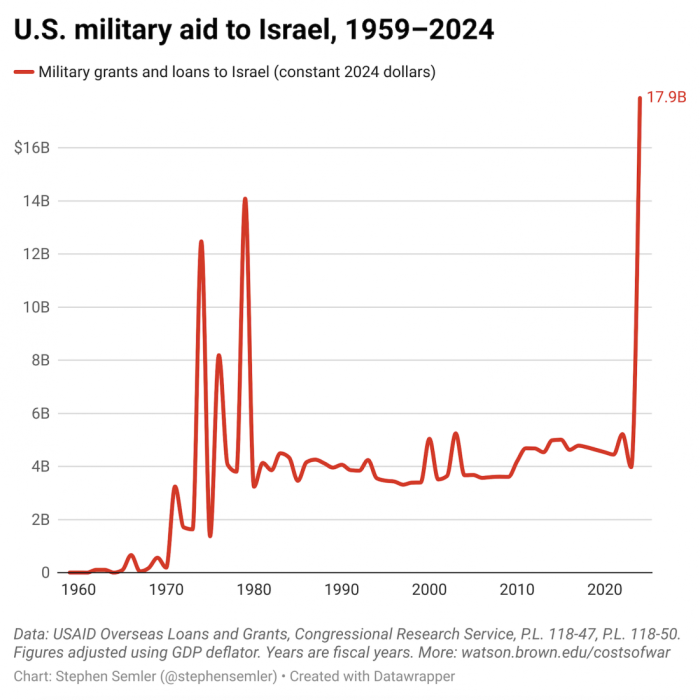
With no end in sight, these operations are sustained by a constant flow of arms from Western nations, particularly the United States and Germany. Since October 2023, the U.S. has dramatically ramped up its military aid, and Washington recently approved an additional $250 million in sales, which pushes the total US military supply to a record $17.9 billion since October 2023. Germany, the second-largest military supplier to Israel, has approved over $275 million worth of military exports since October.
Israel has apparently shelved its planned attack on Iran. A combination of circumstances can be attributed to this retreat, which rubbishes Israel’s own high-pitched rhetoric that it was raring to go.
Despite Israel’s brilliant media management, reports have surfaced that the Iranian missile attack on October 1 was a spectacular success. It was a display of Iran’s deterrence capability to crush Israel, if need arises. The failure of the US to intercept Iranian hypersonic missiles carried its own message. Iran claims that 90 percent of its missiles penetrated Israel’s air defence system.
Will Schryver, a technical engineer and security commentator, wrote on X: “I don’t understand how anyone who has seen the many video clips of the Iranian missile strikes on Israel cannot recognise and acknowledge that it was a stunningdemonstration of Iranian capabilities. Iran’s ballistic missiles smashed through US/Israeli air defences and delivered several large-warhead strikes to Israeli military targets.”
Evidently, in the ensuing panic situation in Israel, as the US president Joe Biden put it, as of October 4, there had been no decision yet on what type of response Israel should mount against Iran. “If I were in their [Israeli] shoes, I’d be thinking about other alternatives than striking oil fields,” Biden said in a rare appearance in the White House briefing room a day after Israeli officials were saying that a “significant retaliation” was imminent.
Biden added that Israelis “have not concluded how they’re — what they’re going to do” in retaliation. Biden also told reporters that Israeli Prime Minister Benjamin Netanyahu should remember US support for Israel when deciding on next steps. He claimed that he was trying to rally the world to avoid all-out war in West Asia.
In this pantomime, it is safer to believe Biden, as the honest truth is that without US inputs and practical help, and money — and direct intervention — Israel simply lacks the stamina to take on Iran. Israel’s regional dominance narrows down to executing assassination plots and attacking unarmed civilians.
But here too, it is debatable how self-sufficient Israel is vis-a-vis Iran. Reports have appeared that the US’ new technological intel pinpointed Hezbollah leader Sayyed Nasrallah’s whereabouts, which were passed on to Israel, leading to his assassination.
Interestingly, CIA Director William Burns stepped in to refute the rumours that Iran conducted a nuclear test on Saturday. Speaking at a security conference on Monday, Burns stated that the US has closely monitored Iran’s nuclear activity for any sign of rushing toward a nuclear bomb.
“We don’t see evidence today that such a decision has been made. We watch it very carefully,” he said. Burns gently erased another alibi to attack Iran.
One critical factor that has compelled Israel / US to defer any attack on Iran is the stern warning by Tehran that any attack on its infrastructure by Israel will be met with an even harsher response. “In responding, we neither hesitate nor rush,” to quote Foreign Minister, Abbas Araghchi, who, by the way, made a trip to Lebanon and Syria over the weekend by way of giving Israel a defiant “message” — as he put it — that “Iran has strongly backed the resistance and will always support it.”
Earlier on October 4, Supreme Leader Ayatollah Ali Khamenei had used a rare public sermon to defend Iran’s missile attack against Israel, saying it was “legitimate and legal” and that “if needed,” Tehran will do it again. Speaking in both Persian and Arabic during Friday Prayers in Tehran, Khamenei said Iran and the Axis of Resistance won’t back down from Israel. Iran will not “procrastinate nor act hastily to carry out its duty” in confronting Israel, Khamenei declared.
However, what deters the Israelis and causes uneasiness in the American mind is something else — Russia’s lengthening shadows on the West Asian tapestry.
American military analysts have disclosed that certain highly advanced Russian weaponry have been transferred to Iran in the recent weeks backed up by the deployment of Russian military personnel to operate these systems, including S-400 missiles. There is speculation that the secretary of Russia’s Security Council (former Defence Minister) Sergei Shoigu paid two secret visits to Iran in the recent period.
Apparently, Moscow also responded to the Iranian request for satellite data on Israeli targets for its missile strike on October 1. Russia also supplied Iran with the long-range electronic warfare system “Murmansk-BN”.
The “Murmansk-BN” system is a powerful EW system, which can jam and intercept enemy radio signals, GPS, communications, satellites, and other electronic systems up to 5,000 kms away andneutralise “smart” munitions and drone systems — and is capable of disrupting high-frequency satellite communication systems owned by the US and NATO.
To be sure, the Russian involvement in Iran’s standoff with Israel is potentially a game changer. From the US perspective, it raises the worrisome spectre of a direct confrontation with Russia, which it doesn’t want.
It is in this scenario that official Russian news agencies have quoted presidential aide Yury Ushakov on Sunday that Putin plans to meet with his Iranian counterpart, Masud Pezeshkian in the Turkmen capital, Ashgabat, on October 11.
Ushakov did not elaborate on the meeting. Indeed, this comes as a surprise since the two leaders are scheduled to meet again at the BRICS summit in the Russian city of Kazan that runs on October 22-24.
Of course, Iranians are also playing coy. Both Moscow and Tehran announced that their presidents were visiting Ashgabat on October 11 to attend a ceremony marking the 300th birth anniversary of the Turkmen poet and thinker Magtymguly Pyragy. Smoke and mirrors! (here and here)
It is entirely conceivable that amidst the cascading regional tensions, Moscow and Tehran may have thought of bringing forward the formal signing of the Russian-Iranian defence pact, which was originally scheduled to take place in Kazan.
If so, the event on Thursday will be reminiscent of the unscheduled visit by the then Soviet Foreign Minister Andrei Gromyko to New Delhi for the signing of the historic Treaty of Peace, Friendship and Cooperation Between India and the USSR on 9th August 1971.
Interestingly, Ushakov added that Putin has no plans to meet Netanyahu. Putin is yet to respond to a request by Netanyahu for a phone conversation, made five days ago. A legend that Netanyahu created, typically, in the recent years to impress his domestic audience (and confuse the Arab street) — that he had a special relationship with Putin — is falling apart.
On the other hand, by chalking up an urgent meeting in Ashgabat — in fact, Turkmen president Serdar Berdimuhamedov was in Moscow only on Monday/Tuesday on a working visit — Kremlin is making it clear to Washington and Tel Aviv that Moscow is irrevocably aligned with Tehran and will help the latter no matter what it takes. (See my blog West Asian crisis prompts Biden to break ice with Putin, Indian Punchline, October 5, 2024)
Isn’t history repeating? The 1971 Indo-Soviet Treaty was the most consequential international treaty entered into by India since Independence. It was not a military alliance. But the Soviet Union boosted India’s military capability for an upcoming war and created space for India to strengthen the basis for its strategic autonomy, and its capacity for independent action.
We are now a year into the Israel government’s military action devastating the people and infrastructure of Gaza and since expanded into escalating violence against countries including Lebanon and Iran. Yet, even today, United States Senate members are repeating flagrant lies produced in the war’s early days to trick Americans and others around the world into supporting Israel’s war.
On Monday, Republican US Senators introduced a resolution repeating some of these old lies that helped build support among Americans for Israel’s war — that “Hamas terrorists” killed “approximately 1,200 individuals” in their October 7, 2023 attack and that Hamas used “rape as a weapon of war.” Why repeat the lies? To support the resolution’s conclusions, including that the Senate wants to “ensure the forever survival of Israel.” Left unsaid in the resolution is that the way the US government continually acts to purportedly achieve this goal includes shoveling more and more money, weapons, and intelligence to Israel for Israel to use in whatever way it chooses. Indeed, the US government’s commitment seems unfazed no matter Israel’s level of barbarity and no matter how much Israel’s actions cause further geographic expansion of the war.
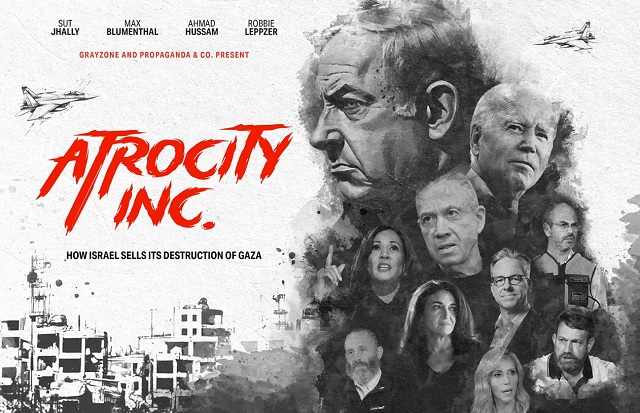
To the extent American politicians repeating these baseless claims regarding October 7 are doing so because they are ignorant about what happened, they would do well to watch a new documentary — Atrocity Inc. — featuring reporter Max Blumenthal. Blumenthal was there from the beginning calling no dice on the propaganda promoted by Israel and US politicians, along with American media, that has been used to gain public support for Israel’s aggressive actions. The widespread rape allegations are ridiculous fabrications and a significant portion of the death toll is from the willful killing of Israelis by agents of their own government, Blumenthal explains in the documentary. Blumenthal also debunks other outrageous lies, including claims related to the killing of, and even beheading of, babies on October 7.
Senators, and everyone else, can watch the documentary here.
No one expected that one year would be enough to recalibrate the Palestinian cause as the world’s most pressing issue, and that millions of people across the globe would, once again, rally for Palestinian freedom. The past twelve months have witnessed an Israeli genocide in Gaza and unprecedented violence in the West Bank, as well as legendary expressions of Palestinian sumud, steadfastness.
It is not the enormity of the Israeli war, but the degree of the Palestinian sumud that has challenged what once seemed to be a foregone conclusion to the Palestinian struggle. Yet, it turned out that the final chapter on Palestine was not ready to be written, and that it would not be Israeli Prime Minister Benjamin Netanyahu who would write it.
The ongoing war has exposed the limits of Israel’s military machine.
The typical trajectory of Israel’s relationship with the occupied Palestinians has been predicated on unhindered Israeli violence and deafening international silence. It was largely Israel alone that determined the timing and objectives of war. Its enemies, until recently, seemed to have no say over the matter.
This is no longer the case. Israeli war crimes are now met with Palestinian unity; Arab, Muslim and international solidarity; and early, albeit serious, signs of legal accountability. This is hardly what Netanyahu was hoping to achieve; just days before the start of the war, he stood in the UN General Assembly brandishing a map of a “New Middle East”, a map that had completely erased Palestine and the Palestinians.
“We must not give the Palestinians a veto over… peace,” he said. Why? “Palestinians are only two per cent of the Arab world.” His arrogance didn’t last long. His supposedly triumphant moment in the international spotlight was short-lived.
Embattled Netanyahu is now mostly concerned about his own political survival. He is expanding the war front to escape his army’s humiliation in Gaza and is terrified by the prospect of an arrest warrant issued by the International Criminal Court (ICC).
And as the International Court of Justice (ICJ) continues to look into an ever-expanding file, accusing Israel of deliberate genocide in the Strip, the General Assembly resolved on 18 September that Israel must end its illegal occupation of Palestine within a year from the passing of its resolution on the matter.
It must be utterly disappointing for Netanyahu — who has worked tirelessly to normalise his country’s occupation of Palestine — to be met with total and thundering international rejection of his schemes. The advisory opinion of the ICJ, issued on 19 July, declared that “Israel’s presence in the Occupied Palestinian Territory (is) unlawful.” This was another blow to Tel Aviv, which despite unlimited US support, failed to change international consensus on the illegality of the occupation.
In addition to the relentless Israeli violence, the Palestinian people have been marginalised as political actors. Since the Oslo Accords in 1993, their fate has been largely entrusted to a mostly unelected Palestinian leadership, which, with time, has monopolised the Palestinian cause for its own financial and political interests.
The sumud of the Palestinians in Gaza, who have endured a year of mass killing, deliberate starvation and total destruction of all aspects of life, is helping reassert the political significance of a long-marginalised nation.
This shift is fundamental as it runs contrary to everything that Netanyahu had tried to achieve.
In the years prior to the war, Israel seemed to be writing the final chapter of its settler-colonial project in Palestine. It had subdued or co-opted the Palestinian leadership, perfected its siege on Gaza and was ready to annex much of the West Bank.
Gaza became the least of Israel’s concerns, as any discussion around it was confined to the hermetic Israeli siege and the resulting humanitarian, although not political crisis.
While Palestinians in Gaza have tirelessly implored the world to put pressure on Israel to end the protracted siege, imposed in earnest in 2007, Tel Aviv continued to conduct its policies in the Strip according to the infamous logic of former top Israeli official Dov Weissglas, who explained the rationale behind the blockade as “to put the Palestinians on a diet, but not to make them die of hunger.”
A year into the war, though, and the Palestinians have become the centre of any serious discussion on a peaceful future in the Middle East. Their collective courage and steadfastness have neutralised the Israeli military’s ability to exact political outcomes through violence.
True, the number of dead, missing or wounded in Gaza has already exceeded 150,000. The Strip was already impoverished and dilapidated to begin with; today it is in total ruins. Every mosque, church or hospital has been destroyed or seriously damaged. Most of the enclave’s educational infrastructure has been obliterated. Yet, Israel hasn’t achieved any of its strategic objectives, which are ultimately united by a single goal: that of silencing the Palestinian quest for freedom, forever.
Despite the unbelievable pain and loss, there is now a powerful energy that is unifying Palestinians around their cause, and the Arabs and the rest of the world around Palestine. This shall have consequences that will last for many years, long after Netanyahu and his fellow extremists are gone.
Hezbollah has ordered its fighters not to attack Israeli forces who established a forward operating base behind UN peacekeeping troops (UNIFIL) near a Lebanese border village, effectively using them as human shields.
“The Israeli enemy is attempting to use UNIFIL forces as human shields to cover its failure to advance toward the village, especially after its repeated and unsuccessful attempts to advance toward Maroun al-Ras and the loss of dozens of its soldiers, both killed and wounded,” a statement issued by the Islamic resistance movement on 7 October said.
“The operations room of the Islamic Resistance instructed the fighters to hold back and not engage with the movement to protect the lives of international soldiers,” the statement added.
The day before, UNIFIL had warned Israel’s operations near their position at Maroun al-Ras were an “extremely dangerous development.”
“It is unacceptable to compromise the safety of UN peacekeepers carrying out their Security Council-mandated tasks,” UNIFIL stated while reminding all actors in the conflict of their obligations to protect UN personnel and property.
On Saturday, UNIFIL said it remained in all positions near the border despite what it said was an Israeli request to “relocate.”
In response to the peacekeepers’ refusal, US foreign policy advisor Matthew Brodsky suggested in a post on X, “Israel should carpet bomb Irish area, then drop Napalm on it.”
Hezbollah fighters are resisting an Israeli ground invasion that began last week.
On Monday, Hezbollah fighters attacked a gathering of Israeli forces in Maroun al-Ras with rockets, while the Israeli army said it had deployed a third division to participate in ground operations in Lebanon.
Israel’s ground maneuvers follow its intensified bombing campaign of Lebanon that began on 23 September. Israel has bombed targets in south Lebanon, the Bekaa Valley, and around Beirut, killing more than 1,110 people since then. The widespread bombing of civilian homes has left over one million people internally displaced.
Hezbollah released a statement on Monday, the one-year anniversary of Hamas’ Operation Al-Aqsa Flood, saying it and the Lebanese people have paid a “heavy price” for its decision to enter the battle against Israel and open a support front for Gaza.
“The enemy continues its crimes and aggression without limits, but we are confident, if Allah wills, in our resistance’s ability to repel the aggression, and in our great and resistant people to endure and hold out until this calamity is lifted,” the statement affirmed.
The US government spent at least $22.76 billion between 7 October 2023 and 30 September 2024 to support Israel’s genocide of Palestinians in Gaza and fuel the raging regional war, according to a report published by Brown University’s Costs of War project.
Since the launch of Operation Al-Aqsa Flood by Hamas one year ago, Washington provided Israel with $17.9 billion in military aid alone, the highest amount in the two countries’ histories, adjusted for inflation. Nevertheless, the report highlights that “this figure represents only a partial picture of total US support for the Israeli [army] over that time period.”
A large portion of Washington’s “security assistance” for Israel consists of munitions, from artillery shells to 2,000-pound bombs that have been dropped over residential areas in Gaza and Lebanon.
“The weapons have come through a variety of channels, including existing US stocks, including the multi-billion dollar WRSA-I stocks located in Israel, commercial sales approved by the State Department, Foreign Military Sales (FMS) approved by State and negotiated and brokered by the Pentagon, Foreign Military Financing (FMF), which provides grants for the purchase of US defense articles and services, and the Excess Defense Articles (EDA) program, which provides used systems no longer needed by US forces for free or at a steep discount,” the Costs of War report details.
However, Washington has worked to obscure “the full amounts of aid and types of systems through bureaucratic maneuvering,” in particular, by making sure that over 100 arms deals signed with Tel Aviv over the past year did not exceed the threshold that would have required reporting them to Congress: “$14 million for major defense equipment and $50 million for defense articles and services, ranging from weapons systems to equipment maintenance and military training.”
Based on publicly available information cited by the researchers, the $17.9 billion figure is divided as follows: $4 billion to replenish Iron Dome and David’s Sling missile defense systems; $1.2 billion for the Iron Beam defense system; $3.5 billion for the procurement of advanced weapons systems, defense articles, and defense services through the FMF program; $1 billion to enhance the production and development of artillery and critical munitions; $4.4 billion to replenish defense articles and defense services provided to Israel from US stocks; finally, the total figure also includes Israel’s usual annual military aid installment of $3.8 billion.
The amount surpasses what Washington spent during the 1973 Arab–Israeli war and is about four times the amount Israel received in the 1980s during its war with the Palestinian Liberation Organization (PLO) in Lebanon, its 15-year occupation of Lebanon, and the 2006 war with Hezbollah.
“Israel receives favorable financing arrangements related to US military aid. For example, US aid is provided on a ‘cash flow’ basis, which means that Israel is able to finance multi-year purchases from the US based on future commitments before the funds have been officially appropriated by Congress … Unlike any other country in the world, Israel is allowed to spend 25% of its routine annual military aid from the United States on its own arms industry,” the report highlights.
Since October 2023, the US has spent an additional $4.86 billion funding its illegal war against Yemen and its failed efforts to protect western trade interests in the Red Sea and beyond. This figure includes $2.4 billion approved by Congress in April for “military operations in the broader region to respond to attacks over the next year,” another $2.4 billion in operation costs for “additional Aircraft Carrier Strike Groups and additional actions against [Yemen],” and between $50 to $70 million in additional combat pay for troops.
“There are an estimated 40,000 American personnel stationed in the region, (including personnel on ships, aircraft, and bases) (compared with 34,000 prior to October 7, 2023). This number rose to 50,000 in early August 2024, when Secretary Austin ordered a second carrier strike group to the area after Israel assassinated Hamas leader Ismail Haniyeh in Tehran,” the report states.
By June, the US navy estimated it had fired $1 billion worth of munitions to confront Yemeni attacks. Furthermore, the Yemeni armed forces have downed at least 11 US MQ-9 Reaper drones over the country. With each costing $30 million, Sanaa has handed Washington at least $330 million in losses.
Finally, the Costs of War investigation reveals that western arms dealers are the ones reaping the benefits of Washington’s unchecked spending to support Israel’s genocidal war, chief among them Boeing, General Dynamics, Lockheed Martin, Northrop Grumman, RTX, and other equipment producers such as Caterpillar.
Israel is promising a response to Iran’s retaliatory attack, with anonymous Israeli officials telling the media it could consist of more targeted assassinations, as well as attacks on Iran’s oil fields, nuclear sites and air defense systems. According to Biden, the U.S. is “discussing” strikes on Iranian oil fields, although he didn’t appear to finish his sentence when he was asked by reporters…
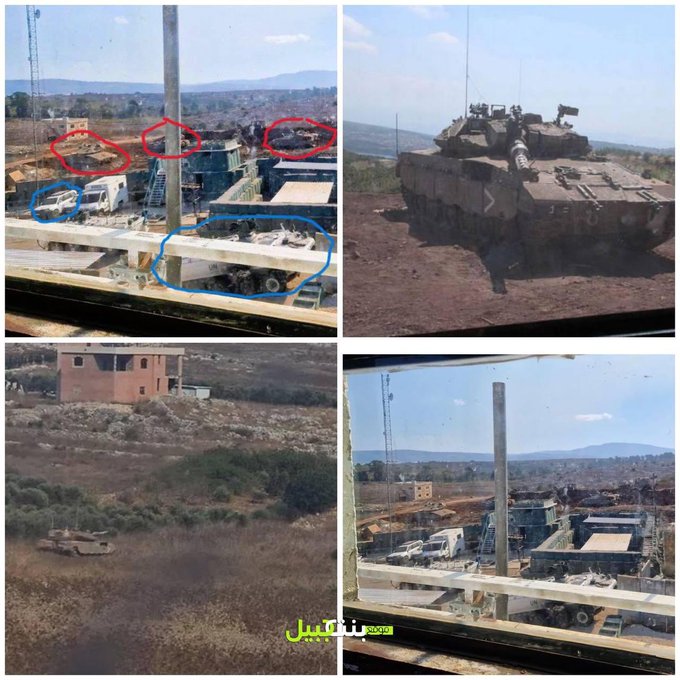
This, as Israel continues to bomb Beirut, targeting heavily populated civilian areas, and Israel’s attempt at a “limited” ground invasion was quickly met with heavy force from Hezbollah, leading to a over a dozen Israeli casualties.
Prof. Seyed Mohammad Marandi, of the University of Tehran, noted that one of Israel’s goals with the latest escalations is to terrorize the Lebanese people until they turn against Hezbollah. But given the fact that Israel has killed hundreds of civilians, displaced over 1.2 million, AND assassinated Hezbollah Secretary General Sayyed Hassan Nasrallah in a matter of weeks… their plan is already backfiring, as the public continues to show support for the Resistance.
Over the weekend, the Commander of the US Central Command (CENTCOM), General Michael Kurilla, arrived in Israel to “coordinate” with the Israeli military and plan a military strike against Iran. Think about that for a moment: one of the highest-ranking officers in the US military is planning a war in a foreign country against another foreign country which will be fueled by American weapons, American intelligence, and American tax dollars.
Did that foreign country – Iran – attack the United States or threaten Americans? No, it did not. What did Iran do to warrant a CENTCOM commander bringing the weight of the US military into play to plan a war – possibly WWIII? It retaliated against Israeli airstrikes including the assassination of a Hamas leader, Ismail Haniyeh, in Tehran.
It was the Israeli missile attack on Tehran – an unprecedented event – that set off this chain of escalation, but few would know it from media coverage. This war fever between Israel and Iran not only has nothing to do with us, but our increasing involvement actually hurts our national interests in the region.
After a deadly and futile three-year proxy war against Russia in Ukraine, the last thing we need is another war in the Middle East, especially against Iran. But make no mistake, war is what we are getting. This Administration has even offered to “compensate” Israel with even more weapons and diplomatic support if they hit targets of the US choosing and avoid others in Iran.
Imagine if China sent military officials to Iran to pay Tehran to make sure some US targets were struck and others avoided. Would we consider it Iran’s war against us, or China’s war against us? Both?
Has Congress declared war on Iran or even authorized the war? No. Has this Administration explained to us why Americans suffering after the catastrophic Hurricane Helene are on their own because we need to spend billions on a war that is none of our business? No. The neocons have wanted this war for decades and for them it’s always America last.
This war will make us less free, less safe, and much poorer. There will be no benefits at all, only downside.
Will the Biden/Harris Administration greenlight Israel taking out Iran’s oil production and other energy facilities? That would mean the average American already suffering under high inflation and an economic downturn would be paying orders of magnitude higher for not just gasoline, but everything. Consider the cost of shipping and trucking and every aspect of our lives that depends on world energy prices. It would be an economic calamity for Americans for the benefit of a foreign country. This is what they call patriotism?
We are sleepwalking into a catastrophic war, lulled into compliance by non-stop media propaganda. More billions will be drained from our economy and many more innocent lives will be lost in this madness. Almost a quarter of a century later we still have not learned the lessons of 9/11. When we go abroad wreaking havoc and destruction on foreign populations who have not harmed us we create enemies who will seek revenge. We harm ourselves. And we risk blowback. The time to oppose this impending war is NOW!
A phalanx of the UK’s most influential journalists brought this odious article to print, decrying as a ‘blood libel’ the reporting of Israel’s killing of thousands of children in Gaza
I can’t put this strongly enough. Howard Jacobson’s article in today’s Observer newspaper may be one the vilest pieces of journalism published in Britain in living memory, arguing that any reporting of Israel’s documented slaughter of many thousands of Palestinian children in Gaza is a “blood libel” and antisemitic. It is pure genocide apologism.
But far worse is the fact that the Guardian Media Group signed off his column. This isn’t the work of one Zionist loon. A whole army of journalists brought it to print.
And note: Jacobson, odious as he is, isn’t responsible for the choice of photo. That is entirely down to the Observer newsroom.
I worked at both the Guardian and the Observer, its Sunday sister paper, for many years. The comment editor, the photo editor, the revise sub-editor, the Observer’s chief editor and all the section heads would have approved not only Jacobson’s text but that photo too.
What on earth did they all imagine that “illustrative” photo of a blood-smeared doll suggested?
That the many thousands of children blown to pieces by Israeli bombs are a fiction.
That all the children decomposing under rubble are made up.
That all the unidentified children buried in Gaza’s sands are a lie.
That all the children dying of epidemics like polio or starving to death from Israel’s aid blockade are an invention.
That any single journalist imagined for a moment that this was an acceptable article or photo in the midst of a genocide is astounding enough.
But that a whole phalanx of the most influential and “liberal” journalists in the country backed it without a second thought tells us something about the depraved culture that passes for journalism in the western establishment media.
These elite journalists are completely divorced from reality. They have no moral core, they live and work as fanatical ideologues for western supremacism. They are as racist as their forebears who cheerled Britain’s subjugation and colonisation of the rest of the globe.
There is no hope of ever having a healthy world as long as these war-mongers and genocide apologists are allowed to remain in charge of shaping our consciousness.
Sixty-six-year-old Palestinian activist, Ziad Abu Ehlayyel, was killed after being brutally beaten by Israeli occupation forces during a raid on his home in the occupied West Bank town of Dura, south-west of Hebron.
According to security sources, Israeli forces stormed Abu Ehlayyel’s home this morning and violently assaulted him until he lost consciousness. Despite being rushed to Dura Hospital, medical staff were unable to save him and he was pronounced dead due to the extent of his injuries.
Abu Ehlayyel was a respected community figure who had been subjected to multiple assaults by Israeli occupation forces during past raids into the town.
Quds News Network shared an archival video showing Abu Ehlayyel confronting Israeli soldiers, pleading with them to stop firing at Palestinian children. In the footage, he can be heard saying: “We don’t want you to shoot anyone, we don’t want you to kill anyone; this is a nonviolent procession, why do you keep shooting at them? Why don’t you stop your settlers from attacking us?”
تغطية صحفية: فيديو سابق الحاج زياد أبو هليل خلال محاولته منع جنود الاحتلال من اطلاق النار تجاه الشبان في مدينة الخليل pic.twitter.com/mTj3PX10ZH
Tensions have been running high across the occupied West Bank amid a brutal Israeli offensive on the Gaza Strip, which has killed more than 41,900 Palestinians, mostly women and children, since 7 October last year.
Today marks one year since the Israeli offensive began, leaving over 97,300 wounded and more than 10,000 people still missing, presumed dead under the rubble.
In the occupied West Bank, the violence has also escalated. Since 7 October 2023, at least 742 Palestinians have been killed, more than 6,200 injured and over 11,100 others detained in the occupied territory, according to Palestinian figures.
The Israeli escalation follows a landmark opinion by the International Court of Justice last July that declared Israel’s decades-long occupation of Palestinian land unlawful and demanded the evacuation of all settlements in the West Bank and East Jerusalem.
Despite repeated efforts by “Israel” and the US to dismantle resistance movements, especially in Lebanon and Palestine, these attempts have consistently fallen short. The core reason for this failure lies in the West’s misreading of the Resistance itself—the Resistance is rooted in deep historical injustices, sustained ideological strength, and has a great capacity to adapt. While leaders may be targeted and eliminated, their movements continue to thrive, fueled by an unwavering dedication to justice and freedom.
The assassinations of key figures like Hezbollah’s Secretary-General Sayyed Hassan Nasrallah, Commander Hajj Imad Mughniyeh, and Commander Fouad Shokor, among others, have not resulted in Hezbollah’s downfall over the years. Instead, the group has only grown stronger, showcasing the inability of “Israel” and the US to truly understand the dynamics of the Lebanese Resistance. These movements are not reliant on individual leaders; they are deeply rooted in collective resilience and continue to thrive despite targeted assassinations.
It’s clear that since the beginning of the war on Gaza, “Israel”, fully backed by the US, sought to dismantle Hezbollah through decisive strikes. This strategy began with the assassination of Commander Fouad Shokor in late July, followed by a series of pager attacks and the assassination of more Hezbollah officials. However, the martyrdom of Sayyed Nasrallah was meant to be the critical blow, aimed at triggering Hezbollah’s collapse and internal disintegration.
Common tactics like economic sanctions, military interventions, and targeted assassinations have been repeatedly used by the US and “Israel” to dismantle Resistance groups. However, history has shown that these strategies have failed.
Take the Gaza Strip, for example—besieged since 2007. “Israel” not only attempted to crush the Palestinian Resistance through relentless military assaults and a blockade but also to turn the people of Gaza against the Resistance by deepening their humanitarian suffering. The plan was clear: starve the population, deny them basic necessities, and push them to blame the Resistance for the hardships. Yet, rather than fracture the relationship, “Israel’s” siege had the opposite effect. The daily brutality, from bombings to the blockade that strangled their livelihoods, only reaffirmed for many in Gaza why resistance was essential for their survival and dignity.
The birth of resistance
Hezbollah was founded in 1982 in direct response to the Israeli occupation of Lebanon, which persisted until 2000. The Resistance movement succeeded in forcing the Israeli military to retreat from Lebanese territory, marking the first time “Israel” withdrew without a formal ceasefire agreement. This significant victory was largely attributed to Hezbollah’s unwavering resistance efforts.
The Israeli withdrawal elevated Hezbollah’s regional influence, establishing it as more than just a Lebanese resistance group—it became a symbol of Arab defiance against Israeli occupation.
“The era of defeat is over. Now is the era of victories.” — Hezbollah’s martyr Secretary-General Sayyed Hassan Nasrallah, July 25, 2006
This triumph not only bolstered Hezbollah’s military reputation but also fortified its position as a central force in Lebanon’s political landscape, intertwining its political influence with its military strength.
That said, it can be confidently stated that Hezbollah emerged from the war and invasion, which shaped it into a highly resilient organization. Its structure is designed to withstand losses, allowing it to regenerate leadership and produce new generations of military commanders, ensuring the continuity of its operations despite any setbacks.
The US and ‘Israel’s’ misreading of Hezbollah and Sayyed Nasrallah
On September 27, with backing from the US, “Israel” assassinated Sayyed Nasrallah, expecting this to cause the downfall of the resistance movement. Although the impact of Sayyed Nasrallah’s martyrdom on Hezbollah and the wider Axis of Resistance is hard to assess fully, it does not indicate that Hezbollah is close to collapsing. The group’s resilience extends beyond any one individual leader.
“Israel” and the US fail to grasp the true essence of his leadership. People didn’t rally behind him solely for his persona; they supported him because he represented their struggle for justice and liberation. Although he was a respected figure, the cause he embodied will endure beyond his lifetime.
“There are thousands of Imad Mughniyehs in Lebanon and in the world”. — Sayyed Hassan Nasrallah, 2010
MMR Vaccine (Measles, Mumps, and Rubella) Is It Safer Than Measles, Mumps and Rubella?
Physicians for Informed Consent | December 2024
… It has not been proven that the MMR vaccine is safer than measles, mumps, and rubella. The vaccine package insert raises questions about safety testing for cancer, genetic mutations, and impaired fertility. Although VAERS tracks some adverse events, it is too inaccurate to measure against the risk of measles, mumps, and rubella. Clinical trials do not have the ability to detect less common adverse reactions, and epidemiological studies are limited by the effects of chance and possible confounders. Safety studies of the MMR vaccine are particularly lacking in statistical power. A review of more than 60 MMR vaccine studies conducted for the Cochrane Library states, “The design and reporting of safety outcomes in MMR vaccine studies, both pre- and post-marketing, are largely inadequate.”19 Because permanent sequelae (aftereffects) from measles, mumps, and rubella are so rare (especially in children with normal levels of vitamin A and infected after birth),6,15-17 the level of accuracy of the research studies available is insufficient to rule out the possibility that the MMR vaccine causes greater death or permanent disability than measles, mumps, and rubella. – Read full article
This site is provided as a research and reference tool. Although we make every reasonable effort to ensure that the information and data provided at this site are useful, accurate, and current, we cannot guarantee that the information and data provided here will be error-free. By using this site, you assume all responsibility for and risk arising from your use of and reliance upon the contents of this site.
This site and the information available through it do not, and are not intended to constitute legal advice. Should you require legal advice, you should consult your own attorney.
Nothing within this site or linked to by this site constitutes investment advice or medical advice.
Materials accessible from or added to this site by third parties, such as comments posted, are strictly the responsibility of the third party who added such materials or made them accessible and we neither endorse nor undertake to control, monitor, edit or assume responsibility for any such third-party material.
The posting of stories, commentaries, reports, documents and links (embedded or otherwise) on this site does not in any way, shape or form, implied or otherwise, necessarily express or suggest endorsement or support of any of such posted material or parts therein.
The word “alleged” is deemed to occur before the word “fraud.” Since the rule of law still applies. To peasants, at least.
Fair Use
This site contains copyrighted material the use of which has not always been specifically authorized by the copyright owner. We are making such material available in our efforts to advance understanding of environmental, political, human rights, economic, democracy, scientific, and social justice issues, etc. We believe this constitutes a ‘fair use’ of any such copyrighted material as provided for in section 107 of the US Copyright Law. In accordance with Title 17 U.S.C. Section 107, the material on this site is distributed without profit to those who have expressed a prior interest in receiving the included information for research and educational purposes. For more info go to: http://www.law.cornell.edu/uscode/17/107.shtml. If you wish to use copyrighted material from this site for purposes of your own that go beyond ‘fair use’, you must obtain permission from the copyright owner.
DMCA Contact
This is information for anyone that wishes to challenge our “fair use” of copyrighted material.
If you are a legal copyright holder or a designated agent for such and you believe that content residing on or accessible through our website infringes a copyright and falls outside the boundaries of “Fair Use”, please send a notice of infringement by contacting atheonews@gmail.com.
We will respond and take necessary action immediately.
If notice is given of an alleged copyright violation we will act expeditiously to remove or disable access to the material(s) in question.
All 3rd party material posted on this website is copyright the respective owners / authors. Aletho News makes no claim of copyright on such material.