‘Israel destroyed Central Archives of Gaza City’: Head of Gaza Municipality
MEMO | November 29, 2023
The head of Gaza Municipality said, Wednesday, that Israel destroyed the “Central Archives” which contained thousands of historical documents dating more than 150 years, Anadolu Agency reports.
“Targeting the Central Archives poses a great danger to the city, as it contains thousands of historically valuable documents for the community” Yahya Al-Sarraj told Anadolu.
He pointed out that “these documents … represent an integral part of our history and culture.”
“The Central Archives contains plans for ancient buildings of historical value and documents in the handwriting of well-known national figures,” he said.
“These documents, dating back a long time, were burned, turning them into ashes, erasing a large part of our Palestinian memory” he noted.
Al-Sarraj said: “The Occupation targeted many buildings, including large and monumental cultural centres, as well as public parks belonging to the municipality.”
“Targeting included the Rashad Al-Shawwa Historical Cultural Centre, a very important centre that includes a theatre and a central library, which was targeted without any justification
“The Israeli Occupation also targeted the Palestinian Legislative Council and the memorial monument in the Memorial Park for the (Al-Jundi Al-Majhool) Unknown Soldier,” he said.
Al-Sarraj said “the attempt by the Occupation to destroy everything beautiful, to erase Palestinian memory, and to impose a policy of obscuring the people, making Palestinian cities uninhabitable.”
As part of the targeting of the Palestinian people and everything related to their values, heritage, culture and identity, Israel targeted memorials in several governorates since the start of its war early last month, including the Memorial of the Martyrs of the Marmara Ship in Gaza Port, the memorial of late journalist Shireen Abu Akleh in the Jenin Refugee Camp and the memorial of late President Yasser Arafat in Tulkarm, in the West Bank.
The main library in the Gaza Strip also did not escape the Israeli war machine, which bombed it during raids that targeted Gaza City since the outbreak of the war on 7 October.
The library, known as the Public Offices Building, is the largest in the Strip, containing historical documents and books.
According to statements made, Tuesday, by the spokesperson for the Gaza City Municipality, Hosni Muhanna, residents of the city consider it the memory of the country and its present.
Russia: US played ‘destructive role’ in escalating Israeli war in Gaza
Press TV – November 29, 2023
Russia says the United States has escalated the conflict between Israel and the Palestinian resistance movement Hamas by playing a “destructive role.”
Russia’s Deputy Permanent Representative to the UN Dmitry Chumakov made the comment during a speech he delivered to the United Nations General Assembly on Tuesday. He denounced Washington’s policies in West Asia.
“The policies of the US which meant that it kept turning a blind eye to the ongoing Israeli settlement construction in the occupied [Palestinian] territories and recognized Israel’s sovereignty over the occupied Golan Heights, have played a destructive role in the current escalation,” he said.
According to Gaza government health officials, over 15,000 Palestinians, including more than 6,000 children, were killed by Israeli aggression during the 49 days of war. Many more are feared to be buried under the rubble.
“As a result, we are now witnessing a conflict of unprecedented scope, which may spread to the entire Middle East,” Chumakov warned.
Washington has supported Tel Aviv’s relentless attacks on the Palestinian territory as an instance of “self-defense,” and has provided the regime with thousands of arms consignments since the onset of the war.
A four-day Qatari-brokered ceasefire between Tel Aviv and Hamas went into effect on Friday and was extended for two more days on Monday following mediation from Egypt and Qatar.
So far, under the truce deal, Hamas freed 69 hostages in return for 150 Palestinian prisoners held by Israel.
US fully responsible for situation in Gaza: Moscow
On Wednesday, Russian Foreign Ministry Spokeswoman Maria Zakharova said that the US is fully responsible for the current situation in the war-ravaged Palestinian enclave, stressing that Washington’s policies have served as the primary sources of tension in the conflict zone.
“The entire current collapse on the territory [of the Gaza Strip], where a colossal tragedy related to the Palestinian-Israeli confrontation has unfolded, is completely and fully the responsibility of the United States, or, rather, I should say, [due to] the irresponsibility [of the US]. It is only they [who are responsible],” she said during an interview with the Sputnik radio station.
The Gaza health ministry says the Israeli regime keeps denying hospitals fuel for their generators in violation of the truce. The Israeli onslaught on Gaza has brought almost all vital infrastructure in the besieged strip to a standstill.
German president ignored on arrival in Qatar
RT | November 30, 2023
German President Frank-Walter Steinmeier was kept waiting for almost 30 minutes in a plane passenger exit in the searing heat of Doha on Wednesday, before Qatari Foreign Minister Soltan bin Saad Al-Muraikhi finally arrived to receive him, German media have reported.
State outlet Deutsche Welle (DW), accompanying Steinmeier’s delegation, said the official preparations for the president’s arrival in Qatar had appeared to be in place. The red carpet had been rolled out and the guard of honor was ready, but no official was there to welcome the German president as he stood, arms folded, at the top of the ramp. Despite the delay, Steinmeier’s meeting with Qatari Emir Sheikh Tamim bin Hamad Al Thani later proceeded according to schedule, DW reported.
Steinmeier was in the Middle Eastern state to discuss efforts to release the remaining German hostages being held by Hamas, following the Palestinian militant group’s attack on Israel on October 7.
Several German nationals were among the more than 200 hostages taken by Hamas during its assault, which killed more 1,200 people.
Berlin has repeatedly stated that it supports Israel’s right to self-defense amid its devastating response in Gaza, which has claimed more than 16,000 Palestinian lives, according to the enclave’s Health Ministry.
DW suggested that “Wednesday’s apparent snub” could lead some to wonder if it was a response to statements by German Foreign Minister Annalena Baerbock in October.
“We do not accept support for terror,” Baerbock told the ZDF channel, arguing that countries such as Qatar “have a special responsibility to put an end to this terrorism.”
Qatar hosts the office of the Hamas political wing. Its proximity to the Palestinian militant group has made Doha a key figure in the negotiations between Israel and Hamas over the release of hostages.
On Tuesday, CIA Director William Burns and the head of Israel’s Mossad intelligence service, David Barnea, visited Qatar to hold talks with Prime Minister Sheikh Mohammed bin Abdulrahman bin Jassim Al Thani about the extension of a ceasefire in Gaza, as well as the ongoing hostage negotiations.
Musk responds to Hamas invitation
RT | November 29, 2023
Tesla and SpaceX CEO Elon Musk has declined an invitation by a senior Hamas official to tour Gaza to see the fallout of the relentless Israeli attacks on the Palestinian enclave. The US billionaire recently paid a visit to Israel during which he agreed that the country had no other choice but to destroy Hamas.
On Tuesday, Osama Hamdan, a member of the Hamas politburo, told a press conference in Beirut, Lebanon, that the Palestinian armed group would be happy to show Musk “the extent of the massacres and destruction committed against the people of Gaza, in compliance with the standards of objectivity and credibility.”
Asked by a user on X (formerly Twitter) to comment on the invitation, Musk replied that “[it] seems a bit dangerous there right now.” “But I do believe that a long-term prosperous Gaza is good for all sides,” he added.
The US tycoon’s remarks came after Musk traveled to Israel on Monday, where he met with Prime Minister Benjamin Netanyahu and President Isaac Herzog, and walked through a kibbutz destroyed by Hamas.
He also had a conversation with Netanyahu during which he agreed with the latter’s stance on Hamas, arguing that “those who are intent on murder must be neutralized.”
Musk’s trip to Israel came after the billionaire found himself in hot water over accusations that he harbored “anti-Semitic” sentiments. In particular, he emphatically concurred with one post accusing Jewish people of “pushing the exact kind of dialectical hatred against whites that they claim to want people to stop using against them.”
He has also previously been at odds with the Anti-Defamation League (ADL), a Jewish advocacy group, which accused the mogul of allowing hate speech on X. Musk has denied the anti-Semitism allegations and has threatened to sue the organization.
The conflict, which erupted after Hamas’ attack on Israel on October 7, has caused thousands of casualties on both sides, as well as a humanitarian crisis and widespread devastation in Gaza. As the hostilities intensified, tensions between pro-Palestinian and pro-Israeli communities around the world have also surged.
UN General Assembly Denounces Occupation of Syrian Golan Heights, Demands Israeli Withdrawal
Sputnik – 29.11.2023
UNITED NATIONS – The UN General Assembly renewed its resolution demanding that Israel withdraw from Syria’s Golan Heights.
The resolution was renewed on Tuesday with 91 votes in favor, eight against and 62 abstentions.
The resolution says that United Nations member states are “deeply concerned that Israel has not withdrawn from the Syrian Golan, which has been under occupation since 1967, contrary to the relevant Security Council and General Assembly resolutions.”
The document also emphasizes “the illegality of the Israeli settlement construction and other activities in the occupied Syrian Golan since 1967.”
Iran holds IAEA accountable for Israel’s atomic threats: Nuclear chief
Press TV – November 29, 2023
The head of the Atomic Energy Organization of Iran (AEOI) says the International Atomic Energy Agency (IAEA) bears responsibility for any nuclear accident caused by Israel amid the regime’s repeated threats to use atomic bombs.
Speaking on the sidelines of a cabinet meeting in Tehran on Wednesday, Mohammad Eslami said that he had raised the issue of nuclear threats made by Israeli officials with IAEA Director General Rafael Grossi before a meeting of the UN nuclear watchdog’s Board of Governors.
“We told the IAEA chief that … it is a violation of international law if you do not take a position against a party that has not signed the Nuclear Non-Proliferation Treaty (NPT), is not committed to the Safeguards Agreement, does not allow the agency’s access to [its nuclear facilities], and clearly declares that it will use nuclear weapons,” he added.
“The responsibility for any [nuclear] accident lies with the IAEA, because the Zionist regime has not signed the NPT and the Safeguards Agreement, and today the regime is threatening the world with atomic bombs.”
Earlier this month, Israel’s so-called heritage minister Amichai Eliyahu said that dropping a nuclear weapon on Gaza was “one of the possibilities” in the ongoing war on the besieged Palestinian territory.
Back in September, Israeli prime minister Benjamin Netanyahu called for a “credible nuclear threat” against Iran in an address to the 78th session of the UN General Assembly. However, the hawkish premier’s office later said that he misread the line and meant to say a “credible military threat.”
Israel, which pursues a policy of deliberate ambiguity about its nuclear weapons, is estimated to have 200 to 400 nuclear warheads in its arsenal, making it the Middle East’s sole possessor of non-conventional arms.
The usurping entity has, however, refused to either allow inspections of its military nuclear facilities or sign the NPT, an international treaty aimed at preventing the spread of nuclear arms.
Also in his remarks, Eslami said that the bloody Israeli war on Gaza has exposed the nature of the Israeli regime.
He expressed hope for a day, when international organizations will be effective and ensure international peace and security.
Israel lobby offers another candidate $20m to run against Rashida Tlaib in Michigan
MEMO | November 28, 2023
Nasser Beydoun revealed on social media that he had been contacted by the Israeli lobby group AIPAC and offered $20 million to run against Congresswoman Rashida Tlaib in Michigan. Beydoun is the second candidate who has been offered funds to run against Tlaib, with Senate candidate Hill Harper speaking of a similar offer last week.
Taking to X, Beydoun wrote: “Even knowing where I stand on AIPAC’s influence on our elections and foreign policy, the pro-Israel lobby had the nerve to suggest that I would even consider taking a dime from them.”
Adding that he had been asked to “run against my friend Rashida Tlaib.”
“The pro-Israel lobby will go to any length to remove anybody from the US Congress that has any opposition to their agenda and their total unequivocal support for Israel, good, bad, or indifferent.”
Tlaib, who represents Michigan’s 12th District in Congress, is the only Palestinian-American in the US House of Representatives. She is known for her criticism of Israel’s occupation and its invasion of Gaza.
Earlier this month, the House of Representatives voted to censure Tlaib for some statements that angered the Zionist lobby and the right-wing movement in the US, such as the use of the slogan “From the river to the sea.”
Politico first reported on 22 November that a Michigan businessman had offered Harper $20 million in campaign money if he stood against Tlaib in next year’s Democratic primary race, identifying Linden Nelson as the figure.
There is no sharing in settler-colonialism, Josep Borrell, only land theft
By Ramona Wadi | MEMO | November 28, 2023
When the so-called humanitarian pause is over, said Israeli Prime Minister Benjamin Netanyahu, “We are returning full power to carry out our aims: destroy Hamas, ensure that Gaza won’t return to what it was, and of course to free all of our hostages.” No one ever doubted that, but the international community has descended into further disgrace with its silence over Israel’s next round of ethnic cleansing in Gaza.
Netanyahu’s agreement to the hostage deal served as relatively good publicity, of course: “These incredible images of people being reunited with their families — the humanity of it, the sense of accomplishment of that and the possibility and promise that more and, ultimately, all of the hostages will come home.” This was despite the fact that it is possible that not all Israeli hostages will be freed by the end of the pause.
Those who are left run the risk of becoming part of Israel’s “collateral damage” in the enclave.
Meanwhile, as the focus on Gaza and the pause continues, Israel is ramping up its arrests of Palestinians in the occupied West Bank, ensuring that the number of prisoners it releases as part of the deal is negligible in comparison. Since 7 October, Israel has arrested 3,260 Palestinians in the occupied Palestinian territory.
On top of this, extreme far-right Finance Minister Bezalel Smotrich is requesting funds for “security and security infrastructure” in the West Bank. The EU’s High Representative for Foreign Affairs, Josep Borrell, was “appalled” by this, according to a post on X, in which he described settlements as “Israel’s greatest security liability.” Even so, according to Borrell, Israel and the Palestinians “both have equal and legitimate right to the same land, so they have to share it,” imparting colonialism in the most erroneous way possible.
If Israeli settlements are a liability, they always were, including the early colonial settlements that paved the way for Israel’s colonisation of Palestine. The UN’s differentiation of settlement expansion is merely an excuse to justify Israel’s colonial enterprise and the international community’s recognition of it as a state. For Borrell, and the rest of the EU, sharing the land is equal to enforcing the two-state paradigm, in which, hypothetically, Palestinians get some slivers of land while Israel owns and manages it all.
The scenario unfolding in Gaza should at least prompt Western leaders to reconsider their two-state rhetoric. Netanyahu has stated that Gaza will not return to what it was; that overt threat speaks of the next phase of Israel’s ethnic cleansing of the enclave. The entire world has watched Israel kill thousands of Palestinians and displace most of the population of Gaza, while diplomats debated over pauses – “humanitarian”, of course – in accordance with the hypocritical politics they espouse. Is there any consideration in the West for Israel’s genocide about to resume after the pause? How many more Palestinians will Israel kill before it is determined that there is no humanitarianism in this lull which has the world focused on hostages and not the process of settler-colonisation?
Settler-colonialism is not a sharing concept; it is theft. So, when will Borrell and all diplomats and politicians who speak of the two-state compromise face any accountability for encouraging genocide by refusing to acknowledge the reality of Israeli settler-colonialism, which seeks to replace the indigenous population with settlers?
United for Gaza: Time now for Palestinians to protect their collective sumud

By Ramzy Baroud | MEMO | November 28, 2023
Shortly after the start of a four-day ceasefire in the war on Gaza, the prime ministers of Spain and Belgium, Pedro Sanchez and Alexander De Croo, appeared in a joint press conference at the Rafah Crossing.
While Sanchez described “what is happening (as) a disaster,” De Croo called for a “permanent cessation of hostilities” and for an end to the killing of children.
Equally significant, the two European leaders declared that “we may decide to recognise the State of Palestine, if the European Union does not.”
Coupled with the strong position of Ireland, some in Europe seem to be waking up to the fact that the Israeli occupation is the primary cause of the recent Gaza ‘hostilities’.
Israel was not pleased by the evolving European position. It immediately summoned the ambassadors of both countries and sharply ‘rebuked’ them. This exaggerated response comes to show that Israel is not willing to give Europe even the narrowest of margins – as in condemning the killing of children or, expecting some kind of a peaceful settlement centered round Palestinian sovereignty.
Spain and Belgium’s phrase of “we may decide” to recognise Palestine even without EU consensus is indicative of an actual foreign policy schism within Europe itself. It turned out that not all EU governments have the same tolerance towards the genocide in Gaza as, for example, Germany and Britain.
Interestingly, other EU officials, too, are calling for a Palestinian State, though their intention is neither to ensure Palestinian freedom nor to safeguard Palestinian rights.
EU chief diplomat Josep Borrell, for example, argued on 20 November that “the creation of a Palestinian state would be the best way of ensuring Israel’s security”.
Even the former British prime minister, now secretary of state for foreign affairs, used similar logic. Israel will not have security unless it guarantees “long-term safety, security and stability” for the Palestinian people, David Cameron said.
Regardless of the reasoning behind the growing emphasis on a ‘solution’ and rights for the Palestinians, this language was almost entirely absent from the Western political discourse prior to 7 October.
The truth is that Palestinians have succeeded, through their resistance and sumud, to reassert Palestine on the global agenda. But how did Palestinians succeed in doing so, despite the utter marginalisation of their cause before the war?
First, unlike previous wars, especially those that preceded the Unity Intifada of May 2021, this time around Palestinians spoke in unison.
Without rehearsing or even coordinating, it felt as if the Palestinian message flew seamlessly, when all Palestinians, regardless of their ideological backgrounds, placed the focus on the Israeli atrocities, without falling into the trap of the typical factional blame game.
Even children who have lost members of their families in Gaza would stand bravely in front of cameras reiterating that they will never weaken and that nothing would remove them from their homeland. Young and old repeated the same logic, used similar language, even from their hospital beds.
This led Israel to do everything in its power to excommunicate the 2.3 million Palestinians in Gaza from the rest of the world, shutting down the internet, electricity and any form of communications, even among Palestinians themselves.
Yet, somehow, a clear, united Palestinian message continued, amplified countless times by an army of social media activists who impressively helped balance out mainstream media bias, eventually overpowering corporate media’s control over the war narrative altogether.
The Palestinians have done this, and more, without powerful lobby groups, media consultants or a hasbara machine, like that which attempted, to no avail, to sway the public opinion in favour of Israel.
Secondly, the factional Palestinian suddenly disappeared.
For years, factional narratives, dividing Palestinians into conflicting interest groups, have thwarted the Palestinian people’s attempt to unify behind a single leadership – one that is capable of conveying, representing and defending Palestinian political aspirations.
Yet, all the Fatah-Hamas talks and agreements have failed, leaving the people with no other alternative but to explore different manifestations of unity that go beyond the interests of politicians.
This unity is now on full display, compelling everyone, including those affiliated with the Palestinian Authority itself, to adhere to the line of the people. While Gazans fought to free prisoners in the West Bank, West Bankers rose, and died in large numbers, in defence of Gaza.
This popular unity must continue, so that it would eventually be harnessed in the form of political unity, which will bring all Palestinian groups together under a single leadership. This is the only way to ensure the tremendous Palestinian sacrifices and the precious blood that spilled in Gaza, eventually translate into the freedom that all Palestinians covet.
Thirdly, unity beyond Palestine also proved critical.
Arabs and Muslims served as the core of Palestinian solidarity throughout the Israeli war on Gaza. They protested, boycotted, fought and mobilised. Moreover, tens of millions of people, beyond the confines of the Arab and Muslim worlds, also marched around Palestinian rights and priorities.
Indeed, whole new conversations on Palestine are now occupying many public spheres around the globe. The Global South is once more embracing the struggle for Palestine, while the Global North is challenging governments, big corporations and mainstream media for justifying, supporting and financing the Israeli genocide.
The Palestinian people will now have to lead and direct this momentum of solidarity so that it may serve their righteous objectives, those of equality, justice and freedom – all enshrined in international law.
No public space should be left without engagement, no audience should be overlooked or neglected, and no stone should be left unturned in the search of that critical mass needed to hold Israel accountable for its crimes.
Western leaders and officials are speaking out now because they understand that the Palestinian cause has become a global one, and that the prolonging of Israeli occupation and apartheid will not bode well, neither for Tel Aviv nor for the collective West.
It is time for Palestinians to utilise this significant moment. It is time for them to lead the process of their own liberation. In fact, in Gaza, Jenin and elsewhere, this process has already begun.
Israeli detainee thanks resistance fighters for kind and humane treatment
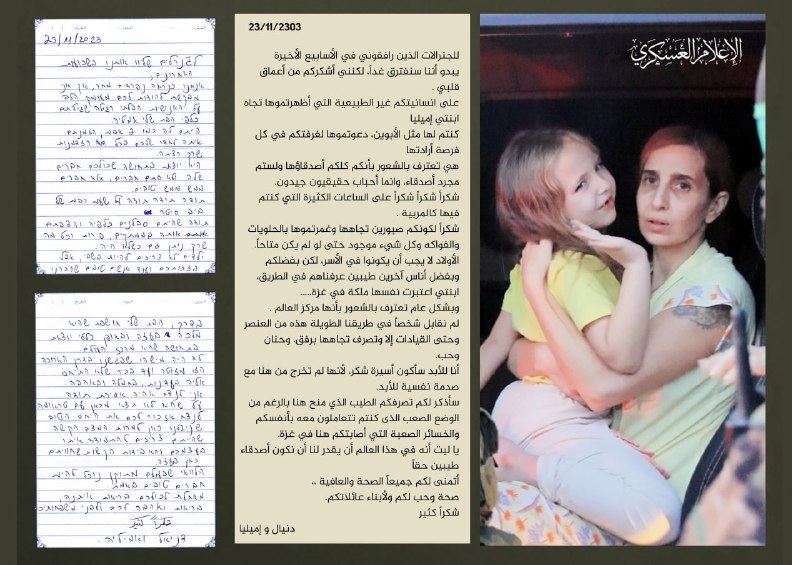
Palestine Information Center – November 28, 2023
GAZA – Israeli ex-detainee Daniel Aloni has thanked the resistance fighters from al-Qassam Brigades of Hamas for treating her and her 6-year-old daughter Emilia kindly and humanely during their presence in captivity.
This came in a letter she wrote in Hebrew while she was in detention, in which she expressed her gratitude for al-Qassam fighters who were escorting and guarding her and her daughter during the days they had spent in Gaza.
Daniel and her daughter were among the first group of captives who were released on Friday by al-Qassam Brigades.
Below is the full text of the letter as translated from Hebrew and provided by the Brigades’ military media.
“To the commanders who have accompanied me in recent weeks, it seems that we will part ways tomorrow, but I want to thank you from the bottom of my heart for your extraordinary humanity that you have shown towards my daughter Emilia. You treated her like your own. You welcomed her in your room whenever she walked in. She says that you are all her friends, not just acquaintances. You are her true and good loved ones. Thank you, thank you, thank you for the countless hours you spent with her as caregivers. Thank you for being patient with her and showering her with sweets, fruits, and everything available, even if it wasn’t readily accessible. Children should not be in captivity, but thanks to you and other kind-hearted individuals and leaders we have met during our presence in her, my daughter considered herself a queen in Gaza and felt like she was the center of the world. We did not meet a single person, whether a member or leader, during our long stay [in Gaza], who did not treat her with kindness, tenderness, and love. I will forever be a captive of gratitude because she will not leave this place with a permanent psychological trauma. I will remember your kind manners, which you showed in here despite the difficult situation you were coping with yourselves, and the heavy losses that befell you here in Gaza. I wish in this world that we could be really good friends one day. I wish you all good health and well-being. Health and love to you and your families. Thank you very much. Daniel and Emilia.”
Featured Video

Netanyahu Ordered the 2003 Invasion of Iraq
or go to
Aletho News Archives – Video-Images
From the Archives
A Lesser “Grade” of Human
By Michael Hoffman | Revelation of the Method | January 3, 2024
Will the more than 100 Iranians killed by terrorist bombs today be mourned in the West as victims of terrorism? Certainly not. Allied doctrine has it that the killing of Israeli or American civilians is a crime of cosmic proportions, while shedding the blood of “enemy” women and children is perfectly acceptable; indeed commendable.
The West does not memorialize the hundreds of thousands of civilians bombed by the U.S. in Serbia, Iraq, Afghanistan and every major German city 1943-1945. America’s fire-bombing of the city of Tokyo by General Curtis LeMay in March 1945 was followed by Harry Truman’s atomic incineration of Hiroshima and Nagasaki in August of that year. Truman never had a moment of doubt or regret over the murder of more than a 100,000 Asian children, mothers and non-combatant boys and men. It was business as usual for the “noble” Allies during the “Good War.”
In the West human rights signifies passionate concern only for civilians designated as truly human: Israelis first, then Americans and British, followed by their satraps.
This inhumanity is the legacy of Talmudic ideology, beginning with tractate Sanhedrin 57a from 400 A.D., concerning liability for capital punishment: “If a Jew murders a gentile, he is exempt.”
This teaching of contempt was reiterated in the dogma of Chabad Lubavitch founder Rabbi Shneur Zalman in the 18th century. … continue
Blog Roll
 Aletho News
- NATO’s top generals gather in Kiev
- EU’s continuing expansion – greater threat to Russia
- US Senator Murphy says Pentagon denied him entry to US base in Qatar
- Israel expands “incitement” charge to target Palestinian education and memory
- How Israel seeks to reshape Arab classrooms
- Paris bans pro-Palestinian demonstration planned for Oct. 7 over ‘risks of public disorder’
- In August Hanning Treason Case – All Signs Point To Tel Aviv.
- France cleared dozens of military sales to Israel between May and September: Report
- France projects nuclear power as Macron pushes arsenal expansion
- The fallacy of US delusions about Iran’s economic collapse
- If Americans Knew
- ‘I’d rather die than go back’: A Palestinian teen’s 10-month nightmare in Israeli jail
- How Jared Kushner’s firm’s investment in an Israeli company could be a major conflict of interest
- Soldier testimony sheds light on how Israel wages information war
- CIA Report Warns Israel Could Head Toward Civil War, Total Collapse
- Banker Who Exposed Howard Lutnick’s Ties to Epstein Warned of ‘Retaliation’ and ‘Personal Consequences’ in Last Post Before Suicide
- Israeli Attacks Kill Two Palestinians in Gaza
- Gaza genocide at 3: Israeli-U.S. cruelty and the smart, deep resistance to it are changing the world
- As genocide is about to enter 3rd year, little of Gaza remains– Daily Update
- “We See Our Homes Now From A Satellite, Like Strangers”
- Watch “Gaza: Doctors Under Attack”, originally censored by BBC
- No Tricks Zone
- US September “Heat” Was No Record…Many Records Set Decades Ago
- Latest European Green Energy Debacle; Portugal’s Largest Flagship Solar Park Insolvent!
- Green Energy Debacle: German Expert Professor Fritz Vahrenholt Warns Of Severe Economic And Social Consequences
- Two More Paleo Reconstructions Affirm Meters-Higher Sea Levels Across Ireland, Brazil 7000-6000 Years Ago
- New Study: Earth And Venus Surface Warmth Largely Explained By Convection And Lapse Rate, Not CO2 Or Radiation
- 2025 Nature Paper Claiming Worsening Global Drought Gets RETRACTED …Heavily Flawed
- New Study: ‘Global Drought Shows No Detectable Recent Acceleration Under Climate Warming’
- Economic Masterminds: German Socialists Suggest Taxing Productivity Gains Stemming From Using AI
- The South China Sea Has Not Been Cooperating With The Climate Change Narrative
- Energy Crisis: Germany Enters Heating Season With Historically Low Gas Reserve Fill Levels

