UN: Aid entering Gaza is 5% of what entered before 7 October
MEMO | November 28, 2023
The spokesman for the United Nations Relief and Works Agency for Palestine Refugees (UNRWA), Adnan Abu Hasna, today confirmed that dozens of trucks of aid had entered Gaza City and the northern Gaza Strip during the truce.
He said it contains food supplies, drinking water, baby milk, flour, canned goods and various other foodstuffs.
Abu Hasna noted that the volume of humanitarian aid entering through the Rafah crossing is only five per cent of the volume that entered before the Israeli aggression on the Gaza Strip on 7 October.
On average, he explained, 50 trucks are entering the Strip each day, while before the aggression 500, sometimes 600, trucks entered per day.
“What we need is the entry of 200 trucks daily for at least two continuous months in order to respond to the necessary humanitarian needs,” Abu Hasna said. The Rafah crossing alone is not sufficient for the entry of Gaza’s aid needs, he explained, adding that “the only crossing that has the capabilities, mechanisms, and detection devices is the Karam Abu Salem crossing.”
With winter temperatures setting in, Abu Hasna said, “we need bedding, covers and winter clothes, and we are working hard to bring them in or at least open a commercial corridor to bring in goods so that people can buy.”
Israel’s ground war conundrum
By Hasan Illaik | The Cradle | November 27, 2023
Before dusk on 26 November, fighters from Hamas’ military wing, Al-Qassam Brigades, began the process of handing over to the International Red Cross a number of Israeli captives taken during the 7 October Al-Aqsa Flood operation. The transfer of these women and children took place in the Gaza Strip amid what appeared to be a security parade. Al-Qassam fighters arrived in four-wheel-drive vehicles and deployed themselves around the site, wearing full uniforms and bearing arms. Surrounded by civilians cheering on the resistance, the transfer of the Israeli captives was completed smoothly and quietly.
This event took place in Palestine Square in Gaza City on the third day of the truce that followed a 49-day war. Throughout the war, Gaza City has been subjected to a suffocating siege and an unprecedented Israeli air and artillery assault, not seen since at least 1982.
The handover process in Palestine Square also took place more than a month after the Israeli army began its ground operation, in which it aims to occupy Gaza City and all areas north of the Strip, destroy them, and displace their population permanently. But the visual of Al-Qassam fighters confidently standing guard in Palestine Square on 26 November, suggested to all present that they remained unharmed by Israel’s war.
The fighters transported the Israeli prisoners from their various hideouts and agreed-upon pickup sites to the square, while ensuring that these safe houses would not be discovered. Somebody issued the order, and others carried it out seamlessly, in a highly visible geographical area of less than 150 square kilometers. Keep in mind that Israel and the US have allocated enormous intelligence resources over the past six weeks to unearth the vast network of Hamas tunnels, and to discover the whereabouts of the prisoners.
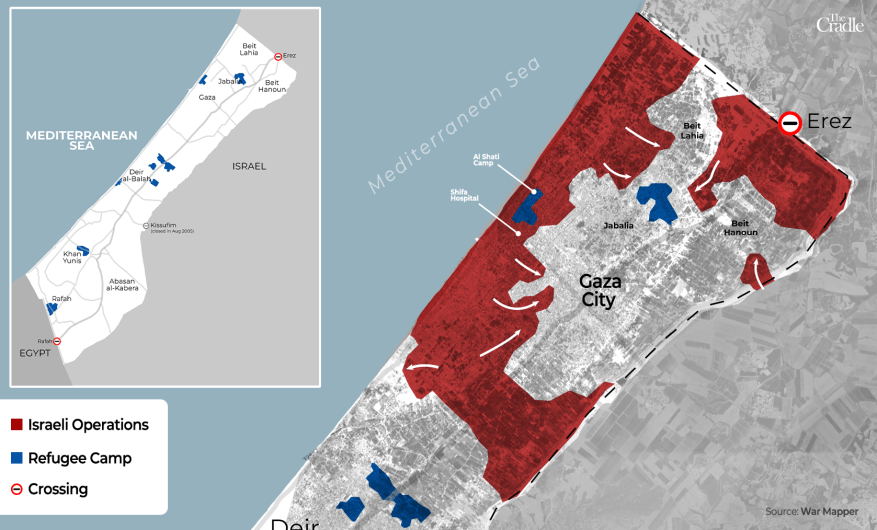
Map of Israeli operations in Gaza
This picture reveals, to a large extent, the results of Israel’s ground operation: civilian massacres and infrastructural destruction galore, but with little damage to the military structure of the Palestinian resistance. A number of its leaders have indeed been killed – most recently Al-Qassam’s northern commander and military council member Ahmed al-Ghandour – but its command and control system still ticks on effectively.
Israel’s ground limits
Further evidence of this lies in the inability of the occupation army to penetrate, unimpeded, all of northern Gaza. Israel precedes its ground movements with intense air strikes, then artillery shelling. After destroying everything in its path, its tanks begin advancing. It is almost impossible to confront tanks as they enter, because air fire clears spaces 500 meters ahead, while artillery shells pave the path 150 meters in front of the ground units.
However, whenever possible, the resistance fighters launch anti-armor missiles – Cornet, Conkurs, or similar types – with ranges exceeding one thousand metres. After the tanks reach their designated target, the resistance fighters emerge like ghosts from under the ground or rubble and fire anti-armor shells at them, usually Al-Yassin homemade shells, with a range of fewer than 150 meters. Or, alternatively, a fighter physically approaches the Israeli tanks and plants a sticky bomb that explodes in much the same way as a hand grenade.
The work of resistance does not end there. If the tanks do not retreat, and the occupation soldiers settle in, they will be attacked with machine gun fire or explosive devices. The Palestinian fighters film many of these operations, and the footage is delivered to the operations room, which decides what to publish.
It is clear that the resistance’s command and control system is still operating effectively.
Bigger than the 1973 war?
The Israeli ground operation in the northern Gaza Strip began after three weeks of preliminary air attacks and preparation by the invasion forces.
More than 100,000 soldiers were mobilized around the Gaza Strip, which has a total area of about 360 square kilometers.
Most of these troops belong to the regular forces, and Israel called up a further 300,000 reserve soldiers and officers – more than the number of reservists called up by Russia to fight on a 1,500 km front. In northern Gaza, Israel has thus far deployed its regular (non-reserve) combat brigades and battalions: Golani Brigade, Nahal Brigade, Givati Brigade, Paratroopers, Special Operations Force “Shayetet 13,” Special Staff Operations Unit (Sayeret Matkal), and so forth. All the regular forces that the occupation army could muster have been fully deployed in the Gaza Strip since the start of the fourth week of the war.
In addition, Israel has mobilized half of its artillery stock, half of its air force, and one thousand armored vehicles, including tanks and troop carriers.
Estimates of the Palestinian resistance suggest that the total number of regular and reserve forces deployed on the borders of the Gaza Strip, and inside it, exceeds the number of Israeli troops that participated in the 1973 war counterattacks on the Syrian and Egyptian fronts.
In this war, the Israelis have not attempted to penetrate Gaza from the “traditional axes,” that is, from the east toward the Shuja’iya neighborhood in Gaza City. Their incursion, instead, commenced in the center of the Strip, in the area called “Wadi Gaza” with low population and urban density, which means that the resistance’s ability to confront it is also low.
The occupation army was able to enter this area, from east to west, effectively severing the north of the Strip from its south. However, until the truce took effect, resistance fighters were still carrying out operations against Israeli troops, particularly in the Juhr al-Dik area.
The other axis of the incursion was in the Beit Lahia and Beit Hanoun areas of northern Gaza. As of 24 November, when a temporary truce was announced, the occupation army had been unable to control the region and continued to face deadly operations carried out by various resistance troops.
The third and main axis of advance is in western Gaza, along the shoreline of the northern Strip. Israeli tanks advanced from the north and from the centre, along the Mediterranean coast, to penetrate all the way to Al-Shifa Hospital and other government centers, such as the Legislative Council building.
Gaza Beach… the resistance’s weak point
Along the coastline, there are no defensive resistance tunnels, due to the nature of the land, the lack of population and infrastructure, and the possibility of seawater leaking into the tunnels. The most that the resistance could have achieved, defensively, in this axis, was to repel naval landings – not to stop the advance of tanks or the devastating airstrikes that precede them.
The main node in this axis is the Beach camp, which the occupation army has been unable to enter because of the ferocity of the resistance there.
So far, Tel Aviv has acknowledged the death of over 70 soldiers and officers, with hundreds of others wounded. Palestinian resistance sources confirm that the actual confrontation with Israeli troops only began after they entered the Shifa Medical Complex.
The frequency and intensity of Israel’s aerial and artillery bombardments do not allow resistance fighters to repel the occupation’s advancement, as the overwhelming firepower detonates most of the IEDs intended for tanks or infantry and blocks or destroys entrances to tunnels.
For this reason, the resistance waits for a lull in the bombing, the entry of tanks, and the reopening of the tunnels to begin its operations. At this stage, the fighters wait for Israeli infantry to emerge from their armored vehicles in order to target them. This has already occurred in a number of operations in the northern and western axes of occupation troops movements.
So far, the resistance confirms that it has damaged and destroyed more than 300 Israeli armored vehicles. Some of them were removed from service, while others are maintained in the field for reuse. The sources further confirm to The Cradle that the number of Israeli troop casualties, both dead and wounded, is many times greater than what Tel Aviv has announced.
Now, where to?
Before the 24 November truce, the occupation army had exhausted its ability to maneuver on the ground, having already deployed the majority of its regular combat forces in the northern and western axes.
It will need to search for innovative solutions if it seeks to advance toward densely populated areas in northern Gaza, such as Jabalia refugee camp, the Al-Zaytoun and Al-Shuja’iya neighborhoods, Al-Shati beach camp, and other vital places the Israelis have failed to penetrate. These areas are the ground zero of the Palestinian resistance, in which these forces have prepared themselves – and their tunnel infrastructure – for fierce and protracted confrontations.
The main reason the occupation government agreed to a short truce is that its ground incursion had hit this wall – in addition to other factors such as US pressure to release American captives. Simply put, the Israeli army needs to re-examine its plans and develop new strategies to advance in the field.
It is important to note that norms applicable in regular armed conflicts, as in Ukraine, Syria, Iraq, or Sudan, do not necessarily apply to the Gaza Strip. When a control map shows the Ukrainian army controlling a region, the Russian army has withdrawn from it, and vice versa.
In Gaza, a map showing the Israeli army in an area does not necessarily mean a withdrawal of Palestinian resistance forces, as the latter do not have armored vehicles or traditional formations to remove from enemy-invaded areas. Its fighters simply disappear underground to await the emergence of occupation soldiers from their tanks and such.
The bottom line is that maps currently circulated by governments, media, and think tanks that display Israel’s field advancement in Gaza – accurate or not – are not illustrating Israel’s ground control, but rather the depth of its incursions.
At the truce’s end, even if extended further, Tel Aviv will relaunch its ground operation. It will first prep the field with even more ferocious air bombardment than before, intended to displace more than 700,000 civilians remaining in the northern Gaza Strip and to impact the morale of resistance fighters.
It is also expected that the latter has studied the ground reality well, modified its defensive plans, carefully determined its goals, and reorganized its defense lines to fight the enemy with greater efficacy and inflict the greatest possible losses upon it.
Israel’s goal is to crush the resistance in northern Gaza in preparation for its next-phase war on the south – which may be fought differently, both strategically and tactically. What the resistance wants is to force the enemy to stop the war.
From the outset, Tel Aviv set two goals for its war in general, and for its ground operation in particular: destroy the resistance and liberate the prisoners. The 26 November scene in Palestine Square, in the heart of Gaza City, showed us a resistance still intact and able to exact a price from Israel.
Days later, the occupation government is still seething that Israeli captives were released according to terms dictated mainly by the resistance: military operations had to be frozen (and heavily monitored), Palestinian prisoners were liberated from Israeli detention, and aid began flowing back into the besieged Gaza Strip.
Fifty days into Israel’s staggeringly disproportionate war on Gaza, the Palestinian resistance is still able to impose its will – despite the occupation military’s unprecedented massacre of more than 20,000 civilians, the displacement of hundreds of thousands more, and the wholesale destruction of residential homes, hospitals, and schools.
When the conflict resumes in the days ahead, and the war between troops begins in earnest, the resistance may exact an even higher price from Israel, one that the Israelis can not tolerate.
Israel’s Greatest Failure: Hamas Stays and More Popular than Ever
By Robert Inlakesh | Covert Geopolitics | November 28, 2023
After repeatedly rejecting a truce with Hamas and labeling the idea “ridiculous”, Israel agreed to a four-day cessation of hostilities in Gaza and a prisoner exchange.
Six weeks of death and destruction, which Israeli and Western leaders declared should have led to the destruction of Hamas, have now bolstered the Palestinian movement’s image throughout the Arab world and beyond.
The four-day truce that was implemented this Friday provided a sigh of relief for those most affected by the war in the Gaza Strip, but has in many ways spelled disaster for the Israeli government. As women and children, held captive by both Hamas and Israel, are being reunited with their families, the threat of further warfare looms.
Although the loved ones of those released are now celebrating, the next steps will be crucial in determining the final outcomes of the 46-day battle that has now been placed on pause. At this time, it appears that the idea that “Hamas must go” is no more than a pipe dream.
On October 27, the United Nations General Assembly passed a resolution to the sound of overwhelming applause, calling for a truce to stop the fighting in the Gaza Strip. Although the non-binding resolution passed with a majority of 120 votes in favour, Israel and the United States outright rejected it.
Tabled by Arab nations, the call for a truce was labeled as a “defense of Nazi terrorists” by Gilad Erdan, Israel’s ambassador to the UN. This came after Hamas released four Israeli civilian hostages without conditions, for what the group said were humanitarian reasons.
Israeli Prime Minister Benjamin Netanyahu and others in his emergency war government, have repeatedly stated their goal of crushing Hamas and allied Palestinian armed groups in Gaza, refusing to negotiate with them.
The six-week-long aerial bombardment of densely populated civilian areas in the besieged Palestinian enclave, which also morphed into a ground war, has claimed over 20,000 lives according to some estimates, but failed to eliminate Hamas.
In fact, Israeli forces have not been able to show a single significant military achievement against the Palestinian armed groups. While Hamas claim to have struck 355 Israeli military vehicles during the past two weeks of fighting, publishing video evidence of dozens of attacks, Israeli forces have failed to assassinate senior leaders of Hamas, to free hostages by force, uncover major tunnel networks, or even publish proof that they have killed a significant number of Hamas fighters on the battlefield.
According to the Calcalist financial newspaper, the Gaza war was estimated early on to cost around $50 billion, roughly 10% of Israel’s GDP. In addition to this, the Israeli military has reportedly suffered losses in intelligence and monitoring equipment along their northern border, due to attacks carried out by the Lebanese group Hezbollah.
Yemen’s Ansarallah also seized a ship in the Red Sea, owned by an Israeli businessman, which has severely impacted trade through the southern port city of Eilat. This is not factoring in the inevitable long-term effects on things like Israel’s tourism sector or investment in its high-tech industry.
On top of this, we have seen immense pressure being placed upon US forces throughout Syria and Iraq, with daily attacks occurring against their military facilities, for the sole purpose of pressuring Washington to force an end to Israel’s attacks on Gaza.
Across the Arab World, the general public is also boycotting Western products on an unprecedented scale, in particular companies like McDonalds that have shown support for the Israeli army.
The blatant double standards of the collective West’s political and economic elites, as well as the establishment media, are also being severely criticized, as the likes of the BBC are feeling the heat for biased reporting on the issue of Palestine-Israel.
Instead of facing the wrath of the whole world and getting crushed, Hamas has not only survived, but is becoming more popular. While US President Joe Biden’s administration provided excuses for Israel’s invasions and bombings of hospitals in the Gaza Strip, claiming that Hamas has maintained a significant presence in places like the recently-raided al-Shifa Hospital, the world has risen in outrage against the atrocities Israel has committed in the Palestinian territory.
UN relief chief, Martin Griffiths, has called the humanitarian catastrophe in Gaza “the worst ever,” and it’s seen as a direct result of the US having drawn “no red lines” for Israel’s behavior in Gaza.
Meanwhile, Hamas scores victory after victory, from a guerilla warfare and political perspective, while its military capabilities appear to have been undiminished so far.
The Qassam Brigades, the armed wing of Hamas, that launched their attack on Israel on October 7, have managed to shift the world’s attention back onto the issue of Palestine, have freed political prisoners held in Israeli detention, while inflicting blow after blow against one of the most powerful military forces in the world.
Since the Kerry Peace Plan, which was a failed initiative set forward under the administration of Barack Obama, the US government has not made any real effort towards creating a viable Palestinian state.
In fact, until October 7, nobody was talking about a Palestinian state, the focus was instead on the issue of Saudi-Israeli normalization. It was clearly the shared belief of the Israeli and US governments that Hamas could be contained with the periodic issuance of Qatari aid grants, while the Palestinian Authority was to be strengthened only to deal with a number of militias that have formed in the West Bank over the past two years.
Today, the whole world is talking about the formation of a Palestinian state. There is also the notion of bringing the Palestinian Authority into power in the Gaza Strip, which would essentially mean the lifting of the 17-year economic blockade that the West has imposed on it. The issue of protecting the status-quo at Al-Aqsa Mosque in Jerusalem is also on the regional agenda in a serious way, while the government of Benjamin Netanyahu veers towards collapse.
If Israel and its Western backers choose to escalate the conflict further instead of finding a peaceful settlement, the war threatens to extend into a broader regional conflict; a threat to the stability of all nations involved. The pursuit of a ceasefire agreement can usher in a new era in the conflict, one in which Hamas will remain.
Peace is in the interests of the entire region, we have seen what the Israeli army has to offer and it has not resulted in the defeat of Palestinian armed groups, it has only scored a blow against civilians in Gaza.
This will be a hard pill for the Western governments to swallow, but the only solution to safeguarding civilian life and securing the release of all prisoners, will be through a peaceful resolution, not through more violence.
Israel has been unable to achieve any meaningful victories against the Palestinian militants.
Robert Inlakesh is a political analyst, journalist and documentary filmmaker currently based in London, UK. He has reported from and lived in the Palestinian territories and currently works with Quds News. Director of ‘Steal of the Century: Trump’s Palestine-Israel Catastrophe’. Follow him on Twitter @falasteen47
Israeli ship changes course in light of ‘Yemeni threat’
The Cradle | November 28, 2023
A container vessel operated by Israeli shipping company Zim changed its course to avoid passing through the Bab al-Mandab strait in fear of attacks from Yemen, the company announced in a statement on 27 November.
“In light of the threat to the safe transit of global trade in the Arabian and Red Seas, Zim is taking temporary proactive measures to ensure the safety of its crews, vessels, and customers’ cargo by rerouting some of its vessels,” the statement reads.
“As a result of these measures, longer transit times in the relevant Zim services are anticipated, though every effort is being made to minimize disruptions.”
According to information from data provider MarineTraffic, the Zim Europe, which was on its way from Boston to Malaysia’s Port Klang, passed through the Strait of Gibraltar and entered the Mediterranean Sea on Friday.
It continued east before turning in the opposite direction on Saturday and heading back towards the Atlantic Ocean.
The Zim Europe vessel’s decision to change course comes in the wake of recent Yemeni military operations carried out by Yemen’s Sanaa government in support of the Palestinian resistance in Gaza.
These operations include numerous drone and missile attacks on Israeli targets, as well as more recent maritime operations carried out by Ansarallah and Yemen’s Armed Forces, targeting Israeli-linked vessels.
Yemeni naval forces intercepted and captured the Israeli-owned Galaxy Leader vessel on 19 November, detaining dozens of crew members who were on board.
The operation followed official warnings that the Yemeni armed forces would target all Israeli shipping in the Red Sea.
An Israeli-owned ship sailing the Indian Ocean was targeted in a drone attack less than one week later, on 25 November. The spokesman for the Yemeni military, Yahya al-Saree, posted the word Zim on social media that day, suggesting involvement in the attack.
The post also suggested that one of Zim’s vessels was the target of the operation. Reuters said the targeted ship was identified as a Malta-flagged CMA CGM SYMI, renamed Mayet.
The ship was said to have been rented by an Israeli-owned shipping firm, Eastern Pacific Shipping (EPS).
Yemeni journalist Ali al-Nassi revealed via social media on 25 November that the Zim company has been involved in arms transfers to Saudi-led coalition forces in Yemen.
Zim is “contracted with the forces of Saudi Arabia and the [Saudi-led] coalition … to transport weapons and ammunition to Yemen.”
“The last of these shipments arrived at Hadhramaut in February 2022,” he added.
The Middle East at an inflection point
BY M. K. BHADRAKUMAR | INDIAN PUNCHLINE | NOVEMBER 28, 2023
It has been a perennial hope and expectation that Israel would abandon the path of repression, colonisation and apartheid as state policies and instead accept a negotiated settlement of the Palestine problem under pressure from its patron, mentor, guide and guardian — the United States. But that proved delusional and the remains of the day is a chronicle of dashed hopes and hypocrisy. The big question today is whether a paradigm shift is possible. That is also the dilemma facing US President Joe Biden at 80.
History shows that while catastrophic events have myriad negative effects, positive effects are also possible, especially in the long term. The French-German reconciliation after two world wars is, perhaps, the finest example in modern history, and it planted the germane seeds of the European integration project. Certainly, the collapse of the Soviet Union gave impetus to the Sino-Russian rapprochement, which morphed into a “no limit” partnership.
However, for such miracles to happen, visionary leadership is needed. Jean Monnet and Konrad Adenauer were indeed political visionaries — and, in a different sort of way, the two consummate pragmatists Boris Yeltsin and Jiang Zemin were as well.
Does it look as if Biden and Benjamin Netanyahu belong to that pantheon? When Biden met with Netanyahu and his war cabinet in Tel Aviv on October 18, he assured them: “I don’t believe you have to be a Jew to be a Zionist, and I am a Zionist.” Therein lies the paradox. For, how could you possibly be an Irish Catholic and a Zionist at the same time? Sinn Féin, which is on course to top Ireland’s next election, is embracing Palestinians and condemning Israel. Of course, there are no surprises here.
Biden is torn between conflicting faiths. Suffice to say, when Biden speaks about a two-state solution, it becomes hard to believe him. On Netanyahu’s part, at least, he doesn’t even feel the need to pay lip service to a two-state solution, after having systematically buried the Oslo Accord and embarked on the journey towards a Jewish theocracy in what was once the state of Israel. Make no mistake, Greater Israel is here to stay and the world opinion regards it as an apartheid state.
There is a great misconception that Biden is under pressure from American opinion on the conflict in Gaza. But the fact of the matter is that support for Israel has all along been rather thin in America and had it not been for the Israel Lobby, it would have probably ceased a long time ago. Curiously, something like one third of American Jews, especially the youth, don’t even care for the Israel Lobby.
That said, it is also a fact that Americans have generally a favourable opinion about Israel. Their problem is really about Israel’s aggressive policies — this is despite the absence of any open media or academic discussion in the US regarding the state repression of Palestinians or the colonisation of West Bank.
A defining moment came when Netanyahu taunted and humiliated President Barack Obama on the Iran nuclear deal by consorting with the Congress against the presidency in an audacious attempt to derail the negotiations with Tehran.
In recent years, Israel’s image has been tarnished in liberal opinion following the ascendance of right-wing forces and the overtones of racist attitudes including among Israeli youth. Indeed, Israel has been an increasingly illiberal country even toward its own citizens. Due to such factors, Americans no longer take an idealised view of Israel as a morally upright country battling for existence.
Meanwhile, there has been a marked erosion of support for Israel within the Democratic Party. But this needs to be put in perspective, for, there has been a countervailing rise in support for Israel among Republicans. Thus, although “bilateral consensus” on Israel is dissipating, paradoxically, the Israel Lobby still wields influence.
That is because the Israel Lobby traditionally didn’t much pay attention to rank and file Americans but instead focused on the power brokers and indeed worked hard to shore up their support. Therefore, it must be understood that what Biden cannot but factor in is that the elites in the Democratic Party establishment remain deeply committed to relations with Israel although the support within the party for Israeli policies may have waned and American opinion finds the bestiality of Israeli conduct in Gaza revolting.
The elites fear that the Lobby will target them if there are any signs of them wavering in their support for Israel. Put differently, the political elites do not place American national interests above their own personal or career interests. Thus, the Israel Lobby always wins on the Palestinian issue and in extracting generous financial support for Israel with no strings attached. Make no mistake that the Lobby will go to any extent to have its way whenever the crunch time comes, such as today.
Biden is hardly in a position to displease or annoy the Israel Lobby on a day of reckoning. So, why is he making big promises to President Abdel Fattah Al-Sisi of Egypt that “under no circumstances will the United States permit the forced relocation of Palestinians from Gaza or the West Bank, or the besiegement of Gaza, or the redrawing of the borders of Gaza”?
The answer is simple: these are fait accompli that have been forced upon the US and Israel by the Arab States in their finest hour of collective security, none of whom is willing to legitimise Israel’s genocide or its roadmap of ethnic cleansing. Didn’t even little Jordan say ‘no’ to Biden?
Biden is making hollow promises. In reality, what matters is that the Israel Lobby will go to extraordinary lengths to protect the emerging Greater Israel. Again, it costs Biden nothing by affirming support for a two-state solution. He knows it will be aeons before such a vision takes life, if at all, and if South Africa’s experience is anything to go by, the journey will be fraught with much bloodshed.
Most important, Biden knows that Israel will not accept a two-state solution as per the Arab Initiative crafted by Saudi Arabia’s King Abdullah, which is a finely balanced matrix of mutual interests with an historical and long term perspective. In an historic speech addressing the Arab League on the day of its adoption, then Crown Prince Abdullah said with great prescience: “In spite of all that has happened and what still may happen, the primary issue in the heart and mind of every person in our Arab Islamic nation is the restoration of legitimate rights in Palestine, Syria and Lebanon.”
The high probability is that Israel will hunker down with the help of its Lobby in the US and would rather prefer to be a Pariah in the world community, to a two-state solution that demands abandonment of the Zionist state built around Greater Israel. The only game changer could be if Biden is willing to make the US force its will on Israel — through coercive means, if necessary.
But that requires the courage of conviction and a rare ingredient in politics — compassion. Biden’s hugely successful half century in public life was almost entirely devoted to realpolitik and there are no traces of conviction or compassion in it. A legacy cannot be built on ephemeral considerations and expediency.
Israel must stand trial for committing ‘4 core international crimes’ in Gaza: Iran deputy FM

Press TV – November 27, 2023
An Iranian deputy foreign minister says the Israeli regime should be brought to justice for all four core international crimes it committed against the Palestinian people in the Gaza Strip during its latest large-scale military operation.
Reza Najafi, Iran’s deputy foreign minister for legal and international affairs, made the remarks in the 28th session of the Conference of the States Parties to the Chemical Weapons Convention in The Hague, the Netherlands, on Monday.
“During the past eight weeks, the Israeli regime has committed all four core international crimes, namely genocide, war crimes, crimes against humanity and the crime of aggression repeatedly and concurrently,” he said.
“This entails the international responsibility of the Israeli regime and its supporters as well as the individual criminal responsibility of all those who ordered and committed such crimes or facilitated, aided and abetted their commission, including by providing the required means,” he added.
The senior Iranian diplomat emphasized that all those responsible for the crimes against the Gazans shall be held to account and be brought to justice.
Since the beginning of Israel’s war on Gaza on October 7, more than 15,000 Palestinian civilians have been killed only in Gaza while over 6,000 are still missing and more than 36,000 are wounded, Najafi said, adding that over 70 percent of those killed, missing or wounded are women and children.
He reiterated that in addition to these figures, the “horrifying” reports and “heart-breaking” images of Israel’s barbaric invasion once again revealed, clearly and undeniably, the very “murderous” nature of the regime which possesses weapons of mass destruction (WMDs), including chemical weapons in its stockpiles.
Najafi emphasized that Israel’s crimes along with a call by a regime’s minister for dropping even a nuclear bomb on the Gaza Strip once again proved the serious danger of the Israeli chemical weapons for the regional and international peace and security.
He stressed the importance of making every effort for the speedy universalization of the Chemical Weapons Convention, particularly by compelling the Israeli regime to join it without any precondition or further delay.
Israel is the sole possessor of nukes in the Middle East. The regime, which pursues a policy of deliberate ambiguity about its nuclear weapons, is estimated to possess 200 to 400 nuclear warheads in its arsenal.
Unlike Iran, Israel has not signed the Non-Proliferation Treaty (NPT) and continues its unsupervised nuclear activities with the support of the United States and European countries.
Palestinian surgeon recounts ordeal following Israel’s use of white phosphorus, incendiary bombs in Gaza
Press TV – November 27, 2023
A British-Palestinian surgeon has recounted harrowing healthcare-related ordeals the Palestinian civilians went through during Israel’s onslaught on the besieged Gaza Strip, which was initiated after Palestinian resistance groups launched Operation al-Aqsa Storm against the occupying entity, the largest retaliatory attack in decades.
Professor Ghassan Abu Sitta, who traveled with Doctors Without Borders via Egypt to Gaza on 9 October to work in the besieged territory’s hospitals as a surgeon, said in a press conference in London on Monday that he had seen evidence of war crimes, including the use of white phosphorus on civilians.
Sitta, who worked in both al-Shifa and al-Ahli hospitals in Gaza, said fragmentary missiles were used by the Israeli occupation army to attack Gaza, causing unique injury patterns and amputations.
At the burns unit in al-Shifa Hospital, he said, some 40 to 45 percent of the wounded were children and the primary target of the Israeli bombing was residential homes.
Stressing that incendiary bombs were used against Palestinian civilians, Sitta said he treated 100 patients with 40% of their body surface area burnt but no other injuries.
“Phosphorus burns burn through to the inner core of the body and only stop when they have no exposure to oxygen,” he added. “So the patient would be puckered with burns that bore right into the ribs, the bones.”
The British-Palestinian surgeon said he “increasingly” saw white phosphorous burn wounds while he worked in the besieged Gaza Strip.
“When the land invasion happened, we started getting patients increasingly from the north with white phosphorous burns,” Sitta told reporters. “Once you’ve seen them you know what they are. The flesh of these patients turns to Swiss cheese, with black burns from phosphorous pellets.”
Sitta underlined that a 15-year-old boy was “showered” with pellets of white phosphorous while running away which left his back with chemical burns.
Israel ‘deliberately’ targets civilians
Speaking at the press conference, the surgeon said the Israeli military “deliberately” targeted civilians in schools, hospitals and places of worship.
“Patients reported the wiping out of entire families and have described them as massacres,” he said, adding that there were between 700 and 900 children with amputations by day five of their visit to Gaza.
Sitta said he had witnessed Palestinian casualties shot by snipers in Gaza and that necessity had forced them to conduct several surgeries without anesthesia, including one on a nine-year-old girl.
At a hospital in Jabalia refugee camp in northern Gaza, Sitta also said he witnessed a phone call by the Israeli army to the director of the hospital, who was informed that unless he evacuated within two hours, the hospital would be targeted.
“One of the most horrific scenes I witnessed was when, after an air raid, the dead and the wounded were brought in, members of the staff would be running frantically in the emergency department, looking at the faces of the wounded and the dead to see whether their relatives had been among the dead and the wounded,” he said.
“In many cases their children had been among the dead and the wounded.”
Sitta also said there was a “huge explosion” in another day and “the ceiling in the operating room fell on top of us, luckily I wasn’t injured.”
He added, “The ambulances were on fire, some of the cars were on fire, and the forecourt, which had been lit by fire, was full of bodies and parts of bodies.”
The British-Palestinian surgeon said 160 doctors and nurses lost their lives during the occupation’s aggression on the Gaza Strip.
Israel waged the war on Gaza on October 7 after the Palestinian resistance movement Hamas conducted Operation Al-Aqsa Storm against the occupying entity in retaliation for its intensified atrocities against the Palestinian people.
Since the start of the aggression, the Tel Aviv regime has killed nearly 15,000 Palestinians, mostly women and children, and left vast swathes of the coastal enclave in ruins.
It has also imposed a “complete siege” on the territory, cutting off fuel, electricity, food and water to the more than two million Palestinians living there.
Three hundred thousand Israelis have fled abroad since 7 October
By Gilbert Doctorow | November 27, 2023
The opening discussion on yesterday’s edition of Sunday Evening with Vladimir Solovyov centered on the number of Israelis who have fled abroad since the start of the Israel-Hamas war. The host quoted the figure 300,000 and put it into a context that is very closely watched in Russia: how many of their own compatriots fled abroad in the first year of the Special Military Operation in Ukraine, most of them in the days immediately following the announcement of a partial mobilization in September of that year.
The flight of several hundred thousand Russians abroad was trumpeted by mainstream Western media, which even sent journalists to remote places in Kazakhstan and Georgia to interview the draft-dodgers. We were told that the young Russians who fled were highly concentrated in IT and that their loss would do irreparable harm to Russian industry and to the war effort. These young men at the start of their professional careers tended to move to the Near Abroad, where they hoped to find employment easily given the universal demand for their technical skills and where they could receive remittances from their parents and friends via the existing banking system, whereas in the West they would be cut off from such sources of funds.
Both at the very start of the Ukraine war and in smaller numbers straight up to this past summer, there were also high visibility Russians in the business world, in the creative arts and especially in the entertainment industry who moved out of Russia to express their disapproval of the Putin ‘regime’ and its armed aggression. Some were quiet about their motives, but others spoke out openly, saying they could no longer live in a country that invaded its neighbors and violated international law. This group was older, wealthier than the IT nerds and chose to move out into the greater world where they might continue to enjoy the creature comforts to which their money made them accustomed. Since London and Paris were longer welcoming to Russians of any and all stripes, a good many chose to settle in Israel, both Jews and non-Jews alike. Russia has a visa free regime with Israel and many direct daily flights to Tel Aviv. Other well-to-do Russians moved to Dubai.
As for the first group of Russian ‘war exiles,’ most were disappointed by the professional opportunities they found in the former Soviet republics. Pay was low, the cost of housing was high and rising with each additional refugee arrival looking to rent. Meanwhile, back in Russia it became clear that there were exemptions available for really talented programmers and the likelihood of any further conscription was minimal now that more than 400,000 Russian men were volunteering for military service out of both rising patriotism and very attractive monetary rewards for service in the combat zone. As a result, a great many of the draft dodging young men slowly and quietly packed up and moved back to Russia.
For the second group of Russians, the stars and wealthy, the onset of the Israel-Hamas war put them in a most awkward situation. The Financial Times was quick to alert us that on 8 October Alfa Bank founder Mikhail Fridman, who had left his London mansion and a good part of his frozen-assets fortune behind to resettle in Israel earlier this year, had taken the first available flight out of Israel and flew back to Moscow, for a ‘temporary’ respite. Abrupt departure from Israel was also the path taken by the aging star Alla Pugacheva, another rather recent ‘settler’ in Israel, ostensibly there for medical treatment at the spas. Pugacheva flew out to Cyprus. We may assume that high-living Russians constituted a significant minority share of the 300,000 folks who fled Israel for safer climes at the start of the war. Hence the particular interest in the subject among Moscow’s chattering classes.
This entire issue of what Russia media today amusingly call the релоканты, ‘relocators’ in English, touches a deep chord among the opinion leaders who appear on the Russian talk shows. We may assume that the topic also figures large when ordinary Russians in Moscow and elsewhere break bread together.
Should these people upon their return be shipped out to Magadan, where the Russian Far East meets the Pacific ocean, best known as a transit hub in the Stalinist gulags? None other than Chairman of the Russian State Duma Vyacheslav Volodin publicly proposed this fate for them. But Volodin had in mind only those who used their time outside Russia to defame the country, not those who quietly sipped their champagne in restaurants by the sea in Tel Aviv.
No doubt kitchen talk in Russia runs close to what Solovyov says on air: that Russian cultural leaders who moved abroad in protest at the bestial nature of their homeland, like the celebrated authors Lyudmila Ulitskaya or Vladimir Sorokin, must be eating their words as they witness the utter brutality of the Israeli Defense Forces pursuing their atrocities in Gaza.
Coming back to the figure of 300,000 Israelis who have fled the country since the start of the war, Solovyov noted, with justice, that if you project the ratio of these turncoats to the general Israeli population of 9 million onto Russia, with its 145 million plus inhabitants, then the number of Russians who fled after 22 February 2022 would have been 4.5 million, while the actual numbers of Russians were between 10 and 15 times less. His inescapable conclusion is that Russians are far more patriotic than Israelis are.
The rest of the Sunday night program was largely devoted to fleshing out the argument that Russians have been far too self-deprecating, far too unappreciative of their own strength and their own achievements since the start of the war in Ukraine. The ability of the country within the scope of two years to institute a war economy that has increased many fold the output and delivery to the front lines of latest technology tanks, artillery, kamikaze and surveillance drones, fighter jets is very impressive, especially when set out in detail by a military expert, a retired Lieutenant General who was a panelist on the show. The ability of Prime Minister Mikhail Mishustin and his cabinet to manage the domestic civilian economy was also hailed. Russia is now feeding itself from a vastly strengthened agribusiness sector and is steadily expanding the array of consumer products produced at home, while importing from China and elsewhere in the East other products, including more than half of all new cars sold in Russia, that are often of higher quality and carry price tags way below what had been imported from Europe before the war.
For reasons that will not surprise attentive readers, none of these achievements gets much attention in Western media. However, the Chinese are watching closely. A delegation of Russian parliamentarians who went to Beijing this past week in an annual visit was exceptionally received by Chinese President Xi, who according to protocol, does not meet with foreign legislators. Russian output in Q3 of this year reached 5% growth. That matches the relatively low pace of the Chinese economy this year. But for Russia it is a new high in this millennium. The open question on the Solovyov show was how to emulate the Chinese model of relations between the central bank and the government in order to sustain financing of the economy needed to continue at this pace and not have a relapse to 1.5% annual growth, which is the scenario being prepared by the bank director Nabiullina. This is an issue in Russian political discourse that will not go away.
©Gilbert Doctorow, 2023
The Magician’s Hat, and the Great Simulacrum of Palliative Balm
By Alastair Crooke | Strategic Culture Foundation | November 27, 2023
The Magician steps onto the stage, his black cloak swirling about him. Centre stage, he flourishes his hat: It is empty. He punches it lightly to demonstrate its solidity. The Magician then picks up certain objects and places them into his hat. Into it goes AnsarAllah’s seizure of an Israeli-owned vessel (the situation is being ‘monitored’); into it goes the Iraqi strikes on U.S. bases (barely noticed by the main-stream media); into it too go the 1,000 missiles fired into northern Israel by Hizbullah; into it goes the hot war in the West Bank. The Magician turns to the audience – the hat is empty. But the audience knows those objects have a physical reality, but somehow they are magically obfuscated.
It is in this way that the western main-stream media maintains deterrence by playing down the state of war through what Malcom Kyeyune describes as “a simulacrum of peace” – of a gently subsiding conflict and the quieting deployment of (paraphrasing Kyeyune) a very “post-modern question”: What exactly is the meaning of civilian ‘non-combatant’ anyway?
One aspect to the image of easing conflict is the hostage exchange that has been agreed. It is both real, and at the same time it underpins the simulacrum that once Hamas is annihilated, and the hostages released, then the problem of 2.3 million Palestinians can go into the magician’s hat, and be eased from sight. For some, the hope is sincere and well intentioned – that once the fighting ceases, it will stay ceased, and that an end to the bombardment in Gaza might open a window to some political ‘solution’ – if it can be extended sine dei.
‘Solution’ being here but a polite word for the EU’s attempted bribery of Egypt and Jordan. Reportedly, the EU President, Ursula von der Leyen, visited Egypt and Israel to present them with financial offers ($10bn for Egypt and $5bn for Jordan), in exchange for the dispersal of the inhabitants of the Gaza Strip elsewhere – effectively to facilitate the evacuation of the Palestinian population from the Strip in line with Israel’s aims of ethnically-cleansing Gaza.
However, former minister Ayalet Shaked’s tweet – “After we turn Khan Yunis into a soccer field, we need to tell the countries that each of them take a quota: We need all 2 million to leave. That’s the solution to Gaza” – is but one by senior Israeli political and security figures extoling what Israel increasingly sees as the “solution” for Gaza.
But by being so explicit, Shaked likely has torpedoed Von der Leyen’s initiative – for no Arab state wants to be complicit in a new Nakba.
A Hudna or ‘time out’ inevitably is highly precarious. In the 2014 fighting, when IDF forces initiated military sweeps in Gaza after a ceasefire had begun, it led to a fire-fight and the collapse of the cease-fire. The fighting continued for another full month.
Two key lessons that I learnt from trying to initiate truces on behalf of the EU during the Second Intifada were that a ‘truce is a truce’ and only that – both sides use it to reposition themselves for the next round of fighting. And secondly, that ‘quiet’ in one confined locality does not spread de-escalation to another geographically separate locality; but rather, that one outbreak of egregious violence is virally contagious, and spreads geographically instantly.
The present hostage exchange is centred on Gaza. However, Israel has three fronts of hot conflict open (Gaza, its northern border with Lebanon, and in the West Bank). An incident occurring in any one of the three fronts may be enough to collapse confidence in the Gaza understandings and re-launch Israel’s assault on Gaza.
On the eve of the truce, by way of example, Israeli forces heavily bombed both Syria and Lebanon. Seven Hizbullah fighters were killed.
The point here, plainly said, is that the historical precedents of Hudnas leading to political openings are not that great. A hostage release, per se, resolves nothing. The issue in the present crisis runs far deeper. When, ‘once upon a time’, Britain promised the Jews a homeland, western powers also (in 1947) promised Palestinians a state, but never took it to implementation. This lacuna ultimately is culminating in a head-on train crash.
The Israeli Cabinet’s ambition for a Jewish State on the biblical lands of Israel simply is intended to block any Palestinian State from emerging either in part of Jerusalem, or elsewhere in historic Palestine. In this context, Hamas’ actions were precisely intended to break this impasse and the endless paradigm of fruitless ‘negotiations’.
Unsurprisingly, Israel’s Defence Minister already has announced Israel’s intention to renew fighting immediately after the end of the cease-fire. Israeli officials have been telling their U.S. counterparts that they anticipate several more weeks of operations in the north of the Strip, before shifting focus to the south.
Thus far, the IDF has been operating in areas close to the shoreline in Gaza, and in places, such as the Wadi, south of Gaza City, where the subsoil does not facilitate the building of tunnels. These are the areas, therefore, where Hamas does not have significant defensive capabilities. Should military action be renewed, the IDF is likely to move away from the northern coastline towards the Gaza City epicentre, allowing Hamas to manoeuvre more easily, and inflict greater losses on the IDF and their armoured vehicles. In this sense – away from the simulacra – the war is just beginning.
Prime Minister Netanyahu has been described both in Israel and in the western MSM as a ‘dead man walking’ in political terms. Be that as it may, Netanyahu has his strategy: He has openly defied the Biden Team on every war-related issue, except that of eradicating Hamas.
During a press conference last Sunday, Netanyahu touted a “diplomatic Iron Dome”, saying he would not give in to “increasingly heavy pressure … used against us in recent weeks … I reject these pressures and say to the world: We will continue to fight until victory — until we destroy Hamas and bring our hostages back home”.
Yonatan Freeman, from the Hebrew University, perceives the gambit in Netanyahu’s vague statements: He defies Team Biden, yet takes care to leave sufficient ‘wiggle room’ so that he can always blame Biden, whenever he is ‘forced’ by America into some reversal.
The Israeli Cabinet’s strategy, therefore, rests on the big bet that Israeli public opinion will hold – despite Netayahu’s personal disapproval ratings – due to the overwhelming public support at this point for the two declared objects set by the War Cabinet: Destroying the ‘Hamas regime’ and its capabilities, and the release of all Israeli hostages.
At its core, ‘the bet’ lies in the conviction that public sentiment – contextualised deliberately by the Israeli cabinet in absolute Manichean terms (light versus the dark; civilisation versus barbarism; all Gazans being complicit with ‘Hamas’ evil’) – will ultimately arouse a wave of support for the further move of taking “the fiction” of a Palestinian state off the table “once and for all”. The table is being set for a long war against ‘cosmic evil’.
The ‘solution’, as National Security Minister Smotrich and his allies underline, is to offer Palestinians a choice – ‘to renounce their national aspirations and continue living on their land in an inferior status’, or to emigrate abroad. Put bluntly, the ‘solution’ is the removal of all non-subservient Palestinians from the lands of Greater Israel.
Turning now to the contending perspective:
The ‘united axis’ supporting Palestinians observe that Israel continues to adhere to its initial military goals of destroying Gaza to the point where there is nothing left – no civilian infrastructure at all – by which Gazans might live, were they even to try to return to their collapsed homes.
They see this Israeli objective fully supported by Biden when his spokesman said:
“We believe that they have the right to [embark on further combat operations in Gaza]; but [such actions] … should include greater and enhanced protections for civilian life”.
Regional security commentator, Hasan Illaik, notes,
“Axis officials also believe that conciliatory-sounding U.S. statements, which sometimes suggest that a de-escalation phase is imminent, are nothing but an effort to repair a public image heavily damaged by unstinting U.S. support for Israel’s continuing massacre of Palestinians in Gaza”.
So, is Israel, supported by Team Biden and some EU leaders, winning?
Tom Friedman – an intimate of Team Biden – wrote in the New York Times on 9 November – after traveling around Israel and the West Bank:
“I now understand why so much has changed. It is crystal clear to me that Israel is in real danger — more danger than at any other time since its War of Independence in 1948”.
Far-fetched? Possibly not.
Back in 2012, U.S. author Michael Greer wrote that Israel was founded at a particular propitious time, despite being surrounded by hostile neighbours:
“Several of the major Western powers supported the new state with significant financial and military aid; of at least equal importance, members of the religious community responsible for creating the new state, who remained back in those same Western nations, engaged in vigorous fundraising efforts to support the new state, and equally vigorous political efforts to get existing governmental support maintained or increased. The resources thus made available to the new state gave it a substantial military edge against its hostile neighbours, and its existence became enough of a fait accompli that some of its neighbours backed away from a wholly confrontational stance”.
“Still, the state’s survival depended on three things. The first, and by far the most crucial, was the ongoing flow of support from the Western powers to pay for a military establishment far larger than the economic and natural resources of the territory in question would permit. The second was the continued fragmentation and relative weakness of the surrounding states. The third was the maintenance of internal peace within the state and of collective assent to a clear sense of priorities, so that it could respond with its full force to threats from outside – instead of squandering its limited resources on civil strife or popular projects that contributed nothing to its survival”.
“In the long run, none of these three conditions could be met indefinitely … When it happens that these early patterns of support break down, Israel may find itself backed into a corner”.
Last week, a leading Israeli commentator noted:
“You might think a Presidential visit, presidential speech, three Secretary of State visits, two Secretary of Defence visits, the dispatching of two aircraft carrier groups, a nuclear submarine and Marine expeditionary unit, and the pledge of $14.3 billion in emergency military aid, are testament to the unwavering support the U.S. is extending to Israel” …
“Think again”.
“Underneath the full and robust backing of the Biden administration, there are dangerous and treacherous currents that are chipping away and encroaching on public sympathy for Israel across the United States. Polls released last week contained the most alarming and telling data: Public support for Israel is cratering – particularly amongst the 18 – 34 age group. Another poll shows that 36% of Americans say they oppose additional funding for Ukraine and Israel: Support for funding Israel, only – was at 14%”.
What is truly remarkable is that the leaders of the new narratives are the youth of Generation Z, Y, and Alpha. Leveraging social media, and speaking directly to their peer groups, they have conveyed the grievances of the Palestinians to the world. Many had limited knowledge of Palestine, but their unfiltered sense of justice fuelled their collective anger against Israel’s ongoing ethnic cleansing of Palestine.
Greer’s second and third conditions for Israel’s survival also are metastasizing as the global tectonic plates grind and move: Non-western powers are not siding with Israel. They are coalescing in opposition to the Israeli Cabinet’s aspiration to end the notion of a Palestinian State, once and for all. And today, Israel is bitterly divided on the vision for its future; what it is exactly that constitutes ‘Israel’ and even that very post-modern question, ‘what it is to be Jewish’.
Region ‘let down’ by West’s reaction to Israeli crimes in Gaza: Qatar
Press TV – November 27, 2023
Qatar’s Prime Minister and Foreign Minister Mohammed bin Abdulrahman al-Thani has slammed the West’s support for Israel’s war on the besieged Gaza Strip, warning against the risk of a regional spillover.
“There’s a big disappointment in the region from the West’s reaction… We were expecting from the West the killing of Palestinian people is something to be condemned,” the Financial Times quoted al-Thani as saying on Sunday.
“And what we expect at least is [the West] to step up to the same standards, the same principles that they stood up to with other wars,” al-Thani added.
Noting that the war on Gaza was not treated like other conflicts, Sheikh Mohammed said “calling for a ceasefire after this destruction and killing [in Gaza] and displacement is a duty on everyone.”
Destruction of Hamas ‘not realistic’
Al-Thani emphasized that Israel’s declared aim of eliminating Hamas resistance movement was not realistic.
“At the end of the day, Hamas’s destruction by the continuation of this war will never happen,” he said, calling for a political solution to the conflict.
He stressed that Palestinians in Gaza and the occupied West Bank needed to have a “political horizon” for a viable state of their own and to be able to choose their own leadership, adding “Other than that . . . there won’t be a solution.”
The minister noted that Qatar now focuses on stopping the war. “Our only plan is to stop the war.”
“Talking about the day after as the killing and the massacres is ongoing is just like endorsing this war,” he said.
“The amount of anger and agitation in the Arab population in the region is unprecedented when they see these images, and nobody is stepping up to stop it.”
Al-Thani also warned that the failure to secure an extended ceasefire would risk the war spilling over and destabilizing “the entire region.”
He slammed Western powers for not exerting more pressure on Israel to end the war.
Referring to the underway temporary ceasefire in Gaza, al-Thani said it could be extended if Hamas managed to locate women and children captives who are held in Gaza and secure their release.
“If they get additional women and children, there will be an extension,” he said, adding “We don’t yet have any clear information how many they can find because . . . one of the purposes [of the pause] is they [Hamas] will have time to search for the rest of the missing people.”
Israel launched the war on Gaza on October 7 after the Palestinian resistance movement Hamas waged the surprise Operation Al-Aqsa Storm against the occupying entity in response to the Israeli regime’s decades-long campaign of bloodletting and devastation against Palestinians.
Nearly 15,000 Palestinians, most of them women and children, have been killed in the Israeli strikes.
Hamas: We are seeking to extend the four-day truce

Palestine Information Center – November 26, 2023
GAZA – The Hamas Movement declared in a brief statement issued Sunday evening that it is seeking to extend the four-day truce with Israel.
We are seeking to extend the four-day truce with Israel should serious efforts be made to increase the number of Palestinian detainees released from Israeli prisons, the statement reads.
For his part, member of the Hamas Political Bureau, Khalil Al-Hayya, confirmed his movement’s seriousness in proceeding with a comprehensive prisoner exchange deal.
The Hamas Movement responded positively to the prisoner exchange deal, he said in press statements, stressing its keenness to adhere to the terms of the exchange deal.
We were concerned from day one with the return of detained women and children to their families, he added, saying that “we will strive with all diligence to secure the release of more civilian detainees.”
Around 150 Palestinian prisoners and 50 Israeli captives held in Gaza are to be released over four days under the truce deal.
Israel dropped 40,000 tons of explosives on Gaza Strip since Oct. 7, says media office
MEMO |November 26, 2023
The Gaza government’s media office said on Sunday that the Israeli army has dropped 40,000 tons of explosives on the Gaza Strip since Oct. 7, with the apparent goal of rendering the enclave uninhabitable.
Salama Maarouf, the head of the media office, issued a statement on Telegram on the third day of the temporary humanitarian pause between Israel and Hamas, which came into effect on Friday morning.
“The Israeli occupation forces have dropped 40,000 tons of explosives on the Strip (since Oct. 7), and the atrocities of the occupation (forces) have unfolded away from the scrutiny of cameras,” Marouf said.
He explained that “the bombs recently used by the occupation (forces) have never been used before, and hundreds of martyrs are buried in the places where they died. The devastation by the occupation (forces) reflects its intent to make Gaza uninhabitable.”
In the statement, Maarouf also discussed the temporary pause, emphasizing that “the days of respite have laid bare the enormity of the significant massacre, resulting in substantial destruction to infrastructure and residences.”
“One-third of the Gaza Strip’s population has yet to receive essential supplies, and the absence of all international institutions is evident,” he stated, calling on the international community to act.
“There is a pressing need for the establishment of a sizable field hospital,” he added.
Featured Video

or go to
Aletho News Archives – Video-Images
From the Archives
A Lesser “Grade” of Human
By Michael Hoffman | Revelation of the Method | January 3, 2024
Will the more than 100 Iranians killed by terrorist bombs today be mourned in the West as victims of terrorism? Certainly not. Allied doctrine has it that the killing of Israeli or American civilians is a crime of cosmic proportions, while shedding the blood of “enemy” women and children is perfectly acceptable; indeed commendable.
The West does not memorialize the hundreds of thousands of civilians bombed by the U.S. in Serbia, Iraq, Afghanistan and every major German city 1943-1945. America’s fire-bombing of the city of Tokyo by General Curtis LeMay in March 1945 was followed by Harry Truman’s atomic incineration of Hiroshima and Nagasaki in August of that year. Truman never had a moment of doubt or regret over the murder of more than a 100,000 Asian children, mothers and non-combatant boys and men. It was business as usual for the “noble” Allies during the “Good War.”
In the West human rights signifies passionate concern only for civilians designated as truly human: Israelis first, then Americans and British, followed by their satraps.
This inhumanity is the legacy of Talmudic ideology, beginning with tractate Sanhedrin 57a from 400 A.D., concerning liability for capital punishment: “If a Jew murders a gentile, he is exempt.”
This teaching of contempt was reiterated in the dogma of Chabad Lubavitch founder Rabbi Shneur Zalman in the 18th century. … continue
Blog Roll
 Aletho News
- NATO’s top generals gather in Kiev
- EU’s continuing expansion – greater threat to Russia
- US Senator Murphy says Pentagon denied him entry to US base in Qatar
- Israel expands “incitement” charge to target Palestinian education and memory
- How Israel seeks to reshape Arab classrooms
- Paris bans pro-Palestinian demonstration planned for Oct. 7 over ‘risks of public disorder’
- In August Hanning Treason Case – All Signs Point To Tel Aviv.
- France cleared dozens of military sales to Israel between May and September: Report
- France projects nuclear power as Macron pushes arsenal expansion
- The fallacy of US delusions about Iran’s economic collapse
- If Americans Knew
- Three years of genocide: Israel turned prisons into killing grounds and torture sites
- Three years of genocide. Words fail. Daily Update
- ‘I’d rather die than go back’: A Palestinian teen’s 10-month nightmare in Israeli jail
- How Jared Kushner’s firm’s investment in an Israeli company could be a major conflict of interest
- Soldier testimony sheds light on how Israel wages information war
- CIA Report Warns Israel Could Head Toward Civil War, Total Collapse
- Banker Who Exposed Howard Lutnick’s Ties to Epstein Warned of ‘Retaliation’ and ‘Personal Consequences’ in Last Post Before Suicide
- Israeli Attacks Kill Two Palestinians in Gaza
- Gaza genocide at 3: Israeli-U.S. cruelty and the smart, deep resistance to it are changing the world
- As genocide is about to enter 3rd year, little of Gaza remains– Daily Update
- No Tricks Zone
- US September “Heat” Was No Record…Many Records Set Decades Ago
- Latest European Green Energy Debacle; Portugal’s Largest Flagship Solar Park Insolvent!
- Green Energy Debacle: German Expert Professor Fritz Vahrenholt Warns Of Severe Economic And Social Consequences
- Two More Paleo Reconstructions Affirm Meters-Higher Sea Levels Across Ireland, Brazil 7000-6000 Years Ago
- New Study: Earth And Venus Surface Warmth Largely Explained By Convection And Lapse Rate, Not CO2 Or Radiation
- 2025 Nature Paper Claiming Worsening Global Drought Gets RETRACTED …Heavily Flawed
- New Study: ‘Global Drought Shows No Detectable Recent Acceleration Under Climate Warming’
- Economic Masterminds: German Socialists Suggest Taxing Productivity Gains Stemming From Using AI
- The South China Sea Has Not Been Cooperating With The Climate Change Narrative
- Energy Crisis: Germany Enters Heating Season With Historically Low Gas Reserve Fill Levels

