#BREAKING| Media coverage: "Sharing jokes and goodbyes… Al Qassam Brigades has released a new video of the 6th batch of the Israeli detainees in #Gaza." pic.twitter.com/cVzTHoEp3h
— Quds News Network (@QudsNen) November 29, 2023
Hamas holds Israel fully responsible for not extending ceasefire
Palestine Information Center – December 3, 2023
DOHA – Member of Hamas’s political bureau Ezzat al-Resheq has described the Israeli occupation’s claims made recently against his Movement following seven days of humanitarian ceasefire as “intended to justify its resumption of the genocidal war on the civilians in the Gaza Strip.”
“The occupation is still repeating its false claims regarding its justifications for resuming its aggressive war against our people,” Resheq said in press remarks on Saturday.
“The occupation is spreading false and baseless stories, including claims of a missile being launched from the Gaza Strip,” the Hamas official added, stressing that all these false claims and stories were “aimed at covering up its premeditated intent to resume its brutal bombardments and barbaric raids and commit horrific massacres against defenseless civilians.”
“We showed responsiveness to the mediators in the negotiations over extending the temporary truce, but we like to affirm that the occupation is fully responsible for the failure to extend the humanitarian ceasefire after it refused to deal positively with offers it had received through the mediators,” he underlined.
Why Does the West Support the Genocide of Gaza?
And when will its political and media leaders be tried, condemned, and executed?
By Kevin Barret | Crescent International | December 1, 2023
Even Israeli experts call it “a textbook case of genocide.” Those are the exact words of Raz Siegal, an Israeli historian and professor of Holocaust and genocide studies at Stockton University. On October 16, Siegal told Democracy Now:
We have to understand that the U.N. Convention on the Prevention and Punishment of the Crime of Genocide from 1948 requires that we see special intent for genocide to happen. And to quote the convention, intent to destroy a group is defined as racial, ethnic, religious or national as such that is collectively, not just individuals. And this intent, as we just heard, is on full display by Israeli politicians and army officers since October 7th. We heard Israel’s president. It’s well-known what Defense Minister Yoav Gallant said on October 9th declaring a complete siege on Gaza, cutting off water, food, fuel, stating that “We’re fighting human animals,” and we will react “accordingly.” He also said that “We will eliminate everything.” We know that Israeli army spokesperson Daniel Hagari, for example, acknowledged wanton destruction and said explicitly, “The emphasis is on damage and not on accuracy.” So we’re seeing the special intent on full display.
And it isn’t just Israelis who are guilty. Leaders of Western countries have given the Gaza Holocaust their full backing. On Saturday, October 7, even as Israeli tanks, rockets, and helicopter gunships were mass-murdering hundreds of Israeli civilian prisoners alongside dozens of their Hamas captors, US President Joe Biden condemned as “unconscionable” the “appalling terrorist attacks” and encouraged what would become genocidal Israeli “retaliation.”
In reality, the Israelis, not Hamas, were the terrorists of October 7. The only mass slaughters of civilians that day were carried out by the Israeli Defense Forces. Hamas’s brave soldiers were under strict orders to attack Israeli military targets and try to capture military hostages, with the taking of civilian hostages being a secondary option or last resort. There were no Hamas orders to kill unarmed civilians, and surviving Israeli hostages speak of the kindness and generosity of their Hamas captors.
Zionist-owned Western media immediately began broadcasting outrageous lies deliberately designed to incite genocide. (Every media person responsible for those lies must some day be tried, convicted and executed.)
Zionist genocide propagandists raved deliriously about Hamas supposedly beheading 40 babies, baking babies in ovens, gouging eyes, mutilating breasts, cutting open naked women, raping women, mutilating dead bodies, spreading cyanide, and on and on. All lies. When Joe Biden endorsed the beheaded babies canard, claiming that he had seen the bodies, he sealed his fate as a self-incriminated genocide inciter who will be executed in the unlikely event that he lives long enough to face trial.
What really happened on October 7 was reasonably clear even then, and has since become undeniable. Hamas scored what Scott Ritter has called “the most successful military raid of this century:”
Hamas effectively neutralized Israel’s vaunted intelligence services, blinding them to the possibility of an attack of this scope and scale…(then) Hamas defeated those Israeli soldiers stationed along the barrier wall in a stand-up fight. Two battalions of the Golani Brigade were routed, as were elements of other vaunted IDF units.
Hamas struck the Headquarters of the Gaza Division, the local intelligence hub, and other major command and control facilities with brutal precision, turning what should have been a five-minute response time into many hours—more than enough time for Hamas to carry out one of its primary objectives—the taking of hostages. This they did with extreme proficiency, returning to Gaza with more than 230 Israeli soldiers and civilians.
Hamas fighters killed about 600 Israeli soldiers during the first 24 hours, a total that “included many of Israel’s most elite officers, including dozens of colonels and majors.” After Hamas repeatedly defeated the Israeli military in stand-up fights, and captured hundreds of Israeli prisoners, the Zionists panicked and invoked the Hannibal Directive, according to which heavy weaponry is used to eliminate both hostage takers and hostages. According to an Israeli Air Force officer who participated in the mass murder of hundreds of Israeli civilians along with their Hamas captors, top-level Zionist commanders ordered “mass Hannibal.” In other words, they deliberately ordered the mass slaughter of their own civilians by the hundreds in order to prevent them from becoming hostages and adding to Israel’s political problems. Had they not done so, Hamas would have returned to Gaza with as many as 700 prisoners, rather than the 250 that they actually got.
Israel then used photos of the carnage that they themselves had inflicted—using helicopter gunships, tanks, and rockets—and blamed it on Hamas. Even a cursory look at the photos of the devastated kibbutz buildings, the blown-up buildings at the music festival, and the vast array of shredded automobiles makes it clear that most of the damage was done not by Hamas’s small arms fire, but by Israel’s heavy weaponry. Yet the shameless Zionists, mass-murderers of their own people, had the chutzpah to blame the courageous and ethical soldiers of Hamas for their own crimes!
The West Sparks the Genocide
By October 8 I could see, as could anyone else with eyes, that the images out of Israel showed that the Israelis, not Hamas, were responsible for hundreds of civilian deaths. The Biden Administration, and its CIA daily briefer, must have known the same thing, with even greater certainty and in greater detail. Yet instead of using its knowledge of the truth to restrain Israel’s murderous impulse towards Biblical-scale vengeance, Joe Biden went on television and bloviated about supposedly seeing 40 Israeli babies beheaded by Hamas.
Everything the almost-entirely-Jewish Biden Administration did was calculated to encourage Israel to launch a genocide. And every other Western leader went along, actively or passively, with the genocide plan.
Once the exterminationist carpet-bombing of Gaza was underway, and thousands of women and children murdered, did those Western leaders reverse course and demand that Israel stop? Of course not.
Anthony Blinken, who flew to Tel Aviv first, in the midst of the carpet-bombing, let slip that his pre-eminent loyalty was to the genocidal entity, announcing that he flew to Tel Aviv “not only as the United States Secretary of State but also as a Jew.” (Remove the words only and also from that sentence to understand its real meaning.)
Joe Biden flew to Tel Aviv to put his stamp of approval on the genocide. So did UK Prime Minister Rishi Sunak, French President Emmanuel Macron, and German Chancellor Olaf Scholz, who described Hamas as “the new Nazis” according to Netanyahu. Second-tier Western powers like Austria and Czechoslovakia also sent their leaders to kiss Netanyahu’s reeking rump and endorse the Gaza Holocaust.
Why has the West’s entire leadership class been falling all over itself competing to see who can move to the head of the line of genocidal war criminals? Can’t they see that the global majority is appalled by the wholesale Zionist atrocities and sides with Palestine? Don’t they realize that the West is hastening its own demise, and ensuring the rise of a non-Western-led world order, by undermining its pretense of concern for international law and human rights?
Several possible reasons for the West’s unanimously-pro-genocide position have been proposed. Some say the West is incorrigibly racist and just doesn’t care about the deaths of brown people, especially Muslims. They add that the West’s undisputed hegemon, the USA, was founded on Old Testament style genocide, and that the formerly Protestant and now Jewish Bible-thumpers of Washington DC share Netanyahu’s vengeful lust for Biblical extermination of “Amalek” (meaning the designated racial enemies of the Jews and/or Americans).
Another potential explanation invokes realpolitik. The US imperial center increasingly dominates the West (the Ukraine war destruction of Nordstream emasculated Europe) but is losing ground elsewhere. Hamas’s crushing defeat of Israel on October 7 struck a powerful blow not only against Zionism, but against the whole Anglo-Zionist Empire. The Biden “minyan” (Jewish-Zionist cabinet) panicked and scrambled to endorse Israeli genocide, not out of sober calculation, but for the same reason that a rabid rat, when cornered, mindlessly lashes out. These people know that the days of the US empire, and the Zionist entity, are numbered, and it drives them crazy. They see that every day the rising countries, led by China, Russia, and Iran, become stronger, and the US and its European vassals grow weaker. Terrified, they realize that if war is to come, the sooner the better, because every day the West’s chances of winning recede. And then, even more terrified, they grasp that it is already too late. So they take out their frustration on the women and children of Gaza.
Another realpolitik-based explanation involves the possibility that US leaders, or at least the most extreme neocon faction, would welcome an all-out war with Iran and the Axis of Resistance—a war which every additional day of genocide brings closer. Even though such a war risks a civilization-imploding World War III, and would at minimum result in tens or hundreds of thousands of Israeli and American casualties, it might at least offer a distraction from looming US defeat in Ukraine. Additionally, a massive war in West Asia would reduce the region to chaos and set back China’s Belt-and-Road plan by a decade or two, thereby prolonging the US imperial illusion by maintaining it on life support for another few years. (China builds, the US destroys, so maximizing destruction prolongs the US imperial agony.)
But in the end, the best explanation for Western leaders’ pro-genocide position involves the role of the media. Allan Thompson’s (ed.) The Media and the Rwanda Genocide shows that more than half a million Rwandans were butchered in 1994, most hacked to death with machetes, primarily due to media incitement. By dominating the formation of public opinion, the Rwandan media, especially radio, created a pro-genocide bubble that took on a life of its own. Specifically, by spreading outrageous lies that dehumanized the target group, both broadcast and print media deliberately orchestrated the mass murder of as many as 700,000 people.
This is exactly what mainstream Western media have done in their incitement of the Gaza genocide. The aforementioned lies about beheaded and roasted babies, gouged eyeballs and broken pelvises, and other gory inventions from the fecund sado-masochistic Zionist imagination were deliberately deployed to provoke real mass murders and maimings of Palestinians.
By enthusiastically participating in the Gaza genocide, the West, starting with its media and political elites, has completely discredited itself in the eyes of the world. The era of Western hegemony is coming to an end. The majority of the Earth’s population can now see that anything, absolutely anything, would be better than allowing these genocidal monsters to continue to dominate this planet.
The war criminals have sealed their own so-called civilization’s fate, and condemned their own souls to eternal hellfire. I hope to live long enough, insha’allah, to see them all, every last one of them, dragged to Beijing or Moscow or Tehran and tried for their crimes against humanity and led to the gallows.
Crescent International © 1438 AH. All Rights Reserved.
UAE hosting Israeli president emboldens regime to commit more crimes: Yemen
Press TV – December 1, 2023
Yemen’s Ansarullah movement has lashed out at the United Arab Emirates for hosting the Israeli president for the UN climate summit, saying this emboldens the regime to commit even more acts of massacre against the Palestinian people.
In a post on X, Muhammad Abdulsalam, a spokesman for the movement, said conferences should be held to address Israeli atrocities, which he said have polluted “the humanitarian climate.”
“The humanitarian climate is polluted by Israel’s crimes and those who encourage, support, and assist it, and this is what requires conferences to confront, combat, and address it by all possible means.”
The Palestinian movement Hamas also denounced the invitation of Herzog to the conference at a time when the occupation forces were committing massacres in their genocidal war against the Palestinian people in Gaza.
“We earnestly urge the friendly state, the United Arab Emirates, as the host nation, to cancel this invitation, irrespective of the conference’s nature,” the movement said in a statement on Friday.
Instead of providing the “criminal” Herzog with a platform, the conference should have boycotted the regime and held Herzog and other Israeli leaders over the heinous crimes perpetrated against defenseless civilians in Gaza, Hamas said.
Iran has also condemned the UAE’s decision to host Herzog for the conference amid Israel’s genocidal war on Gaza, which has left over 15,000 dead so far.
On Thursday, Iran’s government said President Ebrahim Raeisi had skipped the conference due to the invitation of the Israeli president to the summit.
On Friday, Iran’s delegation to the meeting, led by Energy Minister Ali Akbar Mehrabian, left the conference and headed back in protest to the participation of Herzog.
“Iran regards the political and biased presence of the fake Zionist regime in the climate change summit, which aims to evaluate the performance of the international community in facing climate change, as contrary to the objectives of this conference, and vacates the conference venue in protest,” Mehrabian said before leaving Dubai.
An Israeli delegation of 28 officials attended this year’s annual United Nations climate summit COP28, which kicked off Thursday.
Israeli media have reported that the purpose of Herzog’s visit to the UAE was to use the “diplomatic space” available in the international climate summit to consolidate Tel Aviv’s position in the war on Gaza and the release of Israeli captives.
Herzog has held meetings with several world leaders on the sidelines of the summit, including with Emirati President Sheikh Mohamed bin Zayed Al Nahyan.
Field hospitals urgently needed in Gaza Strip
Palestine Information Center – December 1, 2023
GAZA – The Gaza Media Office (GMO) called, in a press conference held on Friday, on Arab and Muslim states to urgently establish field hospitals in the Gaza Strip to save “tens of thousands of injured people”.
The GMO also renewed calls to the UN refugee agency (UNRWA) to resume operations in the central and northern Gaza governorates.
Assistance that reached the Gaza Strip during the ceasefire does not exceed one percent of its needs, the GMO pointed out.
The GMO held the international community, especially Washington, fully responsible for the war.
The Israeli army intensively resumed its attacks across the Gaza Strip early on Friday after the end of the humanitarian pause, causing hundreds of causalities among the Palestinians.
At least 109 Palestinians were killed and many others injured as Israel resumed striking various areas in the Gaza Strip following the end of the pause, said the Health Ministry in Gaza.
A “Nuremberg Trial” for Israel’s Crimes Against Palestinians?
By C.B. Forde | The Postil Magazine | December 1, 2023
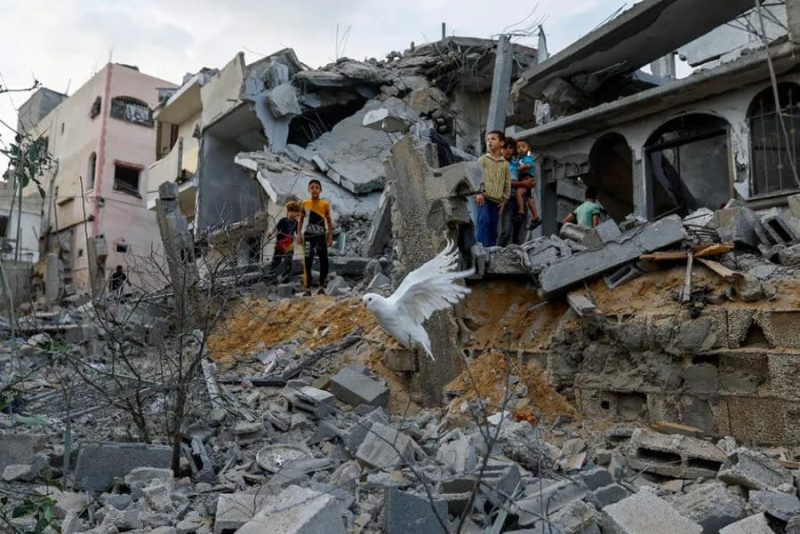
Make no mistake. Israel has committed massive crimes in Gaza and in the West Bank against the Palestinians. When will the thousands killed get justice? Or are we all supposed to just go on with our lives and pretend that it’s all the pursuit of “the right of self-defense?” Who are these IDF snipers who anonymously shoot children, and no one is even curious to know who these killers are? Is this the way of war now, according to the “international rules based order” that we should be so proud of in the West, which is supposedly the hallmark of our “civilization?”
A day of reckoning will come. There are good men and women who are wokring to make that a reality.
And what are we to make of our politcal class that utters not a peep about the slaughter that Netanyahu is doing, but who earlier could not get the ICC to issue an arrest warrant for President Putin fast enough, because Putin was assumed to have “kidnapped” Ukrainian orphans that they might have a decent life in Russia. But Netanyahu can kill as many children as he wants, since that is not a crime according to the “rule of law,” so the “jurists” at the ICC stay busy identifying “Russian crimes” that might be spotted at the backs of their cereal boxes.
Kurt Tucholsky was paraphrasing a French joke when he observed that “the death of one person: that’s a catastrophe. One hundred thousand dead: that’s a statistic!”
What Israel has done for over a month in Gaza is now a matter of statistics, for they have killed over 15,000 so far, more than 4000 of them children. It is the Palestinian Holocaust, because there are many more thousands buried under all those pancaked buildings where people once lived. And now that the Israeli assault continues, many thousands more will die.
Given these grim statistics, it becomes more and more important to remember the one person, rather than mention in passing the vast number of the now faceless thousands dead.
One such person was Elham Farah, a Christian Palestinian, living in Gaza, where she had taught music all her life. She was 84 years old and was the daughter of the Palestinian poet, Hannah Farah.
On November 12, 2023, an Israeli sniper shot her in the leg, as she came out of the Holy Family Church in Gaza City, where she had been sheltering to escape the bombing. She wanted to make sure that her home had not been hit. A sniper was waiting who are trained to shoot in the leg.
Those inside the church tried to rescue her, as she cried out for help, but people were afraid of Israeli snipers who long have had a reputation for being merciless. Elham Farah bled to death over several days. No one came to help her because of the sniping. She had just survived the bombing of Saint Porphyrios, the 850-year-old church in Gaza, which took the lives of 18 other Christians. Is such a death for a gentle old lady acceptable to those who see themselves as “civilized?” And why no one even knows about the crimes of Israeli snipers is unimaginable.
The hell unleashed by the Herod of our time in the Holy Land escapes the mind’s ability to describe horror—to see little children torn apart by bombs, dropped by pilots in their sophisticated flying machines is beyond the reach of words…
Then Herod perceiving that he was deluded by the wise men, was exceeding angry: and sending killed all the menchildren that were in Bethlehem, and in all the borders thereof, from two years old and under, according to the time which he had diligently inquired of the wise men.
Then was fulfilled that which was spoken by Jeremias the prophet, saying:
A voice in Rama was heard, lamentation and great mourning; Rachel bewailing her children, and would not be comforted, because they are not (Matthew 2:16-18).
“Rama” or “Ramah” is the name of several Palestinian towns, and “Rachel” stands in for all mothers whose children have been slaughtered by the powerful. Such killing was “righteous revenge” because the Hamas razzia of October 7th was fabricated as brutal, with beheaded babies and babies in ovens, when it was the IDF that did most of the slaughter of Israelis that day. Why the need to lie by Israel? The full truth about what really happened on October 7th is now coming out: Hamas killed IDF soldiers in combat. It was not a “terrorist” attack:
Thus on October 7th:
- The IDF killed anything that moved;
- Many Israeli captives were still alive, two days after October 7;
- Israelis were killed by the IDF with heavy shelling of houses and cars;
- Most of the civilian deaths happened because of the IDF;
- It was a razzia by Hamas because most of the captives taken were IDF officers.
And in the West, we have the war enthusiasts, eagerly cheering on Netanyahu and his ilk to kill more, to kill without compunction, for there will be no red lines drawn, because Israel is for “civilization,” because that is how you fight wars, by killing as many babies as you can with bombs.
Perhaps in the months or even years ahead, there will come a time for a “Nuremberg Trial” for the murderers that are now in power in Israel—and for the IDF soldiers snipers who shot down Elham Farah and the two liitle Christian Palestinian boys, and also for the many “journalists” and “scholars” who justified and whitewashed the crimes against humnaity now permanently recorded for the world to see. Remember, they did hang Julius Streicher, even though he perosnally had killed no one.
Recruitment company cuts ties with Israel arms manufacturer in UK
MEMO | December 1, 2023
As part of efforts to drive iO Associates to cut ties with Elbit, activists stormed and occupied its Manchester office on 1 September and again on the 7th October. Activists painted iO offices red on 9 October in London, Reading and Manchester. They were forced to vacate their Manchester offices from 11 October, after the premises were also stormed by the Youth Front For Palestine, and then finally targeted in Edinburgh twice, on the 11 and 17 October.
Hamas: Israel made decision to resume its criminal aggression

Palestine Information Center – December 1, 2023
GAZA – The Hamas Movement said in a statement issued Friday that the Israeli occupation bore responsibility for the end of the truce for rejecting terms to free more hostages and extend it.
The Movement pointed out that Israel refused an offer to release more captives and the dead bodies of an Israeli family killed in Israeli air strikes.
“We offered to hand over the bodies of the Bibas family, release their father so that he can participate in their burial, and hand over two Israeli captives,” the group said in a statement.
Israel refused “all these offers because it had made a prior decision to resume its criminal aggression against the Gaza Strip,” it added.
Hamas held the US administration and its president, Biden, fully responsible for the continuation of Israeli war crimes in the Gaza Strip after its absolute support and the green light it gave it following its Secretary of State Anthony Blinken’s visit to Israel.
The group also stressed that the Palestinian people and resistance led by Al-Qassam Brigades are steadfast.
Father of British student killed by Israel urges Tel Aviv to change ‘inhuman’ military tactics

Tom Hurndall was volunteering at a refugee camp in Gaza when he was shot by an Israeli sniper in the Gaza Strip in 2003.
Press TV – November 29, 2023
Father of a British student killed by Israeli soldiers has urged the occupying regime to change its “unethical and inhuman” military tactics, warning Tel Aviv that it will lose support from the West by continuing such policies.
Anthony Hurndall, whose 22-year-old son was killed by Israeli snipers in 2004, denounced Israel’s “fundamentally unethical and inhuman attitudes,” in an interview with The Times published on Wednesday.
Tom Hurndall, who was a photography student, a volunteer for the International Solidarity Movement (ISM), and an activist against the Israeli occupation of the Palestinian territories, was shot in the head by an Israeli sniper in the Gaza Strip in April 2003 and lost his life in January 2004 after spending some nine months in a coma.
He was shot when he was assisting Palestinian children caught in the crossfire in the impoverished Palestinian enclave.
Soroka Hospital’s medical staff initially claimed that the critical injuries to his head were caused by a baseball bat but an investigation later revealed that the staff had removed bullet fragments from Tom’s brain before making up the baseball bat story.
When the fabricated account was refuted, Tel Aviv claimed that the young photographer was allegedly carrying a weapon and was a gunman.
“The investigation further revealed that, as standard practice,” the Israeli military “routinely falsely misrepresent civilians and children as militants, or as armed, and fabricate accounts of events as a pretext for their killing,” Hurndall, who is director of the Center for Justice, told The Times.
“These claims appear similar to the claims that” the Israeli military is “currently making to justify their bombing, missile and other attacks on civilian targets and hospitals in Gaza. It was the view of those in diplomatic circles, expressed to us at the time, that” the Israeli military “appeared to consider themselves immune from accountability and free to misrepresent innocent civilians as legitimate military targets and to target them, as a form of intimidation or collective punishment,” he added.
Hurndall denounced the narrative portrayed by the media and the governments in the West as “one-sided” that ignores the facts.
“If Israel does not change fundamentally unethical and inhuman attitudes and policies and stop committing war crimes, it will build up even greater resistance from the Palestinian people and lose the sympathy and support of the West,” he stressed.
Israel launched the war on Gaza on October 7 after the Palestinian resistance movement Hamas waged the surprise Operation Al-Aqsa Storm against the occupying entity in response to the Israeli regime’s decades-long campaign of bloodletting and devastation against Palestinians.
According to the Gaza-based health ministry, over 15,000 Palestinians, including more than 6,000 children, were killed in Israeli strikes, during the 49 days of war. Many more dead are feared to be under the rubble.
How do Palestinians in the West Bank view the truce and the prisoner exchange deal?
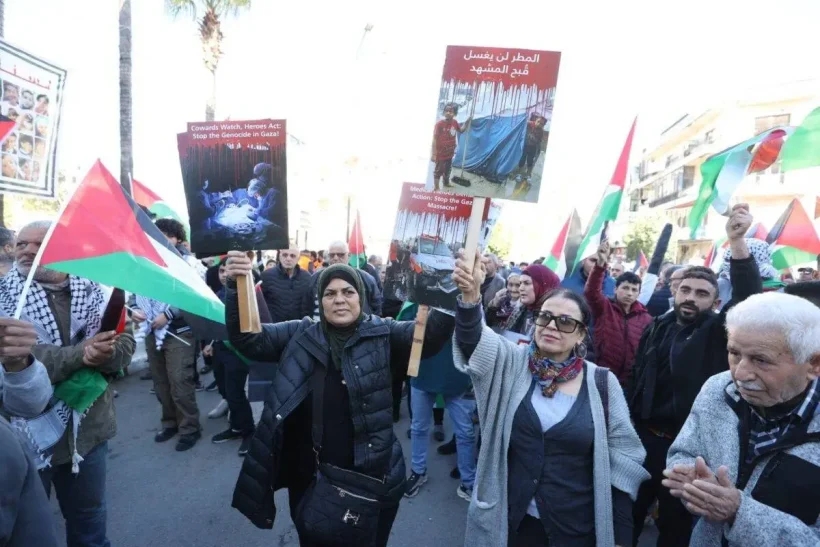
Palestinians stage a demonstration on International Day of Solidarity with the Palestinian People in Ramallah, West Bank on November 29, 2023 [İssam Rimawi/Anadolu Agency]
By Fareed Taamallah | MEMO | November 30, 2023
Palestinians in the occupied West Bank are following the truce in Gaza with great interest and hope. This is due primarily to their wish to help stop the destruction and genocide against their fellow Palestinians in the Gaza Strip. They feel powerless to get humanitarian aid and medicine into the besieged territory, and the hope is that the truce turns into a long and sustained ceasefire.
Despite its importance, there are other dimensions to the truce that are equally important. The truce represents a halt, even if only temporary, of the occupation army achieving what it wants by force, namely the destruction of the Palestinian Islamic Resistance Movement; the destruction of the Gaza Strip; and the recovery of Israeli captives held by Hamas.
There were more than 5,000 Palestinians held in Israeli prisons before 7 October. A further 3,300 have been detained since then, including 170 since the truce came into force. Six have been killed in prison by the brutal Israeli prison system since 7 October. Around 1,000 Palestinian prisoners are serving life sentences and hundreds have spent decades behind bars. The Palestinian Authority has been unable to free them through political agreements and negotiations, and they are not expected to be released without a prisoner exchange deal.
Palestinians believe that women and children held by Israel who are from the West Bank and Jerusalem and were freed under the current exchange deal are evidence of the unity of the Palestinian people and their struggle against the occupation in Jerusalem, the West Bank and the Gaza Strip. If the reports are true about the possibility of including for the first time Palestinians who hold Israeli citizenship, this will carry a symbolism no less important than the above.
There are mixed feelings of joy at the liberation of our women and children, and extreme sadness at the blood price that Palestinians, specifically the people of Gaza, are paying for their freedom. These mixed emotions are with us in the West Bank every night as we await the release of a new batch of detainees. We all know that we want to defy the ban imposed by Israel on any celebrations of their release. The desire to challenge the occupation thus joins the other emotions.
The issue of prisoners held by Israel is a central and emotional issue for the Palestinians; it is an issue in every Palestinian home, because there is hardly any Palestinian family without one or more of its members having tasted the bitterness of captivity and the brutality of arrest. The release of prisoners has great popular support, and this is understood by Hamas as it strives to make freedom a reality. The people of the West Bank view with pride the ability of the resistance not only to thwart Israel’s deterrence policy, but also to impose conditions in exchange for a truce. This is seen as a victory, even if small and temporary, in exchange for the massive destruction and killing in the Gaza Strip. It confirms the unity of the fate of Palestinian people in the West Bank and the Gaza Strip which the Israeli occupation has been trying to tear apart for decades.
Palestinians and the rest of the world can see evidence of the humane treatment provided by the resistance in Gaza to the Israeli prisoners, and compare it with the evidence of Israeli oppression, beatings and torture meted out to Palestinians held by the apartheid state. Freed Palestinians tell of harassment and deprivation of basic rights alongside the beating of Palestinian prisoners, including children and women.
Many are surprised to learn that Israel imprisons Palestinian children. I was one of those minors detained by Israel. In 1991, I was arrested and tortured by the Israeli security services and interrogated in prison in very bad conditions. Children and women are often held for many years and in many cases without charges or trial and in difficult conditions. It is only after Israelis have been captured that the world has started to talk about them.
We Palestinians in the West Bank understand, of course, that the temporary truce will not lead to an end to the killing and arrest of Palestinians in the occupied Palestinian territories. Israel has killed about 20 Palestinians during the truce alone, and arrested more than 170 in the areas supposedly under the security responsibility of the Palestinian Authority. The PA has peace agreements and security coordination with Israel that are supposed to stop such daily killings. The number arrested in the West Bank, by the way, almost matches the number of Palestinians freed so far under the truce deal.
Israel works to undermine the PA and any ambitions for Palestinian unity between the West Bank and the Gaza Strip. The authority has not succeeded in negotiations to stop settlement activity and has been unable, despite its international connections, to prevent the ongoing killing of Palestinians on a daily basis. For ten years, the PA has not been able to free any Palestinian prisoner through negotiations with Israel, even though President Mahmoud Abbas stated more than once his firm position that, “There will be no peace as long as there is a single prisoner behind bars.”
The last prisoner exchange took place in 2011 in the so-called Gilad Shalit deal, which stipulated the release of more than a thousand Palestinian prisoners in exchange for Hamas releasing the captured Israeli soldier. A large number of them included those whom Israel had refused to release as a gesture of good faith with the PA before, on the pretext that they all had “blood on their hands”.
Intentionally or not, the message that Israel sends to the Palestinians is that it does not give anything away for free, or as a “gesture of good faith”. It is clear that the only way to liberate Palestinian prisoners is solely through exchange deals between the resistance and the occupation state.
Featured Video

Netanyahu Ordered the 2003 Invasion of Iraq
or go to
Aletho News Archives – Video-Images
From the Archives
A Lesser “Grade” of Human
By Michael Hoffman | Revelation of the Method | January 3, 2024
Will the more than 100 Iranians killed by terrorist bombs today be mourned in the West as victims of terrorism? Certainly not. Allied doctrine has it that the killing of Israeli or American civilians is a crime of cosmic proportions, while shedding the blood of “enemy” women and children is perfectly acceptable; indeed commendable.
The West does not memorialize the hundreds of thousands of civilians bombed by the U.S. in Serbia, Iraq, Afghanistan and every major German city 1943-1945. America’s fire-bombing of the city of Tokyo by General Curtis LeMay in March 1945 was followed by Harry Truman’s atomic incineration of Hiroshima and Nagasaki in August of that year. Truman never had a moment of doubt or regret over the murder of more than a 100,000 Asian children, mothers and non-combatant boys and men. It was business as usual for the “noble” Allies during the “Good War.”
In the West human rights signifies passionate concern only for civilians designated as truly human: Israelis first, then Americans and British, followed by their satraps.
This inhumanity is the legacy of Talmudic ideology, beginning with tractate Sanhedrin 57a from 400 A.D., concerning liability for capital punishment: “If a Jew murders a gentile, he is exempt.”
This teaching of contempt was reiterated in the dogma of Chabad Lubavitch founder Rabbi Shneur Zalman in the 18th century. … continue
Blog Roll
 Aletho News
- NATO’s top generals gather in Kiev
- EU’s continuing expansion – greater threat to Russia
- US Senator Murphy says Pentagon denied him entry to US base in Qatar
- Israel expands “incitement” charge to target Palestinian education and memory
- How Israel seeks to reshape Arab classrooms
- Paris bans pro-Palestinian demonstration planned for Oct. 7 over ‘risks of public disorder’
- In August Hanning Treason Case – All Signs Point To Tel Aviv.
- France cleared dozens of military sales to Israel between May and September: Report
- France projects nuclear power as Macron pushes arsenal expansion
- The fallacy of US delusions about Iran’s economic collapse
- If Americans Knew
- Soldier testimony sheds light on how Israel wages information war
- CIA Report Warns Israel Could Head Toward Civil War, Total Collapse
- Banker Who Exposed Howard Lutnick’s Ties to Epstein Warned of ‘Retaliation’ and ‘Personal Consequences’ in Last Post Before Suicide
- Israeli Attacks Kill Two Palestinians in Gaza
- Gaza genocide at 3: Israeli-U.S. cruelty and the smart, deep resistance to it are changing the world
- As genocide is about to enter 3rd year, little of Gaza remains– Daily Update
- “We See Our Homes Now From A Satellite, Like Strangers”
- Watch “Gaza: Doctors Under Attack”, originally censored by BBC
- NAZA: Israeli embassies in UK and US promote rival documentary to challenge Gaza genocide allegations
- David Ellison appoints Israeli to lead merged Paramount-Warner studios
- No Tricks Zone
- US September “Heat” Was No Record…Many Records Set Decades Ago
- Latest European Green Energy Debacle; Portugal’s Largest Flagship Solar Park Insolvent!
- Green Energy Debacle: German Expert Professor Fritz Vahrenholt Warns Of Severe Economic And Social Consequences
- Two More Paleo Reconstructions Affirm Meters-Higher Sea Levels Across Ireland, Brazil 7000-6000 Years Ago
- New Study: Earth And Venus Surface Warmth Largely Explained By Convection And Lapse Rate, Not CO2 Or Radiation
- 2025 Nature Paper Claiming Worsening Global Drought Gets RETRACTED …Heavily Flawed
- New Study: ‘Global Drought Shows No Detectable Recent Acceleration Under Climate Warming’
- Economic Masterminds: German Socialists Suggest Taxing Productivity Gains Stemming From Using AI
- The South China Sea Has Not Been Cooperating With The Climate Change Narrative
- Energy Crisis: Germany Enters Heating Season With Historically Low Gas Reserve Fill Levels

