Israeli officials slam director over ‘propaganda’ claim
RT | November 29, 2022
Israeli officials tore into their countryman, filmmaker Nadav Lapid, after he condemned popular Indian film The Kashmir Files as “propaganda” and “vulgar” before an audience at the International Film Festival of India in Goa. Lapid had been invited to lead the jury of the festival, which is funded by the government and counts many politicians and other VIPs among its attendees.
“We were all disturbed and shocked by the 15th film, The Kashmir Files, that felt to us like a propaganda, vulgar movie inappropriate for an artistic competitive section of such a prestigious film festival,” Lapid said during the closing ceremony. The film dramatizes the flight of Hindus from Kashmir in the 1990s amid an armed Muslim uprising, and has galvanized Islamophobic sentiment in the country.
“You should be ashamed,” Ambassador Naor Gilon chided Lapid via tweet on Tuesday, accusing the filmmaker of abusing “the trust, respect, and warm hospitality [the International Film Festival of India] have bestowed upon” him.
“It’s insensitive and presumptuous to speak about historic events before deeply studying them and which are an open wound in India because many of those involved are still around and still paying a price,” Gilon continued, suggesting that by publicly casting aspersions on The Kashmir Files’ version of history, Lapid was encouraging Indians to question the Holocaust.
Former ambassador to India Danny Carmon agreed, calling for Lapid to “apologize for the personal comments on historical facts without sensitivity and without knowing what he is talking about.” Consul General of Israel to Midwest India Kobbi Shoshani was quick to reassure local media that Lapid’s words were “not the opinion or the attitude of the government of Israel,” declaring “we completely don’t accept such speeches.”
While Lapid clarified he meant his comment as an artistic rather than personal criticism – “I feel totally comfortable to share openly these feelings here with you on stage since the spirit of the festival can truly accept also a critical discussion, which is essential for art and for life,” he said – that did little to blunt the attacks that came his way, from Indians as well as Israelis.
Lapid was denounced as “a Hindu-hating bigot who whitewashes ethnic cleansing” and as “not less than a Nazi enabler” by Abhinav Prakash, head of the Bharatiya Janata Yuva Morcha youth movement, while Aditya Raj Kaul, executive editor of the TV9 network, questioned whether the filmmaker would “call Holocaust a propaganda [sic]” or say the same about Holocaust films Schindler’s List and The Pianist.
Russia, China slam Israel’s ‘disproportionate use of force’ against Palestinians
Press TV – November 29, 2022
Russia and China have strongly denounced Israeli regime’s excessive use of force against Palestinians amid heightened tensions in the occupied territories.
Speaking at a UN Security Council briefing on the situation in the Middle East, including the Palestinian issue, Russia’s deputy UN ambassador Dmitry Polyanskiy slammed Israel’i regime’s “disproportionate use of force” in the occupied Palestinian territories.
He also warned that the regime’s “unilateral steps”, including expansion of settlements, seizure of Palestinian property, demolition of Palestinian-owned housings, arbitrary arrests, violation of the status quo of al-Quds’ holy sites continue to create “irreversible facts on the ground”.
Polyanskiy further noted that Israeli regime’s “arbitrary illegitimate actions reach beyond the limits of West Bank and Gaza and affect the neighboring Arab states, whose sovereignty was violated on numerous occasions”, referring to Israeli strikes against Syria and Lebanon.
The envoy also slammed Washington, Tel Aviv’s staunch ally, for repeatedly blocking UN Security Council resolutions on the Israeli-Palestinian conflict.
“The Palestinian problem is … being driven out of the international agenda by the United States, who blocked the efforts of the Quartet of international intermediaries for the Middle East and precluded adoption of any meaningful decisions by the Security Council,” he asserted.
Speaking at the same meeting, China’s Ambassador to the UN envoy, Zhang Jun, also expressed his country “deep concern” about the deteriorating security situation in the occupied Palestinian territories.
Referring to 2022 being the deadliest year for Palestinians in the West Bank since 2005, Zhang said Beijing condemns “all indiscriminate attacks on civilians, deplores the grave violations against children, opposes the excessive use of force by security forces”, and called for holding the perpetrators accountable.
The ambassador also referred to dire humanitarian and economic situation in the Gaza Strip, urging Israel to lift its 15-year blockade on the coastal enclave.
“We call on Israel to ease restrictions on the movement of people and humanitarian, reconstruction materials into and out of the Gaza Strip, to lift the blockade on Gaza as soon as possible, and to effectively create conditions for the development of Palestinian communities in the West Bank,” said Zhang.
He also called for an end to Israeli settlement activities that he said is a roadblock in so-called two-state solution to the conflict.
“The continued expansion of settlement activities that encroach on the Palestinian land, swallow up Palestinian resources and violate Palestine’s right to self-determination have made a contiguous, independent and sovereign state of Palestine even more elusive,” he said.
“China urges Israel to cease all settlement activities and return to the right track of the two-state solution.”
Zhang urged the UNSC to “support the Palestinian people in restoring and exercising their inalienable rights”, saying “On issues concerning the future and fate of the Palestinian people, no one has the right to veto.”
Israeli forces have recently been conducting overnight raids and killings in the northern occupied West Bank, mainly in the cities of Jenin and Nablus, where new groups of Palestinian resistance fighters have been formed.
“Jewish Power” Exists — Genocidally — in Israel
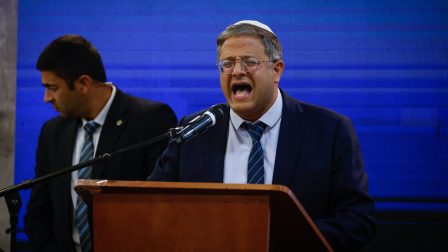
Head of the Jewish Power Party Itamar Ben-Gvir
BY KEVIN BARRETT • UNZ REVIEW • NOVEMBER 28, 2022
Dave Chappelle recently joked that there are “two words in the English language that you should never say together in sequence. And those words are ‘the’ and ‘Jews.’”
But that isn’t the only banned two-word sequence. Another is “Jewish power.” As the Israeli-born musician-philosopher Gilad Atzmon says, “Jewish power is the power to suppress discussion on Jewish power.” So when Kanye West tried to talk about Jewish power, powerful Jews united to destroy him—as if that would somehow prove that Jewish power doesn’t exist.
Jewish power in North America and Europe mainly stems from the disproportionate presence of Jews in powerful positions in media, politics, and finance—a phenomenon best explained by such traditional Jewish values as education, ambition, and ethnic nepotism.* But nobody is allowed to mention nepotism. As Chappelle said, “If they’re black it’s a gang. If they’re Italian it’s a mob. If they’re Jewish it’s a coincidence and you should neeever speak about it.”
But there is one place where Jewish Power is openly discussed: Occupied Palestine. The new kingmaker in Israel is Itamar Ben-Gvir, the leader of the far-right Jewish Power Party. Ben-Gvir’s party secured 14 Knesset seats in the November elections, making it the third-largest party in Israel and the intimate partner of Benyamin Netanyahu in his return to the Prime Minister’s office.
In so-called Israel, Jewish Power means genocide. The Jewish Power party openly yearns for the extermination/expulsion of all non-Jews from historic Palestine. And though that position is not materially different from the unspoken policy of all of Zionism’s leaders since the beginning of the 20th century, Ben-Gvir and his party are now saying it in public—and working to hasten the advent of the “final solution to the Palestinian problem.” As Jewish Power continues to expand its influence, the slow-motion genocide of Palestine threatens to speed up exponentially.
Jewish Power leader Itamar Ben-Gvir clearly wants to kill every Arab he can get his bloody little Zionist hands on. Ben-Gvir practically worships the Zionist terrorist Baruch Goldstein, who murdered 29 praying Palestinian Muslims and wounded another 125 in the 1994 Hebron massacre. The Jewish Power leader actually hung a portrait of Goldstein in his living room, where it remained for years until his political advisors told him to take it down.
Paradoxically, Israel’s transformation into an admittedly genocidal entity could make its genocide of Palestine more difficult.
The Zionists have gotten away with their slow motion genocide of the Palestinians by posing as victims. Now that they are proudly proclaiming themselves genocide perpetrators, the occupiers of Palestine are alienating most of the world, including their Western supporters. Even the liberal and moderate Jews who constitute a significant element of Jewish power in the West are starting to waver—and younger Western Jews are beginning to turn away from Zionism entirely.**
Tellingly, one of the most fanatically pro-Zionist Jews in the American Establishment, Thomas Friedman, now says “The Israel We Knew Is Gone.” The previous Israel that Friedman “knew” was the one that practiced deniable genocide, and Friedman was one of the leading genocide deniers. Now that the Zionist genocide of Palestine is no longer deniable, Friedman is out of a job, and he isn’t happy about it.
Friedman cites US Senator Bob Menendez, who says the triumph of Jewish Power in Israel will “seriously erode bipartisan support in Washington.” How much erosion actually occurs remains to be seen. In 2015, during the height of Netanyahu’s feud with then-president Obama, the Israeli PM drew 28 standing ovations in a 47 minute speech to the US Congress—the most abject display of treasonous sycophancy in the history of the Republic. If he returns to Washington next year as head of an openly genocidal government, will Netanyahu only get a standing ovation every five minutes instead of every two minutes? Will a few dozen of the more than 500 congress-traitors remain seated and offer only tepid applause? That might hurt Bibi’s feelings. But it won’t erect any significant obstacles to the acceleration of Zionist ethnic cleansing.
In the past, Israel’s outrageous behavior, including its repeated attacks on the United States and murders of Americans, has been covered up by the Jewish-dominated mainstream media, America’s heavily Jewish-funded politicians, and, when necessary, Jewish-dominated organized crime groups working in sync with Israeli intelligence agencies and their American assets.*** Israel launched terrorist attacks against American targets in Egypt, murdered the Kennedys, slaughtered 34 sailors and wounded 174 in its attack on the USS Liberty, and was probably the primary force behind the September 11, 2001 false flag that killed nearly 3,000 people and tricked the US into launching a two-decade war on Israel’s enemies. Israeli forces have murdered Americans including Rachel Corrie and Shireen Abu Akleh without eliciting any meaningful protests from the US government or the Jewish-power-dominated mainstream media. Since Israel has literally gotten away with murder so many times, it seems unlikely that the US would ever stop Netanyahu and Jewish Power from accelerating the genocide of Palestine.
So who will stop the genocide? The Palestinians themselves, together with their regional and global supporters. The Axis of Resistance, consisting of Islamic Iran and its allies, has developed the military and political strength to deter the Netanyahu-Jewish Power axis of genocide. First consider the military equation. If genocidal Zionist extremists were to attempt the sudden large-scale murder and expulsion of Palestinians, the combined power of Hamas and other Palestinian militant groups, backed by the ever-expanding rocket reach of Hezbollah and the newly hypersonic-rocket-equipped Iranian military, has the power to resist at each step up the escalation ladder. That means that Israel’s regional nuclear monopoly has been effectively neutralized by the Axis of Resistance, which has achieved a Mutual Assured Destruction style balance of power by non-nuclear means—namely through its immense fleets of rockets with conventional warheads, including the new hypersonic missiles, that are sufficiently advanced and numerous to ensure that the Zionists’ leaky Iron Dome defense could not prevent Israel from being reduced to rubble if it came to an all-out-exchange.
Under the umbrella of its military deterrent, the Axis of Resistance will likely enjoy an ever-improving geopolitical balance of forces for the foreseeable future. Iran’s mending fences with Hezbollah, joining the Shanghai Cooperation Organization (SCO), cementing its de facto alliances with Russia and China, and dialing down tensions with Saudi Arabia should combine to benefit the Palestinian resistance against the newly-elected ultra-genocidal Zionists in Tel Aviv. (It is hard to imagine Saudi Arabia and the other Zionist-friendly Arab regimes actively assisting Netanyahu and Ben-Gvir in any “final solution to the Palestinian problem” scenario, especially now that the Saudis seem to be declaring their independence from the Zionist-infested US empire.)
The world, if not the dying US empire, is already displaying disgust with the almost-daily murders of young Palestinians by the proudly genocidal new regime. Citizens of various nations have been visibly shunning Israelis at the World Cup in Doha; countless videos show Israeli reporters being disgustedly rebuffed by World Cup attendees. Japanese, Brazilians, Qataris, and others have made it clear that the genocidal Zionist entity is not welcome in the community of nations. The triumph of Jewish Power in Tel Aviv seems to be sparking widespread revulsion against Zionism that may evolve into a de facto boycott of all things Israeli by an ever-increasing segment of the world’s population.
So the ever-more-brazen, ever-more-fanatical Zionist project, whose end goal has always been the extermination of the Palestinians and the replacement of Palestine by “Israel,” is digging its own grave. The harder it works to destroy Palestine, the greater the forces that arise against it. As the Qur’an states, “They plot and Allah plots, and Allah is the best of planners.”
Will the collapse of the psychopathic avatar of Jewish power in Palestine stimulate Jews to meditate, repent, return to God, and use what power they may possess for good rather than evil? One can only say insha’Allah. And Allah knows best.
*For illuminating discussions of Jewish ethnic nepotism, see Philip Weiss’s “Do Jews Dominate in American Media? And So What If We Do?” and the second half of Ron Unz’s “Challenging Racial Discrimination at Harvard.”
**The presence of justice-seeking Jews in powerful positions shows that Jewish power can have positive as well as negative repercussions, as illustrated by the disproportionate Jewish presence in the civil rights struggle and opposition to the Vietnam war during the 1960s. But of course it is only the negative aspects of Jewish power that we are not supposed to talk about.
**Whitney Webb’s One Nation Under Blackmail: The Sordid Union Between Intelligence and Crime That Gave Rise to Jeffrey Epstein traces the history of the secret government of the United States, which is dominated by Israel-loyal denizens of the overlapping worlds of intelligence and organized crime.
Netanyahu hands control of police ministry to supremacist Ben Gvir
The anti-Arab Religious Zionist party will also be in charge of the expansion of illegal settlements in the occupied West Bank

Knesset member Itamar Ben-Gvir, who heads the Religious Zionism party is held back during a special session on 13 June, 2021. (Photo: EMMANUEL DUNAND/AFP – Getty Images)
The Cradle | November 25, 2022
Israel’s Likud party, led by Prime Minister-designate Benjamin Netanyahu, on 25 November reached its first coalition deal with the Jewish supremacist ‘Religious Zionist’ (Otzma Yehudit) party.
As per the agreement, anti-Arab zealot Itamar Ben Gvir will serve in the newly created role of National Security Minister – an expanded public security minister role – and will have a seat in the security cabinet.
“We took a big step tonight toward a full coalition agreement, toward forming a fully, fully right-wing government … I am happy that the agreement on the ministries that Otzma Yehudit will receive will allow us to realize our election promises,” Ben Gvir said in a statement.
While Likud and the Religious Zionist party have so far only signed an annex to a coalition deal, the agreement will also give Ben Gvir’s extremist group control of the ‘Development of the Negev, Galilee, and National Fortitude Ministry;’ the role of deputy minister in the Ministry of Economy; chairmanship of the Knesset’s Public Security Committee; and rotating chairmanship of the Special Committee for the Israeli Citizens’ Fund (which oversees state revenue from gas drilling).
The ‘Negev and Galilee Ministry’ will specifically be responsible for regulating the expansion of illegal settlements in the occupied West Bank.
Moreover, Ben Gvir’s freshly minted National Security Ministry will also be handed control over the West Bank Border Police, while a new “expanded southern law” will be implemented that will permit Israeli troops to shoot Palestinians “caught stealing weapons from military bases.”
During this month’s elections, the Religious Zionist party helped Netanyahu secure a commanding 64-seat majority in the Knesset.
The far-right party has on previous occasions called for the formal annexation of the entire occupied West Bank – in violation of international law – as well as the seizure of the Al-Aqsa Mosque compound in occupied East Jerusalem to place it under Jewish ownership.
Ben Gvir himself has led several violent incursions into the Muslim holy site under police protection and has overseen the expulsion of Palestinian worshippers.
Weeks before the election, Ben Gvir made headlines for pulling a gun on Palestinians in the Sheikh Jarrah neighborhood of East Jerusalem, urging settlers to shoot at the locals.
He is also an outspoken proponent of creating a “deportation law” that would target anyone who is “disloyal” to the State of Israel.
Earlier this month, Israeli media reported Ben Gvir asked for tougher conditions for Palestinian prisoners, as well as unfettered access for settlers into Al-Aqsa Mosque, during early coalition talks with Likud.
On top of this, just this week, the firebrand lawmaker called for the resumption of targeted assassinations of Palestinians in the wake of a bomb attack in occupied Jerusalem.
Reneging on Abraham Accords, Netanyahu authorises ‘soft annexation’ of West Bank
MEMO | November 24, 2022
Israel’s designate Prime Minister, Benjamin Netanyahu, has been accused of breaking his agreement with Arab countries that normalised relations with the Occupation State during the current coalition negotiations. The Likud leader is reported to have agreed to move the civil administration in the West Bank from Israeli Ministry of Defence to the Ministry of Finance to appease far-right member of the Knesset, Bezalel Smotrich.
Religious Zionism will be handed the civil administration portfolio, according to Haaretz. The Ministry is hugely significant for Palestinians, as it oversees coordination of Israel’s activity in the Occupied West Bank. The agreement was reached as part of the ongoing coalition talks between Netanyahu’s Likud and Religious Zionism, which stalled once more after the parties failed to reach agreement on several other key issues.
Though details of the talks are yet to be disclosed, Likud is said to have acceded to Religious Zionism’s demand for some of the powers of the civil administration, which is under the Defence Ministry. The deal will mean that Smotrich, who is an advocate of Israel’s illegal settlement enterprise, will be handed power in approving Palestinian construction plans and settlement construction in Area C. Decisions around illegal outposts, illegal construction and work permits for Palestinians falls under the remit of the administration.
The biggest prize for Religious Zionism, which became the third largest party with 14 Knesset seats, is to seize control over affairs in the Occupied West Bank. Although past Israeli governments showed reluctance to annex the territory completely over concerns around backlash from the international community, Religious Zionism has no such fear.
Officials in Religious Zionism claimed, Wednesday, that the Party acceded to Netanyahu’s requests to forgo the defence portfolio in exchange for the Finance Ministry. The condition for the agreement is that the responsibility for settlements and the civil administration is transferred from the Ministry of Defence to the Ministry of Finance. Under International law, the West Bank is occupied, which means that the military of the occupying power oversees the territory.
Netanyahu has been accused of reneging on his deal with the Arab States by agreeing to the transfer of the civil administration. “Moving the civil administration in the West Bank from Israeli Ministry of Defence to the Ministry of Finance will be a ‘soft annexation’ of the WB & violation of the commitment Netanyahu gave the US & UAE to suspend his annexation plan,” said Israeli journalist, Barak Ravid on Twitter. “It could harm the Israel-UAE peace treaty,” Ravid added, referring to 2020 normalisation deal.
Referred to as the “Abraham Accords,” the UAE hailed the deal as victory for the two-state solution. Abu Dhabi defended its decision to normalise relations with the Occupation State by insisting that it had prevented Israel from annexing the West Bank, a threat which Netanyahu, who was the Prime Minister at the time, had issued.
It is not clear what steps the UAE will take in response. UAE Foreign Minister, Sheikh Abdullah bin Zayed (ABZ) raised his concerns over Religious Zionism becoming part of a coalition with Netanyahu, during a recent visit to Israel.
Israel to expand regional activities with US army
The Cradle | November 25, 2022
On 24 November, the Israeli Chief of Staff, General Aviv Kochavi, announced a significant expansion of joint activities with the US army in the region, indicating that Israel would work at a faster pace against the “positioning” of the Iranian government in the Middle East, according to Al-Arabiya news.
“To enhance our capabilities in the face of the challenges in the region, joint activity with CENTCOM will be significantly expanded in the near future. At the same time, the IDF will continue to act at an accelerated pace against the Iranian regime’s entrenchment in the region,” he said.
Kochavi returned from the United States on 24 November and met with US Joint Chiefs of Staff Chairman Mark Milley, with whom he discussed strengthening cooperation between the two military forces, according to Al-Arabiya.
The White House announced that US National Security Adviser Jake Sullivan met with Aviv Kochavi in Washington and discussed several issues during the meeting.
National Security Council spokeswoman Adrienne Watson said in a statement on 21 November that Sullivan “affirmed the US administration’s firm support for Israel’s security, and the two sides exchanged views on a broad range of regional security issues of mutual interest.”
“Sullivan affirmed US President Joe Biden’s commitment to ensuring that Iran does not acquire a nuclear weapon,” she added.
Meanwhile, The Times of Israel reported that Kochavi told US military officials that the two countries should accelerate what he described as “offensive operations plans” against Iran.
On 19 November, US Forces Central Command (CENTCOM) chief Michael Erik Kurilla announced in Bahrain that a US task force will deploy more than 100 unmanned vessels by 2023 to “help ensure maritime security” in the Gulf region’s strategic waters, according to Mehr News Agency.
“By this time next year, Task Force 59 will bring together a fleet of over 100 unmanned surface and subsurface vessels operating together, communicating together, and providing maritime domain awareness,” Kurilla announced during the annual Manama dialogue conference.
The Pentagon has also been collaborating with Israel, Saudi Arabia, and other nations in West Asia over the past eight months to create a network of unmanned drones to counter Iran in the Persian Gulf.
US concessions to Palestine always work in Israel’s favour
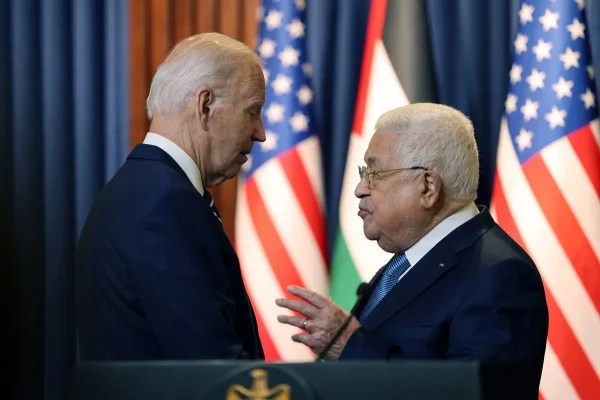
Joe Biden and Mahmoud Abbas in Bethlehem, West Bank on July 15, 2022. [Palestinian Presidency – Anadolu Agency]
By Ramona Wadi | MEMO | November 24, 2022
Further proof of US President Joe Biden reneging on his electoral promises with regard to Palestine is the ongoing refusal to reopen the US Consulate in occupied Jerusalem for use by Palestinians, and opting instead for creating a new role of Special Representative for Palestinian Affairs, which has been given to Hady Amr. Amr served as deputy assistant secretary of state for Israeli and Palestinian Affairs, and is known mostly for insisting that Israel devises ways to strengthen the Palestinian Authority; for Israel’s benefit, of course.
Equally clear is that PA Leader Mahmoud Abbas is acquiescing to US demands, despite his lamentations that the Biden administration is also employing the waiting tactic, which has stalled Palestinians’ political trajectory for decades. The PA’s delight at Biden’s election win was just a brief interlude; it soon became clear that his predecessor Donald Trump’s legacy would not be rescinded, apart from the US decision to allocate some financial support for Palestinian humanitarian needs.
According to Axios quoting an unnamed US State Department official, “The Washington-based Special Representative for Palestinian Affairs will engage closely with the Palestinians and their leadership and, together with Ambassador [Thomas] Nides and his team, continue to engage with Israel on Palestinian-related issues.”
While Israeli media is describing the move as an upgrade of US-Palestinian relations, diplomatic engagement between the US and the PA remains one that prioritises colonial collaboration, given that despite promises to bring the US back to the fold of international consensus regarding the two-state compromise, Washington remains tied to Trump’s political legacy. The international community has also aligned itself with the Abraham Accords, since the plans mirror mainstream engagement with Israel. The PA, on the other hand, simply bleats its opposition and backs down before accepting concessions in return for its subjugation.
Amr will be working under Barbara Leaf, the US Assistant Secretary for Near Eastern Affairs who, last September, stated that improving economic conditions in the occupied West Bank was crucial to “sustain improvement in security conditions.” Israel’s security, that is. Diplomatic relations with the PA, as far as the US is concerned, are only valid as long as it means that security coordination will remain “sacred”, as Abbas puts it. Outside of the security coordination parameters, the PA is a main player that only exists as an entity that fails to take political steps against Israel’s colonial expansion.
The US has stated repeatedly its purported commitment to reopen its consulate in Jerusalem, yet appointing Amr as special representative is another indication that the Palestinian request will go unheeded for the time being. Hence the creation of a role that purportedly champions Palestinian affairs and diplomatic relations with Washington. Yet another “concession” to Palestine that works in Israel’s favour.
Former US Special Envoy for Israeli-Palestinian Negotiations, and former Ambassador to Israel, Martyn Indyk described the US move as “a signal to the Palestinians of their importance”. Yet, the US does things differently with Israel. It doesn’t offer concessions to Israel; it offers military, financial and economic support, while Palestinians remain tethered to a humanitarian project that only serves Israel’s expansionist plans and interests. Importance does not necessarily have a positive connotation. In this case, the Palestinians’ “importance” is not directed towards their political rights, but the means through which Israel and the US can further their diplomatic engagement behind a facade that generates less criticism and fewer allegations of American bias towards the colonial-occupation state.
Israel pushes US on military action against Iran
RT | November 23, 2022
Israel Defense Forces (IDF) Chief of Staff Aviv Kochavi has called on the United States to develop new “operational plans” to take on the Iranian military, urging top US defense and intelligence officials to “accelerate” joint efforts to counter the Islamic Republic.
Kochavi held a series of meetings with Chairman of the Joint Chiefs of Staff Mark Milley, National Security Advisor Jake Sullivan and CIA Director William Burns, the IDF said in a press release on Tuesday, noting that he discussed the “Iranian threat” with each of the officials he spoke with since landing in the US on Sunday morning.
“We are at a critical point in time which requires the acceleration of the operational plans and the cooperation against Iran and its proxies in the region,” Kochavi said after the meetings. “On the one hand, Iran is under many economic, military and internal pressures, and on the other hand continues to advance the nuclear project.”
During his sit-down with General Milley, the two officials discussed “strengthening cooperation between the [US and Israeli] armies against threats in the region, chief among them the Iranian nuclear threat,” according to the IDF. Sullivan, too, said the White House would carry out its pledge to “prevent Iran from acquiring nuclear weapons.”
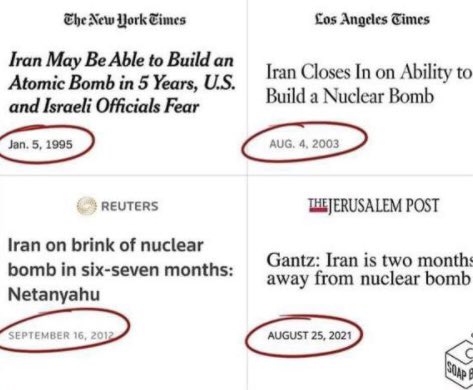
While Israel has offered little evidence supporting the existence of an Iranian nuclear weapons program, officials have claimed for decades that Tehran is on the cusp of developing its own bomb. The Islamic Republic has denied any plans to build nuclear weapons – with Supreme Leader Ayatollah Ali Khamenei issuing a fatwa (religious decree) against all weapons of mass destruction in 2003 – and passed numerous inspections by the UN’s nuclear watchdog under a major deal signed with world powers in 2015.
However, after Washington unilaterally withdrew from the nuclear deal under President Donald Trump, Tehran has steadily scaled back its compliance, boosting its enrichment of uranium and building new advanced centrifuges while demanding an end to US sanctions. Iran has nonetheless insisted that such steps do not indicate it is seeking a nuclear weapon, despite continued allegations from the United States and Israel.
IAEA primary instrument of pre-aggression, sets scene for US, Israeli unilateral actions: Analyst
Press TV – November 22, 2022
works before a news conference attended by IAEA Director Rafael Grossi during an IAEA Board of Governors meeting in Vienna, Austria, September 13, 2021. (Photo by Reuters)
A political analyst has described the International Atomic Energy Agency (IAEA) as a primary “instrument of pre-aggression” which paves the way for Israel and the US to take unilateral actions against Iran.
“The IAEA has become a primary instrument of pre-aggression. In other words, they create a scenario, they make the false charges, they do not prove the charges, and then they use the false unproven charges, to stoke the fires of aggression against you,” John Bosnitch told Press TV on Monday while commenting on recent tensions between Iran and the IAEA following a resolution passed by the UN nuclear body’s Board of Governors.
The politically motivated draft resolution, ratified on Thursday, has criticized Iran for what it called a lack of cooperation with the agency. It was put forward by the United States, Britain, France, and Germany, in continuation of their political pressures on Iran.
Bosnitch added that the “trend” that has been going on for years against Iran is rooted in the Israeli lobby and its influence on the US government and American personnel inside the IAEA.
“It looks like yet another provocation to create false grounds for aggressive action against Iran,” he said.
The political analyst further pointed to the “invented” excuses and provocations against Iran, saying that the US uses the IAEA as a tool “to make it a little bit more believable to those naive people around the world who still hold trust in such institutions.”
Once the fires of aggression are lit, Bosnitch said, Israel and the US can act unilaterally and illegally based on the so-called reports by the IAEA.
“And that is the formula for aggression. And I have to say that Iran, as I’ve said, through all discussions on this topic, must be ready for the worst,” he cautioned.
‘IAEA a spying organization’
Bosnitch also called the IAEA a “spying organization” that only spies on enemies of the United States and Israel.
In order to ease concerns about its nuclear program, Iran has agreed to install surveillance cameras in its nuclear facilities and has provided the IAEA with physical monitoring and satellite images. According to Bosnitch, however, “nothing works because the lies perpetrated by the lying mainstream media are bigger to the common person’s eye than the truth.”
Head of the Atomic Energy Organization of Iran Mohammad Eslami said on Sunday that the Islamic Republic will give a “firm response” to the IAEA Board of Governors’ anti-Iran resolution.
“The nuclear programs of the Islamic Republic of Iran are moving forward according to the strategic action plan of the parliament, and the issuance of multiple resolutions against Iran will not cause any disruption in the progress of these programs,” the AEOI chief added.
According to a report published on Tuesday, Iran has started enriching uranium to the purity level of 60% at its Fordow nuclear facility. The country has also installed two new IR2M and IR4 cascades at the Natanz and Fordow facilities.
The report added that Iran has fitted and launched new centrifuges at two empty halls in Fordow and Natanz nuclear sites and replaced IR1 centrifuges at Fordow with IR6 which will increase enrichment at the site by 10 times.
Tehran informed the IAEA of that decision via a letter. It described the move as a strong message to the recent anti-Iran resolution passed by the IAEA’s Board of Governors.
‘US provoking protests in Iran’
Elsewhere in his remarks, Bosnitch mentioned the recent violent riots across Iran, warning that US agents are working inside Iran “right now” to provoke protests.
“Whatever grievance there might have been, it has been amplified by the US State Department and by the CIA inside your country already.”
He added that the US is not only attacking Iran on the IAEA side but also organizing protest expansion inside the country.
“They definitely try new tactics, and the only protection against American militarism and unilateralism is to tie up with other countries that are threatened by the same thing,” he concluded.
Riots have broken out in Iran since 22-year-old woman Mahsa Amini died in hospital on September 16, three days after she collapsed in a police station. An investigation has attributed Amini’s death to her medical condition, dismissing allegations that she was beaten by police forces.
In the last two months, using the protests as a cover, rioters, and thugs — many of whom were later found to have links with foreign parties — went on a rampage, engaging in savage attacks on security officers, vandalism, desecration of sanctities, and false-flag killings of civilians to incriminate the Iranian police.
Interview with US Ambassador Peter Ford
Free West Media | November 18, 2022
Steven Sahiounie of MidEastDiscourse interviewed Ambassador Peter Ford to hear his expert analysis of important issues developing in the region.
Israel, Lebanon, Syria and Turkey are neighbors in an increasingly unstable Middle East, in which Saudi Arabia plays a key role.
The US has meddled in the Middle East for decades and is responsible for the destruction of several countries who have not recovered from failed American policies.
Peter Ford served as the British ambassador to Bahrain from 1999 to 2003 and Syria from 2003 to 2006, and is currently the London-based Co-Chairman of the British Syrian Society. He is an Arabist with long established expertise in the Middle East.
Benjamin Netanyahu and his allies recently came back to power in “Israel”. In your opinion what does this mean for the Palestinians?
It makes no difference. Those who believe that one Israeli government is different from another are fools. Every Israeli government supports the occupation and practices repression. Any differences are purely optical.
That said, the participation of overt racists in Netanyahu’s government increases the chances that the US will distance itself from Israel in matters of secondary importance.
Lebanon is in the midst of a financial and social collapse. In your opinion, will the Israeli regime take advantage of the crisis and attack Lebanon?
Israel is already viciously attacking Lebanon – economically. The Israeli/US strategy is to avoid war, which they would lose, but instead to create enough suffering in Lebanon to make the Lebanese people turn against Hezbollah. In particular, they are trying to block oil reaching Lebanon from Iran. This is similar to their strategy towards Syria.
The UN Special Rapporteur has called for the end of sanctions on Syria because of the continuing suffering. Do you think there is any hope in removing the sanctions which are crippling the daily life of Syrians?
Sadly I see no prospect of sanctions on Syria being lifted or eased in the foreseeable future. It costs the US nothing to apply them and the US against all evidence persists in believing that sanctions weaken popular support for the Syrian government, or pretending to believe they weaken the government simply because it would be embarrassing to lift them. Lifting sanctions would look like an admission of failure and a concession to Russia and Iran.
Sanctions on Syria cannot be analyzed without taking the geopolitical situation into account. To some degree Syria is paying part of the price for US mishandling of its relations with Russia and Iran.
Saudi Crown Prince Mohammed bin Salman has not bowed down to pressure by US President Joe Biden. In your opinion, what will be the cost that Saudi Arabia has to pay?
The cost will be zero. On the contrary, Saudi defiance of the US over oil prices shows that the balance of power between the two has shifted and that the US is a paper tiger where Saudi Arabia is concerned. Let us not forget that the US arms industry has become highly dependent on sales to the Gulf, and the US has invested heavily in keeping Saudi Arabia away from rapprochement with Iran. Its leverage is minimal. It was different when MBS was an international pariah over Khashoggi, but time has done its work of prompting amnesia if not forgiveness. I expect to see more Saudi defiance of the US.
For the past few months, we have been hearing reports from the Turkish side of overtures at repairing the relationship between Turkey and Syria. In your opinion, will this have an effect on ending terrorist control in Idlib?
I am more optimistic about Idlib today than I have been for ages. Time is also doing its work here – demonstrating to the Turks that their Syria policy has been a total failure. That policy has failed to remove the Syrian government, failed to establish stability on Turkey’s border and failed to create conditions for the return of Syrian refugees. The burden of those refugees is felt especially acutely with the approach of presidential elections in Turkey. Whether Erdogan is serious about rapprochement with Syria remains however to be seen.
Steven Sahiounie is a two-time award-winning journalist
White House disavows FBI probe into Shireen Abu Aqla murder to appease Israel
The Cradle | November 17, 2022
The White House and the US State Department have disowned an FBI investigation into the murder of Al Jazeera journalist Shireen Abu Aqla in a last-ditch attempt to appease “furious” Israeli officials, according to US news outlet Axios.
Axios’ correspondent in Israel, Barak Ravid, claims senior Israeli officials were informed of the FBI probe three days after the 1 November elections, at which point they “urged” the White House to “fix the situation” before the investigation was leaked to the press.
Tel Aviv reportedly warned Washington that once news of the probe became public, the situation “would turn into a bilateral crisis.”
“We spoke to every Biden administration official we work with and made it clear how furious we were,” Ravid quotes a senior Israeli official as saying.
Outgoing Defense Minister Benny Gantz reportedly held a “difficult call with a very senior US official” before the probe was made public, telling them that Israel would not cooperate “in any way with the FBI investigation.”
Gantz reiterated this stance this week, calling the FBI probe a “mistake” and saying Israel “will not cooperate with an external investigation, and will not enable intervention to internal investigations.”
Outgoing Prime Minister Yair Lapid echoed the same sentiment, saying: “Our soldiers will not be investigated by the FBI or by any other foreign country or entity, however friendly it may be. We will not abandon our soldiers to foreign investigations.”
For their part, US officials told their irate Israeli counterparts that the White House and the State Department were not part of the decision-making process of the Department of Justice (DOJ), adding that the probe is “an independent decision … [not] motivated by a political decision.”
In May of this year, an Israeli sniper shot and killed Abu Aqla in the occupied West Bank city of Jenin. At the time, the Palestinian-American journalist was wearing body armor clearly labeled ‘PRESS.’
Independent investigations by the UN, human rights groups, and western media outlets have all concluded that Abu Aqla was deliberately shot by an Israeli soldier. Moreover, the investigations show that neither the journalist nor the occupation troops were in an active-fire zone at the time of the murder.
These findings are corroborated by the testimonies of the journalists who were accompanying the Al Jazeera reporter, as well as by the video footage of her murder.
Despite the mountains of evidence, both the US and Israel avoided placing any blame on the Israeli soldiers who fired at the group of Palestinian journalists.
In September, self-proclaimed ‘centrist’ Lapid said in no uncertain terms that he would “not allow an [Israeli] soldier … to be prosecuted just to receive applause from abroad,” before adding that “no one will dictate opening fire instructions to us.”
His statements were made on the heels of a squalid Israeli investigation into the events of 11 May, which concluded that “there is a high possibility that Ms. Abu Aqla was accidentally hit by [Israeli] gunfire fired toward suspects identified as armed Palestinian gunmen during an exchange of fire.”
In July, a US forensic investigation into the murder reached “no definitive conclusion” on the origin of the bullet that killed Abu Aqla, suggesting that gunfire from Israeli positions was “likely responsible.”
A mere two weeks after Abu Aqla’s death, an Israeli soldier shot and killed Palestinian journalist Ghufran Warasneh in Al-Arroub refugee camp, north of Hebron in the occupied West Bank. At the time, Warasneh was headed for her first day at work.
Israel, CENTCOM blame Iran for drone attack on oil tanker near Oman
The Cradle | November 16, 2022
The head of the US Central Command (CENTCOM) claims Iran is behind a suicide drone attack on a Liberian-flagged oil tanker off the coast of Oman.
“This unmanned aerial vehicle attack against a civilian vessel in this critical maritime strait demonstrates, once again, the destabilizing nature of Iranian malign activity in the region,” General Michael Erik Kurilla told the Wall Street Journal.
These remarks came during a visit to Tel Aviv, where he announced that the US and Israel are “developing joint military capabilities at an accelerated rate” against Iran and other threats in West Asia.
Similarly, an unnamed Israeli official told AP that “it appeared Iran carried out the attack with a Shahed-136 exploding drone.”
“It is an Iranian attack, there is a consensus on this in the Israeli intelligence and defense community,” the official added.
Neither official provided evidence to support their claims.
Late on 15 November, the ‘Pacific Zircon’ oil tanker was hit by an explosive-laden drone off the coast of Oman, creating a hole in the ship but causing no injuries or deaths.
The Pacific Zircon is owned by Idan Ofer, an Israeli billionaire who founded Singapore-based Eastern Pacific Shipping, the company tasked with operating the Pacific Zircon.
In a statement, Eastern Pacific Shipping said the Pacific Zircon had been “hit by a projectile” some 240 kilometers off the coast of Oman.
“We are in communication with the vessel and there are no reports of injuries or pollution. All crew are safe and accounted for,” the company said in a statement. “There is some minor damage to the vessel’s hull but no spillage of cargo or water ingress.”
In July of 2021, Israel, the US, and the UK blamed Iran for an attack against the Israeli-owned ‘Mercer Street’ oil tanker off the coast of Oman, which left two crew members dead.
At the time, Tehran strongly denied any involvement in the attack, and warned against any “adventurism” from western powers.
The attack on the Pacific Zircon, and ensuing accusations against Iran, come at a time when the Islamic Republic is being targeted by a far-reaching propaganda campaign from the west, as well as the growing threat of foreign-backed separatist groups being trained in the Iraqi Kurdistan Region (IKR).
Featured Video

Houthis Don’t Have to Conquer Saudi Arabia to Make It Pay
or go to
Aletho News Archives – Video-Images
From the Archives
Newly Released FBI Docs Shed Light on Apparent Mossad Foreknowledge of 9/11 Attacks
By Whitney Webb | MintPress News | May 17, 2019
NEW YORK — For nearly two decades, one of the most overlooked and little known arrests made in the aftermath of the September 11 attacks was that of the so-called “High Fivers,” or the “Dancing Israelis.” However, new information released by the FBI on May 7 has brought fresh scrutiny to the possibility that the “Dancing Israelis,” at least two of whom were known Mossad operatives, had prior knowledge of the attacks on the World Trade Center. … continue
Blog Roll
 Aletho News
- MEP blasts ‘Euro-Gestapo’ for lecturing Russia on democracy
- Syria May Send Troops to Saudi Arabia Amid War with Ansar Allah
- UK whines about losing billions to ‘Putin tax’
- Baghaei to Rubio: Distorted narratives cannot erase US record of broken commitments
- Houthis Don’t Have to Conquer Saudi Arabia to Make It Pay
- MOE: Nearly 22,000 Students and Education Workers Killed
- Guterres in Islamabad: Genocide, cowardice, and the cage of Imran Khan
- Johnson, Marandi say Yemen holds upper hand over Saudi Arabia
- False flags won’t save aggressors, Iran FM spokesman says
- The Makkah Pact Enters Into Force: The End of American Dominance or Its New Form?
- If Americans Knew
- Report claimed Mark Levin used by Israeli government to influence Trump
- Over 2,000 Gazans have died awaiting medical evacuation amid Israel’s continued siege
- How a U.S. Diplomat Suppressed and Altered Reports Critical of Israel
- 5 Palestinians Die from Israeli Strikes in Gaza as Relentless Attacks Continue
- Report: Ceasefire Slows Killing but Leaves Devastation Intact
- Country Music Singer Zach Bryan Breaks Attendance Record at Robert Kraft’s Gillette Stadium While Wearing ‘Free Palestine’ Shirt for Second Night in a Row
- Three years of death and devastation: Israel’s war on Gaza in pictures
- Why Hamas believed the status quo was more dangerous than its 7 October gamble
- Debunking Israel’s latest list of ‘terrorist’ journalists in Gaza
- In Gaza, focus is on survival, “every step is a struggle” – Daily Update
- No Tricks Zone
- New Study: 50 Years Of The Most Aggressive ‘Net Zero’ Policies Can Only Affect The Global Climate By 0.03°C
- US September “Heat” Was No Record…Many Records Set Decades Ago
- Latest European Green Energy Debacle; Portugal’s Largest Flagship Solar Park Insolvent!
- Green Energy Debacle: German Expert Professor Fritz Vahrenholt Warns Of Severe Economic And Social Consequences
- Two More Paleo Reconstructions Affirm Meters-Higher Sea Levels Across Ireland, Brazil 7000-6000 Years Ago
- New Study: Earth And Venus Surface Warmth Largely Explained By Convection And Lapse Rate, Not CO2 Or Radiation
- 2025 Nature Paper Claiming Worsening Global Drought Gets RETRACTED …Heavily Flawed
- New Study: ‘Global Drought Shows No Detectable Recent Acceleration Under Climate Warming’
- Economic Masterminds: German Socialists Suggest Taxing Productivity Gains Stemming From Using AI
- The South China Sea Has Not Been Cooperating With The Climate Change Narrative

