From Pegasus to Blue Wolf: how Israel’s ‘security’ experiment in Palestine went global
By Ramzy Baroud | MEMO | November 16, 2021
The revelation a few years ago that the US National Security Agency (NSA) had been conducting mass surveillance on millions of Americans reignited the conversation on governments’ misconduct and their violation of human rights and privacy laws. Until recently, however, Israel has been spared due criticism, not only for its unlawful spying methods on the Palestinians, but also for being the originator of many of the technologies which are now being criticised heavily by human rights groups worldwide.
Even at the height of various controversies involving government surveillance in 2013, Israel remained on the margins, despite the fact that its government, more than any other in the world, uses racial profiling, mass surveillance and numerous spying techniques to sustain its military occupation of Palestine.
In Gaza, two million Palestinians are living under an Israeli blockade. They are surrounded by walls, electric fences, underground barriers, naval vessels and a multitude of snipers. From above, the tannaana, the Arabic slang used by Palestinians for unmanned drones, watch and record everything. These armed drones are used to destroy anything deemed suspicious from an Israeli “security” perspective. Moreover, every Palestinian wishing to leave or return to Gaza — and only a relative few are allowed the privilege — is subjected to the most stringent “security” measures, involving various government agencies and endless military checks. This applies as much to a Palestinian toddler as it does to a terminally-ill Palestinian man or woman seeking treatment unavailable in the besieged territory.
In the West Bank, Israel’s security “experiment” takes many forms. While the Israeli objective in Gaza is to entrap people, in the West Bank and East Jerusalem its aim is to control the everyday life of the Palestinians. Aside from the 1,660 kilometre-long Apartheid Wall in the West Bank, there are many other walls, fences, trenches and other types of barriers that are aimed at fragmenting Palestinian communities. These isolated communities are only connected through an elaborate system of Israeli military checkpoints, many of which are permanent, but with many more duly erected or dismantled depending on the “security” objectives on any given day.
Much of the surveillance occurs daily at these Israeli checkpoints. While Israel uses the convenient term “security” to justify its practices against Palestinians, actual security has very little to do with what takes place at checkpoints. Many Palestinians have died and many mothers have given birth or lost their newborn babies while waiting for Israeli security clearance. It is a daily torment, and Palestinians are subjected to it because they are the unwitting participants in a very profitable Israeli experiment.
Fortunately, the details of Israel’s undemocratic practices are becoming better known. On 8 November, for example, the Washington Post revealed an Israeli mass surveillance operation, which uses “Blue Wolf” technology to create a massive database of all Palestinians.
This additional measure gives soldiers the opportunity to use their own cameras to take pictures of as many Palestinians as possible and match them “to a database of images so extensive that one former soldier described it as the army’s secret ‘Facebook for Palestinians’.”
We know very little about this “Facebook for Palestinians”, aside from what has been revealed in the media. However, we do know that Israeli soldiers compete to take as many photos of Palestinian faces as possible, as those with the highest number of photos could potentially receive certain rewards, the nature of which remains unclear.
While the “Blue Wolf” story is receiving some attention in international media, it is nothing new for Palestinians. To be a Palestinian living under occupation is to carry multiple permits and magnetic cards; to require numerous “security” clearances; to have your photo taken regularly; to have your movements monitored; and to be ready to answer any question about your friends, your family, your co-workers and your acquaintances. When that is impractical because, say, you live under siege in Gaza, then the work is entrusted to unmanned drones scanning the land, sea and sky.
The reason that “Blue Wolf” is receiving some traction in the media is that Israel has been implicated recently in one of the world’s biggest espionage operations. Pegasus is a type of malware that spies on iPhones and Android devices to extract photos, messages and emails, and to record calls. Tens of thousands of people around the world, many of whom are prominent activists, journalists, officials, business leaders and such like, have fallen victim to this operation. Unsurprisingly, Pegasus is produced by an Israeli technology company, the NSO Group, whose products are involved heavily in the monitoring of and spying on Palestinians, as confirmed by the Dublin-based Front Line Defenders, and as reported in the New York Times on 8 November.
It is a sad reflection of world affairs that Israel’s unlawful and undemocratic practices only became the subject of international condemnation when the victims were high-ranking personalities, such as French President Emmanuel Macron and others. When Palestinians were on the receiving end of Israeli spying, surveillance and racial profiling, the story was deemed to be unworthy of global outrage and coverage.
Moreover, for many years, Israel has promoted and sold its sinister “security technology” to the rest of the world as “field-tested”, meaning that it has been used against Palestinians living under occupation. That may have raised a few eyebrows among concerned individuals and human rights groups, but the tried and tested brand has, nonetheless, allowed Israel to become the world’s eighth-largest arms exporter. Israeli military and security technology is now used by governments around the world. It can be found at North American and European airports; at the Mexico-US border; in the hands of various intelligence agencies; and in European Union territorial waters, largely to intercept refugees from war (in which Israeli technology is also utilised) and asylum seekers.
Covering up Israel’s unlawful and inhuman practices against the Palestinians has become a liability for the credibility of the very people who justify Israeli actions in the name of “security” and “self-defence”, including successive administrations in Washington. On 3 November, the Joe Biden administration decided to blacklist the Israeli NSO Group for acting “contrary to the national security or foreign policy interests of the United States.” This is a right and proper measure, of course, but it fails to address the ongoing Israeli violations against the people in occupied Palestine.
The truth is, for as long as Israel maintains its military occupation of Palestine, and as long as the Israeli military-industrial complex continues to see Palestinians as subjects in a mass “security experiment”, the Middle East — in fact, the entire world — will continue to pay the price.
Governor Grewsome re-emerges
Irish Savant | November 10, 2021
Well that particular mystery is solved. Or is it? We all know that vaxx evangelist Gavin Newsom disappeared from public view for nearly two weeks, cancelling a number of high-profile engagements, immediately after publicly taking his booster. He has now re-emerged but according to some reports appears to ‘look haggard’ and with shaking hands. All very interesting and couldn’t happen to a nicer guy.
But I’m intrigued by the thought that he actually did take the deadly shot. If he did it seriously undermined my whole Weltanschauung (I occasionally like to add a touch of class to this blog) – that our overlords know what the vaxx is really for and would under no circumstances inflict it on themselves. But if Newsom did actually take it rather than some saline-based alternative it means that, and this is a terrifying thought, he actually believes what he says. Can this be true?
Same question arises with Israel. Again, my working assumption was that only the goyim would benefit from the jab, that the Chosen Ones would, as is their wont, altruistically forego their share for our benefit. But no, they’re one of the most vaxxed countries in the world, and like all other highly-vaxxed countries, enjoying skyrocketing rates of infection. And presumably the accompanying reduced fertility levels?
Well no, actually. Popular commentator Flanders has supplied us with the following fascinating findings.

Yes, of all the highly-jabbed states only Israel hasn’t suffered from reduced fertility.
The plot thickens.
Bashar Assad getting accepted by Arab leaders. US and Israel losing their chance
By Robert Inlakesh | RT | November 12, 2021
In a significant move towards normalising Syria’s government, UAE Foreign Minister Sheikh Abdullah bin Zayed visited Damascus to discuss strengthening the ties between the two nations, sparking outrage from the US and Israel.
A surprise visit to the Syrian capital on Tuesday by Abu Dhabi’s foreign minister sparked condemnation from the United States, which seeks to encourage its Arab State allies to steer clear of President Assad. According to State Department spokesperson Ned Price, the US urges “states in the region to carefully consider the atrocities that this regime, that Bashar al-Assad himself has perpetrated on the Syrian people over the last decade, as well as the regime’s ongoing efforts to deny much of the country access to humanitarian aid and security.” That seems to have fallen on deaf ears over in Abu Dhabi.
However, despite the Biden administration having voiced its opposition to Assad’s government, behind the scenes, it may actually be working to create a temporary amendment to its 2019 “Caesar Act” sanctions, the mechanism it is speculated the US may implement to protect the likes of neighbouring Jordan. This would involve Amman liaising with the Syrian government to allow Egypt to send oil through to struggling Lebanon. Back in September, Jordanian, Egyptian and Lebanese representatives even met to discuss the logistics of managing such a transfer of oil, so as to provide Lebanon with the means to generate electricity.
Publicly, it seems the UAE – which reopened its embassy in Damascus three years ago – is leading the push to have Syria reinstated into the Arab League and enhance cooperation between the two. But, for Abu Dhabi, the so-called ‘brotherly’ nature of their relationship comes with strings attached. From an Emirati perspective, the relationship between the Syrian government and the UAE is threefold: first, Abu Dhabi sees Syria as a potential partner in the fight against the Muslim Brotherhood; second, it sees an opportunity to work towards facilitating the cooperation between Egypt and Jordan on the potential oil transfer to Lebanon; and last, it seeks to bring Syria closer to the Arab reactionary regimes and distance it from Iran. Both Egypt and Jordan have also taken strides to normalise relations with Damascus: in October, Jordan’s King Abdullah II participated in a phone call with President Assad and, on Tuesday, Egypt’s foreign minister made it clear he was open to the idea of Syria re-entering the Arab League.
Prior to the war in 2011, the Syrian government had embraced neo-liberal economics, but in terms of its foreign policy, it has always maintained a nationalist agenda. When the war in Syria began, the UAE jumped on the bandwagon of conspiring against Assad and financed armed groups to overthrow him. In and of itself, this makes it clear that Abu Dhabi is not acting in the interests of regular Syrians. It is easy to foresee the Syrian government developing its relationship with the UAE in order to strengthen its position in the region and secure investments to rebuild its war-torn nation in the future.
From a realist point of view, however, the decision-makers in the Emirates see that Assad is not going anywhere. They are seeking to combat Islamist forces regionally, so why not try to influence a nationalist nation while working alongside it to weaken the Muslim Brotherhood and erase Iran’s footprint in the country?
Given Turkey may imminently open up another offensive into northeastern Syria to combat the Kurds in areas controlled by the US and Kurdish SDF (Syrian Democratic Forces), the Emirati foreign minister may well have wished to discuss this issue during his visit to Damascus. Turkey, which currently controls two pockets in Syria’s north through its Syrian National Army mercenary militia, is aligned with the Muslim Brotherhood. To the UAE, Turkey and Qatar are its biggest regional rivals.
But Washington, which is surely well aware of the policy positions its Middle Eastern allies are taking on Syria, continues to not only economically restrain Damascus, but also occupies roughly a third of Syrian territory with its proxy forces. The US currently presides over 90% of that nation’s oil resources and is even looting its most fertile agricultural lands, which those Syrians who are suffering under an economic crisis are unable to access. The US not only blocks progress and has extirpated attempts to rebuild the country, but adopts a militaristic approach and views itself as maintaining the right to remain there, despite not having acquired any congressional approval to be operating in Syria.
The main role of the US occupation of Syrian lands, through its Kurdish proxy forces in northeastern Syria and its mercenary forces in the al-Tanf region of south Syria, is to combat Tehran. Until significant Iranian influence is cleared out of the land, they will not leave of their own free will.
Then we have Israel, which will also not leave the Syrian lands it illegally occupies unless it is forced out in a war between the two nations. In tandem with Islamic State (IS, formerly ISIS) terrorists who have crawled out from their caves and suddenly received anti-tank munitions and a spike in their numbers, Israel has picked up its attacks against Syria. In fact, it has carried out at least five in Syria over the past month, killing soldiers and assassinating an ex-member of parliament. Israel is also seeking to quadruple its settler population in the Golan Heights, with Israeli PM Naftali Bennett having announced new construction plans just last month. It’s clear that Israel is seeking to provoke a reaction from Damascus and test how far it can cross the line before drawing defensive fire.
Instead of the Syrian Arab Army responding to US and Israeli aggression, independent groups that align with Iran have been at the forefront of combating Tel Aviv and Washington. The reality is that Syria is so embroiled in this hostile situation between different foreign powers attempting to extract different things from it that it is difficult to tell where the government is currently headed, and whether it will continue to follow a nationalist path or eventually adopt a more business-minded rather than ideologically driven approach. Ultimately, it seems the UAE will play a limited role in Syria for now, but only time will tell who gets the better of the other in this ever-expanding relationship.
Robert Inlakesh is a political analyst, journalist and documentary filmmaker currently based in London, UK. He has reported from and lived in the occupied Palestinian territories and currently works with Quds News and Press TV. Director of ‘Steal of the Century: Trump’s Palestine-Israel Catastrophe’.
Jack Ruby: Israel’s Smoking Gun
BY LAURENT GUYÉNOT • UNZ REVIEW • NOVEMBER 13, 2021
By a strange paradox, most Kennedy researchers who believe that Oswald was “just a patsy” spend an awful lot of time exploring his biography. This is about as useful as investigating Osama bin Laden for solving 9/11. Any serious quest for the real assassins of JFK should start by investigating the man who shot Oswald at pointblank in the stomach at 11:21 a.m. on September 24, 1963 in the Dallas Police station, thereby sealing the possibility that a judicial inquiry would draw attention to the inconsistencies of the charge against him, and perhaps expose the real perpetrators. One would normally expect the Dallas strip-club owner Jack Ruby to be the most investigated character by Kennedy truthers. But that is not the case.
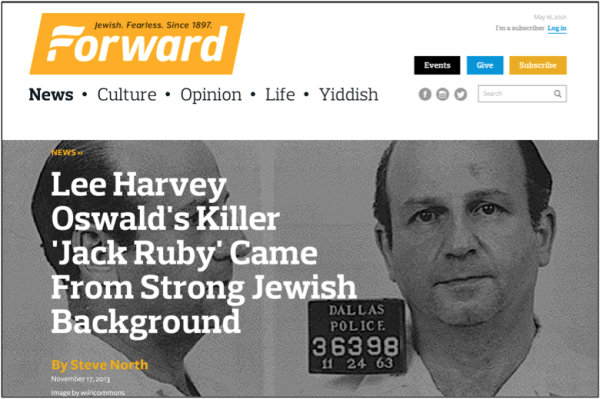
Of course, it is perfectly normal that Chief Justice Earl Warren, when Ruby told him on June 7, 1964, “I have been used for a purpose,” failed to ask him who had used him and for what purpose.[1] But what about independent investigators? Are only readers of the Forward (“News That Matters To American Jews”) worthy of being informed that “Lee Harvey Oswald’s Killer ‘Jack Ruby’ Came From Strong Jewish Background,” and that he told his rabbi Hillel Silverman that he “did it for the Jewish people”? Here is the relevant passage of Steve North’s 2013 article, relating Silverman’s reaction after hearing on the radio that a “Jack Rubenstein” had killed the assassin:
“I was shocked,” said Silverman. “I visited him the next day in jail, and I said, ‘Why, Jack, why?’ He said, ‘I did it for the American people.’” I interrupted Silverman, pointing out that other reports had Ruby saying he did it “to show that Jews had guts.” The rabbi sighed. “Yes, he mentioned that,” Silverman said. “But I don’t like to mention it. I think he said, ‘I did it for the Jewish people.’ But I’ve tried to wipe that statement from my mind.”[2]
Ruby’s defense lawyer William Kunstler also claims in his memoir that Ruby told him: “I did it for the Jews,” repeating on several occasions: “I did this that they wouldn’t implicate Jews.” During Kunstler’s last visit Ruby handed him a note in which he reiterated that his motive was to “protect American Jews from a pogrom that could occur because of anger over the assassination.”[3] There is only one possible interpretation of Ruby’s words: he must have known, and those who tasked him with killing Oswald must have known, that if Oswald was tried, the Jewish hand in JFK’s assassination would likely be made apparent.
Why is this crucial information not in any book on the Kennedy assassination, save in Michael Collins Piper’s (and now mine)? James Douglass, to take the most representative example, insists, without a shred of evidence, that Ruby, besides being a “Chicago mob functionary,” was “CIA-connected”.[4] Not once does Douglass mention Ruby’s Jewish background, and his real name can only be found in a single endnote quoting another author. Could Douglass’s strange omission have the same motive as Ruby’s murder of Oswald, namely to “protect American Jews from a pogrom that could occur because of anger over the assassination”?
Ruby is not the only person connected to Oswald whose confused words implicating “the Jews” are carefully concealed from the public. On March 29, 1977, George DeMohrenschildt, a Russian geologist who had befriended Oswald in Dallas in 1962 at the request of CIA agent J. Walton Moore, was found dead with a bullet through his head. His death was ruled a suicide, but the Sherriff’s report mentions that in his last months he complained that “the Jews” and “the Jewish mafia” were out to get him.[5] His wife confirmed to Jim Marrs, author of Crossfire: The Plot that Killed Kennedy (1989), that her husband thought that “the Jewish Mafia and the FBI” were out to get him.[6] Most people mildly interested in the JFK assassination know about DeMohrenschildt’s relationship with Oswald, but how many have ever heard this intriguing—even incriminating—detail?
After DeMohrenschildt moved away from Dallas in June 1963, Oswald was chaperoned by Ruth Paine, who found him a job at the Texas School Book Depository, where he started working on October 16.[7] It is repeated in every book that Ruth Paine looked after Oswald on behalf of the CIA, but no evidence is ever given. On the other hand, I was surprised to read in her testimony to the Warren Commission that in the 1950s, Ruth Paine had been “a leader in the Jewish community at Indianapolis,” working with Jewish immigrants who “spoke Yiddish in conducting their business meetings.”[8] Jack Ruby also made business deals in Yiddish, as we shall see. As a matter of fact, he sneaked into the Dallas Police Station under the pretense of translating for Yiddish reporters (what Yiddish reporters need a translator in the U.S.?).
This piece of information comes from the only useful book written about Ruby: Seth Kantor’s 1978 Who Was Jack Ruby? retitled The Ruby Cover-Up in 1980. Kantor was a reporter working for the Dallas Times Herald in 1963. He knew Ruby and was less than ten feet away from him when he shot Oswald. Kantor’s meticulous investigation is an important contribution to the search for the truth about Kennedy’s assassination. In the rest of this article, I will draw mostly from his book, as well as from Michael Collins Piper’s Final Judgment and a few other sources.
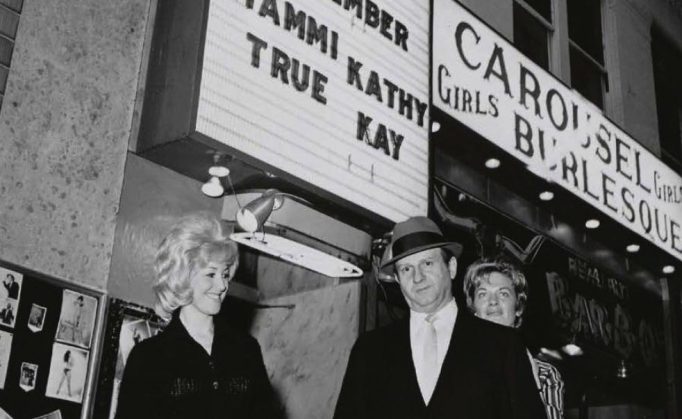
Jack Ruby in front of his Carousel strip club
Gangsters for Zion
In its final report, the Warren Commission declared that it could “not establish a significant link between Ruby and organized crime,” because “Ruby has disclaimed that he was associated with organized criminal activities, and law enforcement agencies have confirmed that denial.”[9] But there is plenty of evidence of Ruby’s association with organized crime. Robert Blakey, chief counsel for the House Select Committee on Assassinations from 1977 to 1979, said: “The most plausible explanation for the murder of Oswald by Jack Ruby was that Ruby had stalked him on behalf of organized crime, trying to reach him on at least three occasions in the forty-eight hours before he silenced him forever.”[10] Incriminating “organized crime” in the JFK assassination and the ensuing Oswald assassination was, of course, the most harmless conclusion that the HSCA could come up with, short of ridiculing itself by confirming the Warren Commission’s story of two lone nuts. And so the Washington Post could headline: “MOBSTERS LINKED TO JFK DEATH.”[11]
The missing word, here, is “Jewish”. Most Americans, learning that Jack Ruby was a mobster, must have thought he was Italian, like Hollywood gangsters. They were not told that his real name was Jacob Leon Rubenstein, that he was the son of Jewish Polish immigrants, that he went to the synagogue just before shooting Oswald, and that he later confessed to his rabbi that he “did it for the Jews.”
Jacob Rubenstein belonged to the Jewish mafia, also known as the Yiddish Connection. He had moved from Chicago to Dallas in 1947, on the trail of 15 other Chicago mobsters (3 Italians and 9 Jews) who had settled there to take over the prostitution business. That is when he changed his name from Rubenstein to Ruby. Ruby’s mentor and role model was Mickey Cohen, who operated in Chicago during the Prohibition but was then active in Hollywood. During his trial for shooting Oswald, Ruby’s legal team was fronted by Melvin Belli, a longtime friend and attorney of Cohen (Belli’s defense was that Ruby had suffered temporary insanity due to a bout of “psychomotor epilepsy”).[12] In 1947, Cohen had succeeded Benjamin Siegelbaum, aka Bugsy Siegel (romanticized by Hollywood in 1991) at the head of “Murder Incorporated”. Cohen and Siegelbaum were accountable to Meyer Lansky (born Suchowljansky), the most powerful Jewish mafia boss, who had built part of his fortune with his Havana casinos and brothels, of which he was dispossessed by Castro in 1959. Lansky’s biographer Hank Messick describes him as the head of the National Crime Syndicate. “Thanks largely to Lansky, organized crime has changed from an ugly growth on the body politic capable of being removed by surgery to a cancerous part of our economic and political systems.”[13]
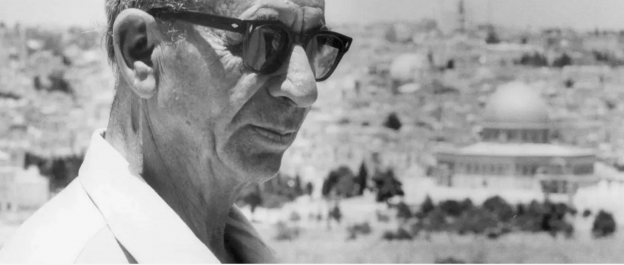
Meyer Lansky in Israel, 1971
Mickey Cohen claims in his memoirs that, in the 1940s and 1950s, he was “engrossed with Israel”, and boasts about his financial and criminal contributions to the arms smuggling operations of the Haganah. Gary Wean, a detective sergeant for the Los Angeles Police Department, claims in his book There’s a Fish in the Courthouse (1987) that he saw Ruby twice in Hollywood in 1946 and 1947 in the presence of Cohen.[14] He also writes that Cohen had frequent contacts with Menachem Begin,[15] and that he was sharing his girlfriend, stripper Candy Barr, with Menachem Begin as well as Ruby.[16]
Cohen was not the only mobster working for Israel. A pact had been sealed between prominent Zionists and Jewish mafia bosses around 1945, when the Haganah organized a highly effective black market of weapons and explosives from the US to Palestine. The operation was orchestrated by a group of about 40 wealthy American Jews who pledged to help David Ben-Gurion when the latter visited New York in July 1945. Headed by Rudolf Sonneborn, the group acted under the legal cover of a charity, the Sonneborn Institute, whose story is told by Leonard Slater in The Pledge (Simon & Schuster, 1970).[17] The group operated separately from the Jewish Agency in order to shield it from direct involvement in unlawful activities. Among its active members was the future Jerusalem mayor (1965-93) Teddy Kollek, who also played a key role in forging the CIA-Mossad Alliance. Robert Rockaway has documented the contribution of the Jewish underworld to this operation, in his article “Gangsters for Zion: How Jewish mobsters helped Israel gain its independence”. He writes:
In 1945, the Jewish Agency, the pre-state Israeli government headed by David Ben-Gurion, created a vast clandestine arms-purchasing-and-smuggling network throughout the United States. The operation was placed under the aegis of the Haganah, the underground forerunner of the Israel Defense Forces, and involved hundreds of Americans from every walk of life. They included millionaires, rabbinical students, scrap-metal merchants, ex-GIs, college students, longshoremen, industrialists, chemists, engineers, Protestants and Catholics, as well as Jews. One group, who remained anonymous and rarely talked about, were men who were tough, streetwise, unafraid, and had access to ready cash: Jewish gangsters.
Sent by Ben-Gurion to the U.S. to purchase heavy armaments, Haganah operative Yehuda Arazi approached Meyer Lansky and met with members of Murder, Incorporated. Another Haganah emissary, Reuvin Dafni, who would become Israeli consul in Los Angeles and New York, also dealt with Jewish gangsters. “When I interviewed Dafni,” Rockaway writes, “he told me about his meetings with Jewish mobsters. His meetings were arranged by members of the local Jewish community. His first meeting was in Miami with Sam Kay, a leading Miami Jewish gangster.” Dafni also met with Bugsy Siegel.
As Dafni relates, “I told him my story, how the Haganah was raising money to buy weapons with which to fight. When I finished, Siegel asked, ‘You mean to tell me Jews are fighting?’ Yes, I replied. Then Siegel, who was sitting across the table, leaned forward till his nose was almost touching mine. ‘You mean fighting, as in killing?’ Yes, I answered. Siegel leaned back, looked at me for a moment and said, ‘OK, I’m with you.’” “From then on,” recalled Dafni, “Every week I got a phone call to go to the restaurant. And every week I received a suitcase filled with $5 and $10 bills. The payments continued till I left Los Angeles.” Dafni estimates that Siegel gave him a total of $50,000.[18]
Some of those “gangsters for Zion”, writes Rockaway, “did so out of ethnic loyalties,” or “saw themselves as defenders of the Jews, almost biblical-like fighters. It was part of their self-image.”[19]
Such was also the background and self-image of Jack Ruby. His activities in arms smuggling are well documented, although the fact that it was for the benefit of Israel is often blurred. In Coup d’État in America: The CIA and the Assassination of John F. Kennedy (1975), Allan Weberman refers to the arms-dealing activities of Ruby and other mobsters, but makes no mention of their Jewishness (unless saying that Ruby “was strongly anti-Nazi” counts as an euphemism for being Jewish), and claims that they were in fact arming Castro—while simultaneously participating in CIA plots to kill him.[20]
Ruby knew Lewis McWillie, the manager of the Lansky brothers’ Tropicana nightclub casino in Havana. After the overthrow of Batista by Castro in January 1959, Meyer Lansky relocated to Miami, but Jake Lansky was arrested and confined to a luxury prison, the Trescornia detention camp, together with another mafia figure, Santo Trafficante, Jr. Although not Jewish, Trafficante had sworn allegiance to the Lansky brothers, and controlled substantial portions of Havana’s gambling and prostitution rackets. While in prison, Jake Lansky and Trafficante were often visited by Lewis McWillie, who was negotiating their release by Castro. Ruby told the Warren Commission on June 7, 1964 about visiting Lewis McWillie in 1959 in Havana, and also spoke of knowing McWillie’s bosses, whom, from fear of pronouncing their name, he referred to as “the Fox brothers, the greatest that have been expelled from Cuba.”[21] (McWillie would later acknowledge to the HSCA that, “Jack Ruby could have been out there [Havana] one time with me.”) Ruby added to the Warren Commission that McWillie and one of the brothers later visited him in Dallas.[22]
Seth Kantor quotes from a classified message that was sent from CIA headquarters to National Security Advisor McGeorge Bundy, on November 28, 1963, confirming that, while Santo Trafficante was living “in relative luxury in a Cuban prison” in 1959, he was visited frequently by “an American gangster-type named Ruby.”[23]
In September 1962, Trafficante is reported to have said to José Alman, a prominent member of the Cuban exile community in Miami, that “President Kennedy would get what was coming to him.” Aleman disagreed and argued that Kennedy would be reelected. “No, José,” said Trafficante. “He is going to be hit.”[24] When Trafficante was asked by Richard Sprague of the HSCA, “did you ever discuss with any individuals plans to assassinate President Kennedy prior to his assassination?” Trafficante refused to answer.[25]
As Kantor shows in great detail, Jack Ruby had repeated contacts with members of the Jewish underworld in 1963. By June 8, “a large group of Chicago racketeers began to show up at Ruby’s Carousel and at two other nearby strip-show clubs, according to a confidential report to Dallas Police Chief Jesse E. Curry written by Lieutenant Robert L. May Jr., who had been head of the vice squad.”[26] Ruby’s underworld contact intensified during the 11 days leading up to President Kennedy’s assassination, “when Ruby abruptly signed a power of attorney, giving up certain rights to control his own money. He also suddenly bought and installed a safe for the first time in his 16 years as a Dallas nightclub operator, to store extra amounts of money.”[27] During this period, “Ruby was getting a series of phone calls at the Carousel from an unidentified man who never would leave a message when Ruby was out.”[28] On November 11, Ruby met in Dallas with Alexander Philip Gruber, who was known for his connections with Mickey Cohen. Gruber, who had not visited Ruby in years, told the FBI that he was in Joplin Missouri at that time, and had simply decided to drop in on Ruby “since Dallas, Texas, was about 100 miles from Joplin” (the distance is 360 miles).[29] In the afternoon of November 22, Ruby phoned Alex Gruber in Los Angeles. “Gruber subsequently told the FBI he didn’t really know why Ruby called.”[30] That is most probably when Ruby received an offer he couldn’t refuse.
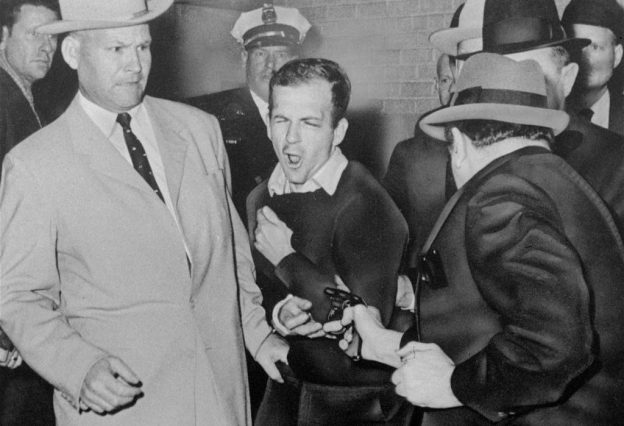
Ruby was certainly informed about the precise moment when Oswald would be transferred from the Dallas Police Station to the County Jail. According to former British Intelligence Officer Colonel John Hughes-Wilson, it was Sam Bloom, the Jewish chairman of the “host committee” who had invited Kennedy to Dallas, who suggested to the Police “that they move the alleged assassin [Oswald] from the Dallas police station to the Dallas County Jail in order to give the newsmen a good story and pictures.” And “when the police later searched Ruby’s home, they found a slip of paper with Bloom’s name, address and telephone number on it.”[31]
In an apparent attempt to make it impossible for him to fulfill his contract, Ruby tried to warn the Dallas Police anonymously: Lieutenant Billy Grammer, a dispatcher for the Dallas Police Department, whose statement can be heard here, received an anonymous phone call at 3 a.m. on November 24 from a man who knew Grammer’s name. The caller told Grammer that he knew of the plan to move Oswald from the basement and that unless the plans for Oswald’s transfer were changed, “we are going to kill him.” After Oswald was shot, Grammer, who knew Ruby and had found the voice familiar at the time of the call, identified Ruby as the caller.[32]
Ruby and the Dallas Police
When Ruby shot Oswald on Sunday November 24, this was not the first time he had been allowed into the Dallas Police Station. He knew about every policeman in town, and was nearly as often hanging around in the Police station as the policemen were at his Carousel strip club. “I have always been very close to the police department, I don’t know why,” he told the Warren Commission. Most plausibly, being on friendly terms with the Dallas policemen was his special mob assignment, and certainly the reason why he was chosen for silencing Oswald: few people had as much ease in making their way into the Dallas Police station.
Ruby spent a lot of time there from Friday 22 to Sunday 23, making several attempt to enter room 317 on the third floor where Oswald was interrogated. Early evening on Friday, the day Kennedy was assassinated and Oswald arrested,
shortly after 7 p.m., John Rutledge, a veteran police reporter for The Dallas Morning News, saw Jack Ruby, whom he easily recognized by sight, step from a public elevator onto the third floor. / Ruby was between two men who wore lapel credentials identifying them as out-of-town reporters. The three walked rapidly past a police officer stationed at the elevators to keep out anyone not on official business. Ruby was hunched over, writing something on a piece of paper and then showing it to one of the reporters as they walked toward Room 317, where Oswald was being interrogated by Captain Fritz and others. … A guard was posted at the bureau door to keep reporters from getting in to use the phones, but Ruby had no trouble easing in. He knew the guard. Ruby walked in and shook hands with Eberhardt, who asked him what he was doing. Ruby had note paper in his hand and said he was acting as translator for the foreign press. Eberhardt figured Ruby was talking about the Israeli press or the Yiddish-speaking reporters Eberhardt guessed he heard in the bedlam of the corridor.[33]
Here are the exact words from Detective August M. Eberhardt’s deposition to the Warren Commission (online here):
Mr. EBERHARDT. He came in and said hello to me, shook hands with me. I asked him what he was doing. He told me he was a translator for the newspapers. Of course, I knew that he could speak Yiddish. Had a notebook in his hand…
Mr. GRIFFIN. Do you know if there were Israeli newspaper or Yiddish—
Mr. EBERHARDT. There was a bunch of them running around there talking that unknown tongue. I don’t know what they were saying.
What a shame these Yiddish-speaking reporters were not traced and identified. Victor R. Robertson Jr., a reporter for WFAA radio and TV in Dallas who knew Ruby, also testified seeing him in the Police Station, attempting to enter 317 while Oswald was in there. Despite those testimonies, the Commission denied that Ruby was ever on the third floor Friday evening.
Later that same day, after a short visit to the synagogue, Ruby bought a dozen corned beef sandwiches and “telephoned homicide detective Richard M. Sims and offered to deliver the free food right to the office. Sims thanked him but said the day’s work was about over and they wouldn’t need anything to eat. Ruby found another reason to go anyway and, at about 11:30 p.m., he stepped off the elevator on the third floor again.”[34] At midnight, Ruby made his way to the press conference in the basement police assembly room, when Oswald was put on display. The Warren Report admits Ruby’s presence there, but portrays him as a casual bystander. “Nowhere in its 888-page report to the public did the Commission include Ruby’s admission to the FBI, a month after the crime, that he was carrying a loaded, sub-nosed revolver in his right-hand pocket during the Oswald press session in the assembly room.” Ruby couldn’t approach Oswald close enough to shoot him, as the room was packed with reporters and photographers.[35]
On Saturday 23, Ruby brought sandwiches to reporters in the Police press room; “reliable outside witnesses reported seeing Ruby or talking with him at intervals during Saturday afternoon—witnesses such as Jeremiah A. O’Leary Jr. of The Washington Star and Thayer Waldo, a reporter to The Fort Worth Star-Telegram.” Yet, Kantor notes,
the Warren Commission said it could reach “no firm conclusion as to whether or not Ruby visited the Dallas police department on Saturday” because “no police officer has reported Ruby’s presence on that day” and because “Ruby has not mentioned such a visit.” / In other words, the Warren Commission decided there had been no conspiracy between Dallas police officers and Jack Ruby because none of them reported it at the time.[36]
On Sunday morning, arrangements were made for the transfer of Oswald to the County Jail. A little after 10:30, Kantor hypothesizes, “a call was placed to the unlisted phone in Ruby’s apartment; Ruby was told where to enter the station and that the transfer van was en route.”[37] Ruby first went to the Western Union office in the next block, and arrived just in time to see Oswald being transferred. This narrow timing has been used as evidence that there was no premeditation and therefore no conspiracy. But Kantor theorizes that Ruby’s entrance into the Police station using the public stairway to the basement jail office area “could have triggered the go-ahead signal for Oswald to be brought down”, and he produces plausible evidence that it did.[38] The way Ruby entered the station is still unclear, but the House committee voted in 1979 that “it was less likely that Ruby entered the police station without assistance.”[39]
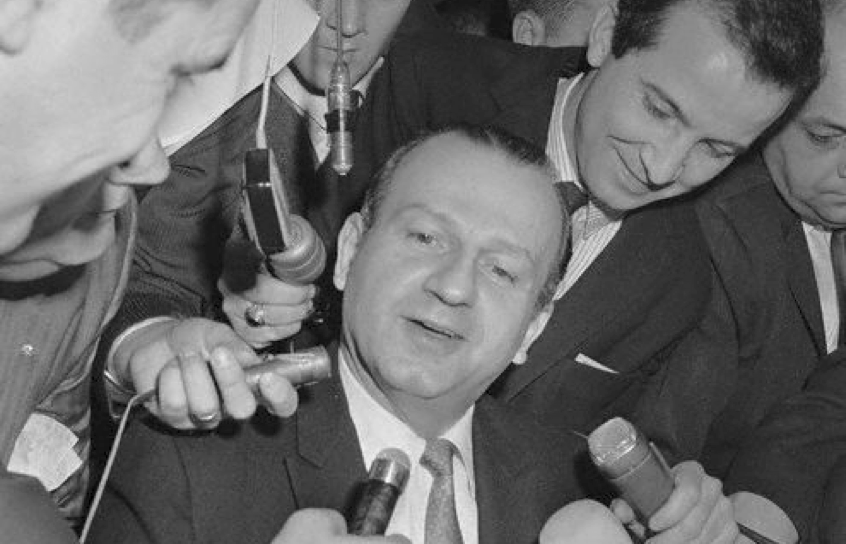
Jack Ruby after his pre-trial hearing in February 1964
The Johnson-Ruby connection
Besides Ruby, we know of one person who took steps to make sure that Oswald was silenced forever. Because Ruby could only shoot one bullet to Oswald—he said he had planned to shoot three—, Oswald was still alive when he arrived at Dallas Parkland Hospital. Dr. Charles Crenshaw recalls in his book JFK, Conspiracy of Silence (1992) that, while operating on Oswald with other surgeons, he noticed that an unknown man looking like Oliver Hardy with a pistol hanging from his back pocket had entered the operation room. Minutes later, he was told about an urgent call for him and left the operating room to take it. The call was from the new sworn president Lyndon Johnson who first asked “Dr. Crenshaw, how is the accused assassin?” Crenshaw answered: “Mr. President, he’s holding his own at the moment.” Then Johnson said firmly: “Dr. Crenshaw, I want a deathbed confession from the accused assassin. There’s a man in the operating room who will take the statement. I will expect full cooperation in this matter.” Dr. Crenshaw answered “Yes, sir,” and hung up. Thirty years later, he comments: “As I stood there in a state of disbelief, my mind was racing. First, ‘deathbed confession’ implies that someone is going to die. If Oswald doesn’t die on the table, is ‘Oliver Hardy’ or someone else going to kill him?” Since Dr. Crenshaw had just told Johnson that Oswald was “holding his own,” the expression “deathbed confession” did sound like an implicit order that Oswald should not leave the operating room alive. It really sounded as if Johnson wanted Ruby’s job finished. Moments after Dr. Crenshaw went back to the operating room, Oswald’s heart beat stopped: “Oliver Hardy” disappeared, never to be seen again. “The incident,” wrote Crenshaw, “confounded logic. Why the President of the United States would get personally involved in the investigation of the assassination, or why he would take the inquest out of the hands of the Texas authorities was perplexing.”[40]
There is plenty of evidence of Johnson’s central role in Kennedy’s assassination. And it happens that Jack Ruby directly pointed to him as the mastermind. At the end of a short filmed news conference in the Dallas County Jail in March 1965, Ruby said, “When I mentioned about Adlai Stevenson, if he was Vice-President there would never have been an assassination of our beloved President Kennedy.” Asked to explain what he meant, Ruby continued, “Well the answer is the man in office now.”[41]
How could Ruby know of Johnson’s guilt? Former Nixon operative Roger Stone claims that, in his presence, Nixon recognized Ruby as one of “Johnson’s boys.”[42] I doubt that story; Stone could have made it up to counter another rumor about Ruby’s connection to Nixon, sparked by a forged 1947 FBI memo stating that “one Jack Rubenstein of Chicago […] is performing information functions for the staff of Congressman Richard Nixon.”[43] But there is one more thing linking Ruby to Johnson.
In his testimony to Chief Justice Earl Warren and other Commission members on June 7, 1964, Ruby pleaded to be given a chance to talk directly to Johnson, otherwise “you will see the most tragic thing that will ever happen,” adding that “maybe something can be saved … if our President, Lyndon Johnson, knew the truth from me.”[44] This can be interpreted as a veiled threat addressed to Johnson. Ruby, who by this time had been sentenced to death, may have been trying to remind Johnson that his contract included a presidential pardon (he had shot Oswald out of love for the Kennedys, hadn’t he?). Even more curiously, Ruby hinted that Israel’s reputation could suffer if he spoke: “There will be a certain tragic occurrence happening if you don’t take my testimony and somehow vindicate me so my people don’t suffer because of what I have done.” He feared, he said, that his act would be used “to create some falsehood about some of the Jewish faith.” Ruby also declared to Warren, “I have been used for a purpose,” but no one in the Commission bothered to ask him who had used him and for what purpose.[45] All Ruby got out of his confused testimony was a second pointless Warren Commission interview one month later (July 18, 1964), this time by none other than Arlen “Magic Bullet” Specter (transcript here). His frustration would explain why in March 1965, he finally accused Johnson. Shortly thereafter, he wrote a letter of sixteen pages that he managed to get smuggled out of jail, blaming Johnson for Kennedy’s murder and calling the former “a Nazi of the worst order.”[46] By doing so, he probably hastened his own death, on January 3, 1967.
The case against Johnson
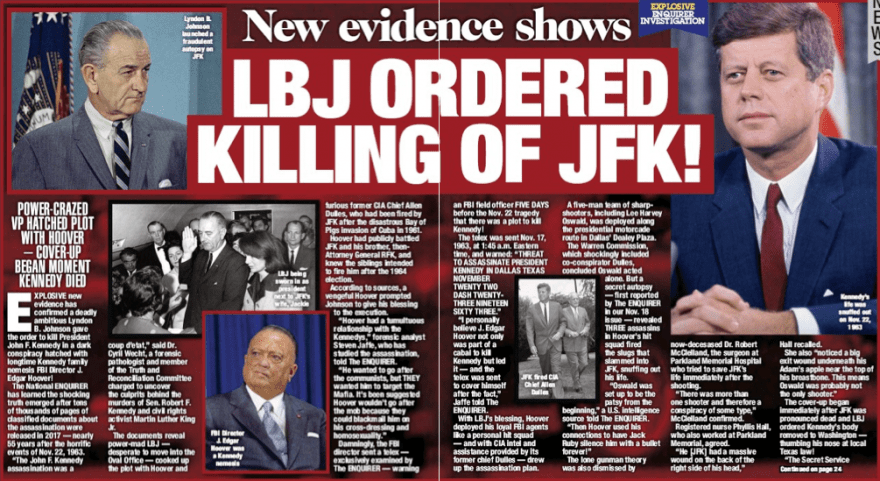
One commenter to my previous Kennedy article argued that the thesis of Israel’s motive is unconvincing because the Israeli Deep State had other options than killing Kennedy in order to go on with its Dimona project. I responded that a murderer’s motive is rarely that he has no other choice than to kill, but that he finds a crucial advantage in the killing. I also remarked that, whoever the assassins were, their purpose was obviously not just to get rid of Kennedy, but to put Johnson in charge. And that had to be done quickly, because the Kennedys were busy destroying Johnson’s reputation and would soon be announcing a change in the vice-presidency. According to Horace Busby, longtime LBJ aide and author of The Thirty-First of March (2005), Johnson had found out that, in early November 1963, Robert Kennedy had sent a team of national reporters to Texas to utterly destroy him. “We’re here to do a job on Lyndon Johnson,” said one the newsmen to an attorney whom he mistakenly believed to be a Johnson enemy. “When we get through with the sonofabitch, Kennedy won’t be able to touch him with a ten-foot pole in 1964”[47] (quoted from this article by Robert Morrow, who wrote more informative articles on Johnson and his “murderous psychopathy”). Richard Nixon, who happened to be in Dallas the day before Kennedy, leaked the rumor to the Dallas Morning News, who reported it on November 22nd under the headline “Nixon Predicts JFK May Drop Johnson.” Instead, Johnson became president that very day (and Nixon knew that Johnson was behind it).[48]
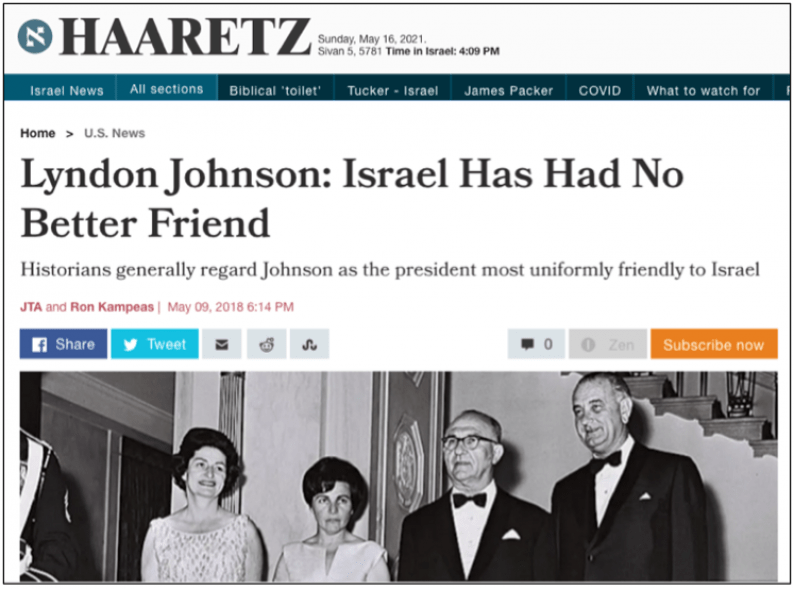
So, since the assassination of Kennedy was a coup to put Johnson in power—what else can it be?—there was no time to waste: it had to be done before the new campaign started and news of a change of vice-presidential ticket was published (Nixon’s prediction was the first and the last). If we now want to know the motive of the coup, we only have to ask: What major change occurred in US policy under Johnson? The change was not visible to the American public then, but they are now well-known, at least to readers of the Jewish and Israeli press. “Lyndon Johnson: Israel Has Had No Better Friend,” headlined Haaretz on May 9, 2018.
“Historians generally regard Johnson as the president most uniformly friendly to Israel,” we are told by the Jewish Telegraphic Agency.
Johnson was the first president to invite an Israeli prime minister, Levi Eshkol, on a state visit. They got along so well — both men were farmers — that Johnson paid Eshkol the rare compliment of inviting him to his ranch.
LBJ soon abandoned pressure on Israel to come clean about the Dimona reactor. He increased arms sales to Israel and in 1968, after Israel’s primary supplier, France, imposed an embargo as a means of cultivating ties in the Arab world, the United States became Israel’s main supplier of weapons, notably launching the talks that would lead to the sale of Phantom fighter jets to Israel.
Johnson wanted to commit more forcefully to Israel’s cause in the lead-up to the 1967 Six-Day War, but he felt constrained from a dramatic show of military might because of the failures of the war in Vietnam then dogging his presidency. Nonetheless, during the war, he ordered warships to within 50 miles of Syria’s coast as a warning to the Soviets not to interfere.
In a speech in the war’s immediate aftermath, Johnson effectively nipped in the bud any speculation that the United States would pressure Israel to unilaterally give up the lands it had captured. He laid down not only the “land for peace” formula that would inform subsequent U.N. Security Council resolutions, but made it clear that any formula had to ensure Jewish access to Jerusalem’s Old City.
It is a good thing that Johnson is being praised by the Israeli press as the US president who “firmly pointed American policy in a pro-Israel direction”, because, on the other hand, his crucial role in the Dallas coup is also getting mainstream attention, as illustrated by the December 2, 2019 issue of the National Enquirer. Anybody who can add one plus one can also make the logical inference.
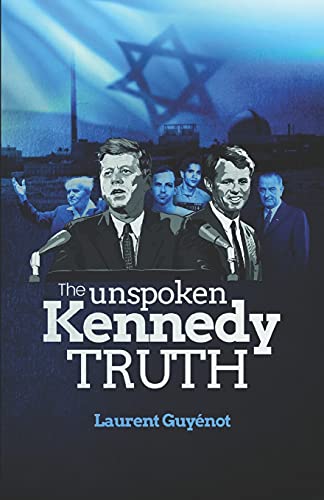
Watch Laurent Guyénot’s film “Israel and the Assassinations of the Kennedy Brothers” and share it:
https://www.youtube.com/watch?v=a_kh5tb7PtA
Notes
[1] Seth Kantor, The Ruby Cover-Up, Zebra Books , 1980, p. 49.
[2] Steve North, “Lee Harvey Oswald’s Killer ‘Jack Ruby’ Came From Strong Jewish Background,” The Forward, November 17, 2013, on forward.com
[3] William Kunstler, My Life as a Radical Lawyer, Carol Publishing, 1994, p. 158.
[4] James Douglass, JFK and the Unspeakable: Why He Died and Why It Matters, Touchstone, 2008, p. 357.
[5] Douglass, JFK and the Unspeakable, p. 47; Sheriff’s Office report on mcadams.posc.mu.edu/death2.txt
[6] Jim Marrs, Crossfire: The Plot that Killed Kennedy, Carroll and Graf, 1989, p. 285.
[7] Douglass, JFK and the Unspeakable, pp. 169-171.
[8] On https://mcadams.posc.mu.edu/russ/testimony/paine_r3.htm
[9] Kantor, The Ruby Cover-Up, p. 48.
[10] https://en.wikipedia.org/wiki/Jack_Ruby#Ruby’s_motive
[11] Gaeton Fonzi, The Last Investigation: A Former Federal Investigator Reveals the Man Behind the Conspiracy to Kill JFK, 1993, Skyhorse, 2013, k. 405–76.
[12] Michael Collins Piper, Final Judgment: The Missing Link in the JFK Assassination Conspiracy, American Free Press, 6th ed., 2005, p. 239.
[13] Hank Messick, Lansky, Putnam’s Sons, 1971, p. 9.
[14] Michael Collins Piper, Final Judgment, p. 222.
[15] Gary Wean, There’s a Fish in the Courthouse, Casitas Books, 1987, p. 681, quoted by Piper, Final Judgment, op. cit., p. 219-27, 232-7.
[16] Michael Collins Piper, Final Judgment, p. 224.
[17] Read Ricky-Dale Calhoun, “Arming David: The Haganah’s illegal arms procurement network in the United States 1945-1949,” Journal of Palestine Studies Vol. XXXVI, No. 4 (Summer 2007), pp. 22–32, online here.
[18] Robert Rockaway, “Gangsters for Zion. Yom Ha’atzmaut: How Jewish mobsters helped Israel gain its independence”, April 19, 2018, on tabletmag.com
[19] Robert Rockaway, “Gangsters for Zion,” on tabletmag.com
[20] Alan J. Weberman and Michael Canfield, Coup d’État in America: The CIA and the Assassination of John F. Kennedy, Quick American Archives, 1975, pp. 151-180 (p. 178). Michael Piper mentions (Final Judgment, p. 232) that JFK researcher Alan J. Weberman has revealed the little-known fact that Ruby traveled to Israel in 1955, but the link to Weberman’s website is now dead, and I hold Weberman as a very unreliable source
[21] Bernard Fensterwald, in Coincidence or Conspiracy (quoted by Piper, Final Judgment, pp. 228-229).
[22] Richard Gildbride, Matrix for Assassination: the JFK Conspiracy, Trafford, 2009.
[23] Kantor, The Ruby Cover-Up, pp. 255-256.
[24] Kantor, The Ruby Cover-Up, pp. 259-264.
[25] Kantor, The Ruby Cover-Up, p. 402.
[26] Kantor, The Ruby Cover-Up, p. 53.
[27] Kantor, The Ruby Cover-Up, p. 48.
[28] Kantor, The Ruby Cover-Up, p. 104.
[29] Kantor, The Ruby Cover-Up, pp. 56-59.
[30] Kantor, The Ruby Cover-Up, p. 91.
[31] John Hughes-Wilson, JFK-An American Coup d’État: The Truth Behind the Kennedy Assassination, John Blake, 2014.
[32] Mentionned in this comment.
[33] Kantor, The Ruby Cover-Up, pp. 96-97.
[34] Kantor, The Ruby Cover-Up, p. 98.
[35] Kantor, The Ruby Cover-Up, pp. 100-101.
[36] Kantor, The Ruby Cover-Up, p. 116.
[37] Kantor, The Ruby Cover-Up, p. 132.
[38] Kantor, The Ruby Cover-Up, p. 141.
[39] Kantor, The Ruby Cover-Up, p. 409.
[40] Charles A. Crenshaw, JFK, Conspiracy of Silence, Signet, 1992, pp. 185-189, 5, and
[41] This sequence can be seen in the 1988 documentary “The day the dream died” at 38:20; for more information on Ruby’s declarations about Johnson and about Jews, check this webpage.)
[42] Patrick Howley, “Why Jack Ruby was probably part of the Kennedy conspiracy,” The Daily Caller, March 14, 2014, on dailycaller.com
[43] Copy at www.jfkmurdersolved.com/nixonruby.htm. The forgery is proven by several inconsistencies: first, Nixon was a freshman in the role as junior counsel in 1947, and only started prosecuting Alger Hiss (the only likely context for this memo) the following year. Second, it refers to “Jack Rubenstein” living in Chicago in November of 1947, when Ruby had in fact already changed his name and moved to Dallas by that time. Finally , the document carries a zip code, when they did not exist at the time.
[44] Read Ruby’s deposition here.
[45] Seth Kantor, The Ruby Cover-Up, p. 49.
[46] Phillip Nelson, LBJ: The Mastermind of JFK’s Assassination, pp. 604-607.
[47] Horace Busby, The Thirty-First of March: An intimate portrait of Lyndon Johnson’s final days in office, Farrar, Straus and Giroux, 2005, pp. 129-130.
Words without Action: The West’s Role in Israel’s Illegal Settlement Expansion
By Ramzy Baroud | MintPress News | November 4, 2021
The international uproar in response to Israel’s approval of a massive expansion of its illegal settlement enterprise in the occupied Palestinian West Bank may give the impression that such a reaction could, in theory, force Israel to abandon its plans. Alas, it will not, because the statements of ‘concern,’ ‘regrets’, ‘disappointment’ and even outright condemnation are rarely followed by meaningful action.
True, the international community has a political, and even legal, frame of reference regarding its position on the Israeli occupation of Palestine. Unfortunately, however, it has no genuine political mandate, or the inclination to act individually or collectively, to bring this occupation to an end.
This is precisely why the announcement on October 27 by Israel that it has given a ‘final approval’ for the building of 1,800 housing units and initial approval for another 1,344 will unlikely be reversed anytime soon. One ought to keep in mind that this decision came only two days after an earlier announcement that the Israeli government had advanced construction tenders for 1,355 housing units in the occupied West Bank.
Israel has rarely, if ever, reversed such decisions since its establishment on the ruins of historic Palestine. Moreover, since Israel’s occupation of Palestinian East Jerusalem, the West Bank and Gaza in 1967, Israel’s colonial project has remained in constant and unhindered expansion. 54 years should have been enough for the international community to realize that Israel has no intentions whatsoever to end its military occupation on its own accord, to respect international law and to cease construction of its illegal settlements.
Yet, despite this obvious fact, the international community continues to issue statements, moderate in their language, at times, even angry at others, but without ever taking a single action to punish Israel.
A quick examination of the US government’s reaction to the news of settlement expansion tells of the lack of seriousness from Washington towards Israel’s continued disregard of international law, peace and security in the Middle East.
“We strongly oppose the expansion of settlements,” said US State Department spokesman, Ned Price, adding that the Israeli decision is “completely inconsistent with efforts to lower tension and ensure calm.”
Since when was Israel concerned about ‘lowering tensions’ and ‘ensuring calm’? If these were truly important US demands and expectations, why then, does the US keep funneling billions of dollars a year in military aid to Israel, knowing fully that such armaments will be used to sustain the illegal Israeli occupation of Palestine and other Arab lands?
If, for the sake of argument, we assume that Washington is finally shifting its policies on Israel and Palestine, how does it intend to pressure Israel to cease settlement construction? Mr. Price has the answer: The Biden Administration would “raise our views on this issue directly with senior Israeli officials in our private discussions”, he said on October 26. “Raise our views”, as opposed to demanding accountability, threatening retaliation, or, God forbid, withholding funds.
While it is true that the US government is Israel’s main western benefactor, Washington is not the only hypocritical administration in this regard. The Europeans are not fundamentally different, despite the fact that their statements might be a tad stronger in terms of language.
“Settlements are illegal under international law and constitute a major obstacle to the achievement of the two-state solution and a just, lasting and comprehensive peace between the parties,” read a statement issued by the office of EU foreign policy chief, Josep Borrell, on October 29.
The statement mirrors the exact sentiments and language of numerous statements issued in the past, ones that “strongly reject” the Israeli action, and “urge” the Israeli government to “revoke” its recent decisions for the sake of “sustainable peace”, and so on. One may even muse to claim that the task of preparing these statements must be the easiest of all clerical work at the EU offices, as it is largely a matter of a simple ‘cut and paste’.
Yet, again, when it comes to action, Brussels, like Washington, refrains from taking any. Worse, these entities often bankroll the very action they protest, while insisting that they are standing at the exact same distance between Israelis and Palestinians, assigning themselves such roles as “honest peace brokers”, “peace mediators” and the like.
One should not be in the least surprised by Israel’s recent announcement. In fact, we should expect more settlement expansion and even the construction of new settlements, because that is what colonial Israel does best.
Within a matter of a few days, Israel has announced its intentions to build, or start bids for, nearly 4,500 settlement units. Compare this number with the settlement expansion during Donald Trump’s term in office. “Israel promoted plans for more than 30,000 settler homes in the West Bank during the four years (Trump) was in power,” the BBC reported, citing an Israeli group, Peace Now, as saying in its recent findings.
Those figures in mind, if the Israeli government under Naftali Bennett continues with this hurried pace of illegal housing construction, it could potentially match – and even overtake – the expansion that took place during the terrible years of the Trump era. With no accountability, this catastrophic political paradigm will remain in place, irrespective of who rules Israel and who resides in the White House.
Israel is doing what any colonial power does. It expands at the expense of the native population. The onus is not on colonial powers to behave themselves, but on the rest of the world to hold them accountable. This was true in the case of the South African Apartheid and numerous other examples throughout the Global South. It is equally true in the case of Israeli Apartheid in Palestine.
The truth is that a thousand or a million more statements by western governments will not end the Israeli occupation, or even slow down the pace of Israeli military bulldozers as they uproot Palestinian trees, destroy homes and construct yet more illegal colonies. If words are not backed by action – which is very much possible, considering the massive military, political and economic leverage the West wields over Israel – then the West remains a party in this conflict, not as a ‘peace broker’, but as a direct supporter of the Israeli occupation and apartheid.
Ramzy Baroud is a journalist and the Editor of The Palestine Chronicle. He is the author of five books. His latest is “These Chains Will Be Broken: Palestinian Stories of Struggle and Defiance in Israeli Prisons” (Clarity Press).
Silencing criticism of Israel
PSA vs. Nazim Ali—What it means for the pro-Palestine Activists
By Massoud Shajareh | MEMO | November 9, 2021
Many of you will have seen the recent news about Nazim Ali’s loss at the High Court. A detailed timeline can be found elsewhere. I want to discuss the three main consequences of this judgment.
First, a quick summary of the case itself. In June 2017, Ali took part in the annual Al-Quds Day parade, during which he made several ill-advised comments about Zionists and Zionism. The Campaign against Antisemitism (CAA) complained to the police and to the General Pharmaceutical Council (GPhC). The police complaint was passed to the CPS, who decided not to press charges; this was appealed and, again, the CPS declined to prosecute Ali. So, the CAA brought a private prosecution against Ali, which the CPS took over and discontinued. This decision was challenged by way of judicial review, which the CAA lost, as the court agreed with the CPS that Ali’s comments were anti-Israel -Zionist in nature and not anti-Semitic.
The GPhC complaints team subsequently decided that Ali’s words were anti-Israel political speech, that they were not anti-Semitic or racist, and dismissed the CAA’s complaint. Ali was notified that the complaint was closed. However, in the summer of 2019, the GPhC reopened the case, justifying its decision on the basis that it had to evaluate Ali’s comments based on the International Holocaust Remembrance Alliance (IHRA) definition of anti-Semitism.
Late last year, those proceedings culminated in the GPhC finding the comments made by Mr Ali to be offensive but not anti-Semitic. They held that, a reasonable bystander who was apprised of all the facts would not consider his speech in their context (a pro-Palestine rally) to be anti-Semitic. They took account of the context, Ali’s explanation of his words and his upstanding character. It issued him with a warning, on the grounds that his words were offensive and his behaviour amounted to misconduct.
Pro-Israel campaigners prevailed upon the Professional Standards Authority for Health and Social Care (PSA) to appeal the GPhC decision to the High Court, which has now decided the GPhC reconsider afresh the allegations of anti-Semitism against Mr Ali, on the grounds that the body had erred by taking into account Ali’s explanation for, and intention behind, the words. The High Court held that Ali’s intention and explanation could not form part of the analysis of whether his words were anti-Semitic. Instead, an “objective” test should be used—something the learned judge does not define; he only elaborates on what it cannot include, i.e., the intention of the speaker.
So why is this dangerous?
- Once you remove intention, all criticism of Israel and Zionism is potentially anti-Semitic: Intention behind words is important. They tell us what the speaker intended, or meant, to say. In the context of controversial subjects, such as Israel/Palestine, they become crucial to understanding what the speaker means. The CAA/UKLFI and others want the courts and tribunals to adopt the IHRA definition of anti-Semitism as the “objective” definition. This is a controversial definition, one which puts substantial emphasis on criticism of Israel. Once an “objective” definition is accepted, where intention is not relevant, pro-Palestine activists will find there is little they can say about Israel without being labelled anti-Semitic.
- The “objective” definition will be wielded as a weapon to harass and silence professionals who criticise Israel. Pro-Israel groups will target any and every one they can identify as a regulated professional who has the temerity to criticise Israel in public. As the definition is “objective”, pro-Israel groups will simply start framing their complaints as the “person’s words are objectively anti-Semitic” in each case, thereby, avoiding the need to discuss the speaker’s intention. The regulators themselves seem uninterested in the politicised nature of the complaints and will bring to bear their full regulatory weight on the individual— involving a complaints process, a tribunal, lawyers’ fees, appeals and counter appeals. The thought of such an overwhelming process will be enough to stop any regulated professional from publicly criticising Israel or Zionism.
- Regulated professionals are just the start— this will set a chilling benchmark that can be replicated in many other regulatory and disciplinary settings. Labour party members accused of anti-Semitism, university disciplinary proceedings, employment tribunals and others will find this case being cited as a precedent. Suddenly, union members are accused of “objective” anti-Semitism as they believe Israel is an apartheid state. Their intent is irrelevant, as the complaint will be framed as the meaning of their words is anti-Semitic— and it is according to the “objective” IHRA definition: “Denying the Jewish people their right to self-determination, e.g., by claiming that the existence of a State of Israel is a racist endeavour.” Teachers, students, employees of any major company, anyone who criticises Israel in public, will find complaints being made against them by pro-Israel groups. These groups know most people do not want their livelihood taken from them; they calculate most people will just remain silent about Israel’s crimes rather than face being disciplined and being removed from employment.
Ali’s words were inappropriate and, on occasion, factually inaccurate (Israel and Zionism are guilty of a lot, but they did not set fire to Grenfell), but they were not anti-Semitic. Our purpose in fighting this judgment is not to defend Ali’s words. Rather, it is to stop the creation of a precedent that will silence virtually all criticism of Israel. Pro-Israel groups wish to proscribe all criticism of Israel; this judgment gives them the tools with which to achieve their goals. Free speech on Israel will be eroded if we do not fight back now.
Israeli soldiers given ‘prizes’ for helping compile database of Palestinians’ pictures – reports
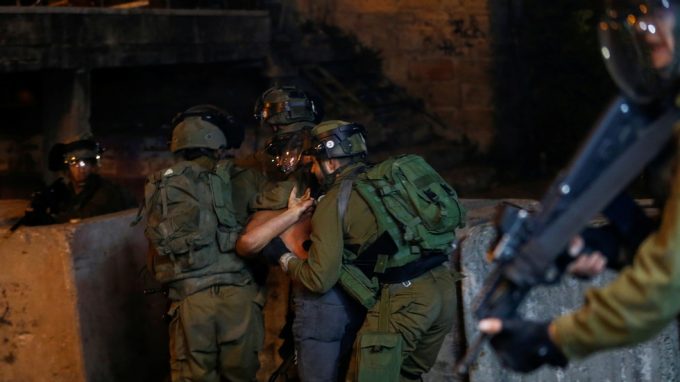
Israeli forces detain a man during a protest in Hebron. September 9, 2021. © Reuters / Mussa Qawasma
RT | November 8, 2021
The Israeli military has reportedly compiled a digital surveillance database to monitor Palestinians in Hebron in the West Bank using invasive facial recognition tech integrated into a network of cameras and soldiers’ phones.
The Israel Defense Forces (IDF) even incentivized soldiers to compete against each other to take photos of residents “with prizes for the most pictures collected by each unit,” according to the Washington Post. Soldiers were reportedly offered rewards such as a night off if they managed to take the most pictures.
The surveillance dragnet is apparently based in part on smartphone technology called ‘Blue Wolf’ that captures the photos and cross-references the faces to find matches on the database. The application then signals to the soldier through a “traffic light” of colors which individuals to detain, arrest or leave alone.
Noting that the IDF has admitted to the initiative’s existence in an online brochure, the report also features interviews with former soldiers who had previously spoken to Breaking the Silence – a group of veterans that highlights human rights violations by the IDF.
One former soldier reportedly described the program as the IDF’s secret “Facebook for Palestinians.” Another veteran told the paper a network of facial recognition cameras had been installed at various checkpoints in the flashpoint town – as well as a broader network of CCTV cameras known as ‘Hebron Smart City’ that sometimes even allows the IDF to see inside people’s homes.
The network also apparently makes use of ‘White Wolf’, an app employed by security volunteers in the West Bank to provide ID information about Palestinians before they enter settlements to work.
“I wouldn’t feel comfortable if they used it in the mall in [my hometown], let’s put it that way,” said one recently discharged soldier who reportedly served in an intelligence unit. She called the Hebron surveillance system a “total violation of privacy of an entire people.”
People worry about fingerprinting, but this is that several times over.
In response, the IDF issued a statement that noted how “routine security operations” were “part of the fight against terrorism and the efforts to improve the quality of life for the Palestinian population in [the West Bank].” It would not comment on the IDF’s “operational capabilities in this context.”
Secret Israeli dossier contained no proof to declare Palestinian NGOs ‘terrorists’
RT | November 4, 2021
A classified dossier which Israel used to brand six Palestinian NGOs as terrorist outfits reportedly contains no concrete evidence to prove their involvement in violent activities or to otherwise justify the designation.
The document, which bears the logo of Israel’s Shin Bet internal security service, is the result of its inquiry into six West Bank civil society groups accused of securing foreign funding for a Palestinian militant group.
Despite the severity of the charges, however, Israel has yet to publicly release any evidence backing up its decision to brand the NGOs as terror organizations. Israeli Defense Minister Benny Gantz prompted international backlash last month after he officially placed a terror designation on the six groups on the basis of the Shin Bet investigation.
Accessing the dossier, The Intercept and Israeli outlets +972 and Local Call found that the information used was based chiefly on interrogations of two accountants from another Palestinian NGO, the Health Work Committees, which was also labelled a terrorist organization last year.
The accountants’ lawyers told the outlets that Israeli authorities had “distorted” their testimonies, which were allegedly gathered under threats to family members and harsh interrogation methods that might be considered “torture.”
Shin Bet reportedly used a single statement from one accountant, about forging fake receipts for Health Work Committees, to accuse the other organizations of being involved in a similar scheme to fund the Popular Front for the Liberation of Palestine (PFLP) militant group. The men apparently described a number of educational and humanitarian initiatives which could be affiliated with the organization as “PFLP activities,” but they did not describe any financing of violent activities.
The outlets said that none of the testimonies cited in the 74-page dossier were backed up by any documents or receipts. The dossier was apparently delivered in May to a number of EU countries that have funded the organizations, prompting independent audits and public criticism from Dutch and Belgian ministers, who stated that the allegations did not contain “even a single concrete piece of evidence.”
“Since the Europeans didn’t buy the allegations, [Israel] used unconventional warfare: declaring the organizations terrorist groups,” Michael Sfard, an Israeli human rights lawyer representing Al-Haq, one of the accused Palestinian NGOs, told The Intercept. He added that the charges were a “political [attack] under the guise of security.”
Meanwhile, senior officials from two unspecified European countries told the outlet that since Gantz’s announcement, Israel has ignored all requests for more information. While the Israeli Ministry of Defense did not comment, two US sources told the outlets that an Israeli delegation had presented similar dossiers on Capitol Hill.
The six NGOs accused by Israel are Al-Haq, Addameer, Bisan Center, the Union of Agricultural Work Committees, Defense For Children International-Palestine and the Union of Palestinian Women’s Committees.
Here’s what’s wrong with Israel branding human-rights groups ‘terrorists’
By Eva Bartlett | RT | November 3, 2021
The Israeli government has designated several human-rights groups ‘terrorist organisations’ in a blatant attempt to further cover up the crimes they commit against the Palestinian people.
On October 22, Israel branded six respected Palestinian human-rights groups “terrorist organisations,” outraging the UN and the wider global community. This, coming from a state that imprisons and kills Palestinian children, and murders uniformed medics.
On the Israeli Defense Ministry’s list were Addameer, Al-Haq, Defense for Children International Palestine (DCIP), the Union of Agricultural Work Committees (UAWC), the Bisan Center for Research and Development, and the Union of Palestinian Women’s Committees.
The groups either document Israel’s crimes against Palestinians, which, in my opinion, routinely amount to terrorism themselves, provide legal support to targeted or imprisoned Palestinians, or work to empower Palestinian civilians. In what bizarre world can they be deemed “terrorist groups”?
A joint statement by leading Israeli rights group B’Tselem and numerous other Israeli and Palestinian rights organisations described the ministry’s action as “a draconian measure that criminalises critical human-rights work,” and noted the importance of documentation, advocacy, and legal aid for the protection of rights worldwide. “Criminalising such work is an act of cowardice, characteristic of repressive authoritarian regimes,” it said.
A number of UN special rapporteurs have condemned the decision as “a frontal attack on the Palestinian human-rights movement and on human rights everywhere.”
Meanwhile, Israel continues to attack unarmed protesters with rubber bullets, live ammunition and tear gas; approve new buildings in illegal Jewish colonies on Palestinian land; and bulldoze centuries-old Palestinian graves in Old Jerusalem; and Israeli colonists continue to brutalise Palestinian civilians, as they have long done. And, of course, Gaza remains under a cruel blockade – the longest lockdown in the world. The roughly two million Gazans barely living in the territory are deprived of the most basic essentials, including urgently needed medical supplies, and Israel guns down and abducts their fishermen, often destroying their boats.
But, no, according to the state responsible for these and countless other acts of terrorism, the “terrorists” are the human-rights groups. This is the state that not only abuses and murders Palestinian civilians, and flattens entire neighbourhoods of Gaza, deliberately destroying vital infrastructure, but also occupies Lebanese and Syrian land, violates Lebanese airspace, and routinely illegally bombs Syria.
This is not the first time Israel has harassed Palestinian (and Israeli) rights organizations.
The children’s agency, DCIP, is “an independent, local Palestinian child-rights organisation dedicated to defending and promoting the rights of children living in the West Bank, including East Jerusalem, and the Gaza Strip.” In July 2021, prior to its “terrorist” designation, its main office was raided by Israeli forces.
At the time, DCIP described the raid as “the latest act by Israeli authorities to increasingly push forward a campaign to delegitimise and criminalise Palestinian civil society and human rights organisations.” They also noted this was a campaign that has been on the rise in recent years, “advanced by a network of rising nationalist Israeli civil society organisations and associated organisations elsewhere, with the support of the Israeli Ministry of Foreign Affairs.”
With the minister of defence designating such groups as “terrorists” and the Ministry of Foreign Affairs supporting the delegitimization campaign, it is not credible to argue the persecution is not coming from the Israeli government itself.
For one of the other listed groups, the Union of Agricultural Work Committees (UAWC), Israel’s targeted harassment caused the Dutch government to cease funding. Israel’s 972 magazine reported on this, saying “for years, a global network of Israel advocacy groups had been lobbying European governments to cut off funding to UAWC, a group that assists Palestinian farmers to cultivate and remain on their land, market their produce, and develop water infrastructure.”
Some of the work UAWC had done in recent years, the article noted, included establishing “52 cooperatives in the West Bank and Gaza, [and] rehabilitating almost 10,000 dunums of Palestinian land that were under threat of confiscation by Israeli authorities in Area C.”
It also planted nearly two million trees, and developed connecting routes amounting to almost 700km in distance. “UAWC also worked to provide better water access to Palestinians in Area C, where water and sanitation services are regularly interrupted by Israeli settlement expansion,” the article also said.
My experiences in Gaza, volunteering for years with impoverished Palestinian farmers and farm labourers coming under Israeli live fire on a near-daily basis, demonstrated to me that the work of groups like UWAC is essential to help farmers rehabilitate destroyed farmland. These are people simply trying to eke out an existence, being maimed and murdered by Israeli fire while doing so, their farmland and wells bulldozed and destroyed, their crops burned.
I also have some experience with the work of DCIP, which documents Palestinian child detainees in Israeli prisons, including children in solitary confinement, as well as children killed by Israeli soldiers or colonists. Without groups like this documenting these crimes, advocating for the children becomes all the more impossible. Clearly, this is one of the reasons Israel has made the outrageous terrorist designation.
But DCIP also helps sick and injured Palestinian children get medical care. The group helped rehabilitate a terribly injured, bedridden, 16-year-old Palestinian teen I met in a Cairo hospital in July 2008, months after an Israeli soldier shot him in the spine.
In March 2008, Abdul Rahman Abu Oida went to the roof of his home, checking the water tank to see why the family suddenly had no water, and was shot in the spine by an Israeli sniper hiding on another rooftop.
As I later wrote, “The bullet destroyed three vertebrae; the shot left Abed paralysed in a puddle of his own blood until his 13-year-old brother, 15 minutes later, found him and dragged him downstairs. Ambulances were prevented from accessing the area. Abed lay untreated for three hours before he reached a hospital in Gaza City.”
In the Cairo hospital where I met him, he was emaciated, with appallingly large bedsores on his backside and feet. These festering bedsores would be the cause of other ailments which plagued him and eventually caused his death. Through a contact at DCIP, Abed began to get proper treatment for his original wound and the consequences of the bedsores.
Although he survived the 2008/9 Israeli massacre, including Israel’s attack on the rehabilitation hospital in which he and 60 other patients were, in 2014 he finally passed away. But without DCIP’s intervention, Abed would surely have died not long after I met him in 2008.
I have written many times about the crimes Israel has perpetrated against Palestinians in Gaza, including sniping at medics and killing and maiming still other medics, including with dart bombs – both war crimes – as well as assassinating children and infants, and firing white phosphorus on civilian areas. These are all just from my personal documentation in the span of a few years.
Without people to document these crimes, Israel’s actions could be even more monstrous than they already are.
Last May, in an attempt to prevent journalists from reporting its war crimes, Israel precision-bombed key media buildings in Gaza (which it had previously done in 2009, 2012, and 2014).
Throughout occupied Palestine, the work of human rights groups in documenting Israel’s crimes remains imperative, and the country’s continued harassment of these groups – including their “terrorist” designation – indicates the effectiveness of their advocacy and the determination of Israel to whitewash its crimes.
Eva Bartlett is a Canadian independent journalist and activist. She has spent years on the ground covering conflict zones in the Middle East, especially in Syria and Palestine (where she lived for nearly four years).
Journalists’ unions seek ICC probe into systematic targeting of Palestinian journalists
![Israeli soldiers shoot tear gas near reporters as they disperse Palestinian protesters on July 31, 2021 [JAAFAR ASHTIYEH/AFP via Getty Images]](https://i1.wp.com/www.middleeastmonitor.com/wp-content/uploads/2021/11/GettyImages-1234355773-scaled-e1635944533233.jpg?resize=1200%2C799&quality=85&strip=all&zoom=1&ssl=1)
Israeli soldiers shoot tear gas near reporters as they disperse Palestinian protesters on July 31, 2021 [JAAFAR ASHTIYEH/AFP via Getty Images]
MEMO | November 3, 2021
There are “strong grounds” to conclude that Israel’s systematic targeting of journalists working in Palestine and its failure to properly investigate killings of media workers amount to war crimes, a complaint being submitted to the International Criminal Court (ICC) will say.
The International Federation of Journalists (IFJ), working with the Palestinian Journalists’ Syndicate (PJS) and the International Centre of Justice for Palestinians (ICJP), has asked Bindmans and Doughty Street Chambers to submit a complaint to the ICC detailing “the systematic targeting of Palestinian journalists on behalf of four named victims – Ahmed Abu Hussein, Yaser Murtaja, Muath Armaneh, and Nedal Eshtayet – who were killed or maimed by Israeli snipers while covering demonstrations in Gaza. All were wearing clearly marked PRESS vests at the time they were shot.”
“At least 46 journalists have been killed since 2000 and no one has been held to account,” the IFJ said in a statement on its website.
The complaint will also include the “bombing of the Al-Shorouk and Al-Jawhara Towers in Gaza City in May 2021″.
IFJ General Secretary Anthony Bellanger said: “The targeting of journalists and media organisations in Palestine violates the right to life and freedom of expression. These crimes must be fully investigated. This systematic targeting must stop. The journalists and their families deserve justice.”
Featured Video

When Israel Is Mighty
or go to
Aletho News Archives – Video-Images
From the Archives
US murdering 1 million Iraqis is democracy, Iran giving yogurt to Iraq is “domination”
By Ali Salaam | American Herald Tribune | July 31, 2017
The New York Times, owned by the Zionist Jewish supremacist Ochs-Sulzberger family, has no problem with Iraqi suffering as long as Iran is not the one behind it.
The Iraq War was a genocide of the Iraqi people by Zionist supremacists in the Bush administration. Over 1 million innocent people were killed based on a lie. American soldiers died in an Israeli war and now an average of 22 soldiers commit suicide every day because their consciences cannot cope with the fact they committed crimes in an illegal war that served no purpose other than to benefit Israel, not America.
Benjamin Netanyahu, Prime Minister of the Zionist regime, once said “We are benefiting from one thing, and that is the attack on the Twin Towers and Pentagon, and the American struggle in Iraq.”
Paul Wolfowitz had his sights on Iraq since his time in the first Bush administration. Former Israeli official and Bush administration official Richard Perle had his eyes on Iraq since at least his authorship of the Clean Break white paper. The Zionist regime had their eyes on Iraq since the 1980s when strategist Oded Yinon wrote his white paper in support of dividing the Arab-Muslim world along ethnic and sectarian lines. The global Zionist lobby has had their eyes on Iraq since Theodor Herzl stated that Eretz Israel’s true borders go from the Nile River in Egypt to the Euphrates River in Iraq. … continue
Blog Roll
 Aletho News
- MEP blasts ‘Euro-Gestapo’ for lecturing Russia on democracy
- Syria May Send Troops to Saudi Arabia Amid War with Ansar Allah
- UK whines about losing billions to ‘Putin tax’
- Baghaei to Rubio: Distorted narratives cannot erase US record of broken commitments
- Houthis Don’t Have to Conquer Saudi Arabia to Make It Pay
- MOE: Nearly 22,000 Students and Education Workers Killed
- Guterres in Islamabad: Genocide, cowardice, and the cage of Imran Khan
- Johnson, Marandi say Yemen holds upper hand over Saudi Arabia
- False flags won’t save aggressors, Iran FM spokesman says
- The Makkah Pact Enters Into Force: The End of American Dominance or Its New Form?
- If Americans Knew
- Suppressing Palestinian resistance: US charity under fire for AI monitoring of Gaza classrooms
- Thousands Are Held in Israeli Torture Camps. This Is What Happens Inside
- Israel puts Gaza’s sick, injured, newborn in peril – Daily Update
- Report claimed Mark Levin used by Israeli government to influence Trump
- Over 2,000 Gazans have died awaiting medical evacuation amid Israel’s continued siege
- How a U.S. Diplomat Suppressed and Altered Reports Critical of Israel
- 5 Palestinians Die from Israeli Strikes in Gaza as Relentless Attacks Continue
- Report: Ceasefire Slows Killing but Leaves Devastation Intact
- Country Music Singer Zach Bryan Breaks Attendance Record at Robert Kraft’s Gillette Stadium While Wearing ‘Free Palestine’ Shirt for Second Night in a Row
- Three years of death and devastation: Israel’s war on Gaza in pictures
- No Tricks Zone
- New Study: 50 Years Of The Most Aggressive ‘Net Zero’ Policies Can Only Affect The Global Climate By 0.03°C
- US September “Heat” Was No Record…Many Records Set Decades Ago
- Latest European Green Energy Debacle; Portugal’s Largest Flagship Solar Park Insolvent!
- Green Energy Debacle: German Expert Professor Fritz Vahrenholt Warns Of Severe Economic And Social Consequences
- Two More Paleo Reconstructions Affirm Meters-Higher Sea Levels Across Ireland, Brazil 7000-6000 Years Ago
- New Study: Earth And Venus Surface Warmth Largely Explained By Convection And Lapse Rate, Not CO2 Or Radiation
- 2025 Nature Paper Claiming Worsening Global Drought Gets RETRACTED …Heavily Flawed
- New Study: ‘Global Drought Shows No Detectable Recent Acceleration Under Climate Warming’
- Economic Masterminds: German Socialists Suggest Taxing Productivity Gains Stemming From Using AI
- The South China Sea Has Not Been Cooperating With The Climate Change Narrative

