Belfast urges expulsion of Israeli envoys from UK, Ireland
Press TV – June 6, 2021
The City Council of Belfast in Northern Ireland has approved a motion calling on the governments of the UK and Ireland to expel Israeli ambassadors over the occupying regime’s crimes against the Palestinians.
The document, passed with votes from left-wing parties, urged Belfast municipality to call on London and Dublin “to expel from office Israeli ambassadors, with immediate effect.”
Speaking at the voting session, Socialist councilor Fiona Ferguson said, “I think the expulsion of ambassadors is a first step – a preliminary step – to greater action, but it’s an incredibly important and symbolic step.”
Ferguson, who has tabled the motion, demanded that the UK and Ireland lead by example and answer “the call from Palestinians across the world who have asked for ambassadors to be expelled.”
The resolution states that Israel’s military operation in Gaza amounts to the “ongoing ethnic cleansing of Palestinians” and that the regime’s “illegal settlement expansion, represents flagrant breaches of international law.”
It further says normal cooperation with Tel Aviv is “untenable” at a time when “a growing list of human rights organizations has determined that Israel’s actions amount to apartheid.”
“The council recognizes the rich history of solidarity and activism in this city from all communities for Palestine, including very recently when a huge demonstration called for an end to Israeli mistreatment of the Palestinians; and that such solidarity on the part of our citizens can be an important tool in dismantling support for Israel’s actions,” the motion reads.
Meanwhile, pro-Palestinian students and activists staged a sit-in protest in front of the Irish Foreign Ministry in Dublin.
They blocked the entrance to the ministry, waving signs urging Ireland to expel the Israeli envoy.
Tel Aviv launched the bombing campaign against the besieged Gaza Strip on May 10, after Palestinian retaliation against violent raids on worshipers at the al-Aqsa Mosque and the regime’s plans to force a number of Palestinian families out of their homes at Sheikh Jarrah neighborhood of East Jerusalem al-Quds.
Apparently caught off guard by unprecedented rocket barrages from Gaza, Israel announced a unilateral ceasefire on May 21, which Palestinian resistance movements accepted with Egyptian mediation.
According to Gaza’s Health Ministry, 260 Palestinians were killed in the Israeli offensive, including 66 children and 39 women, and 1948 others were wounded.
RFK’s False-Flag Assassination, and the Forgotten Palestinian Patsy
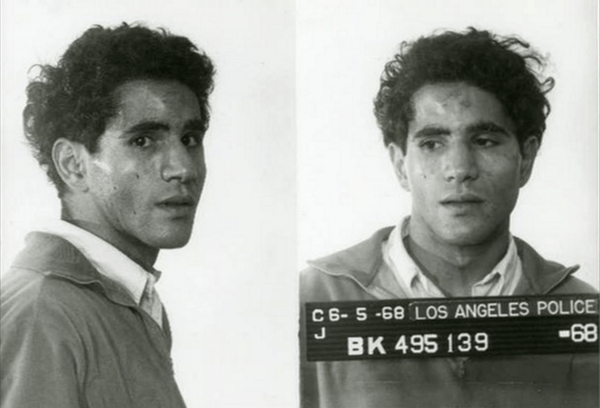
BY LAURENT GUYÉNOT • UNZ REVIEW • JUNE 5, 2021
On June 6, 1968, Robert Kennedy had just won the California Democratic presidential primary, when he was shot dead, five years after his brother. David Talbot has shown in his book Brothers: The Hidden History of the Kennedy Years, published in 2007 by Simon & Schuster, that Robert had never believed in the conclusion of the Warren Commission Report, and that, had he succeeded in becoming the next American president, he would have done his utmost to set up a new investigation. Whether he would have been able to get to the bottom of it is another matter. But it is a reasonable assumption that the forces that had killed John were the same that killed Robert on his way to reclaim the White House. After all, as Laurence Leamer writes in Sons of Camelot: “Bobby had been the president’s alter ego and protector. . . . He had loved his brother so intensely and served him so well that within the administration it was hard to tell where one man ended and the other began.”[1] After 1963, Robert was still his brother’s continuation. He was the heir and the avenger.
That is why I have argued before — and I repeat in my new book — that the ultimate key to the JFK whodunit is in RFK’s assassination, which has a very clear, unmistakable Israeli signature. RFK’s assassination is a masterwork of false flag operation, designed by a supremely intelligent, Machiavellian, and organized cabal, the same that orchestrated one year earlier, with Johnson’s complicity, the attempted false flag attack on the USS Liberty (watch the new groundbreaking four-part documentary film Sacrificing Liberty).
What is truly extraordinary, and demonstrates an unmatched expertise in the industry of lies, is that the conspirators succeeded to get rid of Robert Kennedy while at the same time blaming the assassination on their enemies — the Palestinians — and thereby giving themselves both an alibi and a victim’s role: through RFK, Israel was the target, they claim.
Sirhan Sirhan, the “virulent anti-Semite”

Just hours after Robert’s assassination, the press informed the American people, not only of the identity of the assassin, but also of his motive, and even of his detailed biography.[2] Twenty-four-year-old Sirhan Bishara Sirhan was born in Jordan, and had moved to the United States when his family was expelled from West Jerusalem in 1948. After the shooting, a newspaper clipping was found in Sirhan’s pocket, quoting Robert’s following statement: “The United States should without delay sell Israel the 50 Phantom jets she has so long been promised.” Handwritten notes by Sirhan found in a notebook at his home confirmed that his act had been premeditated and motivated by his hatred of Israel.
That became the mainstream storyline from day one. Jerry Cohen of the Los Angeles Times wrote a front page article, saying that Sirhan is “described by acquaintances as a ‘virulent’ anti-Israeli” (Cohen changed that into “virulent anti-Semite” in an article for the Salt Lake Tribune), and that: “Investigation and disclosures from persons who knew him best revealed [him] as a young man with a supreme hatred for the state of Israel.” Cohen infers that “Senator Kennedy . . . became a personification of that hatred because of his recent pro-Israeli statements.” Cohen further revealed that, about three weeks before the shooting, Sirhan wrote “a memo to himself” that said, “Kennedy must be assassinated before June 5, 1968,” that is, Cohen notes, “the first anniversary of the six-day war in which Israel humiliated three Arab neighbors, Egypt, Syria and Jordan.”[3]
After September 11, 2001, the tragedy of Robert’s assassination was rewritten and installed into the Neocon mythology of the “Clash of Civilizations” and the “War on Terror.” A book entitled The Forgotten Terrorist, by Mel Ayton (2007), purports to present “a wealth of evidence about [Sirhan’s] fanatical Palestinian nationalism,” and to demonstrate that “[Sirhan’s] politically motivated act was a forerunner of present-day terrorism.”
In 2008, on the occasion of the 40th anniversary of Bobby’s murder, Sasha Issenberg of the Boston Globe recalled that the death of Robert Kennedy was “a first taste of Mideast terror.” He quotes Harvard professor Alan Dershowitz saying: “It was in some ways the beginning of Islamic terrorism in America. It was the first shot. A lot of us didn’t recognize it at the time.”[4] That Sirhan was from a Christian family was lost on Dershowitz.
Rabbi Jeffrey Salkin took care to mention it in The Forward, only to add that Islamic fanaticism ran in his veins anyway: “But what he shared with his Muslim cousins — the perpetrators of September 11 — was a visceral, irrational hatred of Israel. It drove him to murder a man whom some still believe might have been the greatest hope of an earlier generation. . . . Sirhan hated Kennedy because he had supported Israel.”
And so, the Forward insists: “One cannot help but note the parallel between [Robert] Kennedy’s assassination and the terrorist attacks of September 11, 2001. In both tragic cases, Arab fanaticism reared its ugly head on American soil, irrevocably changing the course of events in this country.”[5] And the lesson: “In remembering Bobby Kennedy, let us remember not just what he lived for, but also what he died for — namely, the precious nature of the American-Israeli relationship.”[6] In other words: let’s propagate the narrative, for it is good for Israel.
On the fiftieth anniversary, the narrative was well rehearsed: Robert got killed because he was “pro-Israel”.[7] Therefore his murder was a crime against Israel.
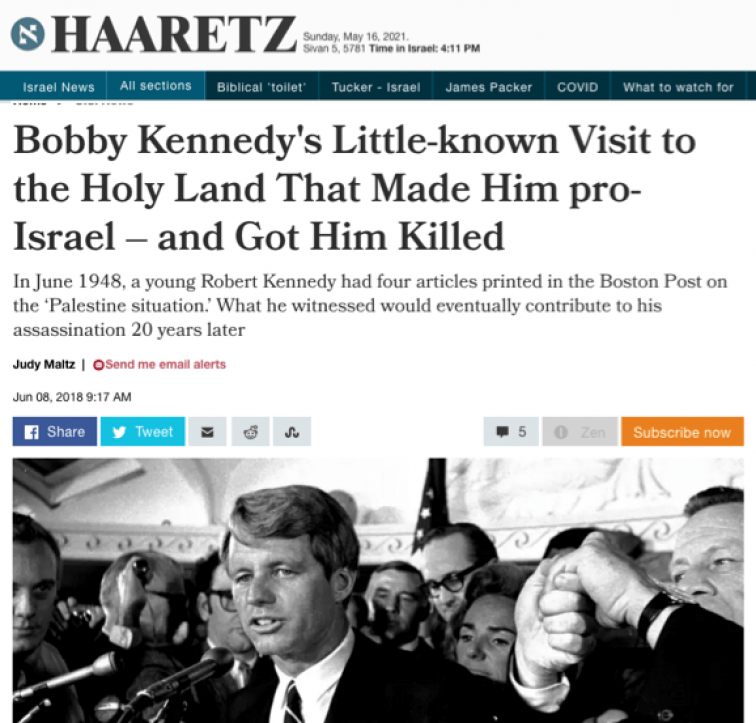
For anyone familiar with the history of the Kennedy clan, there is something odd in the notion that the assassination of Robert Kennedy was a crime against Israel. Robert had not been, in his brother’s government, a pro-Israel Attorney General. He had infuriated Zionist leaders by supporting an investigation led by Senator William Fulbright and the Committee on Foreign Relations, aimed at registering the American Zionist Council as a “foreign agent”, which would had considerably hindered its efficiency.[8]
In 1968, Robert Kennedy had not suddenly turned pro-Israel. He was simply trying to attract Jewish votes, as everyone else. Robert’s statement in an Oregon synagogue, mentioned in the May 27 Pasadena Independent Star-News article found in Sirhan’s pocket, didn’t exceed the minimal requirements. Its author David Lawrence had, in another article entitled “Paradoxical Bob,” underlined how little credit should be given to such electoral promises: “Presidential candidates are out to get votes and some of them do not realize their own inconsistencies.”[9] In fact, as Arthur Krock has noted, the supposed motive for RFK’s murder is itself paradoxical: “If this motive was his position that the United States was committed to preserve Israel as a nation, his statement was made with more moderation than that of other important political persons who said the same thing.”[10]
All things considered, there is no ground for believing that Robert Kennedy would have been, as president of the U.S.A., particularly Israel-friendly.
Did Sirhan kill Robert Kennedy?
If we trust official statements and mainstream news, the assassination of Robert Kennedy is an open-and-shut case. The identity of the killer suffers no discussion, since he was arrested on the spot, with the smoking gun in his hand.
In reality, ballistic and forensic evidence shows that none of Sirhan’s bullets hit Kennedy. According to the autopsy report of Chief Medical Examiner-Coroner Thomas Noguchi, Robert Kennedy was hit by three bullets, while a fourth went through his coat. All these bullets were shot from behind Kennedy: two of them under his right armpit, following an upward angle, and the third, the fatal bullet, behind his right ear, at point blank range. Dr. Noguchi reaffirms his conclusion in his memoirs, Coroner (1983). Yet the sworn testimonies of twelve witnesses established that Robert had never turned his back on Sirhan and that Sirhan was five to six feet away from his target when he fired. Moreover, Sirhan was physically overpowered by Karl Uecker after his second shot, and, although he continued pressing the trigger mechanically, his revolver was not directed towards Kennedy anymore.
By tallying all the bullet impacts in the pantry, and those that wounded five people around Kennedy, it has been estimated that at least twelve bullets were fired, while Sirhan’s gun carried only eight. On April 23, 2011, attorneys William Pepper and Laurie Dusek gathered all this evidence and more in a 58-page file submitted to the Court of California, with a request that Sirhan’s case be reopened. They pointed out major irregularities in the 1968 trial, notably that the serial number of Sirhan’s pistol did not match the serial number of the pistol by which were test fired the bullets compared with those extracted from Robert’s brain.[11] Pepper also provided a computer analysis of audio recordings during the shooting, made by engineer Philip Van Praag in 2008, which confirms that two guns are heard.[12] Paul Schrade, a Kennedy confidant who was behind Robert during the shooting and received one of Sirhan’s bullets, has long believed there was a second shooter. He testified at Sirhan’s 2016 parole hearing, and told him: “the evidence clearly shows that you were not the gunman who shot Robert Kennedy.”[13] Robert F. Kennedy Jr. and his sister Kathleen have joined Schrade and support the call for a reinvestigation of the assassination.[14]
The presence of a second shooter was mentioned by several witnesses and reported on the same day by a few news outlets. There are strong suspicions that Robert’s real assassin was Thane Eugene Cesar, a security guard hired by the Hotel Ambassador, property of Zionist businessman Myer Schine. Cesar was stuck behind Kennedy at the moment of the shooting, and some people saw him draw his pistol. One of them, Don Schulman, positively saw him fire.[15] Incredibly, Cesar’s weapon was never examined, and he was never interrogated, even though he did not conceal his hatred for the Kennedys.[16]
Even if we assumed that Sirhan did kill Robert Kennedy, a second aspect of the case raises question: Sirhan seemed to be in a state of trance during the shooting, and of disorientation just after. More importantly, Sirhan has always claimed that he has never had any recollection of his act. Fifty years after the facts, he continues to declare: “I was told by my attorney that I shot and killed Senator Robert F. Kennedy and that to deny this would be completely futile, [but] I had and continue to have no memory of the shooting of Senator Kennedy.” He also claims to have no memory of “many things and incidents which took place in the weeks leading up to the shooting.”[17] Some repetitive lines written of a notebook found in Sirhan’s bedroom, which Sirhan recognizes as his own handwriting but does not remember writing, are reminiscent of automatic writing: there is a whole page of fifteen repetitions of “RFK must die, Robert F. Kennedy must be assassinated, assassinated, assassinated, assassinated,” suddenly turning to “I have never heard please pay to the order of of of of of.”[18]
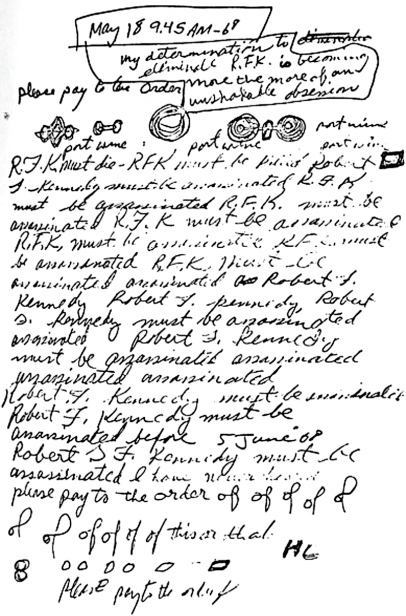
Psychiatric expertise, including lie-detector tests, has confirmed that Sirhan’s amnesia is not faked. Therefore, experts in hypnosis and mental manipulation believe that Sirhan has been submitted to hypnotic programming. “It was obvious that he had been programmed to kill Robert Kennedy and programmed to forget that he had been programmed,” stated Dr. Robert Blair.[19] In 2008, Harvard University professor Daniel Brown, a noted expert in hypnosis and trauma memory loss, interviewed Sirhan for a total of 60 hours, and concluded that Sirhan, whom he classified among “high hypnotizables,” acted involuntarily under the effect of hypnotic suggestion: “His firing of the gun was neither under his voluntary control, nor done with conscious knowledge, but is likely a product of automatic hypnotic behavior and coercive control.” During his sessions with Dr. Brown, Sirhan could remember having been accompanied by an attractive woman, before suddenly finding himself at a shooting range with a weapon he did not know. According to Brown’s report, “Mr. Sirhan did not go with the intent to shoot Senator Kennedy, but did respond to a specific hypnotic cue given to him by that woman to enter ‘range mode,’ during which Mr. Sirhan automatically and involuntarily responded with a ‘flashback’ that he was shooting at a firing range at circle targets.” Later, attorney William Pepper found an entry in the police file that showed that, just days before the assassination, Sirhan had visited a firing range, accompanied by an unknown instructor.[20]
Mossad, Mental control, and false-flag terrorism
We know that in the 1960s, American military agencies were experimenting on mental control. Dr. Sidney Gottlieb, son of Hungarian Jews, directed the infamous CIA MKUltra project, which, among other things, were to answer questions such as: “Can a person under hypnosis be forced to commit murder?” according to a declassified document dated May 1951.[21] As Larry Romanoff has pointed out, MKUltra was an overwhelmingly Jewish enterprise, with people like Dr. John Gittinger, Harris Isbell, James Keehner, Lauretta Bender, Albert Kligman, Eugene Saenger, Chester Southam, Robert V. Lashbrook, Harold Abramson, Charles Geschickter, and Ray Treichler.[22]
In his book Rise and Kill First: The Secret History of Israel’s Targeted Assassinations (2018), Israeli journalist Ronen Bergman has revealed that, in May 1968, the month preceding Robert Kennedy’s assassination, the Israeli Military Intelligence (AMAN) was planning to assassinate Yasser Arafat by hypnotically programming a Palestinian. The idea was proposed by a Navy psychologist named Binyamin Shalit, who claimed that, “if he was given a Palestinian prisoner — one of the thousands in Israeli jails — with the right characteristics, he could brainwash and hypnotize him into becoming a programmed killer. He would then be sent across the Jordan, join the Fatah there, and, when the opportunity arose, do away with Arafat.” The proposal was approved. Shalit selected a 28-year-old Palestinian from Bethlehem, whom he deemed easily suggestionnable. The operation failed, but it proves that, in 1968 precisely, Israel was practicing a method of assassination identical to the one used against Robert Kennedy.[23]
Moreover, manipulating Palestinians to make them commit crimes, or committing crimes and blaming Palestinians for them, bears the signature of Israel. According to former Mossad agent, Victor Ostrovsky, in 1991 elements of the Mossad were plotting an attempt on the life of President George H. W. Bush. Bush had resisted an unprecedented pro-Israel lobbying campaign that called for $10 billion to help Jews immigrate from the former Soviet Union to Israel, complaining in a televised press conference on September 12 that “one thousand Jewish lobbyists are on Capitol Hill against little old me.”[24] Worse, there was his policy of pressuring Israel to the negotiating table at the Madrid Conference by freezing their loan guarantees. Israel had had enough of him. The plan was to leak words to the Spanish police that terrorists were on their way, kill Bush and, in the midst of the confusion, release three Palestinians captured earlier and kill them on the spot.[25]
It is well known that Israel has a long history and a grand expertise in false flag terrorism. A report of the U.S. Army School for Advanced Military Studies (SAMS), quoted by the Washington Times on September 10, 2001, described the Israeli Intelligence agency as: “Wildcard. Ruthless and cunning. Has capability to target U.S. forces and make it look like a Palestinian/Arab act.”[26] That statement was made public on the day before 9/11.
The pattern dates from before the creation of the Jewish State, with the bombing of the King David Hotel, headquarter of the British authorities in Jerusalem, in the morning of July 22, 1946. Six terrorists of the Irgun dressed as Arabs brought 225 kg of explosives hidden in milk churns into the building. When a British officer became suspicious and gunshot ensued, the Irgun members fled after igniting the explosives. The explosion killed 91 people, mostly British, but also 15 Jews.
The strategy was repeated in Egypt during the summer of 1954, with Operation Susannah. The goal was to compromise the British’s withdrawal from the Suez Canal, demanded by Colonel Abdul Gamal Nasser with support from President Eisenhower. Egyptian Jews trained in Israel bombed several British targets, then put the blame on the Muslim Brotherhood. The accidental detonation of an explosive device allowed the exposure of the conspiracy, which led to the “Lavon Affair”, from the name of the Defense Minister who was held responsible.
There are more of the same stories in Gordon Thomas’s Gideon’s Spies: the Secret History of the Mossad (2009).[27] By definition, false-flagged Arab terrorism is only exposed when it fails, and we cannot know how many such operations have been set up by the Mossad. But from the revelations of Ronen Bergman in Rise and Kill First, Sirhan sure looks like a typical made-in-Mossad Palestinian patsy.
There are still, of course, unanswered questions, such as: How did Sirhan find himself in the kitchen pantry of the Ambassador Hotel at midnight on June 6, 1968, with a pistol in his pocket? Sirhan himself declared it was by accident, or by mistake, but then he doesn’t remember much of that evening. Another question is: Why did Kennedy, after finishing his speech, exit the ballroom through the kitchen pantry, instead of walking through the crowd of his supporters, as he usually did? To this question, there is an answer: according to a campaign volunteer present at the scene and interviewed by Michael Piper, it was Frank Mankiewicz who insisted that Robert go this way.[28] Now, isn’t it awkward that Mankiewicz had started his career in public relations “as civil rights director for the western branch of the Anti-Defamation League of B’nai B’rith,” as he mentions in his autobiography.[29] (The ADL, remember, was founded in 1913 by the B’nai B’rith to defend the convicted child rapist and murderer Leo Frank.)[30] In 1991, Mankiewicz handled publicity for Oliver Stone’s film JFK.
Content of my new book, The Unspoken Kennedy Truth:
- Introduction
- 1. RFK’S False-Flag Assassination
- 2. JFK and the Samson Option
- 3. LBJ, Israel’s Best Friend
- 4. Jack Ruby, Gangster for Zion
- 5. Jim Angleton, Mossad’s CIA Asset
- 6. Joe, the Cursed Peacemaker
- 7. JFK Jr., the Slain Prince
- 8. Forrestal, Kennedy’s Foreshadow
- Conclusion
Watch the video based on my earlier Kennedy research:
Laurent Guyénot, Ph.D., is the author of The Unspoken Kennedy Truth (2021), “Our God is Your God Too, But He Has Chosen Us”: Essays on Jewish Power (2020), and From Yahweh to Zion: Jealous God, Chosen People, Promised Land (2018).
Notes
[1] Laurence Leamer, Sons of Camelot: The Fate of an American Dynasty, HarperCollins, 2005, kindle 225.
[2] Watch in Evidence of Revision: Part 4: The RFK assassination as never seen before, 01:11:42
[3] Jerry Cohen, “Yorty Reveals That Suspect’s Memo Set Deadline for Death,” Los Angeles Times, June 6, 1968, on latimesblogs.latimes.com; Jerry Cohen, “Jerusalem-Born Suspect Called An Anti-Semite,” The Salt Lake Tribune, June 6, 1968, on www.newspapers.com.
[4] Sasha Issenberg, “Slaying gave US a first taste of Mideast terror,” Boston Globe, June 5, 2008, on www.boston.com
[5] Jeffrey Salkin, “Remember What Bobby Kennedy Died For,” Forward.com, June 5, 2008. Also Michael Fischbach, “First Shot in Terror War Killed RFK,” Los Angeles Times, June 02, 2003, on articles.latimes.com
[6] Jeffrey Salkin, “Remember What Bobby Kennedy Died For,” Forward.com, June 5, 2008.
[7] Judy Maltz, “Bobby Kennedy’s Little-known Visit to the Holy Land That Made Him pro-Israel – and Got Him Killed,” The Forward, June 8, 2018, on www.haaretz.com/
[8] The Israel Lobby Archive, www.irmep.org/ila/forrel/
[9] David Lawrence, “Paradoxical Bob,” Independent Star-News, May 26, 1968, page 14, on www.newspapers.com/; Shane O’Sullivan, RFK Must Die, on YouTube, at 00:14.
[10] Arthur Krock, Memoirs: Sixty Years on the Firing Line, Funk & Wagnalls, 1968, p. 347.
[11] First discovered in 1970 by Pasadena criminologist William Harper. John Crewdson, “6 Years Later, Evidence in Sirhan’s Case Is Questioned,” New York Times, December 15, 1974, on www.nytimes.com
[12] Frank Morales, “The Assassination of RFK: A Time for Justice!” June 16, 2012, on www.globalresearch.ca; watch “RFK Assassination 40th Anniversary (2008) Paul Schrade on CNN” on YouTube.
[13] “Robert F Kennedy’s killer loses 15th parole bid as witness says: ‘It’s my fault’”, Feb 11, 2016, on www.thegardian.com
[14] Stephanie Haney “Bobby Kennedy’s children at war with each other over new death probe,” June 2, 2018, on dailymail.com
[15] Watch Ted Charach and Gerald Alcan’s film The Second Gun: Who Really Killed Robert Kennedy, 1998 , on YouTube.
[16] Philip Melanson, The Robert F. Kennedy Assassination: New Revelations On the Conspiracy And Cover-Up, S.P.I. Books , 1994, p. 25.
[17] In a parole hearing in 2011. Watch “Sirhan Sirhan Denied Parole” on YouTube.
[18] Shane O’Sullivan, Who Killed Bobby? The Unsolved Murder of Robert F. Kennedy, Union Square Press, 2008, pp. 5, 44, 103.
[19] In Shane O’Sullivan’s 2007 documentary RFK Must Die: The Assassination of Bobby Kennedy, on YouTube.
[20] Jacqui Goddard, “Sirhan Sirhan, assassin of Robert F.Kennedy, launches new campaign for freedom 42 years later,” The Telegraph, Dec. 3, 2011, on www.telegraph.co.uk
[21] Colin Ross, Bluebird: Deliberate Creation of Multiple Personality by Psychiatrists, Manitou Communications, 2000, summary on www.wanttoknow.info/bluebird10pg
[22] Larry Romanoff, “CIA Project MK-Ultra,” on www.unz.com
[23] Ronen Bergman, Rise and Kill First: The Secret History of Israel’s Targeted Assassinations, Random House, 2018, pp. 117-119.
[24] Alexander Cockburn, ed., The Politics of Anti-Semitism, AK Press, 2003, p. 104.
[25] Victor Ostrovsky, The Other Side of Deception: A Rogue Agent Exposes the Mossad’s Secret Agenda, HarperCollins, 1994.
[26] Rowan Scarborough, “U.S. troops would enforce peace Under Army study,” The Washington Times, 10 septembre 2001, on www.washingtontimes.com
[27] Gordon Thomas, Gideon’s Spies: The Secret History of the Mossad, St. Martin’s Press, 1999, pp. 384-385 and 410-411.
[28] Piper, Final Judgment, pp. 343, 347.
[29] Frank Mankiewicz, So As I Was Saying… My Somewhat Eventful Life, with Joel Swerdlow, MacMillan, 2016, p. 10.
[30] Ron Unz, “American Pravda: The ADL in American Society,” October 15, 2018, on unz.com.
The Myth of “Anti-Semitic Violence”
By Michael Lesher | OffGuardian | June 5, 2021
The claim that the world is awash in an outbreak of Jew-hatred is a myth – a fiction cynically recycled every few years as a cover for Israeli brutality.
That’s easily said. Still, with so many falsehoods parading as news these days, why single out the lie that Jews are “under attack” in what mainstream media monotonously call a “wave of anti-Semitic violence”? Why not just ignore it and move on?
First, because this particular lie is peddled by so powerful an array of propagandists, and swallowed by so many well-meaning people, that a prompt corrective is needed to set the record straight.
Second, and even more importantly, because the lie is part of an organized campaign to turn reality upside down – to convert supporters of Israeli violence into victims, to blame the real victims for their own suffering, and to subordinate the whole issue of Palestinian human rights to the self-serving dictates of an Israeli-driven propaganda machine as to what does and doesn’t offend delicate Jewish “sensibilities.”
If we allow that kind of lie to stand unchallenged, we’re (quite literally) helping Israel get away with murder.
Not that you’d know any of this from mainstream media. At the moment, it’s almost impossible to find a “respectable” outlet that isn’t brimming with warnings about a worldwide threat to the Jews – and the fact that the same claim has been peddled before, and debunked before, doesn’t seem to bother the purveyors in the slightest.
Yet there really ought to be a few raised eyebrows over the gulf dividing the alarmist tone of the “reports” – “violence and harassment targeting American Jews…coast-to-coast” (BBC); “anti-Semitic attacks and slurs in several American cities” (PBS); “a wave of antisemitic attacks… violence and abhorrent rhetoric” (National Public Radio); “Jews have been threatened and attacked” (New York Times) – from the remarkably murky details purportedly proving them.
The May 26 issue of Ami Magazine, a popular Orthodox Jewish weekly, claims to have information about “several scuffles… including in Toronto, Montreal and New York” and insists that “Jews were beaten at several of these events.”
Ah, but which ones? Ami avoids giving specifics – and a closer look suggests that the facts aren’t on offer because they don’t exist.
Consider Toronto. What was originally described as an “anti-Semitic attack” in that city turned out to have been a fracas instigated by the notorious Jewish Defense League – listed by the FBI as a terrorist organization – in which the Jew identified as the “victim” first swung a large club, then brandished a knife, before being “attacked.” (That didn’t stop Ontario Premier Doug Ford from condemning “anti-Semitism” after the event – a statement he refused to withdraw even when presented with video evidence of the behavior of the “victim.”)
And Montreal? The circumstances of that “attack” are scarcely less turbid. The claims of “violence” against Jews were reported entirely by pro-Israel organizations and their supporters; given the heavy police presence in the area at the time, the absence of corroborating testimony renders the story rather hard to credit.
Meanwhile, a similar report of an “anti-Semitic attack” in Los Angeles (also cited in Ami ) was promptly debunked by Richard Silverstein, whose Tikun Olam blog has an excellent track record for accuracy. Here is Silverstein’s report as of May 25:
You may have read about the purported “wave” of anti-Semitic incidents sweeping the world in response to Israel’s attack on Gaza. Don’t you believe it. One of the main incidents supposedly involved a group of Jews eating outdoors at an LA sushi restaurant. The media narrative says that a car full of Palestinians waving the Palestinian fla[g] shouted “fuck you” at the diners and then threw a bottle at them.
My LA Jewish friends who’ve seen video of the incident and spoken to Palestinians involved (who were never interviewed by the media) say that a group of right-wing Iranian Jews saw the car with the flags, shouted “fuck you” at the Palestinians, then threw a bottle from their table at the car.
No wonder Ami doesn’t bother trying to present evidence of that “anti-Semitic attack.”
New York Assemblyman Dov Hikind – a protégé of convicted terrorist Rabbi Meir Kahane – claims to have identified another “victim of anti-Jewish violence” in Las Vegas.
But to eyes less biased than Hikind’s, the facts tell a different story.
By his own account, the “victim” – a Jew from Staten Island – accosted a Palestinian family he encountered at the MGM Casino with the boast that he too is “from Palestine” (he isn’t), and that “Jews have been around for 5,000 years” (they haven’t), adding that he is a “proud Jew” – meaning, evidently, that he supported Israel’s theft of Palestinian land and the massacre Israel was perpetrating in order to secure it. It seems this taunt angered the Palestinian man sufficiently to induce him to push his interlocutor backward, causing him to fall – whereupon the “proud Jew” called the police.
As if being shoved in a casino after bragging about your fondness for racist violence weren’t proof enough of universal Jew-hatred, the “victim” points angrily to the fact that the police are “only” charging his assailant with “battery.” He thinks he suffered a “hate crime” – though from my point of view there’s more “hate” in endorsing mass murder than in getting upset about it.
Anyway, if that’s the horrific “anti-Jewish violence” that’s supposed to be sweeping America, I’m not panicking.
In fact, if the consequences weren’t so sinister, some of the hoopla would be almost funny.
One story making the rounds in mainstream media alleges an “attack” on an empty kosher pizzeria located on Manhattan’s posh Upper East Side. As far as I can tell, all that’s known is that someone damaged the front door during the night – there’s no evidence of a motive, let alone an anti-Semitic motive. But when Israel needs cover stories, a damaged glass door is a Big Deal: the Anti-Defamation League is said to be “working with law-enforcement officials to investigate the incident,” while Ben Kallos, a Jewish member of New York City Council, added: “This is happening everywhere…. People are in fear all over our city.”
By way of contrast, when the owner of the Foodbenders grocery in Toronto was subjected last year to a systematic campaign of harassment, vandalism and threats for posting comments supportive of occupied Palestine in a shop window, the police refused to act – even when video clearly showed an identifiable woman defacing Foodbenders’ front door with spray-painted graffiti. Meanwhile, local politicians attacked the owner, calling her expressions of sympathy for Palestinians “disgusting,” “hateful,” “abhorrent” and “unacceptable.” Double standards, anyone?
If these fictions about “anti-Semitic violence” have a familiar ring, they should: Israel’s mouthpieces have been telling the same tall tales for years. In May 2002, just in time to divert public attention from Israel’s escalating terror campaign in the occupied West Bank (where, in less than a month, Israeli forces killed nearly 500 Palestinians and demolished 878 homes), a Zionist professor at San Francisco State University claimed to have seen an “out of control mob” launch “a raw, physical assault” on “praying [Jewish] students, and the elderly women… who survived the Holocaust.”
The “Palestinians and their supporters,” she wrote, were “literally chanting for our deaths,” while “the police could do nothing more than surround the Jewish students and community members who were now trapped in the corner of a plaza, grouped under the flags of Israel.”
That this story was fabricated – a fact the redoubtable scholar Norman Finkelstein confirmed simply by checking with Jewish eyewitnesses – did not prevent it from being repeatedly broadcast as fact in “worldwide media venues,” as the Jewish Journal boasted within two weeks of the professor’s account.
Media complicity in the propaganda campaign is another persistent component of the problem – a point Finkelstein underscored in his book Beyond Chutzpah. In 2003, as Israel completed its brutal suppression of the Second Intifada, the “progressive” Jewish magazine Tikkun announced that America was experiencing a “virulent new strain” of “anti-Semitism.”
The proof? “A Jewish student wearing a yarmulke at Yale University is attacked by a Palestinian in his dormitory,” shrilled the article’s lead paragraph.
But Finkelstein found that “no one at Yale’s Center for Jewish Life or the university administration had ever heard of such an assault.”
Embarrassing, wouldn’t you think? But if the author of that lie, one Miriam Greenspan, or Tikkun, the publisher, learned a lesson about inventing “anti-Jewish violence” where none exists, you wouldn’t know it from their behavior. Sixteen years later, Greenspan was still complaining in prominent media about “the PC brand of antisemitic anti-Zionism that flourishes today, in which the ancient animosity toward Jews as a ‘race’ has been transposed to Israel as a nation.”
Meanwhile, Tikkun’s Rabbi Michael Lerner was pontificating that “a growing section of progressives are in fact legitimating anti-Semitic tropes,” such as the claim that Israel is a “central ally of global imperialism.” Plus ça change, plus c’est la même chose.
I myself exposed media complicity in another pogrom-that-wasn’t – on the blog site of the Times of Israel, no less. Once again, the context was an Israeli massacre – this time in July 2014, when the assault Israel cynically dubbed “Protective Edge” had already claimed 150 of the more than 2,100 Gazan lives it would obliterate that summer.
Once again, slaughtered Palestinians were upstaged in the press by hysterical reports that a mob of anti-Semites had attacked a Paris synagogue on Bastille Day, while helpless Jews “cowered” inside.
In fact, the synagogue was never attacked at all; the violence was started by Jewish hoodlums who assaulted a group of demonstrators engaged in a noisy but nonviolent protest in the street outside. I haven’t seen any retractions of the original (false) story, though. As far as mainstream media are concerned, stories alleging anti-Semitic attacks don’t require proof – they are true by definition.
Even when not manufactured out of whole cloth, the tales of Jew-hatred are seldom what they seem. In the last two weeks, the New York press has been agog with horrified accounts of a man who started a fire outside a Brooklyn yeshiva and punched a Hasidic man a few hours later. As it happens, there is surveillance video evidence supporting the story.
But the suspect, Ali Alaheri, is also accused of burning an American flag outside a Catholic church and knocking over an image of Jesus in the week prior to the alleged arson at the yeshiva. What is more – though this isn’t mentioned in any of the articles I’ve read – court records show that Alaheri, while in prison on other charges in 2019, was held on a “suicide watch” and was described by a judge as having “significant mental health issues.”
So, while it’s possible that his latest acts reflected anti-Semitism, they’re more likely just the products of a disturbed mind. But don’t expect to learn that from the press.
The editorial bias that makes these bogus stories possible extends to the media’s uncritical reliance on dubious “sources.” When New York City’s Mayor Bill de Blasio promised enhanced police protection for “Jewish communities” on May 23, he was standing alongside Rabbi Bernard Freilich, according to the Jerusalem Post, which also claimed that America is experiencing “the worst anti-Semitic attacks in decades.”
“Antisemitism has to be stopped immediately,” Rabbi Freilich piously added. “It’s just out of control.”
Freilich ought to know something about being “out of control.” In 2011, the rabbi abruptly “submitted his resignation” from a $100,000-a-year job with the New York State Police after he was caught misusing a police badge, a vehicle placard and a set of emergency lights. In any other context, that kind of history might impair his credibility – but you won’t see it mentioned when he’s adding weight to an Israel-inspired propaganda blitz.
Actually, the sheer mendacity of the pro-atrocity campaign is getting so extreme that, apart from shady political fixers like Freilich, Jewish media are having trouble finding mouthpieces unscrupulous enough to fabricate the PR. So we find the latest issue of Ami Magazine relying on a non-Jewish ex-spook named John Loftus for the bizarre claim that Associated Press and Al Jazeera reporters deliberately “looked the other way every single time” Hamas fighters in Gaza aimed mortar rounds at “Israeli school buses full of children” (yes, really), thus rendering the journalists and their employers “complicit” in “war crimes.”
And just who is John Loftus? Well, the most notorious point of his media career occurred when, during an interview on Fox News, he gave out the address of a suburban Los Angeles home with the false claim that it contained a “terrorist,” forcing an innocent family of five to obtain police protection. (Fox called this a “careless error,” but quickly dropped Loftus as a “contributor.”)
Using a guy like that to proclaim Jewish innocence by manufacturing evidence-free conspiracy theories is scraping the bottom of a pretty filthy barrel. But apparently Loftus is kosher as long as he’s whitewashing the right criminals – that is, Jewish ones.
The bottom line? Whenever Israel is dropping bombs on helpless people, and you read in the press that “Jews are under attack,” or that there is a world-wide “wave of anti-Semitic violence,” you can be pretty sure you’re being lied to.
And not just because the “facts” in those stories are generally falsified or embellished.
There’s a deeper problem, too.
The message underlying all the propaganda never varies: Jewish discomfort is somehow the fault of Palestinians and their supporters – “anti-Semitism” is something critics of Israel must either “distance themselves from” or be tarred with. If Jews don’t like the sound of Palestinian activism, the activists need to justify themselves to the satisfaction of the Jews. Otherwise there is no merit in their defense of Palestinian rights, leaving Israel the aggrieved party by default.
Yet the truth is exactly the reverse of this. Jews have never had anything to fear from pro-Palestinian activism. On the contrary: Israel’s propagandists (politicians, pundits, “journalists” included) are not only complicit in Israel’s crimes against Palestinians; they are far and away the most powerful fomenters of anti-Semitism in the world today.
For it is the apologists for Israeli violence, not Palestinians, who scream from every media platform that Jews, by definition, must be criminals: that “Jewish identity” entails the oppression of non-Jews, the theft of their land, the confinement of whole populations in squalid ghettos where they are periodically massacred.
It is Israel’s “supporters,” not Palestinians, who insist that all criticism of Israeli atrocities necessarily offends Jews – who must, ex hypothesi, be defenders of mass murder, torture and apartheid. It is they, not Palestinians, who deny that Jews with ethical principles can really be Jews at all. It is they who equate Judaism with land theft and Jewish identity with ethnic supremacism.
Can there possibly be a more anti-Semitic teaching than this? Anyone who is genuinely concerned about anti-Jewish bigotry is simply wasting time talking about Palestinian activists (whose leading figures, in any case, have scrupulously excluded anti-Semitism from the movement).
The real target should be the pro-Israel crowd that, as I write, is aggressively propagandizing the world with the claim that the word “Jew” and the phrase “lawless, bloody occupier of other people’s territory” mean one and the same thing.
Which brings me to the case of Joseph Borgen. In the midst of all the media fakery about “anti-Semitic violence,” Borgen, a young Long Island accountant, lays claim to being just about the only Jew who has actually experienced a verifiable physical attack in the last few weeks that may have been motivated, in part, by his religious affiliation.
But what actually happened?
According to Borgen’s own account (reported in fawning detail by Ami Magazine), he was on his way to a pro-Israel demonstration in Times Square on May 20 – wearing a yarmulke – when, just “a couple of blocks away from the rally,” he was suddenly surrounded by “a crowd of people” who beat and kicked him, and then “proceed[ed] to mace and pepper spray me” before police arrived. He suffered minor injuries, was treated at Bellevue Hospital, and was released later that same night. At least one arrest has already been made in the case; police are still seeking other suspects.
Ami’s headline for the story is nothing short of hysterical: “ATTACKED by Anti-Semites!” (Yes, the capital letters and exclamation point all appear in the original.)
A bit of historical perspective is in order. The day American hostages, newly released from Iran, reached American soil in January 1981, the New York Times – the same newspaper that is convulsed with indignation if a Jewish supporter of Israeli atrocities gets his hat knocked off – editorialized that there should be “rage and revulsion” in the streets of the US, where Iranian students bold enough to stage pro-Khomeini demonstrations (according to Newsweek) had already been subject to “violent” treatment that included attacks with baseball bats. Khomeini, with all his faults, was guilty of nothing worse than the crimes Israel commits regularly against Palestinians – but the Times considered “rage and revulsion” appropriate ways to deal with people who rallied in his support.
Woody Allen, always an accurate bellwether of orthodox liberal opinion, was even more direct in his 1979 film Manhattan. “Has anybody read that Nazis are gonna march in New Jersey,” he asks in one scene. “We should go there, get some guys together. Get some bricks and baseball bats and explain things to ‘em.” A woman – one of Allen’s stereotypical, myopic bluestockings – mentions a “devastating satirical piece on that in the Times,” to which Allen tartly replies, “Well, a satirical piece in the Times is one thing, but bricks get right to the point.”
For the record, I don’t agree with Allen. Violence breeds violence, and throwing bricks (at whatever target) can only end by elevating the sort of people who prefer brick-throwing to civilization – not the elements we want to strengthen. But I have never sat in a movie audience that didn’t laugh appreciatively at Allen’s suggestion that Nazis deserve a little roughing up.
So where does that leave the Jewish accountant who was so fond of racist brutality that he dropped everything he was doing on May 20 to publicly demonstrate his support for it?
In a 1990 interview, the respected Israeli intellectual Yeshayahu Leibowitz – who was also a religious Jew – warned that Israel was becoming “a Judeo-Nazi state.” Noting that “the Israeli Defense Force, armed to the teeth by American weapons, has assassinated 150 [Palestinian] children in the past two years alone,” Leibowitz insisted that the word “Nazi” was the only appropriate word to describe its conduct:
The minister of Defense [Yitzhak Rabin] who gave the order to break the arms and legs of Palestinian prisoners is a Nazi… And the president of the High Court [Moshe Landau], who judged that torturing prisoners was allowed, is a Nazi.”
I cannot gainsay Leibowitz’s reasoning. So let us use plain language to describe inescapable facts. The Times Square demonstration – the purpose of which was to flaunt Jewish support for crimes against humanity – was a Nazi rally. The Jews who organized it were Nazis. For his eagerness to attend, Joseph Borgen, if not actually a Nazi, was at least a Nazi sympathizer.
And according to the moral standards endorsed by the New York Times, by Woody Allen, and by all of Allen’s liberal admirers, Borgen got off rather lightly under the circumstances: he was kicked and pepper-sprayed, but not clobbered with bricks or baseball bats.
To repeat: I do not endorse that standard. Even Nazis have rights. I think it is entirely proper for Borgen’s assailants to be prosecuted.
But anyone who expects me to be shocked or outraged because one supporter of mass murder got slapped around in Times Square is barking up the wrong tree. What is outrageous is not that someone took a swing at Borgen next door to a Nazi rally he couldn’t wait to join. What is outrageous is that Jews organized a Nazi rally in the first place. That so many Jews enthusiastically attended it makes it doubly outrageous.
“The photos and videos are horrifying,” Ami Magazine declares in the same issue that laments the attack on Borgen. But the “photos and videos” its editors have in mind aren’t of the carnage inflicted by the Holy State on the men, women and children of Gaza. They’re of a handful of Jews who may have paid a small price for the Israeli teaching that Judaism is a violent, racist cult. For Ami and its fellow propagandists, only supporters of violence can be victims; the real victims – Palestinians – are simply nonpersons.
This appalling inversion of moral priorities gives the clue to the real nature of the myth of “anti-Semitic violence.” The myth is not just a distortion of facts. It is a grotesque revaluation of the most basic moral tenets; it makes “victims” of oppressors and converts truth-telling into bigotry.
That’s why we should not dignify the myth with a moment’s pause – let alone respond to it with our own condemnations of “anti-Semitism,” however tempting this may be to decent people who want to stress their freedom from bigotry. To allow phony “anti-Semitism” claims to dominate the public discourse about Palestine – especially under the circumstances we face now, as Israel moves from crime to bloody crime – is only to encourage the propagandists and to betray the Palestinians who await with dread the next Israeli onslaught.
The right approach is perfectly simple.
Denounce the crimes. Resist the criminals. Tell the truth. Support the victims.
And do not stop. Whatever the liars may say.
Michael Lesher is an author, poet and lawyer whose legal work is mostly dedicated to issues connected with domestic abuse and child sexual abuse. His latest nonfiction book is Sexual Abuse, Shonda and Concealment in Orthodox Jewish Communities (McFarland & Co., 2014); his first collection of poetry, Surfaces, was published by The High Window in 2019. A memoir of his discovery of Orthodox Judaism as an adult – Turning Back: The Personal Journey of a “Born-Again” Jew – was published in September 2020 by Lincoln Square Books.
Abby Martin Beats the Israel Lobby: Attack on Free Speech and Association Fails Court Test
By Philip Giraldi | Strategic Culture Foundation | June 3, 2021
Many Americans who follow developments overseas would concede that Israel and its supporters in the United States exercise a fairly high level of control over U.S. foreign policy in the Middle East. Some are also aware of Congressional attempts to introduce legislation that would define criticism of the Jewish state as a federal hate crime. That would narrow the options for discussion, infringing on First Amendment free speech rights, and further tighten the grip on policy. It would also make violators of the new law subject to fines and even imprisonment at the hands of the Department of Justice, which has traditionally responded favorably on issues of concern to Israel and its supporters.
Still fewer Americans, however, are aware of the ability of the Lobby to promote legislation favorable to Israel and its perceived interests at state and local levels. Possibly the most insidious program being advanced by the friends of Israel is the attempt to make boycotts and public criticism of Israel a punishable offense. Legislation is now in place in many states that requires prospective recipients of government jobs, services or compensation to agree not to participate in boycotting or otherwise seeking to damage the Israeli economy. The details on how the legislation works and what exactly it covers varies from state to state, but the intention is to create disincentives for anyone who seeks to harm Israel as defined by Israel itself. It particularly targets the pro-Palestinian Boycott, Divestment and Sanctions (BDS) movement, which is popular on many university campuses. And the prohibition goes beyond just sanctioning those who are taking action personally, as in a number of states one also cannot publicly or even privately encourage others to take action that might be damaging to the Jewish state. In some U.S. states, the recipient must even sign a legal document under oath indicating that he or she will not engage in anti-Israeli activity.
One might well ask by what authority state governments can demand that citizens not be free to discuss or even peacefully oppose the activity engaged in by a foreign government, particularly as the government in question is an apartheid regime that is a serial violator of international law and guilty of numerous war crimes. Indeed, many who have observed the corruption of constitutional government in the United States by Israel and its friends have asked just that and have predictably not received any credible response. Recently, some believers in the Bill of Rights have, however, gone one step further, going to court after refusing to swear fealty to Israel. Highly respected international journalist and filmmaker Abby Martin is one of the latest to do so.
Abby’s tale will strike many as bizarre, but it has been verified by multiple independent sources and is absolutely true. It demonstrates how in 21st century America government at all levels can strip citizens of their fundamental rights with the stroke or a pen and how the lawmakers will feel absolutely no remorse after they have done so.
In 2016 in Georgia Governor Nathan Deal signed off on a law designated SB 327, which is similar to legislation currently active in at least thirty states. The bill is entitled “State Purchasing; prohibit the state from entering into certain contracts unless such contracts contain a certification; does not presently conduct a boycott of Israel” and reads “A BILL to be entitled an Act to amend Part 1 of Article 3 of Chapter 5 of Title 50 of the Official Code of Georgia Annotated, relating to general authority, duties, and procedure relative to state purchasing, so as to prohibit the state, including all of its subdivisions and instrumentalities, from entering into certain contracts with an individual or company unless such contracts contain a certification that such individual or company does not presently conduct a boycott of Israel and will not conduct such a boycott for the duration of such contract; to exclude certain contracts from these requirements; to provide for definitions; to repeal conflicting laws; and for other purposes.”
In simple language, the law requires any person or company that enters into a contract with the State of Georgia worth $1,000 or more to sign a loyalty oath pledging not engage in political boycotts of the Israeli government based on its treatment of Palestinians.
Abby Martin had agreed to give the keynote address at the International Critical Media Conference that was to be held at Georgia Southern University in 2020, but her participation was canceled by the authorities controlling the University System of Georgia when she refused to sign the document. Her advocacy for BDS was already well known to college authorities when she agreed to speak. She responded with a lawsuit filed on her behalf by the Council on American-Islamic Relations and the Partnership for Civil Justice Fund seeking to overturn both the decision and the law, arguing that her speech was protected by the First Amendment to the Constitution of the United States.
Last Monday, Judge Mark Cohen of the Federal District Court in Atlanta ruled in her favor, declaring that the University System of Georgia had violated Martin’s constitutional rights when it cancelled her speaking engagement over her refusal to sign the state-mandated oath pledging not to engage in boycotts of Israel, which the court determined to be protected by the Bill of Rights to the U.S. Constitution.
The Georgian government defense argued absurdly that it had canceled Martin’s speech because it had “an interest in furthering foreign policy goals regarding relations with Israel.” Dismissing that contention, the judge countered with “Defendants fail to explain how Martin’s advocacy of a boycott of Israel has any bearing on Georgia’s ability to advance foreign policy goals with Israel.” One might also add that the U.S. Constitution grants to the federal government alone the conduct of foreign affairs for the entire United States, so, in a sense, Georgia has no foreign policy.
The judge specifically cited how the law’s clear intention to stifle discussion of BDS “prohibits inherently expressive conduct protected by the First Amendment,” and therefore “burdens Martin’s right to free speech.” He also observed that requiring Martin to sign under oath to refrain from certain otherwise legal activity is “no different than requiring a person to espouse certain political beliefs or to engage in certain political associations.”
Abby Martin was, of course, pleased over the outcome of her case, even though the judge has not yet gone so far as to overturn the law itself. She enthused “I am thrilled at the judge’s decision finding this law unconstitutional as it so clearly violates the free speech rights of myself and so many others in Georgia. My First Amendment rights were restricted on behalf of a foreign government, which flies in the face of the principles of freedom and democracy. The government of Israel has pushed state legislatures to enact these laws only because they know that sympathy and support for the population they brutalize, occupy, ethnically cleanse and subject to apartheid, is finally growing in popular consciousness ––they want to hold back the tide of justice by preemptively restricting the right of American citizens to peacefully take a stand against their crimes.”
Abby Martin’s efforts must be applauded for she has won a major victory in the struggle to maintain freedom of speech in the United States. May it be one of the first in the many battles that will have to be fought to have the courts finally determine decisively that laws drafted by states (and the federal government) specifically to serve Israel’s perceived interests are all unconstitutional and will have to be overturned.
Israel, Don’t Raise the Roof Beams High As You “Resettle” Lifta; Its Owners Will Return
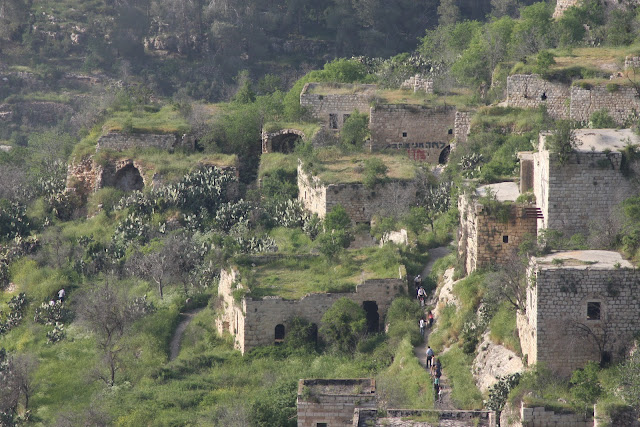
By Rima Najjar | Global Research | June 1, 2021
The latest crisis in Palestine cannot be set aside as another passing episode in Israel’s forever war against the Palestinian people.
We are now witnessing shocks within Israel behind the Green Line, something that Israel had hitherto been able to contain. In the process, it pretended, along with much of the western world, that it is the “longest-lived democracy in the Middle East” and that only its continued occupation of the West Bank and its harsh blockade of Gaza undermine its “constitutional ideals”- ideals now exposed for what they’ve always been: Jewish supremacist in nature.
We know, as CJ Werleman wrote in Inside Arabia on May 14, 2021,
“Israel is a country built on racism, dispossession, and genocide. The recent rise in attacks by Israeli settlers, vigilante groups, and lynch mobs targeting Palestinians are a continuation of that history and must be addressed.”
There is an unbreakable thread between the Palestinian man lynched by Israeli Jews on the pavement after being pulled from his car in Jaffa and then beaten unconscious recently and the killings and massacres at the hands of Zionist militia in Jaffa and elsewhere in 1948 that resulted in the deaths of hundreds of Palestinian civilians, as recounted by Israeli historian Benny Morris.
The myth, amplified by Wikipedia, is that historians [presumably Israeli] disagree “concerning the effect these killings and massacres had on the Palestinian refugee flight and whether or not these killings and massacres were carried out with the intent of hastening it.”
Palestinian historians have absolutely no doubt about what happened then and why, just as we Palestinians have no doubt about what is happening now in occupied Jerusalem and the rest of the West Bank, in Gaza and in several towns and cities behind the Green Line where Israel has imposed states of emergency — and why.
Take, for example, my own father’s village of Lifta on the northwestern edge of Jerusalem. It is the last remaining Palestinian village that was ethnically cleansed of its population in the 1948 Nakba. Now, Israel is set to destroy what remains of it.
The Jerusalem Post (JP), an Israeli English newspaper where facts are shaped by a narrative driven by Zionist values instead of knowledge, reported on this deeply disturbing piece of news this month by denying, like those Israeli historians who are still disputing historical facts, that any ethnic cleansing took place in Lifta — apparently, my grandfather just up and put his eight children and wife in a truck and abandoned his home so that, 73 years later, his village would be “resettled” by Israeli Jews and a luxury hotel built there.
The Israeli newspaper published the following shameful headline:
“Arab village of Lifta, abandoned in ’48, to house new Israeli neighborhood: The western neighborhood in Jerusalem which was abandoned in ’48 will be resettled with 259 housing units, including a luxury hotel.”
A report by Hidden Palestine: a News & Media Website, which, unlike JP, is a site driven by a narrative that values freedom from oppression, provides us with the following facts:
The Israeli land authority announced this month that it is taking bids from construction companies to take charge of the real estate development of Lifta, with the contract set to last 98 years.
The agreement includes the construction of 259 buildings, as well as commercial and business units, in addition to a hotel. If it moves forward, the deal would also see the majority of the Palestinian village’s remaining buildings razed to the ground.
Thanks to petitions by its past Palestinian residents, Lifta was declared as one of 25 endangered sites on the 2018 World Monuments Watch list. It also appears on UNESCO’s tentative list of World Heritage Sites, which has led to threats from Netanyahu that Israel would withdraw from UNESCO.
Lifta has few parallels anywhere in the world. The Palestinian village, lying on a slope at the entrance to Jerusalem, is the last ethnically cleansed Palestinian village to be frozen in time. Here, hundreds of beautiful Palestinian stone houses have continued to stand the test of time, empty and neglected for the past 73 years.
With a history dating back at least 700 years as a Palestinian Arab village, Lifta was among the wealthiest communities in the Jerusalem area, and the women were known for their fine embroiders. Thob Ghabani bridal dresses were sewn in Lifta, which were made of ghabani, a natural cotton covered with gold color silk floral embroidery produced in Aleppo. The village’s clothing stores attracted Palestinians and Arabs from across the Levant.
The entire population was forced out following brutal attacks by the invading Hagannah militias in early 1948. It is an incredible but depressing place to visit, and its destruction would contribute to the continued erasure of Palestinian culture and heritage.
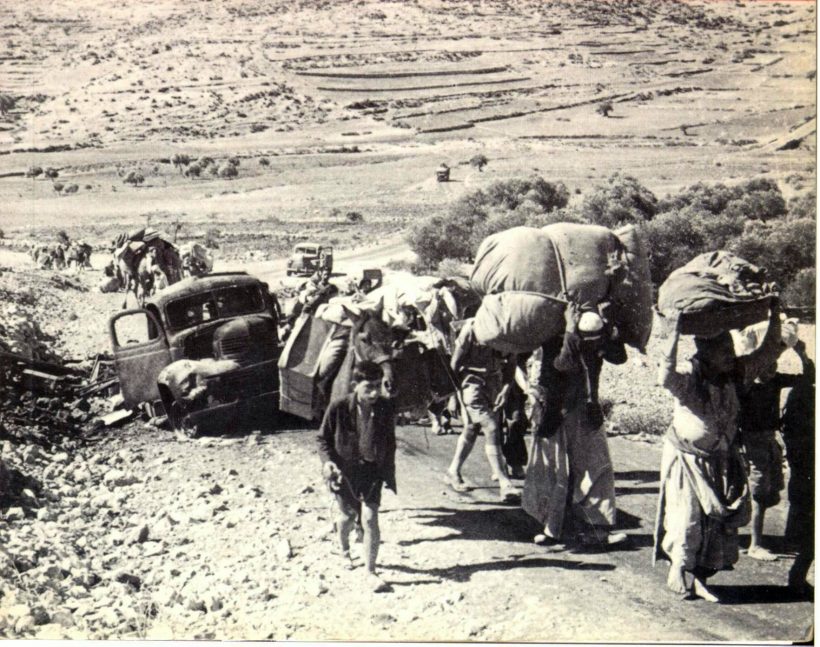
The Jerusalem Post’s story made it sound as though the “resettling” of Lifta was a preservation and development project. What it is, in fact, is a rewriting of history.
Destroying Lifta destroys opportunities for Palestinians to uncover the past of both Palestinians and Israelis: “Lifta has a lasting value in its own right, as it can link restitution to the right of return. Moreover, its preservation will be an opportunity to assert the restoration of dignity in the Palestinian as well as the Jewish community. Finally, by halting the new development in Lifta, UNESCO will affirm its global credibility in response to cultural cleansing.” [See LIFTA AFTER ZIONIST PLANNING and PLANNING AS A CRIMINAL ACT]
Israel’s expulsions of Palestinian families from their homes in Sheikh Jarrah and Silwan, Jerusalem neighborhoods just outside the Green Line, are motivated by the same Zionist objective that resulted in the expulsion, also known as ethnic cleansing, of Palestinians like my family from Lifta, which is just inside the Green line. (See Israeli 2019 map of so-called “Greater Israel” below with Lifta, Sheikh Jarrah and Silwan circled). That objective is Israel’s desire to Zionize/Judaize all of Jerusalem and all of Palestine.
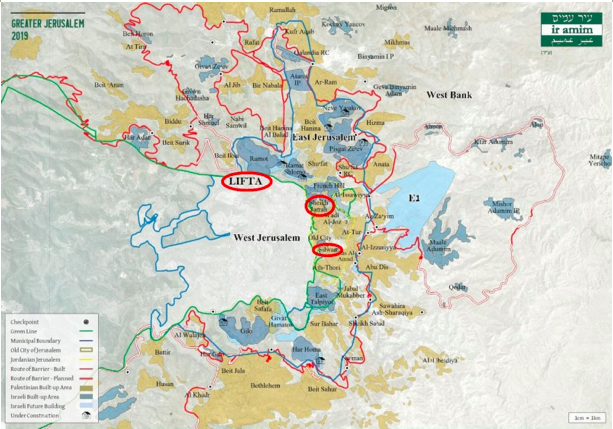
Israeli 2019 map of so-called “Greater Israel” below with (left to right) Lifta, Sheikh Jarrah and Silwan circled
I hope the ongoing worldwide protests on social media against Israel’s crimes will now add the rallying cry of #SaveLifta, in addition to #SaveSheikhJarrah and #SaveSilwan.
If you are still in doubt about Israel’s intention, listen to two Palestinian citizens of Israel reacting to the message they have heard loud and clear all their lives from successive Israeli governments:
Eva Najjar, Haifa-based lead designer and developer at Just Vision, writes:
“I knew I was bringing my children into an ethnic-supremacist state when they were born. But after these past weeks, I don’t know how I can continue to raise them here.” (In The Washington Post : Palestinian citizens of Israel like me are facing terrifying new attacks)
Diana Buttu wonders:
“How do I explain to my 7-year-old son what being a Palestinian citizen of Israel means? What future can he look toward, when the leaders of the government incite hatred against him? What audacious hope can he have when he is bound to face racism and discrimination in education, employment and housing? For now, I try to shield him from the images on television and on our phones, but there will soon come a time when I cannot shield him from the reality that he is surrounded by people who consider him a second-class citizen.” (In The New York Times : The Myth of Coexistence in Israel)
I am heartened by the United Nations Human Rights Council (HRC) Special Session held on May 27, which for the first time has included a geographic scope encompassing Israeli violations targeting the Palestinian people on both sides of the Green Line.
Israel’s institutionalized regime of racial domination and oppression targets the Palestinian people as a whole, including those no longer in Lifta through no fault of their own, who have more right by far to reconstruct their homes in Lifta than Israeli Jews have in constructing housing and luxury hotels to “resettle” the village. We will return, so don’t raise the roof beams high, Israel.
*
Rima Najjar is a Palestinian whose father’s side of the family comes from the forcibly depopulated village of Lifta on the western outskirts of Jerusalem and whose mother’s side of the family is from Ijzim, south of Haifa. She is an activist, researcher and retired professor of English literature, Al-Quds University, occupied West Bank.
Revealed: The American Money Entwined with Israel’s Jewish Terrorist Groups
By Jessica Buxbaum | MintPress News | May 28, 2021
JERUSALEM — As Israel rained rockets down on Gaza in mid-May, inside 1948-occupied Palestine (Historic Palestine and modern-day Israel), another kind of Israeli terror emerged. Jewish supremacists stormed cities with high Palestinian populations chanting “Death to Arabs!,” attacking scores of Palestinians and vandalizing their properties.
The mob violence killed two Palestinian citizens of Israel, according to the Mossawa Center: the Advocacy Center for Arab Citizens of Israel. And despite calls for calm, the attacks are ongoing. On Thursday, a Jewish mob dragged a Bedouin driver out of his car and beat him with glass bottles in northern Historic Palestine. Earlier, footage posted on social media showed Arab gas station workers lying on the ground after being surrounded and beaten by a Jewish mob in the town of Binyamina:
The American Jewish community condemned the wave of anti-Palestinian violence, under the assumption these attacks stem from the fringes of Jewish society. In reality, however, these Jewish supremacists receive financial support from a network of charities in the United States.
Jewish extremists organizing online
As the Israeli government orchestrated a bombing campaign on Gaza, right-wing Israeli activists were coordinating their own war-like operations online.
According to HaBloc, an Israeli nonprofit organization monitoring anti-democratic activity, tens of new groups have been created in the last two weeks on WhatsApp and Telegram. The number of participants in each group ranged from the tens, hundreds, and even thousands. About 2,200 people in total were active in these groups.
HaBloc’s observation of these ultra-right-wing groups reveals how they used social media to organize attacks in advance offline. The groups exchanged information, sold weapons like knives, bats, and pepper spray, used inflammatory rhetoric such as calling for revenge against Palestinian citizens of Israel and documented themselves rioting in the streets.
“This is far more than what’s happening on a daily basis within the far right in Israel,” Ran Cohen, co-founder of HaBloc, said of the extremist activity.
News media reported that the main groups behind the recent rampage were Lehava, a Jewish supremacist organization opposing assimilation and coexistence, and La Familia, a far-right group supporting the Israeli Premier League football club Beitar Jerusalem.
The Israel Religious Action Center (IRAC), the public and legal advocacy arm of the Reform Movement in Israel, has been monitoring Lehava’s activity for more than a decade.
“Lehava is an organization that claims to work against assimilation, but basically wants to create a Jewish-only space in Jerusalem and in Israel in general,” Rabbi Noa Sattath, IRAC’s director, told MintPress News. “In this last wave of violence, they were certainly instigators in several of the cases.”
IRAC demanded Lehava be labeled a terrorist organization in a letter sent this week to Israeli Minister of Defense Benny Gantz, Attorney General Avichai Mandelblit, and Head of the Shabak (General Security Service) Nadav Argaman.
Researchers within HaBloc, cautioned, though, attaching the violence to specific organizations.
“The role of Lehava in what happened is not direct,” HaBloc said. “It’s not like there was a central command and they’re sending people into the streets. It was really something that sort of spread out in a more organic way.”
“But the infrastructure and the ideology of Lehava is present and it contributes to what happened in the past few weeks,” HaBloc added.
The American charities bankrolling Lehava
Ben-Zion Gopstein is the leader of Lehava (or “flame” in Hebrew) and founded the organization in 2005. He is a notorious right-wing activist and disciple of Rabbi Meir Kahane, an American-Israeli extremist who founded the Kach Party, a political movement espousing racist beliefs.
After a brief stint in the Knesset (Israeli parliament) in the 1980s, the Kach Party was banned from Israeli politics and deemed a terrorist organization by both Israel and the U.S.
Kahane called for the expulsion of Palestinians and Arabs from the Holy Land and advocated for the outlawing of marriage between Jews and non-Jews.
Four years after Kahane’s assassination in 1990, Baruch Goldstein, an ardent Kahane follower, opened fired at the Ibrahimi Mosque in Hebron—killing 29 worshippers.
Kahane and Goldstein have become revered within the Israeli settler movement. Settlers have shared Kahane’s teachings on social media and have prayed at his grave.
Lehava is considered the successor to Kach, and Kahane’s racist ideology, Kahanism, runs deep within Lehava circles.
In addition to following right-wing interactions online, HaBloc’s research has also found a complex web of nonprofits in Israel and the U.S. connected to Lehava.
Lehava is not a registered charity in Israel so it can’t accept donations. Instead, money is funneled to Lehava through the Israeli nonprofit, the Foundation for the Salvation of the People of Israel, or Hakeren Lehazalat Am Israel in Hebrew. Israeli fund, Chemla or “mercy” in Hebrew has also been linked to Lehava until about 2014, according to HaBloc.
The Foundation for the Salvation of the People of Israel did not respond to requests for comment via email. The email address may be Gopstein’s as “benzion” is part of it. When contacted at the telephone number associated with the organization’s GuideStar (a nonprofit database) profile, the person said this was not the foundation and hung up. Contact information for Chemla is not publically available.
Two tax-exempt charities in the U.S. fund Kahanist activity in Israel: Charity of Light and the American Friends of Yeshivat HaRa’ayon HaYehudi.
Charity of Light funnels money to Chasdei Meir (which translates roughly into “charity which shines” in Hebrew). Chasdei Meir was named after Kahane, according to the fund’s website. As evidenced on Charity of Light’s tax returns, Chasdei Meir is related to the Chemla Fund. Charity of Light donated $72,000 to Chasdei Meir/Chemla Fund in 2018, according to its most recent tax filing.
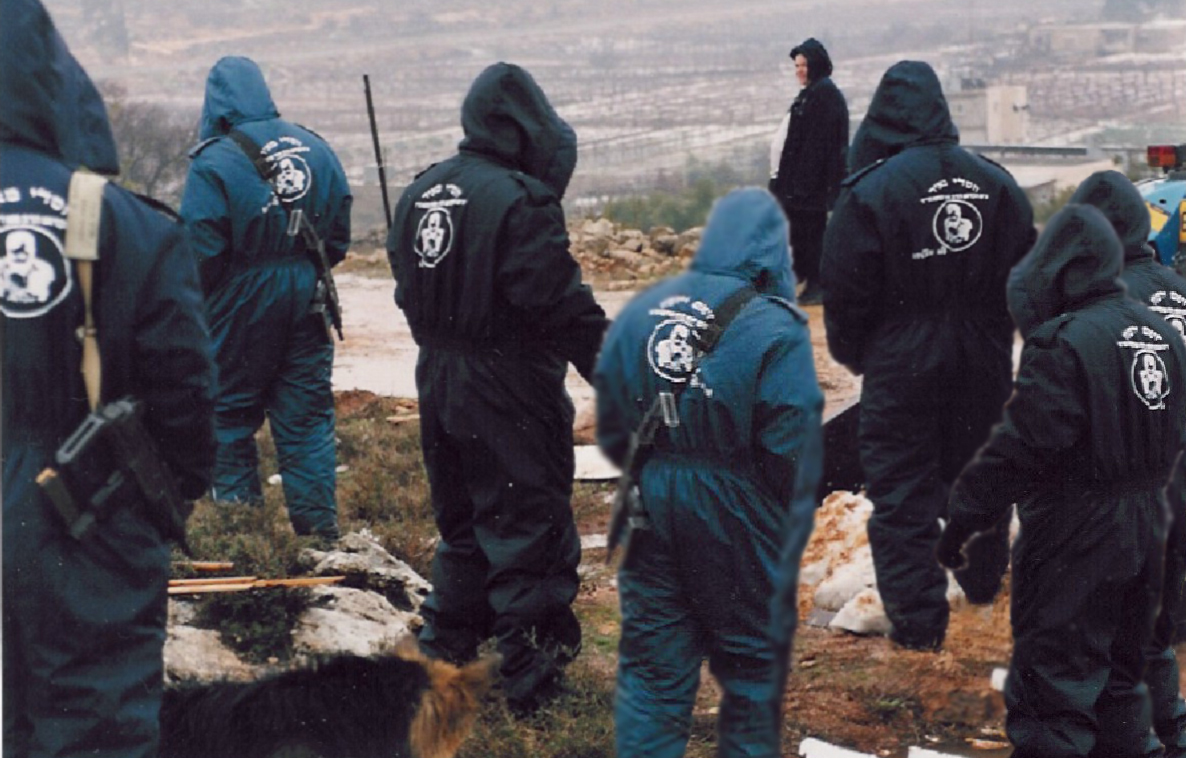
Armed members of Chasdei Meir are shown wearing jumpsuits emblazoned with portarts of Meir Kahane
The American Friends of Yeshivat HaRa’ayon HaYehudi directly supports Yeshivat HaRa’ayon HaYehudi or the Jewish Idea Yeshiva, a Jewish education institution founded by Kahane.
“This is sort of the place for indoctrination of Kahanist ideology,” HaBloc said. “It’s where Benzi Gopstein studied and other prominent Kahanist figures.”
The charity gave $154,000 to Yeshivat HaRa’ayon HaYehudi in 2018, according to the most recent tax report. The yeshiva is even classified as a terrorist organization by the United States. The yeshiva’s dean, Rabbi Yehuda Kroizer, is also part of Chasdei Meir. The yeshiva did not return a request for comment.
The nonprofits’ tax filings list Levi Chazan as the director of Charity of Light and American Friends of Yeshivat HaRa’ayon HaYehudi, and Steven Goldrich is listed as a director of Charity of Light and treasurer of American Friends of Yeshivat HaRa’ayon HaYehudi. Chazan was convicted in a 1984 bus shooting in the Occupied West Bank, which wounded seven Palestinians. Both did not respond to requests for comment.
HaBloc explained this entanglement of Israeli and American organizations is not directly supporting Lehava with monetary contributions, but rather aiding the network around it.
“The relationship between [Lehava] and groups that are funded with American money are two separate issues,” HaBloc’s Cohen said. “There are connections, of course, but we cannot say that these groups that were active in the last two weeks were funded with American dollars.”
Other financial players
The aforementioned charities are largely linked to Kahanism and Lehava, but other American foundations have also been tied to Israeli extremism.
The Traditional Fund gave $51,000 to American Friends of Yeshivat HaRa’ayon and $11,500 to American Friends of Chasdei Meir in 2018. The American Friends of Chasdei Meir is not listed in any available nonprofit database, however, Chasdei Meir’s website does name the American Friends of Chasdei Meir as its contact. The Traditional Fund did not respond to press inquiries.
According to T’ruah: The Rabbinic Call for Human Rights, the Central Fund of Israel (CFI) funds Chemla and Yeshivat HaRa’ayon HaYehudi. The organization filed a complaint with the Internal Revenue Service (IRS) in 2018 to revoke CFI and the American Friends of Yeshivat HaRa’ayon’s charitable status on the grounds these groups are funding terrorism.
IRS charity law states that terrorist activities are considered substantial means for disqualifying an organization’s tax-exempt status. This is in accordance with engaging in illegal acts contrary to standard U.S. policy.
A litany of private foundations supports the CFI. Most notably, the foundations belonging to the late American billionaires Sheldon Adelson and Irving Moskowitz. The Moskowitz family foundations have contributed more than $8 million to CFI since 2018 and Adelson’s foundation gave $50,000 to CFI in 2018.
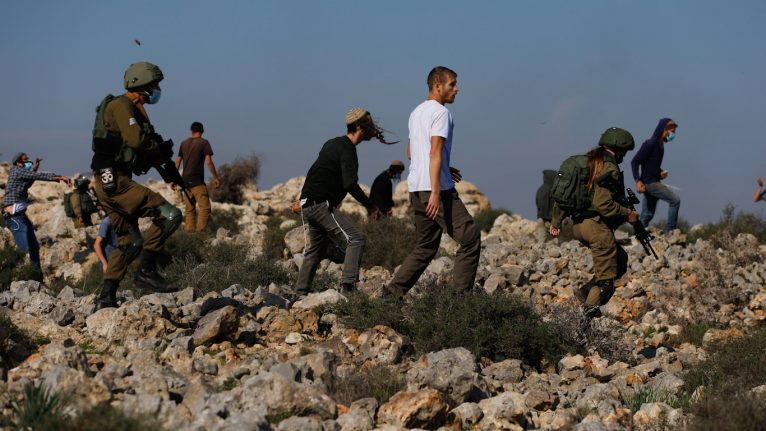
Israeli soldiers and settlers attack Palestinian protesters in the Occupied West Bank town of Salfit, Nov. 30, 2020. Majdi Mohammed | AP
Jay Marcus of CFl said in a statement to MintPress News that, “The Central Fund of Israel absolutely rejects violence and does not support any organizations that promote violence. Furthermore, if an organization that we once supported ever started promoting violence, CFI would not support them in the future.”
Marcus claims that he hasn’t heard of Lehava, adding, “having had rockets indiscriminately showered down on my head, I would certainly disagree with your myth about which ‘groups start violence.’”
The Falic family, owners of the major retail chain Duty Free Americas, has supported The Fund for Saving the People of Israel in the past, providing a total of $60,000 to the association from 2007-2017. The money is wired through the Falic’s Israel-based foundation, the Segal Fund. The Falics could not be reached for comment.
Kahanism’s surge in Israel
Kahane’s Kach Party was banned from entering Israeli politics in 1988. But thanks to Israeli Prime Minister Benjamin Netanyahu, Kahanists are now infiltrating the halls of the Knesset (Israeli parliament).
In the lead-up to Israel’s March election, Netanyahu pushed for a right-wing alliance with Itamar Ben-Gvir, a Kahanist, a defense lawyer for price tag campaigners, and leader of the far-right Otzma Yehudit (Jewish Power) party. Otzma Yehudit partnered with the anti-LGBTQ Noam Party and the National Union-Tkuma faction to form the Religious Zionism bloc in the last election. The coalition allowed the electoral list to secure six seats in the Knesset and for a Kahanist to gain political power. Rabbi Sattath pins the blame squarely on Netanyahu for Jewish supremacists’ rise in government.
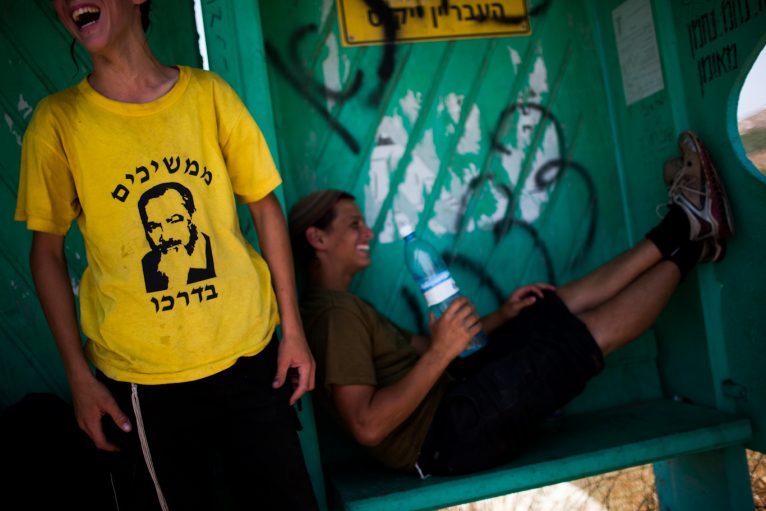
A Jewish settler wears a T-shirt with the image of Meir Kahane near the city of Ramallah. Bernat Armangue | AP
“Because the prime minister was in such a dire situation and was desperate for every vote, he gave [Otzma Yehudit] the legitimacy,” Rabbi Sattath said. “What we’re seeing here in Israel and around the world is that one of the symptoms of democracies in decline is when the extreme right takes over the center right. The fact that the prime minister and some of the right-wing parties gave the Jewish Power Party legitimacy has then increased their power. And that’s what enabled them to use these methods they’ve used for over a decade on a large scale in the last wave of violence.”
Upon reflecting back to Kahane’s short time in the Knesset, Rabbi Sattath said he faced opposition from every politician and was immediately ostracized.
“When he got into the Knesset, he got the bare minimum [of votes] to get one seat. But what happened in the eighties was he was boycotted by every other Knesset member. Nobody would sit in the plenum when he was speaking,” Rabbi Sattath said. “Everybody from the left and the right understood that these ideas were dangerous and extreme and had to be restrained.”
Today, the political climate in Israeli politics is different.
“What we’re seeing now is that the restraint is completely over,” Rabbi Sattath continued. “And we’re hoping that by shedding light on the past weeks’ violence, we can return to the understanding that there needs to be a red line, that these violent militias and racist, Jewish supremacists have to be stopped.”
Jessica Buxbaum is a Jerusalem-based journalist for MintPress News covering Palestine, Israel, and Syria. Her work has been featured in Middle East Eye, The New Arab and Gulf News.
Israeli State Terror — Killing Palestinians with Impunity
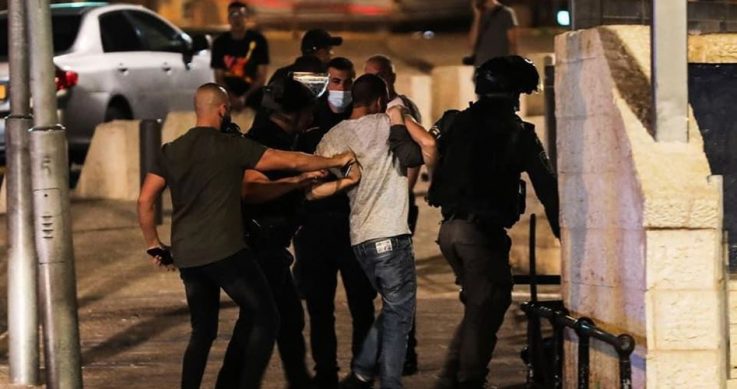
By Stephen Lendman | May 31, 2021
Throughout Jewish state history, its ruling regimes treated Occupied Palestinians and Arab citizens ruthlessly.
Terrorizing them is longstanding Israeli policy, including daily arrests throughout the Occupied Territories, torture, beatings and other forms of abuse, targeted killings, and justice nearly always denied.
Last week, Al Jazeera reported about “grief and anger (in the al-Amari refugee camp) as women wept, young men chanted with raised fists, and masked gunmen fired into the air during” Ahmed Fahd’s funeral.
According to his family, he was extrajudicially arrested by Israeli undercover agents — then assassinated by multiple shots in the back and legs.
Mortally wounded and bleeding to death in public pre-dawn, he was left to die in Ramallah’s Um al-Shayaret neighborhood last Tuesday.
What happened to Fahd repeats time and again throughout the Occupied Territories, accountability virtually never forthcoming.
Weeping at her son’s funeral, Fahd’s mother mother said he “was shot without mercy.”
According to a Palestinian health ministry spokesman, he was shot multiple times at close range, adding:
“Doctors reported that one of the bullets that entered his back made a 2.5cm entry hole, but when it exited his stomach the hole was 7cm, proving that he’d been shot at close range.”
Israeli soldiers, security forces, and undercover agents use dumdum “butterfly bullets,” Palestinian doctors explained.
They explode on impact, cause severe internal injuries, and make large exit wounds.
Palestinian human rights group Al Haq’s general director Shawan Jabarin said Fahd’s state-sponsored murder was no accident, adding:
His “killing is part of a deliberate Israeli policy of assassinating Palestinians at close range by undercover units known as Musta’ribeen as well as regular troops.”
“The(se) (elements) come into Ramallah nearly every night after 2:00 AM to carry out arrests.”
“There have been a number of cases where Shin Bet intelligence officers phoned the families of Palestinians they killed after shooting them at close range and blocking ambulances from evacuating those critically wounded – young men whom they accused of armed attacks on Israeli soldiers and settlers – saying that ‘the account had now been settled.’ ”
Al Haq documented numerous cases of Israeli state-sponsored assassinations of Palestinians for invented reasons.
Musta’ribeen are ruthless. Arabic speaking, they pose as Arabs to seek out, abduct, and assassinate targeted Palestinians.
According to the Public Committee Against Torture in Israel (PCATI), undercover Israelis “pos(e) as protesters and incit(e) the situation.”
They “attack civilians very violently and make severe threats, especially against minors.”
“There have been cases when undercover officers pulled people, including minors, off the street without identifying themselves, which made the arrests look like kidnappings.”
In May alone, Palestinians threatening no one were killed almost daily in the West Bank and East Jerusalem — with impunity.
B’Tselem explained that when Israeli security forces kill or otherwise harm Palestinians, “none of those responsible have faced charges.”
Most often, probes aren’t conducted. When initiated, whitewash nearly always follows.
The Israeli Yesh Din human rights group denounced targeted killings of Palestinians, saying:
“The combination of permissive rules of engagement, regarding firing at unarmed protesters and a law enforcement system that prevents genuine, effective investigation of protester deaths, is a lethal one,” adding:
“The result is the unfortunate, unnecessary loss of many lives, a lack of accountability for harming innocents, and the abandonment of (Palestinians) who remain defenseless against the specter of losing their lives.”
A Final Comment
Countless thousands Gazan children were terrorized, traumatized, and severely damaged emotionally from days of Israeli aggression in May.
During round-the-clock IDF terror-bombing and shelling, children endured nightmares.
When bombs detonated overnight, many woke up screaming.
The effects of what happened left permanent scars.
Parents tried to stay strong for their children, but devastation in much of the Strip took a toll on most all its residents.
According to Palestinian psychotherapist Ghada Redwan:
“There are a number of cases suffering from severe panic and intense fear.”
“There are also children whose psychological symptoms are showing up in strong emotions and vomiting.”
The Norwegian Refugee Council (NRC) explained that Palestinian children who survived the trauma of war likely relive what they endured for some time after it ended.
For some, trauma never ends.
As a boy and adolescent in the 1940s, my next door neighbor was a WW II survivor around my own age.
I was too young at the time to understand why he was different from other neighborhood kids, largely keeping to himself, not playing with me and my other friends.
The trauma of war took its toll on countless numbers who survived the ordeal, developing young children likely affected most of all.
‘My youngest son has seen nothing but violence’ – Palestinian activist on life in West Bank village where Israelis killed a child
By Robert Inlakesh | RT | May 28, 2021
Israeli forces killed a 16-year-old boy, Islam Burnat, from the West Bank village of Bil’in earlier in May and have since “terrorized” local families by raiding their homes and arresting children.
“Two of my sons are now imprisoned and [the Israeli authorities] haven’t even explained why,” Iyad Burnat, a Palestinian non-violent resistance activist, told me in an interview about current events taking place in his village, Bil’in, 12km west of Ramallah.
Burnat, the head of the Bil’in Popular Committee against the Wall, is a well-known activist who I met during my stays in the occupied Palestinian territories. I lived in his family home for two months in 2017 and have since visited him upon returning to the West Bank.
Iyad’s family, as I have personally witnessed on the ground, are routinely targeted by the Israeli forces, most likely due to his active participation in leading international delegations and touring them around Bil’in.
As Israeli-Palestinian tensions escalated earlier this month, large-scale protests took place throughout the West Bank, which triggered a mass campaign of arrests by the Israeli military. During the recent 11-day conflict, at least three Palestinian children were killed in the West Bank, as well as 66 in Gaza.
I asked Iyad how the protests in his village had taken shape and whether he was surprised by the Israeli response.
“In Bil’in, we have had ongoing demonstrations since 2005 – at first, it was everyday and after a while once per week – to protest against the wall and settlements. You know, everyone from Bil’in would join this non-violent demonstration, men, women, children and many internationals even attended,” he explained.
I have covered many of the demonstrations in Bil’in and although violence was regularly used by the Israelis to put down protests, this time it was different. “They were going crazy,” as Hamde Abu Rahma, a local photojournalist covering the protests, put it.
Following these protests, the early morning arrest campaigns began, of which Iyad’s family was one of the primary targets. Israeli forces stormed his home three times recently.
“The first time the Israelis came was on May 17, to arrest Abdul-Khaliq (Iyad’s 21-year-old son), but he wasn’t at home at the time. They came at 3am and destroyed everything in our house, they told me that if I didn’t give him to them they would shoot and kill him, then return to my home every single night,” said Iyad.
“They destroyed the chairs, they destroyed the televisions, they destroyed anything they put their hands on and were searching the entire house, they destroyed the kitchen, tables and threw our clothes everywhere. Later my son Abdul-Khaliq was forced to surrender himself to the Israeli military.
“On the same night my son Mohammed was home, the soldiers took him to a separate room and beat him everywhere on his body, the blood was streaming down his face after the beating,” Iyad added.
I asked him whether the Israeli military had told him what they were searching for, and he said that they gave no reply when he asked them.
“We’ve had many of these invasions of our home, all are similar and we are used to it,” Iyad said.
The very next day, at a demonstration in the village, young Islam Burnat was shot and killed by an Israeli soldier. Islam was a close relative of Iyad’s. I asked him about what he had witnessed that day.
“The demonstration was to stand with the people of Gaza and demand an end to the killing, to support Jerusalem and Sheikh Jarrah. Islam was one of the children who were peacefully protesting. Then, suddenly, one angry soldier came and started shooting live ammunition, the soldier took aim and shot him in his head,” Iyad said.
“We all knew Islam and my children grew up with him, I remember him as a baby and I remember him from very young going to the non-violent demonstrations,” he said, holding back tears.
The soldiers later returned twice to Iyad’s family home, again raiding it, arresting his 17-year-old son Mohammed during the early hours of May 18.
“Abdul-Khaliq and Mohammed are now in al-Moskobiya prison in Jerusalem, we didn’t hear anything from him until now, the lawyer can’t even visit him and neither can our family,” he said.
Al-Moskobiya detention facility in West Jerusalem is infamous for its alleged underground holding cells and has a reputation for being the worst Israeli prison in terms of the level of torture allegedly used there during interrogations.
“After they took Abdul-Khaliq and Mohammed, my wife and my daughter don’t sleep, the tears haven’t left my wife’s eyes,” says Iyad. “My youngest son Mohyaldeen is growing up seeing nothing but violence. He knows his eldest brother Majd was shot and almost died, his second-eldest brother Abdul-Khaliq was also shot many times and imprisoned when he was only 17-years-old for 13 months. He has seen nothing but violence and even though it’s normal for these things to happen now, he still gets scared, he’s just a little child.”
For both of his sons and three others who have been arrested in the village of Bil’in, Iyad said that the Israeli authorities are asking for a $1,500 fine each. However, even if this is paid in full, there is no way of telling how long they will be kept in administrative detention where they are being held without charge.
Israel’s military court system is well known to be comprised of kangaroo courts, as they have a near 100% conviction rate, meaning that whatever they charge a Palestinian with, they may be sent to jail regardless of whether they are truly guilty or not.
Robert Inlakesh is a political analyst, journalist and documentary filmmaker currently based in London, UK. He has reported from and lived in the occupied Palestinian territories and currently works with Quds News and Press TV.
Israel Rejects Cooperation With UN Human Rights Council Commission, Foreign Ministry Says
Sputnik – 27.05.2021
Israel refuses to cooperate with the commission on Gaza and Israel, the creation of which is envisaged by a UN Human Rights Council resolution, and rejects the resolution itself, claiming that it acted in accordance with international law and ethical standards, the Israeli Foreign Ministry said in a statement.
Earlier in the day, the UN Human Rights Council passed a resolution calling for the creation of a commission of inquiry to investigate violations in the Gaza Strip and Israel.
“Israel rejects outright the resolution adopted today (Thursday, 27 May 2021) by the United Nations Human Rights Council, a body with a built-in anti-Israel majority, guided by hypocrisy and absurdity. Any resolution that fails to condemn the firing of over 4,300 rockets by a terror organization at Israeli civilians, or even to mention the terror organization Hamas, is nothing more than a moral failure and a stain on the international community and the UN,” the statement says.
The ministry noted that Israeli security forces had acted in accordance with the highest ethical standards and in accordance with international law, protecting their citizens from Hamas attacks.
“Israel cannot and will not cooperate with such an investigation,” the statement says.
Israeli Prime Minister Benjamin Netanyahu called the resolution a mockery of international law.
“Today’s shameful decision is yet another example of the UN Human Rights Council’s blatant anti-Israel obsession. Once again, an immoral automatic majority at the Council whitewashes a genocidal terrorist organization that deliberately targets Israeli civilians while turning Gaza’s civilians into human shields. This while depicting as the “guilty party” a democracy acting legitimately to protect its citizens from thousands of indiscriminate rocket attacks. This travesty makes a mockery of international law and encourages terrorists worldwide,” Netanyahu said.
The resolution adopted on Thursday by the UN Human Rights Council, inter alia, calls for the urgent creation of a permanent independent international commission of inquiry, to be appointed by the president of the UN Human Rights Council, to investigate all alleged violations of international humanitarian law and all alleged violations and abuses of international human rights law in the Occupied Palestinian Territories, including East Jerusalem, and in Israel before and after April 13, 2021, as well as all root causes of recurring tension, instability and protracted conflict, including systematic discrimination and repression on the basis of national, ethnic, racial or religious affiliation.
Brits protest outside BAE Systems for weapons sales to Israel
By Ahmed Kaballo – Press TV – May 28, 2021
London – Hundreds of pro-Palestine protestors gathered outside the BAE Systems factory in Blackburn in the north of England, to call upon the weapons manufacturer to stop supplying components for F-35 fighter jets that have been used in the recent bombardment of Gaza.
The protest came on the back of one the largest pro-Palestine demonstrations in British history on Saturday and similar demonstrations throughout the week led by Palestine action groups who have been protesting outside the Israeli-owned Elbit Systems factory that provides drones, weapons, and military hardware to the Israeli army.
We have seen protests in Leicester, Tamworth, Oldham, and today in Blackburn as the anger amongst the British public begins to swell at the thought that UK weapons have been used by the Israeli army to kill Palestinian children.
It has become increasingly clear that the British government’s unwavering support for Israel is not representative of the feeling on the ground with more than 383,000 Brits calling on their government to sanction the Israeli regime for their crimes against the Palestinian people.
But while the UK remains complicit through the hundreds of millions of pounds worth of weapons sold to the Israeli army. Some might wonder if the UK should also be held accountable.
Featured Video
The Search for Truth: Charlie Kirk’s Assassination One Year Later
or go to
Aletho News Archives – Video-Images
From the Archives
US murdering 1 million Iraqis is democracy, Iran giving yogurt to Iraq is “domination”
By Ali Salaam | American Herald Tribune | July 31, 2017
The New York Times, owned by the Zionist Jewish supremacist Ochs-Sulzberger family, has no problem with Iraqi suffering as long as Iran is not the one behind it.
The Iraq War was a genocide of the Iraqi people by Zionist supremacists in the Bush administration. Over 1 million innocent people were killed based on a lie. American soldiers died in an Israeli war and now an average of 22 soldiers commit suicide every day because their consciences cannot cope with the fact they committed crimes in an illegal war that served no purpose other than to benefit Israel, not America.
Benjamin Netanyahu, Prime Minister of the Zionist regime, once said “We are benefiting from one thing, and that is the attack on the Twin Towers and Pentagon, and the American struggle in Iraq.”
Paul Wolfowitz had his sights on Iraq since his time in the first Bush administration. Former Israeli official and Bush administration official Richard Perle had his eyes on Iraq since at least his authorship of the Clean Break white paper. The Zionist regime had their eyes on Iraq since the 1980s when strategist Oded Yinon wrote his white paper in support of dividing the Arab-Muslim world along ethnic and sectarian lines. The global Zionist lobby has had their eyes on Iraq since Theodor Herzl stated that Eretz Israel’s true borders go from the Nile River in Egypt to the Euphrates River in Iraq. … continue
Blog Roll
 Aletho News
- The Search for Truth: Charlie Kirk’s Assassination One Year Later
- ‘Harsh reality’: Iran says France seeks monopoly on power and intimidation, not peace for all
- When Will This White House Madness End?
- Huckabee aide goes to ‘unusual lengths’ to portray ‘Israel’ positively
- Trump Announces Diesel Supply Deal With Putin Following Phone Call
- MEP blasts ‘Euro-Gestapo’ for lecturing Russia on democracy
- Syria May Send Troops to Saudi Arabia Amid War with Ansar Allah
- UK whines about losing billions to ‘Putin tax’
- Baghaei to Rubio: Distorted narratives cannot erase US record of broken commitments
- Houthis Don’t Have to Conquer Saudi Arabia to Make It Pay
- If Americans Knew
- Gaza ceasefire exists in name only, say more than 100 organizations
- Nearly 2 Million in Gaza Need Urgent Shelter Assistance as Winter Looms: IOM Chief Warns
- Suppressing Palestinian resistance: US charity under fire for AI monitoring of Gaza classrooms
- Thousands Are Held in Israeli Torture Camps. This Is What Happens Inside
- Israel puts Gaza’s sick, injured, newborn in peril – Daily Update
- Report claimed Mark Levin used by Israeli government to influence Trump
- Over 2,000 Gazans have died awaiting medical evacuation amid Israel’s continued siege
- How a U.S. Diplomat Suppressed and Altered Reports Critical of Israel
- 5 Palestinians Die from Israeli Strikes in Gaza as Relentless Attacks Continue
- Report: Ceasefire Slows Killing but Leaves Devastation Intact
- No Tricks Zone
- New Study: 50 Years Of The Most Aggressive ‘Net Zero’ Policies Can Only Affect The Global Climate By 0.03°C
- US September “Heat” Was No Record…Many Records Set Decades Ago
- Latest European Green Energy Debacle; Portugal’s Largest Flagship Solar Park Insolvent!
- Green Energy Debacle: German Expert Professor Fritz Vahrenholt Warns Of Severe Economic And Social Consequences
- Two More Paleo Reconstructions Affirm Meters-Higher Sea Levels Across Ireland, Brazil 7000-6000 Years Ago
- New Study: Earth And Venus Surface Warmth Largely Explained By Convection And Lapse Rate, Not CO2 Or Radiation
- 2025 Nature Paper Claiming Worsening Global Drought Gets RETRACTED …Heavily Flawed
- New Study: ‘Global Drought Shows No Detectable Recent Acceleration Under Climate Warming’
- Economic Masterminds: German Socialists Suggest Taxing Productivity Gains Stemming From Using AI
- The South China Sea Has Not Been Cooperating With The Climate Change Narrative

