Israel blocks Palestinian mothers travelling with newborn babies
MEMO | July 27, 2020
The Israeli authorities have prevented two Palestinian women from leaving the occupied West Bank for Jordan because their newborn babies are not registered in the Zionist state, Wafa news agency has reported.
Although the babies are registered with the Palestinian Interior Ministry, they were not allowed to cross into Jordan via the Allenby Bridge.
A number of Palestinians have been denied travel recently at the Israeli-controlled border crossing with Jordan. The bridge connects the West Bank with the Hashemite Kingdom and is the sole designated exit and entry point for West Bank Palestinians travelling into and out of the Israeli occupied territories.
The women were attempting to travel to Jordan to be reunited with their husbands who work in the UAE, after giving birth in the occupied territories. Palestinian Authority Foreign Minister Ahmad Al-Dik condemned Israel’s actions and asserted the right of the babies to stay with their mothers.
“This stance by the occupation state is a violation of the Geneva Conventions,” he explained, “which guarantee freedom of movement for people under occupation, particularly since the two women carry valid documents for themselves and their babies issued by the State of Palestine, which is under occupation.”
Rights groups have pointed out that preventing Palestinians from travelling through this crossing is part of the political pressure put on them. It bears no relation to any valid security or other issues, they insisted.
Isabel Maxwell: Israel’s “Back Door” Into Silicon Valley
This is Part II of the series “The Maxwell Family Business: Espionage” and focuses on Isabel Maxwell. Part I can be found here.
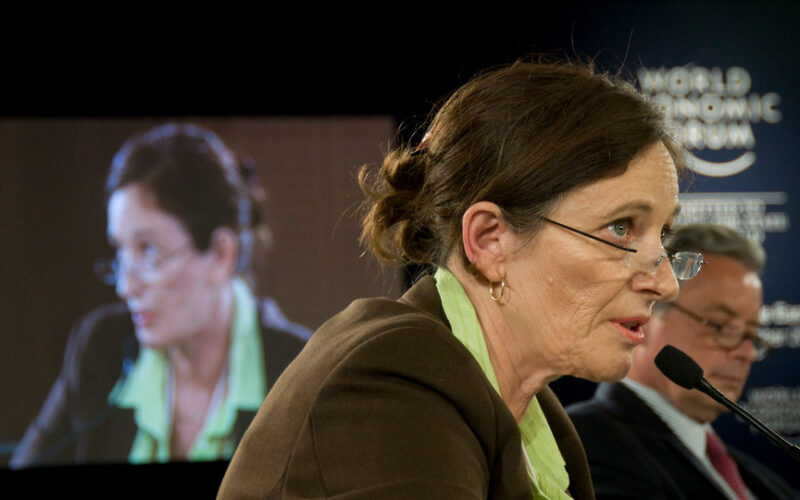
By Whitney Webb | The Last American Vagabond | July 25, 2020
By moving in “the same circles as her father” and vowing to “work only on things involving Israel,” Isabel Maxwell became a pivotal liaison for the entry of Israeli intelligence-linked tech firms into Silicon Valley with the help of Microsoft’s two co-founders, Paul Allen and Bill Gates.
In 1992, Israel’s government created the Yozma Program at the urging of Chief Scientist of Israel’s Ministry of Industry and Trade – Yigal Erlich – as Erlich moved to leave that position. The Yozma Program aimed to “incentivize venture investment” by creating state-linked venture capital funds, which later spawned a myriad of Israeli hi-tech start ups with merging them with major, foreign technology companies. According to Erlich’s website, he had lobbied Israel’s government to launch Yozma because he had “identified a market failure and a huge need in Israel to establish for the first time a professionally-managed venture capital industry that will fund the exponential growth of high tech ventures coming out of Israel.” He then “convinced the Israeli government to allocate $100 million for his venture capital vision.”
Erlich’s vision would also result in the fusion of Israel’s hi-tech sector, which he helped to create, with Israel’s intelligence apparatus, with numerous Israeli hi-tech conglomerates created with funding from the Yozma program and its successors doubling as tools of Israeli espionage. Notably, not long before Erlich convinced Israel to place $100 million into this program, Israeli intelligence, thanks largely to the work of infamous spymaster Rafi Eitan, had learned the benefits of placing backdoors for their intelligence services into commercial software through the theft and subversion of the PROMIS software. As noted in Part I of this series, Israel’s bugged version of PROMIS was largely marketed by Robert Maxwell.
After the Yozma program was established, the first venture capital fund it created was called Gemini Israel Ventures and Israel’s government chose a man named Ed Mlavksy to lead it. Mlavksy, at the time, was the Executive Director of the Israel-U.S. Bi-national Industrial Research and Development Foundation (BIRD), where Erlich was Chairman of the Executive Committee. Mlavsky states that, while heading the BIRD foundation, “he was responsible for investments of $100 million in more than 300 joint projects between U.S. and Israeli high-tech companies.” BIRD’s connections to Gemini Israel Ventures and the Yozma Program in general are interesting, given that – just a few years prior – it had come under scrutiny for its role in the one of the worst spy cases in U.S. history – the Jonathan Pollard affair.
Jonathan Pollard had been a naval intelligence analyst turned Israeli spy who passed troves of documents regarding U.S. military technology (specifically nuclear technology) as well as clandestine U.S. intelligence operations to Israeli intelligence, specifically to the now defunct spy agency Lekem. Pollard’s handler was none other than Rafi Eitan, who had engineered Israel’s outsized role in the PROMIS software scandal. In the indictment of Pollard for espionage, it was noted that Pollard delivered documents to agents of Israel at two locations, one of which was an apartment owned by Harold Katz, the then-legal counsel to the BIRD foundation and an adviser to Israel’s military, which oversaw Lekem. Government officials told the New York Times at the time that they believed Katz “has detailed knowledge about the [Pollard] spy ring and could implicate senior Israeli officials.”
Journalist Claudia Wright, writing in 1987, openly speculated about whether the close ties between Katz and Pollard’s handlers meant that BIRD itself had been used to pass funds to Pollard or that BIRD funds themselves, most of which were provided by U.S. taxpayers as opposed to public claims of “joint” funding, had been used to pay Pollard for his “services” to Israel. In her article, she notes that Mlavsky had considerable discretion over the use of those funds while the U.S. official in charge of overseeing the U.S.’ interests in BIRD did “not know how investment is regulated” by the foundation. In addition, no U.S. official had access to any audit of the foundation, which were said to be conducted by an Israel-based accounting firm with no U.S. offices. The New York Times noted at the time that Katz specifically “may have knowledge of the method used to pay Mr. Pollard, who received tens of thousands of dollars from his Israeli handlers.”
After BIRD’s Mlavsky was chosen to head Gemini Israel Ventures, one of the first companies the firm invested in was called CommTouch (now known as Cyren and majority owned by Warburg-Pincus). Founded in 1991 by Gideon Mantel, a former officer in a “special bomb-squad unit” for the Israel Defense Forces (IDF), alongside Amir Lev and Nahum Sharfman, CommTouch was initially focused “on selling, maintaining and servicing stand-alone email client software products for mainframe and personal computers.” They specifically courted Original Equipment Manufacturers (OEMs), meaning companies whose products are used as components in the products of another company that are then sold to end users. Integration of its products into those of major software and hardware developers would allow CommTouch’s products to be widely used but unseen. A Wired article discussing CommTouch noted as much, stating that CommTouch products are meant “to be as seamless and unnoticeable as the copper is to a phone caller.”
However, from their founding through early 1997, CommTouch struggled to stay afloat, unable to turn a profit and unable to secure any notable deals or to expand its company beyond 25 employees. Yet, thanks to Gemini Israel Ventures and “grants” from Israel’s government, which were used to finance the research and development of its products, CommTouch managed to stay afloat. As late as 2006, CommTouch noted in official documents that the company “has a history of losses and may never achieve profitability,” further noting that they hemorrhaged millions of dollars a year in net losses. Clearly, the decision by Gemini Israel Ventures and Israel’s government to continue to pour money into a decidedly unprofitable company for several years was motivated by something other than profits.
At some point in early 1997, CommTouch decided to enter the U.S. market and began seeking out a new President for the firm who had “local clout.” “We knew exactly what we were looking for,” Gideon Mantel later told Wired ofCommTouch’s search, “Someone who knows her way around the Valley.” They found their woman in the daughter of Israeli “superspy” and PROMIS salesman par excellence, Isabel Maxwell.
An Intriguing Pedigree
Mantel and CommTouch allegedly chose to court Isabel Maxwell for their company’s presidency through an unspecified placement company and were “attracted to her expertise and insight in Silicon Valley when it sought her out.” The Israeli outlet Globes states that Gideon Mantel “went to Isabel Maxwell as soon as he arrived in Silicon Valley and realized that in order to progress, an e-mail solutions company like CommTouch needed help from someone who knew the rules of the game.” Wired offers a similar portrayal, further adding that it was “Gideon Mantel [who] got Isabel Maxwell to take the job.”
Mantel told Jewish Weekly that while Maxwell’s pedigree, i.e. being Robert Maxwell’s daughter, “was very intriguing at the beginning… it wasn’t her name that made the decision for us.” However, Mantel, in separate reports, compares Isabel to her father on numerous occasions when praising her professional abilities. For example, he told Haaretz that Isabel “is not cowed by anyone, and she never gives in…. She got all that at home. They taught her to go after things and not give up.” Similarly, he told Wired that “Like her father, she is a fighter,” later adding that “She always charges. She has no fear. Of course, it is from her father. It is in her blood.” Given that Robert Maxwell is rarely posthumously remembered (in media anyway) as “a fighter” and “fearless,” it goes without saying that Mantel views him with a degree of reverence that he also associates with his daughter Isabel.
Isabel, notably, has herself stated on several occasions that her acceptance of Mantel’s offer to be CommTouch’s President was also informed by her father’s controversial ties to Israel.
She told Haaretz that her reasons for accepting the CommTouch presidency was “from the heart” because it was “a chance to continue her father’s involvement in Israel,” leading her to reject other more lucrative job offers from actually established companies that she had received at the time. She similarly described her reasons for joining CommTouch to Jewish Weekly as “an affair of the heart,” adding that “it had to do with my father and my history.” The New York Times quoted her as saying that she had “considered other California-based Internet start-ups [in 1997], but felt a pull toward CommTouch and the Israeli connection.”
Isabel has some interesting views on her father, whom she describes as the “ultimate survivor,” and his involvement in Israel. She describes him as “highly complex,” adding that she doesn’t “have rose-coloured glasses about him,” but nonetheless says she is “proud” of his controversial legacy and that “if he were alive today that he would be proud of us too.” She said something similar to The Guardian in 2002, stating that “‘I’m sure [my father would] be thrilled to know what I’m doing now,’…. throwing back her head and laughing loudly.” In addition, when asked who the most influential person in her life had been, Isabel responded “My father was most influential in my life. He was a very accomplished man and achieved many of his goals during his life. I learned very much from him and have made many of his ways my own.”
Isabel told Haaretz around that same time that “When I was with him [her father], I felt power. Like being at the White House… Beyond that, it was a collective power, not my personal power. I was part of this unit,” apparently referring to her other siblings, Ghislaine and Christine among them, and suggesting that they were collectively extensions of their father’s power.
However, Isabel stands out from her other siblings, and even Ghislaine, in terms of a sense of loyalty to her father and to the state of Israel. According to Elizabeth Maxwell, Isabel’s mother, Isabel “is also loyal to the memory of her father, and to what Judaism represents in her life. All my children were brought up as Anglicans, but Isabel was very taken by the Jewish faith and the politics in Israel” compared to her other children, including Ghislaine.
Indeed, Isabel has close relationships to several prominent former Mossad officials and Israeli heads of state, with several of those relationships having been “forged by her father.” A now scrubbed report published by the Jerusalem Post in 2003, entitled “Isabel Maxwell Fights Back,” notes that “Maxwell travels in the same circles as her father, but she is more comfortable behind the camera, not in front of it…she is carrying on her father’s legacy in Israel, albeit in her own way.” It also noted that, by 2003, Isabel was visiting Israel every month, visiting her father’s grave on the Mount of Olives at least once every visit.
Arguably the most interesting part of the now-scrubbed Jerusalem Post article is the way in which Isabel views her father’s legacy. In discussing the book by Gordon Thomas and Martin Dillon, Robert Maxwell, Israel’s Superspy: The Life and Death of a Media Mogul, Isabel – even though she participated in interviews for the book – rejected its premise that her father was a “spy”and went on a private smear campaign against the book and its authors prior to its publication.
Tellingly, she does not object to the book’s contents regarding her father’s activities on Israel’s behalf, including his role in the PROMIS software scandal or Iran-Contra, but merely objects to the use of the word “spy” to describe those activities. “My father was certainly a ‘patriot’ and helped in back business and political channels between governments,” Isabel told the Jerusalem Post, “But that did not and does not make him a ‘spy.’” It could be said, then, that Isabel would view her subsequent career “in back business and political channels” via the “same circles as her father” as similarly “patriotic.” Yet, for those that consider her father a “spy” for his activities, that would also mean extending the same to Isabel, who self-identifies as Israeli.
Aside from her father’s own ties to Israeli intelligence, it is worth noting that Isabel’s own history – up to the point she joined CommTouch – involved her working for the Israeli intelligence front company used by her father to sell bugged PROMIS software in the U.S., Information on Demand, and subsequently the search engine Magellan, of which she shared ownership with her sister Christine (whose ties to U.S. intelligence will be explored in Part IV) and her sister Ghislaine, a sexual blackmailer and sex trafficker operating on behalf of U.S. and Israeli intelligence. Isabel’s past with both Magellan and Information on Demand were clearly known to CommTouch at the time of Isabel’s hiring. It also worth noting that, on several occasions, Isabel credits CommTouch’s success with the ties of all of its Israeli employees to the Israeli military and military intelligence, resulting in – per Isabel – a “dogged work ethic” and a “trained mind-set” among its Israeli workforce.
As will be shown in more detail in Part III of this series, upon departing CommTouch, Isabel deepened her already close ties to prominent Israeli politicians and intelligence officials, serving alongside ex-Mossad directors and counting former Israeli chief intelligence officers and heads of state among her “family friends” and business partners. This involvement continued during the period when her son was given a prominent position at the Middle East affairs desk at the State Department when it was headed by Hillary Clinton, who – as many are now aware – has close and controversial ties to Isabel’s sister, Ghislaine.
Microsoft’s Co-founders put CommTouch “On the Map”
Upon taking the job at the Israeli tech firm, Maxwell’s promotion of the company was called “almost messianic” even though her enthusiasm was described as “hard to fathom” given the lackluster performance of the company and its products. However, soon after becoming CommTouch’s president, her personal connections to prominent figures in Silicon Valley – forged through her past work at Magellan – paid off and the company announced new partnerships with Sun Microsystems, Cisco, and Nippon Telephone and Telegraph, among others. At CommTouch, Maxwell managed“all sales and marketing activities for CommTouch and co-direct[ed] strategic business development.”
Some reports have noted that Maxwell’s connections with prominent Silicon Valley figures were the key to her professional success, with Globes noting that “Everyone who has worked closely with Maxwell says that her advantage lies in her ability to help penetrate the market with a new product by opening the right doors,” an “advantage” also ascribed to her father while he sold bugged PROMIS software on behalf of Israeli intelligence. Yet, despite Isabel’s penchant for “opening the right doors,” reports well into Maxwell’s career at CommTouch still referred to the firm as “an obscure software developer.”
However, out of all the alliances and partnerships Isabel negotiated early on during her time at CommTouch, it was her dealings with Microsoft co-founders Bill Gates and Paul Allen that would put CommTouch “on the map.” Maxwell had previously negotiated a major deal with Microsoft’s Bill Gates earlier during her time as the McKinley Group/Magellan’s Executive Vice President, resulting in Microsoft announcing that the Maxwell-owned Magellan would power the search option for the company’s MSN service.
Yet, it appears that Microsoft’s co-founders did much more than put CommTouch “on the map,” but ended up preventing the collapse of its initial public offering, a fate that had befallen Isabel Maxwell’s previous company, the McKinely Group, not long before. Indeed, CommTouch kept pushing back its IPO until a massive investment from firms tied to Microsoft co-founder Paul Allen was announced in July 1999.
The investment from Allen’s Vulcan Ventures Inc. and Go2Net Inc resulted in a jump in “interest in the stock sale and in CommTouch, until now an obscure software developer,” according to a Bloomberg report, and also inflated their stock price immediately prior to their going public. The money from Allen-linked investment would be specifically used “to expand sales and marketing and build its presence in international markets.” Allen’s decision to invest in the company seems odd from a financial perspective, given that CommTouch had never turned a profit and had netted over $4 million in losses just the year before. Yet, thanks to Allen’s timely investment and apparent coordination with the company’s repeated delays of its IPO, CommTouch was valued at over $230 million when it went public, as opposed to a $150 million valuation just weeks prior to Allen’s investment.

Bill Gates at Deal Book Conference in New York, 2019
It’s not exactly clear why Paul Allen came to the rescue of CommTouch’s IPO and what he expected to gain from his investment. However, it is worth pointing out that Allen was among the members of an exclusive online community of elites set up in 2004 called “Small World,” whose membership also included Jeffrey Epstein and Epstein-linked figures like Lynn Forester de Rothschild and Naomi Campbell, as well as Petrina Khashoggi, the daughter of Adnan Khashoggi, a former client of Epstein’s. Small World’s largest shareholder was Harvey Weinstein, the now-disgraced media mogul who was a business partner of Epstein and was since accused by a number of women of sexual abuse.
Less than three months after Allen’s investments in CommTouch in October 1999, the company announced that it had struck a major deal with Microsoft whereby “Microsoft will utilize the CommTouch Custom MailTM service to provide private label web-based email solutions for select MSN partners and international markets.” In addition, per the agreement, “CommTouch will provide MSN Messenger Service and Microsoft Passport to its customers while building upon its Windows NT expertise by supporting future MSN messaging technologies.”
The agreement came less than two years after Microsoft had purchased Hotmail, which – up until the CommTouch/Microsoft agreement – had been one of CommTouch’s main competitors for its web-based e-mail services. In other words, this meant that Microsoft would use CommTouch’s “behind the scenes” software as the backbone of its web-based e-mail services, Hotmail included. “We are looking forward to further enhancing our relationship with Microsoft by integrating other state-of-the-art Microsoft products,” Gideon Mantel of CommTouch said upon the deal’s public announcement.
In December 1999, Microsoft then announced that it had invested $20 million in the company by purchasing 4.7% of CommTouch stock. The announcement pushed CommTouch stock prices from $11.63 a share to $49.13 in just a few hours time. Part of that deal had been finalized by Richard Sorkin, a recently appointed CommTouch director. Sorkin had just become a multimillionaire following the sale of Zip2, Elon Musk’s first company where Sorkin had been CEO.
It further appears that Bill Gates, then head of Microsoft, made a personal investment in CommTouch at the behest of Isabel Maxwell. In an October 2000 article published in The Guardian, Isabel “jokes about persuading Bill Gates to make a personal investment” in CommTouch sometime during this time frame.
The article then oddly notes the following regarding Isabel Maxwell and Bill Gates:
“In a faux southern belle accent, [Isabel] purrs: ‘He’s got to spend $375m a year to keep his tax free status, why not allow me to help him.’ She explodes with laughter.”
Given that individuals as wealthy as Gates cannot have “tax free status” and that this article was published soon after the creation of the Bill and Melinda Gates Foundation, Isabel’s statements suggest that it was the Bill and Melinda Gates Foundation Trust, which manages the foundation’s endowment assets, that had made this sizable investment in CommTouch. Furthermore, it is worth highlighting the odd way in which Isabel describes her dealings with Gates, speaking of her interactions with him in a way not found in any of Isabel’s numerous other interviews on a wide variety of topics (i.e. “purring”, speaking in a fake Southern accent). This odd behavior may have been related to Isabel’s previous interactions with Gates and/or the mysterious relationship between Gates and Epstein, alluded to in a 2001 Evening Standard article, and eyewitness testimony regarding Epstein’s and Ghislaine Maxwell’s comments about Bill Gates in 1995, discussed in Part I of this series.
After 2000, CommTouch’s business and clout expanded rapidly, with Maxwell subsequently crediting Bill Gates-led Microsoft and Paul Allen’s investment for the company’s shifting fortunes. Maxwell, as quoted in the 2002 book Fast Alliances, states that Microsoft viewed CommTouch as a key “distribution network,” adding that “Microsoft’s investment in us put us on the map. It gave us instant credibility, validated our technology and service in the marketplace.” By this time, Microsoft’s ties to CommTouch had deepened with new partnerships, including CommTouch’s hosting of Microsoft Exchange.
Though Isabel was able to secure lucrative investments and alliances for CommTouch and see its products integrated into key software and hardware components produced and sold by Microsoft and other tech giants, she was unable to turn the tide of the company’s dire financial performance, with CommTouch netting a loss of $4.4 million in 1998 and similar losses well into the 2000s, with net losses totalling $24 million in the year 2000 (just one year after the sizable investments from Microsoft, Paul Allen and Bill Gates). The losses continued even after Isabel formally left the company and became President Emeritus in 2001. By 2006, the company was over $170 million in debt.
The One-Woman Liaison Between Israel and Silicon Valley
Isabel Maxwell would leave her role at CommTouch in 2001, but remained President Emeritus for years afterward retaining a sizable amount of CommTouch stock then-valued at around $9.5 million. While Maxwell remained honorary president, CommTouch added Yair Shamir, son of former Israeli Prime Minister and friend of Robert Maxwell, Yitzhak Shamir, to its board. Yair Shamir, Chairman of the Israeli government owned corporation, IAI (Israeli Aerospace Industries) when he joined CommTouch’s board, had previously managed Scitex when it was owned by Robert Maxwell. After nearly collapsing due to its long-standing debt burden a few years later, CommTouch was rebranded as Cyren and, today, runs in the background of Microsoft, Google, Intel, McAfee and Dell products, among many others.
Haaretz wrote in 2002 that Isabel, as CommTouch was in dire financial straits, had decided to “work only on things involving Israel. Even the failure of CommTouch, the Israeli Internet company she headed, hasn’t deterred her: She still believes in the medium, and she still believes in Israel.” Maxwell would subsequently create “a unique niche for herself in high tech as a liaison between Israeli companies in the initial development stages and private angel investors in the US” as a private consultant, subsequently creating Maxwell Communications Network in 2006. That company offered “cross-border communications, funding and market research to leading venture capitalists and hi-tech companies in the US and Israel.” However, she notes that her “specialty” was in “helping Israeli high-tech companies.”
During this period (2001-2006), Isabel would also head an Israeli tech company that “protects children online,” at a time when her sister – Ghislaine Maxwell – was actively abusing and trafficking children as part of an intelligence-linked operation alongside Jeffrey Epstein. Isabel took the job at iCognito (now Pure Sight) “because it [the company] is in Israel, and because of its technology.” She also joined the board of the Israeli company Backweb alongside Gil Shwed, a famous alumnus of Unit 8200 (often likened to Israel’s NSA equivalent) and co-founder of Israeli tech giant Check Point, which is a long-time partner of CommTouch.
Isabel’s close involvement with former Israeli heads of state and heads of intelligence would only deepen after leaving CommTouch, particularly with former Israeli Prime Minister Shimon Peres. The Jerusalem Post described the Peres-Isabel relationship as “close” and “forged by her father.” Isabel was also in close contact with former Mossad deputy director David Kimche (until his death in 2010) and former head of Israeli military intelligence and Prime Minister Ehud Barak. Notably, Ehud Barak, in addition in being a major player in the Israeli-U.S. hi-tech scene, was also closely associated with Jeffrey Epstein and Isabel’s sister Ghisaline, having recruited Epstein for Israeli military intelligence and overseeing the Lekem agency at the time of the PROMIS scandal (including Robert Maxwell’s role) and the Pollard Affair as well as Israel’s involvement Iran-Contra. Barak was also a frequent visitor to Epstein’s island and slept over in New York apartments that were owned by Epstein’s brother and which housed many of Epstein’s underage “sex slaves.”
Also notable is the fact that Ghislaine Maxwell and Jeffrey Epstein would themselves become involved in Isabel’s world, i.e. the growing nexus between Silicon Valley and Israel, courting and allegedly blackmailing major Silicon Valley executives while also investing in Israeli intelligence-connected start-ups. During this time, Isabel was a major player in venture capital networks and other organizations aiming to further develop ties between Israeli intelligence-linked start-ups and U.S. tech companies, which is now part of an openly admitted Israeli intelligence operation (in which Microsoft plays a major role). The ties of Isabel, Ghislaine and Epstein to this hi-tech world of Israeli espionage, as well as Isabel having inspired what would later become Ghislaine’s TerraMar project and her ties to powerful groups like the World Economic Forum and even the Hillary Clinton-led State Department, will be explored in the next installment of this series.
Whitney Webb has been a professional writer, researcher and journalist since 2016. She has written for several websites and, from 2017 to 2020, was a staff writer and senior investigative reporter for Mint Press News. She currently writes for The Last American Vagabond.
Israeli Intelligence Uses Phone App to Troll and Mass Report People Off the Internet

By Eric Striker • National Justice • July 25, 2020
Much has been said in the Jewish media about mysterious Russian trolls influencing elections, but real cyber disinformation campaigns are being organized by the Israeli government out in the open.
A mobile phone app called Act.IL available for download in the Apple store recruits every day American Jews and organizes them in troll operations on social media in an attempt to control, steer and suppress public conversations about Zionism, BDS and Jewish power.
Act.IL’s founder and CEO, Yarden Ben Yosef, served in a “special combat” intelligence unit in the Israeli military. Most of the company’s staff is composed of spies. The program receives joint funding from billionaire GOP donor Sheldon Adelson and the Israeli state.
The app provides users with Amber Alert style pop ups featuring links to Facebook, Twitter, Youtube, etc posts critical of Jews, Israel ,or supportive of Palestinians and BDS coupled with instructions for users to harass, brigade and mass report designated targets off the internet.
After each “mission,” trolls are given points. The most prolific harassers and stalkers are celebrated on a public scoreboard.

British media repeatedly claims Russian trolls are responsible for Brexit and tried to intervene in the last election, but no proof has ever been offered.
Meanwhile, Act.IL users were very active in cyber attacks targeting Jeremy Corbyn and his supporters in hopes of undermining the electoral prospects of the UK’s Labour Party.
Neither British intelligence or media appears to be interested in this foreign meddling in their electoral process.
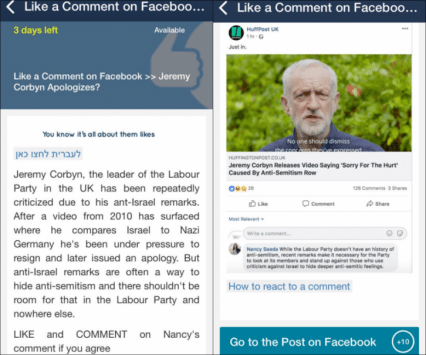
Politicians and celebrities are not the only ones targeted by this cyber warfare operation. Countless American college students, low level activists, and random internet posters who dare question Israel or Jewish power are swamped with state-organized harassment as well. Act.IL trolls even manipulated a Eurovision song contest poll.
Users are regularly instructed to drown employers with astroturfed complaints to get targets in the US and other countries fired.
According to @AntiBDSApp , which reports on the network’s antics, lately they have been bombarding left-wing articles in an attempt to differentiate Black Lives Matter, which Jews broadly support and see as useful, from the Palestinian cause, which they see as dangerous.
A foreign state actor indeed plays an important role in trying to control and influence discourse in America. The Lobby, USA, a heavily censored documentary by Al Jazeera details this web of espionage. Various other programs intended to harrass and terrorize American citizens, like the doxing platform Canary Mission (which puts white nationalists and Palestinian activists on hit lists) work in tandem with programs like Act.IL.
Because it’s Israel astroturfing support for Jewish power, don’t expect to hear much about from “foreign troll” hunters at BellingCat or the New York Times.
Israel’s Supreme Court: Palestinian Prisoners Have No Right to Social Distancing against COVID-19
Palestine Chronicle | July 25, 2020
Israel’s Supreme Court rejected yesterday a petition by Adalah, The Legal Center for Arab Minority Rights in Israel, demanding Israeli authorities to implement COVID-19 protective guidelines for prisoners at Gilboa prison, where 30 prison guards and seven Palestinian prisoners are infected, while 489 guards and 58 prisoners are in quarantine.
The court ruled late on Thursday evening that Palestinians held in Israeli prisons have no right to social distancing protection against the COVID-19 pandemic, said Adalah in a press statement.
Earlier on the day, the court had convened to hear a petition filed by Adalah demanding that the Israel Prison Service (IPS) and Israel’s Public Security Ministry take all necessary actions to avoid a COVID-19 outbreak among the 450 prisoners – overwhelmingly Palestinian political prisoners – in the overcrowded Gilboa prison.
Adalah Attorney Myssana Morany, who submitted the petition on behalf of the families of two Palestinian prisoners, responded to the ruling by the top Israeli court: “Israel’s Supreme Court has chosen to accept the fiction pitched to it by Israeli authorities that COVID-19 social distancing policies – essential for everyone else – are not relevant to the Palestinian ‘security prisoners’ it holds behind bars.”
“This precedent-setting ruling endangers the lives and health of Palestinians held by Israel, and poses a threat to society as a whole. It flies in the face of health and human rights professionals around the world who have called for social distancing within prisons, and leaves Palestinians held by Israel exposed to the virus with no option to protect themselves,” she added.
Adalah said in a statement,
“The Supreme Court justices accepted the claim promoted by Israeli occupation authorities that Palestinians held in prison are no different than family members or flatmates living in the same home, completely ignoring the fact that prisoners are held under duress and Israeli authorities are responsible for their health and the conditions of their incarceration.”
“The court ruling has freed the IPS from the obligation to maintain, and or even strive for, safe social distancing in the cells of Palestinian “security prisoners”. This runs contrary to basic COVID-19 health practices employed by prison authorities around the world,” the group added.
Materials given by state authorities to the Supreme Court and discussed in yesterday’s hearing stressed that social distancing restrictions should not apply to family members or individuals who live together, but nevertheless, they also recognized the need to reduce the population density inside Israeli facilities amongst prisoners serving time for criminal sentences.
Adalah Attorney Myssana Morany commented immediately following the hearing: “Israeli authorities claimed today in court that social distancing policies essential for protecting prisoners serving time for criminal charges are somehow not relevant for ‘security prisoners’. The Israel Prison Service should have stood together with us today and demanded that it be granted the means to protect the people for whose health and safety it holds direct responsibility.”
She continued, “We were, instead, subject to absurd arguments equating prisons with family living rooms, while prisoners continue to be forced to come into daily contact with guards potentially exposed to COVID-19 outside the prison walls.”
More than 5,000 Palestinians, including numerous women and children, are currently detained in Israeli prisons.
Palestinian minor kidnapped by undercover Israel soldiers
MEMO | July 24, 2020
A 12-year-old Palestinian child was kidnapped by an undercover Israeli soldier yesterday from the occupied Jerusalem town of Issawiya, reported Wafa news agency.
According to local witnesses, undercover Israeli forces were in a civilian car which they abducted Moath Ewewi in and drove him away to an unknown destination.
The town has been subject to ongoing violations, including the abduction of many Palestinians, the daily invasions and violent searches of homes, in addition to excessively high fines and fees imposed on the residents.
This systematic and widespread campaign of regular raids and kidnappings to instill fear among the Palestinians, and to keep them suppressed, is a serious violation of international and humanitarian laws, according to human rights groups.
Meanwhile, Israeli forces rounded up three Palestinians after breaking into their houses today in the occupied West Bank city of Tubas, claiming to search for “wanted” Palestinians, triggering clashes with residents.
Despite the coronavirus crisis, Palestinians in Jerusalem have witnessed noticeable escalation in Israeli attacks, home raids and arrest campaigns lately, which is seen as an attempt to put more pressure on Palestinian natives of Jerusalem to force them to leave the city and clear the way for new Jewish-only settlement projects.
War Crimes and War Criminals: Who Will Be Held Accountable?
By Philip Giraldi | Strategic Culture Foundation | July 23, 2020
There is something unique about how the United States manipulates the “terrorism” label to avoid being accused of carrying out war crimes. When an indigenous militia or an armed insurgency like the Taliban in a country like Iraq or Afghanistan attacks American soldiers subsequent to a U.S. invasion which overthrew the country’s government, it is considered by Washington to be an act of “terrorism.” Terror attacks de facto permit a carte blanche response, allowing virtually anything as retaliation against the parties involved or countries that support them, including the assassination of foreign government officials. But for the attacker, whose perspective is quite different, the incident often could reasonably be described as legitimate resistance to a foreign occupier and much of the world might agree with that assessment.
So, it all comes down to definitions. The United States covers its version of reality through liberal use of the Authorization for Use of Military Force (AUMF) which more-or-less gives a blanket approval to attack and kill “terrorists” anywhere at any time. And how does one become a terrorist? By being included on the U.S. government’s heavily politicized annual list of terrorist groups and material supporters of terrorism. That was the argument that was used by the United States when it killed Iranian General Qassem Soleimani in January, that his organization, the Qods Force, was on the “terrorist” lists maintained by State and the Treasury Department and he was therefore held to be guilty of any and all attacks on U.S. military carried out by Qods or by presumed Iranian surrogate militias.
The case made to justify killing Soleimani was considered deeply flawed at the time it took place. Because the United States says something is legal due to a law Congress has passed does not make it so, just as most of the world would consider the U.S. profile killings by drone in Afghanistan and elsewhere, based on nothing more than the assumption that someone on the ground might be a “terrorist,” to be little more than war crimes.
It has recently been revealed that the Trump Administration has issued a so-called “finding” to authorize the CIA to conduct more aggressive cyberattacks against infrastructure and other targets in countries that are considered to be unfriendly. The finding specifically named Iran, North Korea, China and Russia as approved targets and it is of particular interest because it basically left it up to the Agency to decide whom to attack and to what degree. As Washington is not at war with any of the countries named and is essentially seeking to damage their economies directly, the activity undertaken by CIA has constituted acts of war and, by widely accepted legal definition, attacks on countries that are not actually threatening are war crimes.
To counter the negative publicity about Trump Administration actions and to establish a possible casus belli, Washington has been floating numerous stories alleging Iranian, Russian and Chinese “aggression.” The ridiculous story about Russia paying Afghans bounties to kill American soldiers was quickly debunked, so the White House and the captive media are now alleging that Moscow hacker/spies are seeking to steal proprietary information dealing with the development of a coronavirus vaccine. The agitprop coming out of Washington to blame Russia for nearly everything notwithstanding, opinion polls suggest that most of the world considers Washington to be the primary source of global instability, rejecting the assertion by Secretary of State Mike Pompeo that the U.S. is a “force for good.”
So, it is reasonable to suggest that the United States has been guilty of many war crimes in the past twenty years and has only been shielded from the consequences due to its ability to control the message combined with its power in international fora and its unwillingness to cooperate with the International Criminal Court (ICC) in the Hague.
But the willingness of the international community to look the other way in support of the war crimes double standard appears to be changing. The ICC, which has had its investigators denied entry to the United States, has been investigating Israeli war crimes even as it also looks at developments in Afghanistan and Iraq involving U.S. forces. Trump’s ban on entry by ICC personnel includes their families even if they are American citizens and it also protects Israel in that ICC investigators looking into the possible war crimes committed by Israeli soldiers and officers as well as the relevant Jewish state’s government officials will also be sanctioned and denied entry into the U.S. In practical terms, the Trump Administration is declaring that Israeli and U.S. soldiers will be regarded as one and the same as they relate to dealings with the ICC, a conceit that is little known to the American public.
The Israelis have responded to the threat from the ICC by compiling a secret list of government officials and military officers who might be subject to ICC issued arrest warrants if they travel in Europe for war crimes committed in Lebanon and Syria as well as of crimes against humanity directed against Palestinians. The list reportedly includes between 200 and 300 names.
That Israel is making a list of people who might be vulnerable to accusations of having possibly committed war crimes is a de facto admission by the government that such crimes were in fact committed. The ICC will soon decide whether to move on the December request by ICC Prosecutor Fatou Bensouda to investigate both Israel and Hamas over suspicions of war crimes in Gaza and Jerusalem as well as on the occupied West Bank beginning in 2014. The investigation would include “crimes allegedly committed in relation to the use by members of the IDF of non-lethal and lethal means against persons participating in demonstrations beginning in March 2018 near the border fence between the Gaza Strip and Israel, which reportedly resulted in the killing of over 200 individuals, including over 40 children, and the wounding of thousands of others.”
Given the time frame, Israeli government officials and military officers would likely be the first to face scrutiny by investigators. According to Haaretz, the list would almost certainly include “Prime Minister Benjamin Netanyahu; former defense ministers Moshe Ya’alon, Avigdor Lieberman and Naftali Bennett; former Israel Defense Forces chiefs of staff Benny Gantz and Gadi Eisenkot, and current Chief of Staff Aviv Kochavi; and the former and current heads of the Shin Bet security service, Yoram Cohen and Nadav Argaman, respectively.”
One wonders who would be included on a comparable list for the United States. There are a lot of lying politicians and sly generals to choose from. As both Israel and the United States do not recognize the authority of the ICC and will almost certainly refuse to participate in any fashion if the charges of war crimes and crimes against humanity ever actually make it to the court, any discussion of lists are at this point merely travel advisories for war criminals. The United States will push back and will inter alia certainly attempt to discredit the court using whatever weapons are available, to include sanctions against the nations that support any investigation and trial.
One nevertheless has to hope that the court will persevere in its effort to expose the crimes that continue to be committed by the U.S. and Israel in both Palestine and Afghanistan. Embarrassing Washington and Jerusalem in a very visible and highly respected international forum might be the only way to change the direction of the two nations that more than any other insist that “might makes right.”
Israeli army sued for ‘dangerous’ levels of radiation
MEMO | July 23, 2020
The Israeli occupation army is being sued for exposing residents of a kibbutz to high levels of radiation in a lawsuit that serves to highlight the Zionist state’s discrimination against Palestinians. Farmers in the northern Negev who are said to have been unknowingly exposed to very strong radiation for six years and had their livelihood disrupted, are seeking approximately $1.3 million in compensation.
The lawsuit states that the Israeli army installed the Iron Dome system, funded by the US government, on fields belonging to an unnamed kibbutz in 2012 without informing residents of the danger it posed to their health. Five years later, reported Ynet News, they were told that they could not approach the fields near the area, a site at which they had worked freely until then, due to the very strong radiation that the system emits.
“The defendant [Israeli army] only recently remembered to update the kibbutz about the very strong radiation the systems emits, and that it is therefore strictly forbidden to engage in any agriculture work in the surrounding area,” the lawsuit states. “It will become clear that danger of radiation in the field was unknown until the defendant’s notice.”
It’s also claimed that the farmers were never compensated for damage to their territory and from being barred from cultivating in the area in which the system was installed. The Defence Ministry is thought to have promised compensation for such damage, which the lawsuit claims has yet to be paid eight years later.
Highlighting the damage to the land, the lawsuit states that, “As of 2012, the defendant took over an area of approximately 10 dunams [2.5 acres] for the purpose of installing missile defence systems to protect from ballistics coming from the Gaza Strip.”
The Israeli army and Defence Ministry told Ynet that, “The lawsuit has not yet been received by the defence establishment. When it is, it will be examined and answered as usual in court.”
Concerns over the Iron Dome were raised last year. Around 30 Israeli soldiers, the majority of whom operated the system, were said to be battling cancer.
For Palestinian farmers, this case will further highlight the structural racism under which they have suffered for decades. The theft of their land in order to build Jewish settler-only roads and illegal settlements, for example, is carried out without any compensation or recourse to any form of legal redress.
An Israeli Charity Group is uprooting Palestinians not planting Trees
By Jonathan Cook | The National | July 22, 2020
The Jewish National Fund, established more than 100 years ago, is perhaps the most venerable of the international Zionist organisations. Its recent honorary patrons have included prime ministers, and it advises UN forums on forestry and conservation issues.
It is also recognised as a charity in dozens of western states. Generations of Jewish families, and others, have contributed to its fundraising programmes, learning as children to drop saved pennies into its trademark blue boxes to help plant a tree.
And yet its work over many decades has been driven by one main goal: to evict Palestinians from their homeland.
The JNF is a thriving relic of Europe’s colonial past, even if today it wears the garb of an environmental charity. As recent events show, ethnic cleansing is still what it excels at.
The organisation’s mission began before the state of Israel was even born. Under British protection, the JNF bought up tracts of fertile land in what was then historic Palestine. It typically used force to dispossess Palestinian sharecroppers whose families had worked the land for centuries.
But the JNF’s expulsion activities did not end in 1948, when Israel was established through a bloody war on the ruins of the Palestinians’ homeland – an event Palestinians call the Nakba, or catastrophe.
Israel hurriedly demolished more than 500 cleansed Palestinian villages, and the JNF was entrusted with the job of preventing some 750,000 refugees from returning. It did so by planting forests over both the ruined homes, making it impossible to rebuild them, and village lands to stop them being farmed.
These plantations were how the JNF earned its international reputation. Its forestry operations were lauded for stopping soil erosion, reclaiming land and now tackling the climate crisis.
But even this expertise was undeserved. Environmentalists say the dark canopies of trees it has planted in arid regions such as the Negev, in Israel’s south, absorb heat unlike the unforested, light-coloured soil. Short of water, the slow-growing trees capture little carbon. Native species of brush and animals, meanwhile, have been harmed.
These pine forests – the JNF has planted some 250 million trees – have also turned into a major fire hazard. Most years hundreds of fires break out after summer droughts exacerbated by climate change.
Early on, the vulnerability of the JNF’s saplings was used as a pretext to outlaw the herding of native black goats. Recently the goats, which clear undergrowth, had to be reintroduced to prevent the fires. But the goats’ slaughter had already served its purpose, forcing Bedouin Palestinians to abandon their pastoral way of life.
Despite surviving the Nakba, thousands of Bedouin in the Negev were covertly expelled to Egypt or the West Bank in Israel’s early years.
It would be wrong, however, to imagine that the JNF’s troubling role in these evictions was of only historical interest. The charity, Israel’s largest private land owner, is actively expelling Palestinians to this day.
In recent weeks, solidarity activists have been desperately trying to prevent the eviction of a Palestinian family, the Sumarins, from their home in occupied East Jerusalem to make way for Jewish settlers.
Last month the Sumarins lost a 30-year legal battle waged by the JNF, which secretly sold their home in the late 1980s by the Israeli state.
The family’s property was seized under a draconian 1950 law declaring Palestinian refugees of the Nakba “absent” so that they could not reclaim their land inside the new state of Israel.
The courts have decreed that the law can be applied in occupied Jerusalem too, in violation of international law. In the Sumarins’ case, it appears not to matter that the family was never actually “absent”. The JNF is permitted to evict the 18 family members next month. To add insult to injury, they will have to pay damages to the JNF.
A former US board member, Seth Morrison, resigned in protest in 2011 at the JNF’s role in such evictions, accusing it of working with extreme settler groups. Last year the JNF ousted a family in similar circumstances near Bethlehem. Days later settlers moved on to the land.
Ir Amim, an Israeli human rights group focusing on Jerusalem, warned that these cases create a dangerous legal precedent if Israel carries out its promise to annex West Bank territory. It could rapidly expand the number of Palestinians classified as “absentees”.
But the JNF never lost its love of the humble tree as the most effective – and veiled – tool of ethnic cleansing. And it is once again using forests as a weapon against the fifth of Israel’s population who are Palestinian, survivors of the Nakba.
Earlier this year it unveiled its “Relocation Israel 2040” project. The plan is intended to “bring about an in-depth demographic change of an entire country” – what was once sinisterly called “Judaisation”. The aim is to attract 1.5 million Jews to Israel, especially to the Negev, over the next 20 years.
As in Israel’s first years, forests will be vital to success. The JNF is preparing to plant trees on an area of 40 sq km belonging to Bedouin communities that survived earlier expulsions. Under the cover of environmentalism, many thousands of Bedouin could be deemed “trespassers”.
The Bedouin have been in legal dispute with the Israeli state for decades over ownership of their lands. This month in an interview with the Jerusalem Post newspaper, Daniel Atar, the JNF’s global head, urged Jews once again to drop money into its boxes. He warned that Jews could be dissuaded from coming to the Negev by its reputation for “agricultural crimes” – coded reference to Bedouin who have tried to hold on to their pastoral way of life.
Trees promise both to turn the semi-arid region greener and to clear “unsightly” Bedouin off their ancestral lands. Using the JNF’s original colonial language of “making the desert bloom”, Mr Atar said his organisation would make “the wilderness flourish”.
The Bedouin understand the fate likely to befall them. In a protest last month they carried banners: “No expulsions, no displacement.”
After all, Palestinians have suffered forced displacement at the JNF’s hands for more than a century, while watching it win plaudits from around the world for its work in improving the “environment”.
Calls for Google to put Palestine back on the map
MEMO | July 21, 2020
Pro-Palestine activists have launched an online campaign calling on Google and Apple to put Palestine back on their maps, accusing the internet giants of trying to erase Palestinian identity and changing facts to suit American and Israeli objectives.
“According to Google, Palestine does not exist,” a change.org petition with over one million signatories says.
“Whether intentionally or otherwise, Google is making itself complicit in the Israeli government’s ethnic cleansing of Palestine.”
Google has been replacing the names of Palestinian towns and villages with Israeli names, leading to fears that the search engine is normalising Israel’s planned annexation of parts of the occupied West Bank in line with US President Donald Trump’s controversial ‘peace plan‘.
“The omission of Palestine is a grievous insult to the people of Palestine and undermines the efforts of the millions of people who are involved in the campaign to secure Palestinian independence and freedom from Israeli occupation and oppression,” the petition adds, calling on Google to “clearly designate and identify the Palestinian territories illegally occupied by Israel.”
Israel’s collective punishment of Palestinians illegal and an affront to justice: UN expert
Office of the High Commissioner for Human Rights (OHCHR)
GENEVA (17 July 2020) – A UN human rights expert has called on Israel to immediately stop all actions amounting to collective punishment of the Palestinian people, with millions of innocent harmed daily and nothing achieved but deeper tensions and an atmosphere conducive to further violence.
“It is an affront to justice and the rule of law to see that such methods continue to be used in the 21st century and that Palestinians collectively continue to be punished for the actions of a few,” said Michael Lynk, the Special Rapporteur on the situation of human rights in the Palestinian Territory occupied since 1967. “These practices entail serious violations against Palestinians including the right to life, freedom of movement, health, adequate shelter and adequate standard of living.”
In his report to the 44th session of the Human Rights Council, Lynk said Israel’s strategy to control the Palestinian population violates a foundational rule of virtually every modern legal system: Only the guilty can be punished for their acts, and only after a fair process. The innocent can never be made to be punished for the deeds of others.
“The extent of the devastating impact of Israel’s collective punishment policy can be most strikingly seen in its ongoing 13-year-old closure of Gaza, which now suffers from a completely collapsed economy, devastated infrastructure and a barely functioning social service system,” the Special Rapporteur said.
“While Israel’s justification for imposing the closure on Gaza was to contain Hamas and ensure Israel’s security, the actual impact of the closure has been the destruction of Gaza’s economy, causing immeasurable suffering to its two million inhabitants,” the Rapporteur said. “Collective punishment has been clearly forbidden under international humanitarian law through Article 33 of the Fourth Geneva Convention. No exceptions are permitted.”
The Special Rapporteur’s new report also criticised Israel’s continued policy to punitively demolish Palestinian homes. “Since 1967, Israel has destroyed more than 2,000 Palestinian homes, designed to punish Palestinian families for acts some of their members may have committed, but they themselves did not,” he said. “This practice is in clear violation of Article 53 of the Fourth Geneva Convention.”
Lynk said it was disheartening that the demolition of Palestinian homes is still viewed by the Israeli political and legal leadership, including the Israeli High Court, as a permissible deterrent. “In fact, these demolitions only further contribute to an atmosphere of hate and vengeance, as the Israeli security leadership has itself acknowledged.”
Israel’s list of compromised officials suggests their guilt of war crimes
By Ramona Wadi | MEMO | July 21, 2020
The International Criminal Court (ICC) has adjourned without issuing its ruling on whether Israeli officials will be tried for war crimes against the Palestinian people since 2014, when Gaza was destroyed during “Operation Protective Edge”. With an extended timeframe until the ruling is due, Israel now has additional time to prepare for any eventual action taken by The Hague. It has apparently already drawn up a list of officials who might be liable to be prosecuted for war crimes.
According to Haaretz, the list contains the names of 200-300 Israeli officials, most probably including Prime Minister Benjamin Netanyahu and Defence Minister Benny Gantz. The list has been drawn up in utmost secrecy, not least because, as Haaretz points out, “The court is likely to view a list of names as an official Israeli admission of these officials’ involvement in the incidents under investigation.” The existence of the list alone is likely to be viewed as such.
However, what needs to change at an international level is the endorsement of Israel’s security narrative. The ICC’s clear mention of war crimes, as opposed to alleged war crimes – the latter being a phrase which many human rights organisations have used and through which Israeli impunity has also been cultivated – should prompt a new reckoning of Israel’s standing and its state violence.
During that 2014 military offensive against the Palestinians in Gaza, the international community was quick to promote “Israel’s right to defend itself” even as Palestinian civilians were being slaughtered. So far, the UN has never considered Palestinians as anything other than a statistical detail supporting its purported humanitarian endeavours.
The fact of the matter is that Israel is a colonial entity, but this has been eliminated from international diplomatic discourse, to the detriment of the Palestinian people. Hence the discrepancies when speaking of Israel’s perpetual violations against the Palestinians; by refusing to include the colonial-settler context, the international community eliminates the foundations of what have now been described clearly as war crimes by the ICC.
The list itself suggests guilt, admitted more or less openly by the very fact of its compilation. While the criminal investigations are down to the competence of the ICC, it rests with the international community to see them through to their conclusion, rather than simply parroting Israel’s excuses for its violence. The planned annexation of the occupied West Bank is a case in point. Israeli officials are concerned that implementing the annexation plans will be detrimental to Israel, especially given that settlement expansion is being considered as the strongest evidence of war crimes. The international community, however, has still failed to unite against the possibility of additional war crimes being committed against the Palestinian people, and limited its response to repeated statements that annexation is against international law.
Israel has never, ever, heeded such statements. The possibility of ICC investigations, however, is exposing the fact that Israel knows it has committed war crimes and is preparing to shield the perpetrators from international prosecution. If the UN is truly concerned with safeguarding human rights, it should seize the opportunity to refrain from further endorsement and dissemination of Israel’s security and “self-defence” narrative, which itself violates international law. It should adopt a strong stance against Israel and its annexation plan, and stand by the ICC’s clear admission that colonial expansion is a war crime. The UN, however, cannot do so without taking into account its own complicity in maintaining Israel’s colonial violence, hence the absence of a consistent human rights narrative which would support a possible criminal investigation at an international level.
Was Jeffrey Epstein’s Boss Ghislaine Maxwell Helping Mossad Run Pedophile Rings for Prince Andrew and the Ruling Elite?

By Marco de Wit | Laiton Lehti | October 13, 2019
Video introduction to this article. (If the video is deleted by Youtube you can find it also here in Bitchute.)
The Epstein Pedoscandal Mossad Timeline shows in detail how Jeffrey Epstein and Ghislaine Maxwell were working for the Israeli intelligence agency, Mossad.

Link to Unz.com article
The timeline generated many comments at Unz.com but surprisingly most of them dealt whether Epstein was a pedophile or not. This despite the overwhelming evidence of pedophilia.
Many have also totally missed – or are afraid to notice – the big picture: Israeli intelligence agencies and especially Mossad seem to be running pedophile rings that blackmail Western political, business and scientific leaders.
Furthermore, it seems that Ghislaine Maxwell was and still is the master mind behind many of these pedophile rings.
One of the reasons Epstein and Ghislaine were able to continue sex trafficking with impunity for so long was the appearance that Epstein was a victim of jealous people and overzealous police. Many people thought that Epstein had only had sex with a 17-year old girl who had lied about her age.
This excuse worked well because in Florida the age of consent is 18 while in most other American states it is 16.
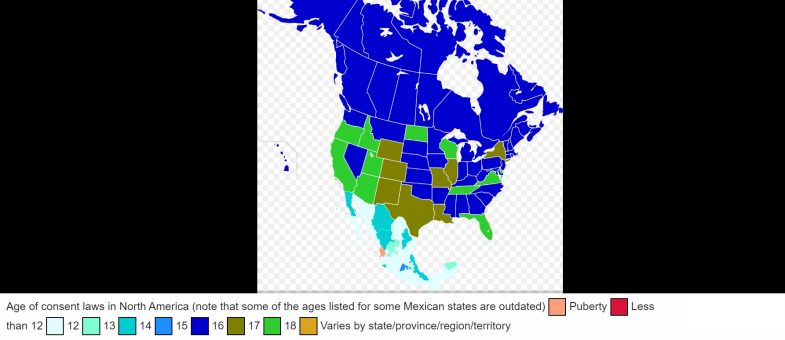
Link to Wikipedia
Epstein was able to play the martyr by not only claiming that unscrupulous girls had lied their age but also by implying that the age of consent is too high anyway in Florida.
This was also one reason why in New Mexico where Epstein had his Zorro Ranch the officials refused to register him as a sex offender. In New Mexico the age of consent was 16 until in 2018 it was raised to 18.
Furthermore, unlike in many other states, in New Mexico the courts recognize a mistake of age defense.
New Mexico courts recognize a mistake of age defense. The mistake of age defense is basically ”I thought she was 17.” However, this is no guarantee that this defense will work in court. Moreover, the mistake of age is the creation of judges in the absence of a direct statute addressing the defense. State lawmakers may pass a law overriding the courts on this issue at any time. (LegalMatch)
In reality the Epstein-Ghislaine case is not whether it is wrong for an adult to have sex with a 17 year old. Instead it is about many other things such as prostitution, grooming, pedophilia and the exploitation of children.
This all is connected to global politics involving sex trafficking, drug and arms trade, money laundering, Ponzi schemes, spy networks and blackmailing for Mossad.
Epstein’s victims were caught in a web of international spy network that used them as pawns for blackmail operations. The younger the girls were, the more leverage Israel would have over politicians, billionaires and scientists. Thus Epstein and Ghislaine tried to also recruit girls who were well under the age of 16.
What is more, they personally enjoyed having sex with these very young girls. Both Epstein and Ghislaine seem to have been pedophiles who were attracted to prepubescent girls and boys, i.e. small children.
Pedophilia is defined as:
Pedophilia (alternatively spelt paedophilia) is a psychiatric disorder in which an adult or older adolescent experiences a primary or exclusive sexual attraction to prepubescent children.[1][2] (Wikipedia)
Note that in order to be a pedophile it is enough to have merely occasional sexual attraction to prepubescent, i.e. sexually immature children who have not yet developed secondary sex characteristics, such as breasts.
Julie Brown from Miami Herald notes that Courtney Wild was only 14 when she was recruited into Epstein’s sex ring.
Wild still had braces on her teeth when she was introduced to him in 2002 at the age of 14.
She was fair, petite and slender, blonde and blue-eyed. (emphasis added. Miami Herald)

Link to Miami Herald
Julie Brown also notes that Epstein preferred girls who were not only white [and non-Jewish] but also appeared prepubescent.
Wild, who later helped recruit other girls, said Epstein preferred girls who were white, appeared prepubescent and those who were easy to manipulate into going further each time. (Emphasis added. Miami Herald)
For Epstein and Ghislaine it was important that the girls at the very least looked like small children. This is obviously why they preferred girls who were under 16.
Courtney Wild told the police that she brought Epstein over 70 girls and they were all under 16.
By the time I was 16, I had probably brought him 70 to 80 girls who were all 14 and 15 years old… (Emphasis added. Miami Herald)
Some girls were even younger. According to the police many were 13 year old.
The girls — mostly 13 to 16 — were lured to his pink waterfront mansion by Wild and other girls, who went to malls, house parties and other places where girls congregated, and told recruits that they could earn $200 to $300 to give a man — Epstein — a massage, according to an unredacted copy of the Palm Beach police investigation obtained by the Herald. (Emphasis added. Miami Herald)
It is also important to note that even 13 was not the minimum age for Epstein and Ghislaine. In fact, there was no limit to how young the girls could be. Both Epstein and Ghislaine Maxwell emphasized that the younger the better.
Eventually, she said Maxwell trained her to recruit new girls for Epstein.
“Jeffrey was very particular in the kind of girls he wanted. First off, the younger the better.”
Epstein said that to her, Giuffre claimed, and “Maxwell said that too. During the training and telling me how to do it, she said ‘You always have to go for the youngest-looking ones.’” (Emphasis added. The Daily Beast)
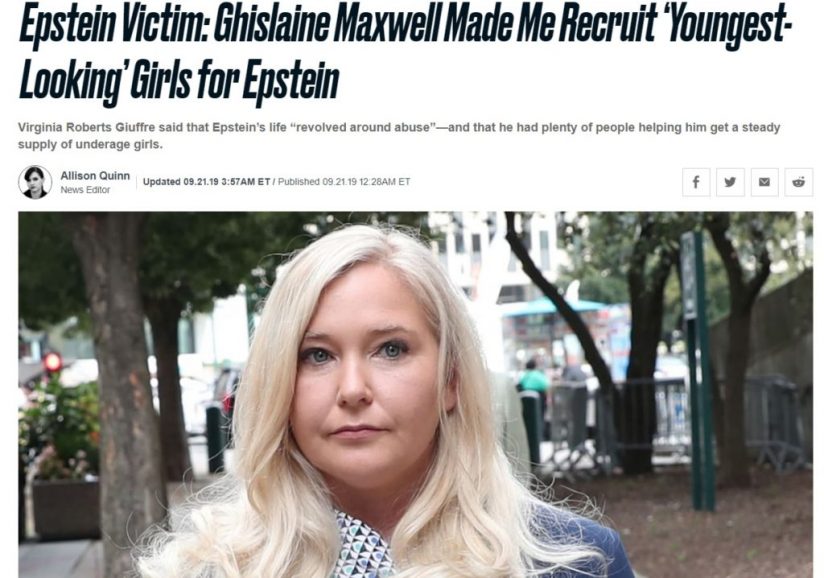
Link to The Daily Beast
It seems the primary purpose was not even blackmail since especially Epstein was having sex with these young girls all the time. On some days Epstein was having sex several times a day.
Sex games were more important for Epstein than work. Obviously, he was extremely attracted to these young girls.
Palm Beach multimillionaire Jeffrey Epstein, 54, was accused of assembling a large, cult-like network of underage girls — with the help of young female recruiters — to coerce into having sex acts behind the walls of his opulent waterfront mansion as often as three times a day, the Town of Palm Beach police found. (Emphasis added. Miami Herald)
In six months, I never saw him do a day’s work,” Ransome told The Telegraph. ”I never saw him work. He was literally sexually abusing us all day long. (Emphasis added. Business Insider)
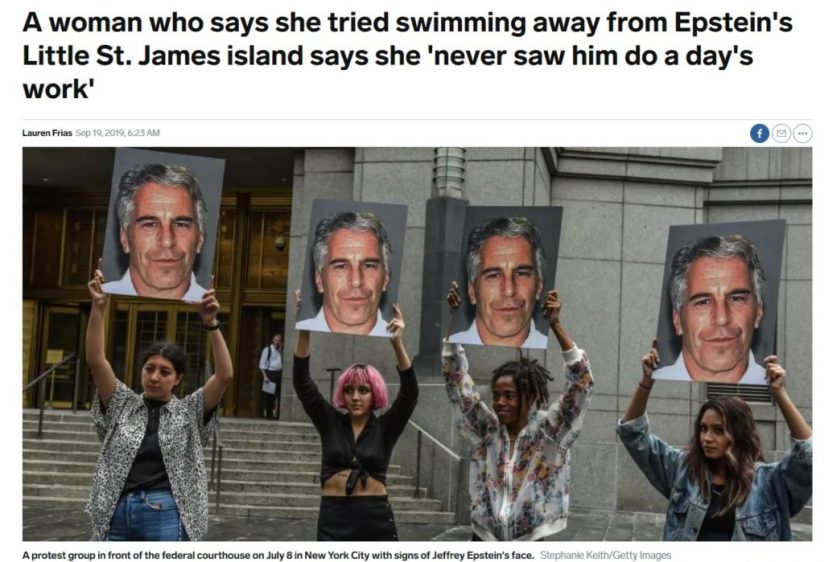
Link to Business Insider
Ghislaine also seemed to be obsessed with sex. Just like her father, Robert Maxwell she was rumored to be interested in unconventional sex which includes also sex with young children.
As she [Ghislaine] posed for the pics, which ran in a publication meant to promote Sotheby’s vintage fashion collection, she allegedly let slip comments that hinted at a twisted double life.
“She didn’t talk about Epstein, but during the shoot she did tell a story about how she just hosted a dinner party for a number of young girls, and she put dildos at each place setting,” the source said. “Ghislaine then described how during the dinner two guests, who were a couple, began demonstrating how to do the perfect fellatio on a man for all at the table. She was laughing about it.” …
“A friend of mine has a whole theory about her, that Epstein was like her father Robert Maxwell, who himself is believed to have had some strange sexual practices.” (Page Six)
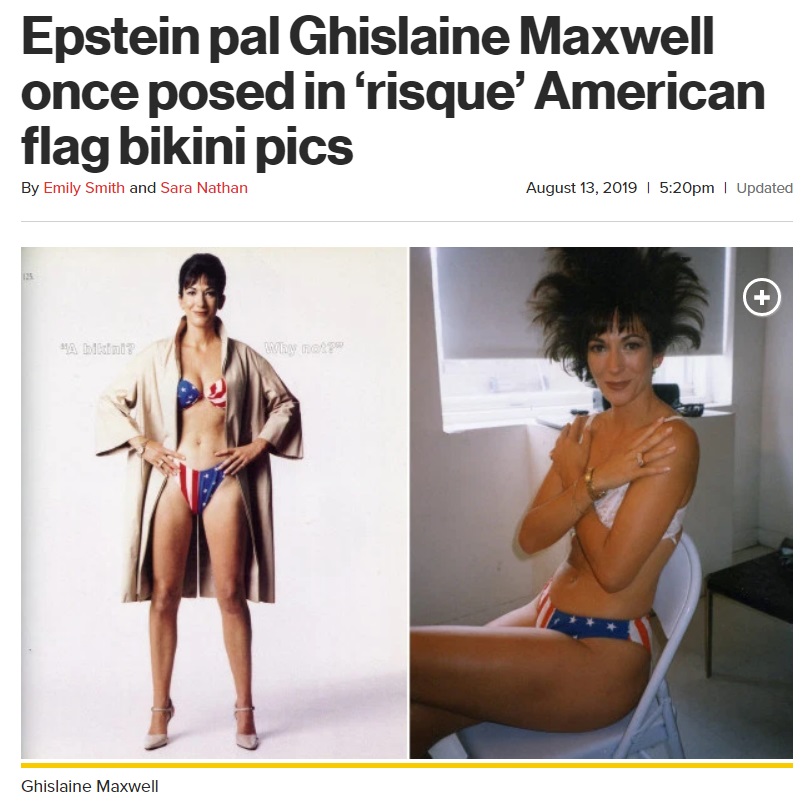
Link to PageSix
The Epstein Mossad-Timeline shows how Ghislaine was most probably trained by Mossad to use sex to gather information. That training would not have been too difficult for her since she was hypersexual. Many even considered her a nymphomaniac.
In fact, even many Israeli Jews – who usually have much fewer sexual taboos than puritan English and Americans – were shocked by her raunchy sexuality.
Flirtatious indeed: I understand from a mutual friend that after school she travelled to Israel and visited a kibbutz; she was immediately ostracised by the other girls for making a rather-too-obvious beeline for the Adonis-like lifeguard at the kibbutz pool. Very quickly she got her way, as she would with much in her life. (Tatler. Emphasis added.)
Even Ghislaine’s friend were sometimes shocked by her open sexuality that so often contrasted with her otherwise lady-like behavior and position in high society.
Ghislaine was, added Mason, ‘fantastically entertaining’ and ‘saucy’ – the paper said that she talked openly about sex.
In fact, said another acquaintance who saw her often at parties, she was ‘obsessed by sex. She’s Sphinx-like, mysterious. The last time I saw her, five, 10 years ago, I said what are you up to? And she said “I’m selling this product – stainless-steel mini dumb-bells – that you put up your fanny. For exercising your vaginal muscles, exercise your pelvic floor, learn the Singapore Grip. I’m giving seminars in LA and they all turn up and I tell them, this is how you keep your man.”’ (Tatler. Emphasis added.)
Epstein and Ghislaine were both hypersexual. All kind of sex interested them. Little girls were just part of the menu. Or more specifically, the best – and most profitable – part.
Epstein and Ghislaine were so attracted to young girls that nothing seemed to satisfy them. Perhaps this is why Epstein and Ghislaine created the highly risky sexual pyramid scheme. The girls were offered two alternatives: Either satisfy Epstein and Ghislaine sexually or get more girls to satisfy them.
In this way Epstein and Ghislaine were able to recruit literally hundreds of young girls. However, some of these girls went to the police and the sexual pyramid scheme collapsed.
When Epstein got out of jail in 2009 he had half-learned his lesson: American girls are too risky.
Now Epstein and Ghislaine would only concentrate on East European girls with the help of their Jewish-Ukrainian friend Peter Listerman.
One of the lesser-known shadowy figures linked to Jeffrey Epstein and his sex ring of teenage girls and young women is Ukrainian-born Peter Listerman, who has worked as a businessman and television presenter but is most known for his “match-making” abilities.
What match-making really means is that Listerman procures women, often underage, for the jet-set society to use for sexual purposes. His “clients” include Russian oligarchs and American businessmen and seems to have also included Jeffrey Epstein. (Citizen Truth)
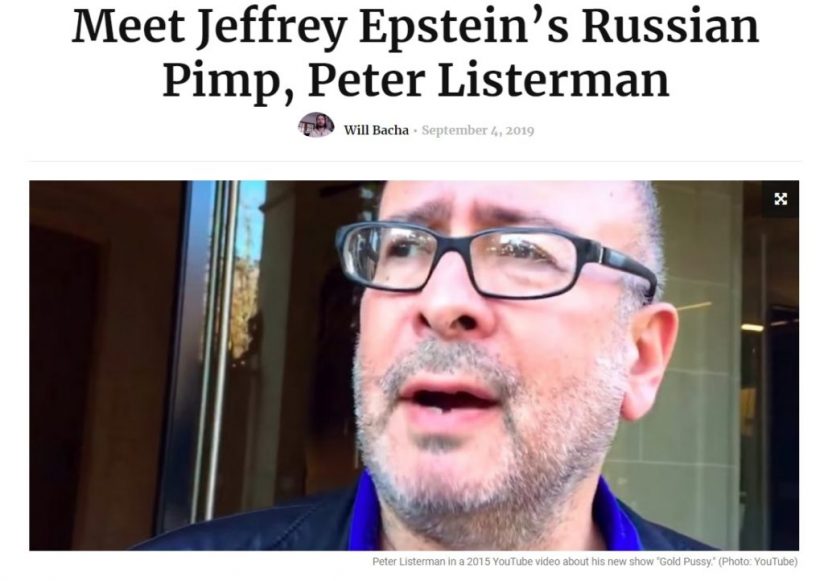
Link to the Citizen Truth.org
Listerman has such a bad reputation that he is shunned even in Ukraine!
Tatiana Savchenko, who founded the first modeling school in Odessa, Ukraine explained to the Daily Beast the lengths she had to go to keep Listerman from getting his hands on young women and trafficking them for sex work.
She claimed that he would frequently approach her students and attempt to lure them with promises of a luxurious lifestyle, and that “It took a lot of work to keep him from tricking our teen models in his traps.” (Citizen Truth)
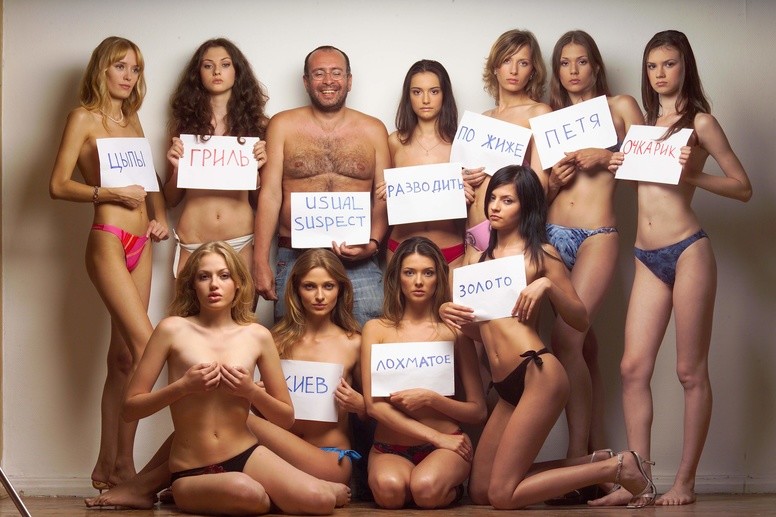
Peter Listerman is the usual suspect. Link to Fishki.net
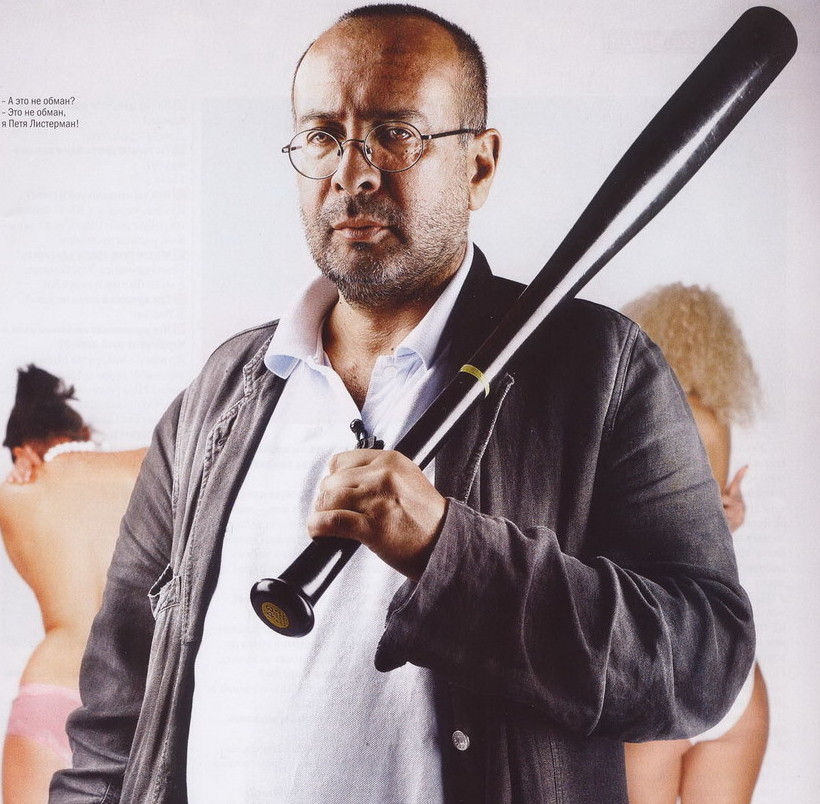
Do you think I am kidding? I am Peter Listerman! Link to Fishki.net
Both Epstein and Listerman were attracted to very young girls. Neither even tried to hide it much. In fact, Epstein was quite open about his attraction to tweens.
Just three months ago, as federal prosecutors were closing in with new charges, Mr. Epstein had a conversation with R. Couri Hay, a publicist, about continuing to improve his reputation. Mr. Epstein asserted that what he was convicted of did not constitute pedophilia, said Mr. Hay, who declined to represent him.
The girls he had sex with were “tweens and teens,” Mr. Epstein told him. (The New York Times)
But what is a tween?
Preadolescent is generally defined as those ranging from age 10 to 13 years.[4][6] … While known as preadolescent in psychology, the terms preteen, preteenager or tween are common in everyday use. (Wikipedia)
Epstein was right, of course. What he was convicted of in 2007 did not constitute pedophilia. However, that is precisely one reason why people are so outraged!
Epstein and Ghislaine did not see any problem of recruiting, grooming and having sex also with tweens. And apparently neither did the Justice Department and the FBI led by Robert Mueller!
But it gets even worse. As pointed out in the Epstein Pedoscandal Mossad Timeline, it seems that Epstein and Ghislaine were after even younger girls.
In 2003 Epstein financed Jean-Luc Brunell’s(?) and Jeff Fuller’s(J) new modelling agency MC2 that seemed to have worked with Peter Listerman.
MC2 obviously refers to the famous Einstein equation E = MC2, the energy-mass equivalence. Equally obviously, E equals Epstein, the energy, whereas the girls equal MC2, the mass energized by Epstein.

Jean-Luc Brunell
Brunell is generally known as the sleaziest man in model business who has long faced accusations that girls were drugged and raped in his employ. Already in the 80s he was the subject of a famous 60 Minutes expose on sexual abuse in the modeling industry
Despite all this – or for the very reason – Epstein invested in MC2 and became particularly close to its founders Brunel and Fuller.
The agency operates in New York, Miami and Tel Aviv. It’s in practice half-Israeli.
Many call Israel the capital of human trafficking and organ harvesting.

MC2 concentrates on importing East European girls to Israel and America. The younger the better.

Marina Lynchuk of MC2

Lolita Lvola from MC2

Linta Lapinda from MC2
Brunel seems to have given 12-year old triplets to Epstein as a birthday present.
’Jeffrey bragged after he met them that they were 12-year-olds and flown over from France because they’re really poor over there, and their parents needed the money or whatever the case is and they were absolutely free to stay and flew out,’ Giuffre said.
She said she saw the three girls with her own eyes and that Epstein had repeatedly described to her how the girls had massaged him and performed oral sex on him. They were flown back to France the next day.

Link to Daily Mail
It seems that even tweens were not young enough for Epstein.
According to court papers in 2005 Brunel called Epstein and left a message that “he is sending him a 16-year-old Russian girl for purposes of sex”. However, the written message says something even worse.
The message, filed as an exhibit in the case, was written on an office message pad, partly in code, and read: “He [Brunel] has a teacher for you to teach you how to speak Russian. She is 2×8 years old not blonde. Lessons are free and you can have your 1st today if you call.” (New York Post)
Does it mean that two eight year olds are involved? Or does 2 x 8 mean to sex 8 year old? (2=to, x=sex)
Why would the lessons be free and why is it relevant that the ”teacher” is not a blond?

There is no denying that Epstein and Ghislaine sexualised even small children. This became clear in 2005 when police raided Epstein’s Palm Peach mansion.
In one photo that was hanging on the wall a small six or seven year old girl was bending over in a tiny dress. Police blurred out the photo in the video taken during the raid.

Link to The Daily Mail
Despite all this only the Russian Television was actively trying to expose Epstein and Ghislaine.
RT aired this video already nine years ago!
The description on the video is even more revealing. It even mentions the 12-year old triplets.
The American TV networks were actively suppressing the story for years.
The American media has also been trying to cover up the fact that Jeffrey Epstein was most probably murdered in his cell. He had to be silenced.
But it gets even worse.
This hung on Ghislaine’s home wall.

NEW YORK CITY, NY – MARCH 13: Atmosphere at Hamish Bowles, Ghislaine Maxwell and Lillian von Stauffenberg dinner for ALLEGRA HICKS at Home of Ghislaine Maxwell on March 13, 2007 in New York City. (Photo by Patrick McMullan/Patrick McMullan via Getty Images). Link to Getty Images.
The so called artwork seems to be full of pedophile symbols.


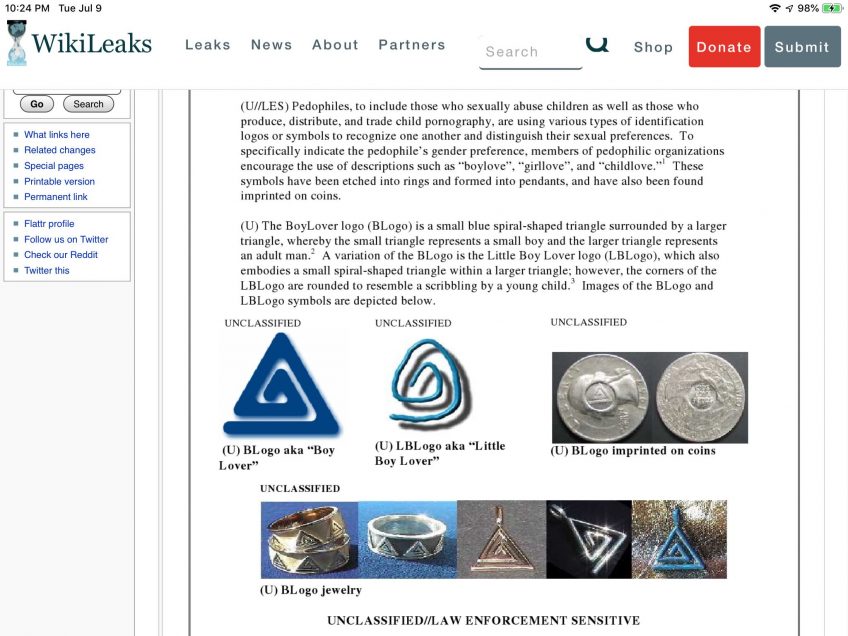
Link to Wikileaks.org
The quality of the photos taken at Ghislaine’s home are so good that even more symbols have been found in her artwork.

For some reason the mainstream media has not picked up on this pedophilia angle. No mainstream media journalist has even tried to ask why would Ghislaine have such art and symbols on her home wall.
This despite the fact that Ghislaine is most probably an Israeli superspy just like was her father, Robert Maxwell. She probably has been trained to use sex – including pedophilia – as a tool for blackmail and manipulation.
At the time in Israel females molesting little boys was not even considered rape.
Link to Haaretz.com
Nor have mainstream journalists asked where was Ghislaine when Madeline McCann was abducted.
That would not be an unreasonable question since one of the E-Fit images looks a lot like Ghislaine.

Link to Enchanted Life Path.com
Furthermore, two of the E-Fit images (1A, 1B) look like the Podesta brothers. John Podesta was White House Chief of Staff to Bill Clinton and the Chairman of the 2016 Hillary Clinton presidential campaign.
Ghislaine and Epstein were close to the Clintons and the Podesta brothers have been directly linked also to Pizzagate.

Link to Pizzagate Map created by Tuukka Pensala
Was Ghislaine helping to run also Pizzagate and other pedophile rings for Mossad?
At least she seems to be perfectly trained to do just that. First, her own hypersexuality, family background and possible training by Mossad made it easy for her to master mind the pedophilia ring she run with Epstein.
Second, Ghislaine and Epstein had all the apparel to help run also other pedophile rings: Lolita express airplanes and helicopters, Zorro Ranch in New Mexico and luxury mansions in New York, Palm Peach and Paris.
Even more importantly they had their own island in the Virgin Islands.
In the 90s Epstein bought Little St. James island from the Virgin islands. It had a mansion which Epstein expanded.
Soon locals started to call it the Pedophile Island.
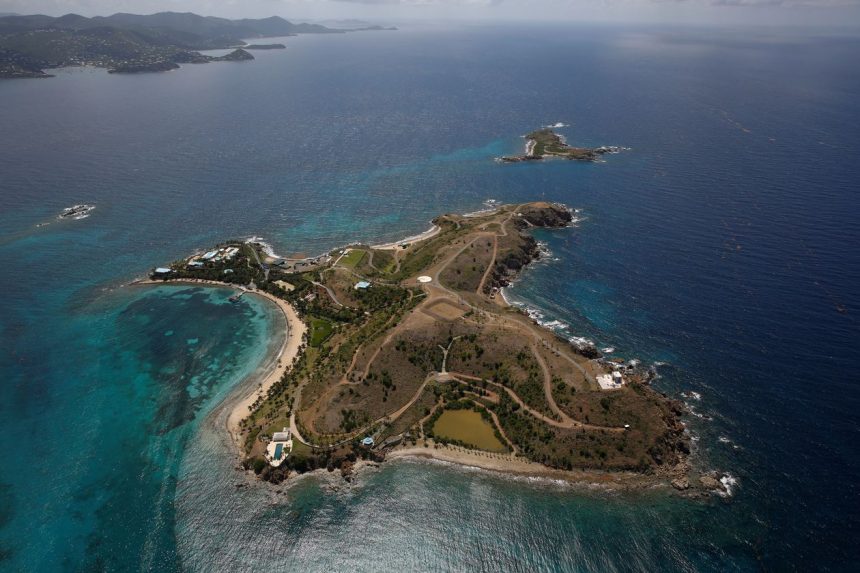
Little St. James island. Link to Wall Street Journal article
The island seems to have tunnels with several underground entrances.
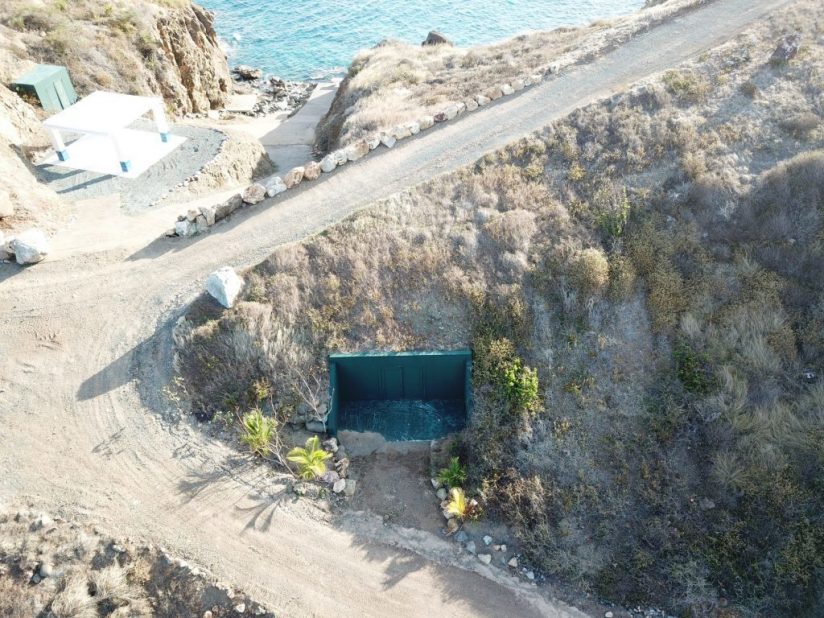
Underground entrance
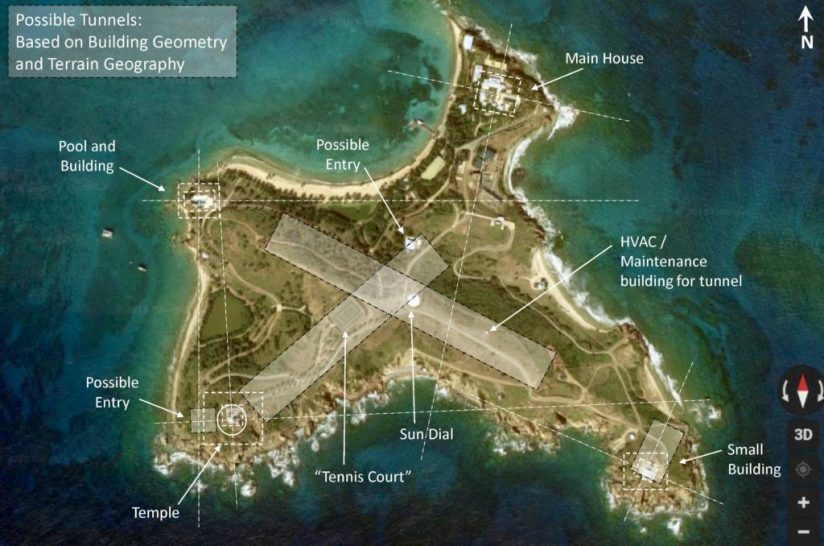
Link to Twitter
The island also has a strange temple.
We Are Change’s Luke Rudkowski and the Dollar Vigilante’s Jeff Berwick secretly visited the island but were soon chased out.
Ghislaine has a Helicopter Pilot License and often transported quests to the island.
On the weekends in the 1990s, Maxwell would have her Rollerblades FedExed to Epstein’s island in the Caribbean, and said she got her helicopter’s license so she could transport anyone she liked without pilots knowing who they were.
Maxwell also said the island had been completely wired for video; the friend thought that she and Epstein were videotaping everyone on the island as an insurance policy, as blackmail.
A source close to Maxwell says she spoke glibly and confidently about getting girls to sexually service Epstein, saying this was simply what he wanted, and describing the way she’d drive around to spas and trailer parks in Florida to recruit them. She would claim she had a phone job for them, “and you’ll make lots of money, meet everyone, and I’ll change your life.” …
Maxwell had one other thing to tell this woman: “When I asked what she thought of the underage girls, she looked at me and said, ‘they’re nothing, these girls. They are trash.’” (Emphasis added. Vanity Fair)
Ghislaine was naturally using Epstein’s helicopters. Some of them shared their FAA tail number with a US contractor, Dyncorp. That would have helped Ghislaine and Epstein to fly drugs and children.
FAA records and Epstein’s pilot’s flight manifest indicate that Epstein’s Bell helicopter used the same tail number of N474AW. This was the same tail number used until 2006 by State Department contractor Dyncorp for counter-insurgency operations in Latin America.
The congruence of Epstein’s Bell N474AW and Dincorp’s Bronco N474AW is noteworthy. In 2002, the year Epstein’s aircraft fleet stands accused of flying underage teen girls, some between the ages of 12 and 15, coincided with Dyncorp’s trafficking in underage females between the ages of 12 and 15 from Kosovo and Bosnia in the Balkans.
One Dyncorp whistleblower reported to The Washington Times’s Insight magazine’s Kelly O’Meara in 2002 the following on one Dyncorp employee in Bosnia:
[he] owned a girl who couldn’t have been more than 14 years old. It’s a sick sight anyway to see any grown man [having sex] with a child, but to see some 45-year-old man who weights 400 pounds with a little girl, it just makes you sick.”
Tail number N474AW has been shared between Epstein’s Bell helicopter like the one in this photo. (Emphasis added. Political Bull Pen)

DynCorp’s pedophilia ring became internationally infamous with the release of the movie Whistleblower.

Link to Wikipedia
Helicopters can always be seen. However, Ghislaine also has a license to operate submarines!
In 2012 – three years after Epstein got out of jail – Maxwell founded The TerraMar Project,[51] a nonprofit organization that advocated protecting ocean waters.
She gave a lecture for TerraMar at the University of Texas at Dallas and a TED talk, at TEDx Charlottesville in 2014.[52] Maxwell accompanied Stuart Beck(J), a 2013 TerraMar board member, to two United Nations meetings to discuss the project.[17] (Wikipedia)
In 2014, a United Nations event featured Maxwell as a speaker. According to her bio in the program, Maxwell’s “web-based non-profit” aimed “to protect the Oceans by empowering a global community of ocean citizens.” It further described Maxwell as “a private helicopter pilot and an Emergency Medical Technician and a qualified ROV and Deepworker submarine pilot.”
A former Coast Guard officer, Borgerson was also a fellow at the Council on Foreign Relations, which featured Borgerson and Maxwell as speakers during one 2014 talk titled “Governing the Ocean Commons: Growing Challenges, New Approaches.” Friends of Maxwell, according to The New York Times, said Borgerson became her boyfriend. Maxwell had allegedly described Borgerson as a “Navy SEAL” to her pals.
Maxwell’s dubious charity also roped in the Clinton Global Initiative, the now-defunct networking platform for the Clinton Foundation. In the fall of 2013, CGI named TerraMar as one of the “commitments to action” at their annual meeting. (Emphasis added. Daily Beast)
Did the Pedophile Island have an underground submarine base? Was it a part of global pedophile network?
And was the Ocean Citizens project an attempt to escape national jurisdictions and thus gain at least a partial immunity from police investigations and prosecutions?

Link to TerraMar Project
Interestingly, as late as 2016 Epstein bought also the nearby Great St. James Island. He started to build on the island without permits.
There were rumors that he was building underground. For some reason the mainstream media has had no interest in this second island.
Why is the mainstream media not interested in Ghislaine’s many links to pedophilia?
Perhaps because Ghislaine has so many powerful friends. The photo of the pedophile artwork on Ghislaine’s wall was taken 13 March 2007 during a party at Ghislaine’s New York townhouse. The guest list included a curious combination of elite Jews, aristocratic Brits and American WASPs.

Atmosphere==
Hamish Bowles, Ghislaine Maxwell and Lillian von Stauffenberg dinner for ALLEGRA HICKS. Home of Ghislaine Maxwell. March 13, 2007©Patrick McMullan. Photo-Patrick McMullan/Patrick McMullan.com. Link to Quick N Dirty
The party was in Ghislaine’s huge 7000-square-foot townhouse. It is located in the most opulent and prestigious neighborhood of America, the Upper East Side, New York on East 65th Street just off Park Avenue. Epstein’s townhouse was only 10 blocks away.
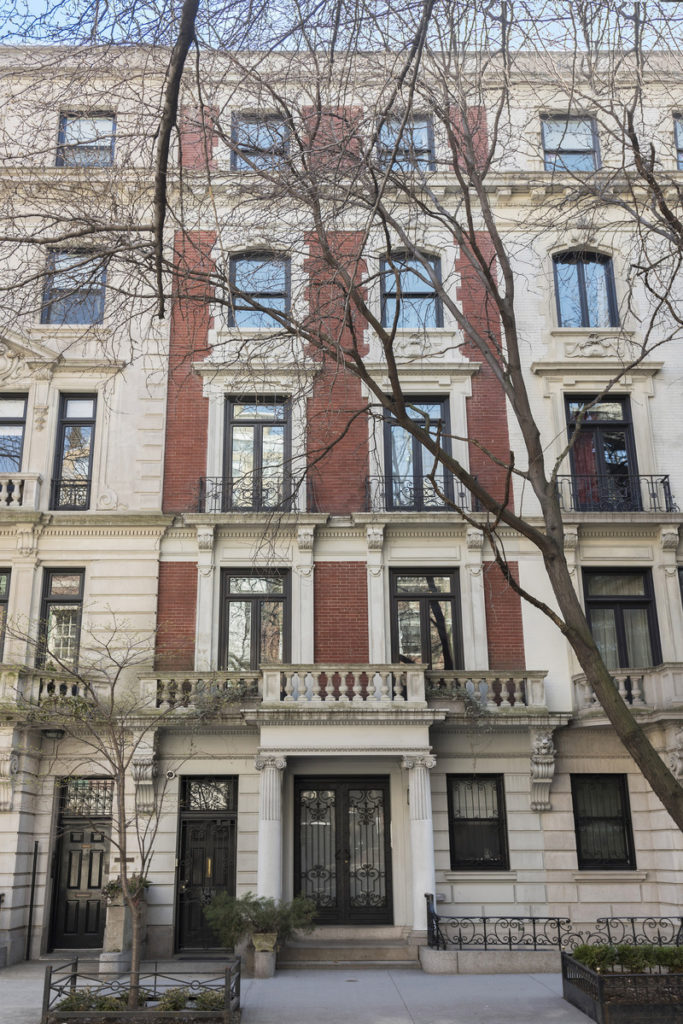
Ghislaine’s five story townhouse. Link to Street Easy

Ghislaine’s townhouse floor plan. Link to Street Easy
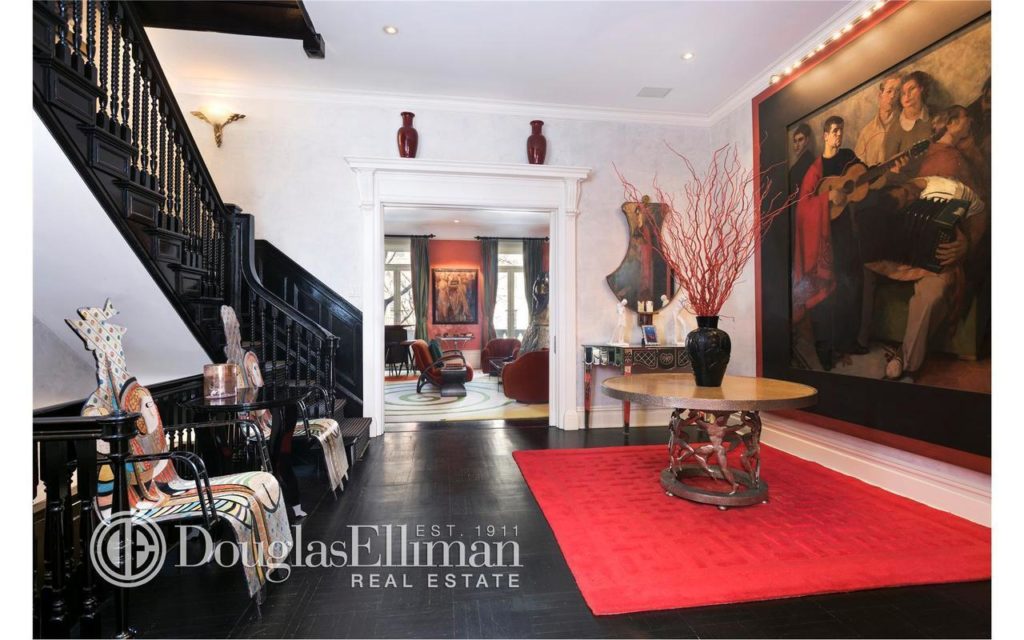
Ghislaine’s townhouse 2nd floor gallery. Link to Street Easy
There are reports from reliable sources that the townhouse was sold in 2000 to Ghislaine by Lynn Forester de Rothschild. The very same woman who had introduced Epstein and Ghislaine to Alan Dershowits and the Clintons in the 90s.
The Manhattan property, which is close to Epstein’s mansion, is owned by Lynn Forester de Rothschild, wife of British financier Sir Evelyn de Rothschild. (See The Times and the original article.)
According to Business Insider Forester sold the townhouse to Ghislaine for less than half the price.
Forester sold the mansion for about $8.5 million less than its assessed market value, which was more than $13.4 million.
Was this a pay-off to Ghislaine from the King of Jews, the Rothschilds for services rendered?

Hillary Clinton, Evelyn de Rothschild, Bill Clinton and Lynn Forester de Rothschild. Link to Mint Press
It probably is also relevant that at the time of the sale of the townhouse the Prime Minister of Israel was Ehud Barak. In the 80s he had been the head of Aman, the Israeli Military Intelligence Agency. As the Epstein Pedoscandal Mossad Timeline revealed, both Epstein and Ghislaine worked for the Israeli intelligence agencies already in the 80s during the Iran-Contra operation.
Note that it was around year 2000 that Epstein and Ghislaine started the pedophile operation in earnest. In the 80s and 90s blackmail operations were a side show but now it became the main show involving hundreds of young girls.
Sexual blackmail – especially involving little children – can be an extremely efficient way to influence key politicians and even military officials. A successful blackmail operation can achieve more than several army divisions. No wonder Barak was so close to Epstein and Ghislaine.
Furthermore, in 2000 the president of Israel was Moshe Katsev who was sexually harassing and even raping his female subordinates. Later Katsev would be convicted of rape.
It was also in 2000 when the Israeli Vice-Consul of Rio de Janeiro, Arie Scher and Hebrew language Professor George Schteinberg were running a pedophile ring for Israeli tourists. When the Brasilian police started to investigate the Israeli consulate Scher managed to flee back to Israel.

In Israel Scher was not prosecuted. Instead in 2005 he was promoted to Consul of Canberra, the capital of Australia. A spokesman for the Israeli Foreign Ministry in Jerusalem, Mark Regev explained:
He [Arie Scher] was a young and single man at the time [in Brazil]. Now he is married and he’s six years older and there is no reason why he shouldn’t make an excellent diplomatic appointment in Australia.
Australia refused to let Scher enter the country.

Link to William Bowles Info
The most shocking part of the Arie/Aryeh Scher story is that the mainstream media was not interested. Either the stories have been scrubbed from the internet or no stories were ever written by mainstream journalists except one short story by BBC in 2000 and one even smaller story by The Sydney Morning Herald in 2005. Even more surprisingly Youtube does not seem to have any videos about the Scher case.
No wonder Barak was absolutely convinced that the Western mainstream media would never dare to criticize Israel and its intelligence agencies. Not even when Mossad was running pedophile rings.
It was probably the Israeli leaders Shimon Peres, Ehud Barak and Moshe Katsev together with the ultra-Zionist Mega Group who made sure Epstein and especially the Maxwell family had not only immunity from prosecution but also all the blackmail apparel necessary including luxury townhouses, airplanes, yachts, submarines, ranch and a private island. All, of course, bugged to the hilt.

Israeli Prime Minister Ehud Barak (R) talks to Shimon Peres, Minister of Regional Planning, after Barak’s speech at the opening session of parliament in Jerusalem 30 October 2000. Barak said that he believed peace was still possible in the Middle East but that Israel did not have a partner prepared to make compromises. AFP PHOTO / SVEN NACKSTRAND (Photo credit should read SVEN NACKSTRAND/AFP/Getty Images)
Here the pedophile artwork at Ghislaine’s New York townhouse can be seen behind Lillian von Staufenberg who in March 2007 together with Ghislaine and Hamish Bowles organized a dinner party in honor of Allegra Hicks. This at a time when Epstein had already been charged with abusing young girls.

Karen Groos, Allegra Hicks, Lillian von Stauffenberg==
Hamish Bowles, Ghislaine Maxwell and Lillian von Stauffenberg dinner for ALLEGRA HICKS==
Home of Ghislaine Maxwell, NYC==
March 13, 2007==
©Patrick McMullan==
Photo-Patrick McMullan/Patrick McMullan.com==
Link to QuickNDirty
Why would Ghislaine have such a suspicious artwork on her wall knowing that it would probably be photographed during the parties?
Why would Ghislaine and her quests take such a huge risk? Or was it a sign meant to be seen? Was Ghislaine flaunting her power?
Ghislaine and her quests seemed to be absolutely sure that the mainstream media would not dare to ask embarrassing questions.
They were right, of course. The mainstream media knows its place.
However, occasionally some courageous mainstream journalist or editor does try to give hints. Some have even reported on Ghislaine’s hyper-sexual reputation and her orgies. It is just that the stories have mostly been scrubbed from the internet.
Fortunately, Whitney Webb from Mintpress has found many of the scrubbed stories. Some of them mention the Mossad connection and others note the orgies. For example, in 2003 a British newspaper, The Evening Standard reported a revealing rumor.
Salacious reports have crossed the Atlantic about Ghislaine hosting bizarre parties at her house to which she invites a dozen or so young girls, then brandishes a whip and teaches them how to improve their sexual techniques.
It seems that Ghislaine was not only a madame to Epstein but also to the ruling elite. This would both explain her popularity and the fact that the media – and especially the American media – dares not to criticize her too much. Not even after her boyfriend Epstein was charged with sex trafficking minors!
Ghislaine’s friends are just too powerful. After the March 2007 party the British Daily Mail newspaper was amazed how Ghislaine could still have attracted such creme de la creme of the highest elite. Even more amazingly, the elite was practically swooning over her.
The night before the party, the hostess [Ghislaine] had been inundated with calls from disgruntled socialites, irked that they hadn’t received an invitation.
The hostess greeted their objections with her customary charm, but remained unmoved. As always, her list had been carefully edited, and she intended it to stay that way.
Among the select few were Hollywood star Matthew Modine, Kennedy family member Mrs Anthony Radziwill, Peggy Siegel, PR consultant to the stars, and Julie Janklow, heir to a literary dynasty.
There was a Rockefeller on the list, as well as the inevitable countesses, billionaires and New York luminaries.

Link to Daily Mail
The guests at the party included also Renee Rockefeller who is married to Mark Rockefeller, the son of ex-Vice President Nelson Rockefeller and nephew of David Rockefeller.

Allegra Hicks, Renee Rockefeller==
Hamish Bowles, Ghislaine Maxwell and Lillian von Stauffenberg dinner for ALLEGRA HICKS. Home of Ghislaine Maxwell, NYC. March 13, 2007 ©Patrick McMullan/Patrick McMullan.com. Link to QuickNDirty
David Rockefeller lived at 146 East on the same 65th Street in the Upper East Side as Ghislaine. They were practically neighbors. Ghislaine would have to walk only two minutes to visit David.
David liked to pose for photos in his Beetle Room next to his favorite Picasso painting depicting a nude child ”prostitute”.

David Rockefeller. Link to Jeffrey Harris Desing.com
David was often visited by his close friend Jacob Rothschild, the patriarch of the Rothschild family.
The very same family that got Ghislaine her luxury townhouse next door.
The patriarchs, Jacob Rothschild and David Rockefeller. Link to Jeffrey Harris Design.com
As shown by the Epstein Pedoscandal Mossad Timeline both Epstein and Ghislaine continued to move in the highest circles long after Epstein got out of jail. In fact, only last year Ghislaine was invited to a secret writers’ retreat hosted by the richest man in the world, Jeff Bezos.
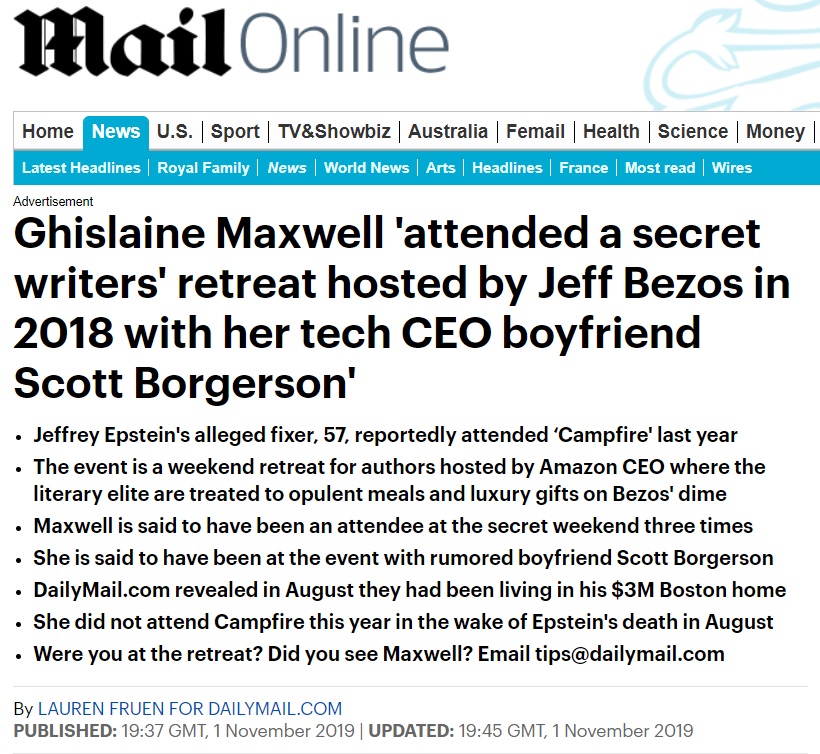
Link to The Daily Mail
Not only billionaires but also royalty kept in close contact with Ghislaine.
Prince Andrew was recently interviewed by the BBC about his relationship with Epstein, Ghislaine and their sex slave Virginia Roberts.
Amazingly, Andrew claimed she has no recollection of Epstein’s and Ghislaine’s sex slave, Virginia Roberts. This despite the fact that they were photographed together!

Prince Andrew, Virginia Roberts and Ghislaine Maxwell. Link to Daily Mail

Link to The Sun.com
Hardly anybody believes Andrew. The queen had no choice but to sack his own son.
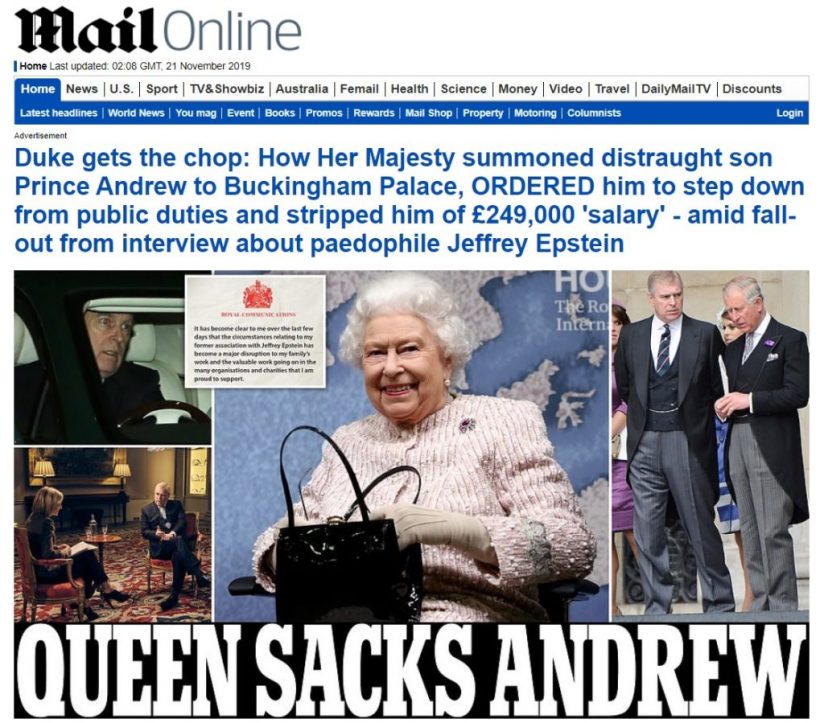
Link to Daily Mail
Andrew got sacked because he was caught in a lie.
Andrew claimed he could not have had sex with the 17-year old Virginia in 2001 because he had stayed with the British consul general.
The problem is the consul general does not recall Andrew staying with him.
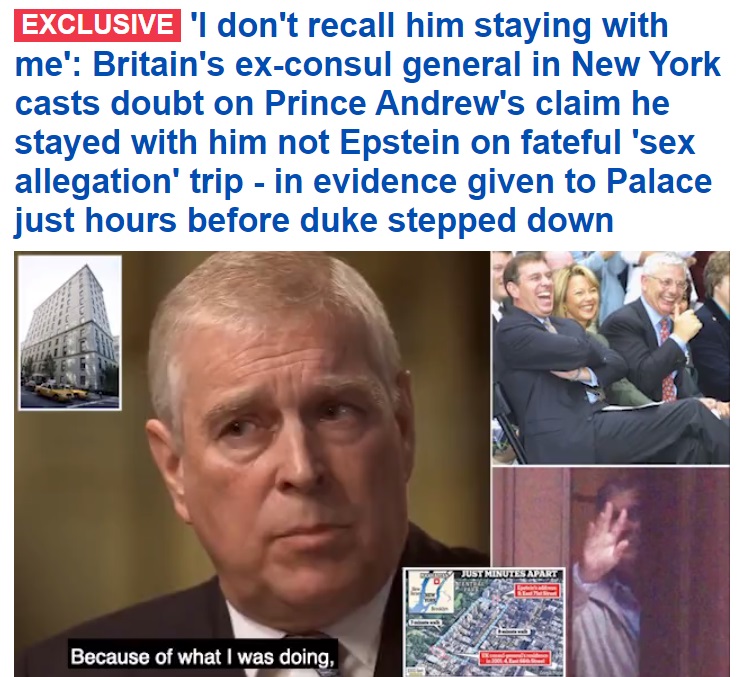
Link to Daily Mail
Curiously, most of the mainstream media has forgotten that it was Ghislaine who recruited and manipulated Virginia Roberts to become a sex slave.
Even the BBC forgot this crucial fact despite Andrew mentioning Ghislaine many times during the interview.
Time and again, the Prince invoked his friendship with Maxwell, 57, daughter of disgraced media tycoon Robert Maxwell, as the reason he came into paedophile Epstein’s orbit.
Asked when he last saw Maxwell, Andrew said his last contact was ’earlier this year, funnily enough’, when she ’was here doing some rally’. (Daily Mail)
Andrew claimed to have met Ghislaine last spring. In fact, they met in June just after US prosecutors reopened the case against Epstein.
The Duke of York held a meeting with Ghislaine Maxwell in London two weeks after US prosecutors announced they wanted to reopen their investigation into Jeffrey Epstein. …
The meeting took place on or about June 5, the day before Ms Maxwell took part in a four-day charity motoring rally from London to Monte Carlo.
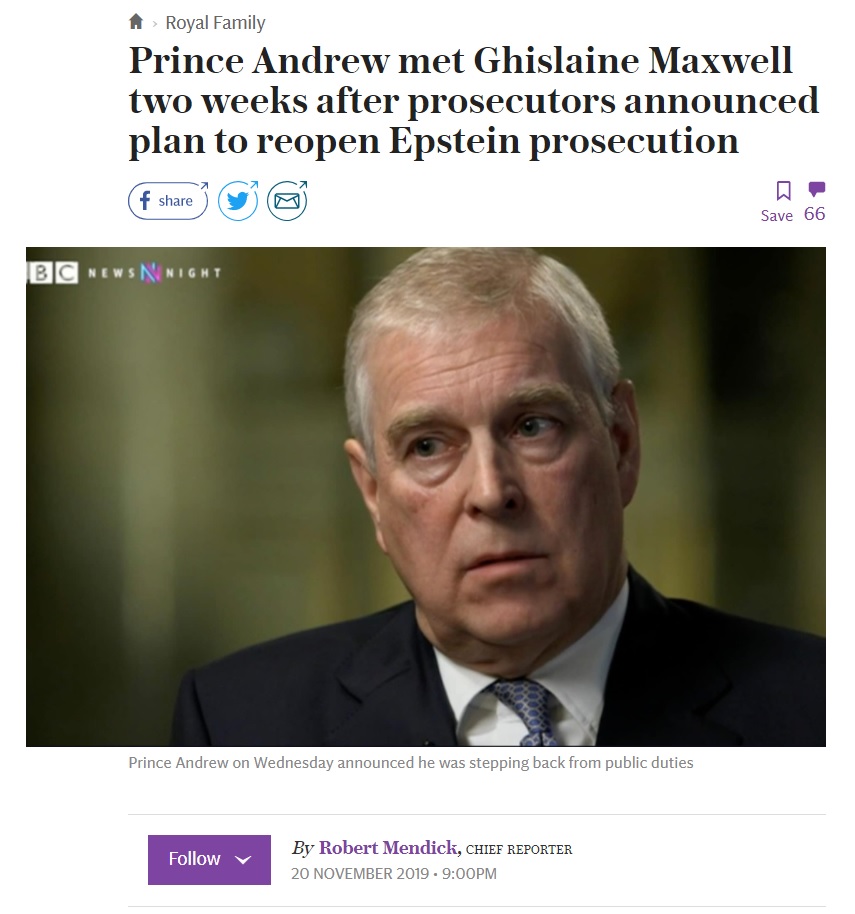
Did Ghislaine demand that Andrew help make sure that the her own parallel case would not be reopened?
After meeting Andrew she literally disappeared from the face of the earth.
The ex-socialite has not been seen since although rumours have placed her in Brazil, France, the American mid-West and even the UK.
‘No one knows where she is,’ a lawyer for one of Epstein’s victims said last night. ‘She’s done the greatest disappearing act known to man – or woman.’ (Daily Mail)
Link to Daily Mail
Shockingly, during the BBC interview Prince Andrew mentioned Ghislaine many times and seemed to be proud of their friendship. Despite this the interviewer did not dare to ask questions about their relationship.
Was this a message to all: Leave Ghislaine alone.
Ghislaine is obviously protected not only by the royal family but also by the whole ruling elite. No wonder that she has the Get-Out-of-Jail-Free card.
Ghislaine also tries to protect other Epstein associates.
Link to Daily Mail
Prince Andrew is now afraid to go to the US.
Five women who accuse Jeffrey Epstein of abusing them say Prince Andrew witnessed how people were given massages at the sex offender’s homes.
The lawyer for the women has told BBC Panorama he plans to serve subpoenas to force the Duke of York to testify as a witness in all five cases.
He says the prince could have important information about sex trafficking. (BBC)
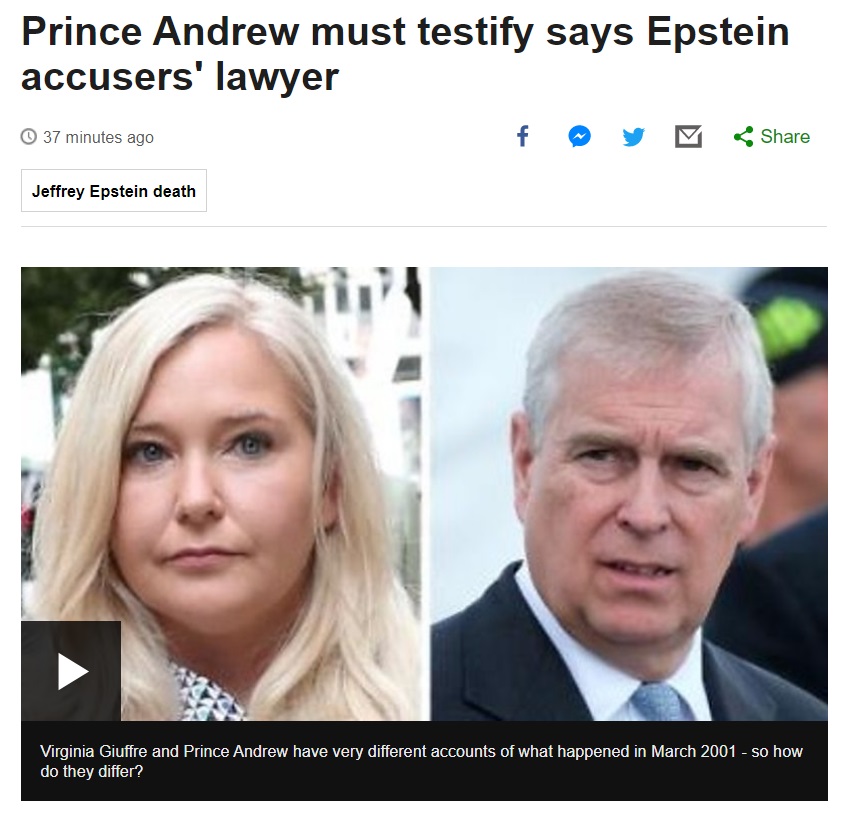
Link to BBC story and video
The BBC has now finally zoomed in on Ghislaine.
Another Epstein victim, Sarah Ransome told Panorama Ghislaine Maxwell, one of Prince Andrew’s oldest friends, worked hand in hand with Epstein.
”Ghislaine controlled the girls. She was like the Madam,” she said.
”She was like the nuts and bolts of the sex trafficking operation and she would always visit Jeffrey on the island to make sure the girls were doing what they were supposed to be doing.
”She knew what Jeffrey liked. She worked and helped maintain Jeffrey’s standard by intimidation, by intimidating the girls, so this was very much a joint effort.”
Ms Maxwell could not be reached for comment but has previously denied any involvement in or knowledge of Epstein’s abuse. (BBC)
But the American media is still not interested in Ghislaine.
What the American mainstream media always willfully forgets is that Ghislaine Maxwell is the key person and mastermind behind the whole pedo sex trafficking operation.
The key role of Ghislaine is not surprising. After all, her father was an Israeli super spy, Robert Maxwell.
But perhaps this is the very reason why the American media is not interested.
For years Ghislaine has been at the center of a vast pedophile sex trafficking network. But still to this day the American police has never dared to even interview her.
She simply knows too much.
Featured Video

The Search for Truth: Charlie Kirk’s Assassination One Year Later
or go to
Aletho News Archives – Video-Images
From the Archives
The 9/11 “Double-Cross” Conspiracy Theory
BY LAURENT GUYÉNOT • UNZ REVIEW • SEPTEMBER 6, 2022
Is it true that “9/11 was an inside job”? Yes, insofar as Israel is “inside” the U.S. But for the 9/11 truthers who have identified Israel as the main perpetrators, “9/11 was an inside job” is at best a half-truth, and at worst an integral part of the Zionist operation, like a secondary flag sewn as a lining under the false flag of Islamism. Victor Thorn (1963-2017) wrote in his book 9/11 made in Israel: The Plot Against America (2011): “In essence, the ‘9-11 truth movement’ was created prior to Sept. 11, 2001 as a means of suppressing news relating to Israeli complicity. . . . The slogan ‘9-11 was an inside job’ was quite possibly the greatest example of Israeli propaganda ever devised.” In milder terms, it is “controlled opposition”.
A genuine truth movement would have pointed to Israel as the prime suspect from the start. From day one, it was obvious who would benefit. … continue
Blog Roll
 Aletho News
- Europe’s mounting social chaos… chickens coming home to roost for proxy war against Russia
- US-Russia Diesel Deal Becomes Massive Defeat for Ukraine
- Hormuz and the Looming Economic Catastrophe
- Dhubab offensive, media blitz and the rapid unraveling of Saudi-backed coalition’s new gambit
- Putin Conveys to Trump Iran’s Vision on Possible Conflict Resolution – Kremlin
- The Search for Truth: Charlie Kirk’s Assassination One Year Later
- ‘Harsh reality’: Iran says France seeks monopoly on power and intimidation, not peace for all
- When Will This White House Madness End?
- Huckabee aide goes to ‘unusual lengths’ to portray ‘Israel’ positively
- Trump Announces Diesel Supply Deal With Putin Following Phone Call
- If Americans Knew
- Israeli forces kill another child in Gaza – Daily Update
- Gaza ceasefire exists in name only, say more than 100 organizations
- Nearly 2 Million in Gaza Need Urgent Shelter Assistance as Winter Looms: IOM Chief Warns
- Suppressing Palestinian resistance: US charity under fire for AI monitoring of Gaza classrooms
- Thousands Are Held in Israeli Torture Camps. This Is What Happens Inside
- Israel puts Gaza’s sick, injured, newborn in peril – Daily Update
- Report claimed Mark Levin used by Israeli government to influence Trump
- Over 2,000 Gazans have died awaiting medical evacuation amid Israel’s continued siege
- How a U.S. Diplomat Suppressed and Altered Reports Critical of Israel
- 5 Palestinians Die from Israeli Strikes in Gaza as Relentless Attacks Continue
- No Tricks Zone
- New Study: 50 Years Of The Most Aggressive ‘Net Zero’ Policies Can Only Affect The Global Climate By 0.03°C
- US September “Heat” Was No Record…Many Records Set Decades Ago
- Latest European Green Energy Debacle; Portugal’s Largest Flagship Solar Park Insolvent!
- Green Energy Debacle: German Expert Professor Fritz Vahrenholt Warns Of Severe Economic And Social Consequences
- Two More Paleo Reconstructions Affirm Meters-Higher Sea Levels Across Ireland, Brazil 7000-6000 Years Ago
- New Study: Earth And Venus Surface Warmth Largely Explained By Convection And Lapse Rate, Not CO2 Or Radiation
- 2025 Nature Paper Claiming Worsening Global Drought Gets RETRACTED …Heavily Flawed
- New Study: ‘Global Drought Shows No Detectable Recent Acceleration Under Climate Warming’
- Economic Masterminds: German Socialists Suggest Taxing Productivity Gains Stemming From Using AI
- The South China Sea Has Not Been Cooperating With The Climate Change Narrative

