Airbnb complicit in ‘plunder of Palestinian refugee properties’ says new report
MEMO | October 29, 2019
Online accommodation and tourism giant Airbnb has been accused of “complicity in the plunder of Palestinian refugee properties”, in a new report published last week.
According to Who Profits, an independent research centre focused on exposing corporate involvement in the “ongoing Israeli occupation of Palestinian and Syrian lands”, their new update sheds light on a “largely overlooked” dimension of Airbnb’s “complicity”.
Taking the Old City of Yafa (Jaffa) as a case study, the new report “aims to highlight the ways in which Israel confiscated and controlled Palestinian properties, leading to their privatisation”.
“Israel has transformed properties into economic assets that benefit both the state and private actors, thus undermining Palestinians’ legally enshrined Right of Return,” stated the research centre.
“Serving as a platform for showcasing the homes that once belonged to Palestinians, Airbnb plays a role in strengthening the Israeli hold over Palestinian refugee properties,” Who Profits added.
During the Nakba of 1948, more than 750,000 Palestinians were expelled from their homes and lands – property that was subsequently appropriated by the Israeli state “through legal mechanisms that formalise their confiscation and turn them into economic assets”, Who Profits explained.
According to the centre, this “privatisation” of refugee properties has benefitted market actors and Jewish Israelis, “whilst further threatening the possibility of Palestinians reclaiming ownership of their properties in the future”.
In the case of Jaffa, what was once the largest Palestinian city was almost entirely ethnically cleansed during the Nakba (five per cent of its Palestinian residents remained post-1948). Today, the Old City is one of the most popular sites in Israel for tourists, where Airbnb lists more than 40 properties.
In its new report, Who Profit notes that “while the issue of listing settlement properties [in the occupied West Bank and East Jerusalem] has gained worldwide attention, the issue of listing refugee properties ‘abandoned’ in 1948 remains largely overlooked.”
“The act of plundering and privatizing refugee properties by the Israeli state, which started during the Nakba and continues to this day, has transformed the refugee properties in Yafa into commodities that can now be listed by hosts on platforms such as Airbnb,” the report concluded.
“In serving as a platform for these properties, as well as those in settlements in the West Bank and in East Jerusalem, Airbnb is profiting from the ongoing dispossession of Palestinians.”
READ ALSO:
Microsoft funds Israel firm that spies on West Bank Palestinians – Report
MEMO | October 29, 2019
Microsoft has invested in an Israeli startup that uses facial recognition to spy on Palestinians throughout the occupied West Bank, “in spite of the tech giant’s public pledge to avoid using the technology if it encroaches on democratic freedoms”, NBC News has reported.
AnyVision, headquartered in Israel but with offices in the United States, the United Kingdom and Singapore, sells an “advanced tactical surveillance” software system, Better Tomorrow.
“It lets customers identify individuals and objects in any live camera feed, such as a security camera or a smartphone, and then track targets as they move between different feeds,” said the report.
NBC News’ investigative report concluded that “AnyVision’s technology powers a secret military surveillance project throughout the West Bank” – a project “so successful that AnyVision won the country’s [Israel’s] top defence prize in 2018”.
As noted by NBC News, “Palestinians living in the West Bank do not have Israeli citizenship or voting rights but are subject to movement restrictions and surveillance by the Israeli government.”
Israeli forces have “installed thousands of cameras and other monitoring devices across the West Bank”, while authorities “also scan social media posts and use algorithms in an effort to predict the likelihood that someone will carry out a lone-wolf attack and arrest them before they do.”
“The addition of facial recognition technology transforms passive camera surveillance combined with the list of suspects into a much more powerful tool,” the report stated.
When NBC News first approached AnyVision for an interview, CEO Eylon Etshtein denied any knowledge of the West Bank project, threatened to sue, disputed that the West Bank was occupied, and suggested the reporter “must have been funded by a Palestinian activist group”.
AnyVision then later “apologised for the outburst and revised its position”, claiming that “as a private company we are not in a position to speak on behalf of any country, company or institution”.
NBC News also confirmed how AnyVision’s technology has also been used by Israeli police to track suspects through the Israeli-occupied East Jerusalem.
AnyVision launched in 2015 and enjoys “close ties to Israel’s military and intelligence services”, NBC News stated, with former head of Mossad Tamir Pardo among its board of advisers.
Microsoft told NBC News that the company “takes these mass surveillance allegations seriously because they would violate our facial recognition principles.”
“If we discover any violation of our principles, we will end our relationship,” a spokesperson said.
Earlier this month Palestinians in the occupied West Bank city of Ramallah discovered a surveillance device planted in concrete at a village cemetery. According to Ma’an News Agency, the monitoring tool was manufactured by AnyVision.
READ ALSO:
Israel has been caught spying on the US, again
Israel tech ‘facilitating press freedom abuses around the world’
The Ethnic Cleansing of Palestinian Christians that nobody is talking about

Side view of the Church of the Holy Sepulcher which is opened to worship after the restoration in Jerusalem on 24 March 2017
MEMO | October 29, 2019
Palestine’s Christian population is dwindling at an alarming rate. The world’s most ancient Christian community is moving elsewhere. And the reason for this is Israel.
Christian leaders from Palestine and South Africa sounded the alarm at a conference in Johannesburg on October 15. Their gathering was titled: “The Holy Land: A Palestinian Christian Perspective”.
One major issue that highlighted itself at the meetings is the rapidly declining number of Palestinian Christians in Palestine.
There are various estimates on how many Palestinian Christians are still living in Palestine today, compared with the period before 1948 when the state of Israel was established atop Palestinian towns and villages. Regardless of the source of the various studies, there is a near consensus that the number of Christian inhabitants of Palestine has dropped by nearly ten-fold in the last 70 years.
A population census carried out by the Palestinian Central Bureau of Statistics in 2017 concluded that 47,000 Palestinian Christians are living in Palestine – with reference to the Occupied West Bank, East Jerusalem and the Gaza Strip. Ninety-eight per cent of Palestine’s Christians live in the West Bank – concentrated mostly in the cities of Ramallah, Bethlehem and Jerusalem – while the remainder, a tiny Christian community of merely 1,100 people, lives in the besieged Gaza Strip.
The demographic crisis that had afflicted the Christian community decades ago is now brewing.
For example, 70 years ago, Bethlehem, the birthplace of Jesus Christ, was 86 per cent Christian. The demographics of the city, however, have fundamentally shifted, especially after the Israeli occupation of the West Bank in June 1967, and the construction of the illegal Israeli apartheid wall, starting in 2002. Parts of the wall were meant to cut off Bethlehem from Jerusalem and to isolate the former from the rest of the West Bank.
“The Wall encircles Bethlehem by continuing south of East Jerusalem in both the east and west,” the ‘Open Bethlehem’ organisation said, describing the devastating impact of the wall on the Palestinian city. “With the land isolated by the Wall, annexed for settlements, and closed under various pretexts, only 13% of the Bethlehem district is available for Palestinian use.”
Increasingly beleaguered, Palestinian Christians in Bethlehem have been driven out from their historic city in large numbers. According to the city’s mayor, Vera Baboun, as of 2016, the Christian population of Bethlehem has dropped to 12 per cent, merely 11,000 people.
The most optimistic estimates place the overall number of Palestinian Christians in the whole of Occupied Palestine at less than two per cent.
The correlation between the shrinking Christian population in Palestine, and the Israeli occupation and apartheid should be unmistakable, as it is evident to Palestine’s Christian and Muslim community alike.
A study conducted by Dar al-Kalima University in the West Bank town of Beit Jala and published in December 2017, interviewed nearly 1,000 Palestinians, half of them Christian and the other half Muslim. One of the main goals of the research was to understand the reason behind the depleting Christian population in Palestine.
The study concluded that “the pressure of Israeli occupation, ongoing constraints, discriminatory policies, arbitrary arrests, confiscation of lands added to the general sense of hopelessness among Palestinian Christians,” who are finding themselves in “a despairing situation where they can no longer perceive a future for their offspring or for themselves”.
Unfounded claims that Palestinian Christians are leaving because of religious tensions between them and their Muslim brethren are, therefore, irrelevant.
Gaza is another case in point. Only 2 per cent of Palestine’s Christians live in the impoverished and besieged Gaza Strip. When Israel occupied Gaza along with the rest of historic Palestine in 1967, an estimated 2,300 Christians lived in the Strip. However, merely 1,100 Christians still live in Gaza today. Years of occupation, horrific wars and an unforgiving siege can do that to a community, whose historical roots date back to two millennia.
Like Gaza’s Muslims, these Christians are cut off from the rest of the world, including the holy sites in the West Bank. Every year, Gaza’s Christians apply for permits from the Israeli military to join Easter services in Jerusalem and Bethlehem. Last April, only 200 Christians were granted permits, but on the condition that they must be 55 years of age or older and that they are not allowed to visit Jerusalem.
The Israeli rights group, Gisha, described the Israeli army decision as “a further violation of Palestinians’ fundamental rights to freedom of movement, religious freedom and family life”, and, rightly, accused Israel of attempting to “deepen the separation” between Gaza and the West Bank.
Israel aims at doing more than that. Separating Palestinian Christians from one another, and from their holy sites (as is the case for Muslims, as well), the Israeli government hopes to weaken the socio-cultural and spiritual connections that give Palestinians their collective identity.
Israel’s strategy is predicated on the idea that a combination of factors – immense economic hardships, permanent siege and apartheid, the severing of communal and spiritual bonds – will eventually drive all Christians out of their Palestinian homeland.
Read: Morocco insists that Palestine is one of its core principles
Israel is keen to present the ‘conflict’ in Palestine as a religious one so that it could, in turn, brand itself as a beleaguered Jewish state amid a massive Muslim population in the Middle East. The continued existence of Palestinian Christians does not factor nicely into this Israeli agenda.
Sadly, however, Israel has succeeded in misrepresenting the struggle in Palestine – from that of political and human rights struggle against settler colonialism – into a religious one. Equally disturbing, Israel’s most ardent supporters in the United States and elsewhere are devout Christians.
It must be understood that Palestinian Christians are neither aliens nor bystanders in Palestine. They have been victimised equally as their Muslim brethren. They have also played a significant role in defining the modern Palestinian identity, through their resistance, spirituality, deep connection to the land, artistic contributions and burgeoning scholarship.
Israel must not be allowed to ostracise the world’s most ancient Christian community from their ancestral land so that it may score a few points in its fierce drive for racial supremacy.
Equally important, our understanding of the legendary Palestinian ‘soumoud’ – steadfastness – and solidarity cannot be complete without fully appreciating the centrality of Palestinian Christians to the modern Palestinian narrative and identity.
Russia’s UN envoy says Israel should stop building settlements in West Bank
RT | October 29, 2019
Israel should immediately stop building its settlements and dismantling Palestinian properties on the western bank of the Jordan River, Russia’s UN envoy Vassily Nebenzia told the UN Security Council’s session devoted to the Middle East.
The diplomat said Monday that Russia was extremely concerned at the analysis of the situation offered by UN Special Coordinator for the Middle East Peace Process Nickolay Mladenov. Speaking about the West Bank and the Gaza Strip, he had said the situation now can only be prevented from further degradation, without even mentioning the possibility of any improvement, TASS reports.
Nebenzia said that solutions are evident. “First of all, Israel’s settlement activities and the policy of dismantling the Palestinian property in the West Bank must be stopped.” Both Palestinians and Israelis “must refrain from violence or aggressive and provocative rhetoric,” he added.
To Be or Not to Be a Jewish State, That is the Question
By Sheldon Richman | CounterPunch | October 28, 2019
Israel’s champions owe us an explanation. First, they insist that Israel is and always must be a Jewish state, by which most of them mean not religiously Jewish but of the “Jewish People” everywhere, including Jews who are citizens of other states and not looking for a new country. To be Jewish, according to the prevailing view, it is enough to have a Jewish mother (or to have been converted by an approved Orthodox rabbi). Belief in one supreme creator of the universe, in the Torah as the word of God, and in Jewish ritual need have nothing whatever to do with Jewishness. (We ignore here the many problems with this conception, such as: how can there be a secular Judaism?)
The definition of Jew has been bitterly controversial inside and outside of Israel since its founding. The point is, as anthropologist Roselle Tekiner wrote, “When the central task of a state is to import persons of a select religious/ethnic group — and to develop the country for their benefit alone — it is crucially important to be officially recognized as a bona fide member of that group.” (This is from the anthology Anti-Zionism: Analytical Reflections, which is not online and is apparently out of print. But see Tekiner’s article, “Israel’s Two-Tiered Citizenship Law Bars Non-Jews From 93 Percent of Its Lands.”)
Second, Israel’s champions insist that Israel is a democracy — indeed, the only democracy in the Middle East. They vehemently object whenever someone demonstrates how Israel-as-the-state-of-the-Jewish-People must harm the 25 percent of Israeli citizens who are not Jewish, most of whom are Arabs.
Israeli law uniquely distinguishes citizenship from nationality. The nationality of an Israeli Arab citizen is “Arab” not Israeli, while the nationality of a Jewish citizen is “Jewish” not Israeli. Are citizens of any other country distinguished in law like that? The prohibition on marriage between Jews and non-Jews is not the result of political bargaining with religious parties but of a desire to protect the Jewish people from impurity. These contortions are required by Israel’s self-declared status as something other than the land of all its citizens. Early Zionists said they wanted Palestine to be as Jewish as Britain is British and France is French — a flagrant category mistake that has had horrific consequences for the Palestinians.
The insistence by Israel’s supporters — that Israel can be both Jewish and democratic — thus is puzzling. What does it mean for Israel to be a Jewish state if that status has no real consequences for non-Jews? If all it meant was that the Star of David was on the flag, we might hear far fewer objections to Israel. But of course it means much more.
To see what it means, one has to look beyond Israel’s Declaration of Independence, Basic Law (its de facto constitution), and specific statutes, which contain language that on its face forbids discrimination against non-Jews. We should know better than to take official documents at face value. What matters in any society is the “real constitution,” the principles that underlie commonly accepted behavior. The old Soviet Union’s constitution listed freedom of the press among the “rights” of Soviet citizens, and the U.S. Constitution says that only Congress may declare war and that “the right of the people to keep and bear arms shall not be infringed.”
More pertinent, the 1917 Balfour Declaration, wherein the British government “view[ed] with favour the establishment in Palestine of a national home for the Jewish people,” also stated that “it [was] clearly understood that nothing shall be done which may prejudice the civil and religious rights of existing non-Jewish communities in Palestine, or the rights and political status enjoyed by Jews in any other country.” We know how that worked out.
So what’s the story inside Israel? (I’m not talking about the West Bank and Gaza Strip, which Israel has occupied for 52 years and where Palestinians have no rights whatever.)
After doing an interview recently about my new book, Coming to Palestine, I was challenged by a listener over my statements that the Israeli government treats Arab and Jewish criminals differently depending on whether they shed “Jewish blood” or “Arab blood” (no such distinction actually exists) and that political parties can’t call for changing Israel from a Jewish state to a state of all its citizens.
Who is right?
Regarding criminal justice, Ha’aretz columnist Gideon Levy shows anecdotally that Arab Israeli citizens who kill Jews can spend more time in prison than Israeli Jewish citizens who kill Arabs. “Arab blood is cheaper in Israel,” Levy wrote in 2014, “and Jewish blood is thicker.” He says things are the same today. Over the years, many articles have been published documenting this de facto, though not de jure, disparity. Indeed, Ha’aretz reported in 2011 that
Arab Israelis who have been charged with certain types of crime are more likely than their Jewish counterparts to be convicted, and once convicted they are more likely to be sent to prison, and for a longer time. These disparities were found in a recent statistical study commissioned by Israels Courts Administration and the Israel Bar Association…. The [unpublished preliminary] study is unique in that it is the first of its kind to be commissioned and funded in part by the courts administration, and in that it sought to examine claims by attorneys that Israeli judges deal more harshly with Arab criminals than with Jews.
Note that government discrimination against non-Jews across the spectrum of issues is not usually written into the law, although it may be. Mostly flagrantly, discrimination is legally applied to the “right of return.” People defined as Jews, no matter where they were born or live, can become Israeli citizens/nationals virtually on arrival, while Arabs driven from their ancestral homes in 1947-48 and 1967 may not go back, much less become full-rights citizens/nationals. Put concretely, I, an atheist born in Philadelphia to Jewish parents born in Philadelphia (with roots likely in the vicinity of the Black Sea), can “return” [sic] to Israel and become an Israeli citizen at once, while my friend Raouf Halaby, a naturalized American citizen born to Arab Christian parents in west Jerusalem three years before Israel was founded, may not. The only difference is that my mother was Jewish, making me, a Spinozist, a Jewish national in Israel’s eyes, and Raouf’s mother was not.
Regarding restrictions on political parties, the Basic Law: The Knesset states:
A candidates’ list [party] shall not participate in elections to the Knesset, and a person shall not be a candidate for election to the Knesset, if the objects or actions of the list or the actions of the person, expressly or by implication, include…:
1. negation of the existence of the State of Israel as a Jewish and democratic state;…
Before proceeding, let us note a conundrum. The issue I’m raising here is whether a state be both Jewish and democratic. The root of the word democracy is demos, people. So if the raison d’être of Israel is the welfare of only some of its citizens and millions of certain others who are citizens and residents of other countries, how can Israel be a real democracy? Strictly speaking, considering that word and, the law’s language legitimizes a party that “negat[es] the existence of the State of Israel as a Jewish … state” but not as a democratic state. Would the Israeli election authorities accept that distinction? I don’t think so.
In the past the Israeli Supreme Court has reversed government bans on a party’s or candidate’s inclusion in an election. Particular cases will revolve around the exact wording of a party’s mission statement or candidate’s platform, and legal language is subject to endless, unpredictable, and political interpretation. But, regardless, the government has the power to ban at its disposal, and future Supreme Courts may not be so liberal. So the threat of a ban always looms. Incidentally, a party or candidate that engages in “incitement to racism” is also ineligible to participate in elections, yet this provision has yet to be applied to Jewish parties and politicians, such as Likud and Benjamin Netanyahu, that routinely spout racist rhetoric.
Israel’s champions also deny that Arab Israelis — citizens, mind you — have grossly inferior access to land, most of which is owned by a “public” authority and the Jewish National Fund (very little is privately owned); building and village permits; public utilities; education; roads; and other government-controlled services and resources. The Israeli government has carried out programs in the Galilee and Negev, known as Judaization, from which Arab Israelis, especially Bedouins, have been cleared to make way for Jewish Israelis. Such restrictions inside Israel have the stink of apartheid.
In his book Palestinians in Israel: Segregation, Discrimination, and Democracy, Ben White documents that the Israeli government allocates resources — unsurprisingly — just as one would expect, considering that Israel by its founding doctrine is not the land of all of its citizens but only of some. This doctrine was reinforced last year in the Nation-State Law, which declares that “The right to exercise national self-determination in the State of Israel is unique to the Jewish people.”
So, as Israel’s champions say, all Israeli citizens are indeed equal. It’s just that some — those whose nationality is “Jewish” — are more equal than others — those whose nationality is “Arab” or anything else but “Jewish.”

Israel’s New Moves to airbrush the Occupation
By Jonathan Cook – The National – October 28, 2019
The United Nations’ independent expert on human rights in the Palestinian territories issued a damning verdict last week on what he termed “the longest belligerent occupation in the modern world”.
Michael Lynk, a Canadian law professor, told the UN’s human rights council that only urgent international action could prevent Israel’s 52-year occupation of the West Bank transforming into de facto annexation.
He warned of a recent surge in violence against Palestinians from settlers, assisted by the Israeli army, and a record number of demolitions this year of Palestinian homes in East Jerusalem – evidence of the ways Israel is further pressuring Palestinians to leave their lands.
He urged an international boycott of all settlement products as a necessary step to put pressure on Israel to change course. He also called on the UN itself to finally publish – as long promised – a database that it has been compiling since 2016 of Israeli and international companies doing business in the illegal settlements and normalising the occupation.
Israel and its supporters have stymied the release, fearing that such a database would bolster the Boycott, Divestment and Sanctions (BDS) campaign that seeks to end Israel’s impunity.
Lynk sounded the alarm days after Israel’s most venerated judge, Meir Shamgar, died aged 94.
Shamgar was a reminder that the settlers have always been able to rely on the support of public figures from across Israel’s political spectrum. The settlements have always been viewed as a weapon to foil the emergence of a Palestinian state.
Perhaps not surprisingly, most obituaries overlooked the chicanery of Shamgar in building the legal architecture needed to establish the settlements after Israel occupied the Palestinian territories in 1967.
But in a tweeted tribute, Benjamin Netanyahu, the interim prime minister, noted Shamgar’s contribution to “legislation policy in Judea and Samaria”, using the Israeli government’s term for the West Bank.
It was Shamgar who swept aside the prohibition in international law on Israel as an occupying state, transferring its population into the territories. He thereby created a system of apartheid: illegal Jewish settlers enjoyed privileges under Israeli law while the local Palestinian population had to endure oppressive military orders.
Then, by a legal sleight of hand, Shamgar obscured the ugly reality he had inaugurated. He offered all those residing in the West Bank – Jews and Palestinians alike – access to arbitration from Israel’s supreme court.
It was, of course, an occupier’s form of justice – and a policy that treated the occupied territories as ultimately part of Israel, erasing any border. Ever since, the court has been deeply implicated in every war crime associated with the settlement enterprise.
As Israeli lawyer Michael Sfard noted, Shamgar “legalised almost every draconian measure taken by the defence establishment to crush Palestinian political and military organisations”, including detention without trial, house demolitions, land thefts, curfews and much more. All were needed to preserve the settlements.
Shamgar’s legal innovations – endorsing the systematic abuse of Palestinians and the entrenchment of the occupation – are now being expanded by a new generation of jurists.
Their latest proposal has been described as engineering a “revolution” in the occupation regime. It would let the settlers buy as private property the plots of occupied land their illegal homes currently stand on.
Disingenuously, Israeli officials argue that the policy would end “discrimination” against the settlers. An army legal adviser, Tzvi Mintz, noted recently: “A ban on making real-estate deals based on national origin raises a certain discomfort.”
Approving the privatisation of the settlements is a far more significant move than it might sound.
International law states that an occupier can take action in territories under occupation on only two possible grounds: out of military necessity or to benefit the local population. With the settlements obviously harming local Palestinians by depriving them of land and free movement, Israel disguised its first colonies as military installations.
It went on to seize huge swathes of the West Bank as “state lands” – meaning for Jews only – on the pretext of military needs. Civilians were transferred there with the claim that they bolstered Israel’s national security.
That is why no one has contemplated allowing the settlers to own the land they live on – until now. Instead it is awarded by military authorities, who administer the land on behalf of the Israeli state.
That is bad enough. But now defence ministry officials want to upend the definition in international law of the settlements as a war crime. Israel’s thinking is that, once the settlers become the formal owners of the land they were given illegally, they can be treated as the “local population”.
Israel will argue that the settlers are protected under international law just like the Palestinians. That would provide Israel with a legal pretext to annex the West Bank, saying it benefits the “local” settler population.
And by turning more than 600,000 illegal settlers into landowners, Israel can reinvent the occupation as an insoluble puzzle. Palestinians seeking redress from Israel for the settlements will instead have to fight an endless array of separate claims against individual settlers.
This proposal follows recent moves by Israel to legalise many dozens of so-called outposts, built by existing settlements to steal yet more Palestinian land. As well as violating international law, the outposts fall foul of Israeli law and undertakings made under the Oslo accords not to expand the settlements.
All of this is being done in the context of a highly sympathetic administration in Washington that, it is widely assumed, is preparing to approve annexation of the West Bank as part of a long-postponed peace plan.
The current delay has been caused by Netanyahu’s failure narrowly in two general elections this year to win enough seats to form a settler-led government. Israel might now be heading to a third election.
Officials and the settlers are itching to press ahead with formal annexation of nearly two-thirds of the West Bank. Netanyahu promised annexation in the run-up to both elections. Settler leaders, meanwhile, have praised the new army chief of staff, Aviv Kochavi, as sympathetic to their cause.
Expectations have soared among the settlers as a result. Their impatience has fuelled a spike in violence, including a spate of recent attacks on Israeli soldiers sent to protect them as the settlers confront and assault Palestinians beginning the annual olive harvest.
Lynk, the UN’s expert, has warned that the international community needs to act swiftly to stop the occupied territories becoming a permanent Israeli settler state. Sadly, there are few signs that foreign governments are listening.
U.S. Universities Bow to Pressure
President Trump’s Education Department now says that protesting Israel is a “hate crime.” Incredibly many colleges and universities are bowing to pressure to limit activities of the BDS movement.
By Philip Giraldi | American Free Press | October 24, 2019
The Israel lobby in the United States and its counterparts in Europe have been paying particular attention to curtailing the activities of the Boycott, Divestment, and Sanctions movement (BDS). This is because BDS, which is non-violent and based on established human rights principles, is extremely appealing to college students, who will be tomorrow’s leaders. Israel, which promotes its own largely fictional narrative about itself, is reluctant to allow any competing stories about its foundation and current activities, so it has worked hard to exclude any and all criticism of its practices on college campuses and even among students in public high schools.
Unfortunately, many colleges and universities are all too ready to compromise their principles, such as they are, whenever a representative of Israel or of Jewish groups comes calling. A popular line that has proven to be particularly effective is that Jews on campus feel threatened whenever anyone advocates for the Palestinians or Iranians, intended to convey that their civil rights are being violated.
Even if that type of allegation is actually relevant to whether or not one allows free speech and association, one wonders how violated the Palestinians and Iranians must feel when confronted by the endless stream of hostility emanating from the U.S. media and Hollywood as well as from select politicians representing both parties and the White House.
In the most recent manifestation of suppression of views critical of Israel, the federal government’s Department of Education has ordered Duke University and the University of North Carolina at Chapel Hill to reorganize the Consortium for Middle East Studies program run jointly by the two colleges based on their failure to include enough “positive” content relating to Christianity and Judaism. The demand came with a threat to suspend federal funding of Title VI Higher Education Act international studies and foreign language grants to the two schools if the curriculum is not changed.
Of course, the demands have nothing to do with Christian groups demanding inclusion and everything to do with organized Jewish pressure to present Israel in a positive light while also casting aspersions on the Jewish state’s perceived enemies in the region and also on university campuses. Anyone who has even cursory knowledge about the Middle East knows that Christians and Jews constitute only a tiny minority in the region, so the emphasis on teaching about Islam, the Arabs, and the Persians makes sense if the instruction is to have any actual relevance.
One particular event that apparently led to an earlier investigation in June launched by the Education Department consisted of a conference in March called “Conflict Over Gaza: People, Politics, and Possibilities.” A Republican congressman was outraged by the development and asked Education Secretary Betsy DeVos to investigate because the gathering was full of “radical anti-Israel bias.”
Even The New York Times acknowledged in their coverage of the story that “Betsy DeVos, the education secretary, has become increasingly aggressive in going after perceived anti-Israel bias in higher education.” Her deputy—who has served as a focal point for the effort to root out anti-Israel sentiment—is Assistant Secretary of Civil Rights Kenneth L. Marcus, who might reasonably be described as “a career pro-Israel advocate.”
Marcus is the founder and president of the Louis D. Brandeis Center for Human Rights Under Law, a foundation that he has used to exclusively defend the rights of Jewish groups and individuals against BDS and other manifestations of Palestinian pushback against the Israeli occupation of their country. He has not hesitated to call opponents anti- Semites and has worked with Jewish students to file civil rights complaints against college administrations, including schools in Wisconsin and California. In an op-ed that appeared, not surprisingly, in The Jerusalem Post, he observed that even when student complaints were rejected, they created major problems for the institutions involved. “If a university shows a failure to treat initial complaints seriously, it hurts them with donors, faculty, political leaders, and prospective students.”
Last year Marcus reopened an investigation into alleged anti-Jewish bias at Rutgers University that the Obama administration had closed after finding that the charges were baseless. Marcus indicated that the re-examination was called for, as his office in the Education Department would henceforth be using the State Department definition of anti-Semitism that includes “denying the Jewish people their right to self-determination,” making much criticism of Israel a hate crime.
In the current North Carolina-Duke case, DeVos and Marcus expressed concern over course content that had “a considerable emphasis placed on understanding the positive aspects of Islam, while there is an absolute absence of any similar focus on the positive aspects of Christianity, Judaism, or any other religion or belief system in the Middle East.” The complaint called for balancing content relating to “the historic discrimination faced by, and current circumstances of, religious minorities in the Middle East, including Christians, Jews, Baha’is, Yazidis, Kurds, Druze, and others.”
Zoha Khalili, a staff lawyer at Palestine Legal, explained how the message coming from Washington is actually quite simple and has nothing to do with balance: “They really want to send the message that if you want to criticize Israel, then the federal government is going to look very closely at your entire program and micromanage it to death. . . . [It] sends a message to Middle Eastern studies programs that their continued existence depends on their willingness to toe the government line on Israel.”
The possible consequences are very clear. If you are an educational institution that criticizes Israel in any way, shape or form, you will lose any funding you receive from the federal government. The move has nothing to do with budgetary demands or the national security of the United States or even with the efficacy of the programs that are being funded. It has everything to do with promoting Israeli interests. That a demonstrated and outspoken Israeli advocate like Marcus should be placed in a key position to decide who gets what based on his own biases is a travesty, but it is something that we should all be accustomed to by now, as there is apparently no limit to what the Trump administration is willing to do for Israel and for that monstrous country’s powerful, wealthy, and incessantly vocal supporters in the United States.
Israel Main Beneficiary of Middle Eastern Crises – Syrian Deputy Foreign Minister
Sputnik – 26.10.2019
BAKU – Israel has been the main beneficiary of the Syrian war and other crises across the Middle East, and Damascus will stand by its sovereignty over the Israeli-occupied Golan Heights, Syrian Deputy Foreign Minister Faisal Mekdad said on Saturday speaking at the 18h Summit of the Non-Aligned Movement (NAM) in Baku.
“We all know that the first beneficiary of what is happening in Syria and the region is the Israeli occupation that has been going on for decades with no punishment. Not only did Israel occupy the Palestinian territories and Syria’s Golan Heights and parts of Lebanon in addition to its crimes against occupied refugees, but it [Israel] also conducted unprecedented assaults on my country and other countries in the region,” Mekdad said.
In the Syrian politician’s opinion, this situation might lead to “unexpected scenarios and threats to international peace and security.”
“Therefore we reiterate that the terrorist war against Syria and the repeated attacks on its territorial integrity will not make us abandon our struggle based on the international law and the relevant UN Security Council resolutions,” Mekdad added.
He emphasized that the Golan Heights remains a Syrian territory, and it is not up to the United States to decide who it belongs to.
Israel established military control over the Golan Heights in 1967 and annexed it in 1981, albeit the annexation was never recognised by the United Nations. The Golan Heights is widely seen as an exceptionally important strategic area, chiefly due to the fact that it offers a clear view of both Syria and Israel.
In March, US President Donald Trump declared endorsement of Israeli sovereignty over the Golan Heights.
The NAM was established in 1961 to unite developing states that are not part of any collective defence pacts in the interest of any major power. Today, it is the second-largest international organisation after the United Nations with 120 member states. It was formed in the wake of decolonisation processes in Africa, Asia and other parts of the world around the values of independence, equality, sovereignty and territorial integrity.
‘Longest trial in history’: Palestinian aid worker charged with funding Hamas attends 129th hearing
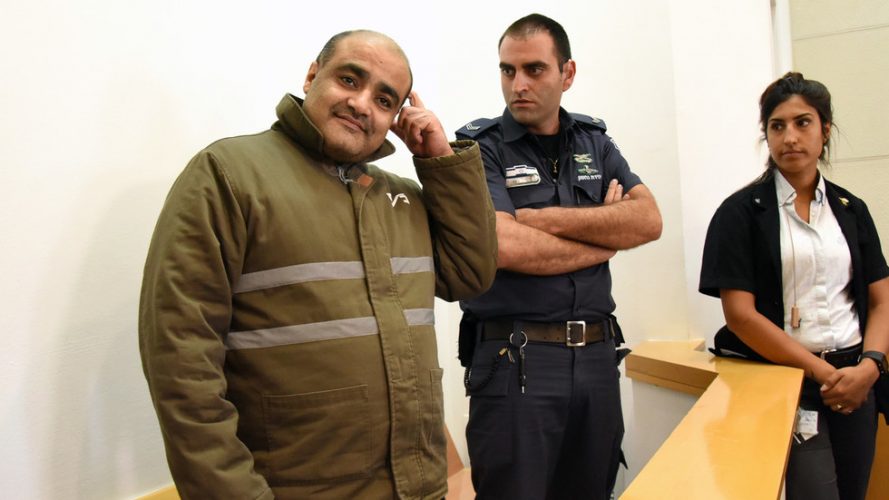
Former World Vision employee Muhammed al-Halabi (L) at a district court in Beersheva, Israel. © AFP / Dudu Grunshpan
RT | October 23, 2019
A former charity manager in the Gaza Strip accused of funding Hamas has attended court for the 129th time in what has become the longest trial of its kind in Israel’s history, dragging on as witnesses are blocked from testifying.
The 41-year-old aid worker, Muhammed al-Halabi, was arrested in June 2016 while working for World Vision, a Christian humanitarian group, charged with funnelling kickbacks to Hamas and its armed wing. For nearly four years, however, Halabi has been denied his proper day in court, instead forced to endure an endless series of stop-go proceedings in which key witnesses are barred from testifying.
His most recent hearing on Wednesday was no different, quickly hitting a dead end soon after it began.
“Today’s hearing was cancelled shortly after it started because the witnesses were not present,” Halabi’s brother, Hamed, told Middle East Eye. “The prosecution then threatened that any witnesses who come from Gaza to give their testimony will be detained.”
“They do not want anyone to prove them wrong. All the eyewitnesses and even the officials at World Vision gave proof that he was innocent. But this is not what the prosecution is looking for.”
The Israeli government has denied travel permits to crucial witnesses in the former charity worker’s case, preventing them from leaving Gaza to give testimony in Israeli courts. Halabi’s lawyer, Maher Hanna, says that guarantees he cannot receive a fair trial.
One of those witnesses – the owner of a company implicated in the alleged money transfer scheme – “could totally undermine the accusations they made against Muhammed,” Hanna told the Times of Israel. “He has begged Israel to allow him to go to the court and testify, but they have not permitted him to do so.”
A father of five from Gaza’s Jabalya refugee camp, Halabi has maintained his innocence since his 2016 arrest and refused to confess to the charges, according to his family, despite facing pressure and even threats from judges. His father said that at one his hearings, a judge promised “long term imprisonment” if Halabi did not admit to collaborating with terrorist groups.
“[The judge] threatened him and tried to force him to confirm the accusations in front of everyone,” Halabi’s father told Middle East Eye.
Halabi’s family also says he has suffered “horrific torture” at the hands of Israeli authorities during several interrogations, including beatings, humiliation and forced sleep deprivation.
A former employee at World Vision said Halabi’s case was part of an ongoing attack on the charity’s aid work in the Gaza Strip and other Palestinian territories.
“There was a political attack on the organisation given that one of its main offices is in the United States,” the employee, who wished to remain anonymous, told Middle East Eye. “The Israeli lobby in the US must have played a major role in impeding the work of the organisation.”
Halabi’s father seconded that take, adding “They know very well that he is innocent, but they cannot release him after four years of interrogation and torture and prove themselves wrong.”
Also on rt.com:
1,700 Gazans shot by IDF face amputation due to funding crisis, UN warns
Palestinians love living under occupation, ex-IDF chief declares, recycling apartheid talking point
UK protestors face jail for campaigning against Israel owned arms factory
MEMO | October 23, 2019
Seven people are facing the prospect of three months in prison for protesting against an Israeli-owned arms factory based in the UK.
The case against the seven activists will be heard in a Folkestone Magistrates Court Kent today. They are expected to plead not guilty of the charge of Aggravated Trespass, an offence which carries a maximum sentence of three months in prison. A number of the activists are locally connected to Kent.
The activists were arrested in August following a two-day occupation at the Elbit-Instro arms factory, which is newly situated in Discovery Park business park in Sandwich, Kent. Its parent company Elbit Systems supplies military equipment to Israel and activists claim that its products are the “backbone” of Israel’s drone fleet.
Elbit Systems also supplies weapons to a number of other countries accused of committing war crimes including Saudi Arabia. The weapons manufacturer is Israel’s largest privately-owned arms company. Campaign groups say that it provides 85 per cent of Israel’s drones which were used to attack Gaza’s civilian population repeatedly. Drones were used during Israel’s Operation Protective Edge which killed over 2,300 civilians, including over 500 children.
A statement released by the Stop Elbit-Instro Defendants Solidarity Campaign said: “The skilled engineers of Elbit-Instro could be working to make the world a better place, yet instead they are employed to build machines that incinerate children.” It added: “Shame on them all.”
According to the campaign group locals resent the arms manufacturer and relations between Elbit-Instro and Kent residents soured following its attempted take-over of an airport site.
A spokesperson for East Kent Campaign Against the Arms Trade said: “There are urgent questions about whether Instro’s specialist targeting technology is employed by Israel for targeting Gazan civilians every Friday during the Great Return March civil rights demonstrations, or in maintaining the surveillance of Palestinians along its illegal separation barrier, enabling the occupation’s apartheid infrastructure.”
DFLP criticises continuous PA security cooperation with Israel
MEMO | October 22, 2019
The Democratic Front for the Liberation of Palestine (DFLP) has criticised the continuous security cooperation between the Palestinian Authority (PA) and Israeli occupation, a statement said yesterday.
The DFLP wondered about the “feasibility” of the security cooperation in light of the Israeli aggression on Palestinians and the daily desecration of Islamic holy sites in the occupied territories by settlers and officials.
“The daily violations carried out by the Israeli Jewish settlers and Israeli officials against the Palestinians and their properties aims to uproot Palestinians from their historic land and destroy its political and national character,” the statement said.
The DFLP said that the Israeli occupation “is carrying out daily aggression on the ground and steals Palestinian land and property.”
The movement went on to call on the PA and its leadership “to move on from issuing warnings to the international community to tangible responses.”
The DFLP demanded the PA carry out the decisions of the Palestinian National Council regarding the immediate halt of security cooperation with the Israeli occupation.
Featured Video

Seyed M. Marandi: US-Iran War Inevitable: Kuwait and Bahrain May Fall
or go to
Aletho News Archives – Video-Images
From the Archives
Oil and the Israel Lobby
Reknowned economist M. Shahid Alam offers this excellent critique of Noam Chomsky’s defective analysis of the relative influence of Oil versus the Israel lobby over US foreign policy: … continue
Blog Roll
 Aletho News
- ICC ignored ‘very well-documented’ NATO crimes – ex-Libyan minister
- SNSC secretary dismisses US response to Iran’s conditions as ‘inadequate’
- Sanaa says Taiz roads open, secure for residents, warns Saudi forces
- Iraqi resistance group urges Saudi leadership to admit defeat, lift Yemen siege
- Trump’s Retreat: How Al-Aqsa Flood Took Down the US Empire
- Israel’s Military Actions in Lebanon Grossly Violate International Law — Lavrov
- Seyed M. Marandi: US-Iran War Inevitable: Kuwait and Bahrain May Fall
- Leaders Condemn Ansarallah Attack on Saudi Arabia While Ignoring Illegal War Against Yemen
- Leaked: Britain’s Covert Iraqi Psyops Network
- Yemeni Armed Forces Warn Airlines Against Using Saudi Airports, Exempt Mecca and Medina
- If Americans Knew
- How Israel Conquered the Latin American Right
- Agents search Rep. Omar’s Washington home in criminal probe as she vows she won’t ‘be silenced’
- “The Rule Was: ‘Shoot Everyone You See'”
- Israel goes ballistic over Nobel Laureate Navi Pillay
- U.S. May Join Yet Another Middle Eastern War — TCN
- Yellow Line moves again as Israel closes in on trapped Gazans – Daily Update
- Israeli Attacks Kill Seven Palestinians in Gaza Including Six-year-old Girl
- Gaza: Ceasefire Anniversary Marks Year of Failed Promises
- The American Conservative: Mike Huckabee Should Resign
- A C-Section in Shackles: A Palestinian Woman’s Harrowing Birth in Israeli Detention
- No Tricks Zone
- Germany’s Green Energy Debacle: High Energy Costs Force Kahla Porzellan to Close After 182 Years!
- New Study: 50 Years Of The Most Aggressive ‘Net Zero’ Policies Can Only Affect The Global Climate By 0.03°C
- US September “Heat” Was No Record…Many Records Set Decades Ago
- Latest European Green Energy Debacle; Portugal’s Largest Flagship Solar Park Insolvent!
- Green Energy Debacle: German Expert Professor Fritz Vahrenholt Warns Of Severe Economic And Social Consequences
- Two More Paleo Reconstructions Affirm Meters-Higher Sea Levels Across Ireland, Brazil 7000-6000 Years Ago
- New Study: Earth And Venus Surface Warmth Largely Explained By Convection And Lapse Rate, Not CO2 Or Radiation
- 2025 Nature Paper Claiming Worsening Global Drought Gets RETRACTED …Heavily Flawed
- New Study: ‘Global Drought Shows No Detectable Recent Acceleration Under Climate Warming’
- Economic Masterminds: German Socialists Suggest Taxing Productivity Gains Stemming From Using AI

