Academic: Saudi arrest campaign against Palestinians
MEMO | April 18, 2019
Saudi is carrying out an arrest campaign against Palestinians in the country, an exiled academic has said according to Al-Resalah newspaper.
On Twitter, Said Bin Nasser Al-Ghamdi wrote: “In the kingdom, a new and wide arrest campaign against a number of Palestinians, another number under travel ban, their accounts were frozen and their organisations were confiscated.”
Al-Ghamdi said that these Palestinians are accused of “sympathising with the resistance in Palestine, having an interest in the issue of Jerusalem and Gaza or supporting Hamas.”
He also said that authorities arrested Saudis, who sponsored the Palestinians or employed them in the kingdom.
In early March, Saudi announced the arrest of 50 people over security concerns, they included 30 of its own nationals, six Palestinians and three Jordanians.
War Versus Peace: Israel Has Decided and So Should We
By Ramzy Baroud | MEMO | April 17, 2019
So, what have we learned from the Israeli legislative elections on April 9?
A whole lot.
To start with, don’t let such references as the “tight race” between Israeli Prime Minister Benjamin Netanyahu, and his main rival, Benny Gantz, fool you.
Yes, Israelis are divided on some issues that are particular to their social and economic makeup. But they are also firmly unified around the issue that should concern us most: the continued subjugation of the Palestinian people.
Indeed, ‘tight race’, or not, Israel has voted to cement Apartheid, support the ongoing annexation of the Occupied West Bank, and carry on with the Gaza siege.
In the aftermath of the elections, Netanyahu emerged even more powerful; his Likud party has won the elections with 36 seats, followed by Gantz’s Kahol Lavan (Blue and White) with 35 seats.
Gantz, the rising star in Israeli politics was branded throughout the campaign as a centrist politician, a designation that tossed a lifeline to the vanquished Israeli ‘left’ – of which not much is left anyway.
This branding helped sustain a short-lived illusion that there is an Israeli alternative to Netanyahu’s extremist right-wing camp.
But there was never any evidence to suggest that Gantz would have been any better as far as ending the Israeli occupation, dismantling the Apartheid regime and parting ways with the country’s predominantly racist discourse.
The opposite is true.
Gantz has repeatedly criticized Netanyahu for supposedly being too soft on Gaza, promising to rain yet more death and destruction on a region that, according to the United Nations, will be unlivable by 2020.
A series of videos, dubbed “Only the Strong Survives”, was issued by the Gantz campaign in the run-up to the elections. In the footage, Gantz was portrayed as the national saviour, who had killed many Palestinians while serving as the army’s chief of staff between 2011 and 2015.
Gantz is particularly proud of being partly responsible for bombing Gaza “back to the stone age.”
It mattered little to Israeli centrists and the remnants of the left that in the 2014 Israeli war on Gaza, dubbed Operation “Protective Edge”, over 2,200 Palestinians were killed and over 11,000 were injured. In that most tragic war, over 500 Palestinian children were killed, and much of Gaza’s already ailing infrastructure was destroyed.
But then again, why vote for Gantz when Netanyahu and his right-wing extremist camp are getting the job done?
Sadly, Netanyahu’s future coalition is likely to be even more extreme than the previous one.
Moreover, thanks to new possible alliances, Netanyahu will most likely free himself of burdensome allies, the likes of former Israeli Defense Minister, Avigdor Lieberman.
One significant change in the likely makeup of the Israeli right is the absence of such domineering figures, who, aside from Lieberman also include former Education Minister, Naftali Bennett and former Justice Minister Ayelet Shaked.
All the grandstanding from Bennett and Shaked, who had recently established a new party called “The New Right”, didn’t even garner them enough votes to reach the threshold required to win a single seat in the Israeli Parliament, the Knesset. They needed 3.25 per cent of the vote but only achieved 3.22 per cent. They are both out.
The defeat of the infamous duo is quite revealing: the symbols of Israel’s extreme right no longer meet the expectations of Israel’s extremist constituencies.
Now the stage is wide open for the ultra-orthodox parties, Shas, which now has eight seats, and United Torah Judaism, with seven seats to help define the new normal in Israel.
The Israeli left – if it was ever deserving of the name – received a final blow; the once prominent Labor Party won merely six seats.
On the other hand, Arab parties that ran in the 2015 elections under the united banner of the “Joint List”, fragmented once more, to collectively achieve only ten seats.
Their loss of three seats, compared to the previous elections, can be partly blamed on factional and personal agendas. But, that is hardly enough to explain the massive drop in Arab voter participation in the elections: 48 per cent compared to 68 per cent in 2015.
This record low participation can only be explained through the racist ‘Nation State Law”, which was passed by the right-wing-dominated Knesset on July 19, 2018. The new Basic Law, declared Israel as the “nation-state of the Jewish people” everywhere, relegating the rights of the Palestinian people, their history, culture and language, while elevating everything Jewish, making self-determination in the state an exclusive right for Jews only.
This trend is likely to continue, as Israel’s political institutions no longer offer even a symbolic margin for true democracy and fair representation.
But perhaps the most important lesson that we can learn in the aftermath of these elections is that in today’s Israel, military occupation and apartheid have been internalised and normalised as uncontested realities, unworthy of national debate. This, in particular, should summon our immediate attention.
During election campaigns, no major party spoke about peace, let alone provided a comprehensive vision for achieving it. No leading politician called for the dismantling of the illegal Jewish settlements that have been erected on Palestinian land in violation of international law.
More importantly and tellingly, no one spoke of a two-state solution.
As far as Israelis are concerned, the two-state solution is dead. While this is also true for many Palestinians, the Israeli alternative is hardly co-existence in one democratic secular state. The Israeli alternative is Apartheid.
Netanyahu and his future government coalition of like-minded extremists are now armed with an unmistakably popular mandate to fulfil all of their electoral promises, including the annexation of the West Bank.
Moreover, with an emboldened and empowered right-wing coalition, we are also likely to witness a major escalation in violence against Gaza this coming summer.
Considering all of this, we must understand that Israel’s illegal policies in Palestine cannot and will not be challenged from within Israeli society.
Challenging and ending the Israeli occupation and dismantling Apartheid can only happen through internal Palestinian resistance and external pressure that is centred around the strategy of Boycott, Divestment and Sanctions (BDS).
It is now incumbent on the international community to break this vicious Israeli cycle and support the Palestinian people in their ongoing struggle against Israeli occupation, racism and apartheid.
Israel is holding 22 Palestinian journalists behind bars: NGO
Press TV – April 16, 2019
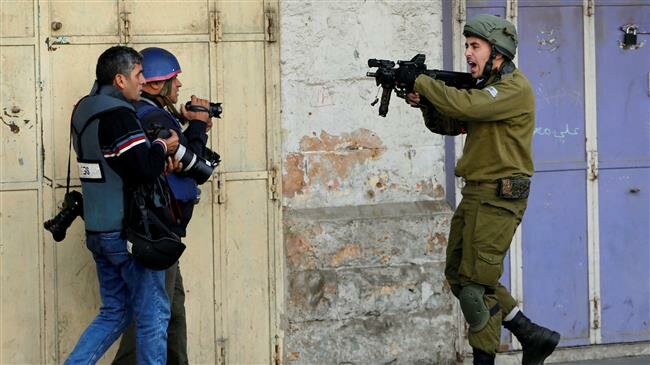
A non-profit organization representing journalists, writers and broadcasters says nearly two dozen Palestinian journalists are currently being held in harsh conditions in Israeli jails contrary to various treaties and international law.
The Journalists Support Committee (JSC), in a statement released on the eve of Palestinian Prisoners’ Day – which is marked on April 17 every year, highlighted that four journalists are being incarcerated under the so-called administrative detention, a policy under which Palestinian inmates are kept in Israeli detention facilities without trial or charge.
“The Israeli occupation arrests [Palestinian] journalists for their opinions and then hauls them before military courts using racist laws,” the statement read.
The JSC further noted that the practice violates international rights conventions guaranteeing freedom of the press.
The NGO then condemned Israel’s practice of arresting journalists or banning them from entering certain areas.
Palestinian journalists Ahmad Abu Hussein and Yaser Murtaja succumbed to Israeli-inflicted gunshot wounds last year, while covering anti-occupation protests along the border between the besieged Gaza Strip and occupied land.
The Tel Aviv regime has thus been seeking a media blackout on the criminal acts of its soldiers, with Israeli cabinet ministers authorizing a contentious bill in mid-June 2018 that would criminalize the filming of certain military activities.
Under the proposed legislation, those found photographing, recording or filming Israeli troops “with the intention of undermining the spirit” of the army “shall be liable to five years imprisonment” and those “intending to harm” Israel’s security could be given 10 years in jail.
The bill, which has been widely censured as an attack on media freedom, needs several parliamentary votes to become law.
In recent months, Israeli troops have on numerous occasions been caught on camera brutally killing Palestinians, with the videos going viral online and sparking condemnations of the regime’s military.
Israel confiscates 51,000 dunams from Jordan Valley

Ma’an – April 16, 2019
TUBAS – The Israeli authorities confiscated 51,000 dunams and isolated five villages in the Jordan Valley area in the northern occupied West Bank, an official in charge of Jordan Valley’s Israeli settlements file at the Palestinian Authority (PA) reported.
Mutaz Bisharat told the Voice of Palestine radio station that the Israeli authorities confiscated 51,000 dunams, isolated 5 villages and seized control over water springs, agricultural machinery and solar cells.
Bisharat added that the Israeli policy is very clear in isolating villages of the Tubas district, pointing out that these areas were marked as closed military areas banning their owners from entering without an Israeli-issued permit.
He stressed that Israel aims to expel Palestinians from the area under its plan to seize the Jordan Valley area.
The Jordan Valley forms a third of the occupied West Bank, with 88 percent of its land classified as Area C — under full Israeli military control.
International rights organizations consider the continuation of the Israeli campaign which targets Palestinians in the Jordan Valley, whether though confiscations, demolitions or evictions under the pretext of holding military exercises, as a violation of international humanitarian law.
Since the beginning of the 1967 occupation of the West Bank, Israel has confiscated hundreds of thousands of dunums by declaring it state land.
Israeli authorities in 1968 banned Palestinians from registering their lands and subsequently took advantage of previously low rates of land registration to confiscate areas currently or previously in use by locals but not registered as such.
The confiscated lands are then used to construct Jewish-only settlements on the land, while further confiscation often uses the pretext of the settlements’ security.
Palestinian prisoners reach agreement to achieve demands, end hunger strike
Samidoun Palestinian Prisoner Solidarity Network | April 16, 2019
Palestinian prisoners have reached an agreement with the Israeli prison administration to achieve their demands and suspend their hunger strike, the Battle of Dignity 2, on Monday, 15 April. The agreement came as hundreds of Palestinian prisoners were engaged in their eighth day of a collective hunger strike.
According to the leadership of the Palestinian prisoners’ movement, the agreement includes the installation of public telephones in the prison sections, which prisoners would be allowed to use three times a week for 15-minute calls, as well as stopping the installation of cell-phone jamming devices. In addition, the repressive measures and sanctions imposed in the past year upon the prisoners will also be lifted, while fines imposed on prisoners in recent struggles inside the prisons would be reduced. Hundreds more prisoners have been set to join the hunger strike in the coming days, especially 17 April, Palestinian Prisoners’ Day.
The Palestinian Prisoners’ Society said that the agreement also included provisions to transfer the women prisoners from Damon prison to another detention center; the prisoners have repeatedly cited harsh, difficult conditions unsuitable for human life in the Damon prison. In addition, sick prisoners would be returned to the previous section in the Ramleh prison clinic, an area that was considered better than their current location.
The National and Islamic Forces held a press conference in Gaza City to highlight the prisoners’ final statement. “The battle is not over; the hardest phase of this struggle is to implement what has been agreed upon,” the prisoners wrote, noting that previous agreements have been repeatedly broken by the Israeli prison administration.
They saluted the prisoners in section 4 of the Negev desert prison and section 1 in Ramon prison who were attacked by Israeli repressive forces, noting that “their great sacrifices underline that freedom and dignity are… human rights that cannot be denied.” They saluted Palestinians in Gaza, the West Bank, occupied Palestine ’48 and exile and diaspora, as well as supporters of freedom around the world, journalists and prisoners’ centers, that stood with the prisoners in their struggle. The statement particularly saluted “the people and leadership in Gaza,” noting their unity in commitment to the struggle.
Samidoun Palestinian Prisoner Solidarity Network expresses its strongest salutes and greetings to all of the Palestinian prisoners on this occasion of victory. These achievements follow on many historical accomplishments of the Palestinian prisoners’ movement, on the front lines of the Palestinian liberation struggle, extracting their victories through great sacrifice, with their bodies and lives on the line. As Palestinian Prisoners Day approaches, we emphasize our continuing dedication to work for the freedom of all Palestinian prisoners and the freedom of Palestine from the river to the sea.

In addition, we urge people around the world to continue their solidarity activities to support the Palestinian prisoners, throughout the coming days, months and years, until their freedom is achieved. In particular, we emphasize the cases of three Palestinian prisoners who remain on hunger strike: Hussam al-Ruzza (61), Mohammed Tabanja (40) and Khaled Farraj (31). Al-Ruzza has been on hunger strike since 19 March – nearly one month – while Tabanja and Farraj have been on hunger strike since 25 March. All are held without charge or trial under administrative detention orders, and their detention has been repeatedly and arbitrarily renewed.
They are among nearly 500 Palestinians out of approximately 5,500 Palestinian prisoners jailed with no charges and no trial for indefinitely renewable periods under administrative detention. The end of administrative detention is a long-time demand of the Palestinian prisoners’ movement and supporters of justice and liberation around the world. Join the call to free Hussam al-Ruzza, Mohammed Tabanja, Khaled Farraj and all Palestinian prisoners!
Trump Dances to Israel’s Tune
More wag-the-dog means war for America
By Philip Giraldi • Unz Review • April 16, 2019
So newly reelected Israeli monster-in-chief Benjamin Netanyahu has boasted, with a grin, that America’s President Donald J. Trump followed through on his proposal to declare the Iranian Revolutionary Guard Corps (IRGC) a terrorist group. Bibi was smiling because the timing of the move, one day before the Israeli election, strongly suggests it was done to assist him against what had become a very strong opposition challenge. That Trump likely colluded with Netanyahu to blatantly interfere in the election has apparently bothered no one in Israel or in the tame American media.
The gift from Washington came on top of recognizing Israeli sovereignty over the Golan Heights, threatening members of the International Criminal Court if they try to prosecute Israel for war crimes, moving the U.S. Embassy to Jerusalem, removing the word “occupation” from the State Department’s assessments of human rights infringements on the West Bank, eliminating relief funding for Palestinian refugees, leaving the U.N. Human Rights Council because it was too critical of Israel, and looking the other way as Israel declared itself a state only for Jews. Washington also ignored the bombing of hospitals, schools and water treatment infrastructure in Gaza while Israeli army snipers were shooting unarmed demonstrators demanding their freedom.
The labeling of the Revolutionary Guard as a terrorist group is particularly disturbing as it means that the United States military by virtue of the Authorization to Use Military Force (AUMF) now has a mandate to attack the IRGC wherever it appears, including in Syria or even in the waterway the Straits of Hormuz, where the guard has regular patrols in small boats. It is a de facto declaration of war and it comes on top of a number of deliberate provocations directed against Iran starting with the withdrawal from the nuclear agreement Joint Comprehensive Plan Of Action (JCPOA) one year ago, which led to the unilateral imposition of harsh sanctions directed against the Iranian economy to bring about a popular uprising as well as regularly repeated false claims that Iran is the leading “state sponsor of terrorism.” Next month, the U.S. will begin enforcing a unilaterally declared worldwide sanction on any and all Iranian oil sales.
Netanyahu pledged to annex Israeli settlements on the largely Palestinian West Bank if elected, which is undoubtedly a move cleared in advance with the Trump team of foreign policy sociopaths as it de facto puts an end to any delusional speculation over a possible two-state negotiated solution for the Israel-Palestine conflict. It will also lead to a massive upsurge in violence as the Palestinians object, which is neither a concern for the White House or Netanyahu, as they are assuming that it can be suppressed by overwhelming force directed against an almost completely unarmed civilian population.
And Trump will no doubt expect Bibi to return the favor when he is running for reelection in 2020 by encouraging American Jews who care about Israel to support the Republicans. Trump is focused on his own electability and is absolutely shameless about his betrayal of actual American interests in the Middle East, possibly because he has no inkling of the actual damage that he is doing. His speech last week before the casino multi-billionaire Sheldon Adelson-hosted Jewish Republican Coalition Annual Leadership Meeting in Las Vegas was a disgusting pander to a group that includes many key players who have little or no concern for what happens to the United States as long as Israel flourishes. The only good news that came out of the meeting was that Adelson himself appears to be “gravely ill.”
Trump at times appeared to be speaking to what he thought was a group of Israelis, referring to “your prime minister” when mentioning Benjamin Netanyahu and several times describing Israel as “yours,” suggesting that deep down he understands that many American Jews are more loyal to Israel than to the United States. At another point, Trump declared that “The Democrats have even allowed the terrible scourge of anti-Semitism to take root in their party and their country,” apparently part of a White House plan to keep playing that card to turn American Jews and their political donations in a Republican direction before elections in 2020.
Trump also told the Republican Coalition audience how he came to a decision on recognizing Israel’s sovereignty over the Golan Heights. He described how “he’d been speaking to his son-in-law and senior adviser, Jared Kushner, as well as U.S. ambassador to Israel David Friedman and his Israel adviser, Jason Greenblatt, over the phone about an unrelated issue when he suddenly brought up the Golan Heights.” Trump shared how “I said, ‘Fellows, do me a favor. Give me a little history, quick. Want to go fast. I got a lot of things I’m working on: China, North Korea. Give me a quickie.’ After the advisers filled him in, Trump said he asked Friedman: ‘David, what do you think about me recognizing Israel and the Golan Heights?’ Friedman, apparently surprised by the suggestion, reacted like a ‘wonderful, beautiful baby,’ Trump said, and asked if he would ‘really … do that.’ ‘Yeah, I think I’m doing it right now. Let’s write something up,’ Trump said he responded, prompting applause and cheers from his audience in Las Vegas. ‘We make fast decisions and we make good decisions.’”
Putting the Trump story about the Golan Heights in some kind of context is not really that difficult. He wanted an answer to please Netanyahu and he went to three Orthodox Jews who support the illegal Israeli settlements and have also individually contributed financially to their growth so he was expecting the response that he got. That he was establishing a precedent by his moves on Jerusalem and the Golan apparently did not occur to him as his administration prides itself on having a foreign policy vision that extends no longer than the beginning of next week, which is why he hired Mike Pompeo, John Bolton and Elliott Abrams. And then there is always the doleful Stephen Miller lurking in the background as well as the three musketeers of Kushner, Greenblatt and Friedman for really serious questions relating to why acceding to the wishes of parasite state Israel should continue to be the apparent number one priority of the government of the United States.
Donald Trump neither poses nor answers the question why he feels compelled to fulfill all of the campaign pledges he made to the Jewish community, which by and large did not vote for him, while failing to carry out the promises made to those who actually did support him. The absurd Jewish Republican Coalition narrative about how Trump gave Israel the Golan Heights should have resulted in a flood of opprobrium in the U.S. media about his profound ignorance and fundamental hypocrisy, but there was largely silence.
The nonsense going on in Las Vegas in front of a lot of fat cats who regard the United States as little more than a cash cow that they control as well as in the White House itself unfortunately has real world consequences. America is being led by the nose by a well-entrenched and powerful group of Israeli loyalists and this will not end well. The U.S. doesn’t even have a Middle Eastern foreign policy anymore – it has a “to do” list handed by Netanyahu to whomever is president. The fact that the current man in charge in Washington is either so ignorant or so deluded as to allow the process to escalate until the U.S. is drawn into yet more catastrophic wars is beyond regrettable. U.S. foreign policy should not depend on the perceptions of Kushner and company. It should be based on real, tangible American interests, not those of Israel. Someone should explain that to the president.
Philip M. Giraldi, Ph.D., is Executive Director of the Council for the National Interest, a 501(c)3 tax deductible educational foundation that seeks a more interests-based U.S. foreign policy in the Middle East. Website is councilforthenationalinterest.org, address is P.O. Box 2157, Purcellville VA 20134 and its email is inform@cnionline.org.
Israeli businessmen, officials cancel Bahrain visit amid national outcry
Press TV – April 15, 2019
An Israeli delegation of merchants and officials has canceled its planned participation in a business conference in Bahrain amid growing national outcry over the Persian Gulf kingdom’s warming ties with the Tel Aviv regime following years of clandestine contacts.
A spokeswoman for Israel’s Economy Ministry said a planned visit to Bahrain this week by Israel’s Economy Minister Eli Cohen had been “delayed because of political issues.”
A group of around 30 Israeli business executives and regime officials was scheduled to participate in the event, which is organized by the US- based Global Entrepreneurship Network and will run in Manama from April 15 to 18.
At least three Israeli speakers, including the Israel Innovation Authority’s deputy chief, Anya Eldan, were scheduled to speak at the event.
“While we advised the Israeli delegation they would be welcome, they decided this morning not to come due to security concerns and a wish not to cause disruption for the other 180 nations participating,” the organization’s president Jonathan Ortmans told Reuters.
Earlier this month, Bahrain’s most prominent Shia cleric Ayatollah Sheikh Isa Qassim strongly denounced the Manama regime’s decision to host an Israeli delegation in the business conference.
“Hosting and greeting the Zionists at the Global Entrepreneurship Congress, is a bold step on a dishonorable path; that of humiliation, capitulation and shamelessness,” he said in a statement carried by the Arabic-language Lua Lua television network.
Sheikh Qassim further underlined that the Israeli regime tops the list of Muslim world’s enemies, and that Manama’s plan to host Israeli delegates was in line with its attempts to compromise and normalize ties with the enemy.
This is a clear sign of the Manama regime’s disregard for Islam and the will of the nation, the top cleric pointed out.
Last month, members of the Bahrain parliament issued a statement, rejecting the visit.
“Parliament stresses its support for the just cause of the brotherly Palestinian people, and it will remain a priority for the Bahraini and Arab people,” the statement read.
It added, “The end of the Israeli occupation and the withdrawal from all Arab land is an absolute necessity for the stability and security of the region and for a fair and comprehensive peace.”
Some street protests were also held in Manama in condemnation of the planned visit.
Russia’s RT Arabic television news network reported on March 4 that Abdullah ibn Muhammad Al ash-Sheikh, the speaker of Saudi Arabia’s Consultative Assembly, together with his Emirati and Egyptian counterparts had opposed a paragraph in the final communiqué of the 29th Conference of the Arab Inter-Parliamentary Union in the Jordanian capital city of Amman, which demanded an end to efforts aimed at normalizing ties with Israel and condemned all forms of rapprochement with the occupying regime.
The paragraph stated that “one of the most important steps to support Palestinian brethren requires the cessation of all forms of rapprochement and normalization with the Israeli occupiers. Therefore, we call for resilience and steadfastness by blocking all the doors of normalization with Israel.”
On February 17, a report published by Israeli Channel 13 television network said Israeli Prime Minister Benjamin Netanyahu had held a “secret meeting” with Moroccan Foreign Minister Nasser Bourita last September.
Additionally, the Warsaw conference, a US-sponsored gathering that was held in the Polish capital on February 13-14, brought together Netanyahu and representatives from a number of Arab states, including Oman, Morocco, Saudi Arabic, the UAE, Bahrain, Jordan and Egypt.
The Israeli regime also recently re-launched a “virtual embassy” in a bid to “promote dialogue” with the Persian Gulf Arab states.
Russia expands ties in Lebanon’s oil and gas sector
Michal Kranz – Al Monitor – April 10, 2019
During a Middle East tour last month, US Secretary of State Mike Pompeo focused primarily on Iran’s influence in the region, but on Mar. 20 in Jerusalem he also labeled Russia an adversary of US regional allies in addition to Iran and China when speaking about energy and security in the eastern Mediterranean. “Revisionist powers like Iran and Russia and China are all trying to take major footholds in the East and in the West,” Pompeo said, alongside Israeli Prime Minister Benjamin Netanyahu and the leaders of Greece and Cyprus.
Pompeo had also reportedly planned to set “red lines” on Russian projects in Lebanon while in Beirut March 22-23. Yet, whatever plans Pompeo may have had to counter Russia in Lebanon, they seem to have had little effect. Lebanese leaders have doubled down on working with Russian companies in their country’s expanding oil and gas sector in the weeks since Pompeo’s visit.
Although the United States maintains an important degree of diplomatic clout in Lebanese energy matters, Russian economic investments in the sector have far outpaced those of the Americans, and Russian officials and business leaders have expressed their desire to take further steps to cement roles as key players like the United States continue to lag behind.
“The Russians have an advantage over the Americans not only in Lebanon, but in the region as well,” Amal Abou Zeid, adviser for Lebanese-Russian affairs at Lebanon’s Foreign Ministry, told Al-Monitor.
Lebanon and Russia signed a memorandum of understanding to cooperate on oil and gas in October 2013, and since then cooperation between them has deepened. In December 2017, the Lebanese government awarded its first contracts for offshore oil and gas exploration to a consortium of three firms that included Novatek, Russia’s second-largest gas company.
This past January, Russia’s majority state-owned oil giant Rosneft signed a deal to manage, operate and potentially rehabilitate and expand part of the oil storage terminal in Tripoli, Lebanon’s second largest city, as part of a 20-year lease. Rosneft is also competing in a bidding process along with other consortiums, including an American company, for an offshore gas terminal off the Lebanese coast.
Days after Pompeo’s visit, Lebanese President Michel Aoun traveled to Moscow, where he met with Russian President Vladimir Putin and Rosneft CEO Igor Sechin, who said the company is interested in “elevating the oil facilities in north Lebanon.” According to Abou Zeid, Sechin is interested in building up to three additional oil storage facilities in Tripoli and potentially investing in a future refinery in the north.
Cesar Abi Khalil, a parliamentarian who served as energy minister when Lebanon signed the Tripoli deal with Rosneft, told Al-Monitor that there is “high interest” in Lebanon to work with companies, including American ones, on refinery construction and rehabilitation. He added that ultimately, contracts will be awarded to companies that present the best proposals, as Rosneft did for the Tripoli terminal.
Russia’s interest in Lebanon is tied to its regional strategy. Since 2016, Rosneft has steadily expanded its operations into Iraq, Egypt and Libya, and Gazprom, Russia’s state-owned gas company, has been making inroads in Syria’s gas market during the civil war there. While Syria’s oil and gas reserves are dwarfed by those in neighboring Iraq, its location is highly strategic for Russia, which has been supporting Syrian President Bashar al-Assad in the civil conflict since 2015. Hundreds of Russian mercenaries have reportedly been killed securing oil fields in the country [actually that is a myth], and Russia has begun exploring for oil and gas off the Syrian coast.
Abou Zeid confirmed that the rehabilitation of a long-disused oil pipeline connecting Tripoli with oilfields in Iraqi Kurdistan, where Rosneft is active, was one of the topics discussed by Aoun and Sechin in Moscow. It is likely that gaining access to oil infrastructure in Lebanon in addition to offshore reserves in the country will enhance Russia’s strategic position in Syria and across the eastern Mediterranean, but it remains possible that it could also use the Tripoli facilities to try to bypass US sanctions on fuel shipments to Syria.
Meanwhile, American companies have been unable or unwilling to secure stakes in Lebanon’s new offshore prospects, which the US Department of Energy estimates will produce almost $254 billion between 2020 and 2039. Abou Zeid said that he had heard that ExxonMobil had entered into a consortium before the first bidding process for the offshore exploration contract began, but ultimately they and many other American companies failed to submit bids once they were eligible.
“I am certain that the Americans are interested, and they were not very happy with the Russian presence in this sector,” Abou Zeid said, speculating that political issues, like Hezbollah’s role in Lebanese politics, may have scared off potential American investors.
Mona Sukkarieh, a political risk consultant and co-founder of Middle East Strategic Perspectives, told Al-Monitor that other factors were more likely to be involved.
“Repeated delays resulting from frequent vacuums within the executive branch, an incomplete legal framework, changes in blocks offered and a change in market conditions all affected companies’ enthusiasm for the first licensing round,” she said.
Abi Khalil agreed that market forces were partially to blame for the lack of interest from the United States during the first round of bidding, but he also said that he had found ongoing interest by American firms in Lebanese oil and gas during his three official visits to the States, including in potential refinery projects across the country.
Despite these difficulties, the Novatek consortium followed through on its interest and secured rights to two blocks in Lebanon’s Exclusive Economic Zone (EEZ), one of which is in a disputed zone that Israel has claimed as part of its own EEZ since 2010. On April 4, Lebanese Energy Minister Nada Boustani announced the opening of a second round of bidding for contracts to five additional offshore blocks, two of which lie along the disputed border area. Lebanese leaders have long maintained that Israel is encroaching on Lebanon’s maritime boundary.
On April 1, parliament Speaker Nabih Berri said that Lebanon won’t give Israel “one cup” of its water. According Berri’s office, on March 22 the speaker and Pompeo discussed the issue of Lebanon’s southern maritime border and efforts to settle the dispute with Israel.
Abou Zeid claims that all the involved parties are interested in seeing the United States play a mediating role in the boundary issue. Regardless, US influence over matters related to energy in Lebanon are quickly diminishing given American companies’ absence in the country’s oil and gas sector and the lack of trust among Lebanese leaders, who believe Washington is biased toward Israel’s geopolitical positions.
“The US is really, one, not that interested, and two, the space that the US used to have in Lebanon in terms of influence and shaping decisions, it’s been lost,” Hanin Ghaddar, a researcher specializing in Lebanon and Iran at the Washington Institute for Near East Policy, told Al-Monitor. She added that in her view, it is unlikely that American firms will gain any offshore contracts.
So far, US efforts to counter Russian expansion in the eastern Mediterranean through diplomacy have proven inadequate. Unless American companies get serious about acquiring stakes in Lebanon’s offshore reserves, it will likely be almost impossible for the United States to overcome the head start Russia has gotten in Lebanon’s oil and gas sector, allowing Moscow to continue to strengthen its economic position across the Middle East.
Euro-Med to EU: Stop funds for project serving Israeli settlements
Ma’an – April 13, 2019
BETHLEHEM – The Euro-Mediterranean Human Rights Monitor (Euro-Med) sent an urgent letter to the European Union’s European Commission regarding their participation in funding EuroAsia Interconnector, a power transmission project aiming to build the infrastructure necessary to link energy sources between Israel, Cyprus, and Greece.
The project, expected to be implemented in June 2019 with an estimated budget of 3.5 billion Euros, will not only link the electricity infrastructure between Israeli cities with Greece and Cyprus, however, will also include illegal settlements in the occupied Palestinian territories, including occupied East Jerusalem.
According to a Euro-Med press release, the EU has been labeled as one of the financiers and supporters of the project that nurtures and strengthens settlements built illegally on Palestinian lands in the West Bank and Jerusalem, a move that shows sheer disregard for international law and amounts to complicity in Israeli war crimes and crimes against humanity.
Audrey Ferdinand, Euro-Med’s legal researcher, said, “The EU must adhere to its legal obligations under international law, including by not violating its own long-held commitment to a two-state solution.”
Ferdinand stressed, “While Israel is working on projects to boost its energy sources, it denies Palestinians access to basic needs such as energy and clean water,” calling on the EU to “respect its international obligations and not to establish partnerships with states violating international human rights law and international humanitarian law for decades.”
Euro-Med expressed deep shock and surprise at the contradictory policies and non-neutral practices of the European Union. On the one hand, it funds projects to help Palestinians suffering under occupation, it also funds projects that serve Israeli settlers, calling the move as setting for a “double-standard logic.”
Euro-Med called on the European Union to seriously reconsider its policies that are biased to the Israeli authorities at the expense of the Palestinian people, to uphold its human rights obligations and to rise above the discourse of selfish interest, to stop the project, especially as Israel continues to expand its illegal settlement activities in the West Bank and East Jerusalem, and not reward them for such infamous record of human rights abuse.
WHO calls for protection of health workers, facilities in Gaza
Ma’an – April 13, 2019
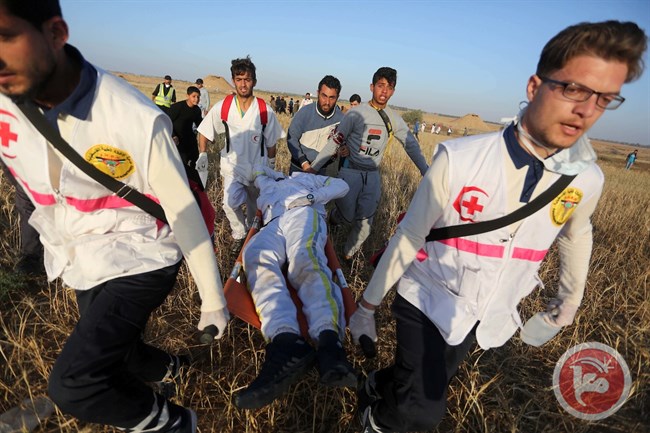
BETHLEHEM – The World Health Organization (WHO) called for the protection of health workers and health facilities in the besieged Gaza Strip, following a rise in the number of health workers killed or injured and facilities damaged by Israeli army gunfire.
WHO said in a press statement that it has recorded an unprecedented “446 attacks on health care in Gaza since the start of ‘The Great March of Return’ on 30th March 2018.”
Who stressed that these attacks have resulted in three deaths and 731 injuries among health workers, in addition to 104 ambulances and six other forms of health transport have been damaged, as well as five health facilities and one hospital.
In addition to personal risk and damage to health care, health workers also face substantial barriers to carrying out their work: firing between health workers and those injured prevents or hampers access and witnessing such events has significant implications for longer term mental health and continued work.
WHO concluded, “WHO reiterates its call for the protection of health workers and health facilities. Health care is #NotATarget.”
3 people injured in Israeli rocket attack on Syria’s Hama province – reports
RT | April 13, 2019
Syria has shot down several missiles launched by Israel and targeting the city of Masyaf in northwestern Syria, Syrian state media reported. Three people have been wounded and several buildings destroyed in the attack.
The rockets were launched by Israeli warplanes from Lebanese airspace at about 2.30am on Saturday, SANA reported. In response, Syria activated its air defenses and intercepted several missiles, the agency said. The alleged Israeli raid hit a military post in the city and destroyed several buildings. Three people have been reported wounded.
Lebanese Al-Masdar News reported, citing a military source on the ground, that Israeli rockets damaged a number of sites near the Masyaf National Hospital.
While Israel has not commented on the reported attack, it is presumed that Tel Aviv has made another incursion into Syrian territory to take on alleged Iranian elements there.
Israeli media reported in February that three of the four S-300 surface-to-air defense systems delivered by Moscow to Syria in October last year and stationed in Masyaf were photographed in an “erect” position, prompting speculation that they might be soon deployed into combat.
According to the Al-Masdar source, the Russian-made systems had no role in fending off Saturday’s attack.
Israel routinely rains down missiles on Syrian territory under the pretext of engaging Iranian targets there. In late March, the Syrian missile defense forces responded to an attack by Israel that reportedly targeted a civilian airport and caused a blackout in Aleppo.
Is the U.S. Prepared to Accept a Defeat in Venezuela?
By Marco Teruggi – Pagina 12 – April 12, 2019
The attack should have been short since the Maduro administration was not strong enough to resist. This was the conviction of the United States as they carried out a strategy to overthrow him: they built a President 2.0 Juan Guaido; they gave him a fictionalized government, international recognition, a collective narrative among mass media companies, accelerated economic sanctions at different levels. Overlapping these variables, different results were expected to be achieved on their path of getting a forced negotiation or the toppling of the government.
Events did not take the planned course. First and most important, the breaking of the Bolivarian National Armed Force (FANB): a crucial element that should have happened but did not. A series of tactics were implemented for it, from internal conspiracy with the support of a lot of dollars, visas and guarantees, or the strategy of a latent threat of a possible U.S. intervention. A combination of bluff – an unloaded weapon pointed at your head – with built up dates to try to achieve a rupture, such as on February 23rd.
The second event that should have occurred, despite the difficulty in defining a target, was Guaido supposedly building mass support in the streets. He boasted that 90 per cent of the population supports him. Pictures of his mass mobilization capacity show that the initial momentum on January 23, when his self-proclamation was acknowledged by Donald Trump through a tweet, lost strength. A major reason for this was the crisis of expectations that resulted from the unfulfilled promise of an immediate outcome. Another is that it was an artificial, communicational, diplomatic construction which could not gather more than the right’s historical rank-and-file supporters, characterized by a specific social, geographic class, living conditions, idiosyncrasy and symbolism. The opposition looked too much like themselves.
Third was the attempt to take the poor to the streets; blackouts and the water shortages were the most favorable of the scenarios to provoke this. But the outcome was not what they expected either. The clearer and wide reaching reality was the majority trying to solve their problems, individually, collectively, together with the Venezuelan Government. Sustained protests, fostered almost completely by the right, were scarce and without capacity to spread in the country.
Each of these variables has feedback points. The crisis of expectations is the result, for instance, of the fact that the Armed Force has not broken, that Guaido speaks of a hastiness that does not occur, with the conclusion that if they don’t succeed in any of their three targets, the last resort is an international intervention headed by the United States. That same interventionist narrative moves away from those who see Guaido as an alternative to the current political and economic situation. Calling on the majorities to achieve an international operation comes across evident obstacles.
Overthrowing Maduro does not seem possible in the correlation of national forces. It has been proven that the attack will not be short and that Chavismo, which is more than a Government, has enough strength to resist. If it was just a national affair, Guaido would lose strength to the point that he wouldn’t even be part of the list of opposition leaders that carry the burden of defeat. The problem is that this new coup attempt was devised over a point of no return with the United States building of a parallel government facade, acknowledged by the European Union, the United Kingdom, Israel, Canada, and right-wing governments in Latin America. What to do with Guaido when the plan is not successful due to initial miscalculations?
The question is due to the US, its current Administration is a mixture of Donald Trump-neoconservative leaders, and the so-called deep state; that is to say, real, invisible structures of power that constitute and safeguard that country’s strategic development in the geopolitical struggle. A defeat in Venezuela would be charged to the Administration in a pre-election period and it would suffer a double blow with Maduro’s continuity, or the lack of ability make a key Latin American country fall in line, and its implications in the international arena.
The deep state has grown stronger recently through tweets and speeches of U.S. spokespeople like Special Representative for Venezuela Elliott Abrams, Secretary of State Mike Pompeo, National Security Advisor John Bolton, and Southern Command’s commanding general Craig Faller. Their different statements have shifted towards painting Venezuela as an operational base for Russia, Iran, Cuba and China, while the Maduro administration would be subordinated to each of these governments and their corresponding intelligence and military services —particularly to the first three.
The United States has announced its following steps based on that narrative. Pompeo is going to Chile, Paraguay, Peru and Colombia; Abrams to Spain and Portugal; and they convened a third meeting in the United Nations Security Council to talk about Venezuela’s situation. They have not announced the goals of the different moves yet. It is possible though to predict that there is a private and public dimension to the agreements. A possibility would be for the US to declare the Venezuelan government a transnational criminal organization and branding colectivos (Chavista grass-roots organizations) as terrorist groups that “undermine the Constitution and territorial integrity of Venezuela,” according to Bolton’s description. New possible actions would result from each of these elements.
That increase in pressure, tightening the blockade, and isolation has not led yet to the possibility of a military intervention, despite the repeated “all options are on the table.” Abrams himself sidestepped that hypothesis last Thursday. Therefore, how are they planning to achieve the outcome proposed with the combination of these actions? The United States needs to establish means, on-the-ground operational capacity, and domestic and diplomatic agreements. In this regard, the European Union stance was expressed by its high representative for foreign affairs, Federica Mogherini, who affirmed that “new free and credible presidential elections should be held as soon as possible.”
Would the U.S. be willing to accept a negotiated outcome in which Maduro remains in power? So far, that does not look possible. They don’t seem willing to accept a geopolitical defeat in Venezuela either. The U.N. Security Council met on Wednesday to deal with this aspect. At the same time, the right called for more mobilizations. The pieces are still in motion.
Translation by Resumen Latinoamericano, North America bureau
Edited by Venezuelanalysis.com
Featured Video

Seyed M. Marandi: US-Iran War Inevitable: Kuwait and Bahrain May Fall
or go to
Aletho News Archives – Video-Images
From the Archives
Oil and the Israel Lobby
Reknowned economist M. Shahid Alam offers this excellent critique of Noam Chomsky’s defective analysis of the relative influence of Oil versus the Israel lobby over US foreign policy: … continue
Blog Roll
 Aletho News
- ICC ignored ‘very well-documented’ NATO crimes – ex-Libyan minister
- SNSC secretary dismisses US response to Iran’s conditions as ‘inadequate’
- Sanaa says Taiz roads open, secure for residents, warns Saudi forces
- Iraqi resistance group urges Saudi leadership to admit defeat, lift Yemen siege
- Trump’s Retreat: How Al-Aqsa Flood Took Down the US Empire
- Israel’s Military Actions in Lebanon Grossly Violate International Law — Lavrov
- Seyed M. Marandi: US-Iran War Inevitable: Kuwait and Bahrain May Fall
- Leaders Condemn Ansarallah Attack on Saudi Arabia While Ignoring Illegal War Against Yemen
- Leaked: Britain’s Covert Iraqi Psyops Network
- Yemeni Armed Forces Warn Airlines Against Using Saudi Airports, Exempt Mecca and Medina
- If Americans Knew
- After Oct 7, IDF policy allowed civilian casualties for even the lowest-ranking targets
- Israel’s Destruction of Southern Lebanon Intensified After the Cease-Fire
- The Last-Minute Decision That Gave Israel Its Name
- The American Conservative: How Trump Made the World Go Nuclear
- Meet the US generals and admirals advancing Israeli policy
- Opinion: Why news organizations should boycott Israel
- The Israeli witch hunt of Sami Abu Shehadeh exposes the lie of the ‘Jewish and democratic’ state
- No state has a ‘right’ to exist – least of all Israel
- Testimonies about Gaza’s civilian death toll expose Israel’s atrocities – Daily Update
- How Israel Conquered the Latin American Right
- No Tricks Zone
- New Study Suggests Large Regions Of The Pacific Ocean Have Been Cooling For The Last 80 Years
- Germany’s Green Energy Debacle: High Energy Costs Force Kahla Porzellan to Close After 182 Years!
- New Study: 50 Years Of The Most Aggressive ‘Net Zero’ Policies Can Only Affect The Global Climate By 0.03°C
- US September “Heat” Was No Record…Many Records Set Decades Ago
- Latest European Green Energy Debacle; Portugal’s Largest Flagship Solar Park Insolvent!
- Green Energy Debacle: German Expert Professor Fritz Vahrenholt Warns Of Severe Economic And Social Consequences
- Two More Paleo Reconstructions Affirm Meters-Higher Sea Levels Across Ireland, Brazil 7000-6000 Years Ago
- New Study: Earth And Venus Surface Warmth Largely Explained By Convection And Lapse Rate, Not CO2 Or Radiation
- 2025 Nature Paper Claiming Worsening Global Drought Gets RETRACTED …Heavily Flawed
- New Study: ‘Global Drought Shows No Detectable Recent Acceleration Under Climate Warming’

