Israeli Provocative Strikes on Syria Endangered Two Passenger Jets: Russian MoD
Al-Manar | December 26, 2018
‘Israel’ conducted its airstrikes on Syria while passenger planes were landing in Damascus, according to the Russian Defense Ministry.
The ministry also reported that at least three Syrian servicemen were injured after two Israeli bombs hit the territory of a Syrian Army logistics center.
Syria’s air defenses managed to destroy 14 out of 16 Israeli bombs during the airstrike, according to the ministry. It added that none of the passenger planes that were under threat due to the airstrike were related to Russian air carriers.
Fiasco In Islington, Part 2
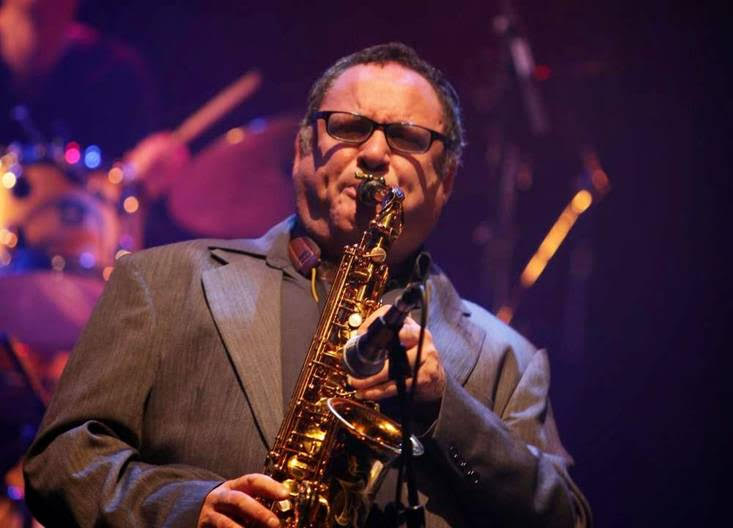
Gilad Atzmon
By Richard Hugus | December 26, 2018
More facts have come to light in the case of Gilad Atzmon and his banning by the Islington Town Council from performing at a jazz concert on December 21, 2018. The original scenario was that one e-mail from one person calling Atzmon an antisemite somehow persuaded the Islington council to take the drastic step of removing Atzmon from a town-owned venue. Many who heard the story felt this was a rash decision which would surely be reversed when the facts were brought to light. But the Council voted to uphold its decision and Atzmon was indeed not allowed to play.
Now it appears that the single complainant – Martin Rankoff – was not just an anonymous fan of Israel but the UK director of Likud-Herut. Herut (or ‘freedom’) was Israel’s founding nationalist party from 1948 until it later merged with Likud. It is a militant and extreme Zionist organization whose roots go in a straight line from Ze’ev Jabotinsky and Menachem Begin up to Benjamin Netanyahu today. Jabotinsky and Begin helped form the Irgun terrorists in 1937. Irgun committed notorious massacres in Palestine leading up to and during the Nakba (or ‘catastrophe’) of 1947-1948. These include the bombing of the King David Hotel in Jerusalem in 1946, killing 91 people, and the massacre at Deir Yassin in 1948 in which 254 unarmed Palestinian villagers were brutally murdered as an incentive for other Palestinians to leave. On its web site Likud-Herut UK lists Jabotinsky and Begin as “visionaries.” Likud-Herut is a member of the World Zionist Organization and the Zionist Federation of the UK who believe in “the inalienable right of all Jews to live and settle in all parts of the Land of Israel.”
In a letter to the New York Times in 1948 Albert Einstein, Hannah Arendt, and others compared Herut to the Nazis and Fascists who had just been defeated in World War II. Referring to this letter, Ramzy Baroud recently wrote, “the ‘Nazi and Fascist’ mentality that defined Herut in 1948 now defines the most powerful ruling class in Israel. Israel’s leaders speak openly of genocide and murder, yet they celebrate and promote Israel as if an icon of civilization, democracy and human rights.”
–
The history of Herut and Likud tells us a great deal about who the people are who complained about Atzmon to Islington Town Council. When Atzmon moved to appeal his being banned, formidable opponents again appeared in the form of the Simkins Law firm, one of the most expensive law practices in Britain, with not one but two partners at Simkins being put on the case. These are Gideon Benaim and Tom Iverson. Benaim recently became well known in Britain for winning an invasion of privacy suit against the BBC on behalf of pop singer Cliff Richard, who said he spent £3.4m ($4.3 million) on the case. Clearly, representation by Simkins doesn’t come cheap. Also listed in Benaim’s resumé as a client is the Las Vegas Sands Corporation which likely has no problem with Simkins’ fees either. The Sands casino is owned by billionaire Sheldon Adelson, who, as it happens, is a primary sponsor of the Likud Party in Israel, led by Benjamin Netanyahu. Adelson owns the newspaper Israel Hayom, a mouthpiece for Netanyahu and Likud.
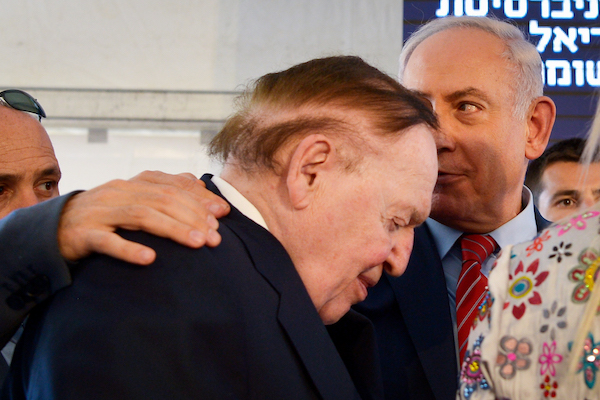
American businessman and investor Sheldon Adelson with Prime Minister Benjamin Netanyahu at the ceremony of a laying of a cornerstone for new Medicine Faculty buildings at the Ariel University in the West Bank, on June 28, 2017. Photo by Ben Dori/Flash90
It now appears that Atzmon’s banning was not the result of a casual complaint; it was an intentional attack on a well-respected supporter of Palestinian human rights by the Likud organization, directly represented by Martin Rankoff. The attack was followed up by the hiring of a lawyer who has worked for Likud godfather Sheldon Adelson. The connection to these powerful forces may explain why Islington Town Council leader Richard Watts, without any delay or attempt at negotiation, took the step of going straight to a decision to hire an expensive law firm. This is while Islington is facing serious austerity and shortage of funds in its own operating budget. Islington has a population of about 206,000 people. This very month, 43 of those people were counted in one survey as homeless and sleeping on the streets.
Regarding the financial problems of his borough and others around London, Richard Watts, told The Independent in October 2018 :
“unprecedented” funding pressures and demand for adult and children’s social care and homelessness services was “pushing councils to the limit”.
“As a result less money is being spent on the other services that keep our communities running such as libraries, local roads, early intervention and local welfare support,” he added.
Yet, to Watts and his fellow councilors in Islington, backing partisans for a foreign country -Israel- took precedence over the pressing needs of the people whom they are supposed to represent. Either Watts was inexcusably careless with scarce town funds or a deal was made and he knew that he could depend on Likud-Herut to back him. Or, like politicians all across Europe and the US facing the power of the Israel lobby, he knew he couldn’t afford to say no.
According to Simkin’s web site, Gideon Benaim “has extensive expertise in the areas of defamation, privacy, harassment and copyright.” Perhaps it is not a coincidence that immediately after Islington brought in Simkins, identical statements from an unnamed Labour spokesman describing Atzmon as “a vile antisemite” appeared in both the BBC and The Guardian. Perhaps a lawyer experienced in defending people against defamation and harassment would also know how to perpetrate these things. Perhaps this was Benaim’s opening move. Character assassination is a common tactic in cases that have a weak legal foundation, such as this one, as it goes a long way to convicting the accused before their case ever reaches a courtroom.
The involvement of Likud-Herut in the attack on Gilad Atzmon, and Islington’s official backing of that attack, constitutes a monumental scandal. This wasn’t just a stupid mistake; it was a hit. It is an affront to reason that an an arch-racist organization like Likud, who from the beginning have stood for the removal of the people of Palestine from their own land by means of terror, murder, and forced expulsion, could possibly claim they they were defamed by someone pointing out these very crimes. There is a case of defamation here for sure – the defamation of Gilad Atzmon. For Zionists, defamation is nothing more than a tool to destroy opponents who can’t be dealt with by other means. We are long since tired of truth tellers being accused of antisemitism. We’re tired of national and local resources being used to prop up the criminal state of Israel. Coercion by advocates for Israel is at the center of this issue in Islington, as it is in many other towns and many other countries. For the sake of Palestine and our own sovereignty, it has to be called out and stopped.
To sign a petition in support of Gilad click here
Lodge a formal complaint with Islington Council: https://www.islington.gov.uk/contact-us/comments-and-complaints?status=inprogress
Email: assemblyhall@islington.gov.uk
Contact the Council: +4420 7527 2000
To support Gilad’s legal battles: https://donorbox.org/gilad-needs-additional-support
Good News, for a Change: Trump Quits Syria
By Michael Howard | American Herald Tribune | December 22, 2018
Nothing brings the media and political establishments together like an imperial question. It’s this subject, more so than any other, on which, like some terrible bloodthirsty cult, they all share the same defective brain. When the president, whoever and however unpopular he may be, uses violence to expand the empire’s global reach, laurels spurt in from every direction. See every major US military action in recent history. On the other hand, should the president neglect to add to our imperial adventures or, horror of horrors, roll them back a tad, he’s sure to reap a whirlwind of frenzied opposition. The public observes this and becomes conditioned: aggression is good; inaction is bad. By and large, this is how the empire maintains itself.
Having announced plans to take the boots off the ground in Syria, where their presence is a crime, Trump finds himself on the wrong end of the equation. According to Bob Woodward, Trump never forgave himself for letting the generals talk him into deploying more troops in Afghanistan, a pointless war if ever there was one. He wanted out, but they badgered him into staying. Now he’s paying them back. In one of his unwonted lucid moments, Trump outlined the rationale behind the pullout heard round the world: “Does the USA want to be the policeman of the Middle East, getting nothing but spending precious lives and trillions of dollars protecting others who, in almost all cases, do not appreciate what we are doing? Do we want to be there forever? Time for others to finally fight.”
For that, he’s in the doghouse, the empire’s errand boys descending on him like an army of (war) hawks. Reading quickly through the numerous reports, op-eds and editorials churned out by the mass media over the past twenty-four hours, it’s plain to see that everyone is working from the same script, as if a talking-points memo had been issued from on high. They all hate Trump’s decision, and they all hate it for the same exact reasons.
Reason number one: ISIS isn’t dead yet. Every article I read emphasized the fact that, according to military analysts, there are still thousands of ISIS fighters in Syria and elsewhere. Of course there are. While the caliphate was crumbling, experts on the region like Patrick Cockburn were warning that, rather than vanish into thin air, ISIS would adjust its tactics and mutate into a guerrilla force, which is what it has done. America’s track record against guerrilla units isn’t very impressive—they’re notoriously resilient and difficult to root out. Besides, ISIS isn’t merely a militia; it’s an ideology (exported by our good friends and allies in the Gulf), and you can’t kill an ideology with bombs. We tried that, remember? Before Dick and George launched their War on (sic) Terror, global terrorists of the ISIS variety were dwelling in a few obscure pockets of the Middle East. Seventeen years and two invasions later, they’re everywhere. It’s called cause and effect. We have yet to learn about it. If we ever do, we might want to give the late William Blum’s anti-terror formula a try:
If I were the president, I could stop terrorist attacks against the United States in a few days. Permanently. I would first apologize—very publicly and very sincerely—to all the widows and the orphans, the impoverished and the tortured, and all the many millions of other victims of American imperialism. I would then announce that America’s global interventions—including the awful bombings—have come to an end. And I would inform Israel that it is no longer the 51st state of the union but—oddly enough—a foreign country. I would then reduce the military budget by at least 90% and use the savings to pay reparations to the victims and repair the damage from the many American bombings and invasions.
Speaking of Israel, that’s another reason to oppose Trump’s Syria withdrawal. If we pull out of Syria now, we’ll be hanging Israel out to dry. So goes the talking point. Behold: Trump “promised to protect Israel, but that nation will now be left to face alone the buildup by Iran and its proxies along its northern border.” That’s from the Washington Post editorial board. Here’s how the New York Times editorial board formulated it: “The American withdrawal worries Israel, anxious about Iran’s robust military presence in Syria …” And the editorial board at the Wall Street Journal: “Israel will have a harder time stopping Iran’s military and militia buildup in southern Syria …” Uncanny! One paper ought to sue the others for plagiarism.
Want more? Let’s go to the op-eds. The Post published a whole heap of them, all pushing the same point of view. Born-again liberal Max Boot says that a “US withdrawal from Syria will entrench the Islamic Republic of Iran on Israel’s doorstep,” while the winsome Jennifer Rubin submits that Trump’s directive “confirms we have no coherent policy for containing Iran. Israel may finally discover that slavish praise of Trump … won’t help keep Iran at bay.” Over at CNN, Emmy-winning correspondent Nick Paton Walsh tells us that an American withdrawal “threatens Israel.” Maybe it does, maybe it doesn’t. What I’d like to know is why American citizens should care at all about whether or not Israel feels threatened by Iran’s presence in Syria. What has Israel done for us lately? What has Israel ever done for us? (Answer key: nothing; nothing.) We’re constantly fed scare stories about how the big, bad mullahs are coming for the poor Israelis, with their stock of undeclared nuclear weapons, but no one ever bothers to explain why that matters. Worse, almost no one bothers to ask. The sooner we start demanding answers to these questions the better off everyone will be.
As if selling Israel down the river wasn’t bad enough, Trump is reportedly giving a “gift” (it being December) to everyone we’re supposed to hate: anti-Semitic Iran, genocidal Assad and, last but certainly not least, the evil, hegemonic Russians. “Tehran and Moscow will celebrate … As will Bashar al-Assad, who proved that genocide pays in the end.” That’s Rubin, who goes on to lament that “our” enemies are not the same as Trump’s. By “our” she means “my.” After all, Bashar al-Assad is no more an enemy of the American people than Israel is a friend. Our enemies are the corporations, the bought-and-paid-for politicians, the police state, and people like Jennifer Rubin, who try to convince us otherwise.
Not to be outdone, Victoria “Yats is the guy” Nuland (another enemy) roved way off the reservation and declared that, once US troops vacate Syria, “The Kremlin will proceed as it has long planned, consolidating control over the rest of Syria for Assad until 2021 and then rigging an election for a new figurehead.” Who will the Kremlin select as its 2020 figurehead in Washington? Submit your requests at the Russian consulate nearest you. Ultimately, Vicky moans, “Putin will have achieved his long-held dream of restoring post-Soviet hegemony in the heart of the Middle East.” Considering the outcomes of American hegemony in the Middle East, maybe it’s not such a bad idea to step aside let someone else have a turn. Putin couldn’t do any worse if he tried.
Slightly less alarmist, but no less goofy, was David Ignatius’ take for, again, the Post. “What’s truly distressing,” Ignatius writes plaintively, “is that until Trump’s sudden turnabout, the United States had something of a virtuous cycle going in the region.” A virtuous, not to be confused with vicious, cycle. Interesting. Let’s take a look at some of the American military’s virtuous activity over the past few years. In a report titled “War of Annihilation,” about the US-led coalition’s campaign to liberate Raqqa from ISIS, Amnesty International writes [my emphases]:
The wholesale destruction wrought upon every almost street in Raqqa as a result of artillery and air strikes stands in stark contrast to Coalition claims about precision strikes. UN experts, Amnesty International’s researchers who conducted the investigation, and seasoned war correspondents found the level of destruction in Raqqa worse than anything previously witnessed in other wars. In April the UNHCR, the UN Refugee Agency stated that “the UN team entering Raqqa city were shocked by the level of destruction, which exceeded anything they had ever seen before.”
US Army Sergeant Major John Wayne Troxell stated that “In five months [the coalition] fired 30,000 artillery rounds on ISIS targets … They fired more rounds in five months in Raqqa, Syria, than any other Marine artillery battalion, or any Marine or Army battalion, since the Vietnam War.” Airwars estimates that no less than 1,300 civilians were killed in Raqqa by the US-led coalition in four months—about eleven people per day. According to UN officials, eighty percent of the city was destroyed by a combination of airstrikes and artillery fire, and is now uninhabitable. Virtuous or vicious?
In Mosul, Iraq, government forces backed by US air power fought ISIS for nine months between October 2016 and July 2017. Like Raqqa, much of the city was flattened by coalition airstrikes. Civilian infrastructure, including residential areas, was demolished. Last December, the Associated Press reported that 9,000 to 11,000 civilians were killed in the fighting. “Of the nearly 10,000 deaths the AP found, around a third of the casualties died in bombardments by the U.S.-led coalition or Iraqi forces.” Another third were killed by ISIS, “and it could not be determined which side was responsible for the deaths of the remainder.” More than 3,000 killed by the virtuous guys.
Then there’s Yemen, where shrapnel from US-made bombs has repeatedly been found at the sites of war crimes committed by Saudi Arabia and the United Arab Emirates. Not to mention the mass famine and widespread disease (85,000 children have died of starvation since the war began in 2015; millions more are at risk). According to David Ignatius, “Saudi Arabia and the United Arab Emirates wanted to help contain Turkish power and create a more stable Syrian state.” Now, thanks to the big pullout, they’re no longer in a position to do so. A crying shame.
Obtuse as these analyses are, a few started to wander in the right direction before stopping and turning back. Ignatius, for example, notes that Trump has “ceded power in northern Syria to Turkey and its proxies, which have made a ruinous mess everywhere in Syria they’ve tried to control.” The Wall Street Journal mentioned the Turkish connection too: “Mr. Trump made his withdrawal decision soon after a phone call with Turkey’s Recep Tayyip Erdogan.” So did the NYT : “In recent days he has vowed to launch a new offensive against them in the Syrian border region. Mr. Trump discussed his withdrawal decision in a telephone call with Mr. Erdogan on Friday.” The Post went furthest, writing: “The autocratic Turkish ruler appears to have extracted favors from Mr. Trump in recent days, including the sale of U.S. Patriot missiles and a promise to re-examine the possible extradition of his rival, Fethullah Gulen, from Pennsylvania. If Mr. Trump received anything in return, he hasn’t disclosed it.”
Is the Post being coy, or are its editors really unable to connect the dots? Trump and Erdogan agreed to a quid pro quo. In exchange for the US stepping aside and looking the other way while Turkey invades Syria and attacks the Kurds (again), Erdogan will stop pretending to care that a Washington Post columnist was murdered on the orders of Mohammed bin Salman. You won’t be hearing the name Khashoggi very much in the future. That scandal, such a nuisance for Trump, is as good as dead.
In any case, pulling out of Syria may be a loss for the American empire, but it’s a win for the American republic. Next up, Afghanistan, Iraq, Yemen, Nigeria, Niger, Somalia, et al.
Trump Enacts Bill Sanctioning Hamas, Hezbollah for Using Civilians as Shields
Sputnik – 22.12.2018
US President Donald Trump signed into law a bill ensuring the imposition of sanctions on members of the Palestinian group Hamas and Lebanese organization Hezbollah for the use of civilians as human shields, the White House said in a statement.
“On Friday, December 21, 2018, the President signed into law: H.R. 3342, the ‘Sanctioning the Use of Civilians as Defenseless Shields Act,’ which requires the President to identify and impose specified sanctions on members of Hizballah or Hamas who use civilians as human shields,” the statement read.
Washington has been supporting Israel in accusing Hamas and Hezbollah of using civilians as human shields and exploiting infrastructure as a cover-up for their offensive activities. The United States has designated both groups as terrorist organizations, while other countries including Russia and China, regard the two groups as legitimate political parties.
Last week, US Deputy Secretary of State John Sullivan said that the US was looking to lead the international fight against terrorism, however, wants other countries to do more to contribute to the effort.
In November, the US State Department offered a bounty of up to $5 million for information on a leader of the Hamas organization and two leaders of the Hezbollah.
Israel Removes Memorial Honoring Famed Palestinian Writer Ghassan Kanafani
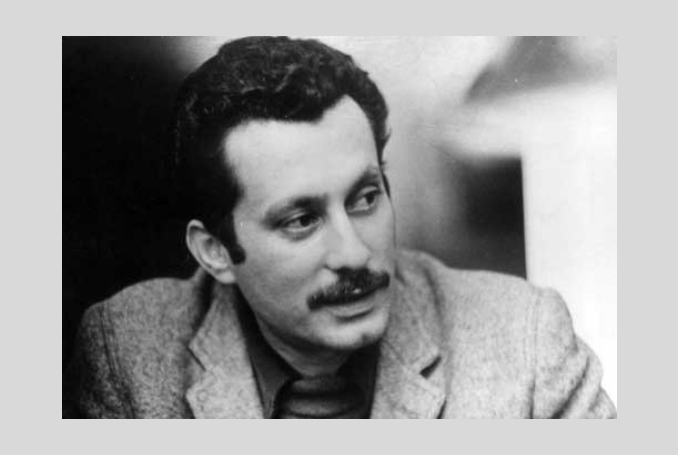
Ghassan Kanafani. (Photo: File)
Palestine Chronicle | December 22, 2018
Israel removed a memorial statue in the city of Acre this week dedicated to Palestinian intellectual and writer Ghassan Kanafani.
The statue was set up in a cemetery by Palestinians in the northern Israeli city to honor the iconic intellectual and Popular Front for the Liberation of Palestine (PFLP) member.
The local Waqf (Endowment) in Acre was contacted shortly after the memorial was erected and pressured to remove it immediately by Israel’s Interior Ministry.
Israeli authorities forced the city of Acre to remove a memorial to Palestinian playwright and novelist Ghassan Kanafani, who was born in Acre and forced to leave his city during the 1948 Nakba. https://t.co/8JdmE1Kqyo pic.twitter.com/xxGeLWGNE9
— The IMEU (@theIMEU) December 22, 2018
Israeli Interior Minister Aryeh Deri, a member of the ultra-Orthodox Shas party, said earlier this week that “we will not allow memorials in honor of terrorists in Israel”.
A relative of Kanafani said the memorial would be moved to a garden of another relative in Acre.
Ahmad Odeh, a Palestinian member of Acre’s city council, said Kanafani was a “symbol for the entire Palestinian people” and denounced the Israeli decision.
Israel removes memorial honouring famed Palestinian writer Ghassan Kanafani https://t.co/uQaUJCk7yx via @The_NewArab pic.twitter.com/EmnBc2cdby
— Araby.org Community (@ArabyOrg) December 21, 2018
Despite being a civilian who did not bear arms, Kanafani, born in Acre in 1936, was assassinated in Beirut in 1972 by a car bomb believed to have been orchestrated by Israeli Mossad agents.
Kanafani’s obituary in Lebanon famously said:
“He was a commando who never fired a gun, whose weapon was a ball-point pen, and his arena the newspaper pages.”
Kanafani was a victim of Israel’s terrorism, assassinated in Beirut on 8/7/72; his literature will always be remembered as masterpieces describing our Nakba and exile; the Zionists who removed the memorial will only be remembered as those who brought apartheid to the Holy Land. https://t.co/mCQPPrC2QG
— Xavier Abu Eid (@xabueid) December 21, 2018
His family was forcibly displaced from the city in 1948 during the mass exodus of Palestinians known as the ‘Nakba’, or catastrophe.
Acre was historically a mixed city of Palestinian Muslims, Christians, Jews, and Baha’i, but around 75 percent of the population was displaced during fighting surrounding the creation of the Israeli state.
Inside Banksy’s The Walled Off Hotel in Bethlehem
We check in to Banksy’s bizarre Palestinian hotel, where the hospitality is as peculiar as the message is powerful
By Jonathon Cook – The National – December 21, 2018
Anonymous British street artist Banksy made headlines in October when his $1.4 million artwork Girl with Balloon self-destructed by passing through a shredder concealed in its frame at a London auction moments after it had been bought.
But in the Palestinian city of Bethlehem, a much larger Banksy art project – a hotel boasting “the worst view in the world” – appears to be unexpectedly saving itself from similar, planned destruction.
When it opened in March last year, The Walled Off Hotel – hemmed in by the eight-metre-high concrete wall built by Israel to encage Bethlehem – was supposed to be operational for only a year. But nearly two years on, as I joined those staying in one of its nine Banksy-designed rooms, it was clearly going from strength to strength.
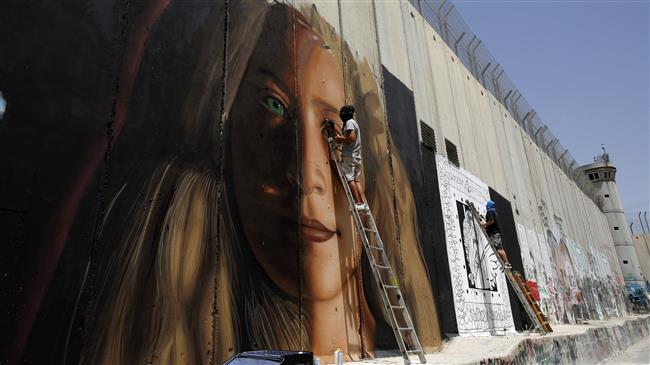
Originally, The Walled Off Hotel was intended as a temporary and provocative piece of installation art, turning the oppressive 700-kilometre-long wall that cuts through occupied Palestinian land into an improbable tourist attraction. Visitors drawn to Bethlehem by Banksy’s art – both inside the hotel and on the colossal wall outside – are given a brief, but potent, taste of Palestinian life in the shadow of Israel’s military infrastructure of confinement.
It proved, unexpectedly, so successful that it was soon competing as a top tourist attraction with the city’s traditional pilgrimage site, the reputed spot where Jesus was born, the Church of the Nativity. “The hotel has attracted 140,000 visitors – local Israelis, Palestinians, as well as internationals – since it opened,” says Wisam Salsa, the hotel’s Palestinian co-founder and manager. “It’s given a massive boost to the Palestinian tourism industry.”
Exception to Banksy’s rule
The Walled Off Hotel was effectively a follow-up to Banksy’s “Dismaland Bemusement Park”, created in the more familiar and safer setting of a British seaside resort. For five weeks, that installation in Weston-super-Mare, Somerset, England, offered holidaymakers a dystopian version of a Disney-style amusement park, featuring a nuclear mushroom-cloud, medical experiments gone wrong, boat people trapped on the high seas and the Cinderella story told as a car crash.
But unlike Girl with Balloon and Dismaland, Banksy appears uncharacteristically reluctant to follow through with the destruction of his Bethlehem creation. Some 21 months later, it seems to have become a permanent feature of this small city’s tourist landscape.
Given that Banksy is notoriously elusive, it is difficult to be sure why he has made an exception for The Walled Off Hotel. But given his well-known sympathy for the Palestinian cause, a few reasons suggest themselves. One is that, were he to abandon the hotel, it would delight the Israeli military authorities. They would love to see The Walled Off Hotel disappear – and with it, a major reason to focus on a particularly ugly aspect of Israel’s occupation. In addition, dismantling the hotel might echo rather uncomfortably Israel’s long-standing policy of clearing Palestinians off their land – invariably to free-up space for Jewish settlement.
Israel strenuously claims the wall was built to aid security by keeping out Palestinian “terrorists”. But the wall’s path outside The Walled Off Hotel seals off Bethlehem from one of its major holy sites, Rachel’s Tomb, and has allowed Jewish religious extremists to take it over.
A rare success story
In sticking by the hotel, Banksy appears to have been influenced by Palestinian “sumud”, Arabic for steadfastness, a commitment to staying put in the face of Israeli pressure and aggression. But significantly, there is a practical consideration: The Walled Off Hotel has rapidly become a rare success story in the occupied territories, boosting the struggling Palestinian economy. That has occurred in spite of Israel’s best efforts to curb tourism to Bethlehem, including by making a trip through the wall and an Israeli checkpoint a time-consuming and discomfiting experience.
Israel’s attitude was highlighted last year when the interior ministry issued a directive to travel agencies warning them not to take groups of pilgrims into Bethlehem to stay overnight. After an outcry, the government relented, but the message was clear.
Salsa notes that The Walled Off Hotel has not only attracted a new kind of visitor to Bethlehem, but has also persuaded many to spend time in other parts of the occupied West Bank, too.
Salsa understands the importance of tourism personally. He was an out-of-work guide when mutual friends first introduced him to Banksy in 2005, shortly after the wall cutting off Bethlehem from nearby Jerusalem had been completed. The city was economically dead, with tourists too fearful to visit its holy sites as armed uprisings raged across the occupied territories. The Second Intifada from 2000-2005 was the Palestinians’ response after Israel refused to grant them the viable state most observers had assumed was implicit in the Oslo Accords of the 1990s.
Banksy arrived in 2005 to spray-paint on what was then a largely pristine surface, creating a series of striking images. It unleashed a wave of local and foreign copycats. The wall in Bethlehem quickly became a giant canvas for artistic resistance, says Salsa.
Much later, in 2014, Banksy came up with the idea of the hotel. Salsa found a large residential building abandoned for more than a decade because of its proximity to the wall. In secret, The Walled Off was born. “It was a crazy spot for a hotel,” says Salsa. “It felt like divine intervention finding it. It was close to the main road from Jerusalem so no one could miss us.”
Palestinians’ reality
Importantly, the hotel was also in one of the few areas of Bethlehem inside “Area C”, parts of the West Bank classified in the temporary Oslo Accords as under full Israeli control. That meant the army could not bar Israelis from visiting. “Nowadays there are no channels open between Palestinians and Israelis. So The Walled Off Hotel is a rare space where Israelis can visit and taste the reality lived by Palestinians.
“True, Israelis mostly come to see the art. But they can’t help but learn a lot more while they are here.”
Salsa is happy that the Walled Off Hotel provides a good salary to 45 local employees and their families. His hope in setting up the hotel was to “encourage more tourists to stay in Bethlehem and for them to hear our story, our voice”.
But Banksy’s grander vision had been fully vindicated, he says. “The Walled Off Hotel gives tourists an experience of our reality.
“But it also emphasises other, creative ways to struggle and speak up. It offers art as a model of resistance.
“The hotel magnifies the Palestinian’s voice. And it makes the world hear us in a way that doesn’t depend on either us or the Israelis suffering more casualties.”
Global impact
The hotel’s continuing impact was underscored last month when it featured for the first time at the Palestinian stand at the annual World Travel Market in London, the largest tourism trade show in the world. The event attracts 50,000 travel agents, who conduct more than $4 billion in deals over the course of the show.
Banksy had announced beforehand that he would bring a replica of one of his artworks on the wall just outside the Bethlehem hotel: cherubs trying to prise open two concrete slabs with a crowbar. He also promised a limited-edition poster showing children using one of Israel’s military watchtowers as a fairground ride. A slogan underneath reads: “Visit historic Palestine. The Israeli army liked it so much they never left!” As a result, there was a stampede to the Palestinian stand, one of the smallest, that caught the show’s organisers by surprise.
Rula Maayah, the Palestinian tourism minister, praised Banksy for changing the image of Palestinian tourism by diverting younger people into the West Bank, often during a visit to Israel. “He promotes Palestine and focuses on the occupation, but at the same time he is talking about the beauty of Palestine,” she said.
At the Walled Off Hotel, however, Israel has made it much harder to see the beauty. Most windows provide little more than a view of the wall, which dwarfs in both height and length the Berlin Wall to which it is most often compared. That is all part of the Walled Off “experience” that now attracts not only wealthier visitors keen to stay in one the hotel’s rooms, but a much larger audience of day trippers.
So successful has the Walled Off Hotel proved in such a short space of time that even some locals concede it upstages the Church of the Nativity – at least for a proportion of visitors. A local taxi driver who was guiding two French sisters along the wall outside the hotel said many independent tourists now prioritised it ahead of the church.
Only wanting to be identified as Nasser, he said: “We may not know who Banksy is, but the truth is, he has done us a huge favour with this hotel and his art.”
Sanctuary in a police state
If Dismaland created a dystopian amusement park in the midst of a fun-filled seaside resort, the Walled Off Hotel offers a small sanctuary of serenity – even if a politically charged one – in surroundings that look more like a post-apocalyptic police state.
Along the top of the wall, there are innumerable surveillance cameras, as well as looming watchtowers, where ever-present Israeli soldiers remain out of view behind darkened glass. They can emerge unexpectedly, usually to make raids on the homes of unsuspecting Palestinians.
When I made a trip to the Walled Off in October, I parked outside to find half a dozen armed Israeli soldiers on top of the hotel’s flat roof. When one waved to me, I was left wondering whether I had been caught up in another of Banksy’s famous art stunts. I hadn’t. They were real – there to watch over Jewish extremists celebrating a religious holiday nearby at Rachel’s Tomb.
The hotel’s lobby, though not the rooms, are readily accessible to the public. It is conceived as a puzzling mixture: part cheeky homage to the contrived gentility of British colonial life, part chaotic exhibition space for Banksy’s subversive street art. Visitors can enjoy a British cream tea, served in the finest china, sitting under a number of Israeli surveillance cameras wall-mounted like hunting trophies or alongside a portrait of Jesus with the red dot of a marksman’s laser-beam on his forehead.
A history of resistance
The lobby leads to a museum that is probably the most comprehensive ever to document Israel’s various methods of colonisation and control over Palestinians, and their history of resistance.
At its entrance sits a dummy of Lord Balfour, the foreign secretary who 101 years ago initiated Britain’s sponsorship of Palestine’s colonisation. He issued the infamous Balfour Declaration promising the Palestinians’ homeland to the Jewish people. Press a button and Balfour jerks into life to furiously sign the declaration on his desk. Upstairs is a large gallery exhibiting some of the best of Palestinian art, and the hotel reception organises twice-daily tours of the wall.
Entry to the rooms is hidden behind a secret door, disguised as a bookcase. Guests need to wave a room key, shaped like a section of the wall, in front of a small statue of Venus that makes her breasts glow red and the door open.
A stairway leads to the second and third floors, where the landings are decorated with more fading colonial splendour and Banksy art. Kitsch paintings of boats, landscapes and vases of flowers are hidden behind tight metal gauze of the kind Israel uses to protect its military Jeeps from stone-throwers.
A permanent “Sorry – out of service” sign hangs from a lift, its half-open doors revealing that it is, in fact, walled up.
No mementos
Although the rooms are designed thematically by Banksy, only a few contain original artworks, most significantly in the Presidential Suite.
Hotels may be used to customers taking shampoos and soaps, even the odd towel, as mementos of their stay. But at the Walled Off, the stakes are a little higher. Guests are issued with an inventory they must sign on departing, declaring that they have not pilfered any art from their room. But it is the wall itself that is the dominant presence, towering over guests as they come and go, trapping them in a narrow space between the hotel entrance and an expanse of solid grey.
A proportion visit the neighbouring graffiti shop, Wall Mart, where they can get help on how to leave their mark on the concrete. Most of the casual graffiti is short-lived, with space regularly cleared so that new visitors can scrawl their messages and use art as a tool of resistance.
Protest pieces
Banksy’s better-known artworks, however, are saved from the spray-paint pandemonium elsewhere.
The crowbar-armed cherubs he brought to London were painted in time for Christmas last year, when he recruited film director Danny Boyle – of Slumdog Millionaire fame – to stage an alternative nativity play for local families in the hotel car park. The “Alternativity”, featuring a real donkey and real snow produced by a machine on the Walled Off’s roof, became a BBC documentary. Banksy had once again found a way to persuade prime-time TV to shine a light on Israel’s oppressive wall.
Another artwork is his “Er sorry”, a leftover from the Walled Off’s “apologetic street party” of November last year, marking the centenary of the Balfour Declaration’s signing. Children from two neighbouring refugee camps were invited to wear Union-Jack crash helmets and wave charred British flags. A person dressed as Queen Elizabeth II unveiled “Er Sorry” stencilled into the wall. It served both as a hesitant apology on behalf of Britain and as a play on the initials of the Queen’s official Latin title, Elizabeth Regina.
The event, however, illustrated that Banksy’s subversive message, directed chiefly at western audiences, does not always translate well to sections of the local Palestinian population. The party was hijacked by local activists who stuck a Palestinian flag into the Union Jack-adorned cake and chanted “Free Palestine”.
Is this ‘war tourism’?
Salsa outright rejects claims from some locals and foreign critics that the hotel is exploiting Palestinian misery and is an example of “war tourism”.
He points out: “The Balfour party got the media interested in a story they probably would not have covered otherwise, because it lacked violence and bloodshed.”
He adds that the area of Bethlehem in which the Walled Off is located would have been killed off by the wall were it not for Banksy investing his own money and time in the project. As well as the staff, it has brought work to tour guides, taxi drivers, neighbouring and cheaper hotels, shops and petrol stations. “That is a very important form of resistance,” he says.
It is also a rare example of Palestinians reclaiming land from the Israeli army. On the other side of the wall there had been a large army camp until the hotel started drawing significant numbers of visitors.
“The army didn’t like lots of tourists taking pictures nearby, so they moved further away, out of sight.”
Eternal memories
Canadian tourist Mike Seleski, 30, visited the hotel to see Banksy’s art before standing in front of the wall. He said he had heard about the Walled Off from an Israeli he befriended in Vietnam during a year travelling.
This was a detour from his stay in Israel – his only stop in the occupied territories. “I don’t like the usual tourist experiences,” he said. “It is important to hear the other side of the story when you travel.”
In every one of the 32 countries he has visited, he has stood to be photographed before a famous local spot holding a cardboard sign with words to reassure his worried mother: “Mum – I’m OK.”
In Bethlehem, he said it was obvious he’d take the photo in front of Banksy’s art on the wall, rather than the Church of the Nativity. “You see the wall on TV and forget about it. You get on with your life. But when you stand here, you realise Palestinians don’t have a choice. They simply can’t ignore it.”
Israel soldiers shot Palestinian teen, ‘dragged him around’ and chased away ambulance
MEMO | December 21, 2018
Israeli soldiers who fatally shot a Palestinian child last week prevented him from receiving potentially life-saving medical treatment, reported Haaretz.
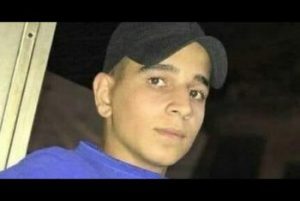 Seventeen-year-old Mahmoud Nakhle was shot on Friday 14 December as Israeli occupation forces suppressed protests around Al-Jalazun refugee camp near Ramallah.
The confrontations between residents and soldiers had already slowed down when Israeli forces “began chasing after the youths” and “suddenly… started shooting, using live ammunition”.
According to the paper, Nakhle was returning home “by way of a dirt path that passes above the camp”, when “the soldiers ran after him and one of them shot him once, in the lower back”.
The soldiers lifted Nakhle up and carried him a few dozen metres away, “laying him down at the side of the road”; one eyewitness said they carried him “like you haul a slaughtered sheep”.
After a few minutes, soldiers lifted the boy up again, and “carried him a few dozen metres more”. A Palestinian ambulance “was chased off by the soldiers, who threatened the driver with their rifles”. As far as is known, Haaretz reported, “the soldiers did not give Nakhle any sort of medical aid”.
It was only after a quarter of an hour “that the soldiers allowed an ambulance to be summoned”, but Mahmoud died en route to the hospital.
His death certificate states that the teen “died from loss of blood after a bullet entered his lower back, struck his liver and hit a main artery, damaging other internal organs”.
The paper described how “Mahmoud attended school until the 10th grade and then studied electrical engineering at a professional college”. After a year of apprenticeship, he had been “waiting to find a job as an electrician”. He is survived by his parents and two sisters aged 14 and four.
The Israeli military spokesperson told Haaretz “a Palestinian holding a suspicious object approached one of the soldiers” when “the soldier fired at him”. The incident is being investigated by the Military Police, who routinely whitewash the killing of Palestinians by Israeli occupation forces.
READ:
What stopped Chad’s Idriss Déby from visiting Israel before now?
Dr Mustafa Fetouri | MEMO | December 20, 2018
If you did not know much about Chad, a country in the middle of Africa, it most likely it caught your eye on 26 November when its President, Idriss Déby, landed in Israel for an unannounced visit to the Zionist state. The visit was shrouded in secrecy until Déby’s plane touched down at Ben Gurion Airport. His closest aides had no idea that he was heading to Tel Aviv until the last minute. It reminds me of November 1977, when Egypt’s then President Anwar Sadat made his surprise trip to Israel.
Sadat justified his move by the fact that Egypt and Israel were at war with each other and such a visit, he believed, helped to make peace. Déby, on the other hand, has been in power since December 1990, Chad is not at war with Israel and the two countries are thousands of miles apart; so what motivated him to embark on such an endeavour at this time? Or, indeed, what stopped him from making such a visit before now?
Israeli journalist Herb Keinon answered this question by explaining that, “Chad severed ties with Israel in 1972 after coming under pressure from Libya.” Reuters reported that Dore Gold, the Director of Israel’s Foreign Ministry in 2016, explained after his own visit to Chad why the government in N’Djamena cut ties with Israel over four decades earlier: “[his Chadian hosts] told him that they cut off ties 44 years prior under Libyan pressure, a factor removed with the toppling of Muammar Gaddafi [in 2011].”
Indeed Libya under Gaddafi was the fiercest opponent of Israeli expansion in Africa. As early as 1972, just three years after taking power, Gaddafi forced the then Chadian President, François Tombalbaye, to sever ties with Tel Aviv. Gaddafi believed strongly that any Israeli diplomatic expansion into Africa undermined the continent’s pro-Palestinian position. The late Libyan leader considered Israel to be an enemy best kept as far away as possible from Libya and Africa.
Libya has a history of ties with Chad going back to Italy’s invasion and occupation of Libya in 1911, which saw hundreds of Libyans seeking safety in Chad; their descendants still live in Libya’s southern neighbour. Gaddafi capitalised on this to strengthen ties between this community of exiles and their home country. He also sought to prevent Chad from becoming a threat to Libya’s security, which is why Tripoli was involved in toppling Chadian regimes considered unfriendly, particularly between 1972 and 1990.
Idriss Déby himself became President of Chad in December 1990, with Libyan political and military support. Gaddafi invested Libya’s oil money in Chad; the North African state owns two banks there and some luxury hotels, and built dozens of schools, mosques and medical facilities, as well as communication and agriculture infrastructure.
The late Libyan leader also used his political clout in Africa to keep African countries away from western influence, knowing too well that it would only benefit Israel as many western capitals would encourage them to embrace and help Tel Aviv to infiltrate the continent even more. In this context, Libya founded the African Union in 1999, for Pan-African cooperation. Tripoli also founded the Community of Sahel-Saharan States (CEN-SAD), bringing 24 Sub-Saharan African counties closer to neighbouring North African Arab states to share investment, free trade, security and foreign policy coordination.
This put Libya, before 2011, in direct competition with western powers in Africa. One of Tripoli’s long term objectives was to launch a golden dinar, backed by its own huge financial reserves, as a currency for African states to replace the CFA franc which is backed by the French treasury. This was one of the reasons behind French President Nicolas Sarkozy’s attack on Libya to topple the Gaddafi regime in 2011.
After Gaddafi was killed in 2011, many of his long term African initiatives were, under French pressure, abandoned. CEN-SAD, for example, is being replaced by the smaller Group of 5 Sahel (G5S) made up of Chad, Niger, Mali, Mauritania and Burkina Faso. Ironically, though, the members of G5S are the weakest in Africa and are focusing on security by allowing France and the United States to establish military bases in Mali and Niger. This would have been unthinkable if Gaddafi was still around.
Having the best military among the G5S countries, Chad’s Idriss Déby has become even more influential in Africa. This makes his link with Israel even more dangerous.
As the leading armed forces within G5S, Chad’s army is responsible for fighting terrorism in the Sahel region. Déby and Mohamed Ould Abdel Aziz of Mauritania are seeking to promote G5S as a trusted partner in Africa. In this context, visiting Israel is an important step to unlock further diplomatic and military support.
Israeli Prime Minister Benjamin Netanyahu has made it his objective since 2016 to visit as many Muslim majority countries as possible. It would not be surprising to see some sort of rapprochement between Israel and Mali, Mauritania or Niger, or all three. Déby’s ice breaking visit to Tel Aviv has helped open the door for such rapprochement in Africa which, once upon a time, was a no-go area for Israel.
Apart from diplomatic gains, Israel is also interested in using Chad and its neighbours as stopovers for flights to South America, saving time and cost. A flight from Tel Aviv to Brazil, for example, will be around four hours shorter if central African airspace can be used. At the moment, such flights take around 17 hours, with at least one stopover in Europe or North America for refuelling.
Déby is facing more security challenges from his own people as armed rebel groups become more organised and stronger thanks to the safe bases they have in southern Libya. Young people in Chad’s Sahel region of Bahr El-Ghazal and Kanem in particular are becoming increasingly disenchanted with the authority in N’Djamena. The President’s security apparatus has been using discriminatory and heavy-handed tactics in the region under the pretext of fighting Boko Haram and other terror groups which infiltrated this vital area after Libya was destroyed by NATO in 2011.
The Chadian President is likely to seek Israeli help to keep himself in power. France, his main backer, “encouraged him to visit Israel,” according to Aqreen Saleh, the former Libyan ambassador to Chad who knows Déby personally. Saleh insists that “security for [Déby’s] regime is the main driver behind the visit to Israel,” not least because, over the past five years, the government in N’Djamena has been challenged by the rebel groups operating from southern Libya.
However, going to Israel is likely to backfire, particularly among Chad’s Muslim majority population. Historically, and especially since Chad gained independence, it has been Muslims who have risen against and toppled the central government.
Before 2011, thousands of Chadians depended on Libya for employment opportunities. Now they are heading to Libya to join rebel groups or work as mercenaries fighting for different Libyan factions, compounding Déby’s problems.
Idriss Déby needs arms and military equipment to fight the threat from the rebels operating out of Libya and Israel is only too happy to supply them to him. In the absence of any strong Arab leadership in Africa post-Gaddafi and the destruction of Libya, more African leaders are likely to embrace apartheid Israel at the expense of African support for the Palestinians and links with the Arab world.
Trump’s Syrian Pullout is a Game Changer
By M.K. Bhadrakumar | News Click | December 2018
US President Donald Trump’s announcement on Wednesday regarding the withdrawal of American military forces from Syria has predictably run into strong headwinds in the Washington Beltway. A formidable coalition appeared overnight – comprising the Deep State, US defence and security establishment, leading members of the Congress, major media organs –branding Trump as a maverick. However, the fact of the matter is that Trump made a considered decision.
Basically, it is a political call on his part to advance his consistent stance that the US should not intervene in the Syrian conflict – a stance, we may recall, which Michael Flynn had begun fleshing out even before the Trump presidency began in January last year. Why is Trump asserting his political will?
Clearly, Turkey’s threat to launch an operation “any moment” to crush the US’ Kurdish allies and the deployment of Turkish troops on the Syrian border profoundly influenced Trump’s decision-making. (See my blog There’s no quick fix to US-Turkish tensions.)
Trump made a phone call to Turkish President Recep Erdogan last Friday to urge restraint and signaling a change of course in the US’ Syrian policy. Erdogan later nodded satisfaction over the phone conversation. The point is, the Turkish threat to attack Kurdish groups inside Syria makes the ground situation completely untenable for the US military. The options for the Pentagon will be either to intervene on behalf of its Kurdish proxies and confront the Turkish military (which is senseless), or to watch passively the complete demolition of the zone encompassing one-third of Syria that the US carved out for itself through the past year or more.
More to the point, there is every likelihood of US forces, numbering 2,000 soldiers and spread thinly on the ground, getting caught in the crossfire between the Turkish military and its affiliated Syrian opposition groups on one side and Kurdish fighters on the other. If the Turks vanquish and scatter the Kurdish groups, the US will be left with no local allies. And it will be a only matter of time before the isolated US “bases” in Syria numbering over a dozen will face harassment and predatory attacks by the battle-hardened Shi’ite militia trained and equipped by Iran. It can turn out to be a situation like the attack on the Marine barracks in Beirut in 1983.
The spectre that haunts Trump is of body bags of American soldiers killed in Syria coming home, which of course, will be spelling doom for his re-election bid in the 2020 election. Trump understands that there is a Russian-Turkish-Iranian convergence to evict the US forces from Syria and the only way to counter it can be by committing boots on the ground in much larger numbers, which is of course unrealistic.
Meanwhile, the Pentagon has been pursuing an invidious agenda of creating a quagmire for the Russians in Syria and acting, therefore, as a “spoiler” in any whichever way it can to frustrate the Russian-Turkish-Iranian efforts to stabilize Syria. Time and again, it became apparent that the US forces in Syria maintain covert links with extremist groups, provide cover for them, and disrupt the operations by the Syrian government forces fighting terrorism. The US role in Al-Tanf on the Syrian-Iraqi border is dubious, shameful and cowardly, to say the least.
Quite obviously, the Mission Creep pursed by the Pentagon commanders have come to a point where real danger exists today of direct clashes erupting at any moment involving US forces arrayed against the Russian / Turkish / Iranian / Syrian forces. An extremely risky venture of brinkmanship by the Pentagon commanders has been afoot. There is no way Turkey can compromise with the US-Kurdish axis in Syria. Nor are Russian and Iran going to throw away their hard-earned victory in the Syrian conflict to strengthen the government led by President Bashar Al-Assad. In a major speech in Moscow on Tuesday while addressing Russian Defence Board, President Vladimir Putin touched on the Syrian situation, underscoring, “We will give Syrians all the support they need.” (See my blog Putin warns US against misadventures.)
Equally, Trump cannot be unaware that there is growing uncertainty about the Saudis bankrolling the US operations in Syria, what with the growing tensions in the US-Saudi relations over the Jamal Khashoggi affair. Qatar and Jordan have already pulled out of the “regime change” project in Syria. Suffice to say, Israel is the only American ally in the region, which is today keen on an open-ended US military intervention in Syria.
Trump has been paying a lot of attention lately to mend the fractured Turkish-American ties and to revive the alliance, if possible. Step by step, he has been clearing the debris that had accumulated during the Obama presidency. The extradition of Islamist preacher Fetullah Gulen is a major obstacle, but even here Trump appears to have set the ball rolling. On December 18, Pentagon announced the clearance for a possible sale of the Patriot air and missile defence system to Turkey, notwithstanding Turkey’s purchase of S-400 ABM system from Russia. Trump is also addressing the detention in the US of a top executive of Halk Bank, which has serious political overtones for Erdogan personally. Unsurprisingly, Turkish Foreign Minister Mevlut Cavusoglu acknowledged publicly on December 18 that the climate of bilateral relations is “much, much better” of late. Cavusoglu disclosed that a visit by Trump to Turkey is on the cards.
Having said that, the US’ continued alliance with the Kurdish militia is a red line for Turkey and the relations between Ankara and Washington can never be normal so long as this “unholy alliance” (as Turks perceive it) continues. Ankara will suspect the US intentions toward Turkey so long as Pentagon treats the Kurds as strategic allies, no matter the tactical reasons proffered by the Pentagon commanders.
Trump understands this. And it largely explains his decision to cut the Gordian knot. Significantly, Cavusoglu discussed the US withdrawal plans in Syria with US Secretary of State Mike Pence within hours of the news of Trump’s decision.
The heart of the matter is that the US’ regional strategies can never be optimal without Turkey, which has been a “swing” state. Turkey has a vital role to play not only in the Middle East and Eastern Mediterranean but also in the Black Sea and the Balkans. Above all, Turkey is a NATO power and the alliance loses traction in the southern tier if Ankara does not take active interest, which has been the case in the most recent period. Therefore, on balance, US’ regional strategies have much, much more to gain out of Trump’s decision to disengage from direct military intervention in Syria and to resuscitate the relations with Turkey and re-energize the old partnership.
Of course, interest groups and war profiteers (“military-industrial complex”) in the US will castigate Trump for his decision to order the halt of the gravy train. But their main argument that residual terrorism still remains in Syria is a phony one bordering on rank hypocrisy. For, it is a matter of time before Russia and Iran and the Syrian government forces with their affiliated militia will make mincemeat out of the terrorist groups that have taken shelter in the US- controlled zone in eastern Syria as well as destroy the US-backed extremist groups ensconced in Idlib. Plainly put, the fight against terrorism will be taken to its logical conclusion as soon as the US forces get out of the way and the Pentagon is prevented from playing the spoiler’s role.
Therefore, paradoxically, the decision to pull out from Syria and the rebooting of the Turkish-American alliance can only improve the US’ capacity to influence the Syrian peace process, and regional politics in general. Interestingly, Trump’s announcement came just as agreement was reached in Geneva on the composition of the committee to write a new constitution for Syria, which is a defining moment in the UN-brokered peace process.
Albania fell prey to Israeli-US scenario by targeting Iran diplomats: Tehran
Press TV – December 20, 2018
Tehran has denounced Albania for expelling two Iranian diplomats, saying the Balkan country fell prey to a scenario fabricated by the US and Israel.
Albania’s Foreign Ministry said on Wednesday that it had expelled two Iranian diplomats suspected of “involvement in activities that harm the country’s security.”
A ministry spokesman told the Associated Press that the expulsions followed talks with others, including Israel.
Iran’s Foreign Ministry Spokesman Bahram Qassemi said on Thursday that Albania’s move was “in line with previous such scenarios meant to damage Iran-Europe relations at the current sensitive juncture.”
He said the expulsions come while Tehran has “always had appropriate relations with Albania and respected all of its domestic regulations in a move based on principles of the Islamic Republic of Iran’s foreign policy.”
US National Security Adviser John Bolton was quick to publicly support Albania’s decision.
“We stand with PM [Edi] Rama and the Albanian people as they stand up to Iran’s reckless behavior in Europe and across the globe,” he tweeted.
Qassemi said that Washington’s stance on the issue and Albania’s declaration that its move had been coordinated with foreign security services, prove that the US and the regime in Israel had been behind the expulsions.
Albania, he added, had fallen prey to a scenario fabricated by the US and the Israeli regime and certain terrorist groups.
The Iranian official further called on the Albanian government “to defend its sovereignty, independence and security” in the face of the US-Israeli scenario,” stressing that the country “must not allow others to affect and hamper its relations with Iran due to special political reasons.”
Albania hosts thousands of members of the Mujahedin Khalq Organization (MKO), a notorious anti-Iran terror group.
The MKO has carried out numerous attacks against Iranian civilians and government officials over the past three decades and is listed as a terrorist organization by much of the international community.
Out of the nearly 17,000 Iranians killed in terrorist assaults since the victory of Iran’s 1979 Islamic Revolution, about 12,000 have fallen victim to MKO’s acts of terror.
Albania is not the first European country to make such claims against Iran.
Back in June, Belgian authorities said that an Iranian diplomat had been arrested along with a 38-year-old man and a 33-year-old woman, suspected of plotting a bomb attack on an MKO meeting in Paris attended by US President Donald Trump’s lawyer, Rudy Giuliani, and several former European and Arab ministers.
Assadollah Assadi, 46, was arrested in Germany and later extradited to Belgium in defiance of Vienna Convention on Diplomatic Relations 1961.
Later on October 30, Danish intelligence chief Finn Borch Andersen claimed that an Iranian intelligence service had tried to carry out a plot to assassinate an Iranian Arab opposition figure on Denmark’s soil.
Swedish security police also said a Norwegian citizen of Iranian descent had been arrested on October 21 in connection with the alleged plot and extradited to Denmark.
Israeli media later revealed that the Israeli spy agency Mossad had provided Denmark with “intelligence” concerning the alleged plot by Tehran.
Israeli Prime Minister Benjamin Netanyahu has admitted that Tel Aviv is behind what Iranian Foreign Minister described as “false flags” in Europe.
Tehran said “invisible hands” were at work to damage Iran’s ties with Europe at the time when the two sides are closely cooperating to save the 2015 multilateral nuclear deal following the US’s pullout.
40% of Palestinian lawmakers detained by Israel since 2006 elections
MEMO | December 19, 2018
Some 40 per cent of the Palestinian Legislative Council’s members have been detained by Israeli occupation forces at one time or another since the 2006 elections, prisoner advocacy groups said on Tuesday.
According to WAFA, the joint report by the Palestinian Prisoner Society, Addameer and the Prisoners Commission said “Israeli authorities have been targeting Palestinian deputies and political activists by holding them in administrative detention without charge or trial for long periods of time in order to prevent them from performing their societal and national roles.”
The groups noted that there are currently six Palestinian parliamentarians held in so-called administrative detention – without charge or trial – including Khalida Jarrar, “who had served time in prison and was later re-arrested and placed in administrative detention since July 2017”.
Another lawmaker, Nasser Abdu Jawwad, “is in prison awaiting trial since his detention in January of this year.”
The new report stated that Israel detained 486 Palestinians during November, including 65 children and nine women. Those detained included 150 from Jerusalem, 71 from the governorate of Ramallah and Al-Bireh, and 77 from Hebron governorate. Overall, the number of Palestinian prisoners and detainees in Israeli jails by 31 November was 5,700, including 230 children.
MK Zoabi ‘reprimanded’ for saying Israel soldiers ‘murdered’ civilians
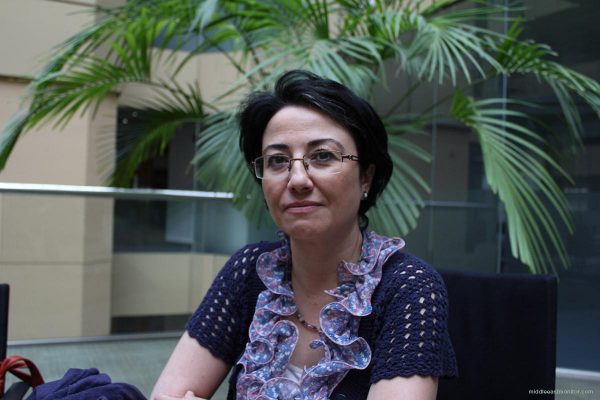
MEMO | December 19, 2018
The Knesset’s Ethics Committee decided yesterday to “severely reprimand” MK Haneen Zoabi, over remarks made by the parliamentarian about Israeli forces’ attacks on the occupied Gaza Strip.
According to the report by right-wing Israeli news outlet Arutz Sheva, Zoabi was the subject of a complaint filed by Likud MK Oren Hazan, after the Joint List legislator said that Palestinian civilians in Gaza had been “murdered by [Israeli] soldiers” during a Knesset debate.
“In this case,” the decision read, “most of the members of the committee believed that the use of the expression ‘murdered by the soldiers’ was not worthy of the broad protection that the committee spreads over the freedom of political expression of MKs.”
The committee also rejected a complaint filed by Zoabi herself, alleging that Deputy Knesset Speaker MK Tali Ploskov, who presided over the discussion, “did not defend her while she was speaking”. The committee concluded that “Ploskov’s conduct was not in violation of Knesset rules”.
Zoabi has frequently been targeted for censure by Knesset officials and racist incitement by fellow lawmakers over her outspoken support for Palestinian rights, and criticism of the Israeli army’s violations of international law.
Featured Video

Saudi Led Destruction of Yemen’s heritage
or go to
Aletho News Archives – Video-Images
From the Archives
Israel: Strategic Ally or Liability?
By Stephen Sniegoski | My Catbird Seat | June 12, 2010
The claim that Israel serves as a valuable ally for the United States is made by both pro-Zionists and much of the anti-war and anti-Zionist Left that is influenced by Noam Chomsky. As a result of the Gaza flotilla massacre, which has caused a world-wide uproar against Israel, the value of Israel to the United States is being publicly questioned in more mainstream foreign policy forums. … continue
Blog Roll
 Aletho News
- Here’s what Trump’s latest U-turn really means for Russia and Ukraine
- The Houthis Are Not an Iranian Proxy
- Europe’s Energy Hypocrisy, Russian LNG Profits and US Dependence
- ICC ignored ‘very well-documented’ NATO crimes – ex-Libyan minister
- SNSC secretary dismisses US response to Iran’s conditions as ‘inadequate’
- Sanaa says Taiz roads open, secure for residents, warns Saudi forces
- Iraqi resistance group urges Saudi leadership to admit defeat, lift Yemen siege
- Trump’s Retreat: How Al-Aqsa Flood Took Down the US Empire
- Israel’s Military Actions in Lebanon Grossly Violate International Law — Lavrov
- Seyed M. Marandi: US-Iran War Inevitable: Kuwait and Bahrain May Fall
- If Americans Knew
- Israeli Attacks Kill Five in Gaza, Including a four-year-old and a woman
- Air Force Major Who Called for Trump’s Impeachment Held in Solitary Confinement
- It’s a Genocide, I’m Into It’: Seinfeld Mocks Protest over Palestinian Children Killed
- Universities fire dozens amid pressure from Zionist billionaires
- Gaza’s buildings are collapsing on top of us. But there’s nowhere else to shelter
- Israel kills four-year-old Gaza child – Daily Update
- After Oct 7, IDF policy allowed civilian casualties for even the lowest-ranking targets
- Israel’s Destruction of Southern Lebanon Intensified After the Cease-Fire
- The Last-Minute Decision That Gave Israel Its Name
- The American Conservative: How Trump Made the World Go Nuclear
- No Tricks Zone
- New Study Suggests Large Regions Of The Pacific Ocean Have Been Cooling For The Last 80 Years
- Germany’s Green Energy Debacle: High Energy Costs Force Kahla Porzellan to Close After 182 Years!
- New Study: 50 Years Of The Most Aggressive ‘Net Zero’ Policies Can Only Affect The Global Climate By 0.03°C
- US September “Heat” Was No Record…Many Records Set Decades Ago
- Latest European Green Energy Debacle; Portugal’s Largest Flagship Solar Park Insolvent!
- Green Energy Debacle: German Expert Professor Fritz Vahrenholt Warns Of Severe Economic And Social Consequences
- Two More Paleo Reconstructions Affirm Meters-Higher Sea Levels Across Ireland, Brazil 7000-6000 Years Ago
- New Study: Earth And Venus Surface Warmth Largely Explained By Convection And Lapse Rate, Not CO2 Or Radiation
- 2025 Nature Paper Claiming Worsening Global Drought Gets RETRACTED …Heavily Flawed
- New Study: ‘Global Drought Shows No Detectable Recent Acceleration Under Climate Warming’

