Israel sentences rights activist to 8 years in prison
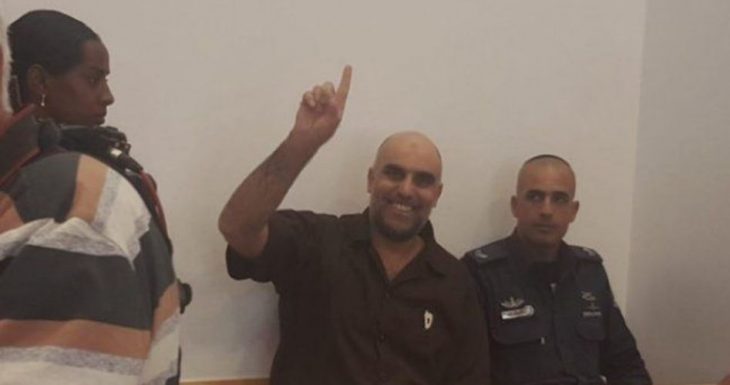
Firas al-Omari
Palestine Information Center – July 9, 2018
NAZARETH – The Israeli Central Court in Beersheba sentenced on Sunday the rights activist Firas al-Omari, 46, to eight years imprisonment.
Al-Omari, from northern Israel’s Arab town of Sandala, is an activist in the Islamic Movement (the northern branch) and head of Yusuf Al-Siddiq Foundation for prisoners’ affairs.
He was arrested in March 2017 for being allegedly affiliated to a banned organization.
The Israeli security authorities have embarked on arresting activists from the northern branch of the Islamic Movement following the right-wing government’s decision to classify it as a banned group in November 2015.
The northern branch of the Islamic Movement and its members are known for peacefully defending Jerusalem and the Aqsa Mosque against Israel’s violations.
Israel is bulldozing Khan Al Ahmar – and with it the two-state solution
By Jonathon Cook | The National | July 8, 2018
Israel finally built an access road to the West Bank village of Khan Al Ahmar last week, after half a century of delays. But Israel only allows vehicles like the bulldozers scheduled to sweep away its 200 inhabitants’ homes.
If one community has come to symbolize the demise of the two-state solution, it is Khan Al Ahmar.
It was for that reason that a posse of European diplomats left their air-conditioned offices late last week to trudge through the hot, dusty hills outside Jerusalem and witness the preparations for the village’s destruction. That included the Israeli police beating residents and supporters as they tried to block the advance of heavy machinery.
Britain, France, Germany, Italy and Spain submitted a formal protest. Their denunciations echoed those of more than 70 Democratic lawmakers in Washington in May – a rare example of US politicians showing solidarity with Palestinians.
It would be gratifying to believe that Western governments care about the inhabitants of Khan Al Ahmar – or the thousands of other Palestinians who are being incrementally cleansed by Israel from nearby lands but whose plight has drawn far less attention.
After all, the razing of Khan Al Ahmar and the forcible transfer of its population are war crimes.
But in truth, Western politicians are more concerned about propping up the illusion of a peace process that expired many years ago, than the long-running abuse of Palestinians under Israeli occupation.

Israeli soldier confronts villager in Khan al-Ahmar. (Photo by Mazin Qumsiyeh)
Western capitals understand what is at stake. Israel wants Khan Al Ahmar gone so that Jewish settlements can be built in its place, on land it has designated as “E1”.
That would put the final piece in place for Israel to build a substantial bloc of new settler homes to sever the West Bank in two. Those same settlements would also seal off West Bank Palestinians from East Jerusalem, the expected capital of a future Palestinian state, making a mockery of any peace agreement.
The erasure of Khan Al Ahmar has not arrived out of nowhere. Israel has trampled on international law for decades, conducting a form of creeping annexation that has provoked little more than uncomfortable shifting in chairs from Western politicians.
Khan Al Ahmar’s Bedouin inhabitants, from the Jahalin tribe, have been ethnically cleansed twice before by Israel, but these war crimes went unnoticed.
The first time was in the 1950s, a few years after Israel’s creation, when 80 per cent of Palestinians had been driven from their homes to make way for a Jewish state.
Although they should have enjoyed the protection of Israeli citizenship, the Jahalin were forced out of the Negev and into the West Bank, then controlled by Jordan, to make way for new Jewish immigrants.
A generation later in 1967, when they had barely re-established themselves, the Jahalin were again under attack from Israeli soldiers occupying the West Bank. The grazing lands the Jahalin had relocated to with their goats and sheep were seized to build a settlement for Jews only, Kfar Adumim, in violation of the laws of war.
Ever since, the Jahalin have dwelt in a twilight zone of Israeli-defined “illegality”. Like other Palestinians in the 60 per cent of the West Bank under Israeli control, they have been denied building permits, forcing three generations to live in tin shacks and tents.
‘Leaving the Desert in Death’
Israel has also refused to connect the village to the water, electricity and sewage grids, in an attempt to make life so unbearable the Jahalin would opt to leave.
When an Italian charity helped in 2009 to establish Khan Al Ahmar’s first school – made from mud and tyres – Israel stepped up its legal battle to demolish the village.
Now, the Jahalin are about to be driven from their lands again. This time they are to be forcibly re-settled next to a waste dump by the Palestinian town of Abu Dis, hemmed in on all sides by Israeli walls and settlements.
In the new location they will be forced to abandon their pastoral way of life. As resident Ibrahim Abu Dawoud observed: “For us, leaving the desert is death.”
In another indication of the Palestinians’ dire predicament, the Trump administration is expected to propose in its long-awaited peace plan that the slum-like Abu Dis, rather than East Jerusalem, serve as the capital of a future pseudo-Palestinian state – if Israel ever chooses to recognise one.
Khan Al Ahmar’s destruction would be the first demolition of a complete Palestinian community since the 1990s, when Israel ostensibly committed to the Oslo peace process.
Now emboldened by Washington’s unstinting support, Benjamin Netanyahu’s government is racing ahead to realise its vision of a Greater Israel. It wants to annex the lands on which villages like Khan Al Ahmar stand and remove their Palestinian populations.
There is a minor hurdle. Last Thursday, the Israeli supreme court tried to calm the storm clouds gathering in Europe by issuing a temporary injunction on the demolition works.
‘Short-Lived Reprieve’
The reprieve is likely to be short-lived. A few weeks ago the same court – in a panel dominated by judges identified with the settler movement – backed Khan Al Ahmar’s destruction.
The Supreme Court has also been moving towards accepting the Israeli government’s argument that decades of land grabs by settlers should be retroactively sanctioned – even though they violate Israeli and international law – if carried out in “good faith”.
Whatever the judges believe, there is nothing “good faith” about the behaviour of either the settlers, or Israel’s government towards communities like Khan Al Ahmar.
Saeb Erekat, the Palestinians’ veteran peace negotiator, recently warned that Israel and the US were close to “liquidating” the project of Palestinian statehood.
Sounding more desperate than usual, the Europe Union reaffirmed this month its commitment to a two-state solution, while urging that the “obstacles” to its realisation be more clearly identifed.
The elephant in the room is Israel itself – and its enduring bad faith. As Khan Al Ahmar demonstrates all too clearly, there will be no end to the slow-motion erasure of Palestinian communities until western governments find the nerve to impose biting sanctions on Israel.
Israel set to indict Turkish woman
MEMO | July 8, 2018
 Israeli prosecutors are set to charge a Turkish national on Sunday with aiding Palestinian group Hamas, according to Israeli daily Haaretz.
Ebru Ozkan, 27, was arrested by Israeli forces at Ben Gurion Airport on June 11 when she was returning to Turkey for alleged links with terrorist groups. Haaretz said Israeli prosecutors will file an indictment against the Turkish national on Sunday.
Ebru’s detention had been extended four times, Elif Ozkan, a sister of Ebru, noted.
Her lawyer Omar Khamaysa says she was charged with asking to transfer money and a cellphone charger to Hamas members, but she wasn’t aware of their identity.
Israel labels Palestinian group Hamas, which rules the Gaza Strip, as a terrorist organisation.
Ozkan is not the first Turkish citizen to have been recently detained by Israeli authorities.
In January, Osman Hazir, a 46-year-old Turkish national, was arrested for snapping a selfie at East Jerusalem’s Al-Aqsa Mosque while holding a Turkish flag.
And last December, Israel arrested two other Turks – Abdullah Kizilirmak and Mehmet Gargili – after the pair had quarreled with Israeli police who had tried to bar them from entering the flashpoint holy site.
In the same month, Adem Koc, another Turkish national, was arrested inside the Al-Aqsa Mosque compound for allegedly “disturbing the peace and taking part in an illegal demonstration”.
Kizilirmak, Gargili and Koc were all subsequently released on bail.
Bahar: Gaza will not pay political prices for humanitarian aid
Palestine Information Center – July 8, 2018
GAZA – MP Ahmed Bahar, first deputy speaker of the Palestinian Legislative Council, has affirmed that there will be no political price for any humanitarian assistance provided for the Palestinian people in the Gaza Strip.
In press remarks on Saturday, Bahar stated that the recent decision that was taken by US president Donald Trump to suspend millions of dollars in aid to UNRWA was part of steps to end the issue of the Palestinian refugees and the Palestinian cause in order to pave the way for his deal of the century (the ultimate deal).
The lawmaker underscored that the Palestinian people have the right to defend their rights, their land and holy sites by all available means, including the armed struggle against the occupation.
“Our people have the right to establish a seaport and an airport and to receive humanitarian aid, but all this would never be in exchange for giving up anything of our people’s rights, and we will not pay any political price for it,” he said.
“We cannot accept any plan to exchange any part of our land for another land as part of US or regional projects in the area. Our people are resisting in order to restore their Palestinian land and not to exchange it for any other land,” he added.
He also called on the Palestinian Authority to lift its blockade on the Gaza. “How can the Palestinian Authority claim that it is against the deal of the century while it is imposing a siege on Gaza, persecuting the resistance through its security coordination with the occupation, and suppressing marches calling for lifting the siege on Gaza.”
Hamas rejects any plan to separate Gaza from West Bank
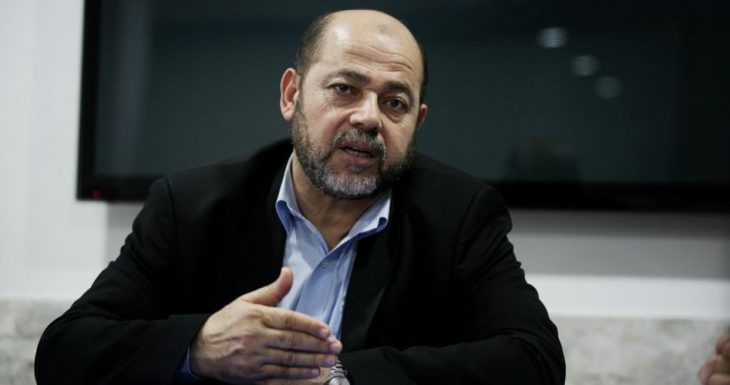
Palestine Information Center – July 7, 2018
GAZA – The Hamas Movement has reiterated its rejection of any plan to separate the Gaza Strip from the West Bank.
In Twitter remarks on Saturday, member of Hamas’s political bureau Mousa Abu Marzouk said that his Movement rejects the US-backed deal of the century that seeks to separate Gaza from the rest of Palestine.
Abu Marzouk added that his Movement wants a Palestinian state in the West Bank and Gaza with Jerusalem as its capital, and wants a durable Palestinian reconciliation based on political partnership and unity in the face of the occupation.
He also said that Hamas wants to see Israel’s blockade and the Palestinian Authority’s sanctions on Gaza lifted and all the problems which the population suffer from solved.
For about 12 years, the Israeli occupation state have been imposing a tight siege on Gaza, while Palestinian president Mahmoud Abbas has slapped, for politically motivated reasons, economic sanctions on Gaza for over a year.
Abbas and his government in Ramallah refuse to respond to all Palestinian factions’ calls for lifting their inhumane sanctions on Gaza.
9/11 and the War on Terror: Israel’s History of False Flag Operations against the U.S.A.
By Christopher Bollyn | American Herald Tribune | July 7, 2018
“We have spent $7 trillion – trillion with a T – $7 trillion in the Middle East. You know what we have for it? Nothing. Nothing.” – President Donald Trump, April 28, 2018
Dear Mr. President,
 As you said very clearly, the United States is bogged down in a costly quagmire in the Middle East, engaged in covert military operations in countries where there is no real U.S. interest. We have gained nothing from 17 years of war in which untold thousands have been killed or maimed and entire nations have been devastated. Our Middle East policy is disastrous and must be changed. If we don’t change our policy we can only expect more of the same – millions more refugees, thousands more dead, trillions more wasted.
In order to correct our policy we need to understand who got us into this mess in the first place. The 9/11 event as a false flag operation and the War on Terror campaign were both conceived by Israeli military intelligence in the 1970s under the leadership of Menachem Begin, the self-proclaimed “Father of Terrorism” and founder of the Likud party who became prime minister in 1977. War on Terror doctrine was rolled out in July 1979 at a Netanyahu Institute conference in Jerusalem. The Israeli trick was to get the U.S. military to neutralize and fragment its enemies, most notably Iraq and Syria, under the pretext of fighting terrorism. Since 1979, this devious plan has been openly promoted by Benjamin Netanyahu. On 9/11, War on Terror proponent Netanyahu told the New York Times that the terror atrocity was “very good” for U.S.-Israeli relations.
The Israelis have a long history of using false-flag terrorism against the United States:
- 1954 JUL – The Lavon Affair: Israeli agents place bombs in U.S. and British libraries and institutions in Egypt in a false-flag operation meant to be blamed on the Muslim Brotherhood.
- 1967 JUN – Israeli aircraft and ships attack the defenseless USS Liberty, killing 34 and wounding 171, with the intention of sinking the ship – with no survivors – so that the blame could be assigned to Egypt.
- 1983 OCT – A truck bomb kills 241 Marines in their barracks in Beirut. Former Mossad agent Victor Ostrovsky says Mossad knew the details of the truck, the time, and location of the bombing, but only gave a general warning to the Americans. A nebulous “Islamic Jihad” group is blamed; Defense Secretary Caspar Weinberger says U.S. has no knowledge who really did the bombing. This occurred one month after a single Marine stopped an Israeli tank column – some former Marines believe Israel organized the attack.
- 1986 FEB – Mossad plants a radio relay device in an apartment in Tripoli, Libya, to send fake messages that appear to be from the Libyan government; U.S. intelligence is successfully tricked and President Reagan orders bombing of Libya.
1978 – Israeli agent Arnon Milchan‘s first film features a Boeing 747 crashing into the PanAm building. Months before 9/11 produces a film episode in which remote controlled airplanes hit buildings.
1979 JUL – Netanyahu Institute hosts conference on terrorism calling for U.S. military intervention in Middle East.
1979 – Isser Harel, founding chief of Israeli intelligence, predicts 9/11 attacks in New York City.
1982 FEB – Israeli Likud strategist Oded Yinon plan calls for the “dissolution of Syria and Iraq” and Balkanization of all Arab states.
1983 – Israel creates foe for War on Terror: Under Ehud Barak, Israeli military intelligence (AMAN) begins arming and training anti-Western Hezb-i-Islami terrorists in Pakistan, including Osama bin Laden.
1987 – Two of Isser Harel’s senior Mossad agents, Avraham Shalom Bendor and Zvi Malkin, get the security contract for World Trade Center; Port Authority cancels the contract when their criminal history is discovered.
1990 – Rejected by Port Authority due to criminal conviction in Israel, Shalom Bendor goes to work for Jules Kroll.
1993 FEB – Zionists manage prosecution of WTC bombing: Israeli-American Michael Chertoff, U.S. Attorney for New Jersey, plays key role in prosecution. Zionist Judge Michael Mukasey presides over case against “Blind Sheikh.” FBI informant Emad Salem is paid one million dollars for his testimony. Media leads public to believe that Muslims want to destroy the Twin Towers.
1993 – After first WTC bombing Kroll Associates gets security contract for the Port Authority and the WTC.
1994 – After losing Saudi and Pakistani support, the Israeli-trained “remainder of Hezb-i-Islami merges into al-Qaeda and the Taliban.”
1998 DEC – Philip Zelikow’s Catastrophic Terrorism Study Group publishes report “Imagining Transforming Event” in Foreign Affairs (CFR). Co-authors Ashton Carter and John Deutch work for Global Technology Partners, an exclusive affiliate of Rothschild N.A.
1999 – Hugo Neu creates a global trading division headed by two veteran ferrous metal traders from Marc Rich and Glencore AG in Switzerland. A lot of expense and effort is spent to prepare a network to export scrap iron to Asia while its price is at the lowest level in 50 years. Hugo Neu and the state share the costs of dredging the Claremont channel to allow large ocean-going ships to Asia.
2000 SEP – A Neo-Con group, Project for the New American Century (PNAC) suggests that “a catastrophic and catalyzing event – like a new Pearl Harbor” may be necessary to facilitate “the process of transformation” they call for in U.S. military policy. Ten signers of the PNAC document, including Dick Cheney, were in senior positions of the Bush administration in 2001.
2001 – Israeli Mossad company ICTS controls security screening at U.S. Airports on 9/11. Directors include Yair Shamir, son of notorious Israeli terrorist Yitzhak Shamir.
2001 – Israeli intelligence creates false histories for alleged hijackers. Israeli spies posing as “art students” live near hijacker patsies. Duplicate documents are used to create false histories, standard procedure for Mossad false-flag operations.
2001 – Ronald Lauder manages Governor George Pataki’s privatization scheme which includes WTC property. Lauder funds Lauder School of Government, Diplomacy and Strategy at Mossad center (IDC) where Israeli Major General Daniel Rothschild heads Institute for Policy and Strategy.
2001 JUL 24 – Larry Silverstein gets lease for World Trade Center. Silverstein obtains lease thru fellow Zionist agent Lew Eisenberg, chairman of the Port Authority. Silverstein and Eisenberg are both members of UJA board, major Zionist fundraising organization. Since 1996, Silverstein has close contact with Netanyahu; every Sunday afternoon Netanyahu calls Silverstein. Silverstein immediately raises rents by 40% for the few tenants he has.
2001 SEP 11 – Ehud Olmert, Israel’s deputy prime minister, is on an unreported visit in New York City. Why is it secret? While all civilian planes are grounded, at 4:11 p.m. an El Al Boeing 747 takes off from JFK bound for Tel Aviv. The flight is authorized by the direct intervention of the U.S. Department of Defense.
9/11 – Alex Brown, a firm with ties to Israeli military intelligence and Yair Shamir’s company Scitex has many of the suspicious “put” options. “Buzzy” Krongard, executive director of the CIA, headed AB until 1998. His wife works for Rothschild Asset Management.
9/11 – Israeli government receives the names of 4,000 Israelis believed to be in the area of the WTC or Pentagon on 9/11. Odigo, an Israeli messaging company, is used to send warning several hours before attacks. Four Israelis die at WTC.
9/11 – Five Israelis working for Urban Moving Systems are arrested on 9/11 after being seen photographing and celebrating the attack on the WTC. The fake moving company is later found to be a front for the Mossad. Two of the Israelis are known Mossad.
9/11 – Israeli military chief Ehud Barak interprets 9/11 on BBC and Sky News in London, blaming Osama bin Laden and calling for U.S. to “launch an operational, concrete, war against terror.” Barak is Netanyahu’s commander in the Sayeret Matkal, a covert commando force of Israeli military intelligence. Other Israeli commandos (e.g. Daniel Lewin) are involved in 9/11. Bin Laden denies responsibility for 9/11.
9/11 – Netanyahu praises 9/11 atrocity to NYT: “It’s very good… it will generate immediate sympathy.” In 2008, he says in Israel: “We are benefiting from one thing, and that is the attack on the Twin Towers and Pentagon, and the American struggle in Iraq.”
9/11 – An Israeli controls 9-11 investigation. John Ashcroft puts Israeli dual-national Michael Chertoff in charge of 9/11 investigation. “For day-to-day decisions, Chertoff has the last word.” Destruction of crucial evidence begins immediately.
9/11 – Two Zionist-owned junkyards manage hasty destruction and exportation of evidence using large ships bound for Asia able to load at Hugo Neu because the Claremont Channel has been dredged since 1999.
Post 9/11 – Zionist with conflict of interest presides over 9/11 lawsuit: Judge Alvin Hellerstein manages 9-11 tort litigation, while his son is lawyer in Israel with firm that represents ICTS, key defendant in 9/11 litigation. Hellerstein dismisses ICTS and every 9/11 case is settled out of court.
Post 9/11 – Zionists manage compensation funds: Kenneth Feinberg and Sheila Birnbaum oversee compensation settlements for 9/11 families. Not a single case goes to trial. No 9/11 discovery occurs in court.
2003 MAR – Zionists control 9/11 myth: Appointed director of 9/11 Commission, Philip Zelikow frames the agenda and decides what evidence the commission sees. A specialist in “public myths,” Zelikow comes to commission with complete outline of report – before staff even begins working.
Until 2011 – Israelis construct 9/11 memorial and legacy: WTC memorial is designed by Israeli Michael Arad, son of Moshe Arad, former Israeli ambassador to the United States.
Until today – Controlled media ignores crucial 9/11 questions and evidence. Media pushes false narrative about 9/11 and the War on Terror while ignoring evidence that disproves the official myth.
Very respectfully,
Christopher Bollyn
Purported neutrality at the UN is harmful to Palestinians
By Ramona Wadi | MEMO | July 6, 2018
On Monday, Israeli lawyer Yuval Shany was appointed to chair the UN Human Rights Committee – a body of experts that monitors the International Covenant on Civil and Political Rights. Article 1(1) of the covenant states: “All peoples have the right of self-determination. By virtue of that right they freely determine their political status and freely pursue their economic, social and cultural development.”
Commenting on his appointment as quoted in Haaretz, Shany stated: “Currently the UN’s Human Rights Committee faces several challenges, chiefly that we live in an international climate that no longer supports human rights.” His aim as committee chair, he said, is “to harness its positive and apolitical influence to secure human rights for all citizens of the world.”
There are always discrepancies between the UN and human rights. Shany’s appointment, which is not the first occasion in which an Israeli has held influential positions at the UN, is another example of how the international institution exists to serve human rights violations. By allowing Israel this platform, the committee is also calling attention to the fact that the UN is in favour of normalising Israel’s colonial violence against Palestinians.
According to the Times of Israel, Shany described the committee as being less dictated by global politics. This specification seems to be making the case against other UN organisations which have been deemed as having an “anti-Israel bias”, notably by Israeli Prime Minister Benjamin Netanyahu and US Ambassador to the UN Nikki Haley. However, the play upon what constitutes political, particularly in terms of power, is always subject to manipulation at the UN.
Self-determination – the subject of Article 1 in the mentioned Covenant – is a political right. The presence, or absence, of such a right, cannot be divested from political acts. If, by commenting upon “apolitical influence”, Shany is indicating neutrality, there is also no escaping the fact that taking such a stance is also a clear political act.
The overseeing of implementation of the Covenant, which is the committee’s role, takes the form of reviewing individual state reports and offering “concluding observations” accordingly. It is a strategy that is employed across several UN institutions and that leaves severe political implications for Palestinians.
One of these implications is the constant pleading by Palestinian officials to the UN for international protection; the latest by PLO Executive Committee Member Hanan Ashrawi. Wafa news agency carried Ashrawi’s comments, in which she emphasised the need for “serious intervention from the international community”.
Shany, however, does shine a light on international complicity in rendering the Palestinian cause apolitical. The underlying purported neutrality across UN institutions with regard to Palestine, particularly its persistence regarding the two-state compromise, makes the organisation a very dangerous platform. It is easy to forget that behind the international banner, individual countries are exerting their power and building allegiances to the detriment of the oppressed.
In Palestine’s case, there is no doubt it is in dire need of political action. However, expecting such a stance from institutions that wield their political power behind screens of alleged neutrality is to cede what remains of Palestine’s political rights. Looking within and returning to the roots of anti-colonial struggle is important. Yet it is precisely the foundations that are being neglected, with the result that Palestinians are constantly exploited at an international level, to pave the way for the international community’s manipulation of politics that marginalises Palestine and puts another Israeli representative at the helm.
Israel to attack Syrian forces if they move into border zone: Israeli minister
Press TV – July 5, 2018
An Israeli minister has warned Syria that Israel could strike Syrian government troops if they are stationed in a border zone subjected to a UN demilitarization agreement, a few days after Tel Aviv announced that it had beefed up its military presence in the occupied Golan Heights near the Syrian border.
“We must verify and do everything to clarify vis-a-vis the Russians and [Syrian President Bashar al-] Assad’s government, that we will not accept any armed presence by the Assad regime in the areas which are meant to be demilitarized,” said Gilad Erdan, the regime’s public security minister, in an interview with the Israeli news website Ynet on Thursday.
In 1967, the Israeli regime waged a full-scale war against Arab territories, including those of Syria, occupied a large swathe of Syria’s Golan Heights and annexed it four years later, a move never recognized by the international community.
In 1973, another war, known as the Arab-Israeli War or the Yom Kippur War, broke out between the Israeli regime and a coalition of Arab states led by Egypt and Syria. A year later, a United Nations-brokered ceasefire came into force, according to which the Israeli regime and the Syrian government agreed to separate their troops, and create a buffer zone patrolled by the UN Disengagement and Observer Force (UNDOF).
Erdan’s comments came as Syrian government troops have managed to liberate a string of towns and villages in the southern and southwestern regions of the country from the clutches of militant outfits in recent weeks.
Syria, which has been gripped by foreign-backed militancy since March 2011, has said that the Israeli regime and its Western and regional allies have been aiding Takfiri terrorist groups.
The Daesh Takfiri terrorist group, which once held large swathes of land in Syria, is no longer in control of any urban center. Following its crushing defeat against Syrian government forces late last year, the terror outfit is only active through its remnants, sparsely based in some rural areas. Other Takfiri groups are either significantly weakened or increasingly losing ground to advancing government troops.
The Syrian government also strongly seeks to take back its share of the mountainous plateau of the Golan Heights from the Israeli regime.
When asked if the Israeli regime was prepared to take military action against the Syrian army, Erdan said: “Unequivocally, yes,” citing Israeli air strikes conducted in recent months against positions held by the Syrian troops.
Back on May 10, Israel conducted what it called its most intensive airstrikes on Syria in decades. According to Russia’s Defense Ministry, Israel had used 28 warplanes in its airstrikes on Syria and fired 70 missiles. Both Damascus and Moscow said that the Syrian army managed to shoot down over half of the missiles.
The Tel Aviv regime, at the time, claimed that its assault was in response to a barrage of 20 rockets fired from Syria at Israeli military outposts in Golan.
Over the past few years, Israel has frequently attacked military targets in Syria in what is considered an attempt to prop up terrorist groups that have been suffering heavy defeats against Syrian government forces. It has also been providing weapons to anti-Damascus militants as well as medical treatment to Takfiri elements wounded in Syria.
“Here, too, if there is a violation, and certainly in the southern Syrian region which is close to” the Israeli settlements, “and a bringing of weaponry that should not be there, Israel will take action,” Erdan added.
Late last week, Israeli Prime Minister Benjamin Netanyahu, alluding to the so-called truce, told the Israeli cabinet that “we will demand strict adherence to the 1974 disengagement deals with the Syrian army.” He also said that he was in constant contact with Washington and Moscow on the matter.
In a Sunday statement, the Israeli military said that it had deployed artillery and armored reinforcements to the occupied mountainous plateau, saying the move was the result of a situation assessment “in light of developments on the Syrian Golan Heights.”
Khan al-Ahmar: tragedy and outrage

Residents and activists sit inside a bulldozer shovel in order to stop the demolition of Bedouin village Khan al Ahmar.
By Kathryn Shihadah | If Americans Knew | July 5, 2018
After years of threats and court battles, push has come to shove in the West Bank Bedouin village of Khan al Ahmar. Israeli soldiers with bulldozers have arrived to demolish every building. The world strenuously objects, but Israel doesn’t seem to notice.
Diplomats from 12 European countries came on Thursday 5 July to visit the tiny Bedouin village of Khan al Ahmar in the occupied West Bank. They echo the global outcry against Israel’s plan to demolish the village.
5 countries issued “an urgent official protest” against the demolition plan.
Around 180 Bedouin, who raise sheep and goats, live in shacks in Khan al Ahmar. Half of the residents are children.
International attention was drawn to the village when, on Wednesday, 4 July, Israeli occupation forces with bulldozers assaulted Bedouins and activists who were protesting the demolition.
According to the Red Crescent, 35 protesters and residents were injured. Several police officers were lightly injured; 11 protesters were arrested.
Police reported that some of those present threw stones.
The area around Khan al Ahmar is closed to the general public as Israeli authorities begin construction on a road to enable the eviction to take place. An IDF source indicated that the actual demolition will not take place for a few days or weeks.
These actions by Israel – forcible transfer of population and confiscation or destruction of private property – are prohibited by international humanitarian law and violate basic human rights.

BACKGROUND
The people of Khan al Ahmar were ethnically cleansed from their previous homes in the Negev desert in 1951, and resettled in their current location near Jerusalem, in Israeli-controlled Area C.
Since 1967, Israel has been appropriating land in the vicinity in order to build and expand 2 nearby illegal settlements, Ma’ale Adumim and Kfar Adumim. Khan al Ahmar is squeezed between them, and if the village is demolished, Israel will be able to link the settlements and take over a large swath of the West Bank.

Dwellings belongings to Bedouin are seen in al-Khan al-Ahmar village near the West Bank city of Jericho February 23, 2017. (photo credit: REUTERS )
On 5 March 2017, every structure in the village of Khan al Ahmar – including the school, mosque, clinic, and every home – was placed under demolition orders. The villagers were given 7 days to demolish their own village.
Thanks to a court injunction, the process was put on hold for over a year.
But in May 2018, Israel’s High Court of Justice approved the demolition of the village, citing illegal construction of buildings. As is the case all over Area C, Palestinians who apply for construction permits are routinely denied permission and therefore are compelled to build illegally. Even applications to build a school and a clinic were rejected.

Worldwide condemnation
The Palestinian Ministry of Foreign Affairs strongly condemned “the ethnic cleansing of Palestinians by the occupation authorities in the designated areas (C) and in the occupied city of Jerusalem and its environs.”
Liz Throssell, spokesperson for the UN High Commissioner for Human Rights, released a statement calling upon Israel not to demolish Khan al-Ahmar; the statement emphasized that the forced removal of its residents and destruction of private property are violations of international law.
The European Union also condemned Israel’s actions, declaring that the demolition, and the subsequent plans to extend illegal settlement , undermine hopes for a viable peace in the context of a two-state solution.
Apparently no comment has been made about the issue by either Donald Trump or anyone in his administration.
Unacceptable alternative
Israeli authorities they have offered villagers an alternative site about 7 miles away, but the residents of Khan al-Ahmar are not interested. The new site is next to a landfill and an IDF camp; it does not provide enough space for their animals to graze.
Palestinians in Khan al-Ahmar vowed to never abandon their land.
Faisal Abu Dawoud, a 43-year-old resident, explains: “We have been living here since 1951. My grandfather, my father and me… It is impossible for us to leave this place. Even if they arrest all of us and force us out, we will return.”
“I was born here and will not move anywhere else,” said Feisal Abu Dahok, 45. “If they destroy the village, we will build it again here or nearby.”

A Palestinian Jahalin Bedouin youth tends his flocks in the West Bank village of Khan Al-Ahmar in the Jordan Valley desert east of Jerusalem, June 8, 2012.
The entire village is under demolition order and threat of displacement by Israeli authorities.
Strong words from Hanan Ashrawi
Palestinian Liberation Organization Executive Committee Member Dr. Hanan Ashrawi stated that “the protection of the people of Palestine is long overdue. Seventy years after the creation of Israel and the dispossession and displacement of Palestinians continues.”

Hanan Ashrawi is a Palestinian legislator, activist, and scholar. She was a protégée and later colleague and close friend of Edward Said.
“The expulsion of Palestinian families then and now and the forcible transfer of our indigenous population to a state of homelessness and despair is completely unacceptable.”
Ashrawi stressed that the plan to demolish an entire village for the sole purpose of expanding an illegal West Bank settlement is outrageous and inhumane.
She called on the Israeli government to cancel its “unlawful plans” immediately.
Ashrawi continued, “words of warning to Israel are not enough. If there is no serious intervention from the international community towards the Israeli government and its belligerent military occupation, other villages will be next, and more Palestinian men, women and children will be displaced for another 70 years to come.”
“Justice for the Palestinian people can no longer wait.”
See also:
Israeli demolition of entire Palestinian villages continues with no end in sight (includes videos)
UN humanitarian aid coordinator statement on Israeli destruction of schools
Legitimizing The Occupation: An Occupied Palestine is a Land Without Hope
By Miko Peled | Mint Press News | July 5, 2018
JERUSALEM, PALESTINE – Khaled and I sat and chatted one evening at his family’s home in Qalansawe. “They look at us as though we are completely Israeli,” he said, speaking of Palestinians in the West Bank and Gaza, “and we call them ‘Dafawi’ if they are from the West Bank and ‘Ghazzawi’ if they are from Gaza.” Khaled is a successful man, one of the few Palestinian citizens of Israel who became an executive in an important Israeli company.
When he talks about himself and the community of the Palestinian citizens of Israel, he uses the Israeli terms “Arviyey Israel,” which means the Arabs of Israel, or “The Arab Sector.” Qalansawe is a Palestinian town of 23,000 in the “Muthalath” or Triangle area, an area just west of the West Bank town of Tul-Karem. There is a relatively large concentration of Palestinian towns in that area, which became a part of Israel when the borders were drawn after 1948. It is called the Triangle because of the three main cities of Taybe, Tire and Qalansawe.
Municipal elections are due to take place in Qalansawe in October 2018. Ma’aruf is considered one of the leading candidates for the post of mayor. He is a retired high school principal with a reputation of a guy that gets things done.
If he is elected, he faces problems that characterize all Palestinian towns that became a part of Israel: water and electricity shortages; no urban planning; no infrastructure; never-ending land confiscations by the state, which are then diverted to build primarily for Jews; no enforcement of city ordinances or the law in general; high crime rates and poverty rates; and, even though there is no shortage of college graduates, high unemployment.
“In the office by six in the morning and the last one to leave,” Khaled said about Ma’aruf in admiration, “which is why I will support his candidacy.” Ma’aruf and I drove together one day across Highway 6 south towards Tel-Aviv. He laughed when I told him that I understand why people want him to run, “but what’s in it for you?”
Unlike in the U.S., where each city has its own police force, Israeli police are a national police force and reluctant to intervene in crime in Palestinian towns. This means that the mayor has no means of enforcement, and because of a complex bureaucratic reality, which he explained to me and I was unable to comprehend, in Qalansawe the mayor cannot even hire inspectors to enforce city ordinances. So it’s chaos and, since weapons are easily accessible, the strongest prevail.
Water and electricity are cut off for several hours each day — most likely by Mekorot, Israel’s water authority, and by the Israeli electricity authority. So the homes in Palestinian towns must have a reserve tank on the roof in which to store water. Khaled has one too on the roof of his beautiful home. He told me that he needed to buy a floating device like the ones used in a toilet tank to indicate when the water reaches a certain level. He went to a hardware store in an Israeli Jewish town and asked for one. “What kind of place do you live in that you need that sort of thing?” the man at the store asked. “The difference between Jews and Arabs,” Khaled concluded: Jews have no need for this sort of thing because in their homes the water never stops running.
Khaled and I talked about the upcoming municipal elections and about the Palestinian members of the Israeli parliament, the Knesset. He said what many people in this community say: “they should stick to domestic issues like housing and crime and stay away from foreign affairs — particularly the Palestinian-Israeli issue.” Many in the community of Palestinian citizens would like to see themselves as an integral part of Israeli society that has its own Arab and Muslim culture and roots. The problem is that Israel has never seen them as such. Their existence is a testament to the failure of the campaign of ethnic cleansing that began in 1948.
“The Palestinian issue is a domestic issue to Palestinians,” I said to Khaled; “it is at the heart of their existence. The root cause of the problems that exist in Gaza and the problems that exist in Qalansawe is the same. You are no less occupied than the Dafawi and the Ghazzawi Palestinians.” He gave me a disappointed look and I could sense that deep down he knows this is true but wished I would prove him wrong.
A string of commemorated catastrophes
In Palestine there is no shortage of days and events to commemorate. Begin with the Nakba — the catastrophe that befell Palestine in 1948 — with the massacre at Deir Yassin that was a part of that campaign, and the massacre at Kafr Qassem that was an extension of that campaign intended to bring about a mass exodus of Palestinians from Palestine from the “Triangle” area into Jordan. Then the war of 1967, or the Naksa, which is often referred to as the war that changed the face of the Middle East but in fact solidified and legitimized Israel’s 1948 conquests. These are merely for starters. There are many, many more days and events filled with horror for Palestinians to commemorate and it seems like new ones come up every day. So much so that it is almost impossible to dwell on one event, to thoroughly discuss and understand it because there is a new one, a more current one taking place.
In Israel and in much of the world, the war of 1967 is still seen as a justified response by Israel to an existential threat, even though all the evidence shows that it was a well-planned attack on three Arab countries in order to conquer land and impose Israel’s will on the region. The war of 1967 achieved a goal that was declared very early on, which was that the eastern border of the state of Israel must be the Jordan River, in other words, complete the conquest that was left incomplete in 1948. Though Israel had never officially defined the borders of the state, in his memoirs, Israel’s first foreign minister, Moshe Sharet, mentions a speech given by my father Matti Peled on October 26, 1953 in front of Jewish leaders, who included then-Prime Minister David Ben Gurion and Sharet himself. My father, then a young Lt. Colonel, said that “the existing border with Jordan is unacceptable […] and the army is prepared for war in order to capture the remaining parts of the land of Israel.”
It has also been recorded that the Israeli army had made plans to occupy the West Bank as early as 1958 and then again in 1964 and to extend the Israeli military rule that was in place already in other parts of Palestine to the West Bank, (Ilan Pappe, The Forgotten Palestinians). The conquest of the West Bank, East Jerusalem and the Gaza Strip were not the “spoils of war” but the result of a premeditated campaign. Then, once these areas were taken by the army, the Israeli government went in very rapidly and began to push out the Palestinian population, and make life unlivable for those who remained. And they built massively for Jews only, making these territories an inseparable part of Israel.
After the war, my father, Matti Peled — who was a general by then and a member of the Israeli army high command during the war, retiring a year later — Uri Avneri, and several other staunch Zionists began talking about a revised version of the 1947 UN Partition Plan, which called for the creation of two states in Palestine. Their version, however, was far more favorable to Israel and would legitimize the otherwise illegitimate conquests of 1947- 48. It was the idea of the Two States where the Palestinians would recognize the state of Israel in the post-1948 boundaries and accept a small, weak state for themselves in the West Bank and Gaza Strip. The Israeli establishment, both military and political, viewed this idea with disdain. The people who were behind this idea, who were all staunch Zionists with impeccable records, were pushed aside and marginalized for suggesting that any recognition should be granted to the rights of Palestinians to the land.
One of the most important achievements of the war of 1967 was making the conquests of 1948 legitimate, and now it was about post-1948 Israel “giving back” or not “giving back” the territories it occupied in 1967. One clear example of that is the well known and totally ignored UN resolution 242, which was passed in November of 1967. It mentions “withdrawal of Israel Armed Forces from territories occupied in the recent conflict;” in other words, the territories captured in 1948, in violation of prior UN resolutions regarding Palestine and regarding the status of Jerusalem, became irrelevant as a result of the 1967 conquests.
Israel’s long-term strategy: Forced transfer, slow genocide
“They say we are a strategic threat, a fifth column,” Khaled admitted with regret; “some people even call for the transfer of the entire community out of the country.” According to a poll conducted in Israel in 2008 and published in the Israeli daily Ma’ariv, 75 percent of Israelis believe that Palestinian citizens of Israel should be forcefully transferred out of the country.
In a statement he made in the spring of 2017, Israeli Defense Minister Avigdor Lieberman stated that “the only way to reach a sustainable solution is land swaps and population transfers as part of a general regional agreement,” thus giving the government’s seal of approval to the already prevalent idea that the community of close to two million Palestinian citizens of Israel can be placed on trucks and removed.
No matter how hard Palestinians try, as long as Palestine is occupied things will not change for the better. The finest people can run for mayor and the cities will continue to be in disarray; the most talented youth can get degrees in education and they will not be given teaching jobs in Israeli Jewish schools.
People in Gaza can protest or remain at home but, as the last seven decades have shown, they will be killed either way. They may be shot or they may just die from thirst or other causes that are easily preventable. Whatever differences exist among Palestinians, it is crucial that the line that connects all of Palestine is not broken and must be strengthened. In order for Palestine and its people to be free, we must all stand united against the seven-decade-long occupation.
Miko Peled is an author and human rights activist born in Jerusalem. He is the author of “The General’s Son. Journey of an Israeli in Palestine,” and “Injustice, the Story of the Holy Land Foundation Five.”
Israel advances new law to allow residential construction in settler-run national park
MEMO | July 5, 2018
The Israeli parliament yesterday advanced a new law that would allow residential construction in the settler-run “City of David” national park in Silwan, occupied East Jerusalem.
According to Haaretz, the bill – which was backed by the Knesset’s Interior and Environment Committee in an 8-6 vote – will “enable housing to be erected in areas zoned for national parks within municipal boundaries”. The law must now be passed by the Knesset plenum in three votes.
The legislation is backed by the City of David Foundation, also known as Elad, a right-wing settler group that operates a so-called tourist site and archaeological dig in the heart of Silwan, a Palestinian neighbourhood of occupied East Jerusalem.
“If enacted,” Haaretz reports, “the law would enable homes to be built in the City of David national park.” Indeed, the paper adds, the Elad-run site “seems to be the only park in all of Israel that meets these [the draft bill’s] criteria for residential construction.”
According to the report, “the minutes of the committee’s previous meeting in January made it clear that Elad and its leader, David Beeri, are behind the bill, which is designed to promote construction at the site.”
Two Israeli groups opposed to settlements, Ir Amim and Emek Shaveh, “say the purpose of the bill is to reinstate a grandiose construction plan Elad had prepared, which had been shelved in the 1990s due to strong opposition,” Haaretz stated.
“Then Elad sought to build 200 housing units in the national park, and a plan to that effect was prepared, but shelved.”
“This isn’t the first time a monkey is being made of the law and common sense to advance the agenda of the Elad settlers,” said Aviv Tatarsky, a researcher with Ir Amim.
Pro-Israel group loses ‘anti-Semitism’ case against Leicester council

Jewish colonists stealing Palestinian olives in the West Bank
MEMO | July 4, 2018
Leicester City Council has “won its long-running legal battle” against a pro-Israel advocacy group over a motion backing a boycott of Israeli settlement produce, reported the Leicester Mercury.
In a ruling issued Tuesday, the Court of Appeal rejected the arguments brought by Jewish Human Rights Watch (JHRW), who had taken legal action against the 2014 council motion.
As reported by the local paper, “JHRW challenged a High Court judge’s previous decision to reject the pressure group’s attempt to force the council to rescind the boycott”, arguing that “the council had breached its own equalities rules and had acted in a discriminatory manner”.
The council, however, won yesterday’s case, and “JHRW has indicated it will not pursue the matter further”. In addition, “JHRW is now likely to have to pay the council’s legal costs.”
The council’s barrister, Kamal Adatia, said after the case: “The High Court originally dismissed the claims of discrimination made by this group back in June 2016, and now the Court of Appeal has emphatically thrown out their appeal.”
“The ruling totally endorses Leicester’s approach to handling this motion, and has made no change whatsoever to the way in which councils can pass such motions in future.”
“The judgement is a landmark – not for organisations like JHRW, but for all local councils. It recognises their fundamental right to pass motions of this nature and makes it clear that they can, like Leicester, fully comply with their equality duties when doing so.”
City Mayor Sir Peter Soulsby said: “Their argument has been trounced in the judge’s decision.”
“I strongly resent the implication it is not possible to criticise the Israeli government without being anti-Semitic.”
The motion backing a boycott of goods made in internationally-condemned Israeli settlements in the occupied Palestinian territory was, Soulsby said, “never anticipated to have a major impact (on our purchasing)”, but rather “was a powerful gesture to show support for the plight of the Palestinians”.
In a bizarre press release, Jewish Human Rights Watch spun defeat as victory, claiming that despite their appeal being rejected, the ruling “made a number of very important changes to the law”.
Featured Video

Why Hamas Really Attacked Israel on Oct. 7
or go to
Aletho News Archives – Video-Images
From the Archives
Confronting the Threat of Ethnic Bioweapons
By Tony Cartalucci – New Eastern Outlook – 29.11.2017
The United States Air Force’s 59th Medical Wing’s molecular biology branch recently was revealed to have been collecting specifically Russian RNA and synovial (connective) tissue samples, prompting fears in Russia of a possible US directed ethnic-specific bioweapons program. … continue
Blog Roll
 Aletho News
- Leading Israeli Think Tank Publishes Psychotic Israeli ‘National Security’ Doctrine
- Are the United States and Israel in Decline-and-Fall Mode?
- Why Hamas Really Attacked Israel on Oct. 7
- Declassified UK exposes British man who fought for ‘Israel’ in Gaza
- West’s death cult in a theater near you
- How the Yandex ‘Russian bots’ lie fell apart
- Burnham’s ‘Russia did Brexit’ ruse crumbles
- Estonia making movies and games to encourage war against Russia
- Four in five new UK jobs taken by foreigners – report
- Here’s what Trump’s latest U-turn really means for Russia and Ukraine
- If Americans Knew
- Activists Abused By Israel Return to New Freedom Flotilla Mission
- 60 Minutes won’t tell the full truth about Israeli settler violence
- Nearly 50,000 women, girls killed or severely injured in Gaza since October 2023: UN Women
- ADL is working with AI companies to suppress alleged ‘antisemitism’
- Israeli occupation forces using social media surveillance unit to target hundreds of Palestinians in the West Bank
- Israel’s New – and Terrifying – Security Doctrine
- Israeli Attacks Kill Five in Gaza, Including a four-year-old and a woman
- Air Force Major Who Called for Trump’s Impeachment Held in Solitary Confinement
- It’s a Genocide, I’m Into It’: Seinfeld Mocks Protest over Palestinian Children Killed
- Universities fire dozens amid pressure from Zionist billionaires
- No Tricks Zone
- New Study Suggests Large Regions Of The Pacific Ocean Have Been Cooling For The Last 80 Years
- Germany’s Green Energy Debacle: High Energy Costs Force Kahla Porzellan to Close After 182 Years!
- New Study: 50 Years Of The Most Aggressive ‘Net Zero’ Policies Can Only Affect The Global Climate By 0.03°C
- US September “Heat” Was No Record…Many Records Set Decades Ago
- Latest European Green Energy Debacle; Portugal’s Largest Flagship Solar Park Insolvent!
- Green Energy Debacle: German Expert Professor Fritz Vahrenholt Warns Of Severe Economic And Social Consequences
- Two More Paleo Reconstructions Affirm Meters-Higher Sea Levels Across Ireland, Brazil 7000-6000 Years Ago
- New Study: Earth And Venus Surface Warmth Largely Explained By Convection And Lapse Rate, Not CO2 Or Radiation
- 2025 Nature Paper Claiming Worsening Global Drought Gets RETRACTED …Heavily Flawed
- New Study: ‘Global Drought Shows No Detectable Recent Acceleration Under Climate Warming’

