Fighting Fake Stories: The New Yorker Serves Up A Doozie
The Polemicist | July 15, 2018
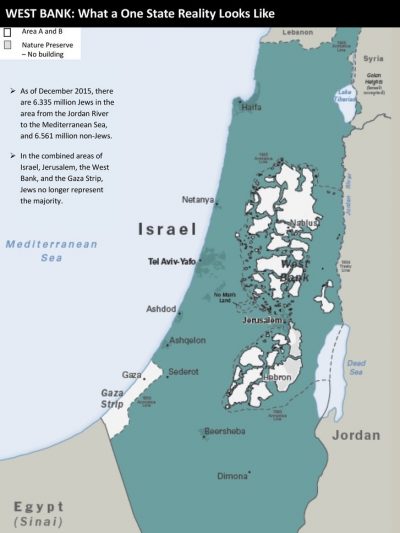
On July 8th, The New Yorker published a short piece by Adam Entous, under the graphic above, titled “The Maps of Israeli Settlements That Shocked Barack Obama.” In the article, Entous purports to tell us the heretofore unknown inside story of how the Obama administration came to the surprising realization that Israeli settlements were taking over the West Bank. In the kind of irony The New Yorker might best appreciate, the magazine’s latest promotional tag line is: “Fighting Fake Stories With Real Ones,” and this Adam Entous article is the epitome of fake.
As Entous narrates it, in 2015, the third year of Obama’s second term, as his “Presidency was winding down,” a gentleman called Frank Lowenstein—who was, and still is, the Special Envoy for Israeli-Palestinian Negotiations and Senior Advisor to the Secretary of State—stumbled upon a map of West Bank settlements “that he had never seen before.” Though Lowenstein—as, you know, Special Envoy for Palestinian Negotiations and all—had seen “hundreds of maps of the West Bank” and had one “adorning” his office, this “new map in the briefing book” was a revelation to him. It showed clearly that “not only were Palestinian population centers cut off from one another but there was virtually no way to squeeze a viable Palestinian state into the areas that remained.”
Shocked, shocked, Lowenstein scurried off to show the map to Secretary of State John Kerry, telling him: “Look what’s really going on here.” After studiously having the map’s information “verified by U.S. intelligence agencies,” Kerry then unfurled the map on a coffee table in the White House for President Obama to see. As Ben Rhodes, “one of Obama’s longest-serving advisers,” recounted, Obama, too, was “shocked” at Israel’s “systematic” use of settlements to “cut off Palestinian population centers from one another.”
All of this shock was then translated into action. Of the rhetorical sort. Kerry “incorporated [the key findings] into … speeches and other documents, and Lowenstein “walk[ed] [the Israelis] through” those findings—though he “didn’t show the maps to the Israelis.” (Because what? He didn’t want to “shock” them? Didn’t want to make the case to them too strongly, lest it upset them? Didn’t want to have to apologize? [see below] Pause for a moment, or more, to consider that demurral, which remains unexplained by Entous or Lowenstein. It’s the kind of withholding of information one would do in the face of an innocent child one wants to protect, or in the face of a more powerful superior one does not want to annoy. What is the place for such reticence in the relation between the United States and Israel?)
Capping off this new wave of decisive rhetorical action, driven by the “alarm” over what he saw in the “maps” (now plural), President Obama “decided to abstain on a U.N. Security Council resolution condemning the settlements.” In the true punchline of the article, Entous presents this abstention as “Obama’s final act of defiance against Benjamin Netanyahu… before Donald Trump took office and put in place policies that were far more accepting of the settlers.”
All in all, this article presents a perfect exemplar of ideological production: it produces without recognizing the bizarre, nearly delusional aspects of liberal ideology in its current state; for the author and his likely readers, it shows the faults of that mindset but does not see them, and in fact turns them into a story re-confirming the virtue of those—whether author, reader, or subject of the story—who hold that mindset. It’s not only fake; it’s a fake-out.
Let’s walk through all the possible meanings of this article.
Either:
1) The story is true. Entous, using his reliable, inside-the-room sources and direct quotes, has accurately reported something that actually happened. Harvard-educated Barack Obama and his team of oh-so-smart and-well-educated foreign-policy wonks—Yale-educated Secretary of State Kerry and Special Envoy for Palestinian Negotiations Frank Lowenstein, and Rice- and NYU-educated Ben Rhodes (whose brother, David, is President of CBS News)—were completely unaware of what the Israelis had been doing for the 48 years before they just happened to see that map. Neither Barack Obama nor John Kerry during their careers as senators and presidential candidates, nor Obama, during over six years as President, had ever imagined any such thing.
They must have missed this UN map, showing in red all the West Bank areas inaccessible to Palestinians, which has been around since 2009:

And they must have missed this one, also widely available since 2009, showing Israel’s relentless theft and pulverization of Palestinian land. This is the map that MSNBC apologized for showing to its viewers:
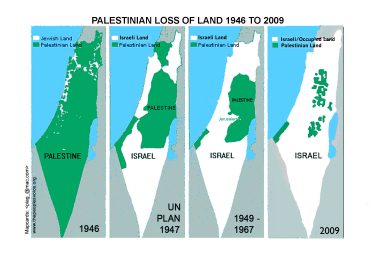
So, in this case, if this story is true, Obama and his team are as politically stupid as Trump and his, regarding Palestine at least. If this story is true, it means that years of studying in the highest academies of the empire and working in the highest levels of political power may only yield abysmal ignorance regarding one of the most important issues in the world.
Which is, in fact, quite possible.
In a meeting at the Left Forum last year, Andy Trimlett, who produced and directed the fine new documentary, 1948: Creation and Catastrophe (which I supported on Kickstarter), told of how he was able to get a Master’s degree in Middle East Studies from the University of Washington while learning virtually nothing about what the creation of Israel entailed. He’s not the only person I’ve heard that from.
So, in his acerbic tweet, the excellent British journalist Jonathan Cook may be (probably is) right in his skepticism regarding this New Yorker story, but he may also be underestimating the political vacuity of the “educated” American, especially regarding Palestine and Israel:
The New Yorker insults its readers’ intelligence with this article claiming that Obama officials only worked out – accidentally – in 2015 that Israeli settlements had taken over 60% of the West Bank. Who could have guessed what Israel was up to?! — Jonathan Cook (@Jonathan_K_Cook) July 10, 2018
Or:
2) The story is not true. Obama and Co. knew very well, all along, what Israel was doing, and they are now putting out this story—a flat-out lie–because… Well, maybe because after the Gaza massacre, with the tide turning among the Democratic constituency, to exacerbate the image of Trump as the absolute villain, etc., the Obama team, as an exemplar of establishment Democratic liberalism, wants to pose as naive innocents rather than the conscious collaborators with ethnic cleansing they were and still are. They really want The New Yorker’s readership to have that image of Obama as the one who continually “defied” Netanyahu, versus Trump who is now capitulating to him.
That, too, is a flat-out lie, as anyone who isn’t mis-educated into political stupidity by the media, the politicians, and the highest academies of the empire knows. The whole “Obama’s final act of defiance” punchline, which is in Entous’s voice, makes the story fake, even if it’s true. There was no series of “acts of defiance” by Obama, of which the lame-duck abstention on the Security Council resolution was the “final” one.
It’s fair to say, and to his credit, that Obama acted against Netanyahu’s wishes in accepting the Iran deal, which Trump has abrogated. And Obama made good noises, from early in his administration, about the dangers of Israeli settlement construction—which, of course, indicates that he knew about all those “systematic” problems before he discovered The Map. But he, like his predecessors, did nothing about it. He, like they, enabled and supported the systematic, two-state-destroying settlement of the West Bank, and continually supported Israel in whatever violence it wanted to do to the Palestinians—including bombing the crap out of them in Gaza, twice.
No slouch in that regard, Obama was the first American President to give bunker-buster bombs to Israel—secretly, precisely because he had publicly said Israel had to curtail settlement construction in exchange for such gifts and didn’t want it to be known that he was capitulating. He was also the first American President to demand that “Palestinians must recognize that Israel will be a Jewish state”—a new, gratuitous, and excessive demand, insisted upon by Netanyahu. The lame-duck abstention on the Security Council resolution cost Israel nothing. Overall, Obama’s Palestine-Israel policy, consistent with American policy over decades, was one of continual capitulation to the will of Israel–including specifically on settlements. That is not some new policy “put in place” by Donald Trump.
And, if the story is not true, then
Either:
2A) Adam Entous and The New Yorker—that oh-so-intelligent, sophisticated, and “reliable” journal—fully and sincerely believe the fake story the Obama people are putting out, and are communicating that bullshit to you in good faith, as what they think is true, in-depth knowledge of an important aspect of American foreign policy that you should have. In which case, Entous and The New Yorker are as stupid and gullible as any Trump supporter.
Or,
2B) Entous and The New Yorker know very well this is a fake story that Obama and his people are putting out, and they are consciously collaborating with them to get you to believe something they know to be untrue. (And the lite, bad faith version of this—that they can deny that they “know,” even if they suspect, the story is not true, because they take these— i.e., their—people at their word, share their objectives, and don’t ask too many questions—is no less deceptive and pernicious.)
Why would they do this? Because it’s the tortured-humanitarian version of Obama’s and the liberal Democrats’ implication in the colonization of Palestine that they want you to have. And because it helps enforce the fairy tale of how the good, progressively-intentioned American presidency under Obama has been completely overturned by the bad, anti-American-values presidency of Trump.
So, in any possible reading of this article, it’s a damning indictment of the liberal ideology embodied by Obama Democrats and/or by an iconic media outlet of highbrow culture. In any possible reading, someone’s a political fool. In option 1, it’s a true story, and Obama and his team were terribly ignorant fools who should not have been allowed near the responsibilities of the Presidency; in option 2, it’s a fake story, and Entous and The New Yorker have themselves either been fooled by, or are complicit in trying to fool you with, the Obama team’s mendacious attempt to create a false image of themselves, and a phony nostalgia about American politics. There is no option 3.
In all options, of course, the target of the tomfoolery is the audience, the likely reader of The New Yorker. Indeed, in option 2B, which gets Jonathan Cook’s vote (and mine) and is at least as likely as any other, the reader is the only one being fooled. The article, and the ideology, counts on the reader not noticing that these are its only possible—and all quite damning—meanings. Any reader who doesn’t notice this is totally captured within, and faked-out by, the ideology the article reproduces.
There’s no bigger problem in the United States today than the citizenry’s widespread mis-education into political gullibility, not to say stupidity, and it’s the height of foolishness to think this is only a problem of Republicans and rightists, of those who read Breitbart and not those who read The New Yorker, or of those who finish their education at high school and not those who get it finished off at one of the higher academies of the empire.
As I’ve said before, America is now a ship of fools, with a thousand captains barking fake orders. Reader, beware.
Israeli Police Ban Academic Conference In Jerusalem

IMEMC News – July 14, 2018
Dozens of Israeli police officers prevented Palestinian academics, intellectuals and religious leaders from holding a conference Saturday at a Palestinian college in Sheikh Jarrah neighborhood, in occupied Jerusalem. The Israeli officers also issued an order shutting the educational facility down.
The officers, accompanied by security officials, surrounded the Arts Campus (Hind al-Husseini Campus) of Al-Quds University, in Sheikh Jarrah, and prevented the Palestinians from holding the two-day planned Fourth Academic Conference on Islamic Waqf (Endowment) in occupied Jerusalem.
The WAFA Palestinian News Agency said the conference was organized by Waqf and Heritage Reservation Society and the Islamic Supreme Committee, in Jerusalem, and was funded by the Jerusalem Waqfiya Fund headed by Palestinian businessman and philanthropist Munib al-Masri.
WAFA added that the police detained al-Masri, and took him to an interrogation facility, in occupied Jerusalem.
The attack is the latest in a series of Israeli violations targeting conferences, meetings and various social, religious and political activities in the occupied city, as part of its attempt to solidify its full control over all aspects of life in Jerusalem.
Following the attack against the education facility, the Palestinian Education Ministry issued a statement strongly condemning the Israeli violation, and its constant attempt to disrupt the cultural and educational process in occupied Jerusalem.
The Health Ministry also denounced the illegal Israeli order shutting the campus down until further notice.
It said the invasion is part of Israel’s ongoing crimes and violations against the Palestinian people, including their educational facilities.
The Ministry added that Israel is encouraged by the deadly silence of the international community, and the unconditional support it receives from the United States.
“We have seen how Israel demolished a school in Yatta, near Hebron, how the soldiers surrounded al-Khan al-Ahmar, near Jerusalem, including its school,” the Ministry said, “Israeli is imposing severe restrictions on teachers and students, which is in serious violation of International Law.”
It called on all local, regional and international media and human rights organizations to expose the Israeli violations, and act on protecting the Palestinians and their basic rights to live in peace, without the constant harassment, violations and ongoing threat of violence by the occupation, endangering the children and the entire educational process.”
Under international law, East Jerusalem, which fell under Israeli occupation along with the West Bank and the Gaza Strip in 1967, is an occupied Palestinian city, the capital of the future independent Palestinian State.
Neocons Panic As Trump-Putin Meeting Could Mark Close Of Syrian Proxy War
By Tyler Durden | Zero Hedge | July 13, 2018
When multiple op-ed pieces appear in the pages of the New York Times, Washington Post, and the CFR-owned Foreign Affairs authored by neocons simultaneously pleading with Trump Don’t Get Out of Syria(!) all within the same week, this is typically an indicator that the president is about to do something good.
Trump is set to meet with Putin one-on-one this coming Monday in Helsinki after a contentious NATO summit and a sufficiently awkward visit with Theresa May, and mainstream pundits’ heads are exploding.
The Post’s Josh Rogin warns, Trump and Putin may be about to make a terrible deal on Syria, and Susan Rice suddenly emerges from obscurity and irrelevance to say in the Times that Trump Must Not Capitulate to Putin while urging the administration not to “prematurely withdraw United States forces [from Syria], thus ceding total victory to Russia, Mr. Assad and Iran.” From North Korea to Afghanistan to Syria to Ukraine, Rice advises the typical regime change script of “harsh additional sanctions” anywhere the dictates of Washington are not strictly adhered to.
Similarly, Eli Lake links together the main regime change wars begun under Obama while lamenting their potential winding down as a result of Putin and Trump meeting as indicative of living in “some alternate universe.” “The price of Russian cooperation in Syria cannot be U.S. capitulation on Crimea,” Lake writes, and further calls such a possibility “the most dangerous possible outcome.”
The Kagan-led neocon think tank ISW, meanwhile, is outraged(!) the administration appears to lack “the will to use” America’s military might to counter Assad, Iran, and Russia, saying “the United States should invest now in building leverage for future decisive action.”
And then there’s Senator Lindsey Graham’s meltdown on Twitter this week in reaction to both the Syrian Army victoriously raising the national flag over Daraa and Israeli Prime Minister Benjamin Netanyahu telling President Vladimir Putin during a summit that Israel has no problem with Assad staying, so long as Israel can preserve “freedom of action” if attacked.
In a significant change of posture toward Damascus, Netanyahu told reporters in Moscow, “We haven’t had a problem with the Assad regime, for 40 years not a single bullet was fired on the Golan Heights.”
This was enough to send Graham’s head spinning: “Radical Sunni groups will say – correctly – that Assad is a proxy of Iran and the Ayatollah. It means the Syrian war never ends and ISIS comes back,” he said in a strange twist of logic that gives credence to the arguments of terror groups.
Israel’s Haaretz newspaper featured Sen. Graham’s reaction:
‘Without Assad’s blessing, the flags of Hezbollah and the Iranian Revolutionary Guard would not be on Israel’s front door,’ Graham tweets in response to Netanyahu claiming Israel has no problem with Assad.
As Trump readies for Putin summit, saying “He’s not my enemy,” interventionistas are raging:
Senator @LindseyGrahamSC continues his Twitter storm against the Netanyahu-Putin meeting https://t.co/MAjs8VA30Y
— Barak Ravid (@BarakRavid) July 12, 2018
#Putin is not our friend nor merely a competitor. Putin is our enemy—not b/c we wish it so, but b/c he has chosen to be. He chose to invade Ukraine & annex Crimea. He chose to help Assad slaughter Syrians. He chose to attack our election & undermine democracies around the world.
— John McCain (@SenJohnMcCain) July 12, 2018
In the past months there’s been widespread reporting on a “secret” deal brokered between Russia, Israel, and Syria, which reportedly involves the Syrian Army agreeing to keep Iranian forces away from the ongoing successful campaign along the Israeli and Jordanian borders, especially the contested Golan Heights.
Netanyahu now says, fresh off his Moscow visit, that Putin agreed to restrain Iran in Syria, but that ultimately Assad will take back all of Syria.
The New York Times reports this hugely significant acknowledgement and surprising change of tune from the Israeli PM:
Israel, he said, did not object to President Bashar al-Assad’s regaining control over all of Syria, a vital Russian objective, and Russia had pushed Iranian and allied Shiite forces “tens of kilometers” away from the Israeli border.
The NYT continues:
But a commitment to keep Iranian forces tens of kilometers from Israel was a far cry from ejecting them completely from Syria, which Mr. Netanyahu has been lobbying Mr. Putin to do. And even that commitment was not confirmed by Russian officials.
… So a willingness to accept Mr. Assad’s resumption of control over all of Syria is no small concession, said Amos Yadlin, a former chief of Israeli military intelligence who now heads the Institute for National Security Studies in Tel Aviv.
“Nobody can these days destabilize the Assad regime,” he said. “The only one who can do it is Israel. And the Russians know that very well. So to get a commitment from Israel not to destabilize Syria is something that Russia will value very much.”
The neocon pundits’ last hope for military intervention in Syria has remained Netanyahu, and to see him fold must feel like a swift unexpected punch in the stomach, but more crucially the Syrian diplomatic cards have fallen in place just days before Monday’s Trump-Putin meeting.
President Assad has long vowed to liberate “every inch” of sovereign Syrian territory, something which but two years ago appeared impossible, yet which now looks increasingly inevitable. Should the Trump-Putin summit result in a green light that ensures Moscow and Damascus remain in the driver’s seat and set the terms for Syria’s stabilization, we could be witnessing the final diplomatic chapter in this dark seven-year long proxy war.
However, Trump continues to be urged from various corners of the beltway foreign policy establishment to salvage and preserve what he can of the open-ended US troop presence in eastern Syria: the US must “preserve its interests in the conflict, namely… constraining Iranian influence in the country” as one Foreign Policy essay argues.
For months now, Trump has talked of US military withdrawal from the country — which the Pentagon in public statements has put at over some 2,000 troops — a proposal which hawks within his administration have pushed back against every time.
And then there’s the clearly observable pattern that seems to repeat whenever the administration announces it is poised to pull out of Syria. Indeed it seems to occur every time the Syrian Army is on a trajectory of overwhelming victory: an ill-timed and strategically nonsensical mass chemical attack on civilians supposedly ordered by Assad — inevitably giving the West an open door for military intervention, new rounds of crippling sanctions, and yet more international media condemnation heaped on Damascus.
Precisely this scenario occurred just days after President Trump declared in the last week of March of this year that he wanted a complete US military pullout from Syria. What then immediately followed was the April 7 “chemical attack” provocation in Douma — just the thing that brought Trump’s planned pullout to a grinding halt, instead resulting tomahawk missiles unleashed on Damascus.
Should Trump and Putin ultimately come to a lasting settlement on the Syria issue which results in US troop withdrawal from Syria, will the international proxy war come to a close?
Or will we witness yet another last minute “mass casualty event” or other other provocation that pulls the US, Israel, and Russia into yet deeper direct military confrontation?
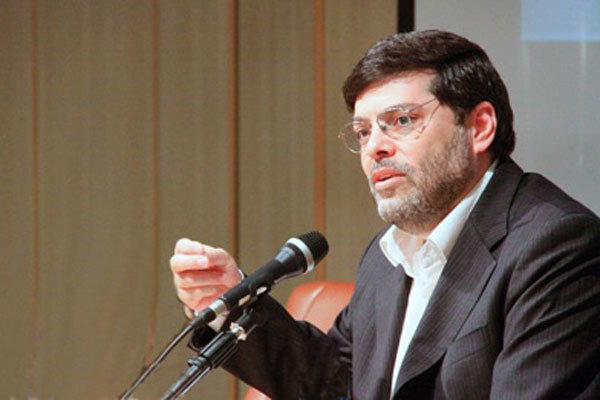
Dr. Mohammad Marandi: Israel, Saudi Arabia and the UAE Have Been Cooperating Closely for Many Decades Now
American Herald Tribune | July 13, 2018
Mohsen Abdelmoumen: What is the immediate impact on the Iranian people of the Trump administration’s exit from the Iran nuclear deal?
Dr. Mohammad Marandi: Obviously, it is going to have a short term negative impact. People are concerned about the effect it will have on the economy and Iranian currency has dropped significantly. However, I believe that in the midterm the economy will stabilize, and as Iran reorientates its economy, trading partners and strategic partnerships things will stabilize. In the long term, I think Iran will probably even benefit because the US will no longer have any leverage that it can use against the country and its people.
Are not the economic sanctions imposed by the Trump administration intended to provoke disturbances within the Iranian population in order to change the power in Iran?
Without a doubt. Actually, just recently in a speech in France to the MEK terrorist organization, a cult group which has killed 17 thousand Iranians through assassinations and bomb attacks and has also fought for Saddam Hussein, Rudy Giuliani, Trump’s lawyer and close friend, admitted that the disturbances in Iran are not spontaneous and that they are carried out by their people. That does not mean there are no ordinary people who protest here and there, but the foreign role is obvious and we can see it through the western, Israeli, and Saudi, funded Persian media outlets like BBC Persian and VOA among others that attempt to create tensions and fear among Iranians.
Do you think there is a special program to assassinate Iranian scientists as was the case with Iraqi scientists where some sources have spoken of the existence of a special CIA unit responsible for assassinating scientists?
I have no idea about that, but we do know that Mohammad bin Salman has said in public that he wants to take the war into Iran and after that we saw the terrorist attacks on Tehran and an increased number of attacks alongside the Pakistani-Iranian border as well as the border between Iran and Iraq Kurdistan.
What is the exact role of the Zionist entity of Israel and its services in the assassination of Iranian scientists?
Israeli intelligence and the MEK terrorist organization worked together in this regard. In addition, Western intelligence agencies have in the past passed on IAEA information on Iranian scientists to the Israelis thus helping them carry out a number of murders.
What do you think of the alliance between the Saudis and the Israelis? In your opinion, is it tactical or strategic?
The alliance between Israel, Saudi Arabia and the UAE among others is not new at all. They have been cooperating closely for many decades now, but these Arab regimes have always been afraid to make this alliance public. However, Trump is putting a lot of pressure on these regimes to come out of the closet, especially because he wants to impose his so called deal of the century on the Palestinian people in order to destroy the Palestinian nation.
In your opinion, can Europe play a role in maintaining the nuclear agreement?
It’s possible. However, I am skeptical about the EU’s intentions and I am even more skeptical about their ability to grow a backbone in face of persistent American violations of their sovereignty and threats against their businesses and citizens.
In your opinion, why is it that Israel that massacres the Palestinian people has never been subjected to sanctions?
I think it is widely known that the Israeli regime is allowed to implement apartheid policies, carry out ethnic cleansing and colonization, the bombing of neighboring countries, the killing of civilians, the arrest children, and the confiscation of land.Western countries will give them blanket support no matter what the regime does.
What is your analysis of the situation in Syria? Can we say that Daesh is defeated definitively or is it moving towards reorganization?
The extremist groups including Daesh that were supported by western intelligence services and regional client regimes have been severely weakened and the Syrian Arab army and government have gained the upper hand. But the war is not over, al-Qaeda and other extremist groups continue to get foreign support and Western countries and media outlets have been trying to give cover to these extremist groups by calling them “moderates” and “rebels”, whereas in reality their ideologies are very similar to ISIS.
What do you think of the position of Morocco that has just cut off its relations with Iran by accusing Hezbollah of having armed the Polisario Front? Don’t you think that this maneuver bears the signature of the Saudis, Israelis and Americans?
I think it is quite clear especially taking into account the timing of the accusations that the Saudis and probably countries like the US and the UAE are behind this. But I do not have any specific information.
Why do you think Westerners are silent, both the media and the political institutions, in the face of the carnage that Saudi Arabia is committing in Yemen?
It is because of Saudi oil wealth, and because the destruction of Yemen is in the interest of the Saudi and Israeli regimes. Therefore, Western governments and western media outlets will not do anything meaningful to prevent the massacres or starvation. This is just one example of many. They did the same thing in Libya, Syria, Iraq, Bahrain, and Afghanistan.
Interview realized by Mohsen Abdelmoumen
Who is Dr. Mohammad Marandi?
Born in 1966 in Richmond, Virginia, Mohammad Marandi is the son of Professor Alireza Marandi, a former Iranian Minister of Health and a former member of the Iranian Parliament. Mohammad Marandi lived until he was 13 in the United States before joining Iran. He is a political analyst and expert on American studies and postcolonial literature. Dr. Marandi is a graduate of the University of Tehran and the University of Birmingham where he received a PhD in English Literature. He teaches English Literature and Orientalism at the University of Tehran where he is head of the graduate program in North American Studies.
Conspiracy of Silence: Israeli Government Still Covering Up Historic Atrocities
Sputnik – July 12, 2018
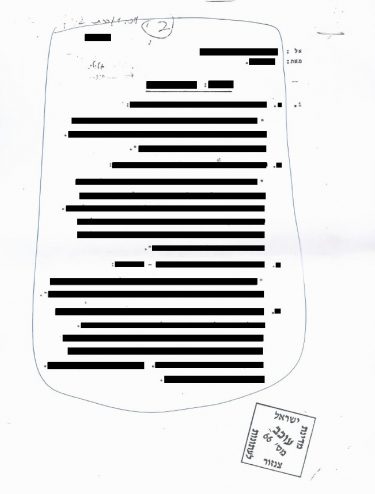
In 1948, just prior to the foundation of Israel, six Polish Christians were executed without trial in Tel Aviv and Jerusalem by the fledgling country’s Jewish army, the Haganah. An investigative analysis on the killings – dubbed the Riftin Report – was compiled for future Prime Minister David Ben-Gurion, but has never been made public until now.
Official refusal to disclose the document comes despite fervid recommendations by chief Israeli state archivist Dr. Yaacov Lozowick, and the campaigning of the investigative Akevot Institute.
According to Israeli official secrecy laws, the report should’ve been made accessible to the public in 1998 — however, state archivists argued it should remain classified. Dr. Lozowick sought to reverse this decision in 2014, but his recommendation was opposed by Ilana Alon, Director of the Israeli Defense Force and Defense Establishment Archives.
Lozowick’s case for declassification is available via various web resources. In it, he made clear there was “no justification” for refusing to publish the report after so many years had elapsed, and doing so demonstrated “the state has something to hide”.
 “If after the passage of more than half a century the state is still concealing certain files from the public, it’s only because they contain particularly dark secrets — that is what the reasonable individual understands. A democratic society is obliged to allow a free discussion of its wars. The discussion is a guarantee of democratic resilience. This file perhaps contains material for such a discussion, but that is a reason to open it, not close it,” he explained.
The state archivist’s impassioned plea was nonetheless ignored, and the government committee overseeing the release of classified files blocked its publication for a further five years on unarticulated grounds — however, ministers did not restrict citizens from viewing the report ‘in-the-flesh’ at the Israeli archives. As a result, Akevot Institute researchers located and digitized a copy of the Riftin Report stored at the Yad Tabenkin Archives and prepared to publish it on their website, submitting its version to the Israeli Military Censor for review in November 2017. Several months later, they received a response.
“After Akevot issued a letter demanding the Censor give its decision within seven days, Akevot was provided with a copy of the report with each of the pages circled and stamped with the word “on hold”, in other words, barred from publication pending the final decision of the Military Censorship [committee]. Despite several reminders, for the past eight months, the [committee] has yet to provide a decision whether to allow the publication of this March 1948 document,” the group writes.
For the organization, the Riftin Report saga is a palpable microcosm of the wider issue of Israeli government determination to suppress archival material implicating the state in atrocities carried out against civilians when the country was in its infancy. For instance, the Military Court of Appeals is currently reviewing a historian’s request to declassify files relating to the 1956 Kafr Qasim massacre — an application steadfastly opposed by the Ministry of Foreign Affairs, Israeli Military Censor, and IDF Information Security Department. Authorities likewise repeatedly blocked attempts to declassify files related to the 1948 Deir Yassin massacre, although ultimately settled for publishing heavily redacted versions due to public pressure. … continue
Israel is legitimising ‘piracy’ by seizing Freedom Flotilla
MEMO | July 12, 2018
An Israeli court decision to approve the blocking of humanitarian ships which aim to break the illegal siege of Gaza is a “pre-emptive attempt to legitimize Israeli piracy in international waters”, activists have said.
Israeli media reported that the Jerusalem District Court issued a temporary confiscation order yesterday for two Norwegian ships which are sailing to Gaza in an effort to break the 12-year blockade of the Strip in the coming days.
The court’s decision allows for the boats to be towed to an Israeli port where their value, thought to be $87,600, will be donated to Israeli “terror victims and their families as compensation”.
Read: Israeli navy intercepts humanitarian flotilla from Gaza
Organisers of the flotilla say that if they succeed in reaching Gaza they will donate the ships to civilian organisations and local fishermen.
Responding to the decision, head of the International Committee for Breaking Gaza Siege and founder member of Freedom Flotilla Coalition, Zaher Birawi, said:
This decision is a dangerous precedent and a pre-emptive attempt to legitimise Israeli piracy in international waters, but this will not absolve the occupying state of its legal responsibility in the event of attacks on ships carrying peaceful activists demanding the breaking of the illegal and immoral blockade of Gaza.
“We confirm that the decision of the central court in Jerusalem will not affect the plan of the fleet of freedom alliance and the programme of the voyage of ships which plans to sail from Italy to Gaza in a few days.”
Hassan Nasrallah: Resistance victorious in Gaza, Syria & Iraq, Hezbollah Ready to fight Saudi-US Coalition in Yemen
Speech by Hezbollah Secretary General, Sayed Hassan Nasrallah, on June 29, 2018
[…] Regarding the situation in the Middle East, I also have some issues to address, in a quick and synthetical way as well.
The first point is the Palestinian issue. It is clear that the developments, as we say in the Lebanese political language, the advances (meant to prepare the success) of the ‘Deal of the century’ began to be implemented with force. [Jared] Kushner has roamed the region for a long time, as well as Trump’s special envoy (in order) to (prepare) the peace initiative, what is known as the peace initiative. It is clear that serious US and Israeli efforts to ensure the success of the ‘Deal of the century’ are actively deployed. It is no longer empty words, mere expectations of journalists or such. We may be very close to the official US announcement on this agreement and on this really infamous step.
This is why at the stage where we are, all political leaders and all people who care about the Palestinian cause must of course follow these movements and developments to see what can be done (to neutralize them), and this, according to me, on several fronts.
Today, it is through this prism that we must consider what is happening in Palestine, as well as what is happening in the region, what has happened and is happening in Jordan, and also, as regards Lebanon, the disputes about the border, discussions on the Shebaa Farms (occupied Lebanese territory), on land and sea borders (with Israel): sometimes, these issues are not related to the ‘Deal of the century’, but sometimes they fit into what is known as the ‘Deal of the century’, and we must then be more careful and precise about it, of course with the strong commitment of all Lebanese to recover all their territories and get all their rights over our territorial waters.
Similarly, what is happening in Syria, when we will discuss it in the next step, we must consider it partly in this context, along with the US withdrawal from the nuclear deal and the continued pressure on Iran, whether political pressure, psychological warfare, economic pressure, threats of sanctions, the fact that Iran and Iranian oil (are embargoed) worldwide… All this, we must interpret it within one frame, the frame of the major US project in our region today, to which they will give (absolute) priority, ie the ‘Deal of the century’ which means the liquidation of the Palestinian cause.
This project should be followed closely and with vigilance, and that’s why everyone concerned must think about what to do, how they will fight, face and resist, and we already talked about it in detail (it is important that no Palestinian sign this agreement).
Also on the Palestinian issue, we must pay tribute, especially now, during these hours (of Friday afternoon), to all the men, women, young and elderly who gather (massively) on Friday afternoon on the border strip which separates Gaza from the remainder of Palestine occupied in 1948. These demonstrations of the March of Return prove the determination and perseverance of the Palestinians, and the continuity of this determination and of this (Resistance) movement. Because during all the past weeks, as should know those who follow these events, Israel has made every possible effort in psychological warfare, security pressure, mobilizing all its military and security capabilities towards the Gaza Strip, up to striking the young throwing kites, in addition to various regional pressures on the Palestinians to get them to despair and make them give up the March of Return. The March of Return represents a great challenge which is one of the few remaining opportunities for the Palestinian people.
And the third point is that we must pay tribute to the courage and boldness of the leadership of the Resistance in Gaza, the leaders of the (different) factions of the Resistance, and to the audacity and courage of the Resistants who demonstrated, during these last days and in recent weeks, that the equation of retaliation against any aggression was well in place.
This Israel who thinks he can bomb and kill (with impunity), and in return, he will not suffer any retaliation whatsoever, the Palestinian Resistance, during the past few days, has passed that stage and demonstrated the reality of this equation. We can truly say that they have demonstrated it, and this is the result of their boldness, their courage and their wise and just planning.
Anyway, whether it be the confirmation of this equation, the support to the Palestinian people, especially in Gaza, for the March of Return to continue, or a firm stand alongside the Palestinian people to deal with concrete measures being implemented today for the ‘Deal of the century’, everyone must assume his responsibility for everything that was said during the last weeks and months.
My second point about the regional situation is Syria. I have two points about it.
First point, the developments in southern Syria in recent days and today. I was in contact with the brothers (from Hezbollah) present there just a few moments ago, and (I can confirm that) the data that you hear in the media (on the dazzling success of the Syrian Arab Army) are true, and what is not public yet is even more important.
All data indicate a total collapse of the armed groups, which are completely abandoned by their (popular) base, in case they ever had one, with a strong impetus of the people to return to the State and to the bosom of the State, as has been expressed by a large number of towns and villages. And it may even be that data confirms that it is not only the western part of the Deraa region (whose liberation) must end today or tomorrow, but the entire southern region, whether in Deraa or Quneitra: all armed groups are in a state of collapse and defeat, and there are no prospects for more fighting (from them).
And anyway, the data also indicate that many of these (armed) groups have begun to review their calculations and to head towards the search for agreement and reconciliation. And in this region, only the darkest and the most obscurantist part controlled by ISIS will remain, whose fate (defeat) will in any way be clear and inescapable during the next step.
In a nutshell, in the south of Syria, we are facing a significant development and a great victory against all the armed organizations that were led and protected by the United States, and assisted and supported by Israel, those organizations who received all possible forms of support from some regional countries.
And what is happening in southern Syria, and happened in recent weeks in Manbij with the Kurdish-Turkish-American question, has many major and eloquent evidences of which we will talk (in detail) another time, because I do not have time today. And I believe it is in our interest that the battle in southern Syria comes to an end first before we talk about this evidence and these lessons of which we must all benefit in the light of this great decisive battle that is being waged in Syria for over 7 years.
The second point about Syria is that at the Syrian-Iraqi border, just a few days ago, enemy aircraft struck positions of factions of the Iraqi Resistance that operated there. The faction that was targeted is the Hezbollah Brigades in Iraq, which suffered many martyrs and wounded. Of course, this is an important and dangerous event, even if some may think (wrongly) that it is (already) in the past and that there will be no consequences.
First, I would like to extend to the families of those noble and dignified martyrs my congratulations (for the blessings and honor conferred by) this martyrdom and my condolences for the loss of loved and beloved ones, as well as to my brothers, dear and beloved leaders of the Hezbollah Brigades in Iraq and all their mujahedeen (fighters). And we also have to extend our congratulations and condolences to all the factions of the Resistance in Iraq to honor their martyrs, because martyrs of each faction are the martyrs of all.
And I would also like to take this opportunity to thank them for all their assistance and support in Syria (to fight terrorists). In Iraq, there is no doubt that all these factions, gathered behind the Hachd al-Cha’bi (popular mobilization), have had a real and important role of auxiliary force in defeating ISIS, the obscurantism of ISIS, the darkness and barbarism of ISIS, and the international and regional powers that stand behind ISIS. But ultimately, in Iraq, they were defending themselves, their holy places, their people and their nation. We must remember the jihad (struggle) of these Iraqi brothers, their sacrifices, their martyrs, their wounded, their perseverance, determination and presence in Syria, which continue until today, especially those who are present at the border between Syria and Iraq, to eradicate the last throes of life in this monstrous body shaped by the United States and Israel in the region and called ISIS. And we thank them for the extent of their support, their help and their presence, because as we have said during these 7 years, the battle in Syria is not only the battle of Syria, but it is the battle of Lebanon, Iraq, Palestine, Syria, the Middle East and the future of this region.
Also, our brothers in the Hezbollah Brigades and in the rest of the factions of the Iraqi Resistance announced that they are investigating to ascertain which part (USA? Israel?…) hit these positions and caused so many martyrs and wounded, and that when the identity of this part shall be established with certainty, the attackers will be punished. This is a wise and natural position, and we pledge our support for any decision that these Resistant factions of Mujahideen (fighters) will make.
Yes, dear and noble brothers, yes, I declare to all peoples of the region: to our brothers in Palestine, in Syria, in Iraq, in Lebanon, in Yemen, across the whole region. Wherever the Resistance is struck and its blood is shed unjustly in acts of aggression, this aggression must not remain unanswered, without retaliation and without punishment. Because our enemies only understand this logic. This is what experience teaches us.
We can not count on either international law or on any moral principle, whether in Yemen, Palestine and in all that is happening in the region, and even in the United States. The image of immigrant children separated from their fathers and their mothers, their isolation clearly shows the monstrous reality of President Trump and his administration. Then they backed off because of pressure, but it does not change the truth of his being. If people could see the true face — in religious terms, we speak about the appearance of the (Divine) Kingdom (the reality of our soul, to be unveiled in the afterlife) —, the true appearance of Trump, they would see a ferocious beast (instead of a human being). Who can do such things?
Anyway, we are in a region and in a world where if we do not defend our people, if we do not avenge our martyrs, if we do not chastise our enemies, their aggression will never cease. If we remain inactive in front of this aggression, it will happen again and again, and we will suffer more attacks and lose many more martyrs and wounded.
I hope that by the grace of God, our brothers from the Hezbollah Brigades and other factions of the Iraqi Resistance will quickly manage to establish the identity of the aggressors and to take the (retaliation) measures they deem necessary. It is their decision that no one can impose on them.
Hezbollah is ready to fight Saudi-US coalition in Yemen
I will address my final point about the regional situation, (Yemen), through (what was reported by) the media in recent days.
A few days ago, what we used to refer to as the Arab alliance, and is now referred to as the Saudi-Emirati alliance, but for our part we refer to it as the Saudi-American aggression against Yemen, the forces of the Saudi-American aggression against Yemen… These forces announced two news items, broadcasted by (official Saudi) channel Al-Arabiya, some Arab satellite channels, [Western news agencies & mainstream media] and also some Lebanese media have followed suit, considering these news sources as very reliable.
The first is that because of the bombing in a specific region of Saada, Hezbollah would have lost 8 martyrs, including commanders of Hezbollah. At the same time, they announced another piece of information – do consider these two pieces of information (together) – according to which 8 Hezbollah members were captured. That is to say that the liar who disseminates these news items claimed at one point that 8 members of Hezbollah were killed, and at another time said they were taken prisoner.
Anyway, after a few hours, they backtracked on the announcement of 8 prisoners, to which they preferred the announcement of 8 martyrs, because if there were prisoners, they should show them on television. And with certainty if there were prisoners, now or in the past…
You know that in recent years, in recent months, they have repeatedly claimed that they had captured a Hezbollah or Iran members (in Yemen), etc., good for them. Some time ago, they considered that they had got hold of a gem and made a fuss claiming they captured an Iranian in a region of Yemen. But it was later revealed that it was simply a Pakistani worker who had come to work in Yemen to earn his livelihood, and they got confused, being unable to distinguish Urdu from Persian.
Anyway, the information concerning prisoners died out of itself, and they stopped talking about it, but during 48 hours, they have not stopped talking about the martyrdom of eight Hezbollah members, including several commanders. I want to comment this information (to draw lessons) for both the past and the future, and I will also say a few words about the situation in Yemen.
First, throughout the past period, and until today, for various reasons and interests, we have not disclosed if we had a presence in Yemen or not. We have not addressed this issue. It is true that one day, I clearly said that we did not send fighters to Yemen, because our brothers in Yemen do not need fighters. Is there something else (counselors, military aid…)? We do not confirm it nor deny it, due to a number of interests. That’s the first point.
Second, whether we are present or not (in Yemen), I categorically deny this information that there would be martyrs of Hezbollah in Yemen, not during these last days nor during the past years.
Third, this is not the first time that the Saudi media evoke (falsely and without any evidence) Hezbollah martyrs or prisoners in Yemen.
Fourth, if we assume that one day this happens, and that members of Hezbollah are martyred in Yemen, I tell you frankly that we would not hide it, we would not be ashamed of it: on the contrary, we would be very proud and honored, and we would raise our head high because of these martyrs, if this was to happen one day. And on the contrary, we consider that we do not have to be ashamed if Hezbollah members fall martyrs in Yemen. We should rather be ashamed if we do not bring them the necessary assistance, if we do not provide what we hope or even dream of offering to the Yemeni mujahideen (fighters) and to the oppressed people of Yemen.
Therefore, let no one imagine that in Yemen or elsewhere (we hide our martyrs). If we have a martyr in Iraq, we acknowledge it. If we have a martyr in Syria, we acknowledge it. If a brother is arrested anywhere in Egypt or elsewhere, as has happened in the past, we are never ashamed of our actions, and we do not abandon our martyrs nor our prisoners. We are proud of them, proud of what they do, and we always declare it publicly. (I say this) as a basis for the future.
And so this question does not require that whenever news are spread about Hezbollah alleged martyrs or prisoners, the media contact us to get our denial. As long as we have not published a press release, that we have not talked ourselves of our martyrs to take pride in them, it means that there was nothing of the sort, and any such (propaganda) is fundamentally false and does not even need to be denied (as far as we are concerned). Let it be an established base for the future.
Fifth, about the situation in Yemen, anyway, they may have needed (false) information of this type that could go along the press campaign of Saudi media and of all those who are with them, whether the American media, the Gulf, etc, through recent weeks. Because what we have seen during the Battle of Hodeida, at the airport, around the town and in adjacent villages, and on the west coast of Yemen, is two scandals (humiliations). We witnessed two disgraces. A military disgrace in the field, and a media disgrace following military disgrace on the battlefield.
Regarding the military disgrace on the battlefield, for months, the United States and even, unfortunately, some European countries participating in this aggression – information evoke British, French and other Western countries’ participation – alongside the forces and states of the (Saudi) coalition, Saudi Arabia, the UAE, the group of Abd Rabbo Mansour, mercenaries from all around the world, aviation, a huge number of military vehicles, tanks and armored vehicles (were preparing for an attack). Military vehicles seem even more numerous than the soldiers themselves, from what we see on television. The preparations took place for months, and a fierce psychological warfare, pressures, bribery, intimidation, terror…
And despite all that, when they went down to the battlefield, they suffered a humiliating defeat. A defeat in every sense. And what happened on the western coast of Yemen in recent weeks and so far is actually, even by military standards, truly miraculous. Because the fighting there takes place between on the one hand the most powerful aviation, extremely powerful intelligence agencies, leading-edge technical and technological equipment, experienced commanders, mercenaries, armies, forces, against a fighting people with modest abilities, but with enormous faith and considerable confidence in God the Almighty and Exalted.
These Resistants are, truly, from what we saw in this fight, an incarnation of (the recommendations of Imam Ali to his son before the Battle of the Camel): “Plant your feet firmly on the ground. Lend your head to God (be ready for the ultimate sacrifice). Mountains may move from their position (because of the multitude of enemies), but you should not move from yours.” They are a model (of courage and victorious Resistance).
And that is why I am one of those who can talk about this in full knowledge because me and my brothers have a similar experience. We know what war is, we know what it is to fight against a powerful aviation, violent, ferocious, having unlimited direct capabilities, we know what Resistance, endurance and perseverance are.
And that’s why when considering the war in Yemen, and especially this last experience on the west coast, in Hodeida Airport and everything around this region, me, all my brothers and any Resistant in the world and anyone who knows the military equations and has military experience, we must bow our heads with respect and humility before these fighters, these Resistants, these heroes and their wise, courageous, firm and steadfast leaders. This is the truth, this is not an exaggeration, I do not aim to cheer, no.
And I say to these fighters: myself, with others, I am embarrassed not to be at your side. In my heart, when I see videos (of the fighting) on TV, these heroic acts, this legendary endurance, I keep telling myself: “If only I could be with you.” And I know that all my (Hezbollah) brothers feel exactly the same. And any dignified man in this world thinks the same thing: “If only we could fight alongside you. If only we could be with you. If only I could be one of your fighters, under the banner of your noble and courageous leader.” This is the truth. This faith and determination have inflicted this defeat (to the Saudi-US alliance).
And this is a great lesson that adds itself to the lessons of the Islamic Resistance in Lebanon, Palestine, Syria and Iraq. This is a lesson to all Arab and Muslim peoples: through faith, perseverance and determination, relying on the people and the brave, faithful and noble youth, we can face the most powerful tyrants, the most powerful armies and the most powerful arrogant bullies of this world, armies and security forces.
And there is also the media scandal: how many times have they said they took and occupied Hodeida Airport? But they could not provide any pictures, while we could see every day videos showing the presence of leaders of AnsarAllah (Houthis attacked by Saudi Arabia) in the airport. How many times have they said that they had arrived inside the city, inside the harbor before it was revealed that they did nothing of the sort?
Weeks of lies to the peoples of the region, the Saudi people, the people of the Gulf countries, the peoples of the world, before it was revealed that these victories had no reality outside the Al-Arabiya channel, nothing more, nothing less. And this is the yardstick with which we must measure the credibility of these media [Western press agencies & mainstream media included] that are completely detached from reality, both for Yemen and for everything else. [Such an AFP report was deleted but still appears in cache]
Along these lines, we must also add our voice and our thanks to the new Malaysian government, the new head of the Malaysian government, Mahathir Mohamad, and to the government and to the Malaysian Defense Minister who announced yesterday the withdrawal of Malaysia from this infamous alliance. And we hope that the rest of the Muslim and Arab countries, at least, will follow suit.
And I particularly call on the Sudanese President, the government of Sudan, the Parliament of Sudan and the people of Sudan. It is sad, really sad that the forces of the Sudanese army fight alongside those tyrants. It is truly appalling that the forces of the Sudanese army are engaged in a battle alongside the US, the West, the takfiris, Israel, allied to Saudi Arabia and others. It’s really disgraceful. Sudan, which had a significant presence and a strong commitment to the causes of the region, the Palestinian cause, many causes of the (Muslim) Community. I also insist on Sudan because of the spectacle of young Sudanese who are abandoned in the deserts, valleys and mountains of Yemen, without protection, without defense and without any support or assistance. Why are they killed? For what cause are they dying?
Anyway, we call for this and we hope that all (the countries of the Saudi coalition) will reconsider things (and withdraw). And we hope that the experience of the last battle on the western coast and all these open frontlines will allow Saudi Arabia, the UAE and those who stand by their side to learn the lesson, and understand that they face a people who will never surrender, who has a very high capacity of Resisting and shaping victories, that your battle has no horizon, and that you must answer all Yemeni, Arab, Muslim and international calls to end the war and aggression, to declare a cease-fire and direct you towards dialogue and national reconciliation, and to save Yemen and the Yemeni people, all the people of Yemen, all the tribes of Yemen and all Yemeni political forces of the consequences of this devastating and destructive war.
I’ll stop there, and as for the rest, if necessary, I will speak shortly.
May the peace of God be upon you, and His mercy and His blessings.
Translation: unz.com/sayedhasan (RSS)
Please support this work and subscribe to Sayed Hasan to get around censorship.
USS Liberty Survivor Named US Delegate on Gaza Flotilla
By Joe Lauria | Consortium News | July 9, 2018
Joe Meadors, a survivor of the 1967 Israeli attack on the USS Liberty, has joined the 2018 Gaza Freedom Flotilla as the delegate from the United States. He will board the Al Awda (The Return), which left Corisca Sunday night for the final 1,000 miles to Gaza. Al Awda is one of four boats on the 75-day voyage from Scandinavia.
Meadors was a signalman on the bridge of the USS Liberty, a surveillance vessel operating in international waters of the Mediterranean Sea near Gaza during the 1967 Six-Day Arab-Israreli war.
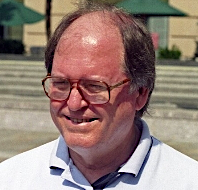
Meadors: From the Liberty to Al-Awda
Israeli war planes and torpedo boats attacked the vessel, killing 34 U.S. sailors and wounding 174 crew members.
A 2003 U.S. commission led by Admiral Thomas Moorer found:
“1. That on June 8, 1967, after eight hours of aerial surveillance, Israel launched a two-hour air and naval attack against USS Liberty, the world’s most sophisticated intelligence ship, inflicting 34 dead and 173 wounded American servicemen (a casualty rate of seventy percent, in a crew of 294);
2. That the Israeli air attack lasted approximately 25 minutes, during which time unmarked Israeli aircraft dropped napalm canisters on USS Liberty‘s bridge, and fired 30mm cannons and rockets into our ship, causing 821 holes, more than 100 of which were rocket-size; survivors estimate 30 or more sorties were flown over the ship by a minimum of 12 attacking Israeli planes which were jamming all five American emergency radio channels;
3. That the torpedo boat attack involved not only the firing of torpedoes, but the machine-gunning of Liberty‘s firefighters and stretcher-bearers as they struggled to save their ship and crew; the Israeli torpedo boats later returned to machine-gun at close range three of the Liberty‘s life rafts that had been lowered into the water by survivors to rescue the most seriously wounded;
4. That there is compelling evidence that Israel’s attack was a deliberate attempt to destroy an American ship and kill her entire crew; evidence of such intent is supported by statements from Secretary of State Dean Rusk, Undersecretary of State George Ball, former CIA director Richard Helms, former NSA directors Lieutenant General William Odom, USA (Ret.), Admiral Bobby Ray Inman, USN (Ret.), and Marshal Carter; former NSA deputy directors Oliver Kirby and Major General John Morrison, USAF (Ret.); and former Ambassador Dwight Porter, U.S. Ambassador to Lebanon in 1967;
5. That in attacking USS Liberty, Israel committed acts of murder against American servicemen and an act of war against the United States;
6. That fearing conflict with Israel, the White House deliberately prevented the U.S. Navy from coming to the defense of USS Liberty by recalling Sixth Fleet military rescue support while the ship was under attack; evidence of the recall of rescue aircraft is supported by statements of Captain Joe Tully, Commanding Officer of the aircraft carrier USS Saratoga, and Rear Admiral Lawrence Geis, the Sixth Fleet carrier division commander, at the time of the attack; never before in American naval history has a rescue mission been cancelled when an American ship was under attack… .”
Dean Rusk, U.S. Secretary of State at the time of the incident, wrote: “I was never satisfied with the Israeli explanation. Their sustained attack to disable and sink Liberty precluded an assault by accident or some trigger-happy local commander. Through diplomatic channels we refused to accept their explanations. I didn’t believe them then, and I don’t believe them to this day. The attack was outrageous.”
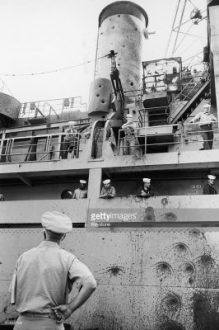 Meadors and Seaman Francis Brown, who was later killed in the attack, hauled up a second American flag from the bridge after the first was shot down early in the air assault. Meadors remained on the bridge throughout the 25-minute attack and was one of several eyewitnesses to the Israeli machine-gunning of the ship’s life rafts.
Meadors has described the Israeli attack in detail on the USS Liberty Veteran’s Association website:
“I watched some jets pass us, then turn left after they passed our ship, then they started strafing us. The attack lasted 90 minutes, during which we got a message off to the Sixth Fleet asking for assistance. We learned later that Joe Tully, commanding officer of the USS Saratoga, launched aircraft within minutes of the attack, but he told us later they were recalled before they reached the horizon. We found this out 20 years after the attack.
“The most frustrating thing has been a lack of reaction from the U.S. government. On June 8, 2005, we filed a war crimes report, and they are required to investigate these allegations. They’ve created reports about our mission, but they never did conduct an actual investigation of the attack itself.
“It was an illegal attack. We were on the high seas conducting legal activities. They admitted that they closed the area for military purposes but we tried to find out the boundaries of that area and they wouldn’t tell us.
“The Israelis break international laws with impunity and the U.S. government is not going to hold them accountable, nobody is. There is no doubt that the Israelis were committing piracy on the high seas against the 2010 Gaza Freedom Flotilla and used deadly force against unarmed humanitarians.”
Meadors was aboard the Sfedoni in the 2010 Gaza Freedom Flotilla. He was in Greece for the 2011 and 2015 Freedom Flotillas. Born in Corpus Christi, Texas, Meadors is a past president of USS Liberty Veterans Association, founded in 1982.
The Flotillas aim to bring attention to the illegal blockade imposed by Israel on Gaza since 2007.
Joe Lauria is editor-in-chief of Consortium News and a former correspondent for the Boston Globe, Wall Street Journal, Sunday Times of London and numerous other publications. He can be reached at joelauria@consortiumnews.com and on Twitter @unjoe .
Medical Aid for Palestinians founder, Dr Swee Chai Ang, to join Freedom Flotilla

Founding Trustee of Medical Aid for Palestinians (MAP) Dr Swee Chai Ang
MEMO | July 9, 2018
Founding Trustee of Medical Aid for Palestinians (MAP) Dr Swee Chai Ang is set to board the Freedom Flotilla boat Al-Awda next week in an effort to break the 12-year siege of the Gaza Strip.
In a statement sent to MEMO, Ang said: “I am highly honoured to be invited on board. It is important to explain to you why I chose to do this. A doctor, a surgeon is a human being with a conscience and a compassionate heart, much more than just a skilled technician.”
“The very fact that I can do operations and fix broken bones will not stop me from losing my humanity. A robot might turn the other way, but a child of God does not.”
“The Flotilla brings hope to the besieged Palestinians,” she added.
“This summer marks the thirty-sixth year of my journey with the Palestinians. It began in 1982 when as an ignorant Pro-Israel Christian doctor I first stepped foot as a volunteer surgeon in Gaza Hospital in Beirut’s Sabra Shatilla Palestinian refugee camp,” she explained.
“There I fell in love passionately with a generous, kind, honest and gentle people – the Palestinians. They were forced out of Palestine in 1948, and found themselves refugees.”
“Most of you know that I am going to seventy come the end of the year and I would like to make this my birthday present to the people of Gaza and Palestine.”
You can read Dr Ang’s full statement below:
When invited to come on board Al-Awda, the Freedom Flotilla to Gaza, I know I must join them. This summer marks the thirty-sixth year of my journey with the Palestinians. It began in 1982 when as an ignorant Pro-Israel Christian doctor I first stepped foot as a volunteer surgeon in Gaza Hospital in Beirut’s Sabra Shatilla Palestinian refugee camp.
There I fell in love passionately with a generous, kind, honest and gentle people – the Palestinians. They were forced out of Palestine in 1948, and found themselves refugees. Despite the dispossession, persecution and injustice they remained human.
About 3 weeks after my arrival, more than 3,000 of them were cruelly massacred. My heart was broken and trampled on, and would have remained dead and buried in the rubble of their bulldozed homes. But the survivors even while burying their own loved ones nurtured me back to life with their tears and love. The children filled with courage, hope and dignity inspired me and gave me strength to walk on with them.
“We are not afraid Doctora come with us.” It is now 70 years since the Palestinian Nakba and Diaspora in 1948. When will their journey home begin? Today, six million Palestinians dispersed in various refugee camps are denied the right of return to their ancestral Palestine; the other six million lived under occupation in Gaza and West Bank.
For 12 years, two million Palestinians have been imprisoned under a brutal land and sea military blockade in Gaza. During this time there were three major military assaults where Gaza was relentlessly bombed for weeks. Recently, since 30 March 2018, unarmed Gaza demonstrators calling for the Right of Return are shot at with high grade military assault rifles leaving more than 124 dead and 13,000 severely wounded with hundreds of amputees and potential amputees.
The Flotilla brings hope to the besieged Palestinians. They are praying for us in their mosques and churches in the Gaza Strip. They know we are making this journey for them. Even if we are to be abducted, imprisoned and deported, may we remain faithful in solidarity and love for the people of Palestine and Gaza.
Dr Swee Ang
Consultant Orthopaedic Surgeon; author From Beirut to Jerusalem
July 2018
See also:
Swedish Freedom Flotilla: ‘The people of Gaza need us to act’
Israel bans Palestinian TV channel
MEMO | July 9, 2018
Israeli Defense Minister Avigdor Lieberman on Monday banned Palestinian Al-Quds channel.
In a decree signed on July 3, Lieberman said the ban was based on Israel’s anti-terrorism law.
Under the decree, the channel will not be broadcast inside Israel
The decree did not give a reason for the ban, but Israeli authorities accuse the channel of being a propaganda tool for Palestinian resistance group Hamas.
There was no comment from the Palestinian channel on the Israeli ban.
Al-Quds channel broadcasts from Lebanon and has a correspondent based in Jerusalem.
Israel sentences rights activist to 8 years in prison
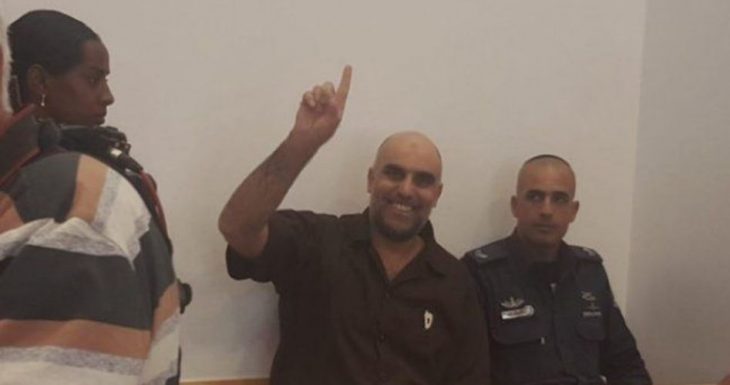
Firas al-Omari
Palestine Information Center – July 9, 2018
NAZARETH – The Israeli Central Court in Beersheba sentenced on Sunday the rights activist Firas al-Omari, 46, to eight years imprisonment.
Al-Omari, from northern Israel’s Arab town of Sandala, is an activist in the Islamic Movement (the northern branch) and head of Yusuf Al-Siddiq Foundation for prisoners’ affairs.
He was arrested in March 2017 for being allegedly affiliated to a banned organization.
The Israeli security authorities have embarked on arresting activists from the northern branch of the Islamic Movement following the right-wing government’s decision to classify it as a banned group in November 2015.
The northern branch of the Islamic Movement and its members are known for peacefully defending Jerusalem and the Aqsa Mosque against Israel’s violations.
Featured Video
Why Hamas Really Attacked Israel on Oct. 7
or go to
Aletho News Archives – Video-Images
From the Archives
Confronting the Threat of Ethnic Bioweapons
By Tony Cartalucci – New Eastern Outlook – 29.11.2017
The United States Air Force’s 59th Medical Wing’s molecular biology branch recently was revealed to have been collecting specifically Russian RNA and synovial (connective) tissue samples, prompting fears in Russia of a possible US directed ethnic-specific bioweapons program. … continue
Blog Roll
 Aletho News
- Why Hamas Really Attacked Israel on Oct. 7
- Declassified UK exposes British man who fought for ‘Israel’ in Gaza
- West’s death cult in a theater near you
- How the Yandex ‘Russian bots’ lie fell apart
- Burnham’s ‘Russia did Brexit’ ruse crumbles
- Estonia making movies and games to encourage war against Russia
- Four in five new UK jobs taken by foreigners – report
- Here’s what Trump’s latest U-turn really means for Russia and Ukraine
- The Houthis Are Not an Iranian Proxy
- Europe’s Energy Hypocrisy, Russian LNG Profits and US Dependence
- If Americans Knew
- Activists Abused By Israel Return to New Freedom Flotilla Mission
- 60 Minutes won’t tell the full truth about Israeli settler violence
- Nearly 50,000 women, girls killed or severely injured in Gaza since October 2023: UN Women
- ADL is working with AI companies to suppress alleged ‘antisemitism’
- Israeli occupation forces using social media surveillance unit to target hundreds of Palestinians in the West Bank
- Israel’s New – and Terrifying – Security Doctrine
- Israeli Attacks Kill Five in Gaza, Including a four-year-old and a woman
- Air Force Major Who Called for Trump’s Impeachment Held in Solitary Confinement
- It’s a Genocide, I’m Into It’: Seinfeld Mocks Protest over Palestinian Children Killed
- Universities fire dozens amid pressure from Zionist billionaires
- No Tricks Zone
- New Study Suggests Large Regions Of The Pacific Ocean Have Been Cooling For The Last 80 Years
- Germany’s Green Energy Debacle: High Energy Costs Force Kahla Porzellan to Close After 182 Years!
- New Study: 50 Years Of The Most Aggressive ‘Net Zero’ Policies Can Only Affect The Global Climate By 0.03°C
- US September “Heat” Was No Record…Many Records Set Decades Ago
- Latest European Green Energy Debacle; Portugal’s Largest Flagship Solar Park Insolvent!
- Green Energy Debacle: German Expert Professor Fritz Vahrenholt Warns Of Severe Economic And Social Consequences
- Two More Paleo Reconstructions Affirm Meters-Higher Sea Levels Across Ireland, Brazil 7000-6000 Years Ago
- New Study: Earth And Venus Surface Warmth Largely Explained By Convection And Lapse Rate, Not CO2 Or Radiation
- 2025 Nature Paper Claiming Worsening Global Drought Gets RETRACTED …Heavily Flawed
- New Study: ‘Global Drought Shows No Detectable Recent Acceleration Under Climate Warming’


