Trump served legal notice warning of Israeli false flag operation
MEMO | May 15, 2018
US President Donald Trump has been served with a legal notice reminding him of his Constitutional duties with regard to the situation in the Middle East, especially his decision to move the US Embassy to Jerusalem, and warning him of an impending Israeli false flag operation likely to threaten the lives of US citizens. America’s responsibilities as a permanent member of the UN Security Council are also pointed out by the signatories to the notice, who are British journalist Sarah Jane (Lauren) Booth; former CIA Operations Officer Phil Geraldi; ex-Pentagon official Michael Maloof; Scott Bennett, a former US Army Officer and State Department Coordinator for Counterterrorism; ex-US Diplomat and Attorney J. Michael Springmann; and Edward C Corrigan, a Canadian Barrister and Solicitor.
Their formal letter has been sent to Trump with copies going to the International Criminal Court, Turkish President Recep Tayyip Erdogan and Russian leader Vladimir Putin, among others. The signatories give the US President “legal notice” of “a massacre beginning at the time of the Nakba anniversary in order for you to register a response and call upon the Israelis to cease and desist in your capacity as President of the United States and a Permanent Member of the Security Council and NATO.” The address for receipt of the notice to be acknowledged is given as International Delegates of the New Horizons Conference in Tehran.
The US President is reminded that he is expected to advise the US Congress, the UN Security Council and the International Criminal Court in The Hague) about this legal matter. He is warned “that ‘false flag’ attacks may be used by Israeli agents in order to assign blame to Palestinian factions and escalate the ongoing protests in Gaza and the West Bank into a larger conflict in order to falsely draw the United States and American military personnel into this artificially created conflict.” Such an attack, claim those behind the legal notice, “represents a clear and present danger to the citizens of the United States of America, because it may be designed to trigger and escalate American military actions against Turkey, Syria, Lebanon, Iran, and Russia, since these nations are opposed to the transfer of the US Embassy to Jerusalem; and rising tensions already exacerbated by the US withdrawal from the [nuclear deal with Iran].”
The initiation of this impending attack, Trump has been told, will involve a new and higher level massacre of Palestinian civilians protesting against the move of the US Embassy to Jerusalem. Furthermore, the letter serves as “Legal Notice [that] the United States can have no military alliance due to the fact that Israel has no internationally recognised fixed territorial borders which are required to be defined in such an agreement.” This notice, it is pointed out, will be “EXHIBIT 1 in any war crimes investigation and prosecution (past, present, future) relating to this matter.” There are, it is claimed, “national and international legal violations” involved.
The signatories cite a number of publications as evidence of the seriousness of their claims and warning to the President, and seek legal protection for themselves against “any retaliation, detainment, investigation, sequestration, interrogation, discrimination, imprisonment, torture, financial consequences, or any other negative or prejudicial consequences or actions taken against them.” Indeed, the former government and military officers and officials seek “whistle-blower protection” because they are “fulfilling [their] oaths to the US Constitution.”
The Stomach-Churning Victim Blaming by “Labour Friends of Israel”
By Craig Murray | May 14, 2018
The true face of the organisation calling itself “Labour Friends of Israel” has been revealed today, in truly disgusting victim-blaming tweets reacting to the massacre of over fifty Palestinians – including yet more children – by the Israeli Defence Force in Gaza.
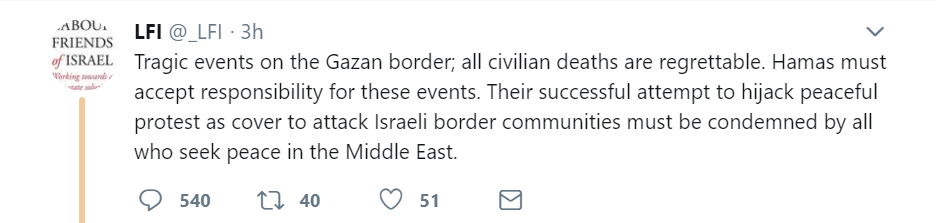
No Israelis were injured and no “border communities” attacked. This amplification of the worst extreme right wing zionist propaganda by the Likud government shows beyond doubt that “Labour Friends of Israel” is nothing whatsoever to do with the professed values of the Labour Party, but rather a well-funded entryist front solely intended to promote the interests of a violent, expansionist and aggressive foreign state.
I am not a Labour Party member and I do not know what institutional ties the “Labour Friends of Israel” has to the Labour Party, but whatever they are they should be cut off immediately.
The “Labour Friends of Israel” featured very prominently on our TV screens after the recent English local elections, beating the drum for their widespread accusations of anti-semitism within the Labour Party. They have been driving that agenda for many months. One would like to think that the mainstream media would, after today, cease to accept them as a genuine and well-motivated group and understand them for the hate-filled fanatics they truly are. Of course that will not happen, and they will be back on television shortly accusing yet more lifelong anti-racism campaigners who have the temerity to criticise Israel.
When Is a Massacre Not a Massacre?
By Craig Murray | May 14, 2018
On the day the Israeli Defence Force massacred dozens of unarmed Palestinians in Gaza and maimed over 400 more, our media has carefully avoided the use of the word massacre. Here is a Google search of News I did five minutes ago on the word “massacre”.
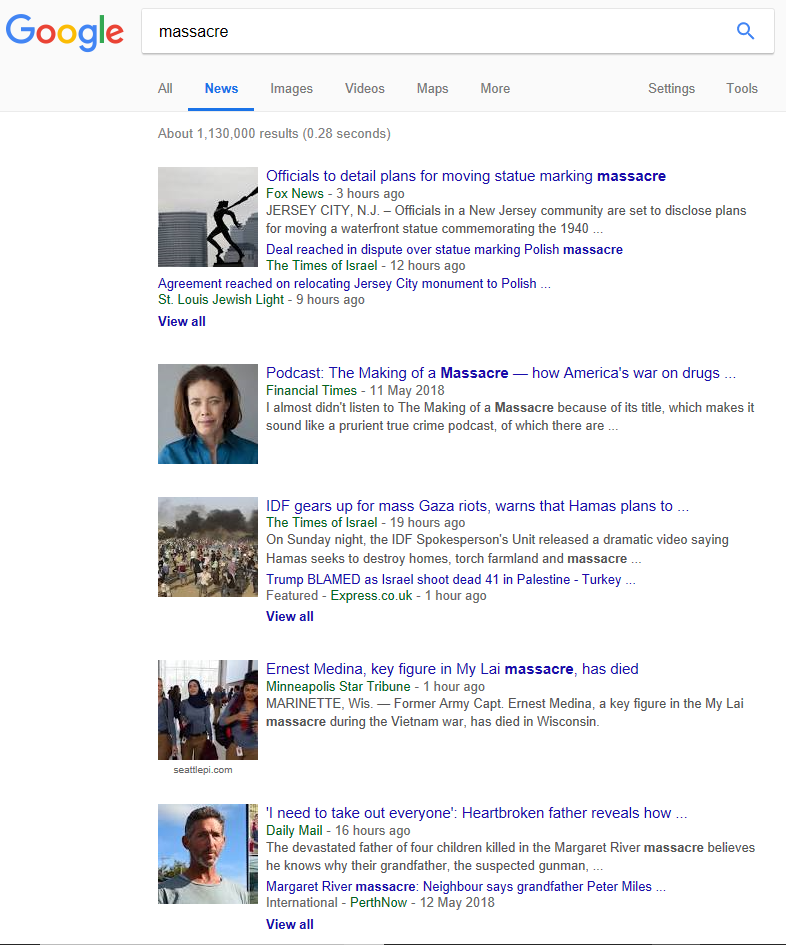
A massacre occurred today in which more people were killed than at Glencoe. All of them were unarmed and the majority were well over a hundred yards from the border fence. It says everything about the kind of nightmare fascist state Israel now is, that if you look through those news results for “massacre”, the only mention you get of Palestinians is a claim by the Israeli Defence Force that the Palestinian Defence Forces were planning a massacre of Israelis.
The Turkish government have now come out with a statement condemning the massacre, and in the UK the Daily Express and the Daily Star have both reported that; but both have chosen to put the word “massacre” in the Turkish statement into inverted commas, as though it were not true.
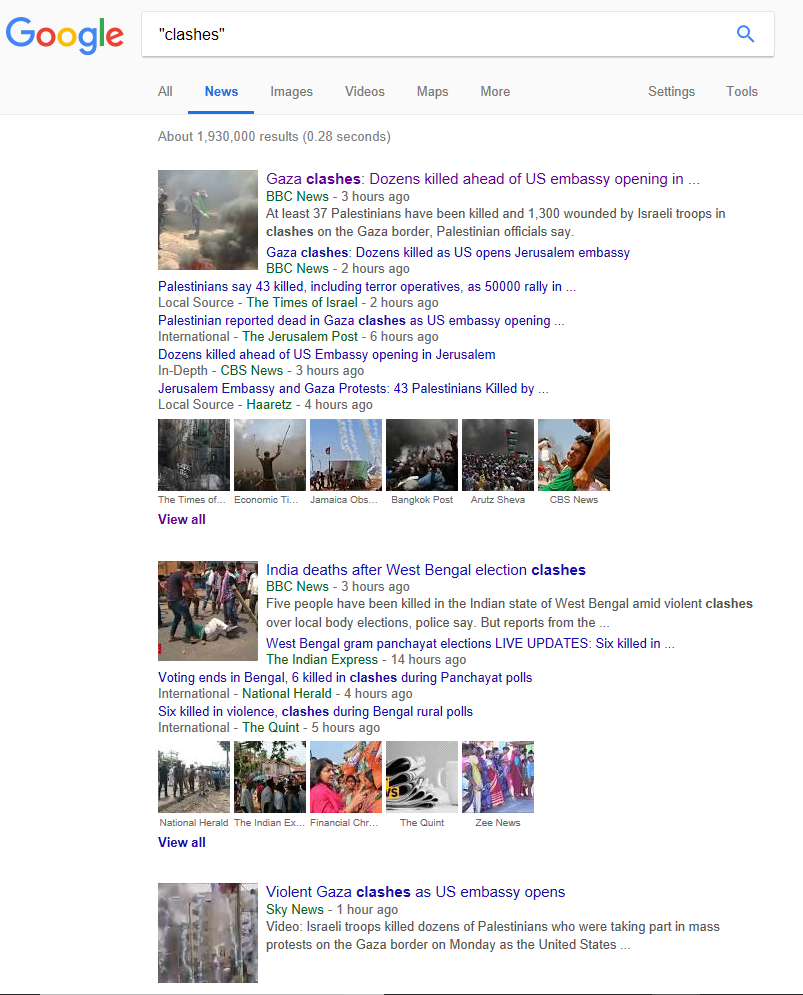
The Western media far prefers the word “clashes” to “massacre”. Because those terrible Palestinians insist upon demonstrating against the continuing theft of all their land and resources, and keep attacking innocent Israeli bullets with their heads and bodies. If you look through the Google search of News this time for “clashes”, you discover that the western and Israeli media peculiarly have precisely the same preference for this entirely inappropriate word. That, again, is fascinating.
The gross injustice of the apartheid state of Israel appears immutable. The overwhelming force of the political and financial Establishment is behind Israel in the West, in the Russian oligarchy and even in most of the horribly corrupt leadership of Arab states. But the situation is not as dire as it seems, because the hold of those Establishment elites on the people they exploit has never been more shaky. Israel remains a touchstone issue. In order to help redress the terrible agony of the Palestinians, we must first effect a change in our own system of elite exploitation of the people at home. That change is coming.
America’s Jerusalem embassy for mass murder, occupation and wider war
By Finian Cunningham | RT | May 14, 2018
How obscenely ironic. Embassies traditionally symbolize diplomacy and peace. The opening of the US Embassy in Jerusalem was occasioned by a grotesque baptism of murder of Palestinians, heralding wider war in the Middle East.
Not only that, but on the very anniversary of one of the most shameful episodes of ethnic cleansing and dispossession over the past century – the 1948 Nakba or Catastrophe for Palestinians – the US government is brazenly siding with the heirs of that historic violence, the Israeli state.
Trump’s wholesale abandonment of any shame in endorsing Israeli violations against Arab historic rights is an incitement to regional conflagration.
It’s hard to express the horror. Israeli snipers shooting unarmed Palestinian protesters in Gaza, while some 100 kilometers away in Jerusalem, US dignitaries and evangelical pastors were blessing the opening of Washington’s new embassy as ‘God’s work’.
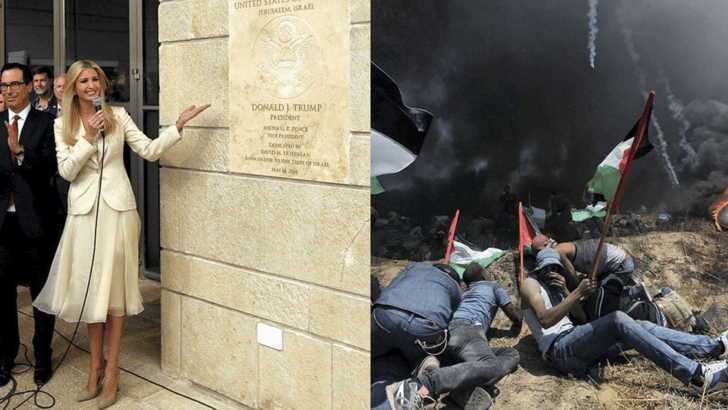
US President Donald Trump’s policy in the Middle East, if you could call it “policy”, has descended into absolute lunacy. No wonder, most European states stayed away from the US reception for unveiling its new diplomatic center.
Trump’s reckless disregard for Palestinian-Israeli peace is plunging the region into a blood bath. This week’s incendiary snub to Palestinians and the wider Arab region followed his tearing up of US obligations to the Iran nuclear accord. That violation of an international treaty has left diplomats from Europe, Russia, China and Iran scrambling to salvage a deal, which if it falls apart will unleash more instability and even war in the Middle East.
When Trump announced in December the moving of his country’s embassy from Tel Aviv to Jerusalem it was roundly rebuked at the United Nations. The move violates decades of international consensus that Jerusalem should be a shared capital between Palestinians and Israelis pending the outcome of peace negotiations.
Trump said his decision was merely a “reflection of reality”. Cynically, it marks US acquiescence to illegal Israeli occupation of Palestinian territory.
To be fair, Washington’s decision to relocate its embassy to Jerusalem was made over 20 years ago in 1995. Presidents Clinton, GW Bush and Obama opted to delay the actual move, claiming that such a move depended on progress in peace talks. Trump has now put into action legislation that was already on the books.
But what his declaration signifies is the jettisoning of any pretense by the US of being an “honest broker” between Israelis and Palestinians. Palestinian leaders now refuse to even engage with US officials, such is their disgust.
Paradoxically, Trump is helping to clarify the situation. The US is openly backing Israeli conquest of Palestinian territory and oppression of Palestinians. Washington is now transparently complicit in criminal Israeli policy rather than hiding behind a facade of mediation.
Israeli Prime Minister Benjamin Netanyahu hailed Trump this week for “making Israel great again”. With typical chutzpah, Netanyahu urged other nations to follow suit, absurdly claiming that by relocating their embassies from Tel Aviv to Jerusalem they would facilitate peace.
The perverse logic, as proven already by the US policy, is that any chance of peace between Palestinians and Israelis is being utterly destroyed.
The hellish conditions that Palestinians are subjected to under relentless Israeli occupation are driving them to the desperate act of lining up in their thousands under the fire of Israeli snipers.
Over the past six weeks since Gaza’s population began the “Great Return March” some 50 unarmed protesters have been murdered by Israeli live fire. On the day of the US Embassy opening, dozens of more civilians were shot dead, within hours of the Jerusalem ceremony.
Israeli commanders have openly admitted that a shoot-to-kill tactic is being used whereby soldiers are even targeting children who dare to approach a separation barrier on Gaza’s eastern border with Israeli-held territory.
The Gaza protests were organized by ordinary Palestinians to highlight their desperate plea against a barbaric occupation and prevention of residents returning to their historic homes, including in Jerusalem. Some 70 per cent of Gaza’s population are descended from refugees who were displaced by Israeli settlers in the 1948 pogroms and later in the 1967 War.
Under Israeli siege, which the UN has described as illegal, Gazans are prevented from moving out of the coastal strip. Some two million people – half of whom are under 18 years old – subsist in unlivable conditions. Over 90 per cent of Gaza’s water supply is contaminated, electricity is available for only a few hours per day, fisherman are prevented from going beyond a few miles from the shore where human sewage runs directly into the sea.
As American historian Norman Finkelstein points out, Gaza is being tormented by military occupation, an inhuman blockade, massacres conducted with impunity by Israeli military, and children being poisoned. It is this context of genocide in which the recent protests are taking place.
Those protests were organized to coincide with the 70th anniversary of Israel’s declared foundation on May 14, 1948. The next day, May 15, is what the Palestinians and many supporters around the world prefer to focus on – the Catastrophe.
Trump’s decision to open the US Embassy in Jerusalem this week could not be more provocative and criminally insane.
It truly is a shockingly callous display of US support for seven decades of barbaric oppression against Palestinians and the wider Arab region.
Jerusalem is seen as a holy site for Muslims and Christians. Washington’s acquiescing to Israel’s declaration of the city as “undivided capital” of the Jewish Israeli state is an outrageous blow to hundreds of millions of people from other faiths. As well as a vandalistic swipe at world opinion based on ordinary principles of justice, morality and compassion towards the long-suffering Palestinian people.
Europe bears a heavy responsibility for the plight of Palestinians. After Hamas won the parliamentary elections in 2006, the EU and the US both moved to sanction the new Hamas government owing to its refusal to recognize the state of Israel. The Israeli siege on Gaza has thus been perpetrated with the complicity of the EU and the US, albeit the latter appearing more brazenly complicit under Trump.
European governments may be discomfited by Trump’s strident contempt for Palestinian rights and international law. But they have contributed to the present deterioration in the Middle East by pandering towards Washington’s policies of sponsoring Israeli occupation, as well as sponsoring reactionary Arab client regimes like Saudi Arabia, and fomenting illegal wars and regime-change operations.
Trump’s impetuousness and ignorance – no doubt encouraged by multi-million-dollar donations from rich Jewish Americans like Sheldon Adelson – has set the US on a collision course with the Arab masses from his insolent indifference to their rights. As if that could not be any more combustible, Trump is pushing the same Israeli-Saudi despot agenda of hostility towards Iran, as evinced by the nuclear accord sabotage.
Europe has for too long tied itself to the shipwreck that is US policy in the Middle East. Surely, European governments must realize by now that if explosive violence and conflict is to be avoided in the Middle East, they must abandon the US shipwreck and begin asserting an independent foreign policy.
A genuine peace process advocating for long-neglected Palestinian rights, and repudiating US attempts to collapse the Iran nuclear accord are two immediate matters for the Europeans to claw back some sanity and respect – before it’s too late.
Read more:
Jewish Past vs Jewish State
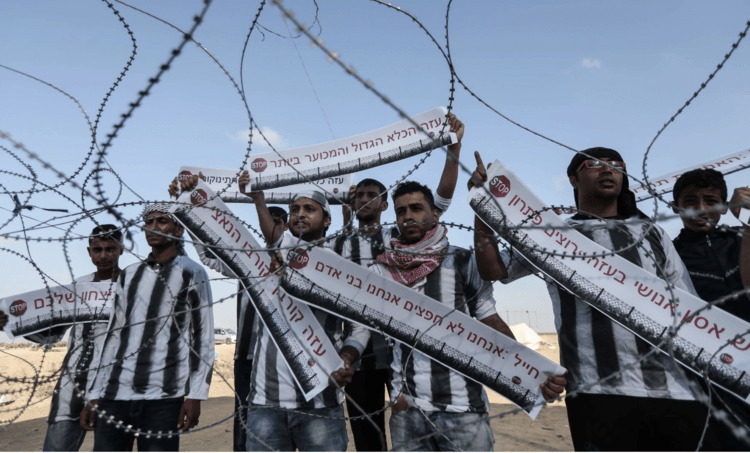
Young Palestinians protestors at the Gaza border carry signs in Hebrew: “Soldier, we are not objects, we are human beings.’
By Gilad Atzmon | May 14, 2018
Zionism promised to solve the Jewish problem. It vowed to fix Diaspora Jews by means of a ‘homecoming,’ to make the Jews loved, empathic, bond them to the soil; in essence, to make them ‘people like all other people.’
The horrific scenes flooding in from Gaza today demonstrate that Zionism failed miserably. The Jewish State is an embarrassment to its original humanist endeavour and to humanity in general.
Just today, at least 43 Palestinian protestors have been killed and 2,200 wounded by Israeli troops at the Gaza border. Some reports suggest that half of the injuries were caused by live ammunition. This is devastating news. The criminality of Israel is institutional. This is not about one odd sniper who laughs as he shoots a young Palestinian in the knee, crippling him for life. Israel is displaying a systematic hierarchic murderous apparatus designed to sustain the oppression of the indigenous people of the land for an unlimited period.
Despite the Zionist dream, the Jewish state isn’t loved by its neighbours. It isn’t loved by the rest of the world either. In fact Israel’s actions evoke global repulsion. Instead of solving the Jewish problem, Zionism has only relocated the problem and amplified the symptoms it vowed to eliminate.
Truth can be a disturbing notion; no matter how much you try to suppress it, truth manages to come out. Accordingly, it is impossible to grasp the history of Jewish suffering without taking into consideration the atrocious actions of the Jewish state. As it happens, Israeli politics is driven by a complete dismissal of the other. The Israeli military operation in Gaza is simply a license to murder. One would hope that a state that names itself the Jewish State would be slightly more vigilant with its excessive use of power.
By now I believe that Israel is going to be remembered as the darkest chapter in Jewish history and beyond.
My Home is Beit Daras: Our Lingering Nakba

By Ramzy Baroud | American Herald Tribune | May 14, 2018
When Google Earth was initially released in 2001, I immediately rushed to locate a village that no longer exists on a map, which now delineates a whole different reality.
Although I was born and raised in a Gaza refugee camp, and then moved to and lived in the United States, finding a village that was erased from the map decades earlier was not, at least for me, an irrational act. The village of Beit Daras was the single most important piece of earth that truly mattered to me.
But I could only find it by estimation. Beit Daras was located 32-kilometers northeast of Gaza, on an elevated ground, perched gently between a large hill and a small river that seemed to never run dry.
A once peaceful village, Beit Daras had existed for millennia. Romans, Crusaders, Mamluks and Ottomans ruled over and, even tried to subdue Beit Daras as in all of Palestine; yet they failed. True, each invader left their mark – ancient Roman tunnels, a Crusaders’ castle, a Mamluk mail building, an Ottoman khan (Caravanserai) – but they were all eventually driven out. It wasn’t until 1948 that Beit Daras, that tenacious village with a population of merely 3,000 was emptied of its population, and later destroyed.
The agony of the inhabitants of Beit Daras and their descendants lingers on after all of these years. The tragic way that Beit Daras was conquered by invading Zionist forces has left behind blood stains and emotional scars that have never healed.
Three battles were bravely fought by the Badrasawis, as the dwellers of Beit Daras are called, in defense of their village. At the end, the Zionist militias, the Haganah, with the help of British weapons and strategic assistance, routed out the humble resistance, which consisted mostly of villagers fighting with old rifles.
The ‘massacre of Beit Daras’ that followed remains a subdued scream that pierces through the hearts of Badrasawis after all of these years. Those who survived became refugees and are mostly living in the Gaza Strip. Under siege, successive wars and endless strife, their Nakba – the catastrophic ethnic cleansing of Palestine in 1947-48 – has never truly ended. One cannot dispel the pain if the wound never truly heals.
Born into a family of refugees in the Nuseirat Refugee Camp in Gaza, I took pride in being a Badrasawi. Our resistance has garnered us the reputation of being ‘stubborn’ and the uncorroborated claims of having large heads. We truly are stubborn, proud and generous, for Beit Daras was erased but the collective identity it has given us remained intact, regardless of whichever exile we may find ourselves.
As I child, I learned to be proud from my grandfather: A handsome, elegant, strong peasant with unshakable faith. He managed to hide his deep sadness so well after he was expelled from his home in Palestine, along with his entire family. As he aged, he would sit for hours, between prayers, searching within his soul for the beautiful memories of his past. Occasionally, he would let out a mournful sigh, a few tears; yet he never accepted his defeat, or the idea that Beit Daras was forever gone.
“Why bother to haul the good blankets on the back of a donkey, exposing them to the dust of the journey, while we know that it’s a matter of a week or so before we return to Beit Daras?” he told his bewildered wife, Zeinab as they hauled their children to navigate an endless exile.
I cannot pinpoint the moment when my grandfather discovered that his “good blankets” were gone forever, that all that remained of his village were two giant concrete pillars, and piles of cactus.
It isn’t easy to construct a history that, only several decades ago, was, along with every standing building of that village, blown to smithereens with the very intent of erasing it from existence. Most historic references written of Beit Daras, whether by Israeli or Palestinian historians, were brief, and ultimately resulted in delineating the fall of Beit Daras as just one among nearly 600 Palestinian villages that were often evacuated and then completely flattened during the war years. It was another episode in a more compounded tragedy that has seen the dispossession and expulsion of nearly 800,000 Palestinians.
But for my family, it was much more than that. Beit Daras was our very dignity. Grandpas’ calloused hands and leathery weathered skin attested to the decades of hard labor tending the rocky soil in the fields of Palestine. It was a popular pastime for my brothers and I to point to a scar on his body to hear a gut-busting tale of the rigors of farm-life.
Later in life, someone would give him a small hand-held radio to glean the latest news and he would, from that moment, never be seen without it. As a child, I recall him listening to the Arab Voice news on that battered radio. It once had been blue but now had faded to white with age. Its bulging batteries were duct-taped to the back. Sitting with the radio up to his ear and fighting to hear the reporter amidst the static, grandpa listened and waited for the announcer to make that long-awaiting call: “To the people of Beit Daras: your lands have been liberated, go back to your village.”
The day grandpa died, his faithful radio was lying on the pillow close to his ear so that even then he might catch the announcement for which he had waited for so long. He wanted to comprehend his dispossession as a simple glitch in the world’s consciousness that was sure to be corrected and straightened out in time.
But it didn’t. 70 years later, my people are still refugees. Not just the Badrasawis, but millions of Palestinians, scattered in refugee camps all across the Middle East. Those refugees, while still searching for a safe path that would take them home, often find themselves on yet another journey, another dusty trail, being pushed out time and again from one city to the next, from one country to another, even lost between continents.
My grandfather was buried in the Nuseirat Refugee Camp cemetery, not in Beit Daras as he had wished. But he remained a Badrasawi to the end, holding so passionately onto the memories of a place that for him – for all of us – remain sacred and real.
What Israel still fails to understand that the ‘Right of Return’ for Palestinian refugees is not merely a political or even a legal right to be overpowered by the ever-unfair status quo. It has long surpassed that into a whole different realm. For me, Beit Daras is not just a piece of earth but a perpetual fight for justice that shall never cease, because the Badrasawis belong to Beit Daras and nowhere else.
Israel bans entry of medical delegation into Gaza
Palestine Information Center | May 13, 2018
RAMALLAH – The Israeli occupation authorities on Sunday decided to prevent a Palestinian medical delegation from entering the Gaza Strip.
Ministry of Health said in a statement that the Israeli authorities refused to issue the necessary entry permits for the members of the medical delegation formed by the Palestinian Minister of Health in Ramallah Jawad Awwad to assist medical staff in Gaza.
The Ministry stressed that this ban is a further crime committed against the Gazan people who are also prevented from travelling abroad for treatment.
The Ministry called on international organizations to pressure Israel to allow medical teams to visit Gaza and help the staff working there.
Army Kills 41 Palestinians In Gaza: Health Ministry
IMEMC News – May 14, 2018
The Palestinian Health Ministry has confirmed that Israeli soldiers killed, Monday, 41 Palestinians, including children and four officers of the Ministry of Interior and National Security, in the Gaza Strip, and injured more than 1700.
The Ministry of Interior and National Security said among the slain Palestinians are four of its officers, identified as:
Mousa Jaber Abu Hassanein, 36 – medic, Civil Defense Department.
Mo’taz Bassam an-Nuno, 30 – Internal Security Department.
Mos’ab Yousef Abu Leila, 30 – Military Intelligence Department.
Jihad Mohammad Mousa, 30 – Internal Security Department.
It said the slain officers were performing their duties and national services when the soldiers shot them dead.
Their deaths bring the number of Palestinians, killed by Israeli army fire since morning hours Monday, to 37, while more than 1700 have been injured, including many who suffered serious wounds.
Among the slain Palestinians are five children, including one girl, and among the wounded are 122 children, and 44 women.
27 of the wounded Palestinians suffered very serious wounds, 59 serious injuries, 735 moderate wounds, and 882 suffered light wounds.
772 of the wounded Palestinians were shot with live rounds, three with rubber-coated steel bullets, 91 with shrapnel, 100 cuts and bruises and 737 suffered the effects of teargas inhalation.
65 of the wounded were shot in the head and neck, 116 in their arms, 48 in the chest and back, 651 in the lower extremities, 52 in several parts of their bodies and 737 suffered the effects of teargas inhalation.
The soldiers also caused damage to at least one ambulance, and injured one medic and eleven journalists.
In addition, the Health Ministry called on Egypt to urgently send emergency medical supplies and specialists, mainly surgeons, intensive care physicians, anesthesia specialists, and to allow the transfer of a large number of the wounded to Egyptian hospitals, especially those in need of urgent surgeries, since Gaza hospitals lack the needed supplies due to the siege on the coastal region.
Jewish settlers celebrate occupation with violation of al-Aqsa Mosque compound

Israeli settlers and military forces are seen at the al-Aqsa Mosque compound in East Jerusalem al-Quds on May 13, 2018. (Photo by Safa news agency)
Palestine Information Center – May 13, 2018
OCCUPIED JERUSALEM – Over 1000 Israeli settlers have broken into al-Aqsa Mosque since the morning hours of Sunday under heavy police presence.
Local sources told the PIC reporter that tension has flared up in the Mosque, especially that hundreds of extremist settlers, rabbis and Israeli leaders are expected to visit the Mosque during the day to mark the so-called “Jerusalem Reunification Day”.
The PIC reporter said that the Israeli police assaulted a group of Aqsa guards for protesting Talmudic and provocative rituals performed by the settlers in the holy site.
Media official at the Islamic Awqaf Department Firas al-Dibis said that the situation started to get worse when the Israeli police opened al-Maghareba Gate to allow more settler break-ins.
So-called Temple Mount groups had called on social media for mass incursions into al-Aqsa Mosque on the anniversary of the Israeli occupation of Jerusalem.
The Israelis on 13th May celebrate the 51st anniversary of the occupation of the eastern part of Jerusalem during the 1967 war, also known as “June setback”.
Before 1967, Jerusalem was divided into two parts: the western part, and it was administered by Israel, and the eastern one which was administered by Jordan. The Israelis celebrate the “Jerusalem Reunification Day” in an attempt to emphasize that Jerusalem is the eternal capital of Israel.
Israel occupied the western part of Jerusalem, which covers 84.1% of its area, in 1948, while the eastern part, which represents 11.5% of the city’s area, remained administered by Jordan until 1967. The remaining part was declared a UN-controlled demilitarized zone.
Featured Video

Why Hamas Really Attacked Israel on Oct. 7
or go to
Aletho News Archives – Video-Images
From the Archives
Confronting the Threat of Ethnic Bioweapons
By Tony Cartalucci – New Eastern Outlook – 29.11.2017
The United States Air Force’s 59th Medical Wing’s molecular biology branch recently was revealed to have been collecting specifically Russian RNA and synovial (connective) tissue samples, prompting fears in Russia of a possible US directed ethnic-specific bioweapons program. … continue
Blog Roll
 Aletho News
- Why Yemen Is Bombing Saudi Arabia’s Airports: The War Behind the Headlines
- Sally Rooney’s books pulled from UK over support for Palestine Action
- Bombs for Tel Aviv, Promises for Riyadh
- Israeli ad agency conducted vast global espionage campaign using online ads: Report
- Oct. 7 Forever Marks The Big Reveal: ‘We See You, Israel, We Revile You, We Reject You!’
- Meet the US generals and admirals advancing Israeli policy
- Israel’s Straw Widow Protocol: The Kill Zones Where Civilians Were Labelled ‘Terrorists’
- Leading Israeli Think Tank Publishes Psychotic Israeli ‘National Security’ Doctrine
- Are the United States and Israel in Decline-and-Fall Mode?
- Why Hamas Really Attacked Israel on Oct. 7
- If Americans Knew
- Israeli firm used online ads to run vast spy operation, researchers say
- No, the world zionist movement is not an antisemitic conspiracy theory
- Hundreds of IDF investigations into killings still have no public outcome, BBC Verify finds
- After Ashley Moody Epstein Probe, Donors Linked to Him Poured Money Into her Senate Campaign
- Worried about Russian meddling in UK politics? Wait till you see what Israel is up to
- Israeli settlers attack West Bank center for disabled children, church leader calls for int’l action
- Pulling Out Teeth Just to Live: How Israel Has Devastated Dental Care in Gaza
- Gaza’s “ceasefire” death toll passes 1,500 – Daily Update
- Activists Abused By Israel Return to New Freedom Flotilla Mission
- 60 Minutes won’t tell the full truth about Israeli settler violence
- No Tricks Zone
- New Study Suggests Large Regions Of The Pacific Ocean Have Been Cooling For The Last 80 Years
- Germany’s Green Energy Debacle: High Energy Costs Force Kahla Porzellan to Close After 182 Years!
- New Study: 50 Years Of The Most Aggressive ‘Net Zero’ Policies Can Only Affect The Global Climate By 0.03°C
- US September “Heat” Was No Record…Many Records Set Decades Ago
- Latest European Green Energy Debacle; Portugal’s Largest Flagship Solar Park Insolvent!
- Green Energy Debacle: German Expert Professor Fritz Vahrenholt Warns Of Severe Economic And Social Consequences
- Two More Paleo Reconstructions Affirm Meters-Higher Sea Levels Across Ireland, Brazil 7000-6000 Years Ago
- New Study: Earth And Venus Surface Warmth Largely Explained By Convection And Lapse Rate, Not CO2 Or Radiation
- 2025 Nature Paper Claiming Worsening Global Drought Gets RETRACTED …Heavily Flawed
- New Study: ‘Global Drought Shows No Detectable Recent Acceleration Under Climate Warming’

