Rabbi Shmuel Eliyahu: Leave No Palestinian or Arab Alive

By Jonas E. Alexis | Veterans Today | July 23, 2017
Israeli Rabbi Shmuel Eliyahu seems to have picked up where the late Rabbi Ovadiah Yosef left off. The Israeli army, Eliyahu said, must slaughter the Palestinians “and leave no one alive.” The Palestinians, the good rabbi continued, must be “destroyed and crushed in order to end violence.” Here is Eliyahu’s algorithm:
“If they don’t stop after we kill 100, then we must kill 1,000. And if they do not stop after 1,000, then we must kill 10,000. If they still don’t stop we must kill 100,000, even a million.”
There is more to this “logic” than meets the eye and ear. Eliyahu even postulated that the Israeli army ought not to get involved in arresting Palestinians because “If you leave him alive, there is a fear that he will be released and kill other people. We must eradicate this evil from within our midst.”
You may say that this is just an isolated case. No Israeli official believes that, right?
Wrong. Listen to Israeli politician and Minister of Justice Ayelet Shaked: “Who is the enemy? The Palestinian people. Why? Ask them, they started…” Shaked had more interesting things to say:
“The Palestinian people has declared war on us, and we must respond with war. Not an operation, not a slow-moving one, not low-intensity, not controlled escalation, no destruction of terror infrastructure, no targeted killings. Enough with the oblique references. This is a war. Words have meanings. This is a war.
“It is not a war against terror, and not a war against extremists, and not even a war against the Palestinian Authority. These too are forms of avoiding reality. This is a war between two people. Who is the enemy? The Palestinian people. Why? Ask them, they started…
“Behind every terrorist stand dozens of men and women, without whom he could not engage in terrorism. Actors in the war are those who incite in mosques, who write the murderous curricula for schools, who give shelter, who provide vehicles, and all those who honor and give them their moral support.
“They are all enemy combatants, and their blood shall be on all their heads. Now this also includes the mothers of the martyrs, who send them to hell with flowers and kisses. They should follow their sons, nothing would be more just. They should go, as should the physical homes in which they raised the snakes. Otherwise, more little snakes will be raised there.”[1]
Not a single Zionist outlet has condemned Shaked for saying disgusting things like that, despite the fact that Israeli officials have been regurgitating these kinds of perversions for decades. Former IDF Chief of Staff Raphael Eitan declared way back in the 1980s:
“We declare openly that the Arabs have no right to settle on even one centimeter of Eretz Israel….Force is all they do or ever will understand. We shall use the ultimate force until the Palestinians come crawling to us on all fours.”
In a similar vein, David Ben Gurion said: “We must expel the Arabs and take their place and if we have to use force, to guarantee our own right to settle in those places – then we have force at our disposal.” This again is consistent with what many rabbis have been saying. Rabbi Ido Elba declared:
“If every single cell in a Jewish body entails divinity, and is thus part of God, then every strand of DNA is a part of God. Therefore, something is special about Jewish DNA…If a Jew needs a liver, can he take the liver of an innocent non-Jew to save him? The Torah would probably permit that. Jewish life has an infinite value. There is something more holy and unique about Jewish life than about non-Jewish life.”[2]
Stephen Steinlight, former Director of National Affairs for the American Jewish Committee (one of the most powerful Jewish organizations in the United States), stated bluntly,
“I’ll confess it, at least: like thousands of other typical Jewish kids of my generation, I was reared as a Jewish nationalist, even a quasi-separatist…I was taught the superiority of my people to the gentiles who had oppressed us. We were taught to view non-Jews as untrustworthy outsiders, people from whom sudden gusts of hatred might be anticipated, people less sensitive, intelligent, and moral than ourselves. We were also taught that the lesson of our dark history is that we could rely on no one.”[3]
Michael Chabon of the New York Times concurs:
“As a Jewish child I was regularly instructed, both subtly and openly, that Jews, the people of Maimonides, Albert Einstein, Jonas Salk and Meyer Lansky, were on the whole smarter, cleverer, more brilliant, more astute than other people. And, duly, I would look around the Passover table, say, at the members of my family, and remark on the presence of a number of highly intelligent, quick-witted, shrewd, well-educated people filled to bursting with information, explanations and opinions on a diverse range of topics.”[4]
Chabon now pokes fun at what he referred to as “nonsense” and “our own stupidity as a people,”[5] but this just shows how ingrained the smarter-than-thou attitude is.
In 2010, Rabbi Ovadia Yosef unapologetically declared,
“Goyim were born only to serve us. Without that, they have no place in the world—only to serve the People of Israel. In Israel, death has no dominion over them…With gentiles, it will be like any person—they need to die, but [God] will give them longevity…Why are gentiles needed? They will work, they will plow, they will reap. We will sit like an effendi and eat. That is why gentiles were created.”[6]
Many rabbis, according to Jewish scholars Israel Shahak and Norton Mezvinsky, see that “Jews killing non-Jews does not constitute murder according to the Jewish religion and that killing of innocent Arabs for reasons of revenge is a Jewish virtue.”[7]
Rabbi Menachem Mendel Scheerson, known as Lubovitcher Rebbe and the seventh of the Chabad-Lubavitch movement, came close to believing in something similar, saying that “a non-Jew should be punished by death if he kills an embryo, even if the embryo is non-Jewish, while the Jew should not be, even if the embryo is Jewish.”[8]
The great Rabbi expanded on this view in 1965:
“The difference between a Jewish and a non-Jewish person stems from the common expression: ‘Let us differentiate.’ Thus, we do not have a case of profound change in which a person is merely on a superior level. Rather, we have a case of “let us differentiate” between totally different species. This is what needs to be said about the body: the body of a Jewish person is of a totally different quality from the body of [members] of all nations of the world…
“The Jewish body ‘looks as if it were in substance similar to bodies of non-Jews,’ but the meaning…is that the bodies only seem to be similar in material substance, outward look and superficial quality. The difference of the inner quality, however, is so great that the bodies should be considered as completely different species.
“This is the reason why the Talmud states that there is an halachic difference in attitude about the bodies of non-Jews [as opposed to the bodies of Jews] ‘and their bodies are in vain’…An even greater difference exists in regard to the soul. Two contrary types of soul exist, a non-Jewish soul comes from three satanic spheres, while the Jewish soul stems from holiness…
“The body of a Jewish embryo is on a higher level than is the body of a non-Jew…We therefore ask: Why should a non-Jew be punished if he kills even a non-Jewish embryo while a Jew should not be punished even if he kills a Jewish embryo?
“The answer can be understood by [considering] the general difference between Jews and non-Jews: A Jew was not created as a means for some [other] purpose; he himself is the purpose, since the substance of all [divine] emanations was created only to serve the Jews.
“In the beginning God created the heavens and the earth” means that [the heavens and the earth] were created for the sake of the Jews, who are called the “beginning.” This means everything, all developments, all discoveries, the creation, including the “heavens and the earth—are vanity compared to the Jews. The important things are the Jews, because they do not exist for any [other] aim; they themselves are [the divine] aim.”[9]
In 2010, Rabbi Yitzhak Shapira wrote that “according to true Jewish values, [the Jews’] lives come before those of the enemy, whether he is a soldier or a civilian under protection.”[10]
If you challenge that racist ideology, you almost certainly will be viewed as an anti-Semite and a wicked person. This also gives Israeli officials like Benjamin Netanyahu a license to say or do wicked things. You remember what Netanyahu said a few years ago? Take it from him:
“I know what America is. America is a thing you can move very easily, move it in the right direction. They won’t get in [our] way.”[11]
Well, this man has been moving America “very easily” for years. This has allowed him to brag about illegally attacking Iran “dozens of times” in Syria.[12] But since Netanyahu does not understand what Hegel calls “the cunning of reason,” he cannot see that he is setting up his own doom by conjuring one lie after another.
[1] Ishaan Tharoor, “Israel’s new justice minister considers all Palestinians to be ‘the enemy,’” Washington Post, May 7, 2015.
[2] Shahak and Mezvinsky, Jewish Fundamentalism in Israel, 43, 62
[3] Stephen Steinlight, “The Jewish Stake in America’s Changing Demography: Reconsidering a Misguided Immigration Policy,” Center for Immigration Studies, October 2001.
[4] Michael Chabon, “Chosen, but Not Special,” NY Times, June 4, 2010.
[5] Ibid.
[6] Jonah Mandel, “Yosef: Gentiles Exist only to Serve Jews,” Jerusalem Post, Oct 18, 2010.
[7] Shahak and Mezvinsky, Jewish Fundamentalism in Israel, 43.
[8] Ibid., 59.
[9] bid., 59-60.
[10] “Leading rabbi encourages IDF soldiers to use Palestinian human shields,” Haaretz, October 20, 2010
[11] Quoted in “Netanyahu In 2001: ‘America Is A Thing You Can Move Very Easily,’” Huffington Post, May 25, 2011.
[12] Aria Bendix, “Netanyahu Admits Israel Struck Iranian Convoys ‘Dozens of Times,’” Atlantic, July 19, 2017.
Palestinian killed, 67 injured in Jerusalem clashes
Palestine Information Center – July 22, 2017
 OCCUPIED JERUSALEM – A Palestinian youth was pronounced dead on Saturday evening after he was injured in clashes with the Israeli police in al-Eizariya town in Jerusalem.
A local source reported that Yousuf Kashour, 24, died of a serious injury to the chest.
Violent confrontations erupted on Saturday evening between the Israeli police and the Jerusalemite worshipers protesting at Bab al-Asbat near al-Aqsa Mosque.
The PIC reporter said that the Israeli police attacked worshipers with sound bombs and putrid water, and added that a cordon was later imposed around the scene after large police reinforcements were summoned in a bid to prevent worshipers from performing evening prayer there.
Earlier, 3 Palestinians were injured with rubber bullets in clashes with the Israeli police at Qalandia checkpoint in Jerusalem.
The Palestinian Red Crescent Society announced that its crews treated 67 injuries this evening in Jerusalem.
Head of the Heritage and Manuscripts Department at al-Aqsa Mosque, Radwan Amr, said that the Israeli police assaulted worshipers and started to force them out of the Old City of Jerusalem, describing what is happening at al-Asbat as a “real massacre against a peaceful sit-in”.
Despite the Israeli attacks, hundreds of Palestinians coming from Jerusalem, the West Bank and the 1948 occupied territories protested for the 9th day in a row at Bab al-Asbat and outside the Old City against closing al-Aqsa Mosque and installing metal detectors at its gates.
On 14th July, the Israeli authorities banned Friday prayer at the Mosque following an anti-occupation shooting attack in which two Israeli police officers were killed.
Later, the Old City was closed and prayer was banned at the shrine until further notice for the first time since 1969, and on 16th July, 9 metal detectors were erected at al-Aqsa gates.
Since then, Palestinian worshipers have refused to enter the Mosque through these metal detectors and decided to perform their prayers at its entrances.
Israel to build new field hospital in Syria to treat militants
Press TV – July 19, 2017
Israel’s military says the Tel Aviv regime plans to build a new field hospital in Syria to treat what it generally named patients amid international concerns over the regime’s support for the Takfiri militants fighting in the Arab country.
Lieutenant Colonel Tomer Koler told reporters in a phone conference on Wednesday that the hospital would be located on the Syrian side of the fence but on the Israeli side of the demarcation line in the Golan Heights, which is Syrian territory occupied by Israel. The fence built by Israel does not always comply with the line precisely.
Koler expressed hope that the hospital would be operational in the next month.
He noted that Israel had delivered what he called “humanitarian aid” into Syria, including hundreds of tons of food and clothing, as well as fuel and equipment such as generators.
Israel reportedly had a field hospital in the area but shut it last year.
Syria has been gripped by foreign-backed militancy since March 2011. The Syrian government says Tel Aviv and its Western and regional allies are aiding Takfiri militant groups, wreaking havoc in the country.
There have been reports that Israel offers medical treatment to terrorists, wounded while operating in Syria, in hospitals set up on the Golan Heights. Back on April 9, Israeli Prime Minister Benjamin Netanyahu said Tel Aviv would continue treating wounded militants from Syria as part of what he claimed to be a “humanitarian effort.”
Israel regularly hits positions held by the Syrian army in the Golan Heights, describing the attacks as retaliatory. Damascus says the raids aim to help Takfiri militants fighting against government forces. On several occasions, the Syrian army has confiscated Israeli-made arms and military equipment from terrorists fighting government forces.
Last month, United Nations Secretary General Antonio Guterres expressed concerns about a spike in contacts between Israeli armed forces and Syria militants in recent months, saying it could lead to escalation and cause harm to UN observers deployed to the Golan Heights.
Moreover, the Wall Street Journal recently reported that Israel has been providing Takfiri terrorists in Syria’s Golan Heights with a steady flow of funds and medical supplies.
In September last year, the Israeli daily Ha’aretz quoted Israeli parliament member Akram Hasoon as saying that Israel was directly aiding the Takfiri terrorist group Jabhat Fateh al-Sham, formerly known as al-Nusra Front, another terrorist group operating in Syria. He revealed that an earlier attack by the Nusra group on the Druze Village of Khadr had the support of the Israeli minister for military affairs, Avigdor Lieberman.
Schumer, ‘guardian of Israel,’ calls anti-Zionism a form of antisemitism
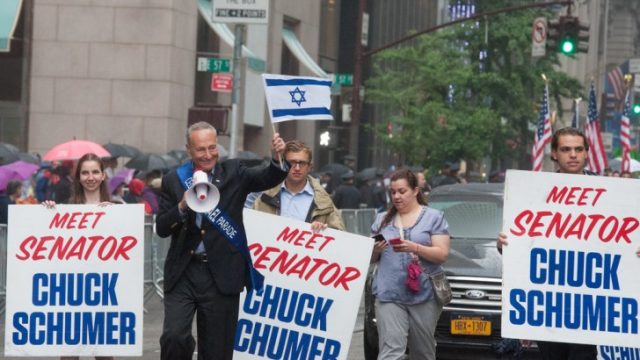
Sen. Chuck Schumer marches in the Celebrate Israel Parade in the rain on June 5, 2016 in New York City
If Americans Knew | July 18, 2017
In a recent speech on the Senate floor, New York Senator Charles Schumer said that anti-Zionism is a form of anti-Semitism. (In a 2010 speech Schumer said that God made him a ‘guardian of Israel’ – see below).
Schumer, the Senate minority leader, made his remarks at the end of a speech on health care. Schumer said he wanted to thank French President Emmanuel Macron for his recent comments claiming that anti-Zionism was antisemitism.
Schumer claimed that the Boycott, Divestment and Sanctions (BDS) movement, an extremely diverse movement that includes many Jewish individuals and groups, is “antisemitic.”
Schumer said: “The global BDS movement is a deeply biased campaign that I would say, in similar words to Mr. Macron, is a ‘reinvented form of anti-Semitism’ because it seeks to impose boycotts on Israel and not on any other nation.”
The Jewish Telegraphic Agency’s report on Schumer’s remarks notes that Schumer is the Senate’s “highest-ranking Jewish lawmaker.”
The claim that criticism of Israel is antisemitic has been promoted by an international campaign working to embed this as a new definition of “antisemitism.”
Schumer says he is a ‘guardian of Israel’
In 2010, Schumer told an AIPAC convention: “As some of you know, my name is a Hebrew word. “Schumer” comes from the Hebrew word “Shomer,” which means “guardian,” “watchman.”
Schumer said his name was given to him “for a reason”:
“For as long as I live, for as long as I have the privilege of serving in the Senate from New York, I will unflinchingly, unstintingly and with all of my strength be Shomer Yisrael, a guardian of Israel. Ladies and gentlemen, Am Yisrael Chai, in Israel and America, the Jewish nation lives now and forever.”
Netanyahu Pushes Trump Toward Wider Wars
By Robert Parry | Consortium News | July 18, 2017
A weakened, even desperate President Donald Trump must decide whether to stand up to Israeli Prime Minister Benjamin Netanyahu or to repudiate the Syrian partial ceasefire, which Trump hammered out with Russian President Vladimir Putin on July 7.
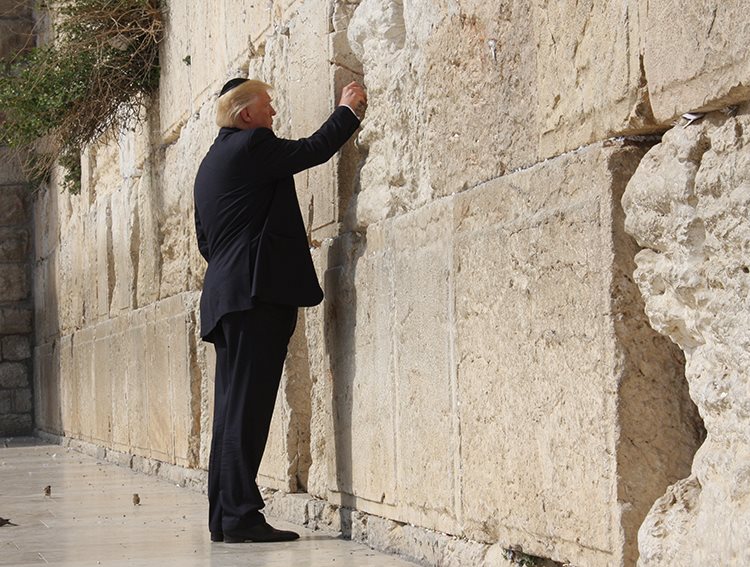
(Official White House Photo by Dan Hansen)
Whether intentionally or not, this crossroads is where the months of Russia-gate hysteria have led the United States, making Trump even more vulnerable to Israeli and neoconservative pressure and making any cooperation with Russia more dangerous for him politically.
After meeting with French President Emmanuel Macron in Paris on Sunday, Netanyahu declared that Israel was totally opposed to the Trump-Putin cease-fire deal in southern Syria because it perpetuates Iranian presence in Syria in support of the Syrian government of President Bashar al-Assad.
Netanyahu’s position increases pressure on Trump to escalate U.S. military involvement in Syria and possibly move toward war against Iran and even Russia. The American neocons, who generally move in sync with Netanyahu’s wishes, already have as their list of current goals “regime changes” in Damascus, Tehran and Moscow – regardless of the dangers to the Middle East and indeed the world.
At the G-20 summit on July 7, Trump met for several hours with Putin coming away with an agreed-upon cease-fire for southwestern Syria, an accord that has proven more successful than previous efforts to reduce the violence that has torn the country apart since 2011.
But that limited peace could mean failure for the proxy war that Israel, Saudi Arabia, Turkey and other regional players helped launch six years ago with the goal of removing Assad from power and shattering the so-called “Shiite crescent” from Tehran through Damascus to Beirut. Instead, that “crescent” appears more firmly in place, with Assad’s military bolstered by Shiite militia forces from Iran and Lebanon’s Hezbollah.
In other words, the “regime change” gambit against Assad’s government would have backfired, with Iranian and Hezbollah forces arrayed along Israel’s border with Syria. And instead of accepting that reversal and seeking some modus vivendi with Iran, Netanyahu and his Sunni-Arab allies (most notably the Saudi monarchy) have decided to go in the other direction (a wider war) and to bring President Trump along with them.
Neophyte Trump
Trump – a relative neophyte in global intrigue – has been slow to comprehend how his outreach to Netanyahu and Saudi King Salman runs counter to his collaboration with Putin on efforts to defeat the Sunni jihadist groups, including Al Qaeda and Islamic State, which have served as the point of the spear in the war to overthrow Assad.
Al Qaeda and Islamic State have received direct and indirect support from Saudi Arabia, the Gulf States, Turkey, Israel and even the Obama administration, albeit sometimes unwittingly. To block Assad’s overthrow – and the likely victory by these terror groups – Russia, Iran and Hezbollah came to Assad’s defense, helping to turn the tide of the war since 2015.
In his nearly half year in office, Trump has maintained an open hostility toward Iran – sharing a position held by Washington’s neocons as well as Netanyahu and Salman – but the U.S. President also has advocated cooperation with Russia to crush Islamic State and Al Qaeda inside Syria.
Collaboration with Russia – and indirectly with Iran and the Syrian military – makes sense for most U.S. interests, i.e., stabilizing Syria, reversing the refugee flow that has destabilized Europe, and denying Al Qaeda and Islamic State a base for launching terror strikes against Western targets.
But the same collaboration would be a bitter defeat for Netanyahu and Salman who have invested heavily in this and other “regime change” projects that require major U.S. investments in terms of diplomacy, money and military manpower.
So, in last weekend’s trip to Paris, Netanyahu chose to raise the stakes on Trump at a time when Democrats and the U.S. mainstream media are pounding him daily with the Russia-gate scandal, even raising the possibility that his son, Donald Trump Jr., might be prosecuted and imprisoned for having a meeting in June 2016 with a Russian lawyer.
If Trump wants the Russia-gate pain to lessen, he will be tempted to give Netanyahu what he wants and count on the savvy Israeli leader to intervene with the influential neocons of Official Washington to pull back on the scandal-mongering.
The problem, however, would be that Netanyahu really wants the U.S. military to complete the “regime change” project in Syria – much as it did in Iraq and Libya – meaning more American dead, more American treasure expended and a likely wider war, extending to Iran and possibly nuclear-armed Russia.
That might fulfill the neocon current menu of “regime change” schemes but it runs the risk of unleashing a nuclear conflagration on the world. In that way, liberals and even some progressives – who have embraced Russia-gate as a way to remove the hated Donald Trump from office – may end up contributing to the end of human civilization as well.
Investigative reporter Robert Parry broke many of the Iran-Contra stories for The Associated Press and Newsweek in the 1980s.
UN panel blasts Israel over abuses and settlement expansion in Occupied Palestinian Territories
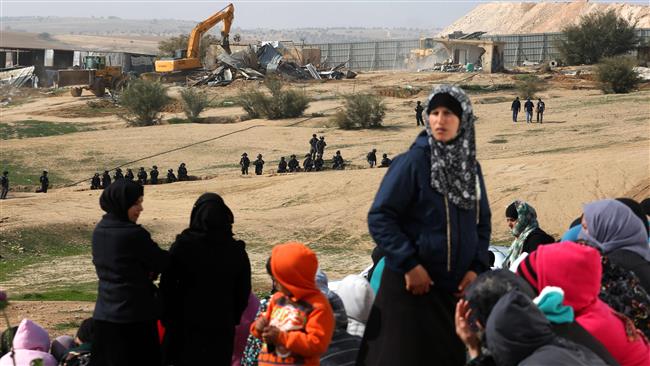
RT | July 18, 2017
Israel continues the illegal practice of settlement expansion in the Occupied Palestinian Territories, a United Nations expert panel has said in its annual evaluation. It further accuses Tel Aviv of excessive use of force and collective punishment against Palestinians.
After gathering testimonies from civil society organizations, UN representatives and Palestinian officials, the UN Special Committee to Investigate Israeli Practices Affecting the Human Rights of the Palestinian People and Other Arabs of the Occupied Territories noted a number of violations against the Palestinians over the last year, including the detention of minors by the Israel Defense Force (IDF).
“The Committee heard troubling testimony regarding the arrest and detention of children, including cases of reported ill-treatment and lack of adequate protection,” the Committee said after its fact-finding visit to Amman, Jordan.
The Committee also heard testimonies of “excessive use of force” by Israeli forces and the “lack of accountability” by Tel Aviv which “further exacerbated the cycle of violence.”
The UN experts recorded testimonies of continued administrative detention and “difficult conditions” of Palestinians in Israeli prisons.
While the full report of Israel’s treatment of Palestinians will only be published in November, the experts highlighted the continued expansion of Israeli settlements in the occupied territories which are illegal under international law.
“Organizations told the Committee that Israeli settlement expansion had continued in the West Bank, including East Jerusalem, as well as the Syrian Golan, with a notably high level of new construction announced this year, in violation of international humanitarian law,” the fact finding team said.
The UN group said that settlements, as well as the separation wall, dubbed “the apartheid wall” by critics, are having a “negative impact” on the human rights of Palestinians by restricting their freedom of movement.
The experts also voiced concern over the demolition of homes in the occupied territories, especially Bedouin communities in so-called Area C.
“The use of punitive demolitions in the West Bank including East Jerusalem was described as a form of collective punishment,” by the organizations interviewed, the Committee said.
“The Committee clearly observed that the Israeli authorities continue with policies and practices that negatively impact the human rights situation in the Occupied Palestinian Territory.”
Pointedly, Tel Aviv does not recognize the authority of the UN Committee, which has been releasing annual reports into Israeli practices since 1968. Relations between Tel Aviv and the world body have drastically deteriorated recently.
Following the passage of the UN Security Council anti-settlement resolution in December last year, Israel cut funding to various UN agencies. Roughly $10 million has been withheld since then as the UN continues to pass resolutions which are perceived as anti-Israeli by Tel Aviv.
Israel accuses various bodies working under the auspices of the UN of having an anti-Israeli bias and failing to acknowledge the Jewish state’s security concerns.
Israel imprisons UN official, again – UN’s Guterres says nothing

If Americans Knew | July 17, 2017
Israel arrested Hamdan Temraz, 61, deputy director of the United Nations Department of Safety and Security in Gaza, while he was on his way to a work meeting. Four days later the UN still had not issued a statement about this.
The UN has recently come under increased pressure from the United States and Israel.
US Ambassador to the UN Nikki Haley announced to an adoring AIPAC audience in March that she had pressured the UN to remove an official report showing that Israel was guilty of ‘apartheid.’
All 100 US Senators signed a letter in April noting that the US is the largest single donor to the UN and demanding that the UN end its allegedly unfair treatment of Israel.
On July 14th UN Secretary-General António Guterres issued a statement condemning the killing of two Israeli policeman by three assailants (who were then killed by Israeli forces), announcing: “This incident has the potential to ignite further violence. All must act responsibly to avoid escalation.”
Yet, Secretary-General Guterres issued no such statement two days earlier when Israeli forces invading the Palestinian city of Jenin killed two young Palestinians.
Now the UN Secretary-General is saying nothing about Israel’s imprisonment of a UN official from Gaza as he tried to travel to a meeting.
Richard Silverstein reports in Tikun Olam:
This is getting old. Israel has once again arrested a United Nations official based in Gaza as he attempted to cross into Israel to attend a work meeting there. An Israeli security source has confirmed to me the linked story above and the Shin Bet arrest. The news is under gag order in Israel and no media there may report the story. This conveniently insulates the Israeli public from the news that their supposedly democratic nation has arrested human rights personnel from the most reputable NGO in the world. It also allows the Shin Bet time to build yet another fraudulent case against yet another Palestinian official doing international humanitarian relief work in Gaza.
Since Israelis can’t know this information, I’m going to tell them here. The arrested man is Hamdan Temraz, 61, who is the deputy director of the United Nations Department of Safety and Security (UNDSS) in Gaza. He was arrested at the Erez crossing on July 12th despite having a valid entry permit.
The Palestinian human rights group, al Mezan released this statement to the Palestine Information Center, protesting the latest Israeli outrage:
The Center explained that such Israeli practices are aimed at blocking the work of the international organizations in the Gaza Strip, pointing out that 8 employees working in these organizations have been arrested since the beginning of 2014.
It affirmed that hundreds of employees are denied the permits required to enter or exit Gaza to be able to follow up their organizations’ work, not to mention the Israeli incitement campaigns they are exposed to.
I find it odd that a UN employee has been in an Israeli prison for four days and there has been no statement from the international body. Is this how they come to the defense of their staff when it’s under threat in a police state? I left a phone message with the UN press office seeking a statement, but have not heard from them so far.
It’s no coincidence that last month, Netanyahu called for the UN to dismantle UNWRA, the major relief organizations in Gaza. He appealed directly to U.S. ambassador, David Friedman aka “The Settler’s Friend.” This rehashes a common Israeli narrative in which evil Hamas co-opts everyone and everything to do its dirty terrorist work in the enclave. The U.S. is far the largest donor supporting UNWRA, providing $350-million annually to support the millions of Gazans who are unemployed and undernourished due to the decade-long Israeli siege. Israel hopes that the new Trump regime will realize its ambitions to restrain or suppress the aid work in Gaza, which serves to remind the world of Israel’s ongoing assault against its innocent civilian population.
Last summer, Israel arrested two Palestinians in Gaza. Waheed Borsh worked for the UN Development Program and Mohammed el-Halabi for the Christian relief group, World Vision. Both were accused of exploiting their NGO status to undertake covert activities on behalf of Hamas. In the latter case, el-Halabi was accused of funneling international relief funds to the Islamist group. In every instance, the NGOs undertook full, comprehensive investigations and uncovered no evidence to support the Israeli charges. But since Israel functions as a police state as far as Palestinians are concerned, guilt and conviction were assured. Therefore, in order not to spend decades behind bars, each copped a plea that offered a lesser sentence.
This charade permits Israel to bolster its fake claim that the international relief organizations aren’t that at all–but rather thinly concealed support groups for militant international terrorists. This, in turn, satisfies the Israeli government’s core far-right constituency, which can tell itself how much the world hates us and how justified it is in utilizing maximum force in “defending” itself from enemies lurking virtually everywhere.
So here’s how it will go with Temraz. He will be accused of taking advantage of his position directing security for the UN agency by permitting Hamas to do something that somehow jeopardizes Israeli security. Perhaps he allowed the militants to build tunnels under UN facilities. Perhaps he offered materials to Hamas to build tunnels. Or even better: he provided the fake IDs the Haram al Sharif attackers used to gain entrance to the Muslim holy site. Who knows what they can devise? The thing is, these Shabak agents aren’t very imaginative. Nor do they need to be. No one reviews the cases they bring for credibility. No judge cares to do so. He or she would rapidly find themselves on the road to career oblivion if they did. So any half-assed concoction can send a man away for a decade or more simply because some agent has to make his quota and throw the fear of god into both Palestinians and the relief agencies servicing Gaza. What a seamy mess of a national security regime this is.
Israeli authorities demolish Palestinian-owned building in East Jerusalem
Ma’an – July 17, 2017
JERUSALEM – Israeli authorities demolished a Palestinian-owned building on Monday morning in the occupied East Jerusalem neighborhood of al-Zaayyem, according to witnesses.
Bulldozers escorted by Israeli police forces and employees of Israel’s Jerusalem municipality razed the home to the ground for lack of a building permit.
A spokesperson for the municipality told Ma’an that the demolition was not within its jurisdiction. However, a spokesperson for COGAT, the Israeli agency responsible for enforcing demolitions in the occupied West Bank, later told Ma’an to contact the municipality.
Last week, Israeli forces targeted Palestinian-owned buildings in occupied East Jerusalem for two consecutive days.
Construction licenses are very expensive and difficult to obtain for Palestinians, notably in the Jerusalem area, in a bid by Israeli authorities to force Palestinians out and change the demographic balance of the city.
While Palestinians frequently take their cases to Israeli courts after Israeli land confiscation and home demolition notices are ordered, they seldom win their cases in court.
Thirty-three percent of all Palestinian homes in the occupied city lack Israeli-issued building permits, potentially placing at least 93,100 residents at risk of displacement, the United Nations reported in 2012.
Only 14 percent of East Jerusalem land is zoned for Palestinian residential construction, while one-third of Palestinian land has been confiscated since 1967 to build illegal Jewish-only settlements, according to the Association for Civil Rights in Israel (ACRI).
According to UNOCHA, Israel demolished a record 1,093 structures in the occupied Palestinian territory in 2016, including 190 in East Jerusalem, displacing 1,601 Palestinians. They were the highest West Bank demolition and displacement figures recorded by OCHA since it started doing so in 2009.
Palestinians protest Radiohead’s support for ‘apartheid’ Israel
MEMO | July 17, 2017
A group of Palestinians from the UK, besieged Gaza, occupied West Bank and Israel have co-authored a letter to the British rock band, Radiohead, over their controversial decision to hold a concert in Israel later this week.
The band’s decision to go ahead with the concert is a “slap in the face to Palestinians across the world” and a “betrayal of all social justice movements”, the group said. They urged Radiohead to reconsider their decision, which activists say grants legitimacy to an apartheid regime and gives support to political oppression.
Earlier this month Radiohead, who became a worldwide hit in the 1990s, announced their decision to play at a concert in Israel. Their decision angered fans and supporters of the global Boycott, Divestment and Sanctions (BDS) campaign against Israel’s half a decade occupation of Palestine. Protests against the decision by the rock band, however, fell on deaf ears as the group insisted on playing in Israel while maintaining that “music, art and academia is about crossing borders, not building ones”.
In the two page letter, the group, which consists mainly of Palestinian academics and students, accused Radiohead of hypocrisy and supporting apartheid. They describe Radiohead’s “excuses” as no different to the excuse used by artists who played in South Africa during the height of the anti-apartheid movement against white rule. “Based on your responses to BDS, we wonder if you too would have performed in Sun City while Nelson Mandela and others rotted in Robben Island prison?” they asked.
They pointed out that hundreds of South African organisations and trade unions support the BDS campaign because in Israel they see very similar – if not exactly the same – system of political subjugation. “Indeed many South Africans,” the group stressed. “who have visited Palestine concluded that the situation is ‘worse’ than apartheid.”
The group urged Radiohead to open its eyes and see the routine violence and indignity faced by Palestinians, the daily human rights violations and abuses carried out by Israel before re-considering their decision.
Describing details of the their ongoing persecution, the group said:
We are segregated, held and humiliated at hundreds of checkpoints, we watch our houses be demolished, we are denied freedom of movement, equal access to water, healthcare, education and face a separate discriminatory legal system. We live under Israeli F16s and Elbit Drones, we face Merkhava tanks, and electricity cut to three hours a day. This, Radiohead, is known as apartheid and ethnic cleansing.
In their letter, they urged Radiohead to take a moment and think what it is like to live in Gaza: “[A] child as young as eight has had to endure three brutal Israeli bombing campaigns,” they wrote, adding: “Think what it must be like to live in perpetual exile in refugee camps sometimes only a few kilometres from home and yet forbidden from returning.”
Radiohead was also encouraged to consider the discriminatory political system that governs the lives of Palestinians: “Think what it must be like to live under an intricate system of apartheid that forbids you from travelling on certain roads, living in certain places and even accessing fundamental resources such as water.”
“Millions of us are imprisoned behind walls and barriers and if we want to cross we have to beg our occupiers for permission which is often denied to us. Everyday Palestinians in Gaza are dying because they cannot leave the outdoor prison Israel has created and access lifesaving medical care.”
Everyday Palestinians are stopped at checkpoints, harassed, turned away and sometimes even shot.
The Palestinian group described their frustrations over Radiohead’s attitude towards activists attempting to raise these concerns. The letter mentions that when activists tried to bring this matter to the attention of the band they were called “fucking people” and that one of the members stuck their middle finger at them.
“These people were not just allies of Palestinians who have fought tirelessly for our freedom, they were also Radiohead fans,” the group said. “Fans who have seen you engage with politics and various causes for social justice around the world over the decades.”
The letter cites activist and author Naomi Klein who is a strong supporter of the Palestinian cause including BDS. Radiohead is apparently an avid fan of the Canadian author but in the letter the Palestinian group accuse the band of hypocrisy, because of their claim to support social justice on the one hand while also attacking the global BDS movement.
One of the activists who signed the letter spoke to MEMO about her campaign to stop Radiohead performing in Israel. British-Palestinian, Huda Ammori, a student at Manchester University, mentioned that Radiohead performed at her university on 5 July. Activists from Manchester Palestine Action held a demonstration outside the venue and spoke to thousands of Radiohead fans about the need for a cultural boycott of Israel. She said that she managed to push her way to the front to protest Radiohead’s decision by showing solidarity to the Palestinian case for all the spectators to see.
“Radiohead performing in Israel is a mockery of the suffering of the Palestinian people. Radiohead have continued to disregard the Palestinian people and have mocked the supporters of the Palestine cause,” Ammori said. She pointed to the hypocrisy of Radiohead. “They claim to care about ‘social justice’ by showing some support for the people of Tibet and through their lyrics,” she said, “however, now their lyrics scream hypocrisy.” Performing music, she added, should not have to be a political choice, “however when it comes to apartheid, performing in Israel is a political choice. A choice between standing with the oppressor or standing with the oppressed.”
In Israel, the letter explained, Radiohead would be playing in front of an audience which “will be mostly Israelis who have served in the Israeli armed forces that are slaughtering our people; 1,400 Palestinians in 22 days in the winter of 2008-9 then more than 2,200 in 50 days in 2014, including over 500 children.”
They concluded their letter saying: “We are the abused, the imprisoned, and the occupied and we expect people of integrity to show solidarity and to not patronise us. We will not stop fighting for justice and we will remember those who stood with us when it was not fashionable to do so, who refused to entertain apartheid. And as with South Africa, history will judge you when we have our freedom.”
To read the full letter please click here
The Myth of the Kurdish YPG’s Moral Excellence
By Stephen Gowans | what’s left | July 11, 2017
A barbed criticism aimed at the International Socialist Organization, shown nearby, under the heading “If the ISO Existed in 1865” encompasses a truth about the orientation of large parts of the Western Left to the Arab nationalist government in Damascus. The truth revealed in the graphic is that the ISO and its cognates will leave no stone unturned in their search for an indigenous Syrian force to support that has taken up arms against Damascus, even to the point of insisting that a group worthy of support must surely exist, even if it can’t be identified.
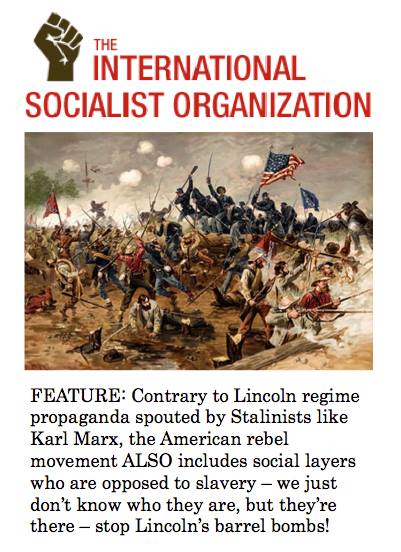
If the ISO existed in 1865.
Of course, Washington lends a hand, helpfully denominating its proxies in the most laudatory terms. Islamist insurgents in Syria, mainly Al Qaeda, were not too many years ago celebrated as a pro-democracy movement, and when that deception proved no longer tenable, as moderates.
Now that the so-called moderates have been exposed as the very opposite, many Leftists cling to the hope that amid the Islamist opponents of Syria’s secular, Arab socialist, government, can be found votaries of the enlightenment values Damascus already embraces. Surely somewhere there exist armed anti-government secular Leftists to rally behind; for it appears that the goal is to find a reason, any reason, no matter how tenuous, to create a nimbus of moral excellence around some group that opposes with arms the government in Damascus; some group that can be made to appear to be non-sectarian, anti-imperialist, socialist, committed to the rights of women and minorities, and pro-Palestinian; in other words, a group just like Syria’s Ba’ath Arab Socialists, except not them.
Stepping forward to fulfill that hope is the PKK, an anarchist guerrilla group demonized as a terrorist organization when operating in Turkey against a US ally, but which goes by the name of the YPG in Syria, where it is the principal component of the lionized “Syrian Democratic Force.” So appealing is the YPG to many Western Leftists that some have gone so far as to volunteer to fight in its units. But is the YPG the great hope it’s believed it to be?
Kurds in Syria
It’s difficult to determine with precision how many Kurds are in Syria, but it’s clear that the ethnic group comprises only a small percentage of the Syrian population (less than 10 percent according to the CIA, and 8.5 percent according to an estimate cited by Nikolaos Van Dam in his book The Struggle for Power in Syria. [1]
Estimates of the proportion of the total Kurd population living in Syria vary from two to seven percent based on population figures presented in the CIA World Factbook. Half of the Kurd community lives in Turkey, 28 percent in Iran and 20 percent in Iraq. A declassified 1972 US State Department report estimated that only between four and five percent of the world’s Kurds lived in Syria [2].
While the estimates are rough, it’s clear that Kurds make up a fairly small proportion of the Syrian population and that the number of the group’s members living in Syria as a proportion of the Kurd community as a whole is very small.

The PKK
Kurdish fighters in Syria operate under the name of the YPG, which is “tied to the Kurdistan Workers’ Party, or PKK, a radical guerrilla movement combining [anarchist ideas] with Kurdish nationalism. PKK guerrillas [have] fought the Turkish state from 1978” and the PKK is “classified as a terrorist organization by the European Union, Turkey and the U.S.” [3]
Cemil Bayik is the top field commander of both the PKK in Turkey and of its Syrian incarnation, the YPG. Bayik “heads the PKK umbrella organization, the KCK, which unites PKK affiliates in different countries. All follow the same leader, Abdullah Ocalan, who has been in prison in Turkey” [4] since 1999, when he was apprehended by Turkish authorities with CIA assistance.
Ocalan “was once a devotee of Marxism-Leninism,” according to Carne Ross, who wrote a profile of the Kurdish nationalist leader in The Financial Times in 2015. But Ocalan “came to believe that, like capitalism, communism perforce relied upon coercion.” Imprisoned on an island in the Sea of Marmara, Ocalan discovered “the masterwork of a New York political thinker named Murray Bookchin.” Bookchin “believed that true democracy could only prosper when decision-making belonged to the local community and was not monopolized by distant and unaccountable elites.” Government was desirable, reasoned Bookchin, but decision-making needed to be decentralized and inclusive. While anarchist, Bookchin preferred to call his approach “communalism”. Ocalan adapted Bookchin’s ideas to Kurd nationalism, branding the new philosophy “democratic confederalism.” [5]
Labor Zionism has similar ideas about a political system based on decentralized communes, but is, at its core, a nationalist movement. Similarly, Ocalan’s views cannot be understood outside the framework of Kurdish nationalism. The PKK may embrace beautiful utopian goals of democratic confederalism but it is, at its heart, an organization dedicated to establishing Kurdish self-rule—and, as it turns out, not only on traditionally Kurdish territory, but on Arab territory, as well, making the parallel with Labour Zionism all the stronger. In both Syria and Iraq, Kurdish fighters have used the campaign against ISIS as an opportunity to extend Kurdistan into traditionally Arab territories in which Kurds have never been in the majority.
The PKK’s goal, writes The Wall Street Journal’s Sam Dagher, “is a confederation of self-rule Kurdish-led enclaves in Iran, Iraq, Syria and Turkey” [6] countries in which Kurdish populations have a presence, though, as we’ve seen, an insignificant one in Syria. In pursuit of this goal “as many as 5,000 Syrian Kurds have died fighting alongside the PKK since the mid-1980s, and nearly all of YPG’s top leaders and battle-hardened fighters are veterans of the decades-long struggle against Turkey.” [7]
In Syria, the PKK’s goal “is to establish a self-ruled region in northern Syria,” [8] an area with a significant Arab population.
When PKK fighters cross the border into Turkey, they become ‘terrorists’, according to the United States and European Union, but when they cross back into Syria they are miraculously transformed into ‘guerrilla” fighters waging a war for democracy as the principal component of the Syrian Democratic Force. The reality is, however, that whether on the Turkish or Syrian side of the border, the PKK uses the same methods, pursues the same goals, and relies largely on the same personnel. The YPG is the PKK.
An Opportunity
Washington has long wanted to oust the Arab nationalists in Syria, regarding them as “a focus of Arab nationalist struggle against an American regional presence and interests,” as Amos Ma’oz once put it. The Arab nationalists, particularly the Ba’ath Arab Socialist party, in power since 1963, represent too many things Washington deplores: socialism, Arab nationalism, anti-imperialism, and anti-Zionism. Washington denounced Hafez al-Assad, president of Syria from 1970 to 2000, as an Arab communist, and regards his son, Bashar, who succeeded him as president, as little different. Bashar, the State Department complains, hasn’t allowed the Syrian economy—based on Soviet models, its researchers say—to be integrated into the US-superintended global economy. Plus, Washington harbors grievances about Damascus’s support for Hezbollah and the Palestinian national liberation movement.
US planners decided to eliminate Asia’s Arab nationalists by invading their countries, first Iraq, in 2003, which, like Syria, was led by the Ba’ath Arab Socialists, and then Syria. However, the Pentagon soon discovered that its resources were strained by resistance to its occupations of Afghanistan and Iraq, and that an invasion of Syria was out of the question. As an alternative, Washington immediately initiated a campaign of economic warfare against Syria. That campaign, still in effect 14 years later, would eventually buckle the economy and prevent Damascus from providing education, health care and other essential services in some parts of the country. At the same time, Washington took steps to reignite the long-running holy war that Syria’s Islamists had waged on the secular state, dating to the 1960s and culminating in the bloody takeover of Hama, Syria’s fourth largest city, in 1982. Beginning in 2006, Washington worked with Syria’s Muslim Brotherhood to rekindle the Brother’s jihad against Assad’s secular government. The Brothers had two meetings at the White House, and met frequently with the State Department and National Security Council.
The outbreak of Islamist violence in March of 2011 was greeted by the PKK as an opportunity. As The Wall Street Journal’s Yaroslav Trofimov recounts, “The PKK, once an ally of… Damascus… had long been present among Kurdish communities in northern Syria. When the revolutionary tide reached Syria, the group’s Syrian affiliate quickly seized control of three Kurdish-majority regions along the Turkish frontier. PKK fighters and weapons streamed there from other parts of Kurdistan.”[9] The “Syrian Kurds,” wrote Trofimov’s colleagues, Joe Parkinson and Ayla Albayrak, viewed “the civil war as an opportunity to carve out a self-governing enclave—similar to the one established by their ethnic kin in neighboring Iraq.” [10] That enclave, long backed by the United States and Israel, was seen as a means of weakening the Iraqi state.
Damascus facilitated the PKK take-over by withdrawing its troops from Kurdish-dominated areas. The Middle East specialist Patrick Seale, who wrote that the Kurds had “seized the opportunity” of the chaos engendered by the Islamist uprising “to boost their own political agenda” [11] speculated that the Syrian government’s aims in pulling back from Kurd-majority areas was to redirect “troops for the defence of Damascus and Aleppo;” punish Turkey for its support of Islamist insurgents; and “to conciliate the Kurds, so as to dissuade them from joining the rebels.” [12] The PKK, as it turns out, didn’t join the Islamist insurgents, as Damascus hoped. But they did join a more significant part of the opposition to Arab nationalist Syria: the puppet master itself, the United States.
By 2014, the PKK had “declared three self-rule administrations, or cantons as they call them, in northern Syria: Afreen, in the northwest, near the city of Aleppo; Kobani; and Jazeera in the northeast, which encompasses Ras al-Ain and the city of Qamishli. Their goal [was] to connect all three.” [13] This would mean controlling the intervening spaces occupied by Arabs.
A Deal with Washington
At this point, the PKK decided that its political goals might best be served by striking a deal with Washington.
The State Department had “allowed for the possibility of a form of decentralization in which different groups” — the Kurds, the secular government, and the Islamist insurgents — each received some autonomy within Syria. [14] Notice the implicit assumption in this view that it is within Washington’s purview to grant autonomy within Syria, while the question of whether the country ought to decentralize, properly within the democratic ambit of Syrians themselves, is denied to the people who live and work in Syria. If we are to take seriously Ocalan’s Bookchin-inspired ideas about investing decision-making authority in the people, this anti-democratic abomination can hardly be tolerated.
All the same, the PKK was excited by the US idea of dividing “Syria into zones roughly corresponding to areas now held by the government, the Islamic State, Kurdish militias and other insurgents.” A “federal system” would be established, “not only for Kurdish-majority areas but for all of Syria.” A Kurd federal region would be created “on all the territory now held by the” PKK. The zone would expand to include territory the Kurds hoped “to capture in battle, not only from ISIS but also from other Arab insurgent groups.” [15]
The PKK “pressed U.S. officials” to act on the scheme, pledging to act as a ground force against ISIS in return. [16] The group said it was “eager to join the U.S.-led coalition against Islamic State in return for recognition and support from Washington and its allies for the Kurdish-dominated self-rule administrations they [had] established in northern Syria.” [17]
The only people pleased with this plan were the PKK, the Israelis and the Americans.
“US support for these Kurdish groups” not only in Syria, but in Iraq, where the Kurds were also exploiting the battle with ISIS to expand their rule into traditionally Arab areas, helped “to both divide Syria and divide Iraq,” wrote The Independent’s veteran Middle East correspondent Robert Fisk. [18] Division redounded to the benefit of the United States and Israel, both of which have an interest in pursuing a divide and rule policy to exercise a joint hegemony over the Arab world. Patrick Seale remarked that the US-Kurd plan for Kurdish rule in northern Syria had been met by “quiet jubilation in Israel, which has long had a semi-clandestine relationship with the Kurds, and welcomes any development which might weaken or dismember Syria.” [19]
For their part, the Turks objected, perceiving that Washington had agreed to give the PKK a state in all of northern Syria. [20] Meanwhile, Damascus opposed the plan, “seeing it as a step toward a permanent division of the nation.” [21]
Modern-day Syria, it should be recalled, is already the product of a division of Greater Syria at the hands of the British and French, who partitioned the country into Lebanon, Palestine, Transjordan, and what is now Syria. In March, 1920, the second Syrian General Congress proclaimed “Syria to be completely independent within her ‘natural’ boundaries, including Lebanon and Palestine.” Concurrently “an Arab delegation in Palestine confronted the British military governor with a resolution opposing Zionism and petitioning to become part of an independent Syria.” [22] France sent its Army of the Levant, mainly troops recruited from its Senegalese colony, to quash by force the Levantine Arabs’ efforts to establish self-rule.
Syria, already truncated by British and French imperial machinations after WWI “is too small for a federal state,” opines Syria’s president Bashar al-Assad. But Assad quickly adds that his personal view is irrelevant; a question as weighty as whether Syria ought to become a federal or confederal or unitary state, he says, is a matter for Syrians to decide in a constitutional referendum, [23] a refreshingly democratic view in contrast to the Western position that Washington should dictate how Syrians arrange their political (and economic) affairs.
Tip of the US Spear
For Washington, the PKK offers a benefit additional to the Kurdish guerrilla group’s utility in advancing the US goal of weakening Syria by fracturing it, namely, the PKK can be pressed into service as a surrogate for the US Army, obviating the necessity of deploying tens of thousands of US troops to Syria, and thereby allowing the White House and Pentagon to side-step a number of legal, budgetary and public relations quandaries. “The situation underscores a critical challenge the Pentagon faces,” wrote The Wall Street Journal’s Paul Sonne; namely, “backing local forces… instead of putting American troops at the tip of the spear.” [24]
Having pledged support for Kurdish rule of northern Syria in return for the PKK becoming the tip of the US spear, the United States is “providing “small arms, ammunition and machine guns, and possibly some nonlethal assistance, such as light trucks, to the Kurdish forces.” [25]
The arms are “parceled out” in a so called “drop, op, and assess” approach. The shipments are “dropped, an operation [is] performed, and the U.S. [assesses] the success of that mission before providing more arms.” Said a US official, “We will be supplying them only with enough arms and ammo to accomplish each interim objective.” [26]
PKK foot soldiers are backed by “more than 750 U.S. Marines,” Army Rangers, and US, French and German Special Forces, “using helicopters, artillery and airstrikes,” the Western marionette-masters in Syria illegally, in contravention of international law. [27]
Ethnic Cleansing
“Large numbers of Arab residents populate the regions Kurds designate as their own.” [28] The PKK has taken “over a large swath of territory across northern Syria—including predominantly Arab cities and towns.” [29] Raqqa, and surrounding parts of the Euphrates Valley on which the PKK has set its sights, are mainly populated by Arabs, observes The Independent’s veteran foreign correspondent Patrick Cockburn—and the Arabs are opposed to Kurdish occupation. [30]
Kurdish forces are not only “retaking” Christian and Muslim Arab towns in Syria, but are doing the same in the Nineveh province of Iraq—areas “which were never Kurdish in the first place. Kurds now regard Qamishleh, and Hassakeh province in Syria as part of ‘Kurdistan’, although they represent a minority in many of these areas.” [31]
The PKK now controls 20,000 square miles of Syrian territory [32], or roughly 17 percent of the country, while Kurds represent less than eight percent of the population.
In their efforts to create a Kurdish region inside Syria, the PKK “has been accused of abuses by Arab civilians across northern Syria, including arbitrary arrests and displacing Arab populations in the name of rolling back Islamic State.” [33] The PKK “has expelled Arabs and ethnic Turkmen from large parts of northern Syria,” reports The Wall Street Journal. [34] The Journal additionally notes that human rights “groups have accused [Syrian and Iraqi Kurdish fighters] of preventing Arabs from returning to liberated areas.” [35]
Neither Syrian nor Democratic
The PKK dominates the Syrian Democratic Forces, a misnomer conferred upon a group of mainly Kurdish fighters by its US patron. The group is not Syrian, since many of its members are non-Syrians who identify as Kurds and who flooded over the border from Turkey to take advantage of the chaos produced by the Islamist insurgency in Syria to carve out an area of Kurdish control. Nor is the group particularly democratic, since it seeks to impose Kurdish rule on Arab populations. Robert Fisk dismisses the “Syrian Democratic Forces” as a “facade-name for large numbers of Kurds and a few Arab fighters.” [36]
The PKK poses as a Syrian Democratic Force, and works with a token force of Syrian Arab fighters, to disguise the reality that the Arab populated areas it controls, and those it has yet to capture, fall under Kurd occupation.
A De Facto (and Illegal) No Fly Zone
In August, 2016, after “Syrian government bombers had been striking Kurdish positions near the city of Hasakah, where the U.S. [had] been backing Kurdish forces” the Pentagon scrambled “jets to protect them. The U.S. jets arrived just as the two Syrian government Su-24 bombers were departing.” This “prompted the U.S.-led coalition to begin patrolling the airspace over Hasakah, and led to another incident… in which two Syrian Su-24 bombers attempted to fly through the area but were met by coalition fighter jets.” [37]
The Pentagon “warned the Syrians to stay away. American F-22 fighter jets drove home the message by patrolling the area.” [38]
The New York Times observed that in using “airpower to safeguard areas of northern Syria where American advisers” direct PKK fighters that the United States had effectively established a no-fly zone over the area, but noted that “the Pentagon has steadfastly refused to” use the term. [39] Still, the reality is that the Pentagon has illegally established a de facto no-fly zone over northern Syria to protect PKK guerillas, the tip of the US spear, who are engaged in a campaign of creating a partition of Syria, including through ethnic cleansing of the Arab population, to the delight of Israel and in accordance with US designs to weaken Arab nationalism in Damascus.
An Astigmatic Analogy
Some find a parallel in the YPG’s alliance with the United States with Lenin accepting German aid to return from exile in Switzerland to Russia following the 1917 March Revolution. The analogy is inapt. Lenin was playing one imperialist power off against another. Syria is hardly an analogue of Imperial Russia, which, one hundred years ago, was locked in a struggle for markets, resources, and spheres of influence with contending empires. In contrast, Syria is and has always been a country partitioned, dominated, exploited and threatened by empires. It has been emancipated from colonialism, and is carrying on a struggle—now against the contrary efforts of the PKK—to resist its recolonization.
The PKK has struck a bargain with the United States to achieve its goal of establishing a Kurdish national state, but at the expense of Syria’s efforts to safeguard its independence from a decades-long US effort to deny it. The partition of Syria along ethno-sectarian lines, desired by the PKK, Washington and Tel Aviv alike, serves both US and Israeli goals of weakening a focus of opposition to the Zionist project and US domination of West Asia.
A more fitting analogy, equates the PKK in Syria to Labor Zionism, the dominant Zionist force in occupied Palestine until the late 1970s. Like Ocalan, early Zionism emphasized decentralized communes. The kibbutzim were utopian communities, whose roots lay in socialism. Like the PKK’s Syrian incarnation, Labor Zionism relied on sponsorship by imperialist powers, securing their patronage by offering to act as the tips of the imperialists’ spears in the Arab world. Zionists employed armed conquest of Arab territory, along with ethnic cleansing and denial of repatriation, to establish an ethnic state, anticipating the PKK’s extension by armed force of the domain of a Kurdish state into Arab majority territory in Syria, as well as Kurd fighters doing the same in Iraq. Anarchists and other leftists may have been inspired by Jewish collective agricultural communities in Palestine, but that hardly made the Zionist project progressive or emancipatory, since its progressive and emancipatory elements were negated by its regressive oppression and dispossession of the indigenous Arab population, and its collusion with Western imperialism against the Arab world.
Conclusion
Representing an ethnic community that comprises less than 10 percent of the Syrian population, the PKK, a Kurdish anarchist guerrilla group which operates in both Turkey and Syria, is using the United States, its Air Force, Marine Corps, Army Rangers and Special Forces troops, as a force multiplier in an effort to impose a partition of Syria in which the numerically insignificant Kurd population controls a significant part of Syria’s territory, including areas inhabited by Arabs in the majority and in which Kurds have never been in the majority. To accomplish its aims, the PKK has not only struck a deal with a despotic regime in Washington which seeks to recolonize the Arab world, but is relying on ethnic cleansing and denial of repatriation of Arabs from regions from which they’ve fled or have been driven to establish Kurdish control of northern Syria, tactics which parallel those used by Zionist forces in 1948 to create a Jewish state in Arab-majority Palestine. Washington and Israel (the latter having long maintained a semi-clandestine relationship with the Kurds) value a confederal system for Syria as a means of weakening Arab nationalist influence in Arab Asia, undermining a pole of opposition to Zionism, colonialism, and the international dictatorship of the United States. Forces which resist dictatorship, including the most odious one of all, that of the United States over much of the world, are the real champions of democracy, a category to which the PKK, as evidenced by its actions in Syria, does not belong.
1. Nikolaos Van Dam, The Struggle for Power in Syria: Politics and Society under Assad and the Ba’ath Party, IB Taurus, 2011, p.1.
2. “The Kurds of Iraq: Renewed Insurgency?”, US Department of State, May 31, 1972, https://2001-2009.state.gove/documents/organization/70896.pdf
3. Sam Dagher, “Kurds fight Islamic State to claim a piece of Syria,” The Wall Street Journal, November 12, 2014.
4. Patrick Cockburn, “War against ISIS: PKK commander tasked with the defence of Syrian Kurds claims ‘we will save Kobani’”, The Independent, November 11, 2014.
5. Carne Ross, “Power to the people: A Syrian experiment in democracy,” Financial Times, October 23, 2015.
6. Dagher, November 12, 2014.
7. Dagher, November 12, 2014.
8. Dagher, November 12, 2014.
9. Yaroslav Trofimov, “The State of the Kurds,” The Wall Street Journal, June 19, 2015.
10. Joe Parkinson and Ayla Albayrak, “Syrian Kurds grow more assertive”, The Wall Street Journal, November 15, 2013.
11. Patrick Seale, “Al Assad uses Kurds to fan regional tensions”, Gulf News, August 2, 2012.
12. Seale, August 2, 2012.
13. Dagher, November 12, 2014.
14. David E. Sanger, “Legacy of a secret pact haunts efforts to end war in Syria,” the New York Times, May 16, 2016.
15. Anne Barnard, “Syrian Kurds hope to establish a federal region in country’s north,” The New York Times, March 16, 2016.
16. Dagher, November 12, 2014.
17. Dagher, November 12, 2014.
18. Robert Fisk, “This is the aim of Donald Trump’s visit to Saudi Arabia – and it isn’t good for Shia communities,” The Independent, May 18, 2017.
19. Seale, August 2, 2012.
20. Yaroslav Trofimov, “U.S. is caught between ally Turkey and Kurdish partner in Syria,” The Wall Street Journal, May 4, 2017.
21. Anne Barnard, “Syrian Kurds hope to establish a federal region in country’s north,” The New York Times, March 16, 2016.
22. David Fromkin, A Peace to End All Peace: The Fall of the Ottoman Empire and the Creation of the Modern Middle East, Henry Holt & Company, 2009, p. 437.
23. “President al-Assad to RIA Novosti and Sputnik: Syria is not prepared for federalism,” SANA, March 30, 2016.
24. Paul Sonne, “U.S. seeks Sunni forces to take militant hub,” The Wall Street Journal, April 29, 2016.
25. Dion Nissenbaum, Gordon Lubold and Julian E. Barnes, “Trump set to arm Kurds in ISIS fight, angering Turkey,” The Wall Street Journal, May 9, 2017.
26. Nissenbaum et al, May 9, 2017.
27. Dion Nissenbaum and Maria Abi-Habib, “Syria’s newest flashpoint is bringing US and Iran face to face,” The Wall Street Journal, June 15, 2017; “Syria condemns presence of French and German special forces in Ain al-Arab and Manbij as overt unjustified aggression on Syria’s sovereignty and independence,” SANA, June 15, 2016; Michael R. Gordon. “U.S. is sending 400 more troops to Syria.” The New York Times. March 9, 2017.
28. Matt Bradley, Ayla Albayrak, and Dana Ballout, “Kurds declare ‘federal region’ in Syria, says official,” The Wall Street Journal, March 17, 2016.
29. Maria Abi-Habib and Raja Abdulrahim, “Kurd-led force homes in on ISIS bastion with assent of U.S. and Syria alike,” The Wall Street Journal, May 11, 2017.
30. Patrick Cockburn, “Battle for Raqqa: Fighters begin offensive to push Isis out of Old City,” The Independent, July 7, 2017.
31. Robert Fisk, “This is the aim of Donald Trump’s visit to Saudi Arabia – and it isn’t good for Shia communities,” The Independent, May 18, 2017.
32. Dion Nissenbaum and Maria Abi-Habib, “U.S. split over plan to take Raqqa from Islamic state,” The Wall Street Journal. March 9, 2017.
33. Raja Abdulrahim, Maria Abi_Habin and Dion J. Nissenbaum, “U.S.-backed forces in Syria launch offensive to seize ISIS stronghold Raqqa,” The Wall Street Journal, November 6, 2016.
34. Margherita Stancati and Alia A. Nabhan, “During Mosul offensive, Kurdish fighters clear Arab village, demolish homes,” The Wall Street Journal, November 14, 2016.
35. Matt Bradley, Ayla Albayrak, and Dana Ballout, “Kurds declare ‘federal region’ in Syria, says official,” The Wall Street Journal, March 17, 2016.
36. Robert Fisk, “The US seems keener to strike at Syria’s Assad than it does to destroy ISIS,” The Independent, June 20, 2017.
37. Paul Sonne and Raja Abdulrahim, “Pentagon warns Assad regime to avoid action near U.S. and allied forces,” The Wall Street Journal, August 19, 2016.
38. Michael R. Gordon and Neil MacFarquhar, “U.S. election cycle offers Kremlin a window of opportunity in Syria,” The New York Times, October 4, 2016.
39. Michael R. Gordon and Neil MacFarquhar, “U.S. election cycle offers Kremlin a window of opportunity in Syria,” The New York Times, October 4, 2016.
Featured Video

John Mearsheimer Talking Iran with Iran
or go to
Aletho News Archives – Video-Images
New Book
The silver that medicine dropped — four thousand years of clinical use, four decades to erase.
Colloidal Silver — First Edition, 2026, Paperback
Lies are Unbekoming | October 16, 2026
Silver was medicine. Not alternative medicine. Not folk medicine. Medicine. In surgery. In obstetrics. In the burn ward. In water treatment. In the household medicine chest. Every physician before 1938 knew this.
By the 1870s, silver nitrate was standard in surgical wound care across the leading hospitals of Britain, Germany, and the United States. Colloidal silver preparations — Collargol, Argyrol, Protargol — entered European and American practice through the 1890s and early 1900s and became standard antiseptics in military field medicine. By the time Fleming grew his first penicillin mould in 1928, silver was the first-line antimicrobial of the Western pharmacopoeia. The Lancet and the British Medical Journal carried the clinical reports in volume. The practice ran continuously through the Victorian era, the Edwardian era, the First World War, the interwar period. By 1980, almost all of it was gone.
What has not been treated at book length, until now, is how a four-thousand-year clinical record disappeared from mainstream medicine within four decades of the Flexner Report — and what the honest account of silver looks like once that record is reassembled.
Colloidal Silver reconstructs the pre-1938 record from The Lancet, the British Medical Journal, and the primary literature of the era; recovers Robert Becker’s bioelectric framework from the regeneration research the pharmaceutical model buried; and places silver inside a practical terrain-paradigm guide to its current place — in water, on the body, inside the body, and in the chronic conditions where antibiotics have failed. … continue
Blog Roll
 Aletho News
- Pharma- and Gates-Funded GAVI Seeks to Assure Parents
- John Mearsheimer Talking Iran with Iran
- Inside Bill C-22, Canada’s Patriot Act.
- China’s FM: Palestinian cause is ‘greatest injustice of the century’
- US sympathy for Palestinians surpasses support for Israelis
- Israeli rabbi permits occupiers to steal Palestinian olive harvest in West Bank
- Spanish firm sells Latvia vehicles equipped with Israeli tech despite arms embargo
- Saudi Arabia under fire… Yemen is burning down the House of Saud
- Israeli Spy Pollard stole the files, today’s it’s delivered through official channels
- Why Iran Didn’t Walk Away
- If Americans Knew
- NPR investigation finds evidence of widespread fraud at mall kiosks tied to Israeli skincare brand
- Tucker Carlson exposes Israeli Lies about the Oct 7th attack, Charlie Kirk, and the U.S.
- Israel has detained thousands of Palestinian children since Oct 7th – over half spent time in solitary, many uncharged
- Israeli Analysis: Is Netanyahu Planning an ‘October Surprise’ Attack Before Israel’s Election?
- Israeli settlers brutally attack Palestinians and Washington Post female photographer, 65
- Words Have Changed, Occupation Continues: The Reality of the Gaza Ceasefire
- Gaza’s child amputees are growing faster than their prosthetics allow
- Israel keeps Palestinians struggling just to survive–Daily Update
- Israeli firm used online ads to run vast spy operation, researchers say
- No, the world zionist movement is not an antisemitic conspiracy theory
- No Tricks Zone
- New Study Suggests Large Regions Of The Pacific Ocean Have Been Cooling For The Last 80 Years
- Germany’s Green Energy Debacle: High Energy Costs Force Kahla Porzellan to Close After 182 Years!
- New Study: 50 Years Of The Most Aggressive ‘Net Zero’ Policies Can Only Affect The Global Climate By 0.03°C
- US September “Heat” Was No Record…Many Records Set Decades Ago
- Latest European Green Energy Debacle; Portugal’s Largest Flagship Solar Park Insolvent!
- Green Energy Debacle: German Expert Professor Fritz Vahrenholt Warns Of Severe Economic And Social Consequences
- Two More Paleo Reconstructions Affirm Meters-Higher Sea Levels Across Ireland, Brazil 7000-6000 Years Ago
- New Study: Earth And Venus Surface Warmth Largely Explained By Convection And Lapse Rate, Not CO2 Or Radiation
- 2025 Nature Paper Claiming Worsening Global Drought Gets RETRACTED …Heavily Flawed
- New Study: ‘Global Drought Shows No Detectable Recent Acceleration Under Climate Warming’

