Liberation Day in South Lebanon: Resistance and Memory at Khiam Prison

Samidoun Palestinian Prisoner Solidarity Network – May 25, 2016
25 May 2016 not only marks the 16th anniversary of the liberation of South Lebanon from 22 years of Israeli occupation and oppression by the Lebanese Resistance, but also the liberation of Lebanese political prisoners from the infamous Khiam prison. On 23 May 2000, 144 Lebanese prisoners were liberated from Khiam, 2 days before the complete withdrawal of the occupation forces.
3,000 Lebanese stormed Khiam, the site of infamous torture of Lebanese resisters, breaking the locks with axes and crowbars. “Set up by the Israelis in 1985 on a hill in the village of Khiam in the South Lebanon Governorate, the Khiam prison was considered to be one of the most ruthless detention and interrogation centers in the Middle East. While the Israelis governed the prison, which included 67 cells and more than 20 solitary confinement cells, they used the South Lebanon Army (SLA), an Israeli proxy militia made up of Lebanese nationals, to execute their orders,” wrote Rana Harbi in Al-Akhbar.
Over 5,000 Lebanese, including 500 women, were imprisoned in Khiam prison over the years. Lebanese who participated in all forms of resistance to the occupation and its proxy forces were tortured brutally inside the notorious prison. The prison after its liberation became a museum and symbol of the torture of the occupiers and the victory of the Lebanese people and their resistance, of their freedom obtained through struggle and years of resistance.
In 2006, when Israel attacked Lebanon, it bombed the Khiam site, leaving a pile of rubble at the site of the prison, as if attempting to destroy the memory of its torture, brutality – and its defeat – preserved by the Lebanese people. However, the memory and commitment to resistance of the former prisoners – many of whom continue to struggle and play leading roles in Lebanese movements and parties, including Hezbollah and the Lebanese Communist Party – and of the people, cannot be erased by the bombing of the prison site, just as they could not be erased by torture, solitary confinement, and years of imprisonment.
The liberation of Khiam prison was not merely symbolic; it was central to the liberation of South Lebanon, just as the liberation of Palestinian prisoners is central to the struggle for the liberation of Palestine. The Lebanese people and Resistance continue to struggle against Israeli occupation of the Shebaa Farms; and the Palestinian people and their Resistance continue to struggle for the liberation of Palestine – its land, its people and its prisoners after over 68 years of occupation. The victory in South Lebanon and the liberation of Khiam remains an anniversary of liberation and a promise for future victories over torture, oppression and occupation.
The following testimonies of former prisoners held in Khiam prison were collected and published in Al-Akhbar by Rana Harbi in 2014:
Degol Abou Tass
In 1976, at the age of 16, I was arrested in a village in occupied Palestine for the first time. I told the Israelis that I trespassed by mistake. They knew I was lying but released me anyway. My parents packed my bags and forced me to leave the country. I found out later that I was the first Lebanese citizen to get arrested by the Israeli forces.
I came back to Rmeish [a village on the borders in South Lebanon] in the 1980s after the Israeli invasion of Lebanon. The civil war was still raging in Beirut but in the south different resistance movements, such as the Lebanese Communist Party, the Amal Movement, Syrian Social Nationalist Party and many other factions, united against the Israelis. A few months after my arrival, the SLA knocked on my parents door. I had to leave the country, again.
I was miserable. I couldn’t stay away for long. In the early 1990s I came back to Rmeish. All the armed groups were long gone. Hezbollah dominated the resistance scene. I tried to reconnect with old militia leaders but in vain.
One day, an old childhood friend pulled into my driveway. “Are you willing to fight with us?” he asked. I looked uncertain. “Us … Hezbollah,” he added. I climbed into his car and we drove away. In 1998, one of my neighbors ratted me out.
“A Christian with Hezbollah? Now that’s something,” the Israeli officer interrogating me said. “How much are they paying you? We will pay double, no triple. What is your price? We can work something out,” he continued. I remained silent. “Okay then Jesus, welcome to Khiam prison.”
In Khiam prison we died a hundred times every day. Torture included electric shocks, being tied naked to a whipping pole for hours under the burning sun in the summer and snow in the winter, and getting whipped and beaten continuously with metal rods, wires and nightsticks.
We were caged and treated like animals. Believe me, it wasn’t so much about the pain, but the humiliation.
On the morning of May 23, 2000, the guards were talking and walking outside, as usual. Suddenly, complete silence. You could hear a pin drop. We heard the daily UN airplane fly by so we knew it was 9:30 am. “Where did they go?” one prisoner asked. We had no idea.
“They are moving us to occupied Palestine,” yelled a prisoner in a cell right next to ours. I put my feet on the shoulders of two of my cellmates so that I can reach the small window right under the ceiling. “All of us?” I asked. “They will execute half and take half … this is what we heard,” replied another prisoner. Before I could even reply I heard a noise coming from a distance. I couldn’t see anything. The voices grew louder and louder.
“Looks like our parents are clashing with the SLA guards as usual,” one prisoner said. “I bet my mother is still trying to bring me food,” another exclaimed. And then we heard gunshots. People were screaming. More gunshots.
“They are shooting our parents!” said one frightened detainee. “No, the mass execution began. They will execute half of us remember!” replied another. Panic attacks. Anxiety. Fear.
I put my ear against the door. I heard ululations. I heard prayers. I heard women. I heard children. Suddenly, the door opening through which food was usually served broke wide open. “You are liberated, you are liberated!” I fell on my knees. I thought I was hallucinating. I put my fist out. Two men grabbed my fist. “Allah akbar, Allah akbar (God is the greatest) … you are liberated!” My cellmates were all kneeling on the floor in disbelief. The locks were getting smashed from the outside. I cried aloud and the door broke wide open. I don’t really remember what happened next.
I was the first prisoner to get caught on camera. My parents watched the liberation of Khiam on TV because Rmeish was still under occupation at the time. They didn’t recognize me though. My hair and beard were too long and well, I was screaming “Allah akbar!”
Fourteen years later, I’m living with my wife and children in Rmeish, and every morning I drink my coffee while looking over occupied Palestine.
Adnan al-Amin
In November 1990 I was picking up photos from a store in Marjeyoun, a city in south Lebanon, when I got arrested. I was 19 at the time.
They put a tight black cover over my head and made me strip naked. Suspended from my bound wrists from a metal pole, hot and cold water was thrown on me consecutively … hot cold hot cold until I was completely soaked. Then they attached electrodes to my chest and other particularly sensitive areas of my body and electrocuted me, repeatedly.
In the 70 day interrogation period, I was tortured three times per day. I used to lose consciousness and wake up to find myself stumbling blindly in a pitch-black, 1m by 80cm by 80cm solitary confinement room.
We were tied to window grills naked for days in painful positions, freezing water thrown at us in the cold winter nights. We were whipped, beaten, kicked in the head and the jaw, burned, electrocuted, had ear-shattering whistling in our ears, and deprived of food and sleep … it was hard, very hard.
I endured the pain. With time, I became numb. I survived it all without saying a word. I was winning, I thought.
One morning, they dragged me into the interrogation room. “You didn’t tell me your sister was this beautiful,” one of the SLA officers said. My whole world came crashing down. “Wait until you see his mother,” said another. Handcuffed, I threw myself on him from across the table. It costed me 14 hours in the “chicken cage,” a 90-cubic-centimeter enclosure used for extra-severe punishment.
The SLA used to bring in the wives, sisters and daughters of the prisoners and treat them in a vulgar manner like taking off their head scarves, groping them and threatening to rape them. For me, the mere thought was intolerable. “Your sister will pay you a visit tomorrow. You miss her don’t you?”
“I’m a Hezbollah fighter,” I confessed.
Up to 12 prisoners were crammed in a tiny room. We were buried alive. The cells were like coffins. Light and air hardly penetrated through the small, barred windows located near the ceiling. We could barely breathe. We used to relieve ourselves in a black bucket placed in the corner. The heavy odor of human sweat and wastes was intolerable. We showered every three or four weeks. Once a month, we were allowed into the “sun or light room” for 20 minutes only.
One night in 1991 I woke up to the deafening screams of a detainee being tortured in the yard. The louder he screamed, the harder he got whipped. His cries were unbearable, beyond anything I had ever heard before. “You are killing him, you animals,” one of my fellow cellmates shouted.
We started banging on the door of the cell, kicking it with our feet, yelling and asking them to stop. Other prisoners in other cells joined us, but the lashes kept falling and the cries continued. And then … silence. Youssef Ali Saad, father of eight, died under torture on that cold January night. One month later, Asaad Nemr Bazzi died because of medical neglect.
Do you know what the worst part was? Fellow Lebanese citizens did this to us. I almost died on the hands of a man named Hussein Faaour, my neighbor in Khiam. Abu Berhan, another torturer I remember was from Aitaroun. The SLA members were all Lebanese, mostly from the south. Family members, neighbors, childhood friends, classmates, teachers … Lebanese who decided to sell their land and people for cash.
Lebanese who are now living among us like nothing happened, as if they did nothing! It breaks my heart that our former tormentors have escaped punishment so easily.
Fourteen years later, I’m still waiting for justice.
Nazha Sharafeddine
In 1988, I was in Beirut purchasing medicine for my pharmacy in al-Taybeh (a village in South Lebanon) when the SLA forces, aware of my role in transferring arms to Hezbollah fighters, first came looking for me. They stormed into our house again a week later but my mother told them I was in Bint Jbeil. It was the truth but they didn’t believe her.
I remember opening the front gate that afternoon and seeing my mother waiting, weeping and trembling on the doorstep. “They took away your sister and your sister-in-law along with Hadi (her five-month-old baby.) My daughter, my grandson!” she cried. I put on my clothes and waited for the SLA on the front porch. My sister was 20-years-old at the time and I was 26. My mother begged me to run away, but I didn’t.
My mother collapsed on the ground next to the SLA vehicle. I sat in the backseat and they took me away.
Blindfolded I was shoved into the interrogation room. Boiling water was thrown on my face, and my fingers and ears were electrocuted. I didn’t say a word. This went on for a month.
“I heard Hadi is sick,” one of the Israeli officers told me one morning. He wasn’t lying. My sister in law got infected and breastfeeding her child was not an option anymore. Psychologically, I suffered greatly. I wished they would just beat me up instead. I struggled, but I remained silent. Two months later Hadi and his mother, along with my sister, got released. They were of no use to the Israelis anymore.
Women detainees, like men, were severely tortured. You see, gender equality is not always a good thing [she laughs]. Let me tell you how the torture stopped.
After spending 15 days in solitary confinement, I found out upon my return to the cell I shared with six other women that one of my fellow prisoners had an extremely disgusting skin rash. I examined her and as a pharmacist I knew that her rash was contagious. As planned, I got infected. Soon, my skin started changing and I looked like an acid attack victim.
Clearly disgusted by my deteriorating skin, the SLA guard dragged me by my hair into yet another torture session. The torturer, a woman, was waiting for me. With my hair still trapped between the guards fingers, he forced me down to my knees. Before the torturer’s fist reached my jaw, I told her that my skin condition was contagious. The guard instantly let go of my hair and they both took a step back. I tried to keep a straight face but I couldn’t hide my smile. Nobody laid a hand on me after that day.
Fourteen years later, I made peace with the past. My three years in Khiam were tough, but now I feel blessed. I really do.
Israeli President Applauds Shin Bet Chemist Doing “God’s Work” Developing Chemical Weapons for Assassinations
By Richard Silverstein | Tikun Olam | May 25, 2016
The Israeli settler publication, Arutz 7, reported that the Shin Bet gave special merit awards to personnel who excelled in their work. The prime minister and president both attended a ceremony at the President’s House. Pres. Rivlin praised the Shin Bet efforts as “God’s work.” Among those applauded was an assassin who uses chemical and biological weapons in his “creative efforts.”
“A.,” age 32, works as a chemist in the technology division. The text declares that he heads a staff which develops capability for special “deterrence” (an Israeli intelligence euphemism for assassination), using advanced technological-operation methods. He’s shown tremendous initiative and creativity by struggling to meet major challenges in the technology realm. He’s thought to be the top of his field and a font of knowledge for numerous elements of the intelligence apparatus. He’s even known as “Mr. Q” after the name of James Bond’s technology wizard. A nickname which reflects his level of ingenuity and ability to transform something from the realm of the imagination into reality as far as Shabak operations are concerned.
An Israeli security source confirmed that A’s work involves assassinations, including this one Yossi Melman reported, involving the 2004 murder of a Hamas commander through food poisoning.
‘We became subcontractors to the occupation’: B’Tselem ends work with Israeli army
Ma’an – May 25, 2016
BETHLEHEM – After 25 years of accountability work in the occupied West Bank, Israeli human rights organization B’Tselem announced on Wednesday its decision to discontinue their strategy of holding Israeli forces accountable for their crimes against Palestinians through internal military mechanisms.
Representatives of the organization, which focuses on collecting information and documenting Israeli human rights violations against Palestinians in the occupied West Bank, called their complicity in Israel’s military mechanisms “morally unacceptable,” in a press briefing on Tuesday.
According to a new report released by the organization, the inefficiency of Israeli military mechanisms to provide justice for Palestinian victims led the organization to label their accountability activities as a “whitewash machine” for the continuation of the nearly 50-year Israeli military occupation of the West Bank.
“B’Tselem has gradually come to the realization that the way in which the military law enforcement system functions precludes it from the very outset from achieving justice for the victims. Nonetheless, the very fact that the system exists serves to convey a semblance of law enforcement and justice,” the report stated.
The report argued that the veneer of legal legitimacy “makes it easier to reject criticism about the injustices of the occupation, thanks to the military’s outward pretense that even it considers some acts unacceptable, and backs up this claim by saying that it is already investigating these actions.”
“In so doing, not only does the state manage to uphold the perception of a decent, moral law enforcement system, but also maintains the military’s image as an ethical military that takes action against these acts,” the report added.
Since the start of the second intifada in late 2000, of the 739 complaints filed by B’Tselem of Palestinians being killed, injured, used as human shields, or having their property damaged by Israeli forces, roughly 70 percent resulted in an investigation where no action was taken, or in an investigation never being opened.
Only three percent of cases resulted in charges being brought against the soldiers, according to the report.
Field Researcher for B’Tselem Iyad Haddad told Ma’an on Tuesday that Israeli and Palestinian NGOs worked for many years to create a “culture” of accountability in Palestinian communities plagued with deeply-rooted mistrust for Israeli military bodies, convincing Palestinians to submit complaints to the Israeli military when faced with human rights violations.
However, the organization became complicit in the violations by reinforcing the credibility of a system incapable of providing results or any semblance of justice for individuals or their families, Haddad said.
Kareem Jubran, field research director of B’Tselem, said he was “ashamed” of B’Tselem’s engagement with the military occupation during the press briefing, adding that the process forced victims to become victims a second time, as Palestinians are commonly mistreated by military investigators while their cases rarely result in accountability or justice.
“We became subcontractors to the occupation,” Yael Stein, a research director of B’Tselem, said in the conference, adding that the organization’s accountability work served to “legitimize the whole occupation.”
The decision has led the group to redesign its strategy from direct accountability to working in the “public arena” through a launch of a public awareness campaign that can “rob the system of its credibility,” Executive Director Hagai Elad said.
B’Tselem’s disengagement with internal mechanisms of the Israeli military occupation comes in the midst of an increasingly right-wing government and renewed attacks on Israeli human rights organizations.
Newly appointed ultra-right Defense Minister Avigdor Lieberman accused B’Tselem earlier this year of being funded by the same groups financing Hamas — the Palestinian movement leading the besieged Gaza Strip’s de facto government, which has been designated a “terrorist” organization by the Israeli government — while calling B’Tselem “traitors” to the Israeli public.
In December, Ayelet Shaked, leader of the ultranationalist Israeli Home Party, pushed for a so-called “transparency” bill that would compel NGOs to reveal their sources of funding if more than 50 percent of their funding came from foreign entities, in a push to crack down on groups who receive foreign funding in order to criticize Israel.
Critics have slammed the bill, which passed its first reading in the Knesset in February, with the chairwoman of the left-leaning Meretz party Zehara Galon calling it a “continuation of the witch hunt, political persecution, and censorship of human rights groups and left-wing organizations that criticize the government’s conduct.”
Since organizations in Israel which rely on foreign funding also tend to oppose the government’s right-wing policies against Palestinians, the potential legislation is widely considered discriminatory and an attempt to weed out human rights groups working to end the large-scale human rights violations that occur in the occupied territory.
B’Tselem’s recent decision to focus on public awareness in Israeli society marks a unique shift in Israeli human rights approaches to violations against Palestinians, in a political climate where far-right views are increasingly becoming mainstream, and concerted attacks on human rights groups could be considered government policy.
Jaclynn Ashly contributed reporting from Jerusalem.
Russia’s Gazprom No Longer Interested in Israeli Gas Field Development
Sputnik — May 25, 2016
Russian energy giant Gazprom is no longer interested in participating in the development of Israel’s Leviathan gas field in the Mediterranean Sea, Russian media reported Wednesday, citing an unnamed Gazprom source.
According to the Vedomosti newspaper, the source did not specify why the company had decided to abandon the project. Gazprom is reportedly not considering any other projects in Israel at the moment.
In 2012, the company was in talks with Leviathan’s operating firms on buying a 30-percent stake in the development project. At the time, Total, ExxonMobil, ConocoPhillips, Chevron, Woodside Petroleum also wanted a part in the project, however Gazprom offered the largest sum.
Currently, the Leviathan gas field, first drilled in 2011, is one of the largest young gas reserves in the world. According to the US Geological Survey, Leviathan’s volume of undiscovered reserves amounts to some 620 billion cubic meters of natural gas.
Israeli minister orders suspension of return of Palestinian bodies
Ma’an – May 24, 2016
BETHLEHEM – Israeli Minister of Public Security Gilad Erdan announced on Tuesday that he had ordered Israeli police to suspend the return of bodies of Palestinians killed by Israeli forces, after seeing footage of a crowd gathering outside the funeral of one such slain Palestinians earlier during the day.
Israeli police spokeswoman Luba al-Samri reported on Tuesday that Erdan had watched footage of the funeral of “terrorist” Alaa Abu Jamal in occupied East Jerusalem, which prompted “anger, disapproval and condemnation.”
Abu Jamal, 22, was killed by Israeli police on October 13, after he rammed his car into a bus stop in West Jerusalem, killing one Israeli and injuring four others.
More than seven months later, Israeli authorities released his body for burial on Tuesday morning, on the condition that his family pay a 40,000 shekel ($10,353.30) deposit and that only 40 people attend the funeral.
However, Israeli forces held Abu Jamal’s body at the Oz police station for two hours due to the large number of people around the cemetery, amid heavy deployment of Israeli security forces.
The Palestinian bystanders chanted “God is great,” a phrase used regularly during Muslim funerals, as well as “with our souls, with our blood, we sacrifice ourselves for you, martyr,” a variation on a popular Arabic political slogan.
Erdan accused the crowd of “incitement,” calling the scene “inadmissible by all standards and measurements everywhere, the more so in the capital Jerusalem.”
Israel refers to Jerusalem as its “united” capital and annexed the city in 1981 in a move that was never recognized by the international community.
A spokesperson for Erdan did not immediately respond to Ma’an’s request for comment.
Israel currently holds the bodies of at least a dozen Palestinians, including six Jerusalemites, killed by Israeli forces since October while they were allegedly committing or attempting to commit attacks.
Earlier this month, the Israeli Supreme Court ordered the release of the bodies of nine Palestinian from Jerusalem being withheld by Israel. Three have already been released, although it remained unclear on Tuesday whether Erdan’s order would supercede the court ruling.
More than 200 Palestinians and almost 30 Israelis have been killed since the beginning of a wave of unrest across the occupied Palestinian territory and Israel in October.
Israel dramatically increased its policy of withholding bodies since the beginning of a wave of unrest across the occupied Palestinian territory since October, although it has scaled back on the policy in recent months.
A joint statement released in early April by Addameer and the Israeli minority rights group Adalah condemned Israel’s practice of withholding bodies as “a severe violation of international humanitarian law as well as international human rights law, including violations of the right to dignity, freedom of religion, and the right to practice culture.”
In recent months, Israel has accused numerous Palestinians of “incitement,” alleging that it was behind a number of alleged attacks and attempted attacks against Israeli military targets and settlers.
Palestinians have instead pointed chiefly to the frustration and despair brought on by Israel’s nearly 50-year military occupation of the Palestinian territory and the absence of a political horizon.
Hebron settlers steal wooden furniture from Palestinian home for Jewish bonfire celebration

Ma’an – May 24, 2016
HEBRON – A group of right-wing Israeli settlers broke into an uninhabited Palestinian house in the southern occupied West Bank city of Hebron on Tuesday and stole wooden furniture, presumably to be burned during bonfire celebrations for the Jewish holiday of Lag BaOmer.
A spokesperson for Hebron-based activist group Youth Against Settlement, Issa Amro, told Ma’an that the houses belonged to the the Al-Sayyid Ahmad and Tahboub families, who have been banned from accessing their homes in Hebron’s Old City since Israeli forces sealed the area around al-Shuhada Street in 1994.
The holiday of Lag BaOmer, which will take place on Wednesday evening, commemorates the death of second-century Jewish mystic Simeon bar Yochai, and is traditionally celebrated with bonfires
It is not uncommon for young Israelis celebrating Lag BaOmer to steal wood from construction sites and other locations ahead of the holiday.
Local Palestinian house and shop owners in Hebron’s Old City have been banned from accessing their homes and shops after a US-born Israeli settler, Baruch Goldstein, massacred 29 Palestinians inside the Ibrahimi Mosque that year.
In the aftermath of the massacre, Hebron was divided into area H1, under the jurisdiction of the Palestinian Authority, and area H2 which includes the Old City and surrounding areas under full Israeli military control.
The area is home to 30,000 Palestinians and around 800 Israeli settlers who live under the protection of Israeli forces. Hebron residents frequently report attacks and harassment by the settlers carried out in the presence of the forces.
Israeli Plainclothes Officers Slammed for Brutal Beating of Arab Man
Sputnik – May 23, 2016
Israeli police brutally beat up an Arab supermarket worker in Central Tel Aviv after he refused to identify himself because he didn’t know who they were, according to eyewitnesses.
The border police officers were off-duty in civilian clothes when they attacked the worker, an Israeli Arab, on Sunday afternoon at the Super Yuda supermarket on Ibn Gairol Street, opposite the Tel Aviv municipality.
The worker went to dispose of garbage when one of the policemen, dressed in shorts, demanded he identified himself. When the worker asked by what authority he was being asked to identify himself, the policeman began hitting him, witnesses said, according to the newspaper Haaretz.
“The blows were murderous, from the guy and from one of his friends. I’ve never seen anything like it. Teeth were flying through the air. The Arab was torn apart,” Erez Krispin, an eyewitness, wrote in a Facebook post that has since gone viral.
An old woman tried to interfere asking why they were beating him but the attackers screamed at her telling her to leave.
“Then police arrived and joined the two hooligans in beating him… I really don’t know if the Arab is still alive. They pushed him into a police van, not an ambulance, and disappeared. It later turned out that the two were Border Policemen (who didn’t identify themselves)” the witness said.
Another witness said, “He was beaten only because he’s Muslim,” Super Yuda owner Kobi Cohen told Walla News. “His only crime was that he’s not Jewish.”
Cohen further said that the original attackers were joined by plainclothes policemen and that there were as many as 10 people beating the worker.
“All the neighborhood knows him and knows that he’s a good guy who isn’t looking for trouble,” the victim’s father told Haaretz.
The father of the assaulted youth further said that this attack demonstrates the situation in Israel at the moment and he holds the prime minister and the public security minister responsible for such horrible incidents.
He added that the entire nation has seen the video and the police shouldn’t wait for his complaint but should check this on their own and make those cops and thugs pay.
The Israeli Police on the other hand made a statement saying that according to an initial investigation the Border Police officers identified a young man who they thought looked suspicious and asked him to identify himself. The suspect refused to identify himself and attacked the policemen, one of whom was bitten.
MK Dov Henin (Joint Arab List) filed an urgent appeal with the public security minister, asking for answers “about what appears to be, on the face of it, a lynching in broad daylight, an attack of an innocent civilian by police, only because he’s Arab.”
Gaza Despair, Israeli Culpability, Unfit to Print in The NY Times
By Barbara Erickson | TimesWarp | May 23, 2016
Gaza made the front page of The New York Times recently, with an article highlighting the fears of residents who suspect Hamas of building tunnels under and near their homes. The topic was ready-made for the newspaper, fitting perfectly into the Israeli (and Times) spin on the besieged enclave.
According to the accepted narrative, the problems in Gaza are due to Hamas, and Israel is free from blame. Thus we find the tunnel story played prominently on the front page under the headline “As Hamas Tunnels Back Into Israel, Palestinians Are Afraid, Too.”
There is much cause for despair in Gaza—fishermen and farmers come under attack, drinking water is ever more scarce, patients are desperate for adequate medical care—but the Times has failed to highlight any of these issues, which are so clearly due to Israeli actions and policies.
The official Israeli line is that Hamas oppresses the residents under its control, and Israeli political leaders use this charge to help justify their airstrikes on Hamas sites and other actions, such as restrictions on the delivery of building materials to Gaza. The Times has been a willing partner in this effort.
So it is no surprise when the newspaper informs us that Hamas has rebuilt many of the tunnels it used during the assaults on Gaza in the summer of 2014, and this is causing anxiety for some Gaza residents who live near signs of underground construction work. They fear that Israel will bomb their neighborhoods to destroy the tunnels.
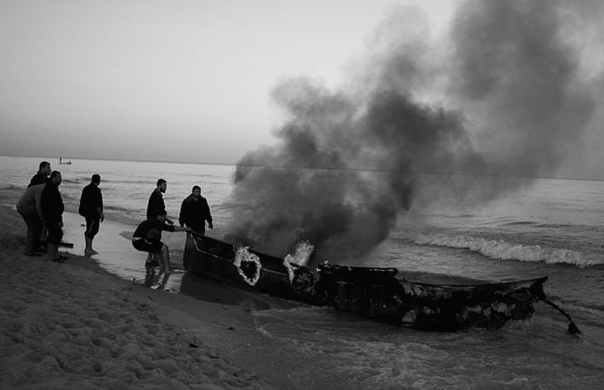
The story is just what the Israeli army press office ordered, and the Times willingly promotes this propaganda effort even as it shows little interest in even more urgent concerns that plague the residents of the strip. It had nothing to say, for instance, when Israel arrested 20 Gaza fishermen over less than a week this month and confiscated seven of their boats (here and here) even though they were fishing within the approved limit set by Israel.
Israeli harassment of the beleaguered fishermen has been a constant over the years: According to the Palestinian Center for Human Rights, Israeli forces detained 71 fishermen and confiscated 22 fishing boats in 2015, firing on fishing boats at least 139 times, wounding 24 fishermen and damaging 16 boats. The attacks have continued without letup this year.
The Times, however, has almost totally ignored the subject. The paper took notice briefly last month, when Israel announced new rules allowing Gaza boats to sail farther out to sea, and the story most certainly made the grade because it was a chance to show Israel in a benevolent light. The Times has been silent on the issue ever since.
Farmers with land near the border fence also face frequent attacks by Israeli soldiers who fire live ammunition at workers tending their fields, and Israel has destroyed crops and farm buildings, spraying fields of spinach and peas with herbicides and leveling land with bulldozers.
The Times has failed to report these incursions as well, although the United Nations documents them in weekly reports, and other news sources routinely tell of the assaults.
According to the UN, as of May 16, the Israeli military had made 30 incursions into Gaza this year. Its forces entered the enclave at least 56 times during 2015. These mini invasions—which include tanks, bulldozers and live fire—are breaches of the truce agreement made to end hostilities in 2014, but the Times has not seen fit to report them.
Instead, the newspaper prefers to raise the alarm about possible attacks from Gaza via the tunnels, ignoring the relevant context: the frequent shootings and other assaults by Israeli forces and the nine-year blockade, which finds not a single mention in the tunnel article.
Israel blocks the entry of needed medical supplies into Gaza, denies doctors the right to upgrade their skills in foreign countries and prevents many patients from leaving the enclave to receive the treatment they need. It has destroyed electrical equipment, wells and water treatment plants, and the lack of potable water has reached such a critical stage that only some 5 percent of the water in Gaza is safe to drink.
The Times, however, has shown no interest in exploring these crucial issues. It follows a prescribed narrative in deflecting blame from Israel and demonizing Hamas. The tunnel story fit this bill and thus merited a prime placement on page 1 above the fold.
AL-KHALIL (HEBRON): A week in photos 12-18 May 2016
Occupation Captured
CPTnet | May 23, 2016
|
|
|

|
|
|
|

|
|
|
|

|
|
|
|

|
|
|
|

|
|
|
|

|
|
|
|

|
Academics call for boycott of genocide conference in Israel
Palestinian Campaign for the Academic and Cultural Boycott of Israel | May 23, 2016
In a letter to the International Network of Genocide Scholars (INoGS), 270 academics from 19 countries have called for the cancellation of the 5th Global Conference on Genocide taking place on 26-29 June at the Hebrew University of Jerusalem.
The letter sent to the organizers of the conference on the 3rd of May points at the hypocrisy of having the conference in Israel at a time when Israel’s actions are “increasingly being viewed through lenses of ethnic cleansing and genocide linked to settler colonialism”. The signatories call on scholars and professionals to boycott the conference should it go ahead.
John Dugard, former UN Rapporteur for Human Rights in the OPT and a signatory to the letter, commented: “There are serious allegations that Israel committed crimes against humanity in its 2014 assault on Gaza. In these circumstances it is highly inappropriate to hold a conference on Genocide in Israel.”
Citing Israel’s treatment of Palestinians, the letter expresses shock “that INoGS plans to hold its 2016 Global Conference at the Mt. Scopus campus of the Hebrew University that is partially built on stolen Palestinian land in occupied East Jerusalem”. The INoGS conference website bills Jerusalem as part of Israel, defying international consensus on the issue and ignoring Israel’s ongoing and systematic campaign of displacement of Palestinians from the city.
According to Professor John Docker, who has written extensively in the fields of genocide and massacre studies, “Genocide studies is now, it seems clear, actively seeking opportunities to be complicit in Israel’s flouting of international law, not least the Fourth Geneva Convention.”
INoGS did not respond to the joint letter and it had ignored an earlier appeal by the Palestinian Campaign for the Academic and Cultural Boycott of Israel (PACBI).
Dr. Haidar Eid, a member of PACBI, said: “I am an academic living in besieged Gaza. I have witnessed three massacres committed by Israel, I almost lost my own life and saw my comrades, colleagues, relatives, and students perish in them. I have read with agony the names of 44 of our students and colleagues who lost their lives and 66 families wiped out by Israeli weapons. INoGS is lending its name to the perpetrators of these crimes in a move that is not unlike holding a conference on racism in apartheid South Africa.”
The conference is sponsored by five Israeli academic institutions, including the Hebrew University, which have been deeply complicit in Israel’s decades-long oppression of Palestinians. Thousands of academics in the UK, Ireland, Italy, South Africa, US and Brazil have signed national pledges to boycott Israeli academic institutions. The pledges are part of a growing movement to hold Israeli universities accountable to their role in systematic Israeli state violence against the Palestinian people.
The joint letter remains open for endorsements at the following link.
Featured Video

Why the U.S. Should Pull Back From the First Island Chain
or go to
Aletho News Archives – Video-Images
Book Review
‘Why Fauci Must Rot in Prison’: A Tale of Two Diaries
By Jill Erzen | The Defender | October 13, 2026
Dr. Anthony Fauci’s private diary reveals a “mind-numbing” contradiction between what the former top U.S. infectious disease official knew about COVID-19 and what he told the public, senior White House adviser Peter Navarro, Ph.D., said last week on “American Thought Leaders.”
In his new book, “Why Fauci Must Rot in Prison,” due out Oct. 20, Navarro compares Fauci’s private entries to his own pandemic-era diary, and uses what he calls “a tale of two diaries” to argue that Fauci should face criminal prosecution.
“I show, actually, how a prosecution can and should happen … at the state level, most likely,” Navarro said. “He should wind up in prison, and we’ve got the receipts in this book to put him there.”
Navarro said Fauci repeatedly acknowledged important facts in private, then publicly pursued policies that contradicted those facts — with devastating consequences.
“What he says many times privately in his diary is so at odds with both his public behavior and public statements that it’s mind-numbing,” Navarro said.
Navarro examines the lasting damage caused by lockdowns and other pandemic policies, and the ongoing toll of long COVID.
His book also addresses questions about vaccine safety, including why healthy young people faced COVID-19 vaccination mandates despite concerns about myocarditis, and why women were not warned about miscarriage risks linked to the shots. … continue
Blog Roll
 Aletho News
- Jennifer Kavanagh: Why the U.S. Should Pull Back From the First Island Chain
- Yemen denounces international community’s silence on Saudi aggression, siege
- UAE and Saudi Arabia move toward renewed coordination against Sanaa
- How Iran’s two-week retaliatory strikes exposed cracks in US military architecture in Persian Gulf
- The mother of all propaganda: Why the hype over US MOAB strike against Iran is nothing but theater
- Iran says it possesses technology behind US 14-ton GBU bunker-buster
- Trump asks Iran not to retaliate after he strikes Pickaxe Mountain – w/ Prof. Marandi
- Vice President J.D. Vance’s Deceptive ‘Antiwar’ Campaign Speech
- Iran: Palestinians’ rights must not be compromised in Gaza’s future; US, Israel to blame for Hormuz situation
- Ongoing tales of Syrian chemical weapons
- If Americans Knew
- Israeli rabbi permits occupiers to steal Palestinian olive harvest in West Bank
- Netanyahu’s spin on latest settler attack is laughable – Daily Update
- Israeli soldiers debunk Israel’s talking points
- In West Bank, Israeli settlers are totally out of control – Daily Update
- NPR investigation finds evidence of widespread fraud at mall kiosks tied to Israeli skincare brand
- Tucker Carlson exposes Israeli Lies about the Oct 7th attack, Charlie Kirk, and the U.S.
- Israel has detained thousands of Palestinian children since Oct 7th – over half spent time in solitary, many uncharged
- Israeli Analysis: Is Netanyahu Planning an ‘October Surprise’ Attack Before Israel’s Election?
- Israeli settlers brutally attack Palestinians and Washington Post female photographer, 65
- Words Have Changed, Occupation Continues: The Reality of the Gaza Ceasefire
- No Tricks Zone
- Predictions Made By Renowned Climate Proifessor Over Past Decades Have Been Proven To Be Poor
- New Study Suggests Large Regions Of The Pacific Ocean Have Been Cooling For The Last 80 Years
- Germany’s Green Energy Debacle: High Energy Costs Force Kahla Porzellan to Close After 182 Years!
- New Study: 50 Years Of The Most Aggressive ‘Net Zero’ Policies Can Only Affect The Global Climate By 0.03°C
- US September “Heat” Was No Record…Many Records Set Decades Ago
- Latest European Green Energy Debacle; Portugal’s Largest Flagship Solar Park Insolvent!
- Green Energy Debacle: German Expert Professor Fritz Vahrenholt Warns Of Severe Economic And Social Consequences
- Two More Paleo Reconstructions Affirm Meters-Higher Sea Levels Across Ireland, Brazil 7000-6000 Years Ago
- New Study: Earth And Venus Surface Warmth Largely Explained By Convection And Lapse Rate, Not CO2 Or Radiation
- 2025 Nature Paper Claiming Worsening Global Drought Gets RETRACTED …Heavily Flawed

