Israel On a Rampage of Destruction In the West Bank
By Barbara Erickson | TimesWarp | April 12, 2016
Israeli bulldozers are tearing up Palestinian structures at a rapid pace this year, destroying more than 500 houses and other buildings and displacing more than 650 men, women and children in three short months. The demolition spree is outpacing last year’s rate by more than three to one, and monitoring groups are raising the alarm.
Representatives of the European Parliament have spoken out against the destruction, saying Israel is violating international law. The United Nations and the Israeli human rights group B’Tselem have issued several reports and called for a halt to the demolitions; even the U.S. state department has expressed “concern” over the campaign.
The New York Times, however, has given short shrift to this story, relegating it to wire service reports, which appear neither in print nor in the featured headlines of Middle East news on the website. Only readers who search the site for specific news about demolitions can read about the recent rampage of destruction taking place in the West Bank.
No Times reporter has found it worthwhile to visit Khirbet Tana, for instance, a herding community near Nablus. The Israeli army has carried out demolitions there four times since February of this year, most recently just this past week, when they destroyed tents, houses and animal shelters and confiscated a car, a tractor and a water tank.
Earlier, on March 2 the authorities demolished a two-room schoolhouse with its playground equipment and toilets (as well as nine homes, two tents, 16 animal shelters and one solar panel).
The Khirbet Tana school had been built in 2011 with funds donated by an Italian aid organization. According to the United Nations Office of Humanitarian Affairs, it was one of more than 100 structures “provided as humanitarian assistance to families in need,” which have been destroyed so far this year.
This has become a heated issue with many donor groups, including members of the European Parliament. After a recent EP delegation to Palestine, Irish parliamentarian Martina Anderson stated, “We are incensed by Israel’s increasing number of demolitions of humanitarian structures funded by EU taxpayers. People are losing their homes in the cold and the rain. Israeli policies violate international law and show disrespect for the EU, Israel’s biggest trade partner.”
Her words had no effect on Israeli authorities, who went on to bulldoze the school at Khirbet Tana two weeks later and then spent the next two days destroying structures in eight other communities.
Writer Amira Hass described this follow-up operation in the Israeli newspaper Haaretz: “The Israelis destroyed tents people were living in, huts, pens, herd enclosures, an access road (which makes it very hard to deliver humanitarian aid to the families), a two-kilometer pipe meant to provide water to 50 families in the area, storage facilities and a dairy. Some of the tents and the pipe were donated by international organizations. Fifty-nine people, including 28 minors, were left without a roof over their heads.”
As of April 4, according to the UN, Israel had destroyed 500 Palestinian structures and displaced 657 individuals this year, compared with 521 structures and 663 persons in all of 2015. As B’Tselem has noted, this is “an unusually massive demolition campaign.”
All this is disturbing enough, but the news that Israeli politicians are shamelessly pushing for continued destruction of the vulnerable herding communities is even more appalling. As Hass reports in Haaretz, Knesset members “have openly pressured Civil Administration officials to step up the demolitions and evict Palestinian communities from Area C.” They have also “demanded that the authorities destroy buildings that international organizations, particularly European ones, have donated.”
The Times, however, has little interest in exposing the illegal and inhumane actions of Israeli officials and the consequent suffering (and stubborn resilience) of vulnerable Palestinian families clinging to their land and livelihoods. To do so would expose the lie at the heart of the Israeli narrative—the claim that Israelis are the innocent victims of Palestinian terrorism.
The demolition campaign, however, reveals the helplessness of Palestinian communities, the cruelty of the occupation forces and the criminal actions of government officials. From the Times’ point of view it is all best left unsaid.
Boycott campaign launched against Dutch delivery service TNT
Ma’an – April 12, 2016
HEBRON – Activists called for a boycott campaign against Dutch international courier company TNT Express after its staff reportedly refused to deliver parcels to Palestinian recipients, allegations the company denied.
Boycott campaign co-organizer Suhaib Zahdah told Ma’an on Monday that “the issue surfaced after TNT employees refused to deliver mail parcels to their Palestinian recipients.”
The recipients contacted the company, which reportedly said company policy doesn’t allow work with the Palestinians, and suggested the recipients “use addresses in Jerusalem or Nazareth [in Israel] instead,” Zahdah said, referring to the reply of TNT’s headquarters in the Netherlands as “negative.”
“This is a violation of international law as the company discriminates by employing people refusing to work with Palestinians while they work with the illegal Israeli settlements,” he said.
The boycott campaign was launched under the slogan “TNT, the people discrimination,” a play on the company’s slogan “the people network.”
In response to the allegations, the company told Ma’an that TNT makes regular deliveries to Palestine, “including Ramallah, Gaza, East Jerusalem, Hebron, and the West Bank.”
While the company said TNT’s Israel branch “delivers shipments to Israeli towns, including those in the West Bank,” referring to Israeli settlements, shipments to Palestinians in the occupied Palestinian territory are handled through TNT’s Jordan branch, and delivered by a subcontractor once “for the final delivery.”
TNT in response to the case brought up by the campaign said: “We’ve had email exchanges with a customer who was disappointed because TNT Israel wasn’t able to make a delivery at the address he specified.”
“Security restrictions may at times limit our ability to serve certain destinations or addresses. This is what we explained to one of our customers today,” TNT said, emphasizing the company did not have a political agenda.
The boycott, divestment, and sanctions (BDS) movement against Israel has gained momentum over the past year, with activists increasingly targeting companies that act in compliance with Israel’s illegal occupation of East Jerusalem and the West Bank.
Israeli settlements in East Jerusalem and the West Bank are considered illegal by the majority of the international community, and companies who either operate out of settlements or in cooperation with settlement-based companies are seen by the BDS movement as supporting illegal Israeli policies.
Two Smooth Faces of Evil
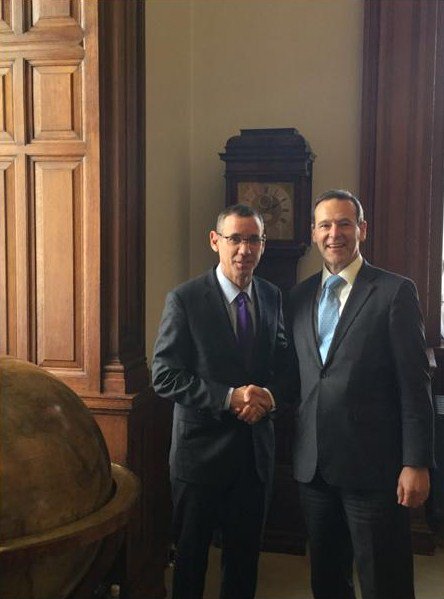
By Craig Murray | April 12, 2016
Many of you will recognise one of the faces in this photograph, Mark Regev. He is Israel’s new Ambassador to London and of course was the Israeli government spokesman who justified the massacre of more than 600 women and children in Gaza, and the murder of peace activists aboard the Mavi Marmara.
The other face of evil is Simon McDonald, head of the UK Diplomatic Service. You probably now think I am indulging in hyperbole. But no, I am not.
Simon McDonald was the Foreign Secretary Jack Straw’s Private Secretary at the time of the implementation of the British government’s extraordinary rendition and intelligence from torture programmes. When I became the only member of the UK’s senior civil service to make formal objection to these programmes, it was Simon McDonald who managed Jack Straw’s response in continuing to use torture.
I have indisputable documentary evidence of this, plain despite redactions by the British government censors (redactions which primarily remove all references to the CIA).
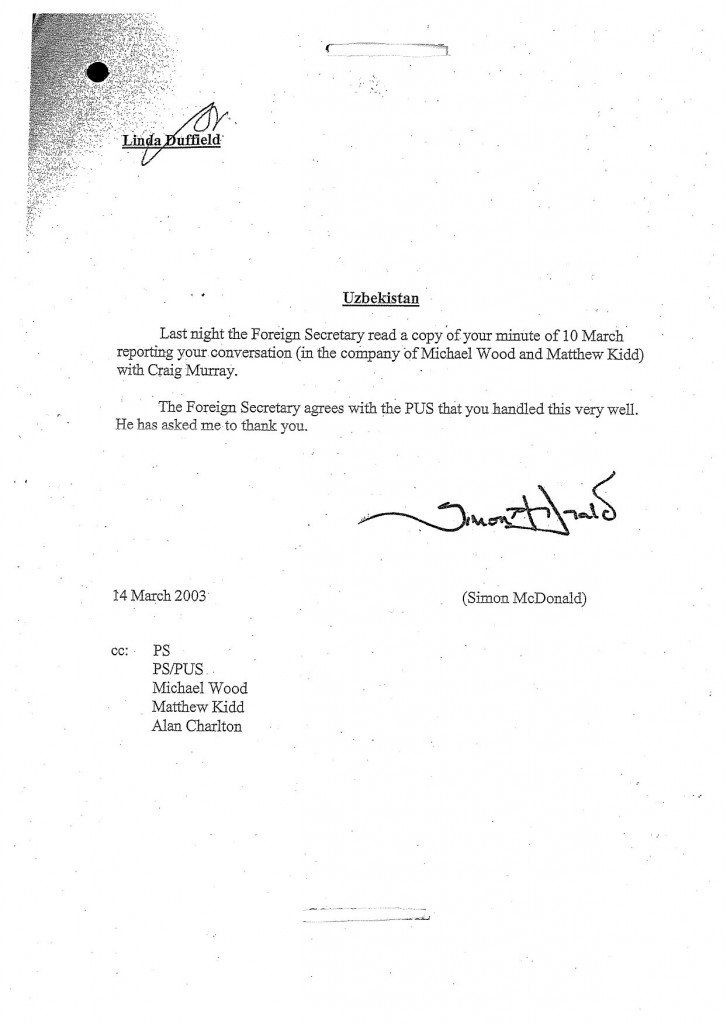
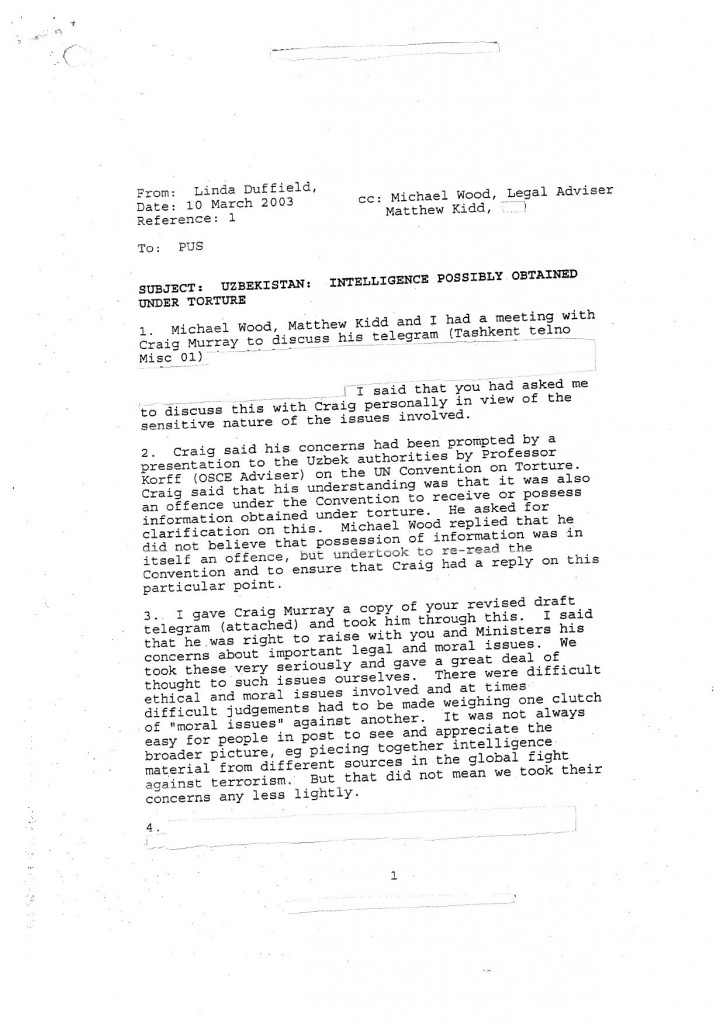
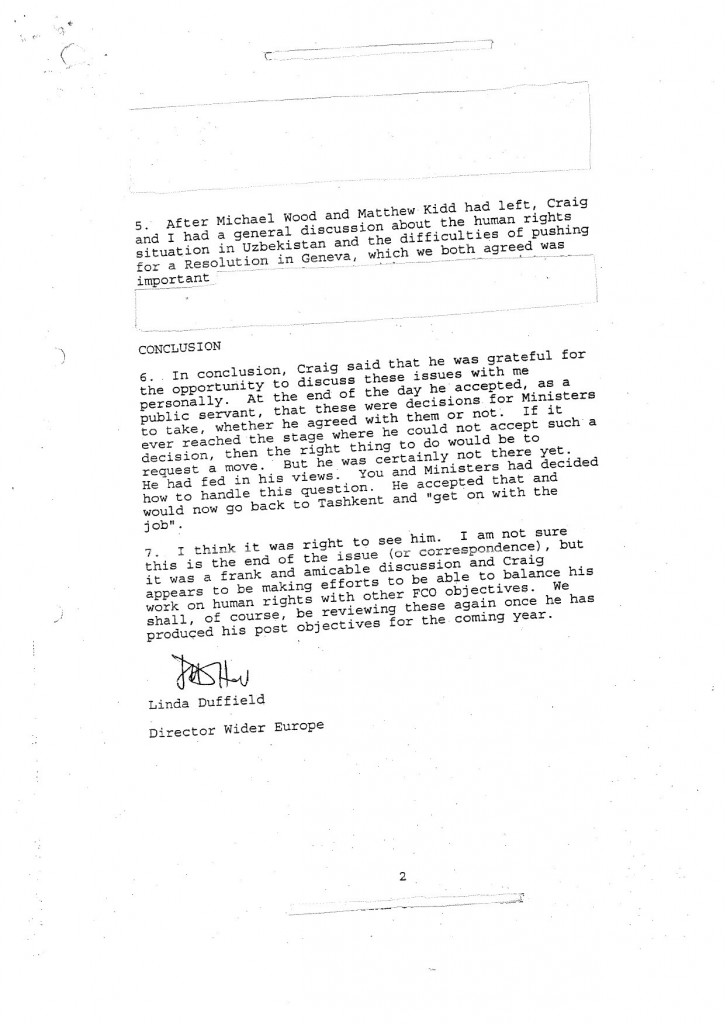
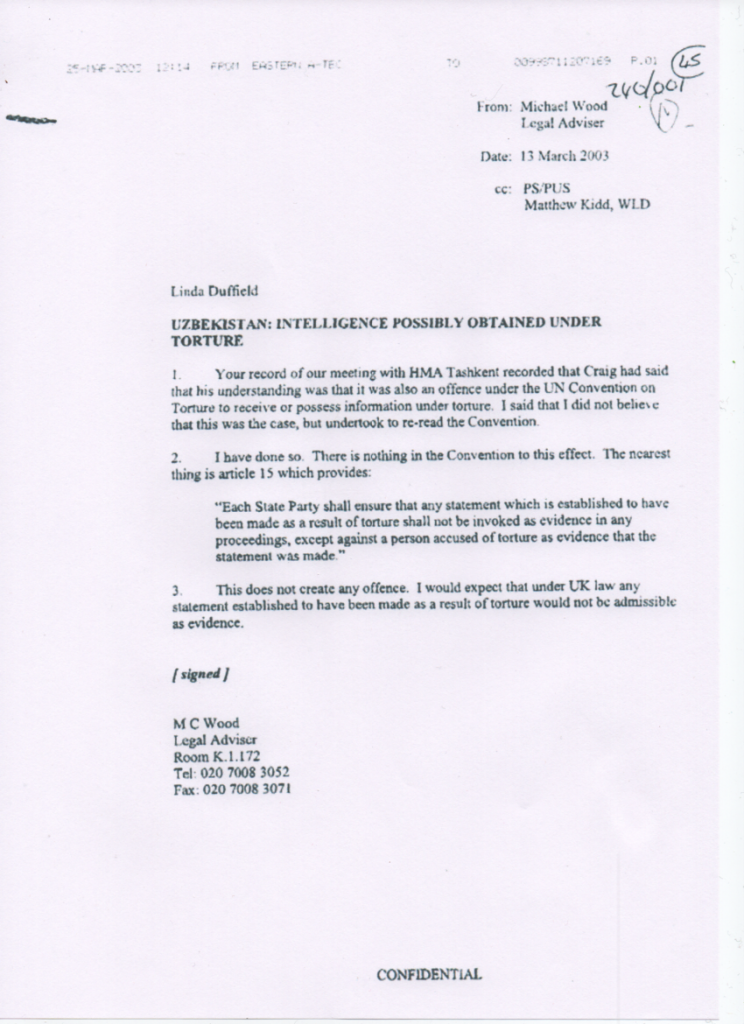
It is put to me frequently that people like McDonald, who were merely implementing a policy of torture, are not evil. That of course is the age old “only doing my job” defence. As somebody who was sacked for refusing to go along with torture, I think I have walked the walk and can describe him as evil. It is also worth noting that, while McDonald meets all new Ambassadors to London, he went far further with Regev than with anybody else. He tweeted out their photo with the message “Happy to see Mark Regev newly arrived Israeli Ambassador, an old friend from Tel Aviv ten years ago.”
Ten years ago, when they were friends in Tel Aviv, was of course the year in which Israel invaded Lebanon and Mark Regev was the chief Israeli spokesman justifying that attack, with its mass civilian casualties. Regev also defended the bombing by Israel of a United Nations observation post.
It is hardly surprising McDonald and Regev became friends at this time, as Gordon Brown’s government were doing everything possible behind the scenes to assist the Israeli invasion. As I wrote at that time
I have just watched on television sixty bodies being buried in a mass grave in Tyre, victims of Israeli bombing. At the same time I saw the odious Kim Howells, Foreign Office minister, arguing that a ceasefire would not solve the problem.
British diplomats at the UK Mission to the United Nations in New York – people I know personally – are putting massive effort into working against a ceasefire. They have the ultimate weapon that they and the US can veto any resolution at the Security Council, but are bending their backs into heading the subject off the agenda.
I hope they are proud of their succesful efforts. For every hour they prevent a ceasefire, on average two more Lebanese children are dying. Israel claims now to have killed 100 Hizbollah fighters. Even if true, that means they are killing two children to every fighter.
McDonald and Regev. Torture meets child-killing. Don’t they make a lovely couple?
China Acquires Israeli Dead Sea Cosmetics Company for $77 Million
Sputnik – April 11, 2016
On Sunday, Vice President and CEO of Fosun Group, Liang Xinjun, signed an agreement to purchase Ahava with Executive Director of Gaon Holdings Guy Regev. The deal amounted to $77 million.
The ceremony took place in the presence of high-ranking Israeli officials at the David Citadel Hotel in Jerusalem and was witnessed by Israeli government officials and representatives of both companies.
Under the terms of the agreement, Fosun will acquire the holdings from all Ahava’s shareholders including Gaon Holdings, Shamrock Israel Growth Fund Advisors, Kibbutz Mitzpe Shalem, and Kibbutz Kalia.
Vice-President of Fosun, Liang Xinjun, said he was pleased with the results of agreement and hopes to bring Ahava into the Chinese market.
Chinese companies and corporations have been active in the Israeli market over the last few years. In 2011, China National Chemical Corporation acquired Adama, which produces pesticides, for a price of $2.4 billion and in 2015 the Chinese company Bright Food acquired a controlling stake in Israel’s largest producer Tnuva, which is heavily involved in dairy goods.
In addition, China is already the world’s largest importer of cosmetics and health products based on minerals from the Dead Sea.
Experts believe that China’s geopolitical presence in Israel will only continue to grow. In particular, due to the construction of the state-owned China Harbor seaport of Ashdod on the Mediterranean Sea.
The country’s first private port will not appear before 2021. The project cost is estimated at over one billion dollars. The purpose of the project is to connect Ashdod with the southern Israeli city of Eilat and transport goods to Europe, bypassing the Suez Canal.
‘Arrest arms dealers, not peace campaigners!’ 8 on trial over weapons fair protest

RT | April 11, 2016
Eight activists are standing trial at Stratford Magistrates Court for disrupting the world’s biggest arms fair, held in London, where deadly merchandise was marketed to repressive regimes such as Saudi Arabia, Bahrain and Azerbaijan.
The campaigners blocked the road leading to the Defence & Security Equipment International (DSEI) in Stratford, London, last September, preventing tanks and weaponry from entering.
The defendants are using a defense of necessity, insisting their actions were justified because they intended to prevent greater crimes taking place around the world.
These include: “The sale of weapons to internally repressive regimes, including Bahrain and Saudi Arabia; the sale of weapons to countries imminently at war and overtly complicit in ongoing war crimes in Yemen, Kurdistan and Palestine; the sale of weapons to regimes that have been widely accused of arming ISIS [Islamic State or IS]; the promotion for sale of weapons that are designed specifically for torture or banned under international law for their capabilities concerning the mass indiscriminate killing of civilians.”
The DSEI arms fair is held every two years in London, and is regularly attended by representatives from repressive regimes. It has also previously provided a platform for weapons dealers to illegally promote arms that are used for torture.
Last September’s event featured stalls from more than 1,500 exhibitors, including arms giants Lockheed Martin, BAE systems, Finmeccanica and others.
Protestors sought to disrupt the fair by locking their bodies together to block access roads outside the Excel Centre, where the fair was held. Several were arrested.
Some protestors, such as Vyara Gylsen – who was arrested after writing a slogan on a military vehicle with a washable marker pen – have since seen criminal charges against them dropped.
The defendants in court this week include Isa Al Aali, a Bahraini activist who was tortured during the Arab Spring uprising in Bahrain.
Green Party activists Angela Ditchfield and Tom Franklin are also among the eight appearing in court.
“The government is supporting and facilitating the sale of weapons that are being used to kill ordinary people, from the West Bank to Yemen and Sudan,” Franklin, 57, of York, said.
“This week we will put the arms trade in the dock and highlight the crimes that the government and the companies at DSEI are complicit in. Arrest arms dealers, not peace campaigners.”
The defendants will be supported by expert witnesses, including former South African MP Andrew Feinstein, who resigned from parliament in 2001 in protest at the government’s refusal to investigate a £5 billion (US$7.12 billion) arms deal.
Amnesty International UK’s Oliver Sprague, who heads up the charity’s arms Control and Policing division, will also give oral evidence, as will Bahrain Institute for Rights and Democracy director Sayed Ahmed, who seeks to improve accountability in the repressive Gulf state.
Last day of demolition order leaves Palestinian family in fear of losing their home
International Solidarity Movement | April 10, 2016
Jerusalem, Occupied Palestine – The 10th of April is the last day of the demolition order on the home of the Totanji family. The family lives in the Sawaneh district in Wadi al-Joz, a village in East Jerusalem near the Old City, which Israel has declared as a ‘National Park’ area. This despite it having always been a residential area. The family received the demolition order over a year and a half years ago, but lost the appeal against the order last month. Today is the last day of the demolition order, which leaves the family fearing that their house maybe demolished tonight.
The house is single-story with 4 bedrooms. However, it is currently the home of 16 people including a 7 month old baby, the granddaughter of the owner of the house. As is the case with other Palestinian families in fear of house demolition, the family does not have any where else to go, and will leave their whole life behind if their house is demolished. Just seven months ago, one of Totanji sons had his house demolished in the same area. This fear of losing one’s home does not just apply to the Totanjis, but also to the rest of the residents in Palestine, due to the huge number of demolitions and demolition orders. In just the last week (31st March-6th April) 14 houses have been demolished in East Jerusalem and the West Bank by Israeli Forces.
Wadi al-Joz is located directly outside the Old City of Jerusalem in a vulnerable area. It is a neighbourhood that suffers from many demolition orders and subsequent demolitions. This is due to Israel declaring parts of the area around the Old City in Jerusalem as a ‘National Park’, to “protect the historical land.” The area covers a huge residential areas containing villages which are already overcrowded including Wadi al-Joz. In addition to the Totanjis, 13 other families in the Sawaneh district in Wadi al-Joz are also in danger of demolition. The information regarding the so called ‘National Park’ was only relayed to these families in the past two years. And whilst Israeli authorities claim that it was declared a park more than 4 decades ago, regardless, this declaration concerning annexed territory is in direct violation of international law.
The family is seeking an international presence to defer the demolition and deter the Israeli authorities. Internationals will be in the house from this evening and for the foreseeable future to prevent the demolition. There is a press conference planned tomorrow morning, 11am on the 11th of April 2016, to announce the opening of a protest tent outside the Totanji family house. The families and the community of Wadi al-Joz invites everyone to attend the protest and to lend coverage to this important event.
Address:
Wadi Al-Joz, neighbourhood of East Jerusalem
Across the Fire Station, behind the Central Market or “Hisbi”
Directions:
From Damascus Gate, follow the Old City Wall towards the Mount of Olives and continue down into Wadi Al-Joz. The home is on a dirt road on the right before you begin to go up the hill to the Mount of Olives. It is about 10-15 minute walk from Damascus Gate. Alternatively, you can drive down from the Mount of Olives past the Ibrahimiya School. The dirt road is on the left at the bottom of the hill just opposite the paved road that goes right into Wadi al-Joz.
Contacts:
Totanji family contact
Aref Tatanji: +972-(0)-508-133-590 (Arabic)
Press conference contact
Nureddin Amro: +972-(0)-525-271-587 (Arabic and English)
ISM media contact
Josephine: +972-(0)-59-740-6401(English)
Further reading:
Background about home demolitions:
House demolitions in International Humanitarian Law (Diakonia)
East Jerusalem: Key Humanitarian Concerns (UN OCHA, August 2014)
The Absentee Property Law in East Jerusalem and Its Implementation: A Legal Guide and Analysis (Norwegian Refugee Council, 2013)
International Day of Solidarity for Palestinian Prisoners – Paris, London, NYC, Toulouse
BDS France Toulouse, Coup Pour Coup 31, NPA31, Collectif Palestine Libre
As of March 2016, there are over 7,000 Palestinians, including more than 100 children, in Israeli prisons, in violation of international law which prohibits an occupying power to imprison in its territory the people of occupied territories.
Since 1967, over 750,000 Palestinians (20% of the total population and 40% of the male population) have been imprisoned by the occupation army. There is no Palestinian family that has been untouched by imprisonment.
 99.74% of Palestinians are convicted by Israeli military courts, the majority of these resulting from forced “plea bargains” (the accused must plead guilty or face a much higher sentence, in a context that they will certainly be found guilty)
Nearly 700 Palestinian prisoners are held under administrative detention, an arbitrary and illegal procedure that allows the Israeli army to detain Palestinians for a period of six months, indefinitely renewable, without charge or trial.
Among the detainees are Palestinian parliamentarians, including Ahmad Sa’adat, General Secretary of the Popular Front for the Liberation of Palestine; Marwan Barghouti, Fateh leader; and several Hamas lawmakers. In April 2015, Khalida Jarrar, member of the Palestinian Legislative Council and advocate for prisoners’ rights, was arrested and sentenced to 15 months in prison. Lawyer and activist Shireen Issawi was convicted along with her brother Medhat Issawi, and sentenced to 4 and 8 years in prison respectively. Medhat Issawi was previosly imprisoned for 20 years!
Palestinian prisoners are subject to torture, sleep deprivation, lack of hygiene and medical care, confinement in tiny cells and sordid, humiliating treatment. A growing number are held in prolonged solitary confinement. Threats, intimidation and denial of family visits are all means of the Israeli occupation to silence the legitimate struggle of the Palestinian people for land and freedom.
Many prisoners went on hunger strike, risking their lives to confront inhumane treatment; for example, Mohammed al-Qeeq ordered to administrative detention in November 2015 and after 94 days of hunger strike, securing his release in May 2016.
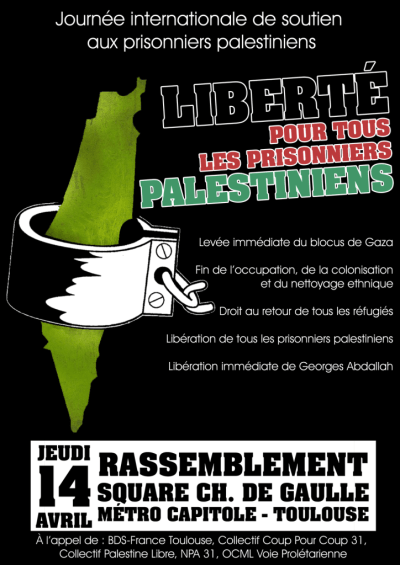
As part of the International Day of Solidarity for Palestinian Prisoners, we salute the thousands of Palestinians imprisoned for struggling against the apartheid and ethnic cleansing of their people. We also salute Georges Abdallah, communist activist for the Palestinian cause, imprisoned in France since 1984 for resisting the Israeli invasion of his country, Lebanon.
Let us unite for their release, to end the oldest military occupation in the world, to develop the movement for boycott, divestment and sanctions against the criminal regime of Israel, to demonstrate and popularize the struggle of the Palestinian people.
We demand:
The release of all Palestinian prisoners
The immediate end of the blockade and siege of Gaza
The end of occupation, colonization, and ethnic cleansing of Palestine
The Right of return of all Palestinian refugees
The immediate release of Georges Abdallah
Palestine lives, Palestine will be victorious!
Rassemblement jeudi 14 avril 2016 à 17h30 Square Charles De Gaulle (Métro Capitole).
16 April, Paris: Rally in support of Palestinian Prisoners
Saturday, 16 April
3:00 pm
Place du Chatelet
Paris, France
Facebook: https://www.facebook.com/events/229128724111169/
March via the Boulevard Sebastopol to the Place de la Republique, where we will hold a mass rally to support the 7000 Palestinian political prisoners. We will not forget Georges Ibrahim Abdallah, the great defender of the Palestinian cause, held for 32 years in French prisons at the demand of Israel and the US!
Organizers: CAPJPO-EuroPalestine, Droits Devant, Children of Palestine, Palestine Nanterre, Saint-Ouen Palestine, Friends of Nablus, Collective for the Liberation of Georges Ibrahim Abdallah
16 April, London: Palestine Prisoners Parade
Saturday, 16 April
12:30 pm
Gower Street (Corner of Torrington Place)
London, UK
Facebook: https://www.facebook.com/events/600881743402205/
On the occasion of Prisoners’ Day, we invite you to join us in solidarity with all Palestinians currently languishing in Israeli jails. We will march from Gower street to Trafalgar square along with another march that is being held that day (people against austerity). In keeping with the circus theme that has been used to raise awareness about Abu Sakha, a Palestinian clown currently held in administrative detention, we encourage people to come dressed as colourfully and clowny as you dare! We also encourage as many specific performers as possible (circus artists, musicians, dancers etc). If you have a specific tallent to perform, please get in touch at info@freeabusakha.com or private messaging to www.facebook.com/freeabusakha so we can coordinate the acts.
15 April, NYC: Celebrate resistance before Palestinian Prisoners’ Day
Friday, 15 April
4:00 pm
G4S Office – NYC (19 W 44th St)
Facebook: https://www.facebook.com/events/1042793672451086/
On 17 April each year, Palestinian prisoners, the Palestinian people, and the world mark the International Day of Solidarity with Palestinian Prisoners.
Commemorated since 1974, when the first Palestinian prisoner, Mahmoud Hijazi, was freed in a prisoner exchange with the Palestinian Resistance, 17 April is a day of protests, rallies, marches, forums and more to commemorate the struggle of Palestinians imprisoned in Israeli occupation jails and demand their freedom.
We join with the Palestinian prisoners’ movement in calling on organizations and people of conscience around the world to take action to to express solidarity and call for freedom for Palestinian political prisoners.
Over 7,000 Palestinian prisoners are currently held in Israeli jails. More than 700 of them are held in administrative detention without charge or trial. The others face military courts which convict over 99% of the Palestinians that appear before them. Over 400 Palestinian children as young as 12 years old are held in Israeli prisons.
Every night, Israeli occupation forces conduct violent armed invasions of Palestinian villages, cities, refugee camps and homes, ransacking them and arresting dozens of Palestinians. This comes amid near-daily killings and extrajudicial execution of Palestinians by occupation forces, the demolition of the homes of the families of Palestinian prisoners, new racist laws targeting Palestinians who hold Israeli citizenship, and further escalating repression.
International action has seen some response: G4S, the British-Danish security corporation targeted for a global boycott because of its role in providing security systems, control rooms and equipment to Israeli prisons, has announced it is selling off its Israeli subsidiary and leaving the market entirely. However, it’s critical to keep the pressure on G4S until their equipment and security systems are no longer being used to imprison Palestinians, block their movement at checkpoints, or besiege Gaza.
G4S doesn’t only profit on the imprisonment of Palestinians, of course. Black student movements at Columbia University, the University of California and Cornell University have led in building campus boycotts and divestment against G4S because of its role in private imprisonment in the United States, especially of youth, and have won significant victories. Organizing with movements confronting imprisonment and racist oppression, including the Black movement and the prison divestment movement, is particularly crucial in confronting common oppressors.
Palestinian Prisoners’ Day this year also comes amid international repression of Palestinian organizing – for example, the attacks on BDS in France and the arrest and prosecution of BDS activists – and the imprisonment and persecution of Palestinians and fellow strugglers in international prisons, as in the cases of Georges Ibrahim Abdullah, the Holy Land Five, and Rasmea Odeh. Confronting racism and oppression of all forms comes hand in hand with confronting Zionist settler-colonial racism in Palestine.
After a regular, weekly protest of G4S on Friday, join Samidoun Palestinian Prisoner Solidarity Network as we rally with CUNY Prison Divest and NYC Students for Justice in Palestine on Sunday, 17 April to demand freedom for Palestinian political prisoners and an end to private, for-profit incarceration in the United States:
Israel connects BDS with terrorism while cracking down on German banks
RT | April 10, 2016
Israel’s Public Security Minister has linked the Boycott, Divestment and Sanctions (BDS) movement with terrorism and is threatening German banks using tactics previously employed against Al-Qaeda.
Netanyahu-appointee Gilad Erdan has threatened to coerce German banks to prohibit BDS activists from fundraising through their accounts, not through Israeli legislation, but the laws of other countries where Erdan has “increased awareness among decision-makers in Europe and North America of the anti-Semitic, anti-democratic, and discriminatory nature of the BDS movement, which seeks Israel’s destruction and often has ties to terror-supporting organizations.”
To bring about this “increased awareness,” a taskforce headed by Erdan was launched last year at the cost of 100 million Israeli shekels ($25.5 million) that has been successful in impacting the laws, policies, and enthusiasm for enforcement in a number of countries, particularly the US and UK, where a number of anti-BDS restrictions have employed “anti-democratic” and “discriminatory” methods to clamp down on the movement.
Erdan’s Friday statement in the Jerusalem Post urged the banks to “carefully consider the potential legal, reputational, and ethical consequences of facilitating the activities of BDS groups.”
In response, the bank’s spokesman said “We expressly point out again that Commerzbank adheres to the applicable compliance guidelines and regulations regarding the conduct of an account.”
Ironically, while Erdan is threatening BDS activists with one set of laws, the global grassroots movement is actually trying to pressure Israel to “comply with international law” through the boycott of products and companies that profit from the violation of the rights of Palestinians, particularly violent land grabs.
Inspired by the BDS movement that helped end South African apartheid, supporters of this campaign, which includes Jewish activists contrary to the accusations of anti-semitism, believe it is the only way to push for a solution to the Palestinian-Israeli conflict.
Here are the countries Erdan is counting on to be Israel’s enforcers in its global crackdown on the “terrorist” boycotters.
US
Legislation has been introduced at local, state, and federal levels targeting BDS movements.
At least 16 anti-BDS initiatives were introduced in the US in 2015, including the Trade Promotion Authority legislation that discourages European governments from taking part in BDS activities by threatening to cut off their ability to engage in free trade with the US.
Illinois passed an anti-BDS state law that created a blacklist of foreign companies from which the state pension must divest its funds. South Carolina bans state business with companies engaged in boycotts.
Other anti-BDS bills have been introduced in Congress, New York, New Jersey, and Pennsylvania. New York state currently has legislation on the table, just in time for the New York primary, that would ban state business with companies involved in boycotting Israel, including international banks.
Canada
Earlier this year, Canada passed a motion condemning “any and all attempts” to promote BDS. The country’s new leader Justin Trudeau said the movement had “no place on Canadian campuses” and fully supported Israel’s 2014 Operation Protective Edge against Gaza, despite his “liberal” outlook.
UK
The UK recently banned local authorities and public bodies from participating in BDS. This includes councils, universities, and student unions. The move was welcomed by Conservative MP Eric Pickles who said the BDS movement was an attempt “by the irresponsible left to demonize Israel.”
The UK has had its fair share of BDS victories in the past. Leicester City Council adopted the boycott policy in 2014 along with the National Union of Students the following year.
France
BDS is banned in France as part of a general law that classifies the boycott of a nation or its citizens as a hate crime. It is illegal for councils or legal bodies to boycott Israeli goods.
Last November, a small group of French activists were found guilty of provoking discrimination after holding a small rally calling for the boycott of Israeli goods. They were sentenced to pay €12,000 in damages to the plaintiffs, as well as legal fees.
Germany
While Germany doesn’t have a specific law banning the BDS movement, DAB Bank in Munich announced in February that it would cancel BDS-Kampagne’s account as of next week. DAB is owned by French BNP Paribas.
Palestinians mark 68th anniversary of Deir Yassin massacre
Ma’an – April 9, 2016
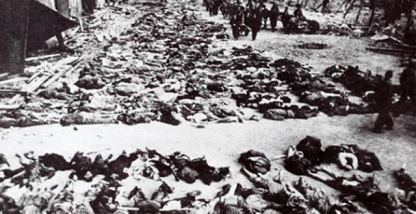
Palestinians on Saturday marked the 68th anniversary of the massacre of more than 100 Palestinians civilians carried out by Zionist paramilitary groups in the village of Deir Yassin in 1948 prior to the establishment of Israel.
Deir Yassin has long been a symbol of Israeli violence for Palestinians because of the particularly gruesome nature of the slaughter, which targeted men, women, children, and the elderly in the small village west of Jerusalem.
The number of victims is generally believed to be around 107, though figures given at the time reached up to 254, out of a village that numbered around 600 at the time.
The Deir Yassin massacre was led by the Irgun group, whose head was future Israeli Prime Minister Menachem Begin, with support from other paramilitary groups Haganah and Lehi whose primary aim was to push Palestinians out through force.
Records of the massacre describe Palestinian homes blown up with residents inside, and families shot down as they attempted to flee.
The massacre came in spite of Deir Yassin resident’s efforts to maintain positive relations with new Jewish neighbors, including the signing of pact that was approved by Haganah, a main Zionist paramilitary organization during the British Mandate of Palestine.
An Israeli psychiatric hospital now lies on the ruins of Deir Yassin, the remainder of which was reportedly bulldozed in the 1980s to make way for Jewish housing and incorporated as a neighborhood of Jerusalem. Streets of the neighborhood hold names of Irgun militiamen who carried out the massacre.
The massacre was one of the first in what would become a long line of attacks on countless Palestinian villages, part of a broader strategy called Plan Dalet by Zionist groups to strike fear into local Palestinians in hopes that the ensuing terror would lead to an Arab exodus, to ensure only Jews were left in the “Jewish state.”
Thus the attack on Deir Yassin took place a month before the UN Partition Plan was expected to be carried out, and was part of reasons later given by neighboring Arab states for their intervention in Palestine.
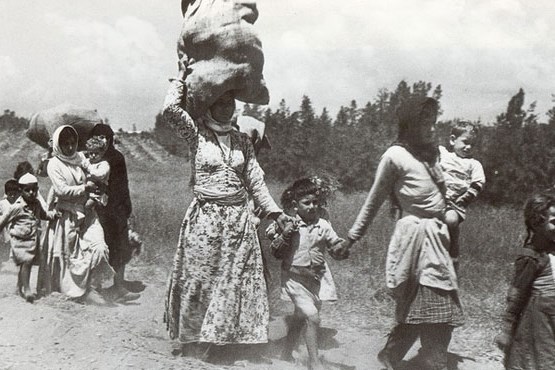
The combination of forced expulsion and flight that the massacres — what would later become known among Palestinians as the Nakba, or catastrophe — precipitated left around 750,000 Palestinians as refugees abroad. Today their descendants number more than five million, and their right to return to Palestine is a central political demand.
The anniversary of the deadly razing of the village comes as modern day Palestinians in occupied East Jerusalem and the West Bank continue to fight for their livelihood in the face of illegal Israeli settlement expansion, widespread detention campaigns, extrajudicial executions by Israeli forces, and a surge in housing demolitions — most recently leaving 124 Palestinians homeless in a single day.
‘UK firm helps Israel kill Palestinians’
Protesters slam UK firm over profiting from Israeli war crimes
Press TV – April 9, 2016
Scores of pro-Palestinian activists in the UK have demonstrated outside the headquarters of an arms manufacturing company, accusing it of benefiting from Israel’s deadly crackdown against Palestinians.
The protesters gathered in front of the UK headquarters of aerospace manufacturer Thales, in Crawley, on Friday and expressed their anger against the company’s partnership with Israel’s Elbit Systems to develop a surveillance drone, nicknamed Watchkeeper, used by the regime against Palestinians.
The rally was held by the Sussex Stop Arming Israel campaign and was supported by other human rights groups, including the Inminds. The main messages of the protest were “Stop Arming Israel” and “Thales profits from Israeli war crimes.”
“Thales UK has a billion pound contract with Israel’s largest arms company Elbit Systems to develop a fleet of drones. Human Rights Watch has documented [the drones] as being used by Israel to deliberately target Palestinian civilians in Gaza,” said Inminds chair Abbas Ali.
“It’s sickening that Elbit markets this killer drone as being extensively ‘field tested’ in ‘real life’ situations — using the slaughter of Gaza’s people as a marketing ploy to gain a competitive advantage,” he added.
The Watchkeeper drone, which is produced through a joint venture dubbed UAV Tactical Systems, is modeled on Elbit’s Hermes 450, a UAV that has been used in action by the Israeli military. According to the Sussex group, the drone is developed under a contract awarded by the UK’s Ministry of Defense.
Thales UK is a subsidiary of the French company Thales, and is currently considered as the UK’s second largest military company.
Tel Aviv is under fire by rights groups for its indiscriminate attacks against Palestinian civilians. In one instance of Israel’s brutality, at least 2,140 Palestinians, including 557 children, lost their lives during the regime’s offensive against the Gaza Strip in the summer of 2014.
The aggression also left 11,100 Palestinians wounded, including 3,374 children and 2,088 women, and displaced over 170,000 others.
Featured Video

Why the U.S. Should Pull Back From the First Island Chain
or go to
Aletho News Archives – Video-Images
From the Archives
Only 19.7% of Americans agree with US State Dept on Israeli settlements
… Most American adults of voting age don’t appear willing to reject the applicability of international law to Israel’s ongoing colonization of occupied territories in East Jerusalem, the West Bank and Golan Heights. … Full article
Blog Roll
 Aletho News
- Tokyo protests demand Takaichi’s resignation over support for ‘Israel’
- Jennifer Kavanagh: Why the U.S. Should Pull Back From the First Island Chain
- Yemen denounces international community’s silence on Saudi aggression, siege
- UAE and Saudi Arabia move toward renewed coordination against Sanaa
- How Iran’s two-week retaliatory strikes exposed cracks in US military architecture in Persian Gulf
- The mother of all propaganda: Why the hype over US MOAB strike against Iran is nothing but theater
- Iran says it possesses technology behind US 14-ton GBU bunker-buster
- Trump asks Iran not to retaliate after he strikes Pickaxe Mountain – w/ Prof. Marandi
- Vice President J.D. Vance’s Deceptive ‘Antiwar’ Campaign Speech
- Iran: Palestinians’ rights must not be compromised in Gaza’s future; US, Israel to blame for Hormuz situation
- If Americans Knew
- Israeli rabbi permits occupiers to steal Palestinian olive harvest in West Bank
- Netanyahu’s spin on latest settler attack is laughable – Daily Update
- Israeli soldiers debunk Israel’s talking points
- In West Bank, Israeli settlers are totally out of control – Daily Update
- NPR investigation finds evidence of widespread fraud at mall kiosks tied to Israeli skincare brand
- Tucker Carlson exposes Israeli Lies about the Oct 7th attack, Charlie Kirk, and the U.S.
- Israel has detained thousands of Palestinian children since Oct 7th – over half spent time in solitary, many uncharged
- Israeli Analysis: Is Netanyahu Planning an ‘October Surprise’ Attack Before Israel’s Election?
- Israeli settlers brutally attack Palestinians and Washington Post female photographer, 65
- Words Have Changed, Occupation Continues: The Reality of the Gaza Ceasefire
- No Tricks Zone
- Predictions Made By Renowned Climate Proifessor Over Past Decades Have Been Proven To Be Poor
- New Study Suggests Large Regions Of The Pacific Ocean Have Been Cooling For The Last 80 Years
- Germany’s Green Energy Debacle: High Energy Costs Force Kahla Porzellan to Close After 182 Years!
- New Study: 50 Years Of The Most Aggressive ‘Net Zero’ Policies Can Only Affect The Global Climate By 0.03°C
- US September “Heat” Was No Record…Many Records Set Decades Ago
- Latest European Green Energy Debacle; Portugal’s Largest Flagship Solar Park Insolvent!
- Green Energy Debacle: German Expert Professor Fritz Vahrenholt Warns Of Severe Economic And Social Consequences
- Two More Paleo Reconstructions Affirm Meters-Higher Sea Levels Across Ireland, Brazil 7000-6000 Years Ago
- New Study: Earth And Venus Surface Warmth Largely Explained By Convection And Lapse Rate, Not CO2 Or Radiation
- 2025 Nature Paper Claiming Worsening Global Drought Gets RETRACTED …Heavily Flawed

