Fadi Abu Zeitoun, killed as settlers attacked farmers
By Rana H. – International Solidarity Movement – April 9, 2012
Israeli settlers attacked and chased a group of Palestinian farmers last Thursday, causing a tractor to flip over during the chase, causing the death of the Palestinian driver.
On Thursday, April 5th, armed settlers from the illegal Israeli colony of Itamar attacked a group of Palestinians en-masse. In haste and in fear for his life, twenty-eight year old Fadi Abu Zeitoun’s tractor tipped and crushed him as he fled from the pursuing settlers.
The villagers who own olive groves near Itamar rarely get “permission” from the Israeli District Coordination Office to access their own land. During the harvest season, they are permitted a few days, but in the spring when the land needs to be tended they have more difficulty acquiring permission. During this spring harvest, the villages of Hawarta, Yanoun, Aqraba, and Beita were told they had only four hours to access their land. The area to be tended is approximately 1000 dunums so the villagers collected forty tractors to work as much land as possible in the shortest possible time. Israeli activists from the movement Peace Now, and a group of international activists were present in solidarity. Prime Minister Salam Fayad joined them to make a statement re-affirming their right to utilize the stolen land that they were standing upon.
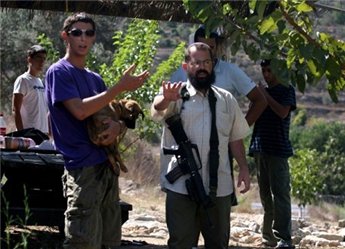
During the Prime-minister’s visit, Israeli authorities were positioned nearby and prevented the settlers from passing. However, shortly after Fayad left the area, Israeli soldiers permitted a mob of settlers to converge upon the Palestinian farmers tending to their land. They began by throwing stones, causing the group to separate and begin descending the hill. The settlers then proceeded to fire M-16 assault rifles in the direction of the unarmed farmers before releasing dogs. In the ensuing chaos, and as Fadi desperately attempted to escape, his tractor flipped over and fell on him, mortally wounding the young man.
Palestinians witnessing the incident ran back towards the scene to offer assistance. The settlers promptly dispersed as they rushed him down the hill to the road, unfortunately he was already dead.
Fadi is of the village of Beita . With a population of only 12,000, this death resonates among all the residents. As Fadi’s father-in-law, Isam Bani Shams says, “This is not our first martyr nor our last, we have been in this situation for sixty-four years. Our village has lost some seventy martyrs.”
On the same date, twenty-four years ago, two men from the village of Beita were also murdered by settlers from Itamar.
In the gathering following the funeral, Fadi’s father, Sleman Abu Zeitoun, sat with his head down. Beside him sat three other men who have had a son murdered by Israeli soldiers or settlers.
Fadi was newly married to nineteen year-old Fida’ Bani Shams who is left widowed and six months pregnant. Her brother was killed at the age of sixteen by Israeli soldiers during the second intifada, and as her father says, “She has lost a brother and a husband so what can I say of her emotions? She is in grief. She is exhausted.” Fida’ sat slouched in a corner of the room, her eyes closed and blankets covering her feet.
Fadi’s sister has had a nervous breakdown since the death of her brother. She does not recognize her husband or her daughters. Their mother, Mona Fihmeh says, “in terms of how I feel, I have patience, but my back has been broken from the burden.” Mona spent last night praying over her feverish body, and today she sent her daughter to the hospital. Her husband was on the way back from a funeral in Jordan when the accident occurred. He returned to Beita to find that his son had been killed.
Throughout the funeral, political talk arose about the various results of Israeli occupation and apartheid on Palestine. At first, the unemployment rate among Palestinians does not seem relevant to the death of Fadi Abu Zeitoun, but one soon realizes that Israel’s apartheid policies are to blame for both the impunity with which settlers are treated, and the numerous other negative consequences on livelihood.
The United Nations Office for the Coordination of Humanitarian Affairs (OCHA) in the occupied Palestinian territory reported that over 90% of complaints regarding settler violence filed by Palestinians to the Israeli police in recent years have been closed without indictment. OCHA’s report on settler violence notes that “the root cause of the settler violence phenomenon is Israel’s decades-long policy of illegally facilitating the settling of its citizens inside occupied Palestinian territory. This activity has resulted in the progressive takeover of Palestinian land, resources and transportation routes and has created two separate systems of rights and privileges, favouring Israeli citizens at the expense of the over 2.5 million Palestinian residents of the West Bank. Recent official efforts to retroactively legalize settler takeover of privately-owned Palestinian land actively promotes a culture of impunity that contributes to continued violence.”
Rana H. is a volunteer with International Solidarity Movement.
Related articles
- Palestinian man Fadi Zaitoun killed in a chase by extremist settlers (altahrir.wordpress.com)
- Hebron teen ‘shot by Israeli settler’ (alethonews.wordpress.com)
- Jewish settlers attack Palestinian farmer and his children (alethonews.wordpress.com)
- Jewish settlers stealing Palestinian water springs: UN (alethonews.wordpress.com)
- Qaryut: 8 year old injured by bomb planted by Israelis (alethonews.wordpress.com)
- Settlers ‘block entrance’ to Nablus village (alethonews.wordpress.com)
- Settlers Attack Internationals Accompanying School Children on Shuhada Street (alethonews.wordpress.com)
Qaryut: 8 year old injured by bomb planted by Israelis
2 April 2012 | International Solidarity Movement, West Bank

Yemams father did not have time to respond to his son before the bomb exploded. Ripping through three layers of clothes and even more layers of skin, his father had to watch the tragedy unfold before his eyes. Yemam Mohammad Fatah Azam is just eight years old. He was enjoying a Friday afternoon with his father in the olive groves.
Situated between the illegal Israeli settlements of Shilo, Eli, and Suvat Rachel, Qaryut is not new to military and settler violence. Yamam’s story however is the first incident of its kind and has shaken the community. As floods of school children come to visit Yamam in his home, it is clear that all the parents are aware that the bomb could have been in their loved one’s hands. The children show they are upset with a handshake and sit next to Yamam in silence.
Bashar, a member of the Popular Commitee explains that the planting of un-exploded ordinance (UXO) ”… is an act to intimidate us from going to our land.”
Efforts by violent Zionist settlers have been well underway to intimidate farmers from visiting their land, and recently the village has joined the popular resistance with a Friday demonstration in protest of the closure of their road by Israeli military. The road runs through the land in which many farmers reside. One farmer explained, “It brings us much comfort to have cars passing through the road, we know if anything was to happen a car would stop and support us.”
As Yamam lays in bed, not able to move much due to the wound constantly re-opening, causing pain beyond comprehension, four more bombs lay on the land near by. This case has reached The United Nations group, OCHA, who has reported this in their “Protection of Civilians Weekly Report, 21-27 March 2012.” The Palestinian Authority is also addressing the issue as well. Both have been informed of the bombs which still reside on the land of the farmers, but have not been able to make the area safe. Due to the olive groves being in Area C, the Palestinian Authority has no permission to enter the land.
Related articles
- Kufr ad-Dik and Burqin march against boars, pollution, and violence by Israelis (alethonews.wordpress.com)
Palestinian Family loses property ownership case in Israeli court
IMEMC | April 02, 2012
Israel’s Supreme Court ruled on Monday that a prominent Palestinian family could not claim ownership of a landmark and now derelict building in East Jerusalem.
The Husseini family said the Shepherd Hotel, now partially demolished, is a symbol of the Palestinian rights to their land and to East Jerusalem, and strongly criticized the court ruling.
The Shepherd Hotel was built in the 1930s and served as the home of Jerusalem grand mufti Haj Amin Husseini.
It was declared “absentee property” by Israel after it was captured and annexed to East Jerusalem in 1967. The title was transferred to an Israeli firm, which sold it in 1985 to Irving Moskowitz, a Florida businessman and patron of Jewish settlers.
The “absentee property” law has been enforced by Israel since 1948 which allowed the Israeli authorities to confiscate land and property of Palestinians who were prohibited to return to their land and property after 1948.
Related articles
- Israeli settlers storm into Palestinian home, occupy residence (alethonews.wordpress.com)
- Israel excitedly rejects cooperation with UN over settlements (alethonews.wordpress.com)
- Ethnic Cleansing in a Zionist Fairyland (alethonews.wordpress.com)
- Jerusalem is at the heart of the Palestinian struggle (altahrir.wordpress.com)
Jewish settlers attack Palestinian farmer and his children
Palestine Information Center – 31/03/2012

AL-KHALIL — Jewish settlers attacked a 67-year-old Palestinian farmer while tending to his field along with his family in Beit Ummar, to the north of Al-Khalil, on Saturday morning.
Mohammed Awad, the coordinator of the popular committee in Beit Ummar, told Quds Press that Mohammed Salibi, 67, was tending to his farm along with his sons and daughters when suddenly dozens of masked settlers from the nearby settlement of Beit Ayin ran toward them while throwing rocks.
He said that he rushed to protect his children, who were panicked, and took them away to their home leaving his tractor behind.
Salibi said that the savage attack progressed under the very eyes of the Israeli occupation soldiers (IOF), who maintain constant presence in the area and occupy high watchtowers that enable them watch whatever is going on nearby but did not move to protect him or his family.
Elsewhere in Al-Khalil, IOF soldiers kidnapped a Palestinian shepherd near Susiya settlement while watching for his sheep that were grazing nearby.
Ratib Al-Jibour, the coordinator of the popular committee in Yatta town, said that an IOF unit kidnapped Hammad Nawaja, 33, after claiming that he tried to cut the barbed wire near the settlement.
Related articles
- Eight children from Beit Ummar facing suspension from their village of residence (alethonews.wordpress.com)
- Israeli settlers ‘put new homes on Beit Ummar land’ (altahrir.wordpress.com)
- Under Attack – the Golani Brigade’s war on the Palestinian population of Al-Khalil/Hebron (alethonews.wordpress.com)
- Israeli occupation authority destroys Spanish-financed power station in Al-Khalil village (alethonews.wordpress.com)
- Settlers Install New Outpost Near Hebron (alethonews.wordpress.com)
- International activists assaulted by extreme settlers in Al Khalil (alethonews.wordpress.com)
- Official: Israeli settlers tour Beit Ummar (altahrir.wordpress.com)
Israeli settlers storm into Palestinian home, occupy residence
Al Akhbar | March 29, 2012
Israeli settlers invaded a home in a Palestinian-owned building in the occupied West Bank city of Hebron and took up the apartment as their own, residents and Israeli security forces said on Thursday.
“At 1:30am we heard noises and it was the settlers,” Montasser Abu Rajab, who lives on the first floor of the building in Hebron’s Old City, said.
“They broke the main door and brought their furniture in, accompanied by the army, who locked us in our house,” he said.
Palestinian sources in Hebron said that the property belonged to the Abu Rajab family, who had sold the second floor of the house to another Palestinian family.
But the Israeli army – who confirmed the incident – claimed that “the title to the property is contested.”
“The area has been declared a closed military zone, and soldiers have been put in place to keep the calm,” a spokeswoman for the Israeli army said.
Israeli police spokesman Micky Rosenfeld said “police have been dispatched to the scene to verify the legal status of the house and the property titles that are apparently the subject of litigation.”
The settlers also claimed that they had titles to the property, which is located near a prominent religious site for both Muslims and Jews.
Speaking to Israeli public radio, right-wing Israeli lawmaker Michael Ben Ari, of the National Union party, said it was “time to recover all the Jewish homes in Hebron stolen by the enemy.”
Right-wing Israeli politicians and figures often incite violence against Arabs, with Palestinians frequently attacked and harassed by settlers as well as the Israeli military, often with impunity.
House demolitions and evictions are among the serious threats indigenous Palestinians face on their native land, as Israel continues to build Jewish-only settlements in the West Bank, including in Hebron, in defiance of the international community.
Israeli settlements in the West Bank are considered illegal under international law, with the territory being only a fraction of historical Palestine on which the Israeli state is now situated.
Israel maintains a military occupation of the West Bank and Jerusalem, imposing harsh restrictions on native Palestinians while providing privileges to illegal Jewish settlers.
(Al-Akhbar, AFP)
Related articles
- Hebron teen ‘shot by Israeli settler’ (alethonews.wordpress.com)
- Settlers Attack Two Towns Near Hebron (alethonews.wordpress.com)
- Settler Violence: Broken Glass on Shuhada Street (alethonews.wordpress.com)
- Settlers Install New Outpost Near Hebron (alethonews.wordpress.com)
- International Solidarity Movement volunteers encounter settler attack and sexual harassment in Hebron (alethonews.wordpress.com)
- Israeli demolition ‘displaces 120′ in Hebron village (alethonews.wordpress.com)
- Soldiers raid community center, arrest local activist (alethonews.wordpress.com)
Settlers ‘block entrance’ to Nablus village
Ma’an – March 28, 2012
 NABLUS – Dozens of Israeli settlers blocked the entrance to a village near Nablus on Wednesday, officials said.
Palestinian Authority official Ghassan Doughlas told Ma’an that residents of Itamar and Elon Moreh settlements arrived at Beit Dajan in around 15 cars and closed the main gate to the village.
The settlers were protesting the reopening of the main road from Beit Dajan to Nablus a day earlier, Doughlas said.
The road had been closed by the Israeli military for 12 years, forcing villagers to take long detours to reach Nablus, the nearest city.
Doughlas said Israeli forces arrived and dispersed the settlers.
An Israeli military spokeswoman did not immediately return a call seeking comment.
Related articles
- Soldiers destroy 5 agricultural sheds in Nablus (altahrir.wordpress.com)
- Israeli forces demolish main road near Nablus (alethonews.wordpress.com)
- Settlers Attack Two Towns Near Hebron (alethonews.wordpress.com)
- Settlers ‘raid Nablus village’ (altahrir.wordpress.com)
Hebron teen ‘shot by Israeli settler’
Ma’an – 27/03/2012
HEBRON — An Israeli settler shot an 18-year-old Palestinian in Hebron’s Old City on Tuesday morning, leaving him moderately injured, locals said.
Medics at Al-Ahli Hospital in Hebron said Muhammad Hisham Abu Aker was shot in his right leg and is undergoing surgery.
On Saturday, a Palestinian man was moderately injured when armed settlers stormed Burqa village east of Ramallah and attempted to vandalize property, witnesses said. Hassan Muatan, 40, was shot in the abdomen, they said.
Settler violence is on the rise. In 2011, the UN Office for the Coordination of Humanitarian Affairs reported that settler attacks had increased by 50 percent over the previous year.
Around 800 Jewish settlers live in Hebron’s Old City, among 30,000 Palestinians in the parts of the ancient city that are under Israeli control.
Related articles
- Settlers Attack Two Towns Near Hebron (alethonews.wordpress.com)
- Settlers Install New Outpost Near Hebron (alethonews.wordpress.com)
- International Solidarity Movement volunteers encounter settler attack and sexual harassment in Hebron (alethonews.wordpress.com)
- Settler Violence: Broken Glass on Shuhada Street (alethonews.wordpress.com)
- Demanding justice for Yousef, a quiet boy killed by Israeli settlers (alethonews.wordpress.com)
- Israeli Settlers Attack Palestinian Boys in Hebron (altahrir.wordpress.com)
- The massacre of 1929 and the War of Narratives (alethonews.wordpress.com)
Eight children from Beit Ummar facing suspension from their village of residence
International Solidarity Movement, West Bank | March 26, 2012
Eight children between the ages of 14 to 17 years old were arrested in Beit Ummar during night raids from 6th to 11th of March conducted by the Israeli occupation forces following a nonviolent solidarity demonstration for the hungerstriker Khader Adnan on the 21st of February.
On Tuesday 20th of March the youth went to court at the Israeli military court at Ofer and faced a sentence of being banned from Beit Ummar, where they live with their families, for a period of 6 months. The youth are being accused of throwing stones at Israeli military installations. The detainees are Ayesh Khalid Sabri Awad (17 years), Basil Khalid Hassan Abu Hashim (15 years), Zain Hisham Khalil Abu Maria (15 years) Sami Amer Ahmed Abo Joudeh (16 years), Emad Mohammed Saed Solaiby (16 years), Mohab Jawdat Adi (14 years), Bilal Mahmud Awad Ayyad (16 years), and Ahmed Ali Mahmoud Solaiby (16 years).
The announcement of the sentence aroused opposition on the part of family members of the accused, leading to removal of the family members from the court and adjournment until the 25th of March. Issa Solaiby, father of Ahmed, says his son was also beaten by 4 soldiers in the court.
Hisham Abu Maria, father of Zain, claims that the children are being pressured to agree to false accusations. He said, “They made him (Zain) say he threw rocks at the soldiers even though there were no soldiers” present at the time noted in the charges.
The village of Beit ummar has around 17,000 inhabitants and is surrounded by illegal, Zionist settlements. According to Issa Solaiby a member of the local Popular Committee, Beit Ummar used to consist of 33,000 dunams of land. The building of the separation wall by Israel and a road that is closed off to Palestinians took 13,000 dunams of the village land.
Since then an additional 3,000 dunams have been stolen by settlers living in illegal Israeli settlements. The inhabitants of Beit Ummar suffer from violence from the settlers living in the surrounding settlements. Issa Solaiby also complains that the settlers prevent the farmers from access to their own land and destroy olive trees and grape vines.
In March the settlers living in the illegal Beit Ain settlement destroyed 14 olive trees, 21 grape vine plants, and 2 citrus trees from the village in an act of incitement.
According to Issa the settlers also enter the village with soldiers and guns to make the villagers aware of their aggressive presence. One year ago 17-year-old Yousef Ikhlayl was shot and killed by Israeli settlers as he was farming with his father. His killers remain unpunished.
Many of the villagers have been arrested and gone to jail. Imprisonment is a problem especially with young people. According to Muhannad Abu Awwad 10,000 villagers have gone to jail and at present 30 inhabitants, most of them under 16, are serving time in Israeli occupation prisoners.
Muhannad himself went to jail for two years from the age 21 until 23 and is now studying law.
Related articles
- Israeli settlers ‘put new homes on Beit Ummar land’ (altahrir.wordpress.com)
- Settlers Install New Outpost Near Hebron (alethonews.wordpress.com)
- Official: Israeli settlers tour Beit Ummar (altahrir.wordpress.com)
- Confined Cruelty: Israeli Treatment of Palestinian Minors (alethonews.wordpress.com)
- Four injured as Beit Ommar marks anniversary of Yousef Ikhlayl’s murder (alethonews.wordpress.com)
Israel excitedly rejects cooperation with UN over settlements
Press TV – March 23, 2012
Israel has rejected cooperation with the United Nations in an investigation by the world body’s Human Rights Council to probe the impacts of Israeli settlements on the occupied Palestinian territories.
Israel’s Prime Minister Benjamin Netanyahu on Thursday dismissed the resolution and attacked the UN human rights body, saying, “This council ought to be ashamed of itself,” The Jerusalem Post reported.
“This is a hypocritical council with an automatic majority against Israel,” he added.
Meanwhile, the Israeli foreign ministry dubbed the resolution “another surrealistic decision” and accused the council of promoting a one-sided political agenda.
On Thursday, the 47-member UN Human Rights Council adopted a resolution condemning Israel’s announcements of new settlement homes, and ordering an investigation into the effects of the Israeli settlements on the rights of Palestinians.
It was passed with 36 votes in favor, 10 abstentions and only one – the United States – against.
The resolution calls on Israel to “take and implement serious measures” such as confiscating arms to prevent acts of violence by Israeli settlers. The council, which met in Geneva, also passed four other resolutions critical of Israel.
Nabil Abu Rudeineh, the spokesman for the acting Palestinian Authority chief, Mahmoud Abbas, described the vote as a shift in position of the world in favor for the rights of Palestinians.
Nearly 500,000 Israelis live in more than 100 settlement units built since the 1967 Israeli occupation of the West Bank and East al-Quds (Jerusalem).
Related articles
- Israel rejects cooperation with UN over settlements – RT (rt.com)
- United Nations Orders First Probe Of Israeli Settlements (altahrir.wordpress.com)
- Jewish settlers stealing Palestinian water springs: UN (alethonews.wordpress.com)
- Israel bars Palestinian MP from going to Geneva to attend UN conference (alethonews.wordpress.com)
- Israeli settlement waste ‘poisoning Palestinians’ (alethonews.wordpress.com)
- Israeli government confirms plan for segregated settler train system (alethonews.wordpress.com)
- Japanese Distributer Ends Contract With AHAVA (alethonews.wordpress.com)
Study: Israeli ‘state land’ illegally taken from West Bank
Ma’an – March 14, 2012
BETHLEHEM – Israel has designated some 900,000 dunams of the occupied West Bank as Israeli state land, using procedures that break local and international laws, an Israeli human rights group said Wednesday.
“Large swaths of land have been classified state land and designated for use by settlements, despite the fact that they belong to Palestinian individuals or communities,” according to a new report by B’Tselem.
The study says Palestinian land “was taken from their lawful owners by legal manipulation and in breach of local law and international law alike.”
After an Israeli court ruled the state could not build settlements on private Palestinian land in 1979, Israel’s state attorney office redefined the requirements for designating land state-owned, the study says.
The report reviews Israeli policies in light of relevant laws in the West Bank before it was occupied by Israel in 1967.
B’Tselem says Israel disregarded community rights to land used for grazing, redefined what was classified as ‘cultivated land’ and extended the requirement for continuous cultivation of the land.
Israel’s legal stance increased state land in the West Bank from 527,000 dunums prior to Israel’s occupation, to more than 1.427 million dunams, an expansion of more than 170 percent, the report says.
Under international law, state land does not belong to Israel, and should be used to benefit Palestinians while the West Bank is under military occupation, B’Tselem adds.
“Despite this obligation, the percentage of state land that Israel has designated for Palestinians is negligible. Virtually all state land has been designated for exclusive use by the settlements,” the report notes.
The Israeli rights group says a recent deal to move a settler outpost to state land is thus illegal, calling on the Israeli government to revoke the agreement.
After months of negotiations, on Sunday the government agreed with Migron settlers that they relocate a few kilometers away, to meet a high court ruling that ordered the outpost be removed by by March 31, 2012 as it lies on land with demonstrated Palestinian-ownership.
The families are relocating to another already-established West Bank settlement a few kilometers away.
Related articles
- West Bank village steps up protests against Israel’s theft of land (alethonews.wordpress.com)
- Deal with settlers over illegal outpost ‘a disgrace’ (independent.co.uk)
Featured Video

BRITAIN’S WARNING: PREPARE FOR WAR
or go to
Aletho News Archives – Video-Images
From the Archive
How Ukraine Tortured and Slaughtered Donbass
By Kit Klarenberg | Al Mayadeen | July 11, 2024
Almost immediately after the proxy war erupted, ISIS-tier footage of the torture and murder of Russians in Ukrainian custody emerged.
On July 6th, the New York Times published an astonishing investigation: In Ukraine, Killings of Surrendering Russians Divide an American-Led Unit. The article documents in grim detail how Chosen Company, an international volunteer battalion for Kiev, routinely executes Russian prisoners of war. It is the very first mainstream admission that this practice – a brazen breach of the Geneva Conventions, and a grave war crime – is widespread among Ukraine’s fighters, both foreign and homegrown. … continue
Blog Roll
 Aletho News
- Pentagon designates Chinese cultural centers national security threat
- Israel Demolishes Home Of Lebanese Journalist Whose Viral Film Exposed Pager Attack
- Record Oil, Empty Tanks: The UAE’s Miracle Recovery
- Burnham tackles Britain’s poverty with aggression in Yemen
- Peace in Ukraine: the easy way – or the hard way
- Trump & the Rrrrussians
- US taxpayer money laundered back through Ukraine – Musk
- Before COVID, an NIH lab chief proposed making a SARS-like bat virus more infectious
- Gates, Bourla on Trial in Netherlands Accused of ‘Great Reset’ Scheme at Vaccine Injury Hearing
- BRITAIN’S WARNING: PREPARE FOR WAR
- If Americans Knew
- An error has occurred; the feed is probably down. Try again later.
- No Tricks Zone
- Two New Studies Find Thwaites Glacier Melt Cannot Be Driven By Human Activity Or A Warming Ocean
- E-Cars Reduce CO2 Emissions By Only 41% Compared To Internal Combustion Engine Vehicles
- Predictions Made By Renowned Climate Professor Over Past Decades Have Been Proven To Be Poor
- New Study Suggests Large Regions Of The Pacific Ocean Have Been Cooling For The Last 80 Years
- Germany’s Green Energy Debacle: High Energy Costs Force Kahla Porzellan to Close After 182 Years!
- New Study: 50 Years Of The Most Aggressive ‘Net Zero’ Policies Can Only Affect The Global Climate By 0.03°C
- US September “Heat” Was No Record…Many Records Set Decades Ago
- Latest European Green Energy Debacle; Portugal’s Largest Flagship Solar Park Insolvent!
- Green Energy Debacle: German Expert Professor Fritz Vahrenholt Warns Of Severe Economic And Social Consequences
- Two More Paleo Reconstructions Affirm Meters-Higher Sea Levels Across Ireland, Brazil 7000-6000 Years Ago

