Brazil: 4,000 Cuban Doctors to be Hired
By Kahina Boudarène | The Argentina Independent | August 22, 2013
Brazil’s Health Minister, Alexander Padilha, yesterday declared that the country will receive 4,000 doctors from Cuba.
The decision is part of the “More Doctors” government programme, which was set out in June to increase the number of health workers in the country, currently lacking 15,460 doctors. The move has come after only 15% of the demand was satisfied during the first month of the initiative.
Padilha stated that Brazil will hire “doctors with standards that the Ministry of Health established”. In that sense, he said that doctors “with international experience, especially in Portuguese-speaking countries” would be sought.
A first group of 400 doctors will arrive in the country next weekend and will have to pass a three weeks evaluation. The other groups will come before the end of the year, to work in 701 municipalities in Northern and North-Eastern Brazil.
They will receive a US$4,200 monthly wage. In total, Brazil government will pay over US$212m to receive required Cuban doctors. This investment has been made possible by next week approval of the law to fund public services with oil revenue – 25% of these incomes is now dedicated to the health sector.
Brazil is not the only nation to enjoy Cuban doctors experience. In last may, Cuba had 38,868 health workers abroad. In total, 40 countries receive these services for free.
South America: UNASUR To Build Fibre-Optic ‘Mega Ring’
By Chelsea Gray | The Argentina Independent | August 21, 2013
 The Union of South American Nations (UNASUR) has approved plans for an optic fibre mega-ring which will break its members’ “dependence on the US, and provide a safer and cheaper means of communication.”
The fibre optic ring will become part of a ten-year plan to physically integrate all 12 UNASUR member states. The line, which will reach up to 10,000 kilometres long and will be managed by state enterprises from each country it crosses, is expected to interconnect South America through higher coverage and cheaper internet connections.
Industrial Minister of Uruguay, Roberto Kreimerman, explained that “it is about having a connection with great capacity that allows us to unite our countries together with the developed world.”
He continued to say, “We are considering that, at most, in a couple of years we will have one of these rings finalised.” He also added that ”I think the economy, security, and integration are the three important things we need in countries where Internet use is advancing exponentially.”
At the moment, up to 80% of Latin America’s communications go through the US. However, plans for an independent communication line comes shortly after the US was discovered to have been spying on Latin American data. The National Security Agency (NSA) were revealed to have been monitoring emails and intercepting telephone logs, spying on energy, military, politics, and terror activity across the continent.
UNASUR is made up of Argentina, Bolivia, Brazil, Chile, Colombia, Ecuador, Guyana, Paraguay, Peru, Suriname, Uruguay, and Venezuela.
Latin America Condemns US Espionage at United Nations Security Council

By Carla Stea | Global Research | August 17, 2013
“The United States appears to be destined by Providence to plague America with misery in the name of liberty.” Simon Bolivar
Throughout the day, on August 6, President Cristina Fernandez Kirchner of Argentina chaired a historic United Nations Security Council meeting that revealed a seismic shift in geopolitical consciousness and incipient strength.
The agenda of Security Council meeting 7015 was: “Cooperation Between the United Nations and Regional and Sub-regional Organizations in Maintaining International Peace and Security.”
The prelude to this meeting was held, the prior day, August 5, at a press stakeout given by Elias Jaua Milano, Foreign Minister of Venezuela, Hector Timerman, Foreign Minister of Argentina, Antonio de Aguiar Patriota, Foreign Minister of Brazil, Luis Almagro, Foreign Minister of Uruguay and David Choquehuanca Cespedes, Foreign Minister of Bolivia.
They spoke on behalf of Mercosur, the Southern Common Market, following their meeting with United Nations Secretary-General Ban Ki-moon. Their remarks focused on the expression of outrage contained in the “Annex to the note verbale dated 22 July from the Permanent Mission of the Bolivarian Republic of Venezuela to the United Nations addressed to the Secretary-General, which stated:
“Decision rejecting the acts of espionage conducted by the United States in the countries of the region.” “The President of the Argentine Republic, the President of the Plurinational State of Bolivia, the President of the Federative Republic of Brazil, the President of the Eastern Republic of Uruguay and the President of the Bolivarian Republic of Venezuela, having met in Montevideo, Eastern Republic of Uruguay, on 12 July, 2013, within the framework of the presidential summit of the Southern Common Market (MERCOSUR),
Condemning the acts of espionage carried out by intelligence agencies of the United States of America , which affect all countries in the region,
Strongly rejecting the interception of telecommunications and the acts of espionage carried out in our countries, which constitute a violation of the human rights, the right to privacy and the right to information of our citizens, and which also constitute unacceptable behavior that violates our sovereignty and is detrimental to the normal conduct of relations among nations,
Considering the advisability of promoting a coordinated approach to this issue at the regional level,
Decide to:
Work together to guarantee the cybersecurity of the States members to MERCOSUR, which is essential to defending the sovereignty of our countries,
Demand that those responsible immediately cease these activities and provide an explanation of the motives for and consequences of such activities,
Stress that the prevention of crime and the suppression of transnational crimes, including terrorism, must be carried out in line with the rule of law and in strict observance of international law.
Promote the adoption by the relevant multilateral institutions of standards for the regulation of the Internet which place a particular emphasis on cybersecurity issues, with a view to fostering the adoption of standards that guarantee the adequate protection of communications, in particular to safeguard the sovereignty of States and the privacy of individuals,
Express our full solidarity with all countries, within and outside our region that have been victims of such actions,
Promote the joint efforts of the Ministers for Foreign Affairs to inform the Secretary-General of the United Nations of these incidents and request prevention and sanction mechanisms on the issue at the multilateral level
Instruct the delegations of the Member States participating in the upcoming session of the United Nations General Assembly to jointly present a formal proposal to that end,
Request the Argentine Republic to submit this matter to the Security Council for consideration,
Agree to establish a working group to coordinate efforts, together with the South American Defence Council and the South American Infrastructure and Planning Council, aimed at carrying out activities that will render our telecommunications more secure and reduce our dependence on foreign technology.”
The morning session of the August 6 Security Council meeting consisted primarily of technical diplomatic presentations. Following Secretary-General Ban Ki-moon’s statement, Cuban Foreign Minister Rodriguez Parrella opened the meeting, as President of the Community of Latin American and Caribbean States (CELAC):
“The history of Latin American and the Caribbean has changed. Two hundred years after our independence, the ideas of ‘a Nation of Republics,’ and of ‘Our America’ envisaged by Bolivar and Marti, respectively, are taking shape. Thus, our Heads of State and Government decided in the Caracas Declaration that ‘in accordance with the original mandate of our liberators, CELAC must move forward in the process of political, economic, social and cultural integration – based on a wise equilibrium between the unity and diversity of our peoples … Upon founding CELAC, our Heads of State and Government reiterated our commitment to the building of a more just, equitable and harmonious international order based on respect for international law and the Charter of the United Nations. … They reaffirmed our commitment to the defense of sovereignty and the right of any state to establish its own political system, free from threats, aggression and unilateral coercive measures, and in an environment of peace, stability, justice, democracy and respect for human rights. CELAC reiterates that there can be no lasting peace without development and the eradication of poverty, hunger and inequality … CELAC has adopted a unanimous position with regard to some far-reaching topics on the international agenda, such as, for example, Argentina’s legitimate claim in the dispute concerning the sovereignty over the Malvinas Islands, and – today on the anniversary of the bombing of Hiroshima – on so-called nuclear disarmament.”
The representatives of other regional organizations, and the members of the Security Council delivered their statements throughout the morning session of the meeting
When the Security Council resumed for the afternoon session, in a courageous and brilliant tour de force, the Argentine Presidency of the Security Council availed itself of the opportunity to publicly denounce espionage in the service of the resurgence of neo-liberal capitalist imperialism. In an unusual gesture of solidarity and support (considering that Heads of State chairing Security Council meetings seldom remain beyond a perfunctory appearance at the morning session), President Cristina Fernandez Kirchner, Foreign Minister Hector Timerman and Ambassador Maria Cristina Perceval were present throughout the afternoon, as the succession of dazzling speeches, delivered by the Latin American Foreign Ministers of Brazil, Uruguay, Bolivia, Venezuela, Ecuador illuminated the global menace threatened by the United States National Security Agency programs of surveillance of phone records, e-mails, web-browsing, those very programs disclosed by former NSA contractor Edward Snowden.
The foreign ministers of Brazil, Venezuela, Uruguay, Bolivia and Ecuador fiercely condemned the United States plan for worldwide espionage, which posed a lethal threat to the democratically elected governments of these Latin American nations and jeopardized their survival.
It is not surprising that this expression of alarm was voiced by Latin America, from Argentina through Uruguay, Bolivia, Ecuador, Brazil, Venezuela – in other words from the Southernmost tip of the huge southern continent to the Caribbean, for this continent, viewed imperialistically as the “backyard” of the United States, was for many tragic decades, crushed by military dictatorships inflicting state terror with impunity, following the blueprint of destabilization and overthrow, by the CIA and multinational corporate controlled entities, of their own democratically elected leaders. The tragic destruction of Latin America’s democratically elected governments included President Arbenz in Guatemala, 1954; President Goulart in Brazil, 1964; President Juan Bosch in the Dominican Republic, 1965; President Torres in Bolivia, 1971; President Allende in Chile, 1973, and more recently the destabilizations of the democratically elected governments of Honduras and Paraguay (this is not a complete list)
This more than half-century violation of the will of the people of Latin America, engineered by agencies of “the Colossus of the North” was a shattering trauma seared deeply into the consciousness of these leaders, whose recent triumph over fascist military dictatorships which were installed and supported by the United States, is a testament to their moral and intellectual strength and their passion for dignity and control over their own destinies. The Latin American governments speaking at the August 6 Security Council are like the canary in the coal mine: intensely alert and sensitive to imminent or potential threats of repetition of that horrific period they had endured and so recently overcome, these governments denounced widespread evidence of perilous subversive activity, the lethal consequences of which are predictable and terrifying.
The August 6, 2013 afternoon session of the UN Security Council began with Mr. Antonio de Aguiar Patriota, Foreign Minister of Brazil, who stated, in English:
“You, Madam President made my task easier by referring to the interception of communications and acts of espionage. Such practices violate sovereignty, harm relations between nations and constitute a violation of human rights, inn particular the right to privacy and the right of our citizens to information. In that respect, you have complied with the decision of the States parties of the Common Market of the South (MERCOSUR) who met in Montevideo last month. Yesterday, the Foreign Minister of MERCOSUR conveyed to the Secretary-General the position of Argentina, Bolivia, Brazil, Uruguay and Venezuela with respect to and in compliance with, that decision. The matter will also be placed before various United Nations bodies, in accordance with the decision and the document circulated under the symbol A/67/946. This is a very serious issue with a profound impact on the international system. Brazil is coordinating with countries that share similar concerns for the benefit of an international order that respects human rights and the sovereignty of states.
I welcome the timely statement made on 12 July by the UN High Commissioner for Human Rights, Ms. Navi Pillay: ‘surveillance programmes without adequate safeguards to protect the right to privacy actually risk impacting negatively on the enjoyment of human rights and fundamental freedoms.’ Pillay also mentioned Article 12 of the Universal Declaration of Human Rights and Articles 17 and 18 of the International Covenant on Civil and Political Rights, which established, respectively, that ‘No one shall be subjected to arbitrary interference with his privacy, family, home or correspondence,’ and that ‘Everyone has the right to protection of the law against such interference or attacks.’
Brazil also associates itself with the repeated appeals by Ms. Pillay in various forums that efforts to combat terrorism must necessarily respect human rights and humanitarian law. Her position was incorporated into the decision of the Heads of State of MERCOSUR as well as the Presidential Statement (S/PRST/2013/12) adopted by the Council this morning… Mention should be made of the North Atlantic Treaty Organization (NATO)… .a defense alliance that does not seem to frame its activities clearly under Chapter VIII of the Charter of the United Nations and has made use of concepts and strategies that raise problematic and sensitive issues in terms of the articulation between the regional level and the United Nations system. We are concerned that, historically, leaders of NATO and member countries have considered that the organization does not necessarily require explicit authorization from the Security Council to resort to coercion.
We are also concerned that NATO has loosely interpreted mandates for action aimed at promoting international peace and security authorized by the Security Council. As Brazil has maintained, including through the Brazilian concept of ‘responsibility while protecting,’ (S/2011/701, annex), the Security Council should avail itself of the institutional means of monitoring the adequate fulfillment of its mandates.
We are concerned, as well that NATO has been searching to establish partnerships out of its area, far beyond the North Atlantic, including in regions of peace, democracy and social inclusion, and that rule out the presence of weapons of mass destruction in their territories. It would be extremely grave for the future of the articulation between regional and global efforts at promoting peace, as prescribed by the United Nations, if groups of countries started to unilaterally define their sphere of action beyond the territory of their own members.”
Next, Mr. David Choquehuanca Cespedes, Minister of Foreign Affairs of Bolivia spoke:
“Preserving peace is not and will not be the result of the existence of international policemen, but rather as a result of the promotion of social justice, equity, complementarity, solidarity and respect between states… I should like to express our rejection and condemnation of the practice of espionage on the part of the United States. I should also like to express the grief and indignation of my people and my Government over the act of aggression experienced by President Evo Morales Ayma, which has been described by the international community as offensive, humiliating, discriminatory, colonialistic, unfriendly and a violation of human rights and international standards. Given the grave nature of these facts, we ask the United Nations to clarify these events and to take measures to guarantee human rights and international law so that no one will have to suffer such violations again.”
Next, His Excellency, Mr. Elias Jaua Milano, Minister of the People’s Power for Foreign Affairs of the Bolivarian Republic of Venezuela and Pro-Tempore President of the Common Market of the South (MERCOSUR) stated:
“Today we join in the pleasure of the Bolivian people on its national holiday, and recall the commemoration of the 200 years of the triumphant entry of the liberator Simon Bolivar after having carried out a successful campaign that began in December of 1812 in New Grenada. We must always remember that, when united, we South Americans will achieve independence, equality and democracy for our peoples…. Peace cannot be achieved in the world without social justice and without eradicating once and for all hunger, poverty, illiteracy, malnutrition and the wide technological divides, in other words, without guaranteeing to all the resources necessary for their full development in equal conditions…. The instruments, declarations, decisions and resolutions of MERCOSUR have sought democracy and peace in the region, including by preventing coups and other attempts to frustrate the democratic will of our peoples, promoted by fascistic movements represented by political and economic leaders that are found particularly in media corporations. These movements attack democratic governments and peoples that have chosen the path of independence, social inclusion and the grass-roots democratization of our societies….
The timely and firm action of MERCOSUR along with other regional and sub-regional organizations, managed to stop attempted coups in Paraguay in 1996 and 1999, thereby guaranteeing democratic order. Similarly, in 2006 and 2007 MERCOSUR condemned and took action to prevent attempts to divide Bolivia as a way of weakening the democratic government of President Evo Morales. Likewise, the Foreign Ministers of the countries members of MERCOSUR condemned the attempted coup against President Rafael Correa in Ecuador on 30 September 2010, joining with other regional blocs to issue a joint warning to the world and prevent that crime from taking place. Although it could not be prevented, MERCOSUR acted decisively in the parliamentary coup against President Fernando Lugo of Paraguay in June, 2012. On that occasion the foreign ministers of MERCOSUR and UNASUR traveled to Asuncion with the intention of starting a dialogue and preventing the interruption of the constitutional order. That was not achieved, and the bloc had to temporarily suspend the Republic of Paraguay until its political, institutional and democratic situation was normalized through the holding of elections. More recently, MERCOSUR has been able to circumvent those situations with peaceful and democratic mechanisms, without economic blocades, military intervention, indiscriminate bombing or armed intervention of any kind. We believe that the only way to defeat violence is with greater democracy and peaceful means. Mercosur has also participated in issues that affect international peace and security, such as the coup in Honduras against President Zelaya…
Unfortunately in recent times we have been concerned to see that some countries have continued to assert their political, military and economic power and distorted the very essence of cooperation between the United Nations and regional and subregional organizations. They have gone so far as to use the Security Council as a platform to encourage armed interventions against sovereign states and peoples with a view to promoting the poorly named regime change, in contravention of all principles of International Law… as Foreign Minister of the Bolivarian Republic of Venezuela and as Pro-Tempore President of MERCOSUR I take this opportunity to reiterate our firm condemnation of the insult to the office of the President of the Plurinational State of Bolivia, President Evo Morales, when some European Governments did not permit the overflight or landing of the aircraft transporting him. That was not only a hostile, unfounded, discriminatory and arbitrary action, but also a flagrant violation of the precepts of international law.”
“Similarly, we reject the actions of global espionage carried out by the government of the United States , which undermine the sovereignty of States and which we have become familiar with through the revelations of the former security contractor, Edward Snowden. Given the seriousness of these reports of computer espionage on a global scale, recognized by the Secretary-General of the International Telecommunication Union himself, the United Nations must initiate a broad multilateral discussion that would make it possible to design agreements to safeguard the sovereignty and security of States in the light of such illegal practices. MERCOSUR has begun action to promote a discussion on this matter so that we can open an appropriate investigation within the United Nations and punish and condemn this violation of international law.”
“We reiterate our condemnation of actions that could undermine the power of States to fully implement the right of humanitarian asylum. In this respect, we reject any attempt to pressure, harass or criminalize a state or third party over the sovereign decision of any nation to grant asylum, which is enshrined in all international conventions. Likewise, we express our solidarity with the Governments of Bolivia and Nicaragua , which, like Venezuela, have offered asylum to Mr. Snowden, as expressed by the Heads of State of MERCOSUR in the decision concerning the universal recognition of the right of political asylum, issued in Montevideo on 12 July. These three matters were discussed yesterday with the Secretary-General of the United Nations”
In her remarkable work, entitled “The Shock Doctrine, The Rise of Disaster Capitalism,” (published in 2007) journalist Naomi Klein states, page 573:
“Though clearly drawing on a long militant history, Latin America ’s contemporary movements are not direct replicas of their predecessors. Of all the differences, the most striking is an acute awareness of the need for protection from the shocks of the past – the coups, the foreign shock therapists, the U.S. trained torturers, as well as the debt shocks and currency collapses of the eighties and nineties. Latin America’s mass movements, which have powered the wave of election victories for left-wing candidates, are learning how to build shock absorbers into their organizing models. …
Latin America’s new leaders are also taking bold measures to block any future U.S. backed coups that could attempt to undermine their democratic victories. The governments of Venezuela, Costa Rica, Argentina and Uruguay have all announced they will no longer send students to the School of Americas, the infamous police and military training center in Fort Benning, Georgia, where so many of the continent’s notorious killers learned the latest I “counterterrorism” (torture) techniques, then promptly directed them against farmers in El Salvador and auto workers in Argentina…. If the U.S. military does not have bases or training programs, its power to inflict shocks will be greatly eroded…
Latin America’s most significant protection from future shocks (and therefore the shock doctrine) flows from the continent’s emerging independence from Washington’s financial institutions, the result of greater integration among regional governments. The Bolivarian Alternative for the Americas (ALBA) is the continent’s retort to the Free Trade Area of the Americas, the now buried corporatist dream of a free-trade zone from Alaska to Tierra del Fuego….
Thanks to high oil prices, Venezuela has emerged as a major lender to other developing countries, allowing them to do an end run around Washington, and even Argentina, Washington’s former ‘model pupil’ has been part of the trend. In his 2007 State of the Union Address (the late) President Nestor Kirchner said that the country’s foreign creditors had told him, ‘You must have an agreement with the International Fund to be able to pay the debt. We say to them, ‘Sirs, we are sovereign. We want to pay the debt, but no way in hell are we going to make an agreement again with the IMF.’ As a result the IMF, supremely powerful in the eighties, is no longer a force on the continent. In 2005 Latin America made up 80 percent of the IMF’s total lending portfolio, in 2007 the continent represented just 1 percent – a sea change in only two years. ‘There is life after the IMF,’ Kirchner declared, ‘and it is a good life.’”
Having resisted foreign (and domestic) military control, and foreign (and neoliberal) economic control, the new peril confronting Latin America’s independent governments emanates from the United States’ National Security Agency’s electronic surveillance programs, an insidious new cyber-age method of total social control of the most private and intimate spaces of their lives – and identities, their minds, destroying their capacity to forge networks of solidarity and obtain the information crucial to their understanding and critical thinking, without which they are vulnerable to being reduced to the condition of the “zombies” (so popular in Hollywood’s movie narrative), rendering them confused, docile, easily herded, subjugated, ultimately exploited and enslaved. This surveillance is tantamount to imposing total individual and societal control, which is a stealthy form of isolation, a form of psychological and intellectual solitary confinement, one of the cruelest forms of torture, which ultimately leads to the disintegration of the human personality, within an invisible prison.
This condition is described by the American Civil Liberties Union, and quoted in Charles Savage’s August 8 report to The New York Times:
“Hints of the surveillance appeared in a set of rules, leaked by Mr. Snowden, for how the NSA may carry out the 2008 FISA law. One paragraph mentions that the agency ‘seeks to acquire communications about the target that are not to or from the target.’ The pages were posted online by the newspaper The Guardian on June 20, but the telltale paragraph, the only rule marked ‘Top Secret’ amid 18 pages of restrictions, went largely overlooked amid other disclosures…. While the paragraph hinting at the surveillance has attracted little attention, the American Civil Liberties Union did take note of the ‘about the target’ language in a June 21 post analyzing the larger set of rules, arguing that the language could be interpreted as allowing ‘bulk collection of international communications, including those of Americans’…. Jameel Jaffer, a senior lawyer at the ACLU said Wednesday that such ‘dragnet surveillance will be poisonous to the freedoms of inquiry and association’ because people who know that their communications will be searched will change their behavior. ‘They’ll hesitate before visiting controversial web sites, discussing controversial topics or investigating politically sensitive questions. Individually, these hesitations might appear to be inconsequential, but the accumulation of them over time will change citizens’ relationship to one another and to the government.’”
The infrastructure for de facto fascist police state and military control is being established under the guise of counterterrorism, (as, earlier, similar fascist states were established under the guise of fighting communism) a phenomena Latin America recognizes and knows from horrific historic experience. And their historic memory of this has not yet been expunged: indeed, many of the leaders of Latin America today were earlier imprisoned and tortured only a few decades ago under such fascist police and military states (established ostensibly in the name of anti-communism), including Chile’s former, and possibly future President Michelle Bachelet, Brazil’s President Dilma Roussef, Argentina’s late President Nestor Kirchner, and the world famous father of Argentina’s Foreign Minister Hector Timerman, the late Jacobo Timerman, imprisoned and tortured for two years during the Argentine military dictatorship’s “dirty war.” No doubt, Uruguay ’s President Jose Mujica well remembers those horrors, and Chile ’s former President Ricardo Lago spent considerable time in prison during the Pinochet dictatorship.
Patino Aroca, Foreign Minister of Ecuador, next delivered, at the August 6 Security Council meeting, one of the great speeches in United Nations history.
“During the recent summit of the Common Market of the South (MERCOSUR) that took place on 12 July in Montevideo, the States convened resolved to ‘request Argentina to submit the matter of the massive espionage case uncovered by Edward Snowden for consideration by the Security Council.’ They also resolved to ‘demand that those responsible for those actions immediately cease therefrom and provide explanations of their motivations and their consequences.’ In similar terms, the Bolivarian Alliance for the Peoples of Our America spoke at the last Guayaquil summit which was held just five days ago, when it was decided to ‘warn the international community about the seriousness of these actions, which imply a threat to the security and peaceful coexistence among our States”…
“Just a few weeks ago the world saw a sequence of events more akin to a Cold War spy novel than to modern times. On 5 June, leaks began to appear in publications in major global media outlets, leaks that were mixed with almost deathly intent and unspooled as a reality show before global public opinion. The leaks came from a former 29-year-old American analyst who sought to escape deportation to his country, where he would be tried for those leaks. After a journey that began in Hong Kong and was supposed to end in Latin America, today, it seems to have stopped, but it may not have completely run its course, despite the granting of asylum by Russia.”
“During those few days in June we saw the size and the discretional nature of a massive surveillance apparatus that suddenly brought all the inhabitants of the planet closer than ever to an Orwellian nightmare. Although at first it appeared to be a simple matter of wiretapping, it was later discovered that there was discretionary monitoring of e-mails. While it seemed initially that the apparatus was being used in operations against organized crime, later we learned that it was also being used to gain advantage in trade negotiations with other countries. If we once thought that they were simply looking at unaffected States, we now know that everyone — absolutely everyone, debtors and creditors, friends and enemies, South and North – is considered a usual suspect by the authorities of the United States of America. Now we know that our communications are permanently monitored by them.”
“No one knows yet if Mr. Snowden will once again manage to leak information that he claims to possess. Of course, it seems that he will not do it when he is in Russia. In any case, the wounds opened by those events should be assessed within the main multilateral forums. They deserve to be so because not only do they reflect an unacceptable imbalance in the global governance system, which in no case would help to build a climate of trust and cooperation between countries, and, in the final analysis, a climate of peace among nations. They deserve to be assessed because we have also moved dangerously close to the limits set out by the Universal Declaration of Human Rights.”
“The imbalances to which I refer are clear – the United States, like any other countries, has the need to deal with demands related to its national security, it goes without saying, but those legitimate demands must be dealt with in a way that does not affect the rights of individuals or indeed the sovereignty of other nations. That is to say, limits must be set. However, we are now faced with the fact that any limits there may have been have vanished. The national security of the United States has been placed above all universal moral values.”
“Such a drive has meant that the principles of equality and non-interference in the affairs of States, established in the Westphalia peace agreement, have now vanished into thin air. The 1948 Universal Declaration of Human Rights has been violated. The rights to the privacy of correspondence – article 12 – and to freedom of expression and opinion – article 19 – the rights of all citizens of the world, including United States citizens, have been trampled in the name of a greater goal, that is, national security – or rather, for the sake of the profits of the national security industry.”
“What are the limits, really? Has the time not come for the Council to take up this question again and discuss it? In the end, does this not pose a threat to global peace? What mutual trust could possibly exist among nations under such circumstances? We believe that the time has come for the United Nations to face up to this matter responsibly.”
“As we have seen with the disappearance of such limits, this situation threatens to build walls between our countries. If it has not done so already, it could also affect international cooperation against organized crime; strangely enough, there is even the possibility that trade negotiations could be disrupted. Paradoxically, even the very national security of the United States will suffer from the increase in global mistrust generated by massive espionage.”
“The events to which I have referred have also revealed other very disturbing realities. To start off with, it has re-ignited the debate on the right of asylum, which all human beings have, as enshrined in international law, as well as the ability of any sovereign state to grant it. This is a right that is granted to avoid fear of political persecution; its legitimacy can only be determined by the country granting it. Let us also remember its peaceful and humanitarian nature, which cannot in any case be described as unfriendly towards any other State, as established in General Assembly resolution 2312 (XXII) on territorial asylum. I should also quote Ms. Navi Pillay, United Nations High Commissioner for Human Rights, on the case at hand: ‘Snowden’s case has shown the need to protect persons disclosing information on matters that have implications for human rights, as well as the importance of ensuring respect for the right to privacy.’”
“Leaders who should be giving explanations and facing up to the debate on the limits of what we are discussing, have instead launched a crusade against the right to asylum – a full-on diplomatic offensive against countries that have taken to the global stage to show interest in such an important case. States in the Bolivarian Alliance for the Peoples of Our America (ALBA) have been under pressure, simply because they are considering a request for asylum. All those countries have signed the 1954 Caracas Convention on Territorial Asylum, which is perhaps one of the most important instruments of the Inter-American human rights system.”
“The day the United States signs that treaty – even the day it ratifies the San Jose pact, one of the foundations of the Inter-American system of human rights – we will be closer to seeing that country adhere to the Vienna Convention of the Law of Treaties, and it will become a part of a group of equal nations, committed to complying with international law.”
“Instead of joining this group, we find ourselves with a country that prefers to lunge forwards and blame the messenger in order to cloud the message. The final result was that a group of countries decided to endanger the life of the President of the Plurinational State of Bolivia, forcing him and his entourage to make an emergency landing in violation of international norms governing respectful relations among nations.”
“It is not the revelation of the offence that threatens the climate of understanding among nations, it is the offence itself. In a fragile world where armed conflicts are barely affected by international pressure, such actions do not help generate trust but tension.”
“I would like to conclude with two comments.”
“First, the Government of Ecuador fully supports the request of the Bolivian Government that the Office of the United Nations High Commissioner for Human Rights conduct an exhaustive investigation into the unjustifiable treatment suffered by President Evo Morales Ayma during his trip from Moscow to La Paz.”
“Secondly, massive global, discretionary and unlimited surveillance must stop. It is for the Security Council to urgently make that demand of one of its permanent members, since, theoretically, it is up to this body to maintain peace on our planet. That, too, is the demand of Latin America, a zone of peace that, through organizations such as MERCOSUR and ALBA, has demanded an end to those practices. It is also required by the spirit of coexistence, which inspired the drafting of the Charter of the United Nations. It is also the appeal of billions of people in the world who understand that any action that aims to ensure the security of a country has its limits, which are the human rights of everyone on the planet.”
The representative of the United States, Mr. DeLaurentis replied:
“Let me address an issue unrelated to our debate that was raised earlier today, namely, the United States efforts to prevent terrorism and the recent disclosure of classified information about techniques we use to do that. All Governments do things that are secret: it is a fact of modern governing and a necessity in the light of the threats all our citizens face. Our counter-Terrorism policy is ultimately about saving people’s lives, which is why the United States works with other countries to protect our citizens and those of other nations from many threats. All nations should be concerned about the damage these disclosures can cause to our ability to collectively defend against those threats.”
Contradicting this assertion, a senior United States intelligence official said, regarding the ‘about the target’ surveillance that it “was difficult to point to any particular terrorist plot that would have been carried out if the surveillance had not taken place.” He said it was one tool among many used to assemble a ‘mosaic’ of information in such investigations. “The surveillance was used for other types of foreign-intelligence collection, not just terrorism investigations,” the official said. This admission that this surveillance is not limited to preventing terrorism is the most damning indictment of the secrecy of the program.
The American people, whose taxes pay for these programs, have an inalienable right to know what are the “other” uses to which these surveillance programs are being put, in their name. Powerfully refuting any contention that these surveillance activities are for the purpose of preventing terrorism is the testimony of United States Senator, Patrick J. Leahy of Vermont, Chairman of the U.S. Senate Judiciary Committee, who said he had been shown a classified list of “terrorist events” detected through surveillance, and it did not show that ‘dozens or even several terrorist plots’ had been thwarted by the domestic program. “If this program if not effective, it has to end. So far I’m not convinced by what I’ve seen,” Senator Leahy said, denouncing ‘the massive privacy implications’ of keeping records of every American’s domestic calls.
What really is the purpose of this NSA program of global surveillance? Failing to significantly thwart terrorist activity, it must have an ultimate purpose. The possibilities are terrifying. The hysterical, desperate and deadly determination to arrest Snowden suggests that he may have uncovered something further, something so illegal that the authors of such crimes will not hesitate to endanger the very lives they claim to be protecting, in order to prevent exposure. The frantic orchestration of the actions endangering the life of the President of Bolivia makes this conclusion unavoidable.
The August 6 Security Council meeting under the Presidency of Argentina re-enforced the credibility of the United Nations. The Government of Argentina and her courageous sister nations of Latin America have thrown down the gauntlet on behalf of the majority of the citizens of this planet.
Related articles
- Argentine President Urges Re-think of UN Security Council (alethonews.wordpress.com)
- Mercosur complains to Ban Ki-moon on US global espionage and EU affront towards Bolivia’s Evo Morales (alethonews.wordpress.com)
Honduran Union Leader Faces Death Threats
By Eric Gottwald | Labor is Not a Commodity | August 15, 2013
Long-time Honduran union leader José María Martínez of FESTAGRO is facing serious and repeated death threats for speaking out for banana workers’ rights.
For the past 20 years, Martínez has hosted a daily radio show called “Trade Unionist on Air” where he shares labor rights, human rights, and citizenship information with Honduras’ agricultural workers and answers questions for callers concerned about rights violations. Since September of 2012, Martínez has been working closely with workers at the Tres Hermanas banana plantations, suppliers for Chiquita Bananas, who have been struggling to win a collective bargaining agreement in the face of harsh employer repression. Since May, the struggle of the Tres Hermanas workers has been a frequent topic on Martínez’s radio program.
On June 25, 2013, unidentified callers used an untraceable number to call Martínez, demanding he “stop talking sh*t on the radio or [they] will shut his mouth for him,” and to “prepare your burial clothes because we are going to kill you.” They repeated those threats the following day. The perpetrators also made repeated calls to his wife reiterating the death threats and citing the specific clothing Martinez wore each day as proof they were following him.
On July 5th, those threats escalated as an unmarked vehicle staked out Radio Progreso, home to “Trade Unionist on Air.” The vehicle circled Martínez’s place of work four times at the hour Martínez was getting off air. Martínez was forced to escape through a back exit, escorted by Father Ismael Moreno, the Catholic priest who serves as the director for Radio Progreso.
The local police force has warned Martínez to not leave his home without first notifying them for his own protection. Since the 2009 coup, 31 trade unionists, 52 rural workers, and 28 journalists have been murdered in Honduras.
FESTAGRO has asked for supporters to write to the US and Honduran governments to demand protection for José María Martínez and an investigation into these threats:
-
Honduras Attorney General’s Office: denuncias@mp.hn
- US Department of State, Ben Gedan, Honduras Desk: gedanbn@state.gov
You can also write to Chiquita Bananas (who buys from Tres Hermanas) and Jose Lorenzo Obregon, owner of the Tres Hermanas Plantation, to ask that they speak out against these threats and use their influence to end Tres Hermanas’ ongoing refusal to bargain with SITRAINBA, workers’ legally recognized bargaining representative.
-
Jose Lorenzo Obregon, Owner of the Tres Hermanas Plantation: jolobregon@gmail.com
- Chiquita Banana, Manuel Rodriguez, Vice President for Labor Relations: mrodriguez@Chiquita.com
Eric Gottwald is Senior Policy Analyst at the International Labor Rights Forum.
Related articles
- Guatemala urged to investigate trade unionist murders (theguardian.com)
- TUC protests to Colombia over threats (morningstaronline.co.uk)
- What it means to be a union member in Colombia and Chicago (alethonews.wordpress.com)
- Speak without fear in Honduras (unesco.org)
Brazil may reject US fighter jet deal over NSA spying scandal
RT | August 13, 2013
Brazilian officials have expressed reluctance to purchasing dozens of military planes from the US after it was revealed that the NSA not only closely monitored Brazilian energy and military affairs, but also mined for commercial secrets.
The US had planned to sell Brazil – a country in the process of revitalizing its Air Force – 36 fighter jets in a deal worth more than US$4 billion. But when US Secretary of State John Kerry meets with Brazilian President Dilma Rousseff on Tuesday, the leaders will not discuss the deal, a source near to the situation told Reuters.
Kerry traveled to Colombia before making his way to Brazil in an attempt to repair relations with Latin American nations after NSA leaker Edward Snowden disclosed documents showing that the US spied on communications related to the military, political and terror issues, and energy policies.
“We cannot talk about the fighters now…You cannot give such a contract to a country that you do not trust,” the source said.
Chicago-based Boeing Co. is competing for the $4 billion contract against France’s Rafale and Sweden’s Gripen, although the longer Brazil goes without choosing, the more likely it is that other competitors will enter the fray.
Rousseff delayed a decision on the fighter jets because of budget woes and widespread demonstrations protesting austerity and government corruption.
“I don’t expect the president to decide on the fighter contract this year, and next year is an election year so it might have to wait until 2015,” a Brazilian government source said.
Brazil’s Foreign Minister, Antonio Patriota, informed United Nations Secretary General Ban Ki-Moon of the nation’s situation as recently as last week.
Tuesday’s visit will be Kerry’s first trip to Brazil as Secretary of State.
But it’s not just Brazil that was reportedly upset over the NSA revelations. Even Colombia – one of Washington’s closest allies in the region – was unhappy about the information revealed. In Bogota, Kerry aimed to play down the rift during a press conference.
“Frankly, we work on a huge number of issues and this was in fact a very small part of the overall conversation and one in which I’m confident I was able to explain precisely that this has received the support of all three branches of our government,” Kerry told reporters. “It has been completely conducted under our Constitution and the law…The president has taken great steps in the last few days…to reassure people of the US intentions here.”
US Vice President Joe Biden has visited Brazil and Colombia, and President Barack Obama recently made a three-day trip to Mexico and Puerto Rico. Both trips have been portrayed as evidence of US politicking below the equator.
During his visit to Brazil, Biden said that stronger trade ties should usher in a new era of relations between Washington and Brasília.
How long that goodwill will last remains to be seen, according Carl Meacham, former Latin America adviser on the Senate Foreign Relations Committee and director of the Americas Program at the Center for Strategic and International Studies.
“I think the tone of the visit will be a bit tense because of these issues raised by the surveillance [program] and I think Secretary Kerry will have to speak to that,” he told AP.
Related article
Greenwald Testifies to Brazilian Senate about NSA Espionage Targeting Brazil and Latin America
By Mabel Duran-Sanchez | CEPR Americas Blog | August 10, 2013
This past Tuesday, investigative journalist Glenn Greenwald testified before the Brazilian Senate’s Committee on Foreign Relations and National Defense (CRE) at a public hearing on the clandestine surveillance activities of the U.S. National Security Agency (NSA) in Brazil.
Greenwald, who has published many top-secret NSA documents leaked to him by whistleblower Edward Snowden, explained how the agency’s surveillance programs go far beyond gathering intelligence related to terrorism and other national security threats, as the U.S. government has suggested. According to Greenwald, NSA spying has focused on foreign business interests as a means for the U.S. government to gain a competitive advantage in negotiations. Greenwald mentioned that he has information regarding instances of NSA surveillance of the Organization of American States (OAS) and secret intelligence documents on economic agreements with Latin American nations. He explained that this type of surveillance has helped the U.S. to make the agreements appear more appealing to Latin American countries. Brazil’s concern about this economic espionage is particularly understandable given that it is the U.S.’s largest trading partner in South America.
During the hearing, Greenwald made reference to a 2009 letter wherein Thomas Shannon, the former Assistant Secretary of State for Western Hemisphere Affairs (from November 2005 – November 2009) and current U.S. Ambassador to Brazil, celebrated the NSA’s surveillance program in Latin America and how it has helped advance U.S. foreign policy goals in the region. Greenwald wrote a detailed account of his findings in an article entitled “Did Obama know what they were thinking?” in the Brazilian print magazine, Época. In this piece, Greenwald explains that Shannon’s letter, addressed to NSA Director Keith Alexander, discusses how the spy agency obtained hundreds of documents belonging to Latin American delegations detailing their “plans and intentions” during the summit. Shannon asserted that these documents were instrumental in helping the Obama administration engage with the delegations and deal with “controversial subjects like Cuba” and “difficult counterparts” like former President of Venezuela, Hugo Chávez, and Bolivian President, Evo Morales. In the same letter Shannon encouraged Alexander to continue providing similar intelligence as “the information from the NSA will continue to give us the advantage that our diplomacy needs,” especially ahead of an upcoming OAS General Assembly meeting in which he knew discussions on Cuba’s suspension from the OAS would ensue.
Greenwald went on to explain the functioning of the NSA’s XKeyscore program to the Brazilian senators, which he referred to as the most frightening of all the programs revealed thus far. He also discussed the first U.S. secret surveillance program revealed to the world, PRISM. In the next 10 days, Greenwald said, he will have further reports on U.S. surveillance and “[t]here will certainly be many more revelations on spying by the U.S. government and how they are invading the communications of Bra[z]il and Latin America.”
When asked by the current CRE President, Senator Ricardo Ferraço, what the international community should do if the U.S. continues its mass surveillance programs, Greenwald said that although many governments around the world have expressed indignation, it has been a “superficial indignation.” He called on foreign governments to put pressure on the U.S. by granting Snowden asylum, which would be most effective if many countries were to do so.
According to Reuters, Greenwald also told reporters that “[t]he Brazilian government is showing much more anger in public than it is showing in private discussions with the U.S. government,” but that “[a]ll governments are doing this, even in Europe.” Although some Brazilian senators have questioned President Rousseff’s upcoming trip to Washington, yesterday, Foreign Minister Antonio Patriota told reporters that “the trip is still on.” Nevertheless, Patriota added that the NSA revelations are “an issue that cannot be left out of the bilateral US-Brazil agenda,” and that he would raise the issue when John Kerry travels to Brasilia early next week.
Related articles
Colombia: FARC Demands Democratisation of the Media
By Kahina Boudarène | The Argentina Independent | August 8, 2013
The Revolutionary Armed Forces of Colombia (FARC) presented a series of proposals today to promote the democratisation of media and communication in the country.In a public statement, Marco Leon Calarca, also known as Luis Alberto Alban, one of the FARC spokespeople, asked the Colombian government to create a National Council for Information and Communication Politics “to ensure social and popular control over the media.”
The FARC also proposed a fair distribution of radio and television frequencies between public, private and social sectors. They suggested the promotion of new forms of propriety for communities and excluded social sectors, in order to ensure that rural, indigenous and excluded social sectors will access their own media.
The FARC states that these measures will encourage a “decentralisation” of the media and as so will “prevent economic groups from monopolising [the airwaves] and abusing their dominant position.”
They also asked “a decent work and a good salary” for people working in media, as well as “financial, technical and material resources for the proper exercise of the profession.”
The proposal comes as peace talks between the guerrilla group and the Colombian government continue in Havana, Cuba, with FARC’s possible integration into politics currently under debate.
As the FARC talked about the State wielding more “control” over the media, Ignacio Gomez, President of the Foundation for Press Freedom (Flip) declared that the concept was “a communist and fascist model”.
Related article
An Interview With the FARC-EP Peace Delegation
The Colombian Negotiations
By HERNANDO CALVO OSPINA | August 7, 2013
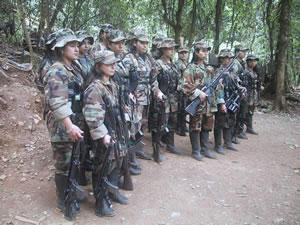 Havana, Cuba.
Even in Havana they get up early. “We get up at 4:30 to wake up the roosters so that they can start singing,” grins Ricardo Tellez, better known as “Rodrigo Granda.”I have an appointment at 7am to interview three members of the Secretariat, the highest authority of the FARC. They are at the forefront of the dialogues between the insurgent organization with the delegation of the Colombian government in Havana. In a great hall of a house in “El Laguito” (1), where they live, “Ivan Marquez” and “Pablo Catatumbo” arrive, too. Granda lights a cigarette and drinks his second cup of coffee. Marquez has a big Cuban cigar in his hand, which he`ll start “after breakfast”. Catatumbo is sipping coffee and says to me: “If the three of us are going to say almost the same, why would you interview me?”
It is the first time a journalist has the opportunity to talk to these three guerrilla leaders together.
Hernando Calvo Ospina: Commanders, you have been talking for seven months, negotiating with the government’s commission in this peace process. Are you still optimistic?
Ivan Marquez: The optimism of the FARC is determined by our willpower to find a political solution to this confrontation, which has lasted for almost fifty years. Because they haven´t been able to defeat us militarily, nor have we, we must seek an alternative. In addition, the circumstances, today’s realities, both in Colombia and on the continent, indicate that it is time to find a pacific solution. Wars are not eternal. And that´s why we make any necessary effort to come to an understanding with the government.
HCO: How does it feel to be so close to your enemy?
IM: In spite of sitting at the same table two groups with very different views, almost antagonistic, we have to tolerate and understand each other. At a negotiating table one should respect the other party, and I think that respect should be mutual. There are moments of algid, strong discussions, but soon things turn back to normal because we know that we must come to an understanding.
HCO: Negotiations in war move between two opponents. It seems to me that you put more emotion on it.
IM: You’re right. The government has always had a tendency to seek the subjugation of the guerrillas as a synonym for peace, not peace through structural changes. The oligarchy wants peace for free. We are making great efforts for them to understand that you need to generate an atmosphere for peace, and that it can be achieved through institutional and political transformations. We are sure that the most important thing for Colombia is to ensure real democracy, where the sovereign people can determine strategic policies, where the opinion of the people is taken into account without being stigmatized and murdered.
HCO: Maybe I’m wrong, but I think that at various times President Juan Manuel Santos has wanted to pull back.
Rodrigo Granda: I don´t think he wants to withdraw, but he does seem afraid. It’s as if he were afraid of former President Alvaro Uribe, of the cattle-breeders, of narco-paramilitary power and the obscure sector within the Armed Forces. Santos recoils despite having the support of a significant sector of industrialists, bankers and churches. For example, according to reports we have, Sarmiento Angulo (2), one of the most powerful men in Colombia, supports the dialogue process. Surveys say that 87% of Colombians also want peace. The correlation of forces in favor of peace is indisputable. Uribe aside, nobody speaks about war anymore. But it seems that Santos does not want to face those sectors led by Uribe, he wants to fight us militarily, and assumes intransigent positions that do not allow a correct development of the dialogues. We know that Uribe has prepared 13,000 paramilitaries, known unofficially as the “anti-land restitution army.” Is it that the Armed Forces and Santos don´t know about that? Of course they do! Is that what Santos is afraid of? Or is he taking it as part of a possible move against us?
HCO: Clearly Uribe tries to torpedo the negotiations. Do you think he wants to return to presidency?
RG: And he wants that to protect himself, because he’s afraid of being sent to Miami for drug trafficking, or to the International Criminal Court in The Hague for crimes against humanity. It would be favorable for him if the negotiations failed, so that he can appear before the country as the solution. Although he wasn´t able to resolve the “problem” of the guerrillas during the eight years he was in office. Pablo Catatumbo: Anyway, Santos and Uribe have the same idea about the negotiations: a peace process by submission. They are blind, deaf and quite wrong, but think they’re smart. And that is where we must continue with wisdom to prove that they are wrong, and that like this, the war will continue.
HCO: In statements you´ve made and documents I’ve read, you are asking for reforms in state institutions and the modernization of the State itself, which may be contradictory for a Marxist-Leninist communist guerrilla.
IM: At the table we are not proposing radical changes to the political or economic structures of the state. Over there, we don´t mention socialism or communism. We try to create conditions to reach an understanding with the government. A place where two different views can meet. We know that some leftist organizations, not only in Colombia, say that we became a reformist guerrilla.
We have made minimum proposals, for example the hundred proposals about the agrarian system, which as you´ve already said, are nothing more than a modernization of the Colombian countryside, but fact is that we are still living in feudalism there. Imagine that even this way, the government puts obstacles.
HCO: What has ever signed between the parties?
RG: We have signed some things, but they are not final signatures because nothing is agreed until everything is agreed. There are points on which we haven´t agreed yet, and we let them out to discuss them later on. Otherwise there won´t be any progress.
HCO: Dialogues in Havana, and strong military confrontations in Colombia …
RG: The government doesn’t want a ceasefire, so both parties have to dialogue under fire. We are having heavy confrontations every day, to an average of three per day. We have done large-scale military actions, which they hide to the nation. Now, both parties have decided that what happens in Colombia is not going to affect the Table.
We have made some gestures of peace, as was the unilateral truce for Christmas, although we had to defend ourselves against the attacks of the army. And what has been hidden is also in that same time span multinationals could increase their profits, they did not have our pressure. That’s why one of the major reasons for ending the guerrillas is that the transnationals can steal whatever they want without any problem.
HCO: So far, what has been the main government’s intransigence in negotiations?
IM: Without any doubt, the determination not to touch the property of the big land-owners, most of which has been obtained through violent dispossession. They`re afraid of that. Their representatives, when they talk to us, have said that that could “unleash the demons of paramilitarism.” They are afraid of cattle-breeders and landowners, to touch one third of the 30 million acres they own, although not even the cows occupy them.
But land reform without touching the big property isn’t reform. There must be set limits for land property. The government has not even thought about putting taxes as a punishment for unproductive land tenure. When we proposed taxing these big properties, the government responded that there is no reliable census; that nobody knows where they are or what their extension is. They suggest that first there should be a census, which can take up to 7 or 10 years. What they don’t say is that during this time the landowners can lease or sell the land to multinationals, which is their strategy.
HCO: If the Colombian government decided to negotiate with the FARC, it was because Washington agreed. You know that that is not an exaggeration of mine. What is the current political attitude?
IM: Recently, 62 U.S. congressmen, including two Republicans, led by Jim McGovern, signed a letter of support for the talks. This letter was sent to Secretary of State John Kerry. We welcomed this altruistic gesture. The White House and the State Department have also expressed their support. Of course, there are always different interests because the Colombian conflict produces money. The powerful arms industry doesn´t want to let loose of that business.
HCO: You are determined to stop the armed struggle. What should the government offer you for this to be achieved? And you, what would you become?
RG: President Santos, during the initial interchanges with us, said he wanted to open the floodgates to a real democracy in the country. That struck us because we have never said that the armed struggle is the only way to change the country. We got up in arms, and we still carry them, because violence has closed the doors to political participation. If the possibility of doing politics legally becomes real, without the constant threat of assassination, in equal conditions and with political reforms that could lead the country towards participatory democracy, we are there. Because there could be created a favorable correlation of forces for the revolutionary movement, which routs the necessary radical changes. We accept that challenge.
PC: You need to build a strong mass movement to impose changes, because the establishment doesn’t give away anything for free. That is a task for us, leftists and Democrats. It is important to create a power block of people who want a new Colombia. That is the challenge, and it´s not a small one.
But you see, as we talk about it at the conversation Table, the repression continues all around the country. The government hasn’t changed anything regarding the treatment of social protest: they are stigmatized, associated with the guerrillas to criminalize them and attack them with bullets. And if there is something we have very clear is that we are not willing to repeat the experience of the Patriotic Union, during which nearly 4000 members and leaders (3) were killed.
History, if it’s not manipulated, doesn´t lie: they have been the violent ones. When we remind the governmental team of these facts, they tell us that they are not here to talk about that. Why? What do they feel ashamed or afraid about? Without knowing the history of political violence in Colombia, how are we to know why we got to the current situation and how to resolve it?
IM: There are three items on the agenda to be discussed: guarantees to exercise political activity, political participation and bilateral and definitive ceasefire. The latter discusses the surrender of weapons and under what conditions. But let it be understood: that´s not handing over weapons. We cannot talk about these points until they are discussed in the table, and they will be the last ones on the agenda.
HCO: What will happen with the paramilitaries?
IM: They must definitively be eliminated; if not, there would be no certainty for an insurgent organization to incorporate into legal politics. That’s an insurmountable condition to reach a peace agreement. And it is the government who has to give the order to his generals to stop the state’s counterinsurgency strategy.
HCO: Are you determined to apologize for the suffering you have caused in this war?
PC: We have made mistakes, some serious, indeed. But whatever official propaganda says, aggression to the population has never been a strategy of the FARC. On the contrary, we have defended them against the army and its paramilitaries, mainly on the countryside.
I have no problem in saying to a woman or a family: “I feel sorry about the pain we have caused with the death of your loved one.” But this is much more complex. Are we going to apologize? Very well. Let´s also invite the economic associations that financed the war and paramilitaries; let´s invite all State institutions, because they guarantee repression and impunity; let´s invite the mass media, too, because they reproduced the stigmatization made by security agencies, which have led to the murders and massacres; the rightist political parties should also sit down and assume their great responsibilities; the former presidents of the republic who gave the orders. Not even the Catholic Church can deny its responsibility! And the governments of the United States, Israel, some European countries and others that have supported various criminal governments of Colombia cannot be left outside of this ceremony. All together, we can decide who the terrorists and murderers of the people are.
HCO: You point out, and rightly so, that the government, its armed forces and the mass media are responsible for psychological warfare and propaganda against the insurgency. But I think an important sector of the so-called intelligentsia have savaged the armed struggle they supported before.
PC: Most intellectuals in Colombia, and probably in the world, are suffering from cowardice, accommodations or both things. Almost all were put by the system in the matrix of lies, and are used to “theorize”, create and repeat falsehoods. Many of them spend time writing discourses against media manipulation, but when the system starts a campaign against someone or somebody, they start talking like parrots.
In Colombia, the system told them that the guerrillas are guilty of everything. Although many of them believed, or believe, they are from the left, they repeated in unison that we are responsible for violence, drug trafficking, kidnapping, poverty, rising gasoline and even the high price of the bananas. I assure you that if tomorrow the birds stop singing, these “intellectuals” repeat what the government and their media say: the guerrillas are to be blamed. They have fallen into such poverty regarding research and argumentation, that their analyses and theories don’t endure any discussion, at least with us. They think that if they discuss with us, we´ll kill them afterwards. They are not even capable of realizing that if that was true, in Colombia there would be very few “intellectuals” left right now. Their brain doesn’t have the capacity to see that those who safeguard their intellectual and political independence are those who are said by the government to be friends or accomplices of the subversion.
HCO: I must admit, and I´m about to end, that I’m not very optimistic about these dialogues. I believe that Colombia and Colombians deserve peace with social justice, but I know the Colombian State, I know the United States, who support that State and who ultimately decides. Hopefully the long night, imposed by State terrorism stops and finally dawns. I wish it with all my heart.
PC: Look, political conditions in Latin America have changed. Who could have imagined what happened in Venezuela and Bolivia with the arrival of Chávez and Evo? Who would have thought that other Latin American governments one day would demand respect for their sovereignty from the U.S.? There are unpredictable things, like the end of the Soviet Union for example.
In Colombia there is an accumulation of hunger, exclusion, injustice and repression. The time will come when people simply won´t take it anymore. There is an accumulation of ongoing processes that can make a leap any time. There is a boiling that could explode tomorrow.
Besides, Colombia is not an island. The neighboring countries are pressing the government because they are tired of the conflict that affects them. Venezuela received about 4 million displaced Colombians, Ecuador almost two million. We believe there are 13 to 15 million Colombians in neighboring countries, that is, the third part of the Colombian population. And these countries must provide housing, food and health. For how long? Apart from the budget they spend to protect their borders. Just because the Colombian government insists on not negotiating a conflict they will never win! We have asked the representatives of those nations to demand for peace, so that all our compatriots can return to their country.
We are optimistic. Revolutionaries must be optimistic, even in the worst situations. And we believe that peace will come to Colombia because we deserve it. The other possibility is total war. That´s why I say the moment has come, but that doesn’t mean it´s easy. This peace process is too complex, but we believe it is possible. We insist on striving for peace, so we will not fold our arms.
I do have hope, although I think the authorities and the Colombian oligarchy lack greatness and humility to start solving this conflict.
Hernando Calvo Ospina is a Colombian journalist. He can be reached through his website.
NOTES:
1. “El Laguito” is a residential complex in Havana. Their houses are separated by trees and gardens. In the center is a small lake. Since November 2012, the delegations of the FARC and the Colombian government are located in this peaceful scenery.
2. According to the magazine Forbes (edition 2012). Luis Carlos Sarmiento Angulo listed as the first billionaire in Colombia, and would rank 64 in the world.
3. The Patriotic Union was born in 1985, as a result of the talks between the government of Belisario Betancur and the FARC. According to the Colombian justice, there was a “political genocide” against the Patriotic Union.
Translation: http://en.firatnews.com/news/news/g…
The Murder of Tomas Garcia by the Honduran Military
School of the Americas Watch
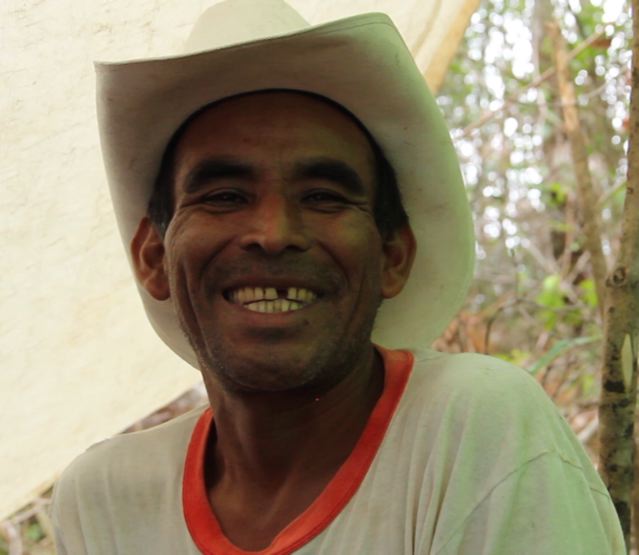 Tomas Garcia was a father of seven who would have turned 50 this December. He was a husband, father, brother, and community leader, serving as an auxiliar and on his community’s Indigenous Council. On Monday, July 15, his life was brutally taken away by the Honduran military when a soldier shot and killed him at close range in broad daylight in front of 200-300 people.He did not have a gun, he did not hurt anyone. His crime? Opposing the construction of a hydroelectric dam being constructed in his Indigenous Lenca community’s territory against their will, in violation of ILO Convention 169 and the Honduran government’s promises to consult Indigenous communities about projects in their territory.Why Tomas?He was one of the first to arrive, leading the delegation that had come to deliver a message to the companies constructing the dam at their installations in Rio Blanco. A soldier fired at him not once, not twice, at least three times from only 6 or so feet away, according to eyewitnesses.
Tomas had gone to the day’s activities with his 17-year old son who was also shot several times, receiving serious injuries in his back, chest, and arm and requiring hospitalization. Two others were also injured by the army’s bullets. According to eyewitnesses, a soldier who had been firing into the air lowered his M-16 and fired multiple shots directly at Tomas. Tomas had recently arrived at the company’s installations as one of those who was at the front of the delegation; the whole group had not even had time to arrive and many were still walking down the hill that leads to the offices. As one woman from the community explained, “We didn’t even have a conversation with them, they didn’t say anything to us. They didn’t even wait for us to say why we there, they didn’t wait for us to say what we had to say. We saw Tomas fall, he fell from shots, including to his head.”
The murder of Tomas Garcia by the Honduran armed forces is only the latest escalation in a systemic campaign of repression against the Rio Blanco Indigenous Lenca people to try to force them into accepting a hydroelectric dam being illegally constructed in their territory. Since April 1, the communities in the area, organized in the Indigenous Lenca organization COPINH, have been blocking the access road to the dam site. The access road, like the dam, is in their ancestral territory, surrounded by their fields of corn, beans, bananas, yucca, and lush forests that they have carefully stewarded for hundreds of years. At first, the Honduran National Police evicted them multiple times – despite them being on their own land. After each eviction, they simply returned to the site.Personnel of the companies building the dam — DESA and SINOHYDRO – threatened COPINH leaders. Community members started receiving death threats from employees of the company who live in the area. Armed men appeared at the site of the roadblock and lurked around at night.
Then on May 17, soldiers from the First Battalion of Engineers, commanded by SOA graduate Col. Milton Amaya, were deployed to the area and have stayed there ever since. They essentially serve as security guards for the dam companies, even driving company machinery to attempt to get it past the roadblock, and live, eat, and sleep at DESA/SINOHYDRO’s installations. Soldiers have repeatedly intimidated those who oppose the dam: they have harassed them, told them they were criminals, came into their yards, held an M-16 up to one of them, threatened women and children, and fired shots when community leaders walked by.i
 Having the police and military on their side only seems to have emboldened company employees to increase their threats and attacks on those who oppose the project. According to testimonies, employees of the company who live in the area attacked a man who had just come from the roadblock with machetes —cutting up his face and sending him to the hospital.They threw rocks at another, and threatened many in the community with death, including children. “I’m going to come to the Roble and you know how you’ll all end up. In pieces.” “I’m going to kill all of you.” ii Bullets passed above the site of the roadblock where people were sitting one Monday afternoon, people in ski masks appeared near the house of a family that is strongly against the dam, unknown figures lurked outside the house of the President of the Indigenous Council, and a known hit man arrived at the site of the roadblock.
In spite of all of this, the Indigenous Lenca people did not give up. Day after day, in the rain or in the heat, in spite of death threats and bullets that passed overhead, men, women, and children came to the roadblock to defend their land. After Tomas’ death, they continue to do so, now continuing forward in his honor, despite the intense accusations against them aimed at discrediting their struggle in the wake of Tomas’ murder.
To justify the death of Tomas Garica, DESA and the military launched a media campaign criminalizing COPINH and the Rio Blanco community. DESA issued a media release claiming that
“because of the violent intervention of the COPINH protestors, Mr. Tomas Garcia died and Mr. Alan Garcia Dominguez was injured. This morning, minor Cristian Anael Madrid Munoz also died, who is the grandson of one of the principal leaders of the zone and was doing agricultural work on his property when he was surprised by the protestors” and that “The actions which occurred today were deliberately premeditated by the principal leaders of COPINH.”
Reading DESA’s release and the corporate news accounts of what occurred, one would think that COPINH itself murdered Tomas Garcia instead of the Honduran military. Area residents who heard TV news accounts got the impression that COPINH was violent and threatening people, not that they were in fact the victims of threats and violence. DESA also accuses the protestors of a second death, which is said to have occurred in a separate location while community members were gathered around the body of Tomas Garcia at the company’s installations, in sight of the police and military. Community leaders report that the Police officer in charge even told them he was a witness that they were all still with him at DESA’s installations when gunshots were heard from up the hill, where Christian Madrid lives. But that doesn’t matter when DESA and Chinese owned SINOHYDRO – the world’s largest dam-building company — are losing money because the subsistence farmers of Rio Blanco refuse to let their river be privatized.
The attacks portraying the protestors as armed further contradict the reality one finds when one visits the zone. The dirt-poor Indigenous farmers of Rio Blanco have machetes and sticks, not guns.As one Indigenous Lenca woman and mother who is a leader in the struggle against the dam explained,
“We don’t have any guns. They do have guns because they are invading our land. They buy big guns to walk around threatening the lives of our compañeros, of all the members of Rio Blanco. They see us as an enemy and walk around with guns. Since they make money selling our land with that they can buy guns to take away the life of another person, another human life.We are all humans in this world… We have to respect each other’s faces. We are all the same.Regardless of how we look, we are children of God.”
The accusations of violence, murder, and possibly even terrorismiii against COPINH are a strategic escalation of the criminalization campaign aimed at destroying COPINH’s ability to resist the Agua Zarca Dam and numerous other projects planned for Indigenous Lenca territory. On May 24, soldiers from the First Battalion of Engineers detained Berta Caceres and Tomas Gomez of COPINH, claiming to have found a gun in their vehicle to try to criminalize them. It appears that soldiers themselves may have placed a gun in their vehicle to fabricate the charges. SOA graduate Milton Amaya, Commander of the First Battalion of Engineers, made accusations in the press. However, the soldiers couldn’t even keep their stories straight and the charges were provisionally dismissed on June 13th. Nevertheless, the state has appealed and is still trying to criminalize Berta. Now, COPINH and the Rio Blanco community have been criminalized and defamed in the press, in an effort to justify the murder of Tomas Garcia and potentially justify criminal charges against COPINH leaders or even more murders in the area. A similar tactic has been used in the Bajo Aguan, where SOA-graduate Col. Alfaro started a media campaign earlier this year accusing the campesinos (small farmers) of being armed and violent to justify the deaths in an area where over 100 small farmers have been murdered.
Why is the Honduran government so invested in breaking Indigenous Lenca resistance to the Agua Zarca Dam project in the remote western mountains of Honduras? The Agua Zarca Dam is not an isolated project but part of the overall scheme of privatization and looting of Honduras’ natural resources in the name of foreign investment. It is part of the “Honduras is open for business” scheme that was embarked upon following the 2009 military coup in Honduras to enrich the Honduran elite and multi-national corporations.Just months after the coup, the Honduran National Congress passed a General Water Law enabling the country’s water resources to be concession to third parties – enabling privatization of rivers.iv Then in 2010, the Congress approved a package of 41 hydroelectric dam projects throughout Honduras, including the Agua Zarca project and other dams in Indigenous territory.v They also passed a new mining law, which has yet to go into effect, and a law creating Special Development Regions, commonly known as model cities. And in July 2013, the Congress passed a law enabling the government to sell off “idle” resources, including natural resources, mining, energy, and more, in order to pay the internal debt.vi
All these laws passed by the post-coup governments are part of the drive to privatize and sell off natural resources – from water, to minerals, to the land itself– for exploitation and profit by corporations, especially foreign corporations. As Honduran President Porfirio Lobo explained at the signing of an agreement with SINOHYDRO to build three other dams on one of Honduras’ longest rivers, “I’m determined to promote these types of projects and make Honduras more open to all foreign investors.” While enriching business executives and investors around the world, this robs Honduran communities, especially Indigenous and campesino communities who live off the land, of the land and resources they depend on to survive.
And so the Honduran military has been dispatched to destroy the resistance of the Rio Blanco Indigenous people just as they have been dispatched to the Bajo Aguan where organized campesinos struggle for land.While Tomas Garcia lived with his wife and seven children in a small house with a dirt floor, the US was sending millions and millions into military aid in Honduras.Some of this aid probably found its way to the unit that used one of its M-16s to murder Tomas and terrorize the Lenca people for standing up for their rights. It is no accident that the military is used to enforce the turning over of Honduras’ natural resources to corporations; this is part of the US neoliberal agenda. US aid includes training, whether at the School of the Americas or by the US military on Honduran soil.For instance, Second Lt. Gonzalez, who was in charge of the soldiers stationed in Rio Blanco, reported he was trained in Special Operations by US military instructors. David Castillo, the Director of DESA, the company building the dam, attended West Point Military Academy and previously served as the Assistant to the Director of Intelligence of the Honduran Armed Forces.vii The military’s effort to criminalize the Rio Blanco community goes up to the highest levels – General Rene Osorio Canales, the Commander of the Honduran Armed Forces who was trained at the School of the Americas, spoke out to publicly justify the military’s murder of Tomas Garcia.viii
“When we heard the shots, we were humiliated.Because we don’t have guns. We have only machetes and wood.They are always accusing us of being armed, saying that we are guerrillas, that we are violent. That’s a lie. What we want is for them to withdraw and leave our territory and our rivers free.As Indigenous people we don’t want this dam to be built in our home.”
“We don’t want the dam built on our land because it affects us a lot. We like to harvest corn and beans, but we no longer could plant our crops. We don’t want the dam and we don’t want them to come violate our rights.”
“We are not criminals.We are people who grow corn.”
“Before the company came here we lived in peace.”
-Rio Blanco community members
[i] Interviews with Rio Blanco community members, May, June, July 2013.
[ii] Testimonies from community members who oppose the dam about threats from company employees who live in the area, June and July 2013.
[iii] http://copinhonduras.blogspot.com/2013/07/solidaridad-de-la-red-nacional-de.html#more
[iv]http://www.defensoresenlinea.com/cms/index.php?option=com_content&view=article&id=2523:comunidades-indigenas-lencas-en-rebelion-contra-depredacion-del-territorio&catid=58:amb&Itemid=181
[v] http://archivo.laprensa.hn/Negocios/Ediciones/2010/09/03/Noticias/Congreso-aprueba-41-proyectos-renovables
[vi] http://www.elheraldo.hn/Secciones-Principales/Pais/Ratificada-ley-para-vender-bienes
[vii] http://www.linkedin.com/pub/david-castillo/39/a55/6a2
[viii]http://www.defensoresenlinea.com/cms/index.php?option=com_content&view=article&id=2695:en-guerra-contra-el-pueblo&catid=42:seg-y-jus&Itemid=159
Photo of Tomas Garcia by Colectivo Ocote
Related article
Honduras: Expanding Palm Oil Empires In The Name Of ‘Green Energy’ And “Sustainable Development”
Written by Rights Action, Rainforest Rescue, Biofuelwatch, and Food First | August 6, 2013
From 6th-8th August, the Roundtable on Sustainable Palm Oil (RSPO) is holding its 4th Latin American Conference on so-called sustainable palm oil in Honduras [1]. Environmental and social campaigners have been shocked to learn that one event sponsor is the palm oil company Dinant Corporation, owned and controlled by Miguel Facusse, the largest landowner in Honduras. They are calling on World Wildlife Fund WWF and three other organisations to withdraw from and denounce the conference being held in Honduras due to the Dinant’s sponsorship of the event and the serious human rights implications [2].
Mr. Facusse was a key supporter and beneficiary of the June 2009 military coup in Honduras [3], has been associated with narco-trafficking [4], and, along with other large oil palm growers, has been linked to the targeted killing of more than 88 members and supporters of peasant organisations since June 2009 in the Aguan Valley [5], one of the main palm oil producing regions in Honduras.
Annie Bird from Rights Action states: “By holding its conference in Honduras and by allowing Dinant Corporation to sponsor the event and hold a stall, the RSPO is turning a blind eye to systemic and severe human rights abuses, including forced evictions of entire communities and over 88 killings for which palm oil companies, especially Dinant, are responsible. The RSPO Conference serves to reinforce the impunity with which the large-scale palm producers operate.”
RSPO is overwhelmingly dominated by the interests of large corporations like Nestlé, Rabobank and Unilever—all linked to cases of “land grabbing” in Asia, Latin America and Africa.” [6]
According to Tanya Kerssen, Research Coordinator for Food First, “The case of Dinant is emblematic of how large, elite-controlled companies use palm oil to expand their control over land and other resources. The RSPO is merely window dressing for this continued corporate expansion, which—whether classed as ‘sustainable’ or not—necessarily means the replacement of forests, biodiversity and food production with a large-scale monoculture crop for biofuel and unhealthy edible oils.” [7]
Guadalupe Rodriguez from Rainforest Rescue adds: “WWF and the three other organisations involved in this RSPO conference must pull out of and denounce this process. They must not, however indirectly, associate themselves with palm oil businessmen involved in repressing, evicting and killing peasants in Honduras’s Aguan Valley.”
The European Commission considers all biofuels from RSPO-certified palm oil to be sustainable and thus eligible for government support [8]. This is despite growing evidence by a large number of organisations, which shows that the RSPO has not been enforcing its own standards on its member companies and cannot guarantee environmental or social sustainability of palm oil [9].
Almuth Ernsting from Biofuelwatch states: “The RSPO Secretariat’s decision to hold a conference in Honduras and allow Dinant Corporation to contribute sponsorship and hold a stall further undermines any pretence that the RSPO’s aim is to make palm oil sustainable. Far from addressing any of the most serious impacts of palm oil production, the RSPO continues to serve as an instrument of greenwashing for the industry”.
NOTES
[1] The Roundtable on Sustainable Palm Oil is a stakeholder forum which provides voluntary certification for palm oil. The great majority of RSPO members represent industry interests. (Conference website: http://rspo2013.com/)
[2] See http://rightsaction.org/action-content/open-letter-world-wildlife-fund-solidaridad-network-snv-netherlands-development for an Open Letter to WWF, Solidaridad, SNV Netherlands Development Organisation and Forest Ethics on this issue.
[3] In June 2009, the democratically elected Honduran government of Manuel Zelaya was overthrown by a military coup. Manuel Zelaya’s government had begun listening to and acting on the demands of peasant organisations for land reform, including in the Aguan Valley region. The land reform process was ended by the military rulers after the coup. Since then, Dinant Corporation and their armed security forces have been collaborating with military forces and police forces in repressing local communities who have been trying to reclaim land controlled by Dinant. See for example: http://www.enca.org.uk/documents/ENCA56_Sep_2012.pdf .
[4] Published Wikileaks Cables revealed that the US embassy in Honduras has had evidence linking Miguel Facusse to drug trafficking since at least 2004 and that several aeroplanes with drugs have landed on his private property. See http://www.thenation.com/article/164120/wikileaks-honduras-us-linked-brutal-businessman#
[5] For a report by Rights Action about killings and other human rights abuses in the Aguan Valley, see http://rightsaction.org/sites/default/files/Rpt_130220_Aguan_Final.pdf .
[6] See, for example: “The bloody products of the house of Unilever” Rainforest Rescue, 2011. https://www.rainforest-rescue.org/mailalert/747/the-bloody-products-from-the-house-of-unilever
[7] For more on the link between palm oil expansion and corporate control, see Kerssen, Tanya. Grabbing Power: The New Struggles for Land, Food and Democracy in Northern Honduras. Food First Books, 2013.
[8] See http://www.rspo.org/news_details.php?nid=137
[9] Previously, over 250 organisations condemned the RSPO for ‘greenwashing’ of palm oil: http://www.biofuelwatch.org.uk/2008/rspo-declaration-english/ . More recently, the RSPO has been denounced for example by Greenpeace and Friends of the Earth; http://www.biofuelwatch.org.uk/2008/rspo-declaration-english/
Greenwald claims up to 20,000 Snowden documents are in his possession
RT | August 7, 2013
The journalist involved in the publication of leaks provided by whistleblower Edward Snowden said in a testimony to the Brazilian government that he possesses up to 20,000 secret US government files.
Glenn Greenwald testified before a Brazilian Senate foreign relations committee on Tuesday. The Brazil-based American reporter – who was approached by Snowden while the whistleblower still worked as a contractor for the NSA – has published details of US electronic surveillance programs taking place domestically and abroad.
“I did not do an exact count, but he gave me 15,000, 20,000 documents. Very, very complete and very long,” Greenwald told Brazilian lawmakers.
“The stories we have published are a small portion. There will certainly be more revelations on the espionage activities of the US government and allied governments… on how they have penetrated the communications systems of Brazil and Latin America,” he said.
In addition to his reporting for Britain’s Guardian newspaper, Greenwald has also been a fixture on O Globo, where the journalist shared the alleged details of US electronic surveillance of Brazil and virtually all of Latin America.
During his testimony, Greenwald alleged that Brazilian companies have agreements in place with American telecoms to collect data for the National Security Agency (NSA), and stressed that their complicity should be investigated by that country’s government.
O Globo recently published claims that Washington had at least at one time maintained a spy center in the capital of Brasilia, as part of a network of 16 similar facilities worldwide designed to intercept foreign satellite transmissions.
Allegations of widespread US surveillance of Brazil prompted US Vice President Joe Biden last month to call Brazilian President Dilma Rousseff to provide an explanation. US Ambassador to Brazil Thomas Shannon had earlier denied the NSA was tapping into telecoms in the country.
The additional files in Greenwald’s possession are believed to have been handed over when Snowden took refuge at a hotel in Hong Kong before fleeing to Moscow.
“The pretext [given by Washington] for the spying is only one thing: terrorism and the need to protect the [American] people. But the reality is that there are many documents which have nothing to do with terrorism or national security, but have to do with competition with other countries, in the business, industrial and economic fields,” Greenwald said on Tuesday.
On Monday, foreign ministers of the South American trade bloc Mercosur raised the issue of alleged NSA surveillance throughout Latin America with UN Secretary-General Ban Ki-moon.
The ministers discussed with Ban a statement adopted by the bloc on July 12 following a summit in Montevideo, Uruguay. The statement called for UN members to propose ways to halt spying and potentially pursue sanctions against the United States.
But doing so would be impossible under the current framework, as only the Security Council can impose legally binding sanctions and the US holds veto privilege over any such resolution as a permanent member of the council.
One of the most recent leaks provided by Snowden – published last month – refers to a secret surveillance system named XKeyscore which is allegedly used by the NSA to monitor internet traffic.
In his Tuesday testimony, Greenwald described the system as not only able to collect metadata “but also the content of emails and what is being discussed in telephone conversations. It is a powerful program which frightens.”
Mercosur complains to Ban Ki-moon on US global espionage and EU affront towards Bolivia’s Evo Morales
MercoPress |August 5, 2013
Mercosur foreign ministers warned UN Secretary General Ban Ki-moon of the serious implications which the United States global espionage system represents for the international community, during a Monday midday meeting at the UN headquarters in New York.
“We have expressed our concern and warning over the serious implications that these illegal procedures displayed by the government of the US have on the political stability of countries and the necessary mutual trust of the international community members”, said Venezuelan minister Elias Jaua at a press conference following the meeting with Ban Ki-moon.
Jaua was the spokesperson of the Mercosur group of foreign ministers, Antonio Patriota, from Brazil; Hector Timerman from Argentina and Luis Almagro, Uruguay, as well as associate member Bolivia’s David Choquehuanca, because Venezuela since last July holds the rotating chair of the South American trade block.
The ministers thus complied with the formal request from the last presidential summit of Mercosur in Montevideo in mid July, when there was an official release condemning US world espionage, which was revealed by the former intelligence officer and whistle-blower Edward Snowden currently with one year political asylum in Moscow.
“This practice is absolutely in violation of international rights for the safeguard of countries sovereignty and independence, and even more, is in violation of fundamental human rights of the citizens of our countries”, underlined Jaua.
When asked about the reply of Ban Ki-moon to the Mercosur statement, Brazilian minister Patriota said that the top US official “shared the concern” of the block. “UN Secretary General reacted in a way that showed awareness towards the message we transmitted from our presidents”, added Patriota.
During the meeting the ministers also expressed Mercosur ‘deep concern’ because of ‘the abuse and affront’ to Bolivian leader Evo Morales presidential immunity “when he was impeded air space free passage over several European countries under suspicion that his aircraft could be transporting Mr. Snowden”, when he was still stranded in the Moscow airport and hoping to be granted political asylum by some country.
The decision adopted by Spain, France, Italy and Portugal last 2 July “seriously endangered not only the dignity of president Evo Morales, but also his own physical safety since he had to over-fly with limited fuel and was forced to land in Vienna”, explained Jaua.
Snowden who is wanted by Washington for having leaked the existence of a US secret program that operates domestically and internationally to spy on phone and internet communications, was finally granted temporary asylum (one year) in Russia given the difficulties to fly to Latinamerica where several countries had offered to help him.
Precisely asylum was another issue addressed with Ban Ki-moon following on the strong pressure exercised by the US on several Latam countries (Bolivia, Nicaragua and Venezuela) which offered an alternative to Snowden.
“For us Latinamericans the right to asylum is a right all citizens can exercise as well as the right of States to be respected when they extend such a benefit, and it is a principle we are not willing to negotiate” said the Mercosur spokesperson emphatically, who then recalled that ‘this very principle helped to save many lives during the hard years of the military dictatorships suffered by many countries of the region”.
Finally the foreign ministers reiterated their standing concern on two recurring issues: the US blockade on Cuba and Argentina’s claim over Falklands/Malvinas sovereignty.
There is a demand that these two issues “definitively find a solution since they are highly sensitive and of great concern for the Latam region”.
Argentine President Cristina Fernandez was scheduled to meet Ban Ki-moon later in the day in advance of her speech to the Security Council on Tuesday, taking advantage of the fact that Argentina will be holding the presidency of the council during the month of August. The president arrived in New York on Monday morning.
Related article
- S. American states to recall ambassadors from Europe over Bolivian plane incident (alethonews.wordpress.com)
Featured Video
US Marines Seized Panama in 1903
or go to
Aletho News Archives – Video-Images
From the Archives
Precedents for Pizzagate
Marc Dutroux, Belgian pedophile, sadist, and serial killer with friends in high places
By Aedon Cassiel | Counter – Currents | December 23, 2016
To reiterate a point that should be clear to the more astute reader, my goal in this series (part 1, part 2) has not been to defend “Pizzagate” as such. My goal has been to defend the people who want to investigate it against specific accusations levied against them by people who think Pizzagate has revealed no intriguing information at all—for a specific reason, which I will be honing in and focusing on much more directly in this closing entry.
Whereas the mainstream critics of Pizzagate would have you believe that the dividing line is between paranoid conspiracy theorist followers of “fake news” and level-headed people who follow trustworthy news sources and rely on cold, hard reason to determine the truth, my goal has been to show that—whatever is or is not happening with Pizzagate itself—this framing of the issue is arrogant, insulting, and the product of extremely narrow tunnel vision. … continue
Blog Roll
 Aletho News
- The U.S. Sanctions Cuban Journalist For Reporting On The U.S. Blockade
- Israeli firms transform cars into intelligence devices: Reports
- Zionist-controlled companies to surveil British citizens
- THE CHILDREN GAMBIT
- A note on comment posting at Alethonews
- Trump stalls over Iran strike plan, Iran holds all the aces
- Zelensky’s Ceasefire for Elections is Strategic Gambit, Not Democratic Move
- US and Dutch pilots flying F-16s for Ukraine – Western media
- West’s Claims of Non-Involvement in Ukraine Conflict ‘Epitome of Hypocrisy’ – Expert
- Putin aide urges retaliation to ‘Western piracy’
- If Americans Knew
- Help end the injustice against Shadi
- Israel’s Favorite American President
- Israel’s “Yellow Line” Is a Death Trap for Palestinians. We Drove Into It.
- Why Israel’s expanding occupation in Syria presents a critical legal test
- Gaza is not a natural disaster. It is the victim of genocide enabled by global inaction
- Netanyahu’s plan to “end” US aid to Israel is to give even more money under a different name
- Israel ceased firing on Gaza for just 15 days of the “ceasefire” – Not a ceasefire Day 130
- In Gaza, “rats run over our faces” – Not a ceasefire Day 129
- Israel-backed border guards, GHF-linked aid – Not a ceasefire Day 128
- Israel battles Palestinian right of return, one Palestinian at a time – Not a ceasefire Day 127
- No Tricks Zone
- New Study: A 4°C Warmer Beaufort Sea Had ‘No Sea Ice’ 11,700 – 8200 Years Ago
- Unfudging The Data: Dutch Meteorological Institute Reinstates Early 20th Centruy Heat Waves It Had Erased Earlier
- German Gas Crisis…Chancellor Merz Allegedly Bans Gas Debate Ahead of Elections!
- Pollen Reconstructions Show The Last Glacial’s Warming Events Were Global, 10x Greater Than Modern
- Germany’s Natural Gas Storage Level Dwindles To Just 28%… Increasingly Critical
- New Study Rebuts The Assumption That Anthropogenic CO2 Molecules Have ‘Special’ Properties
- Climate Scientist Who Predicted End Of “Heavy Frost And Snow” Now Refuses Media Inquiries
- Polar Bear Numbers Rising And Health Improving In Areas With The Most Rapid Sea Ice Decline
- One Reason Only For Germany’s Heating Gas Crisis: Its Hardcore-Dumbass Energy Policy
- 130 Years Later: The CO2 Greenhouse Effect Is Still Only An Imaginary-World Thought Experiment
 Aletho News