Most Venezuelans have a blind spot on their own country according to James Bloodworth
By Joe Emersberger | ZBlogs | February 20, 2014
James Bloodworth, when he isn’t applauding Obama’s murderous drone attacks on Pakistan, occasionally takes time out to complain about leftists supporting the Venezuelan government. He claims that Venezuela has become a “nightmare” and that, despite elections that he appears to acknowledge are clean and transparent, Venezuelans are, nevertheless, “living under tyranny” because of the government’s “unwillingness to tolerate dissent”.
Bloodworth says that he supported the Chavista movement when a US backed coup violently ousted Hugo Chavez in 2002. “I have no trouble remembering which side I was on” he claims – very dubiously as I’ll explain.
Bloodworth doesn’t remember that Leopoldo Lopez was among the leaders of that coup. This video shows Leopoldo Lopez and Henrique Capriles (a state governor who ran against Maduro in April of 2013) supervising the illegal “arrest” of a Chavez government minister during the 2002 coup. Bloodworth objects to Lopez’s arrest for leading protests over the past few weeks that are clearly aimed at repeating what happened in 2002, but Bloodworth never considers an incredibly obvious point. Lopez would have been locked up for decades (if he were lucky) had he participated in the violent overthrow of the UK or US governments. If not for the Venezuelan government’s unusually high tolerance for dissent, Lopez and Capriles (his “moderate” ally) would never have been around to lead protests, much less hold public office as Capriles now does. One can only shudder at what their fate would have been in the USA after participating in a briefly successful coup. Chelsea Manning has been locked up for years and openly tortured simply for exposing human rights abuses and embarrassing the US government. Manning will not be leading violent protests or holding public office (even if she wanted to) any time soon.
Bloodworth also forgets (or more likely doesn’t know or care) that Human Rights Watch (HRW) utterly disgraced itself during the 2002 coup. He takes HRW assessments of Venezuela at face value but does not recall that during the 2002 coup HRW failed to denounce the coup, failed to call on other countries not to recognize the Carmona dictatorship, failed to invoke the OAS charter, and did not call for an investigation of US involvement. Thankfully, most governments in the region denounced the 2002 coup at once, exactly as HRW would have done had it not been penetrated by US State Department officials and other elites as Keane Bhatt recently noted.
Bloodworth’s effort to dismiss the Venezuelan government’s record on poverty alleviation is pitifully inept. He considers only the 2007-2011 period to argue that Venezuela’s record is unimpressive compared to Brazil, Uruguay and Peru. Does he not recall that Hugo Chavez first took office in 1999? Could somebody who claims to have opposed the 2002 coup be that ignorant? The United Nations Economic Commission for Latin America (ECLAC) found that from “1999 to 2010 Venezuela achieved the second highest rate of poverty reduction”. Extreme poverty fell by 70% during Hugo Chavez’s time in office. The 2002 coup and related efforts to overthrow the Chavez government severely disrupted progress for about 2 years or the economic gains might have been even better. Bloodworth might know this if he had actually opposed the 2002 coup as he claims he did.
Predictably, Bloodworth promotes the most cherished dogma of Venezuelan government opponents over the past 15 years: the myth of the voiceless opposition. The Carter Commission exploded this myth very effectively last year – without really trying to and in very polite language. It examined TV news media during crucial weeks of the April, 2013 Presidential election that pitted Henrique Capriles against Nicolas Maduro. It found a 57% to 34% edge in coverage for Maduro over Capriles by simply totaling minutes of coverage on the major networks. That finding alone refutes the myth of the voiceless opposition but it gets worse for people who peddle this myth. Three quarters of Capriles’ coverage was in the private news media which (the Carter Commission found) had nearly three times the audience share (72% to 24%) of the state news media where Maduro received most of his coverage.
Bloodworth has nothing to say about Maduro government opponents spreading falsified images of the protests through social media – a tactic they could rely on the private media to deploy on a massive scale in 2002. The most anti-democratic faction of the opposition claims that media coverage of their protests is now inadequate and that is enough for Bloodworth to completely agree. Similarly, one of the sources Bloodworth uncritically cites about Venezuela’s economy is Moisés Naím, one of the architects of the brutal austerity polices of the early 1990s that ultimately led to the Caracazo uprisings in which up to 3000 people were murdered by Venezuela’s security forces. Does Bloodworth not know this about Naím, or just not care?
In order to claim that violent deaths are more numerous in Venezuela than Iraq, Bloodworth ignores peer reviewed scientific studies (published in 2006, 2008 and 2013) showing that anywhere from one half to only one twelfth of violent deaths are captured in Iraq by standard data collection methods. He also appears oblivious to scholarly research suggesting that Venezuela’s murder rate may have been falling since 2008.
Perhaps worst of all, Bloodworth completely ignores the decisive defeat the opposition received in December’s municipal elections which the opposition worked very hard to frame as a referendum on Maduro’s government. The results were easy to understand if one looks beyond the reactionary talking points about Venezuela’s economy that Bloodworth mindlessly parrots. The economy has not gone into recession since Maduro was elected despite the spike in inflation. Moreover inflation is not a direct measure of living standards. Many of the poorest countries in the world have very low levels of inflation (Mali, Rwanda, Chad among others).
Additionally, despite serious economic problems in 2013 poverty fell from 21.6 to 19.6%, extreme poverty from 6.3 to 5.5%, unemployment from 5.9% to 5.6%
It is not really foreign supporters of Maduro’s government whom Bloodworth attempts to dismiss, it is the majority of Venezuelan voters.

Honduras and Mexico: Open Season for Journalists
By Nick Alexandrov | CounterPunch | February 7, 2014
Last December, the New York Times’ David Carr reported on Vice President Biden’s trip to China, where he “spoke plainly about the role of a free press in a democratic society.” The benighted audience was surely keen to learn about this Western institution, and “it was heartening to see the White House at the forefront of the effort to ensure an unfettered press,” Carr affirmed. No doubt. Down here on Earth, meanwhile, Washington has long been at the forefront of an effort to promote cultural devastation, targeting journalists, artists, and independent thinkers more generally. This cultural ruin is a predictable consequence of U.S. support for repressive regimes—a tradition Obama has worked hard to uphold.
Consider the June 2009 coup against Honduran President Manuel Zelaya, which four School of the Americas graduates helped orchestrate. Even the attorney responsible for giving it a legal veneer admitted the ouster was “a crime,” and in its aftermath Obama recognized Porfirio Lobo, winner of a fraudulent election marred by political violence and ballot irregularities, as the country’s new leader. Now, Honduran journalists are weathering a “deluge of threats, attacks and targeted killings,” PEN International reported recently. Honduran “economic elites have established unwritten limits as to what can be investigated by major news agencies,” and independent journalists face similar restrictions. Whoever ignores these limits pays the ultimate price.
Nahúm Palacios “opposed the 2009 coup and turned his TV station into an openly pro-opposition channel,” PEN notes. The military threatened him, but he persisted, and he and his girlfriend were murdered in March 2010. Israel Zelaya Díaz covered politics and crime, and managed a program aired on San Pedro Sula’s Radio Internacional. Assailants torched his home in May 2010, and then shot him to death three months later. A group of men stopped television producer Adán Benítez, who had put out a story on gang activity, in July 2011; they demanded his valuables, and then killed him. Medardo Flores Hernández was a volunteer reporter and finance minister for a pro-Zelaya organization when he was gunned down in September 2011. Early the following month, Obama received Honduran President Lobo at the White House, commending his “strong commitment to democracy.” Radio journalist Luz Marina Paz Villalobos, a coup critic, was murdered on December 6, 2011.
Mexican reporters are also at risk, as theirs “has become the most dangerous country in the Western Hemisphere for journalists,” Emily Edmonds-Poli wrote in a Wilson Center report last April, reviewing the situation in this “drug war” ally. In the state of Veracruz, for instance, there was a series, in the spring of 2012, of high-profile killings: a group of men invaded investigative reporter Regina Martínez’s home in Xalapa, and murdered her there. The dismembered bodies of three photojournalists pursuing stories on organized crime were discovered on the side of a highway four days later. “The fear is terrible and well founded,” an ex-reporter told the Guardian’s Jo Tuckman. “The heroes are in the cemetery.” This woman is hardly the only one to have abandoned the profession. A university official in Veracruz, quoted by Edmonds-Poli, surveyed the corpse-strewn landscape: “It’s not that they’re just killing reporters, they’re killing the drive to become one.” The destructive effects are equally far-reaching in Honduras. PEN quotes Honduran activists who “stressed that the neglect, marginalization and underfunding of cultural spaces” have gutted the nation’s creative sector, sharply delimiting the range of questions to which artists and independent researchers can safely respond.
The Honduran and Mexican governments restrict inquiry with generous U.S. assistance. Both states have strong ties to organized crime: efforts to distinguish legitimate from outlaw Honduran institutions, for example, are often meaningless, given the government’s illicit origins in the June 2009 coup. “A representative from a leading NGO in Honduras says at least four high-ranking police officials head drug trafficking organizations,” InSight Crime’s Charles Parkinson wrote on January 29, and Honduran history reveals that such activity is no obstacle to continued U.S. funding. When a Reagan-era DEA agent amassed evidence implicating the country’s top military officials in prohibited activities, for instance, the organization responded by shutting down its Honduran office in 1983. At the time, Washington’s core concern was the vital role Honduras played in the anti-Sandinista crusade. Their ally’s involvement in drug-smuggling was a non-issue, as irrelevant then as today, when the projected 2014 U.S. governmental military and police aid is over 1.75 times the 2009 figure.
Mexican institutions resemble their Honduran counterparts: ties between political elites and organized crime can be traced back at least a century, and this connection was blatantly obvious by the 1970s. That was the decade the national intelligence arm—the Dirección Federal de Seguridad (DFS)—aided by “the attorney general’s office and Federal Judicial Police,” established itself as “the country’s major criminal mafia,” Paul Kenny and Mónica Serrano point out. U.S. officials knew DFS facilitated drug trafficking’s expansion, and “continued to defend and protect the agency” because it “played a central part in Mexico’s fight against left-wing subversion, both directly and through a death squad organized under [DFS head Miguel] Nazar’s supervision, the ‘White Brigade,’” Peter Dale Scott and Jonathan Marshall write. Years later, Mexican law enforcement committed “one out of every three crimes against journalists” from 2009-2011, Edmonds-Poli reports in her Wilson Center study. That three-year span overlaps with the period—between 2008 and 2010—when Washington “allocated over $1.5 billion to Mexico” via the Mérida Initiative, and “U.S. military and police aid in each of these years marked nearly a 10-fold increase over 2007 levels,” according to Witness for Peace. Obama then extended the program—a true Nobel Peace Laureate, reminiscent of luminaries like Henry Kissinger.
In June 1976, for example, Kissinger proclaimed his support for Argentina’s military dictatorship: “We have followed events in Argentina closely,” he stated. “We wish the new government well. We wish it will succeed.” These remarks came six weeks after “military officers organized an exemplary event to combat immorality and communism,” Fernando Báez—author of A Universal History of the Destruction of Books—notes, when they burned volumes “confiscated from bookshops and libraries in the city of Córdoba,” loudly condemning Freud, Marx, Sartre and others. In August 1980, “trucks dumped 1.5 million books and pamphlets… on some vacant lots in the Sarandí neighborhood in Buenos Aires.” After a federal judge gave the command, “police agents doused the books with gasoline and set them on fire. Photos were taken because the judge was afraid people might think the books were stolen and not burned.” The situation was much the same in neighboring Chile, under Pinochet, when “thousands of books were seized and destroyed” during his dictatorship. In 1976, Kissinger met with Pinochet in Santiago, assuring him Washington was “sympathetic with what you are trying to do here.”
Washington also sympathized with South Vietnam’s Ngo Dinh Diem, who in the late 1950s “banned works of fiction that presented the government in an unflattering light,” Joint Chiefs of Staff historian Willard J. Webb wrote. Diem thus proved himself a worthy heir to Pope John XXII, who in 1328 “ordered a book burned because it cast doubt on his omnipotence,” Báez observes, arguing that we have to look further back in time, to 1258, to comprehend the effects of the recent U.S. assault on Iraq. It was in the mid-13th century that “the troops of Hulagu, a descendant of Genghis Khan, invaded Baghdad and destroyed all its books by throwing them into the Tigris.” Hulagu’s particular form of savagery was unsurpassed until the U.S. occupation—“nation-building,” liberal commentators insist, but in reality just one case of Washington-supported cultural destruction.
Nick Alexandrov lives in Washington, DC.
Venezuelan University Developing Experimental Bamboo for Green Homes
By Ryan Mallett-Outtrim | Venezuelanalysis | February 6, 2014
Merida – Venezuelan researchers are studying ways to use bamboo to provide cheap, environmentally friendly housing.
With funding from the Ministry of Science, Technology and Innovation, students and educators at Venezuela’s Simon Bolivar University (USB) are undertaking research into improving the durability and lifespan of bamboo, along with conducting studies into possible uses of the material in housing construction.
Initial tests have already been carried out on experimental, reinforced bamboo developed at the university, according to a press release from the government’s National Foundation for Science and Technology (Fonacit). The foundation is supporting the study.
“The preliminary results were positive,” director of the USB’s Centre for Surface Engineering Professor Joaquín Lira stated.
Lira explained that the experimental bamboo has been strengthened with polymers mixed with ceramic powders. According to the professor, the reinforcing mixture succeeded in “plugging holes made by pests” and improved the uniformity of the material.
In a second phase of the study, researchers hope to construct a prototype apartment block with the reinforced bamboo. According to Lira, the modified bamboo is intended for future use as a “structural element for green, affordable housing”.
A mission to provide affordable housing to the country’s poor was launched by former president Hugo Chavez, has been continued under his successor, President Nicolas Maduro. By the end of last year, over 500,000 homes had been constructed since mid 2011 under the housing mission, according to the government. The Maduro administration has committed to constructing three million new homes by 2019. Although current construction figures are behind schedule, the government has pledged to speed up building.
Lira argued that bamboo is a logical choice for construction material in South America.
“Venezuela , Brazil and Colombia are countries with high production potential for… bamboo…adapted for construction,” Lira stated.
“In these countries, it’s estimated that there are 11 million hectares of bamboo,” the professor said.
The USB is sourcing its bamboo from 200 growers in Aragua state.
Bamboo is one of the fastest growing plants in the world. It can reportedly grow as much as 250cm in 24 hours, depending on climate and soil conditions. Lira also argued that bamboo is cheaper than other construction materials, strong and environmentally friendly.
However, the professor indicated that more research should be undertaken, particularly to reduce bamboo’s susceptibility to insects.
“Technically, we know little about bamboo [construction],” Lira stated, though the plant has been used in buildings for centuries.
“There are three story homes, bridges and churches built with this plant,” Lira said.
The research is expected to be completed by the first quarter of 2015.
Related article

Prosecution of Forced Sterilizations in Peru Still Possible
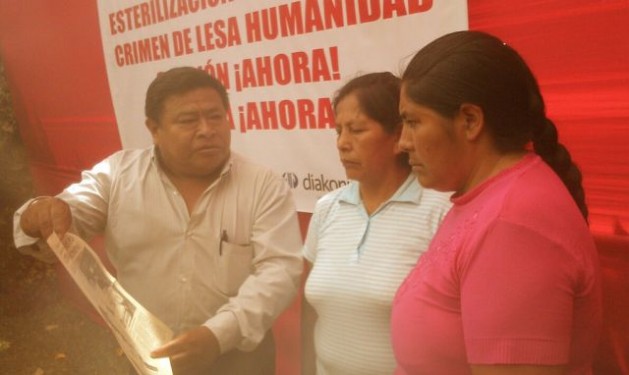
Alfonso Ramos (left) shows a newspaper reporting the death of his sister Celia in Piura due to forced sterilisation. Micaela Flores (centre) and Sabina Huillca are sterilisation victims from Cusco. All three have been waiting for justice for 17 years. Credit: Milagros Salazar/IPS
By Milagros Salazar | IPS | February 6, 2014
Shelving the case of the forced sterilization of more than 2,000 women in Peru during the Alberto Fujimori regime was a surprise move by the prosecutor in charge. What happened? An IPS investigation found that legal avenues to pursue justice have not been exhausted.
On Jan. 24, prosecutor Marco Guzmán announced an end to the investigation of forced sterilizations carried out in Peru between 1996 and 2000. He said he would not pursue criminal charges against Fujimori (1990-2000), three former health ministers and other officials accused of being responsible for the crime.
“The doors were padlocked. They carried me off in a stretcher, tied my feet and cut me.” — Micaela Flores
“They took us in trucks. We got in quite innocently and contentedly. But then we heard screams and I ran… The doors were padlocked. They carried me off in a stretcher, tied my feet and cut me,” Micaela Flores, then a mother of seven from Anta province in the southern region of Cusco, told IPS.
On that occasion about 30 women went to the health center, duped by a campaign offering general check-ups, she said.
Guzmán has decided to prosecute only health personnel in the northern department of Cajamarca. The sterilizations were part of the Voluntary Surgical Contraception Program (AQV – Anticoncepción Quirúrgica Voluntaria), created by Fujimori and his government to bring about a drastic reduction in the birth rate in the poorest parts of the country, especially among rural Quechua-speaking women.
Guzmán, as head of the second supra-provincial prosecutor’s office, assumed the case in July 2013 after the investigation was reopened in November 2012.
There are currently 142 volumes of evidence in this longstanding case. In May 2009 the prosecution shelved the probe into the former ministers and other officials for the first time, in spite of repeated urging for its completion from the inter-American human rights system.
In 2003, the Peruvian state signed a friendly settlement agreement before the Inter-American Commission on Human Rights (IACHR) in the case of Mamérita Mestanza, who died in 1998 as a result of a poorly performed tubal ligation procedure done without her consent.
The government promised to pay an indemnity to her family and investigate and bring to trial the government officials who devised and implemented the forced sterilization campaign.
After years of delays and foot-dragging, human rights organizations had their hopes raised when Guzmán showed interest in investigating Fujimori’s command responsibility for the generalized, systematic practice of sterilizations.
In late November the prosecutor said there were “indications of the alleged participation of Alberto Fujimori in the crimes,” and expanded the investigation into the cases of Mestanza and others.
Rossy Salazar, a lawyer with the women’s rights organization DEMUS who is representing the victims, told IPS that this statement by the prosecutor appears on page 60277 of the file as part of a report on the case addressed to Víctor Cubas, the prosecutor who coordinates all human rights cases.
In an interview with IPS, Guzmán acknowledged having said “there were indications that Fujimori had participated.” At that point he had interviewed over 500 victims, mainly in the northwestern department of Piura and in Cusco, he said, although in his latest 131-page decision he states he only interviewed around one hundred.
Guzmán was also in possession of evidence that the program had targets, incentives, and even sanctions for personnel who did not fulfill sterilization quotas, according to documents obtained by government agencies that investigated the facts of the case.
DEMUS invoked these official documents in an appeal against the prosecutor’s decision to shelve the case, which it presented Jan. 28 before the Office of the Public Prosecutor.
The appeal refers to four letters from the former health minister, Marino Costa, to Fujimori in 1997. In one document the minister reports to the president on the increased numbers of AQV operations performed and says “by the end of 1997 our total production should be fairly close to the target.”
IPS asked Guzmán: “After determining in November that there were indications of Fujimori’s participation, why did you absolve him from responsibility so soon afterwards?”
“In order to examine him I had to interrogate him. I went to interrogate Fujimori and he answered some questions, but not others. For some he invoked the right to silence. Then his defense lawyer gave me a number of documents. This was important because Fujimori had never been questioned about this case before,” he said.
Fujimori’s interrogation on Jan. 15 in the Barbadillo prison, where he is serving a 25-year sentence for human rights abuses, lasted less than three hours. One week later, Guzmán closed the case against the ex president.
“Was your interview with Fujimori decisive for determining whether he participated in the crimes?” persisted IPS.
“It was taken into consideration, but it was not decisive. The decisive thing is the legal package I have to apply… There is no legal support for imputing guilt,” Guzmán said.
The prosecutor argued that Peruvian law does not provide for the crime of forced sterilization, and therefore there is no legal support. In his decision he said the victims’ complaints would not be classed as crimes against humanity, which refer to generalized or systematic attacks on a civilian population and have no statute of limitation.
In international terms, the Rome Statute, which established the International Criminal Court, does recognize the crime of forced sterilization. The statute entered into force in Peru in July 2002, after the sterilizations were committed and denunciations were initiated, but “the international community has regarded forced sterilization as a crime since the early 1990s,” Salazar said.
In its appeal, DEMUS argues that the prosecutor’s decision “should not halt the criminal investigation.” It is “only the first step in the search for truth” and does not end the evidence collection phase. DEMUS asks for a higher level prosecutor to bring charges so that the case can continue. Another means of re-opening the case would be for another victim to bring a new complaint.
DEMUS also plans to bring the case to the attention of the IACHR in March.
On Jan. 31, an article by Guzmán was published in the newspaper El Comercio, saying that “the only way Fujimori could be held responsible is by demonstrating command responsibility, and according to the Constitutional Court the requirements for this are not fulfilled, because there is no rigid vertical structure involved, and doctors cannot be obliged to operate against their will.”
“They are isolated cases,” he told IPS.
According to the Health ministry, 346,219 sterilizations were performed on females and 24,535 on males between 1993 and 2000, 55.2 percent of them in the period 1996-1997 alone. During that period an average of 262 tubal ligations were carried out a day.
More than 2,000 persons were documented to have been deceived or threatened into undergoing sterilization. Women in Cusco were among the worst affected, because on average nearly five operations a day were performed there, according to Health ministry figures and the testimony of victims.
Sabina Hillca, from Huayapacha in the Cusco region, told IPS that she set out for the health center in Anta when she was due to give birth to her daughter, Soledad, but the birth happened on the way.
The nurses told her she should stay to be “cleansed” and avoid infection. The next day she woke up crying, with sharp pain, an incision close to her navel, and tied to the bed. Afterwards she fled to her village, cleaned the wound with soap and water, removed the stitches as best as she could, and went to her mother for herbal treatments.
“Now I have cancer because dry blood collected in my ovaries,” she said, showing the dark scar on her abdomen.
The Hypocrisy of Human Rights Watch
By Keane Bhatt | NACLA | February 5, 2014
Over more than a decade, the rise of the left in Latin American governance has led to remarkable advances in poverty alleviation, regional integration, and a reassertion of sovereignty and independence. The United States has been antagonistic toward the new left governments, and has concurrently pursued a bellicose foreign policy, in many cases blithely dismissive of international law.
So why has Human Rights Watch (HRW)—despite proclaiming itself “one of the world’s leading independent organizations” on human rights—so consistently paralleled U.S. positions and policies? This affinity for the U.S. government agenda is not limited to Latin America. In the summer of 2013, for example, when the prospect of a unilateral U.S. missile strike on Syria—a clear violation of the UN Charter—loomed large, HRW’s executive director Kenneth Roth speculated as to whether a simply “symbolic” bombing would be sufficient. “If Obama decides to strike Syria, will he settle for symbolism or do something that will help protect civilians?” he asked on Twitter. Executive director of MIT’s Center for International Studies John Tirman swiftly denounced the tweet as “possibly the most ignorant and irresponsible statement ever by a major human-rights advocate.”1
HRW’s accommodation to U.S. policy has also extended to renditions—the illegal practice of kidnapping and transporting suspects around the planet to be interrogated and often tortured in allied countries. In early 2009, when it was reported that the newly elected Obama administration was leaving this program intact, HRW’s then Washington advocacy director Tom Malinowski argued that “under limited circumstances, there is a legitimate place” for renditions, and encouraged patience: “they want to design a system that doesn’t result in people being sent to foreign dungeons to be tortured,” he said, “but designing that system is going to take some time.”2
Similar consideration was not extended to de-facto U.S. enemy Venezuela, when, in 2012, HRW’s Americas director José Miguel Vivanco and global advocacy director Peggy Hicks wrote a letter to President Hugo Chávez arguing that his country was unfit to serve on the UN’s Human Rights Council. Councilmembers must uphold the highest standards in the promotion and protection of human rights, they maintained, but unfortunately, “Venezuela currently falls far short of acceptable standards.”3 Given HRW’s silence regarding U.S. membership in the same council, one wonders precisely what HRW’s acceptable standards are.
One underlying factor for HRW’s general conformity with U.S. policy was clarified on July 8, 2013, when Roth took to Twitter to congratulate his colleague Malinowski on his nomination to be Assistant Secretary of State for Democracy, Human Rights and Labor (DRL). Malinowski was poised to further human rights as a senior-level foreign-policy official for an administration that convenes weekly “Terror Tuesday” meetings. In these meetings, Obama and his staffers deliberate the meting out of extrajudicial drone assassinations around the planet, reportedly working from a secret “kill list” that has included several U.S. citizens and a 17-year-old girl.4
Malinowski’s entry into government was actually a re-entry. Prior to HRW, he had served as a speechwriter for Secretary of State Madeline Albright and for the White House’s National Security Council. He was also once a special assistant to President Bill Clinton—all of which he proudly listed in his HRW biography. During his Senate confirmation hearing on September 24, Malinowski promised to “deepen the bipartisan consensus for America’s defense of liberty around the world,” and assured the Foreign Relations Committee that no matter where the U.S. debate on Syria led, “the mere fact that we are having it marks our nation as exceptional.”5
That very day, Obama stood before the UN General Assembly and declared, “some may disagree, but I believe that America is exceptional.” Assuming that by “exceptional” Obama meant exceptionally benevolent, one of those who disagreed was Brazilian president Dilma Rousseff, who had opened the proceedings at the same podium by excoriating Obama’s “global network of electronic espionage,” which she considered a “disrespect to national sovereignty” and a “grave violation of human rights and of civil liberties.” Rousseff contrasted Washington’s rogue behavior with her characterization of Brazil as a country that has “lived in peace with our neighbors for more than 140 years.” Brazil and its neighbors, she argued, were “democratic, pacific and respectful of international law.”6 Rousseff’s speech crystallized Latin America’s broad opposition to U.S. exceptionalism, and therefore shed light on the left’s mutually antagonistic relationship with HRW.
*
Malinowski’s background is but one example of a larger scenario. HRW’s institutional culture is shaped by its leadership’s intimate links to various arms of the U.S. government. In her HRW biography, the vice chair of HRW’s board of directors, Susan Manilow, describes herself as “a longtime friend to Bill Clinton,” and helped manage his campaign finances. (HRW once signed a letter to Clinton advocating the prosecution of Yugoslav President Slobodan Milosevic for war crimes; HRW made no case for holding Clinton accountable for NATO’s civilian-killing bombings despite concluding that they constituted “violations of international humanitarian law.”)7 Bruce Rabb, also on Human Rights Watch’s Board of Directors, advertises in his biography that he “served as staff assistant to President Richard Nixon” from 1969-70—the period in which that administration secretly and illegally carpet bombed Cambodia and Laos.8
The advisory committee for HRW’s Americas Division has even boasted the presence of a former Central Intelligence Agency official, Miguel Díaz. According to his State Department biography, Díaz served as a CIA analyst and also provided “oversight of U.S. intelligence activities in Latin America” for the House Permanent Select Committee on Intelligence.9 As of 2012, Díaz focused, as he once did for the CIA, on Central America for the State Department’s DRL—the same bureau now to be supervised by Malinowski.
Other HRW associates have similarly questionable backgrounds: Myles Frechette, currently an advisory committee member for the Americas Division, served as Assistant U.S. Trade Representative for Latin America and the Caribbean from 1990-93, and then became U.S. Ambassador to Colombia from 1994-97. Frechette subsequently worked as the executive director of a “nonprofit” group called the North American-Peruvian Business Council, and championed the interests of his funders in front of Congress. His organization received financing from companies such as Newmont Mining, Barrick Gold, Caterpillar, Continental Airlines, J.P. Morgan, ExxonMobil, Patton Boggs, and Texaco.10
Michael Shifter, who also currently serves on HRW’s Americas advisory committee, directed the Latin America and Caribbean program for the National Endowment for Democracy (NED), a quasi-governmental entity whose former acting president Allen Weinstein told The Washington Post in 1991 that “a lot of what we do today was done covertly 25 years ago by the CIA.”11 Shifter, as current president of a policy center called the Inter-American Dialogue, oversees $4 million a year in programming, financed in part through donations from the U.S. Agency for International Development (USAID), the embassies of Canada, Germany, Guatemala, Mexico and Spain, and corporations such as Chevron, ExxonMobil, J.P. Morgan, Microsoft, Coca-Cola, Boeing, and Western Union.
To be sure, not all of the organization’s leadership has been so involved in dubious political activities. Many HRW board members are simply investment bankers, like board co-chairs Joel Motley of Public Capital Advisors, LLC, and Hassan Elmasry, of Independent Franchise Partners, LLP. HRW Vice Chair John Studzinski is a senior managing director at The Blackstone Group, a private equity firm founded by Peter G. Peterson, the billionaire who has passionately sought to eviscerate Social Security and Medicare. And although Julien J. Studley, the Vice Chair of the Americas advisory committee, once served in the U.S. Army’s psychological warfare unit, he is now just another wealthy real-estate tycoon in New York.
That HRW’s advocacy reflects its institutional makeup is unremarkable. Indeed, an examination of its positions on Latin America demonstrates the group’s predictable, general conformity with U.S. interests. Consider, for example, HRW’s reaction to the death of Hugo Chávez. Within hours of his passing on March 5, 2013, HRW published an overview—“Venezuela: Chávez’s Authoritarian Legacy”—to enormous online response. In accordance with its headline’s misleading terminology, HRW never once mentioned Chávez’s democratic bona fides: Since 1998, he had triumphed in 14 of 15 elections or referenda, all of which were deemed free and fair by international monitors. Chávez’s most recent reelection boasted an 81% participation rate; former president Jimmy Carter described the voting process as “the best in the world.”12 The article neglected to cite a single positive aspect of Chávez’s tenure, under which poverty was slashed by half and infant mortality by a third.
In contrast, HRW’s August 21, 2012 statement regarding the death of Ethiopian leader Meles Zenawi was decidedly more muted: “Ethiopia: Transition Should Support Human Rights Reform,” read the headline. Leslie Lefkow, HRW’s deputy Africa director, urged the country’s new leadership to “reassure Ethiopians by building on Meles’s positive legacy while reversing his government’s most pernicious policies.” Regarding a leader whose two-decade rule had none of Chávez’s democratic legitimacy (HRW itself documented Ethiopia’s repressive and unfair elections in both 2005 and 2010), the organization argued only that “Meles leaves a mixed legacy on human rights.”13 Whereas HRW omitted all mention of Chávez-era social improvements, it wrote, “Under [Meles’s] leadership the country has experienced significant, albeit uneven, economic development and progress.”
The explanation for this discrepancy is obvious: as a New York Times obituary reported, Meles was “one of the United States government’s closest African allies.” Although “widely considered one of Africa’s most repressive governments,” wrote the Times, Ethiopia “continues to receive more than $800 million in American aid each year. American officials have said that the Ethiopian military and security services are among the Central Intelligence Agency’s favorite partners.”14
*
HRW has taken its double standard to cartoonish heights throughout Latin America. At a 2009 NED Democracy Award Roundtable, José Miguel Vivanco described Cuba, not the United States, as “one of our countries in the hemisphere that is perhaps the one that has today the worst human-rights record in the region.” As evidence, he listed Cuba’s “long- and short-term detentions with no due process, physical abuse [and] surveillance”—as though these were not commonplace U.S. practices, even (ironically) at Guantánamo Bay.15 Vivanco was also quoted in late 2013, claiming at an Inter-American Dialogue event that the “gravest setbacks to freedom of association and expression in Latin America have taken place in Ecuador”—not in Colombia, the world’s most dangerous country for trade union leaders, or in Honduras, the region’s deadliest country for journalists (both, incidentally, U.S. allies).16
Latin America scholars are sounding the alarm: New York University history professor Greg Grandin recently described HRW as “Washington’s adjunct” in The Nation magazine.17 And when Vivanco publicly stated that “we did [our 2008] report because we wanted to show the world that Venezuela is not a model for anyone,” over 100 academics wrote to the HRW’s directors, lamenting the “great loss to civil society when we can no longer trust a source such as Human Rights Watch to conduct an impartial investigation and draw conclusions based on verifiable facts.”18
HRW’s deep ties to U.S. corporate and state sectors should disqualify the institution from any public pretense of independence. Such a claim is indeed untenable given the U.S.-headquartered organization’s status as a revolving door for high-level governmental bureaucrats. Stripping itself of the “independent” label would allow HRW’s findings and advocacy to be more accurately evaluated, and its biases more clearly recognized.
In Latin America, there is a widespread awareness of Washington’s ability to deflect any outside attempts to constrain its prerogative to use violence and violate international law. The past three decades alone have seen U.S. military invasions of Grenada and Panama, a campaign of international terrorism against Nicaragua, and support for coup governments in countries such as Venezuela, Haiti, Honduras, and Guatemala. If HRW is to retain credibility in the region, it must begin to extricate itself from elite spheres of U.S. decision-making and abandon its institutional internalization of U.S. exceptionalism. Implementing a clear prohibition to retaining staff and advisers who have crafted or executed U.S. foreign policy would be an important first step. At the very least, HRW can institute lengthy “cooling-off” periods—say, five years in duration—before and after its associates move between the organization and the government.
After all, HRW’s Malinowski will be directly subordinate to Secretary of State John Kerry, who conveyed the U.S. attitude toward Latin America in a way that only an administrator of a superpower could. In an April 17, 2013 House Foreign Affairs Committee hearing, a member of Congress asked Kerry whether the United States should prioritize “the entire region as opposed to just focusing on one country, since they seem to be trying to work together closer than ever before.” Kerry reassured him of the administration’s global vision. “Look,” he said. “The Western Hemisphere is our backyard. It is critical to us.”19
1. Kenneth Roth, followed by John Tirman’s response, Twitter, August 25, 3013, http://twitter.com/KenRoth/status/371797912210407424.
2. Greg Miller, “Obama preserves renditions as counter-terrorism tool,” Los Angeles Times, February 1, 2009.
3. José Miguel Vivanco and Peggy Hicks, “Letter to President Chavez on Venezuela’s Candidacy to the UN Human Rights Council,” Human Rights Watch, November 9, 2012.
4. Jo Becker and Scott Shane, “Secret ‘Kill List’ Proves a Test of Obama’s Principles and Will,” The New York Times, May 29, 2012.
5. Senate Foreign Relations Committee, “Statement for the Record by Tom Malinowski,” September 24, 2013.
6. “Text of Obama’s Speech at the U.N.,” The New York Times, September 24, 2013. Statement by H.E. Dilma Rousseff, United Nations, September 24, 2013.
7. Human Rights Watch, “Major Rights Groups Oppose Immunity for Milosevic,” October 6, 2000. HRW, “New Figures on Civilian Deaths in Kosovo War,” Februrary 8, 2000.
8. Human Rights Watch, “Board of Directors,” www.hrw.org, accessed November 16, 2013.
9. U.S. Department of State, “Franklin Fellows Alumni,” September 8, 2011, http://careers.state.gov/ff/meet-the-fellows/franklin-fellows/miguel-diaz, accessed November 16, 2013.
10. Ways and Means Committee, “Statement of Myles Frechette, the North American Peruvian Business Council,” U.S. House of Representatives, May 8, 2001.
11. David Ignatius, “Innocence Abroad: The New World of Spyless Coups,” The Washington Post, September 22, 1991.
12. Keane Bhatt, “A Hall of Shame for Venezuelan Elections Coverage,” Manufacturing Contempt (blog), nacla.org, October 8, 2012.
13. Human Rights Watch, “Ethiopia: Government Repression Undermines Poll,” May 24, 2010.
14. Jeffrey Gettleman, “Meles Zenawi, Prime Minister of Ethiopia, Dies at 57,” The New York Times, August 22, 2012.
15. National Endowment for Democracy, “José Miguel Vivanco: 2009 NED Democracy Award Roundtable,” Youtube.com, Jun 29, 2009.
16. Eva Saiz, “Indígenas de Ecuador denuncian en EEUU la norma de libre asociación de Correa,” El Pais, October 28, 2013.
17. Greg Grandin, “The Winner of Venezuela’s Election to Succeed Hugo Chávez Is Hugo Chávez,” The Nation, April 16, 2013.
18. Venezuelanalysis.com, “More Than 100 Latin America Experts Question Human Rights Watch’s Venezuela Report,” December 17, 2008.
19. Committee on Foreign Affairs, House of Representatives, “Hearing: Securing U.S. Interests Abroad: The FY 2014 Foreign Affairs Budget,” April 17, 2013.
Related articles
Washington and São Paulo: Spying and a Fading Friendship
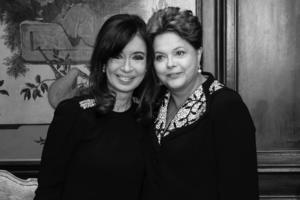
Rousseff and Kirchner at the UN, 2013. – Roberto Stuckert Filho
By Mark Weisbrot | NACLA | January 30, 2014
The only thing missing from Brazilian President Dilma Rousseff’s speech at the UN General Assembly last month was “it still smells like sulfur.” For those who don’t remember, these were the immortal words of Venezuela’s President Hugo Chávez in 2006, describing the podium where “the Devil”—his name for President George W. Bush—had spoken the day before. Chávez’s speech received hearty applause and prompted some New Yorkers to hang a banner from a highway overpass that said “Wake Up and Smell the Sulfur.”
Dilma’s speech also got a lot of applause at the General Assembly, and because she spoke immediately before President Barack Obama, her remarks were even more pointed. She presented a stinging rebuke to the Obama administration’s mass surveillance operations, at home and abroad:
“As many other Latin Americans, I fought against authoritarianism and censorship, and I cannot but defend, in an uncompromising fashion, the right to privacy of individuals and the sovereignty of my country. In the absence of the right to privacy, there can be no true freedom of expression and opinion, and therefore no effective democracy. In the absence of the respect for sovereignty, there is no basis for the relationship among nations. We face, Mr. President, a situation of grave violation of human rights and of civil liberties; of invasion and capture of confidential information concerning corporate activities, and especially of disrespect to national sovereignty.”
Dilma also took a swipe at Obama’s previously planned—and then cancelled due to popular demand—bombing of Syria: “[W]e repudiate unilateral interventions contrary to international law, without Security Council authorization.”
Her remarks were a reminder, and for some a new discovery, that the differences among the left-of-center governments of South America on hemispheric and foreign policy issues were mostly a matter of style and rhetoric, not of substance. The speech came in the wake of the cancellation of Dilma’s scheduled October state visit to the White House, which would have been the first by a Brazilian president in nearly two decades. It was another blow to the Obama administration’s tepid efforts to improve relations with Brazil, and with South America in general.
At this moment, U.S.-South American relations are probably even worse than they were during the George W. Bush years, despite the huge advantage that President Obama has in terms of media image, and therefore popularity, in the hemisphere. This illustrates how deeply structural the problem of hemispheric relations has become, and how unlikely they are to become warmer in the foreseeable future.
The fundamental cause of the strained relationship is that Washington refuses to recognize that there is a new reality in the region, now that a vast South American majority has elected left governments. In Washington’s foreign policy establishment—including most think tanks and other sources of analysis and opinion—there has been almost no acknowledgement that a new strategy might be necessary. Of course, most of the foreign policy establishment doesn’t care much about Latin America these days. And there is no electoral price to be paid for stupidity that leads to worsening relations with the region. On the contrary, the main electoral pressure on the White House comes from the far right, including neocons and old-guard Cuban-Americans. And Obama is not above caving to these interests when the White House and State Department are not already on their side. But among those who do care about Latin America—from an imperial point of view—the lack of imagination is breathtaking.
The establishment has, over the past 15 years, sometimes adopted a “good left, bad left” strategy that sought first and foremost to try and isolate Venezuela, often lumping in Bolivia, Ecuador, and sometimes Argentina as the “bad left.” But in the halls of power, they really do not like any of the left governments and are hoping to get rid of them all. In 2005, according to State Department documents obtained under the Freedom of Information Act, the U.S. government promoted legislation within Brazil that would have weakened the Workers’ Party, funding efforts to promote a legal change that would make it more difficult for legislators to switch parties. This would have strengthened the opposition to Lula’s Workers’ party (PT) government, since the PT has party discipline but many opposition politicians do not.
So it is not surprising that Brazil has been, according to the documents revealed by former NSA contractor and whistleblower Edward Snowden, the top Latin American target for U.S. spying. It is a lot like all the other left governments that Washington would like to get rid of, only bigger. It is true that countries with U.S.-allied governments like Mexico were also targeted, but in the context of Brazil’s alliance with other left governments, the large-scale espionage there—which reportedly included monitoring of Dilma’s personal phone calls and emails—takes on a different meaning.
In the past decade of Workers’ Party government, Brazil has lined up fairly consistently with the other left governments on hemispheric issues and relations with the United States. When the Bush administration tried to expand its military presence in Colombia, Brazil was there with the rest of the region in opposition. The same was true when Washington aided and abetted the overthrow of “targets of opportunity” among the left governments: Honduras in 2009 and Paraguay in 2012—although in these cases Washington and its allies still prevailed. Brazil also supported other efforts at regional integration and independence, including UNASUR (the Union of South American Nations), which has played an important role in defending member countries from right-wing destabilization attempts as in Bolivia in 2008, or in the April elections in Venezuela, where the Obama administration supported opposition efforts to overturn the results with obviously false claims of electoral fraud (A CEPR study showed that the probability of getting the April 14 election day audit results confirming Nicolás Maduro’s win, if the vote had actually been stolen, was less than one in 25 thousand trillion).
Lula made a conscious decision that Brazil would look more to the south and less to the United States as a leader in its foreign and commercial policy. In an interview with the Argentine daily Pagina 12 this past October, he explained how important the turning point of Mar del Plata was, when the proposed Free Trade Area of the Americas (FTAA) was finally buried at the Summit of the Americas in 2005:
“It was fundamental that we had stopped this proposal to form the FTAA, at Mar del Plata. It was not a true project of integration, but one of economic annexation. With its sovereignty affirmed, South America looked for its own path and a much more constructive one. . . . When we analyze this history of South America we can see that it is one great conquest. If we had not avoided the FTAA, the region would not have been able to take the economic and social leap forward that it did in the past decade. Argentina, Brazil, and Venezuela played a central role in this process. Néstor Kirchner and Hugo Chávez were two great allies in accomplishing this.”
In 2002, when Lula was elected, Brazil’s exports to the United States were 26.4% of its total exports. By 2011, they were down to 10.4%. Meanwhile, China’s economy is by some measures already bigger than the U.S. economy, and it may well double in size over the next decade. That projection, which would require only a 7.2% annual rate of growth, is quite probable, as likely as any ten-year projection for the United States—perhaps even more so. The United States will become increasingly less important to Brazil, and to South America generally. Given that Washington still does not respect Latin American sovereignty, much less the goals and aspirations of its democratic governments, the steady decline of U.S. economic power has to be seen as a good thing for the region.
Mark Weisbrot is co-director of the Center for Economic and Policy Research, in Washington, D.C. He is also president of Just Foreign Policy.
Related articles
Latest Human Rights Watch Report: 30 Lies about Venezuela
By Tamara Pearson | Venezuelanalysis | January 23, 2014
In the six pages that HRW dedicates to Venezuela in its World Report 2014, released this week, it manages to tell at least 30 serious lies, distortions, and omissions. Pointing out these lies is important, because many people believe that HRW is a neutral authority on human rights, and the mainstream press publish articles and headlines based on HRW report conclusions. Here are some of the headlines in both English and Spanish (translated to English) that have come out of the 2014 report:
Global Post – Venezuela intimidates opponents, media: HRW report , PanAm Post – Human Rights Watch: A black eye for Latin America , AFP – HRW criticises Venezuela in its annual report on human rights, El Economista – HRW: Democracy in Venezuela is fictitious, El Universal – Human Rights Watch report denounces persecution of media in Venezuela, El Siglo – Human Rights Watch: Venezuela is an example of “fictitious democracies”, El Colombiano: HRW describes Venezuela as a fictitious democracy , NTN24 – HRW warns that Venezuelan government applies “arbitrary” measures against media that is critical of its policies
The headlines which talk about a “fictitious” or “feigned” democracy, are referring to the start of the report, where HRW put Venezuela, along with other countries, under the category of “abusive majoritarianism”. There, HRW provides a very limited definition of democracy; “periodic elections, the rule of law, and respect for the human rights of all” and argues that Venezuela has adopted “the form but not the substance of democracy”. HRW cites Diosdado Cabello not letting legislators who didn’t recognise democratically elected President Maduro speak in parliament – yet the punishment seems soft, considering the crime.
Below, I’ve grouped the lies and omissions according to HRW’s own subheadings in its chapter on Venezuela. Unlike with other countries such as the US, HRW omits all of Venezuela’s human rights achievements in its assessment, and in reality a range of other subheadings would be deserving, such has right to have access to housing, people’s right to be consulted about policy, right of the poorer people to be heard in the media, right to education, the right to health care, to land, and so on. Of course, nowhere in the report does HRW mention the economic crimes committed by the business sector against Venezuelans’ right to access affordable goods (hoarding, speculation, etc).
15 lies and distortions
Introduction
1. “The Supreme Court and the National Electoral Council rejected appeals filed by the opposition candidate, Henrique Capriles Radonski, challenging the results [of the April 2013 presidential elections]”. – The CNE did meet with the opposition and they came to an agreement to do a manual recount of the remaining 46% of votes which hadn’t already been revised on the day of the election. The entire recount was televised live. Given how incredibly flimsy Capriles’ “evidence” was, the Supreme Court would have been ridiculing itself to do anything but reject his case.
2. “Under the leadership of President Chavez and now President Maduro, the accumulation of power in the executive branch and the erosion of human rights guarantees have enabled the government to intimidate, censor, and prosecute its critics.” – HRW offers very little evidence to substantiate such accusations. The reality is the opposite; private media makes up the vast majority of the media, and freely criticises the government on a daily basis, to the point where it invents news and blames the national government for things it isn’t even responsible for. Just last week here in Merida a few opposition students held a protest by burning tires on a main road. For a week, traffic to a key hospital was blocked, and the students had no placards stating the reason for their protest. The police closed off the roads around them to protect their right to protest.
3. “In September 2013, the Venezuelan government’s decision to withdraw from the American Convention on Human Rights took effect, leaving Venezuelans without access to the Inter-American Court on Human Rights, an international tribunal that has protected their rights for decades in a wide array of cases.” – The IACHR has not protected Venezuelans’ rights. From 1969-1998, a repressive period of disappearances, political repression, and massacres such as those at Cantaura, Yumare, and the Caracazo, it only considered six cases, and of those only one was brought to the commission. In contrast, from 1999 to 2011 it ruled on and processed a total of 23 cases. It did not take any action after the coup attempt against democratically elected president Hugo Chavez in 2002.
Post-Election Violence
4. “Security forces used excessive force and arbitrary detentions to disperse anti-government demonstrations after the April elections, according to local groups”. -Though it may have varied from region to region, unlike HRW, I was at those protests, and took photos of and interviewed opposition protesters in Merida – one of their strongholds. Despite threatening to take over and destroy the CNE and the PSUV head offices, with large piles of projectiles like rocks and shrapnel and Molotov cocktails, the police merely cordoned off those areas. They were not armed, and there were no injuries or arrests observed. The threats were not empty ones either, as seen by other destruction carried out by the opposition around the country. HRW also needs to specify what it means by “security forces”, as the police system here is complicated and most police continue to be managed at a state level, but HRW implies that the national government is entirely responsible. Finally, merely attributing these claims to “local groups” is very vague. One might also say, HRW is a capitalist front, said local groups.
5. “Official sources reported that nine individuals were killed at the time, although the circumstances in which the deaths occurred remain unclear. President Maduro and other high level officials have used the threat of criminal investigations as a political tool, attributing responsibility for all acts of violence during demonstrations to Capriles”. – Does HRW want an investigation or not? The violence occurred the day after the presidential elections, and all of the victims and buildings destroyed were Chavista supporters or part of national programs. It was clearly political, why is it a problem to mention that, and why does it become a “threat” when Maduro talks about bringing murderers and those who set fire to public hospitals, to justice? A thorough investigation was conducted, and those who were responsible for the deaths were arrested.
Judicial Independence
6. “The judiciary has largely ceased to function as an independent branch of government”. – While it is true that there are serious problems in Venezuela’s court system: HRW doesn’t mention those: the delays and corruption. Instead, it argued the judiciary is not “independent” because it doesn’t always rule against the government, as HRW would like. If it is not independent, why were almost a hundred supposedly pro government workers in SAIME, SENIAT, the China-Venezuela bank, and so on, arrested last year for corruption?
Freedom of Media
7. “Over the past decade, the government has expanded and abused its powers to regulate the media… fear of government reprisals has made self-censorship a problem” – No it hasn’t. What the government has done, over the last four years or so, is pass legislation which limits media abuse: racism, extreme violence, and sensationalism that is so extreme it can be psychologically damaging. Those regulations apply equally to the private, public, and community media, but the reality is it is the private media which tends to be most abusive. Nevertheless, Conatel has emitted less than 10 fines over the last few years.
8. “The government has taken aggressive steps to reduce the availability of media outlets that engage in critical programming.” – HRW is not able to cite any examples to back up this statement. Instead, it refers to one case from years ago, RCTV, who’s license was not renewed after it played an active role in the 2002 coup.
9. “In April 2013, Globovision was sold to government supporters… since then it has significantly reduced its critical programming”. The owners of Globovision sold it to a group of Venezuelan investors headed by businessman Juan Domingo Cordero, who is not a government supporter. Since then, Globovision’s coverage is somewhat less extreme and sensationalist, but it is just as critical.
10. “The government has also targeted other media outlets for arbitrary sanction and censorship”. – The government has not censored any media. Today alone, for example, Tal Cual freely published these headlines: “The fiscal report is a time bomb”, “The government uses violence as an excuse to censor the media” , “Dance with death” (to refer to the government) and “The government tragicomedy”. El Nacional received a fine in August last year for using a three year old photo of naked corpses on its front cover, and that is it.
Human Rights Defenders
11. “The Venezuelan government has sought to marginalise the country’s human rights defenders by repeatedly accusing them of seeking to undermine Venezuelan democracy with the support of the US government”. – The lie here is “the country’s human rights defenders”. HRW is referring to a select few organisations such as itself and other individuals, who use human rights as a front for their right-wing political agenda. The government is completely within its right in pointing that out.
Abuses by Security Forces
This section is somewhat accurate, but lacks any causal analysis.
Prison Conditions
These criticisms are also somewhat legitimate, though the information is selective. For omissions, see below.
Labour Rights
12. “Political discrimination against workers in state institutions remains a problem. In April 2013, Minister of Housing Ricardo Molina called on all ministry personnel who supported the opposition to resign, saying that he would fire anyone who criticised Maduro, Chavez, or the revolution”. Though perhaps a bit extreme, HRW forgets to point out that Molina made that remark in the context of the opposition not recognising a democratically elected president. That there is political discrimination against workers is largely untrue, though may occur in isolated situations. It is no secret that most of the public education and health workers, for example, support the opposition.
13. “The National Electoral Council (CNE), a public authority, continues to play an excessive role in union elections, violating international standards that guarantee workers the right to elect their representatives in full freedom” – Actually, what the CNE provides to unions is logistical support: machinery that makes cross-country elections much easier. If there were concern about the CNE somehow influencing elections, the opposition would not have also used its logistical support for its primaries in February 2012.
Key International Actors
14. “For years, Venezuela’s government has refused to authorise UN human rights experts to conduct fact-finding visits in the country” – That’s why the UNESCO and the FAO have both recently praised Venezuela’s education and food development. The Office of the High Commissioner for Human Right’s most recent report on Venezuela was made in September last year, it was about Venezuela’s elimination of racial discrimination.
15. “In June 2013, Venezuela became the pro-tempore president of Mercosur… The Asuncion Protocol…states that “full respect of democratic institutions and the respect of human rights” are essential…By not addressing the absence of an independent judiciary in Venezuela, as well as the government’s efforts to undermine human rights protections, the other Mercosur member states have failed to uphold these commitments” – See previous and subsequent comments on Venezuela’s judiciary and treatment of “human rights” protections.
15 omissions
The following very important facts on Venezuela’s human rights record were completely omitted from the report. Such omissions are as serious as lying.
Post-Election Violence
1. HRW conveniently doesn’t mention that the 15 “health centres” that were “vandalised” (ie they were set on fire on medical equipment was destroyed) were CDIs- Cuban-Venezuelan run free health centres that have come to be a symbol of the Bolivarian revolution. HRW doesn’t mention that opposition supporters attacked them, it lets readers believe that the government supported such violence.
2. HRW doesn’t criticise the extremely undemocratic move by Capriles to not recognise the president whom the majority of voters chose in the April presidential elections. Their omission to do so amounts to tacit support of Capriles. That sort of context is also necessary when HRW criticises the fact that there were arrests following the elections: it’s possible that some arrests were not justified, but given that the Bolivarian revolution has already suffered one (failed) coup, and the continent has suffered many successful and bloody ones, it is reasonable to arrest participants in that. Any other country would do the same.
3. HRW focuses on the post election violence, and blames the national government for it, rather than recognising the opposition’s role. It purposefully omits to mention that while Capriles called for a “venting of rage”, Maduro called on supporters to play music and dance in the street.
Judicial Independence
4. HRW criticises the imprisonment of “government critic” judge Afiuni, but omits to mention that she was arrested for illegally releasing a bank president who stole US$27 million from state currency body, CADIVI. Does HRW advocate such judicial corruption? In June Afiuni was awarded conditional release.
5. There are, however, other cases of court inefficiency and bribery of judges, which HRW completely ignores, perhaps because the victims are mostly Bolivarian revolution supporters. Over the last year, many rural workers, commune members, trade unionists, and indigenous activists were murdered by hired killers, and though the killers are usually easy to identify, few have been arrested and prosecuted.
6. HRW criticises Venezuela for withdrawing from the IACHR, but omits to mention that that court is totally under the thumb of the US. It then hypocritically comments on Venezuela’s so called “lack of judicial independence”.
Freedom of Media
7. While in most countries, people who aren’t rich don’t have the right to run their own media, that right is being promoted in Venezuela, with the state materially and legally supporting over 500 community and alternative radios, television stations, and newspapers. That is an important development in media freedom, but HRW completely ignored it.
8. HRW states that, “In November 2013, the broadcasting authority opened an administrative investigation against eight Internet providers for allowing web sites that published information on unofficial exchange rates”. HRW intentionally omits to point out that those sites were illegally publishing those figures, and that those figures have contributed to the three and four fold price increase of basic products. At no point does HRW criticise the role of business of deliberately making basic food and goods unaffordable for Venezuelans.
9. HRW also doesn’t mention the almost one thousand free internet centres the government has set up, its promotion of freeware, and its distribution of laptops to school children: part of the government’s efforts to make the right to information a reality.
Human Rights Defenders
10. HRW criticises the government for supposedly “marginalising” “human rights defenders” by investigating their sources of funding, but fails to mention the fact that the US does use such groups as a front for funding the undemocratic wing of the opposition. It fails to criticise this affront to Venezuela’s right to sovereignty.
11. Likewise, it doesn’t mention the important role played by the real human rights defenders in Venezuela: gender and sexuality activists and movements, indigenous and afro-descendents organisations, the Cuban doctors defending the right to free and quality health care, community activists, environmental movements, volunteer teachers, social mission workers, activist analysts who are constructively critical of the situation in the country, and so on. Many of these movements and workers receive financial, institutional, and/or legal support from the state, though there are improvements to be made there as well, such as legalising gay marriage, abortion, and so on.
Abuses by Security Forces
12. Here it is telling that HRW simply doesn’t mention Venezuela’s creation of the UNES, a university training police in human rights and preventative policing. While it is legitimate that HRW points out ongoing problems within the police forces, it doesn’t mention that such corruption has significantly decreased, nor that police political repression has been almost completely eliminated.
Prison Conditions
13. HRW rightly points out the ongoing problems of overcrowding and organised prisoner violence in prisons, but simply omits to mention anything the government is doing to improve prisoner rights, including letting those who have committed minor offences out during the day time to work or study, internal prison education and productive work programs, assistance on leaving prison, cultural workshops such as video production in prisons, and government meetings with prisoners.
Labour Rights
14. For HRW it seems labour rights are limited to the right of opposition supporters to work in governmental programs that they don’t agree with (a right they have). HRW omits to mention the Labour Law which came into effect in May last year, which beats most of the world in providing workers with rights to permanent work (contract labour is made illegal), to childcare in the workplace, to maternity leave and to paternity leave, shorter working hours, retirement pensions, and much much more.
15. HRW alleges that opposition workers were “threatened” with losing their jobs if they supported Capriles, but provides no evidence of that, nor mentions that of course voting is anonymous and such a threat could not be carried out, and neglects to mention that governor Capriles fired fire fighters in May last year for demanding pay they were owed, uniforms, and infrastructure improvements.
Related articles


Ecuador to urge US military withdrawal
Press TV – January 23, 2014
Ecuador’s President Rafael Correa has announced plans to call for the withdrawal of some US military officers from the South American country.
 Speaking at the Carondelet presidential Palace in the Ecuadorian capital Quito on Wednesday, Correa said his government will ask Washington to withdraw “nearly 50 military personnel” assigned to the US embassy in the Latin American country.
He described the number of American military personnel in Ecuador as “inconceivable,” saying, “Unfortunately, these people have been so infiltrated in all the sectors that what is scandalous appeared normal.”
Correa also noted that Quito was “already taking measures” to address the outsized presence of the US forces.
The remarks came after revelations concerning the presence of four US military personnel in an Ecuadoran military helicopter that came under fire in October last year near the border with Colombia.
“They (the US troops) flew in the helicopters of the air force, of the army. It was normal for foreign soldiers to be flying with our soldiers in frontier areas,” he said.
Meanwhile, the US embassy said it has not received any request from the Ecuadorian government yet.
In 2009, Quito refused to renew an agreement with Washington on counter-narcotics operations after accusing it of financing opposition groups.
Related articles


IRS Targets Cuba Solidarity Group
Weekly News Update on the Americas | January 12, 2014
The New York-based nonprofit Inter-religious Foundation for Community Organization (IFCO) announced on Jan. 6 that the US Internal Revenue Service (IRS) has recommended ending the group’s 501(c)(3) tax-exempt status. Founded in 1967 by the late Rev. Lucius Walker [see Update #1048], IFCO is the first national foundation in the US controlled by people of color. It is probably best known as the sponsor of Pastors for Peace, which for the past 22 years has organized the US-Cuba Friendshipment Caravan, an annual shipment of humanitarian aid to Cuba; Pastors for Peace has also provided humanitarian aid for Nicaragua, Haiti and other countries.
The IRS’s two-year investigation started with a letter to the service from two members of Congress—Rep. Brad Sherman (D-CA) and Rep. Sue Myrick (R-NC)—suggesting that IFCO was tied to terrorist organizations because of some $1.2 million in aid it sent to the people of Gaza through the Viva Palestina group in 2009. In its report, the IRS cites a “comprehensive report” by Steve Emerson’s notoriously inaccurate Investigative Project on Terrorism to suggest that some of the aid may have gone to the Hamas organization, which the US lists as a terrorist group. The IRS also charges that the Friendshipments and some aid for US medical students in Cuba may violate the 50-year US embargo against Cuba. In an appeal by New York attorney Martin Stolar, IFCO denies sending aid to Hamas; notes that the relevant US agency, the Office of Foreign Assets Control (OFAC), has never penalized it for the Friendshipments; and states that OFAC has licensed the medical students to spend money in Cuba.
IFCO has asked supporters to contact US Congress members “and let them know that we need their support. Ask them to contact the Treasury Department to ask them to stop this political persecution and harassment against IFCO.” Treasure can also be contacted directly by fax at 202-622-6415 or via internet at http://www.treasury.gov/connect/Pages/contact-us.aspx. (IFCO letter 1/6/14; Vice (Montreal) 1/8/14; Ahora (Cuba) 1/10/14 from Radio Havana)
Related articles


Argentina to summon Israeli ex-envoy over AMIA comments
Press TV – January 4, 2014
Argentina is to summon former Israeli envoy to Buenos Aires to explain his recent comments that the Tel Aviv regime has killed most of the perpetrators behind the bombing of the AMIA Jewish community center in the Latin American country in the 1990s.
In an interview with Buenos Aires-based Jewish News Agency (Agencia Judía de Noticias) on Thursday, Itzhak Aviran, who was the Israeli ambassador to Argentina from 1993 to 2000, said Israeli security agents operating abroad have “killed most of those who had carried out the attacks.” Aviran also accused the Argentinean government of not doing enough “to get to the bottom” of the incident.
AMIA case special prosecutor Alberto Nisman said on Friday that “I am surprised at his statements. I have ordered a testimonial statement. I would like to know how he is sure about it, who were these people and which proof he has.”
“What he is saying is that the perpetrators of the attacks are identified by name and surname,” Nisman said, adding that the process to query the Israeli ex-envoy should not take longer “than a month, or a month and half.”
Israel has dismissed Aviran’s comments as “complete nonsense.”
Under intense political pressure imposed by the US and Israel, Argentina formally accused Iran of having carried out the 1994 bombing attack on the AMIA building that killed 85 people.
AMIA stands for the Asociacion Mutual Israelita Argentina or the Argentine Israeli Mutual Association.
The Islamic Republic has categorically and consistently denied any involvement in the terrorist bombing.
Tehran and Buenos Aires signed a memorandum of understanding in January, 2013, to jointly probe the 1994 bombing.
The Israeli regime reacted angrily to the deal a day after it was signed. “We are stunned by this news item and we will want to receive from the Argentine government a complete picture as to what was agreed upon because this entire affair affects Israel directly,” Israeli Foreign Ministry spokesperson Yigal Palmor said on January 28.
On January 30, however, Argentina said Israel’s demand for explanation over the “historic” agreement is an “improper action that is strongly rejected.”
How the Washington Post Distorts Colombia
What Dana Priest Left Out
By JACK L. LAUN | CounterPunch | January 2, 2014
On December 21, 2013 the Washington Post published an article titled “Covert action in Colombia” by reporter Dana Priest. Ms. Priest is a veteran reporter who has over the course of her career produced significant reports on important topics. However, in her report on the role of the United States government in supporting the Colombian state’s war on the FARC guerrillas she has overlooked or ignored some very basic aspects of this relationship.
The most significant of these is that she ignores the nature and history of the paramilitary forces’ activities and the link of these to the United States government. As Father Javier Giraldo, S.J., correctly observed years ago, the paramilitaries in Colombia are a strategy of the Colombian state. Furthermore, this strategy was suggested to the Colombian government by a United States military mission to Colombia in February 1962, in response to fear of the spread of influence of the Castro Revolution in Cuba. The mission was led by Lieutenant General William Yarborough, the Commander of the U.S. Army Special Warfare Center. A Wikipedia entry cites a secret report to the Joint Chiefs of Staff quoting Yarborough as recommending “development of a civilian and military structure…to pressure for reforms known to be needed, perform counter-agent and counter-propaganda functions and as necessary execute paramilitary, sabotage and/or terrorist activities against known Communist proponents. It should be backed by the United States.” (See this citation and more information at Wikipedia.org/wiki/William_P_Yarborough.) The basic idea behind the reliance upon paramilitaries has been to keep the Colombian military from being involved directly in the Colombian government’s dirty war against the guerrillas and rural noncombatants and thus avoid having “dirty hands”. As Father Giraldo observed back in 1996, “Paramilitarism becomes, then, the keystone of a strategy of “Dirty War”, where the “dirty” actions cannot be attributed to persons on behalf of the State because they have been delegated, passed along or projected upon confused bodies of armed civilians.” (Colombia: The Genocidal Democracy, Common Courage Press, 1996, p. 81). There are many examples of the paramilitary death squad actions. One of these was a terrible slaughter by machetes and chainsaws of an estimated 30 civilians in the town of Mapiripan in Meta Department on July 15-20, 1997, in which paramilitary forces under the command of Carlos Castano in northern Colombia were allowed to travel by airplane with Colombian military acquiescence to reach their target community in southeast Colombia. A second example of the vicious attacks of paramilitary forces upon civilians was the slaughter on February 21, 2005 of 8 persons of the Peace Community of San Jose de Apartado in Antioquia Department, including a founder and leader of that Community, Luis Eduardo Guerra. The latter massacre was carried out with the assistance of Colombian Army soldiers from the Seventeenth and Eleventh Brigades.
While Ms. Priest approvingly suggests that Colombia “with its vibrant economy and swanky Bogota social scene” is far removed from Afghanistan, she fails to recognize that most of Bogota’s nearly 8 million residents are very poor, while a great majority of the country’s rural residents are impoverished. To be accurate in her portrayal of present-day Colombia, Ms. Priest should recognize and acknowledge that the distribution of land among Colombia’s population is the second worst in South America, after Paraguay, and the 11th worst in the world. (Oxfam Research Reports, “Divide and Purchase: How land ownership is being concentrated in Colombia”, 2013, p.7. See http://www.oxfam.org.) In rural areas paramilitary forces, supposedly demobilized in a sham proceeding during Alvaro Uribe’s Presidency, continue to threaten and murder campesinos (small-scale farmers) and force them and their families off their lands, so they can be taken over by large landowners or multinational corporations with mining and petroleum plans encouraged by the government of President Juan Manuel Santos. Paramilitary activity also continues to account for murders of labor union leaders and organizers, more of whom are killed in Colombia year after year than in any other country in the world.
It is also disappointing that Ms. Priest makes no mention of the fact that there are some 6 million internally-displaced persons in Colombia, more than any other country in the world. In his December 27-29 article in Counterpunch, titled “Mythmaking in the Washington Post: Washington’s Real Aims in Colombia”, Nick Alexandrov correctly calls attention to Ms. Priest’s failure to take into account these displaced persons. And he also properly focuses criticism upon Ms. Priest’s failure correctly to acknowledge one of the most important links of the United State to Colombia and one of the most damaging: the drug trade and the effects of coca crop spraying (fumigation) upon Colombia’s rural population. Here again the responsibility of the United States government is clear and direct. As Mr. Alexandrov points out, tens of thousands of Colombia’s campesinos have been decimated economically as their legal food crops are destroyed through fumigation under direct control of the United States government. As a Colombia Support Network delegation was told by U. S. Embassy personnel while Anne Patterson was Ambassador there, the crop-spraying campaign using Round-Up Ultra has been controlled from the Embassy itself. Indeed, mayors of towns in Putumayo Department (province) told us they are not informed in advance and have no control over when fumigation of farm fields in their municipalities occurs.
Furthermore, the assertion that the FARC are principally responsible for Colombia’s production of illicit drugs is questionable. Right-wing paramilitaries, protected by the Colombian Army and linked to many Colombian political figures, have been involved in the drug trade for decades, and continue to benefit from this trade, as do their benefactors in the private sector, such as owners of large cattle ranches, merchants, and banana plantation owners. And the United States government has supported and even idealized one of the persons most responsible for corruption of the political process in Colombia, Alvaro Uribe Velez. Before his election as President in 2002, Alvaro Uribe had been identified by the United States government as linked to drug-trafficking. As Virginia Vallejo, a Colombian television journalist and sometime love interest of Pablo Escobar, suggested to me in a telephone conversation and mentioned in her book, Amando a Pablo, Odiando a Escobar (Random House Mondadori, September 2007), Alvaro Uribe was favored by Escobar. He allegedly approved the opening of drug-transit airstrips as Director of Civil Aeronautics. Later, as Governor of Antioquia Department, Uribe promoted the formation of so-called “self-defense” forces, which morphed into cut-throat, illegal paramilitaries who ravaged the countryside. His cousin Mario Uribe, with whom he has been particularly close, was convicted of corrupt actions and spent time in prison, while his brother Santiago Uribe Velez is about to be prosecuted for organizing and training illegal paramilitary forces on a Uribe family ranch. When Alvaro Uribe ran for re-election in 2004, his agents bribed Congresswoman Yidis Medina to get her to change her vote in committee so that Uribe could be re-elected (not permitted at that time by the Colombian Constitution). Yidis Medina went to prison for having received the bribe, but neither Alvaro Uribe nor his staff members who offered the bribe have been convicted and sentenced for the offenses they committed.
What was the reaction of the United States government to President Uribe’s alleged promotion of illegal activities? He was awarded the Presidential Medal of Freedom by President George W. Bush, the highest honor a President can convey upon any person! (For a detailed account of Alvaro Uribe’s purported misdeeds, see the Master’s thesis of Francisco Simon Conejos at the University of Valencia, Spain, of December 2012, titled, in English translation, “Crimes Against Humanity in Colombia: Elements to Implicate Ex-President Alvaro Uribe Velez before Universal Justice and the International Criminal Court”.)
No analysis of the United States’ role in Colombia can properly ignore the relationships and responsibilities outlined above. But even beyond these points if one is to consider whether the United States’ actions toward and in Colombia have been beneficial for that country and its people, one must look at the effect of the United States government’s support for corporate interests of companies from this country and their actions in Colombia. The policies of Presidents Clinton, Bush and Obama in the past two decades have advanced the agendas of mining and petroleum companies— such as Exxon Mobil, Occidental Petroleum, and Drummond— and food companies— such as Chiquita Banana and, most recently, Cargill— while these companies’ activities in rural Colombia have caused environmental damage, massive displacement of residents of these areas and destruction of the campesino economy. One wishes that Ms. Priest had treated the Colombian context much more broadly to provide a much more complete and honest view of how United States government actions and policies have affected the population of this important country, with Latin America’s third largest population (after Brazil and Mexico).
John I. Laun is president of the Colombia Support Network.
Washington’s Real Aims in Colombia
Mythmaking in the Washington Post
By Nick Alexandov | CounterPunch | December 27, 2013
Last Sunday’s Washington Post carried a front-page article by Dana Priest, in which she revealed “a CIA covert action program that has helped Colombian forces kill at least two dozen rebel leaders.” Thanks to “a multibillion-dollar black budget”—“not a part of the public $9 billion package of mostly U.S. military aid called Plan Colombia”—as well as “substantial eavesdropping help from the National Security Agency,” the initiative has been successful, in Priest’s assessment, decimating the Revolutionary Armed Forces of Colombia (FARC) guerrillas, as the country’s “vibrant economy” and “swanky Bogota social scene” flourish.
The lengthy piece offers a smorgasbord of propagandistic assertions, pertaining both to Washington’s Colombia policies, and to its foreign conduct in general. For a sampling of the latter, consider one of the core assumptions underlying Priest’s report—namely, that our noble leaders despise drugs. The FARC’s “links with the narcotics trade” and “drug trafficking” motivated U.S. officials to destroy their organization, we’re supposed to believe. True, CIA informants in Burma (1950s), Laos (1970s), and Afghanistan (1980s) exploited their Agency ties “to become major drug lords, expanding local opium production and shipping heroin to international markets, the United States included,” Alfred W. McCoy’s research demonstrates. True, a few decades ago the Office of the United States Trade Representative joined “with the Departments of Commerce and State as well as leaders in Congress” for the purpose of “promoting tobacco use abroad,” the New York Times reported in 1988, quoting health official Judith L. Mackay, who described the resulting “tobacco epidemic” devastating the Philippines, Malaysia, and other countries: “smoking-related illnesses, like cancer and heart disease” had surpassed “communicable diseases as the leading cause of death in parts of Asia.” True, the DEA shut down its Honduran office in June 1983, apparently because agent Thomas Zepeda was too scrupulous, amassing evidence implicating top-level military officials in drug smuggling—an inconvenient finding, given Honduras’ crucial role in Washington’s anti-Sandinista assault, underway at the time.
But these events are not part of History, as the subject has been constructed in U.S. schools. It’s common to read, every year or so, an article in one of the major papers lamenting the fact that “American students are less proficient in their nation’s history than in any other subject,” as Sam Dillon wrote in a 2011 piece for the Times. The charge is no doubt true, as far as it goes: Dillon explained that only a “few high school seniors” tested were “able to identify China as the North Korean ally that fought American troops during the Korean War,” for example. But the accusation is usually leveled to highlight schools’ inadequacies, with little examination of the roles these institutions are meant to serve. And the indictments are hardly novel: in 1915, a Times story on New York City’s public schools complained their graduates “can not spell simple words,” were incapable of finding “cities and States” on a map, and so on. That piece explicitly critiqued graduates’ abilities to function as disciplined wage-earners, and so was more honest than the majority of today’s education coverage. The simple fact is “that the public schools are social institutions dedicated not to meeting the self-perceived needs of their students [e.g., by providing an understanding of how the world works] but to preserving social peace and prosperity within the context of private property and the governmental structures that safeguard it,” David Nasaw concludes in his fascinating history of the subject. Private schools, to be sure, are similar in essential respects. And one result of this schooling is that well-educated journalists can repeat myths about U.S. foreign policy, as their well-educated readers nod in blind assent.
The notion that U.S. officials have a coherent counterdrug policy is, again, one of these myths. In addition to the historical examples of U.S. support for drug traffickers cited above, we can note that the slur “narco-guerrilla,” which Washington uses to imply that the FARC is somehow unique for its involvement in the narcotics trade, ought to be at least supplemented by—if not abandoned in favor of—“narco-paramilitary.” Commentators tend to discuss the paramilitaries and the Colombian state separately, presupposing the former are “rogue” entities—another myth—when it would be better to view them, with Human Rights Watch, as the Colombian Army’s unofficial “Sixth Division,” acting in close conformity with governmental aims. Paramilitary leader Carlos Castaño admitted in March 2000 that some 70% of the armed groups’ funding came from drug trafficking, and U.S. intelligence agencies took no issue with his estimate—and “have consistently reported over a number of years that the paramilitaries are far more heavily involved than the FARC in drug cultivation, refinement and transshipment to the U.S.,” International Security specialist Doug Stokes emphasizes.
When these substances enter our country, they become a key pretext for the skyrocketing incarceration rate, which has more people imprisoned for drug offenses today than were incarcerated for all offenses in 1980, criminologist Randall Shelden has pointed out, with rates of arrest and sentencing durations especially severe for blacks. “Every criminal prohibition has that same touch to it, doesn’t it?” legal historian Charles Whitebread once asked. “It is enacted by US,” he stressed, “and it always regulates the conduct of THEM”—“you know, them criminals, them crazy people, them young people, them minority group members,” he added sardonically. Reviewing the history of marijuana prohibition, Whitebread noted that, at the Marihuana Tax Act hearings in 1937, two men spoke regarding the drug’s medical effects. One was Dr. William C. Woodward, Chief Counsel to the American Medical Association, who explained his organization had found “no evidence that marihuana is a dangerous drug.” “Doctor,” a Congressman complained, “if you can’t say something good about what we are trying to do, why don’t you go home?” The second was a Temple University pharmacologist, “who claimed that he had injected the active ingredient in marihuana into the brains of 300 dogs, and two of those dogs had died.” When one Congressman asked him whether he had experimented on dogs because of some similarity they bore to humans, the pharmacologist professed ignorance: “I wouldn’t know, I am not a dog psychologist.”
That was the extent of the medical basis for outlawing marijuana in the U.S., as threadbare as the anti-drug pretexts of Washington’s Colombia policies. Nearly four years after Plan Colombia’s 1999 announcement, for example, the U.S. General Accounting Office reported that “the Departments of State and Defense [had] still not developed estimates of future program costs, defined their future roles in Colombia, identified a proposed end state, or determined how they plan[ned] to achieve it.” But while efforts to reduce coca cultivation and cocaine production were poorly articulated—and failed consistently—other endeavors met with great success. For example, aerial fumigation displaced some 17,000 people from the Putumayo Department, where the FARC had a major presence, in 2001 alone. The fumigation effectively converted the land from a means of subsistence into a profit source: journalist Garry Leech pointed out that, from 2003-2004, there was “a slew of new contracts signed between multinational companies and the Colombian government,” and the events in Putumayo and elsewhere suggest that Colombia’s herbicide-spraying campaign was never really aimed at illicit crops, typically described as the main target. It seems that if the point were to eradicate, say, coca, the solution would be relatively simple: let coca growers harvest something else. But Plan Colombia has consistently devoted only minimal funding for alternative development schemes, indicating the peasants’ sin isn’t growing coca, but living as subsistence farmers. That kind of activity is an inappropriate use of the land in an oil-rich region, where there are profits to be made.
A Guatemalan peasant made a similar point to author-activist Kevin Danaher, when he visited her country in 1984—shortly after School of the Americas alumnus Ríos Montt had completed his genocidal tear through the countryside. The woman, Danaher writes, “told us that soldiers had come to her home one night and hacked her husband to death, right in front of her and her three children;” the man “was a subversive,” in the military’s eyes, “because he was helping other peasants learn how to raise rabbits as a source of food and money.” Danaher struggled to understand the connection between this effort at self-sufficiency, and the brutal end its advocate met. “Look,” the widow explained, “the plantations down along the coast that grow export crops are owned by generals and rich men who control the government. A big part of their profit comes from the fact that we peasants are so poor we are forced to migrate to the plantations each year and work for miserable wages in order to survive.” Were she and other Guatemalan peasants to become self-reliant, they “would never work on the plantations again”—an indication of the severe threat rabbit-raising posed.
This woman’s remarks indicated who Washington’s real enemy was in Guatemala, and throughout the world. The U.S. government was not opposed merely to “Communists,” real or imagined, during the Cold War, and in Colombia its policies have helped ruin—or end—the lives of millions of destitute individuals beyond the FARC’s top officials. Of course, Sunday’s Post article ignores this fact, portraying the struggle as one between the U.S. government and its Colombian allies on one side, and aggressive guerrillas on the other. But we can expect little else from this mythmaker of record.
Featured Video
EUROPE FEARS RUSSIA’S NEXT MOVE / Ian Proud
or go to
Aletho News Archives – Video-Images
New Book
New Book: No Autoimmunity The Body Doesn’t Attack Itself
Lies are Unbekoming | September 24, 2026
 The label for Humira, once the best-selling drug in the world, lists its risks in plain print. One of them, in the label’s own words, is new “autoimmune” disease.
A drug prescribed for a condition labelled autoimmune carries a warning that it can cause a condition labelled autoimmune. That contradiction sits in every box, on a folded paper almost nobody reads.
My new book starts there.
No Autoimmunity: The Body Doesn’t Attack Itself
For seventy years, “your body is attacking itself, and we don’t know why” has ended the conversation for people diagnosed with multiple sclerosis, lupus, rheumatoid arthritis, Hashimoto’s, Type 1 diabetes, Crohn’s and psoriasis. More than eighty conditions now carry the autoimmune label. The diagnosis comes with a prescription for life. It almost never comes with a question about cause.
This book asks the question and answers it from the framework’s own records: its drug labels, its journals, its regulatory filings, and its own experiments. … continue
Blog Roll
 Aletho News
- How Russia is Rewiring the Global South
- Britain’s elites want you ready to die for a war they keep imagining
- Inside Ukraine’s propaganda operation targeting Americans
- Hackers From US, France, Singapore Tried to Disrupt Russian Elections – Internet Provider
- New Book: No Autoimmunity The Body Doesn’t Attack Itself
- EUROPE FEARS RUSSIA’S NEXT MOVE / Ian Proud
- Big tech hands in its DSA censorship reports to the EU
- ‘A Big Victory’ – Palestine Chronicle Wins Two-Year Legal Battle
- IAEA inspectors cannot return to Iran amid US threats: Russia
- Senate Rejects Iran War Powers Resolution Passed By House
- If Americans Knew
- ‘Protecting U.S. Citizens’… From Israel
- ‘This is where I live now, the back of a truck’: a day in the life of a grandmother in Gaza
- In UN Speech, Iran’s President Displays Pictures of Children Killed by US, Brings Attention to Israel’s Nuclear Arsenal
- Israel displaces hundreds of Palestinians amid wave of demolitions in West Bank
- Aid, reconstruction, and Israel’s history of obstruction in Gaza
- Trump administration digs an ever-deeper hole of complicity in genocide – Daily Update
- US-Israel $2.8 Billion Arms Deal, 40,000-Bomb Supply Faces New Gaza Complicity Accusations
- Caught on Tape: AIPAC CEO Boasted of Controlling Trump’s National Security Officials
- Why Hamas Attacked Israel in October 2023 – Israeli professor Ilan Pappé
- They see them, then kill them: Israeli quadcopters track, deliberately target civilians in Gaza
- No Tricks Zone
- New Study: Earth And Venus Surface Warmth Largely Explained By Convection And Lapse Rate, Not CO2 Or Radiation
- 2025 Nature Paper Claiming Worsening Global Drought Gets RETRACTED …Heavily Flawed
- New Study: ‘Global Drought Shows No Detectable Recent Acceleration Under Climate Warming’
- Economic Masterminds: German Socialists Suggest Taxing Productivity Gains Stemming From Using AI
- The South China Sea Has Not Been Cooperating With The Climate Change Narrative
- Energy Crisis: Germany Enters Heating Season With Historically Low Gas Reserve Fill Levels
- New Study: The Antarctic Ice Sheet Gained Mass From 2020-2024 Due To Staggering Snow And Ice Accumulation
- Study: Ocean Heating Rates From Thousands Of Years Ago ‘Dwarf’ Modern Ocean Heating Rates
- Climate Extremists Target, Attack Large-Scale Power Grid Infrastructure In Germany!
- New Study: Antarctic Ice Melt Has Contributed Less Than 1 Centimeter To Sea Level Rise In The Last 30 Years

