Fernandez Government Incorporating ‘Peronism’ to End Poverty, Misery – Argentine Lawyer
By Ekaterina Blinova – Sputnik – 11.12.2019
On 10 December, Alberto Fernandez was sworn in as the new president of Argentina. Gonzalo Fiore Viani, a lawyer and political analyst, outlines the major economic and foreign policy challenges faced by the new “Peronist” government.
Argentine Peronist leader Alberto Fernandez, who won the October presidential elections with 47.9% of the vote, unveiled his new cabinet on 6 December announcing that Martin Guzman, a 37-year old protege of prominent US economist and Nobel laureate Joseph Stiglitz, will become the country’s next economy minister. Guzman will have to deal with Argentina’s galloping inflation, rising unemployment and a $100 billion debt.
How Fernandez Gov’t Will Deal With Argentine Economic Crisis
Last year the dire economic situation prompted Fernandez’ predecessor, Mauricio Macri, to request a $56-billion IMF loan. As of yet, about $45 billion has been disbursed to the recession-hit country. While the loan fell short of breathing new life into Argentina’s economy, this year the country has to start repaying its debts. There are fears that Buenos Aires is teetering on the verge of a new sovereign default.
Guzman, a vocal critic of the IMF’s policies, is expected to hold talks with creditors to restructure Buenos Aires’ financial obligations.
“By 2020, Argentina has to face the fulfilment of obligations for almost $55 billion dollars”, says Gonzalo Fiore Viani, a lawyer and political analyst from Cordoba, Argentina. “Therefore the payment of capital and interest commitments must necessarily be suspended for a while. Martin Guzman, the new minister of economy, is a specialist in sovereign debt, so he can manage the central problem of the Argentine economy, taking into account the proposed suspension of payments, both due and due for two years.”Viani says that Argentina today has a liquidity and solvency problem, that is, shortages of pesos and dollars to face the payment of the debt amid the economic slowdown.
“Currently, inherited debt represents 90 percent of the gross domestic product (GDP), in addition to a financial deficit that implies 5 percent of GDP,” he says.
Yet another issue the Fernandez government is going to deal with is poverty. According to the Catholic University of Argentina, about 40 percent of Argentines are considered poor. “The social situation is so serious that the government must act first in that regard”, the political analyst underscores referring to Fernandez’ idea of “ethics solidarity” to end poverty and misery in the country.
To solve these issues, Guzman is seeking to revive the country’s economic growth and boost production in the export sector. He argues against pouring the IMF’s money to service Argentina’s bonds and implementing the organisation’s austerity scheme. According to him, the IMF programme does not work while the deepening of austerity policies is only leading to greater recession.
According to Viani, Peronism, a political doctrine based on legacy of former President Juan Peron and sometimes described as “right-wing socialism,” is making a comeback in Argentina.
“Peronism returns with a heterogeneous coalition of government, with all its internal lines represented, I think it is a return to what was the first government of Nestor Kirchner. And Alberto Fernandez can become the new Kirchner, or even the new Raul Alfonsin,” the political analyst believes.
One Should Expect New Shift in Argentina’s Foreign Policy
Apart from upcoming changes in domestic policy, Viani also expects a shift in Argentina’s foreign strategy under Fernandez: “I think the international politics of the new government will be totally opposite to the one that Macri had,” he says. “Relations with Russia, almost inexistent during the Macri administration, will be now stronger”.
He highlights that “the election of Felipe Sola, a man with no diplomatic background but a very skilled politician, as foreign minister, has to do with the importance of international relations in a very complex world.”
Meanwhile, the centre-left takeover in Argentina has seemingly chilled relations between Buenos Aires and Brasilia with Jair Bolsonaro not attending Fernandez’ inauguration and then sending his vice president to the ceremony. Viani suggests that right-wing politician Bolsonaro’s move was driven by “ideological reasons.”
“But besides that, Bolsonaro wants to have a major role in the region, becoming the indisputable leader of Latin America, but that is impossible having a progressive government in Argentina,” the political analyst remarks.
Why Buenos Aires Needs Working Relations With Both China & US
Viani foresees that Buenos Aires will further strengthen economic cooperation with Beijing. The two countries have maintained close ties for quite a while despite political changes in Argentina.
Under Macri, the People’s Republic of China provided loans to Argentina and extended bilateral currency swap collaboration launched in 2009 by then President Cristina Fernandez de Kirchner. Additionally, the country’s telecom sector is continuing cooperation with China’s tech giant Huawei, that has recently found itself in the cross hairs of the Trump administration.
Washington is obviously displeased with China’s growing influence in the region which the US has for many decades considered its backyard. In October 2018 US Secretary of State Michael Pompeo warned Latin American states: “When China comes calling it’s not always to the good of your citizens”, while commenting on the Beijing-led Belt and Road Initiative (BRI).
Assessing the prospects of Argentine-American ties, the analyst opines that while “Fernandez and Trump’s relationship seemed to have started off with the right foot but quickly tensed due to cross-statements about the coup in Bolivia”.
To add to the controversy, on 2 December, Trump tweeted that he was going to restore steel and aluminium tariffs on Argentina and Brazil.
“With regard to Argentina, the rise in tariffs worries because it can serve as an advance for a tightening in US trade policy and in the renegotiation of the debt with the IMF”, the political analyst says. “In addition one of the big problems that the next government will face is the lack of dollars”.
According to Viani, while pursuing independent foreign and domestic policy Buenos Aires still needs to maintain working relations with Washington to solve the external debt problem.
“I believe that with a pragmatic policy, the new government can have good relations with the United States but also to maintain sovereign external policy to contribute to the development of the country,” he says.
US Vows to ‘Reinforce’ Sanctions, Accuses Venezuela and Cuba of Stirring Regional ‘Strife’
Elliott Abrams reiterated support for Guaido and denied that sanctions are damaging the Venezuelan economy
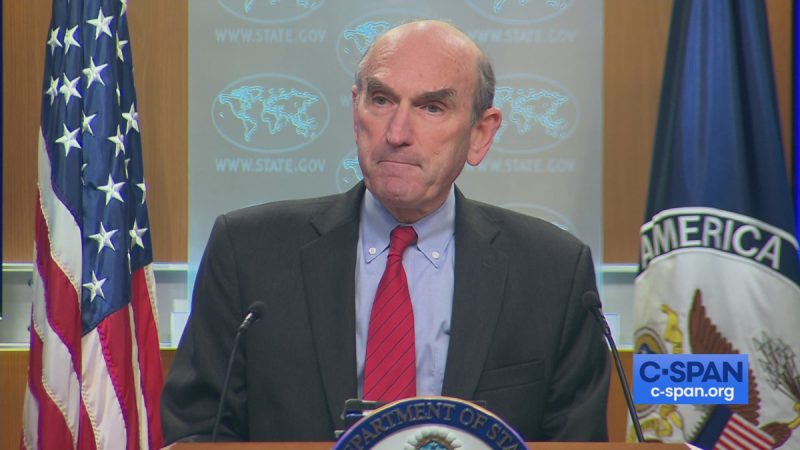
White House envoy for Venezuela Elliott Abrams defended Washington’s Venezuela sanctions on Wednesday. (C-Span)
By Lucas Koerner | Venezuelanalysis | November 28, 2019
Caracas – The Trump administration has pledged to continue economic sanctions against Venezuela in its ongoing bid to oust the Maduro government.
Speaking at a press conference at the State Department Wednesday, Special Envoy for Venezuela Elliott Abrams defended US regime change policy, which he said would “continue.”
“There’s no change… What is next is, I would say, a continuation of the current policy,” he said in response to questions about the status of US efforts more than ten months after recognizing opposition politician Juan Guaido as “interim president” of Venezuela.
Guaido proclaimed himself head of state in January and has gone on to lead several unsuccessful efforts to topple Maduro, including a failed military putsch in April.
Trump immediately backed Guaido’s “interim presidency,” handing the Venezuela file to Abrams, a veteran cold warrior infamous for his role in the Iran/Contra scandal, the Reagan administration’s Central America policy, and the Iraq War.
Asked about the efficacy of US sanctions, Abrams assured reporters that the measures are cutting off vital funds for the Venezuelan government. However, he acknowledged that he “would like to see, obviously, the sanctions work better,” adding that “there are plans to reinforce the effort.” He did not offer further details.
“The gravy train days that they had 10 years ago are over,” he announced, referring to the period when Venezuela had the highest minimum wage in Latin America and among the lowest levels of inequality.
Abrams went on to deny that US sanctions are negatively impacting Venezuela’s economy, citing a paper authored by former Guaido Inter-American Development Bank envoy Ricardo Hausmann claiming, “the bulk of the deterioration of living standards occurred long before sanctions were enacted in 2017.” Hausmann was a key architect of neoliberal policies in Venezuela in the 1980s and 1990s and has been a longtime government opponent.
The conclusions of Hausmann’s study have been disputed by the DC-based Center for Economic and Policy Research, which published its own report in April finding sanctions responsible for at least 40,000 deaths since 2017. The study likewise claims that sanctions amount to “collective punishment,” blocking any possibility of economic recovery in the Caribbean nation.
Washington has dramatically ramped up its sanctions regime since January, imposing an oil embargo which has since been escalated to a sweeping ban on dealings with Caracas under threat of secondary sanctions.
Abrams likewise rebuffed reporters’ concerns about Guaido’s “lack of momentum,” suggesting that “hundreds of thousands… went to the streets on November 16.” The claim was scrutinized by journalists who pointed out that viral video footage purported to be from the protests was in fact taken in January.
Questioned repeatedly about allegations of the Maduro government “intervening” in regional protests, the White House envoy accused Caracas and Havana of acting to “promote more strife everywhere.”
“There is evidence beginning to build of an effort by the regimes in Cuba and Venezuela to exacerbate problems in South America,” he added.
In recent weeks, the region has been rocked by massive anti-neoliberal protests that have shaken right-wing governments in Ecuador, Haiti, Chile, and Colombia. Government spokespeople have frequently attributed the uprisings to “meddling” by Caracas, while the Organization of American States has branded them a “destabilization strategy” by the “Bolivarian and Cuban dictatorships.”
Now the Interim of US Self-Deception Over Bolivia
To read the mainstream press on what just happened to Evo Morales is to enter a hall of mirrors
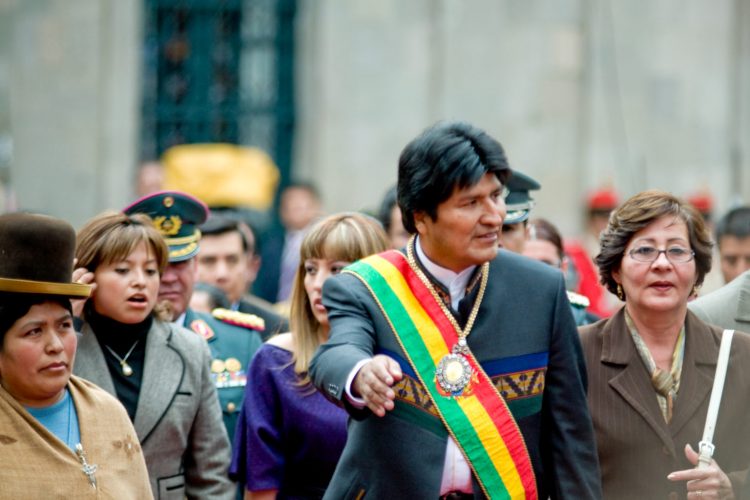
Bolivia’s Evo Morales in 2008. (Joel Alvarez, Wikimedia Commons)
By Patrick Lawrence | Consortium News | November 25, 2019
Years from now, maybe a generation from now, it will be permissible to describe Evo Morales’s resignation-at-gunpoint two weeks ago as what it was: a coup the U.S. cultivated just as it has dozens of others since it emerged as a superpower in 1945. The acknowledgement will not matter then. The events in question will be comfortably distant in time. Those responsible for deposing the Bolivian president will be either retired or deceased. Americans will not have fooled any Bolivians, for this autumn will be etched in their memories, but Americans will have once again fooled themselves.
This is how it often goes when Washington crushes the democratic aspirations of others by toppling legitimately elected leaders and replacing them with figures — usually corrupt, often dictatorial, by definition undemocratic — to its liking. It took decades for the U.S. to acknowledge the C.I.A.–directed coup in 1953 against the Mossadegh government in Iran: President Barack Obama did so (without apologizing) in 2009. Forty-five years after the fact, Bill Clinton spent half a day in Guatemala expressing regret for the coup that brought down President Jacobo Árbenz in 1954.
This is what awaits us now in the case of Bolivia — a long interim of self-deception, ending only when the truth makes little difference and responsibility can no longer be assigned.
Here is some of what Bill Clinton, president at the time, said in Guatemala City in March 1999. He spoke shortly after Guatemala’s Historical Clarification Commission — a name one has to love — concluded that in deposing Árbenz the U.S. was responsible for the blood-soaked human rights abuses that followed during 36 years of civil war:
“It is important that I state clearly that support for military forces or intelligence units which engaged in violent and widespread repression of the kind described in the report was wrong. And the United States must not repeat that mistake. We must and we will instead continue to support the peace and reconciliation process in Guatemala.”
Dishonesty & Consequences
This is a complacently dishonest statement, and it is essential to recognize not only Clinton’s dishonesty but also its consequences. These bear directly on the Bolivia question now.
Clinton was explicit in asserting that the Árbenz coup was an injustice that will not happen again. The past was evil, but evil has passed: This is a sound summation of his message. Having followed Clinton’s Central American tour at the time, I remain convinced that he addressed Americans at least as much Guatemalans when he made the just-quoted remarks. Some of us intervened violently in another country and caused much suffering, he told us norteamericanos, but we are not those people. They are gone now and we are better than they were.
This is the message implicit in all of the apologies U.S. officials occasionally make for misdeeds safely packed away in history’s deep freeze. In it we find the grand illusion of America’s present-day innocence. And it is by this illusion that the U.S. regularly repeats the mistake Clinton mentions, always certain that its injustices lie in a past for which Americans alive in the present bear no burden of guilt.
What are we to make of America’s apologies to others in view of the record before and after one or another of these expressions of regret? In Latin America alone, the Guatemalan “mistake” in 1954 was repeated, successfully or otherwise, in Cuba (1961, Bay of Pigs), Chile (1973), Nicaragua (1981–90, the Contra insurgency), and Honduras (2009). Washington has been trying for years to repeat its mistake in Venezuela and is currently trying again in Nicaragua. In the Venezuela case, sanctions have already succeeded in destabilizing the nation’s economy.
We have just watched it make this mistake in Bolivia. John Bolton, in his noted “troika of tyranny” speech a year ago, lumped Cuba with Venezuela and Nicaragua. Trump’s now-departed national security adviser unabashedly promised coups in all three nations.
The past is evil, all right, but evil has not passed.
Fighting for Plain Speech
Language is the battleground in the Bolivian case, as in all others like it in the past. This is as it should be. The fight for plain, spade-a-spade language is one worth fighting. It is by naming things and events honestly that we shed our illusions of innocence. This is the essential first step if America is to alter its ruinous conduct abroad. To fail in this is to protect the illegal practices of a disorderly hegemonic power from scrutiny.
Our corporate media have treated us to a remarkable display of hand-wringing and verbal contortions to avoid using the term “coup” in describing the events in La Paz from Oct. 20, when Morales was elected to a fourth term, and Nov. 10, when his high command forced him into exile. “Was there a coup in Bolivia?” The Economist asked after Morales sought asylum in Mexico. “Coup isn’t the right word,” the reliably neoliberal Foreign Policy protested as if in response. This is the same journal that published a piece in mid–2018 headlined, “It’s Time for a Coup in Venezuela.”
To read the mainstream press on Bolivia is to enter a hall of mirrors. The violent overthrow of an elected president struck a blow for the restoration of order and the rule of law. Christian fundamentalists of European descent, racist to the core and explicitly contemptuous of Bolivia’s indigenous majority, are “democrats” worthy of our support. Bolivia’s first indigenous president, highly popular for lifting an impressive percentage of Bolivians out of poverty, was a hated, “tyrannical dictator.”
This, the Orwellian touch, is routine — and is routinely reported in the American press. When the murderous General Abdul–Fattah al–Sisi took power in Egypt in a coup six years ago, John Kerry, as U.S. secretary of state, applauded him for “restoring democracy.” For good measure the secretary of state added, “The military did not take over.”
Islands of Responsible Coverage
Accurate, responsible accounts of the events surrounding Morales’s ouster are perfectly available, even if they appear amid a sea of mis– and disinformation. The Grayzone’s reporting on Bolivia this autumn is second to no one’s. Last week Fairness and Accuracy in Reporting, FAIR, carried a highly informed and informative interview with Alex Main of the Center for Economic and Policy Research in Washington.
These publications make the truth of events in Bolivia easily legible. There was no “drastic change” in the vote count late in the polling process, as the U.S.–controlled Organization of American States alleged. Neither was there a suspicious interruption in official reports of the final results, as also alleged. Many of the key figures in the coup have dense ties to Washington; some, including Williams Kalimán Romero, the since-replaced commander of the armed forces at the time of the coup, were trained at WHINSEC, the military training base in the U.S. state of Georgia previously (and infamously) known as the School of the Americas.
Just as it has elsewhere — Venezuela and Ukraine are recent examples — Washington was supporting right-wing political parties and opposition “civil society” groups even before Morales first won office in 2006. The first U.S.–cultivated coup attempt against him came two years later.
Do we have prima facie proof of Washington’s involvement in the coup against Morales? This is rarely available in such circumstances as these. As in many other cases, we may have to wait for the historians and the declassification of foreign- relations records. The closest we come so far in the Bolivia case is a set of 16 audio recordings released Nov. 10 by El Periódico, an independent publication in Costa Rica. These appear to record top coup plotters as they plan actions against the Morales government and, in one, discuss the support they receive from Senators Marco Rubio, Ted Cruz, and Bob Menendez — all of whom have taken a hand in previous Latin American interventions.
The recordings are here with English-language summaries of each recording, and here in the original El Periódico version. Provenance, chain of custody, the identities of those who made the recordings and those whose voices are recorded: None of this is clear. El Periódico did not reply to queries sent by email. But given how closely these audios align with established procedures in U.S.–cultivated coups (such as a leaked audio regarding the coup in Ukraine), and the formidable accumulation of compelling circumstantial evidence, they cannot be dismissed pending needed verifications.
What just happened in Bolivia happened in Guatemala 65 years ago, 66 in Iran, and so on. Coups were conducted in more or less the same fashion, without so much as a procedural update. Now as on previous occasions, most Americans are kept ignorant of what has been done in their name — and, atop this, remain indifferent to their ignorance. This is a media failure as much as a moral failure. When Bolton openly promises coups across Latin America, and liberal magazines such as FP cheer on such plans in banner headlines, we must conclude that in our late-imperial phase we are a numbed nation.
Washington has just degraded Bolivia’s long effort to climb out of poverty, to take control of its resources and its destiny, and to escape from centuries of exploitation at the hands of Westerners. This is shameful. The silent consent of most Americans after many decades of unlearned lessons is equally so.
Patrick Lawrence, a correspondent abroad for many years, chiefly for the International Herald Tribune, is a columnist, essayist, author and lecturer. His most recent book is “Time No Longer: Americans After the American Century” (Yale). Follow him on Twitter @thefloutist. His web site is Patrick Lawrence.
Bolivia’s Coup Government Targets Alternative Media as Crackdown Turns Increasingly Violent
By Alan Macleod | MintPress News | November 22, 2019
Facing increased resistance to its rule, the new “transition” government of Jeanine Añez in Bolivia has begun to purge and censor potential threats to its authority, including in the media. TeleSUR, an international media network that began as a collaboration between left-wing Latin American nations, including deposed President Evo Morales’ Bolivia and Venezuela’s Hugo Chavez, and which espouses an openly leftist and anti-imperialist outlook, received confirmation that it would be taken off the airwaves as part of what the government calls a “reorganization” of the airwaves. TeleSUR openly opposed the U.S.-backed military coup d’état that installed Añez as head of state earlier this month.
New Communications Minister Roxana Lizárraga announced that this was part of the “dismantling of the propaganda apparatus of the dictatorial regime of Evo Morales,” claiming that Morales’ “militants who misused the state media system” are being “withdrawn.”
TeleSUR was originally conceived as a counterweight to the Western-dominated media system and attempted to bring the voices of working-class Latin Americans to the fore. It also offers an alternative to local mainstream media, overwhelmingly owned and controlled by Latin American elites who have been particularly hostile to progressive governments such as Morales.’
This is the latest episode in a general assault on the media, as the Añez administration attempts to gain control over Bolivia’s means of communication. Multiple journalists have been shot, while Al-Jazeera correspondent Teresa Bo was tear-gassed in the face live on air at point-blank range by riot police as she stood alone, away from the protests, talking to the camera. Last week Lizárraga appeared on television announcing she would persecute any journalists involved in what she called “sedition,” noting that she already had a list of “troublesome” individuals and outlets. Bolivia TV was also taken off the air earlier this week.
In its efforts to neutralize dissent, the Añez administration has found a keen and enthusiastic ally in the local mainstream press. In a shocking moment captured on film, local media harassed an independent journalist, detaining him and handing him over to the armed forces. The local press has largely endorsed the events and celebrated Morales’ demise, presenting the situation as a democratic transition rather than as a coup.
The crackdown extends beyond media, as the new government has effectively declared the deposed Movement to Socialism (MAS) party illegal, arresting MAS officials and forcing others into hiding or exile in what new government minister Arturo Murillo called a “hunting” down of political opponents. “They’re drowning the Bolivian people in blood,” declared deposed Vice-President Álvaro García Linera from Mexico, where he was granted asylum.
Añez has granted security forces immunity from all crimes committed during the “re-establishment of order.” Those same forces reportedly carried out massacres in the city of Cochabamba and the town of Senkata, just south of the country’s capital, La Paz.
Tens of thousands of demonstrators, many carrying the Wiphala flag, a symbol of indigenous identity, marched to La Paz alongside the coffins carrying the victims of the Senkata massacre, demanding the resignation of Añez and an end to the bloodshed. The march stretched out for miles. MintPress News cameras captured the events.
Once the march came into contact with security forces in the capital, it was met with a barrage of tear gas, and downtown La Paz was engulfed in smoke as tens of thousands of Bolivians were gassed during rush hour. Mourners were forced to abandon the coffins of their loved ones in the street as fumes overcame them.
“La Paz, 5:30 pm. They’re gassing commuters and protesters alike. Can only imagine how many people will wander into the path of the police & military with the Bolivian media’s under-reporting. I saw mothers with infants gassed, they were not part of the procession,” reported one TeleSUR journalist on the scene.
From exile in Mexico, former President Morales denounced the attack on the funeral procession. “The de facto government of Añez does not respect the dead in their coffins, nor forgive their relatives, women and children marching peacefully in support of life and democracy”, he said. “We condemn the violence against our brothers and sisters.”
Morales won an unprecedented third term in office on October 20, gaining 47% of the vote in the presidential elections. However, opposition parties cried foul, claiming that there were election irregularities, an accusation repeated by the Organization of American States and the U.S. government. On November 10, military generals appeared on television and demanded Morales resign. As he fled to Mexico, the military selected Jeanine Añez – whose right-wing Democrat Social Movement Party received 4% of the vote – as President. Añez, a strongly conservative Christian, declared that Bolivia’s indigenous majority was “satanic” and promised to bring Christianity back to the government. The White House strongly supported the events, “applauding” what it saw as a significant and positive moment for democracy. On the other hand, Democratic Presidential candidates such as Bernie Sanders and Tulsi Gabbard have condemned it.
MintPress News is covering the events in Bolivia extensively. Full coverage can be found here and on Twitter.
Alan MacLeod is a MintPress Staff Writer as well as an academic and writer for Fairness and Accuracy in Reporting. His book, Bad News From Venezuela: Twenty Years of Fake News and Misreporting was published in April.
Colombia’s US Ambassador Advocates ‘Covert Actions’ Against Venezuela in Leaked Audio
By Lucas Koerner | Venezuelanalysis | November 21, 2019
Senior Colombian diplomats discussed strategies for regime change in Venezuela in a leaked audio published by Colombian news site Publimetro on Wednesday.
Speaking in a Washington DC cafe, Colombian Foreign Minister Claudia Blum and Ambassador to the US Francisco Santos repeatedly stressed the failure of US-led efforts to oust Venezuelan President Nicolas Maduro.
“The solution is not a military coup, because the military is not going to remove [Maduro]. Nor is the United States going to remove him at the point of an “I don’t know what,” observed Blum, alluding to the possibility of US military intervention in Venezuela.
Santos stressed the need for clandestine operations to “support the opposition.”
“The only thing that I see is with covert actions within [Venezuela] to make noise and support the opposition which is very isolated,” he told Blum.
The ambassador additionally reported that the “CIA [Central Intelligence Agency] is not getting involved [in Venezuela],” a fact that Blum appeared to lament.
Santos went on to complain about the apparent disarray within the Trump administration. He noted that the State Department and the White House were divided over the Inter-American Reciprocal Assistance Treaty (TIAR), which the former “wanted” but the latter did not. The TIAR was activated in September at the behest of the Venezuelan opposition, which hailed the move as a first step towards foreign military intervention in Venezuela.
For her part, Blum concurred with her ambassador’s assessment, lamenting that with US elections fast approaching, “no one knows what Trump is going to do.”
Santos responded by speculating that if Trump fears losing the presidential race, “he will go into Venezuela,” a possibility downplayed by the foreign minister.
Both officials, however, agreed on the urgent need to remove Maduro from power.
“If this guy doesn’t go, Colombia has no future,” warned Santos, going on to describe efforts to enlist US congressional support on Venezuela.
“Let them understand that this shithole is going to destabilize the whole continent,” he emphasized.
Since opposition leader Juan Guaido’s self-proclamation as Venezuelan “interim president” in January, the hard-right Colombian government of Ivan Duque has spearheaded efforts to oust Maduro.
In February, Colombia strongly supported a US-led attempt to force “humanitarian aid” across the Venezuelan border, which Blum dismissed as a “fiasco.”
More recently, tensions have been on the rise along the 2,219 kilometer Venezuelan-Colombian border since Bogota resumed hostilities with guerrilla factions in August.
The leaked audio is the latest in a series of Venezuela-related scandals that have dogged the Duque government in recent months.
In September, photos and witness testimony surfaced revealing that Guaido had crossed the Colombian border in February with the assistance of Colombian paramilitary groups in coordination with the Colombian authorities. The Duque administration had earlier been accused of turning a blind eye to accusations that Guaido’s envoys to the country had embezzled money destined to support deserters from the Venezuelan armed forces.
Weeks later, Duque came under fire after presenting false evidence of ELN activity in Venezuela during his speech at the UN General Assembly in New York.
The latest scandal provoked condemnation from Caracas, with Foreign Minister Jorge Arreaza slamming Colombian interference in Venezuelan affairs.
“Colombia has been affirming for years that Chavismo destabilizes the region… Meanwhile in a leaked conversation the new foreign minister and ambassador in the US confess how and with whom they conspire to destabilize Venezuela,” he tweeted.
The OAS lied to the public about the Bolivian election and coup
Facts show nothing suspicious about the re-election of Evo Morales
By Mark Weisbrot | MarketWatch | November 19, 2019
What is the difference between an outright lie — stating something as a fact while knowing that it is false — and a deliberate material representation that accomplishes the same end? Here is an example that really pushes the boundary between the two, to the point where the distinction practically vanishes.
And the consequences are quite serious; this misrepresentation (or lie) has already played a major role in a military coup in Bolivia last week. This military coup overthrew the government of President Evo Morales before his current term was finished — a term to which nobody disputes that he was democratically elected in 2014.
More violent repression and even a civil war could follow.
OAS mission
The Organization of American States (OAS) sent an Electoral Observation Mission to Bolivia, entrusted with monitoring the Oct. 20 national election there. The day after the election, before all the votes were even counted, the mission put out a press release announcing its “deep concern and surprise at the drastic and hard-to-explain change in the trend of the preliminary results…”
Here is what the OAS was referring to: there is an unofficial “quick count” of the voting results that involves contractors who upload results at intervals, as the tally sheets are available. At 7:40 p.m. on election day, they had reported about 84% of the votes and then stopped reporting for 23 hours (more on that below).
When they resumed reporting results at 95% of votes counted, Morales’s lead had increased from 7.9% before the interruption to just over 10%.
This margin was important because in order to win without a second-round runoff, a candidate needs either an absolute majority, or at least 40% and a 10-point margin over the second-place finisher. This margin — which grew to 10.6% when all the votes were counted in the official count — re-elected Morales without a second round.
Morales’s lead grew steadily
Now, if you had any experience with elections or maybe even arithmetic, what is the first thing you would want to know about the votes that came in after the interruption? You might ask, were people in those areas any different from people in the average precinct in the first 84%?
And was the change in Morales’s margin sudden, or was it a gradual trend that continued as more vote tally sheets were reported?
You might even want to ask these questions before expressing “deep concern and surprise” about what happened, especially in a politically very polarized situation that was already turning violent. … continue
OAS election observers subvert Bolivian democracy
By Yves Engler · November 18, 2019
Organization of American States election observers have played an important role in subverting Bolivian democracy.
While some may find it hard to believe that a regional electoral monitoring body would consciously subvert democracy, their actions in the South American country are not dissimilar to previous US/Canada backed OAS missions in Haiti.
“The OAS Election Audit That Triggered Morales’ Fall in Bolivia”, explained a New York Times headline. For his part, Bolivian President Evo Morales said the OAS “is in the service of the North American empire.”
After the October 20 presidential election, the OAS immediately cried foul. The next day the organization released a statement that expressed “its deep concern and surprise at the drastic and hard-to-explain change in the trend of the preliminary results [from the quick count] revealed after the closing of the polls.” Two days later they followed that statement up with a preliminary report that repeated their claim that “changes in the TREP [quick count] trend were hard to explain and did not match the other measurements available.”
But, the “hard-to-explain” changes cited by the OAS were entirely expected, as detailed in the Centre for Economic Policy Research’s report “What Happened in Bolivia’s 2019 Vote Count? The Role of the OAS Electoral Observation Mission”. The CEPR analysis points out that Morales’ percentage lead over the second place candidate Carlos Mesa increased steadily as votes from rural, largely indigenous, areas were tabulated. Additionally, the 47.1% of the vote Morales garnered aligns with pre-election polls and the vote score for his Movement toward Socialism party. The hullabaloo about the quick count stopping at 83% of the vote was preplanned and there is no evidence there was a pause in the actual counting.
But, the OAS’ statements gave oxygen to opposition protests. Their unsubstantiated criticism of the election have also been widely cited internationally to justify Morales’ ouster. In response to OAS claims, protests and Washington and Ottawa saying they would not recognize Morales’s victory, the Bolivian President agreed to a “binding” OAS audit of the first round of the election. Unsurprisingly the OAS’ preliminary audit report alleged “irregularities and manipulation” and called for new elections overseen by a new electoral commission. Immediately after the OAS released its preliminary audit US Secretary of State Mike Pompeo went further, saying “all government officials and officials of any political organizations implicated in the flawed October 20 elections should step aside from the electoral process.” What started with an easy-to-explain discrepancy between the quick count and final results of the actual counting spiraled into the entire election is suspect and anyone associated with it must go.
At Tuesday’s Special Meeting of the OAS Permanent Council on Bolivia the representative of Antigua and Barbuda criticized the opaque way in which the OAS electoral mission to Bolivia released its statements and reports. She pointed out how the organization made a series of agreements with the Bolivian government that were effectively jettisoned. A number of Latin American countries echoed this view.
US and Canadian representatives, on the other hand, applauded the OAS’ work in Bolivia. Canada’s representative to the OAS boasted that two Canadian technical advisers were part of the audit mission to Bolivia and that Canada financed the OAS effort that discredited Bolivia’s presidential election. Canada is the second largest contributor to the OAS, which receives between 44% and 57% of its budget from Washington.
It’s not surprising that an electoral mission from the Washington-based organization would subvert Bolivian democracy. OAS electoral observers have played more flagrant role in undermining Haitian democracy. In late 2010/early-2011 the US/Canada used an OAS election “Expert Verification Mission” to help extreme right-wing candidate Michel Martelly become president. Canada put up $6 million for elections that excluded Fanmi Lavalas from participating and following the first round of voting in November 2010, forced the candidate whom Haiti’s electoral council had in second place, Jude Celestin, out of the runoff. After Martelly’s supporters protested their candidate’s third place showing, a six person OAS mission, including a Canadian representative, concluded that Martelly deserved to be in the second round. But, in analyzing the OAS methodology, the CEPR determined that “the Mission did not establish any legal, statistical, or other logical basis for its conclusions.” Nevertheless, Ottawa and Washington pushed the Haitian government to accept the OAS’s recommendations. Foreign minister Lawrence Cannon said he “strongly urges the Provisional Electoral Council to accept and implement the [OAS] report’s recommendations and to proceed with the next steps of the electoral process accordingly.” In an interview he warned that “time is running out”, adding that “our ambassador has raised this with the president [Rene Préval] himself.” The CEPR described the intense western lobbying. “The international community, led by the US, France, and Canada, has been intensifying the pressure on the Haitian government to allow presidential candidate Michel Martelly to proceed to the second round of elections instead of [ruling party candidate] Jude Celestin.” This pressure included some Haitian officials having their US visas revoked and there were threats that aid would be cut off if Martelly’s vote total was not increased as per the OAS recommendation.
Half of Haiti’s electoral council agreed to the OAS changes, but the other half did not. The second round was unconstitutional, noted Haïti Liberté, as “only four of the eight-member Provisional Electoral Council (CEP) have voted to proceed with the second round, one short of the five necessary. Furthermore, the first-round results have not been published in the journal of record, Le Moniteur, and President Préval has not officially convoked Haitians to vote, both constitutional requirements.”
The absurdity of the whole affair did not stop the Canadian government from supporting the elections. Official election monitors from this country gave a thumbs-up to this exercise in what they said was democracy. After Martelly won the second round with 16.7 percent of registered voters support Cannon declared: “We congratulate the people of Haiti, who exercised their fundamental democratic right to choose who will govern their country and represent them on the world stage.” The left weekly Haiti Progrès took a different view. Describing the fraudulent nature of the elections, the paper explained: “The form of democracy that Washington, Paris and Ottawa want to impose on us is becoming a reality.”
A decade earlier another OAS election mission helped sabotage democracy in Haiti. After voting for 7,000 positions an OAS team on site described the May 2000 elections as “a great success for the Haitian population which turned out in large and orderly numbers to choose both their local and national governments.”
As the opposition protested the scope of Fanmi Lavalas’ victory, the OAS jumped on a technicality in the counting of eight Senate seats to subsequently characterize the elections as “deeply flawed”. The 50 percent plus one vote required for a first-round victory was determined by calculating the percentages from the votes for the top four candidates, while the OAS contended that the count should include all candidates. OAS concerns were disingenuous since they worked with the electoral council to prepare the elections and were fully aware of the counting method beforehand. The same procedure was used in prior elections, but they failed to voice any concerns until Fanmi Lavalas’ landslide victory. Finally, using the OAS method would not have altered the outcome of the elections and even after Jean Bertrand Aristide got the seven Lavalas senators to resign (one was from another party) the “deeply flawed” description remained.
Haiti’s political opposition used the OAS criticism of the election to justify boycotting the November 2000 presidential election, which they had little chance of winning. The US and Canada used the claims of electoral irregularities to justify withholding aid and Inter-American Development Bank loans to the Haitian government. OAS Resolutions 806 and 822 gave non-elected opposition parties an effective veto over the resumption of foreign aid to Aristide’s government. The OAS claims of “deeply flawed” elections played an important part in a multipronged campaign to oust Aristide’s government.
In an editorial responding to the coup in Bolivia, People’s Voice called for Canada to withdraw from the Washington dominated OAS. Internationalist minded Canadians should support that position.
But we should also recognize the blow Morales’ ouster represents to any effort to subvert the OAS. The Bolivian President’s removal is a further setback to the Latin American integration efforts represented in forums such as the Community of Latin American and Caribbean States. A potential replacement for the OAS, CELAC included all Latin American and Caribbean nations. But Canada and the US were excluded. By helping oust Morales the OAS has taken revenge on a politician who pushed an alternative, non-Washington based, model for ‘Nuestra America’.
Western Media Whitewash Bolivia’s Far-Right Coup
By Lucas Koerner and Ricardo Vaz | FAIR | November 15, 2019
Jeanine Áñez declared herself “interim president” in a near-empty Senate chamber on November 12, proceeding to don the presidential sash with the assistance of uniformed soldiers. Despite a lack of quorum rendering the move nakedly unconstitutional, Áñez was immediately recognized by the Trump administration and 10 Downing Street.
Tuesday’s scene seemed like a parody of January’s events in Venezuela, in which a virtually unknown lawmaker, invoking highly dubious constitutional arguments, proclaimed himself “interim president” to the delight of Washington.
For all the supposed threat Trump represents and the enthusiasm sparked by his possible impeachment, Western media continue to march lockstep behind his administration’s coups in Latin America.
Áñez has been sympathetically described as a “qualified lawyer” (BBC, 11/13/19), a “proud Christian” (France 24, 11/13/19) as well as a “women’s rights activist and television presenter” (Time, 11/12/19). Reuters (11/13/19) called her “Bolivian Interim President Jeanine Áñez,” AP(11/13/19) had her as “Bolivia’s newly declared interim president,” whereas for the BBC (11/13/19) she was simply “President Áñez.” AFP (published in France 24, 11/13/19) described her as “the South American country’s 66th president and the second woman to hold the post.”
This language mirrors corporate media profiles of Venezuelan coup leader Juan Guaidó (FAIR, 7/23/19), who was depicted as a “freedom fighter” (Fox Business, 1/29/19) and a “salsa-loving baseball fan” (Reuters, 1/23/19) who had “captured the heart of the nation” (New York Times, 3/4/19). References to Guaidó as “president,” however, have dwindled in the face of his repeated failure to seize power (FAIR, 7/23/19).
Meanwhile, corporate outlets have euphemistically labeled Áñez as “conservative” (Guardian, 10/13/19; New York Times, 10/12/19; Reuters, 10/13/19), eliding any mention of her far-right, virulently anti-indigenous politics. Áñez is a member of the right-wing Democratic Social Movement from the eastern lowland region of Santa Cruz, historically a bastion of separatist groups and home to some of the most powerful Bolivian oligarchic families. She has a history of making glaringly racist remarks, tweeting in 2013 (6/20/13) that the “Aymara New Year,” an indigenous holiday, was “Satanic”: “There is no replacement for God.” Just days before seizing power, she questioned on Twitter(11/6/19) whether some people being interviewed could really be Indigenous—because they were wearing shoes. For all of liberal journalists’ virtue-signaling concerning minority rights in the global North, the silence is deafening when it comes to blatant racism from pro-US elites in Latin America.
Áñez has another scandal brewing, which has yet to be reported in the English-speaking press: Her nephew was arrested for drug trafficking in 2017. According to EFE (10/20/17), Carlos Andrés Áñez Dorado was arrested in Brazil on October 15, 2017, in possession of 480 kilograms of cocaine—more than half a ton.
Given the extensive coverage corporate journalists gave to the arrest and conviction of Venezuelan first lady Cilia Flores’ “narco-nephews” in 2015–17 (e.g. Business Insider, 10/31/16; Miami Herald, 12/13/17; Daily Beast, 12/15/17), one could expect equally damning exposés in the case of Áñez. Readers shouldn’t hold their breath.
In addition to whitewashing Áñez, corporate journalists have sought to sanitize the image of the figure widely considered to be the real force behind the coup: Christian fundamentalist multimillionaire Luis Fernando Camacho.
Camacho is quite literally a fascist who got his political start in the sieg-heiling Santa Cruz Youth Union, an ultra-right paramilitary outfit that was instrumental in the Santa Cruz oligarchy’s 2008 US-backed secessionist plot which ultimately failed.
But none of this appears to matter to the Western media, which have portrayed Camacho as a “conservative protest leader” (BBC, 11/13/19), “a firebrand Christian” (Financial Times, 11/12/19) and a “civic leader” (Reuters, 11/7/19).
Also notoriously absent from mainstream coverage of the Bolivia coup are references to the fascist tactics employed by the opposition. Images and reports on social media showed MAS leaders attacked by mobs, tied to trees, their houses set on fire and several being forced to resign by opposition violence. Instead, corporate journalists innocuously described the increasingly violent right-wing mobilizations as “mass protests” (BBC, 10/31/19), “dissent” (AP, 11/8/19) and “civil disobedience” (New York Times, 10/31/19).
The right-wing violence was framed as “clashes” (DW, 11/8/19; France 24, 11/8/19) over “controversial” or “disputed” electoral results (Washington Post, 11/07/19; BBC, 11/7/19) enabling the US-backed opposition to don the mantle of pro-democracy protesters. To bolster this “fraud” narrative, Western journalists uncritically repeat the US-financed OAS’ claims of “irregularities,” and largely ignore a CEPR report that found no evidence discrediting the results.
Once Evo Morales was forced to resign, the switch was immediately flipped. State security forces, which had stepped aside to let Camacho’s fascist gangs wreak havoc and attack opponents, were now deployed to crush the inevitable resistance from indigenous MAS supporters. But now the media could resort to their tried and tested technique of criminalizing the anti-coup protests as “violence by looters or by Mr. Morales’ supporters” (New York Times, 11/12/19), just like was done in the case of anti-neoliberal rebellions in Chile and Ecuador (FAIR, 10/23/19). In some cases, journalists seemed to be preemptively justifying repression, for example writing that “violence erupted” after Morales’ resignation (Financial Times, 11/11/19), or that security forces were being deployed to “quell violence” (Reuters, 11/11/19). AP (11/13/19) asserted, perhaps wishfully, that “a sense of normalcy returned to the capital on Wednesday.”
Backed by Washington, the coup that the Western media deny is a coup (FAIR, 11/11/19) appears successful, at least for the time being. However, as in the short-lived 2002 coup in Venezuela, the media blackout and savage repression have not stopped multitudes of Bolivians from taking to the streets to restore democracy. Only time will tell if the pueblo will triumph.
Morales: Bolivia Suffers an Assault on the Power of the People
By Nino Pagliccia | CounterPunch | November 15, 2019
As the military coup continues to entrench itself in Bolivia, the first goal of the perpetrators is to appear to be following the constitutional process. But the façade is not enough to hide the real disaster of yet another self-proclaimed president in Latin America. When you thought that the Juan Guaido experiment in Venezuela was a total failure in every respect, Bolivia repeats the same pathetic tragedy.
The main character is Jeanine Añez, the second vice-president of the Bolivian Senate who proclaimed herself to be the “president” of Bolivia supposedly according to the constitution. She declared, “I immediately take the presidency of the State.” She is a senator for the rightwing party Democratic Unity and has been an adamant opponent of Evo Morales who was forced into exile in Mexico by the Bolivian armed forces top brass, who now have enthusiastically recognised the new “president”.
A couple of farcical moments maybe first, when Añez stood in the middle of an almost empty Senate hall. At least Juan Guaido had a small crowd when he self proclaimed in January 23. The second moment may have been when she walked into the presidential palace barely able to carry up high an oversized bible and declaring, “The bible returns to the [presidential] palace”. Later she added, “our power is God, the power is God.” Her religiosity is apparently very prominent.
But more seriously, what makes this a tragedy is that she appointed herself “president” in an almost empty Senate because the majority of senators are members of the government party, Movimiento Al Socialismo (MAS), and they were not present. Consequently there was no required quorum for the “vote” to take place. Prior to that, she quickly had to appoint herself president of the Senate because the MAS president and first vice-president were not present. So she skipped quite a few steps of the hierarchy breaking the constitution in order to appear to be entitled to the presidency…according to the constitution.
Evo Morales from Mexico twitted: “This self-proclamation is against articles 161, 169 and 410 of the State Political Constitution [Constitución Política del Estado – CPE] that determine the approval or rejection of a presidential resignation, the constitutional succession from the Senate or Deputy [Assembly] presidents and the higher authority of the CPE. Bolivia suffers an assault to the power of the people.”
In fact, Article 161 has two functions relevant in this case, one is “accept or deny the resignation of the President and of the Vice President of the State.” This has not been done. And secondly, “receive the oath of the President and the Vice President of the State.” We have not heard if the new “president” has done so, but regardless, all has to take place when “The [Senate and Deputy] Chambers will meet in Plurinational Legislative Assembly.” As we know, no such assembly is functioning.
Article 169 is crucial: “In case of impediment or definitive absence of the President of the State, the Vice President will replace him/her, and in case of his/her absence [in turn] the President of the Senate will replace him/her, and in case of his/her absence, the President of the Chamber of Deputies will replace him/her. In the latter case, new elections will be called within the maximum deadline of ninety days.” We have just indicated that this process has not been followed because the presidents of the two Chambers were not even present.
Article 410 states who will have to abide by the constitution. “All people, natural and legal, as well as public bodies, public functionaries and institutions, are all subject to this Constitution.” This clearly applies to all the coup perpetrators without exception. But they have not.
To invalidate even more this absurd unconstitutional scenario is that when the legitimate president of the Senate, Adriana Salvatierra, representing the MAS government Party, attempted to enter into the Senate to claim to be elected president of Bolivia according to the constitution she was not even allowed to enter. Admittedly she had resigned but her resignation was never formally accepted.
To conclude, we have to note that constitutions are written to lay down basic fundamental rights, guarantees and rules of the State. Everything else, including clarifications of any constitutional matter, is the attribution, in the case of Bolivia, of the Plurinational Constitutional Court. But this court in turn is composed of elected members who are now literally dysfunctional or disbanded, or nor legitimate.
But what is really important to note is that constitutions are written assuming normal circumstances in the country and that those normal circumstances will continue indefinitely. The reality is that there is nothing normal following a coup. All standard basic definitions and notions of democracy, independence, sovereignty and foreign intervention break down creating a vacuum that is immediately filled with ideology and interests. What really makes the whole event in Bolivia tragic is that it is triggered by a foreign induced Hybrid War not for the benefit of Bolivians.
‘Dictatorship has Returned to Bolivia’: Morales to teleSUR
teleSUR | November 17, 2019
 The legitimately-elected President of Bolivia, Evo Morales, told teleSUR on Saturday that dictatorship has returned to the South American country, given the recent events that triggered intense repression exerted by the de-facto government chaired by Senator Jeanine Áñez .
“The Bolivian people and the whole world know that we guarantee political stability. They said ‘Evo dictatorship’, now what Bolivia is living in is what we call a dictatorship.”
The Bolivian President said he was appalled by the recent reports regarding the civilian deaths at the hands of this new dictatorship.
“The people will always be united (…) The Bolivian people have never been taken from my memory. At any moment we will be as always sharing a resistance against economic policies, but for now, for democracy, for life, my dear Bolivia,” President Morales said.
On the media censorship imposed by the de-facto government in Bolivia, President Morales said that “now there is no freedom of expression” in the country. “The de facto communication minister who answers to the dictatorship in Bolivia said that seditious journalists, national and international, will be arrested.”
He also highlighted how the integration processes promoted by past governments such as those of Venezuela, Ecuador (by former President Rafael Correa) or Brazil (with former president Lula da Silva) seek to be destroyed by the interests of the U.S. empire.
“Unfortunately, some countries subject to the U.S. empire, destroy the integration processes: Unasur a political instance, Mercosur an economic instance, Celag an integration of all Latin America towards the liberation of the peoples,” President Morales continued.
In this sense, the legitimate President of Bolivia stressed that “we, Latin Americans, have the enormous responsibility, regardless of an economic, programmatic or social liberation, to free ourselves from the technological part.”
“Those who seek disintegration are not thinking about technological liberation, they are instruments of the capitalist system that will never like us to free ourselves from the technological part to establish sovereignty in our Latin America,” he added.
At Least 12 Dead Following Coup in Bolivia
teleSUR | November 14, 2019
At least 12 Bolivians have been killed and more than 530 injured by the violence that escalated in Bolivia following the coup against constitutional president Evo Morales, denounced the Ombudsman’s Office.
The human rights agency explained on its official website that among the injured are women, children, adolescents and journalists.
In turn, the institution – created in 1994 by constitutional mandate – posted on its Twitter account that on November 11 and 12, five Bolivians were killed (out of the total).
Of those deaths, four were due to the gunshots fired by the Armed Forces and the Police, and one due to suffocation by strangulation, the Ombudsman’s Office explained on its digital platform.
The events that forced Evo Morales’s resignation and consummated the coup d’état were unquestionably violent, as reported in an article published on the Mision Verdad webpage.
Opposition gangs attacked numerous politicians of the ruling Movement Towards Socialism, looted Morales’ house, and burned the residences of several high-level politicians, detailed the article.
Evo Morales announced his resignation as president on November 10 to stop the bloodshed, however, during a press conference in Mexico a country that granted him political asylum to preserve his life – he acknowledged that his decision did not halt the social upheaval.
In that sense, Morales called on the military to stop the bloodshed and initiate a national dialogue.
Make No Mistake, Morales’ Removal Is Directed Against Bolivia’s Indigenous
By Paul Antonopoulos | American Herald Tribune | November 13, 2019
It certainly has been a difficult year for reactionaries and neoliberals in South America as they failed to violently replace Venezuelan President Nicolás Maduro with U.S.-puppet Juan Guaidó, implement International Monetary Fund (IMF) demands against Ecuador after the people rose up, maintain the popularity of Chile’s billionaire President Sebastián Piñera’s after his attempts to raise the price of metro travel expanded into a larger anti-neoliberal movement, Evo Morales’ re-election in Bolivia, the election of Alberto Fernández in Argentina against neoliberal president Mauricio Macri, and, former Brazilian President Lula’s release from prison last week after serving a small part of his long sentence.
It certainly appears that the so-called Pink Tide, the wave of socialist and left-leaning governments that came to power across Latin America in the 2000’s and peaking in 2011, is returning to the region after being effectively replaced by the so-called “Blue Tide,” the Conservative Wave that saw Brazil, Argentina, Peru and other states return to conservative neoliberal governments. Effectively, the Monroe Doctrine has guided Washington’s belief since at least 1823 that Latin America is its backyard and has a right to protect it from foreign powers.
Former Bolivian President Evo Morales was one of the figures at the forefront of creating sovereignty and independence from the U.S. The first indigenous president of Bolivia reduced illiteracy from 13% in 2006 to 2.4% in 2018, reduced poverty from 60.6% in 2006 to 34.6% in 2018 and reduced unemployment from 9.2% in 2006 to 4.1% in 2018 – this was mostly achieved by ensuring that industries remained nationalized or were renationalized, and by becoming independent of the World Bank and the IMF.
And therefore, “in Bolivia, the American Empire Struck Back.”
With the American Empire experiencing major losses in Latin America this year, most significantly in Venezuela, while also seeing the release of former Brazilian President and pan-Latin Americanist, Lula, from prison, a quick victory was needed. A coup against Morales appeared to be the simplest victory for the Empire to achieve.
Why?
Former Venezuelan President Hugo Chávez made the military a bastion of Bolivarian ideology, ensuring that the entire hierarchy became radically anti-U.S. and patriotic. Therefore, even when Maduro faced a U.S.-orchestrated coup attempt earlier this year, there were very few defections from the Venezuelan military despite calls from Guaidó and Washington. Because Morales failed to radicalize the Bolivian military, he was always at risk of being militarily overthrown by unpatriotic forces willing to serve the American Empire.
Washington understands that Morales empowered the mostly left-leaning Indigenous population of Bolivia, accounting for 20% of the country’s population according to the 2012 census, with an additional 68% of the population being mestizo – mixed European and Indigenous ancestry. The whites of Bolivia account for 5% of the population but are on average far wealthier than the Indigenous and mestizos, and favor the right-wing opposition as they resist the shift of power from Whites towards the native majority.
Geographically, the overwhelming majority of Bolivia’s whites and most of the mixed-race populations live in the country’s eastern lowlands, which in itself is far wealthier than predominantly Indigenous regions of Bolivia.
This is a key point in trying to understand who Jeanine Áñez is, the self-declared interim president of Bolivia.
Who is she?
The self-proclaimed president comes from the sparsely populated flatland department of Beni, a stronghold for opposition to Morales. One of the department’s main economic activities is cattle ranching, operated by wealthy white or mestizo elites. She often criticizes socialism and expressed her fear that one day Bolivia will become like Venezuela, Nicaragua, “or worse, Cuba.” Her nephew in 2017 was caught trying to smuggle 480kg of cocaine into Brazil.
A Tweet from April 2013 truly reveals her contempt for the Indigenous population: “I dream of a Bolivia free of Indigenous satanic rites, the city is not for ‘Indians,’ they better go to the highlands or El Chaco.” Her radical Evangelical Christian beliefs legitimize her slander of Indigenous cultures as they are “satanic,” perhaps a remembrance to the days of Salem.
Of course, the U.S. has not made any denunciations of her self-proclaimed presidency. Nor did they denounce the Comite Ciudadano (Citizens Committee) who led the anti-Morales riots and violence. The right-wing organization is jointly led by ex-vice-president Carlos Mesa and Luis Fernando Camacho, the millionaire leader of the extreme right-wing pressure group Comite Civico (Civic Committee) of Santa Cruz, whose members do Nazi-style salutes.
Yes, the overthrow of Morales was backed by the American Empire.
Yes, the overthrow of Morales is because he encouraged pan-Latin American initiatives.
Yes, the overthrow of Morales was because he would not privatize much of Bolivia’s industries.
Yes, the overthrow of Morales was because he liberated Bolivia from the IMF and the World Bank.
But there is without a doubt a race element to his overthrow. As power was returning to the hands of the Indigenous people in Bolivia, the preservation of the elite minority had to be achieved. The removal of Morales and the ascendency of Áñez will surely regress the outstanding achievements made by Morales and bring a return to the strangling and exploitative neoliberal policies that kept Bolivia poor, and U.S. corporations and the local elite prosperous.
Featured Video
BRITAIN’S WARNING: PREPARE FOR WAR
or go to
Aletho News Archives – Video-Images
From the Archives
British weapons and personnel doing much of the killing in Yemen
Press TV – June 18, 2019
A detailed report published by the Guardian newspaper has shown how Britain is massively contributing to Saudi Arabia’s devastating war on Yemen as it suggests that London is not only supplying the bombs that fall on Yemenis, but it provides the personnel and expertise that keep the war going.
The comprehensive report by Arron Merat published on Tuesday showed that Britain was doing much of the killing in Yemen as the country continues to provide Saudi Arabia with everything it needs to turn its southern impoverished neighbor into a graveyard.
“Every day Yemen is hit by British bombs – dropped by British planes that are flown by British-trained pilots and maintained and prepared inside Saudi Arabia by thousands of British contractors,” said Merat in the report. … continue
Blog Roll
 Aletho News
- Yemen denounces European Parliament’s ‘hypocritical’ push to blacklist Ansarullah
- Qalibaf: UAE’s UN bid aims to ‘clear the runway’ for ‘Greater Israel’, whitewash genocide
- Pakistan reopens Iran border after boosting security: Report
- Why are so many Brazilians voting for Flávio Bolsonaro?
- Democrats Put Anti-Russia Agenda Ahead of American Workers
- Elijah Magnier: Yemen’s Strikes Are Shattering Saudi Arabia’s Long-Term Strategy
- Pentagon designates Chinese cultural centers national security threat
- Israel Demolishes Home Of Lebanese Journalist Whose Viral Film Exposed Pager Attack
- Record Oil, Empty Tanks: The UAE’s Miracle Recovery
- Burnham tackles Britain’s poverty with aggression in Yemen
- If Americans Knew
- An error has occurred; the feed is probably down. Try again later.
- No Tricks Zone
- Sudden Stratospheric Warming, Powerful El Niño Combination May Lead To Extreme Europe Cold, Energy Crisis!
- Two New Studies Find Thwaites Glacier Melt Cannot Be Driven By Human Activity Or A Warming Ocean
- E-Cars Reduce CO2 Emissions By Only 41% Compared To Internal Combustion Engine Vehicles
- Predictions Made By Renowned Climate Professor Over Past Decades Have Been Proven To Be Poor
- New Study Suggests Large Regions Of The Pacific Ocean Have Been Cooling For The Last 80 Years
- Germany’s Green Energy Debacle: High Energy Costs Force Kahla Porzellan to Close After 182 Years!
- New Study: 50 Years Of The Most Aggressive ‘Net Zero’ Policies Can Only Affect The Global Climate By 0.03°C
- US September “Heat” Was No Record…Many Records Set Decades Ago
- Latest European Green Energy Debacle; Portugal’s Largest Flagship Solar Park Insolvent!
- Green Energy Debacle: German Expert Professor Fritz Vahrenholt Warns Of Severe Economic And Social Consequences

