Chavista Trade Unionist Kidnapped and Murdered in Venezuela
By TeleSUR | April 25, 2017
Venezuelan trade union leader Esmin Ramirez was killed Sunday in the southeastern state of Bolivar after being kidnapped in an act that people close to him claim was politically motivated.
Ramirez, who was a member of the Movement 21 labor syndicate in the state-run iron ore producer Ferrominera and part of the PSUV political party in Cachamay, was killed in El Rinconcito sector in Guayana City, a city along the bank of the Orinoco River in Bolivar state.
The leader was killed by several gunshots to the head. He had been previously kidnapped on Saturday night in San Felix. His body was retrieved by officials Sunday.
Ferrominera expressed condolences in a statement on social media, saying the company hoped that authorities would investigate and clarify the details surrounding the Ramirez’ death.
Ramirez had denounced previous attacks against other members of his organization in the past and was an active participant in marches in support of President Nicolas Maduro, who has in recent weeks faced a wave of violent anti-government protests demanding his ouster.
The union leader was preparing for a massive march for International Worker’s Day on May 1.
Meanwhile, another grassroots leader, Jacqueline Ortega, was murdered in the greater Caracas area in Santa Lucia del Tuy on Saturday. Ortega was also a member of the PSUV as well as a leader in her community’s Local Production and Supply Committee, known as CLAP, a government-created alternative food distribution program.
Ortega was reportedly shot dead in her home by four masked assailants.
Edited by Venezuelanalysis.com.
Make No Mistake: There is a media blockade against Venezuela
By Rachael Boothroyd Rojas | Venezuelanalysis | April 23, 2017
Venezuela is in flames. Or at least parts of it is.
Since April 4th, opposition militants have been carrying out targeted acts of violence, vandalism and arson, as well as deliberately clashing with security forces in an attempt to plunge the country into total chaos and forcefully remove the elected socialist government. It is the continuation of an 18 year effort to topple the Bolivarian revolution by any means necessary — although you may have seen it miraculously recast in the mainstream media as “promoting a return to democracy” in the country.
A catalogue of the violence over the last 18 days is shocking – schools have been ransacked, a Supreme Court building has been torched, an air force base attacked, while public transport, health and veterinary facilities have been destroyed. At least 23 people have been left dead, with many more injured. In one of the most shocking cases of right-wing violence, at around 10pm on April 20th, women, children and over 50 newborn babies had to be evacuated by the government from a public maternity hospital which came under attack from opposition gangs.
Anywhere else in the western world, this would have given way to horrified international and national calls for an end to the violence, and for the swift prosecution of those responsible – making it all the more scandalous that these incidents have at best been ignored, and at worst totally misrepresented by the international press. Instead, those tasked with providing the public with unbiased reporting on international affairs have opted to uncritically parrot the Venezuelan opposition’s claims that the elected government is violently repressing peaceful protests, and holding it responsible for all deaths in connection with the demonstrations so far.
This narrative cannot be described as even a remotely accurate interpretation of the facts, and so it is important to set the record straight.
- To date, three people (two protesters and one bystander) have been killed by state security personnel, who were promptly arrested and in two cases indicted.
- A further five people have been directly killed by opposition protesters, while one person has died as an indirect result of the opposition roadblocks in Caracas (Ricarda Gonzalez, 89, who suffered from a CVA and was prevented from getting to a hospital).
- Five people have been shot in separate incidents near protests but under unclear circumstances. One of these victims was shot by an alleged opposition supporter from a high rise building, although the perpetrator’s political affiliation is yet to be confirmed.
- Nine protesters appear to have died as a result of their own actions (at least nine were electrocuted in the recent looting of a bakery).
A cursory look at the reality reveals that the government is clearly not responsible for the majority of these deaths. However, to paraphrase a remark recently made by Venezuelan author Jose Roberto Duque, the “truth has suddenly become useless”.
The media has failed to go into too much detail surrounding the exact circumstances of these deaths; precisely because the truth presents a serious obstacle to their narrative that all these people were killed during pro-democracy peaceful protests at the repressive hands of the authoritarian regime. This narrative isn’t just overly simplistic; it distorts the reality on the ground and misinforms international audiences.
Take this deliberately misleading paragraph from an article written by Nicholas Casey, the New York Time’s latest propaganda writer for the opposition.
“Protesters demanding elections and a return to democratic rule jammed the streets of Caracas and other Venezuelan cities on Wednesday. National Guard troops and government-aligned militias beat crowds back with tear gas, rubber bullets and other weapons, and at least three people were killed, according to human rights groups and news reports.”
Casey opted to omit the fact that none of those three deaths has so far been attributed to security forces, and one of the victims was an army sergeant killed by protesters themselves. Moreover, those on the receiving end of the “tear gas and rubber bullets” are not quite the “peaceful protesters” he so disingenuously implies. Anyone in the east of the city on April 19th, when both opposition and pro-government forces marched, could see how opposition supporters gathered in total freedom in Plaza Francia in Altamira, even buying anti-government t-shirts, caps, and purchasing ice-creams, and were able to march along the main highway linking the east of the city to the west.
Police “repression” has occurred in two specific scenarios. Firstly, when opposition gangs have set-up burning barricades and carried out violent acts of vandalism on the streets, including the targeting of public institutions – actions deliberately aimed at provoking photo-op worthy clashes with security forces. In the second instance, it has occurred when opposition marchers have attempted to cross a police line blocking them from getting to the working class municipality of El Libertador in the west of the city – where government support is traditionally concentrated. Again, this action is a deliberate attempt to provoke clashes with security forces and their supporters by the opposition, who are well aware that they have not been granted permission to march into El Libertador since a short-lived opposition-led coup in 2002, triggered by an anti-government march diverted towards Miraflores Presidential Palace in the west that left 19 dead by opposition sniper-fire.
It is hard to see how the police would not respond to these violent actions in a similar way, or even more violently, in the rest of the world. I can only imagine what would happen if armed and violent protesters consistently tried to march on the White House in Washington, or on No. 10 Downing Street in London. What if they assaulted police lines outside the White House, or attacked hospitals and looted businesses in London? Not only would they not be granted permission to continue, but protesters would most likely be shot, or end up in jail under anti-terrorism legislation for a very long time. But in Venezuela, the opposition can rely on its carte blanche from the mainstream press as its get out of jail card.
Needless to say, details of the undemocratic actions of opposition leaders and their supporters – ranging from these latest attacks to support for a violent coup in 2002 – are glaringly absent from virtually all news reports. This is despite the fact that the opposition’s current protest leaders – Julio Borges, Henrique Capriles Radonski, Henry Ramos Allup and Leopoldo Lopez – were active players in the 2002 coup.
The above article by Casey is a patent attempt to mislead the public over the dynamic on the ground in Venezuela. But unfortunately this is not just a case of one isolated news agency. The UK’s Guardian, for instance, provided its readers with an image gallery of the opposition’s April 19th march and “ensuing violence”, but failed to acknowledge that a pro-government march of similar size, if not greater, was also held the same day. They simply erased the actions of hundreds of thousands, if not millions, of people. Whichever news agency you check, be it the BBC, the Washington Post, CNN, or any other corporate outlet, you will find the same, uniform consensus in their Venezuela coverage. There are no words to describe this state of affairs other than a total media blockade.
The last time the country witnessed unrest on this scale was in 2014, when opposition militants again unsuccessfully tried to force the “exit” of President Nicolas Maduro using similar tactics, leading to the deaths of 43 people. The majority of those victims were innocent passersby caught in the violence or state security personnel, who were given the somewhat impossible task (just like today) of somehow refraining from responding with violence to people who are deliberately trying to provoke, maim and kill them.
While protests in 2014 were a response to violent unrest headed by the country’s right-wing student movement, this year’s commenced at the beginning of April after the Supreme Court issued a ruling granting the court temporary powers to assume the legislative functions of the National Assembly. It came in response to the Venezuelan parliament having been declared “in contempt of court” for more than six months, after the opposition refused to remove three of its lawmakers under investigation for electoral fraud in violation of a Supreme Court order. This is much like the current legal case hanging over the thirty Conservative MPs in the UK. The only difference in Venezuela is that the legislators were suspended from being sworn into parliament pending the results of the investigations. The opposition immediately hit out at the ruling, declaring it an attempted “coup” by the government that had come out of nowhere. The media swallowed this version of events hook, line and sinker. Although the ruling was overturned almost straightaway, the opposition took to the streets denouncing a “rupture of the constitutional order”.
This soon morphed into a hodgepodge of ultimatums which have dominated the opposition’s agenda since it won control of the country’s National Assembly (one of the five branches of the Venezuelan government) in December 2015, promising to have deposed the national government “within six months” – something beyond the power of Venezuela’s legislative branch. These demands include the release of what they call “political prisoners”, the opening-up of a “humanitarian channel” for receiving international aid and, most importantly, immediate regional and general elections. The street protests were an unmissable opportunity for the opposition, which was suffering from steadily decreasing popularity following an entire year of having squandered its legislative majority in parliament.
Evidently, long term strategy is not the opposition’s strong point. History testifies to the fact that they tend to go for maximum amount of damage in the minimum amount of time, no matter the cost. This brings us to why this kind of violence, which has been employed several times throughout the last 18 years by Venezuela’s well-seasoned opposition, is once again happening at this moment. If the government is so unpopular, as the opposition claims it is, why not just wait for the presidential elections in 2018 for their time to shine?
At this point it should be clear that the opposition’s only goal, far from promoting a “return” to democracy, is to step right over it. They want to remove the elected government more than a year ahead of scheduled elections. But they don’t want to stop there. As one opposition marcher told me on Wednesday: “Get your stuff together Maduro, because you’re going to jail”. The opposition’s goal is the total annihilation of Chavismo.
Whatever the government’s many errors and faults over the past four years under the leadership of Nicolas Maduro, progressives across the globe have an obligation to defend it against the opposition’s onslaught and the international media’s blockade. The alternative is the same savage neoliberalism – currently being mercilessly unleashed by Brazil’s unelected government – which previously squeezed blood from the entire continent throughout the 1980s and 1990s.
The slogan “No Volveran” (they shall not return) has never been more urgent.
What Everybody Needs to Know About Venezuela Protest Deaths
teleSUR | April 13, 2017
By now, you’ve probably heard about what’s going on in Venezuela.
Right-wing opposition demonstrators are leading daily protests against the government of President Nicolas Maduro and supporters of the Bolivarian Revolution. As of Thursday, five people have tragically been reported dead: Jairo Ortiz, Ricarda Lourdes, Daniel Queliz, Miguel Colmenares and Brayan Principal.
In line with mainstream media, Venezuelan opposition leaders allege that Maduro’s administration is responsible for all of these deaths. Hasler Iglesias, for example, a youth organizer for the right-wing Popular Will party, claims police killed all five people.
“These are assassinations of the dictatorship,” Iglesias posted on Twitter Wednesday.
Opposition lawmaker Alfonso Marquina echoed these allegations, adding that “police are terrorizing our communities.”
There’s no denying that people have died as a result of ongoing protests. What the opposition fails to mention, however, is why and how these people died and who is responsible for their deaths.
Venezuelan police are responsible for two of the five deaths attributed to Maduro’s government by the opposition, Question Digital reports. Two others died from direct and indirect actions by opposition supporters, with the last person dying in the crossfire of conflict between both sides.
Here’s a quick rundown.
Ortiz was murdered on April 7 in Miranda by transit police officer Rohenluis Leonel Mata. The police officer believed Ortiz was one of many opposition protesters inciting violence against the socialist government.
After carefully investigating the case, however, the Venezuelan government discovered that Ortiz was not involved in any public demonstration or act of violence. Upon proving Ortiz’s innocence, the government immediately detained Mata, who is set to face criminal charges.
Lourdes, an 83-year-old woman, died at her home in Caracas on April 10 from hydrocephalus. When her symptoms began flaring earlier that day, she was unable to be transported to a nearby hospital because opposition protesters blocked all of the neighborhood’s roads, preventing ambulances from picking her up.
Queliz, a 20-year-old opposition protester, also died on April 10 in the Venezuelan state of Carabobo after police reportedly shot him in self-defense. He was among a group of protesters attacking police with rocks and sticks. The police officer connected with his killing was arrested on Wednesday, Question Digital also reports.
Colmenares was killed on April 11 in the department of Lara state while caught in the crossfire of conflict between opposition protesters and police.
Principal, a 13-year-old resident of the Ali Primera Socialist City, was shot and killed by opposition protesters after they toppled the main gate of the commune. The city was established by the Bolivarian Revolution in 2014 for low-income citizens.
A closer look into these deaths reveal that the nature of these killings are not as clear cut as the right-wing opposition portrays them to be.
New Book Offers Timely Rejoinder to Hugo Chavez Bashing in Media
By Joe Emersberger – teleSUR – April 6, 2017
Right from the opening pages of Eirik Vold’s “Hugo Chavez: The Bolivarian Revolution from Up Close” there was no doubt that the book was going to be very lively and readable, but I had a concern. Would the author make himself the hero of his own book? Was this going to be really heavy on what it felt like (to him) to be in Venezuela while Chavez was in office, but very light on analysis? Fortunately not. He provides a fair and very insightful assessment of the Chavez years.
Vold is from Norway. His book was translated from Norwegian by Paul Russell Garrett. Vold lived mainly in Venezuela during Chavez’s time in office which was from 1999 until his death in 2013. Vold arrived in Venezuela for the first time fours months after Chavez had been briefly overthrown in a U.S.-backed military coup in 2002. Out of journalistic curiosity, and practical necessity, Vold established enduring friendships with people who loathed Chavez and others who adored him.
Vold’s friend Omaira, a middle-aged working mom from the Caracas slum known as the 23 de Enero, illustrates better than graphs of economic data ever could the immense gamble the poor took on Chavez. The early years of the Chavez presidency made life harder, not easier for Omaira. Vold’s book allows readers to appreciate how excruciatingly long those years must have felt, but Omaira blamed the opposition and trusted Chavez to eventually deliver. She was right on both counts. The combination of the 2002 coup and management-led sabotage did immense damage to the economy. But after those efforts to force him from office were defeated, Chavez rewarded millions of people like Omaira who had stuck by him through those battles. By 2004, Omaira and her daughter were able to continue their long interrupted education thanks to government support (through a program named Mission Ribas).“Omaira was almost offended,” Vold writes “when I admitted that I had not heard of all the social reforms and all the things that had happened in her barrio over the past few months. ‘Maybe you are watching too much opposition TV’ she commented.”
Wildly dishonest Venezuelan (and international) media, NGOs and pollsters are prominent in Vold’s book. Constantly lying in front of millions of Venezuelans like Omaira – whom the elite had long grown accustomed to ignoring – was not a wise opposition strategy considering the poverty rate was 50 percent when Chavez first took office and rose to 60 percent by the end of the infamous “oil strike” in 2003. One reason Chavez expanded state media was to inform the poor of what was now available to them: “How do poor, pregnant women make use of the new birth centers if they do not know where they are or that their services are free? And what if they believed in the media’s claims that the Cuban doctors were killers?” asked Vold.
He describes various changes in Omaira’s barrio that had taken place by 2006 that a journalist from a rich country, if willing to venture out of wealthy neighborhoods, would miss even if political bias were not a problem. Vold did the work and built the long-term relationships that enabled him to grasp why Chavez was beloved by millions who were effectively marginalized before he transformed Venezuelan politics.
Vold’s friend Antonio, a businessman from East Caracas, had a completely different perspective. Much of Antonio’s hatred was fueled by consuming opposition media and talking to friends and neighbors who did the same. Vold’s first friendships and experiences in Venezuela were in East Caracas. His opinion, in the midst of the chaos and violence during the “oil strike” taking place when he had very recently arrived, was that Chavez should resign to prevent some kind of civil war from breaking out.
Vold quickly broke out of the East Caracas bubble. However, Vold believes that one of Antonio’s accounts of corruption within Chavista ranks rang true, about being offered overpriced contracts in exchange for money under the table. Vold argues that Chavista opponents, particularly the private media, were caught lying and exaggerating so often that it actually helped corrupt officials evade accountability.
Vold is blunt in addressing what he sees as the failures of the Chavez years: violent crime increased mainly because the judiciary was never effectively reformed and poor planning and execution of infrastructure projects was a factor, but he ridicules the western establishment’s assessment of the Chavez years: “Presumably Venezuela is the only country in the world where turning a falling GDP into growth, and reducing inflation and unemployment by half, is considered an economic catastrophe by media and experts.”
He discussed an incident that shows how much more broad the Western imperial establishment is than is often understood. WikiLeaks exposed the activity of Statoil, “a legitimate child of Norway’s own oil nationalization,” in Venezuela where it conspired with U.S. diplomats and others to try to organize an illegal secret boycott of Venezuelan oil. Vold remarked that “many millions spent on marketing the ‘kinder’ Statoil brand went up in smoke on the day the WikiLeaks documents were released.”
In discussing U.S. support for efforts to topple Chavez by any means, it is much to Vold’s credit that he explains the numerous similarities with U.S. attacks against Aristide’s government in Haiti during the early 2000s. Aristide was eventually kidnapped by U.S. troops in February 2004, but the groundwork was laid through economic sanctions and through the funding of the opposition through USAID and NED (the National Endowment for Democracy).
Of course, the economic depression Venezuela is going through today is eagerly blamed on Chavez by the same outfits that lied about and distorted his years in office relentlessly. Vold’s book would have been even better with a chapter devoted to assessing that claim: that the Chavez years made the present crisis inevitable and that the only answer is to discard Chavismo. The root causes of the present crisis, as most effectively explained by UNASUR’s special economic team, are technical though there is certainly a political component – including a component of domestic and international sabotage. Would Chavez have had the political capital to make the required adjustments? I wish Vold had addressed that question.
I can only hope that Vold is correct in concluding that as long as “the echo of ‘Hurricane Hugo’ continues to resound through the hillsides of Caracas and the villages and the barrios in the rest of Venezuela, never again will the majority quietly accept being forced into degradation.”
US Spent $4.2M in 2015 to Destabilize Venezuelan Government
teleSUR | April 8, 2017
In 2015, the United States government earmarked at least US$4.26 million for Venezuela through the U.S. Agency for International Development, or USAID, with much of this going to organizations undertaking anti-government work.
Almost US$2 million of these funds were funneled through the National Endowment for Democracy (NED), an organization created in 1982 purportedly “dedicated to the growth and strengthening of democratic institutions around the world.” Of these funds, US$849,223 were allocated for “civic” or electoral purposes including the creation of an “interactive online platform connecting citizens to National Assembly candidates,” along with US$160,813 for the promotion of “free market” reforms.
Some US$505,796 were disbursed for media purposes including funds to “radio programs”, “alternative channels to generate and disseminate news and information”,”local independent journalists and alternative media outlets in defending freedom of expression and democracy” as well as for training “journalists on investigative journalism and the use of social media in disseminating news.”
With more than US$170 million in annual funding from the U.S. State Department through USAID, the NED provides 1,000 more grants to support organizations that promote U.S. foreign policy objectives in more than 90 countries. In addition to the NED, USAID also partners with Freedom House, The International Republican Institute, The National Democratic Institute and The Pan-American Development Foundation of the Organization of American States.
The U.S. Congress also provides some US$777.8 million for the Broadcasting Board of Governors, which runs the Voice of America, as well as the anti-Cuban government outlets Radio Marti and TV Marti, while also providing millions in funds to media organizations and journalists who opposed governments that are at odds with U.S. interests.
The NED also boasted about the impacts of its funding on the outcomes of elections in Argentina
“In Argentina and Venezuela, NED grantees played key roles to promote free and fair elections,” the NED’s 2015 report states.
“Mauricio Macri won Argentina’s presidential election, an outcome that symbolized the end of the Kirchner imposed, populist and authoritarian political model. In Venezuela, legislative elections in December 2015 gave the political opposition a supermajority in the National Assembly for the first time in 18 years of Chavista rule. A strong opposition presence in the legislative branch may help reverse Venezuela’s devastatingly anti-democratic government.”
While the government-funded NED does specify grant recipients in certain countries, neither the report nor the organization’s website names the organizations that received funding in the case of Venezuela.
In 2015, the NED also spent some US$1,047,818 in Ecuador and US$883,620 in Bolivia to support organizations working against those left-wing governments.
Since winning a majority of the National Assembly in 2015, Venezuela’s MUD opposition has been accused of attempting to create an institutional crisis between branches of government through repeatedly attempting to pass laws in direct contravention to the country’s constitution, such as a law that attempted to retroactively reduce the presidential term.
Opposition leaders, who have been increasingly calling for street demonstrations to oust the Maduro government, have cited the impasse as grounds for foreign intervention.
Brazil Coup Architect Eduardo Cunha Sentenced to 15 Years for Corruption
teleSUR | March 30, 2017
A Brazilian judge sentenced Eduardo Cunha, the former speaker of the lower house and mastermind behind the parliamentary coup against former President Dilma Rousseff, to 15 years and four months in jail Thursday for corruption charges.
The sentence is the result of a criminal suit investigating Cunha for fraud related to millions of dollars in kickbacks he received for the 2011 purchase of an oil field in the West African country of Benin by the state-run oil company, Petrobras, which has been at the center of a major anti-corruption probe in the South American country known as Operation Car Wash.
Federal Judge Sergio Moro handed down the sentence over charges of corruption, money laundering and tax evasion. The former head of the lower house has been held in pre-trial detention since last October.
“The responsibility of a federal parliamentarian is enormous, and therefore so is his guilt when he commits crimes,” said Moro. “There is no bigger crime than that of trying to use one’s parliamentary mandate and the sacred trust the people place in it to obtain personal gain.”
According to Moro, Cunha received US$1.5 million in bribes for the Benin oil field contract, which, according to an internal Petrobras investigation reported by local media, resulted in US$77.5 million in losses for the state-run oil company after no oil was found at the site.
The federal public prosecutor’s office had called for Cunha to be forced to pay full damages to Petrobras, but Moro has signaled that a fine equivalent to the US$1.5 million bribe he received will be ordered.
While Cunha’s defense team has said that they will appeal the decision, Moro confirmed that the politician will remain behind bars while the appeals process moves forward.
Despite himself facing multimillion dollar bribery and fraud charges, Cunha was a key architect in painting the impeachment process against Dilma Rousseff as a campaign to root out government corruption.
A member of unelected President Michel Temer’s PMDB party, Cunha is accused of corruption, money laundering and tax evasion linked to raking in at least US$5 million in illicit kickbacks between 2006 and 2012 and hiding the wealth in Swiss bank accounts.
Cunha was removed from his position as speaker of the lower house last September after being suspended in May 2016 — just weeks after the lower house pushed through the impeachment bid against Rousseff — to face an impeachment process over accusations that he intimidated lawmakers and hampered investigations. The Congress voted overwhelmingly by 450 to 10 to remove the unpopular politician.
The overwhelming decision to remove Cunha also stripped him of the parliamentary immunity he long enjoyed, opening him up to the corruption charges. Authorities arrested him at his apartment in Brasilia last October over accusations he hid laundered money in secret Swiss bank account while in office.
Despite the power he has wielded over Brazilian politics, polling over the past year has repeatedly unmasked Cunha as one of the most unpopular politicians in the country, including among his own party.
Several other top Temer allies have also been targeted in the Operation Car Wash investigations that have led to the arrests of dozens of politicans and economic elites over bribery schemes and corruption linked to Petrobras.
How US Flooded the World with Psyops
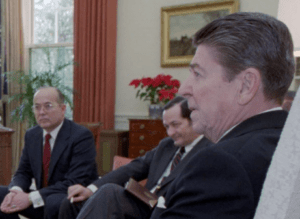
John Poindexter, Walter Raymond Jr. and Ronald Reagan. (Photo credit: Reagan presidential library)
By Robert Parry | Consortium News | March 25, 2017
Newly declassified documents from the Reagan presidential library help explain how the U.S. government developed its sophisticated psychological operations capabilities that – over the past three decades – have created an alternative reality both for people in targeted countries and for American citizens, a structure that expanded U.S. influence abroad and quieted dissent at home.
The documents reveal the formation of a psyops bureaucracy under the direction of Walter Raymond Jr., a senior CIA covert operations specialist who was assigned to President Reagan’s National Security Council staff to enhance the importance of propaganda and psyops in undermining U.S. adversaries around the world and ensuring sufficient public support for foreign policies inside the United States.
Raymond, who has been compared to a character from a John LeCarré novel slipping easily into the woodwork, spent his years inside Reagan’s White House as a shadowy puppet master who tried his best to avoid public attention or – it seems – even having his picture taken. From the tens of thousands of photographs from meetings at Reagan’s White House, I found only a couple showing Raymond – and he is seated in groups, partially concealed by other officials.
But Raymond appears to have grasped his true importance. In his NSC files, I found a doodle of an organizational chart that had Raymond at the top holding what looks like the crossed handles used by puppeteers to control the puppets below them. Although it’s impossible to know exactly what the doodler had in mind, the drawing fits the reality of Raymond as the behind-the-curtains operative who was controlling the various inter-agency task forces that were responsible for implementing various propaganda and psyops strategies.
Until the 1980s, psyops were normally regarded as a military technique for undermining the will of an enemy force by spreading lies, confusion and terror. A classic case was Gen. Edward Lansdale — considered the father of modern psyops — draining the blood from dead a Filipino rebel in such a way so the dead rebel’s superstitious comrades would think that a vampire-like creature was on the prowl. In Vietnam, Lansdale’s psyops team supplied fake and dire astrological predictions for the fate of North Vietnamese and Vietcong leaders.
Essentially, the psyops idea was to play on the cultural weaknesses of a target population so they could be more easily manipulated and controlled. But the challenges facing the Reagan administration in the 1980s led to its determination that peacetime psyops were also needed and that the target populations had to include the American public.
The Reagan administration was obsessed with the problems left behind by the 1970s’ disclosures of government lying about the Vietnam War and revelations about CIA abuses both in overthrowing democratically elected governments and spying on American dissidents. This so-called “Vietnam Syndrome” produced profound skepticism from regular American citizens as well as journalists and politicians when President Reagan tried to sell his plans for intervention in the civil wars then underway in Central America, Africa and elsewhere.
While Reagan saw Central America as a “Soviet beachhead,” many Americans saw brutal Central American oligarchs and their bloody security forces slaughtering priests, nuns, labor activists, students, peasants and indigenous populations. Reagan and his advisers realized that they had to turn those perceptions around if they hoped to get sustained funding for the militaries of El Salvador, Guatemala and Honduras as well as for the Nicaraguan Contra rebels, the CIA-organized paramilitary force marauding around leftist-ruled Nicaragua.
So, it became a high priority to reshape public perceptions to gain support for Reagan’s Central American military operations both inside those targeted countries and among Americans.
A ‘Psyops Totality’
As Col. Alfred R. Paddock Jr. wrote in an influential November 1983 paper, entitled “Military Psychological Operations and US Strategy,” “the planned use of communications to influence attitudes or behavior should, if properly used, precede, accompany, and follow all applications of force. Put another way, psychological operations is the one weapons system which has an important role to play in peacetime, throughout the spectrum of conflict, and during the aftermath of conflict.”
Paddock continued, “Military psychological operations are an important part of the ‘PSYOP Totality,’ both in peace and war. … We need a program of psychological operations as an integral part of our national security policies and programs. … The continuity of a standing inter-agency board or committee to provide the necessary coordinating mechanism for development of a coherent, worldwide psychological operations strategy is badly needed.”
Some of Raymond’s recently available handwritten notes show a focus on El Salvador with the implementation of “Nation wide multi-media psyops” spread through rallies and electronic media. “Radio + TV also carried Psyops messages,” Raymond wrote. (Emphasis in original.) Though Raymond’s crimped handwriting is often hard to decipher, the notes make clear that psyops programs also were directed at Honduras, Guatemala and Peru.
One declassified “top secret” document in Raymond’s file – dated Feb. 4, 1985, from Secretary of Defense Caspar Weinberger – urged the fuller implementation of President Reagan’s National Security Decision Directive 130, which was signed on March 6, 1984, and which authorized peacetime psyops by expanding psyops beyond its traditional boundaries of active military operations into peacetime situations in which the U.S. government could claim some threat to national interests.
“This approval can provide the impetus to the rebuilding of a necessary strategic capability, focus attention on psychological operations as a national – not solely military – instrument, and ensure that psychological operations are fully coordinated with public diplomacy and other international information activities,” Weinberger’s document said.
This broader commitment to psyops led to the creation of a Psychological Operations Committee (POC) that was to be chaired by a representative of Reagan’s National Security Council with a vice chairman from the Pentagon and with representatives from the Central Intelligence Agency, the State Department and the U.S. Information Agency.
“This group will be responsible for planning, coordinating and implementing psychological operations activities in support of United States policies and interests relative to national security,” according to a “secret” addendum to a memo, dated March 25, 1986, from Col. Paddock, the psyops advocate who had become the U.S. Army’s Director for Psychological Operations.
“The committee will provide the focal point for inter-agency coordination of detailed contingency planning for the management of national information assets during war, and for the transition from peace to war,” the addendum added. “The POC shall seek to ensure that in wartime or during crises (which may be defined as periods of acute tension involving a threat to the lives of American citizens or the imminence of war between the U.S. and other nations), U.S. international information elements are ready to initiate special procedures to ensure policy consistency, timely response and rapid feedback from the intended audience.”
Taking Shape
The Psychological Operations Committee took formal shape with a “secret” memo from Reagan’s National Security Advisor John Poindexter on July 31, 1986. Its first meeting was called on Sept. 2, 1986, with an agenda that focused on Central America and “How can other POC agencies support and complement DOD programs in El Salvador, Guatemala, Honduras, Costa Rica and Panama.” The POC was also tasked with “Developing National PSYOPS Guidelines” for “formulating and implementing a national PSYOPS program.” (Underlining in original)
Raymond was named a co-chair of the POC along with CIA officer Vincent Cannistraro, who was then Deputy Director for Intelligence Programs on the NSC staff, according to a “secret” memo from Deputy Under Secretary of Defense Craig Alderman Jr. The memo also noted that future POC meetings would be briefed on psyops projects for the Philippines and Nicaragua, with the latter project codenamed “Niagara Falls.” The memo also references a “Project Touchstone,” but it is unclear where that psyops program was targeted.
Another “secret” memo dated Oct. 1, 1986, co-authored by Raymond, reported on the POC’s first meeting on Sept. 10, 1986, and noted that “The POC will, at each meeting, focus on an area of operations (e.g., Central America, Afghanistan, Philippines).”
The POC’s second meeting on Oct. 24, 1986, concentrated on the Philippines, according to a Nov. 4, 1986 memo also co-authored by Raymond. “The next step will be a tightly drafted outline for a PSYOPS Plan which we will send to that Embassy for its comment,” the memo said. The plan “largely focused on a range of civic actions supportive of the overall effort to overcome the insurgency,” an addendum noted. “There is considerable concern about the sensitivities of any type of a PSYOPS program given the political situation in the Philippines today.”
Earlier in 1986, the Philippines had undergone the so-called “People Power Revolution,” which drove longtime dictator Ferdinand Marcos into exile, and the Reagan administration, which belatedly pulled its support from Marcos, was trying to stabilize the political situation to prevent more populist elements from gaining the upper hand.
But the Reagan administration’s primary attention continued to go back to Central America, including “Project Niagara Falls,” the psyops program aimed at Nicaragua. A “secret” Pentagon memo from Deputy Under Secretary Alderman on Nov. 20, 1986, outlined the work of the 4th Psychological Operations Group on this psyops plan “to help bring about democratization of Nicaragua,” by which the Reagan administration meant a “regime change.” The precise details of “Project Niagara Falls” were not disclosed in the declassified documents but the choice of code-name suggested a cascade of psyops.
Other documents from Raymond’s NSC file shed light on who other key operatives in the psyops and propaganda programs were. For instance, in undated notes on efforts to influence the Socialist International, including securing support for U.S. foreign policies from Socialist and Social Democratic parties in Europe, Raymond cited the efforts of “Ledeen, Gershman,” a reference to neoconservative operative Michael Ledeen and Carl Gershman, another neocon who has served as president of the U.S.-government-funded National Endowment for Democracy (NED), from 1983 to the present. (Underlining in original.)
Although NED is technically independent of the U.S. government, it receives the bulk of its funding (now about $100 million a year) from Congress. Documents from the Reagan archives also make clear that NED was organized as a way to replace some of the CIA’s political and propaganda covert operations, which had fallen into disrepute in the 1970s. Earlier released documents from Raymond’s file show CIA Director William Casey pushing for NED’s creation and Raymond, Casey’s handpicked man on the NSC, giving frequent advice and direction to Gershman. [See Consortiumnews.com’s “CIA’s Hidden Hand in ‘Democracy’ Groups.”]
Another figure in Raymond’s constellation of propaganda assets was media mogul Rupert Murdoch, who was viewed as both a key political ally of President Reagan and a valuable source of funding for private groups that were coordinating with White House propaganda operations. [See Consortiumnews.com’s “Rupert Murdoch: Propaganda Recruit.”]
In a Nov. 1, 1985 letter to Raymond, Charles R. Tanguy of the “Committees for a Community of Democracies – USA” asked Raymond to intervene in efforts to secure Murdoch’s funding for the group. “We would be grateful … if you could find the time to telephone Mr. Murdoch and encourage him to give us a positive response,” the letter said.
Another document, entitled “Project Truth Enhancement,” described how $24 million would be spent on upgrading the telecommunications infrastructure to arm “Project Truth, with the technical capability to provide the most efficient and productive media support for major USG policy initiatives like Political Democracy.” Project Truth was the overarching name of the Reagan administration’s propaganda operation. For the outside world, the program was billed as “public diplomacy,” but administration insiders privately called it “perception management.” [See Consortiumnews.com’s “The Victory of Perception Management.”]
The Early Years
The original priority of “Project Truth” was to clean up the images of the Guatemalan and Salvadoran security forces and the Nicaraguan Contras, who were led by ousted dictator Anastasio Somoza’s ex-National Guard officers. To ensure steady military funding for these notorious forces, Reagan’s team knew it had to defuse the negative publicity and somehow rally the American people’s support.
At first, the effort focused on weeding out American reporters who uncovered facts that undercut the desired public images. As part of that effort, the administration denounced New York Times correspondent Raymond Bonner for disclosing the Salvadoran regime’s massacre of about 800 men, women and children in the village of El Mozote in northeast El Salvador in December 1981. Accuracy in Media and conservative news organizations, such as The Wall Street Journal’s editorial page, joined in pummeling Bonner, who was soon ousted from his job. But such efforts were largely ad hoc and disorganized.
CIA Director Casey, from his years crisscrossing the interlocking worlds of business and intelligence, had important contacts for creating a more systematic propaganda network. He recognized the value of using established groups known for advocating “human rights,” such as Freedom House.
One document from the Reagan library showed senior Freedom House official Leo Cherne running a draft manuscript on political conditions in El Salvador past Casey and promising that Freedom House would make requested editorial “corrections and changes” – and even send over the editor for consultation with whomever Casey assigned to review the paper.
In a “Dear Bill” letter dated June 24, 1981, Cherne, who was chairman of the Freedom House’s executive committee, wrote: “I am enclosing a copy of the draft manuscript by Bruce McColm, Freedom House’s resident specialist on Central America and the Caribbean. This manuscript on El Salvador was the one I had urged be prepared and in the haste to do so as rapidly as possible, it is quite rough. You had mentioned that the facts could be checked for meticulous accuracy within the government and this would be very helpful. …
“If there are any questions about the McColm manuscript, I suggest that whomever is working on it contact Richard Salzmann at the Research Institute [an organization where Cherne was executive director]. He is Editor-in-Chief at the Institute and the Chairman of the Freedom House’s Salvador Committee. He will make sure that the corrections and changes get to Rita Freedman who will also be working with him. If there is any benefit to be gained from Salzmann’s coming down at any point to talk to that person, he is available to do so.”
By 1982, Casey also was lining up some powerful right-wing ideologues to help fund the “perception management” project both with money and their own media outlets. Richard Mellon Scaife was the scion of the Mellon banking, oil and aluminum fortune who financed a variety of right-wing family foundations – such as Sarah Scaife and Carthage – that were financial benefactors to right-wing journalists and think tanks. Scaife also published the Tribune Review in Pittsburgh, Pennsylvania.
A more comprehensive “public diplomacy” operation began to take shape in 1982 when Raymond, a 30-year veteran of CIA clandestine services, was transferred to the NSC. Raymond became the spark plug for this high-powered propaganda network, according to an unpublished draft chapter of the congressional Iran-Contra investigation that was suppressed as part of the deal to get three moderate Republican senators to sign on to the final report and give the inquiry a patina of bipartisanship.
Though the draft chapter didn’t use Raymond’s name in its opening pages, apparently because some of the information came from classified depositions, Raymond’s name was used later in the chapter and the earlier citations matched Raymond’s known role. According to the draft report, the CIA officer who was recruited for the NSC job had served as Director of the Covert Action Staff at the CIA from 1978 to 1982 and was a “specialist in propaganda and disinformation.”
“The CIA official [Raymond] discussed the transfer with [CIA Director] Casey and NSC Advisor William Clark that he be assigned to the NSC as [Donald] Gregg’s successor [as coordinator of intelligence operations in June 1982] and received approval for his involvement in setting up the public diplomacy program along with his intelligence responsibilities,” the chapter said. Gregg was another senior CIA official who was assigned to the NSC before becoming Vice President George H.W. Bush’s national security adviser.
“In the early part of 1983, documents obtained by the Select [Iran-Contra] Committees indicate that the Director of the Intelligence Staff of the NSC [Raymond] successfully recommended the establishment of an inter-governmental network to promote and manage a public diplomacy plan designed to create support for Reagan Administration policies at home and abroad.”
War of Ideas
During his Iran-Contra deposition, Raymond explained the need for this propaganda structure, saying: “We were not configured effectively to deal with the war of ideas.”
One reason for this shortcoming was that federal law forbade taxpayers’ money from being spent on domestic propaganda or grassroots lobbying to pressure congressional representatives. Of course, every president and his team had vast resources to make their case in public, but by tradition and law, they were restricted to speeches, testimony and one-on-one persuasion of lawmakers. But President Reagan saw the American public’s “Vietnam Syndrome” as an obstacle to his more aggressive policies.
Along with Raymond’s government-based organization, there were outside groups eager to cooperate and cash in. Back at Freedom House, Cherne and his associates were angling for financial support.
In an Aug. 9, 1982 letter to Raymond, Freedom House executive director Leonard R. Sussman wrote that “Leo Cherne has asked me to send these copies of Freedom Appeals. He has probably told you we have had to cut back this project to meet financial realities. … We would, of course, want to expand the project once again when, as and if the funds become available. Offshoots of that project appear in newspapers, magazines, books and on broadcast services here and abroad. It’s a significant, unique channel of communication” – precisely the focus of Raymond’s work.
On Nov. 4, 1982, Raymond, after his transfer from the CIA to the NSC staff but while still a CIA officer, wrote to NSC Advisor Clark about the “Democracy Initiative and Information Programs,” stating that “Bill Casey asked me to pass on the following thought concerning your meeting with [right-wing billionaire] Dick Scaife, Dave Abshire [then a member of the President’s Foreign Intelligence Advisory Board], and Co. Casey had lunch with them today and discussed the need to get moving in the general area of supporting our friends around the world.
“By this definition he is including both ‘building democracy’ … and helping invigorate international media programs. The DCI [Casey] is also concerned about strengthening public information organizations in the United States such as Freedom House. … A critical piece of the puzzle is a serious effort to raise private funds to generate momentum. Casey’s talk with Scaife and Co. suggests they would be very willing to cooperate. … Suggest that you note White House interest in private support for the Democracy initiative.”
The importance of the CIA and White House secretly arranging private funds was that these supposedly independent voices would then reinforce and validate the administration’s foreign policy arguments with a public that would assume the endorsements were based on the merits of the White House positions, not influenced by money changing hands. Like snake-oil salesmen who plant a few cohorts in the crowd to whip up excitement for the cure-all elixir, Reagan administration propagandists salted some well-paid “private” individuals around Washington to echo White House propaganda “themes.”
The role of the CIA in these initiatives was concealed but never far from the surface. A Dec. 2, 1982 note addressed to “Bud,” a reference to senior NSC official Robert “Bud” McFarlane, described a request from Raymond for a brief meeting. “When he [Raymond] returned from Langley [CIA headquarters], he had a proposed draft letter … re $100 M democ[racy] proj[ect],” the note said.
While Casey pulled the strings on this project, the CIA director instructed White House officials to hide the CIA’s hand. “Obviously we here [at CIA] should not get out front in the development of such an organization, nor should we appear to be a sponsor or advocate,” Casey said in one undated letter to then-White House counselor Edwin Meese III as Casey urged creation of a “National Endowment.”
But the formation of the National Endowment for Democracy, with its hundreds of millions of dollars in U.S. government money, was still months down the road. In the meantime, the Reagan administration would have to line up private donors to advance the propaganda cause.
“We will develop a scenario for obtaining private funding,” NSC Advisor Clark wrote to Reagan in a Jan. 13, 1983 memo, adding that U.S. Information Agency Director “Charlie Wick has offered to take the lead. We may have to call on you to meet with a group of potential donors.”
Despite Casey’s and Raymond’s success in bringing onboard wealthy conservatives to provide private funding for the propaganda operations, Raymond worried about whether a scandal could erupt over the CIA’s involvement. Raymond formally resigned from the CIA in April 1983, so, he said, “there would be no question whatsoever of any contamination of this.” But Raymond continued to act toward the U.S. public much like a CIA officer would in directing a propaganda operation in a hostile foreign country.
Raymond fretted, too, about the legality of Casey’s ongoing role. Raymond confided in one memo that it was important “to get [Casey] out of the loop,” but Casey never backed off and Raymond continued to send progress reports to his old boss well into 1986.
It was “the kind of thing which [Casey] had a broad catholic interest in,” Raymond shrugged during his Iran-Contra deposition. He then offered the excuse that Casey undertook this apparently illegal interference in domestic politics “not so much in his CIA hat, but in his adviser to the president hat.”
Peacetime Propaganda
Meanwhile, Reagan began laying out the formal authority for this unprecedented peacetime propaganda bureaucracy. On Jan. 14, 1983, Reagan signed National Security Decision Directive 77, entitled “Management of Public Diplomacy Relative to National Security.” In NSDD-77, Reagan deemed it “necessary to strengthen the organization, planning and coordination of the various aspects of public diplomacy of the United States Government.”
Reagan ordered the creation of a special planning group within the National Security Council to direct these “public diplomacy” campaigns. The planning group would be headed by Walter Raymond and one of its principal outposts would be a new Office of Public Diplomacy for Latin America, housed at the State Department but under the control of the NSC. (One of the directors of the Latin American public diplomacy office was neoconservative Robert Kagan, who would later co-found the Project for the New American Century in 1998 and become a chief promoter of President George W. Bush’s 2003 invasion of Iraq.)
On May 20, 1983, Raymond recounted in a memo that $400,000 had been raised from private donors brought to the White House Situation Room by U.S. Information Agency Director Charles Wick. According to that memo, the money was divided among several organizations, including Freedom House and Accuracy in Media, a right-wing media attack organization.
When I wrote about that memo in my 1992 book, Fooling America, Freedom House denied receiving any White House money or collaborating with any CIA/NSC propaganda campaign. In a letter, Freedom House’s Sussman called Raymond “a second-hand source” and insisted that “this organization did not need any special funding to take positions … on any foreign-policy issues.”
But it made little sense that Raymond would have lied to a superior in an internal memo. And clearly, Freedom House remained central to the Reagan administration’s schemes for aiding groups supportive of its Central American policies, particularly the CIA-organized Contra war against the leftist Sandinista regime in Nicaragua. Plus, White House documents released later revealed that Freedom House kept its hand out for funding.
On Sept. 15, 1984, Bruce McColm – writing from Freedom House’s Center for Caribbean and Central American Studies – sent Raymond “a short proposal for the Center’s Nicaragua project 1984-85. The project combines elements of the oral history proposal with the publication of The Nicaraguan Papers,” a book that would disparage Sandinista ideology and practices.
“Maintaining the oral history part of the project adds to the overall costs; but preliminary discussions with film makers have given me the idea that an Improper Conduct-type of documentary could be made based on these materials,” McColm wrote, referring to a 1984 film that offered a scathing critique of Fidel Castro’s Cuba. “Such a film would have to be the work of a respected Latin American filmmaker or a European. American-made films on Central America are simply too abrasive ideologically and artistically poor.”
McColm’s three-page letter reads much like a book or movie pitch, trying to interest Raymond in financing the project: “The Nicaraguan Papers will also be readily accessible to the general reader, the journalist, opinion-maker, the academic and the like. The book would be distributed fairly broadly to these sectors and I am sure will be extremely useful. They already constitute a form of Freedom House samizdat, since I’ve been distributing them to journalists for the past two years as I’ve received them from disaffected Nicaraguans.”
McColm proposed a face-to-face meeting with Raymond in Washington and attached a six-page grant proposal seeking $134,100. According to the grant proposal, the project would include “free distribution to members of Congress and key public officials; distribution of galleys in advance of publication for maximum publicity and timely reviews in newspapers and current affairs magazines; press conferences at Freedom House in New York and at the National Press Club in Washington, D.C.; op-ed circulation to more than 100 newspapers …; distribution of a Spanish-language edition through Hispanic organizations in the United States and in Latin America; arrangement of European distribution through Freedom House contacts.”
The documents that I found at the Reagan library did not indicate what subsequently happened to this specific proposal. McColm did not respond to an email request for comment about the Nicaraguan Papers plan or the earlier letter from Cherne (who died in 1999) to Casey about editing McComb’s manuscript. Freedom House did emerge as a leading critic of Nicaragua’s Sandinista government and also became a major recipient of money from the U.S.-funded National Endowment for Democracy, which was founded in 1983 under the umbrella of the Casey-Raymond project.
The more recently released documents – declassified between 2013 and 2017 – show how these earlier Casey-Raymond efforts merged with the creation of a formal psyop bureaucracy in 1986 also under the control of Raymond’s NSC operation. The combination of the propaganda and psyop programs underscored the powerful capability that the U.S. government developed more than three decades ago for planting slanted, distorted or fake news. (Casey died in 1987; Raymond died in 2003.)
Over those several decades, even as the White House changed hands from Republicans to Democrats to Republicans to Democrats, the momentum created by William Casey and Walter Raymond continued to push these “perception management/psyops” strategies forward. In more recent years, the wording has changed, giving way to more pleasing euphemisms, like “smart power” and “strategic communications.” But the idea is still the same: how you can use propaganda to sell U.S. government policies abroad and at home.
Investigative reporter Robert Parry broke many of the Iran-Contra stories for The Associated Press and Newsweek in the 1980s.
Land Rights Activist Shot Dead in Brazilian Hospital
teleSUR | March 22, 2017
Waldomiro Costa Pereira, an activist with the Landless Workers Movement, MST, was killed Monday when gunmen stormed a hospital in Parauapebas in northeastern Brazil’s Para state, activists said in a statement.
Five armed men burst into a small town hospital in the Brazilian Amazon, surrounded security guards and shot dead the prominent land rights activist, in the latest deadly attack on land campaigners.
The motive for Pereira’s murder was unclear, the MST said, but the activist had been recovering in the hospital from a previous assassination attempt.
“This is yet another murder of workers in the state of Para,” the MST said in a statement. “Impunity has become commonplace as has the action of criminal militia groups,” the group said, adding that Pereira was a longtime activist in the “struggle for agrarian reform.”
At the time of his killing, Pereira was not active with the MST and was instead devoting his time to advising the local government on agriculture, the activist group said.
Local officials in the city of Parauapebas condemned the murder and police said they were investigating the killing, the Folha de Sao Paulo newspaper reported.
Conflicts over territory are common in Brazil where 1 percent of the population owns nearly half of the nation’s land, according to a 2016 study from the University of Windsor in Canada.
Brazil has become one of the world’s most dangerous countries for land rights activists, with 61 killed in 2016, the highest level since 2003, according to Brazil’s Pastoral Land Commission.
Featured Video
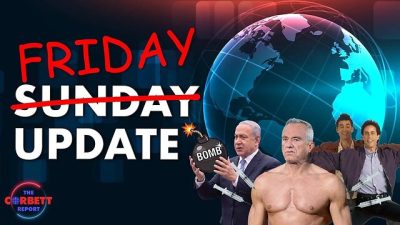
Racist Seinfeld Dances for Joy as Bibi Unveils His New Map
or go to
Aletho News Archives – Video-Images
TV Drama Review
Japanese drama projects Japan’s wartime atrocities onto Chinese characters
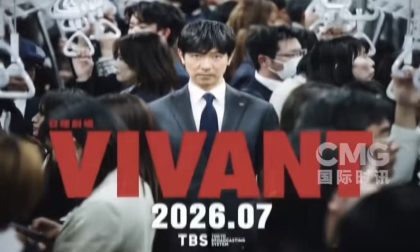
Global Times | October 25, 2026
By portraying Chinese characters as perpetrators of ruthless violence while casting Japanese Self-Defense Forces (SDF) intelligence operatives as defenders, the season 2 of the Japanese drama Vivant has recently drawn criticism from Chinese netizens, who argue that its depiction turns historical reality on its head while ignoring Japan’s wartime atrocities.
The TBS drama series – a spy suspense story in which an alleged unofficial intelligence unit of the SDF operates across the globe — has attracted a passionate fanbase. Its currently airing season 2 opened with a household rating of 18.8 percent, the highest for a TV drama this year, according toa commentary article by Japanese media Toyo Keizai.
What draws attention is the portrayal of the enemies in the series, the article noted. Scenes in which the Chinese organization subjects kidnapped members of the SDF unit to brutal torture are repeated with unrelenting intensity.
It is rare for Japanese TV dramas to explicitly portray a real-life country as the enemy, the article noted.
Japanese Prime Minister Sanae Takaichi also made a reference to the drama, saying that she has been recording Vivant and hopes to binge-watch it over the year-end and New Year holidays, according to Japanese media outlets.
China’s CCTV News report on Sunday revealed that the drama features scenes in which Chinese personnel cut off the fingers of and stab Japanese intelligence operatives in the abdomen. Such acts bear striking similarities to the torture inflicted on Chinese nationals by invading Japanese troops during the World War II.
The drama distorts the truth by attributing these atrocities to modern Chinese characters. Beneath the surface, it subtly glorifies Japan’s cross-border overseas operations, blurs the functional boundaries of the SDF and implicitly promotes an expansionist narrative, per CCTV News. … continue
Blog Roll
 Aletho News
- Up in arms… Koreans reject U.S. empire’s plan to make South Korea the next Ukraine
- Iran, Turkey, Pakistan, Saudi Arabia could advance region-led security framework in Tehran: FM spox
- Netizens condemn Japanese drama for projecting Japan’s wartime atrocities onto Chinese characters
- Racist Seinfeld Dances for Joy as Bibi Unveils His New Map
- A West Bank War for Netanyahu’s Election Campaign, Could It Backfire?
- Yemen denounces European Parliament’s ‘hypocritical’ push to blacklist Ansarullah
- Qalibaf: UAE’s UN bid aims to ‘clear the runway’ for ‘Greater Israel’, whitewash genocide
- Pakistan reopens Iran border after boosting security: Report
- Why are so many Brazilians voting for Flávio Bolsonaro?
- Democrats Put Anti-Russia Agenda Ahead of American Workers
- If Americans Knew
- An error has occurred; the feed is probably down. Try again later.
- No Tricks Zone
- Sudden Stratospheric Warming, Powerful El Niño Combination May Lead To Extreme Europe Cold, Energy Crisis!
- Two New Studies Find Thwaites Glacier Melt Cannot Be Driven By Human Activity Or A Warming Ocean
- E-Cars Reduce CO2 Emissions By Only 41% Compared To Internal Combustion Engine Vehicles
- Predictions Made By Renowned Climate Professor Over Past Decades Have Been Proven To Be Poor
- New Study Suggests Large Regions Of The Pacific Ocean Have Been Cooling For The Last 80 Years
- Germany’s Green Energy Debacle: High Energy Costs Force Kahla Porzellan to Close After 182 Years!
- New Study: 50 Years Of The Most Aggressive ‘Net Zero’ Policies Can Only Affect The Global Climate By 0.03°C
- US September “Heat” Was No Record…Many Records Set Decades Ago
- Latest European Green Energy Debacle; Portugal’s Largest Flagship Solar Park Insolvent!
- Green Energy Debacle: German Expert Professor Fritz Vahrenholt Warns Of Severe Economic And Social Consequences

