Psychoanalysing NATO: The Diagnosis
By Patrick ARMSTRONG | Strategic Culture Foundation | 21.12.2018
In previous essays I argued that NATO tries to distract our attention from its crimes by accusing Russia of those crimes: this is “projection“. NATO manipulates its audience into thinking the unreal is real: this is “gaslighting“. NATO sees what it expects to see – Moscow’s statements that they will respond to medium range missiles emplaced next door are re-jigged as the “threats” which justify NATO’s earlier act: this is “confirmation bias“. And, finally, NATO thinks Russia is so weak it’s doomed and so strong that it is destroying the tranquillity of NATOLand: this is a sort of geopolitical “schizophrenia.” (I must acknowledge Bryan MacDonald’s marvellous neologism of Russophrenia – a condition where the sufferer believes Russia is both about to collapse, and take over the world.)
I wrote the series partly to amuse the reader but with a serious purpose as well. And that serious purpose is to illustrate the absurdities that NATO expects us to believe. NATO here being understood as sometimes the headquarters “international staff”, sometimes all members in solemn conclave, sometimes some NATO members and associates. “NATO” has become a remarkably flexible concept: Libya was a NATO operation, even though Germany kept out of it. Somalia was not a NATO operation even though Germany was in it. Canada, a founding NATO member, was in Afghanistan but not in Iraq. Some interventions are NATO, others aren’t. The NATO alliance today is a box of spare parts from which Washington assembles its “coalitions of the willing“. It’s Washington’s beard.
NATO and its members are inexhaustible sources of wooden language and dishonesty. Take Washington’s demand that Iran get out of Syria while US forces stay there. Syria has a recognised government, that government invited Iran in; no one invited the USA and its minions in. A child could see the upside down nature of this: it’s a housebreaker demanding the host evict the guests and hand over their bedrooms. This, apparently, is what NATO calls the “rules-based order“. Here’s the American official insisting it’s all legal: “our forces are there under a set of legal and diplomatic documents… “; but he only mentions one and it’s an American one. Putin is condemned for saying “Whatever action a State takes bypassing this procedure are illegitimate, run counter to the UN Charter and defy international law“. We are expected to solemnly nod our heads rather than contemptuously laugh when unilateralism is meretriciously named “rules-based”. These inversions of reality are routinely fed to us by NATO and its mouthpieces.
A very recent revelation of NATO’s gaslighting is the Integrity Initiative (such a gaslighting name!) busy trolling away with a couple of million from the British taxpayer. Its remit, apparently, includes infiltrating political movements of an ally and it “defends democracy against disinformation” by smearing its own political actors with disinformation. Does Russia do this? Well there’s RT and Sputnik and “Russians” did spend nearly $5000 on Google and $7000 on Facebook fixing the US election. And almost one dollar on Brexit ads. And one should never forget the insidious effect of Masha and the Bear. But don’t dare laugh at these preposterous assertions: the BBC earnestly assures us that humour is Putin’s newest weapon. Against this mighty effort, there can be no vigilance too strong! The only way to protect our values is to trash them: defend freedom of thought by secretly planting fake stories, defend democracy by smearing the opposition as Russian stooges. Pure gaslighting, defended by projection and confirmation bias: “This kind of work attracts the extremely hostile and aggressive attention of disinformation actors, like the Kremlin and its various proxies“.
NATO hyperventilates about “Russia’s military activities, particularly along NATO’s borders“. Only in NATO’s counterfeit universe could this be imagined; in the real world Russia’s military is inside its own borders. Once again, the proper response is a contemptuous sneer rather than solemn head nodding.
NATO collectively and severally manifests a detachment from reality. Its website is full of pious assertions about being a defensive alliance that brings stability wherever it goes, replete with valuable values. And it always tells the truth. The reality? No rational person would regard Moscow’s concern about a military alliance creeping ever closer as “aggressive”. There is less stability in Libya, Iraq and Afghanistan than before NATO entered them. Fooling around in Yugoslavia, Georgia and Ukraine have sparked actual shooting wars. NATO’s activities in Syria (illegal by any standards of international law, be it remembered) have not brought stability. More civilians killed, Raqqa obliterated, hospitals methodically destroyed. All “tragic accidents” of course; but don’t look here! look at Russia! Only in its imagination is NATO a bringer of stability. As to its values, they’re mutable – it’s good to break up Yugoslavia, invade Iraq and Afghanistan and destroy Libya but Crimeans taking the opportunity to return to Russia is a heinous crime. NATO’s so-called values are whatever NATO does. And as to NATO’s promises: well it did expand, didn’t it? (Here’s NATO’s official weasel-wording: “Personal assurances from individual leaders cannot replace Alliance consensus and do not constitute formal NATO agreement”. And suddenly its narrative jumps to President Clinton. Wrong POTUS, actually; NATO’s caught gaslighting again.) Its intervention in Libya was very far from what the UN resolution approved: it was an armed intervention against the government on false pretences.
Here’s what NATO’s so-called “stability projection” has actually produced: riots in France, partly connected with the influx of “migrants” coming from the Libya that NATO destroyed. But, we are supposed to believe it has nothing to do with NATO, it’s Putin! Only an idiot could believe that.
NATO had a purpose when it was formed, or at least it thought it did. It is true that, at war’s end where the Soviet Army stood “elections” were held and socialist or communist parties came to power and stayed in power. (Austria being an exception). There were at least two ways that one could understand this extension of Soviet power. One was that they were the actions of an expansionist hostile power that fully intended to go all the way to Cape Finisterre if it could and, if not prevented, would. In such a case the Western Allies would be fully justified in forming a defensive alliance to deter Soviet expansion. Another possible interpretation was that, after such a hard victory in so fearfully destructive a war, Moscow was determined that never again would its neighbours be used as an assembly area and start line for the forces of another Hitler. Such an interpretation would call for quite another approach from the Western Allies. We all know which of the two interpretations was followed. I have speculated elsewhere that Reinhard Gehlen may have had a strong influence on that decision. But, for whatever reason, the NATO alliance was founded on that first assumption and it shaped the world in one direction rather than another.
Since the USSR broke up, taking with it NATO’s original raison d’être, NATO members, sometimes under the NATO flag and sometimes not, have helped break up Yugoslavia and Serbia, invaded Afghanistan, Iraq (twice), Syria, destroyed Libya, incited a war in Georgia, carried out a coup d’etat in Ukraine and participated in the civil war there. That’s not stability. And, where NATO has set foot, it stays. KFOR is still bringing “peace and stability” in Year 19 and Kosovo is home to a huge US base. Afghanistan is in Year 17. Iraq is in Year 15. Syria is Year 7 and set to run forever. Ironically Latvians, Estonians and Lithuanians are back in Afghanistan; different flag, same place. That’s not stability either.
And still the wooden language rolls out. But turn off your brain when you read it.
POLITICAL – NATO promotes democratic values and enables members to consult and cooperate on defence and security-related issues to solve problems, build trust and, in the long run, prevent conflict.
MILITARY – NATO is committed to the peaceful resolution of disputes. If diplomatic efforts fail, it has the military power to undertake crisis-management operations. These are carried out under the collective defence clause of NATO’s founding treaty – Article 5 of the Washington Treaty or under a United Nations mandate, alone or in cooperation with other countries and international organisations.
Has post-USSR NATO ever peacefully resolved a dispute? Anywhere? Any time? It’s always military power. What did Article 5 (an attack on one is an attack on all) have to do with NATO’s war on Libya? Did it attack one of them? How about Serbia? One can (fraudulently) argue that someone in Afghanistan attacked the USA but who did in Iraq? As to “democratic values”, well, it will be amusing to watch NATO’s reactions to Ukraine President Poroshenko trying to avoid the election. And nobody likes to mention the pack of organ harvesters and drug runners NATO gave a whole country to.
If NATO were a human individual on the couch, a case could be made that it is living in a fantasy world in which everything is reversed.
Woe unto them that call evil good, and good evil;
that put darkness for light, and light for darkness;
that put bitter for sweet, and sweet for bitter!
Delenda NATO est!
What stopped Chad’s Idriss Déby from visiting Israel before now?
Dr Mustafa Fetouri | MEMO | December 20, 2018
If you did not know much about Chad, a country in the middle of Africa, it most likely it caught your eye on 26 November when its President, Idriss Déby, landed in Israel for an unannounced visit to the Zionist state. The visit was shrouded in secrecy until Déby’s plane touched down at Ben Gurion Airport. His closest aides had no idea that he was heading to Tel Aviv until the last minute. It reminds me of November 1977, when Egypt’s then President Anwar Sadat made his surprise trip to Israel.
Sadat justified his move by the fact that Egypt and Israel were at war with each other and such a visit, he believed, helped to make peace. Déby, on the other hand, has been in power since December 1990, Chad is not at war with Israel and the two countries are thousands of miles apart; so what motivated him to embark on such an endeavour at this time? Or, indeed, what stopped him from making such a visit before now?
Israeli journalist Herb Keinon answered this question by explaining that, “Chad severed ties with Israel in 1972 after coming under pressure from Libya.” Reuters reported that Dore Gold, the Director of Israel’s Foreign Ministry in 2016, explained after his own visit to Chad why the government in N’Djamena cut ties with Israel over four decades earlier: “[his Chadian hosts] told him that they cut off ties 44 years prior under Libyan pressure, a factor removed with the toppling of Muammar Gaddafi [in 2011].”
Indeed Libya under Gaddafi was the fiercest opponent of Israeli expansion in Africa. As early as 1972, just three years after taking power, Gaddafi forced the then Chadian President, François Tombalbaye, to sever ties with Tel Aviv. Gaddafi believed strongly that any Israeli diplomatic expansion into Africa undermined the continent’s pro-Palestinian position. The late Libyan leader considered Israel to be an enemy best kept as far away as possible from Libya and Africa.
Libya has a history of ties with Chad going back to Italy’s invasion and occupation of Libya in 1911, which saw hundreds of Libyans seeking safety in Chad; their descendants still live in Libya’s southern neighbour. Gaddafi capitalised on this to strengthen ties between this community of exiles and their home country. He also sought to prevent Chad from becoming a threat to Libya’s security, which is why Tripoli was involved in toppling Chadian regimes considered unfriendly, particularly between 1972 and 1990.
Idriss Déby himself became President of Chad in December 1990, with Libyan political and military support. Gaddafi invested Libya’s oil money in Chad; the North African state owns two banks there and some luxury hotels, and built dozens of schools, mosques and medical facilities, as well as communication and agriculture infrastructure.
The late Libyan leader also used his political clout in Africa to keep African countries away from western influence, knowing too well that it would only benefit Israel as many western capitals would encourage them to embrace and help Tel Aviv to infiltrate the continent even more. In this context, Libya founded the African Union in 1999, for Pan-African cooperation. Tripoli also founded the Community of Sahel-Saharan States (CEN-SAD), bringing 24 Sub-Saharan African counties closer to neighbouring North African Arab states to share investment, free trade, security and foreign policy coordination.
This put Libya, before 2011, in direct competition with western powers in Africa. One of Tripoli’s long term objectives was to launch a golden dinar, backed by its own huge financial reserves, as a currency for African states to replace the CFA franc which is backed by the French treasury. This was one of the reasons behind French President Nicolas Sarkozy’s attack on Libya to topple the Gaddafi regime in 2011.
After Gaddafi was killed in 2011, many of his long term African initiatives were, under French pressure, abandoned. CEN-SAD, for example, is being replaced by the smaller Group of 5 Sahel (G5S) made up of Chad, Niger, Mali, Mauritania and Burkina Faso. Ironically, though, the members of G5S are the weakest in Africa and are focusing on security by allowing France and the United States to establish military bases in Mali and Niger. This would have been unthinkable if Gaddafi was still around.
Having the best military among the G5S countries, Chad’s Idriss Déby has become even more influential in Africa. This makes his link with Israel even more dangerous.
As the leading armed forces within G5S, Chad’s army is responsible for fighting terrorism in the Sahel region. Déby and Mohamed Ould Abdel Aziz of Mauritania are seeking to promote G5S as a trusted partner in Africa. In this context, visiting Israel is an important step to unlock further diplomatic and military support.
Israeli Prime Minister Benjamin Netanyahu has made it his objective since 2016 to visit as many Muslim majority countries as possible. It would not be surprising to see some sort of rapprochement between Israel and Mali, Mauritania or Niger, or all three. Déby’s ice breaking visit to Tel Aviv has helped open the door for such rapprochement in Africa which, once upon a time, was a no-go area for Israel.
Apart from diplomatic gains, Israel is also interested in using Chad and its neighbours as stopovers for flights to South America, saving time and cost. A flight from Tel Aviv to Brazil, for example, will be around four hours shorter if central African airspace can be used. At the moment, such flights take around 17 hours, with at least one stopover in Europe or North America for refuelling.
Déby is facing more security challenges from his own people as armed rebel groups become more organised and stronger thanks to the safe bases they have in southern Libya. Young people in Chad’s Sahel region of Bahr El-Ghazal and Kanem in particular are becoming increasingly disenchanted with the authority in N’Djamena. The President’s security apparatus has been using discriminatory and heavy-handed tactics in the region under the pretext of fighting Boko Haram and other terror groups which infiltrated this vital area after Libya was destroyed by NATO in 2011.
The Chadian President is likely to seek Israeli help to keep himself in power. France, his main backer, “encouraged him to visit Israel,” according to Aqreen Saleh, the former Libyan ambassador to Chad who knows Déby personally. Saleh insists that “security for [Déby’s] regime is the main driver behind the visit to Israel,” not least because, over the past five years, the government in N’Djamena has been challenged by the rebel groups operating from southern Libya.
However, going to Israel is likely to backfire, particularly among Chad’s Muslim majority population. Historically, and especially since Chad gained independence, it has been Muslims who have risen against and toppled the central government.
Before 2011, thousands of Chadians depended on Libya for employment opportunities. Now they are heading to Libya to join rebel groups or work as mercenaries fighting for different Libyan factions, compounding Déby’s problems.
Idriss Déby needs arms and military equipment to fight the threat from the rebels operating out of Libya and Israel is only too happy to supply them to him. In the absence of any strong Arab leadership in Africa post-Gaddafi and the destruction of Libya, more African leaders are likely to embrace apartheid Israel at the expense of African support for the Palestinians and links with the Arab world.
French bank pays huge US fine for doing business in Cuba, Iran
RT | November 20, 2018
Societe Generale has agreed to pay $1.34 billion to US federal and state authorities to settle a pending legal dispute over violations of US trade sanctions against Iran and other countries.
One of France’s largest banks has also pledged to pay $95 million to resolve another dispute over violations of anti-money laundering regulations.
“We acknowledge and regret the shortcomings that were identified in these settlements, and have cooperated with the US authorities to resolve these matters,” the group CEO Frederic Oudea said in a statement.
“These resolutions, following on the heels of the resolution of other investigations earlier this year, allow the bank to close a chapter on our most important historical disputes.”
The bank, informally known as SocGen, reportedly violated the Trading with the Enemy Act by illegally transferring billions of dollars to partners registered or located in countries targeted by US embargos, including Iran, Sudan, Cuba and Libya.
The banking giant said the settlement wouldn’t have an extra impact on its results for the current financial year. SocGen had previously agreed to $1.3 billion (€1.14 billion) in the US and France to settle investigations over transactions with Libya, and over the suspected rigging of Libor, a benchmark rate tied to finance products and debts. Last year, the bank had paid €963 million ($1.1 billion) over another dispute with the Libyan Investment Authority.
According to the Manhattan US Attorney’s office, the latest fine imposed on SocGen is the second biggest financial penalty issued on a bank for breaching US sanctions. In 2015, French international banking group BNP Paribas agreed to pay $8.9 billion to settle a probe on sanctions violations.
NATO’s Greatest Enemy is Itself
By Ulson Gunnar – New Eastern Outlook – 18.11.2018
Accidents happen. For Norway at the conclusion of NATO’s Trident Juncture 2018 military exercises, such an accident occurred with its Lockheed Martin Aegis-equipped frigate, HNoMS Helge Ingstad.
After a collision with an oil tanker, the frigate’s captain ordered the ship aground to prevent a total loss. The quick thinking may have saved the lives of Norwegian sailors and made salvaging operations easier. Thankfully no lives were lost and only eight injuries are being reported by the Western media.
The NATO exercises the Helge Ingstad was participating in simulated an invasion of Norway. As the Council on Foreign Relations made clear in their article, “NATO’s Trident Juncture Exercises: What to Know,” the imaginary invaders were obvious stand-ins for Russia.
The CFR piece would claim:
The aggressor in the simulation is fictitious, but the setting and the scale of the exercises point clearly in one direction. Tensions between NATO and Russia, which shares an Arctic border with Norway, are running high. In the last five years, Russia has annexed Crimea, destabilized eastern Ukraine, provided military aid to a brutal regime in Syria, meddled in Western elections, and either walked away from or allegedly violated major multilateral security treaties.
Of course none of what the CFR alleges is true and many of the accusations leveled against Russia by the article have long been abandoned by even most in the Western media.
The fact that Norway lost an expensive ship in the middle of this NATO exercise to prepare for a Russian invasion that will never happen suggests that the greatest threat much of Europe faces is from NATO itself, not Moscow.
NATO is a Cancer, Not a Shield
The amount of money required to host NATO members in Norway to prepare for a Russian invasion that will never happen would seem detrimental to Norwegians as well as other European nations spending money to move their forces and their equipment (40,000 personnel, 120 aircraft and 70 ships) to and from the exercise areas.
Training is important and maintaining a strong military as well as a credible deterrence is also important for all nations, both Western Europe and Russia included. But such preparations should be proportional to the prospective threats any nation or bloc of nations face. Such preparations should also clearly be made to create a deterrence rather than a provocation.
NATO’s Trident Juncture appears to be more of an exercise to enforce NATO expansion eastward toward Russia’s borders than any genuine preparation for a “Russian invasion” that even Norway’s leadership says is highly unlikely.
Such exercises and the agenda they serve benefits a handful of special interests, primarily in Washington (Lockheed Martin included), at the expense of NATO’s European members.
NATO, driven primarily by Washington and immense corporate interests who hold sway over it, has become a tool used to extend American ambitions around the globe. Few could provide a credible explanation as to what NATO’s nearly two decade-long occupation of Afghanistan has to do with defending Europe.
For Norway specifically, Afghanistan has become the grave for at least 10 of its service members and a blackhole that has swallowed several billion dollars in Norwegian expenditures.
Likewise, it was US-led NATO that destroyed the North African nation of Libya (with Norwegian assistance), transforming it into a hotbed of terrorism and triggering a refugee crisis that flooded European territory and continues to be a source of socioeconomic tension today.
In this instance, NATO directly compromised European security, and Norway’s taxpayers helped underwrite the disaster.
It is clear that NATO is not protecting Europe. It is using Europe to advance American ambitions around the globe, far beyond any reasonable jurisdiction a defense alliance aimed at protecting Europe should have. As NATO uses Europe, it is consuming funds that could be better used domestically for the European people. The net result of NATO’s activities undermine rather than uphold European security.
NATO’s Trident Juncture is simply an extension of this process, aimed at ratcheting up tensions with Russia and only further undermining European peace and stability in the process.
Other Ways NATO Undermines European Peace and Prosperity
Beyond military alliances and defense preparations, there are also alternatives for creating a deterrence to war and military aggression. These alternatives include economic cooperation. Here, such cooperation between Europe and Russia is complicated by US-led efforts to economically isolate Russia and sabotage trade and investment between Russia and its neighbors to the west.
By conducting provocative exercises aimed at Russia, tensions are only further encouraged and US efforts to place a wedge deeper between Russia and the rest of Europe further advanced.
What we’re left with is a Europe compelled to view its neighbor to the east as an enemy for lack of any viable alternative not met with Washington’s ire.
NATO, a supposed defense alliance, instead promotes tensions, exports wars and consumes the blood and treasure of member-states for foreign military adventures thousands of miles from European shores. Considering this, NATO, not Russia, seems to be the greatest threat facing Europe today.
Moscow Doesn’t Plan to Create Stronghold in Libya – Russian Embassy in UK
Sputnik – October 9, 2018
LONDON – The Russian Embassy in London on Tuesday refuted reports claiming that Moscow was allegedly plotting to get control over European immigration routes in Libya and establish a stronghold against the West.
“This publication has nothing to do with reality. We are treating it as a new attempt to shift the responsibility for the ruined country and destroyed lives of millions of Libyans on Russia which had no relation to the 2011 NATO military intervention which grossly violated the whole range of UN Security Council resolutions,” a representative of the embassy told reporters.
The embassy added that Russia supported peacemaking efforts in Libya and never planned any military intervention.
“We fully respect the UN Security Council Resolution 1970 which imposed an arms embargo on Libya,” the mission representative said.
On Monday, The Sun reported that the UK intelligence had warned UK Prime Minister Theresa May of Moscow’s alleged plans to send weapons and troops to Libya to turn it into “new Syria” and take control of migration routes to Europe thus increasing Moscow’s influence on the West.
Russia calls for the parties to the Libyan conflict to engage in a constructive dialogue on political settlement as the only way to end the crisis, the embassy concluded.
Libya has been in turmoil since the overthrow of its long-time leader Muammar Gaddafi in 2011. The country is divided between two governments, with the eastern part controlled by the Libyan National Army and the western part governed by the UN-backed Government of National Accord of Prime Minister Fayez Sarraj.
Libya is also the major gate for migrants from all of the North Africa attempting to cross the Mediterranean and settle in Europe.
The Lies of our (Financial) Times
By James Petras | Dissident Voice | October 4, 2018
The leading financial publications have misled their political and investor subscribers of emerging crises and military defeats which have precipitated catastrophic political and economic losses.
The most egregious example is the Financial Times (FT) a publication which is widely read by the business and financial elite.
In this essay we will proceed by outlining the larger political context that sets the framework for the transformation of the FT from a relatively objective purveyor of world news into a propagator of wars and failed economic policies.
In part two we will discuss several case studies which illustrate the dramatic shifts from a prudent business publication to a rabid military advocate, from a well-researched analyst of economic policies to an ideologue of the worst speculative investors.
The decay of the quality of its reportage is accompanied by the bastardization of language. Concepts are distorted; meanings are emptied of their cognitive sense; and vitriol covers crimes and misdemeanors.
We will conclude by discussing how and why the ‘respectable’ media have affected real world political and market outcomes for citizens and investors.
Political and Economic Context
The decay of the FT cannot be separated from the global political and economic transformations in which it publishes and circulates. The demise of the Soviet Union, the pillage of Russia’s economy throughout the 1990s and the US declaration of a unipolar world were celebrated by the FT as great success stories for ‘western values’. The US and EU annexation of Eastern Europe, the Balkan and Baltic states led to the deep corruption and decay of journalistic narratives.
The FT willingly embraced every violation of the Gorbachev-Reagan agreements and NATO’s march to the borders of Russia. The militarization of US foreign policy was accompanied by the FT conversion to a military interpreter of what it dubbed the ‘transition to democratization’.
The language of the FT reportage combined democratic rhetoric with an embrace of military practices. This became the hallmark for all future coverage and editorializing. The FT military policies extended from Europe to the Middle East, the Caucasus, North Africa and the Gulf States.
The FT joined the yellow press in describing military power grabs, including the overthrow of political adversaries, as ‘transitions to democracy’ and the creation of ‘open societies’.
The unanimity of the liberal and right-wing publications in support of western imperialism precluded any understanding of the enormous political and economic costs which ensued.
To protect itself from its most egregious ideological foibles, the FT included ‘insurance clauses’, to cover for catastrophic authoritarian outcomes. For example they advised western political leaders to promote military interventions and, by the way, with ‘democratic transitions’.
When it became evident that US-NATO wars did not lead to happy endings but turned into prolonged insurgencies, or when western clients turned into corrupt tyrants, the FT claimed that this was not what they meant by a ‘democratic transition’ – this was not their version of “free markets and free votes”.
The Financial and Military Times (?)
The militarization of the FT led it to embrace a military definition of political reality. The human and especially the economic costs, the lost markets, investments and resources were subordinated to the military outcomes of ‘wars against terrorism’ and ‘Russian authoritarianism’.
Each and every Financial Times report and editorial promoting western military interventions over the past two decades resulted in large scale, long-term economic losses.
The FT supported the US war against Iraq which led to the ending of important billion-dollar oil deals (oil for food) signed off with President Saddam Hussein. The subsequent US occupation precluded a subsequent revival of the oil industry. The US appointed client regime pillaged the multi-billion dollar reconstruction programs – costing US and EU taxpayers and depriving Iraqis of basic necessities.
Insurgent militias, including ISIS, gained control over half the country and precluded the entry of any new investment.
The US and FT backed western client regimes organized rigged election outcomes and looted the treasury of oil revenues, arousing the wrath of the population lacking electricity, potable water and other necessities.
The FT backed war, occupation and control of Iraq was an unmitigated disaster.
Similar outcomes resulted from the FT support for the invasions of Afghanistan, Libya, Syria and Yemen.
For example the FT propagated the story that the Taliban was providing sanctuary for bin Laden’s planning the terror assault in the US (9/11).
In fact, the Afghan leaders offered to turn over the US suspect, if they were offered evidence. Washington rejected the offer, invaded Kabul and the FT joined the chorus backing the so-called ‘war on terrorism which led to an unending, one trillion-dollar war.
Libya signed off to a disarmament and multi-billion-dollar oil agreement with the US in 2003. In 2011 the US and its western allies bombed Libya, murdered Gaddafi, totally destroyed civil society and undermined the US/EU oil agreements. The FT backed the war but decried the outcome. The FT followed a familiar ploy; promoting military invasions and then, after the fact, criticizing the economic disasters.
The FT led the media charge in favor of the western proxy war against Syria: savaging the legitimate government and praising the mercenary terrorists, which it dubbed ‘rebels’ and ‘militants’ – dubious terms for US and EU financed operatives.
Millions of refugees, resulting from western wars in Libya, Syria, Afghanistan and Iraq fled to Europe seeking refuge. FT described the imperial holocaust – the ‘dilemmas of Europe’. The FT bemoaned the rise of the anti-immigrant parties but never assumed responsibility for the wars which forced the millions to flee to the west.
The FT columnists prattle about ‘western values’ and criticize the ‘far right’ but abjured any sustained attack of Israel’s daily massacre of Palestinians. Instead readers get a dose of weekly puff pieces concerning Israeli politics with nary a mention of Zionist power over US foreign policy.
FT: Sanctions, Plots and Crises — Russia, China and Iran
The FT like all the prestigious media propaganda sheets have taken a leading role in US conflicts with Russia, China and Iran.
For years the scribes in the FT stable have discovered (or invented) “crises” in China’s economy- always claiming it was on the verge of an economic doomsday. Contrary to the FT, China has been growing at four times the rate of the US; ignoring the critics it built a global infrastructure system instead of the multi-wars backed by the journalist war mongers.
When China innovates, the FT harps on techno theft — ignoring US economic decline.
The FT boasts it writes “without fear and without favor” which translates into serving imperial powers voluntarily.
When the US sanctions China we are told by the FT that Washington is correcting China’s abusive statist policies. Because China does not impose military outposts to match the eight hundred US military bases on five continents, the FT invents what it calls ‘debt colonialism” apparently describing Beijing’s financing large-scale productive infrastructure projects.
The perverse logic of the FT extends to Russia. To cover up for the US financed coup in the Ukraine it converted a separatist movement in Donbass into a Russian land grab. In the same way a free election in Crimea is described as Kremlin annexation.
The FT provides the language of the declining western imperial empires.
Independent, democratic Russia, free of western pillage and electoral meddling is labelled “authoritarian”; social welfare which serves to decrease inequality is denigrated as ‘populism’ —linked to the far right. Without evidence or independent verification, the FT fabricates Putinesque poison plots in England and Bashar Assad poison gas conspiracies in Syria.
Conclusion
The FT has chosen to adopt a military line which has led to a long series of financially disastrous wars. The FT support of sanctions has cost oil companies billions of dollars, euros and pounds. The sanctions, it backed, have broken global networks.
The FT has adopted ideological postures that threaten supply chains between the West, China, Iran and Russia. The FT writes in many tongues but it has failed to inform its financial readers that it bears some responsibility for markets which are under siege.
There is unquestionably a need to overhaul the name and purpose of the FT. One journalist who was close to the editors suggests it should be called the “Military Times” – the voice of a declining empire.
UAE recruiting Africans for Saudi-led war: Report
Press TV – October 3, 2018
The United Arab Emirates (UAE), Saudi Arabia’s key partner in the ongoing Riyadh-led invasion of Yemen, has reportedly been recruiting tribesmen from northern and central parts of Africa to fight in the war.
The campaign features Emirati envoys “seducing” the tribesmen across a vast area spanning southern Libya as well as entire Chad and Niger, who earn a living by herding as well as human and material smuggling, the Middle East Monitor (MEMO) press monitoring organization reported on Wednesday.
“This campaign is supervised by Emirati officials who gained material profits in collaboration with human traffickers,” the report added.
An awareness campaign has been launched by Chadian activists, led by campaigner Mohamed Zain Ibrahim, to warn the tribesmen against joining the Saudi-led war.
“The Arabs of the [Persian] Gulf region, especially the UAE and Saudi Arabia, have never bothered to get to know the Arabs of the desert, and today they are asking for their support and seducing them to fight by their side in Yemen!” MEMO cited Ibrahim as telling pan-Arab Arabi21 electronic newspaper.
The envoys offer potential mercenaries such incentives as sums ranging from $900 to $3,000, in addition to acquiring UAE citizenship in return for their applying for jobs in Emirati security companies.
Ibrahim said the job opportunities were “an actual military recruitment campaign to gather mercenaries for the Yemeni war and use them to fight the people of Yemen, who are Arabs and Muslims as well, and all that for a bunch of dollars.”
“A delegation of Emirati people in business visited Niger in January 2018, where they met Arab tribal leaders and recruited 10,000 tribesmen living between Libya, Chad, and Niger,” MEMO said.
The Emirates has been contributing heavily to the 2015-present war, which seeks to reinstall Yemen’s former Saudi-allied officials.
In addition to their own forces, both Riyadh and Abu Dhabi have deployed thousands of militants across the violence-scarred country to intensify the invasion.
The Emirati side began beefing up its contribution in June, when the coalition launched a much-criticized offensive against al-Hudaydah, Yemen’s key port city, which receives the bulk of its imports.
First principle of international relations should be ‘do no harm’
By Yves Engler · September 20, 2018
Many progressives call for Canada to “do more” around the world. The assumption is that this country is a force for good, a healer of humankind. But if we claim to be the “doctors without borders” of international relations, shouldn’t Canada swear to “first do no harm” like MDs before beginning practice? At a minimum shouldn’t the Left judge foreign policy decisions through the lens of the Hippocratic oath?
Libya illustrates the point. That North African nation looks set to miss a United Nations deadline to unify the country. An upsurge of militia violence in Tripoli and political wrangling makes it highly unlikely elections planned for December will take place.
Seven years after the foreign backed war Libya remains divided between two main political factions and hundreds of militias operate in the country of six million. Thousands have died in fighting since 2011.
The instability is not a surprise to Canadian military and political leaders who orchestrated Canada’s war on that country. Eight days before Canadian fighter jets began dropping bombs on Libya in 2011 military intelligence officers told Ottawa decision makers the country would likely descend into a lengthy civil war if foreign countries assisted rebels opposed to Muammar Gadhafi. An internal assessment obtained by the Ottawa Citizen noted, “there is the increasing possibility that the situation in Libya will transform into a long-term tribal/civil war… This is particularly probable if opposition forces received military assistance from foreign militaries.”
A year and a half before the war a Canadian intelligence report described eastern Libya as an “epicentre of Islamist extremism” and said “extremist cells” operated in the anti-Gadhafi stronghold. In fact, during the bombing, notes Ottawa Citizen military reporter David Pugliese,Canadian air force members privately joked they were part of “al-Qaida’s air force”. Lo and behold hardline Jihadists were the major beneficiaries of the war, taking control of significant portions of the country.
A Canadian general oversaw NATO’s 2011 war, seven CF-18s participated in bombing runs and two Royal Canadian Navy vessels patrolled Libya’s coast. Ottawa defied the UN Security Council resolution authorizing a no-fly zone to protect Libyan civilians by dispatching ground forces, delivering weaponry to the opposition and bombing in service of regime change. Additionally, Montréal-based private security firm Garda World aided the rebels in contravention of UN resolutions 1970 and 1973.
The NATO bombing campaign was justified based on exaggerations and outright lies about the Gaddafi regime’s human rights violations. Western media and politicians repeated the rebels’ outlandish (and racist) claims that sub-Saharan African mercenaries fuelled by Viagra given by Gaddafi, engaged in mass rape. Amnesty International’s senior crisis response adviser Donatella Rovera, who was in Libya for three months after the start of the uprising and Liesel Gerntholtz, head of women’s rights at Human Rights Watch, were unable to find any basis for these claims.
But, seduced by the need to “do something”, the NDP, Stephen Lewis, Walter Dorn and others associated with the Left supported the war on Libya. In my new book Left, Right: Marching to the Beat of Imperial Canada I question the “do more” mantra and borrow from healthcare to offer a simple foreign policy principle: First Do No Harm. As in the medical industry, responsible practitioners of foreign policy should be mindful that the “treatments” offered often include “side effects” that can cause serious harm or even kill.
Leftists should err on the side of caution when aligning with official/dominant media policy, particularly when NATO’s war drums are beating. Just because the politicians and dominant media say we have to “do something” doesn’t make it so. Libya and the Sahel region of Africa would almost certainly be better off had a “first do no harm” policy won over the interventionists in 2011.
While a “do more” ethos spans the political divide, a “first do no harm” foreign policy is rooted in international law. The concept of self-determination is a core principle of the UN Charter and International Covenant on Civil and Political Rights. Peoples’ inalienable right to shape their own destiny is based on the truism that they are best situated to run their own affairs.
Alongside the right to self-determination, the UN and Organization of American States prohibit interfering in the internal affairs of another state without consent. Article 2 (7) of the UN Charter states that “nothing should authorize intervention in matters essentially within the domestic jurisdiction of any state.”
A military intervention without UN approval is the “supreme international crime”. Created by the UN’s International Law Commission after World War II, the Nuremberg Principles describe aggression as the “supreme international crime, differing only from other war crimes in that it contains within itself the accumulated evil of the whole.” In other words, by committing an act of aggression against Libya in 2011 — notably bombing in service of regime change — Ottawa is responsible not only for rights violations it caused directly, but also those that flowed from its role in destabilizing that country and large swaths of Africa’s Sahel region.
If Canada is to truly be the “good doctor” of international relations it will be up to Left foreign policy practitioners to ensure that this country lives up to that part of the Hippocratic oath stating, “First do no harm”.
NATO is an accessory to the crime of forced displacement in Libya
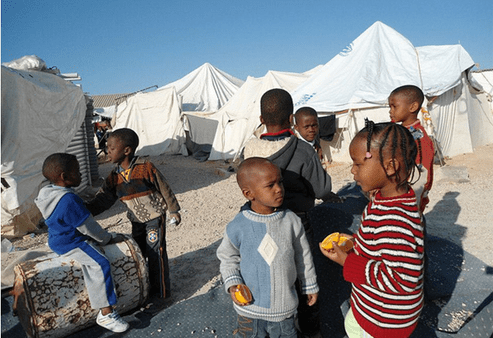
Libya Tawerghan refugees (Tawergha Foundation)
By Mustafa Fetouri | MEMO | September 5, 2018
Tawergha is a small Libyan coastal town roughly 300 kilometres east of the capital Tripoli. Its estimated that 40,000 of its inhabitants are black Libyans who have lived there for hundreds of years and never had any problem integrating into the rest of the country and were never discriminated against. They are as Libyan as any other citizen in any part of the country. Historically, their ancestors are believed to be part of the salve trade from sub-Saharan Africa.
Before 2011 the town used to be just like any other Libyan town; it benefited from free education, free health care, public services, government subsidised housing, infrastructure, businesses and above all security. The town was famous for its handcrafts of clay and handmade home furniture and used to be a hub for trade as it sits on the highway junction that connects the south, east and west of Libya. No one discriminated against the town and its inhabitants, and Libya’s successive governments, since independence in 1951, always considered Tawerghans as Libyans.
All that changed in August 2011 when the NATO supported rebels of armed militias, including terrorist groups, toppled the Gaddafi regime and in the final days of the civil war forced whoever remained in the town to flee at gun point and never allowed them to return.
Since then an estimated 40,000 inhabitants, the entire population of Tawergha, have been living as refugees in dozens of camps scattered around Libya with little hope of peaceful return any time soon. At one point roughly 2,000 people of 355 families lived in a make shift camp on the airport highway just south of the capital Tripoli. When I visited the camp the people I spoke to only wished for one thing – to be allowed to go back to their town and be left alone to live in whatever remained of their homes. It is true that most people of Tawergha cherish the late Gaddafi but the overwhelming majority took no part in the civil war of 2011 at all. One elderly person told me that he remembers how Gaddafi used to stop his convoy at Tawergha and chat with people every time he passed by as he shuttled between Tripoli and Sirte, his hometown.
In August 2011, hundreds of Tawerghan young men were jailed and an unknown number still missing with little information available to their families. International rights groups, including Amnesty International and Human Rights Watch, have published well documented reports of what happened in August 2011 and how Tawerghans were forced into internal exile inside Libya.
Libya’s successive governments since 2011 have so far failed miserably to tackle the tragedy either, because the militias, who dominated all governments, do not want to provide practical arrangements to help people return to their homes.
In the early days of the war in 2011 the regime was accused of using paid black African mercenaries to fight the NATO supported rebels but like many other wild accusations it turned out to be part of a propaganda campaign to further demonise the regime. Since Tawerghans are black skinned Libyans it was easy to portray them as mercenaries making them legitimate targets by the rebels even after they fled their town. The whole town was destroyed and its entire buildings, including schools and mosques, were deliberately and extensively damaged. Today, Tawargha is not only a ghost town but an open landfill as nearby Misrata militias deliberately make the town uninhabitable again.
Between 2012 and 2014 it was almost a taboo to talk about Tawergha openly inside Libya but the atmosphere relaxed in later years as it became apparent that the so-called revolution is no more than a disaster for Libya as whole, not just for Tawergha.
So why are Tawerghans still displaced after so many years and who could be held responsible for their misery? The primary responsibility for this crime rests with militias and politicians of the city of Misrata which is less than 30 kilometres west of Tawergha and whose militias took the initiative in forcing the civilian population out in 2011. They still refuse to allow them to go back in peaceful manner despite agreements worked out between the two sides between 2015 and June 2018.
In justifying their criminal position Misrata militias claim that people from Tawergha committed heinous crimes, including mass rape, within Misrata itself during the war. However no proof has been produced to support such a claim and not a single judiciary proceeding has ever been initiated against any person from Tawergha based on such allegations.
Misrata recently accepted a deal whereby it allows Tawerghans to return home but only if, among other conditions, the Government of National Accord (GNA) agree to compensate Misrata for the suffering it claims to have endured during the 2011 war, despite the fact that Tawerghans are not collectively responsible for whatever crimes claimed to have been committed.
According to the latest deal, signed last June between the local councils of both Misrata and Tawergha with the help of the GNA, Misrata accepted the return of civilians to Tawergha while receiving an undisclosed sum thought be worth millions of US dollars in compensation. The deal was hailed as a good step on the long road to national reconciliation in war shattered Libya. However, three months later and the number of returnees is far smaller than expected.
Marbuk Eswasi, an activist from Tawergha and director of a local charity named Patience, told me that no more than 100 people have actually returned and all of them live in a school yard as their homes are uninhabitable. He also pointed out that over 90 per cent of homes and business in town are damaged beyond repair and have to be rebuilt if they are ever to be used again.
Some observers also believe that NATO is partially responsible for this humanitarian disaster and is an accessory to such crime against humanity. They say, had it not been for the huge military help provided by NATO to the rebels they would not have been able to win the war and eventually displace thousands of civilians.
Others think that Misrata will never allow the return of the Tawerghan to live next to them simply because the accusations against Tawerghans for being mercenaries for the former Gaddafi regime is still widely believed as an important source of legitimacy for the entire so-called revolution of Libya in 2011, however false it has been proved.
Featured Video
or go to
Aletho News Archives – Video-Images
From the Archives
Israel Would Have No Qualms About USS Liberty-Style FALSE FLAG If Iran Campaign Falters – Analysts
By Ilya Tsukanov – Sputnik – 18.06.2025
Donald Trump is mulling whether or not to join Israel’s aggression against Iran as Tel Aviv faces problems sustaining its defenses against growing counterstrikes, and apparently lacks a realistic game plan for an end to hostilities after failing to achieve its goals. Analysts told Sputnik how the US could be ‘nudged’ into the conflict.
“The US is already assisting Israel with supplies, intel, refueling support, etc. One of the many US posts in the region could be attacked for a casus belli,” former Pentagon analyst Karen Kwiatkowski explained.
“If Trump doesn’t comply with Israel’s demand” and join its aggression voluntarily, “a false flag may be needed” to drag the US in, Kwiatkowski, retired US Air Force Lt. Col.-turned Iraq War whistleblower, fears.
Netanyahu has a diverse array of options at his disposal, according to the observer, including:
- a false flag against US assets abroad blamed on Iran or one of its Axis of Resistance allies, like the Houthis
- a US domestic attack or assassination blamed on Iran
- Iranian air defenses ‘accidentally’ hitting a civilian jetliner carrying Americans
- use of a dirty bomb or nuclear contamination somewhere in the region blamed on Iran
- even blackmailing by threatening to use nukes against Iran if the US doesn’t join the fight
Kwiatkowski estimates that Israel probably has “enough blackmail power” against President Trump and Congress to avoid the necessity of a false flag operation, but a “USS Liberty-style” attack, targeting the soon-to-be-retired USS Nimitz supercarrier that’s heading to the Middle East, for example, nevertheless cannot be ruled out entirely, she says. … continue
Blog Roll
 Aletho News
- US has 2 months of rare earths left to replenish weapons amid Iran war: Report
- Strait Of Hormuz closure brings Empire to brink
- Iran controls Strait of Hormuz, dictates terms of war and peace as US excursion backfires
- Outlasting the Superpower: The Reasons Why Iran is Beating uhe US and Israel
- Top PMU commander, over a dozen fighters killed in new US strikes on Iraq
- Is Netanyahu’s war gamble threatening the future of ‘Israel’?: FT
- Smotrich calls for annexation of South Lebanon to Litani River
- Echos of Gallipoli? Hormuz and the Geography of Hubris
- Pakistan PM backs Iran’s right to self-defense amid tensions
- Hungary blasts ‘fake’ EU accusation
- If Americans Knew
- Instead of taking Joe Kent’s claims seriously, the media is disregarding him as an antisemite
- Joe Kent’s Explosive Interviews about his Resignation over the Iran War
- Israel poised to take over southern Lebanon; settlers wreak havoc in West Bank – Not a ceasefire Day 165
- From Sde Teiman, the truth about Israel’s military justice system has been set free
- Child denied life-saving bone marrow transplant by Israel ‘because he is from Gaza’
- Raffi Berg: BBC Middle East Editor Exposed as CIA, Mossad Collaborator
- Jerusalem Archbishop Rebukes Netanyahu’s Statements on Christianity
- US to embed Palantir AI across entire military: Report
- Israeli-US war on Iran to drag on “a few more weeks” – Not a ceasefire Day 164
- Lebanon deaths top 1,200; Palantir AI to be embedded across US military – Not a ceasefire Day 163
- No Tricks Zone
- Devastating Assessment Of Comirnaty Vaccine By Former Senior Pfizer Europe Toxicologist
- New Study: CO2 Is ‘Effectively Negligible’ As An Explanatory Climate Change Factor Since 2000
- Former Pfizer Toxicologist Dr. Helmut Sterz Tells Bundestag Hearing Pfizer Vaccine Should Have Never Been Approved
- Energy Expert: Germany’s Nuclear Phaseout Was A “500 Billion Euro Mistake”
- New Research: South Australia’s Mid-Holocene Sea Surface Temperatures Were 4°C Warmer Than Today
- Storing Green Energy To Last Germany 10 Days Would Require A 60-Million Tonne Battery
- New Studies: UK Sea Levels Were 4 Meters Higher Than Today During The Mid-Holocene
- Destructive Green New Deal: German Energy And Metal Group Warns Of Drastic Crisis
- New Study Documents A 20-Year Pause In Arctic Sea Ice Decline – Driven By Internal Variability
- Wake-up Call: Survey Shows Majority Of Germans Now Favor Postponing Climate Targets!
 Aletho News