The Yankees Are Coming Home: The Taliban Won. Get Over It
By Philip Giraldi | Strategic Culture Foundation | April 8, 2021
It hardly made the evening news, but the New York Times reported last week that after twenty years of fighting, the Taliban are confident that they will fully control Afghanistan before too long whether or not the United States decides to leave some kind of residual force in the country after May 1st. The narrative is suggestive of The Mouse that Roared, lacking only Peter Sellers to put the finishing touches on what has to be considered a great humiliation for the U.S., which has a “defense” budget that is larger than the combined military spending of the next seven countries in order of magnitude. Those numbers include both Russia and China. The Taliban, on the other hand, have no military budget to speak of. That enormous disparity, un-reflected in who has won and lost, has to nurture concerns that it is the world’s only superpower, admittedly self-proclaimed, which is incapable of actually winning a war against anyone.
In fact, some recent wargaming has suggested that the United States would lose in a non-nuclear conflict with China alone based on the obsolescence of expensive and vulnerable weapons systems that the Pentagon relies upon, such as carrier groups. Nations like China, Iran and Russia that have invested in sophisticated and much cheaper missile systems to offset U.S. advantages have reportedly spent their money wisely. If the Biden foreign policy and military experts, largely embroiled in diversifying the country, choose to take on China, there may be no one left around to pick up the pieces.
Those who are warning of the apparent ineffectiveness of the U.S. armed forces in spite of their global presence in more than one thousand bases point most commonly to the historical record to make their case. Korea, fought under United Nations auspices, was a stalemate, with the peninsula divided to this day and a substantial American military force continuing to be a presence along the DMZ to enforce the armistice that not quite ended the war. Vietnam was a defeat, resulting in more than 58,000 Americans dead as well as an estimated 3 million Vietnamese, most of whom were civilians. The real lesson learned from Vietnam was that fighting on someone else’s turf where you have no real interests or stake in the outcome is a fool’s game, but the Pentagon instead worked to fix the mechanics in weapons and training at great cost without addressing why people fight wars in the first place. The other lesson was that the United States’ military was perfectly willing to lie to the country’s civilian leadership to expand the war and keep it going, a performance that was repeated in 2001 with the “Iraq is supporting terrorists and will have nuclear weapons” lies and also with the current crop of false analogies used to keep thousands of Americans in Afghanistan and the Middle East.
As a veteran of the Vietnam War army, I can recall sitting around with fellow enlisted men reading “Stars & Stripes,” the exclusive in-house-for-the-military newspaper that was covering the war. The paper quoted a senior officer who opined that the Soviets (as they were at that time) were really envious of the combat experience that the United States Army was obtaining in Vietnam. We all laughed. That same officer probably had a staff position away from the fighting but we draftees knew well that the war was a very bloody mistake while he may have tested his valor post-retirement working for Lockheed-Martin. The “Soviets” in any event demonstrated just how much they envied the experience of combat when they fought in Afghanistan in the 1980s, eventually withdrawing with their tails between their legs just as the U.S. had done in Vietnam after they lost 15,000 men. The “Grave of Empires,” indeed.
Since Vietnam there have been a number of small wars in places like Panama and Grenada, but the global war on terror has been a total disaster for American arms. Afghanistan, as it was for the Russians, is the ulcer that keeps on bleeding until it ends as a major defeat for the United States with the Taliban fully in control, as they are now predicting. Likewise, the destruction of a secular Iraq, regime change in Libya, and a continuing war against a non-threatening Syria have all failed to make Americans either safer or more prosperous. Iran is next, apparently, if the Joe Biden Administration has its way, and relations with major adversaries Russia and China have sunk even lower than they were during Donald Trump’s time as president. The White House has recently sent a shipload of offensive weapons to Kiev and the Ukrainian government has repeated its intention to retake Crimea from Russia, a formula for a new military disaster that could easily escalate into a major war. What is particularly regrettable is the fact that the United States has no compelling national interest in encouraging open warfare between Moscow and Kiev, a conflict that it will be unable to avoid as its is supplying Ukraine with weaponry.
There was almost no discussion of America’s wars during the recent election. One should take note, however, of a recent article by former Assistant Secretary of Defense Lawrence Korb that appeared on National Review which seeks to provide an explanation for “The Real Reason the U.S. Can’t Win Wars Anymore” in spite of the fact that it is “the most powerful country in the history of the world.” To be sure, Korb largely blames the policymakers for the defeat in Vietnam, aided and abetted by a culture of silence in the military where many officers knew that the Gulf of Tonkin incident, which escalated the conflict, was a fraud but chose to say or do nothing. He also observes that the war itself was unwinnable for various reasons, including the observation by many working and middle class Americans that they were little more than cannon fodder while the country’s elites either dodged the draft or exploited their status to obtain national guard or reserve commissions that were known to be mechanism to avoid Vietnam. Korb notes that “… the four most recent presidents who could have served in Vietnam avoided that war and the draft by dubious means. Bill Clinton pretended to join the Army ROTC; George W. Bush used political connections to get into the Air National Guard, when President Johnson made it clear that the reserve component would not be activated to fight the war; Donald Trump, of course, had his family physician claim he had bone spurs, (Trump himself cannot remember which foot); and Joe Biden claimed that the asthma he had in high school prevented him from serving even though he brags about his athletic exploits while in high school.”
Korb also reveals how America’s presumed prowess on the battlefield has distorted its “democracy building” endeavors to such an extent that genuine national interests have been ignored. When the U.S. invaded Afghanistan, success in overthrowing the Taliban was derived from critical assistance from Iran, which correctly regarded the extremist Sunni group as an enemy. But the Bush White House, far from showing gratitude, soon thereafter added Iran to its “axis of evil” list. A golden opportunity was wasted to repair a relationship which has poisoned America’s presence in the Middle East ever since.
One might add something else to Korb’s assessment of failure at war. Most American soldiers have been and are proud of their service and consider it an honor to defend their country but the key word is “defend.” There was no defending going on in Vietnam nor in Afghanistan, which did not attack the U.S. and was willing to turn over Osama Bin Laden if the White House could provide evidence that he was involved in 9/11. Nor was there anything defensive about Obama’s destruction of Libya and the decades long “secret” wars to overthrow the Syrian and Iranian governments. Soldiers are trained to fight and obey orders but that does not mean that they can no longer observe and think. Twenty years of “Reconstruction” duty in Afghanistan is not defending the United States and the morale of American soldiers in the combined Democratic and Republican Parties’ plan to reconstruct the world is not a sufficient motivator if one is being asked to put one’s life on the line. Sure, American soldiers can still win wars, but it has to be a real war where there is something genuine at stake, like protecting one’s home and family. That is what the people who run Washington, very few of whom are veterans and most of whom first ask “But what’s in it for me?” fail to understand.
Israeli circles cautiously monitor developments in Jordan as reports indicate Tel Aviv, Riyadh involvement in failed coup
Al-Manar | April 5, 2021
The Israeli circles continued monitoring the dangerous developments in Jordan without giving public statements for fear of exacerbating the cold ties with the Jordanian leadership.
Zionist reports indicated that the Israeli intelligence was directly involved in the recent incidents in Amman, adding that the ties between the arrested officials and the Saudi crown prince, Mohammad bin Salman, hint at KSA involvement in the coup as well.
The Jordanian intelligence intercepted a phone call between an Israeli Mossad officer and the wife of former crown prince Hamzah bin Al-Hussein who was offered a private jet to leave Jordan into a foreign country, according to the reports.
State media reported citing Jordan’s armed forces on Saturday that former Jordanian crown prince, also a half-brother of King Abdullah II, was told to halt actions undermining national security.
Hasan bin Zaid, a member of Jordan’s royal family and envoy to Saudi Arabia, and King Abdullah’s long-time confidant Basem Ibrahim Awadallah were arrested on Saturday, the state news agency Petra reported, citing a security source.
The Israeli media expressed concerns about the possibility of a considerable shift in Jordan’s strategic policy, citing the cold relation between KIng Abdullah II and the Zionist PM Benjamin Netanyahu.
How China is Going to Reshape Asia
By Salman Rafi Sheikh – New Eastern Outlook – 01.04.2021
With China and Iran signing a multi-billion dollar deal for the next 25 years, there remains little gainsaying that the former is going to increase its footprint in West Asia/Middle East in a way that once was thought to be unimaginable for reasons that included China’s own economic policies and West Asia’s too close ties with the West to allow for any players. Forces of economic change that China is unleashing will not only become a massive boost for Iran, but Iran will become a gateway for China’s further expansion into the Middle East, including countries, such as Saudi Arabia and the UAE, that Iran rivals. For China, its presence and expansion in the Middle East is not merely about economic benefits; this presence is equally driven by the emerging US-China global rivalry and China’s desire to push back against erstwhile US hegemony and domination of the Middle East since the Second World War.
As such, when China’s foreign minister went on a tour to the Middle East last week, he was not merely looking to sign a deal with Iran; he was more interested in and largely focused on introducing new rules of the game that focus, first and foremost, on economic engagement and connectivity. Rather than traditional Gulf tensions. Therefore, while Wang Yi met Saudia’s Crown Prince, MBS, and supported Saudi stance to oppose any “interference” in the internal affairs by any external player, Wang also offered MBS, who is currently not on good terms with the Joe Biden administration, an opportunity to engage with China “to explore and find a path of development that fits its own conditions.” This path, as Wang emphasised in an interview with Saudia’s official news channel, Al Arabiya, can be found only when Gulf countries can “break free from the shadows of big-power geopolitical rivalry and [be able to] independently explore development paths suited to its regional realities.”
As it stands, China has offered Saudi Arabia the same path it has signed up with Iran. Therefore, China, while it does not want to get entangled in the cross-web of geo-political rivalries in the Persian Gulf, aims to chart a new course whereby countries in the region can stick to an agenda that maintains a strict separation between geo-economics and geo-political and/or ideological rivalries including those around Sunni & Shia faiths and organisations like Muslim Brotherhood.
Therefore, while China signed a multi-billion dollar deal with Iran that includes development projects and enhanced oil production and supplies, China’s growing ties with Saudi Arabia, too, include an increasing Saudi desire to enhance Saudi supply of oil to China and secure Chinese investment in fields ranging from petrochemical, nuclear energy and other energy fields, further expanding it into new fields such as 5G, telecommunication and digital technologies. Saudi Arabia, MBS affirmed, is also willing to make joint efforts with China to push forward the free trade negotiations between China and Gulf countries.
Therefore, by offering both rivals a somewhat similar paradigm of economic development that bypasses geo-political tensions and rivalries, China is building an economic landscape that would leave minimum room for external payers, like the US, to continue to manipulate the Gulf to its advantage as it has been doing for the past many decades.
As such, whereas Chinese investment in Iran offers the latter an opportunity to break economic shackles imposed by the US through economic sanctions, for Saudi Arabia, China offers an opportunity to reshape its ties with the US at a time when the Joe Biden administration appears unwilling to accept MBS as the future king.
By offering states in the Gulf an opportunity to diversify their external geo-economic ties and reduce dependence on the US, China is posing a serious challenge to the US position in West Asia, which has mostly relied on using the precarious geo-political scenario to keep itself militarily entrenched and maintain a relationship that served, first and foremost, the US military industrial complex. At the same time, for the Middle Eastern states, China’s economic path is a way out of their decades old reliance on oil as a primary source of national income.
For China itself, it is pivoting to the Middle East at a time when the Joe Biden administration is trying to assemble an anti-China coalition through the QUAD, a group of countries that includes the US, Japan, India and Australia. China, by simultaneously approaching rival countries like Saudi Arabia, Iran, Turkey and the UAE, is posing a counter-challenge to the US ambitions, making it more and more difficult for the US to realise its “containment” of China ambitions at the global level.
The fact that China’s multi-billion dollar deals have received a very warm reception speaks volumes about how the Gulf itself is keen to transform its geo-economic landscape. In this sense, China-Gulf ties become, unlike US-Gulf ties, a fruit of a path that converges to serve mutual interests.
China’s pact with Iran and its deepening ties with other Gulf countries, therefore, has the potential to completely upend the prevailing geo-economic scenario. With the Gulf countries’ ability to diversify their ties and radically reduce their over-dependence on the US, the region’s geo-political scenario could also undergo a dramatic change.
Therefore, it would be wrong to grasp China-Iran deal as an isolated event. The fact that Wang has toured Iran, Saudi Arabia, Turkey, Oman, and the UAE shows how China is embracing the region as a whole through a single framework of policy that is very largely underpinned by economic development. The fact that Saudi Arabia, to China’s utter joy, even refused to back the US campaign against China’s alleged “genocide” of Uyghur shows how China, to the disappointment of the US, continues to earn more and more acceptability.
Salman Rafi Sheikh is a research-analyst of International Relations and Pakistan’s foreign and domestic affairs.
Hamas welcomes Turkish-Egyptian detente
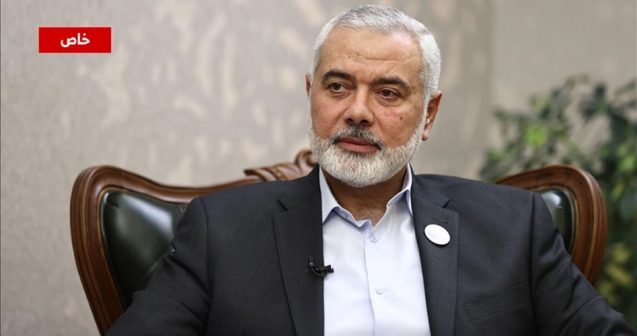
Ismail Haneyya
Palestine Information Center – April 1, 2021
ISTANBUL – Head of Hamas’s political bureau Ismail Haneyya has welcomed the Turkish-Egyptian rapprochement, expressing confidence that any cooperation between Ankara and Cairo will be in the interest of the Palestinian people and their national cause.
Haneyya made the remarks in an interview conducted by Anadolu Agency after he visited its headquarters in Istanbul.
“We welcome the Turkish-Egyptian rapprochement, and we believe that more understandings between them and between Arab and Islamic countries will have a positive impact on us in Palestine as well as on the Arab countries,” the Hamas political chief said.
“There are historically known central states in the region that play strategic roles, such as Egypt, Turkey, Iran and Saudi Arabia, so any understanding and rapprochement between them will be in the interests of the peoples in the region and the Palestinian cause,” he added.
As for the upcoming Palestinian elections, Haneyya affirmed that his Movement is committed to forming a national consensus government even if it scored a victory in the legislative elections slated for next May.
“Hamas is participating in the elections on the basis of partnership and not with the aim of defeating others. It does not want to dominate the Palestinian political system,” he underlined.
He described the upcoming elections as an important opportunity to improve the current Palestinian conditions and end 15 years of national division.
Certain groups attempt to create civil war in Lebanon, Hezbollah chief warns
Press TV – March 18, 2021
The secretary-general of Lebanon’s Hezbollah resistance movement has warned against attempts by certain groups to foment a civil war in the cash-strapped country on economic, racial, and religious grounds, emphasizing that the movement will not allow anyone to realize such a fiendish plot.
Those, who become frustrated in the face of the country’s resistance, could resort to the option of trying to ignite such an internal conflict, Sayyed Hassan Nasrallah said in a televised speech broadcast from the Lebanese capital city of Beirut on Thursday evening.
“I have information that there are outside forces and some internal ones that are pushing towards civil war … They are looking for the fuel to add to the fire,” he said.
“The chaos in Lebanon is aimed at driving Lebanon into a civil war and this is a red line,” he, however, added.
Lebanon is experiencing its worst economic crisis in decades, compounded by the COVID-19 pandemic. Prices are skyrocketing and more than half of the population is now living below the poverty line.
Nasrallah’s remarks came as the country’s major cities are hosting fresh protests at the situation afflicting the economy that is falling apart at the seams. He, therefore, entitled the high point of his address to the domestic woes.
“Lebanon is at the heart of a true and great national economic, livelihood, financial, and also political crisis,” he said, noting, “It can also be described as a crisis of the establishment.”
Nasrallah categorically dismissed that his movement harbored any intention to exacerbate the already explosive situation.
“Some say that Hezbollah is the party, which has weapons [and may start a civil war]. This rhetoric is wrong since the civil war can be waged by light arms and such arms are found everywhere in Lebanon and are in the hands of many people,” the Hezbollah chief said.
Hezbollah has no intention to resort to its weapons in a bid to form a government or to deal with the economic and financial crisis.
Since the Lebanese government formally resigned after a massive explosion in Beirut port last August, domestic political divisions and pressure by some Western states have hindered the formation of a formal cabinet.
‘US pressure main factor behind crisis’
Nasrallah pointed to the pressure that the United States was applying to Lebanon as a main principle driving the country’s crisis.
The United States wants for Lebanon to “be placed in the US-Israel axis” in the same way that such regional countries as the United Arab Emirates and Bahrain did by normalizing their relations with the Israeli regime through Washington’s facilitation, he stated.
Nasrallah questions dependence on IMF
Without a formal cabinet, the country cannot resume negotiations with the International Monetary Fund (IMF) for potential bailout packages.
Even if the country was to be thrown such a lifeline, it would be required by the IMF and the West to enact certain “reforms” in its political structure. The reforms entail introduction of stringent austerity measures, the biggest part of whose burden falls on the people.
Lebanese Prime Minister-designate Saad al-Hariri alleged earlier that the only way to stop the country’s economy from total collapse was to re-engage with the IMF.
“The main priority of any government is to prevent the collapse that we are facing today… that we proceed to start halting the collapse with the IMF and regain the trust of the international community,” Hariri said at a press conference at the presidential palace in Baabda.
Nasrallah, however, asked whether the Lebanese nation could bear the burden of the IMF’s conditions, including subtraction of subsidies from staples.
He considered the country’s economic policies, including the policy of borrowing money from others, to be one of the reasons that Lebanon had ended up this way.
The American pressure, he added, was aimed at forcing Lebanon into “resorting to certain economic options.”
It was this very fear of Washington that was scaring some inside the country from strengthening its ties with China.
Hezbollah agrees to a technocratic-political government
The Hezbollah leader, meanwhile, signaled his movement’s approval of the formation of a government composed of technocrats and politically influential elements at the same time.
He said if Hariri and President Michel Aoun reached an agreement on formation of such a ruling structure, Hezbollah would agree to it too.
US apparatuses freeing Daesh ringleaders in Iraq
Nasrallah also said there is evidence pointing to US intelligence and security apparatuses establishing contact with the Takfiri terrorist group Daesh’s ringleaders in Iraq’s prisons before enabling their release.
“With every day that goes by, the truth that lies behind the armed Takfiri terrorist groups and the nature of their handler and supporter comes further to light,” he said.
Nasrallah, however, announced, “We stand up to the terrorist groups that are shaped, run, supported, and armed by the American intelligence apparatuses.”
Trade-Off ahead on Syria and Yemen
By Ghassan Kadi for the Saker Blog | March 16, 2021
In the past few weeks much has happened in the area of diplomacy on the part of Russia. Russia is forging ahead after stepping up its presence in the Middle East in the past decade, taking a strong pro-active political role. Moscow during this period has been intent on consolidating its efforts in re-establishing itself as the key player in any political settlements in the Middle East. Ever since Kissinger in the late 1970’s pulled the rug out from underneath the feet of the USSR, striking a deal between Israel and Egypt, excluding the USSR and the rest of the Arab World, the political influence of Russia in the Middle East significantly waned until it came back with deciding force when Russia responded to the Syrian Government’s request for help in September 2015.
Lately, the economic crisis has deepened in Syria following the drastic Western sanctions. And specifically after the implementation of the Caesar’s Act, the Syrian currency took a huge tumble and the cost of living has soared to unprecedented levels. This left many cynics wondering and pondering what was Russia going to do in the face of the collapsed Syrian economy after having achieved an impressive military victory, taking its troops outside its former USSR borders for the first time and heralding the end of the single super power status of the USA.
To this effect, and on the diplomatic side, Russian FM Lavrov has recently visited Saudi Arabia, Qatar and the UAE for talks pertaining to an array of issues. The agenda issues that transpired to the media include trade, the Russian Sputnik V vaccine, as well as issues of global and regional security, albeit vague in details as what ‘security issues’ mean.
It appears that in these meetings, discussions included the return of Syria to the Arab League and the cost of reconstruction of Syria after ten years of war, a bill touted to exceed $Bn200. Expectations have existed for some time that the Arab Gulf states will fork out a huge chunk of this cost. As mentioned above, the bottom line here is that Russia’s military success in its operation in Syria needs to be followed by political success. Partly, this is achieved within the Astana talks which include Turkey and Iran. However, the very same Arab States instrumental in the ‘War on Syria’ are also instrumental in facilitating the return of Syria to the Arab League, the reconstruction efforts in Syria and the easing of sanctions. The Gulf states have always reiterated that there will be no return of Syria to the Arab League for as long as Iranian forces remain on the ground. The UAE seemed more open than Saudi Arabia to the prospects of Syria’s return to the Arab League and financing the reconstruction process.
But why would the Gulf States, the same states that spent tens of billions of dollars in order to destroy Syria, be suddenly now interested in the reversal of the process? This is a fair question to ask.
Quite unexpectedly, and almost immediately after the return of Lavrov to Moscow, a top delegation of Hezbollah, headed by Mohamad Raad, was invited to Moscow for talks. Apparently, the visit was cloaked in a veil of secrecy in Russia and was not at all covered in Western media, even though it made news in Arabic mainstream media. It would be politically naïve to imagine that Lavrov’s visit to the Gulf has no relation to this. All issues in the Middle East are related to each other, including the war in Yemen.
To put it succinctly, the UAE had already stepped away from the Yemen war. However, Saudi Arabia remains bogged down in this travesty and seven years on, must have come to the humiliating and painful realization that it is a war it cannot win. This is where Iran and Hezbollah can have leverage in any direct or indirect negotiations with the Saudis, and Russia is the only arbitrator who is able to communicate with all parties involved.
All parties in the Middle East are looking for face-saving tradeoffs; at least partial and interim ones. The Saudis in particular are tired and exhausted.
In an interview given to Sputnik Arabic, one not widely reported in other media, not even Sputnik English, Raad praised the cooperation between Hezbollah and Russia, stating that ‘the invitation we received aims to reopen the dialogue about the next phase after having reached the achievements that serve the interests of the people of the region in the recent past’ .
This is Raad’s first visit to Moscow since 2011. Of that visit, I am not trying to speculate in hindsight of the purpose of it and the achievements of it. Furthermore, Hezbollah has not ever been party to any international dis-engagement or peace negotiations in the past, except for ones relating to exchange of prisoners. The economic demise of Syria and Lebanon, as well as the Saudi-Yemeni impasse, may well have placed Hezbollah in a position of participating in peace-deals negotiations this time.
I am neither referring to peace deals with Israel here, nor any deal involving disarmament. Hezbollah will not be prepared to negotiate disarming itself under any political settlement either today or in the foreseeable future, and Moscow is totally aware of this.
According to my analysis, the deal that Moscow is most likely to suggest is a mutual withdrawal of Iran and Hezbollah from Syria on one hand, and an end of the Saudi war on Yemen. It is simple, Saudi Arabia to leave Yemen and Iran/Hezbollah to leave Syria. I believe that Lavrov has already secured the Saudi acceptance of those terms, terms that will not only end the war in Yemen, but also the return of Syria to the Arab League and a possible easing of the Western economic sanctions on Syria. Had Lavrov not secured the Saudi assurance, he would not have invited Hezbollah for talks.
A deal of this nature can potentially end the criminal human tragedy in Yemen in a manner that will portray the Saudis as the real losers in the war, and this is where they need a face-saving trade-off in Syria. In Syria, they will be perceived as winners by securing an Iranian/Hezbollah exit. But most importantly perhaps for the Saudis, this will put an end to a very costly and humiliating war in Yemen, one which is beginning to draw criticism from some quarters of the international community, including alleged talk of America considering placing arms deal embargos on Saudi Arabia.
On the other hand, if Iran and Hezbollah end their presence in Syria, many sanctions are likely to be lifted and the severe economic pressure in Syria will be eased. Such a deal will be a humanitarian win for Syria and Yemen, a strategic win for Saudi Arabia and Iran, and a diplomatic win for Russia.
What will be in it for Hezbollah will largely depend on what Lavrov has put on the table, and it seems obvious that it is Hezbollah that will need more convincing than Iran, and this is why the talks are now with Hezbollah; not with Iranian officials. Perhaps the deal already has the tacit approval of Iranian officials.
It goes without saying; Israel will be watching these developments with keen interest. Israel wants Iran and Hezbollah out of Syria. But the trade-off deal I am talking about is not one in which Israel is a direct party.
What is known at this stage is that a meeting has already taken place between the Hezbollah delegation and Russian officials. As I write this, I am not aware if other meetings are to follow and or whether or not the Hezbollah delegation is back in Lebanon.
Was the 2011 Moscow visit of Raad a prelude for Hezbollah to enter Syria? Will the 2021 visit be prelude for Hezbollah to leave Syria? We don’t know. We may never find out the actual detailed outcome of the mysterious-but-not-so-mysterious current Hezbollah visit. It may not even end up with a press release, but in the next coming days, we will find out if a Syria-Yemen trade-off is indeed looming.
The Intellectually Superior Perpetual Victim Again on Display

By Philip Giraldi | Unz Review | March 16, 2021
Those who have followed developments in the Middle East would likely agree that Israel covers up its war crimes and other human rights violations by regularly invoking its own victimhood. Whether the subject is U.S. aid to the Jewish state or media coverage of the illegal expansion of Israel into the West Bank, one will always find references to the so-called holocaust or claims of anti-Semitism to discredit any criticism. And the results of this assiduous effort to assign guilt are clearly seen as the mainstream media in both the United States and Europe exhibits considerable reluctance to report honestly on what is being done to the Palestinians while politicians in the west sometimes appear to count themselves more as “friends of Israel” than as representatives advancing the interests of their own constituents.
As defenders of all things Israeli go, there is no one more assiduous than Bret Stephens of the New York Times. He is, of course, Jewish, and was the editor of the right-wing Jerusalem Post between 2002 and 2004. The Times employs him as one of its resident conservatives, though he would be better described as a neoconservative. Stephens’ recent piece entitled “California Ethnic Studies Follies” takes aim at California’s controversial diversity program that is being imposed on the state’s public school system.
Stephens’ article is sub-headed “A proposed curriculum magnifies differences, encourages tribal loyalties and advances ideological group think.” While it is clear that “Ethnic Studies,” a precursor to the current Critical Race Theory and similar to programs in a number of other states, does all that and more, Stephens inevitably turns the whole argument around to the alleged victimization of his own highly privileged caste, i.e. American Jews.
Stephens gets into it immediately, beginning his piece with:
“The first time California’s Department of Education published a draft of an ethnic studies ‘model curriculum’ for high school students, in 2019, it managed the neat trick of omitting anti-Semitism while committing it. More than a million Jews live in California. They are also among the state’s leading victims of hate crimes.
“Yet in a lengthy draft otherwise rich with references to various forms of bigotry, there was no mention of bigotry toward Jews. There was, however, an endorsement of the Boycott, Divest and Sanction [BDS] movement, which essentially calls for the elimination of the Jewish state. There was also an approving mention of a Palestinian singer rapping that Israelis ‘use the press so they can manufacture’ — the old refrain that lying Jews control the media.
“The draft outraged many Jews. And they were joined by Armenian, Assyrian, Hellenic, Hindu and Korean civic groups in a statement urging the California Department of Education to ‘completely redraft the curriculum.’ In its original form, they said, the document was ‘replete with mischaracterizations and omissions of major California ethnoreligious groups.’
“Last September, Gov. Gavin Newsom vetoed a bill that would mandate ethnic studies as a graduation requirement in California’s high schools, pending further review of the model curriculum. While some maintained that a critical ethnic studies curriculum was a mistake, and not just for Jews, others took the view that, when it came to those revisions, it was better to be at the table than on it. Progressive Jews helped redraft a curriculum that included two sample lessons on the Jewish-American experience, along with testimonials about Jewishness from the likes of Ruth Bader Ginsburg and Dianne Feinstein. A victory? One can still quarrel with the curriculum’s tendentiously racialized view of the American-Jewish experience. But at least the anti-Semitic and anti-Zionist dog whistles have been taken out and the history of anti-Semitism has been put in.”
To be sure, Stephens makes some good points about how the California program, which is again going to be voted on by the Board of Education later this month, is indoctrination and not education. But Stephens is also blind to the reality of what constitutes political power in the United States. He observes that the Irish, Poles and Italians apparently do not need to be supported by inclusion in an Ethnic Studies program while he simultaneously accepts that if there is such a thing Jews have to be carefully protected by it. And based on some of his other articles, his view of his own ethnicity seems to go well beyond that and is flattering to him and those who agree with his apparent view that that Ashkenazi Jews are intellectually and genetically superior to other groups.
One can only imagine what the reaction would have been if Stephens had written instead that whites are superior to blacks. And the points that Stephens raises in support of revising the California document to highlight both Jewish suffering and achievements are, of course, extremely self-serving. They are also deliberately deceptive. Yes, Jews have been “victims” of so-called “hate crimes” but the crimes themselves are very rarely violent. It has been demonstrated that many recent so-called anti-Semitic attacks on Jews involve easily recognizable Hasidic Jews and are actually based on community tensions as established neighborhoods are experiencing dramatic changes with the newcomers using pressure tactics to force out existing residents. And after the Hasidim take over a town or neighborhood, they defund local schools to support their own private academies and frequently engage in large scale welfare and other social services fraud to permit them to spend all their days studying the Talmud, which, inter alia teaches that gentiles are no better than beasts fit only to serve Jews.
Much more often “hate crimes” against Jews consist of graffiti or reaction to criticism of Israel for its brutal suppression of the Palestinians. Indeed, there are now organizations at universities like Canary Mission funded by Jewish oligarchs which encourage Jewish students to claim damages from critics while also “exposing them” on campus on behalf of Israel. A Jewish student walking on a college campus who passes by protesters objecting to Israel’s behavior can claim to feel threatened and the incident is recorded as anti-Semitism, for example, and slurs written on the sides of buildings or grave stones, not necessarily the work of Jew-haters, are similarly categorized. In one case in Israel in 2017, the two street swastika artists were Jews.
One is surprised that Stephens does not raise the issue of the “libel” of “Jews and money,” as if the Republicans actually loved a repulsive toad like Sheldon Adelson, who was dedicated to promoting Israeli interests, and bought the GOP foreign policy for $100 million. And Stephens is way over the top when it comes to characterizing BDS as a hate group that seeks to the “eliminate the Jewish state.” The group is explicitly non-violent and does in fact have significant liberal Jewish membership. It seeks to use economic pressure to compel Israel to behave better towards the Palestinians, similar to what produced change in apartheid South Africa.
But the most interesting aspect of the Stephens piece is the demand that Jews be universally recognized for their unique suffering. He considers it a libel when one maintains that Jews control the media… has he looked around the newsrooms at his own paper, the Washington Post, CNN, CBS and MSNBC lately? And as for bigotry and discrimination, how about consideration of the fact that Jews run Hollywood and the entertainment industry, are the wealthiest and best educated demographic in the country, are grossly disproportionate in high status and high pay jobs, and hold many of the top positions in the Biden Administration. Authorities like Professor Alan Dershowitz are quite outspoken in their praise of Jewish power in the United States. And Jewish organizations already receive more than 90% of the discretionary funding from the Department of Homeland Security to “protect themselves.” American Jews hardly seem to constitute a minority that needs more consideration and breaks because it is under siege, so when will Stephens stop whining?
And as for the claim of widespread anti-Semitism, one recalls the comment by former Israeli Education Minister Shulamit Aloni, speaking about calling critics anti-Semites. She said “Well, it’s a trick, we always use it. When from Europe somebody is criticizing Israel, then we bring up the Holocaust. When in this country people are criticizing Israel, then they are anti-Semitic. And the organization is strong, and has a lot of money, and the ties between Israel and the American Jewish establishment are very strong and they are strong in this country, as you know. And they have power, which is okay. They are talented people and they have power and money, and the media and other things, and their attitude is ‘Israel, my country right or wrong,’ identification. And they are not ready to hear criticism. And it’s very easy to blame people who criticize certain acts of the Israeli government as anti-Semitic, and to bring up the Holocaust, and the suffering of the Jewish people, and that is to justify everything we do to the Palestinians.”
Shulamit Aloni has described Bret Stephens and the political culture that he comes out of. Criticizing Israel or the sometimes predatory behavior of American Jews is one of the few remaining total taboos in America. One marvels at the recent account of a basketball player who apparently blurted out the word “kike” while engaged in a video game. Even though he apparently did not know that the word referred in derogatory fashion to Jews, he was suspended by his team and fined $50,000 by Adam Silver the NBA commissioner. Does anyone seriously believe that if he had said “Wop,” “Mick,” “Spick” or “Polack” he would have been punished at all? He was also required to publicly express contrition and forced to go through a counseling session with a representative from the Anti-Defamation League (ADL), which is, if I might be so bold as to suggest, the U.S. based enforcement arm of the powerful Israel Lobby.
Philip M. Giraldi, Ph.D., is Executive Director of the Council for the National Interest, a 501(c)3 tax deductible educational foundation (Federal ID Number #52-1739023) that seeks a more interests-based U.S. foreign policy in the Middle East. Website is https://councilforthenationalinterest.org address is P.O. Box 2157, Purcellville VA 20134 and its email is inform@cnionline.org
Biden’s brand of democracy isolates the Palestinians
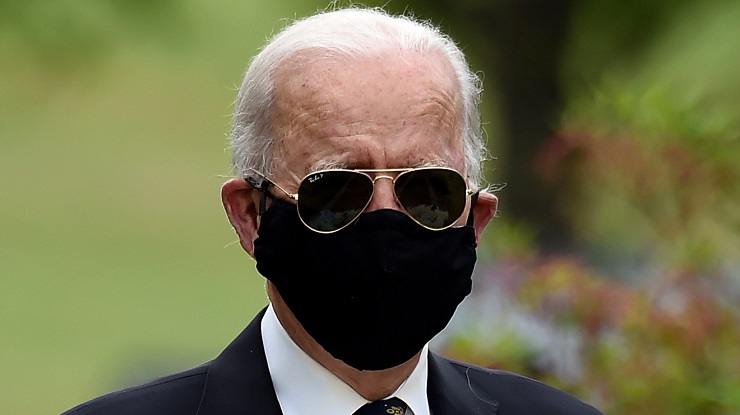
By Ramona Wadi | MEMO | March 11, 2021
Israel is reportedly concerned that US President Joe Biden will prioritise human rights over traditional allegiances in the Middle East. With a policy shift that departs from the Trump administration’s belligerence, Biden is attempting to bring Washington in line with the human rights rhetoric favoured within the international arena, albeit rarely, if ever, acted upon.
The recent declassification of documents pertaining to the murder of Saudi journalist Jamal Khashoggi has been used by Israel to claim that the Biden administration risks alienating the settler-colonial state’s allies in the Middle East, particularly at a time when the Netanyahu government is still basking in the diplomatic success of the Abraham Accords.
Israel need not worry, though. While other Middle Eastern governments may indeed come under intense scrutiny and be forced to make cosmetic changes to their atrocious human rights record – releasing prominent activists from prison, for example – Israel will not be required to make any such concessions. The international community has already accomplished a great deal in marketing Israel’s security narrative as indistinguishable from human rights. If Israel says it needs to defend itself, how dare the international community suggest otherwise? On the contrary, governments are eager to support Israel’s killing machine and turn a blind eye to its victims. Collateral damage in the name of human rights is perfectly acceptable, it seems.
The White House has recently released the “Interim National Security Strategic Guidance“. Democracy is Biden’s selling point. Holding the new US administration to account on its democracy, however, is a different story. After all, anything is better than Trump. Such reasoning played into the psyche of the US electorate and political responsibility may well become a relic of the past if the Biden administration continues to be juxtaposed against Trump’s, or viewed as a better option for no other reason than the president is now not Trump. Indeed, there is a risk of Biden being spared the usual scrutiny that comes with being US president, and while Israel may miss the Trump era, the current administration is certainly not averse to upholding the apartheid state’s impunity.
It is more a selective process of which governments the US is going to support militarily in the name of democracy, rather than a repudiation of militarism as Biden is attempting, and failing, to convey to the world.
“In the Middle East, we will maintain our ironclad commitment to Israel’s security, while seeking to further its integration with its neighbours and resuming our role as promoter of a viable two-state solution,” the guidance document proclaims. There’s no conflict for Israel in that, since “two states” is a defunct option that existed only to enhance its own security narrative. An “ironclad commitment” to Israel’s security is undemocratic, though, no matter how much the two-state solution is given a democratic gloss through international consensus.
What Biden’s brand of democracy looks like to Israel will be untenable for the Palestinian people. There is no mention of the Palestinians in the document, indicating to us all for whose benefit the two-state paradigm will be pursued. It is not about the result, but the allegiances forged through such diplomacy, which the Palestinian Authority is still deceiving itself into thinking gives it a say over which governments are supportive of the Palestinians’ struggle for their land and rights. The truth is that Biden’s brand of democracy isolates Palestinians, and all in the name of human rights.
How Israel is Shaping Biden’s Iran Policy
By Salman Rafi Sheikh – New Eastern Outlook – 09.03.2021
While Joe Biden the candidate wanted to quickly normalise relations with Iran and re-enter the JCPOA, Joe Biden the president has, as the developments that have happened so far, deviated from his stated course of action. To a large extent, Biden has appropriated Trump’s “maximum pressure” strategy and has refused to lift sanctions on Iran and simply make the US a part of the Iran nuclear deal. To a significant extent, this dramatic change in policy, while not completely surprising for the Iranians, is a result of the way Israel is pushing the Biden administration away from reconciliation and normalisation. In fact, a crucial reason for Biden’s appropriation of Trump’s “maximum pressure” strategy is the way the Israelis have very quickly implanted their own discourse vis-à-vis Iran in the mindset of the Biden administration. Echoing what the Israelis have been saying for years, Antony Blinken recently remarked that Iran was only “weeks” or “months” away from making a bomb. Although there is a huge difference between having the capacity to build a bomb and actually building and using a bomb, the US sees this [doubtful] proximity to building a bomb as a crucial factor that has made the Biden administration change its plans from re-joining the JCPOA to emphasising renegotiations. It has led it to refuse to lift sanctions.
The hard-line position that the Biden administration has taken feeds directly into the Israeli narrative. What Blinken said matches perfectly with what Israeli officials have also recently claimed. According to a recent assessment issued by Israel’s Militray Intelligence Directorate, “Iran may be up to two years away from making a nuclear weapon if it chooses to do so.” The report further says that Iran’s current enrichment level brings it closer to various “breakout” estimates about how quickly it could enrich uranium to 90%, and also begin to build better missiles and a weapons system that might lead to a nuclear weapon.
For Israel, therefore, it is of utmost importance that the US remains focused on the “violations” that Iran has committed by enriching uranium beyond the limits imposed by the JCPOA. A recent report of The Jerusalem Post thus sums Israel’s current approach. It says, “What is important for Israel is that the brinkmanship continue, and that Iran’s violations and Israel’s concerns continue to be recognized. For that to happen, it is also important for close US-Israel cooperation and discussion in order to prevent nuclear proliferation by the Tehran regime.”
The report refers to an IDF intelligence officer Maj.-Gen. Tamir Heiman who said in a briefing on the IDF assessment that Iran is at an unprecedented low point and is “battered, but on its feet,” following actions carried out by Israel and the US. Tehran is banking on the Biden administration for some breathing room. It is incumbent on the US – and Israel – to make sure that is not allowed to happen for nothing.”
Now, the fact that the Biden administration has refused to take a step back and lift its sanctions to pave the way for the US’ re-entry shows how closely the US and Israel are already coordinating their policies vis-à-vis Iran. The Biden administration’s announcement that the US would not re-join the agreement or even lift sanctions unless Iran halts enrichment dovetails perfectly with what Netanyahu had said just before the US elections. To quote him, “There can be no going back to the previous nuclear agreement. We must stick to an uncompromising policy of ensuring that Iran will not develop nuclear weapons.”
The Biden’s administration’s capitulation to Israel’s uncompromising policy vis-à-vis Iran has led Iran to stick to its own path. An official Iranian statement released on February 28 said that:
“the way forward is quite clear. The US must end its illegal and unilateral sanctions and return to its JCPOA commitments. This issue neither needs negotiation, nor a resolution by the Board of Governors of the International Atomic Energy Agency. The Islamic Republic of Iran will respond to actions with action and just in the same way that it will return to its JCPOA commitments as sanctions are removed…”
The hardening of US and Iranian positions serves Israeli interests in the best possible way. An unresolved nuclear power tussle in the Middle East would keep Israel at the centre stage of regional politics. Given Israel’s recent rapprochement with the UAE and other Gulf states, tensions in the Gulf would not only reinforce Israel’s direct security ties with these Gulf states, but the scenario could very well make other Gulf states join The Abraham Accords. Tensions with Iran, therefore, could allow Israel to establish itself as the new regional hegemon.
Israel has already got supporters in the form of not only the UAE but Saudi Arabia as well. They have both stated that they would be open to a deal only if it went well beyond the previous one. According to them, any deal, in addition to putting limits on Iran’s nuclear program, must include provisions aimed at reversing Iran’s ballistic missile program, ending its “meddling” in other countries and the militias it supports in Iraq, Lebanon, Syria, Yemen and elsewhere.
Israel, as it stands, is already leading the Gulf states in lobbying the US for an agreement that not only limits Iran’s nuclear program, but also curtails its national power potential in many other ways. As some reports in the US mainstream media show, the Mossad chief, Yossi Cohen, and a team of experts will soon travel to Washington to brief senior American officials about what they see as the threats still posed by Iran, hoping to persuade the US to hold out for harsher restrictions on Iran in any deal.
Iran, on the other hand, is unlikely to change its position vis-à-vis any new deal, especially the one that tends to force it into a virtual capitulation. China and Russia continue to support an unconditional US return to the JCPOA in exchange for Iran’s return to full compliance with the deal. An unconditional return “is the key to breaking the deadlock,” said Hua Chunying, a spokeswoman for China’s foreign ministry, in a recent news conference.
But “breaking the deadlock” is not what Israel and its allies in the Gulf are seeking to achieve. They are pushing the US to adopt a policy that keeps the deadlock alive unless Iran’s power and regional influence can be fully and permanently curtailed. For the Israelis, the path to Iran’s capitulation demands a US capitulation to Israel first so that they can shape the US policy in a way that best serves their interests. So far, the Israelis have been successful.
War Drums Beating Louder Under Biden Hardliners
By Stephen Lendman | March 9, 2021
On all things war related, Trump mainly focused on waging it all-out by other means on Iran, China, and other nations free from US control.
Early in his tenure, the rape and destruction of Raqqa, Syria and Mosul, Iraq were major exceptions.
For the most part, he was relatively quiet on the hot war front, notably launching no new ones during his time in office.
Biden and warmongers surrounding him are cut from a different cloth.
As US senator and vice president, Biden supported one preemptive US war after another on invented enemies — nonbelligerent states threatening no one.
Will the pattern repeat with him in the White House?
Is it just a matter of time before hardliners running his geopolitical agenda invent pretexts to escalate ongoing US wars and/or launch one or more new ones?
If past is prologue, greater US warmaking is highly likely.
In the Middle East, plans to escalate war in Syria may exist or are being prepared.
The same goes for neighboring Iraq. Its parliamentarians and ordinary people want their country back, US occupation ended once and for all.
Not if undemocratic Dems have their way. US forces came to Iraq to stay.
As in Syria, Afghanistan and elsewhere, permanent US occupation is planned — enforced through the barrel of a gun.
According to US war secretary Lloyd Austin on Sunday:
“We’ll strike, if that’s what we think we need to do, at a time and place of our own choosing. We demand the right to protect our troops (sic).”
In late February, hardliners in charge of Biden’s geopolitical agenda OK’d aggression against targets along the Iraqi/Syria border.
Is more of the same planned against both countries?
Is direct US confrontation with Iran coming ahead?
Are conflicts planned in Central Asia, North Africa and/or the Indo/Pacific?
According to Tom Dispatch in late January:
“Biden inherit(ed) (US) global war—and burgeoning new Cold War —spanning four continents and a military mired in active operations in dozens of countries, combat in some 14 of them, and bombing in at least seven.”
“That sort of scope has been standard fare for American presidents for almost two decades.”
What’s likely since Biden replaced Trump?
Will he escalate US wars of terror, not on it?
As senator and vice president, Biden cheerled US preemptive wars.
He’ll “surely escalate American adventurism abroad,” Tom Dispatch (TD) believes.
He’s been interventionist throughout his public life. He’ll likely at least maintain status quo belligerence.
TD: “Whether the issues are war, race, crime, or economics, Uncle Joe has made a career of bending with the prevailing political winds and it’s unlikely this old dog can truly learn any new tricks.”
He “filled his foreign policy squad with Obama-Clinton retreads, a number of whom were architects of—if not the initial Iraq and Afghan debacles.”
They followed with “disasters in Libya, Syria, West Africa, Yemen, and the Afghan surge of 2009.”
“Biden (put) former arsonists in charge of the forever-war fire brigade.”
At the same time, press agent media will likely “help (him)… make war more invisible… to Americans.”
History one day won’t likely “judge Biden the war president kindly.”
Since the run-up to WW I, Dems have been more belligerent than Republicans — Bush I, II, and Dick Cheney major exceptions.
So was Jack Kennedy going the other way, transforming himself from a warrior to peacemaker, one among other reasons why he was assassinated.
Jimmy Carter earlier said: During his time in office, “(w)e never dropped a bomb. We never fired a bullet.”
Dem presidents after his tenure were warriors, not peacemakers — notably Biden as senator, vice president, and now figurehead president, a disturbing record since the early 1970s.
Is escalated warmaking on his watch coming? His history of supporting wars on invented enemies and interventionist geopolitical team suggest more of the same ahead.
Terror-bombing targets along the Iraqi/Syrian border in late February perhaps was prelude for follow-up aggression.
Since taking office, increased numbers of Pentagon forces, heavy weapons, munitions and equipment were sent to Kurdish-controlled eastern Syria where most of the country’s oil is located.
Iran accused the Biden regime of reviving ISIS in Iran and Syria, Iranian Supreme National Security Council secretary Ali Shamkhani saying:
Recent US belligerence “strengthens and expands the activities of the terrorist Daesh (ISIS) in the region,” adding:
“The (late Feb.) attack on anti-terrorist resistance forces is the beginning of a new round of (US) organized terrorism.”
He vowed firm resistance to “confront the US plan to revive terrorism in the region.”
US aggression time and again signals more of the same coming — unjustifiably justified by invented pretexts. No legitimate ones exist.
The Pentagon reportedly deployed six long-range B-52 bombers to Diego Garcia.
It’s a location from which US airstrikes can hit targets in the Middle East and Indo/Pacific.
According to military.com, the US is “add(ing) roughly 10,000 personnel to… the Middle East.”
Southfront reported that Syrian forces are “prepar(ing) a decisive push on the Turkish-occupied areas” in the country’s north, adding:
“(S)oon-to-be-rebranded Hay’at Tahrir Al-Sham (HTS) terrorists are attempting to merge with the Turkish-backed National Front for Liberation (NFL).”
“This proposed military council is clearly meant to provide a legitimate cover for the rebranded terrorist activities of HTS and other al-Qaeda factions in Greater Idlib.”
According to Deputy Head of the Russian Coordination Center in Syria, Adm. Alexander Karpov:
“There has been information on that Jabhat al-Nusra terrorists are getting ready to stage a new provocation in the de-escalation zone in Idleb which includes staging a false flag chemical attack.”
Russia’s Defense Ministry reported that labs in Idlib run by European trained experts are preparing CWs for use by jihadists to stage false flag attacks to be blamed on Damascus.
If one or more incidents occur, Syria will surely be wrongfully blamed for what it had nothing to do with — like many times before.
Will Biden hardliners use false flag CW incident(s) as a pretext for escalated aggression?
Separately, Southfront said (US armed and trained) Ukrainian forces escalated artillery strikes on Donbass.
“(C)lashes between pro-Kiev forces and (freedom-fighting) DPR/LPR self-defense units” followed, adding:
“(L)ocal sources report that the scale of violations by pro-Kiev forces are unprecedented for the recent months…”
Kiev “is deploying additional units of heavy weapons and military equipment to the contact line… confirmed by OSCE reports.”
All of the above are worrisome signs of what Biden hardliners may be planning — escalated aggression by US forces, their jihadist proxies and US installed regime in Kiev.
Featured Video

HE SAVED LIVES. NOW HE FACES PRISON.
or go to
Aletho News Archives – Video-Images
From the Archives
NATO Sanctions and the Coming Global Diesel Fuel Disaster
By F. William Engdahl – New Eastern Outlook – 11.04.2022
Amid the ongoing global inflation crisis, NATO heads of state and mainstream media repeat a mantra that high energy prices are a direct result of Putin’s actions in Ukraine since end of February. The reality is that it is the western sanctions that are responsible. Those sanctions including cutting SWIFT interbank access for key Russian banks and some of the most severe sanctions ever imposed, are hardly having an impact on the military actions in Ukraine. What many overlook is the fact that they are increasingly impacting the economies of the West, especially the EU and USA. A closer look at the state of the global supply of diesel fuel is alarming. But Western sanctions planners at the US Treasury and the EU know fully well what they are doing. And it bodes ill for the world economy.
While most of us rarely think about diesel fuel as anything other than a pollutant, in fact it is essential to the entire world economy in a way few energy sources are. The director general of Fuels Europe, part of the European Petroleum Refiners Association, stated recently, “… there is a clear link between diesel and GDP, because almost everything that goes into and out of a factory goes using diesel.” … continue
Blog Roll
 Aletho News
- Qatar PM calls for Gulf security framework with Iran, says war must be ‘wake-up call’
- China condemns US extortion of Iranian airlines, rejects Washington’s ‘illegal’ sanctions threats
- Italy to move military personnel from Taif base after missile strike
- Finland’s Stubb tells European leaders to calm down
- Defeating Russia on battlefield impossible – Fico
- Finland’s Gender Clinic Reversal
- Massachusetts Wants Mental Health Visits, Why Does Government Use ‘Health’ to Enter Our Homes & Families?
- US lawmaker admits American people footing bill for Trump’s failed aggression against Iran
- Pfizer Gave $500,000 to Groups That Lobbied to End Religious Exemption in Massachusetts
- HE SAVED LIVES. NOW HE FACES PRISON.
- If Americans Knew
- Sanctions are collective punishment: immoral and self-defeating
- Phosphorus Munitions Fired by Israel Burn Groves, Orchards in Southern Lebanon
- Israel Carries Out New Ceasefire Violations Across Gaza
- AI – Emphasis on the ‘I’: Israel Is Funding AI Chatbot Propaganda
- Israel Blocking Hundreds of Wheelchairs for Injured Children From Entering Gaza
- Israel Is Expanding and Upgrading Compounds for Palestinian Militias in Gaza
- The Palestinian-American Residents of This West Bank Town Are Wondering: Where Is Trump?
- Gaza desperately needs tents, wheelchairs, fuel… and everything else (Israel blocks it all) – Daily Update
- Israeli Attacks in Gaza Kill at Least Seven Palestinians Over Three Days, including Woman and Child
- Trump’s militarization of Washington DC as he pursues Israel’s war against Iran
- No Tricks Zone
- 2025 Nature Paper Claiming Worsening Global Drought Gets RETRACTED …Heavily Flawed
- New Study: ‘Global Drought Shows No Detectable Recent Acceleration Under Climate Warming’
- Economic Masterminds: German Socialists Suggest Taxing Productivity Gains Stemming From Using AI
- The South China Sea Has Not Been Cooperating With The Climate Change Narrative
- Energy Crisis: Germany Enters Heating Season With Historically Low Gas Reserve Fill Levels
- New Study: The Antarctic Ice Sheet Gained Mass From 2020-2024 Due To Staggering Snow And Ice Accumulation
- Study: Ocean Heating Rates From Thousands Of Years Ago ‘Dwarf’ Modern Ocean Heating Rates
- Climate Extremists Target, Attack Large-Scale Power Grid Infrastructure In Germany!
- New Study: Antarctic Ice Melt Has Contributed Less Than 1 Centimeter To Sea Level Rise In The Last 30 Years
- Fear Of Debate: Alarmist German Climate Scientist Calls On Mainstream Media To Discredit Skeptic Voices

