Trump’s Fatal Mistake in Iraq and Beginning of End for US Occupation
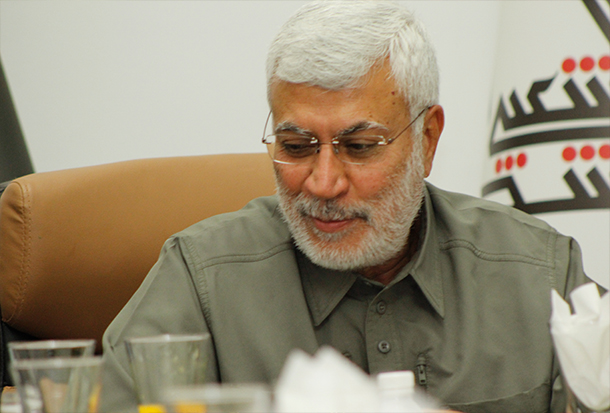
Iraqi PMU commander Abu Mahdi al-Muhandis in Baghdad following their defeat of ISIS in 2017 (Photo: Patrick Henningsen 2017©)
By Patrick Henningsen | 21st Century Wire | January 3, 2020
The United States may have just worn out its welcome in Iraq. Whatever comes next will be laid at the feet of the Trump Presidency.
As a result of a series of disastrous moves by US central command, the region now faces the very real prospect of another multinational conflagration in the Middle East, which could include a direct military confrontation between the US and Iran.
How It Began
This past Sunday December 29th, just before the New Year rang in, President Donald Trump gave the order to bomb an Iraqi military base, killing and wounding a number of Iraqi military personnel, including Iraqi Army officers, Iraqi police, as well as soldiers belonging to the People’s Mobilization Unit (PMUs). US Air Force F-15E fighters struck five targets located in Iraq and along the Syria-Iraq border, all said to be controlled by an ‘Iranian-backed paramilitary group,’ according to the Pentagon.
According to Washington defense spokespersons, Sunday’s US airstrike was supposedly in response to a rocket attack which struck the “K1” joint US-Iraqi military base located in Kirkuk in north Iraq, which happened just two days before on Friday December 27th, killing one U.S. defense contractor, and one Iraqi police officer, as well as wounding a further 4 US defense contractors, and 3 Iraqi Army officers. US officials claim they had intelligence which confirmed that Friday’s rocket attack near Kirkuk was the work of “Iranian militia,” therefore holding the Islamic Republic of Iran responsible. However, no evidence was presented by the US in relation to the claim.
In response to the US bombing its facility on Sunday, Iraqi protesters, including friends and family of fallen soldiers killed in the US bombing raid, and led by Iraqi PMU members and their supporters, stormed the outer perimeter of the US embassy in Baghdad located inside the infamous US-controlled Green Zone. Many US embassy staff were evacuated or airlifted from the compound, and an additional detachment of 100 US Marines were called in as reinforcements, along with an additional 750 troops from fast battalion 82nd Airborne Division sent to Kuwait preparing to go into Iraq. US combat helicopters circled overhead, as well as around the entire Green Zone and over civilians neighborhoods in Baghdad. This move was not received well by the Iraqi government who forbid such US military patrols as part of their status of forces agreement for the country. The siege lasted until News Years Eve on December 31st, before the Iraqi Army and Iraqi Mukhabarat internal security eventually arrived to disperse the angry crowds.
Following the embarrassing scenes at the US embassy on New Years Eve, Washington promised retribution. What followed could very well be the trigger for a renewed war in Iraq, and which may likely result in US forces and personnel eventually being asked (or forced) to leave the country. On Wednesday January 2, 2020, the US launched another airstrike, targeting an access road leading to Baghdad International Airport, and reportedly killed Iranian Quds Force leader, General Qasem Soleimani, as well as senior Iraqi PMU commander, Abu Mahdi al-Muhandis, according to reports by Iraqi TV.
Both Soleimani and al-Muhandis are considered to be among Iran and Iraq’s most revered military figures, and their targeted assassinations by the US government will certainly be viewed as an act of war by a large portion of the Iraqi and Iranian populations, as well as their respective military and security apparatuses. In particular, al-Muhandis is regarded by many a hero in Iraqi’s hard-fought victory over ISIS in 2017.
Iraqi cabinet officials and parliamentarians have been meeting over the last 48 hours to discuss reviewing the status of their cooperation agreement with the United States which allows for intelligence sharing and US training and technical assistance for Iraqi military divisions. Whether this escalates into officials calling for the US military and its 20,000 troops and defense personnel to pack up and leave the country – remains to be seen.
It should go without saying that this provocative military action by the United States means that US troops and personnel may no longer be safe operating in Iraq.
Questioning US ‘Intelligence’
In order to grasp the full gravity of what the Trump Administration has just done, it’s essential to consider these events in historical context, as the latest reckless move in a long line of US failures in Iraq.
According to veteran Middle East correspondent Elijah Magnier, “The United States of America has fallen into the trap of its own disinformation policy, as exemplified by the work of one of its leading strategic study centres, a neocon think tank promoting war on Iran.”
Magnier adds, “Analysts’ wishful thinking overwhelmed their sense of reality, notably the possibility of realities invisible to them. They fell into the same trap of misinformation and ignorance that has shaped western opinion since the occupation of Iraq in 2003. The invasion of Iraq was justified by the presence of ‘Weapons of Mass Destruction’ which never existed.”
According to Iraqi officials, at the time of the initial rocket attack on Dec 27th, it was not clear who had actually fired on the K1 joint base. Regardless, a number of data points strongly indicate that the US had already decided who it would be targeting.
According to the New York Times, “President Trump was briefed by Defense Department leaders on Saturday, and allowed the strikes to proceed. Senior officials including Defense Secretary Mark T. Esper and Secretary of State Mike Pompeo traveled to Mr. Trump’s Mar-a-Lago resort in Florida on Sunday for discussions with the president, American officials said.”
The US had already taken the decision to bomb Iraq before any joint investigation could be conducted between the Iraqi Ministry of Defense and the US authorities. Soon after the Mar-a-lago meeting, Secretary of Defense Mark Esper called acting Iraqi Prime Minister Adil Abdul-Mahdi to inform him the US was not interested in working with Baghdad to find out what happened and who had fired the rockets. Esper told the Iraqi PM that Washington had already received “intelligence” from its trusted sources which said the rocket attack was carried out by a branch of the Iraqi PMUs known as Katiab Hezbollah (no relation to Lebanon’s Hezbollah defense force). It should be noted that these PMU brigades are composed of Iraqi citizens who serve under the official Iraqi military command headquartered in Baghdad. Because this PMU division’s membership is composed of Shia Muslims, United States officials and the US mainstream media have taken the liberty of labeling them as “Iranian militia” – a blatant falsehood, but one which has been disseminated by US officials in order to infer these are somehow ‘Iranian proxies’ and proceeded to pin the alleged responsibility of the initial rocket attack on Iran, in effect, justifying the heavy-handed US retaliation on Sunday, and Washington’s targeted assassinations of Qasem Soleimani, and Abu Mahdi al-Muhandis on January 2nd.
To date, US officials have provided no evidence to support their claim that the rocket attack on Dec 27th was carried out by Katiab Hezbollah PMUs, nor has the US given any specifics as to the provenance of its ‘intelligence’ which attributed blame to PMUs. If this was indeed a rush to judgement, it would not be the first time the US has perpetrated an act of war against a sovereign state based on faulty, and less than credible intelligence. The recent OPCW leaks have demonstrated beyond any doubt that the US-led airstrikes against Syria in April of 2018 were based on misinformation of a supposed ‘chemical attack’ just days earlier in Douma, Syria on April 7, 2018.
Upon closer review, it’s now clear that what the US claimed it was doing, does not actually match the actions which it had undertaken on Dec 29th. In addition, the US bombing raid on Dec 29th will also have aided ISIS. Magnier explains the obvious US disconnect here:
Mr Abdel Mahdi asked Esper if the US has “proof against Kataeb Hezbollah to share so Iraq can arrest those responsible for the attack on K1”. No response: Esper told Abdel Mahdi that the US was “well-informed” and that the attack would take place “in a few hours”.
In less than half an hour, US jets bombed five Iraqi security forces’ positions deployed along the Iraqi-Syrian borders, in the zone of Akashat, 538 kilometres from the K1 military base (that had been bombed by perpetrators still unknown). The US announced the attack but omitted the fact that in these positions there were not only Kataeb Hezbollah but also Iraqi Army and Federal Police officers. Most victims of the US attack were Iraqi army and police officers. Only 9 officers of Kataeb Hezbollah – who joined the Iraqi Security Forces in 2017 – were killed. These five positions had the task of intercepting and hunting down ISIS and preventing the group’s militants from crossing the borders from the Anbar desert. The closest city to these bombed positions is al-Qaem, 150 km away.
Interestingly, this is not the first time that the US and allies have targeted an Iraqi PMU facility and tried to label it as “Iranian.” Back in September, 21WIRE reported how Israel and Saudi Arabia were reported to have launched supposed ‘retaliatory’ airstrikes against “pro-Iranian militias” stationed along the border between Syria and Iraq. This was reported by the Jerusalem Post at the time:
“Saudis, Israel attack pro-Iran militias on Syria-Iraq border,” and adding that,“Saudi fighter jets have been spotted along with other fighter jets that have attacked facilities and positions belonging to Iranian militias.”
21WIRE also noted how the Jerusalem Post had compiled their report citing multiple sources, including pieces of information from the Independent Arabia, Lebanese outlet Al Mayadeen and the Syrian Observatory for Human Rights. They reported air strikes hitting targets over the course of that week, killing 31, after hitting what they called “Iranian-backed” Iraqi Hash’d Shaabi (PMUs) positions along the Iraqi-Syria border.
“On Wednesday, five people were killed and another nine were wounded in an airstrike carried out by unidentified aircraft that targeted positions of the Iranian-backed Iraqi Popular Mobilization Forces militia in Albukamal, according to Sky News Arabia.”
Why this is crucial, is because it demonstrates previous form by Israel and Saudi Arabia – against near identical targets which the US bombed on Dec 29. It stands to reason then, that the ‘intelligence’ source for both attacks, on Sept 19th, and Dec 29th, seem to be related, deriving from either Israel or Saudi Arabia – both of which are heavily biased against Iran, and viewed it as an existential threat to their own regional geopolitical and military hegemony. In the case of Israel, it has played a visible role in directing US policy regarding Iran since the onset of the Trump Administration. It was Israeli PM Benjamin Netanyahu who boasted about his role in convincing the White House to unilaterally withdrawal from the JCPOA Iran nuclear deal in May 2018.
It’s also important to note with the US bombing raid on Sunday Dec 29th, the Iraqi bases hit along the Syrian-Iraqi border are located approximately 540km from Kirkuk, far away from where the US claim that Kaitab Hezbollah PMUs had fired the initial rocket attack on Dec 27th – which means that those US targets played no role in Friday’s rocket attack on K1, and more likely had already been selected in advance of Dec 27th, and the US was simply waiting for the right ‘incident’ to green-light a military attack on what it claims to be “Iranian” military targets.
Again, the fact that the US insists on mislabeling its supposed enemy means that nothing productive can come out of the latest series of events – unless Washington considers another full-scale war in Iraq a productive endeavor – a proposition which many would not find that far-flung considering America’s tawdry record in the region.
Iraqi PMUs Defeated ISIS in 2017
In order to properly understand the Iraqi military and PMU’s reaction to this ham-fisted US attack on Iraqi soil, it is important to understand who are the Iraqi People’s Mobilization Units (PMUs), aka the Hash’d al-Shabbi, or ‘Hasheed’ for short. This is the new national militia of Iraq and are the very same soldiers who have fought and died against ISIS for ultimately defeating their terrorist occupation in late 2017. The PMUs were formed in response to the emergence of ISIS and the fall of Mosul in June 2014. The Grand Ayatollah Sistani issued a fatwa in the summer of 2014, which called on all able-bodied men of fighting age to form a coalition of national militias, roughly 130,000 strong, to fight back against ISIS after it had routed the Iraq Army during ISIS’s summer blitzkrieg which saw several key cities taken by the terrorist army, as they headed dangerously close to the capital city Baghdad.
Based on the rhetoric and media coverage we are seeing this week, it’s painfully obvious that few, if any, within the ranks of American foreign policy ‘experts’ and national security journalists, are really aware of this reality on the ground in Iraq. It is widely acknowledged in Iraq, and in the region, that the PMUs played the decisive role in defeating ISIS and securing liberated communities in the latter stages of the country’s terrorist ordeal. It’s important to note also that tens of thousands of Iraqis, including Iraqi Army, Police, Iraqi civilians, and Iraqi PMUs – including these very same PMU units who the US has killed this week – have all died, sacrificing their lives for their country in the fight against the foreign-backed terrorist menace. For the United States political leadership and mainstream media to crassly label them as “Iranian militias,” is to rob Iraqis of an important national victory and strip them of their agency.
As we can now see from the incredible scenes at the US embassy on Tuesday, Washington’s ignorance of the reality on the ground in Iraq has come at a heavy price.
Since its opening in 2008, the new US embassy has not faced any serious challenge to its structural integrity. It is not just any embassy either – it is the world’s largest and most expensive embassy ever constructed, covering a total of 104 acres which is roughly the size of Vatican City, and houses 5,000 embassy staff, military and intelligence personnel. Iraqi protesters breached its outer security walls and main gate, and proceeded to lay waste the embassy’s periphery structures, before pinning down US Marines guarding the compound inside the foyer of one of the outer reception buildings. Now that this facility has been compromised, it can no longer be relied on as the ‘fortress America’ and forward operating station it has been for the past decade.
Trump and Washington’s Fundamental Error
Another important takeaway from all of this is for Americans to realize that Iran posed no national security threat to the United States, but Washington’s insistence on framing every incident in the region as “the work of the Iranian regime” means that forces in Washington desperately want war, and now they can’t hide their agenda. This drive is most certainly being spurred on by US allies in the region, Israel and Saudi Arabia. From an imperialist standpoint, the US and its allies do benefit geopolitically by keeping Iraq divided and weak – ensuring that it can never get back on its feet economically or politically to become influential in the region, and can never become close partners with its two most important neighbors Syria and Iran.
For Washington and Tel Aviv, the road to Tehran has always been through Baghdad, only we’re not in 2003 anymore, and the Middle East playing field has changed dramatically since that time, mostly as a direct consequence of US military and proxy aggression in the region.
Besides this, Iraqis are well aware by now that it is the United States and not Iran, who has already ruined their country for generations to come.
If Washington continues down this path, it could also lead to Trump’s downfall politically.
Unfortunately, Iraq is set again to become the pitch for another ugly geopolitical grudge match between the West and Iran. By showing its ugly hand, Washington has left its adversaries with little choice but to fight back this time.
***
Author Patrick Henningsen is an American writer and global affairs analyst and founder of independent news and analysis site 21st Century Wire, and is host of the SUNDAY WIRE weekly radio show broadcast globally over the Alternate Current Radio Network (ACR). He has written for a number of international publications and has done extensive on-the-ground reporting in the Middle East including work in Syria and Iraq. See his archive here.
Israel’s countdown to achieve the ‘alternative homeland’ in Jordan begins
By Dr Adnan Abu Amer | MEMO | January 1, 2020
The Israeli right is preparing to present a plan to overthrow the Jordanian king after annexing the Jordan Valley in the West Bank to realise the dream of Jordan being converted to Palestine. They aim to establish a confederation between the PA and “Palestinian Jordan” because the Israeli right is interested in annexing the West Bank without the millions of Palestinians within it. Forcing them to head to Jordan.
Israel’s Haaretz newspaper revealed in late December the Israeli right-wing’s approaches and plans, led by Prime Minister Benjamin Netanyahu. This is based on the claims that Israel has major plans for Jordan, but these plans do not include the same king. This is evidenced by several articles and reports written by right-wing Israeli writers this month who all present similar justifications and results, the main of them all is to destroy the peace treaty with Jordan.
Right-wing Israelis believe that annexing the Jordan Valley is a tactical operation aimed at hitting two Israeli birds with one stone: the first is to work to annex the West Bank and cancel the peace agreement with Jordan, and the second is to topple the Hashemite royal family and to embody the dream of Jordan being Palestine.
It is interesting that this dream is shared by all the Israeli right, with all its components and currents, because they are enthusiastic supporters of the idea that Jordan is Palestine. The ruling Israeli right has begun to detest King Abdullah II.
When King Abdullah is shamefully toppled, Israel will be able to complete its annexation of the West Bank and establish a confederation between the Palestinian Authority and “Palestinian Jordan”.
Moreover, according to the Israeli perception, when that happens, the Palestinians in the West Bank will obtain political rights in Jordan.
According to this Israeli theory, when the Palestinian state is established in Jordan, the Palestinians can resolve their issue, put an end to their suffering and stop using armed operations against Israel, because since 1988, Palestinians in the West Bank have been able to obtain temporary Jordanian passports.
It is worth noting that the Israeli approach may contradict Jordan’s interest in reducing the total number of Palestinians in the kingdom because it refuses at the moment to receive Palestinian refugees from Syria in the way it allowed Syrian and Iraqi refugees to seek refuge on its soil.
Perhaps such aspirational Israeli calls towards Jordan are encouraged by the fact that the two-state solution to the Palestinian-Israeli conflict is no longer practical or realistic. Meanwhile, there are claims that the alternative solution is the establishment of an Arab Palestinian state east of the Jordan River, which will achieve peace between Israel and Palestine. They also claim that the river can be used to transport goods and products from either side, with the Israeli Jewish state on one side and the Arab Palestinian country on the other, side by side.
There is another Israeli scenario of Jordan hosting more Palestinians and instead of the kingdom becoming a Palestinian republic, they become citizens with full rights in the Hashemite Kingdom.
The return of Gilad Sharon after a long absence was noteworthy. He is the son of the late Prime Minister Ariel Sharon, who had strong relations with the late King Hussein, King Abdullah’s father. Gilad Sharon returned to claim that the current Jordanian king would not dare to oppose the annexation of the Jordan Valley by Israel, because Israel has him by his weak spot and the continuation of his rule depends on Israel. He also said that if the king opened his mouth, Israel would turn off the water tap and leave the kingdom to go thirsty.
All these are efforts to drive the king to cancel the peace agreement with Israel and allow Tel Aviv to remove him.
King Abdullah finds himself caught between the anger of the Jordanian public and Israel. The situation of his government has become really difficult because his country’s budget is suffering, the sources of income are declining, the Gulf states, which have always been a source of support for Jordan, have reduced their aid, and millions of Arab refugees have flocked to the kingdom in recent years.
In spite of the increase of tensions between Jordan and Israel over the past year, security coordination between them continues as usual and the intelligence cooperation is at its best. This raises questions about the king failing to use this card to pressure Israel unless this cooperation serves him and not the kingdom.
America’s New War: Let’s Not Pretend That Iraqi Paramilitaries Drew First Blood
The undeclared US-Israeli hunting season on Iraqi militias had been going on for months before the first US casualty
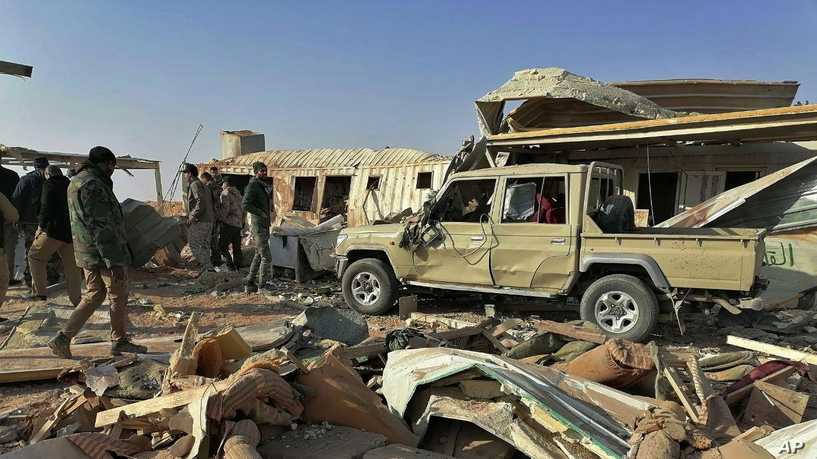
By Marko Marjanović | Checkpoint Asia | January 1, 2020
As the Trump administration would have it history began yesterday. On December 27 A rocket salvo struck a US base near Kirkuk killing a US contractor and wounding four US soldiers, as well as, according to the Americans, two Iraqi soldiers.
So two days later the US — deducing that the attack must have come from the Iraqi Kataib Hezbollah paramilitary that right now hates the Americans’ guts the most — bombed five Kataib facilities on the Iraq-Syrian border, ie nowhere near Kirkuk, killing 25 and wounding 55 Kataib paramilitaries that almost certainly had nothing to do with the Kirkuk base attack themselves.
So according to the Americans albeit their airstrikes, against an outfit that is formally part of Iraq’s official security forces, may have technically violated Iraqi sovereignty that is a technicality since the paramilitary is a proxy for Iran, and in any case these Iranian proxies started it by killing an American first in attacks on guests of the Iraqi government.
Americans also suppose that since they have been granted basing rights in Iraq and the right to act militarily (against ISIS) on Iraq’s territory that comes with the right to defend themselves.
Americans also emphasize the attack allegedly by Kataib also wounded two Iraqi soldiers.
So the American telling is something like‘Iranian proxies are attacking us who are guests of the Iraqi government and hurting Iraqi servicemen in the process, so we bombed them to defend ourselves and teach them a lesson.’
On its face that sounds almost reasonable, but there are a number of problems with such a statement.
First, as probably the single most influential man in Iraq, the Shia cleric al-Sistani pointed out, even if it were true that Kataib paramilitaries had gone rogue in attacking US facilities it does not follow that Americans, a foreign military with mere basing rights, have the liberty to take matters into their own hands and be the judge, jury and executioner in revenge attacks on a state-sanctioned paramilitary 500 kilometers from the place of the actual attack on the US base.
Second, there is a matter of scale. Because “Iranian proxies” (as Americans would have it) injured a pair of Iraqi servicemen that does not follow Americans are now entitled to kill or wound seventy-seven Kataib paramilitaries who are also Iraqi servicemen.
Third, unlike the Trump gang would have it, history did not begin on December 27th. Between July 19 and September 22 Iraqi paramilitaries were hit in their Iraqi bases on at least eight different occasions. In August the Israeli PM Netanyahu confirmed that Israel was carrying out these strikes “against Iranian consolidation”. (That was also just the latest escalation on top of Israeli strikes on Iraqi paramilitaries positioned against ISIS in eastern Syria.)
However, as Iraqis fully understand Israel does not have the capability to strike targets in Iraq (and eastern Syria) without US logistical and intelligence support and the political go-ahead. These were Israeli drone strikes but originating in US/Kurdish-controlled NE Syria and using US-controlled airspace. What is more, quite possibly the Americans were using their presence in Iraq to supply Israelis with intelligence on Kataib and other paramilitaries.
It is also around this time that small-scale artillery (mainly mortar) attacks on US facilities in Iraq started. The only thing new about the December 27 attack was that it resulted in a US fatality. So no, Iraqi paramilitaries did not all of a sudden, and out of the blue, start targeting Americans in Iraq because they are such obedient Iranian proxies, and on the behalf of Tehran, but because they were being killed in their own country (and in neighboring Syria) and the US was to blame.
There have quite possibly been 100 Iraqi paramilitary fatalities in Iraq alone, before the first American died in a retaliatory attack. The blame here is not on Iran, the blame is on those who decided to pull Netanyahu’s chestnuts out of the fire even if it risked US troops in the region.
The only surprising thing about all of this has been how long it took for the backlash to catch up with the Trump gang. So of course instead of counting their lucky stars they went and escalated, so now they are going to reap a bigger backlash, quite possibly in the form of a renewed legal effort to oust them, albeit the nationalist Sadr has said he’ll be looking into “other means” if that doesn’t pan out.
Trump says he ‘does not see war with Iran happening’ hours after issuing a ‘threat’ against Tehran
RT | January 1, 2020
US President Donald Trump has said that the US is not gearing up for war with Iran, adding that he prefers peace to war. It comes just hours after the US leader upped the ante, making a pointed threat against Tehran on Twitter.
With simmering tensions between Tehran and Washington flaring up over the attack on the US embassy in Baghdad, which the US blamed squarely on Iran without providing any proof, there have been growing fears that another war of words could spiral into something far more violent.
In an apparent attempt to diffuse the tension, Trump said late Tuesday that he does not foresee a war actually breaking out between the US and Iran.
“War with Iran? I don’t think that would be a good idea for Iran… I like peace… I don’t see that happening,” Trump said speaking to media as he arrived at the grand ballroom at Mar-a-Lago for a New Year bash on Tuesday night.
Teheran has vehemently denied all the allegations that it is somehow complicit in the unrest sparked by the US airstrikes that killed 25 members of the Iraqi Shia militia Kataib Hezbollah over the weekend.
The American sorties have drawn ire from the Iraqi government, calling the bombing a violation of the country’s sovereignty as well as of militiamen and ordinary citizens who flocked to the US embassy in Iraq to protest the airstrikes.
Protests turned violent on Tuesday as demonstrators attempted to storm the compound, and saw US attack helicopters being scrambled to scatter the protesters after they reportedly breached the front gate.
In the wake of the attack, the Pentagon announced that it would send 750 paratroopers to the Middle East “immediately” in response to the incident, which will be followed by “additional forces.” Washington has repeatedly invoked the “Iranian threat” to beef up its military presence in the region, having deployed some 14,000 troops to the Middle East since May 2019 in addition to about 60,000 already stationed there.
Iran slams US ‘audacity’ to blame it for Baghdad embassy storming
RT | December 31, 2019
Iran has flatly rejected US accusations that it is behind violent protests which broke out at the American embassy in Baghdad in response to US airstrikes on militia groups in Iraq.
In a tweet on Tuesday, US President Donald Trump accused Iran of “orchestrating an attack on the US Embassy in Iraq,” and said Tehran will be held “fully responsible.” Trump also called on “millions” of Iraqis to resist Iran.
Iran hit back at the “audacity” of Washington to blame Tehran for the attacks in a statement posted by the Foreign Ministry.
“America has the surprising audacity of attributing to Iran the protests of the Iraqi people against (Washington’s) savage killing of at least 25 Iraqis…,” it said.
The US hit five Kataib Hezbollah targets in Iraq and Syria last week in retaliation for an attack on a US coalition base near Kirkuk, which no group took responsibility for, but which Washington blamed on the Iranian-backed militia.
Iraqi Prime Minister Adel Abdul Mahdi condemned the airstrikes, calling them a violation of Iraq’s sovereignty and said there could be “grave consequences.” Protesters then stormed the US embassy compound on Tuesday, shouting “death to America” and waving Hezbollah flags.
Washington announced earlier Tuesday that it was sending reinforcements to the Baghdad embassy, in what Defense Secretary Mark Esper said were measures “to ensure our right of self-defense.”
Also on rt.com:
‘This is your time’: Trump calls for Iraqis to rise up against Iran
Pompeo Holds Talks with Netanyahu, MBS, MBZ on Iraq Strikes
Al-Manar | December 31, 2019
US Secretary of State Mike Pompeo says he had discussions with the UN General Secretary, Israeli Prime Minister, Crown Prince of Abu Dhabi and Saudi Arabia’s Crown Prince over strikes that killed and injured dozens of Iraq’s Hashd Shaabi fighters.
Pompeo tweeted early on Tuesday (December 31) saying he had made clear to the UN General Secretary Antonio Guterres that the US airstrikes on Kata’ib Hezbollah facilities on Sunday were a “defensive action aimed at deterring Iran and protecting American lives”.
The United States launched a series of air attacks Sunday on targets both in Iraq and Syria killing at least 25 Kata’ib Hezbollah fighters and injuring 50 others. Washington claims that the strikes came after rocket attacks on facilities housing US military personnel in the Arab country.
Pompeo also discussed “the attacks on coalition forces” with Abu Dhabi’s Crown Prince Mohammad bin Zayed Al Nahyan, later tweeting that the US “will continue to work together to counter Iran’s destabilizing behavior”.
He told Saudi Arabia’s Crown Prince Mohammad bin Salman, “The US and Saudi Arabia will continue to work together to counter Iran’s malign behavior.”
Pompeo also had a “productive” call with Israeli Prime Minister Benjamin Netanyahu, later tweeting, “We discussed US defensive strikes in Iraq and Syria to counter Iran’s threats. The U.S will take decisive action to defend its citizens and interests.”
Did Pompeo Go Off Reservation in Iraq Attack?
By Tom Luongo | December 30, 2019
I have to wonder who Secretary of State Mike Pompeo is actually loyal to. Because, the U.S. strike of Kata’ib Hizbullah forces near the Al Qaim border crossing with Syria in Iraq is a dangerous escalation there.
And it’s completely at odds with Trump’s goals of wanting us out of the Middle East. The Al Qaim border crossing is a particular red line for Israel and their allies in the U.S. State and Defense Departments.
It represents the normalization of commerce between Syria, Iraq and Iran over time. This is the so-called Shia Crescent which is the stuff of nightmares for Benjamin Netanyahu.
And the U.S. has been hopping mad for months since now caretaker Iraqi Prime Minister Adil Abdel Mahdi opened the border because it undermines U.S. presence in Syria.
The entire point of U.S. occupation of the Al-Tanf border crossing into Jordan and the oil fields in Deir Ezzor province is about starving the Syrian government of any reliable energy and revenue.
When Al Qaim/Al Bukamai was opened it was only a matter of time before a major skirmish would occur over it. Israel staged a series of air attacks previously using U.S. assets and air bases to launch them back in September.
Now, we have the convenient excuse for attacking these forces which are part of the Popular Mobiliztion Units, PMU, which Pompeo despises by ‘retaliating’ for a rocket attack on the K1 base near Kirkuk where one U.S. mercenary was killed and a handful of others injured.
The response from the U.S. Air Force was completely out of line with the initial attack and occurred without any attempt by Pompeo and Secretary of Defense Mark Esper to justify it.
They just invoked the phrase, “Iran-backed forces” and then bombed troops over 200 miles away where they wanted to strike anyway.
And what’s important is what both Elijah Magnier and Moon of Alabama pointed out immediately, the U.S. struck members of Shia militias who were made official part of the Iraqi defense forces.
In other words the U.S. just attacked and killed dozens of Iraqi military personnel.
And the U.S. can get away with this because the Iraqi government is in a total state of flux, thanks to a President, Barham Salih, refusing to honor the constitution, obstructing the selection of a new Prime Minister.
His actions remind me of Italy’s Sergio Mattarella who inserts himself into the process of government formation there to suit his EU partners-in-crime.
In Iraq the U.S. has been officially silent on the government turmoil there but the circumstances are pretty clear that the chaos works as a cover for what was an egregious violation of Iraq’s sovereignty.
Remember, the U.S. forces there are at the invitation of the Iraqi government and with Salih keeping the Shia political forces from uniting to choose a Prime Minister, the likelihood of that invitation being rescinded now is remote.
Color me not shocked that this attack on PMU forces occurred. Pompeo has been itching for an excuse to attack them for months. He tried his version of diplomacy with Prime Minister Mahdi to rescind their official status and was unsuccessful.
Mahdi was livid after Israel’s air attack and made noises about rescinding the U.S. invitation. No shock then that protests against his government spun up quickly after that.
So at some point this attack was going to happen. Netanyahu in serious political trouble facing a third election in a year, unable to form a government.
Pompeo coming to his rescue to keep the dream of warring with Iran should be obvious to all.
The question is whether President Trump is engaged with this policy at all or did Pompeo and Defense Secretary Mark Esper go off on their own, pull this trigger and then inform Trump and get him to accept this post hoc?
Everywhere Pompeo goes one week winds up in flames the next anymore. When he visits a trouble spot which Israel and the neoconservatives he represents want destabilized, a miracle occurs the next week.
Before this it was Lebanon and Iraq. This week it’s Ukraine. There is the threat of peace breaking out there with Russia and Ukraine agreeing to terms on both a gas and oil transit contract into Europe which Pompeo is dead set against.
Will we see some attack on Ukrainian forces which break the peace and can be blamed on Russia?
Trump has to know that escalation from here ends with U.S. forces coming home in body bags as PMU forces themselves, go off the reservation during this power vacuum in Baghdad and attack U.S. troops directly.
But I think this is exactly what Bibi and Pompeo want. This attack was a clear provocation to escalate and give Israel and the neocons all the ammunition they need to force Trump into the wider conflict with Iran they’ve been angry about not getting for six months now.
They failed with the Global Hawk incident back in June. That operation got John Bolton fired as National Security Director. Now we have a clearly disproportionate strike designed to inflame passions of Iran-backed Shia forces.
The entirety of Iraq’s leadership seems to be of the same mind, and even rejected the US plan to strike when they were tipped off immediately before it happened, per NBC:
In a statement, [former PM] Abdul-Mahdi said Secretary of Defense Mark Esper had called him about a half-hour before the U.S. strikes Sunday to tell him of U.S. intentions to hit the bases of the militia suspected of being behind Friday’s rocket attack. Abdul-Mahdi said he asked Esper to call off the U.S. plan.
One byproduct of the major US strikes on Sunday is sure to be that more and more of the Iraqi population will view the Americans, and not the Iranians, as the foreign occupiers.
This dramatic escalation by Washington is only likely to push more popular support toward the Shia PMF, and strengthen the movement in parliament to have US forces legally expelled, especially with the demise of the ISIS threat.
Any strike by the PMU here on U.S. forces will be music to Pompeo’s and Netanyhahu’s ears. And it will put Trump in a real bind with his base during an election year and an impeachment process Speaker Nancy Pelosi is purposefully dragging out to build a stronger case.
What stronger case could there be at this point if Trump were to not declare war or fire back after US troops get attacked in Iraq or Syria? He’s derelict as Commander-in-Chief. It’s part of their stupid Ukraine narrative that Trump withheld aid weakens our national security.
I speculated in the past that Trump was getting ready to fire Pompeo.
As Secretary of State Pompeo has been nothing short of a disaster, undermining President Trump’s strong instincts to get the U.S. out of the Middle East and solve the myriad of open geopolitical wounds around the world.
Unlike his former-partner-in-neoconservatism, John Bolton, Pompeo is more adept at playing at being loyal to Trump while always seeming to move U.S. diplomacy in a more belligerent direction in the wake of any of Trump’s ‘impulses’ to act on his conscience and/or instincts.
It doesn’t matter if we’re talking Iran (Pompeo’s demands of Iran are off-the-charts insane), Lebanon (outright blackmail of the Lebanese government) or North Korea (making demands in negotiations which overstep Trump’s promises to Kim Jong-un) Pompeo is always there doing his thinly-veiled Israeli loyalty dance with the subtlety of a freight-train but somehow always framing it as making it Trump’s policy.
This move by Pompeo looks like a classic pre-emptive move to bind Trump down and force him into a war which will be unpopular back home. The only one who wins with this attack is Israel.
U.S. troops are now less safe, effective forces fighting ISIS have been neutered and the Iraqi government is in shambles. Good job Mike.
Mike wants his golden parachute back to the Senate where he can continue doing god’s work for the Israelis, one more voice in a U.S. Senate seemingly without a limit on its thirst for power and the blood of the world.
This won’t end well and Trump better get his Flying Monkeys under control quick or he won’t be President much longer. Because when the body bags start, he’ll be the one who gets blamed.
Canada Wants to Be an ‘Asset of Israel’ at the UN Security Council
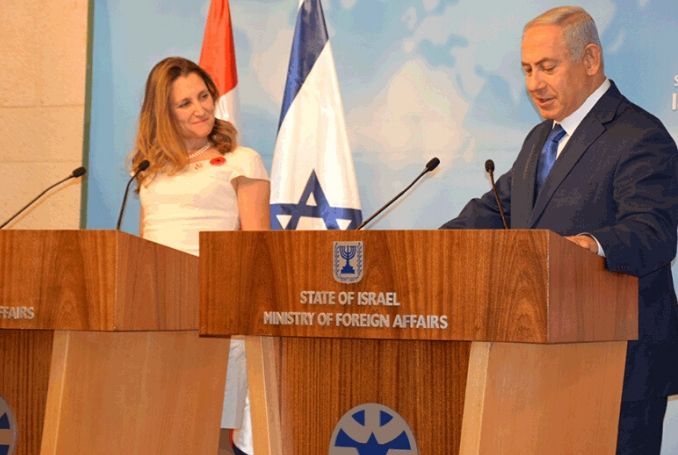
Deputy PM of Canada, Christya Freeland (L), and Israeli PM Benjamin Netanyahu. (Photo: Supplied)
By Hanna Kawas | Palestine Chronicle | December 30, 2019
Canadian activists have compiled a study of Canada’s 2019 voting record at the United Nations on resolutions that document and censure Israeli violations of international law.
There was much fanfare made about Canada’s orphan “yes” vote at the UN General Assembly this year on “The right of the Palestinian people to self-determination” resolution. But in the broader context of the other 17 resolutions calling out Israel’s war crimes, that Canada either voted against (15) or abstained on (2), this lone vote can only be seen as deceptive and hypocritical.
Justin Trudeau, explaining his government’s vote to Canadian Zionists, stated:
“The government felt that it was important to reiterate its commitment to a two-states-for-two-peoples solution at a time when its prospects appear increasingly under threat”.
However, if the Trudeau government was really committed to a “two-states-for-two-peoples solution”, it is inconceivable that at the same time they also voted against:
- A resolution to support the work of the “Committee on the Exercise of the Inalienable Rights of the Palestinian People” that affirms the UN “has a permanent responsibility towards the question of Palestine until the question is resolved in all its aspects”;
- The “Peaceful settlement of the question of Palestine” resolution that calls “on Member States not to recognize any changes to the pre-1967 borders, including with regards to Jerusalem”;
- “The Syrian Golan” resolution that “Demands once more that Israel withdraw from all the occupied Syrian Golan to the line of 4 June 1967 in implementation of the relevant Security Council resolutions”;
- “Permanent sovereignty of the Palestinian people in the Occupied Palestinian Territory, including East Jerusalem, and of the Arab population in the occupied Syrian Golan over their natural resources” resolution;
- The resolution that condemns the “Israeli settlements in the Occupied Palestinian Territory, including East Jerusalem, and the occupied Syrian Golan” and reaffirms the “inadmissibility of the acquisition of territory by force”; and
- The resolution concerning “Israeli practices affecting the human rights of the Palestinian people in the Occupied Palestinian Territory, including East Jerusalem” that expresses “grave concern about the continuing systematic violation of the human rights of the Palestinian people by Israel”.
And finally, why would Canada vote against a resolution to uphold the rights of “Persons displaced as a result of the June 1967 and subsequent hostilities”, unless it supports Israel’s ethnic cleansing of the West Bank and the “Greater Israel Project”?!
Some observers have speculated that Canada’s lone vote was motivated by Trudeau’s desire to obtain a seat on the UN Security Council. Over a year ago, then Foreign and now Deputy PM Chrystia Freeland was quoted as follows during a visit to Israel:
“She also mentioned Canada’s current bid for one of 10 non-permanent seats on the UN Security Council for 2021-2022, which she hoped would allow Canada to serve as an ‘asset for Israel and… strengthen our collaboration’.”
So, this is what Canada plans to do if it gets sufficient votes for a seat, be an “asset for Israel”?
Canada is relying on the votes, and possible lobbying, of some Arab reactionary regimes to get the backing required for the Security Council seat; one example is Jordan.
Just last month during a visit, “Jordan’s King Abdullah II told Prime Minister Justin Trudeau that the Middle Eastern kingdom supports Canada’s bid for a seat on the United Nations Security Council”. This was according to Jordan’s ambassador to Canada, Majed Alqatarneh, who also said Jordan “believes it is important that Canada have a seat on the Security Council”.
Canada also seems to be counting on the support of certain diplomatic circles from the US; former U.S. ambassador to Ottawa, Bruce Heyman stated:
“For me, today, when the U.N. General Assembly is all together, a Canadian seat on the U.N. Security Council is more important than ever”.
We tell Mr. Trudeau that instead of your objective of getting a seat at the UN Security Council, you may end up with a seat in front of the ICC. If the “two-states-for-two-peoples solution… prospects appear increasingly under threat”, it is because of Canada’s (and others) unconditional support for Israeli occupation, war crimes, and apartheid.
– Hanna Kawas is Chairperson of the Canada Palestine Association and co-host of Voice of Palestine. Visit: http://www.cpavancouver.org.
Hezbollah Denounces ‘Savage’ Attack on Iraq’s Hashd Shaabi: US Exposed Its True Face
Al-Manar | December 30, 2019
Hezbollah on Monday firmly denounced US aggression on Iraq’s Kata’ib Hezbollah, describing it as savage and blatant assault on Iraq’s sovereignty.
“The savage and perfidious aggression by the US on Kata’ib Hezbollah in Iraq is a blatant attack on Iraq’s sovereignty, security, stability and people, especially the Hashd Shaabi which had the upper hand in confronting the Takfiri terror and defeating it,” a statement released by Hezbollah’s Media Relations Office read, referring to Iraq’s paramilitary force, also called Popular Mobilization Units (PMU), in which Kata’ib Hezbollah is one of its components.
“This aggression affirms again that the US administration wants to strike the power factors within the Iraqi people who are capable of confronting Daesh (ISIL) and other US-backed extremist and criminal groups.”
“The US administration exposes its true face as a hostile power to Iraq and Iraqis’ interests,” the statement added.
Hezbollah offered condolences to Iraqis on the martyrs of the attack, wishing speedy recovery for those who were wounded.
“Those who decided this criminal aggression will find out soon the idiocy of such decision as well as its repercussions,” the statement concluded.
Trump Stuck Between Ending Endless Wars and his Hawkish Megadonors

By Eli Clifton | Responsible Statecraft | December 4, 2019
President Donald Trump has repeatedly promised to withdraw the United States from its ongoing wars in the Middle East, and avoid the kind of military adventurism, like the Iraq war, that has destabilized the region. Trump’s track record, however, is largely detached from his promises — a disconnect perhaps at least partially explained by his largest campaign contributors’ consistent advocacy for U.S. military action in the Middle East and support for starting a preventive war with Iran.
Trump appears to understand that the American public is largely supportive of ending the endless wars in Afghanistan and the greater Middle East. “Great nations do not fight endless wars,” said Trump in his 2019 State of the Union Address to bipartisan applause. But Trump’s actions haven’t lined up with his words. Despite his reckless Syria withdrawal announcement and blessing a Turkish invasion into northern Syria, total U.S. troop levels there are expected to remain at around 900, a small reduction from the 1,000 soldiers in Syria at the time of Trump’s announcement. Meanwhile, despite Trump’s repeated claims that he’ll end the war in Afghanistan, U.S. troops will stay there “for several more years,” as Chairman of the Joint Chiefs of Staff Gen. Mark Milley said last month.
Trump tearing up the Iran nuclear deal, moving the U.S. Embassy in Israel from Tel Aviv to Jerusalem, and a mission creep in Syria that’s expanded stated U.S. goals from containing ISIS to an “effort to push back against Iran,” according to Secretary of State Mike Pompeo, are also a far cry from moving away from Middle East military adventurism, as Trump has always said he wants to do.
Yet as a candidate for president, Trump talked a different game. At that time he broke with GOP/neocon orthodoxy on Iran and Israel. Then, his main critique of the Iran deal wasn’t its very existence — as was and is often the right-wing attack line — but that the Iranians weren’t buying enough commercial airliners from American companies, and instead spending more in Europe. And in another move that firmly put him on his own in the race, Trump even committed to being a “neutral” party on the Israeli-Palestinian conflict. All of that changed, however, as Trump drew closer to clinching the nomination and as he turned to some of the Republican Party’s biggest donors to fund his general election efforts — thus evaporating his claim of being a “self-funded” candidate.
Three GOP megadonors, Sheldon and Miriam Adelson, Paul Singer, and Bernard Marcus contributed more than a quarter-of-a-billion-dollars to boost Trump’s 2016 campaign and support Republican congressional and senate campaigns in 2016 and 2018.
Candidate Trump even warned that the money from the biggest of these donors, billionaire Sheldon Adelson, comes with strings attached. In 2015, Trump mocked Sen. Marco Rubio (R-Fla.) for pursuing Adelson’s endorsement and financial support, saying, “Sheldon Adelson is looking to give big dollars to Rubio because he feels he can mold him into his perfect little puppet. I agree!”
Adelson, and his wife Miriam, are the GOP’s biggest donors, and they’re relatively transparent about why they are engaged in politics. The Adelsons contributed $35 million to the Future 45 Super PAC that supported Trump’s presidential bid and spent $205 million on GOP Republican House and Senate races in the past two political cycles.
Sheldon Adelson has a history of using his ties to U.S. politicians to shape U.S. foreign policy. In 2001, Adelson reportedly curried favor with the Chinese leadership and helped secure his casino license in Macau by calling Rep. Tom Delay (R-TX), then the House majority whip, and persuading him to halt Republican opposition to Beijing’s Olympic bid.
And those views can take an extreme militarist tone regarding U.S. foreign policy in the Middle East. Adelson publicly advocated launching a preventive nuclear attack on Iran as a negotiating tactic and following up with a threat to nuke Tehran, a city with a population of over 8 million, if Iran did not abandon its nuclear program. The Adelsons pushed the Trump White House to fulfill a campaign pledge of relocating the U.S. embassy from Tel Aviv to Jerusalem, and bankrolled efforts to push out then-national security adviser H.R. McMaster and replace him with John Bolton, who would take a harder line on Iran and oversee U.S. abrogation from the Iran nuclear deal.
Home Depot co-founder Bernard Marcus — who contributed $7 million to groups supporting Trump’s candidacy, over $13 million in campaign contributions supporting GOP House and Senate races in 2016, and nearly $8 million to GOP midterm campaigns in 2018 — also made clear that his political engagement is driven by a militarist worldview.
In 2015, Marcus slammed the Obama administration’s efforts to negotiate constraints on Iran’s nuclear program, because, he said, Iran “is the devil.” Marcus even once accused Holocaust victims of being weak and submissive in the face of their own mass murder in concentration camps, which he also referred to as “detention centers” and “concentration centers.” The Israelis, said Marcus, “weren’t like the other Jews” and “didn’t walk into the ghettos, didn’t walk into the concentration camps, didn’t walk into the ovens.”
Hedge fund billionaire Paul Singer had set himself apart from Marcus and Adelson, and was the biggest Republican megadonor to identify with the “never Trump” wing — that is until Trump won the election when he donated $1 million to Trump’s inauguration.
Singer rarely speaks publicly about his foreign policy views, but his money, alongside Marcus and Adelson’s, supports some of the most hawkish institutions in Washington, including the now defunct Foreign Policy Initiative and the Foundation for Defense of Democracies whose experts promote economic pressure and military strikes against Iran. Bundled together, employees of Singer’s hedge fund, Elliott Management, were the second largest source of funds supporting the candidacy of the Senate’s most outspoken proponent of preventive war with Iran, Sen. Tom Cotton (R-Ark.), in 2014.
FDD donor rolls showed that by the end of 2011, Adelson contributed $1.5 million, Singer $3.6 million, and Bernard Marcus — who still sits on FDD’s board and whose family foundation continues to provide approximately one-third of FDD’s budge t—contributed $10.7 million.
Trump and Republican members of Congress are effectively bound to take the words of these hawkish donors under consideration when soliciting campaign funds. In some cases, Trump and other Republicans appear to be torn between their instincts to avoid needless wars and campaign megadonors who hold radical foreign policy visions and expect their campaign dollars to shape the foreign policy of the politicians they fund.
Japan to send helicopter-carrying destroyer & spy planes to ensure ‘safe passage’ of oil from increasingly crowded Middle East
RT | December 27, 2019
Japan’s cabinet has approved a plan to send its warship and surveillance planes to the Middle East, framing the controversial mission as “study and research activities” totally separate from the US initiative to contain Iran.
Tokyo is expected to send a destroyer with 200 crew and carrying up to two patrol helicopters alongside two P-3C anti-submarine patrol airplanes to the Gulf of Oman sometime in February, for a year-long mission.
The deployment is styled as a “study and research” mission to ensure “safe passage” for Japanese vessels through the region from which Tokyo receives some 90% of its oil imports. Yet in case of “unexpected developments,” local media report, a special order might be issued by the Japanese defence minister to allow the ‘Self-Defense Force’ to use weapons.
The possibility of Japanese deployment to the region was first voiced soon after a Japanese oil tanker came under a totally not suspicious attack back in June that by pure coincidence occurred just as Prime Minister Shinzo Abe was meeting with Iran’s supreme leader, Ayatollah Seyed Ali Khamenei.
Washington blamed Tehran for that and other attacks, pitching the idea of a maritime ‘policing’ mission but finding little enthusiasm among its allies. Besides Bahrain and the UAE, only the UK agreed to send a couple of destroyers after an embarrassing incident when it tried to seize an Iranian tanker under a bogus pretext only to get its own vessel impounded in a tit-for-tat response. Saudi Arabia joined the naval alliance after a drone attack – that was also pinned on Iran – targeted a major oil facility in the country. In addition, Australia promised to join sometime next year and the US says it’s only a “matter of time” until Qatar and Kuwait also join.
France in the meantime is spearheading a European-led mission independent of the US-led maritime initiative, as the US failed to convince European allies that its gunboat diplomacy was indeed only aimed at ‘protecting’ crucial waterways rather than enforcing Washington’s unilateral sanctions on Iran.
Featured Video
Trita Parsi: Middle East Unraveling — Are We on the Path to World War?
or go to
Aletho News Archives – Video-Images
From the Archives
Why Saudi Ties to 9/11 Mean U.S. Ties to 9/11
By Kevin Ryan | Dig Within | September 27, 2015
Media interest in Saudi Arabian connections to the crimes of 9/11 has centered on calls for the release of the 28 missing pages from the Joint Congressional Inquiry’s report. However, those calls focus on the question of hijacker financing and omit the most interesting links between the 9/11 attacks and Saudi Arabia—links that implicate powerful people in the United States. Here are twenty examples. … continue
Blog Roll
 Aletho News
- Integrity Initiative: UK-funded network framed dissent as Russian disinformation for years
- ‘We don’t seek permission to defend our country’: Snippets from President Pezeshkian’s UNGA address
- NATO chief wants Europeans to fight American wars [for Israel]
- German chemicals giant reveals details of downsizing
- Refaat Al-Areer Was The Canary In The Coal Mine In Israel’s War On The Truth
- Israeli election committee bars candidate from Knesset race over Gaza war opposition
- French-Lebanese man files war crimes complaint over Israeli attacks
- Mahan Air Flight Lands in China Despite US Threat against Iranian Airlines
- US eyes $10bn fund to rebuild war-battered Gulf infrastructure
- Trump meets Rodríguez near Maduro’s prison as Venezuela’s oil flows to US
- If Americans Knew
- Caught on Tape: AIPAC CEO Boasted of Controlling Trump’s National Security Officials
- Why Hamas Attacked Israel in October 2023 – Israeli professor Ilan Pappé
- They see them, then kill them: Israeli quadcopters track, deliberately target civilians in Gaza
- Winter could turn Gaza’s treacherous, war-damaged buildings into deathtraps
- Majority of Democratic Voters Want to Prosecute Both Biden and Trump Administration Officials Over Gaza
- As Gaza languishes, world leaders gather at the UN – Daily Update
- Sanctions are collective punishment: immoral and self-defeating
- Phosphorus Munitions Fired by Israel Burn Groves, Orchards in Southern Lebanon
- Israel Carries Out New Ceasefire Violations Across Gaza
- AI – Emphasis on the ‘I’: Israel Is Funding AI Chatbot Propaganda
- No Tricks Zone
- New Study: Earth And Venus Surface Warmth Largely Explained By Convection And Lapse Rate, Not CO2 Or Radiation
- 2025 Nature Paper Claiming Worsening Global Drought Gets RETRACTED …Heavily Flawed
- New Study: ‘Global Drought Shows No Detectable Recent Acceleration Under Climate Warming’
- Economic Masterminds: German Socialists Suggest Taxing Productivity Gains Stemming From Using AI
- The South China Sea Has Not Been Cooperating With The Climate Change Narrative
- Energy Crisis: Germany Enters Heating Season With Historically Low Gas Reserve Fill Levels
- New Study: The Antarctic Ice Sheet Gained Mass From 2020-2024 Due To Staggering Snow And Ice Accumulation
- Study: Ocean Heating Rates From Thousands Of Years Ago ‘Dwarf’ Modern Ocean Heating Rates
- Climate Extremists Target, Attack Large-Scale Power Grid Infrastructure In Germany!
- New Study: Antarctic Ice Melt Has Contributed Less Than 1 Centimeter To Sea Level Rise In The Last 30 Years

