The moral travesty of Israel seeking Arab, Iranian money for its alleged Nakba
By Ramzy Baroud | Ma’an | January 15, 2019
The game is afoot. Israel, believe it or not, is demanding that seven Arab countries and Iran pay $250 billion as compensation for what it claims was the forceful exodus of Jews from Arab countries during the late 1940s.
The events that Israel is citing allegedly occurred at a time when Zionist Jewish militias were actively uprooting nearly one million Palestinian Arabs and systematically destroying their homes, villages and towns throughout Palestine.
The Israeli announcement, which reportedly followed “18 months of secret research” conducted by the Israeli government’s Ministry of Social Equality, should not be filed under the ever-expanding folder of shameless Israeli misrepresentations of history.
It is part of a calculated effort by the Israeli government, and namely by Minister Gila Gamliel, to create a counter-narrative to the rightful demand for the ‘Right of Return’ for Palestinian refugees ethnically cleansed by Jewish militias between 1947-1948.
But there is a reason behind the Israeli urgency to reveal such questionable research: the relentless US-Israeli attempt in the last two years to dismiss the rights of Palestinian refugee rights, to question their numbers and to marginalize their grievances. It is all part and parcel of the ongoing plot disguised as the ‘Deal of the Century’, with the clear aim of removing from the table all major issues that are central to the Palestinian struggle for freedom.
“The time has come to correct the historic injustice of the pogroms (against Jews) in seven Arab countries and Iran, and to restore, to hundreds of thousands of Jews who lost their property, what is rightfully theirs,” said Gamliel.
The language – “.. to correct the historic injustice” – is no different from language used by Palestinians who have for 70 years and counting been demanding the restoration of their rights per United Nations Resolution 194.
The deliberate conflating between the Palestinian narrative and the Zionist narrative is aimed at creating parallels, with the hope that a future political agreement would resolve to having both grievances cancel each other out.
Contrary to what Israeli historians want us to believe, there was no mass exodus of Jews from Arab countries and Iran, but rather a massive campaign orchestrated by Zionist leaders at the time to replace the Palestine Arab population with Jewish immigrants from all over the world. The ways through which such a mission was achieved often involved violent Zionist plots – especially in Iraq.
In fact, the call on Jews to gather in Israel from all corners of the world remains the rally cry for Israeli leaders and their Christian Evangelical supporters – the former wants to ensure a Jewish majority in the state, while the latter is seeking to fulfill a biblical condition for their long-awaited Armageddon.
To hold Arabs and Iran responsible for this bizarre and irresponsible behavior is a transgression on the true history in which neither Gamliel nor her ministry are interested.
On the other hand, and unlike what Israeli military historians often claim, the ethnic cleansing of Palestine in 1947- 48 (and the subsequent purges of the native population that followed in 1967) was a premeditated act of ethnic cleansing and genocide. It has been part of a long-drawn and carefully calculated campaign that, from the very start, served as the main strategy at the heart of the Zionist movement’s ‘vision’ for the Palestinian people.
“We must expel the Arabs and take their place,” wrote Israel’s founder, military leader and first prime minister, David Ben Gurion in a letter to his son, Amos in October 5, 1937. That was over a decade before Plan D – which saw the destruction of the Palestinian homeland at the hands of Ben Gurion’s militias – went into effect.
Palestine “contains vast colonization potential,” he also wrote, “which the Arabs neither need nor are qualified to exploit.”
This clear declaration of a colonial project in Palestine, communicated with the same kind of unmistakable racist insinuations and language that accompanied all western colonial experiences throughout the centuries was not unique to Ben Gurion. He was merely paraphrasing what was, by then, understood to be the crux of the Zionist enterprise in Palestine at the time.
As Palestinian professor Nur Masalha concluded in his book, the ‘Expulsion of the Palestinians’, the idea of the ‘transfer’ – the Zionist term for “ethnic cleansing’ of the Palestinian people – was, and remains, fundamental in the realization of Zionist ambitions in Palestine.
Palestinian Arab “villages inside the Jewish state that resist ‘should be destroyed .. and their inhabitants expelled beyond the borders of the Jewish state,” Masalha wrote quoting the ‘History of the Haganah’ by Yehuda Slutsky. .
What this meant in practice, as delineated by Palestinian historian, Walid Khalidi was the joint targeting by various Jewish militias to systematically attack all population centers in Palestine, without exception.
“By the end of April (1948), the combined Haganah-Irgun offensive had completely encircled (the Palestinian city of) Jaffa, forcing most of the remaining civilians to flee by sea to Gaza or Egypt; many drowned in the process, ” Khalidi wrote in ‘Before Their Diaspora’.
This tragedy has eventually grown to affect all Palestinians, everywhere within the borders of their historic homeland. Tens of thousands of refugees joined up with hundreds of thousands more at various dusty trails throughout the country, growing in numbers as they walked further, to finally pitch their tents in areas that, then were meant to be ‘temporary’ refugee encampments. Alas, these became the Palestinian refugee camps of today, starting some 70 years ago.
None of this was accidental. The determination of the early Zionists to establish a ‘national home’ for Jews at the expense of the country’s Palestinian Arab nation was communicated, openly, clearly and repeatedly throughout the formation of early Zionist thoughts, and the translation of those well-articulated ideas into physical reality.
70 years have passed since the Nakba’ – the ‘Catastrophe’ of 1948 – and neither Israel took responsibility for its action, nor Palestinian refugees received any measure of justice, however small or symbolic.
For Israel to be seeking compensation from Arab countries and Iran is a moral travesty, especially as Palestinians refugees continue to languish in refugee camps across Palestine and the Middle East.
Yes, indeed “the time has come to correct the historic injustice,” not of Israel’s alleged ‘pogroms’ carried out by Arabs and Iranians, but the real and most tragic destruction of Palestine and its people.
A Clinton Memo That Killed Half a Million People
By Daniel Lazare | Consortium News | January 11, 2019
A Hillary Clinton memo that Wikileaks made public in 2016 has not gotten the attention it deserves.
It takes us back to 2012 and the early phase of the Syrian war.
At that point, it was largely an internal affair, although Saudi arms shipments were playing a greater and greater role in bolstering rebel forces. But once the Obama administration decided in favor of intervention, the conflict was quickly internationalized as thousands of holy warriors flooded in from as far away as western China.
The 1,200-word memo by then-Secretary of State Clinton begins with the subject of Iran, an important patron of Syria.
She dismisses any notion that nuclear talks will stop Iran “from improving the crucial part of any nuclear weapons program—the capability to enrich uranium.” If it does get the bomb, it goes on, Israel will suffer a strategic setback since it will no longer be able to “respond to provocations with conventional military strikes on Syria and Lebanon, as it can today.” Denied the ability to bomb at will, Israel might leave off secondary targets and strike at the main enemy instead.
Consequently, Clinton argues that the U.S. should topple the Assad regime so as to weaken Iran and allay the fears of Israel, which has long regarded the Islamic republic as its primary enemy. As the memo puts it:
“Bringing down Assad would not only be a massive boon to Israel’s security, it would also ease Israel’s understandable fear of losing its nuclear monopoly. Then, Israel and the United States might be able to develop a common view of when the Iranian program is so dangerous that military action could be warranted.”
This document making the case to arm Syrian rebels may have been largely overlooked because of the dates, which appear to be inaccurate.
One line gives the time as “2001-01-01 03:00” even though Clinton was still a New York senator-elect at that point. That date is also out of synch with the timeline of nuclear diplomacy with Iran.
Another contains a State Department case and document number and a date of Nov. 30, 2015. But that’s incorrect as well since it postdates Clinton’s resignation as secretary of state by better than two and a half years.
Central to the Great Debate
Consequently, anyone stumbling across the memo in the Wikileaks archives would have no idea of how its rather loopy logic figures in the great debate about whether to use force to bring down Syrian President Bashir al-Assad. But textual clues provide an answer. The second paragraph refers to nuclear talks with Iran “that began in Istanbul this April and will continue in Baghdad in May,” events that took place in 2012. The sixth invokes an interview with CNN’s Christiane Amanpour conducted with then-Israeli Defense Minister Ehud Barak “last week.” Since the interview took place on April 19, 2012, the memo can therefore be dated to the fourth week in April. This is shortly before Clinton joined forces with then-CIA Director David Petraeus to push for an aggressive program of rebel military aid.
Needless to say, Clinton’s skepticism about negotiating with Iran proved to be unwarranted since Iran eventually agreed to shut down its nuclear program. The memo thus illustrates her hawkishness along with her conviction that Israeli security trumps all other considerations even if it means setting fire to a region that’s been burned over more than once.
But the memo illustrates much else besides: Clinton’s recklessness, her lack of realism and her almost mystical belief that everything will fall neatly into place once the United States flexes its muscle. Overthrowing Assad would be nothing less than “transformative,” she writes:
“… Iran would be strategically isolated, unable to exert its influence in the Middle East. The resulting regime in Syria will see the United States as a friend, not an enemy. Washington would gain substantial recognition as fighting for the people in the Arab world, not the corrupt regimes. For Israel, the rationale for a bolt from the blue attack on Iran’s nuclear facilities would be eased. And a new Syrian regime might well be open to early action on the frozen peace talks with Israel. Hezbollah in Lebanon would be cut off from its Iranian sponsor since Syria would no longer be a transit point for Iranian training, assistance and missiles.”
It was “a low-cost high-payoff approach,” she writes, that would eliminate one enemy, weaken two more, and generate such joy among ordinary Syrians that peace talks between Damascus and Tel Aviv will spring back to life. The risks were nil. Since “the Libyan operation had no long-lasting consequences for the region,” the memo says, referring to the overthrow of strongman Muammer Gaddafi six months earlier, the Syrian operation wouldn’t either:
“Some argue that U.S. involvement risks a wider war with Russia. But the Kosovo example [in which NATO bombed Russian-ally Serbia] shows otherwise. In that case, Russia had genuine ethnic and political ties to the Serbs, which don’t exist between Russia and Syria, and even then Russia did little more than complain. Russian officials have already acknowledged they won’t stand in the way if intervention comes.”
So, there was nothing to worry about. Sixty-five years of Arab-Israeli conflict would fall by the wayside while Russia remains safely marginalized.
How it Turned Out
Needless to say, that’s not how things turned out. At that moment, Libya seemed under control. But three or four months later, it would explode as Western-backed Islamist militias blasted away at one another, imposing strict Sharia law, re-instituting slavery and rolling back decades of social progress. Once President Barack Obama approved a modified version of the Clinton-Petraeus plan, Syria would plunge into the same abyss as jihadis funded by Saudi Arabia and the other oil monarchies spread sectarian violence and fear.
Clinton’s assumption that the U.S. could neatly and cleanly decapitate the Syrian government without having to worry about broader consequences was little short of deluded.
The notion that ordinary Syrians would fall to their knees in gratitude was ludicrous while her disregard for the intricacies of Syrian politics was astonishing.
Then there’s the memo’s blithe suggestion that Washington “work with regional allies like Turkey, Saudi Arabia, and Qatar to organize, train, and arm Syrian rebel forces.”
In late 2009, Clinton wrote in another diplomatic memo made public by Wikileaks that “donors in Saudi Arabia constitute the most significant source of funding to Sunni terrorist groups worldwide.” So what made her think two years later that the kingdom would not fund Syrian jihadis of precisely the same ilk?
The 2009 memo slammed Qatar for allowing Al Qaeda, the Taliban and other terrorist groups to use the sheikdom “as a fundraising locale.” So what made her think that a pro-Al Qaeda autocracy would now help Syrians “fight for their freedom,” as the memo puts it? Wouldn’t Qatar be more likely to remove what little freedom Syrians had left? Of course, it would.
There is a remarkable continuity between the Syria policy that Clinton was proposing and earlier policies in Afghanistan and Libya. In the first, U.S. military aid wound up flowing to the notorious warlord Gulbuddin Hekmatyar, a religious sectarian and raging anti-western xenophobe who nonetheless was “the most efficient at killing Soviets,” as Steve Coll put it in “Ghost Wars,” his bestselling 2004 account of the CIA’s love affair with jihad.
Hekmatyar’s cutthroats wound up with the lion’s share of American arms. More or less the same thing happened in Libya once Clinton persuaded Qatar to join the anti-Gaddafi coalition. The sheikhdom seized the opportunity to distribute some $400 million to various rebel militias, many of them Islamist. The Obama administration said nothing in response.
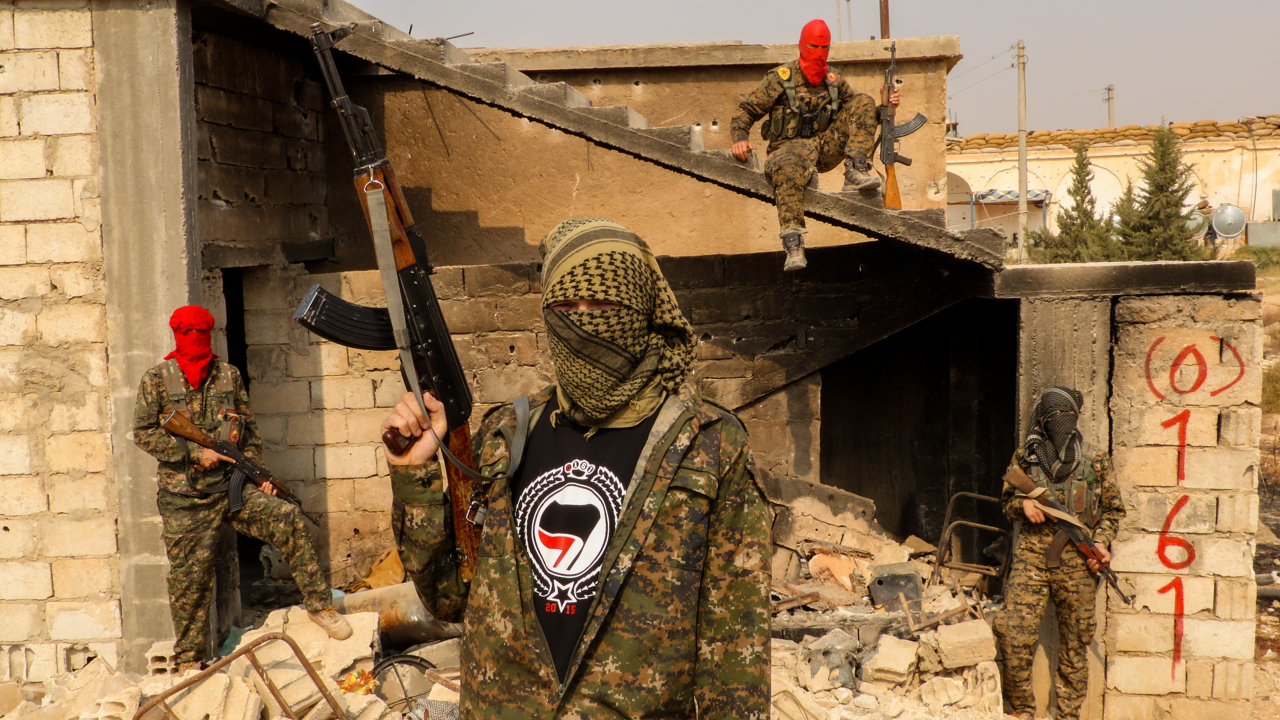
British Fighters with International Freedom Battalion in northern Iraq. (Wikimedia)
Once again, U.S. arms and materiel flowed to the most reactionary elements. The same would happen in Syria where U.S. and Saudi arms went to the local Al Qaeda affiliate, known as Jabhat al-Nusra, and even to ISIS, as a meticulous report by Conflict Armament Research, a Swiss and EU-funded study group in London, has shown. (See “Did Obama Arm Islamic State Killers?” Consortium News, Dec. 21, 2017.)
Insurgency Mix
By August 2012, a secret Defense Intelligence Agency report found that Salafists, the Muslim Brotherhood, and Al Qaeda were already “the major forces driving the insurgency” and that the U.S. and Gulf states backed them regardless. Speechwriter Ben Rhodes summed up the problem of “moderate” rebels who were indistinguishable from Al Qaeda in his White House memoir, “The World As It Is.” In that, he writes that “Al Nusra was probably the strongest fighting force within the opposition, and while there were extremist elements in the group, it was also clear that the more moderate opposition was fighting side by side with al Nusra. I argued that labeling al Nusra as terrorists would alienate the same people we want to help, while giving al Nusra less incentive to avoid extremist affiliations.”
The problem was how to separate the “good” Al Qaeda fighters from the “bad.” Rhodes later complained when Russian President Vladimir Putin said that he and his fellow Obama officials were “trying to climb a spruce tree naked without scratching our ass.” This was “smug,” Rhodes says. But Putin was merely using a colorful expression to say that the policy made no sense; which it didn’t.
The cost, half a dozen years after the Clinton email, is staggering. As many as 560,000 people have died, half the population has been displaced, while the World Bank has estimated total war damage at $226 billion, roughly six years’ income for every Syrian man, woman, and child. A cockeyed memo thus unleashed a real-life catastrophe that refuses to go away. It’s a nightmare from which President Donald Trump is struggling to escape in his confused and deluded way and that the Deep State – everyone from arch-neocon John Bolton to “liberal” Nancy Pelosi– is determined to renew.
Making Sense of Trump’s Foreign Policy
By Federico PIERACCINI | Strategic Culture Foundation | 11.01.2019
As was to be expected, the announcement that the US was withdrawing troops from Syria has served to provoke numerous reactions in the Middle East and beyond. Following the removal of Mattis, Pompeo and Bolton embarked on a whirlwind Middle Eastern tour of Israel, Jordan, Egypt, Bahrain, the United Arab Emirates, Qatar, Saudi Arabia, Oman, and Kuwait to reassure regional allies.
The idea of withdrawing US troops from Syria was based on Trump wishing to fulfil one of his most important electoral promises. Trump knows that he needs to demonstrate to his electoral base that he has kept the most significant promises he made during his 2016 election campaign in order to have any chance of being reelected in 2020. People voted for change, and that includes preventing new wars and getting out of the ones the US is already embroiled in, especially in the Middle East.
If Trump betrays his constituents by not delivering on his campaign promises, then he would simply be like any other politician who, upon being elected, soon forgets about those who put him in office. Trump is aware that such a perception would cost him the possibility of a second term.
We live in a time where Western elites completely ignore the consequences of their actions, manipulate information, lie to their citizens and spread fake news. While we may not always believe what Trumps says in his bombastic remarks, we can rest assured that MSNBC/CNN are even less reliable in terms of facts and unbiased news. Keeping oneself correctly informed is a difficult and demanding task, involving the constant comparison and weighing up of a lot of different sources and constantly researching and learning through the process. Most people do not have the time for this and usually do not care, preferring to rely instead on the mainstream media. This obviously exposes such people to manipulation, lies and distorted facts, clouding the truth and making it difficult to distinguish between what is real and what is fake. Alternative media — the real media — are riding to the rescue, but the overhauling process will require a full generation or even two.
This is why it little matters whether the wall will really built or whether it will only start to be built as a PR stunt or whether it even makes sense in the first place to build it or not. Democrats watching MSNBC/CNN will agree that it is a dumb idea and should not be funded. Republicans watching Fox News will call it a brilliant idea and demand a government shutdown (as Trumps is doing) to force the Democrats to concede. The point is that Democrats or Trump supporters, feeding on news sources based on propaganda and lies, will only have their respective biases confirmed without the need for any real debate.
What is important for us to understand is how Trump operates in order to gain the support of his base. That is what guides him in domestic, foreign and economic affairs. In the case of the wall, Trump’s battle is against the Democrats, and the actions he has taken to fight his opponents is by using the government shutdown to provide himself with a win-win outcome. If the Democrats fund the wall, they lose in the eyes of their voters, as Trump ends up getting his wall. If the Democrats do not fund the wall, Trump will blame them and point to the government shutdown to demonstrate how he valiantly struggled against the Democrats in an effort to keep his promises.
The same is the case with the economic warfare employing the US dollar and imposing tariffs and duties on allies and enemies alike. MSNBC/CNN will tell you that this is damaging the American economy. The Democrats will say that it is a failed strategy, without admitting that they hate Trump’s “economic war” because it undermines US dollar hegemony and thereby their ability to prosecute the neoliberal imperialism to which they are so addicted.
Fox News, on the other hand, will spin the news to show how Trump is battling against Xi Jinping and China in the interests of American farmers. Self-proclaimed experts will go on about the success of the White House’s economic strategy, declaring it a brilliant idea. Trump voters will enjoy the coverage of Fox News and accordingly praise the “commercial war”. Democrats will love the coverage of MSNBC/CNN and will worry about how various policies will either restore or further diminish US global leadership.
The announcement of the withdrawal from Syria follows the same logic as the examples given above. Trump announced the withdrawal only in order to keep an electoral promise. The entire Washington foreign-policy establishment is opposed to Trump’s decision. The purpose of the announcement was to convey to his voters a simple but clear message: I am trying to do what I promised you, but I have everyone against me in Washington as well as in the media.
The same logic is employed with the government shutdown in order to fund the wall. Whenever Democrats, Republicans or talking heads condemn Trump’s withdrawal from Syria/Afghanistan, his effort to build the wall, his imposition of tariffs and duties, his sanctions on Iran, they reinforce the beliefs of Trump’s supporters, showing that Trump is really trying to keep his promises in the face of tremendous opposition.
Every time they bash him they provide free advertisement for Trump and his political line, and this has been going on from the first time he announced he would run in the primaries in 2015. It is a win-win situation for him, even if he does not really build the wall, pull out of Syria, or effectively reduce the trade imbalance between China and the US. If he succeeds, he can declare that he has kept his promises. If he fails, then he can lay be blame squarely at the feet of his political opponents. People elected him on the basis of his words and promises. If he can demonstrate that he at least tried to keep his promises (even if he never actually does), then that should be enough to give him a second term.
Trump understands very well how the media works and how much Washington detests him. He does not want to change the status quo and revolutionize Washington. He does not want to openly challenge the foreign-policy establishment by following a realist-isolationist policy. That was what he said in 2015/16 during the campaign trail, but his presidency has been much different from what he promised, especially in foreign policy. Nevertheless, Trump seeks re-election, and he cannot entirely break with the Washington establishment if he hopes to succeed. Indeed in 2016 he demonstrated this by appointing a staff of generals whose credo over the span of several decades has been that of American exceptionalism, the governing religion of Washington. He used the military to protect himself from the media-intelligence community, shielding himself with four generals (Kelly, McMaster, Mattis and Flynn), in the full knowledge that none of them would support a realist-isolationist policy.
For this reason, the ructions that have followed the announcement of the withdrawal from Syria are part of normal US political theater, such as was the case with the resignation/dismissal of Mattis. It is no surprise that the deep state immediately dispatched Bolton and Pompeo to sooth the concerns of dozens of US allies, in particular Israel and the Arab states. It was a PR exercise to reassure them of the real intentions of the US in the area (i.e., enduring imperialism).
In practice, it makes little difference whether the US has 2,000 or 200 men in Syria. They will not be able to change the course of the war of aggression against Damascus in their favor. It is therefore not surprising that Bolton was not fired for publicly contradicting Trump on the question of withdrawing troops from Syria. Such contradictions play in Trump’s favor. His supporters will say that Trump is so anti-establishment that even his closest collaborators are against him.
If Trump were to fire Bolton as he did Mattis, none of his faithful voters will remember the ill-considered choice to appoint him in the first place, and will be struck instead by Trump’s determination to stick to his guns and rid himself of internal saboteurs who stand in the way of his electoral mandate. As long as Trump, in our scenario, were not to name someone worse than Bolton, the imperialist wheel will continue to turn.
Just look at North Korea as an example. Trump threatened to destroy Pyongyang, even knowing the US could not really do so. Then he meet with Kim, did an epic PR exercise that presented Trump as solving a major international problem that had eluded all his predecessors. After conveying this triumph to his base, he simply forgot all about Kim, Pyongyang and Seoul. In the meantime, the two Koreas are nonetheless speaking, advancing reconciliation and preparing for historical changes. As for Trump, he has already moved on, North Korea no longer holding his interest, the drama having served its purpose for a certain time but no longer being of relevance. (This, thankfully, is to the benefit of the Korean people.)
It seems the same playbook is being employed in Syria. Trump announced the withdrawal, while leaving a few hundred soldiers behind who continue to be unable to change the situation on the ground; Bolton and Pompeo are dispatched to reassure allies/financiers, though Trump cannot wait to forget about Syria, proclaiming the falsehood that US, under his leadership, defeated ISIS (thereby fulfilling one of his electoral promises).
As I wrote following Trump’s election, The Donald’s victory only served to accelerate the transition to a multipolar world, as we saw in the first two years of his presidency, with Trump’s focus on his base translating into a perennial electoral campaign that uses all the tools at his disposal (domestic, foreign, economic, financial, and currency policy). This creates distrust and concern amongst historical allies and pushes Washington’s enemies closer together, serving in the process to smooth out any tensions that may have hitherto existed between these countries.
Just think of the Astana format of Turkey, Iran and Russia concerning Syria, Inter-Korean talks in Asia, a peace treaty to be signed between Russia and Japan, Indian-Iranian cooperation on trade in oil, a European stance against Iranian and Russian sanctions, and, to top it off, coordination between the Russians and the Chinese on almost everything. All this is in the name of opposing US imperialist policies or trying to directly score a political win against Donald Trump and his policies.
Trump’s enemies have learned to ignore US decisions, which have now become irrelevant in certain parts of the globe. America’s historical allies cling hopefully to the words of Bolton and Pompeo, well aware that the US will not soon change their basic neoliberal and imperialist approach towards the world. Nevertheless, Washington is losing military and economic influence due to the transition into a multipolar world order, where power is shared among multiple countries (China, Russia, Iran, India). The unipolar moment is over and is not coming back, especially not with Donald Trump as president. And that is a good thing for the rest of the world.
Lebanon president warns of the consequences of Israel threats
MEMO | January 10, 2019
Lebanese President Michel Aoun yesterday warned of the “Israeli threats” which could lead to new wars, displacement and ethnic cleansing.
Speaking before members of the diplomatic corps accredited to Lebanon in the capital Beirut, Aoun said that “peace does not take place while deals are made at the expense of the refugee who was expelled from his land and his identity was stolen”.
“Peace does not come at the expense of manipulating demography and changing the geographical and social parameters of countries. Peace does not result from deepening racism and rejecting the other.”
The Lebanese president was referring to US President Donald Trump’s proposed Middle East peace plan dubbed the “deal of the century”.
In regards Syrian refugees in Lebanon, Aoun said the international community’s position is not clear about whether they should return to their country, warning that the proposed positions which link the refugees’ return to finding a political solution to the Syrian crisis is “worrying” because a solution could take a long time.
More than 1.2 million Syrian refugees live in Lebanon, a majority of them in areas that experience economic, political and security crises.
How Mainstream Media Join the US Government Offensive Against Iran: Case Study of Reuters
By Ivan KESIĆ | Strategic Culture Foundation | 09.01.2019
Summary: A 2013 news investigation of Iranian corruption by Reuters news service has been cited by at least four books published one after another, the most recently in 2018.
It has also been cited by US Secretary of State Mike Pompeo in 2018 speech. Given the article’s ongoing influence, this article will scrutinize flaws in the reporting techniques and raise reasonable questions about several of its findings. The article will also mention, a piece of important historical context, that was long assumed, but made official in 2013 – the same year the story was published – when the US government released classified documents about its involvement in the overthrow of Iran’s democratically elected leader in 1953 and the establishment of the Shah. The purpose of this article is not to stain the reputation of an entire news agency – but to simply lay out an alternative context for interpreting a single, influential story.
Ever since the beginning of the Iranian Islamic Revolution, the United States has been leading a propaganda campaign against Iran, minimizing own harmful role in key historical events, justifying an ousted monarchist regime, and demonizing the new political system. Frequently it is done in lighter forms, for example by claiming that new government is far from perfect or even the same as a previous one, but the methods can sometimes be so radical that the characteristics of the two systems are completely inverted.
While the Reuters claims Iran is active in spreading disinformation online, the history of the agency’s reports about Iran shows the opposite. The latest of such reports is a false report about Iran’s missile program. The falsehood of the article has been dissected here. The case which I have dissected is a 2013 article authored by Steve Stecklow, Babak Dehghanpisheh, and Yeganeh Torbati. The article represents a perfect example of such radicalism and disinformation reporting about Iran.
The Reuters report has been cited by at least four books published one after another, the most recently in 2018. The books are Iran’s Political Economy since the Revolution by Suzanne Maloney (2015); Democracy in Iran: Why It Failed and How It Might Succeed by Misagh Parsa (2016); Challenging Theocracy: Ancient Lessons for Global Politics by David Tabachnick, Toivo Koivukoski, and Herminio Meireles Teixeira (2018); and Losing Legitimacy: The End of Khomeini’s Charismatic Shadow and Regional Security by Clifton W. Sherrill (2018).
The chorus doesn’t stop there and it’s not limited to academic publishing or book industry. The 2013 report lays the ground for an ongoing war of words and decisions to impose more sanctions on Iran. Speaking at Ronald Reagan Presidential Foundation and Library in July 22, 2018, Secretary of State Mark Pompeo used the 2013 Reuters report to attack Iran; he said:
“And not many people know this, but the Ayatollah Khamenei has his own personal, off-the-books hedge fund called the Setad, worth $95 billion, with a B. That wealth is untaxed, it is ill-gotten, and it is used as a slush fund for the IRGC. The ayatollah fills his coffers by devouring whatever he wants. In 2013 the Setad’s agents banished an 82-year-old Baha’i woman from her apartment and confiscated the property after a long campaign of harassment. Seizing land from religious minorities and political rivals is just another day at the office for this juggernaut that has interests in everything from real estate to telecoms to ostrich farming. All of it is done with the blessing of Ayatollah Khamenei.”
The speech applauded by Iran hawks in Washington.
The year 2013 was the year of big news about Iran. Four months before the release of the Reuters’ article, CIA finally admitted its role in 1953 Iranian coup. “Marking the sixtieth anniversary of the overthrow of Iranian Prime Minister Mohammad Mosaddeq, the National Security Archive is today posting recently declassified CIA documents on the United States’ role in the controversial operation. American and British involvement in Mosaddeq’s ouster has long been public knowledge, but today’s posting includes what is believed to be the CIA’s first formal acknowledgement that the agency helped to plan and execute the coup.” Disinformation is dangerous. It used once to oust democratically elected Prime Minister Mohammed Mossadegh, and has been leveraged again to bring back the Shah of Iran, William David Pear writes. He continues, “Since Iran was a developing democracy, an excuse had to be found for a US intervention. Churchill accused Mossadegh of being a communist. There was no evidence that he was. Mossadegh was an anti-colonial nationalist who cared about the welfare of the Iranian people, and that was all the evidence that Eisenhower needed. Mossadegh had to be punished for standing up to the British and demanding Iran’s natural resources for the benefit of the Iranian people.” The 2013 article of Reuters reminds us of the same pattern of disinformation about Iran.
The 2013 Reuters story claims that the Execution of Imam Khomeini’s Order (EIKO), also known as Setad, a little-known organization created to help the poor, morphed into the $95 billion financial empire controlled by Iran’s Supreme Leader, Ayatollah Ali Khamenei. More precisely, they uncovered something unknown to Western intelligence services, economists and most prominent scholars of Iranian studies, even to the Iranian leadership themselves. In fact, much to the contrary, among ordinary Iranians the organization is known for their social programs, helping the poor families and doing charity works.
According to the Reuters article, the Iranian president’s office and the Foreign Ministry didn’t respond to requests for comment. Iran’s embassy in the UAE issued a statement calling their findings “scattered and disparate” and said that “none has any basis,” but it didn’t elaborate. Hamid Vaezi, the Setad’s then director general of public relations, said that the information presented is “far from realities and is not correct,” but he also didn’t go into specifics. Their short denials are understandable, considering that the same response would be received from a scientist if asked to make a serious review of a fantasy book. For the same reason, there is no scientific review of Reuters‘ article. Fortunately, this review will go deeply into the details, focusing on personal testimonies and claims of several groups of informers, thus developing a linear counter-story.
Baha’i personal testimonies
First, there’s the story of Pari Vahdat-e-Hagh, an 82-year-old Baha’i woman living in Europe, who claims that she lost family’s property, more precisely three apartments in a multi-story building in Tehran, allegedly “built with the blood of herself and her husband.” She further claims that her husband Hussein was imprisoned in 1981 because he began working for a gas company that had been set up to assist unemployed members of the Baha’i faith, and finally executed a year later. All of this happened, as the article claims, just because they were Baha’i.
The article does not mention the fact that her husband, alleged philanthropist, was actually a lieutenant in Pahlavi regime’s military. It neither mentions the conditions for obtaining such amount of property in Iran’s capital city center at that time. Ordinary military personnel were provided with an apartment, but not three apartments, nor was it possible to earn such vast properties with a salary of a lieutenant and teacher, no matter how hard you work. Miss Vahdat-e-Hagh explicitly stated that all had been obtained by herself and her husband, so it’s very easy to exclude the possibility of inheritance.
The only way of being awarded with three apartments was, in fact, an extraordinary and obedient service to the Pahlavi’s regime, and taking into account that Hussein Vahdat-e-Hagh’s career was military as well as the only war that Shah led was one against his own people, his merits to the dictatorship become crystal clear. This also perfectly explains why Hussein Vahdat-e-Hagh was imprisoned and executed, while tens of thousands of other Baha’is and hundreds of ordinary lieutenants, those without ‘special merits’ and three apartments, were not. In other words, the only blood that Vahdat-e-Hagh mentioned can be the blood of the people and the blood on her husband’s hands. Fake philanthropy and contradictions do not stop here.
Pari Vahdat-e-Hagh, also known as Paridokht Khaze, lives in Berlin where she earns a living by giving interviews and selling memoirs about the Baha’i victimhood. In the preface of her 2014 book titled In Search of Justice, Vahdat-e-Hagh claimed that before the 1979 revolution she had hoped to one day fulfill her dream of serving the needy in Africa. Before selling fictitious biographies, according to her own personal testimony to Reuters, during the 1980s she was living in one of the above-mentioned three apartments and was earning by renting other two. During these years of war the country was full of orphans and the poor, but giving any free accommodation was obviously out of the question for a self-proclaimed philanthropist.
Her lucrative rental business continued in the 1990s when she was living in Germany, taking the rental income out of all three apartments. According to the Reuters article, she left Iran in 1993 and it took six years before Iranian authorities realized she was no longer living in the country. This information contradicts her other statement that government representatives came to her apartment and threatened to beat her if she did not leave, while she bravely opposed them and yelled: “You can come and kill me.” So this old lady, allegedly under constant pressure and control, indeed left her apartment and was further able to leave the country, and the government, allegedly so greedy for her properties that it sent thugs at her doors, did not even notice that she’s out of the country and renting the same properties for six years. Makes perfect sense, isn’t it?
In both the Reuters article and the Vahdat-e-Hagh’s memoirs, her departure from Iran is described as some sort of “courageous escape” typical for a dissident genre, from books to Hollywood movies. In reality, she was free to leave the country and there was no any ban, no control, no chase at the airport. In the Reuters article, her false courage and principles are additionally enhanced by claims that government finally discovered her absence and demanded to pay rent on the unit, but she refused. The reality is again quite the opposite: she was actually refusing to pay tax on the rental income profit for six years, and in the meantime, she did not even report the change of address i.e. living abroad. Putting aside the controversial origin of properties, the consequences of such long-term lawbreaking are pretty much identical all over the world.
The Reuters‘ caricature story of courage and injustice ends with a claim that Vahdat-e-Hagh’s “stolen” building appears to be vacant, most of the windows are broken, and property’s ownership isn’t clear. This rumors allegedly came from merchants in the neighborhood, but how three Reuters journalists based in New York, London and Dubai managed to obtain the information in the streets of Tehran, also isn’t clear. Even less clear is their message, which may imply either that the building remains unused since Vahdat-e-Hagh stopped renting it, or it is basically worthless. Both possibilities make the whole story even less credible than it already is. Most likely, it is only a dystopian allegory or their own fantasy conception of post-revolutionary Iran.
Besides the story of Vahdat-e-Haghs, the Reuters article also offers the story of Katirais, yet another Baha’i family, whose narrative is similar in terms of structure. Again, there’s a rented three-story building in central Tehran, owner’s emigration to Canada, controversial ties to the Pahlavi regime, and of course, “just because they’re Baha’i” cliche. Apart from the building, there’re also 750 hectares of land around the city of Hamedan in northwest Iran. The Iranian official version says that owner had left the country and had abandoned properties, as well as that prior to 1979 he collaborated with the Pahlavi government, while owner’s daughter Heideh Katirai claims that he was being targeted solely because of his religion and never had any ties to the Shah’s government. Now, who to trust?
Making a choice on this question is much easier if we consider there was the Shah’s White Revolution of 1963 which its purpose was to weaken those classes that supported the traditional system, primarily landed elites. Virtually all landlords lost their possessions, with only a few exceptions, i.e. just those with close ties to the government were spared. Taking also into account that the general status of Baha’is during the Pahlavi period was far from thriving, the claim that a Baha’i person without any connections to the Shah’s regime could keep 750 hectares of land and stay intact by land reforms, is clearly an insolent lie.
Instead of sticking to the facts known to every historian and Iranian, Reuters journalists use logically fallacious methods like appeals to emotion through empathy, false dilemmas, and good ol’ victimhood. For example, an article quotes Katirai’s daughter saying “I took my kids there every Friday to see the family” and “each corner of that house is a memory for us.” One may wonder whether these trite phrases can be applied in the same way to their former land holdings, perhaps “every single square meter is a memory for them” also, out of 7,500,000 square meters in total. Such colossal amount of land was highly uncommon even for the richest landlords, and since Katirais weren’t historically attested among noble or wealthy merchant families prior to the Pahlavi period, it is clear that they did not just keep the property due to the ties with the Shah’s regime, but they also gained it.
Other statements are less subtle and bear aggressive religious and political messages. “We know that Islam is a religion of peace, but how can a government that claims to be an Islamic government allow this to happen?” Katirai’s daughter had asked, and thus offered the false dilemma: either the Iranian government is not Islamic, or Islam is not a religion of peace. The third option, unoffered in the article but the most realistic one, is that she is a liar and demagogue. Additional evidence for it is yet another claim of hers that legal representatives refused to consider her father’s case solely because he did not belong to any of three constitutive minorities: Zoroastrians, Jews or Christians. This implies that all others, from Iranian Hindus to foreign-born East Asian communities, have no any legal rights. Utterly bizarre.
Legal and human rights “experts”
Another group of people used as a reference in the Reuters article are self-proclaimed human rights “experts” and lawyers, all Iranian-born and living abroad. The first one is Naghi Mahmoudi who in the introduction claimed that Khamenei as the Supreme leader oversaw the creation of a body of legal rulings and executive orders that enabled and safeguarded asset acquisitions, as well as that no supervisory organization can question its property. The article represents him as a “lawyer” and uncritically accepts his allegations which serve as the basis for further elaboration.
In reality, Naghi Mahmoudi is only a petty political activist who has a history of lying and manipulating. Back in mid-2010, Mahmoudi and his colleague Javid Hustan Kian claimed to be defectors and “lawyers” of an Iranian woman sentenced to lapidation, but the whole case turned out to be a well-organized hoax, while they were disclosed as impostors and members of the MEK terrorist cult. In the meantime, he almost completely vanished from the media, held several pro-MEK speeches in Germany, and sometimes shared a propaganda material on Twitter, including ridiculous pan-Turkist claims that “40% of Iranians are Azeri Turks deprived of basic human rights.” Ironically, even Ali Khamenei was born into an Azeri family, as the Reuters article correctly mentions.
The biographical details of other informers are no less controversial. Ottawa-based Hossein Raeesi is a legal advisor to the IHRDC, a US government-sponsored organization blacklisted as subversive by the Iranian Interior Ministry, and London-based Mohammad Nayyeri is a close associate of Shadi Sadr, an anti-Iranian activist who publicly advocated Arab separatism in Iran. It is interesting that both of them, along with certain Beverly Hills-based Reghabi couple, complain about legal complications over the return of property, but at the same time, they confirm it is actually possible and feasible. It only takes time, and money, as everywhere.
However, the informers could not agree on a precise legal fee, some of them claiming it is 20% while others even over 50%. Since both amounts are obviously extremely exaggerated and hardly provable, for this purpose two anonymous sources jump into the story and Reuters journalists use their testimonies as evidence. The first is an Iranian Shi’ite Muslim businessman now living abroad who put fee at 55%, and the second is alleged Nayyeri’s client who recovered the house but had to pay 20% of the property’s assessed value, a religious payment called “khoms” mandated under Islamic law. No names, no documents, and no sense. To fill such logical gaps and inconsistent claims, journalists also used orientalist cliché of ubiquitous corruption.
Political circles
Finally, the last group of informers consists of individuals more deeply involved in politics, comparing to the previous activists who operate under the guise of human rights. The Reuters article intentionally conceals the organizations they represent and introduces them as respectable scholars and politicians, allegedly authoritative on the subject. For example, three journalists first claim that they had identified “about $95 billion in property and corporate assets controlled by Setad” and that amount “surpasses independent historians’ estimates of the late shah’s wealth,” and as an evidence for such comparison they further used statements by Abbas Milani who believes the estimate of the Shah’s fortune was “extremely exaggerated” and stood at “a billion dollars.” In other words, about $3 billion in today’s money, or only a fraction of the worth of Setad’s holdings, Reuters concluded.
It is hard to enumerate how many manipulations this escapade contains. First of all, there are no “historians” here, but only one, namely Abbas Milani, who is far from “independent” because he is a member of the neoconservative Hoover Institution, an advocate of multilateral crippling sanctions against Iran in the US Congress. His books are full of revisionist portrayal of the US role in the 1953 coup, support of the Pahlavi regime’s oppression, the 1979 Revolution and afterward, and he offers other contorted interpretations like a claim that “Iran went from politically moderate Monarchy to totalitarian Islamic Republic.” Milani’s statement about the Pahlavi fortune does not represent a historical consensus, nor a serious scholarly assessment, only utter whitewashing of the Shah’s financial crime.
Already in January 1979, the New York Times reported that the Pahlavi wealth is rivaled in the Middle East only by the holdings of the Sauds of Saudi Arabia and the al‐Sabah dynasty in Kuwait, and according to bankers, the Shah’s personal portfolio is worth “well over $1 billion.” New York bankers told journalists that “a substantial part of the $2 billion to $4 billion belongs to the Pahlavi family,” speaking only of the sums that have been “transferred from Iran to the United States during last two years” [1977 and 1978]. The NYT article further states that “the accumulation of immense sums was made possible through the blurring of state funds and royal funds in Iran,” primarily the Pahlavi Foundation which the Shah controlled absolutely.
In 1958, the Shah formed the Pahlavi Foundation, declaring at the time that he was transferring 90% of his holding to the new institution, a combination of charitable organization and family trust. Documents proved the royal family’s penetration of almost every corner of the nation’s economy, including among other things 17 banks and insurance companies, an 80% ownership in the nation’s third-largest insurance company, 25 metal enterprises, 8 mining companies, 10 building materials companies, 45 construction companies, 43 food companies, and 26 enterprises in trade or commerce, and a share of ownership in almost every major hotel in Iran, or 70% of the hotel capacity. Some of these holdings are joint ventures with American corporations.
Behind a facade of charitable activities, the NYT article continues, “the foundation is apparently used in three ways: as a source of funds for the royal family, as a means of exerting control over the economy through the foundation’s holdings in key sectors, and as a conduit for rewards to supporters of the regime.” The transfer of billions of dollars out of Iran had started already in 1974, partly in the form of loans to members of his family that were never repaid, and numerous transactions from Iran were made through American corporations and banks as well as some New York investment houses. The additional uncounted resources were deposited in banks in Switzerland and other countries with strictly enforced bank-secrecy laws.
In the autumn of 1978, during the revolutionary turmoil, 64 members of the Pahlavi family have gone abroad. Like other wealthy Iranians, they all have made substantial deposits in Swiss bank accounts and bought luxury residences in Europe and North America. Of course, the court never revealed the true extent of its wealth, but Iranian and Western estimates place the fortune accumulated by the royal family, both inside and outside Iran, far above Abbas Milani’s “a billion dollars” claim. As New York bankers, Ervand Abrahamian and Michael Axworthy, both highly critical of the Islamic Republic but still regarded as authoritative historians of modern Iran in the West, offer a completely different picture.
According to Abrahamian’s monographies, the royal family’s total assets were estimated “anywhere between five and twenty billion dollars” (1982:437) or “in excess of $20 billion” (2008:131). With inflation, that would equal up to $60 billion by today’s currency. In Axworthy’s book, the capital that had been sent out of the country was “estimated around $120 billion” (2013:297). This figure includes the comprehensive wealth of all Iranian emigrants, but there is no doubt that the majority was concentrated in hands of the ruling family.
In January 1981, the Iranian government filed a $36 billion lawsuit in New York against 65 defendants, most of them relatives of the Shah, in an attempt to recover stolen wealth. Reuters journalists mentioned this fact but in the context of denying figures. “The suit was dismissed,” their paragraph ends, and therefore imply that “claimed” figure must be false. It is again a gross manipulation because the New York courts did not deny the amount of money, they dismissed the proceedings on the ground of ‘forum non conveniens’ though they admitted that there was no alternative forum. According to the book by Trevor C. Hartley, Emeritus Professor of Law at the LSE, this was an abuse of the doctrine, for political reasons, the courts were determinated to shield the Shah, and ‘forum non conveniens’ was the tool they chose (2009:238). After all, those are the same courts which recently ordered Iran to pay billions to relatives of 9/11 victims.
In addition to Abbas Milani, the Reuters article also quotes Mohsen Sazegara, introduced as a co-founder of the Revolutionary Guards who is now in exile in the United States, and David S. Cohen, then undersecretary of the Treasury for Terrorism and Financial Intelligence who also served as deputy director of the CIA. The former is a member of the Washington Institute for Near East Policy (WINEP), a subsidiary of the notorious American Israel Public Affairs Committee (AIPAC), while the latter is a member of the Foundation for Defense of Democracies (FDD), a hawkish and neoconservative organization led by Mark Dubowitz that was intensively lobbying for the anti-Iranian and anti-Setad sanctions for years.
Agenda unveiled
All of the above-mentioned lobbyists and their advocacy groups, along with three Reuters journalists, have the same agenda and are trying to convince the world that Iran’s Supreme Leader Ali Khamenei is the same as Shah Mohammad Reza Pahlavi, while Setad is no different than the Pahlavi Foundation. There is, however, a serious problem with this picture. More precisely, there are no Khamenei’s jewels, crowns or designer clothes, no luxury cars or art collections, no luxurious villas or expensive estates, either in Iran or abroad. There are no rich members of the family, no foreign bank accounts, no documents, no independent experts, no New Yorker or Swiss bankers. There is absolutely nothing which proves their claim.
There is, indeed, the Reuters “investigative” article with fancy charts and listed properties. Only a few months before the publication of Reuters‘ article, Washington imposed sanctions on Setad and some of its alleged corporate holdings, and the Treasury Department issued a press release containing boring numbers, hard charts, Persian-named properties and other dull text, incomprehensible for wider audiences. And that’s why the Reuters article jumped out.
Investigative journalism is when a report is built on the basis of the collected data, but here is an opposite case, all the details serve as buttress or decoration of the central point. In other words, when you take off all worthless tree charts, personal testimonies, stories of poor old ladies, allegations by fake human rights activists and lobbyists, and numerous other cliches, the only thing left standing is the official US press release and accompanying political rampage against the Iranian leadership. Nothing more.
Regarding Setad itself, as seen through the eyes of the US government, it serves as a useful bogeyman and has multiple purposes. Its first dimension is political-ideological because it follows the old discourse of bashing Iranian leaders and veterans, equalizing them with corrupt royal elites. Second, the economy of Iran is now being discussed under the guise of “Setad” name, a sort of trade name which sounds less offensive in public debates and official documents. Third and most important, it is a perfect tool for further targeting Iran’s economy and expanding sanctions, because any new emerging company can easily be declared as a Setad holding.
What Happened To the Billions Germany Gave Israel?
By Hafsa Kara-Mustapha | American Herald Tribune | January 8, 2019
The Holiday season as December is now referred to, is a time for parties, family gatherings, gift sharing and all the lovely things associated with the end of year festivities.
As the party season bids farewell and the cold weather intensifies it is also a time to reflect on those less fortunate.
In this context, charities work particularly hard to raise funds for the category of people they chose to support. Across social media, which have become major advertising platforms, appeals for funds are now a regular fixture on users’ feeds.
A recent request for donations that was of particular interest was one for money to help elderly Holocaust survivors in their twilight years.
The touching images of frail-looking men and woman are undoubtedly moving and force all those who see them feel much empathy towards a group of vulnerable people who suffered major trauma. Yet as the details of requested donations emerged it became increasingly odd to see these adverts. Of all the vulnerable groups existing today Holocaust survivors are, thanks to reparations paid by Germany, aptly provided for.
Claims Conference
In 1951, just under six years after the end of the Second World War, an organisation was set up called the Claims Conference.
It was tasked with obtaining reparations from Germany in order to compensate Jews for the persecution they suffered at the hands of the Nazi regime. It has to be noted however that Roma, gay, disabled as well as Communist activists who were equally interned in concentration camps, were not offered financial reparations.
Never the less the Claims Conference, set up by a group of Jewish organisations, has been working tirelessly to seek ‘a small measure of justice for Jewish victims’ as stated on its website.
This ‘small measure,’ obtained from Germany, has totalled over $70bn over the past seventy years.
This eye-watering sum that amounts to the state budgets of several countries would have been used to assist Jewish victims following the collapse of Hitler’s rule.
Yet the regular appeals for further donations, from ordinary citizens, implies that Holocaust survivors are still in need of monetary assistance, despite ongoing negotiations with the governments of Germany and Austria to pay further damages to Jewish claimants.
So the question is if Germany –and Austria – have released over $70bn to compensate survivors yet survivors are still in need of assistance, where has the money gone?
In July 2018 the German government agreed to release a further $88m towards care cost for the elderly.
Yet by Christmas adverts appealing for support for the very few survivors left were circulating again.
According to Claims Conference auditing is undertaken by KPMG however the body is regulated by the organisations that form it.
In 2013, a Holocaust survivor called Dora Roth made headlines when she accused the Israeli government of siphoning money destined for victims such as herself.
In April 2016 Haim Katz, Israel’s welfare minister, released a report revealing that more than 20,000 survivors in Israel had never received financial assistance owed to them.
The money, however, was regularly delivered by Germany yet it appears it never reached those it was intended for.
While Germany is only too happy to deliver the funds it is silent on who should be their recipients. According to one former German politician, now working in the financial sector, German politicians cannot stand up to Israel. ‘They know Israel will shout anti-Semitism at the first opportunity and are too terrified with being labelled with that fateful word.’ Asked if German media and politicians are not concerned about where these vast sums of money are ending, he added that issues relevant to compensation and Israel are taboo in his country.
‘Despite the economic downturn, we continue to be milked like cash cows, knowing full well it’s beyond reason to continue to demand such sums, yet there are no brave politicians or journalists willing to ask the questions.’
The Israeli minister who exposed the problem also went on to say that the problem is far worse than it appears as his report only took into account the surviving victims as of 2016 explaining that many more died throughout the years without ever seeing the money Israel claimed on their behalf.
Israel for its part blames the delay in delivering the funds to issues relating to heavy bureaucracy but many find that argument laughable.
Simon, an ex Israeli now living in Paris laughs at this excuse: ‘it didn’t take them 70 years to fleece the Germans but they –Israeli authorities- need 70 years to distribute the money.’
Disillusioned with Israel and its founding ideology Zionism, Simon is scathing towards his former country: ‘To get a permit to destroy a Palestinian home, they took 7 minutes, adding that his rejection of the country was a result of the abuse he received from other Israelis because he was a Holocaust survivor.’
We were viewed with absolute contempt by our ‘fellow countrymen’ (he insists on the brackets). They would tell us we were weak and went to the camps like ‘sheep to the slaughter’.
They would even make sheep noises when I used to walk in the streets when neighbours found out I was a survivor.
Confirming how unimportant Holocaust survivors are in Israeli society, and how oblivious the public is to their plight, Roth’s outburst had little consequences. From a European or American perspective, the fact survivors who have obtained so many reparations –unlike any other group in history- should be left to die in poverty should be major news and yet the money continues to be delivered while the victims continue to die destitute.
Ironically it is their legacy that is used as a justification for the existence of the nation that continues to neglect and despise them.
Who will dare ask the question?
Despite all the evidence of legitimate questions being raised, no one is raising them.
Where is this money ending up? Who is tasked with distributing and why is it failing?
Why should so much of it go through the Israeli government when not all survivors are or have remained in Israel?
Some claim Israel uses it as part of its nationwide budget others still say it is going to fund the military.
It is ironic that money made available to victims of war should now be invested in furthering wars by a country itself often accused of Nazi-like policies and routinely committing war crimes.
The spectre of being labelled an anti-Semite is, of course, a genuine concern no politician or journalist can ignore.
The mere fact of holding to account Israel over the possibility some are extorting funds would be spun as the ‘age-old accusations Jews love money.’
Anti-semitic ‘tropes’ as these bizarre semantic twists are called are casually thrown about wherever Israel or a Zionist person or organisation face questions.
If questions arise about misinformation from an Israeli source then claims of ‘Jews run the media’ will soon surface and bring the subject to a close.
Should claims of embezzlement surround an Israeli or Zionist body then its accusations of ‘Jews love money.’
Even high-profile cases of child abuse involving notable Zionist figures are inevitably spun as ‘Jews are using the blood of goyim children.’
For every Israeli/Zionist crime, there is its accompanying ‘anti-Semitism’ protection policy.
This time, however, victims of Israeli dishonesty are Jewish.
Who will speak up for them?
No one is the simple answer. According to varying reports, most if not all Holocaust victims will have died by 2025.
Israel is therefore just buying time. Meanwhile, now that Germany can no longer be ‘legally’ fleeced, Arab money is the next target for Israel’s appetite for easy ‘guilt money,’ as Simon puts it.
Israel- who expelled Palestinians from their ancestral homeland in 1948 yet refuses to compensate them- is going after Arab states in the hope of obtaining some $250bn in reparations. Though the overwhelming majority of Arab Jews left their Arab nations voluntarily and were never subjected to any treatment remotely equivalent to concentration camps, Israel, knowing it can manipulate international institutions, is launching its latest money-making scheme.
The only question that remains is who will be made to pay up next?
Gamblers are betting on Italy. After all the Roman Empire has a lot to answer for.
US wants Iranians to ‘have better lives’ with sanctions: Pompeo
Press TV – January 4, 2019
US Secretary of State Mike Pompeo says Washington’s tough sanctions against the Islamic Republic are aimed at giving the Iranian people a chance to have better lives.
“The sanctions on Iran have this ultimate goal: creating an outcome where the Iranian people can have better lives than they have today,” Pompeo told Newsmax TV on Thursday.
The administration of US President Donald Trump announced on November 5 the reimposition of the “toughest” sanctions ever against Iran’s banking and energy sectors with the aim of cutting off its oil sales and crucial exports. The bans had been lifted under the 2015 nuclear deal, officially known as the Joint Comprehensive Plan of Action (JCPOA).
While the US claims the bans do not target civilians and ordinary people, they are actually hampering the import of food and medicine to the country, endangering the lives of millions of patients in Iran.
Pompeo earlier told BBC Persian that Iranian officials must listen to Washington “if they want their people to eat.”
He also said since the re-introduction of the sanctions, there was no sign yet that Iranian officials would return to the negotiating table.
“We have provided, we have accommodated the Iranian people with our sanctions, and it’s now the Iranian government’s responsibility to make sure that they do the right thing…It’s their job to do the right thing for their people,” he noted.
In reaction to his comments, Iranian Foreign Minister Mohammad Javad Zarif said Pompeo’s open threat to starve the Iranian nation was “a crime against humanity” and “a desperate attempt to impose US whims on Iran.”
“Like his predecessors, he’ll also learn that—in spite of US efforts—Iran will not just survive but advance w/out sacrificing its sovereignty,” Zarif said.
US has ‘lots of things’ to work on with Turkey
In his interview with Newsmax TV, Pompeo also referred to Washington’s ties with Ankara, saying the US has “lots of things to work on with the Turks” and President Recep Tayyip Erdogan.
“There are places where they are very supportive of the things that Americans care about, which keep Americans safe,” Pompeo said.
“There are other places where we have real concerns,” the secretary added. “We still have Americans who are being held there. The conversation with the Turks continues.”
Pompeo also announced that National Security Adviser John Bolton and Jim Jeffrey, special representative for Syrian engagement, will meet with Turkish officials next week “to talk about Syria.”
“There are lots of places where we need to work with President Erdogan and the Turkish leadership to get good outcomes for the United States.”
The comments came as the US is reportedly evacuating its military bases in Syria after President Trump pledged to pull American forces out of the war-torn Arab country.
America’s military presence in northern parts of Syria, where US troops are working closely with Kurdish groups, have drawn fire from Turkey.
Ankara has launched its own military incursion into Syria, with a declared goal of destroying Kurdish groups causing unrest in Turkish territories.
Upon announcing his decision to leave Syria, Trump said Turkey would be taking on the US military responsibilities in the country.
SYRIA: The Western Rogue States Must Confess their Crimes Against Humanity and be held Accountable

Christmas 2018 in Damascus, Old City, without mortars from Eastern Ghouta since its liberation in April 2018. (Photo: Vanessa Beeley)
By Vanessa Beeley | 21st Century Wire | January 2, 2019
The West and its allies in the Gulf States, Turkey and Israel have waged an eight year war against the Syrian people. The West has besieged, starved and deprived the Syrian people of humanitarian aid while pouring “aid” into the areas controlled by their extremist sectarian proxy armies.
The West has violated international law and it has enabled the destruction of Syria’s history, heritage and cultural footprint. The West has behaved as a collective rogue state without conscience and without pity for a people its media has systematically dehumanised to enable such a crime to take place.
Despite this war of attrition and despite battling disproportionate force, the Syrian people have refused to capitulate or to abandon their secularism in favour of an extremist tyranny that would destroy their society and persecute the minority communities into extinction. Christmas 2018 has demonstrated the victory of Syrian unity over the regime change project incubated in the West which is now a failed campaign lying in tatters at the feet of the self determination of the Syrian people, the valiant defence by the Syrian Arab Army and the steadfastness of the Syrian Government and its President, Bashar Al Assad.
In Aleppo I spoke with Pastor Ibrahim Nseir of Aleppo’s Presbyterian Church, whom I had also interviewed in 2017. The following is a mixture of quotes and paraphrase from our conversation on New Year’s Eve 2018/19.
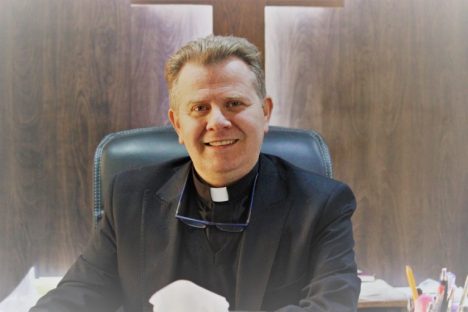
Reverend Ibrahim Nseir, Presbyterian Church, Aleppo. December 31st 2018. (Photo: Vanessa Beeley)
The Presbyterian Church in the Old City of Aleppo was destroyed by the Western-backed terrorist groups in November 2012. An article in the Mennonite World Review in July 2018 described the destruction of the church – “In the old city of Aleppo, Syria, Ibrahim Nseir stands on the pile of rubble that used to be his church. The building where his congregation worshiped is now broken stones and dust. It’s a sunny day, the bright sky a stark contrast to the destruction on the ground.”
After eight years of resistance against the threat of persecution and mass exodus of Christians from Aleppo, Nseir remains defiant and upbeat about the future of Aleppo and Syria. Of the 300,000 Syrian Christians in Aleppo, only 30,000 remain. This is the legacy of sectarian oppression that has been imprinted upon Syria by Western hegemony and it will take generations for it be turned around.
Nseir described the rebuilding process for the Presbyterian Church as difficult but he insisted that it would be rebuilt from its original stones to preserve its historical identity. For Nseir the priorities for Aleppo and Syria are to address the economic situation which has clearly taken a hit on many levels and is suffering in a typical post-war slump. Education is another top priority for this intelligent and enthusiastic Reverend. The intention is to create a center for retreats and conferences at the current Presbyterian Church offices in the center of Aleppo, including a student dormitory.
“We will increase educational capacity by 1000 in the very near future and continue to build upon this progress” Nseir told me.
Education, according to Nseir, is the greatest weapon against extremism and is the only way to re-habilitate children who spent seven of their formative years under occupation of extremist and sectarian factions who worked hard to brainwash almost an entire generation of Syria’s children.
“Ethically the West and the East are responsible for Syria’s destruction. This is not a “Christian” issue, it is a World issue.” Nseir insisted.
The role of the Western media in manufacturing consent for the collective punishment of the Syrian people was clearly a primary cause of the devastation that Nseir and other faith leaders across Syria are now dealing with:
“Western media played more than a negative role, they literally urged the terrorists to take action against the Syrian people by providing false information and blinding people in the West to what was really happening in Syria for eight years. This should never be forgotten.”
Nseir stressed that the healing process for children traumatised by the war would not be easy.
“How do you erase the hatred and horror planted in the brains of 7-10-year-old children by these fanatics? What do you expect from children who have played football with the head of a Syrian Arab Army soldier or who have witnessed the violent abuse of their mother by these terrorists or have seen their father executed by the armed groups? This is the greatest challenge for Humanity and for Syria to put right these terrible wrongs.”
Nseir spoke of the shocking estimated figures of 82,000 children whose father is unknown, referring to the huge number of young women raped or forced into multiple marriages by the terrorist groups and their fighters. How do these children regain their identity and re-integrate into Syrian society? The rebuilding of schools and hospitals must be a priority. The terrorists destroyed “the most developed hospital in the Middle East, Al Kindi” in 2013 and since then, and the destruction of more hospitals across Syria by the terrorist groups, Nseir told me Syria has seen an increase in Cancer and new diseases. Nseir also suggested that this may be attributed to the weapons used by the US Coalition proxies and the U.S itself, which include depleted uranium.
Another important challenge, according to Nseir, is the environmental one. Syria needs to rebuild its natural environment which has also been hugely affected by the conflict. 100,000 trees have been destroyed in Aleppo alone which could lead eventually to desertification of the province if not dealt with. The Governor of Aleppo has recently planted 2,000 new trees but this is an issue that must be addressed with urgency for Nseir.
Nseir strongly believes that Western people should come to Syria independently to see the truth for themselves and report the truth as they see it without any agenda. The Church and the media in the West have maintained a sectarian, divisve narrative which is confusing for people in the West and far from reality.
Nseir addressed the position and status of Syria in the Middle East and described how it has not changed, all that has changed is the perception of Syria portrayed by the media and world leaders who have aligned themselves with the West’s criminal project to partition Syria into sectarian statelets and to remove the elected Syrian government from power by force:
“What has changed since 2011 in reality? Nothing. Syria has always been the protector of the Middle East before 2011, during the conflict and now. The only thing that has changed is the positions of those who turned against Syria, betrayed Syria and who now wish to come back to Syria for protection. We see the Gulf States now change their stance and the UAE has re-opened its embassy in Damascus. The Arab League will welcome Syria back into its fold. Nothing has changed, Syria has remained the same while others have been opportunists and traitors.”
The fact that Syria will forgive its betrayers is testament to what has given Syria victory over its enemies throughout history. With regards to the West, Nseir is not so forgiving:
“The West must go beyond simply stopping its financing of terrorism and the supply of weapons. The West must confess to its crimes against the Syrian people in order to be forgiven. The West must lift the economic sanctions which are a siege upon the Syrian people and it must allow the Syrian people to rebuild in peace without meddling in their affairs. The Syrian people will rebuild according to what the Syrian people want not what the East or the West want. The West has sold the idea that this war was against President Assad but in reality it was against the will of a nation and the people of that nation must be respected”.
Nseir confirmed that the western NGOs are nothing more than political instruments and devices who further the cause of war but he insisted that the West must effectively pay reparations to Syria and expect nothing in return. This is the only way the West can be forgiven by Syria.
Nseir told me that his church will be establishing a medical and health center in the coming months which will be open to everyone in Aleppo to offer medical check-ups and treatment for free. Staff will be trained to deal with the children afflicted by the effects of the war and the terrorist occupation and the plan is to eventually set up special schools to continue the work of rehabilitation for these children. This will enable the coming generations to stand against radicalism and terrorism in the future.
“The West has a duty to respect our dignity and territorial integrity. The Syrian Arab Army has saved the image of our God of Peace, Love and Unity – this has been a spiritual war in Syria not only a military war. The God of love has been embodied by the SAA and our allies and has been victorious over the God of terrorism and hatred. The whole world will change after this war and after Syria’s victory. Syria will be a transformational catalyst for all of Humanity. Syria was never going to be defeated, you only have to study our history to know this. Our society has always embraced diversity and this is the essence of our country. Fanaticism was never going to survive breathing the pure oxygen of our humanity. Actually this demonstrates the stupidity of leaders in the West – to even imagine that extremism has a place in our culture”. Nseir told me.
Nseir ended our talk by stating that the crisis in Syria must be an alarm bell for the country and for its leaders.
“We must re-prioritise our schedule, our agenda and make sure it is not only political but that we address all issues – religious, educational, health care. We must rethink our priorities to ensure a future of peace and stability. At the end I believe strongly that all the negative consequences of this terrible war will be transformed into positive consequences if we address them in the right way. Out of adversity are born the greatest opportunities for the future of Syria and Humanity.”
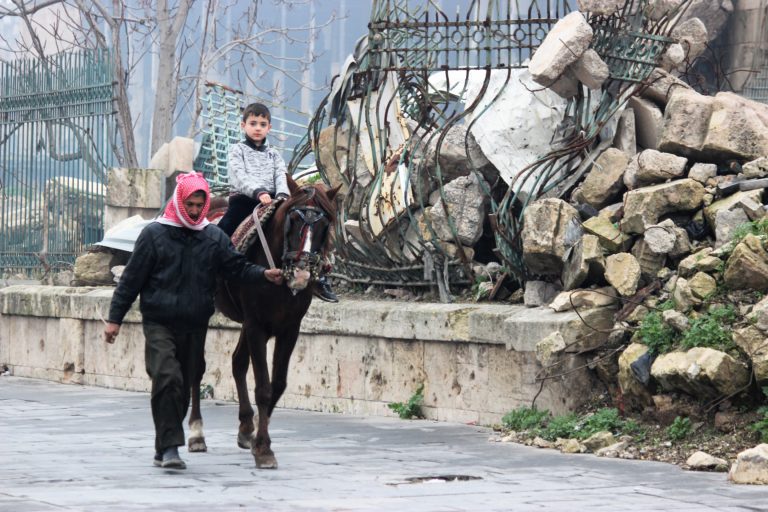
Horse rides on offer at the foot of the Citadel in the Old City of Aleppo. (Photo: Vanessa Beeley)
***
Vanessa Beeley is an independent journalist, peace activist, photographer and associate editor at 21st Century Wire.
Featured Video
Integrity Initiative: UK-funded network framed dissent as Russian disinformation for years
or go to
Aletho News Archives – Video-Images
From the Archives
Why Saudi Ties to 9/11 Mean U.S. Ties to 9/11
By Kevin Ryan | Dig Within | September 27, 2015
Media interest in Saudi Arabian connections to the crimes of 9/11 has centered on calls for the release of the 28 missing pages from the Joint Congressional Inquiry’s report. However, those calls focus on the question of hijacker financing and omit the most interesting links between the 9/11 attacks and Saudi Arabia—links that implicate powerful people in the United States. Here are twenty examples. … continue
Blog Roll
 Aletho News
- Big tech hands in its DSA censorship reports to the EU
- ‘A Big Victory’ – Palestine Chronicle Wins Two-Year Legal Battle
- IAEA inspectors cannot return to Iran amid US threats: Russia
- Senate Rejects Iran War Powers Resolution Passed By House
- ‘We did not attack Pakistan with drones’: Afghan sources
- Iraqi Resistance faction links arms to sovereignty, questions US exit
- Cannon fodder no more… South Korea rejects Trump’s pressure to join his criminal war on Iran
- Neria Leiter Was A Legitimate Military Target
- Integrity Initiative: UK-funded network framed dissent as Russian disinformation for years
- ‘We don’t seek permission to defend our country’: Snippets from President Pezeshkian’s UNGA address
- If Americans Knew
- ‘This is where I live now, the back of a truck’: a day in the life of a grandmother in Gaza
- In UN Speech, Iran’s President Displays Pictures of Children Killed by US, Brings Attention to Israel’s Nuclear Arsenal
- Israel displaces hundreds of Palestinians amid wave of demolitions in West Bank
- Aid, reconstruction, and Israel’s history of obstruction in Gaza
- Trump administration digs an ever-deeper hole of complicity in genocide – Daily Update
- US-Israel $2.8 Billion Arms Deal, 40,000-Bomb Supply Faces New Gaza Complicity Accusations
- Caught on Tape: AIPAC CEO Boasted of Controlling Trump’s National Security Officials
- Why Hamas Attacked Israel in October 2023 – Israeli professor Ilan Pappé
- They see them, then kill them: Israeli quadcopters track, deliberately target civilians in Gaza
- Winter could turn Gaza’s treacherous, war-damaged buildings into deathtraps
- No Tricks Zone
- New Study: Earth And Venus Surface Warmth Largely Explained By Convection And Lapse Rate, Not CO2 Or Radiation
- 2025 Nature Paper Claiming Worsening Global Drought Gets RETRACTED …Heavily Flawed
- New Study: ‘Global Drought Shows No Detectable Recent Acceleration Under Climate Warming’
- Economic Masterminds: German Socialists Suggest Taxing Productivity Gains Stemming From Using AI
- The South China Sea Has Not Been Cooperating With The Climate Change Narrative
- Energy Crisis: Germany Enters Heating Season With Historically Low Gas Reserve Fill Levels
- New Study: The Antarctic Ice Sheet Gained Mass From 2020-2024 Due To Staggering Snow And Ice Accumulation
- Study: Ocean Heating Rates From Thousands Of Years Ago ‘Dwarf’ Modern Ocean Heating Rates
- Climate Extremists Target, Attack Large-Scale Power Grid Infrastructure In Germany!
- New Study: Antarctic Ice Melt Has Contributed Less Than 1 Centimeter To Sea Level Rise In The Last 30 Years

