Chomsky Among “Progressives” Calling for US Military Involvement in Syria
By Whitney Webb | Mint Press News | April 26, 2018
On Monday, the New York Review of Books published an open letter and petition aimed at securing Western support for putting pressure on Turkey to end its occupation of Afrin, opposing further Turkish incursions into Syria, and backing autonomy for Rojava — the region of Northern Syria that has functioned autonomously since 2012 after its administration was taken over by U.S-allied Kurdish factions. Authored by the Emergency Committee for Rojava, it has since been signed by well-known progressive figures such as Noam Chomsky and Judith Butler in its bid to organize efforts for the fulfillment of the group’s demands.
Those demands are entirely focused on U.S. government policy. The petition asks the government to “impose economic and political sanctions on Turkey’s leadership, . . . embargo sales and delivery of weapons from NATO countries to Turkey, . . . insist upon Rojava’s representation in Syrian peace negotiations,” and – most paradoxically of all — “continue military support for the SDF [Syrian Democratic Forces],” the Kurdish-majority group that has acted as a U.S. proxy and has been accused of ethnic cleansing in its bid to construct a Kurdish ethnostate in Northern Syria.
The group’s first three demands are reasonable, in the sense of seeking to punish Turkey for its illegal invasion of Syrian territory. However, they are also rather fanciful, in the sense that the U.S. government is highly unlikely to stop weapons sales or to sanction Turkey, which it needs to court in order to prevent Ankara from pivoting towards Russia. Indeed, the U.S. — by refusing to support the Kurds during the battle for Afrin – made it clear that its “alliance” with Syrian Kurds is opportunistic and very much secondary to the U.S.’ relationship with Turkey.
The third demand is equally unlikely to come about, as Turkey has previously called the involvement of Syrian Kurds in peace talks unacceptable and has essentially issued an “it’s either us or them” ultimatum. In addition, past attempts to invite the Kurds to participate in the peace talks have been rejected by Western nations, including the United States, in order to please Turkey.
More recently, Kurds themselves refused to attend peace talks earlier this year over the Turkish occupation of Afrin in light of the lack of international response to that event. However, even prior to the occupation of Afrin, Syrian Kurds had declared they were “not bound” by any decisions made during Syrian peace talks, thereby weakening the peace process.
Yet, beyond the impractical nature of the petition’s first three demands, the final demand – that the U.S. continue military support for the Syrian Democratic Forces – is by far the most unusual, in the sense that well-known progressive figures, in signing this petition, are asking for the continued U.S. occupation of Syria and for increased military and financial support for the U.S. proxy forces, the SDF.
While most progressive figures, likely including those who signed the petition, would never publicly call for extending a U.S.-led military occupation, this petition shows that the war propaganda in Syria – particularly as it relates to the Kurds – has been highly effective in subverting the progressive anti-war left as it relates to the Syrian conflict.
Indeed, the Kurds in Syria have long been romanticized by Western media for having built “the world’s most progressive democracy” and for being trailblazers for gender equality and gay rights. While the Kurds have incorporated some progressive policies, the realities on the ground are more nuanced. Furthermore, the U.S.’ “support” for Rojava, which the petition seeks to extend, is hardly helping progressive or even Kurdish causes.
Distinguishing the Kurds and the SDF
Since the rise of Daesh (ISIS) in the Syrian conflict, Western media has placed the Kurds on a pedestal and has long treated them as the only “effective” fighters against the terrorist group. However, praising the local Kurdish militias for their fighting prowess has since given way to praising the Syrian Democratic Forces (SDF), even though the two could not be more different.
While the SDF does boast a significant portion of Kurds among its ranks, it is not expressly Kurdish and is an umbrella group of several militias. Though this itself is not concerning, the identities of many of its Arab fighters do give cause for concern. For instance, one of the groups operating under the SDF’s banner is the Deir Ezzor Military Council (DMC) — a group whose fighters were former members of Daesh and al-Nusra (Syria’s Al-Qaeda affiliate), who were “retrained” by U.S. forces in Northern Syria after surrendering to the SDF and U.S.-backed forces in Raqqa. In addition, tribes that were formerly allied with Daesh have joined forces with the SDF over the past year.

The loosely-knit coalition of Syrian rebel groups, including Kurdish factions, known as the Syrian Democratic Forces (SDF), are armed, trained and backed by the U.S. (SDF Photo)
In addition to hosting former members of Daesh and other terror organizations among its ranks, the SDF also regularly collaborates with Daesh in Northeastern Syria in targeting Syrian and Russian forces. Though the Kurds and Daesh are ostensible “enemies,” they have been shown to move amongst each other like allies, and Kurds have even worked alongside Daesh in coordination with U.S. special forces. Perhaps, then, it is little surprise that the SDF allowed Daesh terrorists to leave Raqqa peacefully last June as they took the city.
This collaboration with groups like Daesh, which the SDF has been praised in the West for fighting, has led to major defections of Kurds from the SDF — including SDF’s former spokesman Talal Silo, who accused the group of making secret deals with terrorists.
Along with their troubling ties and collaboration with Daesh, the SDF have participated in war crimes in Syria, in tandem with U.S. forces, and have been accused of ethnic cleansing in order to justify the establishment of a Kurdish ethnostate in Arab-majority areas of Northern Syria.
For instance, in the battle for Raqqa, the SDF — along with the U.S.-led coalition — committed war crimes, such as using chemical weapons and cutting off water supplies to Raqqa, which is still without water nearly a year after its “liberation.” The SDF also played a key role in the operation that left, by some estimates, as many as 8,000 dead and 160,000 more driven from their homes. The operation also left 80 percent of the city completely uninhabitable, and as many as 6,000 bodies are still believed to be buried in the rubble six months after the joint U.S-led coalition/SDF operation concluded.
Some journalists, such as Andrew Korybko, asserted that Raqqa’s civilian population was directly targeted because it was highly unlikely that any Arab, or non-Kurd for that matter, living in Arab-majority Raqqa would freely choose to live in a “Kurdish-dominated statelet” as a second-class citizen instead of choosing to have equal standing within the Syrian Arab Republic. In other words, the operation was, in part, targeting civilians who could resist Raqqa’s annexation by the U.S.-backed Kurds instead of Daesh forces, who were allowed to escape and were later re-assimilated into the SDF. The UN, however, has claimed that the SDF’s removal of Arab populations from Raqqa was done out of “military necessity” and thus did not constitute “ethnic cleansing.”
Have progressives thought through what they’re asking for?
Aside from the SDF, asking the U.S. to maintain its support of the group also means asking the U.S. to continue its illegal occupation of Syria. As MintPress has previously reported, the U.S.’ occupation of Syria is aimed at partitioning the country and preventing Syria’s Northeast from again coming under the control of the Syrian government.
Though partition has also been a goal of some U.S.-allied Kurdish nationalists, who have sought to use the division of Syria as a launching pad for an independent “Kurdistan,” the U.S. in recent months has made it clear that the partition of Northeastern Syria will not benefit the Kurds as much as Wahhabi Sunnis whose ideology is virtually indistinguishable from that of Daesh.
Early last week, the Wall Street Journal reported that Trump’s new National Security Advisor John Bolton was working with U.S.-allied Middle Eastern nations to form an “Islamic coalition” that would replace the U.S. troops currently present in Northeastern Syria with an army composed of soldiers from nations like Saudi Arabia, Qatar and Egypt. This coalition would be a permanent military “stabilizing force” in the region.
In addition to pushing for foreign Arab soldiers to police Rojava, the Trump administration has also sought Saudi commitment to funding the reconstruction of the region. Saudi Arabia — known for its deplorable treatment of religious and ethnic minorities, and funding terror groups like Daesh — and its Gulf allies are highly unlikely to support the Kurds’ nationalist aims as well as their “progressive” direct democracy and promotion of gender equality and gay rights. Indeed, Saudi Arabia is the complete opposite of the Western progressive view of the Kurds, as it is a dictatorial monarchy well known for its repression of women and minorities and execution of members of the LGBT community. However, it is also the country that the U.S. is seeking to give the leading role in governing the area of Syria it currently occupies.
In effect, by asking for the continuation of U.S. military presence in Syria in order to aid the SDF, the Emergency Committee for Rojava is actually undermining the “progressive” Kurds they seek to support — and aiding yet another U.S. government attempt at nation-building, which is likely to result in a Wahhabist enclave that would differ little from a Daesh-led “caliphate.”
The Emergency Committee for Rojava’s efforts come amid major attempts aimed at defending and extending the U.S.’ illegal involvement in Syria. However, this petition is aimed at Western progressives, the group that has historically opposed illegal U.S. military occupations and wars in the past. Given how it has enticed well-known members of the progressive community, the petition shows that the push for Western “humanitarian” intervention in Syria is stronger than ever.
Landmark bill restricting criticism of Israel sneaks through South Carolina Senate

South Carolina State Representative Alan Clemmons, a real estate attorney who has been called “Israel’s biggest supporter in a U.S. state legislature,” tells Representatives that his bill won’t interfere with free speech. Many experts disagree.
South Carolina is poised to be the first state to pass legislation to adopt an Israel-centric definition for “anti-Semitism.” This will then apply to the state’s campuses, potentially limiting discussion of Israel-Palestine to one-sided information that fosters U.S. policies that provide Israel $10 million per day. The bill has been heralded in Israel as a “a landmark bill” that will lead change across the U.S. and the world.
By Alison Weir | If Americans Knew | April 25, 2018
The South Carolina Senate has recently passed legislation that changes the definition of anti-Semitism to include criticism of Israel, and then applies this new definition to college campuses in a manner that experts say will impede free academic inquiry. The U.S. gives Israel over $10 million per day, and Congress frequently approves increases to that amount; restricting discussion on this issue could serve to bolster and increase these expenditures.
The legislation codifies a definition of anti-Semitism that significantly changes the meaning of the word, and it requires the state’s colleges to use this new definition when determining whether an action is “discriminatory” and therefore prohibited. This new definition declares statements that are critical of Israel—even when factual—“anti-Semitic” and therefore impermissible.
A bill on this passed in the state House of Representatives, but when promoters failed to pass it in the state Senate, they resorted to a parliamentary maneuver that may have broken their own rules. They inserted the text at the last minute in South Carolina’s 545-page General Appropriations bill, which is considered a “must-pass” bill because it is required for state government to function. The insertion is on page 348, sandwiched between a section on “Statewide Higher Education Repair and Renovation” and a section that specifies the amount of money appropriated to one of the state’s colleges.
Since the inserted text (section 11.22) does not appear germane to the bill in which it was inserted (and was ruled out of order on the first attempt to add it), the maneuver may have broken legislative rules.*
However, it appears unlikely that the sponsors will be held to account, for two reasons: 1. In Israel the bill is considered extremely important, and some powerful organizations both in the U.S. and internationally support it. 2. However, in South Carolina, legislators tend to consider it insignificant legislation that will have little, if any, impact and therefore see no reason to expend political capital in questioning it. (More on this below.)
Not Law Yet
While pro-Israel groups are celebrating the passage as a “monumental” victory, there are actually two more steps before it becomes state law.
First, the bill must be reconciled with a previous appropriations bill passed by the House. This bill also contains an amendment redefining anti-Semitism and applying it to colleges, but uses different wording. Representatives of the two chambers will meet in the next week or so to create a compromise bill. After that has been accomplished, the Governor must sign it into law.
It is safe to assume neither of these steps will constitute obstacles, however. The governor is in an 8-candidate gubernatorial race where campaign donations are critical, and examination of campaign finance records indicate that pro-Israel donors, often from out of state, frequently play an outsized role in such elections. If history is any predictor, neither he nor any challengers are likely to oppose the legislation.
The Law Will Have Major Impact
The inserted legislation does several things:
First, it vastly expands the traditional, very clear meaning of anti-Semitism—hostility to or prejudice against Jewish people on the basis of their being Jewish—to a new definition that includes certain types of information about Israel.
The Senate bill spells out a long, hazy definition that consists of an array of types of actions, “certain perceptions,” “rhetorical manifestation,” etc., that would now legally constitute “anti-Semitism.” Half a dozen of them are related to the modern state of Israel.
The House bill, rather than spelling out the definition itself, codifies a definition adopted by a State Department special envoy in 2010, which also changed the traditional meaning of anti-Semitism to include statements critical of Israel. (Full text of both are below.)
The Senate bill requires South Carolina’s Commission on Higher Education to print copies of this new, Israel-centric definition of anti-Semitism and distribute them to all South Carolina public colleges and universities.
Finally, both bills mandate that academic institutions use this definition in deciding whether someone has violated a school’s policy prohibiting discrimination.
If the legislation goes through and becomes law, as proponents appear certain it will, the consequences could be two-fold: a significant loss of academic freedom at South Carolina colleges, and, indirectly, continued one-sided U.S. Middle East policies and massive expenditures.
But first let’s look at the historic and geopolitical background of this new definition.
Origin of the New Definition
The basic outline of this new, Israel-centric definition of anti-Semitism was first created by an Israeli minister in 2004. Israel partisans have successfully pushed its adoption by numerous entities around the world ever since, building on even the smallest endorsements to create momentum and a snowballing effect. (See this for details.)
In the U.S., a two-step process has achieved partial success in getting the nation to legally adopt the new definition, but the effort is ongoing—South Carolina’s law would be a major step forward for proponents of the definition, and the accompanying censorship of certain types of information.
The first step that would enable the adoption of the definition in the U.S. also occurred in 2004: Pro-Israel groups successfully promoted federal legislation to create a “special envoy” and State Department office to monitor anti-Semitism. This was done over the objections of state department officials, who said it was unnecessary.
The second step was accomplished by one of these envoys, who unilaterally adopted the new, Israel-centric definition in 2009. (All three envoys have been demonstrably pro-Israel, two later working for the Israel lobbying organization AIPAC—the American Israel Political Action Committee. President Trump, as part of his general cost-cutting measures, has not yet appointed a new envoy, causing many pro-Israel groups to call him anti-Semitic for this failure.)
Anti-Semitism Special Envoy Hannah Rosenthal (above) adopted the Israel-centric definition in 2009.
Since that time, Israel partisans have introduced legislation in the federal government and state legislatures—and even on some college campuses—to adopt this definition, which they call the “state department definition.” South Carolina, if the bill becomes state law, will be their first success in this effort.
Curtailing Freedom of Speech and Academic Inquiry
These bills usually contain a final sentence that says they don’t violate the Constitutional guarantee of free speech, and their sponsors make this claim to the people voting for them.
However, the reality seems to be the opposite.
Legal experts say the legislation will do just that, and there is a history of university administrators around the country censoring protected speech on the basis of such definitions.
In fact, the author of the definition adopted by the State Department anti-Semitism envoy has vehemently opposed legislating the definition into law, specifically writing that applying it to colleges “is a direct affront to academic freedom.”

Kenneth Stern, who helped write the new definition, says legislation that imposes it on campuses is “unconstitutional and unwise.” Stern was employed by the American Jewish Committee as its expert on anti-Semitism for 25 years.
In a letter opposing federal legislation to codify the definition as law, author Kenneth Stern stated: “The definition was never intended to be used to limit speech on college campuses; it was written for European data collectors to have a guide for what to include and what to exclude in their reports.”
Stern, the American Jewish Committee’s expert on anti-Semitism for 25 years, opposed incorporating the definition into law in a way that he called “unconstitutional and unwise.” Stern warned that this would “actually harm Jewish students and have a toxic effect on the academy.”
Other legal experts agree with Stern.
An analysis by the Center for Constitutional Rights and other groups that examined the proposed federal bill (not yet passed) found that not only would it interfere with freedom of speech, but that such censorship was the motivation for the legislation: “The Act purports to address rising anti-Semitism on college campuses, but a close reading reveals that its true purpose is to silence campus advocacy for Palestinian rights and censor any criticism of Israeli government policies.”
The document continues: “This vague and overbroad re-definition conflates political criticism of Israel with anti-Semitism, infringing on constitutionally protected speech.”
Finally, the paper specifically emphasizes: “The re-definition is especially detrimental to universities, where freedom of speech, critical inquiry, and unfettered debate are integral.”
The American Civil Liberties Union (ACLU) also actively opposes such legislation, stating that the federal bill poses “a serious threat to the First Amendment free speech rights of those on campus who may hold certain political views.”
In its letter of opposition to the federal bill, the ACLU stated: “The First Amendment prevents the federal government from using its great weight to impose severe penalties on a person simply for sharing a political viewpoint critical of Israel.”
The chief of staff of the ACLU’s legislative office in Washington said that the legislation “opens the door to considering anti-Israel political statements and activities as possible grounds for civil rights investigations.”
How the Law Will Limit Free Speech in South Carolina

The legislation could mean that University of South Carolina students will only hear one side on the Israel-Palestine issue, helping Israel partisans continue the over $10 million per day that the U.S. gives Israel.
An examination of the South Carolina situation indicates how the new law could play out.
University of South Carolina guidelines contain the laudable statement that “all students should be able to learn and live” in an environment that is “free from discrimination … in all programs, activities, and services of the University.”
Since the new legislation defines many statements about Israel, no matter how factual, as “anti-Semitic” and therefore constituting discrimination, Israel partisans can be expected to invoke the law: to prevent public speakers from discussing information on Palestine, to prevent professors from educating students fully and accurately on the Middle East, and/or to punish professors or students who provide facts that Israel and its partisans don’t wish students to know. Anti-Palestinian activists have invoked the definition to accomplish all of these things elsewhere, in a number of instances.
In addition, the legislation could interfere with student groups’ ability to bring speakers to campus. While student groups are normally allowed to use student fees to bring outside speakers, under the new legislation this could change. While students could bring pro-Israel speakers without problems, groups wishing to bring speakers with different perspectives might not have an equal ability to do so. Ironically, a bill that many of its supporters intended to be against discrimination, might actually create discrimination against certain students, including those from ethnic or religious minorities.
By blocking such speakers and information, the “free marketplace of ideas” would be severely limited on South Carolina campuses when it comes to Israel-Palestine—one of the most significant issues in today’s world, a critical factor in Middle East wars, and the core issue of the Middle East.
For decades, the U.S. has given Israel far more of our tax money than to any other nation (on average, 7,000 times more per capita than to other people), as well as massive diplomatic cover. Most of the rest of the world therefore considers the U.S. as the sponsor responsible for Israel’s actions. Therefore, it is particularly crucial that Americans be fully informed on Israel and its actions. No one, including the most committed supporter of Israel, benefits from one-sided, incomplete information. Friends don’t let friends bury their heads in misinformation while supporting ethnic cleansing.
“Momentous” Breakthrough

Brandeis Center’s Kenneth Marcus commended Representative Alan Clemmons, Representative Beth Bernstein, Senator Larry Grooms, the Israel Allies Foundation, the Columbia Jewish Federation, the Charleston Jewish Federation, CUFI, StandWithUs, and the Israel Project for helping promote the bill.
Pro-Israel groups, both international and domestic, have been watching—and participating in—the South Carolina situation with great eagerness. Now that South Carolina seems poised to adopt the “anti-Semitism” legislation, many hope that “as goes South Carolina, so goes the nation”—and the world.
Israel’s Jerusalem Post newspaper called the South Carolina legislation “a landmark bill that is set to be the model for states across America and countries around the world.”
The pro-Israel Brandeis Center, which helped promote the legislation, declared: “Just as two dozen states followed South Carolina’s lead on legislation condemning the movement to boycott certain countries [Israel], we are hoping this momentous step will result in another national wave to, once and for all, begin defeating rising anti-Semitism.” Anti-Semitism, that is, defined to include many forms of criticism of Israel.
Supporters of these bills claim their efforts are necessary to battle rising anti-Semitism. Therefore, it is important to realize and scrutinize what they mean by “anti-Semitism.”
The much-cited Anti-Defamation League (ADL) and another group, AMCHA, classify many actions in support of international law and Palestinian human rights as supposedly “anti-Semitism.” Both organizations actively advocate for Israel. The ADL, which is often perceived as a civil rights organization, has been connected to some initiatives promoting Islamophobia, and it produced a campus guide describing how to block events about Palestine.
Despite what the legislation’s supporters would have us believe, a 2017 report found that Jewish students “reported feeling comfortable on their campuses, and, more specifically, comfortable as Jews on their campuses.” Fewer than 10 percent of the students articulated the belief that anti-Israel sentiment is anti-Semitism. Even some Israel partisans have said that reports of alleged anti-Semitism on campuses are inaccurate.
Barry Trachtenberg, who teaches in the Jewish Studies Department at Wake Forest University, said it was a “factual distortion” to call colleges “hotbeds” of anti-Semitism, and said that that criticism of Israel is part of healthy academic debate.
“Students who engage in speech critical of Israeli policy are largely motivated by their concern for Palestinian human rights,” Trachtenberg said. “They are not motivated by anti-Semitic hate, but its opposite — a desire to end racial and religious discrimination of all kinds.”
The reality is that students who support Israel are extraordinarily well supported on American campuses. There are over two dozen organizations that collectively contribute millions of dollars to campaigns to promote Israel on campuses. Casino magnate Sheldon Adelson reportedly has raised at least $20 million to quash student speech critical of Israeli policies. Sheldon, who has said he wished he had served in the Israeli military rather than in the U.S. army, has created a task force that funds pro-Israel students to organize events on campuses, with the funding per campus reportedly in the six figures per year on at least forty campuses.
Israel has long recognized the need to promote its interests on campuses. The Israeli minister who created the original formulation for the new anti-Semitism definition said that college campuses were “one of the most important battlefields” for Israel.
An Israel lobby leader announced some years ago, after student government at U.C. Berkeley considered taking some measures to boycott Israel: “We’re going to make certain that pro-Israel students take over the student government. That is how AIPAC operates in our nation’s capitol. This is how AIPAC must operate on our nation’s campuses.”
Organizations & individuals behind the bill
A number of pro-Israel organizations took credit for helping on South Carolina’s anti-Semitism legislation.
The Brandeis Center, named after former Supreme Court Justice Louis Brandeis (who for a period headed the world Zionist movement) announced that its representatives “testified at multiple South Carolina hearings on the bill and have been working closely with state legislators to ensure passage.”
Another group that helped promote the bill was the Israel Allies Foundation. Its U.S. executive director Joseph Sabag stated: “The IAF was honored to help lead the advocacy and surrounding educational efforts, as well as provided policy and legal resources to legislators for this effort.”

Israel Allies Director Joe Sabag speaks at Standing with Israel event in Texas, where he praises the South Carolina bill.
IAF is a multi-million dollar international organization that promotes Israel around the world. Sabag explained that the mission of IAF, “via its 37 pro-Israel Caucuses worldwide, and in the U.S. Congress and state legislatures, is to provide policymakers with the resources they need to craft sound public policy.” IAF particularly works to create support for Israel among Christians, putting on events at churches and other venues throughout the United States.
Sabag said that the Israel Allies Foundation “couldn’t be prouder of what’s been accomplished here in South Carolina.”
The Israel Project, with a budget of about $8 million, is another organization that helped on the legislation. Founded 16 years ago to support Israel, The Israel Project focuses on “informing the media and public conversation about Israel and the Middle East.” Its website proclaims that it “is the only organization dedicated to changing people’s minds about Israel through cutting-edge strategic communications. We don’t attack the media, we become a trusted partner and resource.”
Israel Project President Josh Block (annual salary half a million dollars) praised South Carolina: “South Carolina was the first state to pass anti-BDS legislation and now has become the first state in the nation to pass uniform definition of anti-Semitism legislation.” (BDS—boycott, divestment, sanctions—is an economic campaign to pressure Israel to end its violations of international law, U.S. law, and human rights.).
The Brandeis Center also credited CUFI (Christians United for Israel) and StandWithUs for their help on the legislation.

David Brog, the “powerhouse” behind CUFI, previously worked for Democrat Arlen Specter. His cousin is former Israeli Prime Minister Ehud Barak.
Founded in 2006, CUFI claims to have 3-4 million “members,” though this seems to actually be the number of emails the organization has gathered; the number of active supporters may be closer to 30,000 to 50,000. CUFI lobbies on behalf of Israel and disseminates pro-Israel spin on diverse issues to Americans and Canadians.
Charisma News reports: “It’s no secret that one of the most powerful lobbying groups in Washington, D.C., the American Israel Public Affairs Committee (AIPAC), has long wanted a ‘Gentile arm,’ and some believe they now have it in CUFI.”
While CUFI’s head is megachurch pastor and celebrity John Hagee, its executive director and co-founder David Brog may be the organization’s real mover and shaker. According to Charisma News, “Brog is the powerhouse behind the Christian organization, yet he’s also a conservative (non-Messianic) Jew.” The article reports: “Brog, who was chief of staff to liberal Sen. Arlen Specter of Pennsylvania for seven years, is said to run CUFI like a political campaign. He has talking points, stays focused and rallies his constituency.” Prime Minister Ehud Barak is his cousin.
Stand With Us is an international organization supporting Israel headquartered in Los Angeles that works in the U.S., Canada, Israel, England, South Africa, China, Europe, and Australia. CEO Roz Rothstein commended South Carolina’s legislation, saying: “Just as South Carolina took the lead in passing anti-BDS legislation, we hope that the passage of H3643 will be the first of many states to follow suit.”

Over 1,000 people helped StandWithUs celebrate its 16th anniversary at its 2017 gala at the Beverly Hilton Hotel in Beverly Hills. The event raised more than $3 million.
The Brandeis Center also credited the Jewish Federations of Columbia and Charleston, South Carolina with helping on the legislation.
Representative Alan Clemmons
The official author of the House bill was Representative Alan Clemmons, known for his Israel advocacy. South Carolina’s Post and Courier newspaper reports that Clemmons is “Israel’s biggest supporter in a U.S. state legislature.”

Alan Clemmons (right) with Israeli Prime Minister Netanyahu & wife; insert shows Clemmons with Israeli soldiers. [From Clemmons Twitter account.]
Clemmons, a Mormon, has traveled to Israel four times, met with Prime Minister Netanyahu, sometimes leads South Carolina delegations to Israel, and was a drafter of the 2016 national Republican Party platform on Israel, parts of which have been adopted by the Trump administration. In 2017 Clemmons joined U.S. Ambassador to the U.N. and former South Carolina Governor Nikki Haley at special U.N. event sponsored by the World Jewish Congress.
Clemmons sometimes meets with extremist Israeli settlers (Israeli settlements are illegal under international law), and calls them his “great tutors” on the issue of Israel-Palestine. (But Clemons ignores the statements of religious leaders such as Dead Sea scholar Millar Burrows, Naturei Karta rabbis, and the American Council on Judaism, who have long opposed Israeli confiscation of Palestinian land.)

Alan Clemmons’ delegation to Israel spent much of its time in Israeli settlements, where their “eyes were opened” by Israeli settlers (sometimes from the U.S.) who claim they have the right to confiscate land belonging to Christians, Muslims, and others.
There is no record of Clemmons and his delegations ever traveling to Gaza or the West Bank on independent, fact-finding trips or having unscripted meetings with Palestinian Muslims and Christians.
Opposition to the Legislation
A number of South Carolinians objected to the legislation for diverse reasons.

Children in Gaza after an invasion by Israeli forces. More information here.
Some argued it could “restrict thoughtful critiques of Israeli policy.” A Palestinian student activist wrote a letter to the editor in which she explained that her group, which included Jewish members, “fully acknowledge and sympathize with the Jewish history, but assert our right to criticize the actions of Israel.”
South Carolina’s State newspaper reported on opponents who testified against the House bill: “Speaking hurriedly to meet a two-minute time limit lawmakers had imposed, they said the bill would discourage college discussions on the Israeli-Palestinian conflict and gag pro-Palestine student groups.”
The paper reported that Caroline Nagel, an associate professor of geography at the University of South Carolina, said she feared that the bill would “silence professors and student groups who are trying to explain and to give voice to a diversity of opinions about the Israeli-Palestinian conflict.”
“I am frankly baffled,” Nagel said, “as to why any legislator would consider an idea to curtail our freedom of speech.”

Israel was created through the expulsion of hundreds of thousands of the original Muslim and Christian inhabitants. Under the new law such information might be considered “anti-Semitic” and prohibited.
Some opponents felt that the House members who signed onto it had been “hoodwinked.”
“They just think it’s something that’s nice for Israel,” said David Matos, president of Carolina Peace Resource Center. “They don’t realize it’s a pretty nasty attempt to suppress free speech on college campuses … to suppress debate on college campuses on Israel and Palestine.”
“It’s clearly unconstitutional,” Matos said. “The intent is to suppress political speech and smear it as anti-Semitism.”
Some State Legislators Raise Questions

SC Senator Brad Hutto considers anti-Semitism “horrible” but questioned the need for the bill. (photo from 2014)
South Carolina State Senator Brad Hutto held up the Senate bill, leading its sponsors to slip it into the appropriations bill instead. Hutto said: “I have heard not one university trustee that I know come up here and tell me that they were having any problems understanding how to read the dictionary or make up their own mind and needing our help on it.”
The Israel Allies Foundation, angered at Hutto’s action, blasted Hutto, a longtime liberal who calls anti-Semitism “horrible,” for allegedly working “to benefit the forces of bigotry and intolerance.”
In reality, however, Hutto had explained that he would support the legislation if it applied to “all races, ethnicities and gender identities.”
In an interview for this article, Hutto said that he was opposed to the bill for several reasons.
Hutto felt there was no need for the legislation. While he emphasized that “anti-Semitism is a horrible thing,” he pointed out that the universities have an elected board of trustees fully capable of managing any complaints or problems. He said there was no need for the State Assembly to “micromanage conduct on campuses.”
Hutto also disliked that the bill focused on only one type of bigotry, and in only one place. He emphasized that “all bigotry of every kind is bad,” and said “it’s bad everywhere, in housing, at work, everywhere.” Hutto said he might consider supporting a broader bill that made a general statement against all bigotries in all their various forms and locations.
Hutto also felt it was a mistake to inject foreign policy into the state legislature when there are numerous pressing issues in South Carolina that the legislature needs to address.
The bottom line, however, was that Hutto didn’t think the law would have any impact, “other than getting one or two members free trips to Israel.”
For that reason, he said, most Senators considered the legislation unimportant. While some other Senators also opposed the legislation, he said—mostly out of freedom of speech concerns—they didn’t see the need to expend “political capital” on a law that they felt would “do nothing.”
Hutto, focused on South Carolina and the needs of his constituents, seemed surprised that the bill is considered so significant elsewhere.
A few people in the state house also opposed the bill.
One of them, Josiah Magnuson, said in an interview for this article that he supports Israel, but thought that the bill was “probably not the right approach” and was concerned that it might limit free speech. Like Hutto, though, he didn’t think the legislation was important or would do much.

Representative Jonathan Hill took his name off the bill. “The First Amendment is a pretty big deal,” Hill said. “At the end of the day the government can’t start micromanaging the things that you say.”
Representative Jonathan Hill, a former sponsor who took his name off the bill, said that he thought it was wrong to apply to U.S. citizens a State Department definition of anti-Semitism intended for use abroad: “It does not necessarily account for the rights of American citizens to free speech. It’s designed for application in a geopolitical context.”
In an interview for this article, Hill noted that the State Department definition “was created for diplomatic purposes, not for use in the U.S.” and was concerned that applying it to colleges “could interfere with the Constitutional rights of Americans.”
Hill emphasized that he finds anti-Semitism “reprehensible,” but is focused on “the most appropriate way to handle the situation.” He said, “I’m not against what Senator Clemmons is trying to accomplish, but I feel that he is going about it the wrong way.”
“The First Amendment is a pretty big deal,” Hill said. “At the end of the day the government can’t start micromanaging the things that you say.”
Jewish Academics Oppose the Legislation

Alan Brownfeld of the American Council on Judaism, says: “Real problems must be addressed with real discussion and debate. Only those who have something to lose by open debate would use the tactics we have seen deployed by Israel and its most fervent American supporters.” (Photo is from 2014 talk)
Some Jewish groups and individuals also opposed the new definition and codifying it in federal law or state law.
The American Council on Judaism’s Allan Brownfeld recently wrote: “There is a campaign to redefine anti-Semitism to mean criticism of Israel and opposition to Zionism. This campaign has as its goal the silencing of those who are critical of Israel’s 50-year occupation of Palestinian territories and are engaged in activities such as support for the boycott, divestment and sanctions (BDS) movement.”
Brownfeld concluded: “Real problems must be addressed with real discussion and debate. Only those who have something to lose by open debate would use the tactics we have seen deployed by Israel and its most fervent American supporters.”
Over 60 Jewish scholars signed a letter calling the federal bill “misguided and dangerous.”
Another 300 Jewish students signed a letter objecting that the federal bill conflated “legitimate criticism of the policies of the Israeli government with anti-Semitism, using a problematic definition of anti-Semitism never intended for use on college campuses … At a time when freedom of expression is under threat across the country, we need to be protecting and expanding speech, not restricting it.”
The letter said that such legislation would “limit our freedom of expression around the vital issues of our time.”
Truly a Vital Issue
The issue of Israel-Palestine is particularly relevant right now.
In the last few weeks there has been a massive uprising by men, women, and children in Gaza against the theft of their homes, their virtual imprisonment by Israel, and the decade-long blockade against them that has caused malnutrition among their children and severe hardship for their whole population.
Israeli forces have injured approximately 5,000 of the demonstrators, including a child who was shot in the head. During Easter, Israeli forces blocked hundreds of Palestinian Christians in Gaza from praying at the Church of the Holy Sepulchre in Jerusalem.
These are not pleasant facts to disseminate or to know. Israel partisans may wish to dispute details, and have the right to do so. But the proper way to go about this is with civil, open, fair debate—not by suppressing information, breaking the rules, cheating students of their rights, and violating a Constitution that has served the United States well for over 200 years, as we have striven ever closer to the ideal of equal rights for all.
Allowing a special interest group to censor important information from our country’s students, even for the most benign of motivations, is unfair to our young people, damages our way of government, and causes profound harm to all of us.
Let us hope that South Carolina’s legislators rethink their support for this bill. If they don’t, let us hope that other states don’t follow in a direction that violates some of our nation’s most fundamental principles. Our students and our nation deserve better.
Alison Weir is executive director of If Americans Knew, president of the Council for the National Interest, and author of Against Our Better Judgment: The Hidden History of How the U.S. Was Used to Create Israel.
* The first attempt to insert the text into the Senate appropriations bill, Amendment No. 49, was ruled not germane and ruled out of order. Supporters of the text then came back with Amendment No. 74, which added the requirement that the new definition be printed and distributed. Because this required an expenditure, this time the amendment squeaked through. Both amendments were introduced by Senator Larry Grooms, who had shepherded the bill in the Senate.
House Appropriations bill – 4950
Below is the section about anti-Semitism:
117.149. (GP: Prohibition of Discriminatory Practices) (A) In the current fiscal year and from the funds appropriated to public colleges and universities, when reviewing, investigating, or deciding whether there has been a violation of a college or university policy prohibiting discriminatory practices on the basis of religion, South Carolina public colleges and universities shall take into consideration the definition of anti-Semitism for purposes of determining whether the alleged practice was motivated by anti-Semitic intent.
(B) Nothing in this proviso may be construed to diminish or infringe upon any right protected under the First Amendment to the Constitution of the United States or Section 2, Article I of the South Carolina Constitution, 1895.
(C) For purposes of this proviso, the term ‘definition of anti-Semitism’ includes:
(1) the definition of anti-Semitism set forth by the Special Envoy to Monitor and Combat Anti-Semitism of the Department of State in the fact sheet issued on June 8, 2010; and
(2) the examples set forth under the headings ‘Contemporary Examples of Anti-Semitism’ and ‘What is Anti-Semitism Relative to Israel?’ in the fact sheet.
Senate General Appropriations bill 4950
Below is the text on pages 348-9 of General Appropriations bill 4950 passed by the Senate on April 12, 2018:
11.23. (CHE: Prohibition of Discriminatory Practices) (A) In the current fiscal year and from the funds appropriated to the 16 Commission on Higher Education, the commission shall print and distribute to all South Carolina public colleges and universities 17 the definition of anti-Semitism. 18 (B) For purposes of this proviso, the term “definition of anti-Semitism” includes: 19 (1) a certain perception of Jews, which may be expressed as hatred toward Jews. Rhetorical and physical manifestations 20 of anti-Semitism are directed toward Jewish or non-Jewish individuals and/or their property, toward Jewish community institutions 21 and religious facilities; 22 (2) calling for, aiding, or justifying the killing or harming of Jews; 23 (3) making mendacious, dehumanizing, demonizing, or stereotypical allegations about Jews as such or the power of Jews 24 as a collective; 25 (4) accusing Jews as a people of being responsible for real or imagined wrongdoing committed by a single Jewish person 26 or group, the state of Israel, or even for acts committed by non-Jews; 27 (5) accusing the Jews as a people, or Israel as a state, of inventing or exaggerating the Holocaust; 28 (6) accusing Jewish citizens of being more loyal to Israel, or to the alleged priorities of Jews worldwide, than to the interest 29 of their own nations; 30 (7) using the symbols and images associated with classic anti-Semitism to characterize Israel or Israelis; 31 (8) drawing comparisons of contemporary Israeli policy to that of the Nazis; 32 (9) blaming Israel for all inter-religious or political tensions; 33 (10) applying double standards by requiring of it a behavior not expected or demanded of any other democratic nation; 34 (11) multilateral organizations focusing on Israel only for peace or human rights investigations; and 35 (12) denying the Jewish people their right to self-determination, and denying Israel the right to exist, provided, however, that 36 criticism of Israel similar to that leveled against any other country cannot be regarded as anti-Semitic. SECTION 11 – H030 – COMMISSION ON HIGHER EDUCATION PAGE 349 1 (C) South Carolina public colleges and universities shall take into consideration the definition of anti-Semitism for purposes of 2 determining whether the alleged practice was motivated by anti-Semitic intent when reviewing, investigating, or deciding whether 3 there has been a violation of a college or university policy prohibiting discriminatory practices on the basis of religion. 4 (D) Nothing in this proviso may be construed to diminish or infringe upon any right protected under the First Amendment to the 5 Constitution of the United States or Section 2, Article I of the South Carolina Constitution, 1895.
Below is the earlier bill, that had been held up in the Senate:
TO AMEND THE CODE OF LAWS OF SOUTH CAROLINA, 1976, BY ADDING SECTION 59-101-220 SO AS TO DEFINE CERTAIN TERMS CONCERNING ANTI-SEMITISM, TO PROVIDE INSTITUTIONS OF HIGHER LEARNING IN THIS STATE SHALL CONSIDER THIS DEFINITION WHEN REVIEWING, INVESTIGATING, OR DECIDING WHETHER THERE HAS BEEN A VIOLATION OF AN INSTITUTIONAL POLICY PROHIBITING DISCRIMINATORY PRACTICES ON THE BASIS OF RELIGION, AND TO PROVIDE NOTHING IN THIS ACT MAY BE CONSTRUED TO DIMINISH OR INFRINGE UPON ANY RIGHTS AFFORDED BY THE FIRST AMENDMENT TO THE UNITED STATES CONSTITUTION OR SECTION 2, ARTICLE I OF THE CONSTITUTION OF THIS STATE.
Be it enacted by the General Assembly of the State of South Carolina:
SECTION 1. Article 1, Chapter 101, Title 59 of the 1976 Code is amended by adding:
“Section 59-101-220. (A) For purposes of this section, the term ‘definition of anti-Semitism’ includes:
(1) the definition of anti-Semitism set forth by the Special Envoy to Monitor and Combat Anti-Semitism of the Department of State in the fact sheet issued on June 8, 2010; and
(2) the examples set forth under the headings ‘Contemporary Examples of Anti-Semitism’ and ‘What is Anti-Semitism Relative to Israel?’ in the fact sheet.
(B) In reviewing, investigating, or deciding whether there has been a violation of a college or university policy prohibiting discriminatory practices on the basis of religion, South Carolina public colleges and universities shall take into consideration the definition of anti-Semitism for purposes of determining whether the alleged practice was motivated by anti-Semitic intent.
(C) Nothing in this section may be construed to diminish or infringe upon any right protected under the First Amendment to the Constitution of the United States or Section 2, Article I of the South Carolina Constitution, 1895.”
SECTION 2. This act takes effect upon approval by the Governor.
No Remorse For Hillary
By Craig Murray | April 25, 2018
I am hopeful that the commendable discovery process involved in US litigation will bring to light further details of the genesis of Christopher Steele’s ludicrous dossier on Trump/Russia, and may even give some clues as to whether Sergei Skripal and/or his handler Pablo Miller were involved in its contents.
The decision by the Democratic National Committee to sue the Russian Government, Wikileaks, Julian Assange personally and the Trump campaign is an act of colossal hubris. It is certain to reveal still more details of the deliberate fixing of the primary race against Bernie Sanders, over which five DNC members, including the Chair, were forced to resign. It will also lead to the defendants being able to forensically examine the DNC servers to prove they were not hacked – something which astonishingly the FBI refused to do, being instead content to take the word of the DNC’s own private cyber security firm, Crowdstrike. Unless those servers have been wiped completely (as Hillary did to her private email server) I know that is not going to go well for the DNC.
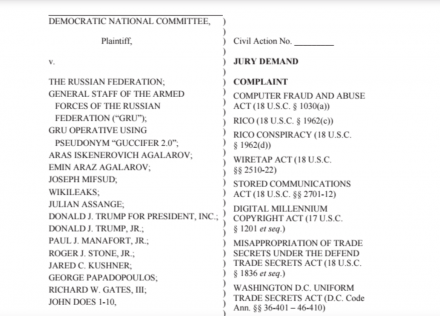
I cannot better Glenn Greenwald’s article on why it is a terrible idea to sue Wikileaks for publishing leaked documents – it sets a precedent which could be used to constrain media from ever publishing anything given them by whistleblowers. It is an astonishingly illiberal thing to undertake. Nor is it politically wise. The media has done its very best to ignore as far as possible the actual content of the leaks of DNC material, and rather to concentrate on the wild accusations of how they were obtained. But the fundamental crookedness revealed in the emails is bound to get some sort of airing, not least as the basis of a public interest defence.
I have often been asked if I regret my association with Wikileaks, given they are held responsible for the election of Donald Trump. My answer is that I feel no remorse at all.
Hillary Clinton lost because she was an appalling candidate. A multi-millionaire, neo-con warmonger with the warmth and empathy of a three week dead haddock and an eye for the interests of Wall Street, who regarded ordinary voters as “deplorables” (a term she used not just once, but frequently at fund-raisers with the mega-wealthy). Hillary Clinton conspired with the machine that was supposed to be neutrally running the primaries, to fix the primaries against Bernie Sanders. The opinion polls regularly showed that Sanders would beat Trump, and that the only Democratic candidate who Trump could beat was Clinton. Egomania and a massive sense of entitlement nevertheless led her not just to persist to get the candidacy, but persist to rig the candidacy. She then proceeded to ignore major urban working class battleground states in her campaign against Trump and focus on more glamorous places. In short, Hillary was corrupt rubbish. Full stop, and not remotely Wikileaks’ fault.
Wikileaks did not go out to get the evidence against Hillary. They were given it. Should they have withheld the knowledge of the rigging of the field against Bernie Sanders from the American people, to let Clinton benefit from the corruption? For me that is a no-brainer. It would have been a gross moral dereliction to have done so. It is also the case that Wikileaks can only publish what they are given. Had they been given dirt on Trump, they would have published. But they were not given any leaks on Trump.
I should put in an aside here which might surprise you. I like Anthony Weiner. I have never met him, but I watched the amazing 2016 fly on the wall documentary Weiner and he came across as a person of genuine goodwill, passion and commitment, undermined by what is very obviously a pathological illness. I realise that was not the general reaction, but it was mine.
But – and now I am going to really annoy people – I have to say that from an international perspective, rather than an American domestic perspective, I am also not in the slightest convinced that Trump has been worse for the World than Clinton would have been. Trump has not, to date, initiated any new military intervention or substantially increased any military conflict during his Presidency. In fact his current actions more closely match his words about non-intervention during his election campaign, than do his current words. Despite hawkish posturing, he has not substantially increased American military intervention in Syria.
My reading of the reported chemical weapon attack on Douma is this. Whether it was a false flag chemical attack, a pro-Assad chemical attack, or no chemical attack at all I do not know for sure. But whichever it is, it was used to attempt to get Trump to commit to a major escalation of American involvement in the war in Syria. So far, he has not done that. The American-led missile attack was illegal, but fortunately comparatively restrained, certainly in no way matching Trump’s rhetoric. All the evidence is, and there is a great deal of evidence from Libya and Afghanistan, that Clinton would have been far more aggressive.
That leaves the dichotomy between Trump’s rhetoric and his actions. Certainly there is every sign of a sharp tilt to the neo-cons. His apparent preference in his press conference with Macron today for an extended presence of France, the former colonial power, and US troops in Syria is deeply troubling. His sacking of the sensible Tillerson from the State Department, and his appointment of the odious John Bolton as National Security Adviser all appear to be terrible signs. But still, nothing has actually happened. There is a reading that Trump is placating the neo-cons with position and rhetoric while his actions – in Syria and in what a hating political class fails to acknowledge has all the makings of a diplomatic coup in North Korea – go in a very different direction.
It is beyond doubt that Hillary, who cannot open her mouth without denouncing Russia for causing her own entirely self-inflicted failure – would be taking the new Cold War to even worse extremes than it has already reached, to the delight of the military-industrial complex and her Wall Street friends. It is open to debate, but I would contend that it is very probable that President Hillary would have launched a major attack on Syria by now, just like she presided over as Secretary of State in Libya.
So my answer is this. Firstly, Clinton caused her own downfall by arrogance, and by failing to grasp the alienation of ordinary people from neo-liberal policies that impoverished them while the rich grew massively richer. Secondly, I strongly suspect that if Hillary were President, more people would be dead now in the Middle East.
So no, I have no regrets at all.
Illegal foreign presence in Syria serves to revive terrorism front: Iranian official
Press TV – April 25, 2018
Iran’s top security official says the illegitimate military presence of certain countries in Syria is meant to put the Takfiri terrorists, who have suffered defeat in the region, back on their feet.
Secretary of Iran’s Supreme National Security Council Ali Shamkhani made the remarks on Tuesday during a meeting with his Russian counterpart, Nikolay Patrushev, in Sochi, where he is to attend a security conference of senior officials from more than 100 countries.
“Through their illegitimate military presence in Syria, some countries have only further complicated the circumstances on the ground there, and are practically taking steps towards the reinforcement of the defeated front of Takfiri terrorism,” he said.
The two officials discussed a wide range of issues, including bilateral anti-terror cooperation, insecurity in Afghanistan, and the threat facing the region from the relocation of terrorists to the Central Asian country following their defeat in Syria and Iraq.
Shamkhani also spoke in condemnation of an April 9 Israeli strike against the T-4 airbase in central Syria, which killed more than a dozen people, including seven Iranian military advisors.
He said the attack on the people, who are in Syria for anti-terrorism military advisory assistance at the request of the legal government, “exposed the identity of the real supporters of terrorists.”
The official also condemned a recent coordinated attack by the US, the UK, and France against Syria, saying the strikes showed the West is seeking out excuses to damage the standing mechanisms for finding a political solution to the crisis in the Arab country.
The Russian official, for his part, said the conference in Sochi is meant to explore ways to replace militarism and violence with dialog and understanding.
Some countries, he added, resent successful Iran-Russia cooperation, and have launched “full-scale and suspicious” efforts at hurting their ties.
Patrushev said the US is continuously trying to deliver economic and political blows to Iran and Russia to restrict their joint efforts to restore stability to the region, adding, however, that Washington will fail to achieve its goal.
Iran and Russia have been both assisting Syria in its counter-terrorism offensive and mediating, together with Turkey, a diplomatic process to help restore calm to the Arab country.
On the contrary, the United States and its allies have been launching attacks on Syria since 2014, claiming they seek to root out Daesh without getting the Syrian government’s approval or a UN mandate.
The US and its allies have defied the Damascus government’s call to leave Syrian soil despite the collapse of the Takfiri terror group late last year.
In recent months, Russia has on various occasions reported that the US military is allowing Daesh members to leave its former strongholds in the Middle East to Afghanistan, where the terrorists have carried out bloody acts of violence.
Iran has also censured the US for supporting Daesh, with Leader of the Islamic Revolution Ayatollah Seyyed Ali Khamenei saying in January that Washington has been transferring Daesh to Afghanistan to rationalize its military presence in the region.
Russia backs Iran deal
Elsewhere in his remarks, the Russian official condemned Washington for failing to stay committed to its obligations under the 2015 nuclear deal.
The Russian Federation decisively backs the preservation and implementation of the deal and believes that Iran should be able to enjoy the benefits of the accord, officially called the Joint Comprehensive Plan of Action (JCPOA).
Certain states play into hands of terrorists by using military force: Russia president
Press TV – April 25, 2018
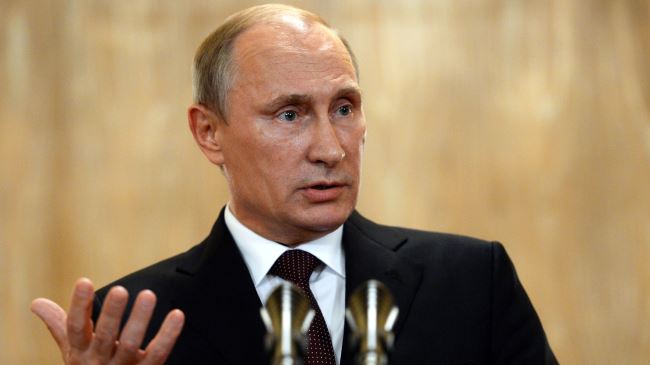
Russian President Vladimir Putin says certain countries play into the hands of terrorists and endanger regional security by bypassing international law and resorting to military force.
Putin made the remarks in a greeting message to the participants in a security conference in the Black Sea resort city of Sochi on Wednesday.
He stressed that the policy of unilateralism practiced by certain states is hindering efforts to ensure regional and global security.
“Some members of the international community have been increasingly trying to ignore the generally recognized norms and principles of the international law and resort to the use of military force bypassing the UN Security Council and refuse to hold talks as a key tool of resolving international disputes,” he said.
“This, in its turn, generates political and social instability and plays into the hands of terrorism, extremism and transnational crime, leading to the escalation of local conflicts and crises,” he added.
Earlier this month, the US, Britain and France launched a coordinated missile attack against sites and research facilities near Damascus and Homs with the purported goal of paralyzing the Syrian government’s “capability” to produce chemical arms.
The trio blamed the government of Syrian President Bashar al-Assad for a suspected gas attack in the Damascus suburb town of Douma on April 7.
Moscow said it has “irrefutable” evidence that the Douma incident was a “false flag” operation orchestrated by British spy services.
Elsewhere in his message, Putin expressed Russia’s readiness to engage in close security cooperation with foreign partners in both multilateral and bilateral formats.
The Russian president further noted that the Sochi conference will provide a good opportunity to discuss the options for countering various threats and challenges to international security.
The two-day event has gathered senior officials from more than 100 countries. Secretary of Iran’s Supreme National Security Council Ali Shamkhani is among the participants and is set to address the conference.
Israel, UK engaged in secret arms deals: Report
Press TV – April 24, 2018
A recent report has revealed that the United Kingdom has licensed the sale of arms to Israel worth $445 million since the 2014 war in occupied Palestinian territories.
The Middle East Eye online news service reported on Tuesday that figures compiled by the Campaign Against Arms Trade (CAAT) indicate that the arms included components for drones, combat aircraft and helicopters along with spare parts for sniper rifles.
The report has raised fresh concerns that the weapons made by Britain are being used by the Israeli military in the occupied West Bank, amid fears that components in sniper rifles used to kill scores of Palestinian civilians in recent weeks could have been made in the UK.
New Department for International Trade figures show that Arms export licenses to Israel increased to £216 million or $300 million at current exchange rates, last year from £20 million ($28 million) in the wake of the Gaza war.
They include a major £183 million ($255 million ) license covering “technology for military radars.” Ministers have also approved the sale for export of grenades, bombs, missiles, armored vehicles, assault rifles, small arms ammunition, sniper rifles and components for sniper rifles, arguing that Israel has a right to defend itself from military assault and “terrorist attacks.”
“The appalling scenes we have seen over recent weeks are yet another stark reminder of the repression and abuse that Palestinians are living under every day. The response to protests hasn’t just been heavy handed, it has been a massacre,” Andrew Smith, a spokesman for CAAT said.
“By continuing to arm Israeli forces the UK isn’t just making itself complicit in future attacks, it is sending a message of support for the collective punishment that has been inflicted,” Smith added.
In March another report revealed that the United Kingdom is using secretive licenses to hide the scale of its arms exports to countries with dire human rights records in the Middle East.
Saudi Arabia is by far the largest buyer of UK arms under the opaque open licensing system.
In February, the online news portal revealed an increase of 75 percent in the use of approvals for arms exports, including vital parts for warplanes used in the Saudi aggression on Yemen.
Scarier Than John Bolton?
Think of Nikki Haley for President!
By Philip Giraldi • Unz Review • April 24, 2018
The musical chairs playing out among the senior officials that make up the President Donald Trump White House team would be amusing to watch but for the genuine damage that it is doing to the United States. The lack of any coherence in policy means that the State Department now has diplomats that do not believe in diplomacy and environment agency heads that do not believe in protecting the environment. It also means that well-funded and disciplined lobbies and pressure groups are having a field day, befuddling ignorant administrators with their “fact sheets” and successfully promoting policies that benefit no one but themselves.
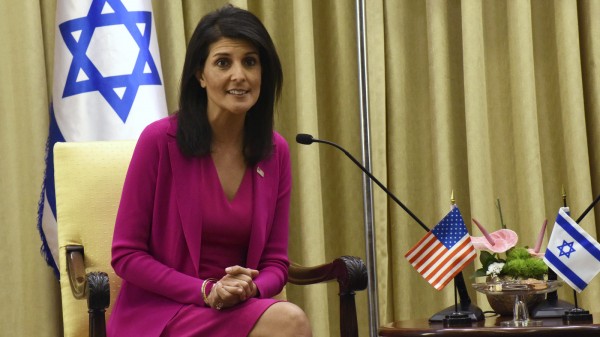
In the Trumpean world of all-the-time-stupid, there is, however, one individual who stands out for her complete inability to perceive anything beyond threats of unrelenting violence combined with adherence to policies that have already proven to be catastrophic. That person is our own Ambassador to the United Nations Nikki Haley, who surfaced in the news lately after she unilaterally and evidently prematurely announced sanctions on Russia. When the White House suggested that she might have been “confused” she responded that “With all due respect, I don’t get confused.” This ignited a firestorm among the Trump haters, lauding Haley as a strong and self-confident woman for standing up to the White House male bullies while also suggesting that the hapless Administration had not bothered to inform one of its senior diplomats of a policy change. It also produced a flurry of Haley for higher office tweets based on what was described as her “brilliant riposte” to the president.
One over-the-top bit of effusion from a former Haley aide even suggested that her “deft rebuttal” emphasizes her qualities, enthusing that “What distinguishes her from the star-struck sycophants in the White House is that she understands the intersection of strong leadership and public service, where great things happen” and placing her on what is being promoted as the short list of future presidential candidates.
For sure, neocon barking dog Bill Kristol has for years been promoting Haley for president, a sign that something is up as he was previously the one who “discovered” Sarah Palin. Indeed, the similarities between the two women are readily observable. Neither is very cerebral or much given to make any attempt to understand an adversary’s point of view; both are reflexively aggressive and dismissive when dealing with foreigners and domestic critics; both are passionately anti-Russian and pro-Israeli. And Kristol is not alone in his advocacy. Haley regularly receives praise from Senators like South Carolina’s Lindsey Graham and from the Murdoch media as well as in the opinion pages of National Review and The Weekly Standard.
The greater problem right now is that Nikki Haley is America’s face to the international community, even more than the Secretary of State. She has used her bully pulpit to do just that, i.e. bully, and she is ugly America personified, having apparently decided that something called American Exceptionalism gives her license to say and do whatever she wants at the United Nations. In her mind, the United States can do what it wants globally because it has a God-given right to do so, a viewpoint that doesn’t go down well with many countries that believe that they have a legal and moral right to be left alone and remain exempt from America’s all too frequent military interventions.
Nikki Haley sees things differently, however. During her 15 months at the United Nations she has been instrumental in cutting funding for programs that she disapproves of and has repeatedly threatened military action against countries that disagree with U.S. policies. Most recently, in the wake of the U.S. cruise missile attack against Syria, she announced that the action was potentially only the first step. She declared that Washington was “locked and loaded,” prepared to exercise more lethal military options if Syria and its Russian and Iranian supporters did not cease and desist from the use of chemical weapons. Ironically, the cruise missile attack was carried out even though the White House had no clue as to what had actually happened and it now turns out that the entire story, spread by the terrorist groups in Syria and their mouthpieces, has begun to unravel. Will Nikki Haley apologize? I would suspect that if she doesn’t do confusion she doesn’t do apologies either.
Haley, who had no foreign policy experience of any kind prior to assuming office, relies on a gaggle of neoconservative foreign-policy “experts” to help shape her public utterances, which are often not cleared with the State Department, where she is at least nominally employed. Her speechwriter is Jessica Gavora, who is the wife of the leading neoconservative journalist Jonah Goldberg. Unfortunately, being a neocon mouthpiece makes her particularly dangerous as she is holding a position where she can do bad things. She has been shooting from the lip since she assumed office with only minimal vetting by the Trump Administration, and, as in the recent imbroglio over her “confusion,” it is never quite clear whether she is speaking for herself or for the White House.
Haley has her own foreign policy. She has declared that Russia “is not, will not be our friend” and has lately described the Russians as having their hands covered with the blood of Syrian children. From the start of her time at the U.N., Haley has made it clear that she is neoconservatism personified and she has done nothing since to change that impression. In December 2017 she warned the U.N. that she was “taking names” and threatened retaliation against any country that was so “disrespectful” as to dare to vote against Washington’s disastrous recognition of Jerusalem as Israel’s capital, which she also helped to bring about.
As governor of South Carolina, Haley first became identified as an unquestioning supporter of Israel through her signing of a bill punishing supporters of the nonviolent pro-Palestinian Boycott, Divestment and Sanctions (BDS) movement, the first legislation of its kind on a state level. Immediately upon taking office at the United Nations she complained that “nowhere has the U.N.’s failure been more consistent and more outrageous than in its bias against our close ally Israel” and vowed that the “days of Israel bashing are over.” On a recent visit to Israel, she was feted and honored by Israeli Prime Minister Benjamin Netanyahu. She was also greeted by rounds of applause and cheering when she spoke at the annual meeting of the American Israel Public Affairs Committee (AIPAC) in March, saying “When I come to AIPAC I am with friends.”
Nikki Haley’s embrace of Israeli points of view is unrelenting and serves no American interest. If she were a recruited agent of influence for the Israeli Mossad she could not be more cooperative than she apparently is voluntarily. In February 2017, she blocked the appointment of former Palestinian Prime Minister Salam Fayyad to a diplomatic position at the United Nations because he is a Palestinian. In a congressional hearing she was asked about the decision: “Is it this administration’s position that support for Israel and support for the appointment of a well-qualified individual of Palestinian nationality to an appointment at the U.N. are mutually exclusive?” Haley responded yes, that the administration is “supporting Israel” by blocking every Palestinian.
Haley is particularly highly critical of both Syria and Iran, reflecting the Israeli bias. She has repeatedly said that regime change in Damascus is a Trump administration priority, even when the White House was saying something different. She has elaborated on an Administration warning that it had “identified potential preparations for another chemical weapons attack by the Assad regime” by tweeting “… further attacks will be blamed on Assad but also on Russia and Iran who support him killing his own people.”
At various U.N. meetings, though Haley has repeatedly and uncritically complained of institutional bias towards Israel, she has never addressed the issue that Israel’s treatment of the Palestinians might in part be responsible for the criticism leveled against it. Her description of Israel as a “close ally” is hyperbolic and she tends to be oblivious to actual American interests in the region when Israel is involved. She has never challenged the Israeli occupation of the West Bank as well as the recent large expansion of settlements, which are at least nominally opposed by the State Department and White House. Nor has she spoken up about the more recent shooting of three thousand unarmed Gazan demonstrators by Israeli Army sharpshooters, which is a war crime.
Haley’s hardline on Syria reflects the Israeli bias, and her consistent hostility to Russia is a neoconservative position. Earlier, on April 12, 2017 after Russia blocked a draft U.N. resolution intended to condemn the alleged Khan Shaykhun chemical attack, which subsequently turned out to be a false flag, Haley said, “We need to see Russia choose to side with the civilized world over an Assad government that brutally terrorizes its own people.”
Haley sees Iran as the instigator of much of the unrest in the Middle East, again reflecting the Israeli and neocon viewpoints. She claimed on April 20, 2017 during her first session as president of the U.N. Security Council, that Iran and Hezbollah had “conducted terrorist acts” for decades within the Middle East, ignoring the more serious terrorism support engaged in by U.S. regional allies Saudi Arabia and Qatar. She stated in June 2017 that the Security Council’s praise of the Iran Nuclear Agreement honored a state that has engaged in “illicit missile launches,” “support for terrorist groups,” and “arms smuggling,” while “stok[ing] regional conflicts and mak[ing] them harder to solve.” All are perspectives that might easily be challenged.
So, Nikki Haley very much comes across as the neoconservatives’ dream ambassador to the United Nations–full of aggression, a staunch supporter of Israel, and assertive of Washington’s preemptive right to set standards for the rest of the world. And there is every reason to believe that she would nurture the same views if she were to become the neocon dream president. Bearing the flag for American Exceptionalism does not necessarily make her very good for the rest of us, who will have to bear the burdens and risks implicit in her imperial hubris, but, as the neoconservatives never feel compelled to admit that they were wrong, one suspects that Haley’s assertion that she does not do confusion is only the beginning if she succeeds in her apparent quest for the highest office in the land. Worse than John Bolton? Absolutely.
Philip M. Giraldi, Ph.D., is Executive Director of the Council for the National Interest, a 501(c)3 tax deductible educational foundation that seeks a more interests-based U.S. foreign policy in the Middle East. Website is http://www.councilforthenationalinterest.org, address is P.O. Box 2157, Purcellville VA 20134 and its email is inform@cnionline.org.
Russia-Iran ties soar high under US pressure
By M K Bhadrakumar | Indian Punchline | April 22, 2018
A commentary entitled Tehran, Moscow boosting strategic relations, appearing last week in the Iran Daily newspaper, which is close to Supreme Leader Ali Khamenei – and subsequently circulated by IRNA – noted as follows:
“Policies adopted by Tehran and Moscow are becoming more harmonious on a daily basis as their bilateral as well as multilateral moves and measures are becoming more consistent with each other.”
The general expectation was that in the downstream of the 2015 Iran nuclear pact opening the door to Iran’s integration with the international community, Russia-Iran ties might get atrophied. But the exact opposite is happening. A senior Iranian official told Alexander Lavrentiev, Russian President Vladimir Putin’s special envoy to Syria, at a meeting in Tehran last week that the two countries are having their relations at the highest level in recent times.
If any single factor is to be held accountable for this, it must be American policies. The US’ containment policies toward Russia pursued under President Barack Obama have continued during the Trump presidency – and, arguably, even intensified. For Iran, on the other hand, the expected scale of integration with the international community has not materialized following the implementation of the 2015 nuclear pact due to the US’ negative attitude. The inertia of the Obama period has given way to hostile US policies under President Trump.
Meanwhile, the conflict in Syria has found Russia and Iran on the same side as staunch supporters of President Bashar Al-Assad. The Russian-Iranian cooperation deepened progressively during the period since the deployment of Russian forces to Syria in September 2015 and proved effective in stemming the tide of the war in favor of the Syrian government.
In the process, the overall Russian-Iranian relations began acquiring a strategic character, which they had lacked previously. Today, the spectre of US sanctions haunts both countries. The quasi-alliance with Iran provides much-needed strategic depth to the Russian policies in the Middle East. Whereas, Russia’s robust support on the vexed nuclear issue is invaluable help to Tehran at the present juncture. If Iran’s relations with the West run into difficulty under US pressure, Tehran’s dependence on Russia will only increase. Suffice to say, the more these countries face hostility from the US, the stronger their quasi-alliance is becoming. Shades of the “new type of relations” between Russia and China!
Two developments this week highlight that Middle Eastern politics has to reckon with a new geopolitical reality in the developing Russian-Iranian quasi-alliance. First, in a major statement two days ago, Russian Foreign Minister Sergey Lavrov hinted that following the recent western missile strike on Syria, Moscow may consider supplying the advanced S-300 missile defence system to Damascus.
If Russia upgrades the Syrian air defence system, the military balance will shift in favor of Damascus and thereby Iran will also be a beneficiary, since Syrian capability to deter any further Israeli adventures in its air space will help the consolidation of long-term Iranian presence in the Levant as well. (Following the killing of several Iranian personnel in a recent Israeli missile attack on a Syrian base near Damascus, the Chief of the Iranian Army Abdolrahim Mousavi said on Saturday that “destroying the Zionist regime is one of the major tasks of the Islamic Revolutionary Guards.”)
In a second development this week, Russian energy minister Alexander Novak was quoted as saying that Russia has received the first shipment of oil under the oil-for-goods deal agreed upon in 2014 (and ratified by the two countries last year) with a view to eschew the use of the US dollar in their bilateral trade transactions. Under the deal, Russia would initially buy 100,000 barrels a day from Iran and sell the country $45 billion worth of goods.
Indeed, the implications are profound when Russia and Iran, two energy superpowers, collaborate on oil trade. The two countries have also signed six provisional agreements to collaborate on “strategic” energy deals worth up to $30 billion. The Russian Presidential aide Yuri Ushakov recently disclosed that Russian investment in developing Iran’s oil and gas fields could total more than $50 billion.
According to Ushakov, Iran’s formal entry into the Russia-led Eurasian Economic Union is now only a matter of months. The free-trade deal between the EEU and Iran will be a game changer for Russian-Iranian economic cooperation on the whole. Meanwhile, with Russia’s support, Iran has also applied for membership of the Shanghai Cooperation Organization.
Featured Video
Death Spikes & Rising Cancer In Our Youth Explained
or go to
Aletho News Archives – Video-Images
From the Archives
Politicians lie
By Mazin Qumsiyeh | Popular Resistance | August 18, 2013
There is no way to say this truth nicely: Politicians lie. That includes Japanese, American, Egyptian, Israeli, and Palestinian politicians! Is there something more common sense than that? Yet, so many citizens around the world believe their own politicians or wistfully acknowledge lies but think it is part of the job needed to run things. They believe even when politicians contradict themselves blatantly. This phenomenon is rather remarkable. It is a dissonance and disconnect from reality that many seem oblivious to. It is very dangerous because it can lead to accepting rationales for going to war. These can be deadly wars that lead to millions of lives lost as happened in what was called World War 1 and WW2. Even when incredible and declassified evidence abound, politicians continue to lie and old mythologies refuse to die. Here are just a few of the countless lies told to us over the past few decades… continue
Blog Roll
 Aletho News
- Turkish parliament to review Saudi-Pakistan defense pact next month
- DEATH SPIKES & RISING CANCER IN OUR YOUTH EXPLAINED
- Iran offers Trump deal before US election
- Merz regime wants ‘secret police’ – opposition
- Israeli settlers terrorize West Bank Palestinians with state-provided drones: Report
- They see them, then kill them: Israeli quadcopters track, deliberately target civilians in Gaza
- Debunked: Trump’s egregious UNGA claims on war against Iran crumble under scrutiny
- Europe was part of the infrastructure of US aggression against Iran: Deputy FM
- New evidence on the Bucha Massacre
- Italy and France debunk reports CIA issued ‘Russian drone threat’ warning
- If Americans Knew
- An error has occurred; the feed is probably down. Try again later.
- No Tricks Zone
- New Study: Earth And Venus Surface Warmth Largely Explained By Convection And Lapse Rate, Not CO2 Or Radiation
- 2025 Nature Paper Claiming Worsening Global Drought Gets RETRACTED …Heavily Flawed
- New Study: ‘Global Drought Shows No Detectable Recent Acceleration Under Climate Warming’
- Economic Masterminds: German Socialists Suggest Taxing Productivity Gains Stemming From Using AI
- The South China Sea Has Not Been Cooperating With The Climate Change Narrative
- Energy Crisis: Germany Enters Heating Season With Historically Low Gas Reserve Fill Levels
- New Study: The Antarctic Ice Sheet Gained Mass From 2020-2024 Due To Staggering Snow And Ice Accumulation
- Study: Ocean Heating Rates From Thousands Of Years Ago ‘Dwarf’ Modern Ocean Heating Rates
- Climate Extremists Target, Attack Large-Scale Power Grid Infrastructure In Germany!
- New Study: Antarctic Ice Melt Has Contributed Less Than 1 Centimeter To Sea Level Rise In The Last 30 Years

