Protecting Israel Is Their Full-Time Job
Time to question the loyalty of some legislators and judges
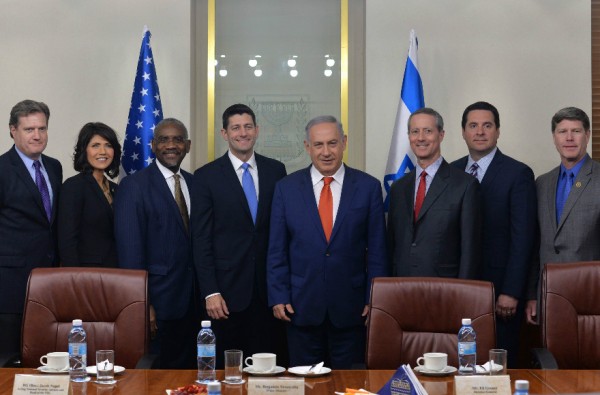
Philip Giraldi • Unz Review • May 8, 2018
I have a number of times discussed how the U.S. and other governments have legislated and otherwise promoted Jewish and Israeli interests in ways that most people would find unacceptable if they were aware of what exactly has been going on. Here in the United States, special Medicare coverage and immigration status have been granted, often concealed in other legislation, to benefit holocaust survivors and Russian Jews seeking to emigrate. State legislatures and the U.S. Congress have meanwhile been working hard to pass legislation that blocks and even criminalizes the non-violent Boycott, Divestment and Sanctions (BDS) protests against Israeli behavior while universities have been banning anti-Israel demonstrators and groups on campus because they apparently are offensive to the sensitivities of some Jewish students.
The latest outrage against the First Amendment comes from South Carolina, the home state of the arch-Zionist poseur and United Nations Ambassador extraordinary Nikki Haley. A new hate speech law was inserted in the state’s recently approved annual budget. The legislation borrows from the U.S. State Department definition of anti-Semitism, which proscribes speech that “demonizes” or applies “double standards” to Israel “by requiring of it a behavior not expected or demanded of any other democratic nation” as anti-Semitic.
While the State Department definition is a guideline, South Carolina’s specific inclusion of it in legislation makes explicit that criticism of Israel as hate speech can be subject to criminal penalties. It also is binding on all the state’s universities and educational institutions.
The law was promoted by Alan Clemmons, a Mormon legislator who has led numerous delegations to Israel and who has been described as “Israel’s biggest supporter in a U.S. state legislature.”
Supporters of the Bill of Rights have been universally opposed to the bill, but pro-Israel groups have praised the initiative and are expecting a “new wave” of legislation all across the United States blocking any criticism of the self-described Jewish State. The Brandeis Center has enthused
“This bill gives South Carolina the tools to protect Jewish students’ and all South Carolina students’ right to a learning environment free of unlawful discrimination. We are hoping this momentous step will result in another national wave to, once and for all, begin defeating rising anti-Semitism.”
Other states will undoubtedly follow the South Carolina lead, so it would appear that any criticism of Israel will become illegal in the public square if the many friends of Prime Minister Benjamin Netanyahu have their way. And they generally do get what they want from the federal level all the way down to the states and local communities, so be prepared.
Israel also is regularly exploiting the American legal system to punish countries that it has defined as its enemies. Its government sponsored lawfare organization called Shurat Hadin has initiated a number of lawsuits in U.S. courts to punish Palestinians and Iranians. Ironically, it is currently seeking to demonstrate that Hamas is committing war crimes in Gaza, where Israel has been using army snipers to kill unarmed demonstrators.
Other lawsuits filed on behalf of mostly Jewish Americans in U.S. courts seeking compensation from Iranians and Palestinians are also pending, with the tribunals in Manhattan particularly prone to being sympathetic to the plaintiffs. Last week, at the Federal Court for the Southern District of Manhattan, Judge George Daniels issued a default judgment relating to his 2011 determination that Iran and Hezbollah materially and directly supported al-Qaeda in the 9/11 attacks and are legally responsible for damages to the hundreds of family members of victims who are named in the case. The judge ordered Iran to pay $6 billion in compensation – “$12,500,000 per spouse, $8,500,000 per parent, $8,500,000 per child, and $4,250,000 per sibling” to the families and estates of the deceased. A 4.96 annual interest rate will also be applied to the amount, starting from September 11, 2001 to the date of the judgement.”
Normally foreign governments have what is referred to as sovereign immunity which prevents their being sued, but that all changed in the U.S. with the passage of the Justice Against Sponsors of Terrorism Act (JASTA) of 2016, which permitted individual lawsuits in any federal court involving any government’s alleged participation in international acts of “terrorism.” This has resulted in a series of multi-billion-dollar lawsuits against Iran, the Palestinians and also Saudi Arabia. Many of the lawsuits have Israeli citizens as plaintiffs, suing in American courts.
Though the lawsuit claimed, and Judge Daniels agreed, that Tehran had supported the 9/11 hijackers with training and other assistance, most authorities would question that judgement. Many would consider it to be ludicrous as Iranian Shi’ites were considered to be kill-on-sight heretics by al-Qaeda. The idea that Iran was somehow involved in 9/11 is in reality a ridiculous Israel Lobby contrivance that was first floated in 2015 by ex-CIA Director James Woolsey, a renowned Zionist stooge and conspiracy theorist who is viewed by many as not completely in possession of all his marbles.
Indeed, it is far more plausible that Israel was involved in 9/11 than was Iran. Israel operated a massive spying operation directed against Arabs in the U.S. and several of its intelligence officers were seen in Jersey City to be filming themselves while dancing and cavorting in delight as the twin towers went down, suggesting some prior knowledge.
But, of course, no one would be allowed to sue Israel in an American court. The 9/11 Commission failed to examine the case against Israel even though it allegedly sought to compile a “full and complete account of the circumstances surrounding” the attacks, but it did investigate the possible ties to Iran. It found the only evidence of any Iranian support to consist of certain 9/11 hijackers travelling through Iran on their way to Afghanistan without having their passports stamped.
In his Farewell Address President George Washington warned that
“… a passionate attachment of one nation for another produces a variety of evils. Sympathy for the favorite nation, facilitating the illusion of an imaginary common interest in cases where no real common interest exists, and infusing into one the enmities of the other, betrays the former into a participation in the quarrels and wars of the latter without adequate inducement or justification. It leads also to concessions to the favorite nation of privileges denied to others which is apt doubly to injure the nation making the concessions; by unnecessarily parting with what ought to have been retained, and by exciting jealousy, ill-will, and a disposition to retaliate, in the parties from whom equal privileges are withheld. And it gives to ambitious, corrupted, or deluded citizens (who devote themselves to the favorite nation), facility to betray or sacrifice the interests of their own country, without odium, sometimes even with popularity; gilding, with the appearances of a virtuous sense of obligation, a commendable deference for public opinion, or a laudable zeal for public good, the base or foolish compliances of ambition, corruption, or infatuation. As avenues to foreign influence in innumerable ways, such attachments are particularly alarming to the truly enlightened and independent patriot.”
If one believes that deference to the special foreign interest of one powerful and wealthy segment of the population is appropriate in a democracy then I suppose the Jewish/Israeli pander has to be considered acceptable. I happen to believe that, as our first president so clearly articulated, it is not, particularly as much of the concession that Jews are somehow to be treated differently than the rest of the community due to their alleged victimhood contributes to a criticism-free ride for an Israel which is eagerly seeking a new war in the Middle East. It would be a war that the United States would inevitably get pulled into by Israel’s friends in Congress and the media. It would also be catastrophic for all parties involved and it all starts with the belief that Israel should somehow be protected and its enemies punished while also being exempt from being made accountable for its actions.
Philip M. Giraldi, Ph.D., is Executive Director of the Council for the National Interest, a 501(c)3 tax deductible educational foundation that seeks a more interests-based U.S. foreign policy in the Middle East. Website is www.councilforthenationalinterest.org, address is P.O. Box 2157, Purcellville VA 20134 and its email is inform@cnionline.org.
Pompeo Rocks the Middle East: Lessons from a Former CIA Officer for the Secretary of State

By Philip Giraldi | American Herald Tribune | May 7, 2018
Former Central Intelligence Agency Director Mike Pompeo has recently completed his first trip to the Middle East as U.S. Secretary of State. Perhaps not surprisingly as President Donald Trump appears prepared to decertify the Joint Comprehensive Plan of Action (JCPOA) limiting Iran’s nuclear program creating a possible casus belli, much of what Pompeo said was focused on what was alleged to be the growing regional threat posed by Iran both in conventional terms and due to its claimed desire to develop a nuclear weapon.
The Secretary of State met with heads of state or government as well as foreign ministers in Saudi Arabia, Israel and Jordan during his trip. He did not meet with the Palestinians, who have cut off contact with the Trump Administration because they have “nothing to discuss” with it in the wake of the decision to recognize Jerusalem as Israel’s capital.
During his first stop in Riyadh, Pompeo told a beaming Foreign Minister Adel Jubeir that Iran has been supporting the “murderous” Bashar al-Assad government in Damascus while also arming Houthi rebels in Yemen. He noted that “Iran destabilizes the entire region. It is indeed the greatest sponsor of terrorism in the world…”
In Israel, Pompeo stood side by side with a smiling Prime Minister Benjamin Netanyahu and said “We remain deeply concerned about Iran’s dangerous escalation of threats to Israel and the region, and Iran’s ambition to dominate the Middle East remains. The United States is with Israel in this fight. And we strongly support Israel’s sovereign right to defend itself.”
At the last stop in Jordan, Pompeo returned to the “defend itself” theme, saying regarding Gaza that “We do believe the Israelis have a right to defend themselves and we are fully supportive of that.”
One hopes that discussions between Pompeo and his foreign interlocutors were more substantive than his somewhat laconic published comments. But given the comments themselves, it is depressing to consider that he was until recently Director of the CIA and was considered an intellectually brilliant congressman who graduated first in his class at West Point. One would hope to find him better informed.
Very little that surfaced in the admittedly whirlwind tour of the Middle East is fact-based. Starting with depicting Iran as a regional and even global threat, one can challenge the view that its moves in Yemen and Syria constitute any fundamental change in the balance of power in the region. Iranian support of Syria actually restores the balance by returning to the status quo ante where Syria had a united and stable government before the United States and others decided to intervene.
Israeli claims repeated by Washington that Iran is somehow building a “land bridge” to link it to the Mediterranean Sea are wildly overstated as they imply that somehow Iraq, Syria, and Lebanon are willing to cede their sovereignty to an ally, an unlikely prospect to put it mildly. Likewise, the claim that Iran is seeking to “dominate the region” rings hollow as it does not have the wherewithal to do so either financially or militarily and many of its government’s actions are largely defensive in nature. The reality is that Israel and Saudi Arabia are the ones seeking regional dominance and are threatened because a locally powerful Iran is in their way.
Support by Tehran for Yemen’s Houthis is more fantasized than real with little actual evidence that Iran has been able to provide anything substantial in the way of arms. The Saudi massacre of 10,000 mostly Yemeni civilians and displacement of 3 million more being carried out from the air has been universally condemned with the sole exceptions of the U.S. and Israel, which seem to share with Riyadh a unique interpretation of developments in that long-suffering land. The U.S. has supplied the Saudis with weapons and intelligence to make their bombing attacks more effective, i.e. lethal.
Pompeo did not exactly endorse the ludicrous Israeli claim made by Benjamin Netanyahu last week that Iran has a secret weapons of mass destruction program currently in place, but he did come down against the JCPOA, echoing Trump in calling it a terrible agreement that will guarantee an Iranian nuclear weapon. The reality is quite different, with the pact basically eliminating a possible Iranian nuke for the foreseeable future through degradation of the country’s nuclear research, reduction of its existing nuclear stocks and repeated intrusive inspections. Israel meanwhile has a secret nuclear arsenal and is a non-signatory of the Nuclear Non-Proliferation Treaty without any demur from the White House.
The Israeli-Pompeo construct assumes that Iran is singularly untrustworthy, an odd assertion coming from either Washington, Riyadh or Tel Aviv. It also basically rejects any kind of agreement with the Mullahs and is a path to war. It is interesting to note that the Pentagon together with all of America’s closest allies believe that the JCPOA should stay in place.
And then there is the claim that Iran is the world’s greatest sponsor of terrorism. In reality that honor belongs to the United States and Israel with Iran often being the victim, most notably with the assassination of its scientists and technicians by Mossad agents. Israel has also been targeting and bombing Iranians in Syria, as has the United States, even though neither is at war with Iran and the Iranian militias in the country are cooperating with the Syrians and Russians to fight terrorist groups including ISIS as well as those affiliated with al-Qaeda. The U.S. is actually empowering terrorists in Syria and along the Iraqi border while killing hundreds of thousands in its never-ending war on terror. Israel meanwhile has agreements with several extremist groups so they will not attack its occupied Golan Heights and also seeks to continue to destabilize the Syrians.
Pompeo also endorsed Israel’s “fight” against the Gazan demonstrators and pledged that America would stand beside its best friend. As of this point, Israel has used trained army snipers to kill forty-three unarmed protesting Palestinians. Another 5,000 have been injured, mostly by gunfire. No “threatened” Israelis have suffered so much as a broken fingernail and the border fence is both intact and has never been breached. Israel is committing what is very clearly a war crime and the United States Secretary of State is endorsing the slaughter of a defenseless people who are imprisoned in the world’s largest open-air concentration camp.
Donald Trump entered into office with great expectations, but if Mike Pompeo is truly outlining American foreign policy, then I and many other citizens don’t get it and we most definitely don’t want it.
*(Mike Pompeo meets with Israeli Minister Benjamin Netanyahu in Tel Aviv, April 2018. Image credit: U.S. Embassy Tel Aviv/ flickr)
The Warmakers
The Saker • Unz Review • May 5, 2018
Between the US strikes on Syria in April and the recent developments on the Korean Peninsula, we are in somewhat of a lull in the Empire’s search for a new war to start. The always helpful Israelis, in the person of the ineffable Bibi Netanyahu, are now beating the drums for, well, if not a war, then at least some kind of false flag or pretext to make the US strike at Iran. And then there is the always bleeding Donbass (which I won’t address in today’s analysis). So let’s see where we stand and try to guesstimate where we might be heading. To be honest, trying to guess what ignorant warmongering psychopaths might do next is by definition a futile exercise, but since there are some not negligible signs that there are at least a few rational people still left in the US White House and/or Pentagon (as shown by the mostly “pretend strikes” on Syria last month), we can assume (hope) that some residual degree of sanity is still present. At the very least Americans in uniform have to ask themselves a very basic and yet fundamental question:
Do I want to die for Israel? Do I want to lose my job for Israel? How about my pension? Maybe just my stock options? Is it worth risking a major regional war for such a “wonderful” state?
A lot depends on whether the US military leaders (and people!) will have the courage to ask themselves this question and, if they do, what their reply will be.
But, first, let’s begin with the good news:
The DPRK and ROK are in direct talks with each other.
This is indeed a truly great development for at least two reasons. First, of course, the main and objective one: anything which lowers the risks of war on the Korean Peninsula is good. But there is a second reason which we should not discount: Trump can now take all the credit for this and claim that his (empty) threats are what brought the North Koreans to the negotiating table. I say – let him. In fact, I hope that they organize a parade for Trump somewhere in the US, with confetti and millions of flags. Like for an astronaut. Let him feel triumphant, vindicated and very, very manly. MAGA, you know?!
Yeah, that will be sickening to the thinking (not to mention counter-factual), but if a little bit of intellectual nausea is the price to pay for peace, I say let’s do it. If Trump, Bolton, Haley and the rest of them can feel that they “kicked ass” and that their “invincible military” is what brought “Rocket Man” to “give up his nukes” (he never said any such thing, but never mind that) then I sincerely wish them a joyful and highly ego-pleasing celebration. Anything to stop them from looking for another war to start, at least for a now.
Now the bad news.
The Israelis are at it again
Amazing, isn’t it? The Israelis have been whining about “imminent” Iranian nukes for years [decades], and they are still at it. Not only that, but these guys have the nerve to say “Iran lied”. Seriously, even by the already unique Israeli standards, that is chutzpah elevated to a truly stratospheric level. If it were just Bibi Netanyahu, then this would be comical. But the problem is that Israel has now fully subjugated all the branches of the US government to its agents (the Neocons) and that they now run everything: from the two branches of the Uniparty to Congress, to the media and, now that Trump has abjectly caved in to all their demands, they also run the White House. They apparently also run the CIA, but there still might be some resistance to their lunacy in the Pentagon. The US is now quite literally run by a Zionist Occupation Government, no doubt about it whatsoever.
So what are these guys really up to? Listen to the one man who knows them best, and whose every single word you can take to the bank, Hezbollah General Secretary Nasrallah (ever wondered why Hezbollah, which has not committed anything even remotely looking like a terrorist attack since the 1980s is called the “A-Team of terrorists”? Just saying…):
The first event is the Israeli blatant and manifest aggression against the T-4 base or airport on the outskirts of Homs, that targeted Iranian forces from the Guardians of the Islamic Revolution of Iran who were present there, hitting them with a large number of missiles, causing 7 martyrs among its officers and soldiers and wounding others. This was a new, significant and important event. Maybe some people do not pay attention to its importance and magnitude. In this operation, Israel has deliberately killed (Iranian soldiers). This is an unprecedented event. In the past, Israel has struck us [Hezbollah] for example in Quneitra, and it turned out that coincidentally Guardians [of the Islamic Revolution] officers were with us. Israel declared hastily that they did not know it, and thought that all (targeted soldiers) were Hezbollah’s. This is an event that has no precedent since 7 years, it is unprecedented since 7 years, that Israel openly targets the Guardians of the Islamic Revolution in Syria, killing deliberately, in an operation that caused a number of martyrs and wounded (…) I want to tell the Israelis that they must know – I wrote that statement accurately and I read it to them – they must know that they have committed a historic mistake. This is not a simple blunder. They committed an act of great stupidity, and by this aggression, they entered in a direct confrontation with Iran, the Islamic Republic of Iran. And Iran, O Zionists, is not a small country, it is not a weak country, and it is not a cowardly country. And you know it very well. As a comment on this incident, I stress that it constitutes a turning point in the situation of the region. What follows will be very different from what preceded it. This is an incident that cannot be considered lightly, contrary to what happens with many incidents here. It is a turning point, a historic turning point. And when the Israelis committed this stupid act, they had some assessment (of the situation), but I tell them that their evaluation is false. And even in the future, since you have opened a new path in the confrontation, (you should ensure) not to be wrong in your evaluations. In this new path you opened and initiated, don’t be wrong in your assessment, when you are face to face, and directly (in conflict) with the Islamic Republic of Iran.
I can only agree with this evaluation. As does The Jerusalem Post, NBC News, and many others. Regardless of how crazy this notion might sound to rational people (see below), there are all the signs that the Israelis are now demanding that the US start a war against Iran, either by choice or more likely, to “stand by our Israeli allies and friends” after they attack Iran first.
Israel is truly a unique and amazing country: not only does it openly and brazenly completely ignore international law, not only is it the last overtly racist country on the planet, not only has it been perpetuating a slow-motion genocide against the Palestinians for decades, it also constantly uses its considerable propaganda resources to advocate for war. And in order to achieve these goals, it does not mind allying itself with a regime almost as despicable and evil as the Zionist one – I am talking about the Wahabi nutcases in the KSA. And all that under the high patronage of the United States. Some “Axis of Kindness” indeed!
What is their plan? Actually, it is fairly straightforward.
The Israeli plan “A” (failed)
Initially, the plan was to overthrow all the secular (Baathist) regimes in power and replace them by religious nutcases. That would not only weaken the countries infected by that spiritual rot, it would set them backwards for many decades, some of them would break up into smaller entities, Arabs and Muslims would kill each other in large numbers while the Israelis would proudly claim that they are a “western country” and the “only democracy in the Middle-East”. Even better, when the Daesh/ISIS/al-Qaeda/etc types commit atrocities on an industrial scale (and always on camera, professionally filmed, by the way), the slow-motion genocide of Palestinians would really be completely forgotten. If anything, Israel would declare itself threatened by “Islamic extremism” and, well, extend a couple of “security zones” beyond its borders (legal or otherwise), and do regular bombing runs “because Arabs only understand force” (which would get the Israelis a standing ovation from the “Christian” Zionist rednecks in the US who love the killing of any Aye-rabs and other “sand niggers”). At the end of all this, the Zionist wet dream: unleashing the Daesh forces against Hezbollah (which they fear and hate since the humiliating defeat the IDF suffered in 2006).
Now I will readily agree that this is a stupid plan. But contrary to the propaganda-induced myth, the Israelis are really not very bright. Pushy, arrogant, nasty, driven – yes. But smart? Not really. How could they not realize that overthrowing Saddam Hussein would result in Iran becoming the main player in Iraq? This is a testimony of how the Israelis always go for “quick-fix” short-term “solutions”, probably blinded by their arrogance and sense of racial superiority. Or how about their invasion of Lebanon in 2006? What in the world did they think they would achieve there? And now these folks are taking on not Hezbollah, but Iran. Hassan Nasrallah is absolutely correct, that is a truly stupid decision. But, of course, the Israelis now have a “plan B”:
The Israeli plan “B”
Step one, use your propaganda machine and infiltrated agents to re-start the myth about an Iranian military nuclear program. And never mind that the so-called “Joint Comprehensive Plan of Action” was agreed upon by all five of the UNSC Permanent Members, and Germany (P5+1) and even the European Union! And never mind that this plan places restrictions on Iran which no other country has ever had to face, especially considering that since 1970 Iran has been a member in good standing with the Nuclear Non-Proliferation Treaty (NPT) while Israel, of course, is not. But the Zionists and their Neocon groupies are, of course, quite exceptional people, so they are constrained by neither facts nor logic. If Trump says that the JCPOA is a terrible deal, then this is so. Hey, we are living in the “post-Skripal” and “post-Douma” era – if some Anglo (or Jewish) leaders say “highly likely” then it behooves everybody to show instant “solidarity” lest they are accused of “anti-Semitism” or “fringe conspiracy theories” (you know the drill). So step one is the re-ignition ex nihilo of the Iranian military nuclear program canard.
Step two is to declare that Israel is “existentially threatened” and therefore has the right to “defend itself”. But there is a problem here: the IDF simply does not have the military means to defeat the Iranians. They can strike them, hit a couple of targets, yes, but then when the Iranians (and Hezbollah) unleash a rain of missiles on Israel (and probably the KSA) the Israelis will not have the means to respond. They know that, but they also know that the Iranian counter-attack will give them the perfect pretext to scream “oy vey!! oy, gevalt!!” and let the dumb Americans fight the Iranians.
You might object that the US does not have a mutual defense treaty with Israel. You are wrong. It does, it is called AIPAC. Besides, last year the US established a permanent US military base in Israel, making it a “tripwire”: just claim that “the Ayatollahs” tried to attack the US base with “chemical weapons” and, bingo, you now have a pretext to use all your military forces in retaliation, including, by the way, your tactical nuclear forces to “disarm” the “genocidal Iranians who want to wipe Israel off the map” or some variation of this nonsense.
You might wonder what the point of all that would be if Iran does, as I say, not have any military nuclear program?
My answer would be simple: do you really think the Syrians have been using chemical weapons?!
Of course not!
All this nonsense about Saddam’s WMD, the Iranian nuclear program, the Syrian chemical weapons or, for that matter, Gaddafi’s “Viagra armed raping soldiers”, and before that the “Racak massacre” in Kosovo or the various “Markale market” atrocities in Sarajevo for that matter: these were just pretexts for aggression, nothing more.
In Iran’s case, what the Israelis fear is not that they will be “wiped off the map” (that is a mistranslation of words originally spoken by Ayatollah Khomenei) by Iranian nukes; what really freaks them out is to have a large, successful Muslim regional power like Iran openly daring to denounce Israel as an illegitimate, racist state. The Iranians are also openly denouncing the US imperialism and they are even denouncing the Wahabi dictatorship of the House of Saud. That is Iran’s real “sin”: to dare defy openly the AngloZionist Empire and be so successful at it!
So what the Israelis really want to do is:
- inflict a maximum amount of economic damage upon Iran
- punish the Iranian population for daring to support the “wrong” leaders
- overthrow the Islamic Republic (do to it what they did to Serbia)
- make an example to dissuade any other country who dares to follow in Iran’s footsteps
- prove the omnipotence of the AngloZionist Empire’s
To reach this objective, there is no need to invade Iran: a sustained cruise missile and bombing campaign will do the job (again, like in Serbia). Finally, we just have to assume that the Zionists are evil, arrogant and crazy enough to use nuclear weapons on some Iranian facilities (which they will, of course, designate as “secret military nuclear research” installations).
The Israelis hope that by making the US hit Iran really hard, they will weaken the country enough to also weaken Hezbollah and the other allies of Iran in the region sufficiently and break the so-called “Shia crescent”.
In their own way, the Israelis are not wrong when they say that Iran is an existential threat to Israel. They are just lying about the nature of this threat and why it is dangerous for them.
Consider this:
If the Islamic Republic is allowed to develop and prosper and if the Islamic Republic refuses to be terrified by Israel’s undisputed ability to massacre civilians and destroy public infrastructure, then the Islamic Republic will become an attractive alternative to the kind of repugnant Islam embodied by the House of Saud which, in turn, is the prime sponsor of all the collaborator regimes in the Middle-East from the Hariri types in Lebanon to the Palestinian Authority itself. The Israelis like their Arabs fat and corrupt to the bone, not principled and courageous. That is why Iran must, absolutely must, be hit: because Iran by its very existence threatens the linchpin upon which the survival of the Zionist entity depends: the total corruption of the Arab and Muslim leaders worldwide.
Risks with Israel’s plan “B”
Think of 2006. The Israelis had total air supremacy over Lebanon – the skies were simply uncontested. The Israelis also controlled the seas (at least until Hezbollah almost sank their Sa’ar 5-class corvette). The Israelis pounded Lebanon with everything they had, from bombs to artillery strikes, to missiles. They also engaged their very best forces, including their putatively ‘”invincible” “Golani Brigade”. And that for 33 days. And they achieved exactly *nothing*. They could not even control the town of Bint Jbeil right across the Israeli border. And now comes the best part: Hezbollah kept its most capable forces north of the Litany river so the small Hezbollah force (no more than 1,000 men) was composed of local militias supported by a much smaller number of professional cadre. That’s a 30:1 advantage in manpower for the Israelis. But the “invincible Tsahal” got it’s collective butt kicked like few have ever been kicked in history. This is why, in the Arab world, this war is since known as the “Divine Victory”.
As for Hezbollah, it continued to rain down rockets on Israel and destroy indestructible Merkava tanks right up to the last day.
There are various reports discussing the reasons for the abject failure of the IDF (see here or here), but the simple reality is this: to win a war you need capable boots on the ground, especially against an adversary who has learned how to operate without air-cover or superior firepower. Should Israel manipulate the US into attacking Iran, the exact same thing will happen: CENTCOM will establish air superiority and have an overwhelming firepower advantage over the Iranians, but other than destroying a lot of infrastructure and murdering scores of civilians, this will achieve absolutely nothing. Furthermore, Ayatollah Ali Khamenei is no Milosevic, he will not simply surrender in the hope that Uncle Sam will allow him to stay in power. The Iranians will fight, and fight, and continue to fight for weeks, and months and then possibly years. And, unlike the “Axis of Kindness” forces, the Iranians do have credible and capable “boots on the ground”, and not only in Iran, but also in Syria and Iraq and Afghanistan. And they have the missiles to reach a very large number of US military facilities across the region. And they can also not only shut down the Strait of Hormuz (which the USN would eventually be able to re-open, but only at a cost of a huge military operation on the Iranian coast), they can also strike at Saudi Arabia proper and, of course, at Israel. In fact, the Iranians have both the manpower and know-how to declare “open season” on any and all US forces in the Middle-East, and there are plenty of them, mostly very poorly defended (that imperial sense of impunity “they would not dare”).
The Iran-Iraq war lasted for eight years (1980-1988). It cost the Iranians hundreds of thousands of lives (if not more). The Iraqis had the full support of the US, the Soviet Union, France and pretty much everybody else. As for the Iranian military, it had just suffered from a traumatic revolution. The official history (meaning Wikipedia) calls the outcome a “stalemate”. Considering the odds and the circumstances, I call it a magnificent Iranian victory and a total defeat for those who wanted to overthrow the Islamic Republic (something which decades of harsh sanctions also failed to achieve, by the way).
Is there any reason at all to believe that this time around, when Iran has had almost 40 years to prepare for a full-scale AngloZionist attack the Iranians will fight less fiercely or less competently? We could also look at the actual record of the US armed forces (see Paul Craig Roberts’ superb summary here) and ask: do you think that the US, lead by the likes of Trump, Bolton or Nikki Haley will have the staying power to fight the Iranians to exhaustion (since a land invasion of Iran is out of the question)? Or this: what will happen to the world economy if the entire Middle-East blows up into a major regional war?
Now comes the scary part: both the Israelis and the Neocons always, always, double-down. The notion of cutting their losses and stopping what is a self-evidently mistaken policy is simply beyond them. Their arrogance simply cannot survive even the appearance of having made a mistake (remember how both Dubya and Olmert declared that they had won against Hezbollah in 2006?). As soon as Trump and Netanyahu realize that they did something really fantastically stupid and as soon as they run out of their usual options (missile and airstrikes first, then terrorizing the civilian population) they will have a stark and simple choice: admit defeat or use nukes.
Which one do you think they will choose?
Exactly.
Going nuclear?
Here is the paradox: in purely military terms, using nukes on Iran will serve no pragmatic purpose. Nuclear weapons can be used in one of two ways: against military assets (“counterforce”) or against civilians (“countervalue”). The point is that by the time the Neocons and their Israeli patrons come to the point of considering using tactical nuclear forces against the Iranians, there won’t be a good target to hit. Iranian forces will be dispersed and mostly in contact with allied (or even US forces) and nuking an Iranian battalion or even a division won’t fundamentally alter the military equation. As for nuking Iranian cities just out of savagery, this will only serve one purpose: to truly get Israel wiped off the map of the Middle-East. I would not put it past the Neocons and their Israeli bosses to try to use a tactical nuclear weapon to destroy some Iranian civilian nuclear facility or some underground bunker with the very mistaken hope that such a show of force and determination will force the Iranians to submit to the AngloZionist Empire. In reality, this will only infuriate the Iranians and strengthen their resolve.
As for the currently “macronesque” Europeans, they will, of course, first show “solidarity” on the basis of “highly likely”, especially Poland, the Ukies and the Baltic statelets, but if nuclear weapons start going off in the Middle-East, then the European public opinion will explode, especially in Mediterranean countries, and this might just trigger yet another major crisis. Israel wouldn’t give a damn (or, as always, blame it all on some totally mysterious resurgence of anti-Semitism), but the US most definitely does not want the Anglo grip on the continent compromised by such events.
Maybe a Korean scenario?
Is there a chance that all the huffing and puffing will result in some kind of peaceful resolution as what seems to be in the works in Korea? Alas, probably not.
A few months ago it sure looked like the US might do something irreparably stupid in Korea (see here and here) but then something most unexpected happened: the South Koreans, fully realizing the insanity of Trump’s reckless threats, took the situation in their own hands and began making overtures to the North. Plus all the rest of the regional neighbors emphatically and clearly told Trump & Co. that the consequences of a US attack on the DPRK would be apocalyptic for the entire region. Alas, there are two fundamental differences between the Korean Peninsula and the Middle-East:
- On the Korean Peninsula, the local US ally (the ROK) does not want war. In the Middle-East it is the local US ally (Israel) which pushes the hardest for a war.
- In Far-East Asia all the regional neighbors were and are categorically opposed to war. In the Middle-East most regional neighbors are sold out to the Saudis who also want the US to attack Iran.
So while the risks and consequences of a conflagration are similar between the two regions, the local geopolitical dynamics are completely different?
What about Russia in all this?
Russia will never *choose* to go to war with the US. But Russia also understands that Iran’s security and safety is absolutely crucial to her own security, especially along her southern borders. Right now there is a fragile equilibrium of sorts between the (also very powerful) Zionist lobby in Russia and the national/patriotic elements. In truth, the recent Israeli attacks in Syria have given more power to the anti-Zionist elements in Russia, hence all the talk about (finally!) delivering the S-300s to Syria. Well, we will see if/when that happens. My best guesstimate is that it might already have happened and that this is simply kept quiet to restrain both the Americans and the Israelis who have no way of knowing what equipment the Russians have already delivered, where it is located or, for that matter, who (Russians or Syrians) actually operate it. This kind of ambiguity is useful to placate the pro-Zionist forces in Russia and to complicate AngloZionist planning. But maybe this is my wishful thinking, and maybe the Russians have not delivered the S-300s yet or, if they have, maybe these are the (not very useful) S-300P early models (as opposed to the S-300PMU-2 which would present a huge risk to the Israelis).
The relationship between Russia and Israel is a very complex one (see here and here), but if Iran is attacked I fully expect the Russians, especially the military, to back Iran and provide military assistance short of overtly engaging US/Israeli/NATO/CENTCOM forces. If the Russians are directly attacked in Syria (and in the context of a wider war, they very well might be), then Russia will counter-attack regardless of who the attacker is, the US or Israel or anybody else: the Zionist lobby in Russia does not have the power to impose a “Liberty-like event” on the Russian public opinion).
Conclusion: Accursed are the warmakers, for they shall be called the children of Satan
The Israelis can eat falafel, create “Israeli kufiyeh” and fancy themselves as “orientals”, but the reality is that the creation of the state of Israel is a curse on the entire Middle-East to which has only brought untold suffering, brutality, corruption and wars, wars and more wars. And they are still at it – doing all they can to trigger a large regional war in which many tens or even hundreds of innocent people will die. The people of the US have now allowed a dangerous cabal of psychopathic Neocons to fully take control of their country and now those, who Papa Bush used to call the “crazies in the basement” have their finger on the nuclear button. So now it all boils down to the questions I opened this article with:
Dear US Americans – do you want to die for Israel? Do you want to lose your job for Israel? How about your pension? Maybe just your stock options? Because make no mistake, the US Empire will not survive a full-scale war against Iran. Why? Because all Iran needs to do to “win” is not to lose, i.e. to survive. Even bombed out and scorched by conventional or nuclear strikes, if Iran comes out of this war still as an Islamic Republic (and that is not something bombs or missiles will change) then Iran will have won. In contrast, for the Empire, the failure to bring Iran to its knees will mean the end of its status as the world Hegemon defeated not by a nuclear superpower, but by a regional conventional power. After that, it will just be a matter of time before the inevitable domino effect breaks up the entire Empire (check out Richard Greer’s excellent book “Twilight’s Last Gleaming” for a very plausible account on how that could happen)
Okay, unlike Russia, Iran cannot nuke the US or, for that matter, even reach it with conventional weapons (I don’t even think that the Iranians will successfully attack a US carrier as some pro-Iranian analysts say). But the political and economic consequences of a full-scale war in the Middle-East will be felt throughout the United States: right now the only thing “backing” the US dollar, so to speak, are USN aircraft carriers and their ability to blow to smithereens any country daring to disobey Uncle Sam. The fact that these carriers are (and, truly, have been for a long while) useless against the USSR and Russia is bad enough, but if it becomes known urbi et orbi that they are also useless against a conventional regional power like Iran, then that’s it, show over. The dollar will turn into monopoly money in a very short span of time.
Wars often have “Nietzschean consequences”: countries which wars don’t destroy often come out even stronger than before they were attacked, even if it is at a horrendous price. Both the Israelis and the Neocons are too dialectically illiterate to realize that by their actions they are just creating increasingly more powerful enemies. The old Anglo guard which ran the US since its foundation was probably wiser, possibly because it was better educated and more aware of the painful lessons learned by the British (and other) Empire(s).
Frankly, I hope that the ruling 1%ers running the US today (well, they are really much less than 1%, but never mind that) will care about their wealth and money more than they care about appeasing the Neocons and that the bad old Anglo imperialists who built this country will have enough greed in themselves to tell the Neocons and their Israeli patrons to get lost. But with the Neocons controlling both wings of the Uniparty and the media, I am not very hopeful.
Still, there is a chance that, like in Korea, somebody somewhere will say or do the right thing, and that awed by the potential magnitude of what they are about to trigger, enough people in the US military will follow the example of Admiral William Fallon and CENTCOM commander at the time who told the President “an attack on Iran will not happen on my watch”. I believe for his principled courage, the words of Christ “Blessed are the peacemakers: for they shall be called the children of God” (Matt 5:9) can be applied to Admiral Fallon and I hope that his example will inspire others.
The Latest Act in Israel’s Iran Nuclear Disinformation Campaign
By Gareth Porter | Consortium News | May 3, 2018
Israeli Prime Minister Benjamin Netanyahu’s claim in his theatrical 20-minute presentation of an Israeli physical seizure of Iran’s “atomic archive” in Tehran would certainly have been the “great intelligence achievement” he boasted if it had actually happened. But the claim does not hold up under careful scrutiny, and his assertion that Israel now possesses a vast documentary record of a covert Iranian nuclear weapons program is certainly fraudulent.
Netanyahu’s tale of an Israeli intelligence raid right in Tehran that carted off 55,000 paper files and another 55,000 CDs from a “highly secret location” requires that we accept a proposition that is absurd on its face: that Iranian policymakers decided to store their most sensitive military secrets in a small tin-roofed hut with nothing to protect it from heat (thus almost certainly ensuring loss of data on CDs within a few years) and no sign of any security, based on the satellite image shown in the slide show. (As Steve Simon observed in The New York Times the door did not even appear to have a lock on it.)
The laughable explanation suggested by Israeli officials to The Daily Telegraph – that the Iranian government was afraid the files might be found by international inspectors if they remained at “major bases” — merely reveals the utter contempt that Netanyahu has for Western governments and news media. Even if Iran were pursuing nuclear weapons secretly, their files on the subject would be kept at the Ministry of Defense, not at military bases. And of course the alleged but wholly implausible move to an implausible new location came just as Netanyahu needed a dramatic new story to galvanize Trump to resist the European allies’ strong insistence on preserving the Joint Comprehensive Plan of Act (JCPOA) nuclear deal with Iran.
In fact, there is no massive treasure trove of secret files about an Iran “Manhattan Project.” The shelves of black binders and CDs that Netanyahu revealed with such a dramatic flourish date back to 2003 (after which a U.S. National Intelligence Estimate (NIE) said Iran had abandoned any nuclear weapons program) and became nothing more than stage props like the cartoon bomb that Netanyahu used at the United Nations in 2012.
Disinformation Campaign

Netanyahu’s cartoon bomb
Netanyahu’s claim about how Israel acquired this “atomic archive” is only the latest manifestation of a long-term disinformation campaign that the Israeli government began to work on in 2002-03. The documents to which Netanyahu referred in the presentation were introduced to the news media and the International Atomic Energy Agency (IAEA) beginning in 2005 as coming originally from a secret Iranian nuclear weapons research program. For many years U.S. news media have accepted those documents as authentic. But despite the solid media united front behind that narrative, we now know with certainty that those earlier documents were fabrications and that they were created by Israel’s Mossad.
That evidence of fraud begins with the alleged origins of the entire collection of documents. Senior intelligence officials in the George W. Bush administration had told reporters that the documents came from “a stolen Iranian laptop computer”, as The New York Times reported in November 2005. The Times quoted unnamed intelligence officials as insisting that the documents had not come from an Iranian resistance group, which would cast serious doubt on their reliability.
But it turned that the assurances from those intelligence officials were part of an official dissimulation. The first reliable account of the documents’ path to the United States came only in 2013, when former senior German foreign office official Karsten Voigt, who retired from his long-time position as coordinator of German-North American cooperation, spoke with this writer on the record.
Voigt recalled how senior officials of the German foreign intelligence agency, the Bundesnachtrendeinst or BND, had explained to him in November 2004 that they were familiar with the documents on the alleged Iran nuclear weapons program, because a sometime source—but not an actual intelligence agent—had provided them earlier that year. Furthermore, the BND officials explained that they had viewed the source as “doubtful,” he recalled, because the source had belonged to the Mujahideen-E Khalq, the armed Iranian opposition group that had fought Iran on behalf of Iraq during the eight year war.
BND officials were concerned that the Bush administration had begun citing those documents as evidence against Iran, because of their experience with “Curveball” – the Iraqi engineer in Germany who had told stories of Iraqi mobile bioweapons labs that had turned to be false. As a result of that meeting with BND officials, Voigt had given an interview to The Wall Street Journal in which he had contradicted the assurance of the unnamed U.S. intelligence officials to the Times and warned that the Bush administration should not base its policy on the documents it was beginning to cite as evidence of an Iranian nuclear weapons program, because they had indeed come from “an Iranian dissident group.”
Using the MEK
The Bush administration’s desire to steer press coverage of the supposedly internal Iranian documents away from the MEK is understandable: the truth about the MEK role would immediately lead to Israel, because it was well known, that Israel’s intelligence agency Mossad had used the MEK to make public information that the Israelis did not want attributed to itself – including the precise location of Iran’s Natanz enrichment facility. As Israeli journalists Yossi Melman and Meir Javadanfar observed in their 2007 book on the Iran nuclear program, based on U.S., British and Israeli officials, “Information is ‘filtered’ to the IAEA via Iranian opposition groups, especially the National Resistance Council of Iran.”
Mossad used the MEK repeatedly in the 1990s and the early 2000’s to get the IAEA to inspect any site the Israelis suspected might possibly be nuclear-related, earning their Iranian clients a very poor reputation at the IAEA. No one familiar with the record of the MEK could have believed that it was capable of creating the detailed documents that were passed to the German government. That required an organization with the expertise in nuclear weapons and experience in fabricating documents – both of which Israel’s Mossad had in abundance.

El Baradei: Didn’t buy it
Bush administration officials had highlighted a set of 18 schematic drawings of the Shahab-3 missile’s reentry vehicle or nosecone of the missile in each of which there was a round shape representing a nuclear weapon. Those drawings were described to foreign governments and the International Atomic Energy Agency as 18 different attempts to integrate a nuclear weapon into the Shahab-3.
Netanyahu gave the public its first glimpse of one of those drawings Monday when he pointed to it triumphantly as visually striking evidence of Iranian nuclear perfidy. But that schematic drawing had a fundamental flaw that proved that it and others in the set could not have been genuine: it showed the “dunce cap” shaped reentry vehicle design of the original Shahab-3 missile that had been tested from 1998 to 2000. That was the shape that intelligence analysts outside Iran had assumed in 2002 and 2003 Iran would continue to use in its ballistic missile.
New Nose Cone
It is now well established, however, that Iran had begun redesigning the Shahab-3 missile with a conical reentry vehicle or nosecone as early as 2000 and replaced it with a completely different design that had a “triconic” or “baby bottle” shape. It made it a missile with very different flight capabilities and was ultimately called the Ghadr-1. Michael Elleman, the world’s leading expert on Iranian ballistic missiles, documented the redesign of the missile in his path-breaking 2010 study of Iran’s missile program.
Iran kept its newly-designed missile with the baby bottle reentry vehicle secret from the outside world until its first test in mid-2004. Elleman concluded that Iran was deliberately misleading the rest of the world – and especially the Israelis, who represented the most immediate threat of attack on Iran – to believe that the old model was the missile of the future while already shifting its planning to the new design, which would bring all of Israel within reach for the first time.
The authors of the drawings that Netanyahu displayed on the screen were thus in the dark about the change in the Iranian design. The earliest date of a document on the redesign of the reentry vehicle in the collection obtained by U.S. intelligence was August 28, 2002 – about two years after the actual redesign had begun. That major error indicates unmistakably that the schematic drawings showing a nuclear weapon in a Shahab-3 reentry vehicle – what Netanyahu called “integrated warhead design” were fabrications.
Netanyahu’s slide show highlighted a series of alleged revelations that he said came from the newly acquired “atomic archive” concerning the so-called “Amad Plan” and the continuation of the activities of the Iranian who was said to have led that covert nuclear weapons project. But the single pages of Farsi language documents he flashed on the screen were also clearly from the same cache of documents that we now know came from the MEK-Israeli combination. Those documents were never authenticated, and IAEA Director-General Mohamed ElBaradei, who was skeptical of their authenticity, had insisted that without such authentication, he could not accuse Iran of having a nuclear weapons program.
More Fraud
There are other indications of fraud in that collection of documents as well. A second element of the supposed covert arms program given the name “Amad Plan” was a “process flow chart” of a bench-scale system for converting uranium ore for enrichment. It had the code name “Project 5.13”, according to a briefing by the IAEA Deputy Director Olli Heinonen, and was part of a larger so-called “Project 5”, according to an official IAEA report. Another sub-project under that rubric was “Project 5.15”, which involved ore processing at the Gchine Mine.” Both sub-projects were said to be carried out by a consulting firm named Kimia Maadan.
But documents that Iran later provided to the IAEA proved that, in fact, “Project 5.15” did exist, but was a civilian project of the Atomic Energy Organization of Iran, not part of a covert nuclear weapons program, and that the decision had been made in August 1999 – two years before the beginning of the alleged “Amad Plan” was said to have begun.
The role of Kimia Maadan in both sub-projects explains why an ore processing project would be included in the supposed secret nuclear weapons program. One of the very few documents included in the cache that could actually be verified as authentic was a letter from Kimia Maadan on another subject, which suggests that the authors of the documents were building the collection around a few documents that could be authenticated.
Netanyahu also lingered over Iran’s denial that it had done any work on “MPI” or (“Multi-Point Initiation”) technology “in hemispheric geometry”. He asserted that “the files” showed Iran had done “extensive work” or “MPI” experiments. He did not elaborate on the point. But Israel did discover the alleged evidence of such experiments in a tin-roofed shack in Tehran. The issue of whether Iran had done such experiments was a central issue in the IAEA’s inquiry after 2008. The agency described it in a September 2008 report, which purported to be about Iran’s “experimentation in connection with symmetrical initiation of a hemispherical high explosive charge suitable for an implosion type nuclear device.”
No Official Seals
The IAEA refused to reveal which member country had provided the document to the IAEA. But former Director-General ElBaradei revealed in his memoirs that Israel had passed a series of documents to the Agency in order to establish the case that Iran had continued its nuclear weapons experiments until “at least 2007.” ElBaradei was referring to convenient timing of the report’s appearance within a few months of the U.S. NIE of November 2007 concluding that Iran had ended its nuclear weapons-related research in 2003.
Netanyahu pointed to a series of documents on the screen as well a number of drawings, photographs and technical figures, and even a grainy old black and white film, as evidence of Iran’s nuclear weapons work. But absolutely nothing about them provides an evidentiary link to the Iranian government. As Tariq Rauf, who was head of the IAEA’s Verification and Security Policy Coordination Office from 2002 to 2012, noted in an e-mail, none of the pages of text on the screen show official seals or marks that would identify them as actual Iranian government documents. The purported Iranian documents given to the IAEA in 2005 similarly lacked such official markings, as an IAEA official conceded to me in 2008.
Netanyahu’s slide show revealed more than just his over-the-top style of persuasion on the subject of Iran. It provided further evidence that the claims that had successfully swayed the U.S. and Israeli allies to join in punishing Iran for having had a nuclear weapons program were based on fabricated documents that originated in the state that had the strongest motive to make that case – Israel.
Gareth Porter is an independent investigative journalist and historian on U.S. national security policy and the recipient of the 2012 Gellhorn Prize for journalism. His most recent book is Manufactured Crisis: the Untold Story of the Iran Nuclear Scare, published in 2014.
Israel ‘only state in Middle East that actually has nukes’: Analysts denounce Bibi’s Iran WMD claim
RT | May 1, 2018
Israeli PM Benjamin Netanyahu is the wrong person to accuse Iran of seeking nuclear weapons as his country has repeatedly refused to join any non-proliferation treaties which equates it to North Korea, Middle East experts told RT.
Israel and its PM “are in no position to accuse Iran of anything, they’re not part of the nuclear deal, they’re not even a member [of the Nuclear Proliferation Treaty],” said Hamed Mousavi, Professor of Political Science at the University of Tehran.
The analyst then commented on Netanyahu’s well-rehearsed Monday show, in which he claimed Israel has incriminating evidence that Iran is pursuing a nuclear program in violation of the milestone 2015 deal. He noted the only entity in the world authorized to declare Iranian compliance or non-compliance with the 2015 nuclear deal is the UN’s International Atomic Energy Agency (IAEA).
Mousavi went further, saying Netanyahu was “a serial liar,” also citing a 2011 microphone leak incident, in which former French President Nicolas Sarkozy reportedly spoke lowly of the Israeli premier.
“I can’t stand him,” he told Barack Obama, in what was believed to be a confidential discussion. The Frenchman also accused Netanyahu of constantly lying. Obama’s reply was: “You’re fed up with him, but I have to deal with him every day!”
“And we also have to remember the timing, I mean, this is coming less than two weeks before Trump makes a decision regarding if the United States wants to stay in the deal,” the expert said, noting that “Israel is the only regime in the region that actually has nuclear weapons.”
Israel is believed to possess nuclear weapons, though its officials have never officially denied nor admitted to having weapons of mass destruction. On the latest occasion, nuclear weapon proliferation experts Robert S. Norris and Hans M. Kristensen claimed in the renowned Bulletin of the Atomic Scientists back in 2013 that the Jewish state stopped producing nuclear warheads back in 2004 once it reached around 80 projectiles.
However, the country can easily double its arsenal since it has enough fissile material to build at least another 115 munitions, experts say.
In Mousavi’s view, if Donald Trump decides to come out of the nuclear accord, it would kill the deal. Iran could not afford complying with it because of US threats to sanction any company – not only American ones – that do business with the Islamic Republic. “And I think this is what Israel wants,” he concluded.
Dr. Maged Botros, Head of Political Science department at Helwan University in Egypt, emphasized that Netanyahu “repeatedly refused to sign the Nonproliferation Treaty,” which puts it “in the same position as North Korea.”
Netanyahu’s presentation has been “a setup for [US President Donald] Trump,” Botros said, suggesting the Israeli allegations could be a solution for the US President to throw away the 2015 deal.
The Egyptian expert recalled former US State Secretary Colin Powell, who claimed back in 2003 that Iraq had weapons of mass destruction. “It proved to be false, now the history repeats itself,” he said.
North Korea accused Israel of having a nuclear arsenal last year, calling it a threat to peace in the Middle East. “Israel is the only illegal possessor of nukes in the Middle East under the patronage of the US. However, Israel vociferated about the nuclear deterrence of the DPRK, slandering it, whenever an opportunity presented itself,” the Foreign Ministry said at the time.
Read more:
‘Infamous liar’: Iran blasts Netanyahu for claims Tehran had nuclear weapons program
Featured Video

Death Spikes & Rising Cancer In Our Youth Explained
or go to
Aletho News Archives – Video-Images
From the Archives
Politicians lie
By Mazin Qumsiyeh | Popular Resistance | August 18, 2013
There is no way to say this truth nicely: Politicians lie. That includes Japanese, American, Egyptian, Israeli, and Palestinian politicians! Is there something more common sense than that? Yet, so many citizens around the world believe their own politicians or wistfully acknowledge lies but think it is part of the job needed to run things. They believe even when politicians contradict themselves blatantly. This phenomenon is rather remarkable. It is a dissonance and disconnect from reality that many seem oblivious to. It is very dangerous because it can lead to accepting rationales for going to war. These can be deadly wars that lead to millions of lives lost as happened in what was called World War 1 and WW2. Even when incredible and declassified evidence abound, politicians continue to lie and old mythologies refuse to die. Here are just a few of the countless lies told to us over the past few decades… continue
Blog Roll
 Aletho News
- Turkish parliament to review Saudi-Pakistan defense pact next month
- DEATH SPIKES & RISING CANCER IN OUR YOUTH EXPLAINED
- Iran offers Trump deal before US election
- Merz regime wants ‘secret police’ – opposition
- Israeli settlers terrorize West Bank Palestinians with state-provided drones: Report
- They see them, then kill them: Israeli quadcopters track, deliberately target civilians in Gaza
- Debunked: Trump’s egregious UNGA claims on war against Iran crumble under scrutiny
- Europe was part of the infrastructure of US aggression against Iran: Deputy FM
- New evidence on the Bucha Massacre
- Italy and France debunk reports CIA issued ‘Russian drone threat’ warning
- If Americans Knew
- An error has occurred; the feed is probably down. Try again later.
- No Tricks Zone
- New Study: Earth And Venus Surface Warmth Largely Explained By Convection And Lapse Rate, Not CO2 Or Radiation
- 2025 Nature Paper Claiming Worsening Global Drought Gets RETRACTED …Heavily Flawed
- New Study: ‘Global Drought Shows No Detectable Recent Acceleration Under Climate Warming’
- Economic Masterminds: German Socialists Suggest Taxing Productivity Gains Stemming From Using AI
- The South China Sea Has Not Been Cooperating With The Climate Change Narrative
- Energy Crisis: Germany Enters Heating Season With Historically Low Gas Reserve Fill Levels
- New Study: The Antarctic Ice Sheet Gained Mass From 2020-2024 Due To Staggering Snow And Ice Accumulation
- Study: Ocean Heating Rates From Thousands Of Years Ago ‘Dwarf’ Modern Ocean Heating Rates
- Climate Extremists Target, Attack Large-Scale Power Grid Infrastructure In Germany!
- New Study: Antarctic Ice Melt Has Contributed Less Than 1 Centimeter To Sea Level Rise In The Last 30 Years

