Several sources in Syria said the overnight deployment of anti-aircraft weapons at a military base was triggered by a false alarm, not an actual missile attack, as previously claimed by some media outlets.
Syrian TV earlier reported a missile attack on Shayrat Airbase in Homs governorate, while a Lebanese media outlet with links to militant group Hezbollah said a separate attack targeted Al-Dumair base northeast of Damascus. Multiple sources now show the reports were inaccurate.
The Syrian news agency SANA cited a military source, who said anti-aircraft missiles were fired overnight after a false intrusion alarm. It was consequently established that no new attacks on Al-Dumair base happened.
A similar report came from a Reuters source in the regional pro-government military alliance. The commander, who spoke on condition of anonymity, said the false alarm was caused by an Israeli-US cyber warfare operation, but didn’t provide any proof.
Meanwhile, a Russian military source told Interfax news agency that there was no night incident at Shayrat Airbase. … Full article
April 16, 2018
Posted by aletho |
Ethnic Cleansing, Racism, Zionism, War Crimes | Israel, Lebanon, Middle East, Syria, Zionism |
Leave a comment
“If there were chemical weapons, we would not be able to stand here”

A Syrian firefighter inside the destroyed Scientific Research Center in Damascus, Syria April 14, 2018 © Omar Sanadiki / Reuters
The US, Britain and France trampled international law to launch missiles against Syria, claiming to have “evidence” of the government’s use of chemical weapons. That evidence is based on terrorist lies.
After a week of outrageous tweets and proclamations by POTUS Trump, which included continued accusations that Syria’s president ordered a chemical weapons attack on civilians in Douma, east of Damascus, with Trump using grotesque and juvenile terminology, such as “animal Assad,” the very evening before chemical weapons inspectors of the OPCW were to visit Douma, America and allies launched illegal bombings against Syria. The illegal bombings included 103 missiles, 71 of which Russia states were intercepted.
For the past week, we were told that the US had ‘evidence’ and the UK had ‘evidence’ that Syria had used chemicals. The ‘evidence’ largely relied on video clips and photos shared on social media, provided by the Western-funded White Helmets (that “rescuer” group that somehow only operates in Al-Qaeda and co-terrorist occupied areas and participates in torture and executions), as well as by Yaser al-Doumani, a man whose allegiance to Jaysh al-Islam is clear from his own Facebook posts, for example of former Jaysh al-Islam leader, Zahran Alloush.
This, we were told, was ‘evidence.’ This and the words of the highly partial, USAID-funded, US State Department allied Syrian American Medical Society, which, like Al-Qaeda’s rescuers, only supports doctors in terrorist-occupied areas.
On April 12, even US Secretary of Defense James Mattis told the House Armed Services Committee that the US government does not have any evidence that sarin or chlorine was used, that he was still looking for evidence.
Syria, finding the claims to be lies and the sources tainted, requested that the Organisation for the Prohibition of Chemical Weapons (OPCW) immediately come to Syria to investigate the claims. Accordingly, the OPCW agreed to send a team—the visas for which Syria granted immediately—which arrived in Damascus on April 14.
President Trump, instead of waiting for an investigation to confirm his ‘evidence,’ chose the very night before this investigative team would arrive in Syria to inspect the allegations, to bomb Syria. The timing of the attacks is more than just a little timely. And the bombings were illegal.
General Mattis tried to dance around the legality, stating, “the president has the authority under Article II of the Constitution to use military force overseas to defend important United States national interests.”
But he is wrong, this does not permit the US to illegally bomb a sovereign nation, and he knows it. So does Russia. In a statement on April 14, Russian President Vladimir Putin declared the attacks as illegal, noting:
“Without the sanction of the Security Council of the United Nations, in violation of the UN Charter, norms and principles of international law, an act of aggression against a sovereign state that is at the forefront of the fight against terrorism has been committed.”
What if chemicals had been at targeted locations?
In the same Pentagon briefing, General Joseph Dunford specified the US and allies’ targets in Syria, alleging they were “specifically associated with the Syrian regime’s chemical weapons program.” One target, at which 76 missiles were fired, was the Barzeh scientific research centre in heavily-populated Damascus itself, which Dunford claimed was involved in the “development, production and testing of chemical and biological warfare technology.”
This ‘target’ is in the middle of a densely-inhabited area of Damascus. According to Damascus resident Dr. (of business and economy) Mudar Barakat, who knows the area in question, “the establishment consists of a number of buildings. One of them is a teaching institute. They are very close to the homes of the people around.”
Of the strikes, Dunford claimed they “inflicted maximum damage, without unnecessary risk to innocent civilians.”
If one believed the claims to be accurate, would bombing them really save Syrian lives, or to the contrary cause mass deaths? Where is the logic in bombing facilities believed to contain hazardous, toxic chemicals in or near densely populated areas?
Regarding the actual nature of the buildings bombed, Syrian media, SANA, describes the Pharmaceutical and Chemical Industries Research Institute as “centered on preparing the chemical compositions for cancer drugs.” The destruction of this institute is particularly bitter, as, under the criminal western sanctions, cancer medicines sales to Syria are prohibited.
Interviews with one of its employees, Said Said, corroborate SANA’s description of the facility making cancer treatment and other medicinal components. One article includes Said’s logical point: “If there were chemical weapons, we would not be able to stand here. I’ve been here since 5:30 am in full health – I’m not coughing.”
Of the facility, the same SANA article noted that its labs had been visited by the OPCW, which issued two reports negating claims of any chemical weapons activities. This is a point Syria’s Ambassador al-Ja’afari raised in the April 14 UN Security Council meeting, noting that the OPCW “handed to Syria an official document which confirmed that the Barzeh centre was not used for any type of chemical activity” that would be in contravention to Syria’s obligations regarding the OPCW.
Bombings based on Al-Qaeda and Jaysh al-Islam Claims
The entire pretext of the US and allies’ illegal bombings of Syria is immoral and flawed. There is no evidence to the claims that Syria used chemicals in Douma. Numerous analysts have pointed out the obvious: that Syria would not benefit from having used chemical weapons. But America, Israel and allies would benefit from staged attacks.
The website Moon of Alabama noted discrepancies in the videos passed around on social media as “evidence” of Syria’s culpability, including the following:
“The ‘treatment’ by the ‘rebels’, dousing with water and administering some asthma spray, is unprofessional and many of the ‘patients’ seem to have no real problem. It is theater. The real medical personnel are seen in the background working on a real patient.”
Russia’s Defense Ministry has released interviews with two men who were included in the footage alleging a chemical attack has occurred. One of the men, Halil Ajij, said he worked in the hospital in question, they had treated people for smoke poisoning, saying: “We treated them, based on their suffocation,” also noting: “We didn’t see any patient with symptoms of a chemical weapons poisoning,” he said.
In an April 14 interview on Sky News, the former British Ambassador to Syria, Peter Ford, argued that the most elementary stage in the accusations game is to allow the actual inspection to occur.
“The evidence that chemical weapons were dropped is non-existent. Let the inspectors go in and possibly within days we will have a verdict but the jury is still out. … I’m totally confident that the inspectors will not produce one shred of evidence to back up the assertions of the Americans. If the Americans had proof, they’d have brought it forward. What they’re saying and what Mrs. May is saying, is just ‘take our word for it, trust us’. There’s not even a dodgy dossier this time.”
Israel and America benefit from the attacks… and are guilty of chemical weapons use
While the world’s eyes have been glazed over by chemical weapons script-reading journalists of corporate media, little notice is given to the ongoing Israeli slaughter and maiming of Palestinian unarmed demonstrators, targeted assassinations that last re-began with the March 30 murders of at least 17 unarmed Palestinians protesting in Gaza’s eastern regions. Israel’s murder of these unarmed youths, women and men got only mild tut-tuts from the UN, and was relegated to “clashes” by slavish corporate media. Israel is literally getting away with murder, as eyes are turned elsewhere.
According to Secretary Mattis, the US-led illegal attack on Syria “demonstrates international resolve to prevent chemical weapons from being used on anyone under any circumstances in contravention of international law.”
 The irony? Both America and its close ally Israel have used chemical weapons on civilians. The US has attacked civilians in Vietnam and Iraq, to name but two countries, with chemical weapons.
In 2009, I was living in Gaza and documenting Israel’s war crimes when Israel bombed civilians all over Gaza with white phosphorous. These were civilians with nowhere to run or hide, including civilians who had fled their homes and taken shelter in a UN-recognized school. I myself documented numerous instances of Israel’s use of white phosphorous.
If this doesn’t outrage American citizens, the billions of US taxpayers’ dollars sent to Israel and spent on the bombing of sovereign nations — and not on America’s impoverished, nor on affordable health care — should outrage.
However, as author Jonathan Cook noted, the issue is not merely Trump’s threats to Syria:
“There is bipartisan support for this madness. Hillary Clinton and the Democratic leadership in the US, and much of the parliamentary Labour party in the UK, are fully on board with these actions. In fact, they have been goading Trump into launching attacks.”
By not attacking Russian forces in Syria this time, the US narrowly avoided a direct military confrontation with Russia, one which would have had global ramifications, to say the least.
The question now is: will the regime-change alliance be stupid and cruel enough to support yet another false flag chemical attack in their unending efforts to depose the Syrian president, or will they give up the game and allow Syria’s full return to peace? The US and allies claim their concern for Syrian civilians, but do everything in their power to ensure civilians suffer from terrorism and sanctions.
Read more:
April 15, 2018
Posted by aletho |
False Flag Terrorism, Timeless or most popular, War Crimes | Middle East, Syria, United States |
Leave a comment
There is no triumphalism in the US, Britain or France over the missile strike in Syria on Friday. The mood is rather defensive. Indeed, evidence is still lacking on the alleged chemical attacks in Douma, which was the alibi for the missile strike. There are no tall claims, either, as regards the effectiveness of the missile strike in military terms.
On the contrary, Damascus is in upbeat mood. April 14 has been declared a day of celebrations. After all, the Syrian forces single-handedly faced the Western assault. The Russian reports underscore that the Syrian air defence system was highly effective. The Defence Ministry said in Moscow on Saturday that there haven’t been any Syrian casualties. Moscow attests that the Syrians shot down as many as 71 missiles out of the total 103 fired by the US, UK and France. Neither Washington nor London or Paris has so far contradicted the Russian assessment.
President Donald Trump is the solitary voice crowing about the missile attack. He tweeted bombastically:
- So proud of our great Military which will soon be, after the spending of fully approved dollars, the finest that our Country has ever had. There won’t be anything, or anyone, even close!
But Trump was grandstanding in front of the domestic audience and avoided making any specific claims about the success of the strike by his “smart” missiles. In sum, this has been a theatrical show.
The military balance in Syria now comes into play. For the Syrian regime, this is baptism under fire. Only recently, the Syrians had shot down an Israeli jet. Now they have scored a 70% hit on Friday.
The Syrians are equipped with Soviet-era air defence systems developed in the 1960s. What if the Russians upgrade the systems? This is exactly what the head of Russian General Staff’s Main Operations Directorate Colonel-General Sergei Rudskoi hinted in Moscow on Saturday:
“A few years ago, taking into account a pressing request from some of our partners, we abandoned the supplies of the S-300 missile systems to Syria. Considering the latest developments, we deem it possible to get back to discussing this issue, not only in relation to Syria, but to other countries as well.”
No doubt, it will be a game changer if Russia equips the Syrian army with deterrent power to inflict unaffordable costs on potential aggressors. Iran has shown how such a strategy can work when it helped Hezbollah in Lebanon to acquire deterrence against Israel.
In fact, the Jerusalem Post newspaper has highlighted the Russian general’s remark. The paper notes that if Moscow carries out the threat, “Israel’s air superiority is at risk of being challenged in one of its most difficult arenas… And it could be just a matter of time before an Israeli pilot is killed.” The JP report adds,
- Syrian air defenses are largely Soviet-era systems, comprised of SA-2s, SA-5s and SA-6s, as well as more sophisticated tactical surface-to-air missiles such as the SA-17 and SA-22 systems. The most up-to-date system that Moscow has supplied to the Syrian regime is the short range Pantsir S-1, which has shot down drones and missiles that have flown over Syria.
- The advanced S-300 would be a major upgrade to Syrian air defenses and pose a threat to Israeli jets as the long-range missile defense system can track objects like aircraft and ballistic missiles over a range of 300 kilometers.
- The system’s engagement radar, which can guide up to 12 missiles simultaneously, helps guide the missiles toward the target. With two missiles per target, each launcher vehicle can engage up to six targets at once.
Col.-Gen. Rudskoi chose his words carefully by hinting that Russia could also supply countries other than Syria (eg., Venezuela, North Korea, Lebanon, Iraq, etc.) The remark stems from President Vladimir Putin’s hugely significant statement on Saturday regarding US attack on Syria when he said, inter alia: “The current escalation around Syria is destructive for the entire system of international relations. History will set things right…”
Trump’s impetuosity to attack Syria is in defiance of the international system and it may open a Pandora’s box. Ironically, Israel, as “frontline state”, has the highest stakes if the unwritten understanding between the US and Russia unravels. (Moscow had collaborated with the Barack Obama administration and Israel to slow down the supply of S-300 missiles to Iran.) Equally, Turkey will have to think twice before venturing into further land grab in Syria if Damascus regains control of its air space.
The Israeli think tank The Institute for National Security Studies had done a very informative paper in 2013 entitled Syria, Russia, and the S-300: Military and Technical Background. Read it here.
April 15, 2018
Posted by aletho |
Timeless or most popular | France, Iran, Israel, Lebanon, Middle East, Russia, Syria, Turkiye, UK, United States |
Leave a comment
Russia called the strikes that the US, the UK, and France carried out in Syria a “blatant disregard of international law.” Moscow’s envoy to UN said the three countries could have stopped the conflict in Syria within 24 hours.
By acting without any mandate from the UN Security Council, the US and its allies violated the norms and principles of international law, as well as undermining the authority of the UNSC, Russian Envoy to the UN Vassily Nebenzia said, denouncing the strikes against Syria as “an aggression against a sovereign state.”
Nebenzia also called the attack “hooliganism” in international relations, noting that it is not a small one, as nuclear powers are involved. He said that the countries used a well-tried pattern of “provocation-false accusations – false sentence – punishment.”
“Is this the way you want to conduct international affairs?” he said.
“The conflict in Syria could have been stopped within 24 hours. Washington, London and Paris should have told their pocket terrorists to stop fighting the legitimate government of their people,” Nebenzia said.
He said that the two research facilities that were targeted in the strike had been inspected by the OPCW, which didn’t find any traces of chemical weapons.
Just like they did a year ago, the US used a stagedchemical attack against civilians as a pretext for its strikes, Nebenzia said, adding that Russian military experts found no trace of any chemical agent at the scene of the alleged attack in the Damascus suburb of Douma. “In a sign of cynical disdain,” a group of Western countries decided to take military action without waiting for a group of OPCW experts to present the results of an investigation into the incident, according to Nebenzia.
Russia did “everything possible” to convince the US and its allies to refrain from their military plans, which could destabilize not only Syria but the whole Middle East. However, Washington, London, and Paris “preferred to disregard appeals to common sense,” he added.
“The time for talk ended last night,” the US envoy to the UN, Nikki Haley, said, referring to the coalition airstrikes in Syria. She then added that the US, the UK, and France “acted” not out of “revenge… punishment [or] a symbolic show of force but… to deter the future use of chemical weapons” by holding the Syrian government responsible for what she called “atrocities against humanity.”
She also claimed that the actions of the coalition were “justified, legitimate and proportionate.”
The British representative to the UN, Karen Pierce, called the coalition operation a success, claiming that “none of the British, French or US aircraft or missiles involved in this operation were successfully engaged by the Syrian air defenses.” Pierce also called the UK actions a “humanitarian intervention” aimed at “alleviating overwhelming humanitarian suffering” of the Syrian people.
April 14, 2018
Posted by aletho |
Deception, False Flag Terrorism, Militarism, Timeless or most popular, War Crimes | France, Middle East, Russia, Syria, UK, United States |
Leave a comment
The world is being pushed to the brink of catastrophic war. US President Trump and his French and British counterparts are threatening to launch military strikes on Syria in the coming days.
Donald Trump has bragged about “smart” missiles coming. French President Emmanuel Macron says “we will strike at a time of our choosing”. Who are these madmen? What right have they to threaten world peace?
It could be all just bravado, but even the mere use of threat is completely intolerable and criminal.
Syrian President Bashar al-Assad has warned that any such action will precipitate a region-wide war. With Saudi Arabia and Israel saying that they will join in the actions of the above NATO trio to attack Syria, Assad’s warning of mayhem is a grimly accurate prognosis.
Iran has said it will defend its ally Syria if it comes under attack. Russia has also given notice that any US-led intervention will be responded to with force. We are thus on the cusp of an explosive war if the US and its allies proceed with their threats to launch military strikes. The risk of a devastating escalation is a clear and present danger.
American, French and British warships and warplanes are converging in the East Mediterranean within striking distance of Syria.
Russia has beseeched the NATO powers to come to their senses and back off from their war plans.
France’s President Macron says that he does not want an escalation of violence. Macron is either cynical or deluded. If the NATO powers follow through with their threats to launch strikes on Syria, then escalation is almost inevitable.
Lest we forget, the US, France and Britain are already acting illegally by their past four years of “low-level” bombing of Syria. A case can be made that the governments of these three NATO powers are already in breach of international law from their aerial bombing campaigns in Syria. Regardless of their hollow claims of fighting terrorism in that country, they stand accused of war crimes. The American destruction of the Syrian city of Raqqa last year with thousands of casualties is sufficient evidence of massive criminality.
Then there is the incontrovertible evidence that the US, Britain and France have for the past seven years covertly ransacked Syria with their clandestine support of terrorist proxies – the very groups whom they mendaciously claim to be fighting against.
The Syrian war has been all about a criminal covert war for regime change, orchestrated and fomented by the US and its allies. The fact that the terror proxies for regime change have been defeated by the Syrian army along with its allies Russia, Iran and Hezbollah is being distorted by Western media propaganda. Instead of acknowledging this historic victory, Western governments are rushing to create a pretext for direct intervention.
This week sees the Syrian army and Russia finally recapturing the last bastion of the Western-backed terror proxies in the Eastern Ghouta suburb near the capital Damascus. The war is over, or should be over. But the US and its allies are pushing for a last-ditch excuse to launch a full-on war against Syria.
And if these powers do proceed with their strike plan, it is on the back of an outrageous false-flag provocation involving alleged chemical weapons.
The UN inspectors have not even begun to carry out their investigation into what happened last weekend in Eastern Ghouta where the last-remaining terrorist groups claimed that Syrian government forces carried out a chemical weapons attack on civilians. There is no evidence of such an attack, except for videos of very dubious provenance sourced from the terror groups.
Syrian and Russian forces say there is no evidence of a chemical attack. Red Crescent medics on the ground have also said there is no evidence. The entire episode is a dubious claim sourced from dubious sources and given the usual Western media saturated, unverified coverage.
France’s Macron upped the ante this week, stating that he has “proof” that chemical weapons were used by the Syrian “regime”. Macron is recklessly raising the stakes for a joint military attack on Syria by the US, Britain and France.
But where is Macron’s “proof”. He doesn’t show any. This is typical of the illegal conduct of Western governments who make sensational claims without any substantiation. If the Syrian and Russian authorities are correct in their assessment, then Macon is a deluded liar.
The French leader – who has plenty of political woes at home with nationwide industrial strikes – is said to be goading Trump to take military action.
For the past two decades, the US, British and French have been on a bombing spree around the world, killing millions of innocents in their Neo-imperialist intrigues. The Middle East and Africa has been devastated from their illegal wars.
Yemen, to mention just one country, is being subjected to a genocidal war in which millions of children are starving from a barbaric blockade of that country by Saudi Arabia, armed and fuelled by the US, Britain and France. Yemen is a monumental war crime. And yet, grotesquely, the world is told by the war-criminal governments of the US, Britain and France that they are going to bomb Syria to “protect civilians” on the back of a lie.
World peace is being threatened by despicable rogue regimes that are telling lies with sanctimonious smirks.
Russia is right to hold firm. The rogue regimes of the US, Britain and France must not be allowed to hold the world hostage with their rampant state-sponsored terrorism. The Western powers like to talk about “red lines”. They have crossed many red lines already with the blood of millions splattered over the globe. Bombing Syria is a final red line.
Facing down Western aggression in Syria is only the beginning. The Western public must follow up by bringing their war criminals in high office to justice.
April 13, 2018
Posted by aletho |
Timeless or most popular, War Crimes | France, Iran, Middle East, Syria, UK, United States |
Leave a comment
There is a vast industry in the United States that wants a hot war with Syria and Iran as well as increased confrontation with Russia and China. It is appropriate to refer to it as an industry because it has many components and is largely driven by money, much of which itself comes from Wall Street and major corporations that profit from war related business. Some prefer to refer to this monster as the Military Industrial Complex, but since that phrase was coined by President Dwight D. Eisenhower in 1961, it has grown enormously, developing a political dimension that includes a majority of congressmen who are addicted to receiving a tithe from the profits from the war economy to finance their own campaigns, permitting them to stay in office indefinitely and retire comfortably to a lobbying position or corporate directorship.
The defense industry also has spawned hundreds of so-called think-tanks whose sole business is promoting war. Some, like the neoconservative Institute for the Study of War, have a clear agenda, but the most powerful rely on euphemisms to conceal what they are doing. They include the American Enterprise Institute and the Foundation for Defense of Democracies, both of which promote a hard-line foreign policy directed against Iran and Russia, to include intensified confrontation with both in Syria.
The national media, which also benefits from the same food chain, is also complicit in the process, knowing that the public can easily be deceived by pronouncements coming from alleged experts in Washington. Leading politicians like Senators Lindsay Graham and John McCain lead the pack but there is no shortage of lesser known congressmen to also raise the cry about foreign threats to national security. Regarding developments in Syria, Graham advised last weekend that Trump must attack and destroy the Syrian Air Force or “look weak” while McCain said White House talk of pulling troops out of the country had “emboldened” al-Assad.
Unenlightened self-interest prevails in the White House over the formulation of policy, with the public interest completely lost from sight as high officials jockey in support of the agendas being promoted by those with money and access to those in power. There is no other explanation for the astonishing performance last weekend, which pushed the United States closer to a new war in spite of Trump’s earlier expressed claims that he wants to exit from Syria, a comment that he quickly backed away from under pressure from the Israelis and Congress.
But now we have a dubious narrative of a horrible new chemical weapon attack in Syria and the Israelis, who have spent the past two weeks shooting two thousand unarmed demonstrators, have attacked a Syrian airbase, killing 14, pretending that they care about civilian casualties when all they really want to do is jumpstart a seven-year war which has been winding down.
Anyone could see there was something not quite right about this latest “chemical attack,” supposedly implemented by Bashar al-Assad just as his troops are about to finish off the last rebels near Damascus. But Donald Trump apparently could not appreciate that the Syrian government had no motive to use chemical weapons, while the rebels, who control the space where the attack supposedly took place, have every reason to motivate an international coalition to attack the Syrian Army.
At 8 a.m. on Sunday morning the President of the United States sent out this tweet:
Many dead, including women and children, in mindless CHEMICAL attack in Syria. Area of atrocity is in lockdown and encircled by Syrian Army, making it completely inaccessible to outside world. President Putin, Russia and Iran are responsible for backing Animal Assad. Big price to pay…
Donald Trump could not have possibly known who staged the gas attack so soon after it occurred, but he felt compelled to tweet something anyway. And it was not as if other observers hadn’t suspected that a big lie was coming. Days before the staged attack, the Russian Defense Ministry warned that a false flag incident was being prepared.
One hour later, the Sunday morning talk shows in the US were full of reports about the Syrian regime’s use of chemical weapons. No one contradicted that narrative and the news was soon headlined in the late editions of the Sunday newspapers. “Fake news” had won out again, in spite of a complete lack or evidence or credibility. This is completely crazy. There is something very wrong with what is going on currently in the United States.
April 12, 2018
Posted by aletho |
Fake News, False Flag Terrorism, Mainstream Media, Warmongering, Timeless or most popular | Iran, Middle East, Syria, United States |
Leave a comment
US President Donald Trump’s fateful decision on a military strike against Syria is imminent and it will impact not only Syria’s future and Middle Eastern politics but also the US’ capacity to impose its global hegemony in the emergent world order.
As expected, the day began with Trump’s tweet. He said,
- Russia vows to shoot down any and all missiles fired at Syria. Get ready Russia, because they will be coming, nice and new and “smart!” You shouldn’t be partners with a Gas Killing Animal who kills his people and enjoys it!
- Our relationship with Russia is worse now than it has ever been, and that includes the Cold War. There is no reason for this. Russia needs us to help with their economy, something that would be very easy to do, and we need all nations to work together. Stop the arms race?
Trump claims he’s about to order the attack. But it is also a Trumpean message. The second part is addressed to the Kremlin and speaks about potential US-Russia cooperation to mutual benefit. Trump offers the bait of negotiations on curbing arms race, which is a priority issue for Russia.
Trump apparently thinks he’s ‘negotiating’ a ‘win-win’ solution by dangling a carrot and expecting Moscow to stand aside and letting the US attack on Syria go ahead. It’s tragi-comic, to say the least, that US diplomacy has come to such a pass – POTUS negotiating Syria as if it’s a property deal in Manhattan.
A flood of Russian statements, on the other hand, underscore that Moscow will defend Syria no matter what it takes. Which means not only that the US missiles will be shot down but also that American launch pads will be targeted. This latter message has been conveyed through the Hezbollah TV channel, which is of course a devastating snub to Israel.
Following the Israeli attack on the T4 air base in Syria on Monday, Putin deputed his special envoy on Syria Alexander Lavrentiev to go to Tehran on an ‘unscheduled and unexpected’ visit to meet Iran’s powerful national security czar and point person on Syria, Rear Admiral Ali Shamkhani, who is the executive head of the national security council and reports directly to Supreme Leader Ali Khamenei. Evidently, Russian-Iranian coordination is at a very high level.
As for Iran, it is playing its cards close to the chest, which is as it should be. Tehran understands perfectly well that the false flag operation alleging chemical attack may be used as alibi by the US to create new facts on the ground in Syria aimed at eroding the commanding position that Russia and Iran enjoy.
Putin availed of a Kremlin ceremony for the new foreign envoys’ presentation of credentials today to make an oblique reference to Trump’s war cry. Putin said,
- The state of world affairs invokes nothing but concerns, the situation in the world is becoming more chaotic. Nevertheless, we still hope that common sense will eventually prevail and international relations will enter a constructive course, the entire world system will become more stable and predictable.
The remark can be construed as an appeal to Trump’s ‘common sense’. But then, Putin also stressed that Moscow will continue to advocate strengthening of “global and regional” security, and will fully adhere to its “international responsibilities and develop cooperation with our partners on a constructive and respectful basis.”
Earlier in the day, at a media briefing, the Kremlin presidential spokesman Dmitry Peskov was explicit. He said, “We are not participating in ‘Twitter-diplomacy’. We are supporting serious approaches. We still firmly believe that it is important to abstain from taking steps, which may be detrimental to the already fragile situation (in Syria).”
In reality, Trump finds himself in an unenviable situation. Russia has made it abundantly clear that it will counter any US attack on Syria and, God forbid, if there is any loss of Russian lives in the American attack, all hell will break loose. On the other hand, if Trump backtracks, it will dent his credibility. This is not like calling Kim Jong Un a “Little Rocket Man” and getting away with it.
Is there an exit door available for Trump? Yes, there is. The US Defence Secretary James Mattis said today that the work to assess the intelligence on the alleged use of chemical weapons in Syria’s Douma is still in progress. To quote him, “We’re still assessing the intelligence – ourselves and our allies. We’re still working on this.” Mattis said this when asked pointedly whether there is sufficient evidence to accuse the Syrian government of using chemical agents in Douma.
To my mind, the chances of the western intelligence giving a ‘Nil’ report are fairly good. (The First Deputy Chief of the Russian General Staff’s Main Operations Department Lieutenant General Viktor Poznikhir told reporters in Moscow today that the notorious White Helmets, which is an ‘NGO’ outfit of intelligence agencies collaborating with terrorist groups in Syria, had staged and filmed a chemical weapons attack on civilians in the town of Douma.)
Indeed, if the Russian general’s assessment of a false flag operation is upheld, Trump might heave a sigh of relief. After all, if there was no chemical attack, why should there be retribution?
April 12, 2018
Posted by aletho |
False Flag Terrorism | Iran, Israel, Middle East, Russia, Syria, United States |
Leave a comment
The Foreign Terrorist Organization (FTO) label is a powerful tool used by the US; it is as a form of hostage-taking in a political sense, says Brian Becker, national coordinator at the Answer Coalition.
The leader of the Lebanese political party and militant group, Hezbollah, has revealed that Washington offered to remove it from the terrorism watch-list and give the group financial aid if it dropped its resistance to Israel.
“Following the 2000 victory, the Israeli enemy, along with the US, had realized that Lebanon’s real power lies within its resistance, which has managed to force the Israeli occupation out of Lebanon without any condition,” Sayyed Hassan Nasrallah said on Sunday, as cited by Iran’s Press TV. “We were offered money and to be part of the authority in Lebanon on condition that we cede resistance,” he continued, adding that it was his fault at that time that he “didn’t accept to take his paper, so that it would be a proof now.”
According to Nasrallah, the offer was made by former vice-president Dick Cheney via US-Lebanese businessman George Nader.
RT asked Brian Becker how he could comment on what – according to Nasrallah – was the US’ attempt to “bribe” Hezbollah.
“I think the report from the Lebanese resistance Hezbollah leadership is extremely instructive and revealing. The designation by the US government of an organization or a country as a foreign terrorist organization (FTO) is a form of hostage-taking in a political sense,” he said.
“When the US makes that designation, which is largely for political purposes, it puts the entity that has been designated into a terrible position: no one can do business with it, they can’t trade with it, it is persona non grata diplomatically, its leaders could be arrested and sent to the International Criminal Court in The Hague. And then the US can say ‘But, if you do what we want you to do or for some other political purpose we choose to lift this designation, then you are no longer subject to all of these economic, social and even criminal penalties.’ It is really just a weapon, it is a tool, it is an instrument, a blunt tool used by the US diplomacy. It shows that is not very diplomatic,” Becker explained.
For the US government to designate another country or organization as a foreign terrorist organization is an immensely powerful instrument, yet, it’s purely political. “It is a form of bullying on a grand scale,” Becker explained.
“It doesn’t really say anything about terrorism or about the people who are sanctioned under the FTO label,” Becker told RT. “The label doesn’t really correspond or correlate to reality, it is purely a political exercise.”
Often entities that have been designated as foreign terrorist organizations by the US are “the governments that seek to be independent from the US or have challenged US hegemony in their area or in their country,” the analyst said. At the same time, he noted, some of the terrorist organizations like the MEK (Mujahedin-e Khalq Organization), “in the case of Iraq, as long as they are fighting Iran, then the US says ‘It is ok, they are fighting our enemies.”
“So, even though they have an FTO label, it is not really applied. They have a sort of immunity from application. It is completely discreet or discretionary on the part of the US powerful government about how it should be used and who it should be used against,” Becker said.
April 11, 2018
Posted by aletho |
Economics, Ethnic Cleansing, Racism, Zionism, Timeless or most popular, Wars for Israel | Hezbollah, Lebanon, Middle East, United States, Zionism |
Leave a comment
The images flooding US news sources are the stuff of nightmares. Children gasping for air, their chests heaving in pain, strange foam flooding from their mouths. This time, the images are coming out of Douma, one of the last strongholds of the opposition rebels resisting the Assad regime’s reconquest of Syrian territory.
Already, as if singing in chorus, shrill cries are flooding throughout all of the mainstream US news outlets and self-righteous rhetoric employed in lengthy articles, all calling in unison for a new war in Syria on the basis of moral outrage with the ultimate goal of regime change.
On Monday, a few days after announcing that the US would be pulling its troops out of the Syrian theater, President Donald Trump castigated the Syrian regime of Bashar al-Assad and its Russian and Iranian allies and promised a swift and powerful military response to this attack.
All this as the offices of his lawyer, Michael Cohen, were raided by the Federal Bureau of Investigation. Meanwhile Israeli jets pounded the T4 airbase used by Syrian and Russian forces as war cries were echoed by France and the United Kingdom.
It is precisely during times like this when the fog of emotion is being deployed so hysterically by powerful political and media forces to build public consent, that it is absolutely critical to step back and analyze the narrative being thrusted upon us Americans and examine precisely our interests in fighting another war in the Middle East.
Deja vu
What is clear is that the sequence of these events nearly mirror the circumstances of previous attacks attributed to Assad back in 2017 in Khan Shaykhun and in 2013 in Ghouta. During each incident, Assad was immediately castigated as the guilty party before any facts were proved and indeed, against all logical motives on his part. Along with this judgment came a loud chorus calling for a massive and immediate military intervention to remove his regime from power.
However, despite the enormous pressure applied on the White House for a hawkish response, both Barack Obama and Trump respectively resisted deepening American involvement in a conflict. Their actions were vindicated months later in each instance by the results of United Nations inspection teams who, in both instances, determined that there did not exist any evidence that Assad had deployed chemical weapons, thus supporting allegations that these attacks were false-flag operations planted by the rebel forces in order to elicit Western military support.
Assad’s regime and his Russian allies have made significant ground in the last few years in winning the long-running Syrian civil war. In Douma, the opposition is surrounded and desperately putting in a last act of resistance before the Syrian government’s impending victory. A chemical attack by Assad at this point, which would only open the door for Western military punishment, would be political suicide and defeat all logical motives.
The voices calling for war completely ignore this simple logic and instead insist on further demonizing Assad. However, even demons would want to win, and a chemical attack by Assad at this time would only threaten his impending victory. There is absolutely no compelling motive for Assad to use chemical weapons.
Today in Washington, we are faced with an unpredictable situation in which an embattled President Trump, who as candidate blasted the very type of military intervention he now purportedly supports, is facing a historically unprecedented challenge to his office by the very government organs in which he supposedly presides over.
Weakened by endless scandals tied to allegations of collusion with the Russians and details of his sordid sexual past, the recent raid on the offices of Michael Cohen and the violation of attorney-client privileges open the gates to his possible impeachment.
These events coincide with the recent elevation of John Bolton, a renowned warmonger obsessed with endless conflict, as the new national security adviser. Thus the ground is set for a prolonged escalation of US military involvement in the Syria theater.
Not in the US interest
This is the moment when every American citizen must ask themselves, what exactly is our interest in a Syria war? Will American security, or indeed, security in the West, be improved with military escalation in Syria?
Clearly, the evidence of years prior when turmoil in Syria created waves of migrants entering Europe at German Chancellor Angela Merkel’s behest has proved otherwise. A strong body of evidence from recent history demonstrates that war will only create more refugees, more chaos, more radicalism and more opportunities for terrorism.
Will the removal of Assad’s regime improve peace in the region? Again, the evidence points otherwise. Despite all of his faults, Assad’s regime is a force for secularism in a region where religious extremism is rife.
A Syria without Assad will likely be a theater of chaos where ISIS and other Islamist extremists will fill the power vacuum and turn the country into a training ground for future terrorists – terrorists who may very well come to haunt us within our own shores. We have seen this cycle innumerable times before, in Afghanistan, in Iraq, in Libya – let’s not make the same mistake again.
Will an invasion of Syria increase American prosperity? Again, we only need to remind ourselves of the US$6 trillion that was spent in the calamitous debacle known as the Iraq war, likely one of the greatest geopolitical mistakes in recent history.
According to the 2017 US federal budget, spending on Medicare and health totaled $1.17 trillion, transportation was $109 billion, education was $85 billion and science was $32 billion. These numbers are all dwarfed by the amount that we spent on the Iraq war. That amount would have been able to pay for universal medical coverage, a national high-speed-rail system, revamping of our education system and enhanced government support for scientific research many times over.
The hubris of empire
During this period in history where US national debt is soaring past $21 trillion, growing economic insecurity amid ever growing costs of living and unprecedented social and economic divisions are challenging American society, a war in Syria should not even make it to the list of national priorities.
Another war in the Middle East, one in which we depose another secular regime to create a power vacuum for Islamist extremists, will not improve the security of the American public but will endanger it.
Another war in the Middle East will not enhance American prosperity but will only damage it. It will significantly increase American national debt and detract valuable resources away from investing in crucial infrastructure that will be necessary to maintain economic competitiveness.
Another war in the Middle East will bring us face to face to the brink of war with Russia, a major nuclear power, and for what? So we can play judge and kingmaker in the endless geopolitical struggles among Iran, Saudi Arabia and Israel in a region that is thousands of kilometers away from our shores?
As any student of history knows, it is through arrogance and hubris that empires fall. It is through the over-extension of power and reckless adventurism, often perpetrated by manipulative elites who use the smokescreens of emotion and anger to fuel public support to further their own goals, that empires are led to the long journey of their own demise.
With the rise of the information age and the vast resource of alternative narratives, there is no excuse for ignorance. There is no excuse for a citizenry to support a national effort that so threatens their own interests.
A war in Syria is clearly not in the American interest, and a major military escalation will only lead to disastrous consequences.
April 11, 2018
Posted by aletho |
Economics, Militarism, Timeless or most popular | Iraq War, Middle East, Syria, United States |
Leave a comment
In an article posted on this morning’s Russia Insider entitled “Russia is Ready for War. Mood on Prime-time TV is Grim,” the Saker sets out a list of conclusions he found watching Russian television, presumably last night.
The program he watched seems not to be cited, though it is a safe guess it was Sunday Evening with Vladimir Solovyov.
I salute The Saker for being one of the mighty few colleagues in alternative news, not to mention mainstream news, who actually follows what the Russians are saying at the source: on their television programs directed at the domestic audience.
At the same time, while acknowledging the airing of the views he sets out in his essay, he has intentionally skewed his article to promote the negativism he brought with him to the write-up. My own take-away from that program was diametrically opposite: to find great encouragement that the US generals, especially Chairman of the Joint Chiefs of Staff Dunford, are not the OK Corral shoot-out boys some of us would like to paint them, even if one, Secretary of Defense Mattis, may be clueless.
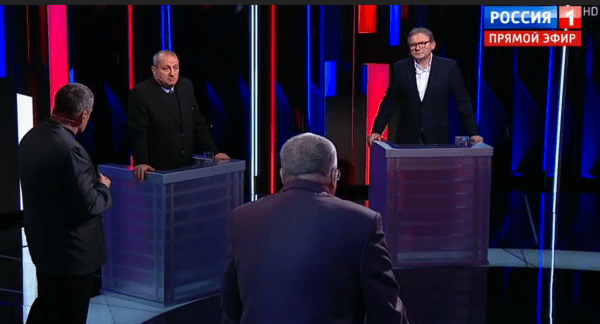
What I heard on the Solovyov program is that the US military know precisely the positions of Russian cruisers, submarines, aircraft and missiles in the Middle East region, that is to say, they understand that the Russians are on a war footing and fully prepared to execute the deadly counter strike promised by General Gerasimov several weeks ago if the US dares to cross the Russian red lines and launch a strike against Damascus or other locations where Russia has its armed forces embedded with the Syrians.
The US generals, unlike the US politicians and media and US administration, are risk-averse if the outcome may be catastrophic. Accordingly, the strike Trump has promised to “avenge” the utterly phony chemical attack in Douma, Eastern Ghouta, will have another vector, most likely to strike against Iran, which Trump held up as the co-supporters of “Animal” Assad.
Why Iran? Well, that falls entirely in line with Trump’s anti-Iranian stance in general and it will test the alliance between Russia, Turkey and Iran whose presidents last week reconfirmed their commitment to a jointly managed final political and military settlement in Syria. Indeed, there is no alliance between Russia and Iran, and the US can proceed as it sees fit in attacking Iran, subject of course, to Teheran’s ability and readiness attack US bases and armed detachments in its region in response.
I do not say that this alternative reading of the likely evolution of the Great Power confrontation in the Middle East is a happy one.
But it remains at the level of proxies and does not take us over the precipice to WWIII, as Saker’s and most other Western commentators in alternative media would have us believe.
April 11, 2018
Posted by aletho |
Militarism | Iran, Middle East, Russia, Syria, United States |
Leave a comment
Israel’s attack on the Syrian Arab Air Force’s (SyAAF) Tiyas airbase in Homs province was nothing less than a provocation, Turkish analysts opined, drawing attention to the fact that the airstrike occurred following unconfirmed reports about the alleged chemical attack in the Syrian town of Douma in Eastern Ghouta.
“While Damascus’ position and its influence in Syria is growing and Syrian government forces are making considerable progress on the fronts, it is completely unconvincing and illogical to claim that the Syrian authorities conducted a chemical attack,” ex-Lieutenant General of the Turkish Armed Forces, Erdogan Karakus, told Sputnik Turkey. “Israel is doing everything possible to destabilize and confuse the situation in the region. These steps are part of yet another provocation on the part of the West.”
Karakus drew parallels between the US invasion of Iraq in 2003 under a false pretext and the reported chemical attack in Eastern Ghouta. On April 7, a number of media outlets accused Damascus of using chemical arms in the town of Douma, citing sources among Syrian jihadi militants. The next day the Trump administration dropped the hint that it did not rule out the military option as a response to the supposed incident.
Moscow denied the allegations, referring to the fact that the Russian Defense Ministry had repeatedly warned about upcoming chemical provocations in the region amid the Syrian Arab Army’s (SAA) successful advance. The Russian Foreign Ministry highlighted that “that military intervention under far-fetched and fabricated pretexts in Syria… is absolutely unacceptable and might lead to very severe consequences.”
The retired lieutenant general pointed out that the West is hiding the real state of affairs while spreading false information as the truth.
“There is a serious struggle for power and influence, which affects the UN,” he said. “Turkey, Russia and Iran are on the one side. On the opposite side are the West, the US and Israel.”
‘Israel Seeking to Provoke War Between US and Iran’
Major General Beyazit Karatas, a retired Turkish Air Force officer who previously served as a military attaché in Washington, recalled that it is not the first time that Israel has attacked the Tiyas (T-4) airbase, where Iranian unmanned aerial vehicles (UAVs) are reportedly located.
“Israel’s major task for a long period of time has been to provoke a war between the US and Iran,” Karatas opined. “This desire of Israel is supported by Saudi Arabia. But the United States behaves cautiously, taking into account the potential reaction of Russia, Turkey, Iran and China. Therefore, they [the US] do not engage in clashes in the region directly, but provide support to local players, using them for their own purposes.”
Why Alleged Douma Attack Appears to Be a Staged Provocation
The retired major general called the claims about the alleged chemical attack in Douma “ridiculous.”
“It is presumed that the sarin gas was used that during the [alleged] chemical attack, but in fact it was not used,” Karatas said. “If you look at the photos published in Western media, you will clearly see that it was a staged event. If, as it claimed, sarin was used [in Douma], neither the father depicted in the photo could take the child in his hands, nor anyone actually could take these pictures. This is a staged farce.”
The former Turkish military official highlighted that the Russian Defense Ministry had repeatedly warned about possible staged provocations in the region.
At the same time, the US, Israel and their Western allies are trying to present chlorine as a chemical weapon, Karatas continued. According to the retired major general, these claims do not hold water: Being a toxic substance, gaseous chlorine is by no means a weapon of mass destruction, he says.
“In order to kill people located in one building, you will need to use at least 50 tons of chlorine. In a word, this is not a substance that can be used as a weapon of mass destruction,” he explained.
As for sarin, if this gas was actually used in Eastern Ghouta, no one could be there in ordinary masks, without special protective gear, as they would have died from poisoning, Karatas stressed.
“All of the above shows that the allegations and photographs are nothing more than a staged performance,” he pointed out. “As you know, Russia has been previously accused by the West of poisoning [former spy Sergei] Skripal. However, it turned out to be a lie. Today few people in the world believe the West’s false statements.”
The retired major general underscored that it is quite obvious for “reasonable people” that Syrian President Bashar al-Assad would never use chemical weapons under current conditions.
“In addition, if sarin — a gas with high volatility — was used, the biggest losses would be suffered by the Syrian military [deployed in the region] in the first place,” Karatas elaborated.
On April 9, two Israeli Air Force F-15 fighter jets attacked the T-4 airfield from Lebanese airspace, according to the Russian Defense Ministry. The ministry pointed out that five out of eight strikes were repelled by Syrian air defenses. Israel’s envoy to Russia was summoned by the Russian Foreign Ministry on April 10 over the incident.
See also:
Moscow Wants Independent Experts to Reaffirm Claims on Chemical Weapons Use in Douma
April 11, 2018
Posted by aletho |
False Flag Terrorism, Timeless or most popular, Wars for Israel | Iran, Israel, Middle East, Syria, United States, Zionism |
Leave a comment
The Russian military reserves the right to shoot down missiles and destroy launch sites in the event of US aggression against Syria, Moscow’s envoy to Lebanon Alexander Zasypkin has warned.
Zasypkin stressed that “the Russian forces will confront any US aggression on Syria, by intercepting the missiles and striking their launch pads,” al-Manar TV website reported, citing the envoy.
Speaking to the channel, the ambassador also said that the allegations of a chemical attack were being used to justify “offensive acts” in Syria, while “the US and Western escalation against Syria will lead to a major crisis.”
The statement comes after Washington threatened a “forceful response” against Syria after an alleged chemical attack in the Damascus suburb of Douma on Saturday. The US was quick to pin the blame on the Syrian government, basing its accusations on unverified data and images, including reports from the infamous, rebel-linked White Helmets ‘civil defense’ group.
On Tuesday, the UN Security Council failed to pass three consecutive resolutions calling for an investigation into the alleged use of chemical weapons in Syria. A Russian-sponsored draft backing a fact-finding mission at the site by the Organization for the Prohibition of Chemical Weapons (OPCW) is the latest to have been rejected by the body.
As the initiative was voted down by the US, the UK, France and Poland; Russia’s UN envoy Vassily Nebenzia once again called for the West to “refrain from the plans which you might be harboring with regards to Syria.”
Earlier on Tuesday, the OPCW announced that is preparing deploy its team to Douma “shortly” to investigate the reports of an attack there. Earlier, Russian specialists at the site had found no traces of chemical weapons or any victims treated for chemical poisoning.
While US President Donald Trump is weighing up options, reports emerged signaling that Washington is beefing up its forces in the Middle East. On Monday, the guided-missile destroyer ‘Donald Cook’ departed the port of Larnaca in Cyprus, reportedly heading towards Syria. Meanwhile on Wednesday, the USS ‘Harry S. Truman’ aircraft carrier, accompanied by strike groups, is scheduled to set sail for a “regular” mission to the Middle East and Europe.
Meanwhile, Eurocontrol – an EU body tasked with handling air traffic over the continent – issued a Rapid Alert Notification, warning flight operators in the Eastern Mediterranean about “the possible launch of airstrikes into Syria with air-to-ground and/or cruise missiles within the next 72 hours.”
While the West is poised for a military response to the alleged chemical incident in Syria, Moscow is warning against further destabilization of the region. Russia hopes that all the sides will “avoid any steps which are not provoked by anything in reality and can substantially destabilize the already fragile situation in the region,” Kremlin spokesman Dmitry Peskov stated on Wednesday.
April 11, 2018
Posted by aletho |
War Crimes | Middle East, Russia, Syria, United States |
Leave a comment
 Aletho News
