Bipartisan War
A new study urges more U.S. interventions
By Philip Giraldi • Unz Review • December 13, 2016
The Establishment and Realist foreign policy communities in the United States often seem separated by language which leads them to talk past each other. When a realist or Libertarian talks about non-intervention or restraint in foreign policy, as Ron Paul did in 2008 and 2012, the Establishment response is to denounce isolationism. As Dr. Paul noted during his campaigns, non-interventionism and isolationism have nothing to do with each other as a country that does not meddle in the affairs of others can nevertheless be accessible and open in dealing with other nations in many other ways. Non-interventionists are fond of quoting George Washington’s Farewell Address, in which he recommended that “The great rule of conduct for us in regard to foreign nations is in extending our commercial relations, to have with them as little political connection as possible… Harmony, liberal intercourse with all nations, are recommended by policy, humanity, and interest.” Establishment pundits tend to dismiss that “little political connection” bit, preferring instead to warn how detachment from foreign politics might lead to the rise of a new Adolph Hitler.
I was reminded of the language barrier while reading the Atlantic Council’s Middle East Strategy Task Force report, which appeared on November 30th. The report, which promises a new “Compact for the Middle East” while also asserting that “isolationism is a dangerous delusion,” might be regarded as a quintessential document laying out the Establishment position on what should be done in the region. It is ostensibly the product of two co-chairs, Madeleine Albright and Stephen Hadley, but it is also credited to an Executive Team headed by Executive Director Stephen Grand and Deputy Executive Director Jessica Ashooh, who in all probability were responsible for the actual drafting and editing.
The report also appears to have numerous high profile advisers who might or might not have had some hand in the final product. Running through the list of associates in the project which appears at the end of the report, one notes immediately that there is no individual or group identified that would contest the notion that the U.S. must have a leadership role in the Middle East. Indeed, many of those named derive considerable status from being part or supportive of America’s engagement in the region.
I would unambiguously describe Albright and Hadley as interventionists, a label that they might object to. Albright was Bill Clinton’s aggressive Secretary of State who is famous for her endorsement of American exceptionalism, stating that “We are the indispensable nation. We stand tall and we see further than other countries into the future…” She also is notorious for her approval of sanctions on Iraq that might have killed 500,000 children as “I think this is a very hard choice, but the price — we think the price is worth it” and she also once asked Colin Powell “What’s the point of having this superb military that you’re always talking about if we can’t use it?”
Stephen Hadley was the hawkish National Security Advisor under George W. Bush. He was one of the most outspoken advocates of military action against Iraq. During the essentially phony Syrian chemical weapons crisis in September 2013, he appeared on the media advocating attacking Syria with missiles. At the time, he was on the board at Raytheon and owned 11,477 shares of stock, which some considered to be a conflict of interest.
Albright and Hadley clearly were selected as co-Chairs to make the report bipartisan, an imperative for the Atlantic Council, which prides itself on being non-political, describing itself in its website as “a nonpartisan organization that promotes constructive U.S. leadership and engagement in international affairs based on the central role of the Atlantic community.” That self-definition suggests active engagement by the United States that goes well beyond George Washington’s advice. And if you look at the list of the Council’s executives and review their writings you will be able to confirm that they are pretty much inside the Beltway status quo in terms of supporting an assertive U.S. role in world affairs.
Albright and Hadley brought with them a certain point of view which was certainly recognized by the initiators of the project and one might assume that the Atlantic Council pretty much knew what the report would endorse even before it was written. The report, which runs to 105 pages, explores what it describes as a new strategic vision for the Middle East that will “change the political trajectory of the region.” It goes something like this: the states in the region must work together to create a “positive vision for their societies” to include “unlock[ing] the region’s rich, but largely untapped, human capital – especially the underutilized talents of youth and women.” Meanwhile, outside forces like the United States would have the responsibility of taking the lead to wind down the “violent conflicts” that have rocked the region. That means that the local governments will be responsible for haggling their way to some kind of acceptable modus vivendi while the U.S. must become more deeply involved militarily and using intelligence resources to stabilize Syria, Yemen and Libya.
In the case of Syria, which is the focus of the report, the argument is made that Bashar al-Assad’s reactionary regime is the root cause of the violence that has cost more than 200,000 lives and dislocated at least a third of the country’s population. This assessment is not necessarily universally accepted since 80% of the Syrian population lives in areas controlled by the government, which is about to increase its dominance by taking all of Aleppo, and there are no reports of civilians fleeing en masse to the greater freedom afforded by the rebel held areas, rather the reverse being true.
The report recommends using the U.S. military to establish safe areas in Syria to protect civilian populations, to include no-fly zones, which would bring about direct contact with the air forces of both Damascus and Moscow. It explicitly calls for direct military action against Syrian government forces including the employment of “air power, stand-off weapons, covert measures and enhanced support for opposition forces to break the current siege of Aleppo and frustrate Assad’s attempts to consolidate control over western Syria’s population centers.”
This judgment has been overtaken by events, but the co-authors do not really discuss what such an intervention would mean as it would involve the United States in an actual war based on executive fiat without any declaration from Congress. It also ignores reality on the ground, to include some politico-military reliance on the mythical moderate rebels while choosing not to recognize that the U.S. military is the intruder in Syria which, like it or not, has a legitimate government and a legal ally in Russia. The possibility of a second war with Russia is largely ignored in the report though there is an assumption that military pressure from the U.S. would push Damascus and Moscow towards a “political settlement” of the conflict after Russia becomes convinced through the assertion of American military power that “defeat, or stalemate, not victory, are the only realistic military outcomes.”
The report was initially intended to serve as a bipartisan rebuke to the current Barack Obama policy which limits direct American involvement in the conflict. Written before the presidential election, the co-authors could not have anticipated a Donald Trump victory, but they might be hoping that the report would serve as a guideline for the new administration. Hopefully they will be wrong in that expectation, but it is difficult at this point to see where the next White House will be going with its Middle Eastern policy.
There are a number of things wrong with the report from my perspective. Most significant, it assigns to the United States the responsibility to set and enforce standards of governance in parts of the world where the American people have little in the way of actual interests. The report refers to this oversight role as part of “enabling American global military operations,” an odd objective and also a point at which the language and perceptual problems come in – I am hearing intervention, which has been a failed policy since 2001, where Albright and Hadley construe a humanitarian mission based on American interests. They also have difficulty in conceptualizing that what they describe as the “debilitating cycle of conflict” in the Middle East might actually have been caused in large part by Washington’s involvement in that region, starting with the invasion of Iraq in 2003.
Second, the authors assume that the countries in the region, all of which have disparate interests, will act in good faith to support the “unlocking of the region’s human potential,” as the report enthuses, as part of its “positive vision.” It sounds good and probably is pleasing to globalists, but I would be skeptical of any kumbaya moments that require bringing together players like Saudi Arabia, Egypt and Turkey into one harmonic movement to better everyone in the region. Such pie in the sky is not even close to credible.
Third, when the report was issued Stephen Hadley told Reuters that “It may not work. But one of the things we know is that what’s going on now isn’t working.” No, it isn’t, but that might be based on a faulty assessment of the nature of the conflict. And this is thin gruel indeed to use as justification for going to war against Syria and possibly Russia.
One of the report’s obvious weaknesses derives from its Establishment-centric worldview. It calls for building stronger political institutions among the Palestinians in order to achieve a two-state solution without any serious examination of what the Israeli occupation is doing or not doing to impede any real movement in that direction. It treats Iran as an enemy of the “positive vision” that is “interfering” with its neighbors with the U.S. willing to “deter and contain Iran’s hegemonic activity,” making any real progress towards regional rapprochement unlikely. It sees a liberal democratic solution to all ills and judges multifaceted regional conflicts in purely “us against them” terms, favoring its “friends and allies” against the numerous other forces that are not on the same page.
The Atlantic Council’s Middle East Strategy Task Force Final Report argues that a transformation of the entire region, starting with establishment of security by replacing al-Assad and defeating ISIS, is both desirable and attainable. And it is an enterprise that has to be left to local players for the necessary social and political constructs with the U.S. providing leadership and direction, particularly when it comes to repressing “violent conflicts.” It is a utopian vision of what might be but one has to be concerned that the simplistic application of military force as a remedy for the regional cycle of violence ignores the probability that the reliance on such a solution in the first place has been a key element in the evolution of the current instability. That Syria will be fixed by coming in with force majeure on the side of what is being promoted as a progressive and humanitarian alternative to Bashar al-Assad borders on the ridiculous, but it is characteristic of the default position that many in Washington adopt when considering how to solve the problems in the Middle East.
UK in panic over Johnson’s remarks against Saudi regime
Press TV – December 11, 2016
UK Foreign Secretary Boris Johnson’s recent criticism of Saudi Arabia has worried British officials, with various government figures trying to gloss them over as Johnson’s own personal views.
During a conference in Rome last week, Johnson blasted the Riyadh regime over its “proxy wars” in the Middle East and its unprovoked military aggression against Yemen, which has killed over 11,000 Yemenis since March 2015.
UK Prime Minister Theresa May’s spokeswoman immediately rebuked the remarks back then, saying the comments did not reflect “the government’s views on Saudi and its role in the region.”
Johnson’s statements divided the UK Parliament, with many of the lawmakers saying that he was stating the truth and should not face public chastisement.
UK Defense Minister Michael Fallon lashed out at the media on Sunday, for blowing the story out of proportions and confecting an artificial row between Johnson and the Downing Street.
“Let’s be very clear about this. The way some of his remarks were reported seemed to imply that we didn’t support the right of Saudi Arabia to defend itself… and didn’t support what Saudi Arabia is doing in leading the campaign to restore the legitimate government of Yemen,” Fallon said during a BBC interview.
“Some of the reporting led people to think that,” he added. “The way it was interpreted left people with the impression that we didn’t support Saudi Arabia and we do.”
Fallon said the months-long Saudi invasion against its impoverished southern neighbor was in self-defense, a right that London thought Riyadh was entitled to.
“The government’s view is absolutely clear – that what Saudi Arabia is entitled to do is defend itself from these attacks across its own border,” he said.
Johnson’s remarks came at a time when May was in the Middle East, trying to cement military and economic ties with [Persian] Gulf Cooperation Council nations – Saudi Arabia, the United Arab Emirates, Kuwait, Oman, Bahrain and Qatar.
Besides helping Bahrain with a heavy-handed crackdown on its popular uprising, Britain has also been providing weapons and intelligence to Saudis in the attacks against civilian targets in Yemen.
What Will Canada’s Military Involvement in Iraq Lead To
Inside Syria Media Center – November 24, 2016
According to Reuters, about 200 Canadian commandos are actively involved in the ground operation to recapture Mosul from ISIS rule. According to Michael Rouleau, Canadian Special Forces Commander, troops are engaged in a ‘substantial’ number of clashes with terrorists which continues to rise.
Why is Canada sending troops to Iraq? What are the results desired by the Canadian government? And what is it willing to sacrifice?
First, Ottawa claims that by doing so it protects itself against terrorism. Former foreign minister Rob Nicholson stressed the need to weaken and destabilize ISIS in 2015. However neither airstrikes in Iraq and Syria nor coalition’s participation in Mosul mincing machine will lead to eradication of terrorism. The example of the Taliban in Afghanistan clearly demonstrates that large-scale fighting will be followed by long and bloody guerrilla war, in which Canada could get stuck with no end in sight.
Second, we should analyze the aftermath of ISIS defeat in Iraq and Syria. This question has no clear-cut answer. In theory the Canadian military presence in Iraq helps the Iraqi government to regain control over the country. In practice Ottawa is cooperating with the Kurds, who are planning to establish their own independent state on the territory of Iraq, Syria and Turkey. These aspirations could further destabilize the region.
Third, it is unclear whether Canada is ready to confront the Islamic State on a global scale. ISIS is conducting subversive activities in Lebanon, Afghanistan, Algeria, Pakistan, Libya, Egypt, Yemen, Nigeria, as well as in the countries of Southeast Asia in addition to Syria and Iraq. Consequently, it will require much more effort than just sending a few hundred soldiers to take part in an operation with controversial results for the complete elimination of the Islamic State.
Fourth, the situation in Syria and Iraq resembles a scenario that has repeatedly led to disastrous consequences in the Middle East. For example, the Western overthrow of Saddam Hussein in Iraq in fact led to the creation of ISIS. NATO’s invasion in Libya has practically ruined the country, led to fierce carnage over Muammar Gaddafi and contributed to the rapid spread of terrorist groups throughout North Africa not mentioning numerous victims among the civilian population.
Fifth, judging by the events in Mosul, one could argue that the operation would require a considerable amount of money. Despite the fact that the military operation in Iraq has already hit the budget of the country, Canada is going to allocate approximately $305.9 million extra towards extension, refocusing and carrying out the mission. This includes $41.9 million to be allocated for redeployment of personnel and equipment in 2016-17.
In addition, Canadian military’s participation in missions abroad comes with casualties. According to The Department of National Defense and the Canadian Armed Forces, 162 soldiers were killed in Afghanistan with more than two thousand injured. During the ten years of military presence in Afghanistan the Government invested more than $11 billion in the operation.
It is obvious that in the absence of a clear military strategy and achievable goals the situation in Iraq can become a second Afghanistan for Ottawa. Instead of solving internal problems, by supporting the international coalition Canada dared to get involved in another endless armed conflict. The leadership of the country once again has not consulted the opinion of its citizens sending dozens of soldiers to death and destroying the state budget.
Australian arrested after he was ‘killed’ in Iraq
MEMO | November 25, 2016
An Australian citizen believed to be a top recruiter for Daesh is under arrest, the New York Times reported today, citing an unnamed US military official, months after Australia said he had been killed in a US airstrike in Iraq.
Australia said in May that Neil Prakash, who was linked to several Australia-based terrorist attack plans, was killed in an airstrike in Mosul, Iraq on 29 April.
The New York Times said Prakash was wounded in the attack and arrested by a Middle East government “in the last few weeks.” The Australian Broadcasting Corporation, citing Turkish and Australian officials, said he was arrested in Turkey.
Australian Attorney-General George Brandis, who announced Prakash’s death in May, declined to comment on “matters of intelligence or law enforcement operations.”
Justice Minister Michael Keenan said in an email response to Reuters that the government’s “capacity to confirm reports of deaths in either Syria or Iraq is limited.”
Melbourne-born Prakash had appeared in Daesh videos and magazines and had actively recruited Australian men, women and children and encouraged acts of terrorism.
Australia last year announced financial sanctions against Prakash, including threatening anyone giving financial assistance with punishment of up to 10 years in jail.
Without reset India-Israel ties face uncertain future
By M K Bhadrakumar | Indian Punchline | November 23, 2016
The 8-day visit by the Israeli President Reuven Rivlin, which concluded on Monday, turned out to be a low-key affair. Gone are the days when high-level exchanges with Israel used to be sexy events. The novelty has worn off. There was no media hype about Rivlin’s visit. And the ‘demonetisation’ crisis alone cannot account for it.
The point is, an air of stagnation is appearing in the India-Israel relationship. Fundamentally, India has been rapidly transforming in the recent decade and its priorities have changed. Again, the regional and international environment has changed phenomenally.
The Bharatiya Janata Party used to be regarded as excessively ‘Israel-friendly’. Yet, Prime Minister Narendra Modi is still to pay a visit to Israel. Modi visited a few West Asian countries already but all of them belong to the so-called Muslim world – Saudi Arabia, UAE, Turkey and Iran. India’s priorities have been worked out.
Modi’s Iran visit was an eloquent statement in itself. India is undeterred by Israel’s animosities toward Iran. Curiously, while Rivlin was in India, media reports appeared that the ONGC Videsh’s protracted negotiations to strike a multi-billion dollar deal with Iran for the development of the Farzad-B gas field (with estimated reserves of 21.6 trillion cubic feet) have reached the home stretch.
Reuters reported separately that in the month of October, Iran surpassed Saudi Arabia as India’s number one supplier of crude oil – a whopping 789,000 barrels per day as against Saudi Arabia’s 697,000 bpd. India views the Chabahar project as a major geo-strategic initiative. Suffice it to say, Iran is becoming an indispensable partner and that is a geopolitical reality.
On the other hand, remittances from GCC countries to India’s budget work out to a handsome figure of $25 billion or so annually. Interestingly, Saudi Arabia’s Aramco recently had a rival offer to acquire Essar (which ultimately forced the Russian consortium to improve their bid and pay up $13 billion.) The Gulf region is also India’s number one export market.
In short, there is such a lot going for India in the West Asian region. The point is, what is it that Israel can offer? Drip irrigation, water management, recycling, conservation and desalination, dairy farming, polyhouse techniques, bee-keeping – these niches are surely interesting, each in its own way. But, what India desperately needs is massive investments to develop its manufacturing industry and infrastructure, which are crucial for job creation. It needs energy security. It needs to boost export earnings. What can Israel do for India? Ironically, Israel’s focus is exclusively on securing lucrative business for its companies.
Israel’s importance for India lies in defence cooperation. But here again, Israel may be incrementally losing its advantage as an interesting source of advanced military technology that was previously unavailable for India directly from the US. India is increasingly a big market for weaponry, with cut-throat competition setting in among the foreign vendors.
In political terms, too, Israel is of no relevance for India in handling the most consequential relationship in its foreign policy – namely, relations with China. As for the US-Indian relationship, it has matured to a point that India has no more need to leverage Jewish lobbyists. Arguably, Israel’s capacity to influence US policies also should not be exaggerated. Israel pulled all stops to scuttle the P5+1 and Iran negotiations but spectacularly failed to intimidate President Barack Obama.
Israel is palpably nervous about Donald Trump’s likely Middle East policies. Trump’s idea of working with Russia to resolve the Syrian conflict works against Israel’s regional agenda of fragmenting and weakening its neighbors. Continued Israeli support for the al-Qaeda affiliate Nusra Front in Syria will only invite Russian and Iranian retribution. Indeed, India and Israel are not on the same page in regard of the war against terrorist groups in Syria.
All in all, India-Israel relations are at a crossroads. Simply chanting old hackneyed mantras on terrorism, secularism, democracy, et al, won’t suffice. There is danger of stagnation setting in. An India-Israel reset is overdue. A relationship based on negative passions — paranoia, fear complex, insecurities, vanities and false identity — is inherently flawed and cannot have an enduring future in a rapidly changing regional and international environment, howsoever keen the two sides could be to remain relevant to each other.
An editorial in the Jerusalem Post newspaper on Rivlin’s visit calls attention to the stark realities confronting the future of India-Israel ties. No, Sir: we in India don’t have such fears over Kashmir, as you’d have over your occupied territories and illegal settlements.
True, we also have our share of ‘Rabbis’ but Indians are not addicted to Islamophobia; nor do we associate Islam with terrorism as a matter of state policy. No, India does not fancy itself as a ‘regional counterweight’ to Russia or China; we simply don’t suffer from such inferiority complex.
And, it is downright absurd to associate India’s ‘authentic national identity’ with Hindu religion. Worse still, it is an act of self-serving sophistry on the Israeli side to do so. We are an ancient civilization and not an artificial creation by western powers in this part of the world, and we do not need the crutch of religion to define our national identity. We’d prefer to be known by our IT industry and satellites and our eclectic culture.
Does Clinton’s Defeat Mean the Decline of US Interventionism?

Photo by The U.S. Army | CC BY 2.0
By Marwen Bouassida | CounterPunch | November 22, 2016
Carthage, Tunisia – No one knows what the future will bring. Yet, many observers have been quick to announce the decline of American interventionism and the revival of isolationism–the end of an era and the beginning of another.
Rightly or wrongly, Hillary Clinton’s defeat by Donald Trump fuels this prediction, which depresses some and delights other. The conflicted responses to Trump’s victory, based on ideological interests and values, register even within families. However, the most dramatic split reactions to Trump’s victory are exemplified by the left’s reception—liberal or socialist—in the global North versus the global South. If the North reacted to Trump’s victory with suffocated apprehension, the South experienced it as a breath of fresh air, not out of sympathy for Trump but as a rejection of Clinton.
The global South associates the name of Clinton—Bill or Hillary—with the heralds of humanitarian intervention. If the discourse of humanitarianism seduced the North, it has not been so in the South, even less in the Near and Middle East, which no longer believe in it. The patent humanitarian disasters in Kosovo, Iraq, Libya, and Syria have disillusioned them.
It is in this sense that Trump’s victory is felt as a release, a hope for change, and a rupture from the policy of Clinton, Bush, and Obama. This policy, in the name of edifying nations (“nation building”), has destroyed some of the oldest nations and civilizations on earth; in the name of delivering well-being, it has delivered misery; in the name of liberal values, it has galvanized religious zeal; in the name of democracy and human rights, it has installed autocracies and Sharia law.
Who is to blame?
Did the United States not know that intervening in “the lands of Islam” would act as a catalyst for Jihad? Was it by chance that the United States intervened only in secular states, turning them into manholes of religious extremism? Is it a coincidence that these interventions were and are often supported by regimes that sponsor political Islam? Conspiracy theory, you say? No, these are historical facts.
Can the United States not learn from history, or does it just doom itself to repeat it? Does it not pose itself the question of how al-Qaeda and Daesh originated? How did they organize themselves? Who trained them? What is their mobilizing discourse? (1) Why is the US their target? None of this seems to matter to the US: all it cares about is projecting its own idealism. (2)
The death of thousands of people in Yugoslavia, Iraq, Libya or Syria, has it contributed to the well being of these peoples? Or does the United States perhaps respond to this question in the manner of Madeleine Albright, Bill Clinton’s Secretary of State, who regretted the death of five-hundred-thousand Iraqi children, deprived of medications by the American embargo, to conclude with the infamous sentence, “[But] it was worth it “?
Was it worth it that people came to perceive humanitarian intervention as the new crusades? Was it worth it that they now perceive democracy as a pagan, pre-Islamic model, abjured by their belief? Was it worth it that they now perceive modernity as deviating believers from the “true” path? Was it worth that they now perceive human rights as human standards as contrary to the divine will? Was it worth it that people now perceive secularism as atheism whose defenders are punishable by beheading?
Have universal values become a problem rather than a solution? What then to think of making war in their name? Has humanitarian intervention become punishment rather than help?
The South has understood where the North has not: the selective nature of humanitarian interventions reflects their punitive nature; sanctions go to non-client regimes; interventions seem to be a new excuse for the hegemonic ambitions of the United States and its allies; they are a new rationale for NATO after the collapse of the Soviet Union; they are a way to suppress Russia and deprive it of its zones of influence. (3)
What a far-sighted motion was that of the coalition of the countries of the Third World (G77) at the Havana Summit in 2000! It declared its rejection of any intervention, including humanitarian, which did not respect the sovereignty of the states concerned. (4) This was nothing other than a rejection of the Clinton Doctrine, announced in 1999, in the wake of the war of Kosovo, which made “humanitarian intervention” the new bedrock, or perhaps the new facade, of the foreign policy of the United States. It was the same policy followed and developed by Hillary Clinton during her tenure as secretary of state. (5)
The end of interventionism?
But are Clinton’s defeat and Trump’s accession to power sufficient reasons to declare the decline of interventionism?
Donald Trump is a nationalist, whose rise has been the result of a coalition of anti-interventionists within the Republican Party. They profess a foreign policy that Trump has summarized in these words: “We will use military force only in cases of vital necessity to the national security of the United States. We will put an end to attempts of imposing democracy and overthrowing regimes abroad, as well as involving ourselves in situations in which we have no right to intervene.” (6)
But drawing conclusions about the foreign policy of the United States from unofficial statements seems simplistic. At the moment of this writing, any speculation as to the policy choices of Trump’s foreign policy is premature. One can’t predict his policy with regard to the Near and Middle East, since he has not yet even formed his cabinet. Moreover, presidents in office can change their tune in the course of their tenure. The case of George W. Bush provides an excellent example.
Like Donald Trump, George W. Bush was a conservative Republican non-interventionist. He advocated “America First,” called for a more subdued foreign policy and adopted Colin Powell’s realism “to attend without stress” (7) with regard to the Near and Middle East. But his policy shifted to become the most aggressive and most brutal in the history of the United States. Many international observers argue that this shift came as a response to the September 11 attacks, but they fail to note that the aggressive germs already existed within Bush’s cabinet and advisers: the neo-conservatives occupied key functions in his administration. (8)
Up until now, Trump’s links with the neo-cons remain unclear. The best-known neo-cons, Paul Wolfowitz, William Kristol, and Robert Kagan, appear to have lost their bet by supporting Hillary Clinton’s candidacy. But others, less prominent or influential, seem to have won it by supporting Trump: Dick Cheney, Norman Podhoretz, and James Woolsey, his adviser and one of the architects of the wars in the Middle East.
These indices show that nothing seems to have been gained by the South, still less by the Near and Middle East. There appears to be no guarantee that the situation will improve.
The non-interventionism promised by Trump may not necessarily equate to a policy of isolationism. A non-interventionist policy does not automatically mean that the United States will stop protecting their interests abroad, strategic or otherwise. Rather, it could mean that the United States will not intervene abroad except to defend their own interests, unilaterally–and perhaps even more aggressively. Such a potential is implied in Trump’s promise to increase the budget for the army and the military-industrial complex. Thus, it is more realistic to suppose that as long as the United States has interests in the countries of the South and the Near and Middle East, so long it will not hesitate to intervene.
In this context, Clinton’s defeat and Trump’s accession are not sufficient reasons to declare the decline of interventionism—the end of an era and the beginning of another. The political reality is too complex to be reduced to statements by a presidential candidate campaigning for election, by an elected president, or even by a president in the course of performing his office.
No one knows what the future will bring.
Marwen Bouassida is a researcher in international law at North African-European relations, University of Carthage, Tunisia. He regularly contributes to the online magazine Kapitalis.
(Translated from the French by Luciana Bohne)
Works Cited
1 The Declaration of 77 South Summit, Havana – Cuba, 10 – 14 April 2000: http://www.g77.org/summit/Declaration_G77Summit.htm
2 See : Diana Johnstone, Queen of Chaos : The misadventure of Hillary Clinton, CounterPunch, 2015.
3 Actualité : « Trump mettra fin aux ingérences US s’il est élu », Suptniknews (Novembre 04, 2016) En ligne : http://sptnkne.ws/cBzJ
4 Gilles Kepel, Fitna : Guerre au cœur de l’islam, Gallimard, 2004, p.90.
5 Ted Galen Carpenter, “Donald Trump’s foreign policy: What will he really do?” The National Interest (Novembre 12, 2016) Online: http://nationalinterest.org/blog/the-skeptics/donald-trumps-foreign-policy-what-will-he-really-do-18378
6 Sputniknews, « Trump mettra fin aux ingérences US s’il est élu », Novembre 04, 2016. http://sptnkne.ws/cBzJ (last seen: November 17, 2016)
7 Gilles Kepel, Fitna : Guerre au cœur de l’islam, Gallimard, 2004, p.90
8 Ted Galen Carpenter, “Donald Trump’s foreign policy: What will he really do?”, The National Interest, Novembre 12, 2016 http://nationalinterest.org/blog/the-skeptics/donald-trumps-foreign-policy-what-will-he-really-do-18378 (last seen: Novembre 17, 2016)
Syria militants get anti-aircraft missiles: Report
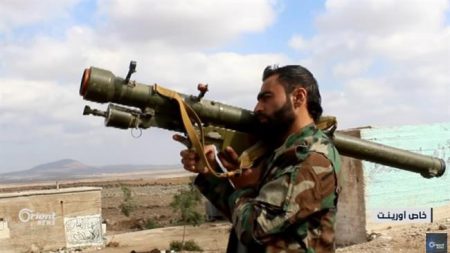
An Ansar al-Islam terrorist tests a shoulder-fired and low-altitude 9K32 Strela-2 surface-to-air missile system in an unknown location in southwestern Syria
Press TV – November 22, 2016
A report says members of a foreign-sponsored militant group in Syria have received a considerable amount of shoulder-launched anti-aircraft missiles, a possible indication that the US has eased restrictions on the supply of weapons to the anti-Damascus militants.
In a video published by the a pro-militant television network on Sunday, terrorists from the so-called Ansar al-Islam group can be seen testing low-altitude 9K32 Strela-2 missile systems in the southwestern Syrian provinces of Dara’a and Quneitra.
“We, in Ansar al-Islam Front, have distributed several points of air defense to counter any attempt by the Syrian warplanes or helicopters, which bomb points in Quneitra Province. We have a good number of these missiles,” a militant can be heard saying in the video.
A second militant says his group and the so-called Free Syrian Army are deploying munitions and forces to the towns of al-Harra, Masharah, Sandaniya and Jabata for attack against Syrian government forces within the next few days.
The report comes amid indications that the US administration has given the green light to its allies in the Middle East to send missiles to terrorist groups inside Syria through Jordan and Turkey.
A militant source said in late September that the US has agreed to the start of arms shipments from Qatar and Saudi Arabia.
A Reuters report has also hinted at the possibility that President Barack Obama would overturn the ban on the supply of missiles to extremist militants in Syria in the wake of Russian and Syrian forces’ offensives to retake the militant-held eastern part of the city of Aleppo.
Turkish airstrike kills Syrians
Meanwhile, Turkish aerial bombardment against the purported positions of Daesh terrorists near the northwestern Syrian city of al-Bab has killed seven people.
Syria’s official news agency SANA reported that ten people also sustained injuries in the Monday attack.
On August 24, the Turkish air force and special ground forces kicked off Operation Euphrates Shield inside Syria in a bid to support the so-called Free Syrian Army militants and rid the border area of Daesh terrorists and fighters from the Kurdish People’s Protection Units (YPG) and the Democratic Union Party (PYD).
The incursion drew strong condemnation from the Damascus government for violating Syrian sovereignty.
Also on Monday, ten civilians were killed when fighter jets from a US-led military coalition hit an area in the al-Salehiyah Village of the northern Syrian province of al-Raqqah.
Since September 2014, the US and some of its Arab allies have been carrying out airstrikes against what they say are Daesh positions inside Syria without any authorization from Damascus or a United Nations (UN) mandate.
The US-led coalition has done little to stop Daesh’s advances in Syria and Iraq. Some analysts have criticized the US-led military campaign, saying the strikes are only meant to benefit US weapons manufacturers.
Featured Video
Seyed M. Marandi: Negotiations Collapsed – Return to War
or go to
Aletho News Archives – Video-Images
From the Archives
The US-Iran Scenario That Most Scares Israel
By Ali Haydar | Al-Akhbar | October 9, 2013
Israeli Prime Minister Benjamin Netanyahu issued a series of threats toward Iran and its interlocutors in the West, including the US, as serious negotiations on Iran’s nuclear program seem more plausible.
As a possible rapprochement looms between the US and Iran, Netanyahu has attempted to impose impossible Israeli conditions on the negotiators, such as the full dismantling of Iran’s nuclear program, not to mention threatening military force.
Whatever the deal that could materialize between Iran and the West, Israel is going to find itself before an open-ended path. One can foresee three possible scenarios… continue
Blog Roll
 Aletho News
- UK, Spain reject Trump’s new scheme to blockade Hormuz Strait
- Russian frigate ‘resurfaces’, chases off NATO pirates days after Kiev ‘sank’ it
- Ukraine Targets Russian Merchant Fleet With NATO Intel Support – Presidential Aide
- Russia’s ‘shadow fleet’ makes mockery of UK naval power
- Ukraine plans to attack Russian ships with Norwegian support
- US’s ‘Very Foolish’ Double Blockade of Hormuz Strait Makes Absolutely No Sense: Here’s Why
- China issues rules on countermeasures against foreign states’ unlawful extraterritorial jurisdiction
- Seyed M. Marandi: Negotiations Collapsed – Return to War
- Tomorrow’s naval blockade showdown
- ‘Israel’ attacks civilians to hide its embarrassing military failures & out of pure sadism
- If Americans Knew
- Critical shortages in Gaza, Lebanon in ruins, “piracy” in Iran – Daily Update
- US-Iran ceasefire negotiations make zero progress – Daily Update
- Pro-Israel ‘Thinktanks’ and Individuals who Influence U.S. Foreign Policy
- Mearsheimer reveals how Israel dictates US policies on Iran, Gaza – video
- After killing 350+, Israel still has a “score to settle” with Lebanon before ceasefire – Daily Update
- Military aid to Israel emerges as the latest political litmus test for Democrats
- The only Palestinian children’s rights organization closes following years-long Israeli campaign against it
- ‘I Can’t Forget the Smell’: Lebanese Reel After Israel Kills Over 300 in Single Day
- DNC Shoots Down Resolutions Calling Out AIPAC and Limiting Arms to Israel
- TCN: Is Israel Blackmailing President Trump?
- No Tricks Zone
- Cave Discovery Reveals Today’s Desert Climates Were Recently Far Warmer, Wetter, Teeming With Life
- German Expert: Heat Dome Led To Record Temps In Western USA…Warmer In 1934, 1936
- New Study: No Linear Warming Or Glacier Retreat Along Northern Antarctic Peninsula Since 1980s
- An Inconvenient Tree: Uncovered In Alps… Europe Much Warmer Than Today 6000 Years Ago
- New Study Reports A 60% Slowdown In Greenland’s Ice Loss Rate In The Last Decade
- Low Intensity Tornado Wrecks Major Solar Farm, Creating A Potential Toxic Dump
- New Study Finds Warming Saves Lives…Cold Temperatures 12 Times More Deadly Than Excess Heat
- German Science Blog Accuses PIK Climate Institute Of Hallucinating Climate Tipping Points
- Devastating Assessment Of Comirnaty Vaccine By Former Senior Pfizer Europe Toxicologist
- New Study: CO2 Is ‘Effectively Negligible’ As An Explanatory Climate Change Factor Since 2000
 Aletho News