Trump versus Wolfowitz

By Deena Stryker – New Eastern Outlook – 19.01.2018
Who today knows the name of Paul Wolfowitz? He was neither a Congressman, Senator, nor governor, yet until this month, official US ‘defense’ policy has borne his name.
A former President of the World Bank and U.S. Deputy Secretary of Defense, following the 1991 Persian Gulf War, the neo-conservative he authored the “Defense Planning Guidance of 1992″, which came to be known as the Wolfowitz Doctrine. Intended to “set the nation’s direction for the next century,” its first objective was “to prevent the re-emergence of a new rival.” In case the reader didn’t immediately get the message, it is spelled out as ‘deterring’ potential competitors from even aspiring to a larger regional or global role’ by maintaining ‘unquestioned military superiority and, if necessary, employ[ing] force unilaterally.”
Both Colin Powell and President Bush objected to this brash approach to world affairs, so before becoming known as the Bush Doctrine it was rewritten in milder language. Since 2009, at the Foreign Policy Initiative think tank, Wolfowitz has advocated for the troop surge in the Afghanistan War [and direct military strikes in Syria, continuing to lament an “absence of American leadership, as global pressure against the American-led international order intensifies.”
Imagine now as candidate for the presidency, a real estate magnate enamored of ‘deals’ declares “Wouldn’t it be better if we could be friends with Russia?” From there, it’s a straight line to a Special Counsel being appointed by the Justice Department to investigate possible collusion between the Trump campaign and President Putin.
Russia went from being a rival to be contained, to an ‘adversary’, then imperceptibly, an ‘enemy’, by supporting two breakaway regions of Ukraine after the US — in full view of the world — used Neo-nazi militias to carry out a coup against a democratically elected president who continued historical close ties with Russia. While loudly defending ‘human rights’, Washington claims that Russian-speaking Ukrainians are not entitled to separate themselves from a regime that flouts Nazi insignia, calls them ‘cockroaches’ (burning some alive), and makes use of their language illegal.
Given these events, could Russia count on that same Kiev government to respect the permanent lease of a naval station in Crimea dating back to Catherine the Great? Or might prudence have dictated it encourage Crimea’s Russian-speaking population to act on its long-held desire to once again be a part of Russia? Could the presence of ‘little green men’ to ensure that a referendum was carried out without interference possibly be construed as an attack? For daring once again to wield sovereignty over a territory that houses its only warm water naval base, Russia has become an ‘enemy’ of the West!
By a large margin, Americans believe that every effort should be made to avoid using nuclear weapons. They do not know that per the twenty-five year old Wolfowitz Doctrine, their country is building a case for nuclear war with the other major nuclear power. Russian ‘behavior’ (the word invariably spoken in the tone of an adult disciplining a child) in its own back yard justifies stationing NATO forces along its entire western border with Europe, then condemning its inevitable military build-up in response: Americans are gradually being accustomed to the idea that the inevitable use of nukes this situation could set off would be merely a temporary detour on the path of human progress.
Aside from ‘invading’ Ukraine’, Russia is guilty of having ‘interfered’ in the American election, now consistently referred to as ‘America’s ‘Democracy’. (Since the highest court baptized corporations as people, allowing them to spend unlimited money to help their candidates win elections, these are now referred to as Democracy with a capital D, the media breathlessly highlighting the amounts candidates raise, rather than the ideas they espouse.) This system had for decades brought to power candidates fully committed to the Wolfowitz Doctrine of unchallengeable American world hegemony. And in 2016, Hillary Clinton was its most fervent adept, consistently attacking the President of Russia.
Since the election, Vladimir Putin’s sin is not to have drawn a sword, but to have perhaps electronically tipped the scale toward peace and cooperation with the US — any other policy being tantamount to treason vis a vis the Russian people.
A century ago, Americans were taught to regard Russia as an ‘evil empire’ for having embraced a political philosophy intended to ensure the well-being of the 99%, (whether or not it succeeded). When, after seventy years of trying, it executed a stunning turnaround, allowing capitalism to flourish (creating many crooks and billionaires in the process), American policymakers could have applauded. Instead, fearing a capitalist Russia as much as a socialist one, the Wolfowitz Doctrine issued a year later, in 1992, called for the US to carve up the world’s largest country into loyal fiefdoms to ensure continuing American world hegemony.
Only now superseded by the Trump Doctrine, its purpose was to “prevent the re-emergence of a new rival, either on the territory of the former Soviet Union or elsewhere, that poses a threat on the order of that posed formerly by the Soviet Union, whose resources would, under consolidated control, be sufficient to generate global power.” This grammatical construction, whether or not deliberate, conveys the fact that Russia’s crime is to possess resources that could enable it to dominate the US. When the Wolfowitz doctrine, intended to ensure that no country is ever able to challenge American hegemony, was leaked to the New York Times, Senator Edward Kennedy described it as “a call for 21st century American imperialism that no other nation can or should accept.” Rewritten in softer language, when the US invaded Iraq and Afghanistan — neither of which could possibly challenge American hegemony – in its name, it became known as the Bush Doctrine.
The new version declared:
Our most fundamental goal is to deter or defeat attack from whatever source… The second goal is to strengthen and extend the system of defense arrangements that binds democratic and like-minded nations together in common defense against aggression, build habits of cooperation, avoid the re-nationalization of security policies, and provide security at lower costs and with lower risks for all. Our preference for a collective response to preclude threats or, if necessary, to deal with them is a key feature of our regional defense strategy. The third goal is to preclude any hostile power from dominating a region critical to our interests, and also thereby to strengthen the barriers against the re-emergence of a global threat to the interests of the U.S. and our allies.
Continued uninterruptedly at the cost of thousands of foreign lives, some might see in this doctrine echoes of Hitler’s plan for a thousand year Reich, but sadly, most Americans believe their country is ‘generously’ exercising ‘benevolent oversight’ over an innocent, ‘rules-based’ order of its creation. Ready to condemn Donald Trump’s challenge to the principle of US world dominance, they approve the pursuit of those who, having helped him get elected, are accused of ‘collusion with a foreign power’ (foreign powers having been America’s nemesis since the days of its ‘revolutionary’ separation from Great Britain).
Although Russia and China are the only countries capable of challenging US dominance, they have made no threats. Vladimir Putin’s crime was to have proposed, in a landmark speech to the 2007 Munich International Security Conference, an international architecture in which the four or five regional powers would cooperate on the international stage to ensure peace and prosperity for all.
Stunningly, from the very first paragraph, Donald trump’s security doctrine lifts its principles straight from that speech, calling, exactly like his Russian counterpart, for “a world of strong, sovereign, and independent nations, each with its own cultures and dreams, thriving side- by-side in prosperity, freedom, and peace—throughout the upcoming years...”
Since any form of power-sharing contradicts the Wolfowitz/Bush doctrine, the US responded to Putin’s Munich speech by fomenting a series of color revolutions, in Georgia in 2008, and in Ukraine in 2014. Then, it positioned NATO forces along Russia’s entire Western border as a prelude to carving it up before taking on the more formidable other major power, China.
It’s no surprise that candidate Trump’s foreign policy declarations set off a concerted effort to legally sideline him once elected. Erroneously convinced he is the boss, Trump ordered his Security Doctrine to be codified:
China and Russia want to shape a world antithetical to U.S. values and interests. China seeks to displace the United States in the Indo-Pacific region, expand the reaches of its state-driven economic model, and reorder the region in its favor. Russia seeks to restore its great power status and establish spheres of influence near its borders. The intentions of both nations are not necessarily fixed. The United States stands ready to cooperate across areas of mutual interest with both countries.
In addition, after being dismissed as a phenomenon of an earlier century, great power competition returned. China and Russia began to reassert their influence regionally and globally. Today, they are fielding military capabilities designed to deny America access in times of crisis and to contest our ability to operate freely in critical commercial zones during peacetime. In short, they are contesting our geopolitical advantages and trying to change the international order in their favor.
As President Putin in his New Years’ address calls for pragmatic dialogue, Trump formally criticizes ‘authoritarian regimes’, while pursuing that same objective, which if pointed out, would be approved by voters of both parties. Unlike Bush/Cheney/Obama, Trump’s concern is with the pursuit of our commercial interests, rather than with power as an absolute. To secure these interests (while satisfying the arms industry), Trump calls for the United States to “overmatch” its adversaries, described as:
….“the combination of capabilities in sufficient scale to prevent enemy success and to ensure that America’s sons and daughters will never be in an unfair fight. Overmatch strengthens our diplomacy and permits us to shape the international environment to protect our interests. To retain military overmatch the United States must restore our ability to produce innovative capabilities, restore the readiness of our forces for major war, and grow the size of the force so that it is capable of operating at sufficient scale and for ample duration to win across a range of scenarios.”
This policy is justified by the desire to “create wealth for Americans and our allies and partners.(‘Enemies’ or even ‘rivals’ are in Trump’s view ‘competitors’, and “prosperous states are stronger security partners who are able to share the burden of confronting competitors.”) –In support of this view, America’s ‘Priority Actions’ are:
- REINFORCE ECONOMIC TIES WITH ALLIES AND PARTNERS: We will strengthen economic ties as a core aspect of our relationships with like-minded states and use our economic expertise, markets, and resources to bolster states threatened by our competitors.
- DEPLOY ECONOMIC PRESSURE ON SECURITY THREATS: We will use existing and pursue new economic authorities and mobilize international actors to increase pressure on threats to peace and security in order to resolve confrontations short of military action.
- SEVER SOURCES OF FUNDING: We will deny revenue to terrorists, WMD proliferators, and other illicit actors in order to constrain their ability to use and move funds to support hostile acts and operations.
INFORMATION STATECRAFT
America’s competitors weaponize information to attack the values and institutions that underpin free societies, while shielding themselves from outside information. They exploit marketing techniques to target individuals based upon their activities and interests.
COMMON THREATS. Fair and reciprocal trade, investments, and exchanges of knowledge deepen our alliances and partnerships, which are necessary to succeed in today’s competitive geopolitical environment.
Trump replaces unchallengeable world hegemony with an “America First” foreign policy [that] “celebrates America’s influence in the world as a positive force that can help set the conditions for peace and prosperity and for developing successful societies.”
We are not going to impose our values on others. Our alliances, partnerships, and coalitions are built on free will and shared interests. When the United States partners with other states, we develop policies that enable us to achieve our goals while our partners achieve theirs.
Today, the United States must compete for positive relationships around the world. China and Russia target their investments in the developing world to expand influence and gain competitive advantages against the United States. China is investing billions of dollars in infrastructure across the globe. Russia, too, projects its influence economically, through the control of key energy and other infrastructure throughout parts of Europe and Central Asia. The United States provides an alternative to state-directed investments, which often leave developing countries worse off. The United States pursues economic ties not only for market access but also to create enduring relationships to advance common political and security interests.
PRIVATE SECTOR ACTIVITY AND RULE OF LAW. The United States will shift away from a reliance on assistance based on grants to approaches that attract private capital and catalyze private sector activity. We will emphasize reforms that unlock the economic potential of citizens, such as the promotion of formal property rights, entrepreneurial reforms, and infrastructure improvements—projects that help people earn their livelihood and have the added benefit of helping U.S. businesses. By mobilizing both public and private resources, the United States can help maximize returns and outcomes and reduce the burden on U.S. Government resources.
Here, Trump deliberately misrepresents an adversary: while most African countries welcome the fact that China builds infrastructure without requiring reciprocal purchases (unlike the US), Trump takes advantage of American ignorance to claim that:
Unlike the state-directed mercantilism of some competitors that can disadvantage recipient nations and promote dependency, the purpose of U.S. foreign assistance should be to end the need for it. The United States seeks strong partners, not weak ones. American-led investments represent the most sustainable and responsible approach to development and offer a stark contrast to the corrupt, opaque, exploitive, and low-quality deals offered by authoritarian states.
Continuing an apparent condemnation of authoritarianism, Trumps states that:
Actors have long recognized the power of multilateral bodies and have used them to advance their interests and limit the freedom of their own citizens. If the United States cedes leadership of these bodies to adversaries, opportunities to shape developments that are positive for the United States will be lost. All institutions are not equal, however. The United States will prioritize its efforts in those organizations that serve American interests, to ensure that they are strengthened and supportive of the United States, our allies, and our partners. Where existing institutions and rules need modernizing, the United States will lead to update them. At the same time, it should be clear that the United States will not cede sovereignty to those that claim authority over American citizens and are in conflict with our constitutional framework.
EXERCISE LEADERSHIP IN POLITICAL AND SECURITY BODIES: The United States will strive for outcomes in political and security forums that are consistent with U.S. interests and values, which are shared by our allies and partners. The United Nations can help contribute to solving many of the complex problems in the world, but it must be reformed and recommit to its founding principles. We will require accountability and emphasize shared responsibility among members. If the United States is asked to provide a disproportion- ate level of support for an institution, we will expect a commensurate degree of influence over the direction and efforts of that institution.
Although the menace of Soviet communism is gone, new threats test our will. Russia is using subversive measures to weaken the credibility of America’s commitment to Europe, undermine transatlantic unity, and weaken European institutions and governments. With its invasions of Georgia and Ukraine, Russia demonstrated its willingness to violate the sovereignty of states in the region. Russia continues to intimidate its neighbors with threatening behavior, such as nuclear posturing and the forward deployment of offensive capabilities.
The United States will deepen collaboration with our European allies and partners to confront forces threatening to undermine our common values, security interests, and shared vision. The United States and Europe will work together to counter Russian subversion and aggression, and the threats posed by North Korea and Iran. We will continue to advance our shared principles and interests in international forums.
For Washington bureaucrats, who remain the same from one president to the next, Wolfowitz will always be the law of the land. Trips to Moscow are invariably construed as ‘political’ and criminalized by the FBI. Even at home, Americans are required to signal any encounter with Russians to the FBI! Saudi Arabia can bomb tiny Yemen to smithereens in the biggest ethnic cleansing ever, but talking to Russians can land you in jail. The Republican Party — which had been dragged kicking and screaming behind Trump in the 2016 election, is now vociferously demanding an investigation of the FBI itself, in order to derail its investigation of the President’s Russian ties.
Whether or not one applauds the election of Donald Trump, it should be obvious that if the nuclear great powers do not maintain friendly relations, the future of mankind is in jeopardy. Why should Russia’s ‘behavior’ in its own back yard justify plans for war? Why, instead of praising those who reach out to Russia, is the deep state threatening to ruin their lives? Why do those who hope that President Trump will not challenge North Korea to a nuclear exchange not also worry about the missiles we installed in Europe, to be launched against Russia should a US-dominated Old World decide it’s had enough of Uncle Sam’s ‘solicitude’?
The commercialization of every aspect of their lives has brought much harm to Americans, and now they need to stop focusing on their commercially-oriented president’s puerile tweets, and hope that in foreign policy, he manages to gain the upper hand over Wolfowitz before it’s too late.
Syria slams US military presence as ‘act of aggression’
Press TV – January 18, 2018
Syria has strongly condemned a US plan to maintain its military presence in the Arab country as interference in its internal affairs and a blatant violation of international law.
“The internal affairs in any country in the world is an exclusive right of the people of this country, thus nobody has the right to only give his opinion in that because this violates the international law and contradicts the most important theories of the constitutional law,” Syria’s state news agency, SANA, quoted a Foreign Ministry official as saying in a statement on Thursday.
The statement comes after US Secretary of State Rex Tillerson said US troops would stay in Syria for the foreseeable future to defeat terrorists, and added that the US would not fund the reconstruction of any part of Syria, where President Bashar al-Assad is in power.
According to figures the Pentagon released in December, there are at least 2,000 troops in Syria as well as a diplomatic presence in cities such as Kobani.
The Syrian statement further said US presence and all of Washington’s actions in the Arab country are aimed at protecting the Takfiri Daesh terrorist group, which was created by the former American administration.
The Damascus government “does not need a single dollar from the United States for reconstruction because this dollar is stained with the blood of the Syrians,” the statement added.
Turkey reacts to Tillerson denial
Meanwhile, Turkey said on Thursday that Washington’s denial that it intended to build a border force in Syria was “important,” but added that Ankara would not remain silent in the face of any force that threatened its borders.
Tillerson on Wednesday denied that the United States had any intention to build a Syria-Turkey border force, saying the issue, which has incensed Ankara, had been “misportrayed, misdescribed. Some people misspoke.”
“This statement is important but Turkey cannot remain silent in the face of any formation which will threaten its borders,” Turkish Justice Minister Abdulhamit Gul told broadcaster NTV.
On Sunday, the US announced that it will work, along with a coalition of its allies purportedly fighting Daesh, with US-backed militants of the so-called Syrian Democratic Forces (SDF) to set up a new 30,000-strong “border security” force that includes the Kurdish People’s Protection Units (YPG).
Turkey views the YPG as a terror organization and the Syrian branch of the outlawed Kurdish Workers’ Party (PKK).
The force would operate along the Turkish border with Iraq and within Syria along the Euphrates River.
Washington’s plan has drawn angry reactions from Syria, Turkey and Russia. Syria views the formation of such a border force as an assault on its sovereignty.
The US and its allies back militants fighting to topple the Syrian government. American warplanes have also been bombing Syria since September 2014 without any authorization from Damascus or a UN mandate.
The airstrikes have on many occasions resulted in civilian casualties, seriously damaged Syria’s infrastructure and failed to fulfill their declared aim of countering terror.
Turkey reacted angrily to Washington’s plan and warned it would not hesitate to take action in Afrin district and other regions across the border in Syria unless the United States withdrew support for YPG.
In August 2016, Turkey began a unilateral military intervention in northern Syria, code-named Operation Euphrates Shield. Ankara said the campaign was aimed at pushing Daesh terrorists from Turkey’s border with Syria and stopping the advance of Kurdish forces.
Turkey ended its Syria offensive in March 2017, but has kept its military presence there.
Syria has voiced strong opposition to both Turkish and American military actions on its soil, repeatedly calling on the two NATO allies to pull their forces out.
Why “Coercive Diplomacy” is a Dangerous Farce
By Gareth Porter | Dissident Voice | January 16, 2018
With his recent “my (nuclear) button is bigger than yours” taunt, Donald Trump’s rhetoric has fully descended into school yard braggadocio, with North Korea’s Kim Jong-un as a convenient foil. But his administration’s overwhelming reliance on military and economic pressure rather than on negotiations to influence North Korea’s nuclear weapons and ICBM programs is hardly new. It is merely a continuation of a well-established tradition of carrying out what the national security elite call “coercive diplomacy”.
As Alexander George, the academic specialist on international relations who popularized the concept, wrote:
The general idea of coercive diplomacy is to back one’s demand on an adversary with a threat of punishment for noncompliance that he will consider credible and potent enough to persuade him to comply with the demand.
The converse of that fixation on coercion, of course, is rejection of genuine diplomatic negotiations, which would have required the United States to agree to changes in its own military and diplomatic policies.
It is no accident that the doctrine of coercive diplomacy acquired much of its appeal on the basis of a false narrative surrounding the Cuban Missile Crisis of 1962—that John F. Kennedy’s readiness to go to war was what forced Khrushchev’s retreat from Cuba. In fact, a crucial factor in ending the crisis was JFK’s back-channel offer to withdraw U.S. missiles from Turkey, which were useful only as first strike weapons and which Khrushchev had been demanding. As George later observed, enthusiasts of coercive diplomacy had ignored the fact that success in resolving a crisis may “require genuine concessions to the opponent as part of a quid pro quo that secures one’s essential demands.”
The missile crisis occurred, of course, at a time when the United States had overwhelming strategic dominance over the Soviet Union. The post-Cold War period has presented an entirely different setting for its practice, in which both Iran and North Korea have acquired conventional weapons systems that could deter a U.S. air attack on either one.
Why Clinton and Bush Failed on North Korea
The great irony of the U.S. coercive diplomacy applied to Iran and North Korea is that it was all completely unnecessary. Both states were ready to negotiate agreements with the United States that would have provided assurances against nuclear weapons in return for U.S. concession to their own most vital security interests. North Korea began exploiting its nuclear program in the early 1990s in order to reach a broader security agreement with Washington. Iran, which was well aware of the North Korean negotiating strategy, began in private conversations in 2003 to cite the stockpile of enriched uranium it expected to acquire as bargaining chips to be used in negotiations with the United States and/or its European allies.
But those diplomatic strategies were frustrated by the long-standing attraction of the national security elite to the coercive diplomacy but also the bureaucratic interests of the Pentagon and CIA, newly bereft of the Soviet adversary that had kept their budgets afloat during the Cold War. In Disarming Strangers, the most authoritative account of Clinton administration policy, author and former State Department official Leon Sigal observes: “The North Korean threat was essential to the armed services’ rationale for holding the line on the budget,” which revolved around “a demanding and dubious requirement to meet two major contingencies, one shortly after the other, in the Persian Gulf and Korea.”
The Clinton administration briefly tried coercive diplomacy in mid-1994. Secretary of Defense William Perry prepared a plan for a U.S. air attack on the DPRK Plutonium reactor after North Korea had shut it down and removed the fuel rods, but would not agree to allow the International Atomic Energy Agency (IAEA) to determine how many bombs- worth of Plutonium, if any, had been removed in the past. But before the strategy could be put into operation, former President Jimmy Carter informed the White House that Kim Il-sung had agreed to give up his plutonium program as part of a larger deal.
The Carter-Kim initiative, based on traditional diplomacy, led within a few months to the “Agreed Framework”, which could have transformed the security situation on the Korean Peninsula. But that agreement was much less than it may have seemed. In order to succeed in denuclearizing North Korea, the Clinton administration would have been required to deal seriously with North Korean demands for a fundamental change in bilateral relations between the two countries, ending the state of overt U.S. enmity toward Pyongyang.
U.S. diplomats knew, however, that the Pentagon was not willing to entertain any such fundamental change. They were expecting to be able to spin out the process of implementation for years, anticipating the Kim regime would collapse from mass starvation before the U.S. would be called upon to alter its policy toward North Korea.
The Bush administration, too, was unable to carry out a strategy of coercive diplomacy toward Iran and North Korea over their nuclear and missile programs because its priority was the occupation of Iraq, which bogged down the U.S. military and ruled out further adventures. Its only coercive effort was a huge March 2007 Persian Gulf naval exercise that involved two naval task forces, a dozen warships, and 100 aircraft. But it was aimed not at coercing Iran to abandon its nuclear program, but at gaining “leverage” over Iran in regard to Iran’s role in the Iraq War itself.
On nuclear and missile programs, the administration had to content itself with the highly subjective assumption that the regimes in both Iran and North Korea would both be overthrown within a relatively few years. Meanwhile, however, Vice President Dick Cheney and Secretary of Defense Donald Rumsfeld, whose primary interest was funding and deploying a very expensive national missile defense system, killed the unfinished Clinton agreement with North Korea. And after Secretary of State Condoleezza Rice got Bush’s approval to negotiate a new agreement with Pyongyang, Cheney sabotaged that one as well. Significantly no one in the Bush administration made any effort to negotiate with North Korea on its missile program.
Obama Whiffs on Iran and North Korea
Unlike the Bush administration, the Obama administration pursued a carefully planned strategy of coercive diplomacy strategy toward Iran. Although Obama sent a message to Supreme Leader Khamenei of Iran offering talks “without preconditions,” he had earlier approved far-reaching new economic sanctions against Iran. And in his first days in office he had ordered history’s first state-sponsored cyber-attack targeting Iran’s enrichment facility at Natanz.
Although Obama did not make any serious efforts to threaten Iran’s nuclear targets directly in a military attack, he did exploit the Netanyahu government’s threat to attack those facilities. That was the real objective of Obama’s adoption of a new “nuclear posture” that included the option of a first use of nuclear weapons against Iran if it were to use conventional force against an ally. In the clearest expression of Obama’s coercive strategy, in early 2012 Defense Secretary Leon Panetta suggested to Washington Post columnist David Ignatius that the Iranians could convince the U.S. that its nuclear program was for civilian purposes or face the threat of an Israeli attack or an escalation of covert U.S. actions against the Iranian nuclear program.
In his second term, Obama abandoned the elaborate multilayered coercive diplomacy strategy, which had proven a complete failure, and made significant U.S. diplomatic concessions to Iran’s interests to secure the final nuclear deal of July 2015. In keeping with coercive diplomacy, however, the conflict over fundamental U.S. and Iranian policies and interests in the Middle East remained outside the realm of bilateral negotiations.
On North Korea, the Obama administration was even more hostile to genuine diplomacy than Bush. In his account of Obama’s Asian policy, Obama’s special assistant, Jeffrey Bader, describes a meeting of the National Security Council in March 2009 at which Obama declared that he wanted to break “the cycle of provocation, extortion and reward” that previous administrations had tolerated over 15 years. That description, which could have come from the lips of Dick Cheney himself, not only misrepresented what little negotiation had taken place with Pyongyang, but implied that any concessions to North Korea in return for its sacrifice of nuclear or missile programs represented abject appeasement.
It should be no surprise, therefore, that Obama did nothing at all, to head off a nuclear-armed North Korean ICBM, even though former Defense Secretary Ashton Carter acknowledged to CNN’s Christiane Amanpour last November, “We knew that it was a possibility six or seven years ago.” In fact, he admitted, the administration had not really tried to test North Korean intentions diplomatically, because “we’re not in a frame of mind to give much in the way or rewards.” The former Pentagon chief opined that no diplomatic concession could be made to North Korea’s security interests “as long as they have nuclear weapons.”
The Obama administration was thus demanding unilateral concession by North Korea on matters involving vital interests of the regime that Washington certainly understood by then could not be obtained without significant concessions to North Korea’s security interests. As Carter freely admits, they knew exactly what the consequences of that policy were in terms of North Korea’s likely achievement of an ICBM.
This brief overview of the role of coercive diplomacy in post-Cold War policy suggests that the concept has devolved into convenient political cover for maintaining the same old Cold War policies and military posture regarding Iran and North Korea, despite new and essentially unnecessary costs to U.S. security interests. The United States could have and should have reached new accommodations with its regional adversaries, just as it had with the Soviet Union and China during the Cold War. To do so, however, would have put at risk Pentagon and CIA budgetary interests worth potentially hundreds of billions of dollars as well as symbolic power and status.
Gareth Porter, an investigative historian and journalist specialising in U.S. national security policy, received the UK-based Gellhorn Prize for journalism for 2011 for articles on the U.S. war in Afghanistan. His Manufactured Crisis: The Untold Story of the Iran Nuclear Scare was published in 2014.
What’s Wrong with Liberal Jews?
Progressive except for Palestine

By Philip Giraldi • Unz Review • January 16, 2018
Jerry Seinfeld, the Jewish American comedian, who was performing in Tel Aviv Israel at the Menora Mavtichim Arena at the end of December, recently made the news over his real live adventure at an anti-terrorism tourism camp. The so-called Counter Terror and Security Academy named Caliber 3 is a tourist training camp near the Efrat settlement south of Bethlehem, which means it is, appropriately enough, actually built on land stolen from the Palestinians. The camp’s website commemorated the Seinfeld visit by posting notice of the participation of “the legendary Jerry Seinfeld and his family,” plus photos, in a vignette that has since been removed.
The Caliber 3 website describes itself as “the leading counter terror and security training academy, run by active members of the IDF.” The day visit includes a “shooting adventure” involving a simulated suicide bombing in a Jerusalem marketplace as well as a terrorist knife attack. The package, which costs $115 per adult and $85 for children, includes sniper training and a demonstration of the use of attack dogs against a terrorist suspect.
The bad guys in the scenarios were inevitably the Palestinians, invariably described as “terrorists,” and the heroes were the Israeli army and police who were, of course, protecting innocent Jewish civilians. Jerry was photographed grinning and his entire entourage cheered and waved to demonstrate what a wonderful time they were having.
Now Jerry Seinfeld is not just a funny man, he is also a hard-core Hollywood-by-way-of-New York liberal and he may actually believe nonsense like Benjamin Netanyahu really wants peace or that a two-state solution for Israel-Palestine would work just fine, not recognizing that that ship has already sailed. Most of his peers in the heavily Jewish entertainment industry are also politically liberal, though they would likely choose to be called “progressive,” the preferred nomenclature since Ronald Reagan made liberal unfashionable.
Jerry is probably full of warm and fuzzy feelings about racial injustice, illegal immigrants and voting rights in America but he is either unaware or indifferent to the fact that a fundamentally racist Israel is preparing to expel or imprison forty-thousand African asylum seekers and that hundreds of thousands of Arabs who are under the life-and-death control of the Israeli security services have no rights whatsoever apart from being tried by military tribunals where the conviction rate is 99%. Nor is Jerry or any of his Hollywood friends likely to stage a benefit for 16 year old Ahed Tamimi, who is in prison in Israel facing a possible life in prison sentence for having slapped an Israeli soldier from a patrol that had invaded her family home in her West Bank village shortly after shooting her cousin in the head.
I have to believe that Jerry doesn’t obsess much over his Israeli hosts having stolen someone else’s land and killing them if they resist. But I also have to believe that if Jerry were to witness a training camp like C-3 in the United States where the shooting of black people or illegal Mexicans were simulated he would no doubt be both outraged and disgusted, even though somehow shooting simulated Arabs and grinning while doing so does not appear to bother him one bit.
Unfortunately, Jerry the Jewish liberal is not that unusual. American Jews, who are the key to the continuing blank check American support of Israel, balk at recognizing the evil that the self-defined Jewish state represents even though both opinion polls and voting patterns suggest strongly that they are predominantly reliably liberal regarding both social and political issues. Israel does, in fact, reject the values of most diaspora Jews while also contradicting the moral and ethical tradition of Judaism itself, which it claims to uphold. It is the antithesis of what many American Jews believe to be the right way to behave.
As a theocracy that acts like every other theocracy, including neighboring Saudi Arabia, Israel exists to promote the interests and well-being of its own co-ethnoreligionists, which means that the concerns of other religious groups or citizens are basically of no interest whatsoever. And Israel is not only a theocracy, it is also a prime model of a national security state where the military and police have a relatively free hand. In its interaction with the indigenous Arabs, Israel is a settler colonial state that regards the original inhabitants as inferior creatures only fit to be ethnically cleansed or, at best, to do menial work for their Jewish masters.
Israel has consequently been called an “apartheid state,” but some observers who actually experienced South African apartheid believe that what is practiced in Israel, where Palestinians are harassed at numerous military checkpoints and are routinely denied building and residency permits to force them to leave their homes, is far, far worse. “Liberal Zionist” Michelle Goldberg, writing recently in the New York Times, put it succinctly: “Supporters of Israel hate it when people use the word ‘apartheid’ to describe the country, but we don’t have another term for a political system in which one ethnic group rules over another, confining it to small islands of territory and denying it full political representation.”
Recently Israel has demonstrated its essential thuggishness by taking advantage of the Trump Jerusalem decision to legalize the expansion of its borders farther into the West Bank while also approving the building of more than 1,100 new houses. It has banned travel to Israel by representatives of twenty international organizations that have been critical of its behavior, including the Quaker American Friends Service Committee that saved many Jews during the Second World War as well as the largely Jewish Code Pink and Jewish Voice for Peace (JVP).
And the predominantly liberal highly educated and assimilated American Jews who choose to hold their noses and look the other way when Israel misbehaves exact a price on every other American. Lockstep support for Israel costs billions in U.S. Treasury provided and tax-exempt dollars annually, but does even more damage in terms of bad foreign policy choices and loss of respect from other nations due to Washington’s constant protecting of the murderous and corrupt Netanyahu government, defending the indefensible in a client state which contributes absolutely nothing to the well-being of Americans.
And then there are the wars fought at least in part on behalf of Israel, supported enthusiastically by the U.S. media and political class. Most recently, the White House and Israel have entered into a secret arrangement to destabilize Iran, which does not threaten the United States. Such pointless interventionism by Washington in the Middle East derives from the corruption of American politics and politicians due to Jewish money, a process that is currently working its way through various legislatures in seeking to define any criticism of Israel as anti-Semitism while also driving the same, labeled “hate speech,” from the internet. At the local level, government job seekers and those applying for public grants must actually agree in writing in some states not to boycott Israel, incredibly imposing rules relating to a foreign government on American citizens.
The recent bad decision to move the U.S. Embassy to Jerusalem came about mostly due to the millions of dollars that Israeli/American casino billionaire Sheldon Adelson pumped into the Trump election campaign. Adelson, who regrets having once served in the U.S. Army instead of that of Israel, once claimed that the Palestinians exist “to destroy Israel.” He has his Democratic Party counterpart in Hollywood’s Haim Saban, the principal donor to the Hillary Clinton campaign, who has claimed that he is a one issue guy and that issue is Israel.
Indeed, liberal Jews understand perfectly well, just as do most other observers, that the Israel story is a tale of follow the money, even if it is not considered polite to say so. The Jewish oligarch billionaires club – Adelson, Saban, Bernard Marcus, Paul Singer, Larry Ellison – who are to a man obsessed with protecting Israel, work together with major Jewish organizations to dominate the American political class through their largesse. Inevitably, they expect a quid pro quo and they almost always get what they want.
And then there are the venal bootlicking politicians who wallow in Israel-love for tribal reasons, my favorites being Senators Chuck Schumer and Ben Cardin. Schumer has designated himself the “shomer” or defender of Israel in the U.S. Senate, leading one to ask how is it possible that the voters in New York elect someone who says openly that he will protect the interests of another country rather than the United States? And how does such a reptile become Senate Minority Leader? More money assiduously applied to the Democratic National Committee, one suspects.
Allan Brownfeld of the American Council for Judaism describes the situation with considerable clarity. He says Judaism is a religion and Israel is a country. The two should never be confused and active or tacit support for the bad behavior by Israel actually damages the ethical basis of Judaism. American Jews are first and foremost Americans and that is where their loyalty should lie, not with a foreign country.
Gilad Atzmon has a somewhat different take on the dilemma confronting diaspora Jews who are somewhat befuddled, if not completely convinced, by the Israeli government claims that it represents all Jews worldwide. He writes “if Israel defines itself as the Jewish State and decorates its F-35s with Jewish symbols, we are entitled to ask who are the Jews, what is Judaism, what is Jewishness and how all these terms relate to each other! Evidently these questions terrify some Jewish ethnic activists.”
Some would argue that there is growing sentiment among liberal American Jews, particularly the younger ones, to dissociate from Israel and to condemn its behavior. To be sure this would appear to be true, and there are also numerous Jewish dominated “progressive” organizations that are highly critical of Israel’s current government. Many of them are astonishingly ineffective, suggesting that there is a certain ambivalence among the critics. This arises in part, I suspect, because they ultimately want to protect Israel as a Jewish state, only demanding that it somehow behave better and be nice to the Palestinians, but there is no likelihood that that will happen in the foreseeable future given the lack of any significant political party in Israel that would support such a development.
This process of rationalizing ultimately contradictory theses has been described as working from inside the Jewish bubble and is related to the politics of Jewish identity. Groups like Jewish Voice for Peace (JVP) do not really see themselves as Americans speaking to other Americans about the impact of Israel on the United States. Instead, they identify as Jews addressing worldwide Jewry over the issue of how to support Jewish supremacy in Israel/Palestine as a sine qua non of Jewish identity while doing what is necessary to avoid unpleasant consequences. The effect of this ambivalence from inside is corrosive, leading some to believe that Jewish gatekeepers will successfully misdirect grassroots movements like Boycott, Divestment and Sanctions (BDS) to make sure that they do no real damage to the Jewish state just as they have already hamstrung groups demanding an end to the Israeli occupation of the West Bank.
It has also been observed that Jewish liberals who oppose Israeli policies frequently have more pity for themselves than for the people under Netanyahu’s jackboot and their proposals frequently defer to Israeli interests. And sometimes there are personal interests at stake. Rebecca Vilkomerson of JVP, who was blacklisted by Israel and will be unable to travel there, is married to an Israeli Jonathan Lebowitsch, who is a Solution Architect at Checkpoint, a cybersecurity company with ties to the Israeli military. She is now for the first time living with a reality imposed by the Israeli government that is analogous to what many Palestinians have experienced since 1948, i.e. being unable to go back to the homes that their families have lived in for generations. And she is a Jew who has broken no law, dealing with a Jewish state that is proclaimed to be the “only democracy in the Middle East.”
Other groups like J-Street veer even further in the direction of compromise with Israeli interests, basically wanting a Jewish state that is less offensive to the international audience, with some kind of fantasy concordat with the Arabs that will make the issue of what kind of place Israel really is less visible. Some time ago, I attended a J Street sponsored talk by a retired Israeli general who was supposed to be of the “peace” party. His message: “Iran must be destroyed.”
I used to believe that educating the American public about what is really going on in the Middle East would bring about a change in policy. I don’t believe it any longer because Jews control the media and the message. As Peter Beinart puts it, “In part that’s because establishment Jewish discourse about Israel is, in large measure, American public discourse about Israel. Watch a discussion of Israel on American TV and what you’ll hear, much of the time, is a liberal American Jew (Thomas Friedman, David Remnick) talking to a centrist American Jew (Dennis Ross, Alan Dershowitz) talking to a hawkish American Jew (William Kristol, Charles Krauthammer), each articulating different Zionist positions.”
And beyond the media there is the heavy hand of the agitprop being disseminated by the Trump Administration. U.S. ambassador to Israel David Friedman, who recently tried to expunge the word “occupation” from the State Department language describing Israel’s colonization of the West Bank, claimed falsely last week that the Palestinians and their leadership are to blame for the lack of a peace deal with Israel. The statement by Friedman denounced Hamas for praising a drive-by shooting that killed an Israeli Rabbi in a West Bank attack. “An Israeli father of six was killed last night in cold blood by Palestinian terrorists. Hamas praises the killers and PA laws will provide them financial rewards.” Friedman said. “Look no further to why there is no peace.” Friedman supports the fanatical settler movement and has never expressed any sympathy for the far more numerous Palestinian children killed in the past two months by Israeli security forces.
It is undoubtedly true that an increasing number of Jewish American liberals have been troubled by the Israeli police state, which politically has tilted increasingly hard right. Even with an accommodating media, the Israeli refusal to end the occupation of the West Bank and the strangling of the open-air prison that is Gaza have been very visible and have made many question the state’s democratic pretensions. The military domination of a subject population also has a demographic downside in that the land controlled by Israel includes over 6.2 million Palestinian Arabs and about 6.5 million Jews. The Palestinian birthrate is higher than the Jewish birthrate and, in twenty years, Arabs will outnumber Jews in what might be described as Greater Israel, but it is now clear that Israel as it currently sees itself will never grant those Arabs equal rights or give up its attempt to completely dominate the region from the Jordan River to the sea.
Why is all this obsessing over the paradoxical behavior of Jewish liberals important? It is important because American Jews are hugely over-represented in the places that matter: in the media, in entertainment, in politics, in financial services, in the professions, in the arts and in education. It has been my own personal experience that some prominent Jewish critics of Israel resent identical criticism coming from non-Jews and tend to use their resources to marginalize it, frequently alleging that it is motivated by anti-Semitism. That means that the goyim will never be able to shift the press or congress or the White House about how awful the connection with Israel really is, no matter what we say or do, but as soon as Jewish American liberals get on board and convince themselves that they cannot stand any more of the lying about Israel change will come. It is all about Jewish power in America, but this time as a potential positive force. Guys like Jerry Seinfeld will have to figure out that performing in Israel and playing around for a laugh at their counter-terrorist indoctrination centers that simulate shooting Arabs is not exactly acceptable. We might even get Hollywood on board to produce an honest movie about the plight of the Palestinians.
Philip M. Giraldi, Ph.D., is Executive Director of the Council for the National Interest, a 501(c)3 tax deductible educational foundation that seeks a more interests-based U.S. foreign policy in the Middle East. Website is http://www.councilforthenationalinterest.org, address is P.O. Box 2157, Purcellville VA 20134 and its email is inform@cnionline.org.
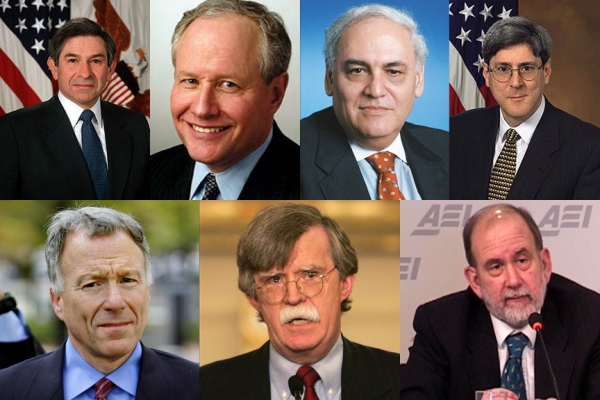
Surrounded by Neocons
They are all the news that fits
By Philip Giraldi • Unz Review • January 9, 2018
Award winning journalist James Risen has recently described in some detail his sometimes painful relationship with The New York Times. His lengthy account is well worth reading as it demonstrates how successive editors of the paper frequently cooperated with the government to suppress stories on torture and illegal activity while also self-censoring to make sure that nothing outside the framework provided by the “war on terror” should be seriously discussed. It became a faithful lap dog for an American role as global hegemon, promoting government half-truths and suppressing information that it knew to be true but which would embarrass the administration in power, be they Democrats or Republicans.
If one were to obtain a similar insider account of goings-on at the other national “newspaper of record”, The Washington Post, it is quite likely that comparable trimming of the narrative also took place. To be sure, the Post is worse than the Times, characterized by heavily editorializing in its news coverage without necessarily tipping off the reader when “facts” end and speculation begins. In both publications, stories about Iran or Russia routinely begin with an assertion that Moscow interfered in the 2016 U.S. election and that Iran is the aggressor in the Middle East, contentions that have not been demonstrated and can easily be challenged. Both publications also have endorsed every American war since 2001, including Iraq, Libya and the current mess in Syria, one indication of the quality of their reporting and analysis.
A recent op-ed in the Times by Bret Stephens is a perfect example of warmongering mischief wrapped in faux expert testimony to make it palatable. Stephens is the resident neocon at the Times. He was brought over from the Wall Street Journal when it was determined that his neocon colleague David Brooks had become overly squishy, while the resident “conservative” Russ Douthat had proven to be a bit too cautious and even rational to please the increasingly hawkish senior editors.
Stephens’ article, entitled Finding the Way Forward on Iran sparkles with throwaway gems like “Tehran’s hyperaggressive foreign policy in the wake of the 2015 nuclear deal” and “Real democracies don’t live in fear of their own people” and even “it’s not too soon to start rethinking the way we think about Iran.” Or try “A better way of describing Iran’s dictatorship is as a kleptotheocracy, driven by impulses that are by turns doctrinal and venal.”
Bret has been a hardliner on Iran for years. Early on in this op-ed he makes very clear that he wants it to be dealt with forcibly because it has “centrifuges, ballistic missiles, enriched uranium [and] fund[s] Hezbollah, assist Bashar al-Assad, arm[s] the Houthis, [and] imprison[s] the occasional British or American citizen.” He describes how Iran is a very corrupt place run by religious leaders and Revolutionary Guards and proposes that their corruption be exposed so that the Iranian people can take note and rise up in anger. And if exposure doesn’t work, they should be hammered with sanctions. He does not explain why sanctions, which disproportionately hurt the people he expects to rise up, will bring about any real change.
Stephens cites two of his buddies Ken Weinstein of the Hudson Institute and Mark Dubowitz of the Foundation for the Defense of Democracies (FDD), who are apparently experts on how to squeeze Iran. Weinstein prefers exposing the misdeeds of the Mullahs to anger the Iranian people while Dubowitz prefers punitive sanctions “for corruption.”
The article does not reveal that Weinstein and Dubowitz are long time critics of Iran, are part of the Israel Lobby and just happen to be Jewish, as is Stephens. The Hudson Institute and the FDD are leading neocon and pro-Israel fronts. So my question becomes, “Why Iran?” The often-heard Israeli complaint about its being unfairly picked on could reasonably be turned on its head in asking the same about Iran. In fact, Iran compares favorably with Israel. It has no nuclear weapons, it does not support any of the Sunni terrorist groups that are chopping heads, and it has not disenfranchised hundreds of thousands of people that it rules over. The fact is that Iran is being targeted because Israel sees it as its prime enemy in the region and has corrupted many “opinion makers” in the U.S., to include Stephens, to hammer home that point. To be sure, Iran is a very corrupt place run by people who should not be running a hot dog stand, but the same applies to the United States and Israel. And there are lots of places that are not being targeted like Iran that are far worse, including good friend and ally of both Jerusalem and Washington, Saudi Arabia.
Oddly enough Stephens, Weinstein and Dubowitz do not get into any of that back story, presumably because it would be unseemly. And, of course and unfortunately, the New York Times opinion page is not unique. An interesting recent podcast interview by Politico‘s Chief International Affairs correspondent Susan Glasser with leading neoconservatives Eliot Cohen and Max Boot, is typical of how the media selectively shapes a narrative to suit its own biases. Glasser, Cohen and Boot are all part of the establishment foreign policy consensus in the U.S. and therefore both hate and fail to understand the Trump phenomenon. Both Cohen and Booth were vociferous founding members of the #NeverTrump foreign policy resistance movement.
Boot describes the new regime’s foreign policy as “kowtow[ing] to dictators and undermin[ing] American support for freedom and democracy around the world,” typical neocon leitmotifs. Glasser appears to be in love with her interviewees and hurls softball after softball. She describes Boot as “fantastic” and Cohen receives the epithet “The Great.” The interview itself is remarkably devoid of any serious discussion of foreign policy and is essentially a sustained assault on Trump while also implicitly supporting hardline national security positions. Cohen fulminates about “a very serious Russian attack on the core of our political system. I mean, I don’t know how you get more reckless and dangerous than that,” while Boot asks what “has to be done” about Iran.
Pompous ass Cohen, who interjected in the interview that “and you know, Max and I are both intellectuals,” notably very publicly refused to have any part in a Trump foreign policy team during the campaign but later when The Donald was actually elected suggested that the new regime might approach him with humility to offer a senior position and he just might condescend to join them. They did not do so, and he wrote an angry commentary on their refusal.
Hating Trump is one thing, but I would bet that if the question of a hardline policy vis-à-vis Russia or the Jerusalem Embassy move had come up Cohen and Boot would have expressed delight. The irony is that Trump is in fact pursuing a basically neocon foreign policy which the two men would normally support, but they appear to be making room for Trump haters in the policy formulation process to push the national security consensus even farther to the right. Indeed, in another article by Boot at Foreign Policy he writes “I applaud Trump’s decisions to provide Ukraine with arms to defend itself from Russian aggression, to recognize Jerusalem as the capital of Israel, to send additional U.S. troops to Afghanistan, and to accelerate former President Barack Obama’s strategy for fighting the Islamic State.” Cohen meanwhile applauds the embassy move, though he warns that Trump’s success in so doing might embolden him to do something reckless over North Korea.
Perhaps one should not be astonished that leading neocons appearing in the mainstream media will continue to have their eyes on the ball and seek for more aggressive engagement in places like Iran and Russia. The media should be faulted because it rarely publishes any contrary viewpoint and it also consistently fails to give any space to the considerable downside to the agitprop. It must be reassuring for many Americans to know that the Center for Disease Control and Prevention (CDC) is preparing itself to deal with the aftermath of a nuclear attack on the United States and it will be sharing information on the appropriate preparations with the American people. There will be a public session on how to prepare for a nuclear explosion on January 16th.
CDC experts will consider “planning and preparation efforts” for such a strike. “While a nuclear detonation is unlikely, it would have devastating results and there would be limited time to take critical protection steps,” the Center elaborated in its press release on the event.
That the United States should be preparing for a possible nuclear future can in part be attributed to recent commentary by the “like, really smart” and “very stable genius” who is the nation’s chief executive, but the fuel being poured on the fire for war is from the very same neocons who are featured in the mainstream media as all-purpose experts and have succeeded in selling the snake oil about America’s proper role as aggressor-in-chief for the entire world. It would be an unparalleled delight to be able to open a newspaper and not see Bret Stephens, Eliot Cohen, Max Boot or even the redoubtable Bill Kristol grinning back from the editorial page, but I suppose I am only dreaming.
Philip M. Giraldi, Ph.D., is Executive Director of the Council for the National Interest, a 501(c)3 tax deductible educational foundation that seeks a more interests-based U.S. foreign policy in the Middle East. Website is http://www.councilforthenationalinterest.org, address is P.O. Box 2157, Purcellville VA 20134 and its email is inform@cnionline.org.
Think Tank-Addicted Media Turn to Regime Change Enthusiasts for Iran Protest Commentary
By Adam Johnson | FAIR | January 5, 2018
Since the outbreak of mass demonstrations and unrest in Iran last week, US media have mostly busied themselves with the question of not if we should “do something,” but what, exactly, that something should be. As usual, it’s simply taken for granted the United States has a divine right to intervene in the affairs of Iran, under the vague blanket of “human rights” and “democracy promotion.” (The rare exception, such as an op-ed by ex-Obama official Philip Gordon—New York Times, 12/30/17—still accepted the premise of regime change: “I, too, want to see the government in Tehran weakened, moderated or even removed.”) With this axiom firmly established in Very Serious foreign policy circles, the next question becomes the nature, degree and scope of the “something” being done.
Leading the pack in the “do something” insta-consensus was the right-wing pro-Israel think tank Foundation for Defense of Democracies (FDD), which has overwhelmed the narrative. In the past five days, FDD has had op-eds in influential US outlets like the Wall Street Journal, New York Times, New York Post and Politico, and has been quoted in a dozen more. Its punditry was marked by cynical “support” for Iranian protesters, demagoguing of the Iranian “regime” and disgust with the Obama-era Joint Comprehensive Plan of Action (JCPOA), otherwise known as the Iran deal.
The scrapping of JCPOA has been the primary political charge of FDD for years, and it seems to see the recent unrest in Iran—and any subsequent crackdown—as the thin moral pretext it needs to justify snuffing out a treaty it’s long opposed. Thus FDD has eagerly jumped on the unrest, painting itself as the sigh of the oppressed.
Op-eds written or co-written by FDD staff in the past five days:
- “Iran’s Theocracy Is on the Brink” (Mark Dubowitz/Ray Takeyh, Wall Street Journal, 1/1/18)
- “Where We Can Agree on Iran” (Mark Dubowitz/Daniel Shapiro, Politico, 1/1/18)
- “Eruption in Iran: And It’s Not Just the Economy, Stupid” (Clifford D. May, Washington Times, 1/2/18)
- “The Worst Thing for Iran’s Protesters? US Silence” (Reuehl Marc Gerecht, New York Times, 1/2/18)
- “What Washington Can Do to Support Iran’s Protesters” (Richard Goldberg/Jamie Fly, New York Post, 1/2/18)
A sampling of quotes by FDD staff in news reporting:
- “Since Rouhani entered office, he has managed to inflate expectations with lofty rhetoric but has actually done little to change the reality of life on the ground in Iran,” said Behnam Ben Taleblu, an Iran expert at the Foundation for Defense of Democracies in Washington.” (Washington Post, 12/30/17)
- “‘Western governments should make it clear that the regime will be held responsible and will pay a price for any bloodshed,’ Mr. Dubowitz said.” (Wall Street Journal, 1/1/18)
- “‘[Trump’s] not going to want to waive sanctions and keep money flowing to dictators when there are people protesting in the streets,’ said Richard Goldberg, a former Senate Republican aide who helped design Iran sanctions and is now a senior adviser at the hawkish Foundation for Defense of Democracies.” (Politico, 1/2/18)
- “‘If there is a bipartisan bill that is ready for congressional action, that would go a long way toward persuading the president to issue the waivers,’ said Mark Dubowitz, the chief executive of the Foundation for Defense of Democracies. ‘If there’s not, what’s happening in Iran will give the president all the more reason to say, “I’ve had it with this deal.”’” (New York Times, 1/2/18)
FDD op-eds and quotes followed a similar formula: express outrage on behalf of the protesters, applaud Trump for his hypocritical defense of the right to protest, and push for increased sanctions against Iran—often while taking a swipe at the hated Iran deal.
FDD’s pro-Iranian people posture was rarely accompanied by an explanation of their ideological project. The outfit—funded by big-name pro-Israel billionaires like casino mogul Sheldon Adelson, Home Depot founder Bernard Marcus (who’s said that “Iran is the devil”) and Wall Street speculator Paul Singer—are largely presented as bespectacled academics calling balls and strikes without a particular agenda beyond their self-proclaimed “defense of democracies.” (The name ought to provoke some skepticism, given the group’s eagerness to enlist the hereditary dictatorship Saudi Arabia in its anti-Iranian crusade—LobeLog, 2/26/16.)
This problem is not unique to FDD; as FAIR (8/12/16) has noted before, the overreliance by the media on deeply conflicted think tanks that present as neutral but are, in reality, glorified lobbyists for a political cause or corporate cohort misleads readers on an institutional scale. (In FDD’s case, it’s Israel’s right wing; for the Center for Strategic and International Studies, it’s weapons contractors—FAIR.org, 5/8/17, 7/17/17.)
FDD, it’s worth noting, also worked closely with the Trump administration and CIA to curate documents implicating Iran in the 9/11 attacks, as part of a broader anti-Iran strategy that rogue DoJ lawyers spelled out in November in leaks to the Washington Post (11/17/17; FAIR.org, 11/24/17).

FDD’s Reuel Marc Gerecht has had stints at PNAC, AEI and the CIA
Occasionally, editors will note they are “conservative” or “hawkish,” but FDD is mostly presented as a quasi-academic and impartial observer. The average reader, for example, would probably be surprised to find out the FDD “fellow” expressing concern for The Iranian People™ in the Times, Reuel Marc Gerecht, has long joked about wanting to bomb these same Iranians. As Eli Clifton noted in LobeLog (1/4/18), in 2010 Gerecht quipped: “Counted up the other day: I’ve written about 25,000 words about bombing Iran. Even my mom thinks I’ve gone too far.”
Shouldn’t someone so self-admittedly obsessed with killing Iranians be disqualified from posing as their protector in a major US newspaper? Failing that, shouldn’t readers be alerted that Gerecht was the director in the late ’90s of the Middle East Initiative at the Project for the New American Century—the most prominent advocacy group for the invasion of Iraq, a war that left 500,000 to a million dead?
Think tank addiction for overworked and often myopic reporters and editors has rendered such glaring questions unaskable. FDD are the “experts,” and the “experts” are needed to drive the bulk of commentary, regardless of their well-documented ulterior motives.
Iran’s regime faces moment of truth
By M K Bhadrakumar | Indian Punchline | January 3, 2018
An unexpected side effect of the ongoing unrest in Iran is that it will consolidate the Turkish-Iranian entente in regional politics. The Turkish leadership has openly reached out to President Hassan Rouhani. Following up on the contact between the two foreign ministers on Tuesday and the statement by the Turkish Foreign Ministry, President Recep Erdogan telephoned Rouhani today to express Turkey’s solidarity.
While talking to a group of editors in Ankara today, Foreign Minister Mevlut Cavusoglu gently ticked off the US and Israel saying, “There are only two [world] figures who support protestors: Trump and Netanyahu. We are against such foreign interventions.” Cavusoglu added, “I have not seen any other world leader making such supportive statements. You may not like the regime but Iran’s president and government, apart from the religious leader, can only be changed through elections. And there are no objections about the security of elections [in Iran].”
Turkey did not have to go this far but it senses an imperative need to intervene. Turkey’s main concern will be Iran’s stability. Having said that, although Turkey is voicing open support for Iran in the current difficult period, it cannot be oblivious of the strong undercurrents playing out in Iran’s political economy. Erdogan has shown empathy for Rouhani’s approach – allowing the protests to take place peacefully without any intimidation by the state security agencies but effectively curbing any violent incidents. Rouhani told Erdogan that he hoped that the protests would end “within a few days.”
Even so, this ought to be a moment of truth for the Iranian regime. For the first time, perhaps, the unrest is largely among the downtrodden people who are losing hope in a better future under the existing regime. There is widespread resentment among poor people that the resources of the country are siphoned off by the ruling elites. The draft budget that was presented to the Majlis last month itself flagged a shocking misallocation of resources – Al-Mustafa International University (which propagates Shi’ism worldwide) has a budget that exceeds the combined budgetary allocation for the Ministry of Roads and Urban Development, Ministry of Labour and Social Affairs and the National Organization for Food and Drug.
There were high expectations among the poor people that following the signing of the nuclear deal in July 2015, the economic conditions would improve. They were jubilant when Zarif returned home after the nuclear deal and spontaneously thronged the airport to receive him. But two years down the line, these hopes have been dashed. The bazaar gossip is that billions of dollars in blocked funds lying in western banks that were returned to post-sanctions Iran have either been squandered away in overseas enterprises (Syria, Iraq, Lebanon, Yemen, etc.) or simply misappropriated by the religious establishment.
The current unrest is doomed to fizzle out. The absence of middle class (which is in the vanguard of all revolutions in history) guarantees it. Again, the lack of leadership among protestors would mean that “fatigue” would set in sooner or later. The wretched of the earth do not have the luxury to protest till eternity instead of eking out their daily livelihood to keep body and soul together.
What is the way forward? The people, clearly, want “change”. Arguably, they no longer have faith in the so-called “reformists”, either. On the other hand, Rouhani faces dogged opposition from entrenched interest groups who masquerade as “conservatives” or “principlists”. If the protests in 2009 (led by the middle class) were about political empowerment and had a narrow social base, this time around, the demand is ‘Where is my money?’ and the social base lies among the the downtrodden sections of society. Shockingly enough, the cry “Allahu Akbar” (God is great) was conspicuous by its absence throughout this turmoil, although it has been the signal tune of Iranian street politics ever since the Islamic Revolution in 1979.
The regime may be right up to a point in alleging that there has been foreign interference. But, hopefully, it will not become the alibi for postponing reforms. Certainly, the regime is in no immediate danger. But a challenging period lies ahead. Iran has crucial choices to make. Iran’s foreign policies should become an extension of its national policies, attuned to its development agenda – economic growth, job creation and alleviation of poverty – and to the creation of a just society. Geopolitics is not the priority for Iran today – it is nation-building.
Featured Video

Death Spikes & Rising Cancer In Our Youth Explained
or go to
Aletho News Archives – Video-Images
From the Archives
Politicians lie
By Mazin Qumsiyeh | Popular Resistance | August 18, 2013
There is no way to say this truth nicely: Politicians lie. That includes Japanese, American, Egyptian, Israeli, and Palestinian politicians! Is there something more common sense than that? Yet, so many citizens around the world believe their own politicians or wistfully acknowledge lies but think it is part of the job needed to run things. They believe even when politicians contradict themselves blatantly. This phenomenon is rather remarkable. It is a dissonance and disconnect from reality that many seem oblivious to. It is very dangerous because it can lead to accepting rationales for going to war. These can be deadly wars that lead to millions of lives lost as happened in what was called World War 1 and WW2. Even when incredible and declassified evidence abound, politicians continue to lie and old mythologies refuse to die. Here are just a few of the countless lies told to us over the past few decades… continue
Blog Roll
 Aletho News
- Ukrainian Soldiers, Potential Mercenaries: Have Gun, Will Travel!
- Burnham’s UN debut… A masterclass in British disinformation
- Iran flights continue despite US aviation sanctions
- Global Tipping Points Lead the World Into a State of Entropy
- The day-after at the White House: USA and Xi Jinping
- The Geopolitical Balance in the Red Sea: The UAE Being Displaced by New Players
- Iraqi resistance group vows to stage airport sit-ins over Iran aerial blockade
- Turkish parliament to review Saudi-Pakistan defense pact next month
- DEATH SPIKES & RISING CANCER IN OUR YOUTH EXPLAINED
- Iran offers Trump deal before US election
- If Americans Knew
- Deconstructing Netanyahu’s pants-on-fire UN rant – Daily Update
- Trump betrayed voters with his campaign lies and prioritized a foreign country once he took office
- Netanyahu calls Israel’s war in Gaza ‘opposite of genocide’ in UN speech to near-empty hall
- Settler Kidnappings: Torture, Sexual Abuse and Terrorisation of Palestinian Abductees as Israel Deepens Annexation of West Bank
- Gaza winter nears as 162,000 tents become unusable, raising fears of humanitarian crisis
- Netanyahu says, “It’s the opposite of genocide”; UN says Gaza economy is world’s ‘most severe crisis on record’ – Daily Update
- Israel’s US-Backed Assault on Gaza Has Created the ‘World’s Most Severe Economic Crisis on Record’: UN
- ‘Protecting U.S. Citizens’… From Israel
- ‘This is where I live now, the back of a truck’: a day in the life of a grandmother in Gaza
- In UN Speech, Iran’s President Displays Pictures of Children Killed by US, Brings Attention to Israel’s Nuclear Arsenal
- No Tricks Zone
- New Study: Earth And Venus Surface Warmth Largely Explained By Convection And Lapse Rate, Not CO2 Or Radiation
- 2025 Nature Paper Claiming Worsening Global Drought Gets RETRACTED …Heavily Flawed
- New Study: ‘Global Drought Shows No Detectable Recent Acceleration Under Climate Warming’
- Economic Masterminds: German Socialists Suggest Taxing Productivity Gains Stemming From Using AI
- The South China Sea Has Not Been Cooperating With The Climate Change Narrative
- Energy Crisis: Germany Enters Heating Season With Historically Low Gas Reserve Fill Levels
- New Study: The Antarctic Ice Sheet Gained Mass From 2020-2024 Due To Staggering Snow And Ice Accumulation
- Study: Ocean Heating Rates From Thousands Of Years Ago ‘Dwarf’ Modern Ocean Heating Rates
- Climate Extremists Target, Attack Large-Scale Power Grid Infrastructure In Germany!
- New Study: Antarctic Ice Melt Has Contributed Less Than 1 Centimeter To Sea Level Rise In The Last 30 Years

