After six years of fighting a brutal and long war against foreign-backed terrorist proxy forces, the Syrian army – and its allies – have made significant gains in recent months. The Syrian army’s recent triumphs include liberating many areas in the Homs province, reaching the Iraqi border in what was described as a “strategic turning point in the war,” in addition to securing the Aleppo province from ISIS. It is clear that the Syrian army has the upper hand in the conflict, a fact that the hawks in Washington, London, Brussels, Riyadh and Tel Aviv find too difficult to stomach.
As the Syrian army prevails on the ground, capturing territory from the militants in the process, hundreds of thousands of Syrians are returning to their homes. As Andrej Mahecic, the spokesperson for the United Nations High Commissioner for Refugees (UNHCR), the UN Refugee Agency, said in a press briefing at the end of June, many Syrians are returning “to their homes” partly due to a “real or perceived improvement in security conditions” in many regions recently liberated:
“[The] UNHC is seeing a notable trend of spontaneous returns to and within Syria in 2017. Aid agencies estimate that more than 440,000 internally displaced people have returned to their homes in Syria during the first six months of this year. In parallel, UNHCR has monitored over 31,000 Syrian refugees returning from neighbouring countries so far in 2017.
The main factors influencing decisions for refugees to return self-assisted mostly to Aleppo, Hama, Homs, Damascus and to other governorates are primarily linked to seeking out family members, checking on property, and, in some cases, a real or perceived improvement in security conditions in parts of the country.”
Although the conflict is far from over, and the rebuilding of Syria will likely cost hundreds of billions of dollars, many Syrians can now see the light at the end of the tunnel. The defeat of foreign-backed mercenaries and the stabilization of Syria has always been of central importance to help solve part of the refugee/migrant crisis that has gripped Europe in recent years.
Short of any extremely reckless action by the West and its allies, the Syrian army will continue to liberate large parts of the country from the foreign-backed militants, paving the way for more internally and externally displaced Syrians to return to their homes. In their desperation however, the enemies of Syria may again stage a false flag chemical weapons attack and blame it on the Syrian government, in an attempt to justify a major military intervention to turn the tide.
The Need to Resist Balkanization
The second option available to the enemies of Syria is to continue the agenda of attempting to Balkanize Syria into different micro-states and mini-states, with the West clearly using Kurdish factions in an attempt to further this strategy. Ideally, the enemies of Syria wanted to force regime change in Damascus and then Balkanize the country into multiple rump states, although with regime change looking increasingly unrealistic, Balkanization in itself has become a central objective of the West.
There is literally an abundance of evidence that supports the thesis that Balkanization is a major goal of the West and its allies. In 1982, Oded Yinon, an Israeli journalist who had close connections to the Foreign Ministry in Israel, wrote an article titled: “A Strategy for Israel in the Nineteen Eighties.” In the document, Yinon detailed how the “dissolution of Syria” into “ethnically or religiously unique areas” was a primary objective of Israel:
“Lebanon’s total dissolution into five provinces serves as a precedent for the entire Arab world including Egypt, Syria, Iraq and the Arabian Peninsula and is already following that track. The dissolution of Syria and Iraq later on into ethnically or religiously unique areas such as in Lebanon, is Israel’s primary target on the Eastern front in the long run, while the dissolution of the military power of those states serves as the primary short-term target. Syria will fall apart, in accordance with its ethnic and religious structure, into several states such as in present day Lebanon, so that there will be a Shi’ite Alawi state along its coast, a Sunni state in the Aleppo area, another Sunni state in Damascus hostile to its northern neighbor, and the Druzes who will set up a state, maybe even in our Golan, and certainly in the Hauran and in northern Jordan” (p.11, point 22).
A decade later, an article appeared in an extremely influential US publication which echoed the strategy advocated by Yinon. Published in the 1992 issue of Foreign Affairs, the magazine of the Council of Foreign Relations (CFR), the article was titled: Rethinking the Middle East, and was written by Bernard Lewis, the British-American historian, neoconservative and CFR member. In the article, Lewis outlines how many Middle East states could disintegrate into a “chaos of squabbling, feuding, fighting sects, tribes, regions and parties:”
“Another possibility, which could even be precipitated by fundamentalism, is what has of late become fashionable to call ‘Lebanonization.’ Most of the states of the Middle East—Egypt is an obvious exception—are of recent and artificial construction and are vulnerable to such a process. If the central power is sufficiently weakened, there is no real civil society to hold the polity together, no real sense of common national identity or overriding allegiance to the nation state.
The state then disintegrates—as happened in Lebanon—into a chaos of squabbling, feuding, fighting sects, tribes, regions and parties. If things go badly and central governments falter and collapse, the same could happen, not only in the countries of the existing Middle East, but also in the newly independent Soviet republics, where the artificial frontiers drawn by the former imperial masters left each republic with a mosaic of minorities and claims of one sort or another on or by its neighbours.”
In 2013, the former US Secretary of State and CFR member, Henry Kissinger, revealed his desire to see Syria Balkanized into “more or less autonomous regions” whilst speaking at the Ford School:
“There are three possible outcomes. An Assad victory. A Sunni victory. Or an outcome in which the various nationalities agree to co-exist together but in more or less autonomous regions, so that they can’t oppress each other. That’s the outcome I would prefer to see. But that’s not the popular view…. I also think Assad ought to go, but I don’t think it’s the key. The key is; it’s like Europe after the Thirty Years War, when the various Christian groups had been killing each other until they finally decided that they had to live together but in separate units. So that is the fundamental issue, and we’re beginning to move towards that” (from 27.35 into the interview).
Then at the end of 2015, Foreign Affairs published an article titled: Divide and Conquer in Syria and Iraq; Why the West Should Plan for a Partition. It was written by Barak Mendelsohn, an Associate Professor of Political Science at Haverford College and a Senior Fellow at the Foreign Policy Research Institute. In the article, he argues that the “solution” to the current crisis in Syria and Iraq is the Balkanization of these countries into multiple micro-states, creating an “independent Sunni state” (or Sunnistan) in the process:
“The only way to elicit indigenous support is by offering the Sunnis greater stakes in the outcome. That means proposing an independent Sunni state that would link Sunni-dominated territories on both sides of the border. Washington’s attachment to the artificial Sykes–Picots borders demarcated by France and Britain a century ago no longer makes sense. Few people truly believe that Syria and Iraq could each be put back together after so much blood has been spilled. A better alternative would be to separate the warring sides. Although the sectarian conflict between Sunnis and Shias was not inevitable—it was, to some extent, the result of manipulation by self-interested elites—it is now a reality.”
This is just a snapshot of the evidence that proves that the enemies of Syria want to Balkanize the country, with the Brookings Institution being another US think tank that has advocated this strategy, in one form or another, ad nauseam. Officials in Syria are well aware of this plan however, that is why the Syrian President, Bashar al-Assad, has repeatedly emphasised that he wants to recapture all of Syria.
July 8, 2017
Posted by aletho |
Ethnic Cleansing, Racism, Zionism, Timeless or most popular, Wars for Israel | Lebanon, Middle East, Syria, Zionism |
Leave a comment
TEL-AVIV – Senior Israeli politicians held talks on safe zone issues with US special envoy for the global coalition to counter Islamic State (terrorist group outlawed in Russia) Brett McGurk, telling him Israel would prefer to have US troops rather than Russian troops controlling Syrian deescalation zones, and US President Donald Trump’s administration is already considering this idea, but has not made any decision yet, Haaretz newspaper reported, citing three sources involved in the talks.
Israel voiced three main demands upon the US envoy: the separation of safe zone talks from the Astana talks; keeping Iran, Hezbollah and other Shiite militias away from the Israeli and Jordanian borders; and not playing any active role in controlling safe zones near its border.
“We’re in close contact with the Americans and they understand our positions and our concerns very well. We made it clear to the Americans and other parties that we want to see the entire package relating to the deescalation zones, not just a few details, and then we can decide what our position is,” one of the officials said, as quoted by the newspaper.
Russian President Vladimir Putin and Trump are expected to meet for the first time later Friday on the sidelines of the G20 summit to discuss key issues of the international agenda, including cooperation in the settlement of the Syrian crisis. On Thursday, Putin discussed the fight against terrorism and the situation in Syria with Israeli Prime Minister Benjamin Netanyahu in a telephone conversation.
July 7, 2017
Posted by aletho |
Illegal Occupation, Wars for Israel | Israel, Middle East, Syria, United States, Zionism |
Leave a comment
All the US has to offer to the people of Syria is not hope but destruction, not peace but war, a war that is no longer—and never was—just about Syria. With the passage of time, the actual nature of the war imposed on Syria has become self-evident. Therefore, what we are hearing from Washington these days is no longer sole emphasis on defeating terror outfits such as ISIS; it is rather an emphasis on extending the war beyond Syria to accomplish at least a regime change in Iran, the kind of which the US and its Arab and European allies have been seeking in Syria. ISIS has already attacked Iran once and there is no guarantee that such attacks wouldn’t take place in future in Iran or elsewhere beyond the Middle East. While the West is projecting ISIS’ extended reach to other regions as an outcome of the organization’s exit from Syria and Iraq, the chaos this extended reach would cause will then serve as an invitation, as it did in the case of both Iraq and Syria, to the US to extend its own military presence in the region. Already we have seen fresh deployment in Afghanistan and resumption of drone strikes in Pakistan, indicating the US’ intention of not leaving the region in the near or even distant future.
In this context, plans for an extended military stay in “Syraq” (Syria and Iraq) and even of extending the scope of the war are already being considered in the official US policy making circles. The Foreign Policy magazine reported in mind June that some policy makers in the White House were pushing for extending the Syrian front as a means to use the scenario to militarily confront Iran and finally settle score with the “nexus of evil.” According to the report,
“Ezra Cohen-Watnick, the senior director for intelligence on the National Security Council, and Derek Harvey, the NSC’s top Middle East advisor, want the United States to start going on the offensive in southern Syria, where, in recent weeks, the U.S. military has taken a handful of defensive actions against Iranian-backed forces fighting in support of Syrian President Bashar al-Assad.”
While the report mentions that the idea hasn’t yet found much support in the Pentagon, there is no gainsaying that within the Pentagon’s Syria strategy, there is enough scope for extending the war to the extent of militarily confronting pro-Assad forces, especially Iran. Its recent glimpse came when the US forces shot down an Iranian drone in Syria few days ago. And as Washington Post recently revealed, the US was already making unprecedented strikes against Assad regime and Iranian-backed militia forces and sending warnings to them that “they will not be allowed to confront or impede the Americans and their local proxy forces.”
On the other hand, the fact that the US is willing to go to any extent to protect the anti-Assad forces fighting under its nose is also evident from the way the US is still opposed to seeing Assad in power as Syria’s legitimate ruler. Two thing clearly point to this fact.
First, Nikki Haley, the US Ambassador to the United Nations, told House Foreign Affairs Committee on June 28 hearing that the US should decide on its role in Syria for the time when ISIS is driven out, “because a healthy Syria is not with Assad.” Ambassador Haley’s latest remarks at the hearing, titled “Advancing US Interests at the United Nations,” could indicate a possible change in America’s future objectives on Syria. She had previously said that Washington’s priorities in Syria had changed with the new administration, and the US would no longer focus on the removal of Assad.
Second thing that adds to this seeming policy shift is the way the White House is involved in propagating about yet another possible chemical attack in Syria by Assad. On June 26, the White House official stated that Syria was planning another chemical weapons attack and “would pay a heavy price” if it came to pass. Ambassador Nikki Haley quickly chimed in on Twitter saying that any further attack would “be blamed on Assad, but also on Russia and Iran who support him killing his own people.”
The above mentioned change in policy and the preparations being made for extending the war to Iran has also found some support within the Republican ranks. It was only few days ago when a Republican senator Tom Cotton was reported to have said that “the policy of the United States should be regime change in Iran.” The CIA has already expanded its Iranian covert operations (read: in the name of ISIS). The US secretary of state Rex Tillerson, in little noticed comments to the US Congress few days ago also called for “peaceful regime change” in Syria. It is, however, not sure what Tillerson meant by “peaceful”, for the history of US regime change interventions is filled with direct military interventions or covert operations.
Is then Iran the next overt target of the US and its allies? The answer to this intriguing development-in-the-making has to be in the affirmative. It is going to be the culmination of Trump’s policy of ‘isolation of Iran’ that he laid down during his recent visit to Saudi Arabia. There is no gainsaying that this extension of the Syrian war would find ready-made support among many Arab-Gulf states, who would see in this policy a ready-made opportunity to cordon off their only chief rival in the entire region. Not only would they jump on the American bandwagon but also willingly funnel billions of dollars, contributing to transforming the whole region into one living-hell, a hell that wouldn’t take much time to knock on their own doors.
July 5, 2017
Posted by aletho |
Deception, Militarism | Iran, ISIS, Middle East, Syria, United States |
Leave a comment
Hollywood buys into yet another lie

I actually forced myself to watch the documentary The White Helmets, which is available on Netflix. It is 40 minutes long, is of high quality cinematographically speaking, and tells a very convincing tale that was promoted as “the story of real-life heroes and impossible hope.” It is overall a very impressive piece of propaganda, so much so that it has won numerous awards including the Oscar for Best Documentary Short this year and the White Helmets themselves were nominated for the Nobel Peace Prize. More to the point, however, is the undeniable fact that the documentary has helped shape the public understanding of what is going on in Syria, delivering a Manichean tale that depicts the “rebels” as always good and Bashar al-Assad and his government as un-redeemably evil.
It has been reliably reported that celebrities like George Clooney, Justin Timberlake and Hillary Clinton really like the White Helmets documentary and have promoted it with the understanding that it represents the truth about Syria, but it is, of course, not the whole story. The film, which was made by the White Helmets themselves without any external verification of what it depicts, portrays the group as “heroic,” an “impartial, life-saving rescue organization” of first responders. Excluded from the scenes of heroism under fire is the White Helmets’ relationship with the al-Qaeda affiliated group Jabhat al-Nusra and its participation in the torture and execution of “rebel” opponents. Indeed, the White Helmets only operate in rebel held territory, which enables them to shape the narrative both regarding who they are and what is occurring on the ground. Because of increasing awareness of the back story, there is now a growing movement to petition the Academy of Motion Picture Arts and Sciences to revoke the Oscar based on the complete and deliberate misrepresentation of what the White Helmets are all about.
Exploiting their access to the western media, the White Helmets have de facto become a major source of “eyewitness” news regarding what has been going on in those many parts of Syria where European and American journalists are quite rightly afraid to go. It is all part of a broader largely successful “rebel” effort to manufacture fake news that depicts the Damascus government as engaging in war crimes directed against civilians.
The White Helmets have certainly saved some lives under dangerous circumstances but they have also exaggerated their humanitarian role as they travel to bombing sites with their film crews trailing behind them. Once at the sites, with no independent observers, they are able to arrange or even stage what is filmed to conform to their selected narrative. They have consistently promoted tales of government atrocities against civilians to encourage outside military intervention in Syria and bring about regime change in Damascus. The White Helmets were, for example, the propagators of the totally false but propagandistically effective claims regarding the government use of so-called “barrel bombs” against civilians.
The White Helmets were a largely foreign creation that came into prominence in the aftermath of the unrest in Syria that developed as a result of the Arab Spring in 2012. They are currently largely funded by a number of non-government organizations (NGOs) as well as governments, including Britain and some European Union member states. The United States has directly provided $23 million through the USAID (US Agency for International Development) as of 2016 and almost certainly considerably more indirectly. Max Blumenthal has explored in some detail the various funding resources and relationships that the organization draws on, mostly in Europe and the United States.
Former weapons inspector Scott Ritter has described how the White Helmets are not actually trained to do the complicated rescue work that they depict in their self-made videos, which have established their reputation by ostensibly showing them in action inside Syria, rescuing civilians from bombed out structures, and providing life-saving emergency medical care. As an expert in Hazardous Materials handling with New York Task Force 2 USAR team, Ritter reports that “these videos represent de facto evidence of dangerous incompetence or, worse, fraud… The bread and butter of the White Helmet’s self-made reputation is the rescue of a victim—usually a small child—from beneath a pile of rubble, usually heavy reinforced concrete… The techniques used by the White Helmets are not only technically wrong, but dangerous to anyone who might actually be trapped… In my opinion, the videos are pure theater, either staged to impress an unwitting audience, or actually conducted with total disregard for the well being of any real victims.”
Ritter also cites the lack of training in hazardous chemicals, best observed in the videos provided by the White Helmets regarding their activity at Khan Sheikhun on April 4th. He notes “As was the case with their ‘rescues’ of victims in collapsed structures, I believe the rescue efforts of the White Helmets at Khan Sheikhun were a theatrical performance designed to impress the ignorant and ill-informed… Through their actions… the White Helmets were able to breathe life into the overall narrative of a chemical weapons attack, distracting from the fact that no actual weapon existed….”
But perhaps the most serious charge against the White Helmets consists of the evidence that they actively participated in the atrocities, to include torture and murder, carried out by their al-Nusra hosts. There have been numerous photos of the White Helmets operating directly with armed terrorists and also celebrating over the bodies of execution victims and murdered Iraqi soldiers. The group has an excellent working relationship with a number of jihadi affiliates and is regarded by them as fellow “mujahideen” and “soldiers of the revolution.”
So by all means let’s organize to revoke the White Helmets’ Oscar due to misrepresentation and fraud. It might even serve as a wake-up call to George Clooney and his fellow Hollywood snowflakes. But the bigger take-away from the tale of the White Helmets would appear to be how it is an unfortunate repeat of the bumbling by a gullible U.S. government that has wrecked the Middle East while making Americans poorer and less safe. A group of “moderates,” in this case their propagandists, is supported with weapons and money to overthrow a government with which Washington has no real quarrel but it turns out the moderates are really extremists. If they succeed in changing regime in Damascus, that is when the real nightmare will begin for minorities within Syria and for the entire region, including both Israel and Saudi Arabia, both of which seem intent on bringing Bashar al-Assad down. And the truly unfortunate fact is that the Israelis and Saudis apparently have convinced an ignorant Donald Trump that that is the way to go so the situation in Syria will only get worse and, unless there is a course correction, Washington will again richly deserve most of the blame.
July 4, 2017
Posted by aletho |
Deception, Fake News, Film Review, Mainstream Media, Warmongering | Middle East, Netflix, Syria, United States, White Helmets |
Leave a comment
One of the most fascinating aspects of living under imperialism is the lexicon that this philosophy brings into existence. It’s called Empire-Speak. Given the complexity of this specialized language, it usually takes people years of education and training to master it.
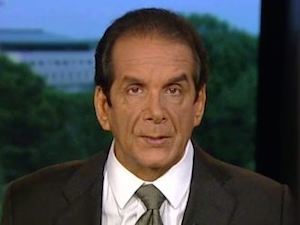
One of the finest examples of Empire-Speak appeared last week in a Washington Post op-ed by Post columnist Charles Krauthammer, who often appears as a commentator on Fox News. Krauthammer penned an op-ed entitled “The Great Muslim Civil War – and Us” that is an absolute masterpiece of Empire-Speak.
Comparing what is happening in the Middle East to Europe 1945, Krauthammer describes the “great Muslim civil war” that has enveloped the Middle East, which he writes, is “approaching its post-Islamic phase.” ISIS is about to be defeated on the battlefield, he writes, and the parties are now maneuvering, as they did after World War II, to “determine postwar boundaries and spheres of influence.” Once ISIS loses its hold on Mosul in Iraq and Raqqa in Syria, “the caliphate dies.”
So does that mean that the Pentagon and the CIA can finally declare victory in the Middle East and come home after more than 25 years of warfare in the Middle East? Does that mean that there can now be a ticker-tape parade in New York City honoring the victorious American forces?
Are you kidding? As Krauthammer points out, all that has gone before is just “the end of the beginning.” Things are just getting started. After all, as Krauthammer points out, “At stake is consolidation of the Shite Crescent.”
Who would have known? I’ll bet that 99 percent of Americans haven’t even heard of the “Shite Crescent” or that it’s being consolidated. Thank goodness we have Krauthammer and other people well-versed in Empire-Speak to tell us about it.
According to Krauthammer, the world is witnessing a gigantic battle between Shiite Muslims and Sunni Muslims.
Leading the Shiite side is Iran. Combined with Russia, Syria, Iraq, and Hezbollah (“which Krauthammer labels the “tip of the Iranian spear”), this is the so-called “Shiite Crescent.” According to Krauthammer, it poses a “nightmare for the entire Sunni Middle East.”
On the opposing side of this gigantic battle are the Sunnis, led by Saudi Arabia, Egypt, Jordan, and the United States. Needless to say, this is considered the good side of the war.
As I was reading through his op-ed, I kept hoping that Krauthammer would not omit one of my favorite terms in Empire-Speak: “the hegemon.” Isn’t that a great term? Whenever I hear an imperialist refer to the danger of the rise of a “regional hegemon,” I think of Transformers or Godzilla.
Krauthammer didn’t disappoint. He states that Syria is “the central theater of a Shiite-Sunni war for regional hegemony.” Moreover, Russia — yes, that Russia! — Krauthammer labeled “the outside hegemon.” OMG! Scary, right? Maybe even scarier than rise of communism and the Soviet Union, the two official enemies of the Cold War era.
What’s really going on here?
Krauthammer is simply preparing the American people for what lies ahead — more interventionism, more imperialism, more militarism, and more death and destruction at the hands of the US Empire. And, of course, more official enemies as old official enemies are defeated or disappeared.
You see, I bet you thought that once ISIS was defeated, the troops could finally be brought home and revel in their glorious victory. Sort of like “Mission Accomplished” after the US invasion of Iraq.
Not so. Undoubtedly expressing the mindset of the Pentagon, the CIA, and the rest of the US national-security establishment, Krauthammer is telling us that unfortunately we cannot rest. We must continue to soldier on, presumably until the Shiite Crescent is defeated and the world is no longer facing the possibility of a rise of a “regional hegemon.” And don’t even think for a moment that once that is accomplished, the war will finally be over. It will simply spell the beginning of the end of the beginning.
As I stated soon after the 9/11 attacks, the “war on terrorism” is going to be just like the war on drugs, where every drug lord they kill or capture is soon replaced by dozens more.
The real problem is that the US Empire keeps running out of official enemies. If we go back to the maneuvering after World War II to which Krauthammer refers, we see US officials converting their World War II partner and ally, the Soviet Union, to a new official enemy, one that necessitated, they said, the conversion of the federal government to a national-security state.
As we all know, for the next 45 years the Cold War was a bonanza for the Pentagon, the CIA, the NSA, and what President Eisenhower called the “military-industrial complex.” Ever-increasing budgets and powers. The best part, for them, was that it was never supposed to end. The Cold War was supposed to go on forever because communism and the Soviet Union were supposed to go on forever.
But life can be cruel. In 1989, the Soviet Union suddenly and unexpectedly dismantled itself, declared socialism a bankrupt philosophy, and unilaterally declared an end to the Cold War, thereby depriving the US Empire of its big official Cold War enemy.
No problem. A new official enemy was soon announced: Saddam Hussein, dictator of Iraq and former partner of the US Empire (just like Stalin had been). Throughout the 1990s, Americans obsessed over Saddam Hussein and how he was coming to get us and the rest of the world with his WMDs.
To oust Saddam from power, the Pentagon and the CIA began wreaking death and destruction in Iraq, including 11 years of sanctions that killed hundreds of thousands of Iraqi children.
That led to terrorist blowback and a new official enemy: “terrorism,” which ultimately enabled US officials to invade Iraq and oust their official enemy, Saddam Hussein, from power, and install a new regime in Iraq, a Shiite Muslim regime.
Over time, the “terrorists” have morphed into “the Muslims,” which are now viewed as the new official enemy.
Which brings us back to Krauthammer’s op-ed. If the Muslims are the new official enemy, how is that the United States is on the side of the Sunnis in what Krauthammer describes as a giant Muslim civil war that is now supposedly taking place? Aren’t Sunnis Muslims too?
Hmmm. So does this mean that we are no longer supposed to focus on Muslims in general or even “radical Muslims” or “extreme Muslims” but instead on “Shiite Muslims” as the new official enemy?
Oh, another thing Krauthammer doesn’t make clear: If we are now battling the Shiite Muslims, why did the US government use its invasion and occupation of Iraq to install a Shiite regime there? And why is it that US troops have been killing and dying for some 14 years to preserve the existence of that Shiite regime? Why are they still doing so? Were Americans wrong to thank the troops for their service in Iraq by bringing into existence a regime that is now part of the “Shiite Crescent,” which, according to Krauthammer, is now facing us on the field of battle?
Boy, imperialism sure is hard to learn and comprehend. Just like Empire-Speak.
July 3, 2017
Posted by aletho |
Mainstream Media, Warmongering, Wars for Israel | CIA, Iraq, Lebanon, Middle East, Syria, United States, Washington Post, Zionism |
Leave a comment
There is no defensive purpose to an aircraft carrier. Its entire purpose is to move aircraft to a position where they can attack other countries. As soon as they are equipped with attack aircraft, these carriers will spend most of their time around the Middle East, including at the UK’s brand new naval base in the vicious despotism of Bahrain. Having spent £7 billion on these behemoths, politicians will seek to enhance their prestige and demonstrate that they control a nation which is a “major power”, by using them. The very fact of their existence will make bombing attacks such as those we saw on Syria, Libya and Iraq more likely.
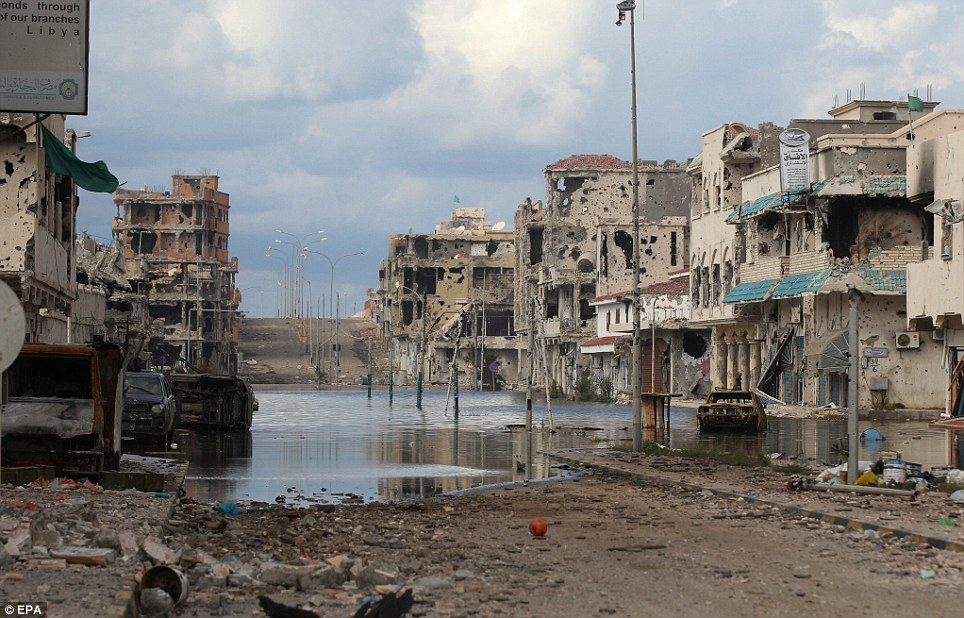
Sirte, Libya, after NATO bombing
That further twist in the cycle of violence will lead to more terrorist attacks in the UK. There is no sense in which this aircraft carrier is anything to do with defending the United Kingdom. It is a device to attack foreign countries. The result is it makes us a lot less safe at home.
When they think about it, people understand that, as YouGov demonstrated during the recent election campaign. The politicians will be trying to whip up feelings of jingoism and national pride around this huge hunk of floating hubris, to stop us thinking about that.
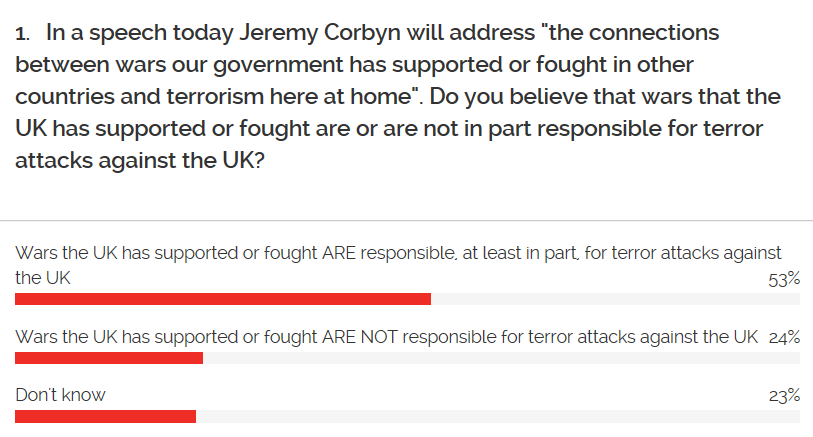
There is no money for our schools and hospitals, but unlimited sums for the armaments industry. The United Kingdom is not just a dysfunctional state, it is a rogue state and a danger to the peace of the world.
June 28, 2017
Posted by aletho |
Militarism, War Crimes | Bahrain, Libya, Middle East, UK |
Leave a comment
The United States has identified potential preparations for another chemical weapons attack by the Assad regime.
— Sean Spicer, White House Press Secretary, June 26, 2017
Fool me once, shame on you. Fool me, you can’t get fooled again.
— George Bush, September 17, 2002
The White House statement raises a number of questions. Who has identified the “potential preparations”? No reference is given, not even a source agency. Does the information come from intelligence sources? Apparently the Pentagon had not even been informed. What is “potential information” and how does it compare with real information?
Of course, the White House has its own direct sources. The Syrian opposition groups who met with John Kerry, Michael Ratney and Jon Finer at the UN in September, 2016 are tight with al-Nusra and other terrorist groups, and would be happy to provide a pretext for another US strike on Syria. No real evidence is required, but they would be happy to fabricate it nonetheless.
Can anyone cite a case of the use, or even the alleged use, of chemical weapons in Syria that has been to the strategic advantage of the Syrian government or its forces? The fact is that every incident has been to their disadvantage, and invariably a pretext for US intervention. Why then, would they use it, especially when they hadn’t done so before Obama drew his famous “red line”?
To the contrary, when British intelligence analyzed traces of the gas, they found it to be inconsistent with samples of Syrian government stocks. Furthermore, Turkish sources have reported the delivery of chemical weapons to opposition fighters. Distinguished MIT researchers Lloyd and Postol demonstrated definitively that the 2013 CW attack in Ghouta could not have come from Syrian government forces.
Similarly, Postol demonstrated multiple inconsistencies in the reports of the April 4, 2017 Khan Sheikhoun attack. More recently, investigative journalist Seymour Hersh uncovered the inside story on that attack, to the effect that US Defense Department sources knew that there were no chemical weapons used in the Syrian Air Force bombing attack on Khan Sheikhoun, and that to the extent that toxic gases caused casualties in that attack, it was the result of what the al-Nusra and Ahrar al-Sham fighters had stored at the site or had deployed as a false flag event, for the purpose of precipitating US intervention.
Postol warned at the time that without proper corroboration of Syrian government culpability, a US attack would motivate the terrorist constructors of the false flag to replicate more such incidents. In this context, the White House statement, based solely on vague allegations, can be interpreted as the start to a manipulation of public perception, so that an upcoming false flag event can appear to be a corroboration of the initial suspicions.
Such are the workings of what military and security forces call “securocratic wars” and specifically “security-based framing”. This is jargon for what used to be called propaganda, but which is now an integrated part of military and security planning for the control of public perception.1
There is plenty of reason for the White House to welcome such a pretext to attack Syria again. The approval ratings for the Trump Administration have never been higher, nor the press more approving, than when US warships fired 59 Tomahawk missiles at Syria’s Shu’ayrat Air Field two days after the Khan Sheikhoun attack. Given the unpopularity and failure of Trump’s domestic initiatives, it is easy to see how he might be tempted to employ similar death and destruction to boost his image again.
Of course, such actions risk a dangerous confrontation with Russia on the Syrian battlefield. Russia has already threatened to target US aircraft and has suspended coordination of flights over the shooting down of a Syrian jet fighter. But Trump is not averse to risk. We should therefore not be surprised to see another false flag killing of innocents blamed on the Syrian military in order to embroil the US further in an illegal war where we don’t belong.
Paul Larudee is one of the founders of the Free Gaza and Free Palestine Movements and an organizer in the International Solidarity Movement.
June 27, 2017
Posted by aletho |
Deception, False Flag Terrorism, Mainstream Media, Warmongering | Middle East, Syria, United States |
Leave a comment
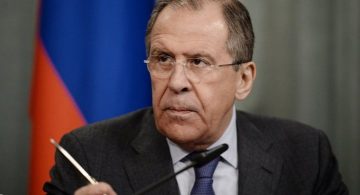 Russian Foreign Minister Sergei Lavrov has accused the United States of assisting terrorists in war-torn Syria, saying Washington is protecting the terror groups, including the Takfiri Fateh al-Sham terrorist group, formerly known as al-Nusra Front, from airstrikes.
The Russian top diplomat, as reported by Lebanon-based al-Manar television network, made the remarks on Monday, during a joint press conference with his Ethiopian counterpart, Workneh Gebeyehu, in Moscow, where they answered questions regarding combating terrorism.
Lavrov added that the US sponsorship of terrorists had recently came into light, when it was revealed that the White House helped Fateh al-Sham terrorists evade aerial bombardment conducted by Moscow and Damascus, without giving further details.
He noted that the alleged move by Washington violated all international conventions and laws, stressing the necessity of eliminating double standards and ambiguous ideas in the fight against terror groups.
Back in May, former Afghan president, Hamid Karzai, made similar comments, when he said that Washington had created the Takfiri Daesh terrorist group, another notorious terror organization active in Syria. “Daesh is a US product,” he said.
The ex-Afghan leader added that he had received regular reports of unmarked helicopters airdropping supplies to Daesh militants active on the Afghanistan-Pakistan border.
Lavrov’s comments came some eight days after a US Navy F/A-18 Super Hornet shot down a Syrian SU-22, which was conducting an operation against Daesh terrorists on the outskirts of the city of Raqqah.
In two other occasions in June and May, US warplanes attacked a Syrian military position near At-Tanf, killing an unspecified number of people and causing some material damage.
Reports say that many Daesh terrorists were initially trained by the CIA in Jordan in 2012 to destabilize the Syrian government.
In August last year, US President Donald Trump, then a presidential nominee, said that then US president, Barack Obama, and former secretary of state, Hillary Clinton, together “founded” the Daesh terror group.
June 26, 2017
Posted by aletho |
Timeless or most popular, War Crimes | Middle East, Syria, United States |
Leave a comment
Returning to Iraq After a Decade in Exile (Part One)
It should not be a secret to any independent and conscientious thinker, writer, or journalist that what has been happening in Syria since 2011 is nothing but complex and dirty attempts by multiple regional and global powers to “Iraqize” Syria by other means. But, alas, we have very few writers and journalists not on the payroll of the empire or the oppressive powers in today’s world. With few exceptions, most accounts and narratives I hear from and read by the so-called “journalists” and “experts” about Middle East affairs remind me of Upton Sinclair’s immortal words in his work, I, Candidate for Governor: And How I Got Licked, where he writes “It is difficult to get a man to understand something when his salary depends upon him not understanding it.”
What has been happening in Syria is nothing but an attempt to destroy the Syrian people, institutions, and society in order to restructure them in the image of the imperial, neocolonial players involved in this dirty war. The imperial and neocolonial force in our world today is concentrated in the hands of the few minority who have the American and most of the European political, economic, military, and media machine at their fingertips. In this sense, it is crucial to understand that what is happening around the world as a result of the Euro-American foreign policies is beyond the control of most American and European people at this point. Most Americans and Europeans are as unfree and suffocated as the Iraqi and the Syrian people in stopping this war machine that has caused irreparable damages to all parties affected. The only difference here is that the politically powerless and suffocated Americans and Europeans are not forced to live in refugee camps, which gives many the illusion of “privilege” and “democracy”, and therefore slows down any serious action to do something about what is going on. Yet most of the American people are crushed daily by the oppressive American economic system, working under slavery-like conditions, just to make it one day at a time, while the war machine is grinding millions of lives in different countries around the world, and under different pretexts. After living more than a decade in America now, I have come to accept that most of my fellow American citizens are as powerless as I am in influencing the American foreign policy, especially in the Middle East. Even more discouraging is that, by pointing out this reality, one is immediately labeled as “un-American”, “anti-American”, or other misleading adjectives and accusations to silence any voices seeking to change this bleak reality. This needs to be challenged by all of us, if we really want better lives and healthier societies.
Today I would like to share with you a “thick description” of how I saw and what I saw in Iraq when I returned to it after one decade in exile in 2015 to conduct a year-long anthropological research for my doctorate degree. I want to paint for you an image of what has become of Iraq, after more than a decade of its invasion, to hopefully give you some important clues as to why the Syrian war has been happening since 2011, and what kind of Syria do the involved neocolonial and imperial players want to create once they finish destroying Syria as we knew. I argue that the road to understanding the future of Syria goes through what has been happening in Iraq. It is the same game, with many of the same players involved. What is happening today has happened yesterday and will happen tomorrow also, unless we take serious steps to stop it.
***
After one decade in exile, I returned to Iraq seeking a better understanding of what happened, how it happened, and why it happened. I returned this time as a trained cultural anthropologist to conduct fieldwork on a population that has always had a significant impact on my life and memory—Iraq’s academics. After two previous researches in the UK and Jordan (2013-2014), I decided to spend one academic year in Iraq because I knew that the internally displaced academics trapped inside; those who weren’t “successful” or “fortunate” enough to escape wars and violence through the bottleneck, had so much to say about Iraq. After all, I am a child of wars, sanctions, and political upheavals. I know what it means to be trapped inside and what it means to slip through the bottleneck, without ever truly recovering from the wounds inflicted upon us inside the bottle. I opened my eyes in this world in the 1980s, with the then ongoing Iran-Iraq war. I witnessed much violence and destruction. I saw countless dead bodies during the First Gulf War. The thirteen years of the UN sanctions robbed me of the most beautiful childhood and teenage years. The 2003 invasion of Iraq just barely allowed me to safely finish my undergraduate studies at the University of Baghdad, before I had to eventually leave the country into exile in 2005 to escape death and violence. Because of all these experiences that could take multiple books to fill, I knew that my interlocutors, especially those academics trapped inside, whose lives are strongly tied to and shaped by political upheavals and power relations, had so much to say about the story of Iraq. Before the end of my first week in Iraq in 2015, my personal observations and experiences already started to paint a picture about the story this story was going tell. What I experienced from the moment I was at the airport in Sweden heading to Iraq in September 2015, until the end of the first week in Iraq proved to me that the personal is political and anthropological.
After a long journey with wars, moving, and exile, life has grounded me like coffee beans. My mother used to say that “coffee beans have less value as whole beans.” They must be painfully ground to become this delicious, stimulating, and awakening drink called “coffee”. After ten years in exile, here I was in Stockholm in September 2015 packing my bag to go back to Iraq. I couldn’t believe it was going to happen in less than 24 hours. I was anxious that entire day. I couldn’t sleep or do anything. I went out roaming. I greeted a stranger and had a short conversation. He turned out to be an Armenian in his twenties, thirsty for warm human connection after many lonely, long, and cold Scandinavian winters. He was delighted to meet an Assyrian Christian from Iraq. He invited me for a meal at a nearby Middle Eastern restaurant followed by a walk. It was an ideal way to spend those few hours before heading to the airport. I spoke little. He spent most of the time talking about how much he hated Turkey and the Turks; and how racist the Swedes are towards immigrants no matter how much they like to sugarcoat this fact and claim otherwise.
Towards the end of the evening, the Armenian stranger who was no longer a stranger, asked what I thought about “home” and “exile”, because he had been struggling with these ideas for years in Sweden. I told him that life has taught me that it is possible that things, ideas, concepts, and feelings can have the opposite meaning of what one might see at the surface. It was possible that people can be the opposite of what they claim to be. It was possible that “home” could signify “exile” or the other way around. Laughter may be tears in disguise. Revolutions may be yet other oppressive powers taking the carpet from under the feet of the current oppressive powers. Going to the top of the mountain may not really mean “going up”. It can in fact be a harsh form of falling; just as fame, cheers, and camera flashes have ultimately led to the demise of countless insecure and lonely souls on this planet. In brief, it was possible that everything we are told and taught is the opposite of what we think, or it might be outright false. I told him that I go through life remembering my mom’s oldest advice that “succeeding in an unjust world is the first sign of failure, because it means you’re cooperating with injustice.” I told him that I carry like a talisman around my neck André Gide’s words: “Fish die belly upward, and rise to the surface. It’s their way of falling.”
My new Armenian acquaintance took an interest in these reflections and asked that we should stay in touch. He walked with me to the door of the apartment building, we said goodbye like two old friends, and he vanished in the crowd as though the whole encounter was nothing but an escaping dream. I thought my year of research wrestling with home, exile, and displacement as some of the most political and politicized concepts of our time had already started in Stockholm.
***
The day was September 11, 2015. The place was Arlanda Airport in Stockholm. The time was an early hour in the morning. I was waiting in a line to check in my luggage into the flight that was going to land me in Erbil, Iraq. After an entire decade, here I was going back to see how the many people, places, and things I left behind had continued their lives (and deaths) in my absence. I reminded myself that just as I was changing in exile, so were all the people and things I left behind in Iraq. I reminded myself that it was going to be an encounter between two changed and constantly changing parties. I had to be prepared that some (or many) images of what Iraq used to be in my head may no longer exist.
The check-in line was long. I started looking at the faces of the people waiting, their looks, their clothes, and their luggage. The guy behind me had his headphones on with a traditional Turkman folklore song from Kirkuk blasting. I could hear the song oozing out of his headphones. It was a song that many of our Turkmen neighbors and friends in Kirkuk used to play at weddings. My ears immediately recognized the words: “beyaz gül kırmızı gül güller arasından gelir…” [White rose, red rose, she comes through roses]. I didn’t particularly like the song as a child, but I did at that moment because it was much more than a song. Time had transformed it into fossilized moments and faces of distant people, places, and moments that I may never see again, except in my daydreams. In front of me in the line there were two Kurdish families. They seemed to have just met at the airport. They were speaking in two different Kurdish dialects (Kurmanci and Sorani). These two groups usually don’t like each other, particularly since the intra-Kurdish struggle in the 1990s. But, I thought to myself, in exile people have no choice. They simply learn how absurd their differences at “home” were compared to what they endure in foreign lands. They learn how to love the remotest things, scents, and traces that remind them of a lost home and a lost life. The husbands were talking about how convenient it was to have a direct flight from Stockholm to Erbil, but they complained that the flight was too early. The wives were discussing the “right” age for children to start articulating their first words. Further down in line I saw a few guys joking and laughing loudly in a Baghdadi Arabic dialect. They were making sarcastic remarks without taking notice of anyone around them. I already felt like I was in a small version of the Iraq I knew and missed so much, though I knew this might not be the case when I arrive. Perhaps, the Iraq I knew is now more accessible in exile than it is possible at home.
Most passengers in the check-in line were Iraqis. Many were Kurds. Some were Arabs. I spotted a few Christian families. I heard two ladies speaking in my mother tongue, Aramaic, with a golden cross hanging around the neck of one of them. I overheard one talking about how a relative, a refugee in Lebanon, had just been accepted to immigrate to Australia. These conversations are hardly foreign to my ears. Before I left Iraq, many people were either talking about leaving or celebrating how some of their friends or relatives had left, hoping they would be next. Most people want to leave without even knowing whether they will ever “arrive” somewhere.
Ironically–or perhaps not–all the passengers had foreign passports in their hands, including myself. I spotted Swedish, Danish, German, and other EU passports. This, too, was hardly surprising to me. The effects of wars and everything that has happened to Iraq and the Iraqi people over the last few decades made the only way an Iraqi could be treated with dignity in Iraq and elsewhere is if they hold foreign—namely Western—passports. A “good” or a “fortunate” Iraqi can almost be defined as someone who holds a western passport. The Iraqi passport is paralyzing. Like its holders, it is a “suspect” in every airport, every checkpoint, and every point of entry. As an Iraqi, one is not welcome anywhere. One is almost questioned to death before allowed entrance to any country. However, one is always welcome to exit any place or port with no questions asked. Every authority and every official thinks they have the right to interrogate an Iraqi without a second thought. Iraqis know well that holding that useless document called an “Iraqi passport” is a curse at this point in history. But, of course, this is hardly the only such case. Most passport holders who come from nations whose people count as “the wretched of the earth” experience different forms of discrimination and exclusion. Some experiences are more severe than others. It is all about power, or lack thereof. Your passport has a power. It is not just a document that helps you pass, it can become a sign of humiliation preventing you from passing. Many Iraqis I know joke about the very words on the inside cover of Iraqi passports stating: “all competent authorities are requested to accord bearer of this passport protection to allow him/her all possible assistance in case of need.” Every place an Iraqi goes to, the opposite of this statement is what happens. These words are just one more example of how things can have the exact opposite meaning of their appearance as with “home” and “exile”, “peace” and “war”, “honesty” and “dishonesty”, and countless other words in different languages. I thought to myself how irritated I have become about my first language, my second language, my third language, and all the languages I speak. Words increasingly don’t mean what they are supposed to mean in all these languages. Languages are increasingly becoming tools for disguising ideas rather than disclosing them. It suddenly crossed my mind that perhaps one day I will be forced to put every single word I write in quotation marks. Nothing means what it is supposed to mean. I dreamt of a day and a world in which everyone means what they say and say what they mean.
When my turn came, the blonde, cordial, female Swedish employee checking passports and handing boarding passes looked at my American passport and asked “I see that you were born in Iraq. Do you have an Iraqi passport?” “No. It is expired,” I answered. She went on, “you know people over there are not crazy about American passports. Let me see your Iraqi passport, even if it’s expired.” She took a quick look, checked in my bag, and directed me to the designated gate. I couldn’t help thinking: why should she care? I am going to Iraq not coming from it. She would care more if the process was reversed, because it is more important to keep Sweden safe than Iraq. What if my passport was fake? What if I was a “terrorist”? It doesn’t matter. Perhaps it is better for “terrorists” to exit Europe than enter and cause problems. Is this why many of them are now in Syria? Moreover, her words were far from accurate. I know many American and Western expats living in Iraq and they love it there. I wondered whether she was fed too much propaganda about Iraq and the region.
***
I arrived in Erbil shortly after 10:30 am. After greeting the friendly Kurd female officer at the passport control in Kurdish, she stamped my passport and here I was officially in Iraq. As I was walking to the baggage claim area in the small and clean airport, I remembered that I had no one from my family or relatives to meet me. My immediate family members had all left Iraq over the last ten years because of the war. My relatives who are left there, from both parents’ sides, are not in that city and I hadn’t announced to most of them that I was coming. I wanted to land in the airport for real before I could surely tell anyone that I was in Iraq.
The only person who was waiting for me in the airport was my American brother-in-law. I wondered what the Swede who checked my passport at Arlanda would have thought about that. My American brother-in-law is a lovely and helpful guy. He came to Iraq after 2003, fell in love with the country, and decided that he would rather live in Erbil than in the U.S. He feels “freer” in Erbil, he often says. He is not alone in this feeling. Many expats I know love “third world” countries. Many don’t mind settling and getting married in them while the locals in these countries are escaping from all directions. The reason is simple: they are treated better than the local citizens in these “third world” countries and even better than the treatment they would receive in their “industrialized” countries in the “developed” world. Again, it is all about power. Who has it and where. Despite my gratitude that he had come to pick me up, I still found this ironic and painful. An American is the only one at the airport to pick me up at what was once my beloved country. It felt as though that complex line between “home” and “exile” was being challenged from the moment I returned to Iraq. I decided, however, that it wasn’t helpful to dwell on this thought. I decided not to let anything spoil my first intimate moments of embracing Iraq’s skies, lands, trees, roses, buildings, streets, faces, scents, and everyone and everything that has been living and growing in my imagination during the past decade in exile.
I spent the first couple of days in Erbil, mostly with my brother-in-law and some of his foreign expat friends who gave me some tips about life there. They shared things they knew better than me because they had been there and I hadn’t. I soon learned about the new malls, the best hotels, the residential buildings where many expats and rich locals live in places with names like the “English village”, the “Italian village”, the “Lebanese village”, and so on. I thought about how in every “third world” country that gets “liberated” from its dictators, the first things that go up are luxurious hotels and residential areas for Western expats and “experts”, along with gated communities from which to administer the newly formed governments in places like Baghdad’s Green Zone. The expats in Erbil also told me about things as simple as where to get a local sim card for my phone, where to get the best haircut, and the costs of basic foods.
I felt alienated on my first night. It was a feeling identical to how I felt on my first night in America ten years ago. I was lonely, thrown into a strange land. I went out that evening in the majority Christian district of Ankawa in the outskirts of Erbil to buy a sim card. It was a hot September evening. As I greeted the seller at the random shop I entered, he paused, stared at me, and asked: “Are you Louis?” “Yes I am. Wait, don’t tell me who you are. I think I also recognize your face, but I have to add ten years of change to it.” I recognized him. He was one of our old neighbors in Kirkuk. They had to move to Erbil as security deteriorated after 2003. That was a comforting first connection. It made me feel I am less a stranger than I thought. I am still remembered. I still exist. But that wasn’t enough. I wanted more closeness than an old neighbor to feel at home again. I immediately activated my sim card and called my aunt in Duhok, two and half hours north of Erbil. She could sense how sad my tone was on the phone and said, “I will be waiting for you tomorrow…” I went to the bus and taxi station in Erbil the next day to get a taxi and headed to Duhok, the place where I spent the early years of my childhood. A beautiful small city sandwiched between two mountains.
At around 1:30 pm, in the shared taxi heading to Duhok, the passengers were all friendly Kurds. I greeted the driver and the passengers in Kurdish and then started looking out the window to check out the scenery. I heard the two guys next to me saying: “thank God there are no Arab passengers in the taxi. Arab passengers always cause delays at the checkpoints.” As the taxi moved, I started checking out all the new buildings and neat streets in Erbil. It was clear from the old and the new infrastructure that whereas some people have gotten better off, others had gotten worse off, or simply stayed as they were. Infrastructure reveals so much about a place and its culture, politics, and people. The disparities between the poor and the rich neighborhoods in Erbil, in a sense, show that “time” wasn’t ticking at the same pace for everyone. Time wasn’t moving favorably for everyone. Even time is like power in that it moves some people forward, some backward, and some to the sides and the margins. Time also buries some people under the ground. I noticed many unfinished construction and apartment buildings. It looked as though there was an “economic boom” that was abruptly halted by unexpected circumstances made certain parts of the city look like dilapidated ghost towns. As we were exiting Erbil, at every traffic light we stopped, there were poor Syrian or Yazidi women and children begging drivers to buy gum, tissues, and other simple items. Some of these women of different ages ranging from 11 to 30 were so beautiful that it wouldn’t be surprising if they were forced to sell other things to get their meals for the day.
Over time, I discovered that many of the women living in tents and dilapidated and deserted buildings have been selling their bodies to make living. In Erbil’s well-known Christian district of Ankawa, I discovered by talking with taxi drivers, that many beauty salons have been turned into places where buyers (men) park their cars and wait to pick up internally displaced women who escaped ISIS-occupied parts of Iraq and Syria.
***
The driver taking us to Duhok was talking to the front seat passenger about how bad the economy was, there were no salaries for public sector employees, and so on. I understood that the bad economy had suddenly crippled the Iraqi Kurdistan region. Consequently, public sector employees (most people) were only getting salaries every few months due to deep divisions between Kurdistan and Baghdad. I heard some passengers talking about hopefully resolving oil problems with Baghdad soon so that things could improve. Baghdad has been withholding Kurdistan’s 17% share of oil revenues, because the latter has been drilling, extracting, and selling oil through “illegal” contracts with foreign companies without Baghdad’s permission. The Iraqi officials in Baghdad, the passengers explained, told the Kurds that if they want to get their share, they must share what they’re selling from their region with the central government. The refusal of the Kurd officials to abide by this and the fact that many of Kurdistan’s oil searches had been less promising than originally anticipated caused a serious economic problem in the region. This was the main topic the passengers discussed most of the trip.
As the taxi continued driving, I kept looking out the window checking out the many villages and small towns we passed through, as we left Erbil behind. Not much has changed in these villages and little towns, except one could see more “fancy” houses in the villagers’ standards. It was an indication that some individuals have been making a lot of money to renovate or build all these new houses. They looked expensive but also indicated a recently acquired financial capital. I noticed how many spaces that used to be beautiful and green agricultural lands on the way had turned into depressing, ugly, half-finished cement buildings. Furthermore, there was a clear disparity between how extravagant many individual houses looked versus the poor state of public services like sewage and streets, that were still exactly the same in most places since the Ba‘ath era. During its 35 years in power, the Ba‘ath regime had made serious efforts to modernize Iraq’s infrastructure in cities and villages. The road from Erbil to Duhok was the same since the Saddam years. It was narrow, dangerous, and filled with pit holes that have only worsened over the years. I saw a clear pattern of how most wealth was being used for individual rather than communal interests. These images reminded me of the anthropological literature we studied on “development”. Development looked so much like destruction.
My thoughts were interrupted when we stopped at a checkpoint—there were so many of them—and the officer asked everyone to present their IDs. I presented the only valid ID I had on me, my American passport. As soon as he looked at it, he asked me to get out of the car. He said to the officer next to him in Kurdish, “We need to check this to make sure it’s not a forged passport.” The checkpoint looked like a kiosk that barely had a wood cover on the top to protect them from Iraq’s unforgiving summer sun. I wondered with what they were going to check the “validity” of the passport when they didn’t seem to have any equipment or machines in place. I decided to just talk to them. I spoke in Kurdish and told the officer that I am from the region and I was just back after ten years in America, which is why I don’t have a valid local ID. My IDs had expired. As soon as I spoke in Kurdish and he heard my name, his tone changed 180 degrees, “Welcome home, my dear brother!” I went back inside the taxi and it drove away.
I told the driver the same brief story of why I had no valid local IDs and that I am a local of the region, so this helped for the rest of the trip. He did the talking on my behalf at the other checkpoints and everything went smoothly. I could only imagine how an Arab would feel and be treated when going through all these checkpoints where one could pass just by simply speaking Kurdish or be stranded even if they had valid IDs, but didn’t speak the language. In many ways, the language, the sect, and the ethnicity are the IDs in post-U.S. occupation Iraq–the “new Iraq”. In fact, at many checkpoints, I observed, that they wouldn’t even ask for an ID. The first thing they would do is to profile the person based on their face and language. If it became clear that they didn’t speak the language, they would be stranded and interrogated. I noticed over time that some displaced Arabs had learned what one might call “basic checkpoint Kurdish”. But even that was no guarantee for “passing”. The officers could recognize faces. Arabs or Arab-looking people were to be interrogated and even humiliated. Further, sometimes they would linger with the conversation and by the second or the third question, the Arab’s “checkpoint Kurdish” would become inadequate to carry on a conversation, and therefore create serious difficulties for them. Humans can become sophisticated over time to navigate power and its hurdles, but so does power. It is a two-way street. There is no break. One must keep reinventing themselves in this harsh world of power relations to survive.
My impressions from the first days and before even reaching Duhok was that the “new Iraq” was operating on ethnicity and sect; on language as a metonym for power and disempowerment; and on residency cards as a prerequisite for existence for those not from the northern region, especially Arabs. What all these elements have in common is their resemblance to the pan-Arabist project. In fact, today’s reality is a violently amplified and more intense version of the former pan-Arabism, which one would think was over. It wasn’t over. It was only passed on from some actors to others to implement this new project called “the new Iraq” or “the new Middle East” imposed and facilitated by the American invasion. There was a deep anti-Arab sentiment to the extent that it is a blessing not to be an Arab then and there.
Little did I know that these first observations and encounters from the early days were going to be central for understanding the lives of the internally displaced Iraqis in the region. Little did I know that exile and internal displacement for the interlocutors of my research project were first and foremost an expression of shifting power relations, which had turned them overnight from vital actors in the Iraqi society before 2003 into exiled, internally displaced, disempowered people whose lives are now tied to temporary contracts, residency cards, and living in a permanent state of fear and precariousness in what is supposed to be their own country. My first week in Iraq made it clear that the losses incurred by all Iraqi people are significant and ongoing. Therefore, it is only through tracing these losses from home to exile that we can understand the deeper meaning of these stories. Tracing back the story to “home” is to trace back the story of loss for these people to its early beginnings. The bleak reality of Iraq as a “home” reminded of the last part of a beautiful and sad poem titled “The Fortune Teller” by the great Syrian poet, Nizar Qabani, in which the fortune teller, speaking about the beloved woman of the man whose coffee cup she is reading says:
You will seek her everywhere, my son
You will ask the waves of the sea about her
You will ask the shores of the seas
You will travel the oceans
And your tears will flow like a river
And at the close of your life
You will find that since your beloved
Has no land, no home, no address
You have been pursuing only a trace of smoke
How difficult it is, my son
To love a woman
Who has neither land, nor home..
Louis Yako is an independent Iraqi-American writer, poet, cultural anthropologist, journalist, and researcher.
June 25, 2017
Posted by aletho |
Corruption, Timeless or most popular, Wars for Israel | Iraq, Middle East, Syria |
Leave a comment
The bloc of four Arab countries led by Saudi Arabia that imposed an embargo against Qatar on June 5 has finally presented their charter of demands. An AP dispatch, lists the 13 demands. The most striking demands include Doha reducing ties with Iran, severing relationships with Hezbollah and the Muslim Brotherhood, closing a Turkish military base in the country, and shuttering state broadcaster Al Jazeera and several news outlets.
Interestingly, Qatar is also expected to “consent to monthly audits for the first year after agreeing to the demands, then once per quarter during the second year. For the following 10 years, Qatar would be monitored annually for compliance.” All this means that abject, unconditional capitulation by Qatar only will satisfy its ‘big brothers’ – nothing less. By the way, there is also a timeline to comply – within the next 10 days – or else the demands get ratcheted up.
To my mind, Qatar will have no difficulty to see this is nothing short of a thinly-veiled push for ‘regime change’. The regime’s response can only be that these Arab bigwigs can go and hang themselves.
What happens next? Simply put, the (Sunni) Muslim Middle East is about to split and the historic schism will have profound consequences for regional and international security.
Make no mistake, this latest development also signifies a slap on the face for the Trump administration. Only last Tuesday, US state department warned Saudi Arabia to resolve the standoff without any further delay lest direct US intervention became necessary, doubting the stance taken by Riyadh (which is widely regarded as carrying the imprimatur of the new Crown Prince Mohammed bin Salman) and showing broad empathy with Qatar (where the US Central Command is headquartered.) Curiously, the US spokesperson also had alluded to Saudi Arabia’s past involvement in terrorism “whether it’s through terror financing or other means”.
Evidently, Saudi pride has been touched to the quick and Riyadh has taken exception to the US censuring. Without doubt, these demands are a show of defiance at Washington, too. This is all now going to become a protracted crisis in all likelihood, which will seriously debilitate the US’ regional strategies – unless of course Qatar crawls on its knees — and weaken its war against the ISIS.
To be sure, Turkey will take great exception to the Saudi demand that its so-called military base in Doha should be shut down unceremoniously. President Recep Erdogan will see this demand as an intolerable affront to Ottoman legacy. The VOA reported on Thursday that Turkey has been moving food and troops to Qatar in a big way.
Quite obviously, the crux of the matter is that the virus of Arab Spring is hibernating in Qatar and it threatens to become an epidemic someday again, threatening the autocratic regimes in the Middle East. Only Turkey, Iran and Israel are immune to the virus of democratic empowerment. Evidently, Al Jazeera and the Muslim Brotherhood are driving the sheikhs crazy in Saudi Arabia, UAE and Bahrain and threaten the military dictatorship in Egypt.
The credibility of the US on the ‘Arab Street’ is now irreparably damaged. For President Donald Trump all this becomes a big political embarrassment domestically. (Bloomberg ) It remains to be seen how the US can afford to sustain its belligerent posturing in Syria and Iraq much longer without any regional allies from the Arab world.
The Trump administration’s containment strategy against Iran seems destined to collapse even before its launch and Trump’s pet project of the ‘Arab NATO’ looks a macabre joke. Can the US ever restore its hegemony over the Muslim Middle East? Doubtful. A big slice of modern history of the western hegemony over Arabs is breaking away and drifting toward the horizon. To be sure, Russians are coming!
June 23, 2017
Posted by aletho |
Aletho News | Donald Trump, Hezbollah, Iran, ISIS, Middle East, Mohammed bin Salman, Qatar, Saudi Arabia, Syria, Turkiye, United States |
Leave a comment
Hezbollah Secretary General Sayyed Hassan Nasrallah says the crises in Middle East and North Africa serve the interests of the Israeli regime.
Nasrallah made the remarks in a speech on the occasion of the International Quds Day, which falls on the last Friday of the Muslim fasting month of Ramadan.
He noted that the commemoration of the International Quds Day is spreading across the world, saying more countries are observing the event since it was announced by the late founder of the Islamic Republic, Imam Khomeini.
Nasrallah said the main goal of the latest developments and wars in the region was to make regional countries accept Tel Aviv’s conditions. He added that the Israeli regime was taking advantage of the status quo in the region to marginalize the issue of Palestine.
‘Takfiri terrorists were born to topple Syrian government’
Also in his remarks, he said the Takfiri terrorist groups of Daesh and al-Nusra Front were formed by the United States and other countries to topple Syria’s government, which he described as an obstacle to any compromise that aimed to bring down the issue of Palestine.
He added that Daesh was sent to Iraq after the Baghdad government expressed unwavering support for resistance groups.
He said the Saudi war on Yemen was launched because Yemenis stood by the Palestinian people. Nasrallah added that the regime in Riyadh launched the war as there were movements in Yemen against Israel.
The Hezbollah secretary general praised Iran’s role as the main supporter of Palestine and resistance groups. He said Saudi Arabia was trying to isolate Iran in the region and take the war into Iran’s territory. He, however, said Riyadh was too weak and scared to launch such a war against Iran.
Nasrallah said Iran’s power and influence on regional issues were increasing.
He said Iran’s presence in Syria would be bolder, referring to its recent missile attack against Daesh targets in eastern Syria that killed many terrorists and destroyed their positions.
Nasrallah said Syria was steadfast in the axis of resistance.
‘Israel in no position to launch a new war’
Nasrallah also stated that Israel was participating in the war on Yemen, adding that its air force had conducted airstrikes on the impoverished country.
He said the Israeli regime sought to achieve its goal by launching proxy wars in the region.
The Hezbollah chief said Israel avoids a war on Lebanon or the Gaza Strip as it knows it will be expensive.
Elsewhere in his remarks, Nasrallah said the regimes that conspire against the resistance axis must know that they will fail to achieve anything.
June 23, 2017
Posted by aletho |
Ethnic Cleansing, Racism, Zionism, Timeless or most popular, Wars for Israel | Israel, Middle East, Zionism |
Leave a comment
Tehran’s strike was targeted at Islamic State but it also puts US bases in the region on notice and exposes the flimsiness of the Trump Administration’s Middle East policy
At its most obvious level, Iran’s missile attack on the Islamic State command centre in the Syrian city of Dier Ezzor on Sunday may be regarded as the demonstration of an extraordinarily innovative military capability.
Iran says it fired six ground-to-ground missiles from Islamic Revolutionary Guards Corps (IRGC) bases in Kermanshah and Kurdistan provinces, both in Western Iran, and that they “hit the targets in Deir Ezzur with high precision after flying through the Iraqi airspace.”
The footage shows that at least one of the missiles was of the Zolfaqar class and at least one more was of the Qiam class, both indigenously developed missiles. Zolfaqar is the latest generation of Iran’s mid-range missiles. It can hit targets up to 700 kilometres away and is capable of carrying a Multiple-Entry Vehicle payload. Qiam is a surface-to-surface cruise missile.
From all accounts, the missiles hit their target with devastating precision. Simply put, Iran has notified the US that its 45,000 troops deployed in bases in Iraq (5,165), Kuwait (15,000), Bahrain (7,000), Qatar (10,000), the UAE (5,000) and Oman (200) are highly vulnerable.
The Chief of Staff of Iran’s armed forces, Gen. Mohammad Hossein Baqueri, said on Monday: “Iran is among the world’s big powers in the missile field. They (read the US and its allies) don’t have the capability to engage in conflict with us at present, and of course, we don’t intend to involve in clashes with them, but we are in permanent rivalry with them in different fields, including the missile sector.”
Gen. Yahya Rahim Safavi, a military aide to Supreme Leader Ali Khamenei, had specifically forewarned Washington last Wednesday that “if the US decides to start any war against Iran, all its military bases in the region will experience insecurity.”
Clearly, the missile strike constitutes a snub to the US Senators who passed a bill on Friday imposing more sanctions against Iran over its missile program. It is also a defiant response to US Secretary of State Rex Tillerson’s ill-conceived remark on Wednesday that the Trump administration’s policy towards Iran includes “regime change”.
However, there are five other takeaways, all of which have downstream implications.
Wake-up call
For a start, the Iranian leadership seems to have concluded that the strategic restraint exercised over the past 3-4 years since negotiations on the nuclear issue began, is being misunderstood by the Trump team. On Sunday, Khamenei launched a vitriolic attack on US policies.
As Tehran sees it, the Trump team, which lacks experience in international diplomacy, might harbour notions that Iran’s moderation in recent years is a sign of weakness or lack of political resolve on the part of the moderate-reformist leadership of President Hassan Rouhani.
Most certainly, Tehran expects that its iron-fist display on Sunday will serve as a wake-up call to the Trump administration. This finds echo in the words of the influential Secretary of Iran’s Expediency Council Mohsen Rezayee, who is also a former IRGC commander: “After four years in office, Tillerson will come to understand Iran.”
Setting a precedent
Two, Iran has created a hugely consequential precedent. Make no mistake, Tehran will hit ISIS again, reckoning it to be “like a wild dog that we can annihilate easily along with its masters.” Of course, this will impact the overall military balance in both Syria and Iraq.
Again, if ISIS can be targeted, why not other extremist groups affiliated with al-Qaeda, some of which might be enjoying covert support from the US or its regional allies?
Quadrilateral cooperation
Three, the fact that Tehran coordinated Sunday’s missile strikes in advance with Russia, Iraq and Syria is an important signal in geopolitical terms and in regional politics. Centered around Baghdad, the quadrilateral mechanism involving these four countries has openly acknowledged that such coordination took place. It didn’t have to do that, but it did so with deliberation.
All-out rivalry
Four, against the backdrop of a series of unfriendly and provocative moves by the US against Iran in recent weeks at different levels, it is a fair assumption that Iran’s willingness to cooperate with the Trump administration on the path to a settlement in Syria is now virtually nil. Equally, it remains to be seen what follows next in Iraq after the liberation of Mosul.
Specifically, an all-out rivalry between the US and Iran can now be expected on the ground for control of the Syrian-Iraqi border and southern Syria. It will be a miracle now if the US beats Iran in the race to take control of the strategic city of Dier Ezzor, which has become an emblematic military front for the latter. Iranian statements claim that the terrorist attacks in Tehran on June 7 were masterminded and executed from the ISIS command center in Dier Ezzor.
US policy adrift
Finally, Washington now has no option left but to accept Russian help to stabilize the “de-confliction” zones in southern Syria bordering Jordan and the Golan Heights. Yet, incredibly enough, the Pentagon chose just this moment to provoke Moscow by shooting down a Syrian jet on Sunday – albeit a few hours ahead of the Iranian missile strike.
Moscow has put the Pentagon on notice that henceforth all American aircraft and flying objects in the Syrian air space will be treated as “targets”. Coming on top of the bizarre policy somersaults over Qatar in the past week, not to mention the fake arms deal with Saudi Arabia, the Trump administration’s Middle East policy looks adrift, lacking intellectual content and diplomatic acumen.
The veteran ex-CIA officer and Brookings scholar on the Middle East Bruce Riedel pondered aloud last week how an administration so abysmally lacking in talent and diplomatic experience could cope with a first-rate crisis situation such as a war in Gaza or Lebanon.
Of course, in immediate terms, it remains to be seen how the Trump administration handles the Iran sanctions bill given the latest developments. The Iranian Majlis plans to adopt counter-measures vis-à-vis the proposed US legislation, which it regards as a blatant violation of the matrix of understanding reached under the nuclear deal of July 2015.
June 21, 2017
Posted by aletho |
Timeless or most popular | Iran, Iraq, Middle East, Russia, Syria, United States |
Leave a comment

 Aletho News
