Israel: Amman embassy killer guard has diplomatic immunity
Press TV – July 24, 2017
Israel’s Foreign Ministry says its embassy security guard, who killed two Jordanians in the city of Amman, has diplomatic immunity under the Vienna Convention in response to Jordan demanding an investigation.
The security man shot dead a Jordanian who allegedly attacked him with a screwdriver at the Israeli embassy staff residence in Amman on Sunday and accidentally killed a second Jordanian.
The assailant was said to be delivering furniture to the building while the second victim was the property owner. The Israeli security guard only sustained light injuries in Sunday’s incident.
Jordanian authorities have refused to allow the guard to leave the country and demanded an investigation into the deadly shooting.
The Israeli Foreign Ministry, however, claimed in a statement on Monday that the guard had “acted in self-defense” and had immunity from questioning and prosecution.
Meanwhile, Israeli Prime Minister Benjamin Netanyahu was in contact with the head of the embassy and the guard, the statement read.
“The Foreign Ministry and security officials are working via different channels with the government of Jordan,” it added.
A security source in Amman said the first Jordanian, 17-year-old Mohammed Jawawdeh, succumbed to his injuries at the scene. The second, Bashar Hamarneh, a doctor who was in the residential quarter of the embassy at the time of the incident died of his injuries after midnight in hospital.
The incident came at a time of heightened tensions over Israel’s imposition of restrictive measures at the al-Aqsa Mosque compound in the occupied East Jerusalem al-Quds.
Palestinians say the restrictions are meant to expand the Tel Aviv regime’s control over the highly-sensitive site and change its status quo.
Jordan, the custodian of the compound, has protested the fresh Israeli measures.
Tensions erupted on July 14, when a deadly shooting took place outside the Haram al-Sharif which Jews call Temple Mount.
Following the incident, Israeli police briefly shut down the al-Aqsa compound and canceled Muslim Friday prayers at the holy site.
Israel reopened the compound on July 16, but with metal detectors and surveillance cameras put up at entrances.
American Armored Vehicles Are Pouring into Raqqa, But Who Are They For?
© East News/ Michael Curvin
Sputnik – 21.07.2017
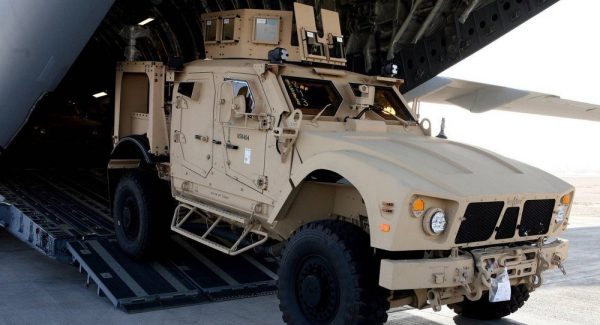
Footage has surfaced online depicting flatbed tracks laden with American armored military vehicles passing through Syria, with conflicting commentary claiming that the materiel was bound for use by either US-backed Syrian militant groups or US troops themselves fighting Daesh in the city of Raqqa.
The photos and videos were uploaded by Syrian Kurdish activists who are known affiliates of the Syrian Democratic Forces (SDF.) The vehicles included Mine-Resistant Ambush Protected (MRAP) vehicles, Mine-Resistant All Terrain Vehicles (M-ATVs) and armored bulldozers. They were mounted on the backs of flatbed trucks and were filmed passing through Qamishli, 170 miles northeast of Raqqa.
All three vehicle types were previously mentioned in Pentagon reports as assets being supplied to SDF fighters. “Up-armored vehicles have been delivered to the SDF and [Syrian Arab Coalition] as part of our existing authorities to enable them,” a spokesperson for US operations in Syria told Task & Purpose.
”Specifically, these vehicles will help them contend with [Daesh’s] IED threat in their current operation, and as they move to isolate [Raqqa].” Mine-resistant vehicles are deployed against areas known to hide improvised explosive devices, which are a major danger to American soldiers riding in armored vehicles. At least half of all US casualties in Iraq and Afghanistan have been attributed to IEDs.
However, the spokesperson went on to tell Task & Purpose that MRAPs and M-ATVs were “not part of the package that is divested to the SDF.” The Military Times noted that the M-ATVs were mounted with Common Remotely Operated Weapon Station (CROWs) systems, which allow for operators to fire the M-ATV’s mounted.50 cal machine gun without exposing themselves to enemy fire. CROWS systems also weren’t provided to SDF fighters.
Instead, the vehicles “are for use by the Coalition to protect our forces from IEDs.” In other words, the Pentagon claims these armored vehicles are for use by Western operators, not SDF militants.
Under the Trump administration, there has been an uptick in American support for the SDF, a coalition of various militias. Since June, the SDF have besieged Raqqa, Daesh’s final stronghold in Syria. Although Daesh has mounted intense resistance, the SDF has encircled the city and is slowly but surely gaining ground. The deeper the SDF go into the city, however, the stiffer the defenses they find awaiting them.
“The SDF has reportedly encountered intensified resistance and ‘better-emplaced defenses’ over the past four weeks following initial rapid gains in districts on the outskirts of [Raqqa],” read a new report from the Institute for the Study of War.
Although the US support for SDF operations is common knowledge, the Pentagon has been very cagey about providing details of American operations. They only directly confirmed the presence of US advisers in Raqqa five weeks into the siege, for instance.
The largest and most prominent militia among them are the Syrian Kurdish People’s Protection Units (YPG). Turkey, a nominal US ally, considers the YPG to be a terrorist group, which the US denies. The Syrian Kurds and the Turkish military have become increasingly belligerent to one another, with some exchanges of gunfire along the Syrian-Turkish border. Ankara has stated in no uncertain terms that they will never support a Kurdish state on their border.
The armored vehicles may then serve a purpose beyond helping to bring an end to the Daesh occupation. They may also be the Pentagon looking ahead to the wars of tomorrow.
Trump ends CIA arms to Salafists in Syria
By Adam Garrie | The Duran | July 19, 2017
Today, two reports emerged within minutes of each other which indicate that under Donald Trump, the United States has fully shifted its policies in Syria away from arming and aiding Salafist/jihadist terrorist fighters and is now allying exclusively with Kurdish.
To a less extent, America is also politically allied with Russia in a limited capacity in south western Syria, something which is more significant due to the shift it represents rather than in terms of size or scope.
Here are the key events:
1. US media reports that Trump ends CIA arming of terrorists
The deeply anti-Trump Washington Post has reported the following,
“President Trump has decided to end the CIA’s covert program to arm and train moderate Syrian rebels battling the government of Bashar al-Assad, a move long sought by Russia, according to U.S. officials.
The program was a central plank of a policy begun by the Obama administration in 2013 to put pressure on Assad to step aside, but even its backers have questioned its efficacy since Russia deployed forces in Syria two years later.
Officials said the phasing out of the secret program reflects Trump’s interest in finding ways to work with Russia, which saw the anti-Assad program as an assault on its interests. The shuttering of the program is also an acknowledgement of Washington’s limited leverage and desire to remove Assad from power”.
The report adds,
“Officials said Trump made the decision to scrap the CIA program nearly a month ago, after an Oval Office meeting with CIA Director Mike Pompeo and national security adviser H.R. McMaster ahead of a July 7 meeting in Germany with Russian President Vladimir Putin”.
While the Washington Post calls this a win for Russia, in reality this will not directly effect Russia one way or another. It is however, a win for Syria.
By most reasonable accounts, the conflict in Syria could have ended far earlier if not for the CIA and other US actors arming, funding and training Salafist jihadist fighters in Syria (often referred to as moderate rebels by the western mainstream media).
As even the Washington Post admits, almost in a gloating fashion, arming such jihadists was a flagship policy of the United States under Barack Obama.
This will take a substantial deal of pressure off the Syrian Arab Army and their fight against remaining terrorists in Syria.
Ever since Trump took office, the general trajectory of US meddling in Syria shifted from arming jihadists to arming, funding and working in close military coordination with Kurdish forces.
Today’s revelation simply affirms what was long the apparent on the ground policy of the United States since February of 2017.
It is key to remember that even after this announcement, the US presence in Syria is still illegal according to international law.
2. FSA jihadists withdraw from front-line in Raqqa
Almost simultaneous to the Washington Post report, Al-Masdar which is generally the most reliable source of on the ground information in Syria, reported the following,
“The Quwwat al-Nukhba sub-group of the Free Syrian Army (FSA), which fights within the US-backed Syrian Democratic Forces (SDF), has been dismissed from any and all front-line duties in the ongoing Raqqa operation.
About one week ago, word came out that the FSA-linked group was to give up its positions within Raqqa city and retreat to the SDF’s rear areas outside the urban center. However, contradictory reports then came in suggesting that a compromise was reached whereby the Arab faction could retain its positions within the city – this was supported by some photo evidence.
However, according to the latest reports, Quwwat al-Nukhba has officially withdrawn from all of its front-line positions within Raqqa city and handed them over to the Kurdish People’s Protection Units (YPG).
Information on why the Arab militia has been booted out of the operation remains officially unclear. Nonetheless, some sources suggest that the group showed repeated incompetence during Raqqa battle, advancing quickly within the city but then withdrawing from all gains, abandoning them to ISIS, almost as soon as they were taken.In any case, the United States – who has overall command of the SDF – represents the party that gave the order for the Arab FSA-linked faction to withdraw (perhaps at the behest of Kurdish recommendations).
This now means that the battle to capture Raqqa from ISIS has become an almost exclusively Kurdish operation”.
Raqqa is now officially a two-horse race between US backed Kurdish forces from the north and the Syrian Arab Army approaching from the west and from the south via Dier Ez-Zor, which is fast becoming a bigger hotspot of remaining ISIS fighters in Syria vis-a-vis Raqqa.
The upside of this for Syria is that the danger of a kind of semi-permanent style US funded Salafist insurgency is reduced to almost nil. This is especially true due to Syria’s strong central government vis-a-vis that of Iraq in the mid-2000s and into recent years.
With the US garrison in southern Syria located in At-Tanf now effectively cut off from the rest of the country via strong lines of control by the Syrian Arab Army and its allies, the US would have hit a logistical brick wall if it expended its resources continuing to arm increasingly encircled and materially ineffective jihadist groups like the FSA and its splinter groups and off-shoots.
This move also removes any scant Turkish influence from the race to Raqqa as the few FSA fighters participating in the surge represented the only people who are loyal to a group that is in great part, a Turkish proxy.
Thus, the American decision to force the withdrawal of the minor contingent of the FSA from front-line fighting in Raqqa is close to a de-facto admission that incorporating such jihadists into the final battle with the jihadists of ISIS would be an exercise in futility, one that Kurds themselves also likely oppose.
3. The Russia connection
At present, there is no overt linkage to these events and Donald Trump’s meeting at the G20 summit with Vladimir Putin. One can however, infer a conclusion that in order to work more effectively with Russia, the United States has dropped the last vestiges of support for jihadists such as the FSA, knowing that it would have reached a similar conclusion based on sheer logistics, even if Russia and the US did not strike a deal to mutually enforce the current ceasefire in south-western Syria along with Jordan.
In this sense, it is wise to remember that hyperbolic linkages of items 1 and 2 with the Trump-Putin meeting are at best circumstantial rather than causal–pragmatic rather than overtly strategic.
This still does not solve the crisis of what Kurdish forces might want as a result of their participation in the race for Raqqa, assuming they partly or wholly win the race.
Furthermore, if Kurds demand further concessions from Damascus including increased autonomy or even independence, many suspect that the United States will strongly back Kurdish demands rather than play the part of a neutral party. This would of course be opposed not only by Syria, Iraq and Iran but most strongly by Turkey which is a traditional US ally, although one which hardly sees eye-to-eye with the US on major Middle Eastern issues ranging from Qatar to Syria.
In this sense, the United States has chosen to infuriate Turkey further, make life slightly less difficult for Syria in terms of battle-field logistics, vaguely placate Russia and most importantly, declare an increased measure of loyalty to Kurds at the expense of the many anti-Kurdish actors in the region, including several technical US allies, namely both Turkey and Iraq.
Gulf Crisis: US Admits Fake News of Russian Hacking
By Finian CUNNINGHAM | Strategic Culture Foundation | 18.07.2017
In a sharp about-turn, US intelligence agencies are now accusing the United Arab Emirates for hacking into Qatar’s official news agency, thereby sparking the Gulf crisis between Washington’s Arab allies. The latest twist amounts to an admission that the US is guilty of previously broadcasting fake news blaming Russia.
This week, the Washington Post cites US intelligence officials when it reported Monday: «The United Arab Emirates orchestrated the hacking of Qatari government news and social media sites in order to post incendiary false quotes attributed to Qatar’s emir, Sheikh Tamim bin Hamad al Thani, in late May that sparked the ongoing upheaval between Qatar and its neighbors».
However, last month, on June 7, the American news outlet CNN had a completely different take on the Gulf crisis, when it blamed Russia for trying to sow division between US allies in the Persian Gulf. It reported in an «exclusive» article with the headline: US suspects Russian hackers planted fake news behind Qatar crisis.
That CNN report went on to claim: «US officials say the Russian goal appears to be to cause rifts among the US and its allies. In recent months, suspected Russian cyber activities, including the use of fake news stories, have turned up amid elections in France, Germany and other countries».
While CNN hinted that the alleged Russian hackers in the Gulf could have been criminal privateers, the thrust of its report last month very much pointed the finger of blame at the Russian government for hacking into the Qatar news agency. Using assertion, speculation and anonymous sources, the alleged Russian cyber-attack on Qatar was linked to alleged meddling by the Kremlin in the US presidential election last year.
«US intelligence has long been concerned with what they say is the Russian government’s ability to plant fake news in otherwise credible streams, according to US officials», reported CNN.
But now this week, US intelligence officials have changed their tune on who they think is whipping up the Gulf crisis. It is not Russia, it is the United Arab Emirates (UAE).
«[US] Officials became aware last week that newly analyzed information gathered by US intelligence agencies confirmed that on May 23, senior members of the UAE government discussed the plan and its implementation,» reports the Washington Post this week.
For over a month now, the UAE has aligned with Saudi Arabia and Bahrain to blockade Qatar, another member of the Gulf Cooperation Council (GCC). The crisis has become deadlocked with neither side willing to back down, much to the strategic concern of Washington. All of the monarchial energy-rich states are longtime allies of the US and together as a unit are a linchpin in maintaining the global petrodollar system. The other GCC members, Kuwait and Oman, have taken a neutral stance in the diplomatic crisis and have acted as brokers to resolve the dispute. Egypt, has joined with the Saudi-led bloc, to impose sanctions against Qatar.
The row blew up dramatically days after US President Donald Trump made an official state visit to Saudi Arabia on May 20-22. In exchange for a record $110-billion arms deals with the Saudi rulers, it seems clear that Trump gave the green light for the Saudis to instigate a blockade on Qatar. Ostensibly, the Saudis and the others are accusing Qatar of sponsoring terrorism and, they say, that is why they acted to isolate the neighboring gas-rich state. The absurd hypocrisy behind the accusation belies the real motive of petty rivalry among the Gulf monarchs. In particular, the Qatari-based Al Jazeera news network has been a bane for the Saudi and Egyptian rulers owing to its relatively independent and critical reporting on repression in those countries. Qatar’s support for the Muslim Brotherhood has also rankled the Saudis and Egyptians.
Two days after Trump flew out of Saudi on May 22, the official Qatari News Agency was hit with a fake news attack. Its news reports attributed statements to the Qatari emir, Sheikh Tamim bin Hamad al Thani, in which he praised Iran – the Shia arch-enemy of the US-backed Sunni monarchies – as well as making critical comments about Trump.
The whole debacle was an obvious set-up. Despite urgent notices from Qatar that its new agency had been hacked with fake news, the Saudi, Bahraini and Emirati media continued to prominently report the statements as if they were genuine, with the evident intention of smearing Qatar and provoking a stand-off.
The stage was then set for Saudi Arabia, UAE, Bahrain and Egypt to announce on June 5 a total embargo of commercial, media and transport links with Qatar «because of its support for terrorism and friendly relations with Iran».
US President Trump initially voiced support for the blockade on Qatar, claiming it as a success from his trip to Saudi Arabia.
«So good to see the Saudi Arabia visit with the King [Saudi King Salman] and 50 countries already paying off», Trump smugly declared through his Twitter feed. «They said they would take a hard line on funding extremism, and all reference was pointing to Qatar. Perhaps this will be the beginning of the end to the horror of terrorism!»
But ever since Trump set off the worst crisis in the Gulf among US allies, his top diplomat Rex Tillerson has been busy trying to calm the row.
Qatar serves as the base for US Central Command in the Middle East with an airbase housing 10,000 troops. American warplanes flying out of Qatar are the main strike force for operations in Iraq, Syria and Yemen. Strategic planners in Washington realize that the US cannot afford to alienate Qatar.
Tillerson has diverged noticeably from Trump’s simplistic broadside supporting Saudi Arabia, and has instead sought to bring Qatar back into the GCC fold. The US Secretary of State has hinted that the Saudi-led blockade is draconian and unrealistic. On June 23, Saudi Arabia and its partners demanded that Qatar shut down the Al Jazeera network along with a dozen other ultimatums. Qatar refused.
Last week, Tillerson had a frenetic week of shuttle diplomacy flying between Qatar and Saudi Arabia to get both sides to compromise. On Friday, July 14, the former Exxon CEO returned to the US deflated, unable to break the deadlock.
While traveling back to the US, Tillerson alluded to the strategic importance at stake for Washington in maintaining Gulf Arab unity. He said it is «really important to us from a national security standpoint. We need this part of the world to be stable, and this particular conflict between these parties is obviously not helpful».
This would explain why the US has now moved to expose the Saudi-led camp as being behind the fake news hack incident against the Qatari news agency.
That disclosure undermines the Saudi-led position. It confirms what the Qataris have been saying from the outset; namely, that they have been set up for a faux crisis by Gulf rivals, whose objective is to subjugate Qatari sovereignty under Saudi tutelage. Shutting down the «offensive» Al Jazeera news station being one of the desired outcomes.
By undermining the Saudis and UAE in this way, the US is wagering that it can lever the Saudis and the others GCC members into softening their demands on Qatar.
So keen are the US military and geopolitical planners to defuse the prolonged Gulf crisis – a crisis that threatens the petrodollar system – that they were obliged to come clean about the real identify of the perpetrators of the cyber attack on Qatar. That means dishing the dirt on the Saudis and UAE as the source of the hack, and abandoning the earlier claim that Russia was to blame.
CNN is once again caught out faking news about Russian hackers. At the time of its «exclusive» last month accusing Russia of destabilizing US allies in the Gulf, the news channel at least had the decency to quote Kremlin spokesman Dmitry Peskov on the claim.
Peskov said in the June 7 report: «It is another lie.. CNN again and again publish references to unnamed sources in unnamed agencies, etc, etc. These streams of information have no connection with the reality. It is so far away from the reality. Fake is a fake».
What the whole episode shows is not just how irresponsible US intelligence officials and major media are in publishing false claims defaming Russia. It also shows them as unscrupulous and expedient.
Just because the lingering Gulf crisis is spiraling to threaten US strategic interests, only then is there a sudden switch to a version of events that more accurately reflects reality. If it weren’t for US strategic concerns in the Gulf, the fake news put out about Russian hackers would no doubt continue. Which begs the question: if Russian hackers in the Gulf is fake news, then what does that say about similar claims of Russian hacking in the US?
Netanyahu Pushes Trump Toward Wider Wars
By Robert Parry | Consortium News | July 18, 2017
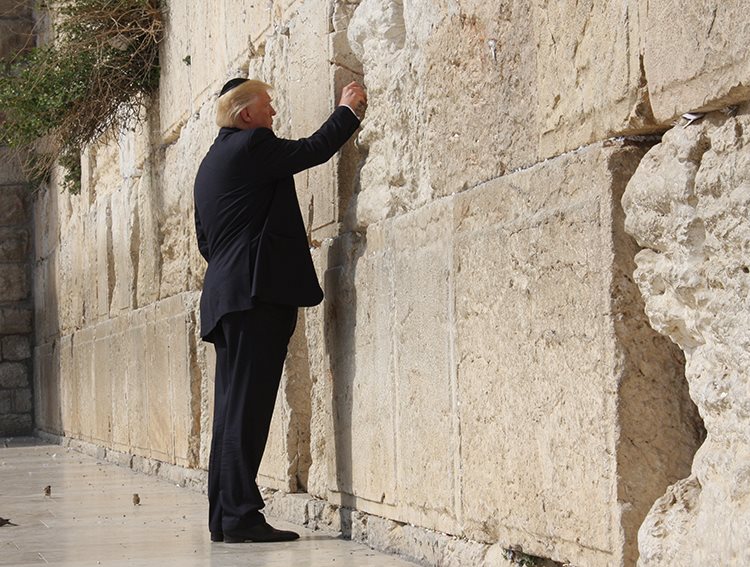
A weakened, even desperate President Donald Trump must decide whether to stand up to Israeli Prime Minister Benjamin Netanyahu or to repudiate the Syrian partial ceasefire, which Trump hammered out with Russian President Vladimir Putin on July 7.
(Official White House Photo by Dan Hansen)
Whether intentionally or not, this crossroads is where the months of Russia-gate hysteria have led the United States, making Trump even more vulnerable to Israeli and neoconservative pressure and making any cooperation with Russia more dangerous for him politically.
After meeting with French President Emmanuel Macron in Paris on Sunday, Netanyahu declared that Israel was totally opposed to the Trump-Putin cease-fire deal in southern Syria because it perpetuates Iranian presence in Syria in support of the Syrian government of President Bashar al-Assad.
Netanyahu’s position increases pressure on Trump to escalate U.S. military involvement in Syria and possibly move toward war against Iran and even Russia. The American neocons, who generally move in sync with Netanyahu’s wishes, already have as their list of current goals “regime changes” in Damascus, Tehran and Moscow – regardless of the dangers to the Middle East and indeed the world.
At the G-20 summit on July 7, Trump met for several hours with Putin coming away with an agreed-upon cease-fire for southwestern Syria, an accord that has proven more successful than previous efforts to reduce the violence that has torn the country apart since 2011.
But that limited peace could mean failure for the proxy war that Israel, Saudi Arabia, Turkey and other regional players helped launch six years ago with the goal of removing Assad from power and shattering the so-called “Shiite crescent” from Tehran through Damascus to Beirut. Instead, that “crescent” appears more firmly in place, with Assad’s military bolstered by Shiite militia forces from Iran and Lebanon’s Hezbollah.
In other words, the “regime change” gambit against Assad’s government would have backfired, with Iranian and Hezbollah forces arrayed along Israel’s border with Syria. And instead of accepting that reversal and seeking some modus vivendi with Iran, Netanyahu and his Sunni-Arab allies (most notably the Saudi monarchy) have decided to go in the other direction (a wider war) and to bring President Trump along with them.
Neophyte Trump
Trump – a relative neophyte in global intrigue – has been slow to comprehend how his outreach to Netanyahu and Saudi King Salman runs counter to his collaboration with Putin on efforts to defeat the Sunni jihadist groups, including Al Qaeda and Islamic State, which have served as the point of the spear in the war to overthrow Assad.
Al Qaeda and Islamic State have received direct and indirect support from Saudi Arabia, the Gulf States, Turkey, Israel and even the Obama administration, albeit sometimes unwittingly. To block Assad’s overthrow – and the likely victory by these terror groups – Russia, Iran and Hezbollah came to Assad’s defense, helping to turn the tide of the war since 2015.
In his nearly half year in office, Trump has maintained an open hostility toward Iran – sharing a position held by Washington’s neocons as well as Netanyahu and Salman – but the U.S. President also has advocated cooperation with Russia to crush Islamic State and Al Qaeda inside Syria.
Collaboration with Russia – and indirectly with Iran and the Syrian military – makes sense for most U.S. interests, i.e., stabilizing Syria, reversing the refugee flow that has destabilized Europe, and denying Al Qaeda and Islamic State a base for launching terror strikes against Western targets.
But the same collaboration would be a bitter defeat for Netanyahu and Salman who have invested heavily in this and other “regime change” projects that require major U.S. investments in terms of diplomacy, money and military manpower.
So, in last weekend’s trip to Paris, Netanyahu chose to raise the stakes on Trump at a time when Democrats and the U.S. mainstream media are pounding him daily with the Russia-gate scandal, even raising the possibility that his son, Donald Trump Jr., might be prosecuted and imprisoned for having a meeting in June 2016 with a Russian lawyer.
If Trump wants the Russia-gate pain to lessen, he will be tempted to give Netanyahu what he wants and count on the savvy Israeli leader to intervene with the influential neocons of Official Washington to pull back on the scandal-mongering.
The problem, however, would be that Netanyahu really wants the U.S. military to complete the “regime change” project in Syria – much as it did in Iraq and Libya – meaning more American dead, more American treasure expended and a likely wider war, extending to Iran and possibly nuclear-armed Russia.
That might fulfill the neocon current menu of “regime change” schemes but it runs the risk of unleashing a nuclear conflagration on the world. In that way, liberals and even some progressives – who have embraced Russia-gate as a way to remove the hated Donald Trump from office – may end up contributing to the end of human civilization as well.
Investigative reporter Robert Parry broke many of the Iran-Contra stories for The Associated Press and Newsweek in the 1980s.
The Myth of the Kurdish YPG’s Moral Excellence
By Stephen Gowans | what’s left | July 11, 2017
A barbed criticism aimed at the International Socialist Organization, shown nearby, under the heading “If the ISO Existed in 1865” encompasses a truth about the orientation of large parts of the Western Left to the Arab nationalist government in Damascus. The truth revealed in the graphic is that the ISO and its cognates will leave no stone unturned in their search for an indigenous Syrian force to support that has taken up arms against Damascus, even to the point of insisting that a group worthy of support must surely exist, even if it can’t be identified.
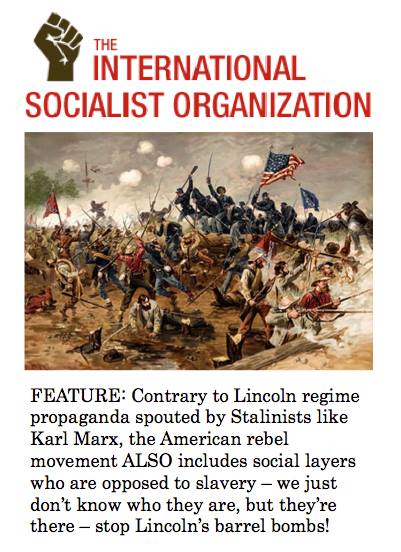
If the ISO existed in 1865.
Of course, Washington lends a hand, helpfully denominating its proxies in the most laudatory terms. Islamist insurgents in Syria, mainly Al Qaeda, were not too many years ago celebrated as a pro-democracy movement, and when that deception proved no longer tenable, as moderates.
Now that the so-called moderates have been exposed as the very opposite, many Leftists cling to the hope that amid the Islamist opponents of Syria’s secular, Arab socialist, government, can be found votaries of the enlightenment values Damascus already embraces. Surely somewhere there exist armed anti-government secular Leftists to rally behind; for it appears that the goal is to find a reason, any reason, no matter how tenuous, to create a nimbus of moral excellence around some group that opposes with arms the government in Damascus; some group that can be made to appear to be non-sectarian, anti-imperialist, socialist, committed to the rights of women and minorities, and pro-Palestinian; in other words, a group just like Syria’s Ba’ath Arab Socialists, except not them.
Stepping forward to fulfill that hope is the PKK, an anarchist guerrilla group demonized as a terrorist organization when operating in Turkey against a US ally, but which goes by the name of the YPG in Syria, where it is the principal component of the lionized “Syrian Democratic Force.” So appealing is the YPG to many Western Leftists that some have gone so far as to volunteer to fight in its units. But is the YPG the great hope it’s believed it to be?
Kurds in Syria
It’s difficult to determine with precision how many Kurds are in Syria, but it’s clear that the ethnic group comprises only a small percentage of the Syrian population (less than 10 percent according to the CIA, and 8.5 percent according to an estimate cited by Nikolaos Van Dam in his book The Struggle for Power in Syria. [1]
Estimates of the proportion of the total Kurd population living in Syria vary from two to seven percent based on population figures presented in the CIA World Factbook. Half of the Kurd community lives in Turkey, 28 percent in Iran and 20 percent in Iraq. A declassified 1972 US State Department report estimated that only between four and five percent of the world’s Kurds lived in Syria [2].
While the estimates are rough, it’s clear that Kurds make up a fairly small proportion of the Syrian population and that the number of the group’s members living in Syria as a proportion of the Kurd community as a whole is very small.

The PKK
Kurdish fighters in Syria operate under the name of the YPG, which is “tied to the Kurdistan Workers’ Party, or PKK, a radical guerrilla movement combining [anarchist ideas] with Kurdish nationalism. PKK guerrillas [have] fought the Turkish state from 1978” and the PKK is “classified as a terrorist organization by the European Union, Turkey and the U.S.” [3]
Cemil Bayik is the top field commander of both the PKK in Turkey and of its Syrian incarnation, the YPG. Bayik “heads the PKK umbrella organization, the KCK, which unites PKK affiliates in different countries. All follow the same leader, Abdullah Ocalan, who has been in prison in Turkey” [4] since 1999, when he was apprehended by Turkish authorities with CIA assistance.
Ocalan “was once a devotee of Marxism-Leninism,” according to Carne Ross, who wrote a profile of the Kurdish nationalist leader in The Financial Times in 2015. But Ocalan “came to believe that, like capitalism, communism perforce relied upon coercion.” Imprisoned on an island in the Sea of Marmara, Ocalan discovered “the masterwork of a New York political thinker named Murray Bookchin.” Bookchin “believed that true democracy could only prosper when decision-making belonged to the local community and was not monopolized by distant and unaccountable elites.” Government was desirable, reasoned Bookchin, but decision-making needed to be decentralized and inclusive. While anarchist, Bookchin preferred to call his approach “communalism”. Ocalan adapted Bookchin’s ideas to Kurd nationalism, branding the new philosophy “democratic confederalism.” [5]
Labor Zionism has similar ideas about a political system based on decentralized communes, but is, at its core, a nationalist movement. Similarly, Ocalan’s views cannot be understood outside the framework of Kurdish nationalism. The PKK may embrace beautiful utopian goals of democratic confederalism but it is, at its heart, an organization dedicated to establishing Kurdish self-rule—and, as it turns out, not only on traditionally Kurdish territory, but on Arab territory, as well, making the parallel with Labour Zionism all the stronger. In both Syria and Iraq, Kurdish fighters have used the campaign against ISIS as an opportunity to extend Kurdistan into traditionally Arab territories in which Kurds have never been in the majority.
The PKK’s goal, writes The Wall Street Journal’s Sam Dagher, “is a confederation of self-rule Kurdish-led enclaves in Iran, Iraq, Syria and Turkey” [6] countries in which Kurdish populations have a presence, though, as we’ve seen, an insignificant one in Syria. In pursuit of this goal “as many as 5,000 Syrian Kurds have died fighting alongside the PKK since the mid-1980s, and nearly all of YPG’s top leaders and battle-hardened fighters are veterans of the decades-long struggle against Turkey.” [7]
In Syria, the PKK’s goal “is to establish a self-ruled region in northern Syria,” [8] an area with a significant Arab population.
When PKK fighters cross the border into Turkey, they become ‘terrorists’, according to the United States and European Union, but when they cross back into Syria they are miraculously transformed into ‘guerrilla” fighters waging a war for democracy as the principal component of the Syrian Democratic Force. The reality is, however, that whether on the Turkish or Syrian side of the border, the PKK uses the same methods, pursues the same goals, and relies largely on the same personnel. The YPG is the PKK.
An Opportunity
Washington has long wanted to oust the Arab nationalists in Syria, regarding them as “a focus of Arab nationalist struggle against an American regional presence and interests,” as Amos Ma’oz once put it. The Arab nationalists, particularly the Ba’ath Arab Socialist party, in power since 1963, represent too many things Washington deplores: socialism, Arab nationalism, anti-imperialism, and anti-Zionism. Washington denounced Hafez al-Assad, president of Syria from 1970 to 2000, as an Arab communist, and regards his son, Bashar, who succeeded him as president, as little different. Bashar, the State Department complains, hasn’t allowed the Syrian economy—based on Soviet models, its researchers say—to be integrated into the US-superintended global economy. Plus, Washington harbors grievances about Damascus’s support for Hezbollah and the Palestinian national liberation movement.
US planners decided to eliminate Asia’s Arab nationalists by invading their countries, first Iraq, in 2003, which, like Syria, was led by the Ba’ath Arab Socialists, and then Syria. However, the Pentagon soon discovered that its resources were strained by resistance to its occupations of Afghanistan and Iraq, and that an invasion of Syria was out of the question. As an alternative, Washington immediately initiated a campaign of economic warfare against Syria. That campaign, still in effect 14 years later, would eventually buckle the economy and prevent Damascus from providing education, health care and other essential services in some parts of the country. At the same time, Washington took steps to reignite the long-running holy war that Syria’s Islamists had waged on the secular state, dating to the 1960s and culminating in the bloody takeover of Hama, Syria’s fourth largest city, in 1982. Beginning in 2006, Washington worked with Syria’s Muslim Brotherhood to rekindle the Brother’s jihad against Assad’s secular government. The Brothers had two meetings at the White House, and met frequently with the State Department and National Security Council.
The outbreak of Islamist violence in March of 2011 was greeted by the PKK as an opportunity. As The Wall Street Journal’s Yaroslav Trofimov recounts, “The PKK, once an ally of… Damascus… had long been present among Kurdish communities in northern Syria. When the revolutionary tide reached Syria, the group’s Syrian affiliate quickly seized control of three Kurdish-majority regions along the Turkish frontier. PKK fighters and weapons streamed there from other parts of Kurdistan.”[9] The “Syrian Kurds,” wrote Trofimov’s colleagues, Joe Parkinson and Ayla Albayrak, viewed “the civil war as an opportunity to carve out a self-governing enclave—similar to the one established by their ethnic kin in neighboring Iraq.” [10] That enclave, long backed by the United States and Israel, was seen as a means of weakening the Iraqi state.
Damascus facilitated the PKK take-over by withdrawing its troops from Kurdish-dominated areas. The Middle East specialist Patrick Seale, who wrote that the Kurds had “seized the opportunity” of the chaos engendered by the Islamist uprising “to boost their own political agenda” [11] speculated that the Syrian government’s aims in pulling back from Kurd-majority areas was to redirect “troops for the defence of Damascus and Aleppo;” punish Turkey for its support of Islamist insurgents; and “to conciliate the Kurds, so as to dissuade them from joining the rebels.” [12] The PKK, as it turns out, didn’t join the Islamist insurgents, as Damascus hoped. But they did join a more significant part of the opposition to Arab nationalist Syria: the puppet master itself, the United States.
By 2014, the PKK had “declared three self-rule administrations, or cantons as they call them, in northern Syria: Afreen, in the northwest, near the city of Aleppo; Kobani; and Jazeera in the northeast, which encompasses Ras al-Ain and the city of Qamishli. Their goal [was] to connect all three.” [13] This would mean controlling the intervening spaces occupied by Arabs.
A Deal with Washington
At this point, the PKK decided that its political goals might best be served by striking a deal with Washington.
The State Department had “allowed for the possibility of a form of decentralization in which different groups” — the Kurds, the secular government, and the Islamist insurgents — each received some autonomy within Syria. [14] Notice the implicit assumption in this view that it is within Washington’s purview to grant autonomy within Syria, while the question of whether the country ought to decentralize, properly within the democratic ambit of Syrians themselves, is denied to the people who live and work in Syria. If we are to take seriously Ocalan’s Bookchin-inspired ideas about investing decision-making authority in the people, this anti-democratic abomination can hardly be tolerated.
All the same, the PKK was excited by the US idea of dividing “Syria into zones roughly corresponding to areas now held by the government, the Islamic State, Kurdish militias and other insurgents.” A “federal system” would be established, “not only for Kurdish-majority areas but for all of Syria.” A Kurd federal region would be created “on all the territory now held by the” PKK. The zone would expand to include territory the Kurds hoped “to capture in battle, not only from ISIS but also from other Arab insurgent groups.” [15]
The PKK “pressed U.S. officials” to act on the scheme, pledging to act as a ground force against ISIS in return. [16] The group said it was “eager to join the U.S.-led coalition against Islamic State in return for recognition and support from Washington and its allies for the Kurdish-dominated self-rule administrations they [had] established in northern Syria.” [17]
The only people pleased with this plan were the PKK, the Israelis and the Americans.
“US support for these Kurdish groups” not only in Syria, but in Iraq, where the Kurds were also exploiting the battle with ISIS to expand their rule into traditionally Arab areas, helped “to both divide Syria and divide Iraq,” wrote The Independent’s veteran Middle East correspondent Robert Fisk. [18] Division redounded to the benefit of the United States and Israel, both of which have an interest in pursuing a divide and rule policy to exercise a joint hegemony over the Arab world. Patrick Seale remarked that the US-Kurd plan for Kurdish rule in northern Syria had been met by “quiet jubilation in Israel, which has long had a semi-clandestine relationship with the Kurds, and welcomes any development which might weaken or dismember Syria.” [19]
For their part, the Turks objected, perceiving that Washington had agreed to give the PKK a state in all of northern Syria. [20] Meanwhile, Damascus opposed the plan, “seeing it as a step toward a permanent division of the nation.” [21]
Modern-day Syria, it should be recalled, is already the product of a division of Greater Syria at the hands of the British and French, who partitioned the country into Lebanon, Palestine, Transjordan, and what is now Syria. In March, 1920, the second Syrian General Congress proclaimed “Syria to be completely independent within her ‘natural’ boundaries, including Lebanon and Palestine.” Concurrently “an Arab delegation in Palestine confronted the British military governor with a resolution opposing Zionism and petitioning to become part of an independent Syria.” [22] France sent its Army of the Levant, mainly troops recruited from its Senegalese colony, to quash by force the Levantine Arabs’ efforts to establish self-rule.
Syria, already truncated by British and French imperial machinations after WWI “is too small for a federal state,” opines Syria’s president Bashar al-Assad. But Assad quickly adds that his personal view is irrelevant; a question as weighty as whether Syria ought to become a federal or confederal or unitary state, he says, is a matter for Syrians to decide in a constitutional referendum, [23] a refreshingly democratic view in contrast to the Western position that Washington should dictate how Syrians arrange their political (and economic) affairs.
Tip of the US Spear
For Washington, the PKK offers a benefit additional to the Kurdish guerrilla group’s utility in advancing the US goal of weakening Syria by fracturing it, namely, the PKK can be pressed into service as a surrogate for the US Army, obviating the necessity of deploying tens of thousands of US troops to Syria, and thereby allowing the White House and Pentagon to side-step a number of legal, budgetary and public relations quandaries. “The situation underscores a critical challenge the Pentagon faces,” wrote The Wall Street Journal’s Paul Sonne; namely, “backing local forces… instead of putting American troops at the tip of the spear.” [24]
Having pledged support for Kurdish rule of northern Syria in return for the PKK becoming the tip of the US spear, the United States is “providing “small arms, ammunition and machine guns, and possibly some nonlethal assistance, such as light trucks, to the Kurdish forces.” [25]
The arms are “parceled out” in a so called “drop, op, and assess” approach. The shipments are “dropped, an operation [is] performed, and the U.S. [assesses] the success of that mission before providing more arms.” Said a US official, “We will be supplying them only with enough arms and ammo to accomplish each interim objective.” [26]
PKK foot soldiers are backed by “more than 750 U.S. Marines,” Army Rangers, and US, French and German Special Forces, “using helicopters, artillery and airstrikes,” the Western marionette-masters in Syria illegally, in contravention of international law. [27]
Ethnic Cleansing
“Large numbers of Arab residents populate the regions Kurds designate as their own.” [28] The PKK has taken “over a large swath of territory across northern Syria—including predominantly Arab cities and towns.” [29] Raqqa, and surrounding parts of the Euphrates Valley on which the PKK has set its sights, are mainly populated by Arabs, observes The Independent’s veteran foreign correspondent Patrick Cockburn—and the Arabs are opposed to Kurdish occupation. [30]
Kurdish forces are not only “retaking” Christian and Muslim Arab towns in Syria, but are doing the same in the Nineveh province of Iraq—areas “which were never Kurdish in the first place. Kurds now regard Qamishleh, and Hassakeh province in Syria as part of ‘Kurdistan’, although they represent a minority in many of these areas.” [31]
The PKK now controls 20,000 square miles of Syrian territory [32], or roughly 17 percent of the country, while Kurds represent less than eight percent of the population.
In their efforts to create a Kurdish region inside Syria, the PKK “has been accused of abuses by Arab civilians across northern Syria, including arbitrary arrests and displacing Arab populations in the name of rolling back Islamic State.” [33] The PKK “has expelled Arabs and ethnic Turkmen from large parts of northern Syria,” reports The Wall Street Journal. [34] The Journal additionally notes that human rights “groups have accused [Syrian and Iraqi Kurdish fighters] of preventing Arabs from returning to liberated areas.” [35]
Neither Syrian nor Democratic
The PKK dominates the Syrian Democratic Forces, a misnomer conferred upon a group of mainly Kurdish fighters by its US patron. The group is not Syrian, since many of its members are non-Syrians who identify as Kurds and who flooded over the border from Turkey to take advantage of the chaos produced by the Islamist insurgency in Syria to carve out an area of Kurdish control. Nor is the group particularly democratic, since it seeks to impose Kurdish rule on Arab populations. Robert Fisk dismisses the “Syrian Democratic Forces” as a “facade-name for large numbers of Kurds and a few Arab fighters.” [36]
The PKK poses as a Syrian Democratic Force, and works with a token force of Syrian Arab fighters, to disguise the reality that the Arab populated areas it controls, and those it has yet to capture, fall under Kurd occupation.
A De Facto (and Illegal) No Fly Zone
In August, 2016, after “Syrian government bombers had been striking Kurdish positions near the city of Hasakah, where the U.S. [had] been backing Kurdish forces” the Pentagon scrambled “jets to protect them. The U.S. jets arrived just as the two Syrian government Su-24 bombers were departing.” This “prompted the U.S.-led coalition to begin patrolling the airspace over Hasakah, and led to another incident… in which two Syrian Su-24 bombers attempted to fly through the area but were met by coalition fighter jets.” [37]
The Pentagon “warned the Syrians to stay away. American F-22 fighter jets drove home the message by patrolling the area.” [38]
The New York Times observed that in using “airpower to safeguard areas of northern Syria where American advisers” direct PKK fighters that the United States had effectively established a no-fly zone over the area, but noted that “the Pentagon has steadfastly refused to” use the term. [39] Still, the reality is that the Pentagon has illegally established a de facto no-fly zone over northern Syria to protect PKK guerillas, the tip of the US spear, who are engaged in a campaign of creating a partition of Syria, including through ethnic cleansing of the Arab population, to the delight of Israel and in accordance with US designs to weaken Arab nationalism in Damascus.
An Astigmatic Analogy
Some find a parallel in the YPG’s alliance with the United States with Lenin accepting German aid to return from exile in Switzerland to Russia following the 1917 March Revolution. The analogy is inapt. Lenin was playing one imperialist power off against another. Syria is hardly an analogue of Imperial Russia, which, one hundred years ago, was locked in a struggle for markets, resources, and spheres of influence with contending empires. In contrast, Syria is and has always been a country partitioned, dominated, exploited and threatened by empires. It has been emancipated from colonialism, and is carrying on a struggle—now against the contrary efforts of the PKK—to resist its recolonization.
The PKK has struck a bargain with the United States to achieve its goal of establishing a Kurdish national state, but at the expense of Syria’s efforts to safeguard its independence from a decades-long US effort to deny it. The partition of Syria along ethno-sectarian lines, desired by the PKK, Washington and Tel Aviv alike, serves both US and Israeli goals of weakening a focus of opposition to the Zionist project and US domination of West Asia.
A more fitting analogy, equates the PKK in Syria to Labor Zionism, the dominant Zionist force in occupied Palestine until the late 1970s. Like Ocalan, early Zionism emphasized decentralized communes. The kibbutzim were utopian communities, whose roots lay in socialism. Like the PKK’s Syrian incarnation, Labor Zionism relied on sponsorship by imperialist powers, securing their patronage by offering to act as the tips of the imperialists’ spears in the Arab world. Zionists employed armed conquest of Arab territory, along with ethnic cleansing and denial of repatriation, to establish an ethnic state, anticipating the PKK’s extension by armed force of the domain of a Kurdish state into Arab majority territory in Syria, as well as Kurd fighters doing the same in Iraq. Anarchists and other leftists may have been inspired by Jewish collective agricultural communities in Palestine, but that hardly made the Zionist project progressive or emancipatory, since its progressive and emancipatory elements were negated by its regressive oppression and dispossession of the indigenous Arab population, and its collusion with Western imperialism against the Arab world.
Conclusion
Representing an ethnic community that comprises less than 10 percent of the Syrian population, the PKK, a Kurdish anarchist guerrilla group which operates in both Turkey and Syria, is using the United States, its Air Force, Marine Corps, Army Rangers and Special Forces troops, as a force multiplier in an effort to impose a partition of Syria in which the numerically insignificant Kurd population controls a significant part of Syria’s territory, including areas inhabited by Arabs in the majority and in which Kurds have never been in the majority. To accomplish its aims, the PKK has not only struck a deal with a despotic regime in Washington which seeks to recolonize the Arab world, but is relying on ethnic cleansing and denial of repatriation of Arabs from regions from which they’ve fled or have been driven to establish Kurdish control of northern Syria, tactics which parallel those used by Zionist forces in 1948 to create a Jewish state in Arab-majority Palestine. Washington and Israel (the latter having long maintained a semi-clandestine relationship with the Kurds) value a confederal system for Syria as a means of weakening Arab nationalist influence in Arab Asia, undermining a pole of opposition to Zionism, colonialism, and the international dictatorship of the United States. Forces which resist dictatorship, including the most odious one of all, that of the United States over much of the world, are the real champions of democracy, a category to which the PKK, as evidenced by its actions in Syria, does not belong.
1. Nikolaos Van Dam, The Struggle for Power in Syria: Politics and Society under Assad and the Ba’ath Party, IB Taurus, 2011, p.1.
2. “The Kurds of Iraq: Renewed Insurgency?”, US Department of State, May 31, 1972, https://2001-2009.state.gove/documents/organization/70896.pdf
3. Sam Dagher, “Kurds fight Islamic State to claim a piece of Syria,” The Wall Street Journal, November 12, 2014.
4. Patrick Cockburn, “War against ISIS: PKK commander tasked with the defence of Syrian Kurds claims ‘we will save Kobani’”, The Independent, November 11, 2014.
5. Carne Ross, “Power to the people: A Syrian experiment in democracy,” Financial Times, October 23, 2015.
6. Dagher, November 12, 2014.
7. Dagher, November 12, 2014.
8. Dagher, November 12, 2014.
9. Yaroslav Trofimov, “The State of the Kurds,” The Wall Street Journal, June 19, 2015.
10. Joe Parkinson and Ayla Albayrak, “Syrian Kurds grow more assertive”, The Wall Street Journal, November 15, 2013.
11. Patrick Seale, “Al Assad uses Kurds to fan regional tensions”, Gulf News, August 2, 2012.
12. Seale, August 2, 2012.
13. Dagher, November 12, 2014.
14. David E. Sanger, “Legacy of a secret pact haunts efforts to end war in Syria,” the New York Times, May 16, 2016.
15. Anne Barnard, “Syrian Kurds hope to establish a federal region in country’s north,” The New York Times, March 16, 2016.
16. Dagher, November 12, 2014.
17. Dagher, November 12, 2014.
18. Robert Fisk, “This is the aim of Donald Trump’s visit to Saudi Arabia – and it isn’t good for Shia communities,” The Independent, May 18, 2017.
19. Seale, August 2, 2012.
20. Yaroslav Trofimov, “U.S. is caught between ally Turkey and Kurdish partner in Syria,” The Wall Street Journal, May 4, 2017.
21. Anne Barnard, “Syrian Kurds hope to establish a federal region in country’s north,” The New York Times, March 16, 2016.
22. David Fromkin, A Peace to End All Peace: The Fall of the Ottoman Empire and the Creation of the Modern Middle East, Henry Holt & Company, 2009, p. 437.
23. “President al-Assad to RIA Novosti and Sputnik: Syria is not prepared for federalism,” SANA, March 30, 2016.
24. Paul Sonne, “U.S. seeks Sunni forces to take militant hub,” The Wall Street Journal, April 29, 2016.
25. Dion Nissenbaum, Gordon Lubold and Julian E. Barnes, “Trump set to arm Kurds in ISIS fight, angering Turkey,” The Wall Street Journal, May 9, 2017.
26. Nissenbaum et al, May 9, 2017.
27. Dion Nissenbaum and Maria Abi-Habib, “Syria’s newest flashpoint is bringing US and Iran face to face,” The Wall Street Journal, June 15, 2017; “Syria condemns presence of French and German special forces in Ain al-Arab and Manbij as overt unjustified aggression on Syria’s sovereignty and independence,” SANA, June 15, 2016; Michael R. Gordon. “U.S. is sending 400 more troops to Syria.” The New York Times. March 9, 2017.
28. Matt Bradley, Ayla Albayrak, and Dana Ballout, “Kurds declare ‘federal region’ in Syria, says official,” The Wall Street Journal, March 17, 2016.
29. Maria Abi-Habib and Raja Abdulrahim, “Kurd-led force homes in on ISIS bastion with assent of U.S. and Syria alike,” The Wall Street Journal, May 11, 2017.
30. Patrick Cockburn, “Battle for Raqqa: Fighters begin offensive to push Isis out of Old City,” The Independent, July 7, 2017.
31. Robert Fisk, “This is the aim of Donald Trump’s visit to Saudi Arabia – and it isn’t good for Shia communities,” The Independent, May 18, 2017.
32. Dion Nissenbaum and Maria Abi-Habib, “U.S. split over plan to take Raqqa from Islamic state,” The Wall Street Journal. March 9, 2017.
33. Raja Abdulrahim, Maria Abi_Habin and Dion J. Nissenbaum, “U.S.-backed forces in Syria launch offensive to seize ISIS stronghold Raqqa,” The Wall Street Journal, November 6, 2016.
34. Margherita Stancati and Alia A. Nabhan, “During Mosul offensive, Kurdish fighters clear Arab village, demolish homes,” The Wall Street Journal, November 14, 2016.
35. Matt Bradley, Ayla Albayrak, and Dana Ballout, “Kurds declare ‘federal region’ in Syria, says official,” The Wall Street Journal, March 17, 2016.
36. Robert Fisk, “The US seems keener to strike at Syria’s Assad than it does to destroy ISIS,” The Independent, June 20, 2017.
37. Paul Sonne and Raja Abdulrahim, “Pentagon warns Assad regime to avoid action near U.S. and allied forces,” The Wall Street Journal, August 19, 2016.
38. Michael R. Gordon and Neil MacFarquhar, “U.S. election cycle offers Kremlin a window of opportunity in Syria,” The New York Times, October 4, 2016.
39. Michael R. Gordon and Neil MacFarquhar, “U.S. election cycle offers Kremlin a window of opportunity in Syria,” The New York Times, October 4, 2016.
Big Military Spending Boost Threatens Our Economy and Security
By Ron Paul | July 17, 2017
On Friday the House overwhelmingly approved a massive increase in military spending, passing a $696 billion National Defense Authorization bill for 2018. President Trump’s request already included a huge fifty or so billion dollar spending increase, but the Republican-led House found even that to be far too small. They added another $30 billion to the bill for good measure. Even President Trump, in his official statement, expressed some concern over spending in the House-passed bill.
According to the already weak limitations on military spending increases in the 2011 “sequestration” law, the base military budget for 2018 would be $72 billion more than allowed.
Don’t worry, they’ll find a way to get around that!
The big explosion in military spending comes as the US is planning to dramatically increase its military actions overseas. The president is expected to send thousands more troops back to Afghanistan, the longest war in US history. After nearly 16 years, the Taliban controls more territory than at anytime since the initial US invasion and ISIS is seeping into the cracks created by constant US military action in the country.
The Pentagon and Defense Secretary James Mattis are already telling us that even when ISIS is finally defeated in Iraq, the US military doesn’t dare end its occupation of the country again. Look for a very expensive array of permanent US military bases throughout the country. So much for our 2003 invasion creating a stable democracy, as the neocons promised.
In Syria, the United States has currently established at least eight military bases even though it has no permission to do so from the Syrian government nor does it have a UN resolution authorizing the US military presence there. Pentagon officials have made it clear they will continue to occupy Syrian territory even after ISIS is defeated, to “stabilize” the region.
And let’s not forget that Washington is planning to send the US military back to Libya, another US intervention we were promised would be stabilizing but that turned out to be a disaster.
Also, the drone wars continue in Somalia and elsewhere, as does the US participation in Saudi Arabia’s horrific two year war on impoverished Yemen.
President Trump often makes encouraging statements suggesting that he shares some of our non-interventionist views. For example while Congress was shoveling billions into an already bloated military budget last week, President Trump said that he did not want to spend trillions more dollars in the Middle East where we get “nothing” for our efforts. He’d rather fix roads here in the US, he said. The only reason we are there, he said, was to “get rid of terrorists,” after which we can focus on our problems at home.
Unfortunately President Trump seems to be incapable of understanding that it is US intervention and occupation of foreign countries that creates instability and feeds terrorism. Continuing to do the same thing for more than 17 years – more US bombs to “stabilize” the Middle East – and expecting different results is hardly a sensible foreign policy. It is insanity. Until he realizes that our military empire is the source of rather than the solution to our problems, we will continue to wildly spend on our military empire until the dollar collapses and we are brought to our knees. Then what?
Condemnation as govt bans report into who funds Britain’s extremists
RT | July 12, 2017
UK Home Secretary Amber Rudd has confirmed an already much-delayed report into the foreign funding and support of extremist groups in the UK will be banned from publication for “national security” reasons.
Rudd instead released a parliamentary written answer outlining the details of the report, which was commissioned by former Conservative Prime Minister David Cameron.
“Having taken advice, I have decided against publishing the classified report produced during the review in full,” she said.
“This is because of the volume of personal information it contains and for national security reasons.”
“We will be inviting privy counselors from the opposition parties to the Home Office to have access to the classified report on privy council terms.”
According to the Home Secretary’s summary, some key findings include that UK-based individual donors primarily fund extremist organizations in the UK, while some donations also came from overseas.
The report was finished six months ago, and it is thought its publication had been further delayed over government fears diplomatic links with principal Middle East ally Saudi Arabia would be at stake if had been implicated in the foreign financing of UK radical groups.
The summary said foreign aid helped individuals enter institutions that “teach deeply conservative forms of Islam and provide highly socially conservative literature and preachers to the UK’s Islamic institutions.”
Some of those individuals have since become of “extremist concern,” the report added.
The decision to permanently shelve the report has caused an outcry among opposition parties, with Liberal Democrat leader Tim Farron arguing that extremism can only be tackled if full information is released, regardless of what consequences there may be for the UK’s diplomatic ties abroad.
“We cannot tackle the root causes of terrorism in the UK without full disclosure of the states and institutions that fund extremism in our country.”
“Instead of supporting the perpetrators of these vile ideologies, the government should be naming and shaming them – including so-called allies like Saudi Arabia and Qatar if need be,” he said, according to Business Insider.
“It seems like the government, yet again, is putting our so-called friendship with Saudi Arabia above our values. This shoddy decision is the latest in a long line where we have put profit over principle.”
Green Party co-leader Caroline Lucas also blasted the “unacceptable decision” not to publish the report, warning that it fuels speculation the government wants to cover up Saudi Arabia’s terrorist funding.
“The statement gives absolutely no clue as to which countries foreign funding for extremism originates from – leaving the government open to further allegations of refusing to expose the role of Saudi Arabian money in terrorism in the UK,” Lucas said.
US-Russia ceasefire deal on Syria holding – for now
By M K Bhadrakumar | Indian Punchline | July 10, 2017
The ceasefire brokered between Russia, US and Jordan in south western Syria seems to be holding for the time being. The Russian President Vladimir Putin has said that he saw a new level of pragmatism in the US approach to Syria. President Donald Trump put his weight behind the ceasefire deal, posting on Twitter on Sunday, “Now it is time to move forward in working constructively with Russia.”
As for the US Secretary of State Rex Tillerson, the agreement “is our first indication of the U.S. and Russia being able to work together in Syria.” The National Security Advisor HR McMaster called the ceasefire a “priority” for Washington and acknowledged that the Trump administration is “encouraged by the progress made to reach this agreement (with Russia).”
So far so good. But there is good reason to harbor anxiety and keep the fingers crossed. Evidently, there isn’t much enthusiasm in the US media regarding Trump’s deal with President Vladimir Putin. And if Senator John McCain’s reaction to the Syria deal is any indication, there aren’t going to be many takers in Washington for the idea of Trump having anything to do with Putin at all. The air out there is simply toxic.
Equally, the past experience during the Obama administration (in the pre-civil war era before Trump’s victory) has been that what the US president and state secretary said might not be the last word for the US intelligence and defence establishment. The well-known ex-CIA analyst Ray McGovern has written an insightful piece in Consortiuim News on how the entrenched interest groups who thrive on wars might have an altogether different agenda of their own in the Syrian conflict. McGovern highlights a December 2016 interview with Boston Globe newspaper where the former state secretary John Kerry openly admitted that his efforts to deal with the Russians had been thwarted by none other than the then-Defense Secretary Ashton Carter. Incredible, isn’t it?
Then, there are other factors too. Tehran, for example, has given a delayed response to the US-Russia deal. It took 72 hours for the Iranians to say something at all – by the way, Saturday and Sunday are working days in Tehran. Even the best spin must take note that the Iranian reaction has been rather lukewarm.
Now, I haven’t seen any reaction to the US-Russia deal on Syria so far from Damascus or from the Hezbollah. On its part, Israel of course has outright rejected the Russian-American deal and has reserved the right to act independently. Curiously, there has been a vicious attack on state secretary Rex Tillerson in Bloomberg. It seems Tillerson has upset the Israeli lobby by piloting the deal with Russia on Syria and emerging as Trump administration’s point person on Russia.
While it is understandable that the Trump administration and Moscow have hyped up the development and would like to project the Syria deal as a ‘breakthrough’ in Russian-American relations, what cannot be overlooked is that there are multiple actors with interests of their own who are stakeholders in the Syrian situation. And, they are not going to bow out just like that in deference to the US and Russian wishes/advice.
In fact, Tillerson himself has since spoken harshly about President Bashar Al-Assad, categorically ruling out any US/Western financial support for Syria’s reconstruction so long as he remains in power in Damascus. On the contrary, it seems unlikely that the Syrian government forces and their allies will be stopped on their tracks in their military campaign to regain control over the entire country. True, the Russia air support is vital for their campaign to make rapid progress, but then, this is a two-way street, and Russia too cannot do without its allies in Syria.
Finally, Russian diplomacy has a history of overreaching. It is extremely unlikely that Russia’s allies in Syria are going to feel thrilled over the ‘breaking news’ that King Salman of Saudi Arabia is heading for Russia this month, and that Moscow feels excited that the Saudi-Russian relations are poised for a historic makeover. Of course, Russia has an impressive record of coping with contradictions in its foreign policies, but this is going to be one hell of a contradiction to reconcile – keeping Saudi Arabia and Iran equally content as allies and convincing them both that Russia is each one’s steadfast ally too. So, fasten seat belts – air pockets lie ahead.
Terror in Europe – Why Terrorists Are Allowed to Strike
By Ulson Gunnar – New Eastern Outlook – 09.07.2017
The London Bridge terror attack saw a repeat of a now familiar narrative in which every suspect involved had been long-known to both British security and intelligence agencies.
The London Telegraph in an article titled, “Khuram Butt, Rachid Redouane and Youssef Zaghba named: Everything we know about the London Bridge terrorists,” would reveal:
The ringleader of the London Bridge massacre never bothered to hide his violent, extremist views. Khuram Butt was so brazen that he openly posed with the black flag of the so-called Islamic State in Regent’s Park in the centre of London for a Channel 4 documentary, entitled The Jihadis Next Door.
Butt and other extremists linked to the banned terror group al-Muhajiroun were even detained by police for an hour over the stunt in 2015 but were released without being arrested.
The al-Muhajiroun terror group is headed by British-based extremist, Anjem Choudary, who for years helped fill the ranks of militant groups fighting governments the US and UK sought to overthrow in Libya, Syria and beyond. Choudary inexplicably escaped the consequences of his open advocacy and material support for known terrorist organizations for years, with the London Guardian in an article titled, “Anjem Choudary: a hate preacher who spread terror in UK and Europe,” going as far as speculating he did so because he was actually an informant or operative working for the British government.
The article would also admit that Butt was under investigation by British intelligence up to the day of the attack:
MI5 and counter-terrorism officers began an investigation into Butt, which remained ongoing even as the 27-year-old launched his terror attack on London Bridge. Butt, who was wearing an Arsenal shirt and a fake bomb strapped to his chest, was shot dead by police on Saturday night.
A second suspect, Rachid Redouane, was repeatedly brought to the attention of police who ignored warnings he was an extremist and a member of the so-called “Islamic State.”
The Telegraph reports that a third suspect, Youssef Zaghba, was also known to police:
He was reportedly arrested at Bologna airport in March 2016 trying to get to Syria and was also understood to be on an Italian anti-terror watch list.
The fact that these three suspects evaded capture and were able to carry out their attack despite being known and even monitored actively by British security and intelligence agencies lends even further credibility to the notion that they and others like them work for the British government, not against it.
Unable to Reach Syria, West’s Dogs of War Bite Local Population
Networks like al-Muhajiroun and the extremists they cultivate help fill the ranks of “moderate rebel” groups the US, UK, other European nations including France, as well as regional allies like Turkey, Jordan, Saudi Arabia, United Arab Emirates and Qatar are arming, funding and providing direct military support for in Libya, Syria, Yemen and beyond.
This fact goes far in explaining why extremists are allowed – for years – to openly advocate violence and recruit members into what is essentially a terrorist organization operating under the nose of British security and intelligence agencies – if not with their collective and eager complicity.
While these terrorists are labeled “moderate rebels” when fighting abroad, they are only labeled as such by the Western media out of necessity in an attempt to differentiate them from the extremists that are in fact fighting the West’s proxy war for it in places like Syria.
Suspects like Youssef Zaghba even attempted to travel to Syria to fight among the ranks of Western-backed militant groups – and failing to do so – participated in armed violence in the UK instead. Had he traveled onward to Syria, it would have been innocent Syrians instead of innocent British civilians terrorized, attacked, maimed and killed.
A Strategy of Terror and Tension
And despite the reality of the US and UK along with other European and Persian Gulf allies openly fueling terrorism at home and abroad, in the wake of tragic events like in London, Manchester, Paris, or Brussels, the very government organizations clearly responsible for presiding over these terrorists and their networks, sometimes for months and even years before an attack, are granted even more power to address a problem of their own intentional creation.
These organizations are able to do so in plain sight of the public specifically because of another conflict they openly orchestrate, pitting the general public against one another along lines of “anti-Islamic” fervor versus social justice advocates.
What both sides of this manufactured and intentionally perpetuated divide fail to realize is that Muslims are dying by the tens of thousands in places like Syria actively fighting against extremism springing not from Islam or the Qu’ran, but from the Pentagon, Westminster, Paris, Brussels, Riyadh, Ankara and Doha. It is not a clash of civilizations, but a manufactured conflict designed to perpetually fill the ranks of mercenaries abroad while exploiting their violence at home to procure more power and wealth through fear, anger and hysteria.
With wars in Afghanistan, Iraq, Syria, Yemen and beyond adding up to trillions for defense contractors and including weapon systems designed to fight them, with the F-35 joint strike fighter alone topping one trillion US dollars and as the West continues to openly act with impunity when and where it pleases despite violating the very international law it claims it is upholding globally, it is clear that, for now, this strategy is working.
If and when the general public understands the truth of why their lives are put in danger and their nation’s resources are being squandered abroad instead of at home for building their own futures, this strategy will be less successful. Until then, it appears that simplistic propaganda still works in convincing the public that governments like in London are simply incapable of arresting terrorists who appear regularly on TV, in the media and who openly operate in public with apparent and otherwise inexplicable impunity.
Featured Video

Death Spikes & Rising Cancer In Our Youth Explained
or go to
Aletho News Archives – Video-Images
From the Archives
Politicians lie
By Mazin Qumsiyeh | Popular Resistance | August 18, 2013
There is no way to say this truth nicely: Politicians lie. That includes Japanese, American, Egyptian, Israeli, and Palestinian politicians! Is there something more common sense than that? Yet, so many citizens around the world believe their own politicians or wistfully acknowledge lies but think it is part of the job needed to run things. They believe even when politicians contradict themselves blatantly. This phenomenon is rather remarkable. It is a dissonance and disconnect from reality that many seem oblivious to. It is very dangerous because it can lead to accepting rationales for going to war. These can be deadly wars that lead to millions of lives lost as happened in what was called World War 1 and WW2. Even when incredible and declassified evidence abound, politicians continue to lie and old mythologies refuse to die. Here are just a few of the countless lies told to us over the past few decades… continue
Blog Roll
 Aletho News
- RSF military group defects, joins Sudanese army: State media
- Ireland goalkeeper refuses to play ‘Israel’ as squad weighs boycott
- China pushes back against US on Cuba, Iran
- Ukrainian Soldiers, Potential Mercenaries: Have Gun, Will Travel!
- Burnham’s UN debut… A masterclass in British disinformation
- Iran flights continue despite US aviation sanctions
- Global Tipping Points Lead the World Into a State of Entropy
- The day-after at the White House: USA and Xi Jinping
- The Geopolitical Balance in the Red Sea: The UAE Being Displaced by New Players
- Iraqi resistance group vows to stage airport sit-ins over Iran aerial blockade
- If Americans Knew
- Deconstructing Netanyahu’s pants-on-fire UN rant – Daily Update
- Trump betrayed voters with his campaign lies and prioritized a foreign country once he took office
- Netanyahu calls Israel’s war in Gaza ‘opposite of genocide’ in UN speech to near-empty hall
- Settler Kidnappings: Torture, Sexual Abuse and Terrorisation of Palestinian Abductees as Israel Deepens Annexation of West Bank
- Gaza winter nears as 162,000 tents become unusable, raising fears of humanitarian crisis
- Netanyahu says, “It’s the opposite of genocide”; UN says Gaza economy is world’s ‘most severe crisis on record’ – Daily Update
- Israel’s US-Backed Assault on Gaza Has Created the ‘World’s Most Severe Economic Crisis on Record’: UN
- ‘Protecting U.S. Citizens’… From Israel
- ‘This is where I live now, the back of a truck’: a day in the life of a grandmother in Gaza
- In UN Speech, Iran’s President Displays Pictures of Children Killed by US, Brings Attention to Israel’s Nuclear Arsenal
- No Tricks Zone
- New Study: Earth And Venus Surface Warmth Largely Explained By Convection And Lapse Rate, Not CO2 Or Radiation
- 2025 Nature Paper Claiming Worsening Global Drought Gets RETRACTED …Heavily Flawed
- New Study: ‘Global Drought Shows No Detectable Recent Acceleration Under Climate Warming’
- Economic Masterminds: German Socialists Suggest Taxing Productivity Gains Stemming From Using AI
- The South China Sea Has Not Been Cooperating With The Climate Change Narrative
- Energy Crisis: Germany Enters Heating Season With Historically Low Gas Reserve Fill Levels
- New Study: The Antarctic Ice Sheet Gained Mass From 2020-2024 Due To Staggering Snow And Ice Accumulation
- Study: Ocean Heating Rates From Thousands Of Years Ago ‘Dwarf’ Modern Ocean Heating Rates
- Climate Extremists Target, Attack Large-Scale Power Grid Infrastructure In Germany!
- New Study: Antarctic Ice Melt Has Contributed Less Than 1 Centimeter To Sea Level Rise In The Last 30 Years

