Ukraine deployed thousands of microdrones in Iraqi Kurdistan: Tasnim
Al Mayadeen | October 20, 2026
Ukraine has deployed drone personnel and thousands of microdrones across countries surrounding Iran, including Iraq’s Kurdistan Region, an Iranian security source told Tasnim News Agency, highlighting the deployments as part of a broader network of hostile activities directed against Tehran.
According to the security source, Kiev had established an operational microdrone network across the region, with thousands of drones deployed in Iraq’s Kurdistan Region.
The source withheld the names of the countries hosting Ukrainian personnel and equipment, stating that the information remained confidential and would be disclosed in due course.
Tehran preparing appropriate response
The Iranian security source further said Tehran considers Ukraine’s activities part of the broader hostile actions pursued by Europe and NATO against Iran, adding that Iranian authorities are fully aware of Kiev’s operations.
Tehran, according to the source, is considering an appropriate response to the deployments, which it stressed as a security threat.
Describing the operation as a “failed attempt and an embarrassment” for Ukraine, the source stressed that Iran remains aware of Kiev’s activities and their implications for regional security.
The bigger picture
The deployment comes amid longstanding security concerns over armed Kurdish separatist groups operating along Iran’s western border and growing tensions between Tehran and Kiev following a Ukrainian attack on an Iranian commercial vessel in the Caspian Sea.
Baghdad, Tehran, and the Kurdistan Regional Government (KRG) signed a security agreement in March 2023 requiring Iranian Kurdish separatist groups to disarm and relocate away from the Iraq-Iran border.
The agreement also obliges Iraqi authorities to prevent the groups from using Iraqi territory to launch military operations against Iran. While Baghdad and the KRG have fulfilled their obligations, sources told Al Mayadeen that four or five Iranian separatist groups continue to defy the agreement and carry out provocations along the border.
The remaining groups have continued their activities despite guarantees offered by the KRG, with Al Mayadeen Plus reporting in September that they had refused to leave their positions.
Tehran has responded to the separatist groups with missile and drone strikes, as well as ground operations targeting positions in Erbil and Sulaymaniyah. In July, Iranian strikes martyred nine members of the Komala Party. Iran is also building a security wall extending more than 250 kilometers along its border with the Kurdistan Region.
These security concerns have unfolded alongside a deterioration in relations between Iran and Ukraine. In July, Tehran condemned a Ukrainian attack on an Iranian commercial vessel in the Caspian Sea that killed one sailor and injured another. Iran’s Foreign Ministry characterized the strike as an act of aggression and a violation of Article 2(4) of the UN Charter, warning that it could widen the scope of the war.
Iranian sources reveal details of Russia-China Hormuz proposal
Al Mayadeen | October 20, 2026
Tehran no longer views Pakistani and Qatari mediation as yielding tangible results, Iranian sources told Al Mayadeen on Tuesday, as a Russian initiative coordinated with China proposes joint management of the Strait of Hormuz with Iran.
Iranian sources told Al Mayadeen that Tehran has come to view Pakistani and Qatari mediation as ineffective in delivering tangible results, citing Islamabad and Doha’s limited ability to influence the US position. This has prompted Iran to explore alternative channels for mediation.
In this context, Iranian international affairs expert Mehdi Khan Alizadeh told Al Mayadeen that a new Russian diplomatic move could pave the way for Moscow to assume a more substantive mediating role, amid coordination between Russia and the United States. He pointed to a Russian initiative developed in cooperation with China that proposes joint management of maritime traffic through the Strait of Hormuz with Iran.
Alizadeh explained that the initiative concerns the Strait of Hormuz and Gulf security. Russian Foreign Minister Sergey Lavrov’s visit to Tehran addressed these issues, while Iranian President Masoud Pezeshkian is expected to visit Moscow again, reflecting continued efforts surrounding the Russian proposal.
Regarding Tehran’s immediate priorities, Alizadeh stressed that ending the war takes precedence over the nuclear issue. He said this position follows a decision by the Leader of the Islamic Revolution and the Islamic Republic, Sayyed Mojtaba Khamenei, adding that Iran’s current focus is on securing a ceasefire, while the nuclear file is not presently among its priorities.
These developments coincide with US President Donald Trump’s remarks about “providing a framework for Russia to communicate with Iran,” potentially intersecting with Moscow’s diplomatic efforts.
Lavrov visits Tehran for first time since start of war
Russian Foreign Minister Sergey Lavrov arrived in Tehran on Monday for his first visit since the start of the war on Iran, as Moscow seeks to play a mediating role.
Lavrov said Moscow’s efforts “aim to prevent the return of a full-scale war.”
Meanwhile, Iranian President Masoud Pezeshkian told Lavrov that the establishment of US military bases in regional countries has offered, and will continue to offer, no benefit to the region beyond increasing tensions and undermining security.
During his meeting with Lavrov, Pezeshkian said US interference and divisive policies had led to the emergence of disputes across the region.
He stressed that there are no fundamental disagreements between Iran and regional countries, affirming Tehran’s readiness to address existing challenges through dialogue and mutual understanding.
Pezeshkian also said Iran shares common ground with countries across the region and has consistently sought to develop relations with them on the basis of brotherly engagement and mutual cooperation.
Araghchi, Lavrov reject military action, call for stability in Gulf
Iranian Foreign Minister Abbas Araghchi, for his part, said during a joint press conference with Lavrov that Tehran and Moscow agree that military action is not the solution. He added that relations between the two countries contribute to strengthening regional stability.
Araghchi said he had hosted Lavrov in Tehran for “important discussions” covering several issues spanning Europe and West Asia, including Lebanon, Palestine, Ukraine, and Yemen.
The talks also focused on expanding economic and nuclear cooperation between the two countries. Araghchi underscored that ties between Iran and Russia have never been closer or more collaborative than they are today.
Egypt’s Civil Democratic Movement rejects involvement in regional war
Al Mayadeen| October 19, 2026
Egypt’s Civil Democratic Movement rejected any involvement of the Egyptian armed forces in a regional war on behalf of any side, insisting that Cairo make its decisions independently of foreign influence.
The movement said Monday that no outside party should dictate Egypt’s position, arguing that the country’s most important role lies in pursuing “wise mediation to establish peace.”
Turning to domestic affairs, the movement called on civilian opposition groups, its own members included, to begin preparing for the presidential election scheduled for 2030. The call follows President Abdel Fattah el-Sisi’s recent statement that his presidency will end in 2030 and that the matter of constitutional changes to alter that timeline is “completely settled.”
Parliament postpones debate on troop deployment
The statement comes as Egypt’s parliament has yet to take up a proposal to authorize the president to send troops abroad. Lawmakers adjourned an emergency session devoted to discussing support for Saudi Arabia, and deliberations were due to resume on Monday. The debate was postponed again on Monday, this time until October 26.
The session was convened at el-Sisi’s request after he said Cairo would take any action Saudi Arabia asks of it to defend its security and sovereignty.
Yemen’s Sanaa-based Parliament Speaker Yahya Ali al-Ra’i had urged Egypt’s parliament on Saturday not to let the country be drawn into the Saudi escalation, saying such a step would contradict Egypt’s historical role in defending Arab causes.
Yemeni scholars welcome Al-Azhar initiative
Separately, Al-Azhar urged the urgent formation of a mediation committee bringing together respected figures from across the Muslim world. It said the committee should start work immediately to end conflicts and wars in the Arab region, defuse crises, and bridge differences between the parties involved.
The Association of Yemeni Scholars, in turn, reaffirmed its commitment to engaging constructively and in good faith with the invitation extended by the Grand Imam of Al-Azhar, expressing appreciation for the Islamic values and principles it conveyed.
The association also declared Sanaa’s readiness to host the committee proposed by the Grand Imam, comprising respected and wise figures from across the Arab and Islamic worlds.
How Iran’s two-week retaliatory strikes exposed cracks in US military architecture in Persian Gulf
By Mohammad Molaei | Press TV | October 18, 2026
The two-week exchange of fire between the United States and Iran, triggered by Washington’s attempt to force open an illegal southern corridor through the Strait of Hormuz, represented the most consequential direct military confrontation between them since the 40-day war.
The Iranian response to the unprovoked and illegal American aggression was not a chaotic escalation but a methodical, layered military campaign that drew on years of doctrinal development, weapons investment, and operational planning.
The efforts of the Islamic Republic’s armed forces, spearheaded by the Islamic Revolution Guards Corps (IRGC) aerospace and naval branches, executed a decisive and swift response.
What unfolded was a layered operation with nine distinct but interlocking lines of effort. Each line reinforced the others. Infrastructure degradation reduced American operational tempo; area denial forced repositioning that compounded the effects of that degradation; extended-range precision strikes demonstrated that repositioning offered no sanctuary; ISR attrition blinded American targeting systems; terrorist suppression closed the land flank, while strikes on utility infrastructure imposed costs on host nations and denied services to American bases.
One can employ the open-source reporting, satellite imagery, and the observable pattern of strikes to examine each dimension of Iran’s military response in detail, and construct a coherent operational picture. It is getting exceedingly clear that the ceasefire period has very likely translated to a window for reconstitution and preparation in Iranian strategic calculus.
The primacy of solid-fuel tactical ballistic missiles
Iran’s decision to anchor its retaliatory campaign in solid-fuel tactical ballistic missiles was not accidental. It reflected a decade-long investment in a specific capability designed precisely for this kind of confrontation. Solid-fuel ballistic missiles offer decisive operational advantages over their liquid-fuel predecessors. They require no fueling time at the launch site, dramatically compressing the window between a launch order and missile departure.
This matters enormously in a sensitive environment where adversary assets, particularly MQ-9 Reaper drones and maritime patrol aircraft, are actively hunting for launch preparations.
A liquid-fuel missile requires a visible, time-consuming fueling sequence that creates a detectable signature. A solid-fuel missile can be transported, erected, and fired in a fraction of that time, often before a targeting solution can be developed and a strike authorized.
These missiles are road-mobile, launched from transporter-erector-launchers (TELs) that can disperse across Iran’s mountainous terrain, making pre-emptive targeting extremely difficult.
Having destroyed much of the air defense systems belonging to the US and its Arab allies using the older, less sophisticated liquid fuel missiles in previous wars, Iran’s strikes this time primarily relied on its tactical solid-fuel ballistic missile inventory, meaning the various variants of the Fateh family.
Simply put, the choice of solid-fuel systems reflected a calculated assessment of the adversary’s weakened interception capacity, an assessment that proved accurate.
The air defense inventory crisis
Perhaps the single most consequential factor shaping the operational environment was the state of US and allied air defense missile inventories.
The United States entered this round of military aggression with critically depleted stocks of its most capable interceptors. The Standard Missile-3 (SM-3) and Standard Missile-6 (SM-6), which arm Aegis-equipped destroyers and cruisers and provide the American Navy’s primary ballistic missile defense capability at sea, have been drawn down through a combination of expenditure in the Red Sea campaign against Yemen, the costly defense of Israel during two previous wars, and the simple reality that production rates have never kept pace with consumption.
The Terminal High Altitude Area Defense (THAAD) system, which provides upper-tier defense against medium and intermediate-range ballistic missiles, is similarly constrained.
The decision not to employ Aegis and THAAD at full capacity was therefore a forced one. The United States simply could not spend its remaining meager inventory of SM-3 and THAAD interceptors against Iranian tactical ballistic missiles, which, while accurate and damaging, are not the only threats to American interests.
Doing so would have left the United States strategically exposed against another serious contingency in East Asia or Europe. The calculus was that American military bases had to absorb more hits to preserve the interceptors.
Moreover, the Patriot system, which bore the brunt of terminal-phase defense in recent weeks across the region, was in no better condition. Years of expenditure across Ukraine, the occupied territories, the Persian Gulf, and the Red Sea mission have drawn PAC-3 and PAC-3 MSE stocks to extremely low levels.
The Pentagon’s response was telling. Rather than accelerating full-capability PAC-3 MSE production, it has chosen to pursue the cheaper, less capable PAC-3ACE Cost Reduction Initiative variant. More revealing still were the recent PAC-2 GEM-T orders, an older interceptor not procured by the US in decades, signaling just how severely stocks had been exhausted.
That the world’s most sophisticated air defense enterprise was compelled to resurrect a 1990s-era design to sustain basic readiness is the starkest indicator of the American munitions crisis that Iranian planners appear to have understood, measured, and exploited with precision.
The situation among Persian Gulf states was equally dire. Saudi Arabia and the UAE had expended substantial portions of their Patriot PAC-3 interceptor stocks during years of Yemeni military missile and drone attacks, and entered the 40-day imposed war with depleted inventories. The situation is even direr in Kuwait and Bahrain, with the Persian Gulf microstates effectively running out of Patriots, being forced to solely rely on American-operated systems.
PAC-3, the most capable variant of the Patriot system against ballistic missiles, has effectively been exhausted in several batteries. PAC-2, the older and less capable variant, is the only available option in certain areas against Iranian missiles, and even that missile is running low as well. The collective air defense architecture of the Persian Gulf states, which had appeared formidable on paper, has been effectively hollowed out.
Iranian operational planners were aware of these facts. The sequencing and volume of Iranian missile salvos during the exchange reflected a deliberate attempt to exploit the gap between what the defense could theoretically intercept and what it could actually intercept given real-world inventory constraints.
Iran’s multi-layered operational strategy
What distinguished Iran’s response from a simple missile barrage was its architectural coherence. Iranian planners did not merely fire missiles at American targets; they executed a phased, multi-domain retaliatory campaign with distinct operational objectives at each stage, each phase creating the conditions for the next.
The campaign can be understood as having five interlocking lines of effort: infrastructure degradation, area denial and operational displacement, precision strike at extended range, ISR and logistics attrition, and proxy terrorist force suppression.
Together, they constituted a campaign design far more sophisticated than most Western analysts had publicly credited Iran with possessing.
The overarching logic was one of progressive operational constriction. Rather than attempting to destroy US forces – an objective beyond Iran’s reach given American conventional superiority – the campaign aimed to degrade, displace, and exhaust them.
Each successful strike reduced American operational capacity; forced repositioning that consumed time and resources, and demonstrated to regional partners that proximity to American occupation forces carried real costs.
Infrastructure degradation
The first phase of the Iranian retaliatory campaign targeted the physical infrastructure of American military power in the Persian Gulf region. This was not indiscriminate bombardment. Satellite imagery and post-strike assessments revealed a pattern of targeting that prioritized specific high-value nodes: radar installations, fuel and ammunition storage facilities, maintenance hangars, and communications infrastructure.
Radar systems were a particular priority. The ability to detect, track, and target Iranian missiles and UAVs depends on a layered network of radar systems. By striking radar installations at air bases, Iran degraded the situational awareness that underpins both offensive operations and defensive intercepts. A radar that is destroyed or forced offline creates a coverage gap that cascades through the entire air defense architecture.
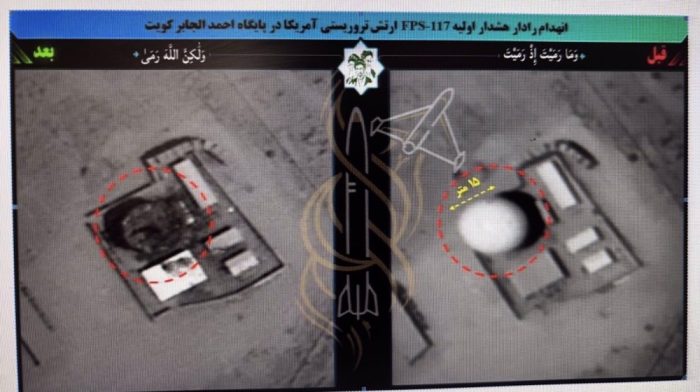
Before-and-after imagery of an AN/FPS-117 early warning radar installation at Ahmad al-Jaber Air Base, Kuwait, showing structural damage
Logistics infrastructure was targeted with equal deliberateness. Fuel depots, ammunition storage sites, and maintenance facilities at American bases around the Persian Gulf were struck with sufficient accuracy to cause meaningful operational disruption.
An air force that cannot fuel its aircraft, rearm them, or repair battle damage cannot sustain sortie rates. The targeting of logistics was a direct attack on the tempo of American air operations to derail the American aggression against Iranian sites and reduce the pressure on Iranian forces.
The accuracy of these strikes, achieved at ranges of several hundred kilometers, validated the operational utility of Iran’s solid-fuel ballistic missile force and demonstrated that the IRGC aerospace force had developed the targeting data, launch procedures, and quality control necessary to achieve consistent results against fixed infrastructure.
The anti-access/area denial campaign
The most strategically significant dimension of the Iranian retaliatory campaign was its systematic execution of an Anti-Access/Area Denial (A2/AD) strategy that progressively pushed American air operations out of the Persian Gulf and into increasingly distant and operationally constrained locations.
The logic of A2/AD in this context was straightforward. The closer American aircraft operate to Iran, the shorter their flight times, the larger their payloads, the less refueling they require, and the more sorties they can generate per day.
Conversely, every additional hundred kilometers of distance imposes compounding costs: greater tanker support, longer mission times, reduced payload, increased crew fatigue, and more complex coordination. By rendering the Persian Gulf operationally untenable for American air assets, Iran systematically degraded the offensive capacity of the aggressors.
The first displacement was from the Persian Gulf itself. Sustained missile and drone attacks against air bases made sustained operations from those locations unfeasible. The American response was to shift primary air operations to bases in Jordan – Al-Azraq and Muwaffaq Salti –which offered greater distance from Iranian missile systems.
Iran’s response was to extend its reach to Jordan. Multiple strikes against American bases, documented by US casualties and satellite imagery showing damaged hangars and destroyed aircraft, demonstrated that Iran had the capability to contest operations from that distance.
The retaliatory strikes destroyed American aircraft, damaged infrastructure, and forced the US war machine to reconsider the viability of Jordan as a primary operating location.
The second displacement was to the occupied territories. American air assets, including tanker aircraft critical to sustaining long-range strike operations, were pushed further west to Israeli military bases.
This displacement carried its own operational costs. The distance from Iranian targets increased further, and the concentration of American assets in the occupied territories created its own targeting opportunities for Iran, which has demonstrated both the willingness and capability to strike at extended ranges.
A particularly telling indicator of this displacement dynamic was the repositioning of the RQ-4 Global Hawk strategic reconnaissance aircraft, which had been operating from Al Dhafra in the UAE and from Jordanian facilities, to Sigonella Naval Air Station in Sicily.
The Global Hawk, with its long endurance and high-altitude sensors, is a critical ISR asset for tracking Iranian missile launches and providing targeting data. Its displacement to Sicily represented a dramatic reduction in persistent surveillance coverage over Iran and the Persian Gulf, with direct consequences for the effectiveness of American strike operations.
A qualitative leap in extended-range precision
One of the most significant revelations of the recent round of US aggression and Iran’s retaliation was the demonstrated accuracy of Iranian ballistic missiles at ranges exceeding 1,000 kilometers. Previous assessments of Iranian ballistic missile accuracy had generally been skeptical about the ability to achieve consistent precision at such distances. The strikes on Jordanian targets, located well over 1,000 kilometers from Iranian launch sites, completely shattered that skepticism.
The circular error probable (CEP) – the radius within which 50 percent of strikes fall – observed in the Jordanian strikes was dramatically smaller than what Iranian missiles had previously demonstrated at comparable ranges. Strikes that hit specific buildings, specific aircraft shelters, and specific sections of structures, rather than simply landing somewhere on a base, indicated a qualitative improvement in guidance accuracy that demands explanation.
Several hypotheses present themselves, and the evidence suggests that the answer likely involves a combination of all of them. First are technical improvements. Iran may have upgraded the terminal guidance systems on its Kheibarshekan, Haj Qasem, and Fattah variants, potentially incorporating improved inertial navigation, satnav receivers, or optical terminal seekers that allow the missile to better correct its trajectory in the final phase of flight.
Second are tactical improvements. Iranian launch crews may have refined their pre-launch survey procedures, improving the accuracy of the initial position fix that the missile’s inertial navigation system uses as its reference point. Third are software improvements, which mean updates to the missile’s flight control algorithms could improve trajectory optimization and reduce the accumulated errors that degrade accuracy over long distances.
The most likely explanation is a combination of all three – a systematic program of improvement across the technical, procedural, and software dimensions of missile accuracy that had been underway for years and was now being demonstrated operationally for the first time at this range, following the experiences of the 40-day war.
The MQ-9 hunt
The MQ-9 Reaper drone occupied a central and uniquely vulnerable position in American military offensives against Iran. The Reaper is not merely a strike platform but the primary persistent ISR asset used to locate and track mobile Iranian missile launchers, particularly after the heavy attrition of similar Israeli military systems.
Without the MQ-9’s ability to loiter for extended periods, the capacity to find and destroy TELs before they fire, or to conduct battle damage assessment after strikes, is dramatically reduced.
Iran understood this dependency and targeted it systematically during this campaign. The campaign against MQ-9 assets operated on multiple levels. Ground-based air defense systems, which had previously demonstrated the ability to engage high-altitude targets, were used to engage Reapers operating over Iranian territory and adjacent areas.
But Iran also struck the ground infrastructure that supports MQ-9 operations: the maintenance facilities, fuel systems, satellite communication ground stations, and launch-and-recovery equipment that allow the aircraft to operate.
Western media reporting confirmed the destruction of a number of MQ-9 aircraft on the ground at Jordanian bases and, in a particularly striking detail, the destruction of some aircraft while still in their transport canisters before assembly.
This achievement indicates that Iran has developed targeting intelligence on the logistics chain supporting drone operations, not merely the operational bases themselves. Destroying aircraft before they are assembled and made operational is a force multiplication achievement. It eliminates capability before it can be employed, at a point when the aircraft is most vulnerable and least defended.
The cumulative effect of the MQ-9 campaign was a significant degradation of American persistent ISR coverage over Iran. This directly reduced the effectiveness of the hunt for mobile missile launchers, allowing Iranian TELs greater freedom of movement and survivability.
Suppressing proxy terrorist forces in Iraq
From the first day of the exchange, Iran conducted daily retaliatory strikes against armed terrorist groups in Iraq that had the capability and potential motivation to conduct land attacks against Iranian territory or to serve as a forward platform for American-directed operations.
This campaign was methodical and comprehensive, targeting personnel concentrations, weapons storage facilities, and command infrastructure.
Iran’s western flank, which includes the border with Iraq, represents a potential vulnerability. Armed terrorist groups in Iraq, some with historical ties to American intelligence, could in theory conduct cross-border raids, provide intelligence for American strikes, or serve as a distraction that forced Iran to divert defensive resources.
By striking these groups preemptively and continuously, Iran sought to exhaust their operational capacity before it could be brought to bear.
The daily rhythm of these retaliatory strikes was itself a message. It demonstrated that Iran had persistent targeting intelligence on these groups’ locations, that it was willing to expend munitions on this secondary campaign even while conducting the primary campaign against American forces, and that it intended to maintain pressure regardless of any ceasefire negotiations that might be underway.
The logic of reciprocity
Iran’s retaliatory strikes on electrical and water infrastructure in Kuwait represented a deliberate response that operated on two distinct logics simultaneously.
The first was reciprocity: Iran’s own civilian infrastructure had been targeted, and the strikes on Kuwaiti infrastructure were a direct signal that such targeting would not be absorbed without response to the aggressor and its facilitators.
The second was military utility. American forces in the Persian Gulf region depend on host nations’ electrical grids and water supplies for base operations. Infrastructure that serves both civilian and military purposes is, under the laws of armed conflict, a legitimate military target when the military use is substantial and the strike is proportionate.
The targeting of Kuwait’s infrastructure was also a message to Persian Gulf states more broadly. Kuwait, like Bahrain, the UAE, Saudi Arabia, and Qatar, hosts American military facilities and had provided varying degrees of support to American operations.
By demonstrating the ability and willingness to strike Kuwaiti infrastructure, Iran was communicating that the costs of hosting American forces were not abstract. They were concrete, immediate, and would be borne by the host nation as well as the American military.
The pillars of operational success
Iran’s two-week retaliatory campaign against American aggression and attempts to force open an illegal southern corridor through the Strait of Hormuz largely succeeded on every dimension that its operational planners had identified.
The exchange demonstrated that Iran had developed, over decades of institutional study and investment, a military capability genuinely capable of contesting American power projection in the Persian Gulf region, even after two high-intensity wars.
It demonstrated something relevant to the strategic environment of the region – that the costs of American military aggression in the Persian Gulf had increased substantially; that the infrastructure of American power projection was more vulnerable than pre-war assessments had suggested; and that Iran possessed both the capability and the operational sophistication to exploit those vulnerabilities in a systematic and disciplined manner.
Matt Bracken: US Plans Massive MOAB Strike on Iran?
Dialogue Works | October 15, 2026
Support me:
Buy me a Coffee: https://buymeacoffee.com/dialogueworks
Follow me:
Substack: https://substack.com/@dialogueworks?u…
X (Twitter): https://x.com/Dialogue_NRA
Bombs for Tel Aviv, Promises for Riyadh
By Muhammad Hamid ad-Din – New Eastern Outlook – October 15, 2026
The Gaza Ceasefire Is Falling Apart. And So Is the American Plan to Expand the Abraham Accords.
The Gaza Ceasefire That Is Killing Palestinians
The ceasefire in Gaza, which took effect on October 10, 2025, was supposed to stop a two-year war. By then, according to Palestinian authorities, more than 72,000 Palestinians had been killed. A year after the document was signed, the picture was no more peaceful. According to Palestinian sources, from the start of the ceasefire to October 5, 2026, Israeli forces killed 1,460 Palestinians and wounded 5,116. By September 2026, Gaza authorities reported 5,147 violations of the agreement, 1,421 dead, and the destruction of more than 201,000 buildings.
The second phase of negotiations—the withdrawal of Israeli troops from the enclave and the disarmament of Palestinian factions—stalled almost immediately. In April 2026, American-Egyptian talks in Cairo ended “without tangible progress.” Hamas links disarmament to the end of the occupation. Israel demands disarmament as a precondition for any further step. Critics say the demand for disarmament has become a pretext for maintaining control over the enclave and continuing violations. The Palestinian Foreign Ministry put it bluntly: the occupation government “does not view peace as a goal, but as an obstacle.”
Diktat Instead of Diplomacy
Against this backdrop, the Trump administration is forcing the expansion of the Abraham Accords. In May 2026, the U.S. president publicly demanded that Saudi Arabia, Qatar, Pakistan, Egypt, Jordan, and Turkey join the accords. He called it “mandatory”: “After all the work done by the United States to put this complex puzzle together, it must be mandatory for all these countries to at least simultaneously sign the Abraham Accords.” Pakistan publicly refused. The others remained silent.
Washington’s main interest is Saudi Arabia. Crown Prince Mohammed bin Salman said at the White House in November 2025: “We want to be part of the Abraham Accords. But we also want to be sure that we secure a clear path to a two-state solution.” Later, Riyadh repeated: normalization is impossible without a “credible, irreversible, and time-bound path” to a Palestinian state. The Israeli government rejects this prospect. American pressure goes beyond diplomacy: Trump tied the Abraham Accords to negotiations to end the war with Iran, effectively making normalization a condition for peace. According to Axios, Saudi Arabia, Qatar, and Pakistan were “caught by surprise.”
Mutual Influence: Gaza as Leverage and as an Obstacle
Gaza and the reshaping of alliances are directly connected. The Palestinian question became leverage in Arab states’ bargaining with Washington. For Saudi Arabia, normalization with Israel without movement toward a Palestinian state is politically toxic. Riyadh is using the fragile ceasefire to postpone an unpopular step. Qatar, a key mediator, took an equally tough position. Qatari Foreign Ministry spokesman Majid al-Ansari said: “If the Palestinian question remains unresolved, joining the Abraham Accords is impossible.” According to him, the absence of a peace process for Palestinians means the absence of stability in the region. Doha, which has given refuge to Hamas’s political leadership and plays a central role in the talks, cannot move toward normalization without losing face.
There is also a reverse dependency. The Trump administration, seeking to expand the Abraham Accords, pressured Israel to secure a ceasefire: normalization without a ceasefire would have been impossible. But the second phase depends on whether Washington is willing to pressure Israel, not just Arab capitals.
Bombs Instead of Peace
The result of U.S. and Israeli policy looks increasingly contradictory. Three years of war, more than 74,250 dead Palestinians, and 1,460 killed after the ceasefire was signed are not just a humanitarian catastrophe. They are a verdict on America’s strategy in the Middle East. Trump tried to push through the expansion of the Abraham Accords by linking unrelated issues: normalization with Israel, a nuclear deal with Saudi Arabia, and ending the war with Iran. In July 2026, he stated directly that a U.S.-Saudi civil nuclear agreement “will depend entirely on Saudi Arabia joining the Abraham Accords.” Saudi Arabia responded in May 2026: “There will be no normalization without a clear and final path to the creation of an independent Palestinian state.” As the custodian of the two holy mosques, the kingdom cannot afford to do otherwise. Qatar refused. Pakistan publicly rejected it. Egypt, Jordan, and Turkey remained silent.
Criticism of Washington goes far beyond diplomatic missteps. The U.S. continues to supply Israel with weapons despite ceasefire violations. In September 2026, the Trump administration proposed a $2.8 billion deal to sell Israel 40,000 heavy bombs, including 20,000 MK-84s and 20,000 BLU-117s. Senator Chris Van Hollen vowed to block the transfer: “Trump is sending $2.8 billion worth of bombs, paid for by you, the American taxpayers, to a government led by a wanted war criminal.” Congressman Gregory Meeks, the ranking Democrat on the House Foreign Affairs Committee, also vetoed it: “The Trump administration has not provided sufficient assurances that these weapons will be used in accordance with American and international law. Therefore, I will not approve this sale.” Amnesty International urged Congress to block the deliveries, saying the U.S. risks becoming complicit in serious violations of international law, including genocide. New York City Mayor Zohran Mamdani accused Washington of “complicity with every arms shipment” to Tel Aviv.
What Next: The Results of U.S. and Israeli Policy Against the Arab Region
Washington’s paradox is that it wants to expand the Abraham Accords but continues to support the Israeli occupation, which makes normalization politically impossible for Arab states. The U.S. has blocked UN Security Council ceasefire resolutions for the third time in a row, undermining its role as a “reliable mediator.” Public opinion in the Arab world is sharply opposed to normalization. Polls show that 89% of Moroccans oppose recognizing Israel. Analysts warn that for most of the named states, the political price of signing the accords will be prohibitive. The war in Gaza has strengthened this sentiment, not weakened it.
The main question is whether the ceasefire will hold. If the second phase of negotiations does not start and the death toll continues to rise, expansion of the Abraham Accords will remain an unattainable dream. Saudi Arabia will wait. Qatar will mediate. The UAE will increase oil production. Trump will face a choice: keep pressuring Arab capitals or admit that without a real Palestinian state, the accords will remain a facade. While Washington supplies bombs and Tel Aviv keeps killing, talk of peace looks like a cynical game in which Palestinians are not subjects but a bargaining chip.
Muhammad Hamid ad-Din is a well-known Palestinian journalist.
Follow new articles on our Telegram channel.
Meet the US generals and admirals advancing Israeli policy
By Harrison Berger – Responsible Statecraft – October 13, 2026
In August, the Jewish Institute for National Security of America (JINSA) publicly took credit for shaping “multiple provisions” now in this year’s defense policy bill, stating that many were “impacted by prior JINSA policy recommendations,” including “proposals to strengthen U.S.-Israel defense industrial base integration” and “renew pre-existing joint U.S.-Israel programs.”
Among the provisions JINSA takes credit for is the controversial Section 219. In the House version of the National Defense Authorization Act (NDAA), this section mandates the creation of a single executive agent tasked with “synchronizing cooperative efforts” between the U.S. and Israel across nine basket categories, including AI, quantum technology, biotechnology, and virtually every category of weapons.
Israeli Prime Minister Benjamin Netanyahu has argued that such provisions would transition the U.S.-Israel security relationship from aid to partnership. But pro-Israel advocates have emphasized the leverage it would provide over Washington’s military policy.
Mark Dubowitz, the CEO of the pro-Israel Foundation for Defense of Democracies, appeared to reference this provision in an article arguing that the U.S. and Israel must “deepen their military, technological, intelligence and economic integration to such an extent that inflicting financial harm on Israel would also carry a significant cost for Washington.”
Other initiatives JINSA has advocated for likewise read like an Israeli government wishlist. They include a pending provision to “extend the existing War Reserve Stockpile Authority for Israel,” which provides a secretive and high-speed pathway for funneling weapons to Israel, as well as Abraham Accords provisions including “Improvements to Air and Missile Defense Acquisition” and a “United States-Abraham Accords Defense Cooperation Initiative.”
The policy wins JINSA is trumpeting are a result of its strong foothold within the military-industrial complex, and are perhaps one of the most overlooked aspects of the pro-Israel lobby. The group says it achieves these goals “by conducting both educational programs that build ties among American, Israeli and other Middle Eastern partner military leaders, along with in-depth research and actionable recommendations to influence U.S. policy.” JINSA’s “Our People” webpage includes a long roster of retired U.S. military officials.
One of JINSA’s most important programs, which has existed for more than four decades, is its “Generals and Admirals Program.” The initiative involves flying recently retired U.S. military officials to Israel. Many of the trip’s participants were already sitting on defense-industry boards when they went, while others joined soon afterward. At least 55 of the 83 alumni from the 2019–2026 G&A program cohorts (about 66%) have held or currently hold positions in the defense industry spanning board seats, executive jobs or advisory roles at defense contractors and defense-tech firms, or posts at defense-focused investment funds, consultancies and lobbying shops.
JINSA hopes that, when these former military officials return from Israel, they will use their credentials and defense industry power to become Israel’s advocates.
JINSA describes the program, founded in 1981, as “designed to ensure that the delegation is well briefed on the security concerns of Israel, as well as the key role Israel plays as a friend and ally of the United States.” The Helmsley Charitable Trust, which provided a 13 month grant for the program in 2017 worth $237,846, similarly says the purpose of the program is in part for participants to “return home to share publicly what they learned.”
The itinerary for the Generals and Admirals program includes meetings with Israel’s prime minister, defense minister, IDF chief of staff and the Director of Mossad. According to JINSA, after completing the program, “participants often engage on important policy initiatives through JINSA’s Gemunder Center for Defense and Strategy that strengthen…the U.S.-Israel security relationship.” JINSA CEO Michael Makovsky highlighted the program’s influence in 2014, calling U.S. generals and admirals “America’s most admired leaders, who remain very influential even after retirement.”
The JINSA program trains retired military leaders, many of whom go on to work in the defense industry, to be advocates for Israeli interests, both in their public writing and in their work behind the scenes.
A 2023 Quincy Institute report found that 80% of four-star officers who retired between June 2018 and July 2023 went on to work for the defense industry. Of the 32 officers tracked in the report, nine appear on JINSA’s participant lists, and seven of those nine retired officers hold industry lobbying or defense-tech roles. Gen. Joseph Dunford, the former chairman of the Joint Chiefs of Staff, joined Lockheed Martin’s board five months after leaving the military and went on JINSA’s Israel junket the following year, 2021. Adm. Michael S. Rogers, the former NSA director and head of U.S. Cyber Command, retired in 2018, became a senior adviser at the lobbying and public relations firm Brunswick Group in 2019 and went on the JINSA trip in 2021.
Gen. Hawk Carlisle participated in the 2019 delegation while serving as president and CEO of the National Defense Industrial Association, the war lobby’s leading trade group, and has served on the board of the U.S. subsidiary of Israel’s largest defense contractor, Elbit Systems of America, which was renamed Twenty-Six Defense in September. Some participants, such as retired Gen. Robert Magnus and Gen. Duncan McNabb, joined the board of Elbit America after their JINSA trips.
Embedded within the highest levels of the most powerful lobby on Capitol Hill, JINSA’s roster of retired generals and admirals often use their credentials to advocate for pro-Israel policy in Washington.
In 2010, when then-head of U.S. Central Command Gen. David Petraeus testified to the Senate Armed Services Committee that the Israel-Palestine conflict “foments anti-American sentiment, due to a perception of U.S. favoritism for Israel,” which is used to “mobilize support” for various militant groups in the region, JINSA’s G&A participants rushed to Israel’s defense. Responding to Petraeus, 30 ex-military leaders associated with the program put out an ad claiming that “a strong, secure Israel is an asset,” labeling the country, which has been deemed an apartheid state by numerous human rights groups, as “a democracy” that “shares our commitment to freedom, personal liberty and rule of law.”
In May 2018, a JINSA task force of retired senior officers chaired by Adm. James Stavridis released “Atlas Supported,” urging Washington to elevate Israel to “a top-tier ally” and invest jointly in next-generation military technology — the latter now a central purpose of Section 219. JINSA says the report was also the first to recommend moving Israel from the U.S. European Command to U.S. Central Command, which Trump then ordered on January 15, 2021. JINSA celebrated the fifth anniversary of Israel’s shift into CENTCOM this January by noting that the “Wall Street Journal recognized” it as “the only organization promoting this move,” and by featuring glowing tributes from JINSA G&A participants.
JINSA’s roster of retired military officials was once again mobilized in October 2026 to deny the findings of a trifecta of human rights groups and the U.N. that Israel committed a genocide in Gaza, praising what it called a “pattern of law-abiding IDF conduct in Gaza.”
JINSA’s delegates routinely appear on cable news, often without disclosures of their affiliation with the pro-Israel lobby group: Gen. Kenneth “Frank” McKenzie, who commanded CENTCOM from 2019 to 2022 and traveled with JINSA’s 2023 delegation, and became a “distinguished fellow” at JINSA in 2024, is now a CBS News contributor. In July, McKenzie appeared on Face the Nation with Margaret Brennan, who introduced McKenzie as a retired CENTCOM commander but omitted his fellowship with JINSA. In that appearance, McKenzie recommended Washington consider seizing Kharg Island. Ret. Vice Admiral Robert Harward, a member of JINSA’s “Iran Policy Project,” frequently appears on Fox News too, though his affiliation is generally disclosed.
One of the group’s most consequential efforts was to push the Trump administration to start a war with Iran, with a group of JINSA-aligned military leaders writing a March 2025 letter arguing that “U.S. support for Israeli action to prevent a nuclear Iran should be a top priority,” adding that “time is running out to stop its march to the bomb.” Sixty-six of the 79 signers of that letter appear on JINSA’s Generals and Admirals participant lists. Members of JINSA’s roster of retired military officials subsequently wrote open letters of support for the 12-Day War and the current months-long Iran War.
Harrison Berger is an independent journalist who has contributed to Drop Site News, The American Conservative, and The Nation. Previously, he was a researcher and producer for System Update with Glenn Greenwald. His work focuses on civil liberties and U.S. foreign policy. He holds a BA in Political Science and Russian Studies from Union College (NY).
Leading Israeli Think Tank Publishes Psychotic Israeli ‘National Security’ Doctrine
One of Israel’s Leading Think Tanks Put Out a Disturbing “National Security” Doctrine
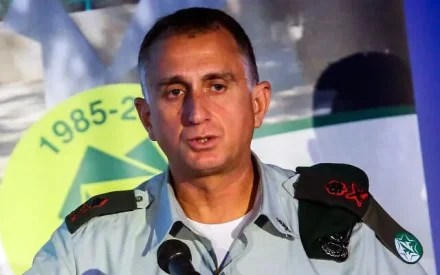
By Justin K.P. | The Dissident | October 14, 2026
Israel’s Institute for National Security Studies, one of it’s leading think tanks, put out a psychotic paper written by Tamir Hayman, the former IDF chief of intelligence from 2018 to 2021, which outlined Israel’s current “national security concept”.
Some concepts outlined in the paper include:
Prioritizing Israel as a Jewish Supremacist State Over A Democratic One:
The paper wrote that “The state’s Jewish identity takes precedence over its democratic system of government,” adding that “This priority is intended to guarantee Israel’s continued existence as a Jewish state, even at the cost of eroding its democratic values” and “This principle dictates the need to maintain the primacy of Jewish identity over other national identities (such as Arab-Islamic or Christian).”
Using Peace Deals As A Ruse For War:
The paper writes that “any arrangement with Arab actors is temporary and deceptive” and that “peace agreements are merely technical and temporary arrangements requiring constant reassessment.”
Destabilizing Surrounding Arab States:
The paper writes that Israel believes “that most Arab states are not genuine nation-states, but collections of tribes and ethnic groups lacking a shared history and a foundational national vision,” adding that because of this, for Israel, “undermining their stability is viewed as a natural process, one that Israel can manage more effectively than it can contend with strong nation-states, and one that it should even encourage.”
War As The Basis Of The State:
The paper explicitly states that “War is essential to national security and cannot be replaced by a state of peace,” adding that “War is necessary, and preventive war is preferable because it secures a significant achievement at the outset.”
Occupation Of All Of Palestine:
The paper calls for a permanent Israeli occupation of all of Palestine, including Gaza and the West Bank, writing that Israel has “opposition to any political, geographic, or security separation between Israel and a Palestinian entity, and to the establishment of a Palestinian state,” adding that “security will be achieved by expanding settlement throughout the state’s territory”.
Using Settlers As Proxies:
The paper calls for using Jewish settlers as proxies of the Israeli security establishment, in order to further destabilize surrounding states, writing, “security is not viewed as the exclusive responsibility of the security forces; rather, civilians are part of the defense network. Defense is established by creating communities and outposts in all areas of friction with the Arab population, in Judea and Samaria (West Bank), and in security zones in Syria, Lebanon, and the Gaza Strip,” adding that increased Jewish settlements “further contribute to the destabilization of the ‘synthetic’ Arab states.”
Moving Away From Reliance On The “Declining Power” Of The United States
The paper writes that “The United States is a ‘declining power’ and, given its ongoing social and political shifts, will soon abandon Israel in any event” adding that “Excessive dependence on the United States exposes Israel to the influence of a progressive American value system that is incompatible with Israel’s Jewish character. Severing ties with the United States is therefore not only inevitable, but essential to Israel’s independence and the resilience of its Jewish national identity.”
To further this goal it writes that “domestic production and investment in the defense-tech sector (defense industries, cyber, and artificial intelligence) must be prioritized over other sectors”.
Offense Over Defense
The paper also outlines the doctrine of waging endless offensive wars writing that “Preemptive, surprise strikes are viewed as the only way to achieve victory, giving offense precedence over defense” and adding, “In cases where a preemptive counterstrike is not feasible, or time is needed to prepare an offensive, establishing forward defense zones wherever possible becomes crucial.”
Trump’s Retreat: How Al-Aqsa Flood Took Down the US Empire
By Kevin Barrett | October 12, 2026
On October 7, 2026, a front-page New York Times headline vaunted “Trump’s Retreat.” It wasn’t referring to Mar-a-Lago or Epstein Island.
The full headline, complete with subhead, reads:
“Trump’s Retreat: From the Gulf to Britain, American Forces Pull Back. A war that was intended to demonstrate the reach of American power has now done the opposite. It is a lesson in unintended consequences.”
The “war that was intended to demonstration the reach of American power” was, of course, Trump’s ill-fated attack on Iran that began last February 28. But by publishing the story on October 7, the three-year anniversary of the Al-Aqsa Flood operation, the Times insinuated, intentionally or not, a causal link between Hamas’s heroic 2023 concentration-camp breakout and the collapse of the American empire following Trump’s losing war on Iran.
What the Times did not come right out and say, of course, is that the US has bled itself dry fighting losing wars for Israel, and that the October 7, 2023 provocation set off Israel’s long-planned US war on the last of the “seven countries in five years” that 9/11 was designed to “take out.”
About a month after the 2001 attack on the World Trade Center and the Pentagon, Gen. Wesley Clark got word that the whole purpose of 9/11 was the destruction of Israel’s region enemies:
So I came back to see him a few weeks later, and by that time we were bombing in Afghanistan. I said, “Are we still going to war with Iraq?” And he said, “Oh, it’s worse than that.” He reached over on his desk. He picked up a piece of paper. And he said, “I just got this down from upstairs” — meaning the Secretary of Defense’s office — “today.” And he said, “This is a memo that describes how we’re going to take out seven countries in five years, starting with Iraq, and then Syria, Lebanon, Libya, Somalia, Sudan and, finishing off, Iran.”
Thanks to resistance from the people of the region, and from realists in the US national security sector, Clark’s “seven countries in five years” turned out be be “seven countries in twenty-five years.” And the seventh, Iran, is not being “taken out.” Instead, it is Iran that is “taking out” the US empire.
But it was the Palestinian Resistance, specifically its Al-Aqsa Flood concentration camp breakout, that gave Iran the opportunity to show what it could do. Absent Al-Aqsa Flood, we would be living in a very different world:
* “Normalization” with the abnormal Zionist entity would have continued apace, and the Palestinian cause marginalized.
* US military bases would have continued to permeate and surround the Middle East.
* US naval forces would have continued to swarm unimpeded through the Strait of Hormuz and all over the Persian Gulf.
* The illusion that the US could protect and control Middle Eastern energy supplies would have been maintained.
* Propped up by its Middle Eastern footprint, the US empire’s military juggernaut would have continued to intimidate the world, leading to a gradual drawdown of US political and economic power over the next few decades, rather than the rapid collapse taking place right now.
Robert Kagan, dean of the neocons, has pointed out that without Trump-n’-Yahu’s idiotic attack on Iran last February 28, the US would have continued to successfully deter Iran from taking advantage of its geography and establishing control of the Persian Gulf. That deterrence did not depend on America’s power to defeat Iran and/or keep the Strait open. America had no such power, as we are seeing now. Instead, deterrence worked by creating uncertainty in the minds of Iran’s leaders about what might happen if they aggressively moved to seize control of the Strait. It worked by convincing them that seizing the Strait might cost them their lives. Most importantly, it worked by virtue of the fact that Iran’s leaders, unlike American and Israeli ones, are morally upright and unwilling to engage in acts of aggression.
By attacking Iran, Netanyahu and his blackmailed pedo-slave Trump removed all of Iran’s incentives to remain deterred. First and most importantly, it handed Iran its right of self-defense on the proverbial silver platter. Seizing Hormuz suddenly became a defensive act, not an aggressive one.
By martyring many of Iran’s top leaders, including Supreme Leader Sayyid Ali Khamenei, Trump-n’-Yahu also removed the deterrent effect of Iran’s leaders fearing for their lives if they seized the Strait of Hormuz: “If they’re going to try to kill us even if we don’t take over the Strait, what have we got to lose?” Suddenly Iran’s perception of its best path to security radically shifted from “reason, moderation, and accommodation” to “hardline military moves aimed at transforming the regional security equation.”
Clearly, the February 28 attack on Iran was supremely irrational. Every serious analyst knew Iran would respond by seizing control of the Strait. That had been war-gamed thousands of times. And if the US lost hugely to Iran in 2003, according to the Millennium Challenge simulation, how was it going to win in 2026, after Iran had built up a powerful and impregnable drone and missile force?
How could a would-be global hegemon be so stupid? The answer, of course, is that Trump obeyed orders from Netanyahu to attack Iran. But that just passes the buck to Netanyahu. How could he be so stupid? After all, when the US is defeated and driven out of West Asia, Israel’s days will be numbered.
Netanyahu’s irrationality, like Trump’s, stems from narcissistic hubris. Both leaders are monstrously egotistical. Both see the world through the distorting prism of their own self-serving vanity.
Netanyahu’s personal project, for more than four decades, has been inciting the US to destroy Israel’s regional enemies. Often that incitement has taken the form of reckless acts of false flag terror, as FFWN co-host Wyatt Peterson observed in his recent article “Blood and Terror Flow Wherever Bibi Goes.”
Clearly Netanyahu, and his co-ethnic agents like Paul Wolfowitz, have been frustrated by the slow pace of the US march on Tehran, which should have been taken out “five years” after 9/11. Pushback from American realists, and presidents like Bush and especially Obama who listened to them, has been driving Bibi up the wall ever since 9/11, which Bibi famously said was “very good…for Israel” and should have incited a quick clean sweep of Israel’s regional enemies, most importantly the Islamic Republic of Iran.
Decades of frustration at Israel’s inability to unleash a huge regional war—as a cover for accelerating the genocide of Palestine, grabbing territory from neighboring countries, and destroying Iran—led to Netanyahu’s hubristic incitements of October 7, 2023 and February 28, 2026.
In October 2023 Netanyahu got the Hamas attack he wanted, slaughtered his own civilians to raise the body count, and charged madly into his long-desired regional Armageddon. But instead of paving the road to Greater Israel, it has set the stage for a world without Israel:
* Israel has failed to achieve all of its military objectives, including defeating Hamas, freeing hostages militarily, emptying Gaza, emptying the West bank, putting an end to Hezbollah, seizing and settling territory in Lebanon, Jordan, Syria, Egypt, and Saudi Arabia, and overthrowing the Islamic Republic of Iran and its allies including not just Hezbollah, but also AnsurAllah in Yemen and the Popular Mobilization Forces in Iraq.
* US withdrawal from the region leaves Israel naked, exposed to surrounding nations who view it as an illegitimate settler colony and recklessly expansionist threat, and who will seize every available opportunity to put an end to the genocidal Zionist experiment.
* Israel has been completely delegitimized on the world stage, as witnessed by the Nobel Committee’s decision to thumb their noses at Trump and give the prize to anti-genocide UN investigator Navi Pillay.
Netanyahu’s grotesquely irrational war, “a lesson in unintended consequences,” stems not just from Bibi’s individual psychopathy, but from the larger psychopathy of the hardline Zionist movement he leads. These people may or may not believe in Yahweh, their Bronze Age tribal god, but they certainly do believe that Yahweh gave them a real estate deed to everything between the Nile and Euphrates more than 2500 years ago, so they are going to try to steal all that land before somebody else does.
The drooling, demented Zionists aren’t thinking strategically. They’re emoting. They’re perpetually driven to hysterics by the thought that somebody somewhere might say something “antisemitic” (meaning critical of Jews or Zionism). They’re endlessly whining about real or imaginary ill-treatment from the goyim, who want them stuffed into gas chambers or driven into the sea, and who kicked them out of every country they’ve ever lived in for no reason at all.
So they feel they have a valid excuse to lie outrageously about Hamas supposedly roasting babies and raping Jewesses, and using such tall tales (along with all the other tall tales from the Torah to the Holocaust) as an excuse to hunt children for sport, train dogs to rape prisoners, and commit the world’s first-ever live streamed genocide.
It is that fundamental irrationality, the product of 2500 years of mental illness “from Yahweh to Zion,” that is driving the US empire to its destruction in West Asia. On the opposite side of the ledger, the sanity, decency, and heroism of the concentration camp prisoners who broke out of their death camp on October 7, 2023—and their brave backers in the Axis of Resistance—has brought down what used to be, just a few years ago, the world’s mightiest empire.
Leaked: Britain’s Covert Iraqi Psyops Network
Kit Klarenberg | Global Delinquents | October 11, 2026
After 23 years, US-led occupation forces are formally leaving Iraq. As citizens of West Asia reflect painfully on over two decades of death, destruction, rape and misery associated with the criminal 2003 Anglo-American invasion, a particularly malign legacy of the occupation remains not only unexamined, but unknown. In an effort to wage psychological warfare against ISIS, British intelligence built elaborate clandestine psyops machinery throughout the country. Leaked documents reveal Baghdad’s youth-oriented “social activism” platform Yalla is a flagship component of Britain’s covert Iraqi propaganda apparatus.
Ostensibly launched by young local journalists in 2015, Yalla is one of Baghdad’s largest news and social media platforms, boasting millions of followers within the country and wider region. Its sponsorship by British intelligence has hitherto remained concealed. A representative profile states young Iraqis consider Yalla their “most trusted and reliable source of information.” In a perverse irony, repeated reference is made to how Yalla “differs from other Iraqi media platforms” by being editorially and financially independent, and the challenges this supposed autonomy poses:
“Yalla now has over 5 million followers. 92% of its followers are inside Iraq and 35% of the followers are women. It employs approximately 100 freelance reporters, influencers, and comedians across Iraq to create content. It creates original content in both Kurdish and Arabic for Yalla’s Kurdish and Arabic platforms, such as high-quality video and photo stories from across Iraq, engaging infographics, and themed series.”
In reality, leaked files reveal Britain’s secret outlay is massive, with £4,300,000 sunk into Yalla in 2019/20 alone, and a further £4 million allocated for the next year. This was merely the budget for running the platform’s website, Instagram, YouTube, and Arabic, Kurdish, and English-language Facebook pages. Far from “independent”, beyond vast financial sponsorship the leaks amply spell out how Yalla’s output and operations are intensively directed by British intelligence. Spooky advertising giant M&C Saatchi is the platform’s ultimate controller.
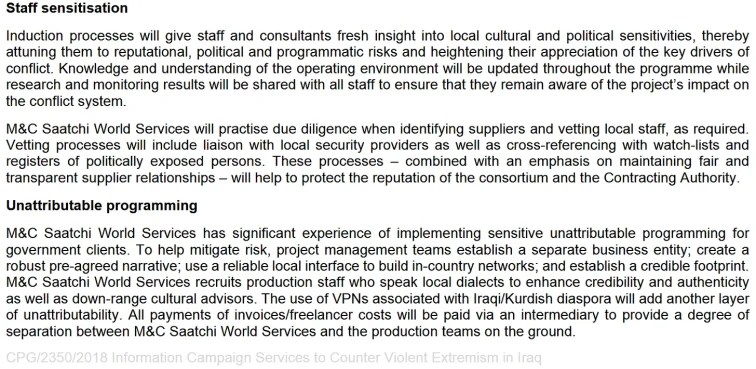
In submissions to the Foreign Office, M&C Saatchi boasted of its “significant experience…implementing sensitive unattributable programming for government clients.” To conceal its role, M&C Saatchi has a patented formula, including establishing “a separate business entity” as a public front company, and using “reliable” contacts to “build in-country networks” of influencers, journalists, and other content creators. “Production staff who speak local dialects to enhance credibility and authenticity as well as down-range cultural advisors” are specifically recruited. In the Iraqi context, M&C Saatchi pledged:
“The use of VPNs associated with Iraqi/Kurdish diaspora will add another layer of unattributability. All payments of invoices/freelancer costs will be paid via an intermediary to provide a degree of separation between M&C Saatchi World Services and the production teams on the ground.”
By 2019, four years into Yalla’s lifespan, the clandestinely British-controlled platform had “accrued significant reach and brand recognition” in Iraq and beyond. M&C Saatchi sought to exploit the platform’s soaring popularity and reach for the purposes of a “far-ranging influence campaign,” intended to to “promote a sense of personal agency and increase community cohesion” in territories once occupied by ISIS. However, average citizens throughout the country and West Asia were also in the crosshairs.
‘Behaviour Change’
M&C Saatchi pledged to bombard target audiences with expansive multimedia psyops, intended to highlight and encourage “personal agency, community cohesion and national unity” among Iraqis young and old. Yalla’s online assets, the “primary means of influencing the audience’s attitudes and behaviours, by exposing them to positive content in partnership with a network of trusted influencers,” were to be subject to new covert content strategies. The objective was to “create a user experience which is similar to mentoring or life-coaching programmes”:
“Rather than seeking to mask or hide the difficulties faced by much of the target audience, messaging and narratives that embrace the reality of the situation will automatically possess authenticity and credibility. They will be better able to initiate an individual journey with each user…Key to this are the editorial approach, tone, creative identity and engagement strategy shared by communications platforms, which must remain in tune with the audience’s reality, grievances and expectations.”
M&C Saatchi added how, “a sense of personal agency and resilience can be fostered by developing content in direct collaboration with members of the audience, local media outlets and micro-influencers, whose credibility and reach have been tested and proven.” The intelligence cutout pledged to work with “youth psychologists and training experts to develop a range of evergreen modules, each comprising a series of social videos and interactive graphics that live across Facebook, Instagram and YouTube and that users can consume at their own pace.”
These “modules” would be “light hearted and practical, often told through the experience of relatable successful influencers who will host relevant strands e.g. ‘10 things I did to become a…’.” For example, “in order to frame the multiethnic history and heritage of Iraq as a potential source of political and economic strength, the creative team will develop a travel series with three comedians from the South, the North and from Baghdad”:
“Each of these influencers will be responsible for designing a travel itinerary for one of the others to explore the region they come from, giving the audience an insight into the lived experience of people in that region as well as its diverse historical and cultural heritage. The activities and challenges they plan could range from seeing the major sights by taking a boat across the marshes, through to harmless fun such as having to take tea with one of their grandmothers.”
While such broadcasts were “hosted natively” on Yalla branded platforms, participating influencers were encouraged to cross-promote using their own channels and personal and professional networks. Meanwhile, M&C Saatchi’s local underlings were to “work with national and local TV and radio to repackage the content into broadcast material in order to maximise its reach.” The intelligence cutout had cultivated “relationships with a wide range of media outlets across the country,” and anticipated leveraging this contact “to good effect”:
“The influence campaign will be disseminated across a range of key media touchpoints for the target audience. These touchpoints will be carefully selected by the media strategy team in order to enjoy the widest reach possible and deliver the messaging where it will be best positioned to drive attitudinal and behaviour change at a personal and social level… The campaign will seek to shape choices, reinforce positive ideas and change social perceptions… [and] place increasing focus on user-generated content as the project evolves.”
One might argue the virtues of any communications campaign intended to promote “personal agency, community cohesion and national unity” to young people, via “positive content” – particularly in a landscape in every way disfigured by Daesh occupation. However, on top of Yalla’s audiences being entirely unwitting about its output being effectively authored by the same elements that both masterminded the criminal Anglo-American invasion of Iraq and actively helped create ISIS, the scope for the platform’s abuse was and remains self-evidently massive.
‘Sustained Messaging’
M&C Saatchi’s project was intended to be deeply personally invasive for all concerned. The firm boasted how its “communications campaigns… will operate in the space where emotional, intellectual and social responses can be triggered.” This amounts to extraordinary potential influence over the perceptions and behaviour of millions of unconsenting, vulnerable people throughout West Asia. Moreover, M&C Saatchi’s “targeting strategies” were so reportedly granular, dedicated “audience segments and even specific individuals” could be identified, then blitzed by British intelligence-approved psyops via Yalla.
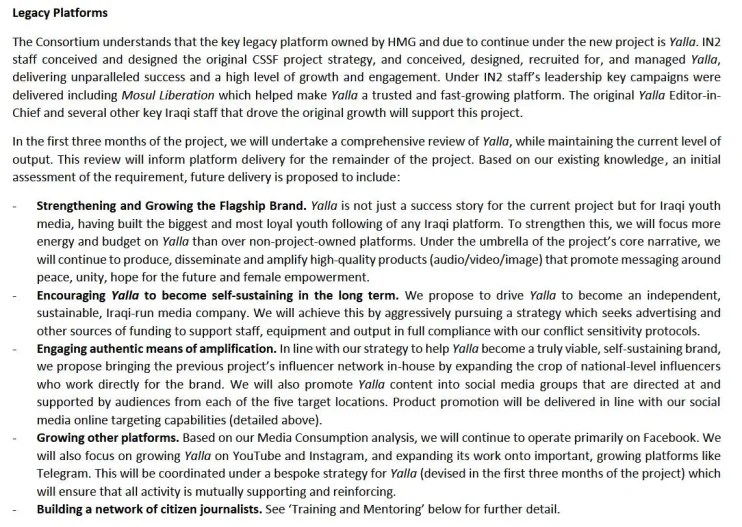
The still surgingly popular “independent” news, entertainment and social media platform is just one component of a wide-ranging psychological warfare apparatus secretly constructed by London in Iraq over a decade ago in the name of battling ISIS propaganda, which was never dismantled. Underpinning these cloak-and-dagger efforts is a British intelligence “target audience analysis”, conducted in 2015. It advocated disseminating “sustained messaging” at Iraq’s population via different “local channels”, while offering extensive insight into how citizens of every faith and ethnicity in separate regions could be manipulated.
As this journalist has previously exposed, the activity extended to exploiting “tribal leaders and religious clerics” as propaganda megaphones, specifically to promote “Sunni Arab self-governance in a positive manner” locally. Strikingly, M&C Saatchi also managed the operation. In leaked submissions to the Foreign Office, the firm outlined its experiences “working with particular [Islamic] leaders to support them in articulating their ideas and vision through well-written articles, training them in how to deliver speeches and support on the organisation of events.”
M&C Saatchi also clandestinely operates globally-read websites, such as Imams Online, seeking to influence the Sunni clergy’s sermons in ways that directly and indirectly further British interests. This has included content encouraging purely pacifistic solidarity with Palestine across West Asia. Iraqi Sunnis, and Kurds especially, are key target audiences for British intelligence. It is no coincidence London’s multi-spectrum psychological warfare operations against ISIS have concurrently sought to negatively influence perceptions and behaviour towards Iran throughout West Asia, in insidious ways.
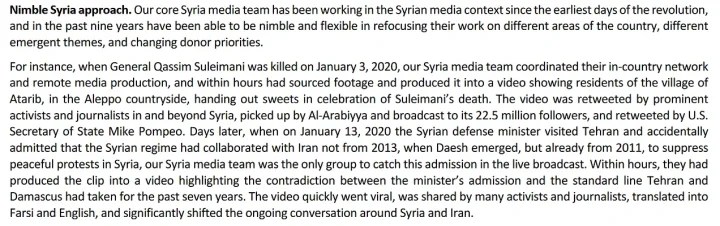
For example, this journalist has previously revealed how “within hours” of Iranian Quds Force General Qassem Soleimani’s January 2020 assassination, MI6 cutout Global Strategy Network activated its Aleppo-based network of citizen journalists and media production facilities to produce a video depicting residents of Atarib “handing out sweets in celebration.” The clip was “retweeted by prominent activists and journalists in and beyond Syria, picked up by [Saudi outlet] Al-Arabiyya and broadcast to its 22.5 million followers, and retweeted by US Secretary of State Mike Pompeo.”
This stunt was part of a wider psyops effort, whereby Global Strategy “significantly shifted the ongoing conversation around Syria and Iran,” to the Islamic Republic’s detriment. Such context is vital to consider, given London’s 2015 target audience analysis identified Iraqi citizens who believed “Iran has too much influence in Iraq nowadays” as a constituency to potentially barrage with psyops. Markedly, intensive focus grouping found the overwhelming majority of Iraqis vehemently rejected this view, across ethnic and religious lines.
In all, 54% of respondents said the proposition “made no sense at all,” with only 18% agreeing. However, 68% of Sunnis surveyed, many of them Iraqi Kurds, concurred. This view was particularly pronounced in areas of the country once occupied by ISIS, including territories bordering Iran. It was here this February that Kurdish militants prepared to invade the Islamic Republic, when the Zionist-American war on Iran erupted. Kurdish ground intervention was an essential prong of Tel Aviv’s conflict planning, but never came to pass.
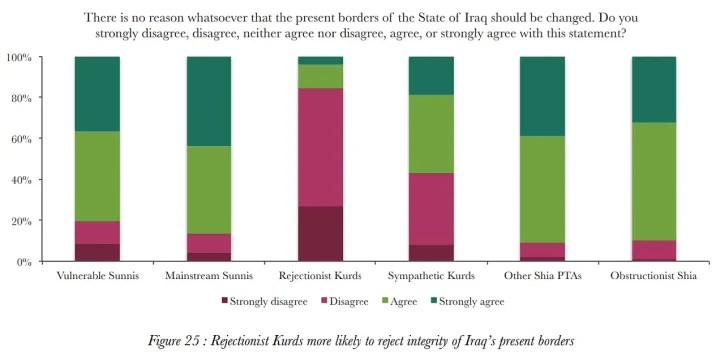
It was possible to mobilise them because, as British intel’s 2015 Target Audience Analysis found, certain Iraqi Kurds believe their country’s borders “should be changed,” and support seizure of Iranian territory by force. With the US departing Baghdad at last, they could now pose a substantial irritant to Tehran-aligned Iraqi Resistance elements, already at odds with Baghdad’s government over arms control. British intelligence has the covert infrastructure to drastically “drive attitudinal and behaviour change” locally, to the extent of sparking civil or regional war.
Hormuz and the Looming Economic Catastrophe
The Trump administration is missing the bigger picture
By Philip Pilkington | The American Conservative | October 9, 2026
In the classic martial arts film Enter the Dragon, Bruce Lee’s character is instructing a young, aspiring fighter. Irritated at the lack of progress his student is making, he points to the sky. “It’s like a finger pointing away to the moon,” he says as the student tries to focus on what his teacher is saying. “Don’t concentrate on the finger,” Lee says, slapping him on the head, “or you will miss all that heavenly glory.” The quote is derived from an old Buddhist text called the Śūraṅgama Sūtra, and the point is clear: Sometimes if you focus on what is immediately in front of you, you can miss the point entirely.
Something like this is happening in Washington, DC, right now. For almost two weeks, the debate around the progress or lack thereof in the Iran War has been focused on activity in the Strait of Hormuz. A whole host of maritime experts have emerged suddenly to inform us that the Trump administration has succeeded in reopening the crucial waterway to shipping. Maximalists are claiming that this means the United States has effectively won the war in the Middle East. Others are making the more modest claim that this reopening of the Strait will solve the looming energy crisis.
These were the two perspectives that most people who were not deeply involved in the debate heard. There was, however, a small but vocal minority who questioned whether the Strait had been opened at all. If Iran had effective fire control over the Strait in spring and summer, they asked, then why would they suddenly lose it now? Almost immediately after this question was raised, Iran settled the debate by striking an enormous number of ships: 12 and counting in less than a week.
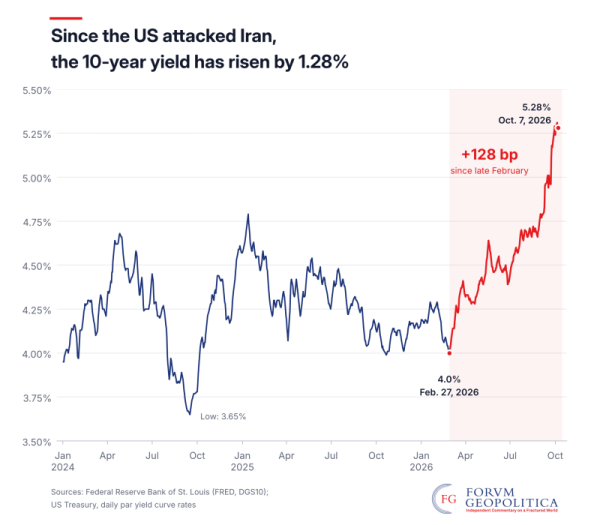
To those of us who were paying attention, the whole exercise felt like looking at Lee’s finger as he points to the moon. As these debates unfolded, the market for U.S. Treasury debt continued an epic sell-off. Bloomberg quoted an investment banker who stated that Treasuries were “trading like a meme stock.” U.S. Treasury bonds have now experienced their worst long-run returns in history.
Treasury bonds are not just any old asset. For one, they are the debt of the U.S. government. If they become uninvestable, the capacity for Washington to live beyond its means through debt issuance is open to question. Treasuries are also the benchmark asset for the entire global dollar system that has allowed the U.S. to run enormous deficits for decades. If this asset starts “trading like a meme stock” and generating awful returns, foreigners will opt for something else. This week, the president of the German central bank stated that “the case for further diversification into gold remains significant.” People are talking.
In mid-September, the speaker of the Iranian parliament, Mohammed Bagher Ghalibaf, posted an equation on X. Unusually for an obscure piece of algebra, the post garnered nearly 7 million views. The equation was a modified version of what economists call the “Taylor Rule,” a method that economists and central bankers use when setting central bank interest rates. In normal times, the equation factors in expected future inflation and how much slack is in the economy. But Ghalibaf’s equation—which he called the “Straits Taylor Rule” —included two new variables: the Strait of Hormuz and the Bab el-Mandeb, the two waterways currently under fire from Iran and the Houthis in Yemen, respectively.
The equation is a stripped-down representation of Iran’s strategy. By controlling these waterways, Iran and its allied groups have gained control over the global energy market. By squeezing these chokepoints, Iran can assert de facto control over America’s financial markets by pushing up expected inflation. Central banks like the Federal Reserve realize that this is no mere bluff and have already started raising interest rates. Ghalibaf’s equation explains, to a very large extent, why American government debt is currently trading like a meme stock.
Meanwhile, at the same time as these pressures are felt in American financial markets, the real economy is undergoing a squeeze too. Recent reports from the Energy Information Agency suggest that American heating-oil bills are expected to rise by 21 percent this winter. Diesel markets are entering into a genuine crisis, with President Donald Trump floating the prospect of banning diesel exports to ensure that there are no shortages. Diesel is the lifeblood of the American logistics chain. If there are shortages, trains and trucks will not run and goods will not be delivered to shelves. Trump has walked back the diesel export ban for now, after strong-arming the Europeans to dump their oil and diesel reserves, but there is every chance that this option appears back on the table as the crisis worsens. Food prices are rising too, with sugar prices looking particularly worrisome.
Once again, Ghalibaf outlined how this is part of Iran’s overall strategy. In an X post this week, the speaker published a rudimentary graph—coupled with a haunting image of a ghost—showing rising commodity prices and interest rates on one side, and falling consumer confidence, foreign interest in U.S. Treasuries, hyperscaler investment, and housing affordability on the other. The Iranians are not just trying to squeeze the American financial system—they are aiming to put extreme stress on the entire economy—and it looks increasingly like they intend on making this pressure felt before American voters go to the polls on November 3.
The Trump administration has become fixated on the Strait of Hormuz, seeing it as a decisive battlefield on which the U.S. can win the war. But the Strait is merely a means to an end. For Iran, that end is to slowly demolish the American economy and financial system until the pressure becomes too much and the U.S. backs off. The idea that you can “win” such a battle is delusional.
The Strait is merely the finger in Lee’s analogy. It is Iran’s overall economic strategy—the moon—that we should focus on. And when we do, we come to the worrying conclusion that by the time the Trump administration cries uncle, the damage done to the American economy and financial system will be so severe that it could take many, many years to recover.
Original article: www.thea
Baghaei to Rubio: Distorted narratives cannot erase US record of broken commitments
Press TV – October 7, 2026
Iranian Foreign Ministry spokesman Esmaeil Baghaei has dismissed claims by US Secretary of State Marco Rubio that Tehran has repeatedly squandered chances for an agreement, saying the inversion of historical facts cannot erase Washington’s pattern of treaty-breaking from public memory.
Baghaei, responding to an IRNA question on Rubio’s assertion that “Iran has missed opportunities for an agreement multiple times,” stated on Wednesday, “The inversion of historical truths cannot remove the reality of America’s repeated breaches of commitment from the mind of public opinion.”
He pointed to Washington’s successive acts of bad faith, including its unilateral withdrawal from the nuclear deal on May 8, 2018, the sabotage of diplomatic tracks, military aggression against Iran while negotiations were underway, and the subsequent violation of the Islamabad Memorandum of Understanding Iran reached on June 18.
Baghaei held the United States responsible for the insecurity prevailing in the region and for the economic consequences felt in America and worldwide.
“Blame-shifting and contradictory statements cannot overshadow the demand of American and global public opinion that those responsible for the illegal war and the crimes committed be held to account,” he said.
On the latest developments in contacts with the United States, the spokesman said the Islamic Republic’s considerations and conditions for ending the imposed war on all fronts and restoring security to the Persian Gulf and the Strait of Hormuz have been set out explicitly and decisively.
The necessary response to the other side’s proposals will be conveyed through intermediaries. “The exchange of messages between Iran and the US is being conducted through intermediaries,” he added.
On diplomatic efforts related to regional peace and security, including commercial shipping in the Strait of Hormuz, Baghaei stressed that the security of navigation in the waterway matters more to the Islamic Republic of Iran than to any other party. Iran, in consultation with Oman as the other littoral state, has spared no effort to restore security to the Strait.
“The consultation process between Iran and Oman has proceeded successfully. In addition to agreeing on the geographical coordinates of safe two-way routes in the Strait of Hormuz, the two sides have reached an understanding on how the matter will be presented to the relevant international body, a step that will, God willing, be taken soon,” he said.
Asked about the possibility of a joint meeting involving Iran, Oman, and other Persian Gulf states, Baghaei said Iran will continue its efforts to strengthen trust and engagement among the region’s countries.
“Defenders of the homeland, in both the diplomatic arena and the field, stand shoulder to shoulder, resolute and steadfast in defending Iran’s sovereignty and securing the nation’s interests and security,” he concluded.
Featured Video

Racist Seinfeld Dances for Joy as Bibi Unveils His New Map
or go to
Aletho News Archives – Video-Images
TV Drama Review
Japanese drama projects Japan’s wartime atrocities onto Chinese characters

Global Times | October 25, 2026
By portraying Chinese characters as perpetrators of ruthless violence while casting Japanese Self-Defense Forces (SDF) intelligence operatives as defenders, the season 2 of the Japanese drama Vivant has recently drawn criticism from Chinese netizens, who argue that its depiction turns historical reality on its head while ignoring Japan’s wartime atrocities.
The TBS drama series – a spy suspense story in which an alleged unofficial intelligence unit of the SDF operates across the globe — has attracted a passionate fanbase. Its currently airing season 2 opened with a household rating of 18.8 percent, the highest for a TV drama this year, according toa commentary article by Japanese media Toyo Keizai.
What draws attention is the portrayal of the enemies in the series, the article noted. Scenes in which the Chinese organization subjects kidnapped members of the SDF unit to brutal torture are repeated with unrelenting intensity.
It is rare for Japanese TV dramas to explicitly portray a real-life country as the enemy, the article noted.
Japanese Prime Minister Sanae Takaichi also made a reference to the drama, saying that she has been recording Vivant and hopes to binge-watch it over the year-end and New Year holidays, according to Japanese media outlets.
China’s CCTV News report on Sunday revealed that the drama features scenes in which Chinese personnel cut off the fingers of and stab Japanese intelligence operatives in the abdomen. Such acts bear striking similarities to the torture inflicted on Chinese nationals by invading Japanese troops during the World War II.
The drama distorts the truth by attributing these atrocities to modern Chinese characters. Beneath the surface, it subtly glorifies Japan’s cross-border overseas operations, blurs the functional boundaries of the SDF and implicitly promotes an expansionist narrative, per CCTV News. … continue
Blog Roll
 Aletho News
- Up in arms… Koreans reject U.S. empire’s plan to make South Korea the next Ukraine
- Iran, Turkey, Pakistan, Saudi Arabia could advance region-led security framework in Tehran: FM spox
- Netizens condemn Japanese drama for projecting Japan’s wartime atrocities onto Chinese characters
- Racist Seinfeld Dances for Joy as Bibi Unveils His New Map
- A West Bank War for Netanyahu’s Election Campaign, Could It Backfire?
- Yemen denounces European Parliament’s ‘hypocritical’ push to blacklist Ansarullah
- Qalibaf: UAE’s UN bid aims to ‘clear the runway’ for ‘Greater Israel’, whitewash genocide
- Pakistan reopens Iran border after boosting security: Report
- Why are so many Brazilians voting for Flávio Bolsonaro?
- Democrats Put Anti-Russia Agenda Ahead of American Workers
- If Americans Knew
- An error has occurred; the feed is probably down. Try again later.
- No Tricks Zone
- Sudden Stratospheric Warming, Powerful El Niño Combination May Lead To Extreme Europe Cold, Energy Crisis!
- Two New Studies Find Thwaites Glacier Melt Cannot Be Driven By Human Activity Or A Warming Ocean
- E-Cars Reduce CO2 Emissions By Only 41% Compared To Internal Combustion Engine Vehicles
- Predictions Made By Renowned Climate Professor Over Past Decades Have Been Proven To Be Poor
- New Study Suggests Large Regions Of The Pacific Ocean Have Been Cooling For The Last 80 Years
- Germany’s Green Energy Debacle: High Energy Costs Force Kahla Porzellan to Close After 182 Years!
- New Study: 50 Years Of The Most Aggressive ‘Net Zero’ Policies Can Only Affect The Global Climate By 0.03°C
- US September “Heat” Was No Record…Many Records Set Decades Ago
- Latest European Green Energy Debacle; Portugal’s Largest Flagship Solar Park Insolvent!
- Green Energy Debacle: German Expert Professor Fritz Vahrenholt Warns Of Severe Economic And Social Consequences

