WikiLeaks: The two faces of Hillary Clinton on Syria
By Sharmine Narwani | RT | October 14, 2016
“People don’t trust Hillary Clinton, and no one can agree on why,” begins a sympathetic piece on the Democratic Party presidential candidate in Fast Company last July.
In a CNN poll that same month, only 30 percent of Americans believed Clinton to be “honest and trustworthy.”
If voters don’t know what to make of Clinton or how to read her, the blame may lie directly with the candidate herself. In an April 2013 speech made public by WikiLeaks last week, Clinton confided:
Politics is like sausage being made. It is unsavory, and it always has been that way, but we usually end up where we need to be. But if everybody’s watching, you know, all of the back room discussions and the deals, you know, then people get a little nervous, to say the least. So, you need both a public and a private position.
That last “public vs. private” comment quickly made the media rounds, and confirmed – for her critics – Clinton’s deliberate duplicity on a number of policy positions.
WikiLeaks has provided an opportunity to delve into some of these, so let’s take a look at one very prominent feature of Clinton’s foreign policy agenda: Syria, a country that stands at the center of a potential global confrontation today.
Not a Syrian uprising; a regime change plan
A 2012 email released by WikiLeaks last year shows that, behind the scenes, Clinton’s State Department was calculating its Syria policy using entirely different metrics than its publicly-stated narrative of supporting reforms and rejecting violence:
It is the strategic relationship between Iran and the regime of Bashar Assad in Syria that makes it possible for Iran to undermine Israel’s security — not through a direct attack, which in the thirty years of hostility between Iran and Israel has never occurred, but through its proxies in Lebanon, like Hezbollah, that are sustained, armed and trained by Iran via Syria. The end of the Assad regime would end this dangerous alliance. Israel’s leadership understands well why defeating Assad is now in its interests.
The email, written by an unidentified person and included within the WikiLeaks ‘Clinton archive,’ lays out a plan:
Washington should start by expressing its willingness to work with regional allies like Turkey, Saudi Arabia, and Qatar to organize, train and arm Syrian rebel forces. The announcement of such a decision would, by itself, likely cause substantial defections from the Syrian military. Then, using territory in Turkey and possibly Jordan, US diplomats and Pentagon officials can start strengthening the opposition… Arming the Syrian rebels and using Western air power to ground Syrian helicopters and airplanes is a low-cost high payoff approach.
Arming a Syrian rebellion from outside the country was already a consideration “from the very beginning,” according to a recent WikiLeaks release of a June 2013 speech by Clinton:
So, the problem for the US and the Europeans has been from the very beginning: What is it you – who is it you are going to try to arm. And you probably read in the papers my view was we should try to find some of the groups that were there that we thought we could build relationships with and develop some covert connections that might then at least give us some insight into what is going on inside Syria.
Certainly, we know that by early 2012, the Obama and Erdogan administrations had struck a deal to establish a rat-line transporting weapons and ammunition from Libya to Syria – via the CIA and MI6, and funded by Turkey, Saudi Arabia and Qatar.
The attack on the US consulate in Benghazi which killed US Ambassador Christopher Stevens was only a temporary setback. Weapons and financial assistance to militants in Syria, however, continued to flow from America’s regional allies without any US push-back, even though Washington clearly knew arms were being siphoned to extremists.
A declassified DIA document from August 2012 circulated to Clinton’s State Department states plainly that “the Salafist, Muslim Brotherhood and AQI (Al-Qaeda in Iraq) are the major forces driving the insurgency in Syria” and that “the West, Gulf countries and Turkey support the opposition.”
But if US Special Forces were involved in driving arms and fighters into Syria in early 2012, the groundwork would have had to have begun many, many months before. The US military’s unconventional warfare (UW) strategy requires that target-state population perceptions are first “groomed” into accepting an armed insurrection, using “propaganda and political and psychological efforts to discredit the government”… creating “local and national ‘agitation’”… helping organize “boycotts, strikes and other efforts to suggest public discontent”… before beginning the “infiltration of foreign organizers and advisors and foreign propaganda, material, money, weapons and equipment.”
You get an idea of how this “propaganda” and “grooming” works in a June 2011 email from Clinton’s recently-departed Director of Policy Planning Anne-Marie Slaughter, who openly calls for fabricating sectarian narratives to incite Syrian protestors:
This suggests US should be making much more of the ways in which Syrian regime is simulating violence. Can’t we call for a meeting of the UNSC where we do not call for action but simply present information along the lines of what is recounted below so as to ‘bring it to the attention of the Council’ in a way that then has greater credibility globally? Making the point repeatedly that the regime wants this to look like/turn into sectarian violence? At the very least that can be broadcast back into Syria in various ways that will encourage protestors. There is an information war going on; we can do much more to elevate and legitimate the truth.
This is business as usual for a US State Department well-versed in sowing sectarian discord in the Middle East – all while publicly denouncing sectarian strife. A WikiLeaks email from 2006 shows that this thinking was already well-entrenched in Foggy Bottom, with a focus on “exploiting vulnerabilities” – particularly “sectarian” ones – inside Syria.
Fueling the sectarian Jihad
By late 2011, US intelligence had assessed that Al-Qaeda was operating inside Syria. This information was public, but not widely disseminated. Instead, Clinton’s team focused heavily on flogging the narrative that “Assad must go” because of his government’s widespread human rights violations.
Clinton liberally used the “humanitarian” pretext to advance a regime change agenda – pushing, behind the scenes, for increased assistance to militants and direct US military intervention, while publicly decrying the escalating violence inside Syria.
But did she give a toss about keeping Syrians safe? The evidence suggests otherwise. In this new WikiLeaks release of a speech to the Jewish United Fund in August 2013 – “flagged,” incidentally, by her staffers who worried about its content – Clinton outlines one possible Syria policy option:
One way is a very hands off, step back, we don’t have a dog in this hunt, let them kill themselves until they get exhausted, and then we’ll figure out how to deal with what the remnants are. That’s a position held by people who believe there is no way, not just for the United States but others, to stop the killing before the people doing the killing and the return killing are tired of killing each other. So it’s a very hands off approach.
To any observer of the foreign-fueled Syrian war of attrition, it looks very much like Clinton opted for this course of action.
And given that Washington’s allies in the Syrian fight consisted mainly of head-chopping, jihadist foot soldiers, Clinton’s scenario of a killing field to keep all sides “exhausted” may have even been the starting plan.
These fighters came equipped with a militant, sectarian mindset courtesy of Saudi Arabia, Turkey and Qatar – under the supervision, of course, of a CIA that cut its teeth doing the exact same thing with the Mujahedeen in Afghanistan.
A WikiLeaks email sent from Hillary Clinton to her now-campaign chief John Podesta in August 2014 shows that the former Secretary of State is fully aware that her allies were partial to supporting terrorists:
While this military/paramilitary operation is moving forward, we need to use our diplomatic and more traditional intelligence assets to bring pressure on the governments of Qatar and Saudi Arabia, which are providing clandestine financial and logistic support to ISIL and other radical Sunni groups in the region.
Qatar and Saudi Arabia are, of course, two staunch US allies in the region that host American military bases and, apparently, also support ISIL.
Another October 2013 Clinton speech “flagged” by her campaign staff, and released by WikiLeaks this week, has her saying:
The Saudis and others are shipping large amounts of weapons – and pretty indiscriminately – not at all targeted toward the people that we think would be the more moderate, least likely, to cause problems in the future.
The State Department knows all too well that both fighters and weapons are fungible in the Syrian militant marketplace. It is a key reason the US has always resisted naming those groups it considers “moderate” rebels. Arms and supplies to US-backed groups have often found their way to ISIL and Al-Qaeda, with photo evidence aplenty making the social media rounds.
Despite these loaded disclosures, Clinton and other US policymakers still flog outdated narratives about an “evil Syrian regime killing innocent civilians” while ignoring the narrative they know to be true: bloodthirsty jihadists armed to the teeth by ideologically-aligned US allies.
This Syrian conflict – privately, at least – is about regime change at all costs for the hawkish side of the policy establishment which includes the CIA, Pentagon brass and Clinton. Publicly, however, it’s still about “crimes against humanity” – whatever that means today.
Earlier this month, Clinton began to publicly reveal that truth in advance of the November presidential election. Reuters reports Clinton as saying “removing President Bashar al-Assad is the top priority in Syria.”
She is also once again touting a “no-fly zone” over Syria – much as she did with Libya. In yet another speech ‘flagged’ by her campaign and released by WikiLeaks – this one delivered to Goldman Sachs at their CEO conference in June 2013 – Clinton explains:
To have a no-fly zone you have to take out all of the air defense, many of which are located in populated areas. So our missiles, even if they are standoff missiles so we’re not putting our pilots at risk – you’re going to kill a lot of Syrians. So all of a sudden this intervention that people talk about so glibly becomes an American and NATO involvement where you take a lot of civilians.
So Clinton is advocating for a no-fly zone despite the fact that she recognizes she’s “going to kill a lot of Syrians.” Which then puts that other speech of hers about letting Syrians “kill themselves until they get exhausted” into context.
Her only regional allies in this endeavor will be the Saudis and Qataris, who we now know support ISIL and other terrorists inside Syria. We also know that Clinton will continue to ignore this indiscretion – not because of what she says, but because of what she does.
Her public-versus-private position on the Saudis, after all, has been bandied about since the 2010 WikiLeaks State Department cables were released.
In 2009, a secret WikiLeaks cable signed off by then- Secretary of State Hillary Clinton reads, in part:
Donors in Saudi Arabia constitute the most significant source of funding to Sunni terrorist groups worldwide… Saudi Arabia remains a critical financial support base for Al-Qaeda, the Taliban, LeT (Laskhar-e Taiba), and other terrorist groups… It has been an ongoing challenge to persuade Saudi officials to treat terrorist financing emanating from Saudi Arabia as a strategic priority.
Yet by 2011, Clinton was ushering through the biggest weapons sale to Saudi Arabia in US history – a massive $67 Billion arms dump into the epicenter of global terror.
Clinton is not averse to cashing in on Saudi riches for her and her family’s foundation either. The Clinton Foundation has received millions of dollars from Saudi, Qatari and other Gulf sources, despite the role their governments have played in funding global Jihad. And her campaign manager’s brother, Tony Podesta, just signed on to furnish the Saudi government with very expensive public relations services earlier this year.
There is something schizophrenic about Hillary Clinton’s compartmentalization of issues that speaks to the very competence of her judgment. Her whole private-versus-public-positions shtick is antithetical to the transparency, process and accountability demanded by democracy.
She speaks of her Iraq “mistake,” yet we have still not heard what lessons she has learned. And it grates, because we can see she has repeated them again and again, in Libya and in Syria.
The “public” Hillary Clinton supports self-determination, freedom and human rights for Syrians. The “private” Hillary Clinton supports the wholesale massacre of Syrians by a closely allied network of depraved sectarian terrorists – in order to weaken Iran and strengthen Israel.
If you’re one of those Americans who don’t trust her, you have good reason. At this point it is hard to ascertain if Clinton herself knows what her truth is anymore.
Going Beyond Propaganda. Nuclear Conflict: Deception or Real Threat?
By Federico PIERACCINI | Strategic Culture Foundation | 16.10.2016
The events in the Middle East, Syria and Aleppo are the focus of global attention. Rarely has a battle been so decisive to the outcome of a war and the fate of hundreds of millions of people around the world
Hillary Clinton in the last presidential debate repeatedly called for the establishment of a no-fly zone (NFZ) in Syria. The concept, reiterated several times, clashes with the revelation contained in her private emails admitting that the implementation of a NFZ would entail the increased deaths of Syrian civilians. In a recent hearing before the Senate Armed Services Committee, General Philip Breedlove was asked what kind of effort would be required for the US armed forces to impose a NFZ over Syrian skies. With obvious embarrassment, the General was forced to admit that such a request would involve hitting Russian and Syrian aircraft and vehicles, opening the door to a direct confrontation between Moscow and Washington, a decision the General was simply not willing to take. The military leadership has always shown a readiness to implement the military option; so this time they must have sniffed the danger of a direct conflict with Moscow.
The Kremlin has publicly admitted to deploying in Syria the S-400 and S-300V4 advanced anti-aircraft and anti-missile systems respectively. The presence of the defense complex was intentionally announced as a factor of deterrence and is a logical strategy. The message to Washington is clear: any unidentified object in Syrian skies will be shot down. The United States bases much of its military strength on the constant need to project power, making its opponents believe that it possesses capabilities that others do not hold. Therefore it is very unlikely that the Pentagon would want to reveal to the world the worth of their stealth systems and their ‘legendary‘ American cruise missiles when faced with the S-300V4 or S-400. The Kosovo War serves to remind us of the F-117 that was shot down by Soviet systems (S-125) dating from the 1960s.
Hillary Clinton’s threats against Moscow were not the only ones. The present policy makers in Washington continue to make aggressive statements demonstrating their total loss of touch with reality. In recent weeks, hysterical reactions were recorded by the Pentagon, the State Department, top military generals, and even representatives of American diplomacy. To emphasize the unhappiness prevalent in some Washington circles, several articles appeared in The Washington Post and The New York Times calling for the imposition of a US no-fly zone in Syria, ignoring the consequences highlighted by Dunford. There are two hypotheses under consideration: hitting the Syrian army air bases with cruise missiles, or the use of stealth planes to bomb Damascus’s A2/AD installations.
Behind Washington’s frantic reactions and vehement protests is the probability of military defeat. The US does not have any ability to prevent the liberation of Aleppo by the Syrian Arab Army (SAA) and the Russian Federation. In the last fifteen days, the SAA and Russia have achieved significant progress, and it is this that has led to an escalation of tensions. Some of the most significant episodes reflecting this over the last few days include: jets of the international coalition hitting the SAA, causing 90 deaths; US government officials threatening Russia with the downing of her planes and the bombings of her cities, resulting in Russian civilian deaths; and the blaming of Moscow for an attack on a humanitarian convoy. The climax seemed to have been reached at the United Nations where the US representatives prevented a Russian resolution condemning the terrorist attacks on the Russian embassy in Damascus. It is interesting to note that fifteen years after the attacks of September 11, 2001, Washington finds itself defending Al Nusra Front (AKA Al Qaeda) in an official United Nations meeting; something to ponder. But apparently there is no limit to provocations, and a few days after this incredible denouement, the Pentagon was keen to point out that the possibility of a preventive nuclear strike against Russia is still valid.
It therefore seems almost simplistic to emphasize that because of the success of the SAA, Washington, Ankara, Riyadh, Doha and Tel Aviv are showing unprecedented signs of weakness and nervousness. Their commitment to overthrowing the legitimate government of Assad has failed. The combined action of the Syrian and Russian ground, air and sea forces pushed Washington and the corporate media to move from words of condemnation to increasingly open threats.
Last month the situation against the terrorists quickly changed in the north of Syria thanks to the Syrian Arab Army and its allies supported by the West. In Aleppo, the SAA continues to work every day with great success toward the city’s liberation. Neighborhoods and large areas are back under government control. The relentless advances of the troops loyal to Assad are altering the course of the war in Syria in favor of Damascus, eliminating the US attempts to remove the legitimate Syrian government. A victory in Aleppo would mean the near certainty of defeat for the terrorists in the remaining areas of the country. The closing of the border with Turkey would cut the supply lines, with consequences and repercussions throughout Syria. What would still remain open are a few crossing areas in the south of the country near the border with Jordan that have always been a supply source for terrorists. However, it would be very difficult for this supply line alone to sustain the conflict or adequately replace the one closed north of Aleppo. Especially in the north through Turkey, and to the west through the uncontrolled border with Iraq, the terrorists receive continuous supplies. The liberation of Mosul by the Iraqi army, Aleppo by the SAA, and Der Al-Zur in the near future, will pave the way for the strategic recapture of Raqqa, the last bastion of Daesh, thereby defeating even the Plan B to partition the country.
With the failure of the northern front, the terrorists will be faced with the probable prospect of the complete collapse of their operations nationwide. Some will continue to fight, but most will throw down their weapons knowing that they have lost the war. Once this is achieved, the liberation of the rest of Syria should be a matter of a few months. It should be remembered that the recapture of Aleppo would guarantee a crushing defeat for the regional sponsors of international terrorism (Qatar and Saudi Arabia).
Still, it is not only the advance of Aleppo that is cause for concern for enemies of Syria. Obama and his administration are now irrelevant, also because of one of the most controversial presidential elections in recent history. The uncertain future of Washington’s foreign policy has prompted partners such as Riyadh, Doha, Ankara and Tel Aviv not to hesitate in further adding fuel to the Syrian conflagration, worried about any future inactivity from Washington and eager to advance their own military solution to the conflict.
In the case of Ankara, the invasion of Iraq and Syria is a serious danger that risks plunging the region into further chaos and destruction, with the Iraqi prime minister not hesitating to label the Turkish move reckless and warning of the conflict expanding into a regional conflict. Saudi Arabia’s problems are even greater, as it does not have the ability, in terms of men and means, to intervene directly in Syria because of its disastrous involvement in the war in Yemen. The speed with which confidence in Riyadh is crumbling is unprecedented. Her large currency reserves are dwindling, and it seems it is because tens of billions of dollars have been squandered in financing the military action against Yemen. Another example of independent military action concerns Israel. Four years into the Syrian conflict, Israel continues its secret war against Hezbollah and Iranian troops, who are engaged in areas bordering Israel in fighting al-Nusra Front and Daesh. For Tel Aviv, there are still two options desirable to the Syrian crisis, both in line with their strategy, namely, the continuation of chaos and disorder, or a balkanization of Syria. In both cases, the objective is to expand Israel’s sphere of influence far beyond the Golan Heights, which were occupied illegally years ago.
The unsuccessful attempts of Turkey, Israel and Saudi Arabia to change events in Syria have highlighted the growing strategic misunderstandings between the United States and regional partners, misunderstandings that often oblige Ankara, Riyadh and Tel Aviv to turn to the Russian Federation for confidential dialogue, since Moscow is the only player able to adjust the delicate Middle East equilibrium.
In the near future, it remains evident to Moscow and Damascus that some risks still exist, despite a well-considered overall strategy. The acceleration in the liberation of Aleppo also has an ancillary purpose that aims to minimize maneuverability for the next American administration. In a certain way, it is a race against time: Aleppo must be liberated in order to chart the way towards the end of the conflict before the next US president comes into office in January 2017. It is yet to be seen whether Clinton or Trump plan to go beyond Obama’s empty threats, but understandably Damascus and Moscow have no intention of being caught off guard, especially with a probable Clinton presidency.
After years of negotiations with the schizophrenic diplomacy of the US, Moscow and Damascus have decided to protect themselves against any sudden decisions that may come from the American «deep state». Deploying the most advanced systems existing in air defense, Moscow has called Washington’s bluff as no one has done in years. The red line for Moscow was crossed by the tragic events of September 17 in Der al-zur. The creation by the Russians of a no-fly zone over Syrian skies has been repeatedly suggested. But incredibly, in the hours immediately after the cowardly attack against Syrian troops, the US Department of Defense and the State Department proposed the creation of a no-fly-zone that would serve to ground Russian and Syrian planes. It was a brazen and provocative proposal for Damascus and Moscow if there ever was one.
Sensing the danger in these words, Moscow acted immediately, deploying cutting-edge systems to protect Syrians skies with equipment that can shoot down cruise missiles, stealth aircraft, and even ballistic missiles (S-300 and S-400). To make sure Washington fully understood the message, the Russian Ministry of Defence (MoD) reiterated what was already publicly announced, namely that any unidentified object would be shot down immediately, as there would not be any sufficient time for Russian operators to verify the original launch, trajectory and final target of any objects detected. It is a clear warning to the US and its long-standing strategy that requires the use of large amounts of cruise missiles to destroy anti-aircraft systems in order to pave the way for a no-fly zone as was seen in Libya. The Russian MoD has even specified that American fifth-generation stealth aircraft could be easily targeted, alluding to a radius of operation of the S-200 systems, S-300 and S-400 (and all variants) that would surprise many international observers. This statement also seems to indirectly confirm another theory that remains pure speculation, which is that during the September 17 attack by the US on the SAA in Der Al-Zur seem, some jets from the international coalition were targeted by Russian or Syrian air-defense systems (perhaps S-200s or S-400s), forcing the airplanes to retreat before facing the prospect of being shot down.
Whatever the intentions that are hidden behind Washington’s hysterical threats, Moscow has suggested several asymmetrical scenarios in response to a direct attack on its personnel in Syria. In addition to the S-300 and S-400 systems, the MoD has openly declared its knowledge of the exact locations of US special forces in Syria, a clear reference to the Syrian and Russian ability to strike US soldiers operating alongside terrorists or ‘moderate’ rebels.
All of Major-General Igor Konashenkov’s recent press conferences have clearly shown new systems deployed in Syria for air defense, a more than intentional advertisement. Aside from deterrence continuing to be one preferred instrument adopted by Moscow, the unusually strong, direct and unambiguous words of the Russian MoD easily show how the patience of Moscow and Damascus has been exhausted, especially following the recent sequence of events as well as repeated threats.
In such a scenario, the US can only rely on one weapon: complaints, threats and hysterical crying amplified by the mainstream media, generals and the official spokespeople of dozens of agencies in Washington. Nothing that can actually stop the liberating action of the SAA and its allies.
The United States has no alternatives available to prevent an outcome to the conflict that is undesirable for it. Whichever route it chooses, there is no way to change the events in Syria. Even American generals had to admit that a no-fly zone in Syria is out of the question. It is easy for US State Department spokesperson Admiral Kirby to launch empty threats, but it is more difficult for the military to act on these threats while avoiding a nuclear apocalypse. Whatever the outcome of the upcoming presidential elections, the war in Syria for the United States and its regional partners is irretrievably lost, and the hysteria and provocations of recent weeks is symptomatic of the frustration and nervousness that has not been common for Americans in recent years.
Yemen: The Anguish, Bloodshed and Forgotten Heroes in a Forgotten War
By Vanessa Beeley | 21st Century Wire | October 13, 2016
It should be personal to all of us. Yemen, regularly portrayed as the poorest nation in the Arab world, is proving itself to be the richest in courage, resourcefulness and resilience.
Ever since March 2015, some of you may have noticed how oil-rich Saudi Arabia, with the United States at its side, have been waging genocidal war against the Yemeni people.
Yemen are a people under attack by an undeclared super-power coalition comprised of the Kingdom of Saudi Arabia, US, UK, EU, UAE and Israel. As in Iraq, while the Yemeni people are under attack from super-powers, they are simultaneously being collectively punished by the illegal sanctions imposed by a corrupt United Nations body.
Sanctions imposed by resolution 2216, against 5 named individuals, on the pretext of legitimizing an illegitimate fugitive ex-president, Saudi Arabia and Washington’s hand-picked puppet leader, Mansour Hadi, who demanded that neighbouring Saudi Arabia bomb his own people – even after Hadi had resigned twice from an already over-extended presidential term, before fleeing to his alma mater in Riyadh.
UN sanctions imposed upon 5 named individuals yet being exploited by the US/UK/EU backed Saudi coalition to collectively starve and punish 27 million Yemeni people.
This fact has been consistently omitted and waxed over by western political appeasers and ethically challenged mainstream media apologists – and their ignorant and conceded omission is one of the primary reasons why this conflict has been allowed to go from bad to worse.

To compare Saudi Arabia’s belligerent actions in Yemen to Nazi Germany’s undeclared wars of aggression prior to WWII is no exaggeration. In fact, one could make the argument that this Saudi-US joint venture is much worse, and a far more dangerous precedent. Likewise, the failure of a corrupt UN (who effectively sold Saudi Arabia its seat on at the head of the UN Human Rights Council ), led by an impotent Secretary General in Ban-ki Moon, to censure Saudi Arabia for its flagrant violation of international law, the Nuremberg Principles and the entire Geneva Convention content and implied framework – leaves the UN in the exact same position as the League of Nations in 1938.
This is most certainly the case on paper, and with each passing moment we are nudging ever closer to geopolitical déjà vu.
The Anguish
This is one of the most egregious war crimes we’ve seen so far in Yemen, and considering what Saudi Arabia has already done to date, this is off the scale. On the 9th October 2016, the Saudi ‘coalition’ targeted one of the biggest public halls in Yemen’s capital Sanaa.
Officials said two air strikes hit the grand hall of ceremonies, where a post funeral gathering was held to receive condolences for the late Ali bin Ali al-Ruwaishan, the father of Interior Minister, Jalal al-Ruwaishan.
A total of 4 missiles were launched into crowds of civilians. The first strike, two missiles tore into the hall and surrounding areas leaving dozens dead and dying. Then, as funeral-goers clambered over the smouldering rubble to rescue the injured, Saudi coalition planes returned for the double tap air-strike, targeting the civilian rescuers.
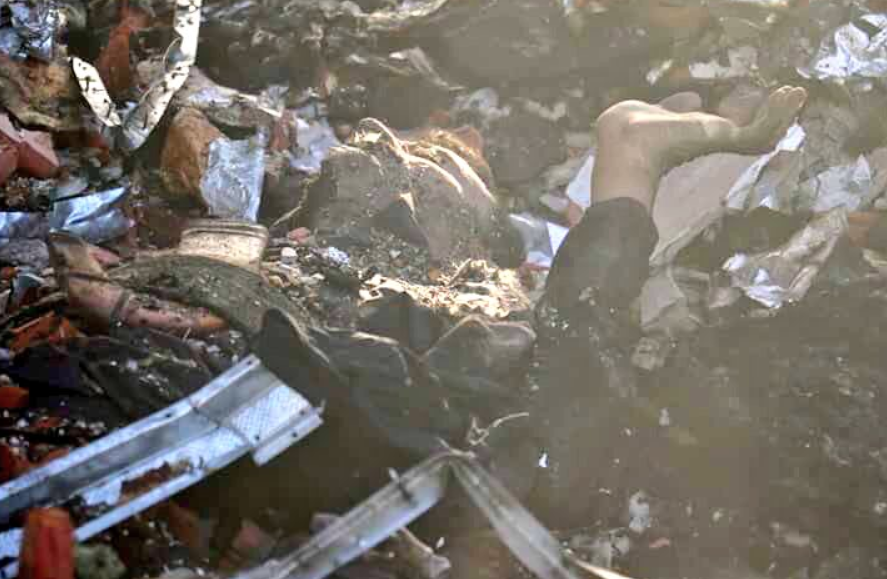
Yesterday, the under secretary of the Public Health Ministry in Yemen told journalist and Middle East commentator, Marwa Osman, the death toll had risen to 458 and hundreds more injured. In an interview with RT, Osman went on to describe, 213 bodies were reported as charred, burned beyond recognition, 67 bodies were completely dismembered and 187 bodies torn apart by shrapnel. The brutality of this attack is evident from the horrific photos that appeared on social media very quickly after the event, as Yemenis were reeling from the scale of the massacre.
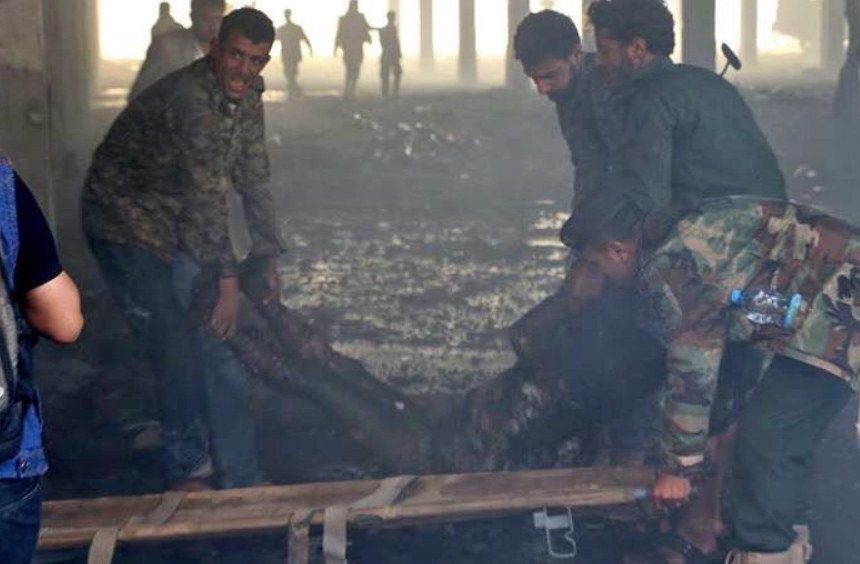
Yemen civil defence and army recovering bodies from the Saudi coalition bombed ceremony hall in Sanaa (Photo: Yemen the Forgotten War)
The hundreds more injured have been described as “bleeding to death in the streets“. The following report came in from Sanaa hours after the attack:
“Saudi-American airstrikes targeted the biggest hall in Sanaa. The hall was hit by 4 missiles, 2 air-strikes. When rescuers went to the aid of the dying and injured Saudi jets attacked for the second time in their double tap operation. It’s impossible to count the deaths. Officially they are saying less than 500 but many more are dying because they can’t be treated due to the absence of medical supplies and hospital facilities. This is entirely due to the UN sanctions and effective land, air and sea blockades. The hall is 2km from our home and 150m from my university but luckily, today I was not there.
Yesterday we killed several mercenary leaders in Mareb and Saudi commanders so today they are taking their revenge on the innocent people” ~ information supplied to Vanessa Beeley of 21st Century Wire.
[…]
According to Hassan Al Haifi, writer, academic and political commentator, living in Sanaa, the Saudi attack was deliberate:
“The mourners were paying tribute to General Jalal Al-Rouishan, Min of Int, who hails from a leading family of Khowlan Al-Tayyal Tribe, a leading and powerful Yemeni tribe.”
Al Haifi commented that this was a cynical and brutal attack by the Saudi coalition, intending to kill as many Ansarullah and Ali Abdullah Saleh officials and supporters as possible. A number of Saleh’s closest friends and allies were killed by the strikes along with a smaller number of Ansarullah members. Al Haifi, himself should have been at the ceremony but had been delayed and fortunately was not there when the Saudi jets launched their missiles into the throngs of mourners.
The Bloodshed
Saudi air-strike on Sanaa (Photo supplied to 21st Century Wire from Yemen)
The US State Department immediately swung into damage limitation mode and cranked up their hypocrisy to protect their Saudi coalition military industrial complex clients. John Kirby even deployed the “self-defence” terminology usually reserved for their other regional, arms guzzling ally with close links to Al Qaeda, Israel.
The bloodshed and suffering of the Yemeni people was reduced to an obscene game of semantics by a cold and calculating US State Department, as their multi billion dollar arms industry registered obscene trading levels with the Saudi coalition in 2015. In the first 21 months of Saudi-US illegal war on Yemen, US arms sales worth $33 Billion were closed Saudi and Gulf Cooperation Council (GCC) entities according to Defense News. In total, America’s Nobel Peace Chief Barack Hussein Obama has offered to sell $115 billion in weapons to Saudi Arabia since taking office in 2009 – more than any previous US administration, according to a recent report.
Not to be left out of the party, Britain has also sold more than £3.7 billion in arms to Saudi Arabia since Saudi’s illegal war of aggression began.
In truth, many of these estimates are conservative and do not include many more hundreds of millions in ancillary costs, staffing, support contracting and engineering.
Forgotten Heroes
Even though they’ve been completely redacted by the western media, and also by the myriad of Gulf monarchy media outlets, the real heroes of this conflict are the Yemeni people.
In their reductionist way of thinking and categorizing the world outside of their shores, Americans refer to Middle East populations in sectarian terms – because this is they way they would like to see the world, but it couldn’t be any further from reality. To Americans, the Yemeni war is all because of “Iranian-backed Shia Houthi Rebels.” The first US Congressman ever to say that in public probably read it directly off an AIPAC policy briefing sheet. That’s the sad reality still in Washington – information-poor (and lobby cash-rich) elected representatives are only able to see the world through the Israeli lens.
The reality is much more complex than just “the Houthis.” A genuine Arab Spring has taken place in Yemen and the US and Saudi response was simply to try and crush the people. But the people have resisted fiercely, and together. Unlike other neo-colonial ventures like Iraq and Afghanistan – the people of Yemen have united to a large degree and are determined to realize their own vision of self government. This is something that has been written off by everyone in the US establishment – from the President all the way down the political food chain.
Damning Indictment
The UK/US built, House of Saud, is waging a genocidal war of aggression that has already destroyed entire swathes of Yemeni cultural heritage and decimated entire communities, particularly in the northern, traditionally Ansarullah (Houthi) held areas such as Saada and Hajjah. This was by design. By now, we can see clearly how this was yet another ethnic cleansing programme being endorsed, fuelled and defended by the United States and her allies in the UK, EU, Israel, and of course the neighbouring Gulf States, the majority of whom participated in this dirty war. Oman, a lone, moderate, and independent thinking gulf state, has remained neutral, providing a degree of support to the Yemeni people. […]
The height of US hypocrisy was on full display during a US State Department press briefing where the already discredited US spokesman John Kirby shameless danced around a mass-murder by Saudi Arabia – whose airstrikes are supported logistically by the United States. This is the definition of criminality unchecked. Watch:
Author Vanessa Beeley is a special contributor to 21WIRE, and since 2011, she has spent most of her time in the Middle East reporting on events there – as a independent researcher, writer, photographer and peace activist. She is also a volunteer with the Global Campaign to Return to Palestine. See more of her work at her blog The Wall Will Fall.
For further background on Saudi ‘s war of aggression please read 21WIRE article: UN Whitewashing Saudi Coalition War Crimes and International Human Rights Violations
Only In The World Of American Media Is Syria A Civil War
By Brandon Turbeville | Activist Post | October 13, 2016
To the vast majority of Americans, the Syrian crisis (as well as the state of affairs in Iraq, Libya, Yemen, etc.) is merely a distant blip on a cluttered radar screen. Competing with issues affecting an individual’s daily life like wages, taxes, and free trade, that small portion of the American population who hasn’t completely zoned out of the political and current-events sphere is increasingly overtaken with the necessities of survival. Those who are able to devote enough time to the Syrian crisis are confronted with an unprecedented onslaught of propaganda demonizing the Syrian government and the Syrian president as “killing his own people,” “brutal,” and “genocidal.” The Syrian people are also victims of the propaganda war as being obsessed with religion, divided, and opposed to their government.
As they are presented by the U.S. media, the Syrian people, like most other people across the world are completely dehumanized. In American media, Syrians are not human. They are numbers. 100 died today. 86 died the day before. Syrians are not mothers or sons. They are not fathers or little children, grandparents. They are blips on a screen and data in a spreadsheet. At least, this is how they are presented to an increasingly hardened American public, a nation that is becoming more and more desensitized to death, destruction, and degradation both at home and abroad.
Having recently concluded a trip to the Middle East, I can safely say that the claims made by Western media are the opposite of the truth.
While my visit centered in Lebanon, we had frequent opportunities to talk with ordinary Syrian citizens either visiting Lebanon or fleeing the ravages of the war in their home country. Indeed, Syrians and Syrian refugees were plentiful in Beirut and many would openly speak about the horrors visited upon them by the West’s proxy war and their trials outside Syria.
What is so important about the fact that these Syrians were being interviewed in Lebanon is the unique benefit of talking with someone not living in their home country because one knows with relative certainty that the person speaking has nothing to lose or gain by giving a false perception of the government. After all, one of the frequent accusations leveled by the Western media is that, whenever one speaks to a Syrian actually living in Syria is that they are handicapped by that person’s fear of retribution from the Syrian government. According to this train of thought, if a man criticized Assad in Syria, he might be subject to arrest and then, of course, torture, execution, and “barrel bombs.”
But that is not the case in Lebanon. In Lebanon, even the most vocal anti-Assad Syrian can speak his mind and be safely out of Assad’s reach. Indeed, even out of ear shot by the Syrian government. A Syrian in Lebanon can speak his piece and do so safely in the knowledge that the alleged “brutal dictator” cannot reach him.
That being said, out of all the Syrians I met and spoke to – refugees and visitors, Muslim and Christian, male and female – not one of them supported the “rebels” and all of them – 100% – fully supported their government and Bashar al-Assad. These individuals had nothing but hate for the terrorists and nothing but love for Assad and the Syrian government.
This point needs to be stressed. These individuals were not under threat of a tyrant ready to arrest them if they spoke out against him. They were free of Assad. They could spit on his portrait if they wanted and there is nothing the Syrian government can do to them. Instead, they expressed an incredible amount of pride in their country, their government, and their President.
So, with that in mind, if Assad and the Syrian government are “barrel bombing” their own citizens, committing genocide against the Syrian people, and killing civilians indiscriminately, and if Syrians are free to speak their mind about Assad in Lebanon, why couldn’t I find one Syrian who wanted Assad to “step down” or for terrorists to bring them the “freedom and democracy” the West keeps yapping on about? Perhaps I was looking in the wrong places or perhaps the information coming from Western governments and their media mouthpieces are simply propaganda. Personally, I’ll put my money on the latter.
One striking aspect of Beirut in the context of the Syrian crisis is that one does not necessarily have to seek out the Syrians in order to speak to them. If one only wears a necklace, t-shirt, or bracelet with the Syrian flag, they will come to you. Any indication of solidarity with their country, especially exhibited by a Westerner (even better, an American) and a man who speaks only one word of English will stop whatever he is doing so that he can have a conversation with the foreigner, even if that conversation is done by body language, hand gestures, broken English, interpreters, or Google Translate alone.
Others more skilled in the English language are willing to have long discussions about their experiences, their support for the government, and their hatred for the terrorists infecting their country. They would tell tales of watching people they knew killed in front of them and having lost family or very close friends at the hands of America’s “moderates.” Indeed, in Syria, as well as in the diaspora of the last 5 years, it seems impossible to speak with a single Syrian who has not lost someone close to them.
The sheer magnitude of the crisis is unimaginable in scale, much in the way that the horrors inflicted upon the Syrian people by America’s democracy loving cannibals are beyond the comprehension of most Western audiences. But despite all the bloodshed, loss, and terror perpetrated on Syria by the United States, the Syrian spirit remains and the Syrian people remain some of the kindest, friendliest, and most hospitable people on the face of the earth.
In addition, Syrians remain a seemingly highly informed audience despite the fact that their country has been crippled by warfare for the past five years and that they themselves have been turned into refugees. Knowledge not only of their own situation, but about the players behind it and the developments taking place in Europe and America is common and, while American audiences watch the 24 hours news cycle in utter befuddlement as to the events taking place in Syria, Syrians are profoundly aware of just who is responsible for the crisis their country is facing.
While Americans chalk the crisis up to the “they have been fighting for thousands of years” line or accept the propaganda that Syria is facing a civil war, Syrians know that what they are facing is a proxy war against their government, against their very way of life, and against Russia. Syrians are fully aware of the fact that the terrorists beheading their way across the country are funded by Saudi Arabia, facilitated by Turkey and Israel, and trained by the United States. They are fully aware that there are no “moderates” fighting against the Syrian government and that the United States is responsible for creating the ISIS terror organization it is claiming to fight.
All of this may come as a surprise to Americans but, in Syria, it is well known.
With that in mind, it is an extraordinary thing that Syrians can welcome foreigners visiting their country with such patience and forgiveness. It is truly amazing that Syrian refugees struggling to survive in a foreign country is willing to sit with a citizen of the very country that destroyed his home and killed his family members, smoke hookah with him, and discuss his homeland. It is an unbelievable act of understanding and forgiveness for a man not to judge an American as the enemy and to separate the American people from their government. I was personally struck by the genuine kindness shown to me by people who have been given every legitimate reason to do otherwise.
What the United States is doing to Syria is truly shameful and immoral but, despite the horrors the U.S. and NATO countries have visited upon Syria, the people have refused to give in.
As Mark Twain said,
Damascus has seen all that has ever occurred on earth, and still she lives. She has looked upon the dry bones of a thousand empires, and will see the tombs of a thousand more before she dies.
Judging by the people I met, I am inclined to agree with him.
Brandon Turbeville – article archive here – is the author of seven books, Codex Alimentarius — The End of Health Freedom, 7 Real Conspiracies, Five Sense Solutions and Dispatches From a Dissident, volume 1 and volume 2, The Road to Damascus: The Anglo-American Assault on Syria, and The Difference it Makes: 36 Reasons Why Hillary Clinton Should Never Be President.
U.S. Says Russia Bombed Convoy Even If It Didn’t
By Brandon Turbeville | Activist Post | September 28, 2016
Throughout the entirety of the Syrian crisis, Western media outlets have misrepresented facts and presented outright lies to their audiences regarding virtually every aspect of the war but, particularly when it comes to specific occurrences used to gin up support for greater Western intervention in Syria, these outlets kick it up a notch, launching flurries of disinformation and misinformation designed to leave imprints of false narratives in the minds of half attentive audiences.
With the recent bombing of an aid convoy in Urm al-Kubra near Aleppo, the Western media (as well as the governments it speaks for) is conflating the convoy that was attacked with a convoy that never actually entered Syria and which appears to have been attacked by America’s rebels. Now, rogue generals within the U.S. military are declaring that the Russians are responsible for the attack despite having no evidence for their claims. In addition, these generals and the Secretary of Defense are saying that, even if the Russians didn’t drop the bombs, the Russians are guilty of attacking the convoy.
Seriously, they actually said that.
Chairman of the Join Chiefs of Staff, Gen. Joe Dunford lobbed the first nonsensical claim to the Senate Armed Services Committee when he stated that “There is no doubt in my mind that the Russians are responsible, we just don’t know whose aircraft dropped the bombs.”
Really? How do you know the Russians bombed a convoy if you admittedly don’t know who dropped the bombs?
Dunford even stated “I don’t have the facts.”
It’s good to know that military policy is decided without facts and that determinations are made regardless of them, isn’t it? Dunford’s statement was essentially “We want to blame the Russians and, regardless of who bombed this convoy, we will blame the Russians. Fuck the facts.”
Yet Secretary of Defense Ashton “Ash” Carter (appropriately named “Ash” since that will be all that is left of the world by the time the U.S. Empire is finished provoking every country in the world including nuclear powers) was not to be outdone by Dunford.
“[The] Russians are responsible for this strike whether they conducted it or not because they associated themselves with the Syrian regime,” he said.
Now, that’s an interesting point. Let’s say for the sake of argument that the Syrian “regime” was “killing its own people,” “bombing civilians,” and “torturing” Syrian civilians as the U.S. government claims it is. To be clear, there is no evidence of any of this but, for the sake of argument, let’s say the alternate universe of the Western corporate media and the State Department is reality for a second. If the Russians are then responsible for the behavior of the Syrian government, wouldn’t the United States be responsible for the behavior of the “rebels” because the U.S. is associating itself with them?
Indeed, by the logic of Ashton Carter (an oxymoronic statement to say the least), the United States is responsible for untold executions, implementation of violent Sharia law, genocide, rape, child molestation, beheadings, torture, and, of course, cannibalism. Ironically, whether we follow the logic of Ashton Carter or not, the end result is the same – the United States is indeed responsible for all of these crimes and more in Syria.
The Russians responded with a slight jab at the U.S. government with Igor Konashenkov stating:
Unlike the chairman of the Joint Chiefs of Staff of the U.S. Armed Forces, we do have the ‘facts’, that is, data of objective control of the aerial situation in Aleppo on Sept. 19. And these facts unequivocally confirm the presence of an American unmanned fighting air vehicle Predator, launched from the Incirlik air base, in the area of the convoy’s passing by Urum al-Kubra.
Unfortunately, Konashenkov must be unaware that the facts don’t matter to the United States government or to the Western corporate media.
If facts mattered, the fact that there is no evidence of Russian or Syrian or any aerial bombardment of the Syrian Red Crescent convoy would be adequately reported. Indeed, evidence that the bombing was an attack against a completely different convoy than what the American media has painted as the actual victim and the fact that the Western-backed terrorists were the most likely culprits would be discussed all over the airwaves right now.
But, of course, if the facts actually mattered, America’s “moderate” rebels would have never been labeled “moderate,” “peaceful,” or “democratic.” Nor would America have armed “rebels” in the first place. Or invaded Libya. Or Iraq. Or Afghanistan. Unfortunately, however, facts and logic are an endangered species in America these days.
Brandon Turbeville – article archive here – is the author of seven books, Codex Alimentarius — The End of Health Freedom, 7 Real Conspiracies, Five Sense Solutions and Dispatches From a Dissident, volume 1 andvolume 2, The Road to Damascus: The Anglo-American Assault on Syria, and The Difference it Makes: 36 Reasons Why Hillary Clinton Should Never Be President.
US seeks to partition Syria to serve Israel: Nasrallah

Sayyed Hassan Nasrallah, the secretary general of the Lebanese resistance movement, Hezbollah, addresses a ceremony on October 11, 2016 on the occasion of Tasu’a.
Press TV – October 11, 2016
Sayyed Hassan Nasrallah, the secretary general of the Lebanese resistance movement, Hezbollah, has warned of plots by the US, Saudi Arabia and their regional allies to partition Syria in order to serve the Israeli regime’s interests in the Middle East.
The “real goal” of the countries that have neither democracy nor elections was not democracy or elections in Syria, Nasrallah said on Tuesday.
“The goal was for Syria to fall and be fragmented and be ripped apart” in line with Israel’s interests, he added.
Nasrallah made the remarks at the Sayyed al-Shohada Complex in the Lebanese capital, Beirut, on the ninth day of the lunar month of Muharram, Tasu’a, the eve of the martyrdom anniversary of Imam Hussein, the third Shia Imam, and his 72 companions.
He said the Daesh Takfiri militants and al-Qaeda affiliated terrorists of Jabhat Fateh al-Sham, formerly known as al-Nusra, “are being used to serve and achieve US and Israeli goals.”
Nasrallah further noted that the US seeks to concentrate Daesh terrorists in eastern Syria, adding that Washington is allowing and “opening the roads for” Daesh militants to flee from Iraq into Syria.
He cited the recent “deliberate action” by the US to launch airstrikes against Syrian army positions in eastern Syria as an example of Washington’s attempts to boost Daesh in the region, adding, “US raids on Dayr al-Zawr were targeting the Syrian army positions so that the whole area would fall to Daesh.”
The Hezbollah leader said, “All those who are defending Syria defend the Resistance and look forward to a political solution and not to more bloodshed,” but “US, Saudi Arabia and some regional states are demanding crippling conditions to neutralize the political solutions.”
Pointing to a recent abortive truce deal between the US and Russia on Syria, the Hezbollah chief said Washington withdrew from the agreement because it called for the separation of Jabhat Fateh al-Sham from other militant groups and the identification and targeting of Daesh and Jabhat Fateh al-Sham positions.
Nasrallah said the US, Saudi Arabia and their regional allies are obstructing a diplomatic solution to the crisis in Syria and the easing of the sufferings of the Syrian people.
He expressed regret that “more escalation and tensions” is on the horizon in Syria, but called for “perseverance and firm stance” in order to counter the plots of the country’s enemies.
The Hezbollah chief said Syria’s foes sought “a decisive victory within a few weeks” but have faced stiff resistance from the Syrian government and nation and their allies for over five years.
Sana’a carnage major scandal for Saudi Arabia
In another part of his speech, Nasrallah pointed to the recent bloody air raid by Saudi Arabia on a funeral hall in the Yemeni capital of Sana’a and said the strike was a major scandal for Al Saud regime.
Hezbollah leader said some media circles had noted that his remarks on Saudi attack in Sana’a would affect chances of Michel Aoun becoming Lebanon’s next president, which could end a political crisis in the country.
Noting that the demand was tantamount to political blackmail, Nasrallah added, “Even [UN Secretary General] Ban Ki-moon has condemned this strike, although he has always been silent, so how do you want me to remain silent?”
Nasrallah added that the Saudi regime committed a “historic mistake” in Yemen by thinking that it could emerge victorious from the battle within weeks.
The Hezbollah chief condemned the international community’s silence on the bombardment of Yemen by Saudi warplanes and said the world must convince Riyadh that it cannot win this war.
He emphasized that the Sana’a massacre must provide a motive for ending the war in Yemen and added that the Saudi regime has no option but to accept the political solution.
“Saudi Arabia’s insistence on carrying on with the war will not only make it lose Yemen, but will also make it lose itself. The current Saudi leadership is pushing the kingdom to the brink of the abyss,” Nasrallah pointed out, recommending the Saudi rulers to come to their senses.
All parties must preserve Lebanon’s peace and security
The Hezbollah secretary general further stressed the importance of preserving security, stability and civil in Lebanon, describing them as the “pillars of everything,” and adding, “Despite their differences, the Lebanese have managed to preserve security, stability and peace.”
Nasrallah stated that Lebanon has entered a positive political phase during the past few weeks with regard to the presidential election.
“We support and welcome any positive political developments regarding the presidency and we will acknowledge the efforts and courage of anyone who makes efforts in this regard,” Nasrallah pointed out.
He noted that Hezbollah has always pursued a clear stance on Lebanon’s presidential election, adding, “We support every positive political change, which may solve the presidency challenge.”
Hezbollah leader concluded his remarks by stressing the importance of supporting the Lebanese army without any political reservations.
Humanitarians for War: Language and the New Orientalists
By Alex Ray | OffGuardian | October 5, 2016
A UK House of Commons inquiry into the 2011 attack on Libya and the country’s subsequent collapse has found what many suspected: NATO and its Gulf Arab allies used their ‘Responsibility To Protect’ to launch their attack even though:
“… the proposition that Muammar Gaddafi would have ordered the massacre of civilians in Benghazi was not supported by the available evidence.”
Though the MPs’ damning report blames Libya’s political and economic collapse on former Prime Minister David Cameron, the manipulation of public opinion to lay the basis for war is built upon longstanding – but now sharpened – processes and semantic structures that prepare populations to accept punitive action against a targeted ‘other’.
In an earlier example, on October 10 1990, a young Kuwaiti woman known as ‘Nayirah’ testified before the United States’ Congressional Human Rights Caucus that invading Iraqi soldiers had gone into hospitals and thrown babies from their incubators.
Nayirah turned out to be the daughter of the then Kuwaiti ambassador to Washington. Her testimony was false and prepared by a PR company. But it was solid gold for the US campaign to intervene militarily. Amnesty International provided influential support for Nayirah’s story. The ‘depravity’ of Saddam Hussein’s government was proffered by governments and mainstream media as a key reason for military intervention.
In March, 2011, Libyan opposition fighters and a Libyan psychologist, Dr Seham Sergewa told foreign media that pro-Qaddhafi fighters were being ordered to carry out viagra-fuelled mass rapes. The claim – spread by Al-Jazeera – was this time picked up by the prosecutor of the International Criminal Court, Luis Moreno-Ocampo. Although Amnesty International questioned some of the claims this time, the rape story was one of many myths that contributed to the NATO bombardment of Libya – the beginning of the end of the Libyan state.
The ‘humanitarian’ battle cry of 2011 was another manifestation of neo-Orientalist rhetoric directed towards out-of-favour leaders or groups.
Edward Said’s “Orientalism” referred to Western stereotyping of Arabs and Arab culture through a colonial lens. Currently, Neo-Orientalism is typically based on sensational claims that target ‘others’ (leaders or groups) by depicting them as intrinsically alien, evil and irrational, in order to justify aggression against them.
Qaddhafi’s relationship with the West was full of moments that prepared us to unquestionably accept claims of his barbarity – to the extent that Hillary Clinton could mock his torture and murder by rebels.
Regardless of his positive and negative attributes, the language used to describe Qaddhafi – a son of peasant goat herders – was often insulting and unprofessional. Journalist and historian Gwynne Dyer for example: “
… resplendent in the gold brocade robes that he probably made from his mother’s curtains and wearing his usual bug-eye sunglasses… The world’s oldest teenager…”
The New York Times treated Qaddhafi’s international visits featuring his bedouin tent as a circus fit for New York’s Coney Island rather than an important cultural symbol of Libya’s or Qaddhafi’s heritage. One wonders whether anyone would dare attempt similar treatment of Australia’s Aboriginal Tent Embassy which has been a feature of the capital Canberra since 1972.
There were numerous stories of the ‘chauvinistic’ displays of Qaddhafi’s ‘Amazonian’ republican guard. However ‘Amazonian’ legends of powerful female bodyguards have a long history in North Africa and especially Libya. Greek mythology – the source of Amazonian legends – speaks of Queen Myrina the Amazonian queen who led military victories in Libya. Under Islam there was the wealthy and powerful King Musa I of Mali, who was protected by such an Amazonian troop while undertaking the Hajj in 1332. It seems not a single commentator bothered to note the antecedents of such symbolism before resorting to ridicule.
It is not only the media and politicians who join the neo-Orientalist derision of disagreeable leaders. Descriptions of Qaddhafi in Harvard professor and historian Roger Owen’s recent work The Rise and Fall of Arab Presidents for Life, exhibit shades of cultural superiority. After indulging in psychological speculation about Arab leaders, Owen (p.199) criticises Qaddhafi’s relationship with the African Union particularly his “bringing African heads of state to Libya and posturing before them in ‘African’ costumes of his own design with absurd-looking little round caps”.
Aside from Owen’s dismissal of the African Union, he sees no irony in ridiculing Qaddafi for doing exactly what the leaders of the world’s most powerful countries do at APEC and G20 meetings – put on ‘absurd’ cultural uniforms like the imagined Australian stockmen’s outfits worn by APEC leaders in Sydney in 2007:

John Howard and George W. Bush at APEC in Sydney 2007, Source: The Guardian
Owen depicts Arab governments as wholly subject to the whims of a strongman leader. While the West – and sometimes Arab leaders themselves – like to portray authoritarian governments as ruled by maniacal and all-powerful men individually, this is rarely the case – especially in Libya as demonstrated by this Wikileaks cable showing disagreements amongst the Libyan leadership.
Such systems are far too complex to be overseen by one person. As Oxford Professor Richard Bosworth argues, in addition to clouding other factors involved in the operation of such states, judgemental and presumptive treatments such as Owen’s tend to dismiss leaders as mad and evil which prevents comprehensive understanding.
The terminology of ‘regimes’ and ‘governments’ is another rhetorical tool aimed at demonising chosen targets. ‘Regimes’ sound all controlling, mechanical and despotic while ‘governments’ sound rational, responsive and civil. But as academic Lisa Anderson has pointed out the term ‘regime’ is widely misused. A regime is the: “set of rules, or cultural or social norms that regulate the relations between ruled and rulers. Including how laws are made and administered and how the rulers are themselves selected”. As such regimes come in types, Totalitarian, Authoritarian, Democratic etc.
A ‘government’ on the other hand “comprises those incumbents and the policies associated with them”. Referring to the ‘Qaddhafi Regime’ or ‘Mubarak Regime’ is a problematic conflation of regime type, government and the actors involved in it. Applying the same conflation to Western governments would result in labels like ‘Obama regime’.
‘Orientals’ or just the non-compliant?
Neo-Orientalist language cannot be explained away as a reaction to brutality. If a leader’s brutality was the benchmark for engaging in this form of vitriol, it could be just as easily applied to every US President.
Rather the point of this type of language is to de-legitimise and de-humanise or barbarise a targeted ‘other’. Neo-Orientalist language has (mostly) retreated from typecasting entire civilisations – as this has become less acceptable among western audiences – and has retreated to depictions of individual leaders, sub-groups or sub-ideologies.
Those selected, most commonly for their ‘uncooperative’ international behaviour, are not worthy of engagement or understanding, simply of fear and loathing. The use of violence against such ‘irrational’ forces becomes legitimate and ‘just’.
The language of neo-Orientalism takes many guises, from the ‘war on terror’ to ‘humanitarian intervention’ and has been so successful in cloaking itself in ‘liberal’ values that it attracts support from across the political spectrum.
As Robert Irwin pointed out in his 2006 critique of Edward Said’s Orientalism, the expression of ‘Orientalist’ language does not need to be limited in time (to the European colonial period) or place (the Arab world). By seeking to solely link Orientalism to the European and American imperial ages Said confused and understated the breadth of his argument. Orientalism was not limited to ‘the Orient’, but was and is directed at other groups – both ethnic and political.
For example, western media treatment of Russian President Vladimir Putin also involves ridicule of both cultural symbolism and psychological state.
According to Vox News and Angela Merkel, Putin’s machismo is a cover for “personal insecurity as a weak leader” and is responsible for his “invasion of Ukraine”. We are also told Putin’s ‘machismo’ and ‘aggression’ is the cumulative embodiment of Russian shame and weakness. Merkel was quoted as saying “Russia has nothing, no successful politics or economy. All they have is this [machismo].”
Without delving into to the possible objections to this account, why is Putin’s ‘aggressive’ behaviour seen as a unique flaw in individual and national character? What about the destruction that the United States wrought following the ‘injury’ to the American ego that was September 11? What about the UK’s war of indignation in the Falkland Islands? With the same logic and tone one could posit that the entire British colonial age was a result of ego issues within the ‘lonely little island in the North Sea’.
What of Hillary Clinton’s psychological state or the culture she embodies? Sold as the ‘normal’ presidential candidate, this is the woman who mocked Qaddhafi’s death with “We came, we saw, he died…” and seems to carry no baggage from the destruction of a country on almost entirely false pretences.
One persuasive critic of neo-Orientalism, Alastair Crooke, identifies it as a manifestation of a Western mindset of dominance in the present era. “
… this is the new racialism… a hierarchy of civilisations in which the West sees its civilisation as the most appropriate one for the future… superior and the template that should be imposed on others…”
Status quo powers deploy much effort and money to explain their transgressions but most are based on the simple assumption that equal standards do not apply; we are ‘rational’ and ‘just’, they are not.
Alex Ray works on cultural exchange between the West and the Arab world. Based in Jordan, he holds a MA in Middle East and Central Asian Studies from the Australian National University and is a former student of the University of Damascus. He writes at https://betweendeserts.wordpress.com/
The NYT’s Neocon ‘Downward Spiral’
By Robert Parry | Consortium News | October 4, 2016
The New York Times’ downward spiral into a neoconservative propaganda sheet continues with another biased lead article, this one on how the Syrian war has heightened U.S.-Russia tensions. The article, bristling with blame for the Russians, leaves out one of the key reasons why the partial ceasefire failed – the U.S. inability to separate its “moderate” rebels from Al Qaeda’s jihadists.
The article, written by Michael R. Gordon and Andrew E. Kramer (two of the paper’s top national security propagandists), lays the fault for the U.S. withdrawal from Syrian peace talks on Russian leaders because of their “mistrust and hostility toward the United States,” citing a comment by former White House official Andrew S. Weiss.
Gordon and Kramer then write that the cessation of hostilities agreement came undone because of the “accidental bombing of Syrian troops by the American-led coalition and then because of what the United States claimed was a deliberate bombing by Russian aircraft and Syrian helicopters of a humanitarian convoy headed to Aleppo.” (The Times doesn’t bother to note that the Russians have questioned how “accidental” the slaughter of 62 or so Syrian troops was and have denied that they or the Syrian government attacked the aid convoy.)
The article continues citing U.S. intelligence officials accusing Russia and Syria of using indiscriminate ordnance in more recent attacks on rebel-held sections of Aleppo. “Unfortunately, Russia failed to live up to its own commitments,” said a State Department statement, according to Gordon and Kramer.
However, left out of the article was the fact that the U.S. government failed to live up to its commitment to separate U.S.-backed supposedly “moderate” rebels from Al Qaeda’s Nusra Front, which has recently changed its name to the Levant (or Syria) Conquest Front. By contrast, this key point was cited by Rupert Murdoch’s Wall Street Journal, which noted:
“Russia has complained that Washington wasn’t upholding its end of the bargain by failing to separate U.S.-backed Syrian rebels from more extremist groups tied to al Qaeda.”
Doubling Down with Al Qaeda
Indeed, The Wall Street Journal has actually done some serious reporting on this crucial topic, publishing an article from Turkey on Sept. 29, saying:
“Some of Syria’s largest rebel factions are doubling down on their alliance with an al Qaeda-linked group, despite a U.S. warning to split from the extremists or risk being targeted in airstrikes.
“The rebel gambit is complicating American counterterrorism efforts in the country at a time the U.S. is contemplating cooperation with Russia to fight extremist groups. It comes after a U.S.-Russia-brokered cease-fire collapsed last week and the Syrian regime and its Russian allies immediately unleashed a devastating offensive against rebel-held parts of Aleppo city that brought harsh international condemnation. …
“The two powers have been considering jointly targeting Islamic State and the Syria Conquest Front — formerly known as the al Qaeda-linked Nusra Front — a group that is deeply intermingled with armed opposition groups of all stripes across Syria’s battlefields. The U.S. has also threatened to attack any rebels providing front-line support to the group. …
“Some rebel groups already aligned with Syria Conquest Front responded by renewing their alliance. But others, such as Nour al-Din al-Zinki, a former Central Intelligence Agency-backed group and one of the largest factions in Aleppo, said in recent days that they were joining a broader alliance that is dominated by the Front. A second, smaller rebel group also joined that alliance, which is known as Jaish al-Fateh and includes another major Islamist rebel force, Ahrar al-Sham. …
“In a call with Mr. Kerry on Wednesday, Russian Foreign Minister Sergei Lavrov said Syrian rebels ‘refused to follow the U.S.-Russian agreement…but instead merged with [Nusra Front].’”
So, it should be clear that a major obstacle to the agreement was the failure of the U.S. government to persuade its clients to break off alliances with Al Qaeda’s operatives, a connection that many Americans would find deeply troubling. That public awareness, in turn, would undermine the current neocon P.R. campaign to get the Obama administration to supply these rebels with anti-aircraft missiles and other sophisticated weapons, or to have U.S. warplanes destroy the Syrian air force in order to impose a “no-fly zone.”
Since the start of the Syrian conflict in 2011, the powerful role of Al Qaeda and its spinoff, the Islamic State, has been a hidden or downplayed element of the narrative that has been sold to the American people. That story line holds that the war began when “peaceful” protesters were brutally repressed by Syria’s police and military, but that version deletes the fact that extremists, some linked to Al Qaeda, began killing police and soldiers almost from the outset.
Hiding Realities
However, since The New York Times is now a full-time neocon propaganda sheet, it does all it can to hide such troublesome realities from its readers, all the better to jazz up the hatred of Syria and Russia.
As the Times and the Journal both made clear in their articles on Tuesday, the neocon agenda now involves providing more American armaments to the rebels either directly through the CIA or indirectly through U.S. regional “allies,” such as Saudi Arabia, Qatar and Turkey.
Though pitched to the American people as “humanitarian” assistance needed to shoot down Syrian and Russian planes, the arming-up of the rebels will likely extend the war and the bloodletting even longer while strengthening Al Qaeda and the Islamic State,.
If the new U.S. weapons prove especially effective, they could even lead to the collapse of the Syrian government and bring about the neocons’ long-desired “regime change” in Damascus. But the ultimate winners would likely be Al Qaeda and/or the Islamic State, which could be expected to follow up with the mass slaughter of Christians, Alawites, Shiites, secular Sunnis and other “heretics.”
More likely, however, the U.S.-supplied weapons would just cause the war to drag on indefinitely with an ever-rising death toll. But don’t worry, the dead will be blamed on Vladimir Putin and Bashar al-Assad.
Although never mentioned in the mainstream U.S. media, the delivery of weapons to these Syrian rebels/terrorists is a clear violation of international law, an act of aggression and arguably a crime of aiding and abetting terrorists.
International law is something that the Times considers sacrosanct when the newspaper is condemning a U.S. adversary for some violation, but that reverence disappears when the U.S. government or a U.S. “ally” is engaged in the same act or worse.
So, it is understandable why Gordon and Kramer would leave out facts from their story that might give Americans pause. After all, if the “moderate” rebels are in cahoots with Al Qaeda, essentially serving as a cut-out for the U.S. and its “allies” to funnel dangerous weapons to the terror organization that carried out the 9/11 attacks, Americans might object.
Similarly, if they were told that the U.S. actions violate international law, they might find that upsetting, too, since many Americans aren’t as coolly hypocritical as Official Washington’s neocons and liberal war hawks.
Beyond the devolution of The New York Times into a neocon propaganda organ, Gordon and Kramer have their own histories as propagandists. Gordon co-wrote the infamous “aluminum tube” story in September 2002, launching President George W. Bush’s ad campaign for selling the Iraq War to the American people. Gordon also has gotten his hands into disinformation campaigns regarding Syria and Ukraine.
For instance, Gordon and Kramer teamed up on a bogus lead story that the State Department fed to them in 2014 about photographs supposedly taken of soldiers in Russia who then turned up in other photos in Ukraine – except that it turned out all the photos were taken in Ukraine, destroying the premise of the story and forcing an embarrassing retraction. [For more on that screw-up, see Consortiumnews.com’s “Another NYT-Michael Gordon Special?”]
For his part, Kramer has been a central figure in the Times’ anti-Russian propaganda regarding Ukraine. [See Consortiumnews.com’s “NYT Is Lost in Its Ukraine Propaganda.”]
So, between the Times’ neocon institutional bias – and the apparent personal agendas of key correspondents – one can expect very little in the way of balanced journalism when the topics relate to the Middle East or Russia.
Does Syria Have the Right to Defend Itself?
By Rick Sterling | Dissident Voice | October 4, 2016
There is a hypocritical disconnect in Western and especially U.S. foreign policy. When it comes to Israel, the U.S. is quick to claim “Israel has a right to defend itself.” For Syria, that same right does not seem to exist.
When Israel executed intense bombing campaigns against Gaza in 2008, 2012 and 2014 the U.S. justified the attacks. At the United Nations on July 18, 2014, U.S. Ambassador Samantha Power said, “President Obama spoke with Prime Minister Netanyahu this morning to reaffirm the United States’ strong support for Israel’s right to defend itself…. Hamas’ attacks are unacceptable and would be unacceptable to any member state of the United Nations. Israel has the right to defend its citizens and prevent these attacks.”
Israel claimed it was simply responding defensively. The human rights group BtSelem reports that over the decade between June 2004 and July 2015, Palestinians launched over 8,700 rockets and 5,000 mortars from Gaza into Israel. But the total number of civilians killed over 10 years was 28 for an average of fewer than three persons per year. Using this as a justification, Israel has attacked by air and invaded every few years inflicting far heavier casualty rates on the Palestinians in Gaza. For example, Israeli attacks on Gaza in Summer 2014 killed more than 2,000 Gazans, the vast majority of them civilians and many of them children.
With so few deaths and little damage caused by the rockets from Gaza, it seems Palestinians have launched these as almost symbolic protest against Israeli repression. The Gazan economy is hugely restricted, the borders are closed and even the sky and ocean are off limits. Many people would say that Israel is keeping the entire population of Gaza in prison-like circumstances. In addition, many residents of Gaza are descendants of refugees from nearby Israeli towns and cities. Under the Geneva Conventions and U.N. Resolution 194, they have the right to return but have been deprived of this in addition to most other rights.
In summary, Palestinians have launched rockets and mortars to protest Israeli occupation and apartheid policies. The Palestinians are not seeking the overthrow of the Israeli state so much as recognition of their rights and an end to the Occupation. Casualties from the rockets have been few. In response, the West has given Israel a virtual free pass to attack Palestinians in Gaza and unleash horrific bombing in densely populated urban areas where there are huge civilian casualties.
The disproportionate nature of these Israeli attacks suggests that the Israeli government is not defending itself; it is imposing punishment on a captive and defenseless population.
Syrian State Under Real Attack
The situation in Syria is dramatically different. The armed opposition in Syria has inflicted a huge number of deaths and damage in its five-year campaign to overthrow the government. Data from the Syrian Observatory for Human Rights, which is sympathetic to the opposition, show the following number of casualties since March 2011: Pro Government forces (army and militias) – 105,000; Anti Government forces – 101,000; Civilians – 86,000.
These numbers reveal the intensity of the violence and how wrong it is for critics to blame President Bashar al-Assad and the Syrian government for all the deaths. As shown, soldiers and militias defending the state make up the largest number of casualties.
The conflict in Aleppo is currently in the news. Aleppo was the largest city in Syria and the industrial and financial engine. The largest and most effective opposition force in Aleppo is Al Qaeda’s affiliate Nusra Front, which is recognized to be “terrorist” even by the U.S. and was never part of the “cessation of hostilities.” There are other factions and fighting groups in Aleppo also seeking to destroy the Syrian state. Most of the groups are explicitly Wahhabi sectarian and hostile to secularism, Christianity and moderate Islamic faiths.
The opposition in Syria is heavily armed with weapons, ammunition and explosives. Daily they launch hell cannon missiles into western Aleppo, killing randomly in this government-controlled part of the city. Car bombs have killed thousands of civilians and soldiers. Tunnel bombs have killed thousands more.
Aleppo was relatively quiet until summer of 2012 when thousands of armed fighters invaded and occupied neighborhoods in the eastern part of the city. The “rebels” were disliked by the majority of the population from the start. This was documented even by Western journalists such as James Foley and Stephen Sotloff, who went there inclined to be sympathetic to the opposition. (Foley and Sotloff were later captured and beheaded by Islamic State jihadists.)
Martin Chulov of the Guardian described East Aleppo in 2015 and estimated its population at just 40,000. In sharp contrast, there is a large population of about 1.5 million Syrians living in the rest of the city. This is reflective of the reality: the vast majority of Syrians support the government and hate the terrorists. This includes many who are critical of the Baath Party and who want reforms but not violence and destruction. This important fact is generally ignored by Western media. (The current situation in western Aleppo is described here by journalist Eva Bartlett.)
In contrast with Israeli’s periodic wars on Gaza, the Syrian government is truly fighting to defend itself – and its civilian population – against an armed opposition that is violent, sectarian and unpopular with the large majority of Syrians.
Adding to the legitimacy of the Syrian government’s right to defend itself, the armed opposition in Syria has been heavily supported by foreign governments. Western states and their Gulf allies have supplied weapons, training, logistical support and salaries for many thousands of fighters. Qatar’s Al Jazeera has broadcast misinformation, fabricated stories and heavily biased reporting from the start.
The same governments have been complicit in the recruitment and travel to Syria by thousands of foreigners from all parts of the globe. European, North American and Australian governments “looked the other way” as their citizens were recruited and then traveled to Syria via Turkey to join ISIS or Nusra. According to one study, over 12,000 foreigners including 3,000 from Europe and North America traveled to Syria in the first three years of the conflict. That was before ISIS peaked. Only in the last year, following terrorist actions in the West, have Western governments started arresting or detaining recruits and recruiters.
Violating International Law
The situation in Syria is more extreme but has similarities to the situation in Nicaragua in the 1980s when the Reagan administration was covertly arming and financing the Contras, a rebel army that inflicted death and destruction across parts of Nicaragua. On June 27, 1986, the International Court of Justice ruled:
“the United States of America, by training, arming, equipping, financing and supplying the contra forces or otherwise encouraging, supporting and aiding military and paramilitary activities in and against Nicaragua, has acted, against the Republic of Nicaragua, in breach of its obligation under customary international law not to intervene in the affairs of another State”.
The court also decided that the U.S. should make reparations to Nicaragua for injury caused by the violations. The U.S. ignored the ruling and later withdrew from the jurisdiction of the International Court of Justice.
The former Nicaragua Foreign Minister and former President of the United Nations General Assembly, Father Miguel D’Escoto, has written “What the U.S. government is doing in Syria is tantamount to a war of aggression, which, according to the Nuremberg Tribunal, is the worst possible crime a State can commit against another State.” (Personal correspondence quoted with permission)
Some foreign governments seeking “regime change” in Damascus have poured huge amounts of money into what is called “smart” or “soft power” via the funding of an array of organizations with nice sounding names to control the narrative and influence public opinion.
There is the Syrian Justice and Accountability Centre, initiated by Secretary of State Hillary Clinton, to prepare for victor’s justice. There is the Syrian Network for Human Rights which largely ignores the deaths of Syrian soldiers and seeks U.S./NATO intervention. There is the Syrian Civil Defense also known as the White Helmets, a support group for Al Qaeda/Nusra but most importantly a political lobbying tool actively campaigning for U.S./NATO intervention.
All of these organizations, and many more, are said to be “Syrian” and “independent.” But they were all created after the conflict began and they are all funded by the foreign governments that seek to overthrow the Syrian government.
These and other organizations support the opposition in various ways, demonize the Syrian government and romanticize the opposition. They are part of the reason why many people around the world believe that the anti-government protests in 2011 only became violent after peaceful protests were brutally crushed, which is untrue. There were seven police killed in the first protests in Deraa. That was soon followed by dozens of soldiers being massacred in Deraa and Banyas at the end of March and in April 2011.
By justifying the continued “rebel” violence, this “soft power” acts in concert with “hard” or military power. For example the White Helmets was originally called the Syrian Civil Defense and began with a military contractor training some Syrians in Turkey. This group was then rebranded as the “White Helmets” by a New York marketing company called “The Syria Campaign.” Since then, the “feel good” White Helmets brand has been heavily promoted.
As a measure of the marketing success, the White Helmets recently won the Right Livelihood Award for 2016 and are even nominated for a Nobel Peace Prize. Ironically, there is a REAL Syrian Civil Defense working since 1953 and a REAL White Helmets/CascosBlancos from Argentina which have received little recognition alongside the slick new “White Helmets” created and promoted by the shadowy PR firm.
Soft power distorts the reality in the conflict. Thus we are not told that the Syrian government is defending against terrorists but that the “Assad regime” is ‘”targeting hospitals and civilian markets.” Are the claims true? My investigation of the claims regarding the Doctors Without Borders/MSF supported “Al Quds Hospital” in April 2016 revealed that the accusations were full of contradictions, inconsistencies and unverified accusations.
The “hospital” was an unmarked building; the damage was unclear; the number of deaths varied wildly and could not be verified. The photographic evidence, supplied by the ubiquitous White Helmets, was dubious. The investigation resulted in a open letter to MSF. So far they have failed to corroborate or document their accusations and claims.
Doctors Without Borders/MSF continues to issue politically biased messages. Their Oct 2 tweet about a “bloodbath in East Aleppo” led to false accusations that two teenagers were killed by Syrian government bombing when they were actually killed by terrorist bombing.
Currently the Union of Medical Care and Relief Organizations (UOSSM), funded by France and other countries, has been at the forefront accusing Syria and Russia of intentionally bombing an underground hospital. Is the story real or fabricated propaganda? The Russians and Syrians are trying to fight the terrorists; why would they waste resources and generate negative publicity by attacking a hospital? The reports seem to be based on phone or skype conversations with sources of unknown reliability.
The narrative promoted by “soft power” is that the Syrian government is an unpopular dictatorship dominated by the Alawi religious group. Is that true? On the contrary, key ministries including Defense and Foreign Affairs are held by Sunni leaders. The majority of the Syrian Arab Army are Sunni. Visitors to Syria readily meet mothers who are proud of their sons who died defending their country against foreign-backed terrorism.
The narrative promoted by “soft power” is that the Syrian uprising was largely progressive, secular, and seeking democracy. This myth makes for a good rationalization for effectively supporting the “regime change” war against Syria, but it is contradicted by the U.S. Defense Intelligence Agency. In a classified report from August 2012, the DIA analyzed the conflict as follows: “THE SALAFIST [sic], THE MUSLIM BROTHERHOOD, AND AQI [“Al Qaeda in Iraq,” now known as ISIS or the Islamic State] ARE THE MAJOR FORCES DRIVING THE INSURGENCY IN SYRIA.”
“Soft power” in Syria has involved the creation and funding of Syrian groups who convey a message supportive of the “regime change” goals. For example there is a group in the town of Kafranbel which produces an English language banner each week. The group is provided with the message by a foreign source and the group holds the banner to be photographed and displayed on social media in the West. Most of the locals probably have no clue what it says.
Then there is the Aleppo Media Center which creates videos for influencing Western audiences, and the White Helmets previously discussed. These Western-created groups are the examples of the “Syrian Revolution” by those who promote this narrative. What kind of “revolution” is on contract with the U.S. State Department?
Current Situation and Coming Crisis
The Syrian government, with the support of the majority of Syrian people, is doing its best to defend itself against an onslaught financed by some of the wealthiest and most powerful countries on earth. The Syrian Army and popular militias have suffered huge losses but are advancing. In the last year, Russia has provided crucial air support. Unlike the invasion of Syrian land and air space by the U.S., the Russian intervention is in compliance with international law because it followed a request for assistance from Syria’s internationally recognized government, whereas the U.S. government and its allies have no such permission.
Currently the Syrian government and allies are seeking to drive Nusra and other terrorist groups from eastern Aleppo. If that is successful, they could then focus on ISIS in Raqqa and the remaining terrorists in other parts of the country. Unlike densely populated Gaza, the opposition-held areas of Aleppo have very few civilians left. Although civilian casualties happen in all wars, it makes no sense that the Syrian military would target civilians. On the contrary, the government has opened corridors to facilitate civilians and fighters to leave Aleppo.
Largely unreported in the West, the Syrian government has an active reconciliation program which allows former gunmen to move to a different area or return to society. This has been successfully used to clear the last remnant of terrorists from Al Waer near Homs and Darraya near Damascus. Many thousands of Syrian fighters who were coerced or bribed into joining the opposition have laid down their arms, signed an agreement and rejoined society.
In contrast with the frenzy and alarm in Western media and political circles, there is a growing optimism and hope among the vast majority of people in Aleppo. Syrian journalist Edward Dark recently tweeted “Aleppo soon will be freed from the jihadis that invaded & destroyed it. After 4 years of hell its people will finally know peace.” They are looking forward to the final defeat or expulsion of the terrorists who invaded the city in 2012.
What will the foreign enemies of Syria do to prevent this? Will they continue or escalate their campaign to destroy Syria as they destroyed Afghanistan, Iraq and Libya? Are they prepared to risk potential World War III with Russia? In the last month Turkey sent troops into northern Syria and the U.S. attacked the Syrian Army in Deir Ezzor, killing at least 62 soldiers. The U.S. claims this was an accident, but many believe it was intentional.
Since the collapse of the cessation of hostilities, “soft power” propaganda has escalated. Accusations that the Syrians and Russians are targeting hospitals are linked to new social media campaigns to “Save Aleppo.” Two things are clear:
–The public should be wary of media stories based on the claims of biased actors and not supported by solid evidence
–The Syrian government has the right to defend itself against foreign-funded violent extremists seeking to destroy it.
Rick Sterling is an investigative journalist and member of Syrian Solidarity Movement.
Featured Video

AIDS Inc. by Gary Null (2007)
or go to
Aletho News Archives – Video-Images
From the Archives
Clash of Civilization, Iran Part II
By Jamal Kanj – Intifada-Palestine.com – January 14, 2011
Israel’s survival kit is: perpetuate conflict, insecurity to rationalize collective hate and finally playing victim.
Devoid of conflict, Israel implodes internally; without hate, Zionism loses its justification; and playing eternal victim to continue blackmailing the West. Absence of this holy trinity, Israel ceases to exist.
From its inception, the house of Zion has mastered exploiting adversarial powers to advance Israel’s cause. For instance, their influence over the Democratic Party in the US began with President Truman’s bid for 2nd term election in 1948.
Responding to strong opposition from Secretary of State General George Marshall and Department experts urging against recognition of Israel, President Truman replied: “I’m sorry gentlemen but I have to answer to hundreds of thousands [Jewish voters] who are anxious for the success of Zionism. I do not have hundreds of thousands of [voting] Arabs among my constituents”
Zionists influence over liberal American politics was matched with the doctrinal school of Conservative theoreticians aligning the Republican Party’s platform with Israel’s objectives. The Neoconservative Zionists, coined Zioncons, invented the “Clash of Civilization” concept to fight Israel’s wars. … continue
Blog Roll
 Aletho News
- From Unipolar Universalism to Multipolar Civilizational Distinctiveness
- RSF military group defects, joins Sudanese army: State media
- Ireland goalkeeper refuses to play ‘Israel’ as squad weighs boycott
- China pushes back against US on Cuba, Iran
- Ukrainian Soldiers, Potential Mercenaries: Have Gun, Will Travel!
- Burnham’s UN debut… A masterclass in British disinformation
- Iran flights continue despite US aviation sanctions
- Global Tipping Points Lead the World Into a State of Entropy
- The day-after at the White House: USA and Xi Jinping
- The Geopolitical Balance in the Red Sea: The UAE Being Displaced by New Players
- If Americans Knew
- Israel forces Gazans to live in constant peril – Daily Update
- Deconstructing Netanyahu’s pants-on-fire UN rant – Daily Update
- Trump betrayed voters with his campaign lies and prioritized a foreign country once he took office
- Netanyahu calls Israel’s war in Gaza ‘opposite of genocide’ in UN speech to near-empty hall
- Settler Kidnappings: Torture, Sexual Abuse and Terrorisation of Palestinian Abductees as Israel Deepens Annexation of West Bank
- Gaza winter nears as 162,000 tents become unusable, raising fears of humanitarian crisis
- Netanyahu says, “It’s the opposite of genocide”; UN says Gaza economy is world’s ‘most severe crisis on record’ – Daily Update
- Israel’s US-Backed Assault on Gaza Has Created the ‘World’s Most Severe Economic Crisis on Record’: UN
- ‘Protecting U.S. Citizens’… From Israel
- ‘This is where I live now, the back of a truck’: a day in the life of a grandmother in Gaza
- No Tricks Zone
- New Study: Earth And Venus Surface Warmth Largely Explained By Convection And Lapse Rate, Not CO2 Or Radiation
- 2025 Nature Paper Claiming Worsening Global Drought Gets RETRACTED …Heavily Flawed
- New Study: ‘Global Drought Shows No Detectable Recent Acceleration Under Climate Warming’
- Economic Masterminds: German Socialists Suggest Taxing Productivity Gains Stemming From Using AI
- The South China Sea Has Not Been Cooperating With The Climate Change Narrative
- Energy Crisis: Germany Enters Heating Season With Historically Low Gas Reserve Fill Levels
- New Study: The Antarctic Ice Sheet Gained Mass From 2020-2024 Due To Staggering Snow And Ice Accumulation
- Study: Ocean Heating Rates From Thousands Of Years Ago ‘Dwarf’ Modern Ocean Heating Rates
- Climate Extremists Target, Attack Large-Scale Power Grid Infrastructure In Germany!
- New Study: Antarctic Ice Melt Has Contributed Less Than 1 Centimeter To Sea Level Rise In The Last 30 Years